




Abstract
Examining a multilingual dataset of Twitter and Instagram messages posted by a variety of actors (NGOs and individual activists, small brands, and others) during the 2020 and 2021 Fashion Revolution Week campaigns for a more sustainable fashion system, we analyze frequently occurring discursive representations and self-representations that include individual mentions of persons or small brands. We show that individual mentions are mostly proposed in the tweets and Instagram messages posted by small brands and that they count as argumentation from example. Arguments based on a locus from example are part of two simultaneous argumentative patterns, responding to different issues and using two different maxims, respectively based on induction and from a principle ‘from truth to possibility’; in the latter case, brands represent themselves as best practice cases, showing that a more sustainable fashion system is possible because it is already happening. Our findings contribute to explaining how the activity type of digital activism successfully integrates multiple goals of different actors (citizens, NGOs, brands) in the campaigning by offering the possibility of simultaneous argumentation.
Keywords
Introduction
This paper originated from a recurrent feature found in a dataset concerning activists’ argumentation in social media messages posted during the Fashion Revolution Week campaign, which aims to raise awareness of sustainable fashion. This multilingual dataset was collected within the framework of a broader research project on social media discourse concerning sustainable fashion, with the aim of looking at how women are discursively represented in the campaign (see Greco et al., 2021).
We expected to find mentions of categories of women, such as garment workers, brands, consumers, or artisans. While these mentions of general categories are present, when annotating the 2020 data, we also found a strikingly high number of discursive representations or self-representations of individual mentions of cases: brief narrative accounts were given about individual brands, individual women (sometimes mentioned by name), individual artisans, or individual activists campaigning for a more sustainable fashion system (Greco et al., 2021: 93). Being discursively represented as positive agents who play an active role with respect to fashion sustainability, these women or brands clearly occupied the role of ‘exemplary’ cases in the Fashion Revolution campaign.
The presence of narratives about individuals has already been observed by scholars who analyze small stories on social media (Georgakopoulou, 2017). However, this approach tends to leave argumentation aside. In this paper, we ask whether individual mentions also play an argumentative role, that is, whether they are used as arguments from example in the activists’ campaign. In other words, we propose to go beyond a descriptive account of the dataset and understand what argumentative roles these mentions of individual persons or brands play.
Consequently, the research questions guiding this paper are as follows:
RQ1: Given the plurality of actors participating in the campaign (which will be described more fully in section 2.1), which actors most commonly cite ‘exemplary’ individual mentions of persons and brands that are considered agents for change?
RQ2: Can ‘exemplary’ individual mentions be reconstructed as arguments from example? If yes, what type of standpoints do they support? Are they inserted into argumentative patterns?
Our paper is intended as a contribution to the study of discourse and argumentation on social media, with a particular focus on digital activism (Greco, 2023). While the importance of linguistic strategies on social media has been studied, research into discursive and argumentative strategies in this context is still scant.
Literature review
Activists’ argumentation in the controversy surrounding sustainable fashion
Infamously, the collapse of the Rana Plaza building in 2013 killed over a thousand garment workers in Bangladesh. In the aftermath of this accident, Carrie Sommers and Orsola De Castro founded the activist organization Fashion Revolution (henceforth: FR), which at the time of writing this paper counts 14 offices in as many countries of the world. 1 FR advocates for more sustainability in the fashion industry, both at the environmental and at the social level. Notably, the fashion industry is ‘inescapably labour intensive’ (Taplin et al., 2003: 1023), as some of its sewing-related activities are not mechanized. This has raised activists’ concerns about the conditions of garment workers. Additionally, there is ongoing controversy regarding the environmental costs of the fashion industry in terms of the chemicals used for agriculture, the quantity of water required to grow the materials used and for the treatment of garments, the chemicals used in dying clothes, and the quantities of non-recyclable waste generated, to mention but a few aspects.
Since 2014, FR has organized Fashion Revolution Week every year in April to commemorate the Rana Plaza catastrophe and to talk about the social and environmental sustainability problems related to the fashion industry. Fashion Revolution Week exploits the opportunities provided by social media and includes as many participants as possible in the campaign, including not only activist organizations such as FR, but also a variety of other actors. As Highfield (2016) puts it,
Online, collective action [of social movements] involves a diverse cast of actors, platforms, tools and issues, using social media and their affordances as part of strategies of promotion, organization, resistance, subterfuge and surveillance (p. 106).
Participants are asked to use rallying hashtags (Karamalak and Cantoni, 2021) such as #fashionrevolution, and #whomademyclothes to be part of the campaigning, which is mostly carried out through Instagram (henceforth: Ig) and Twitter. Consequently, the data we collected include tweets and Ig messages. Adapting the analysis proposed by De Cock et al. (submitted), for this paper, we consider the following categories of participants in the campaign:
○ Activists. This includes NGOs, such as FR itself, Clean Clothes Campaign, and others; and individual activists, whether well-known figures such as Orsola de Castro (one of the FR founders), or private citizens;
○ Small fashion brands or small entrepreneurs, who put sustainability at the core of their business;
○ Magazines, other media and institutions, such as museums, universities, etc.
Identifying these categories is important to see whether argumentation from example is more used by one or other actor (see RQ1).
Mentions of individual cases: Introducing an argumentative perspective
In a previous publication regarding the 2020 data (Greco et al., 2021: 91), it was observed that individual mentions of women with an exemplary function were recurrently associated with a positive discursive characterization of agentivity. In other words, individual mentions mostly concerned ‘women who act as agents in a broad sense, namely as persons having an active function with respect to sustainable fashion’ as opposed to women being represented as victims or passive recipients of someone else’s action. It seems, therefore, that mentions of individual exemplary cases recur more often when the speakers are referring to women as agents promoting change in the fashion industry, who are endowed with the possibility and demonstrate a willingness to take action toward this end.
These findings called for further research. In fact, it seemed that the mention of individuals holding the role of change agents was somehow related to a strategy of showing that change in the fashion industry is possible. In this sense, individual mentions were discursively represented as an indication of best practices, suggested as possible ways of solving the current problems of the fashion system.
In this paper, we intend to further develop these findings into a systematic argumentative analysis. Our research questions are intended to verify which actors post messages that include individual mentions, whether these mentions contain argumentation from example; and, if so, what standpoints these arguments support and by means of what argumentative patterns. Before proceeding with our empirical analysis, we delve into the rich literature relative to argumentation from example in the next Section.
Argumentation from example: Different maxims for one locus
Argumentation from example (or by example 2 ) is often present in typologies of argument schemes, both in theoretical accounts and in pedagogical handbooks (e.g. Foster, 1911). Hastings (1962: 25) states that this is ‘the most commonly cited mode of reasoning in argumentation, debate and public speaking textbooks’.
More often than not, this argument scheme is mentioned in relation to the important and ubiquitous process of induction, which concentrates on the relationship between the identification of individual tokens and generalization of a broader type (cf. e.g. Garssen, 2017: 113; Kienpointner, 1992: 365). Significantly, Hastings (1962: 25) names it ‘reasoning from example to descriptive generalization’. We may formulate the inferential rule at the basis of generalization as ‘if something is true for x, y, z. . .., then it is generally true for the group to which x, y, z belong’. To cite just one example, Ziegelmueller and Kay (1997: 102) list example under ‘inductive arguments’, defining it as follows:
The argument by example examines several specific cases in a given class and assumes that if the known cases are alike with regard to a specific characteristic, then other unknown cases in the same class will exhibit the same characteristics. The conclusion of an argument by example rests on the assumption of regularity of a characteristic within a class (Ziegelmueller and Kay, 1997: 102, emphasis in the original).
As Hastings (1962: 30) puts it, ‘The generalization may be derived from one instance or from several’; this concept was already present in Whately (1828 [1963]: 87–88). Often, accounts of arguments from example propose critical questions (cf. Hastings, 1962) or other tests to critically evaluate arguments from example. For instance, Ziegelmueller and Kay (1997: 103–104) suggest checking whether examples are typical, whether negative instances are accounted for, and whether a sufficient number of examples has been examined. Oldenburg and Leff (2009: 8) discuss examples based on a single instance, that is, ‘anecdotal argument’, evaluating its pros and cons and stating that ‘it can and sometimes does act in a rationally acceptable manner’. This is especially true if just one example shows that terrible consequences can arise if you ignore this anecdotal evidence 3 ; for instance, it would be unreasonable to eat an unknown fruit where one example has been given that shows that a person has become seriously ill after eating it.
The fact that arguments from example are often associated with induction (Sinnott-Armstrong and Fogelin, 2015; Ziegelmueller and Kay, 1997, etc) may induce us to think that examples are always used in inductive processes. However, this would be an oversimplification (somewhat curiously, based on a process of unwarranted induction!). Indeed, reducing the notion of argument from example to the notion of induction would be misleading. Kienpointner (1992: 366) states that in everyday argumentation, examples are not normally used for generalization (induction) but for other purposes. Several authors have mentioned other functions, which we briefly recall below.
Perelman and Olbrechts-Tyteca (1969: 350) distinguish three functions of proposing examples: making generalization possible, illustrating an already established regularity, and encouraging imitation. In their view, argumentation from example corresponds to the first function, and is part of the ‘relations establishing the structure of reality’ on the basis of a ‘particular case’; thus it ‘makes generalization possible’ (Perelman and Olbrechts-Tyteca (1969: 350). However, the other two processes still use examples, but for different purposes. In particular, ‘The role of illustration is to strengthen adherence to a known and accepted rule, by providing particular instances which clarify the general statement’ (Perelman and Olbrechts-Tyteca, 1969: 357). Drawing on this approach, Kienpointner states that examples can be used to either illustrate or strengthen inferential rules. 4 As regards the third function, Perelman and Olbrechts-Tyteca (1969: 362) observe that some examples are used as role-models ‘to incite to an action’ in practical argumentation.
Argumentation studies equally consider the role of counterexamples and their functioning. Citing Popper’s (1935) reflection on the role of invalidating cases in science, scholars have reflected on ‘the exemplum in contrarium, which prevents an unwarranted generalization’ (Perelman and Olbrechts-Tyteca, 1969: 355, emphasis in the original). A single counterexample is enough to prove that a theoretical principle does not hold as a universal principle (Sinnott-Armstrong and Fogelin, 2015: 334).
Rigotti and Greco (2019: 255) consider another argumentative use of examples, described by the medieval inferential rule ‘ab esse ad posse valet consequentia’, which relates to the fact that the existence of an individual case proves that a given situation is possible (not that it is always true; but that it can be true). This inferential rule goes from truth to possibility, while the opposite does not hold (Eisler, 1904). 5 Said otherwise, it does not offer a conclusion about a general rule but rather about the possibility of a certain event happening: ‘it is legitimate to draw inferences from the fact that something exists, to the fact that it is possible’ (Rigotti and Greco, 2019: 255). When discussing the feasibility of an action (as activists propose to do), this type of reasoning can be strategic to show that change is possible, because it is already happening.
In reflecting on the different possible uses of examples, we adopt the perspective of the Argumentum Model of Topics for the analysis of inference in argumentation (Rigotti and Greco, 2019). In this model, which largely draws on the tradition of the study of topoi-loci in antiquity as well as in medieval reflection, the bases of argument schemes are loci as sources of arguments. The AMT model allows us to contain different uses of argumentation from example within the same locus from example, but accounting for different inferential rules. In fact, the AMT distinguishes between loci as sources of inference and maxims, that is, the often implicit premises that activate the inference in argument schemes. Following an intuition that dates back to Boethius, in the AMT, different maxims correspond to one locus (Rigotti and Greco, 2019: 250). In the case of argumentation from example, this distinction permits us to account for the different functions discussed above, which can be reinterpreted as different maxims of the locus from example. Going back to the most important uses of examples identified above, in line with the AMT, we propose to formulate the following maxims of the locus from example:
1. Induction: ‘If something is true for x, y, z. . .., then it is generally true for the group to which x, y, z belong’.
2. Counterexample: ‘If even a single instance x contradicts a general rule, the general rule is not valid’.
3. From truth to possibility: ‘If a certain situation/behaviour has taken place in a given case, then it is possible that it will take place in other cases’ (Rigotti and Greco, 2019: 255).
If we take the locus-maxim difference into account, we can see that the inferential strength of examples depends on which maxim is at work.
To conclude, we observe that arguments from example, like all arguments, can appear in argumentative patterns. According to Van Eemeren (2017: 19),
An argumentative pattern is characterized by a constellation of argumentative moves in which, in order to deal with a particular kind of difference of opinion, in defense of a particular type of standpoint a particular argument scheme or combination of argument schemes is used in a particular kind of argumentation structure.
In this paper, the concept of argumentative pattern is useful because we consider recurring instances of arguments from example in tweets and Ig messages, which may be part of ‘stereotypical’ patterns, because they ‘occur frequently in the communicative activity type concerned’ (Van Eemeren, 2017: 22).
Methods
Empirical dataset
The dataset analyzed in this paper is defined by four criteria: (a) it was collected during the Fashion Revolution Weeks of 2020 (20–26 April) and 2021 (19–25 April); (b) all the posts were collected on the basis of containing the hashtag #fashionrevolution; (c) it consists of Ig posts and tweets related to women’s representations (see section 1); finally, (d) it includes messages in seven different languages, namely English, Spanish, Portuguese, French, German, Italian, and Dutch.
The posts were collected through a hashtag-based extraction of #fashionrevolution, undertaken by different providers. Ig posts were retrieved through Picodash (www.picodash.com) both for 2020 and 2021, whereas tweets were collected by the Centre de Traitement Automatique du Langage of UCLouvain (Naets, 2018) in 2020 and by TweetBinder (https://www.tweetbinder.com/) in 2021. All these providers operate in accordance with the terms and conditions established by Instagram and Twitter.
As explained in section 1, this paper is partially based on a pre-existing dataset of Ig posts and tweets published in 2020, which was obtained by searching for discursive representations of women, namely, nouns and adjectives, in the different languages indicated above; for example, Woman/en and Female for English, or Mujer(es) and Femenino(s)/a(s) for Spanish (Greco et al., 2021: 91). The same selection process was later performed for posts relating to Fashion Revolution (2021). Therefore, our dataset for this paper includes a subset of all the posts published during Fashion Revolution Week 2020 and 2021, in which women are represented.
For this paper, we discarded posts that seemed irrelevant to the campaign (or whose relevance was difficult to assess), such as purely commercial posts, that is, posts that asked consumers to buy particular products, declaring a connection to Fashion Revolution Week through hashtags but without adding any relevant content about sustainability (see for example the following Ig post: ‘We love the details in our custom made clothing. Effortless City Chic straight Skirt in 100% Wool crepe fabric with a soft pink 100% Silk lining . . . features a centre back split and a left handside zipper, no waist band, just two feminine darts for ease, comfort and the ultimate fit’, 25 April 2021). Ours is, of course, a decision that can be questioned, as one could argue that even selling an item of clothing on the grounds of its sustainability contributes to the cause of Fashion Revolution Week. However, we were interested in those messages that explicitly contributed to the conversation about sustainable fashion. We also did not consider posts that only contained hashtags or emoticons, or that were not related to FR.
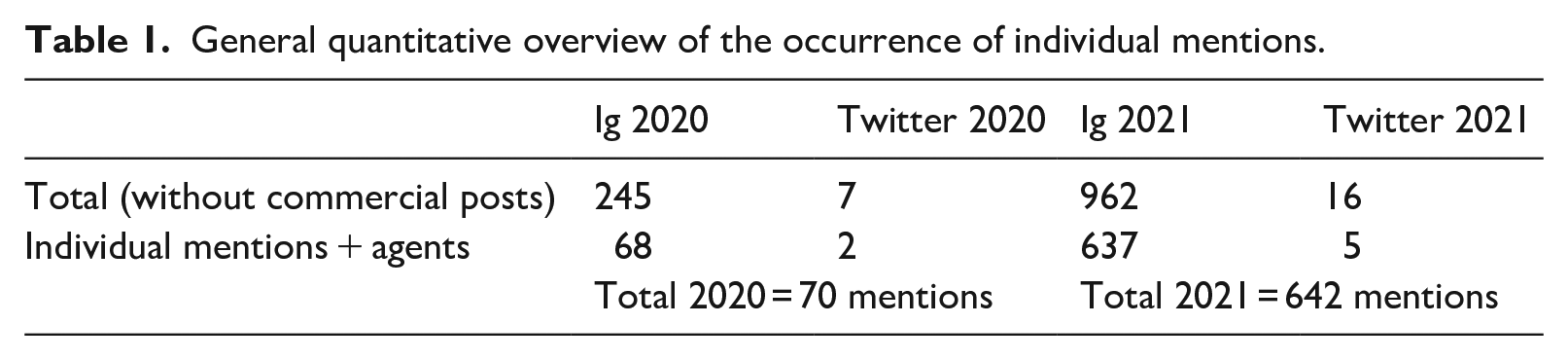
Our final dataset for this paper consists of a total of 1207 Ig posts and 23 Tweets, respectively 245 Ig posts and 7 tweets for 2020 and 962 Ig posts and 16 tweets for 2021. 6 The considerable difference between the number of posts included in the dataset relating to 2020 and 2021 is due to two main reasons. Firstly, the 2020 data were initially collected for a pilot study. Secondly, the online campaign by FR is increasingly successful, which means that the number of posts grew between 2020 and 2021 (see Fashion Revolution, 2020, 2021). The fact that we do not have many Twitter messages may be partially due to Ig being a preferred platform for fashion discourse and/or the restrictions related to our focus on women’s representations.
Criteria for annotation and analysis
We manually annotated the dataset on Excel using three different layers. The annotation of the 2020 data was performed collectively by De Cock et al. Subsequently, Schär et al. went through the 2021 data together and then revised the whole dataset to eliminate minor inconsistencies. The criteria for annotation were discussed repeatedly until at least two of the authors agreed on the annotation of the posts and tweets.
The first layer of annotation offered two options: general, when a given post contained reference to a general entity or group (e.g. ‘garment workers’ in general), and individual mention, when it portrayed the discursive representation of an individual case (e.g. ‘Antonella, sarta milanese, è la factotum della sartoria sociale SunnCoop di Corsico’ (‘Antonella, milanese seamstress, is the factotum of the social tailor’s shop SunnCoop in Corsico’, 26 April 2020, Ig). In sum, we annotated as general all the posts that talked about women in general, for example referring to the women included in the category of garment workers. For individual mention, we selected all the posts that named a specific actor, for example, a brand, an activist, a woman, or an entrepreneur, either by citing their name or by making a clear reference to them. This also included cases of self-representation, in which the author of the post talked about herself or the account of a small brand talked about itself.
Then, for the second layer of annotation, we analyzed the agency of the identified individual mentions. We determined whether each case represented (a) an agent 7 engaging in a positive change in the fashion industry, for example by creating a brand that respects its workers’ rights, (b) a victim of the current system, or (c) a recipient of the actions of other groups.
The third layer of annotation, which relates directly to RQ1, concerned the type of actors using the individual mentions as examples, or, in other words, the type of account owners publishing each post. We identified the following four categories of account owner: activists, small brands, institutions, and others (see section 2.1).
The activists category included both individual activists and activist organizations, who for the purposes of this paper are considered together, while small brands encompassed both small-scale companies and early-stage entrepreneurs, as sometimes an individual is both the founder and the only person working for a brand. Under the label institutions, we inserted media, universities, cultural centers, and similar entities; we also added an others category for the few posts that did not fall within any of the above categories.
In some cases, where it was not possible to determine the type of account owner from simply reading the post, we accessed the link to their social media profile, which is made available by the data providers. For example, in some posts it was not clear whether a particular account owner belonged to an activist organization or to a small brand until we complemented the information contained in the post with a visit to their profile.
Following the annotation of these three layers, we proceeded with the argumentative analysis of the individual mentions. To address RQ2, we investigated whether the individual mentions could be reconstructed as arguments based on the locus from example and what standpoints they supported. Using the AMT, we identified the maxim at work, and observed whether arguments based on the locus from example were inserted within argumentative patterns.
Findings
Table 1 represents the overall number of cases in which individual mentions appear in the datasets (2020 and 2021 data, Instagram and Twitter). The last row includes examples of positive agentivity, that is, individual mentions representing women (garment workers, artisans, entrepreneurs) or small brands doing something positive regarding sustainable fashion. As noted in Greco et al. (2021), the high number of individual mentions related to positive agentivity was striking in the 2020 data (see Introduction) and was confirmed in the 2021 data. For this reason, as mentioned in the Introduction, this paper concentrates on the use of individual mentions to describe agents who play an active role in the ‘fashion revolution’, that is, a transition toward a more sustainable fashion system.
General quantitative overview of the occurrence of individual mentions.
The majority of individual mentions in our dataset are associated with accounts that correspond to small brands or small entrepreneurs, which talk about sustainability as a key feature of their production (see Table 2). In the remaining cases, an important role is played by activist organizations and individual activists.
Individual mentions and types of actors using them. 8
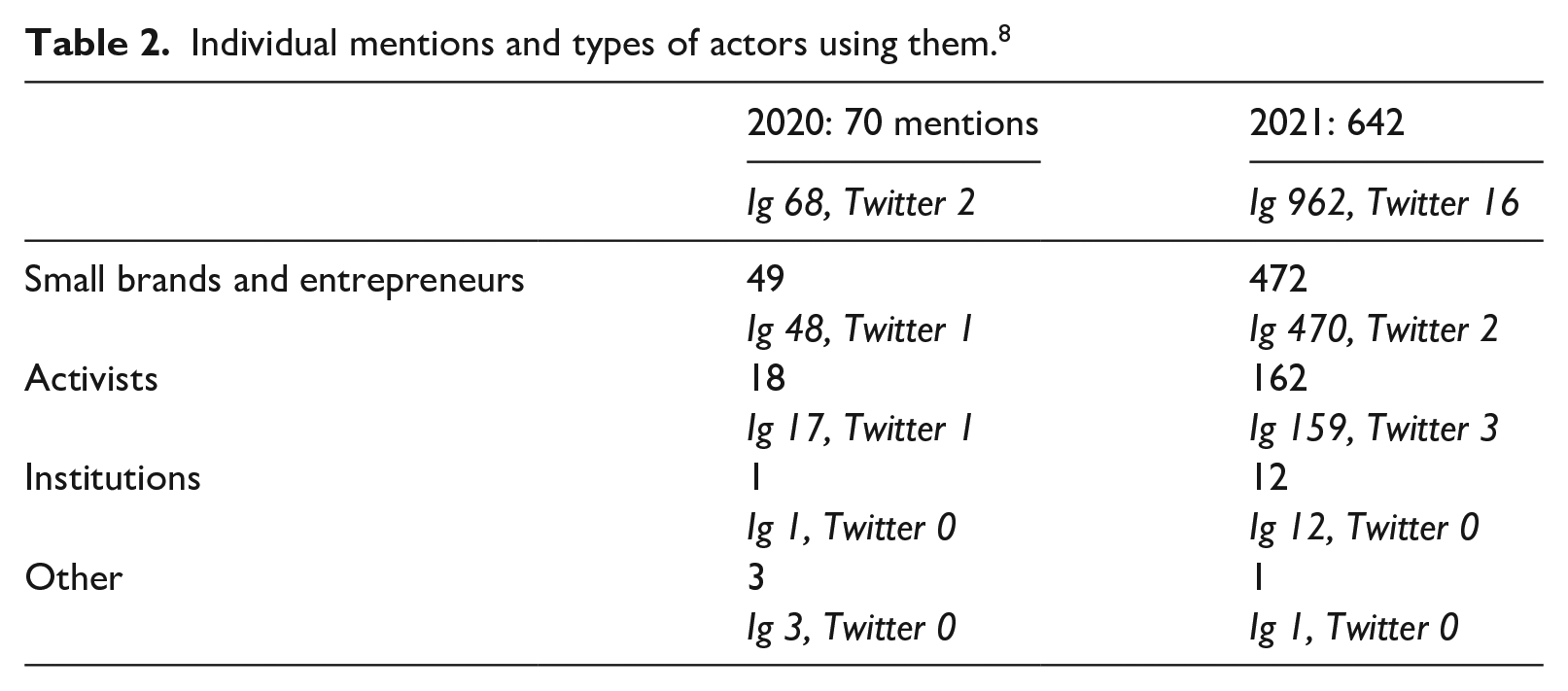
Given the clear prevalence of small brands when it comes to making individual mentions, in order to answer RQ1 in this paper, we will focus on the argumentative functions of individual mentions in the communications of small brands.
Our analysis shows that the individual mentions used by small brands can be classified as arguments from example. To proceed with the analysis, we will first introduce a representative example from the dataset (example 1) and then explain the general findings, referring to further examples when needed. The posts are quoted verbatim and are reproduced as published, including any errors.
(1) I made your clothes Today is the 8 th anniversary of Rana plaza factory building in Dhaka Bangladesh collapsed. This tragedy took life of 1138 people, most of them were young working women in fearful conditions as the building had many cracks ans were on verge of collapse. No management was there to pay heed to their fears and they were forced to work as they had deadlines to meet and most of them were from renowned fashion brands All theseT- shirts which were dipped in the blood and fear were brought by us. This was mainly because the workers didn’t have organised union and there was lack of transparency in supply chain. In this wake the fashion revolution 2as born which is spreading awareness about such issues and giving consumers the tools by which they can asks brands #whomademycloth #whomademyfabric We as a brand supports#fashionrevolution and vouch for transparency in supply chain, fair wadges and good working conditions. Here we are introducing our stars who helps us to make fabrics and who work behind the scene From first Jitu bhai - who prints our fabrics Ketan bhai - who checks the fabric after each process Suresh bhai - he folds the fabric after being checked And Lal bhai - He dyes the fabric #imadeyourfabric #imadeyourclothes #fashionrevolutionweek #fashionrevolution #fairwadges#fairworkingconditions #fashion_rev #ethicalfashionbrand #sustainablefashionbrand #sustainablefashionindia #fashionrevolutionindia #sustainablefashion #consciousfashion #consciousconsumer (Ig, 25 April 2021, our emphasis).
This example is representative of how individual mentions (in this case, the names of the four workers mentioned) are used as arguments from example. In particular, we found two argumentative patterns in small brands’ Ig posts and tweets in which the said arguments from example appear. As we will discuss below, these argumentative patterns are based on two different maxims of the locus from example; they are used to present arguments about different issues, which in our view correspond to two different communicative functions of brands’ digital engagement in Fashion Revolution Week.
A first pattern (A, Table 3) has the function of supporting a commercial standpoint advanced by the brands and addressed to readers as potential consumers, as in the reconstruction of argumentation in Table 3. In line with the pragma-dialectical representation, we use 1 for the standpoint and 1.1, 1.1.1, etc. to indicate the concatenation of supporting arguments; statements in brackets are implicit. Because we are not only reconstructing argumentation within (1) but an argumentative pattern recurring in the dataset, we reconstruct a general (abstract) pattern.
Argumentative pattern A.

The standpoint in pattern A tends to be implicit, and is supported by an argument 1.1 (‘we make sustainability happen’) which is based on a causal relationship, which presupposes that sustainability is a value and a good reason to buy from a given brand. Argument 1.1 is further supported by an argument based on the locus from example (namely, 1.1.1), which employs the maxim of induction, namely: ‘If something is true for x, y, z. . .., then it is generally true for the group to which x, y, z belong’. In other words, the use of individual mentions of specific cases of sustainable practice is a means of indicating that the brand itself uses sustainable practices in general. Depending on the specific posts or tweets, these might be related to environmental and/or social fashion practices. In (1), the mentions of the four individual garment workers play the role of arguments from example, with the aim of showing that the process by which this brand creates garments is sustainable in all of its phases.
Argumentation from example also has a second function in the same posts, which corresponds to a second argumentative pattern (B, Table 4). It shows that it is possible for the fashion system to change and rely on small brands rather than continuing with existing practices.
Argumentative pattern B.

In B, the argument based on the locus from example evokes the maxim from truth to possibility. In our dataset, this maxim is used to argue from best practices. The small brands are discursively representing themselves as virtuous exemplary agents, who show that change is possible. As noted above, the strength of this use of the maxim from truth to possibility of the locus from example lies in the fact that speakers do not claim that change is ‘generally present’ but that it is possible. In terms of strategic communication, this rules out possible objections to the FR campaign on the basis of the alleged fact that more sustainable practices are impossible because the fashion system as it is now does not allow them to happen (see the discussion of H&M argumentation in Greco and De Cock, 2021: 62).
In some posts, brands cite several examples of their virtuous practices (e.g. naming some of the artisans who work with them, citing their first names, as in (1)). In other cases, they simply cite themselves as a virtuous example, as in (2), where the speaker (an independent designer) talks about herself (see the statement beginning with ‘Esta soy yo’):
(2) ‘(. . .) Bajo el hashtag #quienhizomiropa buscan conscientizar sobre la esclavitud y las deplorables condiciones laborales que sufren miles de empleados textiles alrededor del mundo. Por una industria más justa para todos los participantes de la cadena y por un consumo más consciente. Saber y conocer de dónde viene y por qué manos fue hecha cada prenda que vestimos, es un gran paso hacia este cambio. Esta soy yo Our translation: ‘(. . .) Under the hashtag #whomademyclothes they seek to raise awareness about slavery and the deplorable working conditions of thousands of textile workers around the world. For an industry that is fairer for all participants in the production chain and for a more conscious consumption. Knowing where each garment we wear comes from and by whose hands it was made, is a big step towards this change. This is me 

 , la que piensa, diseña, investiga, prueba, falla y vuelve a probar, para poder llegar a una pieza de calidad, buscando siempre personalizar los diseños, para que se sientan identificadas y hagan un uso extensivo y consciente de cada diseño que se llevan (. . .)’. (Ig, 25 April 2021), the one who thinks, designs, researches, tests, fails and tries again, in order to achieve a piece of high quality, seeking always to personalize the design, so that you (plural form) feel identified and make an extensive and conscious use of each design that you take with you (. . .)’.
Unlike pattern A, pattern B can be traced back not only to the discourse of brands, but also to that of activists, when they represent themselves using individual mentions. In such cases, they argue that being sustainable is possible, because some individual activists are already living sustainably or working toward sustainability. (3), taken from the discourse of activists (rather than brands), represents one of these cases.
(3) Meet some of the women leading fashion’s sustainable revolution, including Fashion Revolution’s co-founders @Carrysomers and @orsoladecastro https://www.vogue.co.uk/arts-and-lifestyle/article/the-women-leading-sustainable-revolution . . . #FashionRevolution (Twitter, 20 April 2020).
Discussion
We will now proceed with answering the research questions posed in this paper, before providing further directions for research in the next section.
RQ1: Given the plurality of actors participating in the campaign, which actors most commonly cite ‘exemplary’ individual mentions of persons and brands that are considered agents for change?
Most of the individual mentions we found are used by small brands. The presence of small brands in the campaign is in line with the phenomenon of digital activism, where the goals of different actors are united for a common purpose (Highfield, 2016). Moreover, it has been noted previously that ‘Rather than being seen as a threat to the independent fashion sector’s ethos, technology has been embraced as a tool allowing independent fashion producers to amplify their voices as they challenge existing fashion paradigms’ (Tuite, 2018: 420).
FR actively involves small brands that focus on sustainability: there is a section dedicated to such brands on their website. Moreover, through the currently active ‘Small but perfect’ campaign, FR encourages ‘Business Support Organisations to host events to support fashion start-ups and stakeholders from the circular fashion ecosystem’ (our emphasis). 9 All in all, the presence of small brands in the campaign should not be seen as surprising.
RQ2: Can ‘exemplary’ individual mentions be reconstructed as arguments from example? If yes, what type of standpoints do they support? Are they inserted into argumentative patterns?
Our findings show that individual mentions by small brands play the role of arguments from example. Table 5 summarizes the two argumentative patterns found in our dataset, which exist contemporaneously in brands’ Ig posts and tweets, in a synoptic way. (Table 5)
Synoptic representation of patterns A and B.
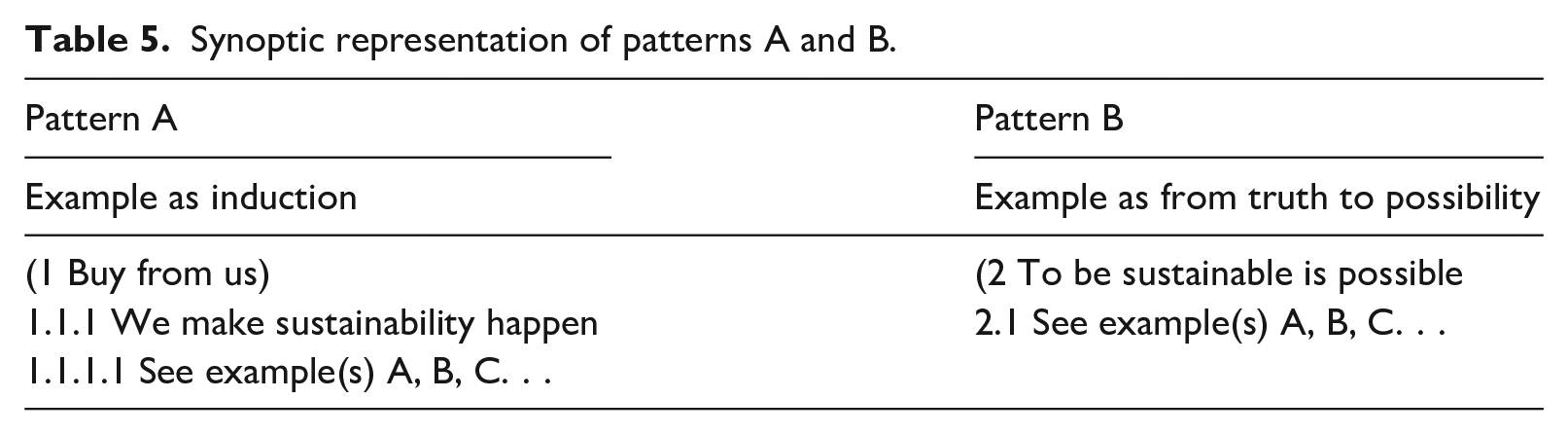
Following Mohammed (2016), we interpret the co-occurrence of these two argumentative patterns in the same posts and tweets as simultaneous argumentation, namely ‘argumentative exchanges where several issues are addressed’ and ‘there is at least one argument, or one argumentative move, that plays a role in both discussions without any of the discussions being subordinate to the other’ (Mohammed, 2016: 234). This is the case in our dataset concerning small brands’ argumentation from example. In fact, small brands address two different issues, the former being ‘should consumers buy from us?’, and the latter ‘is sustainability possible for a fashion brand?’. Arguably, these two issues are interesting to two different categories of audience, namely consumers and sustainable fashion activists or citizens interested in sustainable fashion. These two categories of audience are distinguishable in abstracto, but may end up overlapping in terms of concrete individuals, who may be part of both categories. In fact, sustainable fashion activists may arguably want to shop sustainably when it comes to their own wardrobe; and consumers might wish to be informed about sustainability-related issues.
As Mohammed (2016: 233–234) observes, the presence of simultaneous argumentation is often related to multi-layered activity types, that is, ‘argumentative practices that are conventionally multi-purposive and can also be thought of as multi-purposive activity types’. To our knowledge, while sustainable fashion activists’ discourse has been examined from a perspective of argumentative activity types (Brambilla, 2019), digital (fashion) activism per se has not yet been studied as an activity type; we consider it a good candidate for being defined as a multi-layered activity type, because of the presence of multiple actors with multiple goals, which are often coordinated by activist organizations (Highfield, 2016).
Two aspects of our findings are particularly important to examine in greater depth. The first concerns the presence of simultaneous argumentation in our data. On the face of it, one may object that some brands only employ pattern A, making purely instrumental use of Fashion Revolution Week to advertise their products without really adopting pattern B. However, small brands that participate in the Fashion Revolution campaign know that readers of their posts are not only potential consumers, but also activists and citizens who are concerned about sustainability. Thus, it is important for small brands to participate in the campaign in a way that is not (or does not appear to be) purely instrumental. 10 As shown in both (1) and in (2), small brands actually devote some part of their posts to describing the importance of sustainability.
Notably, a more instrumental use of the Fashion Revolution campaign might be made by brands who only post ‘commercial messages’, that is, advertising their products. In this paper, purely commercial messages were excluded from the dataset (see the Section on Methods). In future research, we could consider whether these types of post exploit the visibility of the campaign for their own profit or whether they form part of the activists’ campaign. Indeed, even commercial posts may enable small sustainable brands to amplify their voice (Tuite, 2018: 411) and differentiate themselves from the big brands in the fast fashion and luxury sectors (see the classification of the largest fashion companies by annual revenue by the Business of Fashion, 2021), who tend not to participate in digital activism campaigns surrounding sustainability.
The second aspect that deserves further discussion concerns pattern B, in which the locus from example adopts the maxim from truth to possibility. This maxim is less extensively studied in the literature than other maxims of argumentation from example; however, in our view, it deserves to be considered in relation to digital activism, because in this activity type people try to change the status quo. In fact, going from reality to possibility is particularly effective when someone wants to show that a new scenario, which is distinct from the existing status quo, is possible. The existence of small brands that abide by sustainable practices is a sign that change is already happening. In such a situation, arguing from best practice can be a strategic move: it does not prove that change is widespread but that it is possible. In this way, it removes a series of possible objections that are sometimes heard in the controversy surrounding sustainable fashion, such as the fact that the system is as it is, or that profit cannot be achieved if you strive for sustainability, etc.
Conclusions
This paper focused on individual mentions of persons (activists, garment workers) and small brands which form part of discursive representations and self-representations posted by several actors, including activist NGOs, individual activists, small brands, and others, on Twitter and Instagram during the Fashion Revolution Week campaigns in 2020 and 2021. The multilingual empirical dataset at the basis of our analysis is part of a larger research project on the sustainability of the fashion industry and was built looking for posts that contained women’s representations. In terms of size, this annotated dataset compares to some of the other datasets that have been annotated so far for argumentation mining on Twitter (Schaefer and Stede, 2021) and includes an argumentative analysis of Instagram, which has been little studied in argumentation.
Our findings show that it is largely small brands participating in Fashion Revolution Week that make use of individual mentions, which are indeed used as arguments based on the locus from example. Arguments from example are included in two simultaneous argumentative patterns, based respectively on a maxim of induction and a maxim from truth to possibility. These findings promote a better understanding of the affordances of digital activism, including how different actors reconcile the goal of contributing to the campaign with their own goals (e.g. selling clothes, if they are a small brand).
Future research on digital activism in the context of sustainable fashion will be able to identify other argumentative patterns, giving a more complete picture of the different simultaneous discussions that are present in the campaign.
Despite the relatively large size of our dataset, a limitation of this study is that digital activism in the field of sustainable fashion is a dynamic phenomenon, with the number of participants in Fashion Revolution Week growing every year. Moreover, the surrounding institutional context is also rapidly changing; for example, in May 2022, the European Parliament issued a new briefing entitled ‘Textiles and the environment’, 11 laying out its strategy for improving environmental sustainability. Immediately after this achievement, FR and other NGOs launched the ‘Good clothes fair pay’ campaign, asking European institutions to take the social dimension of sustainability into account. 12 The situation, thus, is constantly evolving. In this sense, only a longitudinal study of digital activism during Fashion Revolution Week over the years will be able to trace the continuous ongoing change. To this end, we are collecting data for each edition of Fashion Revolution Week at the Institute of Argumentation, Linguistics and Semiotics (IALS) of the Università della Svizzera italiana (USI), with the aim of making longitudinal studies of digital activism possible.
Footnotes
Acknowledgements
The authors gratefully acknowledge the support of COST Action CA17132 ‘European Network for Argumentation and Public Policy Analysis’ ( ). We would like to thank the participants of the conference Argage – Argumentation and Language, held at the University of Neuchâtel in November 2021, for their valuable suggestions on an earlier version of this paper. We are also indebted to the Centre de traitement automatique du langage of the Université catholique de Louvain and especially Hubert Naets for downloading the tweets in 2020 and to Judy Nagle for language editing of this paper.