




Abstract
Using a small corpus of marriage proposal stories authored by British citizens, this paper aims to identify and make explicit seven defining parameters of frames (namely, default elements, default scenario, default context, default inference, default form, default argument, and instantiations) and explain and exemplify each.
Defining frames
As noted by many, including van Dijk (2020), how ‘frame’ is defined and identified can vary enormously. This paper argues in favor of a more rigorous definition of the term ‘frame’ on the basis of seven crucial dimensions that are typically implicated in framing research, and exemplifies these defining criteria for several different kinds of frames. The suggested parameters not only render the proposed definition maximally precise, but also enable other researchers to replicate the method. These include:
i. default elements (comparable to a cast of characters) and relations between the roles;
ii. default script or scenario (carried out by those playing the roles and denoting stereotyped sequences of actions);
iii. default context (seemingly corresponding to Kövecses, 2020 ‘supraindividual level’, which is not attached to a specific experience);
iv. default inference or interpretation (the first or most salient meaning that comes to mind due to conventionality, frequency, familiarity, prototypicality, or stereotypicality (Giora, 2003) – or rather the preferred, unconditional automatic (i.e. initial and direct) interpretation (see Levant et al., 2020));
v. default written or spoken form, based on relative frequency and conformity to a standard pronunciation, spelling, or basic syntagmatic norm (preferred collocations or grammatical constructions and phraseological patterns of word use (see Hanks, 2013; Martin, 2008; Omazic, 2008; Philip, 2008));
vi. default argument (a particular belief or opinion for a variable or construction that is assigned automatically by a person or organization and remains in effect unless canceled or overridden by a hearer); and
vii. instantiations (where a frame is expressed or instantiated by instances attached to a particular context) (Langacker, 2008).
Defaultness, as defined here, relies on socially shared cognition, that is on the various types of knowledge shared by different groups in society. What is considered ‘default’ then varies from culture to culture. There can not only be noticeable differences between races, classes, or generations, but also personal versions of social knowledge (Potter, 1996; van Dijk, 2014). And subtle differences in frame knowledge may lead to overwhelming misunderstandings and disappointments, in private and in public. Speakers cannot control which fragments of the frame are activated in comprehension. That is, recipients can use parts of the frame not used by speakers. It is a philosophical belief based on the underappreciated tension between storage (storing the encoded memories and frames) and retrieval (accessing/using stored memories and frames). An essential distinction is between long-term and short-term (or ‘working’) memory. The latter typically lasts between 15 and 30 seconds and has restricted information capacity. The former refers to any memory that can be recalled after that length of time and the upper limit on how much information it can hold is not known. In other words, immediate or short-term memory is for ‘events experienced once’ (Melton, 1963: 5), and long-term memory or habit for ‘traces established by repetitive learning experiences’ (p. 5). Frames, it is claimed, are accessed from long-term memory (Coulson, 2001), which is split into explicit and implicit memory. Implicit memories are things that are done without thinking or that are experienced with no conscious awareness. They include types of ‘muscle memory’, such as knowing how to wash your face, ride a bike, etc. Explicit memory is further subdivided into episodic (memory for events or episodes from one’s life, such as the time one went to Berlin) and semantic, or rather epistemic, (memory for facts, such as the fact that Berlin is the capital of Germany). The two certainly overlap or are in a state of permanent interaction (Kompus et al., 2009; Menon et al., 2002). It is through the process of generalization, abstraction, or decontextualization of ‘experience models’ that human beings acquire, alter, and confirm frames (on mental models, see Johnson-Laird, 1983; van Dijk, 2014). Frame retrieval can thus also be affected by context and autobiographical experience. Apparently, not all socioculturally shared frames are generic or abstract, however. A case in point is the atomic bombings of Hiroshima and Nagasaki in August 1945, which remain accessible without a reminder cue.
Frame retrieval appears to have several forms. For example, the brain may go from recognition to frame recall. These are different psychological processes. Recognition has to do with generalized or socioculturally shared frames (those that arise without any particular context or special experience being necessary), and recall with their particularized instantiations (those that require such specific contexts). For example, take the KILLING SPREE frame partially instantiated by comedian and television presenter Russell Brand: In a Guardian column, Let teary pain turn to bongo-playing joy, page 20, Sport, July1 2006, he, in a reference to the World Cup match between Holland and Portugal, wrote: ‘Valentin Ivanov, the referee, made the pitch his Hungerford, and with an insecure, itchy trigger finger dispatched like a whimsical Michael Ryan’. There seem to be generalized constituents – such as a MURDERER, WEAPON, VICTIMS, a TIME and PLACE where the shooting spree took place – and particularized instantiations, such as Michael Ryan, two semi-automatic rifles and a handgun, his mother, a dog-walker and 14 other residents of Hungerford, August 1987, etc. Instantiations are quickly forgotten, and only some fragments that the reader has learned from their particular contexts may be remembered. That is, recipients dynamically construe and update the socially shared frame. For Hanks (2013), however, there is a difference between cognitive and social salience. The former involves memorability or ease of recall, while the latter is recognizable as frequency of use. The two are ‘independent (or possibly inverse) variables’ (p. 5). On this view, frames are socially (or statistically) salient, and their floutings or exploitations (deliberate and ostentatious breaches) cognitively salient. Crucially, frames are conventional and for that very reason unmemorable, whereas their exploitations are unusual and therefore quite easy to recall or not easily forgotten. This is in contrast to Giora (2003), who has casually equated cognitive salience with frequent usage. Part of the difficulty with this debate is that Hanks confuses linguistic norm with instantiation, but also conflates memory and attention or subsequent elaboration and adaptation. But there are factors other than frequency that make instances, including idioms and collocations, come easily to mind (Kahneman, 2011): (i) a salient event that attracts your attention, such as the Bill Clinton-Monica Lewinsky affair, will be easy to remember; (ii) a traumatic event, such as the brutal killing of Egyptian student Naira Ashraf in front of the gates of Mansoura University, will be easily retrieved from memory; (iii) humorous materials are better remembered than non-humorous materials (Schmidt, 1994); (iv) the autobiographical record of your own experience is more available than things that happened to others; (v) and pictures, music and lyrics are better recalled than mere words or statistics. The effects of exploitations on memory are a result of physiological arousal (Craik and Blankstein, 1975). Finally, note that Croft and Cruse (2004) equate attention with cognitive salience. Specifically, they distinguish between four different aspects of attention: selection, dominion (or scope of attention), scalar adjustment, and dynamic attention. The first three (focus, scope and scale of attention) are all ‘static construals of a scene’ (p. 53). In any case, cognitive salience as a construal of focus of human beings’ attention or consciousness (Croft and Wood, 2000; Langacker, 1999) differs from meaning salience through frequency, familiarity, and conventionality as in Giora (1997, 2003) and feature salience as in Ortony et al. (1985).
The brain, I hypothesize, consists of highly complex frame networks that are interconnected by cohesive ‘ties’ (Halliday and Hasan, 1976), and which are linked to the behavior of the animal. This requires tracking individual role-bearers in cases where a single human being goes through a whole process or an entire episode of his/her life, such as the history of a completed criminal procedure (for ‘tracking’, see also Martin, 1992; Tseng, 2013). As an example, Fillmore notes that in reciprocal impolite exchanges hearers understand that the impolite person in the INSULT frame is the OFFENDER in the REVENGE frame, and the insult the OFFENSE (Andor, 2010; Fillmore, 1977). In the Naira Ashraf case, the killer in the KILLING frame, or the colleague carrying a concealed knife and stabbing her repeatedly on or near a campus ground, becomes the person arrested in the ARREST frame, then the defendant both in the ARRAIGNMENT hearing and the trial, and in the end the prisoner or person to be executed in a PUNISHMENT frame. ‘Professor’ ties with ‘pupil’, ‘student’, ‘graduate’, ‘postgraduate’, ‘PhD’, and ‘postdoc’. The interpretation of ‘widow’ or ‘divorcee’ depends on ‘wife’, ‘housewife’, ‘bride’, ‘fiancée’, ‘girlfriend’ or ‘bachelorette’ (i.e. on flashback frames such as MARRIAGE, WEDDING, ENGAGEMENT, DATE/MEETING, and SINGLENESS) (Figure 1; see also Dancygier and Sweetser, 2014); the interpretation of ‘grandmother’, on ‘mother’ and ‘pregnant woman’. In short, cohesive relations between frames involve identity of reference. Consider as an example ‘Then there are those flashforwards to courtroom scenes’ (Times, Sunday Times, 2018), ‘Newton and Rachel, now a couple, are visited by Newton’s first wife (Keri Russell) and son [. . .]. Then there are the curious flash-forwards to the late 1940s in which one of Newton and Rachel’s great-grandsons is on trial, a victim of lingering racial prejudice’ (Hoffman, 2016), or ‘Although notoriously faithless and an adulteress, heiress Mary Bowes, widowed and fabulously wealthy, didn’t deserve years of sadistic violence meted out by Andrew Stoney, the charming but disreputable Irish soldier she was duped into marrying’ (Redford, 2010). Here, ‘heiress’ ties with ‘widow’, a woman whose husband has died (i.e. who was once married) and therefore ties with ‘adulteress’. FrameNeT has been limited to single sentences and has done nothing yet on discourse or links within whole texts, as admitted by Fillmore. In Andor’s (2003: 115) words, the Fillmorian approach is ‘too much lexicalist in nature’, and frame semanticists ‘have not yet been able to extend their analysis to the level of discourse and text’.
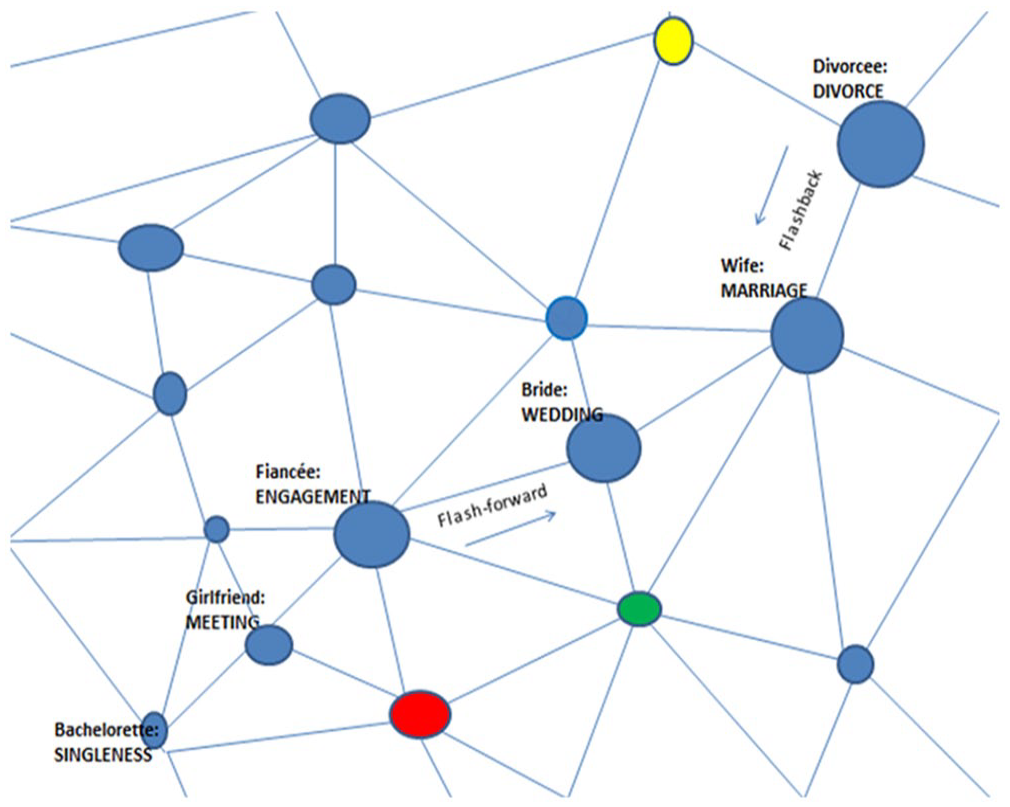
A frame network for ‘divorcee’.
That frames vary culturally is hardly news. For example, Arab Christians have fewer legal options to divorce than Muslims. The Philippines is also a country without divorce. If a Muslim husband says to his wife ‘I hereby divorce you’, he will thereby achieve a divorce, because in Muslim cultures there is such a conventional procedure whereby merely by uttering such a sentence divorce (a conventional effect) can be achieved. Not so if it is pronounced by a Muslim wife to her husband. She can, however, include an equal right to divorce in the contract, and few do, or apply for ‘khula’, a divorce granted by a judge at the wife’s request. In Arabic-speaking countries, marriage is defined as a legally accepted relationship between a man and a woman in which they live together. The partners eligible to enter into a married state thus have to be over 18 years old, of different sexes, and not related by blood. Child marriages and sex with children are illegal. An Islamic marriage, known as a nikah, must be conducted by an imam in front of wedding guests and two sane, responsible adult witnesses. Crucially, it is a contract, signed by both parties and two male witnesses, and must contain an amount of money (mahr), negotiated between families, that is granted to the wife. A woman also needs a ‘wali’ (a male guardian) to oversee her marriage. Nikah marriages are taken as better examples of marriages than ‘urfi’ (unofficial), ‘muta’h’ or ‘sigheh’ (temporary), and ‘misyar’ (allowing opposite-sex couples to live separately but come together for sexual relations) marriages. The latter are controversial or outlawed, although misyar, a no-strings marriage of convenience, has become increasingly popular in Saudi Arabia. They are floutings or exploitations of the MARRIAGE frame. Under Islamic law, a man is permitted to have up to four wives, but only if he treats each wife equally. Most Arab families rarely allow their daughter to become a second wife, however. Tunisia also banned polygamy in 1956. By contrast, in contemporary Western society, a marriage or a relationship is not necessarily heterosexual, and polygamy is not incorporated into law. In Arab countries, arranged marriages are still the norm. Extramarital and premarital sex is forbidden in Islam and dating prohibited; an unmarried pregnant woman is seen as bringing shame and dishonor. Muslim women are prohibited from marrying non-Muslims, though Muslim men can marry Christian and Jewish women. Islamic faith marriages are not valid under British law, because Muslim couples must additionally go through a civil ceremony (e.g., Sherwood, 2020).
As to the fourth criterion, it should be noted that there are many different kinds of inferences, including logical implication, entailment, logical consequence, and conversational implicature. The first three are semantic inferences, ‘derived solely from logical or semantic content’ (Levinson, 1983: 103). In contrast, conversational implicatures are pragmatic inferences, ‘based on both the content of what has been said and some specific assumptions about the co-operative nature of ordinary verbal interaction’ (p. 104; see also Carston, 2002a, 2002b; Levinson, 2000; Sperber and Wilson, 1995). For some, however, there are two good reasons to distinguish between pragmatic inferences (i.e. socio-cognitive processes that can produce implicatures) and implicatures (i.e., products of such socio-cognitive processes) (Haugh, 2015: 66; see also Bach, 2006; Feng, 2013; Horn, 2004, 2012). First, a speaker can ‘block’ or ‘suspend’ an inference, but ‘repair’ or ‘dispute’ an implicature. Second, while you can hold speakers committed to or accountable for implicatures to varying degrees, you can hold neither speakers nor recipients accountable for all the inferences they make when participating in discourse or interaction (except when such inferences are made available to others through saying or implicating) (Haugh, 2015: 66). In any case, ‘[n]either language in general nor semantics in particular is an autonomous system or a separate module that can be characterized in isolation from other aspects of cognition’ (Langacker, 1991: 35). Argument is another type of reasoning, one that is essentially public or social in character and that seeks to persuade (Johnson, 2000). This can be labeled ‘speaker-argument’ to distinguish it from ‘hearer-inference’ and ‘hearer counter-argument’ (Abdel-Raheem, forthcoming).
For Langacker (2008), lexical units have conventional forms and meanings, which ‘are less specific than the
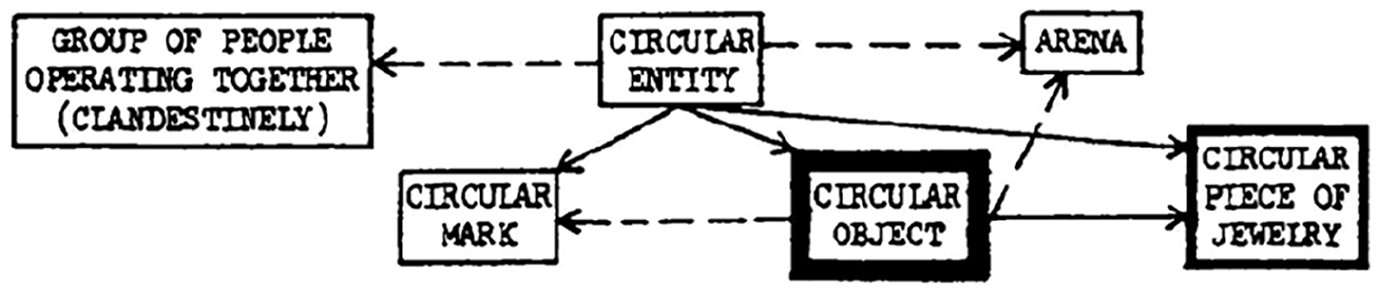
A fragment of the network associated with ring.
According to Fillmore (1977, 1985), frames are coded in (or evoked by) lexical units (which include both individual lexical items and phrasal units) and grammatical constructions (lexico-syntactic patterns that impose their own meanings and participate in certain ways in shaping the senses of the lexical material they contain). The description of lexical units, claims Fillmore, must include not just valence properties (information about their dependents), but also polarity preferences (information about the governing context) and collocates (their default, or preferred, syntagmatic companions). Note that some concepts (e.g. printed menus and tipping) may ‘use’ a frame (in this case, restaurant) of which they are not necessarily a part. But the main point is that frames can be identified and even structured by a lexical entry that serves as a ‘head’. Or, to put it another way, the main thing that evokes a given frame is a lexical head of a phrase or sentence. If this is indeed the case, then the dependents of that head can usually be expected to be potential expressions of the frame elements or conceptual parts of that frame (i.e., of that kind of situation identified as a frame) (see Martin, 2008). In cases where the semantic head of an expression represents a syntactic dependent, a semantically ‘thick’ (or frame-bearing) noun and a ‘light’ or supporting verb or preposition co-occur, as in give advice, take a bath, make a statement, say a prayer, have a fight, and the like, or in danger, under arrest, at risk, etc. The lexical unit (or the phrase it syntactically heads) sometimes represents a predicate or relation on which the phrases representing frame elements are dependent, but in other cases it stands for a frame element (Fillmore, 1977). For instance, explains Fillmore, a role-designing noun such as guard not only activates a frame of someone protecting a place or person but also represents the individual that holds that role. Salience influences the choice of lexical items within a particular frame (Andor, 2010). For instance, milk and cow are highly salient, milk and goat less salient, and milk and horse not salient at all. Similarly, ride and horse have a higher degree of salience (and hence of co-occurrence and collocation) than ride and cow. However, not all the concepts Fillmore and his colleagues think of as ‘core’ have to be expressed in a given context. In fact, the omission of some frame elements (FEs) is allowed by the grammar of language. For instance, the subject in an imperative clause, which stands for the agentive element (mover, actor, buyer, seller, or whatever), is usually omitted. Indeed, several kinds of ‘null’ frame elements can be distinguished: constructional, existential, anaphoric, and generic (Fillmore, 1977, 1982).
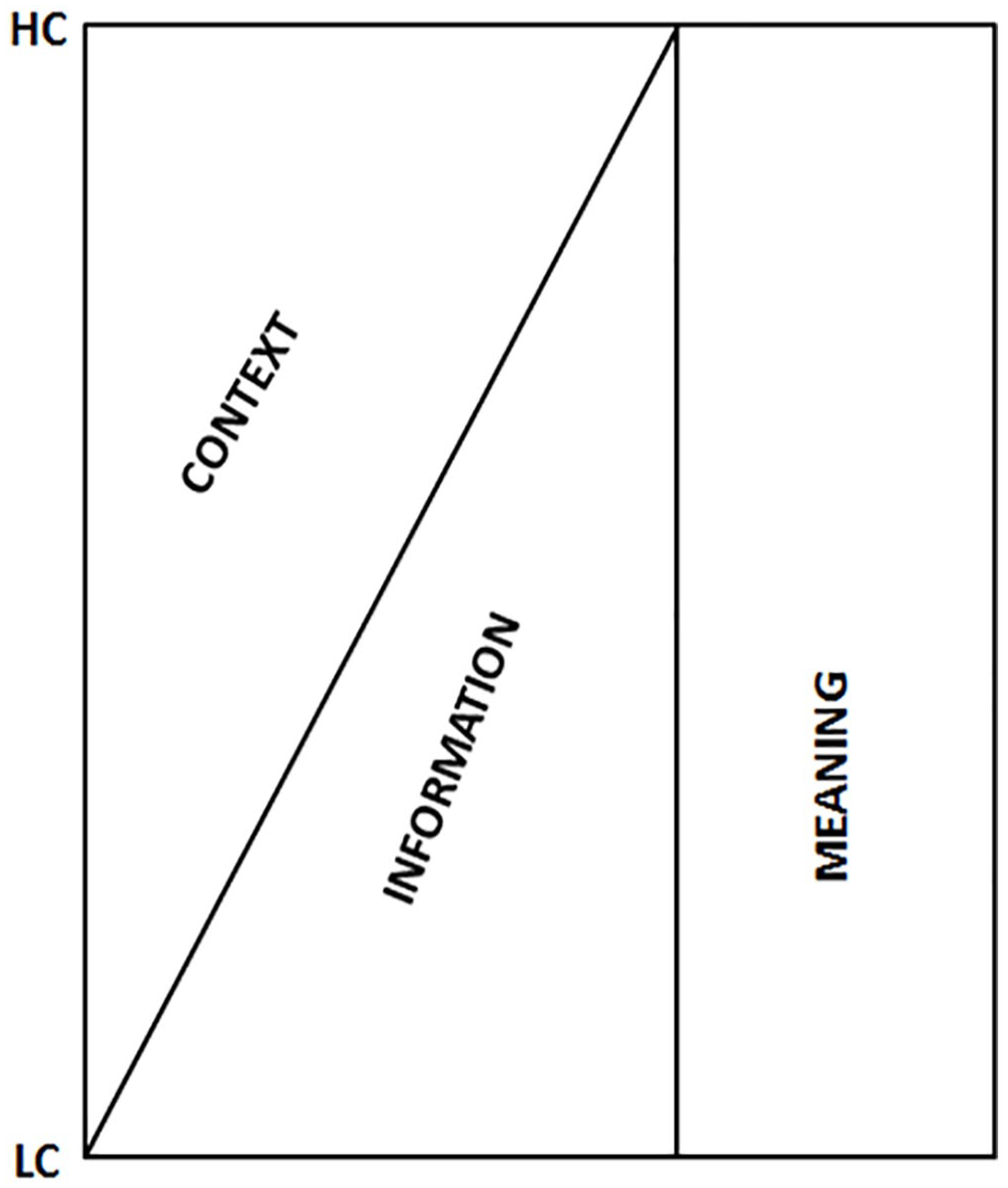
Particularly relevant is Edward T. Hall’s influential concept of high-/low-context communication and its use in cross-cultural research. His concept suggests that preprogrammed culture specific context and information are combined by individuals in order to create meaning, as shown in Figure 3. This note deserves to be quoted in full:
High- and low-context.
High-context cultures make greater distinctions between insiders and outsiders than low-context cultures do. People raised in high-context systems expect more of others than do the participants in low-context systems. When talking about something that they have on their minds, a high-context individual will expect his interlocutors to know what’s bothering him, so that he doesn’t have to be specific. The result is that he will talk around and around the point, in effect putting all the pieces in place except the crucial one. Placing it properly― this keystone― is the role of his interlocutor. To do this for him is an insult and a violation of his individuality. (Hall, 1976: 113)
Hence, there are already some differences between British and American vocabulary – riding or horse riding/horseback riding, glasses/eyeglasses, bin or dustbin/garbage can, pavement/sidewalk, single/one-way trip, toilet or WC (water closet)/bathroom or rest room, chips/French fries, tights/pantyhose, Alsatian/German shepherd. In these examples, the British style at first sight looks blind to the subtleties. ‘Active zone’ is a useful term in this context (see Langacker, 1993, 2009), though by no means limited to language (Littlemore, 2015). That is, American, rather than British, English is rich in rhetorical flourish and tends to spell out the active zones or frame elements explicitly. For instance, the morpheme back specifies which particular part of the horse is privileged to participate most directly and crucially. By contrast, horse riding does not provide information about the active zone of the landmark; nor does riding spell out the frame element HORSE explicitly. But for many, including Langacker, these subtleties add nothing to the content conveyed by the expression, so this American phrase is cumbersome or needlessly redundant. In terms of Grice (1975) maxims, the American words in question are simple and obvious tautologies and therefore seem to violate at least the maxim of Quantity. A violation of this sort is frequently used for comic effect. Michael McIntyre, Britain’s highest-earning standup comedian, explained in a November 2015 interview on ITV’s The Jonathan Ross Show how Americans felt the need to simplify English words to the extreme. The episode got more than 4.8 M views or laughs and 6222 comments on YouTube from around the world. ‘In Australia we are more descriptive. It isn’t a sidewalk or a pavement ― it is a footpath’, one YouTube commentator said. However, indeterminacy is dependent on context, not language. In Langacker (1993, 2009), determinacy refers to ‘a definite and precise specification of the elements connected to one another and how they are connected’ (2009: 40). The usual situation, he claims, is one of indeterminacy rather than determinacy. To put it simply, ‘[i]t is more common for there to be some vagueness [. . .] in regard to either the elements participating in grammatical relationships or the specific nature of their connection’(Langacker, 2009: 41). Other things being equal, certain principles of cognitive salience generally hold unless overridden by other factors: human >non-human; subjective > objective; whole > part; concrete > abstract; visible >non-visible; functional > nonfunctional; interactional >non-interactional; etc. The term for a part may be used for the whole for expressive purposes, but also if it has special cognitive salience with regard to a specific contextually crucial function (Langacker, 1993). Due to their pragmatic implications, obvious tautologies can indeed have communicative significance or convey a great deal (Levinson, 1983). Still, indeterminacy is natural, expected, and ubiquitous, not pathological (see also Nikiforidou, 2007; Paradis, 2004). Were it not for indeterminacy, Langacker argues, language users would have to avoid a perfectly formed sentence such as ‘The dog bit the cat’ in favor of an awkward alternative such as ‘The dog’s teeth, jaws, jaw muscles, and volition bit that portion of the cat’s tail extending from 6 to 12 cm from the tip’. To be scientific, this proposition has to be empirically testable and refutable.
The case of public marriage proposals
This subsection examined a 13,445-word corpus of 30 marriage proposal stories authored by British citizens and published in the Guardian between 22 September 2003 and 29 February 2022. The aim was to identify how people told journalists their stories about getting down on one knee, which is part of the MARRIAGE frame. The identification of this episode was assisted by electronic techniques such as the creation of wordlists and keyword lists. Familiarity with the corpus data allowed a classification of linguistic practices or choices regarding the use of marriage proposal words. The following corpus linguistic techniques were used for empirical investigation:
Analysis of how often a particular search term occurred (frequency) across stories (range) in my corpus.
Use of wildcards to stand for zero or more characters (e.g. a search for knee will retrieve knee, knees, kneeing, knee-ish, etc.);
Use of concordance lines for qualitative analysis. By presenting every instance of a search term together with its surrounding text, I was able to examine meaning and usage, but also to manually exclude certain forms or uses from the quantification of results, where necessary.
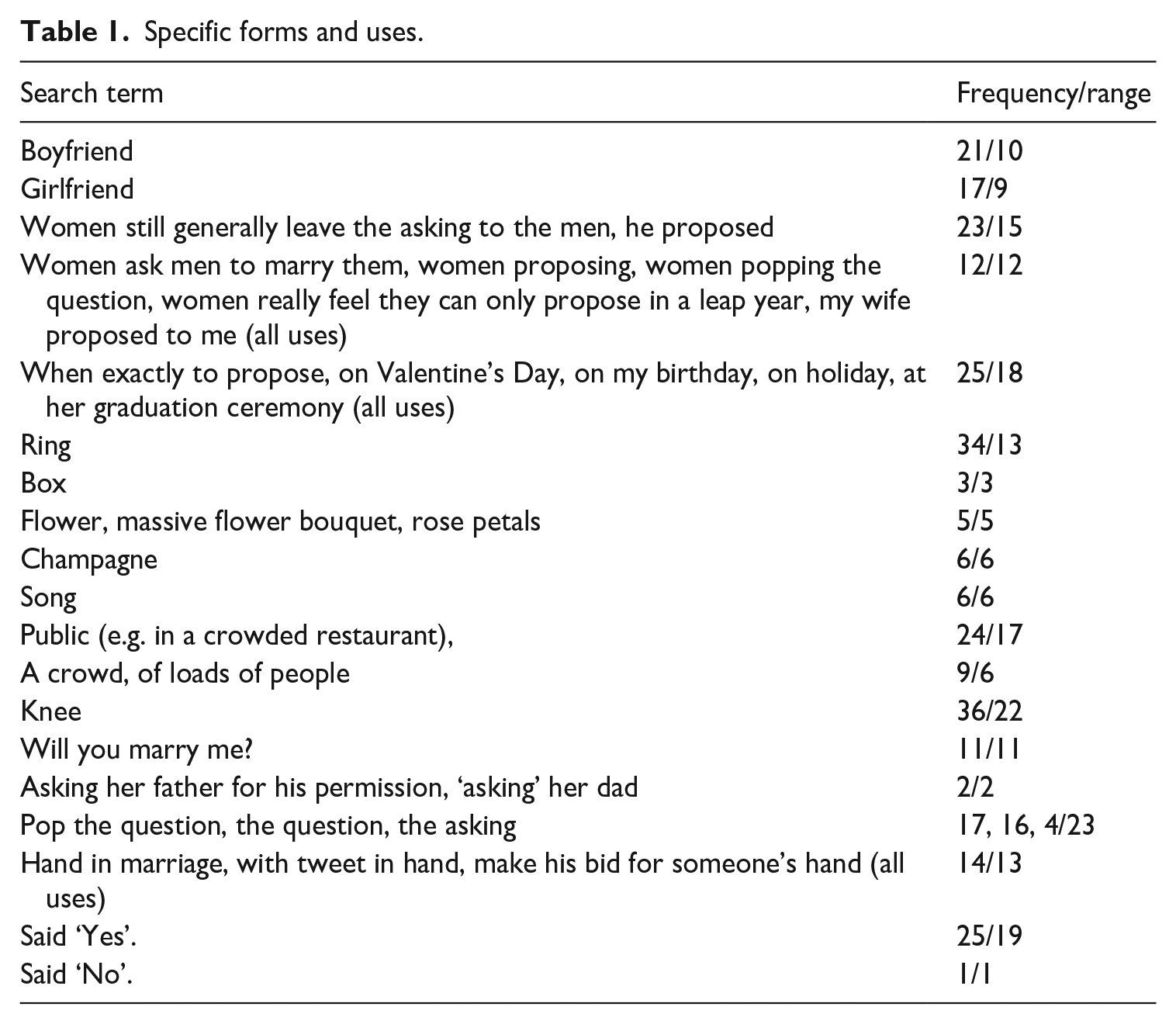
As Table 1 illustrates, in English-speaking cultures a marriage proposal episode has default elements such as a boyfriend, a girlfriend, a ring, a public setting (e.g. in the plane, in the middle of the street, at our favorite restaurant, or at her graduation ceremony), and a temporal setting (e.g. on Valentine’s Day, over dinner, etc.), and there is a default scenario in which a man gets down on one knee and proposes or pops the question “Will you marry me?” The crowd may then explode, and there may be cheering and people start chanting and signing an English engagement song. The question has a default context and inference, namely a marriage offer. A range of answers can be expected after a proposal: “Yes”, “No”, “Not yet”, “Can I get back to you on that one?”, or “Erm. . .I’m really not sure about this”. The phrase “pop the question” appeared 16 times across nine stories, and “the asking” two times across two stories. The definite article signals socially shared knowledge. Concordance lines showed that the use of “down on one knee” is very common (Figure 4). The number of women popping the question is increasing, but this is seen as a form of frame-element exploitation: “I think I now know why women still generally leave the asking to the men. Planning a meaningful and romantic proposal is incredibly traumatic and nerve-wracking. Never again shall I scoff when I hear of yet another marriage offer at the top of the Eiffel Tower”, wrote Kelly Bowerbank, a Fashion Editor and a freelance contributor to the Guardian. “The notion of the marriage proposal as an overwhelmingly male responsibility is so culturally pervasive that even to look at an image of a woman down on one knee holding a ring box seems incongruous”, said Guardian columnist Rhiannon Lucy Cosslett. In contrast, the expression “proposes to his boyfriend” occurred only one time in a story – that is, it had a very low frequency and range. In fact, same-sex marriages are frame-element floutings (Figure 5). The default form “someone’s hand in marriage” occurred only two times in two stories: “The funniest bit was asking her father for his permission” and “I also found a way to go along with the tradition of “asking” her dad, without quite actually doing it. At a time we were alone, I said to him “I am going to propose to ****** on holiday, and it would mean a lot to me if I had your blessing”” (double quotation marks in the original).
Specific forms and uses.
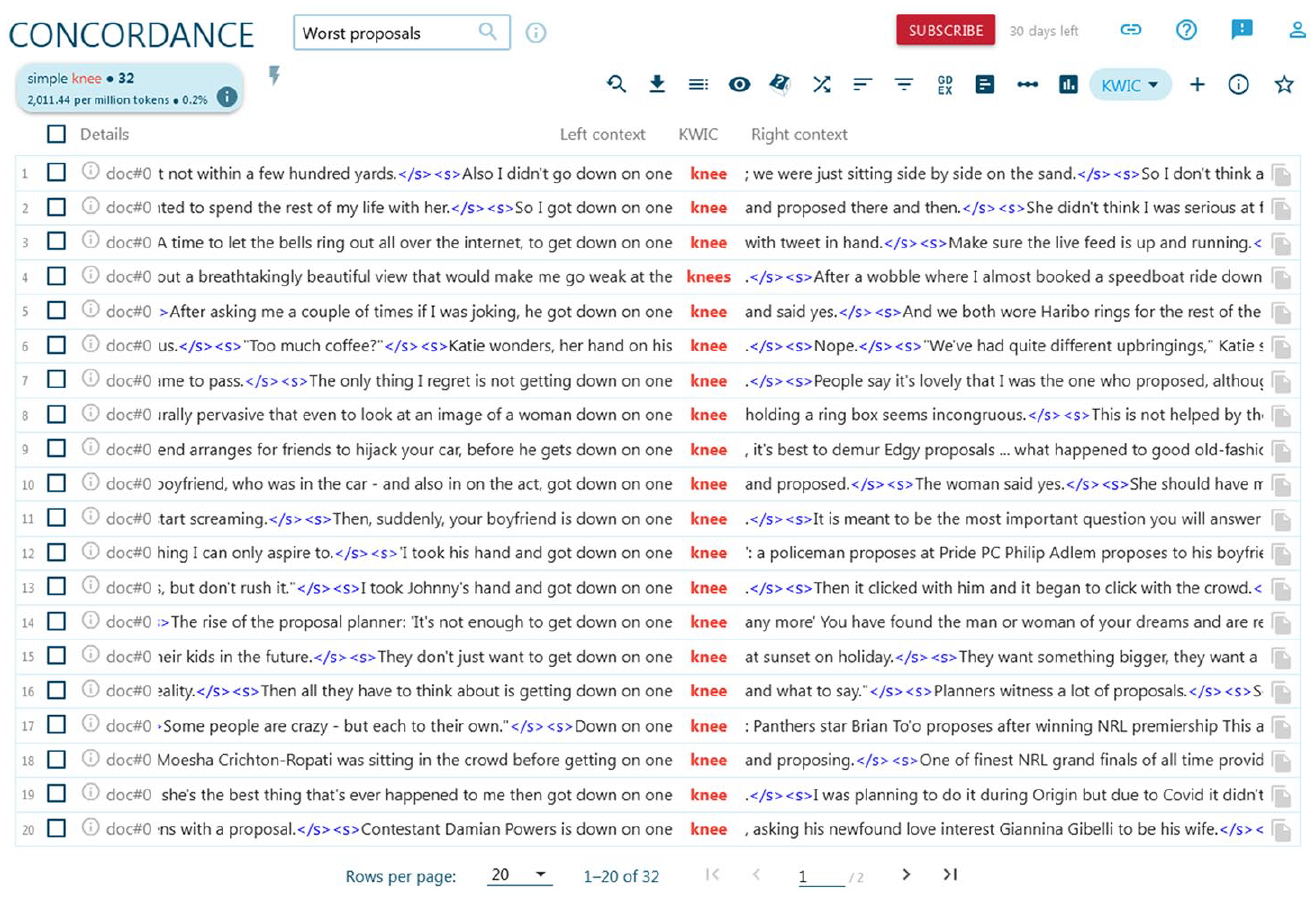
Twenty randomly selected concordance lines for “knee”.
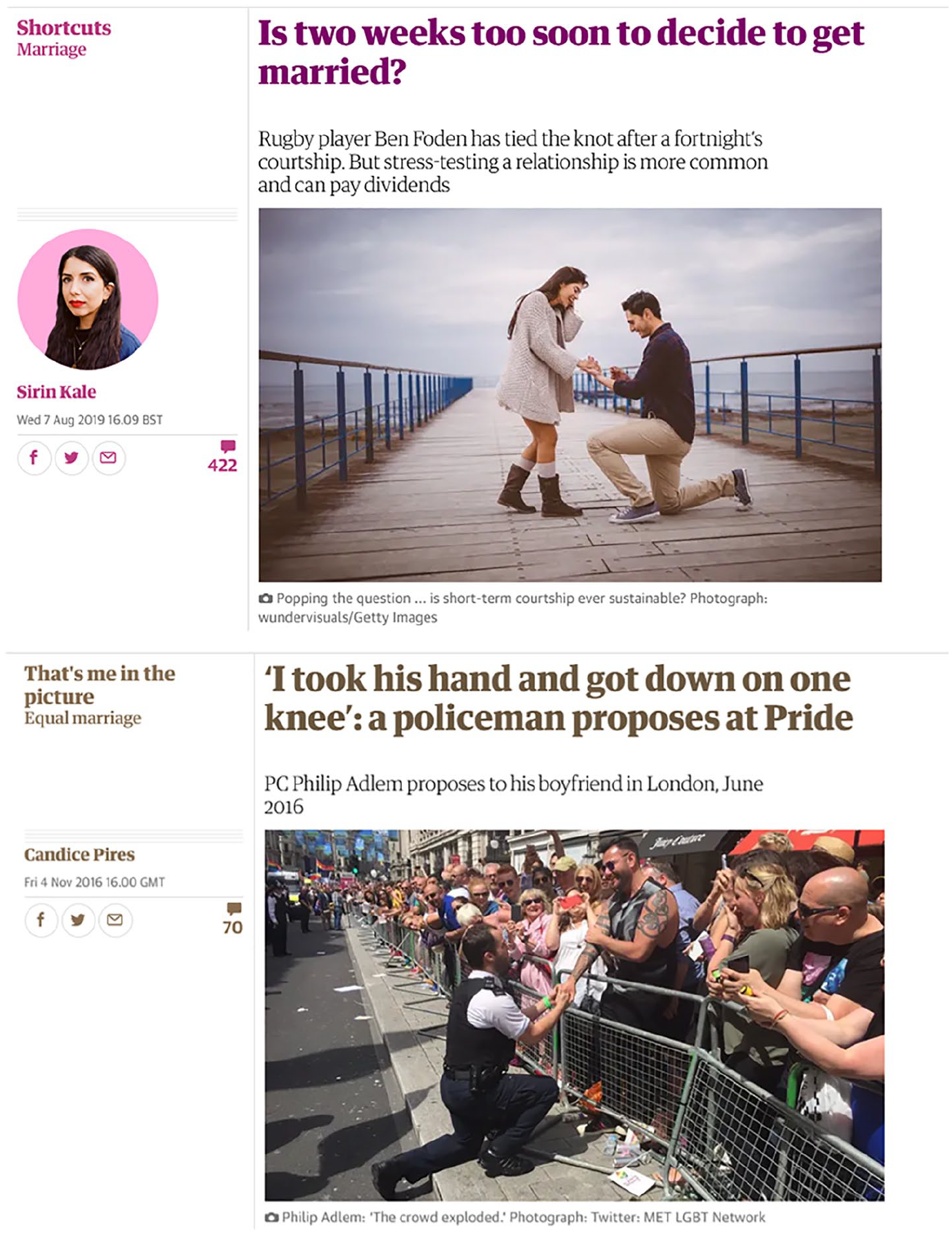
Marriage proposal as part of the British MARRIAGE frame.
The expression somebody’s hand (in marriage) can be analyzed with respect to the seven above criteria as follows:
i. default elements: a suitor or his family and a girl or her parents.
ii. default scenario: In Muslim cultures, when a suitor asks a father for his daughter’s hand in marriage, the father will consult her and other family members and act accordingly. She can make up her mind which of her many suitors she should marry. If she accepts, she will answer shyly, ‘Ilit shoofoo ya, Baba’, or ‘Whatever you see, Dad’,
iii. default context: a marriage offer.
iv. default inference: a pledge especially of marriage, or permission to marry somebody, especially a woman.
v. default form: to ask X for their Y’s hand in marriage.
vi. default argument: having someone you love say to you that they are into you enough to be around you forever.
vii. instantiations: ‘Last October, Dr. Lantos asked Ms. Ashfaq’s parents for their daughter’s hand in marriage’; ‘Bill Clinton is not giving away his daughter Chelsea’s hand in marriage for another three weeks’ (The New York Times).
Conclusion
In this paper, I have provided a brief and necessarily selective discussion of the notion of frame, suggesting seven parameters that I consider to be the characteristics that every definition of frames should include. For this purpose, I used a sample corpus of 13,445 words of texts authored by British people. Space has precluded a more exhaustive discussion of how notions such as schemas, domains, and mental spaces relate to frames, but I hope that this work will stimulate a larger amount of cross-disciplinary work (see also Abdel-Raheem, forthcoming).
Footnotes
Declaration of conflicting interests
The authors declared no potential conflicts of interest with respect to the research, authorship, and/or publication of this article.
Funding
This research received no specific grant from any funding agency in the public, commercial, or not-for-profit sectors.