




Abstract
In an ordinary interaction, communicants have various, mostly unconscious goals which reflect their interactional, social and personal needs. In these interactions, people’s minds try to find a balance between reaching these goals and consuming cognitive energy. If a speaker puts too little effort into speech production, she risks not achieving her communicative goals. This is especially typical when the atmosphere is relaxed, a good example of which is family discourse. An analysis of recorded conversations shows that there are certain regular manifestations of risk-taking in family discourse, such as expressing immature thoughts, raising a large variety of topics and overguessing. A substantial amount of risk-taking in family discourse is in one way or another connected with false confidence in the interlocutors’ common ground. Family members know each other well, which results in an overestimation of the similarity of their understanding of words and objects. This attitude leads them to use cryptic, hard-to-comprehend speech. Quick, everyday interactions are mostly automated, and the speakers do not recognise that their speech is full of implicitness and underdeterminacy.
Keywords
Introduction
According to a general definition, risk-taking is ‘a task or action that involves a challenge a person takes in order to obtain some sort of benefit, when there is an element of uncertainty involved in the outcome’ (AUEssays, 2018). The definition fits well with games such as gambling and poker, where risk-taking is a basic term for describing various game tactics. In business, it is often said that if you are not ready to take a big risk, you are not able to achieve a big gain. In sports, a team may take a risk by putting more effort into offence than defence. In gambling, business and sports, risk-taking may be an explicit element of planning a future strategy and can be verbalised in discussions with other people involved. In concrete moves during an ongoing process, risk-taking may be a conscious decision of a person. On the other hand, an experienced gambler, football player or businessperson also may take risks unconsciously as a learned mode of decision-making.
In the contexts mentioned above, risk-taking may be a purposeful manner of behaviour, while in traffic, in most cases, it is an unconscious way of driving. When a young driver takes risks and drives too fast, he or she (mostly he) probably does not consciously control his actions, but creates risky situations by following his feelings. Nevertheless, one can say that such a behaviour is appropriate from the point of view of his aims. By driving fast, he gains some positive effects: the experience of speed is fun, and he may get admiration from fellow passengers. When speaking of risk-taking in interaction in this article, we are dealing with this idea of risk-taking in traffic rather than the risk-taking a gambler would make. Risk-taking is rarely a conscious move in interaction. It is more often a more or less automated and unintentional way of speaking or listening. Nevertheless, it can have negative consequences for interlocutors – just as is the case in traffic.
Research has shown differences in people’s inclination to take risks (Nicholson et al., 2005). There is a fairly rich literature on age and gender factors in the risk-taking of car drivers (e.g. Turner and McClure, 2003). The same people who take risks in traffic behave in a similar way in other settings (Kibrom and Mannering, 2016). There are certainly also differences in the way people take risks in interaction, but studies are still lacking on this matter.
When examining risk-taking in interaction, we concentrate on dyadic conversations. Settings where a larger number of participants are involved, for example, mealtime at a table at home (Bova, 2019), have their own rules and peculiarities which are quite different from those in a dyadic conversation (Cooney et al., 2020). Certainly, it would also be interesting to study risk-taking in the interactions of various types of larger groups. However, in order to avoid expanding our topic too much, we will examine only dyadic interactions.
We will examine risk-taking in interaction in the following order. First, we will discuss the issue at a general level by referring to the literature where the topic has, explicitly or implicitly, been touched on. Then, we will concentrate on a special manner of interactional risk-taking, namely that motivated by avoidance of cognitive effort. After that we will show, using authentic examples, how this type of risk-taking is manifested in family discourse. Finally, in the concluding remarks, we will make, among others, some preliminary observations on risk-taking in various speech genres and discuss whether our findings are universal or if they only reflect Russian communicative culture and language, which is the sphere of our illustrative materials.
Risk-taking in interaction: A review
All human activities include some risks, including interactions between people. Nevertheless, this issue has not gained much attention in research. In this section, we will first demonstrate some subfields of interactional research where risk-taking has been explicitly mentioned as a factor influencing the choices of interlocutors. Then, we will touch on other views on interaction where similar risks are clearly present but are not understood in that way.
Risk-taking is sometimes mentioned as a characteristic of participation in a discussion. We can say that joining a social media debate creates a risk for the people involved (Goh et al., 2011; Livingstone and Helsper, 2007). A collection of articles (Sirotinina and Kormilitsyna, 2016) includes several studies on the causes, consequences and avoidance of risk-taking in media texts. Those situations reflect risk-taking at a macro level and in written discourse. As to a face-to-face interaction, there are very rare observations on risk-taking, Brown being an exception. In launching his notion of adequate understanding, he describes how the speaker 1 tries to find an expression which the listener is familiar with. It should be ‘sufficiently comprehensible’, as he puts it. In turn, the listener constantly checks and elaborates on what has been said in an attempt to minimise the risk of misunderstanding (Brown, 1995: 30). Brown is right in arguing that both the speaker and the listener must assess which kind of risk is needed in order to ensure ‘adequate understanding’ – if we use Brown’s terminology. Brown also speaks of the avoidance of risk-taking as a communication strategy. Because interaction mostly happens without careful planning, the word ‘strategy’ can be used in this context only in a figurative meaning.
Risk-taking has gained rather wide attention in one field of face-to-face interaction research, namely L2 (second language) research. Indeed, difficulty in finding a suitable expression when speaking may make an L2 speaker resort to risky means from the perspective of understanding (see e.g. Dörnyei and Thurrell, 1991; Lewandowska, 2019). In some cases, the phenomenon as such is similar in both L1 and L2 speech, but the reason for taking the risk is different. For example, the (over)use of placeholders and empty words, a risk for understanding, occurs in L2 talk because of a lack of language command, while in L1 talk it is often just a result of the avoidance of cognitive effort or the lack of a need to be exact. In general, when trying to take advantage of the results of L2 communication research in research on risk-taking in ‘normal’ L1 conversation, we have to bear in mind that much of L2 communicative strategy research has been carried out in classroom settings. When we move on to ordinary communication situations, interlocutors’ behaviour is very different. In many settings of this kind, especially in ELF circumstances, we see, instead of risk-taking, an active risk avoidance, which occurs for example in avoiding difficult and dangerous topics (Corder, 1981; Elyildirim, 2017; Mustajoki, 2017).
As a whole, a conversation is quite a risky undertaking consisting of minefields of various kinds, as described in the literature (see e.g. Bazzanella, 2019; Honghui and Dongchun, 2019 and the literature there). Although risk-taking is only seldom explicitly mentioned as a motivation for certain behaviour in interaction, it is present in all kind of encounters between people. Interlocutors always have various goals and, when prioritising one of them, others are put at risk. Let us look at this claim more closely.
Goals communicants have in interaction can be divided into interactional, personal and social. In a normal face-to-face interaction the goals are in most cases instinctual and unconscious. Therefore, the interlocutors, as a rule, are not able to answer the question: ‘What was your goal when you said this?’ Conscious or not, the goals of interaction serve as landmarks for the brains of the interlocutors in the course of a conversation.
We take first
A need for politeness may result in a recipient being unwilling to interrupt a speaker with clarification requests, which often becomes a ‘let-it-pass strategy’ (Firth, 2009). In other words, the recipient notices that he didn’t understand what the speaker said, but does not reveal this. He may think that he will understand the passage later on the basis of further conversation or that the message the speaker tried to express was not important (cf. Hinnenkamp, 2001; Linell, 1995). The let-it-pass strategy serves interactional goals by keeping the course of interaction fluent, but on the other hand, it is a risk for achieving sufficient understanding.
Personal needs and goals
The way we communicate is also influenced by personal needs which are not directly connected with the content of interaction itself. In their behaviour, people usually seek admiration and respect from those around them. Language is a good tool for demonstrating one’s knowledge, intelligence and wit. The knowledge you show when speaking of complicated and interesting things and the manner in which you speak tell about you as a person and an individual. We sacrifice interactive goals for personal goals when we use metaphors, figurative expressions, aesthetically elegant expressions or new fashionable words, aiming for admiration in the eyes of other communicants, even at the expense of clarity and comprehensibility of speech (cf. Kulikova, 2019; Miljohina, 2019; Montminy, 2010). Consequently, communicants, by trying to reach one goal, put the achievement of other goals at risk.
The needs and goals of interlocutors have been widely analysed in literature. What has been almost unheeded is the effect of avoidance of cognitive effort on reaching these goals. The phenomenon itself has been described in psycholinguistic research, but there is very little consideration of the way it influences concrete communication situations. This is what we are trying to do. In the context of risk theory, achieving the goals and aims of interaction can be seen as profits or gains (benefits), while cognitive efforts are the costs. In other words, if we try to save cognitive energy too much, we risk being able to achieve the gains.
Avoidance of cognitive efforts
People strive to minimise effort in activity (Clark and Wilkes-Gibbs, 1986; Westbrook and Braver, 2015), a phenomenon often called the ‘least effort principle’ (Olson, 1970; Prokopenko et al., 2010). This is rather clear when we speak of physical activities. If it is not necessary to hurry, we walk instead of running. When moving from one place to another, in a normal case, we take the route which is the most direct and/or easiest. The same mechanism concerns the work of our brain, although the consequences are less obvious. The need to avoid unnecessary cognitive effort becomes obvious if we consider the energy consumption of the human brain. Although the brain constitutes only 2% of body weight, it consumes about 20% of the body’s oxygen and glucose (see e.g. Purdon et al., 2002: 1641).
In order to understand the significance of this issue to the way people interact, we have to take a look at the results of recent brain research. According to an increasing number of studies, the human brain operates in a dual mode. System 1 is responsible for implicit, automatic and unconscious processes, while System 2 is in charge of explicit, controlled and conscious processes (see the good overviews in Bargh and Chartrand, 1999; Järvilehto, 2015). System 1 uses intuition, while System 2 is based on intentional reflection. These systems work in close contact with each other and mostly as a joint device, but to understand the process of interaction, it is reasonable to see them as separate devices.
Gilbert et al. (1988) argue that the usage of System 2 takes approximately three times more cognitive energy than actions based on System 1. Therefore, in order to minimise the consumption of cognitive energy, the human brain tries to automate interaction whenever possible. As a result of this, people are, as a rule, unaware of the way they speak and comprehend. They often think that everything is going well, although this is not quite true. ‘Speakers [—] tend to overestimate how effectively they communicate, believing that their message is understood more often than it really is. [—] Most people, most of the time, think that what they say is pretty clear’, as Keysar (2008: 277) puts it. In this respect, risk-taking does not differ from other features of interaction. Let us take as an example a central notion in conversation analysis, turn-taking. Research has managed to find several rules and regularities in turn-taking, although interlocutors themselves are not able to identify these movements during a dialogue.
For the speaker, the easiest way to save energy is to avoid individualisation of speech without thinking of the communication situation or audience at hand (Kecskes, 2017). On the other hand, recipient design (Blokpoel et al., 2012; Mustajoki, 2012; Newman-Norlund et al., 2009), or in other terms, audience design (Bell, 1984; Horton and Gerrig, 2002; Sacks and Schegloff, 1979), accommodation (Dragojevic and Giles, 2014; Palomares et al., 2016) or just tailoring (Pierce-Grove, 2016), is the main tool in achieving communicative goals and preventing problems in understanding (Bremer and Simonot, 1996), with the monitoring recipient’s reactions being an important prerequisite (Clark and Krych, 2004). The speaker must find a reasonable balance between energy consumption and the risks to non-comprehension of her speech by the recipient (cf. Do et al., 2020; Sperber and Wilson, 1986).
For the recipient, the main way of avoiding risks is to listen actively and with full concentration. His role is not easy because the speaker’s message is often not very clear. ‘Communicators are neither always competent, nor always honest’ (Mazzarella and Pouscoulous, 2020: 2, emphasis in the original). A permanent risk in listening derives from the mind wandering. Killingsworth and Gilbert (2010) argue that the mind wanders on average 46.9% of the time people are awake. One can argue that the recipient has even more space for mind wandering. Therefore, the biggest risk for proper participation in a conservation for the recipient is non-listening (Galantucci and Roberts, 2014; Roberts et al., 2016). This does not always directly save energy, but it means that the available time can be used for other purposes. People have plenty of things to think about: what to eat tonight, where to go on holiday, whether John’s fever is serious. Another option for non-concentration on the content of speech is when the recipient starts to think about the characteristics of the speaker (clothing, hairstyle etc.) instead of listening to what she is saying.
Home as a special place of interaction
Berger and Bradac (1982) argue that a state of uncertainty results in avoiding risk by putting more effort into interaction. By looking at this issue the other way around, we come to the conclusion that risk-taking is more likely in a safe and relaxed atmosphere. For many people, home provides a safe haven where people feel they can be (almost) themselves. For this reason we have taken our illustrative examples from family discourse (FD), which takes place in a favourable environment for risk-taking (Mustajoki, 2017; Mustajoki and Bajkulova, 2020). The material originates from a database of colloquial speech collected at Saratov State University in Russia (Baikulova, 2014, 2016).
The family environment is a special context for interaction if we use Van Dijk’s (2008) terminology (pp. 21–36), and family discourse can be seen as a certain communicative activity type (Linell, 2010: 42–43). Interaction at home is a common context in people’s lives. According to the findings of the ‘A speaker’s day’ project, conversations at home comprise 22% of peoples’ communication situations each day, which is approximately the same amount as conversations at work (Sherstinova, 2015). Naturally, the composition of families and the way interaction takes place in them vary widely, as shown for example within Family Communication Pattern Theory (Hesse et al., 2017; Koerner and Fitzpatrick, 2006). Despite these differences, the family sphere has some regular features which may occasionally emerge in other communicative settings but are nowhere as fundamental as in FD (see in more detail Mustajoki and Bajkulova, 2020).
First, home is the place where people learn and develop their first language, which in fact is their genuine mother tongue (cf. Bakhtin, 1986). There are rules and norms in FD, but as a whole it comprises the most natural variety of language (Baikulova, 2014: 106–118; Cameron, 2001: 21). Second, home is by definition a place where people spend their leisure time after work or school. Most people certainly have learnt to act and interact fluently in various circumstances, but nevertheless, when they return home, they feel that they can behave and express themselves more freely than outside the home. In such settings, people tend to speak and interact as naturally as possible without paying attention to the way they do this.
Third, a relevant distinctive feature of FD is the composition of the communicants. Home is an exceptional communication environment including systematic and long-established intergenerational relationships and relationships involving both men and women. One can see similar elements in other communicative settings as well, for example, in friendship relations and at workplaces, but in no other place is the relationship as intensive and long-standing as at home. The joint history creates a broad common ground and close ties between family members. This makes a solid platform for easy interaction without any special reference to differences in mental worlds. It creates a certain confidence in oneself and other interlocutors in comparison to other contexts where a person has to be more conscious and careful. Confidence opens more space for openness and non-concentration. A consequence of this is frequent and versatile risk-taking.
The further characteristic which increases problems in interaction in the home comes from the flexibility of the communication space: the conditions constantly change. There are some stable moments in interaction, for example, meal time at the table or joint TV watching, but face-to-face settings with full concentration on each other are rare, and people often speak when they are doing something else and may not even be able to see the recipient, who is located in another room.
Forms of risk-taking
In order to identify various forms of risk-taking, we use the Multidimensional Model of Interaction (MMI; see Figure 1). It includes crucial-for-success interaction factors (monitoring and recipient design, the mental worlds of interlocutors, and circumstances), and its inner circle demonstrates different phases of the smallest unit of interaction, the quantum, where a speaker says something to a recipient. In authentic interaction, different phases of the process of producing and comprehending speech are more complex and less linear. Additionally, interaction consists of elements of cooperation and joint activities. Therefore, as in any other model, the MMI is only an approximation of reality. In any case, it can be used for highlighting the role of various factors influencing the course of interaction. A more detailed description of the MMI can be found in Mustajoki (2021).
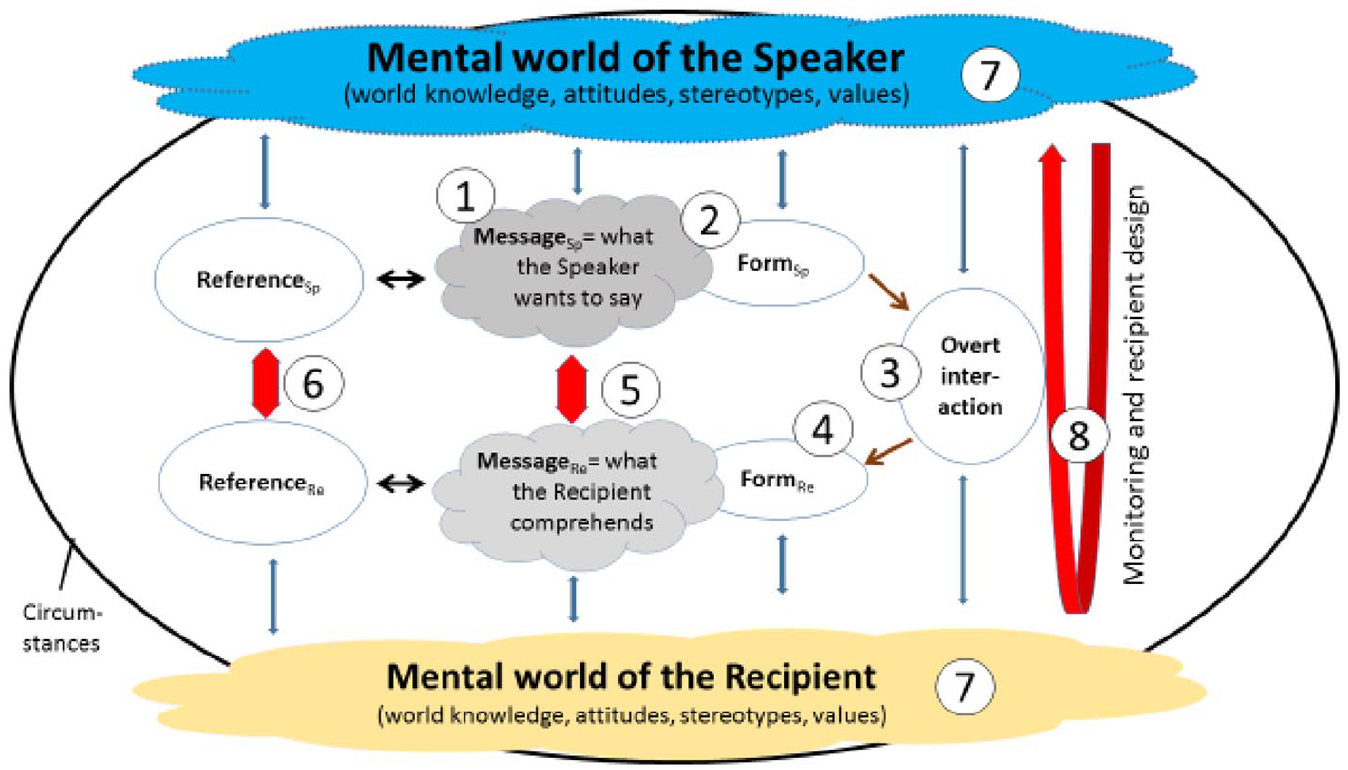
Multidimensional model of interaction (cf. earlier versions in Mustajoki, 2012, 2017, 2021; Mustajoki and Bajkulova, 2020).
Referring to different phases of interaction, risk-taking occurs in the following ways:
○ Item 1. The speaker is taking up a risky topic or is expressing a message which is not yet ready in her mind.
○ Item 2. The speaker uses an inappropriate form to express the message (1).
○ Item 3. The speaker is not pronouncing the form (2) clearly (e.g. mumbling or in a hushed voice) or does not take into consideration the circumstances (noise).
○ Item 4. The recipient does not listen attentively and is too active in producing in his mind the content of the heard message (3).
○ Item 5. The speaker resorts to cryptic, ambiguous expressions and believes that she is clear enough. However, the recipient does not understand the intention of the speaker although the form of the message that it sent by the speaker (2) is the same that is heard (4).
○ Item 6. The reference of the message is wrongly interpreted by the recipient.
○ Item 7 refers to the mental worlds of the participants, which play a crucial role in the process of interaction. The mental world is an umbrella notion for the various capacities and states communicants have, including linguistic (especially pragmatic) competence, general and individual knowledge of the world, attitudes, prejudices and stereotypes, opinions and values, and their current mental and physiological state. The mental worlds of interlocutors influence all phases of interaction, but their role comes especially clear in the interpretation of the message (Item 5) and the reference (Item 6).
○ Item 8 reflects the role of monitoring and recipient design (accommodation of items 1 and 2 to the recipient and situation). In reaching the goals and aims of interaction, this is paramount.
Risky elements in producing and receiving the output (Items 1–4)
Confidence in a safe environment leads family members to be more open in expressing their feelings and worries than in other communicative settings. However, the opportunity to express one’s feelings can also easily lead to unpleasant scenes. A typical situation comes from annoyance and frustration at the behaviour of a family member. The frequent occurrence of hyperbole is a manifestation of this (see e.g. McCarthy and Carter, 2004; Pomerantz, 1986). Indeed, the use of hyperbole (exaggerations and overstatements) as a rhetoric trope is only possible when the speaker is confident in the recipient’s ability to understand that a literal interpretation is not intended. Describing ‘millions of mosquitos’ in the air is not risky, whereas exaggerated formulations when commenting on behaviour may be a risky move in a conversation. There are plenty of occurrences of this kind in the material: Ты никогда. . . (You never. . .), Ты как всегда. . . (You as usual. . .).
The husband is speaking to the wife. 1. He: Вечно вот ты / я говорю/ а ты не слушаешь // You, you always / (when) I speak / and you are not listening. 2. She: Я слушаю / I am listening. 3. He: Нет / ты всегда о своём чём-то думаешь / No! / You always think of your own business.
Both the person who is expressing her feelings and the object of the outburst can be anyone, but according to our material, the most frequent risk situations with this content are a wife speaking to her husband (see Example 1), a mother speaking to her children and a grandmother speaking to her adult daughter. Example 2 demonstrates a typical situation where both the mother and the son express themselves bluntly. However, one can easily see the imbalance in the deontic and epistemic rights between them. The mother is the ‘main regulator’ in the conversation (cf. Heritage, 2012; Stevanovic, 2013). This resembles situations in institutional communicative settings, for example, between a superior and subordinates (Landmark et al., 2015; Stevanovic and Peräkylä, 2012), but the family ties make the situation more explosive. If the imbalance of deontic rights is quite evident in the pair ‘parents-children’, then it is a much more complicated issue in a conversation between adult parents and grandparents (Pikuleva et al., 2021).
The mother is speaking to her son. 4. Mother: Дима / cходи в магазин// У нас сахар кончился// Dima / go the grocery shop!// we’re out of sugar 5. Son: Мам / подожди доиграю// (playing a computer game) Mom / wait a minute / I will finish the game 6. Mother: Эти игры без конца! А у нас обед! Иди/ иди / я говорю! These games are endless! / We are going to eat! Go / go / I am speaking to you! 7. Son: Ну мам/ потом// Mom / later 8. Mother: Не мамкай! Иди скорей! Уже бы сбегал давно! Do not say mom! Go, go! You could be already back!
In general, even when this is quite a normal and accepted manner of interaction at home, bluntness of speech may be risky from the point of view of effectiveness of communication. Parents typically order children to do things without softening their words: Сейчас же иди уроки делай! (Do your homework immediately!); А ну ложись живо спать! (Go to bed right now!). Various forms of expressing requests can be found in all languages and cultures, but there are differences in the frequency of the usage of direct and less direct means. Russians seem to use the basic imperative form more often than representatives of other cultures (Bolden, 2017; Mills, 1992).
An obvious reason for possible confusion in the course of interaction is that the aim of the speaker is unclear even to herself. People are not able to say everything that they wish to (Scott-Phillips, 2018; Wilson and Sperber, 2004). It is often the case that the speaker has only a fuzzy concept in her mind and has difficulties in putting it into verbal form. There are more thoughts that people would like to express than there are words in languages (Jucker et al., 2003). Many communicative settings outside the home do not allow for the risk of sharing incomplete thoughts, and well-formulated talk is expected. In a relaxed home atmosphere, there is more space for this. In Example 3, the wife is trying to use the word ‘garlic squeezer’, but Russian lacks a common word for such a device. She starts producing the phrase before it is finished in her mind – a common feature in circumstances where people are relaxed and are not concentrating on the interaction.
Wife speaking to her husband. 9. Wife: А эту дай. . . Give me. . . 10. Husband: Что тебе дать? What to give you? 11. Wife: Ну / эту //как её? Чеснок давить // Ah, that / what is it? Garlic squeeze. . . 12. Husband: Так бы сразу и сказала // Why did you not say so right away?
Home as a safe haven gives the illusion that communicants can behave as they wish and that everything is allowed. Such an attitude is quite understandable because this is in general true. However, this can lead to a self-centred and open way of speaking. A common case of this is speaking to a person who is not listening. There can be various reasons for this: (1) the recipient may not hear due to distance or a noise caused by a household appliance, TV, children at play or the simultaneous conversation of other people; (2) the recipient does hear but is concentrating on something else, for example, working on a computer, looking at a smartphone or cooking dinner; or (3) the recipient does hear but pretends not to. One can occasionally see similar situations in other communicative settings, but due to the relaxed atmosphere and close relations between family members, these cases are especially frequent in FD. In many cases, the transcripts do not show what really happens because the speaker is not necessarily aware that the recipient is not listening. In Example 4, the reaction of the recipient reveals that he is not listening.
The wife and husband are sitting at a table. The coffee maker is on and makes noise. 13. She: Что завтра будем делать? What shall we do tomorrow? 14. He: Ложку дай! Give me a spoon! 15. She: Я тебя спрашиваю / что завтра делать будем I am asking / what shall we do tomorrow.
A well-known fact is that the recipient does not just receive a message transferred to him as such, but produces it in his brain on the basis of the heard voice signals. This is an important and in most cases very useful feature of speech perception, because it helps the work of the recipient in settings where it is difficult to hear every word and gives him time to prepare his own message. However, there can be also other reasons for not concentrating on the speaker’s intention to express something, for example, the recipient is hoping to hear something in particular in the speaker’s message or is just too lazy to put sufficient energy into listening. This often results in overguessing, which is a very common phenomenon in spontaneous interaction (Mustajoki and Bajkulova, 2020: 349). However, too actively using the technique ‘hear something and add the rest’ is a risk for correct understanding and can lead to unexpected outcomes in a fast-paced setting. An example is reported in Mustajoki (2017: 67). The speaker says ‘Bring some potatoes as well’ to a recipient who is leaving for the grocery store and is already standing far away. After he hears ‘Bring some. . .’, his brain starts to work and he remembers that he forgot to put tomatoes on the shopping list. So he hears, ‘Bring some tomatoes as well’.
False confidence in common ground and cryptic speech (Items 5–8)
For a successful interaction, the communicants must have a certain degree of common ground consisting of world knowledge and various beliefs (Clark, 1996; Clark and Brennan, 1991; Mustajoki, 2022; Stalnaker, 1978). In other words, this means joint elements in their mental worlds (Mustajoki, 2012, 2017). Members of a family usually have many common experiences and share a substantial part of their mental worlds (Bolden, 2018). This extensive common ground enables communicants to regularly understand incomplete and unclear speech with frequent ambiguities (Davidson, 2005: 89–108; Van Brakel, 2006).
Groundless confidence in this common ground, the familiar and safe environment, and the feeling that it is not necessary to put much effort into interaction lead to speech that is (too) cryptic, which is an umbrella notion for a lack of clarity, unambiguousness and accuracy. Not everything is said aloud, or if it is said, it is said in an indirect way. Not paying attention to this issue saves cognitive energy – and at the same time is a potential risk for non-understanding. Cryptic speech has various realisations. One of them is obvious – unclear pronunciation. A high tempo of speech, the spontaneousness of the interaction and non-concentration on articulation easily lead to mumbling, swallowing of words or syllables, and just speaking too fast. The more ordinary and safe a situation is, the more likely these defects occur in speech.
Other forms of cryptic speech are connected to implicit and/or elliptic expressions. Since the works of Austin, Searle and Grice, the difference between ‘what is said’ and ‘what is meant (implicated)’ has been one of the most discussed phenomena in interactional research. Several terminological dichotomies with slight differences in meanings are in use: sentence / direct / semantic / locative / literal meaning or explicature vs utterer’s (speaker’s) / indirect / pragmatic / illocutive / non-literal meaning or implicature (for overviews with interesting new insights, see e.g. Börjesson, 2011; Carston, 2009; Elder, 2019).
The usage of implicit speech is, by definition, a risk for interaction. Based on the examples in the material, we arrived at the following classifications: intellectual (or knowledge-related) implicitness (the speaker expects that the recipient knows a certain word and/or the concept behind it), referential implicitness (a reference in the speech is not obvious) and functional implicitness (the utterance of the speaker has another or an additional speech function than the literal interpretation indicates).
Indeed, in a spontaneous and relaxed atmosphere, family members often fall into the trap of the common ground fallacy. There are plenty of occurrences of this kind in the material. Example 5 represents a typical situation where a schoolgirl uses a word (and concept) unknown to her grandmother. Contemporary Russian has a huge number of English loanwords (see e.g. Mustajoki, 2020). Many of them already belong to written language (kompjuter, imidzh, kemping, shou etc.) or are widely used in colloquial speech (bojfrend, juzer, laver etc.). Besides these, there are also words used only in youth slang. In Example 5, a quite normal word for a contemporary kid slajm (slime) does not yet belong to her grandmother’s vocabulary.
Ira, 8, is speaking with her Grandmother. 16. Ira: Баб / а купи слайм // Grandma / buy slime. 17. Grandma: Что? What? 18. Ira: Слайм. Slime. 19. Grandma: А что это? What is it?
After visiting a grocery shop, a mother speaks with her son about various kinds of milk. 20. Mother: Но я купила [this milk] потому что сдачи не было у продавщицы // Пришлось это взять. I bought this [milk] because the cashier didn’t have any change // I had to take this. 21. Son: В нашем магазине? Да у них вообще какая-то... In our shop? Yes, they have a strange [cashier] 22. Mother: Нет / это я. . . на остановке взяла. No, I . . . in the shop near the bus stop.
By
However, the meaning of implicit requests and other hints is not clear in all situations. Some requests are obvious, others more cryptic. The common ground of the interlocutors and their joint history of habits and actions play a decisive role in using and understanding implicit speech. When one says It is cold in here after arriving at a summer cottage in the autumn, the phrase can be easily understood as ‘put the fire on’, but only on the condition that this is a routine action for these people in this setting. In less obvious cases, implicitness may engender a conflict of interpretations. If a speaker says The Brows bought an electric car and has a hidden agenda of proposing that the family should also buy one or at least think about doing so, she takes the risk that the recipient does not understand or pretends not to understand the message. On the other hand, a direct suggestion can be risky from another point of view: it can annoy a spouse who does not like the idea at all.
He wants to have a mirror. She does not understand the indirect request at first and asks for clarification. 23. He: Таня! А где другое зеркало / без подсветки? Tanya! Where is the other mirror without lighting? 24. She: Что / оно тебе нужно? What / you need it? 25. He: Да. Yes.
There are several occurrences of functional implicitness in our material. Not all of them take place in a request setting. Here is one example: a daughter comes home late, and the mother says to her Ну / наконец-то! (Finally!). The mother wants to express her joy at seeing the daughter, but the daughter hears in the phrase only a rebuke: ‘It is already very late! Where have you been? I was worried’.
Conclusions
The aim of this article was to consider the role of risk-taking in face-to-face interaction. People have various goals when they take part in interaction, which inevitably leads to competition between them. When people pay too much attention to personal or social goals, they may not reach their interactional goals. In addition to this, avoidance of cognitive effort is a permanent background factor influencing the effectiveness of communication. People try to minimise their energy consumption in activity, including in interaction. A general way to do this is not give one’s full concentration to a conversation. This occurs especially often in circumstances where the communicants feel confident and the topic of conversation is not very important, which can be exemplified in family discourse. Because interaction mostly takes place without conscious decisions made by the communicants, risk-taking is also usually an automated technique.
Not concentrating enough on what and how to speak may lead to risk-taking in all phases of producing and receiving speech. The topic of speech may be uncertain and the speaker may try to express a thought which is not yet ready. She may choose an infelicitous word or phrase or deliver the message in a way inappropriate for the circumstances. The recipient may be too active in reproducing the message. The main risk is, however, resorting to cryptic speech, including underdeterminacy and various forms of indirect expressions.
The origin of the material raises the question of whether our conclusions only reflect the Russian communicative sphere. As thousands of studies in the field of intercultural communication have shown, there are substantial differences in the way representatives of different cultures interact. As for the Russian culture, the following features, in contrast to Western cultures, have been identified: people have a more collectivistic rather than individualistic orientation, hierarchies play an important role, and the overall approach to the world is holistic and emotional rather than analytical and rational (see e.g. Larina et al., 2016). There is, of course, great variation among people within the same culture, but these findings are true if we compare the representatives of this culture on average. The general orientation, based on values and traditions, results in concrete interactional patterns. Some of these are rather similar in all cultures. For example, as shown in many studies (Ting-Toomey, 1999, among others), the concept of face is a regular feature of any culture, but various cultures differ in how people try to maintain face. Another common characteristic of all cultures seems to be that people adjust their speech to the communication situation, for example, they speak to strangers in a different way than to family members. However, this also varies (Evtyugina et al., 2019). All in all, one can see some features of Russian communicative culture in our findings, but most of the risk factors mentioned in Figure 1 are universal. The differences between cultures concern only the frequency of occurrences of various phenomena.
Another question which emerges is the possible uniqueness of FD in comparison to other contexts of discourse. In any context, communicants take risks, and some of these risks are similar to those found in FD. In an intensive interaction with friends, overguessing and expressing immature thoughts are common. To their best friends, people reveal their deepest feelings, which may be risky. The common ground fallacy is a continuous bugbear in all kinds of discourse. It is a permanent problem in conversation between specialists and laymen and between researchers from different fields. What is specific for FD is a certain set of risk factors and the high likeliness that they will occur.
This was a material-based attempt to examine some manifestations of risk-taking in family discourse. Many questions still remain open, for example: Are there differences between communicators in risk-taking, similar to those in gambling or driving? Which forms of risk-taking are typical in other genres or communicative situations? To what extent is risk-taking conscious, or is it always automated? We are convinced that applying risk-taking as a tool to approach interaction reveals features which would otherwise remain unnoticed. Thus, we can get closer to the very essence of this fundamental human activity.
Footnotes
Acknowledgements
This article is an output of a research project implemented as part of the Basic Research Programme at the National Research University Higher School of Economics (HSE University).
Declaration of conflicting interests
The author(s) declared no potential conflicts of interest with respect to the research, authorship and/or publication of this article.
Funding
The author(s) received no financial support for the research, authorship and/or publication of this article.