




Abstract
This study investigates the persuasive effects of messages generated with artificial intelligence in online political targeting, focusing on three distinct strategies: targeting based on political orientation, age, and personality traits. Through an experimental design conducted across 15 countries (N = 7118), we uncovered that political targeting based on voters’ pre-existing political orientation, receiving messages from a party that is already favored by the receiver, had a persuasive impact on voters. These effects included higher likability of the ad and heightened issue importance. Contrary to popular belief, targeting based on age or a combination of multiple categories does not affect persuasive outcomes. Taken together, by building upon a cross-national analysis, this research provided a robust analysis of how multiple targeting strategies influence the electorate in an EU election context.
Political parties all over the globe employ targeting techniques to reach voters (Vliegenthart et al., 2024; Votta et al., 2024). Using tailored social media messages, in particular, is gaining popularity (Bossetta, 2018). The practice involves collecting vast amounts of personal data from voters, such as demographics, interests, and locations, to deliver highly personalized and tailored messages, often in the form of digital ads on social media. Political actors do not only aim to persuade the receiver of these messages (Dommett et al., 2024), but also foster their empowerment by offering more relevant political information that might help them to make informed (political) decisions. However, besides these more optimistic views (Koc-Michalska et al., 2023), concerns have been voiced about the negative consequences of these targeting strategies (Zuiderveen Borgesius et al., 2018). Platforms are often unwilling to share more information about their strategies, which makes the practice very opaque. More specifically, the combination of the use of large amounts of personal data with sophisticated generative artificial intelligence (AI) raises concerns among the public, academic community, and policymakers (Simchon et al., 2024). AI might allow political parties with less expertise to target messages more effectively to potential voters. While it can be an equalizer for smaller parties, it also can create a “highly scalable ‘manipulation machine’ that targets individuals based on their unique vulnerabilities without requiring human input” (Simchon et al., 2024: 1). AI’s role in reshaping the impact of political messaging thus raises sharp concerns about its potential to undermine democratic processes. Could AI contribute to creating circumstances online where citizens become more easily persuaded if the messages they receive are identity-based? Or are the possible effects overblown, and is the effectiveness of AI-driven microtargeting simply limited (Simon and Altay, 2025)?
While research focused on political targeting is rising (Chu et al., 2023; Kruikemeier et al., 2022; Lavigne, 2021), we still know little about its potential impact. Most research has focused on single countries, in particular on the United States with its two-party system (Endres, 2020; Tappin et al., 2023), while the impact of targeting in various political (multi-party) systems is often overlooked. Because of the more complex nature of targeting in these countries, it remains unknown to what extent the effects of targeting are generalizable. In addition, research has usually focused on one targeting strategy based on single identities (e.g. party-based matching, Binder et al., 2022), while research on other types of targeting (e.g. personality and age) has been less common. This is surprising, as most of the controversy around targeting focused on personality targeting. Matz et al. (2017) showed that one can infer personality characteristics based on data that people leave behind online, making it a likely strategy to tailor political messages based on these features. We expect that whether targeting has a persuasive impact might depend on the specific targeting criteria and context. Finally, much of the existing research often does not account for the potential influence of generative AI. This study answers the following research question:
This study, thereby, aims to fill gaps in previous work by conducting a comprehensive experimental design across 15 countries to rigorously examine the persuasive impact of three distinct political targeting strategies using voters’ identities: their preferred party, age, and personality.
Different matching techniques and their persuasive impact on voters
Scholarly research has increasingly engaged with research on data-driven campaigning, which also refers to political (micro-)targeting, and sets out different definitions (Dommett et al., 2024). When taken together, Dommett et al. (2024) define data-driven targeting as “accessing and analyzing voter and/or campaign data to generate insights into the campaign’s target audience(s) and/or to optimize campaign intervention” (p. 13). Hence, in simple terms, this means that online political messages are increasingly matched to individual voters to tailor messages to their interests or characteristics. Matching is performed using large databases containing personal information that voters – knowingly and mostly unwittingly – leave online, such as individual characteristics, preferences, and behaviors (Acquisti et al., 2015). Political microtargeting is thus a data-driven form of online advertising in which political actors hope to persuade voters more successfully, as consistent and effective targeting is expected to produce substantial and enduring persuasion effects on individuals.
Targeting based on different criteria
Targeting can happen based on different traits. A review of 327 studies by Hinds and Joinson (2018) revealed that personal data can be used to infer different demographic characteristics. Sociodemographic traits like age and gender are thus easily obtainable and help politicians reach certain groups of voters. Targeting messages to either gender or age is a crude but useful measure that divides the voter population into large, segmented groups. Location-based targeting is another example of an often-used targeting criterion, as this can also be done easily, particularly in local elections. A more sophisticated form of targeting is based on inferred data. Research has shown that computers can accurately predict personality traits based on 300 likes on Facebook (Youyou et al., 2015). Other types of digital trace data from voters, such as written text and social media posts, can also be used to derive personality types (Hirsh & Peterson, 2009; Zarouali et al., 2022). This tactic involves inferring psychological traits that are not immediately visible but can be highly effective in persuading voters (Simchon et al., 2024). In the following sections, we will critically examine the theoretical foundations and scientific evidence related to the persuasive impact of various targeting strategies, which are based on political orientation (an interest category), age (a socio-demographic category), and personality similarity (an interfered category), to develop specific hypotheses.
Why are targeted messages more persuasive and what role does political orientation play?
The elaboration likelihood model (ELM; Petty and Cacioppo, 1983, 1986) is a crucial framework for understanding political targeting’s effectiveness. It highlights the importance of people’s motivation and ability to process a political ad (Petty and Briñol, 2008; Petty and Cacioppo, 1986). When people are motivated and able to process a message, they think carefully about the information presented to them. The strength of the argument plays a large role in determining the persuasive influence of a message: when a message has a strong and convincing argument, it is deemed more persuasive than a message with a weak argument (Petty and Cacioppo, 1986). When people are not motivated and not able to process a message, they tend to rely on peripheral cues, such as whether they perceive the sender of the political ad as a known and trusted source. Thus, following this logic, under both routes, targeting can have an impact (De Keyzer et al., 2015). Under high elaboration, for example, when citizens receive a targeted message from a party that is already liked by the receiver, the arguments in the message are better processed, and the message becomes more persuasive. Conversely, under low elaboration, the message from the party that is liked could serve as a cue – people may trust the party more, so the message will have a (weak) impact on attitudes. Thus, when voters are targeted by a political party they know and trust, they are likely to accept the information presented to them (Petty and Cacioppo, 1986).
In addition, Motivated Reasoning (Kunda, 1990) proposes that the level of (in)congruency present in a political message influences how much cognitive load is needed to process the message. When people are exposed to congruent information, for example, when seeing a message in line with their political orientation, the voter may process the message in a fast, intuitive way that takes little cognitive effort. When encountering incongruent information – when seeing a message contradicting their political orientation – the voter may try to reconcile the discrepancy between the incongruent information and their predispositions by disregarding the incongruent information (Meffert et al., 2006; Redlawsk, 2002). According to cognitive dissonance theory, people experience psychological discomfort when they are exposed to messages that contain incongruent information (Festinger, 1957). To dissolve this discomfort, people prefer to allocate their attention to attitude-consistent content (Dvir-Gvirsman, 2019; Knobloch-Westerwick and Meng, 2009; Sülflow et al., 2019). Scholars suggest that people are especially prone to this behavior regarding political information since political beliefs are part of one’s self-identity (Donsbach, 1991; Stroud, 2008). Thus, based on these considerations, it is expected that when citizens are presented with a congruent political message (because it is in line with their political orientation), they will be motivated to process the information and will not disregard it. This is also in line with the idea of self-referencing, originating from social psychology. This idea entails that when voters relate information in messages to themselves, they tend to judge that information more positively due to their generally positive self-perception (De Keyzer et al., 2015; Tam and Ho, 2005).
By using AI, this practice of persuading people based on self-reference or identity-based information might become even easier. Journalists also report that AI-generated campaigning was used in the 2024 European parliamentary elections (Quinn and Milmo, 2024). AI is increasingly adopted in advertising to create content, to enhance targeting strategies, improve the ability to segment and reach specific target audiences, and to personalize ad content to better align with audiences’ needs and interests (Gao et al., 2023). For targeting, machine learning technology and data analytics can be used to derive insights into the personal characteristics of potential voters, and thus to identify and target specific audience groups (Gao et al., 2023). For personalization, campaigners can automatically create messages aimed at persuading people using large language models (LLMs). LLMs can also be used to test which message is predicted to be the most persuasive for different types of audiences or prototypical voters (Jungherr, 2023). As such, AI can assist in creating political messages of high quality at relatively low costs that appeal to individual voters by creating personally salient messages based on the receiver’s personal beliefs and past online behavior, among others (Boerman et al., 2017; Jungherr, 2023; Mogaji et al., 2020). Moreover, GenAI systems may also adapt not only the political issue mentioned in the ad but also its tone, framing, and complexity, making the message, in theory, even more persuasive (Simon and Altay, 2025). When deployed in a political context, the use of highly personalized information that is based on people’s individual preferences has the potential to strengthen motivated reasoning even more than general forms of microtargeting, which often rely on a single or just a few targeting criteria (as spending indicates, see Votta et al., 2024). Such personalized targeting is therefore more likely to enhance the persuasive impact of these political messages. In other words, by offering political messages that match voters’ predispositions and their communication style, the possibility of them disregarding those messages is minimized, as the messages offer congruent rather than incongruent information.
Thus, AI allows political parties to act upon which issues are salient among individual voters much more efficiently and at scale. However, following salience theory, the disruption might be less stark (Budge, 1982; Walgrave et al., 2009). With the exception of novel issues, political parties can likely only convincingly campaign on issues that they are traditionally associated with, thereby diminishing the effect of tailored messages (Budge, 1982). The salience of these issues among individual voters is, moreover, only partly determined by personal preference and largely by external events and election context. This likely narrows the number of salient issues and consequently possibilities for issue differentiation using AI. Nevertheless, the existence of AI presents a sharp contrast with previous campaign practices largely focused on salient macro-issues and issues that parties are already commonly associated with (Wagner and Meyer, 2014).
Insights from previous studies show that matching aspects of a political message to the receiver generates persuasive advantages. For example, Lavigne (2021) found that targeting can be an effective way to strengthen party ties. Binder et al. (2022) found that when voters receive a political ad from a political party they like, they evaluate that party more positively. Targeted advertisements are also matched based on personally relevant political issues. Chu et al. (2023) found that, regardless of partisanship, voters perceive ads about topics that are important to them as more informative, interesting, and persuasive. Taking the ideas formulated in psychological models on information processing and empirical findings, we expect that when voters are exposed to political messages aligning with their political orientation, the message is perceived to be more persuasive. Hence, we expect that targeted messages lead to a positive evaluation of the message, perceive the issue in the message as more important, and agree with the policy mentioned in the message because voters will align themselves with the position the political party takes on that specific issue. We hypothesize the following:
Matching based on age
Political parties find targeting based on demographic age very promising for several reasons (Votta et al., 2024). First, it is relatively easy to identify voters from different age groups even without using their personal data, and to target them with issues they are more likely to care about. In other words, age correlates with policy interests, and thus, it is relatively easy to tailor messages to allocate scarce resources. An example of age-based targeting is referencing student loan policy in a message targeted at younger age groups and pensions in a message targeted at older age groups. However, age-based targeting can also be found in how messages are framed. A different tone might appeal to different age groups. Demographics, such as age, must often be submitted by the user themselves when they set up an account. Consequently, this information is more likely to be accurate and available. Better data accuracy decreases the risk of mistargeting. Third, in many political contexts, age can be predictive of vote choice. For instance, in most political contexts, younger age groups are more likely to vote for progressive parties, while older age groups are more likely to vote for conservative parties (Rekker, 2024). In addition, the vote preferences of younger voters could be less consolidated than older voters (Schmitt-Beck and Partheymüller, 2012). If the message turns out to be effective in mobilizing these groups, targeting based on age could thus lead to electoral advantage.
Thus, targeting based on age is a rather practical option, but is it also effective? Using insights from digital marketing in the commercial sector, we find some evidence here in favor of this assumption. Higgins et al. (2018) found that a combination of age and gender congruency leads to higher click-through rates; for instance, younger male users increasingly clicked on congruent messages by over threefold when a young male model appeared in the message. Kaspar et al. (2019) found that demographic targeting (a combination of gender, age, professional interest, place of residence, and occupation), which was personally relevant, did increase visual attention for the ad, but this was not a necessary condition for subsequent attitudes or evaluations. Based on this rather anecdotal evidence, it seems that targeting based on age (younger people receiving a message congruent with their age) might increase persuasiveness. Moreover, based on the same theoretical considerations mentioned above, namely that targeted messages perceived as more self-relevant are evaluated more positively, draw greater attention, and are more thoroughly processed, we also expect similar effects for political messages that are age-congruent:
Matching based on personality
Similar messages can be framed differently to appeal to different personality types by highlighting different aspects of the same issue or by varying the tone. For instance, a message from a political candidate can be presented with a focus on their communal goals and caring character for very altruistic individuals, or the message can highlight the candidate’s goals for specific groups and show opposition to antagonistic individuals. It is possible that technological advancements, like Generative AI and machine learning, have increased the efficiency and availability of crafting large amounts of tailored messages and creating personality profiles (Simchon et al., 2024). The current literature predominantly shows that personality tailoring can have a positive effect on persuasiveness. Although personality traits can be categorized in many ways, one generally accepted taxonomy is the Big Five Trait Taxonomy (John and Srivastava, 1999). This taxonomy distinguishes five personality dimensions, also referred to as the “Big Five”: extraversion, agreeableness, conscientiousness, neuroticism/negative emotionality, and openness/open-mindedness (John and Srivastava, 1999; Soto and John, 2017). Political messages that are tailored to the Big Five personality traits are perceived as more persuasive (Hirsh et al., 2012; Simchon et al., 2024). Tailoring to extraversion traits showed higher vote intentions and did change attitudes toward the sending party (Zarouali et al., 2022). In contrast, another study only finds persuasive effects of tailoring to extraversion traits on ad evaluation or vote intention if the content of the ad also matches pre-existing political attitudes (Decker and Krämer, 2023). Messages tailored to the thinking versus feeling personality dimensions have shown to increase both vote intentions and reinforce party attitudes (Zarouali et al., 2024). Moving beyond the purely political messages to commercial messaging, content that is tailored to Big Five personality traits was found to have a significant effect on ad engagement as well as click-through and conversion rates, but it does not seem to affect attitude toward the advertised product (Matz et al., 2017; Winter et al., 2021). These findings show that personality-tailored messages spark more interest and that the use of matching can also affect behavior. Overall, the type of personality matching between these studies varies, as well as the experimental stimuli, which makes repeated findings of positive congruency effects convincing. Specifically, the Big Five trait neuroticism, which has recently more often been coined “negative emotionality,” includes anxiety as a specific facet referring to the extent to which people worry a lot – and thus are more anxious – or are more relaxed and handle stress well (Soto and John, 2017). Anxiety as a personality trait has received little scholarly attention in the field of political communication so far, even though it could influence political decision-making. Studies show that anxiety increases information-seeking behavior, leads to less heuristic processing of the message, and increases risk aversion (Wagner and Morisi, 2019). Anxious individuals are shown to focus more strongly on issues and candidate qualities than to be purely led by partisanship (Monogan, 2020). When anxiety is increased through political communication, this could have a demobilizing effect (Wagner and Morisi, 2019). This effect is undesirable, especially when considering the importance of voter turnout on election outcomes and given the possibilities that online targeting offers in targeting specific voter groups. In light of the lack of empirical studies on the effects of anxiety, it is unknown if this personality dimension is a particularly effective targeting category. Still, considering the changes in message perceptions and attitudes found in the existing literature on personality tailoring and the role of anxiety in political information processing described above, we hypothesize the following:
Reinforcing effect of different types of matching
Building on the literature surrounding the ELM and motivated reasoning, alongside empirical research on various types of message matching, the exact reinforcing effect of targeting individuals based on multiple characteristics remains unclear. According to the ELM, the more closely a message aligns with voters’ predispositions, the less likely they are to dismiss it. Several empirical studies on political targeting have demonstrated that targeting individuals based on attributes like political affiliation, age, or personality can effectively influence attitudes (Matz et al., 2017; Winter et al., 2021; Zarouali et al., 2024), and behavior (Lavigne, 2021) or increase persuasiveness (Hirsh et al., 2012; Simchon et al., 2024). While there is limited research on the mechanisms behind these effects, perceived ad relevance – how well an ad aligns with the recipient’s preferences – has been identified as a key driver in enhancing ad effectiveness (Celsi and Olson, 1988; Zarouali et al., 2024).
Based on this, one might expect that the more a political message is matched to multiple personal characteristics, for example, with the use of GenAI, the stronger the persuasive effect would be. However, a recent study found that targeting individuals using several personal characteristics offers no persuasive advantage compared to targeting with just a single data point (Tappin et al., 2023). This suggests that there is no cumulative reinforcing effect of matching on multiple attributes. This finding could be explained by the so-called “personalization paradox” (Aguirre et al., 2015), which states that personalization can increase message relevance but can simultaneously also increase feelings of vulnerability. Boerman et al. (2021) found that ads using less personal and private information (e.g. information on recently visited websites) were seen as more acceptable than those using more individual-specific and private data (Boerman et al., 2021). There might thus be a boundary-crossing effect in which messages that are targeted at different characteristics increase feelings of unease, which counteract persuasive effects. Given the gaps and inconclusive findings in the literature, we propose the following research question:
Contextual differences in the impact of political targeting
As we conducted this study in multiple countries during the 2024 European Parliament election, we can assess whether external contextual differences affect the persuasive impact of targeted messages. Previous research on the supply side of targeting shows that in wealthier countries and countries with proportional representation, political actors put more financial resources into the campaign (Votta et al., 2024). Others found that people perceive certain forms of political targeting as less acceptable in countries that have higher levels of legislative regulation (Vliegenthart et al., 2024). These findings imply that the persuasive effectiveness of targeted messages also depends on the context, for instance, the regulatory framework or professionalization of the campaign (Votta et al., 2024).
We believe that in the context of the EU elections, the length of membership of the EU might be an important contextual factor. Previous work showed that political advertising strategies differ between EU countries, for instance, with newer member states engaging more in negative campaigning (Vliegenthart and Zeh, 2017). Others found that, during the 2019 European Parliament election campaign, differences exist between parties in the use of paid media (Kruschinski and Bene, 2022). Sponsored posts (existing posts that are boosted by paying money) are more popular in countries that joined the EU in 2004. Ads are, however, more popular in older EU member states (and the Czech Republic and Estonia). This can lead to two rationales. On one hand, older member states are often older democracies with a longer history of more professionalized political campaigning and more experience with the EU parliament election campaign. In contrast, newer members tend to be younger democracies with less professionalized campaigns and a shorter history with EU campaigns. Consequently, we argue that politically targeted messages may be more persuasive in countries with longer EU membership. In other words, voters in countries with longer EU membership are expected to be more accustomed to targeted messaging in the form of ads, leading to reduced resistance to EU-focused campaigning. However, on the other hand, it can also be expected that citizens who are more accustomed to advanced campaign efforts are expected to be more immune toward persuasion efforts by political elites. Hence, longer EU membership could also make people more resistant to persuasion efforts. Consequently, due to the explorative nature and conflicting assumptions, we pose a research question:
Method
Procedure and participants
To test our hypotheses and research questions, we developed a short political message using AI (specifically ChatGPT-4o), targeting participants based on three characteristics across two topics. This setup created a 2 (political orientation: left vs right-wing party) × 2 (age: young vs old) × 2 (personality trait anxiety: calm vs anxious) × 2 (topic: electric car subsidies vs sugar tax) between-subjects design. Participants were randomly assigned to one of the 16 conditions (and one control group 1 ), each receiving a targeted message that varied by targeting criteria and topic. After viewing the message, participants responded to questions measuring our dependent variable. Finally, we debriefed participants to inform them that the message was specifically created for this study and did not necessarily reflect actual party positions on the topics. We obtained ethical approval from the WUR Research Ethics Committee before data collection began (ERB number: 2024-084).
The data for this study were collected in 15 European countries during the lead-up to the 2024 European Parliamentary elections. The selected countries – Austria, Bulgaria, Germany, Denmark, Estonia, Spain, France, Croatia, Hungary, Italy, the Netherlands, Poland, Portugal, Romania, and Sweden – were chosen to represent variation in degrees of democratic freedoms, electoral systems, and geographic locations within Europe. For the data collection, we worked together with the market research company Bilendi. The survey instrument was translated from English into the respective national languages by Bilendi, which also compensated participants following the terms of their respective country panels. Data collection ran from 31 May to 9 June 2024, for all countries participating in the EP election.
We aimed for 500 participants per country. This number was chosen as a practical balance between feasibility and representativeness. In our case, collecting data across many EU member states required keeping the country samples relatively modest, while still ensuring that each country was meaningfully represented. For this reason, we prioritized including a larger number of countries with smaller samples rather than collecting larger samples within fewer countries. To ensure representativeness, soft quotas on age and gender were implemented within each country sample, approximating relevant national demographics based on Eurostat data. Our initial sample consisted of 8260 participants. After excluding participants who were not eligible to vote in the relevant country election or who completed the survey in an unreasonably fast amount of time (<5 minutes), a total of 7118 valid survey completions were obtained, with 50.2% of participants identifying as female, 49.6% identifying as male, and 0.2% identifying as other. Age distribution among participants was as follows: 8.8% aged 18–24, 15.7% aged 25–34, 18.9% aged 35–44, 20.7% aged 45–54, 20.1% aged 55–64, and 16.0% aged 65–74. This age and gender distribution aligns with demographic data representative of the populations in the respective countries. Notably, the sample displayed a bias toward higher education levels; however, this bias was considered manageable within the study’s design.
Stimulus
For the stimulus creation, we used ChatGPT-4o. Specifically, we provided prompts for each condition, for example: “Use the argument to write a political ad that persuades a young voter to vote for a left-wing political party: Sugary drinks and foods cause obesity, diabetes, and other chronic health problems. A tax on sugar helps to promote a healthier lifestyle by making unhealthy products more expensive. Therefore, [party name] aims to introduce a sugar tax. Write a maximum of 60 words. Use calm language.” We then varied the instructions in italics based on the factors we wanted to manipulate and allowed the program to generate political messages accordingly. In this procedure, the initial outputs generated by ChatGPT appeared convincing and highlighted aspects relevant to the different groups. As a result, we adopted these outputs as the initial version of our stimulus material. Afterward, we manually adjusted the texts to ensure that the versions differed only by the targeted factors. This was necessary to get a clean experimental design.
As part of the manipulation of political orientation, we referenced either a left-wing or right-wing party relevant to each country. This was a decision made by the authors of this paper, not ChatGPT. We opted to include real parties, as opposed to fictional parties, to improve the ecological validity of the stimuli. Furthermore, as we are interested in the effects of microtargeting by political parties, it is particularly relevant that the messages in the stimuli come from real parties, to ensure that the political orientation of the party is made sufficiently salient. To select the relevant parties per country, we selected the left-wing and right-wing parties from each country with the largest predicted vote share in the lead up to the EU parliamentary elections, as per Politico, which amalgamates the results of several opinion polls per country to estimate predicted vote share (POLITICO Poll of Polls, 2024). The left-wing versions of the stimuli highlighted societal benefits, while the right-wing versions emphasized economic advantages. These differences were the outcome of the prompt posted above. For age, the messages targeting younger people emphasized present-day benefits, while those for older participants highlighted advantages for future generations and (grand)children. In the messages aimed at more anxious individuals, we modified the language to convey a sense of urgency, adding phrases like “we are running out of time” or “before it’s too late,” which were exchanged for more neutral descriptions for calmer participants. Again, all these differences to target various age groups and groups with different personality traits were suggested by ChatGPT. The topics chosen, subsidies for electric cars and the introduction of a sugar tax, were selected for their political neutrality and compatibility with all other factors. The sugar tax is a suitable topic because it is plausible that it would be debated at the EU level, while at the same time, it is not highly visible in the election context. This also makes it likely that people do not hold strong feelings about it. In addition, we wanted a second topic that is somewhat more salient but still not highly polarizing. Electric car subsidies fit this role well: they are linked to the broader climate change debate, yet, unlike other facets of that debate, they are generally viewed positively across different political groups (European Alternative Fuels Observatory, n.d.). Moreover, the issue does not fall neatly along a left–right divide, as it combines both ecological and economic considerations, making it less clear which parties would support or oppose it. In sum, the choice of topics and the setup allowed us to apply similar adjustments for targeting across both topics. Including two topics ensured that our findings were not topic-specific, strengthening the generalizability of our results.
Measures
Measures to create the independent variables
To create the independent variables for our study (see Appendices 1 to 4), we added measures for political orientation, age, and personality trait anxiety to our survey. We measured left-right political orientation on an 11-point scale (M = 5.77, SD = 2.73) following others (e.g. Kroh, 2007). Age was measured by asking participants about their age, with the possibility to place themselves into one of six categories (18–24, 25–34, and so on). This measure allowed us to implement age quotas in all countries during the time of the data collection. Finally, we measured anxiety using a short version of the Big Five personality scale (Soto and John, 2017). In this tested scale, anxiety is measured with two items. We introduced the question with the text, “Here are some characteristics that may or may not apply to you. Please write a number next to each statement to indicate the extent to which you agree or disagree with that statement.”. Afterward, participants indicated: “I’m a person who . . . 1) worries a lot, . . . 2) is relaxed, handles stress well.”. To give answers to these statements, participants were provided a scale from 1, “does not apply,” to 7, “very much apply”. For the analysis, one item was recoded, and then both items were combined into an index (M = 3.83: SD = 1.42).
Dependent variables
To measure message evaluation, we asked participants how they evaluated the political message after being exposed to the stimulus material. They could indicate for six different adjectives on a 7-point scale whether they agreed or disagreed that the political message was appealing, informative, boring, nice, stupid, or unattractive. We recoded and combined these items to a composite score, with higher values reflecting a more positive evaluation of the message (α = .84, M = 4.00: SD = 1.41).
For issue importance, participants were asked how important they considered a tax on sugar-rich products / a subsidy for electric cars to themselves and people in their country. Participants only saw the items for the topic that was mentioned in their political ad. Participants could answer these items with a 7-point scale ranging from 1 “not at all important”, to 7 ”very important” (α = .96, M = 3.72: SD = 1.96).
Finally, for issue attitude, we asked participants whether they agreed with the argument expressed in the political ad. For sugar tax, this was “There should be an additional tax on sugar-rich products (sugar tax)”. For electric cars, it was “There should be higher subsidies for electric vehicles”. Participants could indicate their level of agreement on a scale ranging from 1 “don’t agree at all” to 7 “very much agree” (M = 3.67: SD = 2.19).
Analyse
Before starting the analyses, we created our independent variables, that are dummy-coded for each targeting factor, with values of 0 (incorrectly targeted) and 1 (correctly targeted). First, we divided participants into left-wing and right-wing groups for targeting based on political preference. We considered participants who scored 5 or lower as left-wing, and those who scored between 6 and 11 as right-wing. We then created a variable where left-wing participants viewing a left-wing message or right-wing participants viewing a right-wing message were assigned a value of 1 (correctly targeted), while mismatched participants were assigned a 0. Even though not all participants might view a message sent by the party they intend to vote for, we argue that this is a valid operationalization to measure differences in effects between liked and disliked parties, given that feelings of sympathy toward other parties generally follow the lines of left-right ideological divides (Gidron et al., 2023; Harteveld, 2021). 2 Following the same principles, we created an age-based dummy variable. Participants aged 18 to 54 were grouped as “younger,” and those above 55 as “older”. Participants were coded as 1 if the message matched their age group and 0 if it did not. Finally, for targeting based on anxiety, we used a score ranging from 1 to 7. Participants who scored between 1 and 4 were categorized as calm, and those scoring above 4 as anxious. We created a dummy variable where participants received a value of 1 if the message matched their anxiety level and 0 if it did not. This approach resulted in dummy-coded variables for political preference, age, and anxiety, each reflecting whether participants were correctly targeted based on these factors. In addition, we conducted robustness checks where we used left-right positioning, age, and anxiety as moderators of the treatment condition, thus indicating the degree of (mis)targeting, instead of a simple targeting/mis-targeting classification. The models are reported in Appendix 4.
To assess the effects of targeting individuals based on party preference, age, and personality, we conducted random intercept, fixed-slope multilevel regression analyses for each dependent variable. In a first step, we estimated the models by incorporating the targeting variables, along with education, gender (female), and issue of the message (sugar tax versus electric vehicles) as control variables. Each model accounted for the participants being nested in countries by including the country as the second level, and the slopes for the independent variables were set to one. In a second step, we add the country-level variable (EU membership) to the models and allow the effects of the targeting variables to vary across countries (random slope models). Interactions between EU membership and targeting variables (cross-level interactions) allow for testing the final research question. All analyses were conducted using the xtmixed command in STATA.
Results
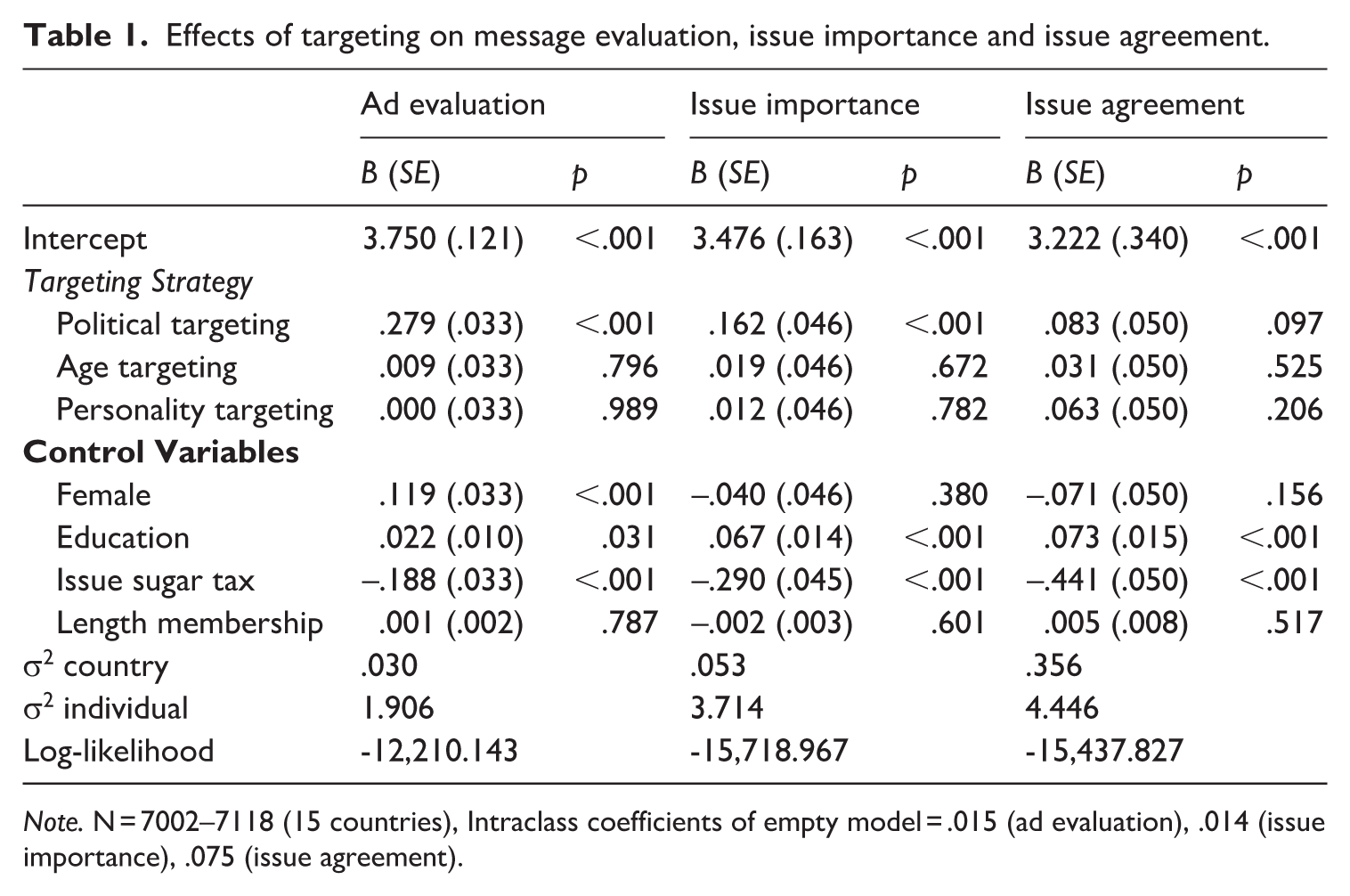
Our first hypothesis assumed that a message aligning with an individual’s favorable view of a party has a positive effect on the evaluation of the message, their perceptions of the importance of the issue highlighted in the message, and their agreement with the issue highlighted in the message. The results can be found in Table 1.
Effects of targeting on message evaluation, issue importance and issue agreement.
Note. N = 7002–7118 (15 countries), Intraclass coefficients of empty model = .015 (ad evaluation), .014 (issue importance), .075 (issue agreement).
Looking at the findings for the first dependent variable, there is one significant effect in the assumed direction. If participants received a message that was in line with the political view of the participants about the left or right-wing orientation (congruency on the party level), the message was evaluated significantly better. On average, they result in a .279 higher message evaluation score compared to political views that are not aligned, which is on a seven-point scale, a substantial difference. These results provide evidence consistent with H1a, indicating that message-party alignment is associated with higher message evaluations. Regarding issue importance, the model displayed in Table 1 shows that participants correctly targeted based on political preference indicated that the issue mentioned in the message was more important compared to those being wrongly targeted. The effect size (b = .162) is substantially smaller compared to evaluation.
Finally, looking at the findings of issue agreement, political targeting again is a (this time marginally) significant positive predictor. If participants were part of a condition that correctly targeted participants on the political level, their agreement with the issue attitude expressed in the message was higher compared to those who were wrongly targeted (b = .083), but this effect is only marginally significant (p = .097). Hence, the findings are consistent with the predictions of H1c. Taken together, receiving targeted messages from a party that is already liked does lead to more positive message evaluations, people perceive the issue in the message as more important, and agree, to some extent, more with the issue position. It should be noted that the effects are small.
The second hypothesis assumed the effects of targeting based on the age of the participants on message evaluation, issue importance, and issue attitude. Looking at Table 1, the findings show that the estimates do not reach significance in any of the three models. Hence, based on our findings, targeting based on age, whether executed correctly or not, does not make a difference for the dependent variables. Consequently, for H2a, H2b, and H2c, we do not find evidence for our hypotheses. In the third hypothesis, we assumed an impact of the personality trait anxiety. Again, and rather surprisingly, the findings show that the estimates fail to reach statistical significance in all three models. Therefore, we must conclude that in our study, we do not find evidence for the idea that targeting based on the personality trait anxiety makes a difference in the evaluation of the message, the perception of the issue’s importance, or the attitude toward the issue brought up in the message. In sum, we do not find evidence for H3a, H3b, and H3c.
The robustness checks reported in Appendix 4 confirm the findings reported above, with higher levels of party alignment yielding higher ad evaluations, as reflected in the significant interaction effect between left-right positioning and political targeting on ad evaluations, issue importance, and (marginally significant) issue agreement. In line with the results reported above, the other interaction effects are not significant.
RQ1 asked about the combined effects of correctly targeting people based on party alignment, age, and personality for message evaluation, issue importance, and issue attitude. To test if the effects of the manipulated factors depend on each other, we ran additional multi-level models, including two-way interaction terms of the factors. Findings show that the interaction terms do not have a significant influence on the three dependent variables (p > .05). Thus, we do not find proof that the effects of the manipulated factors are conditional on each other, and, thus, we do find evidence of a reinforcing effect.
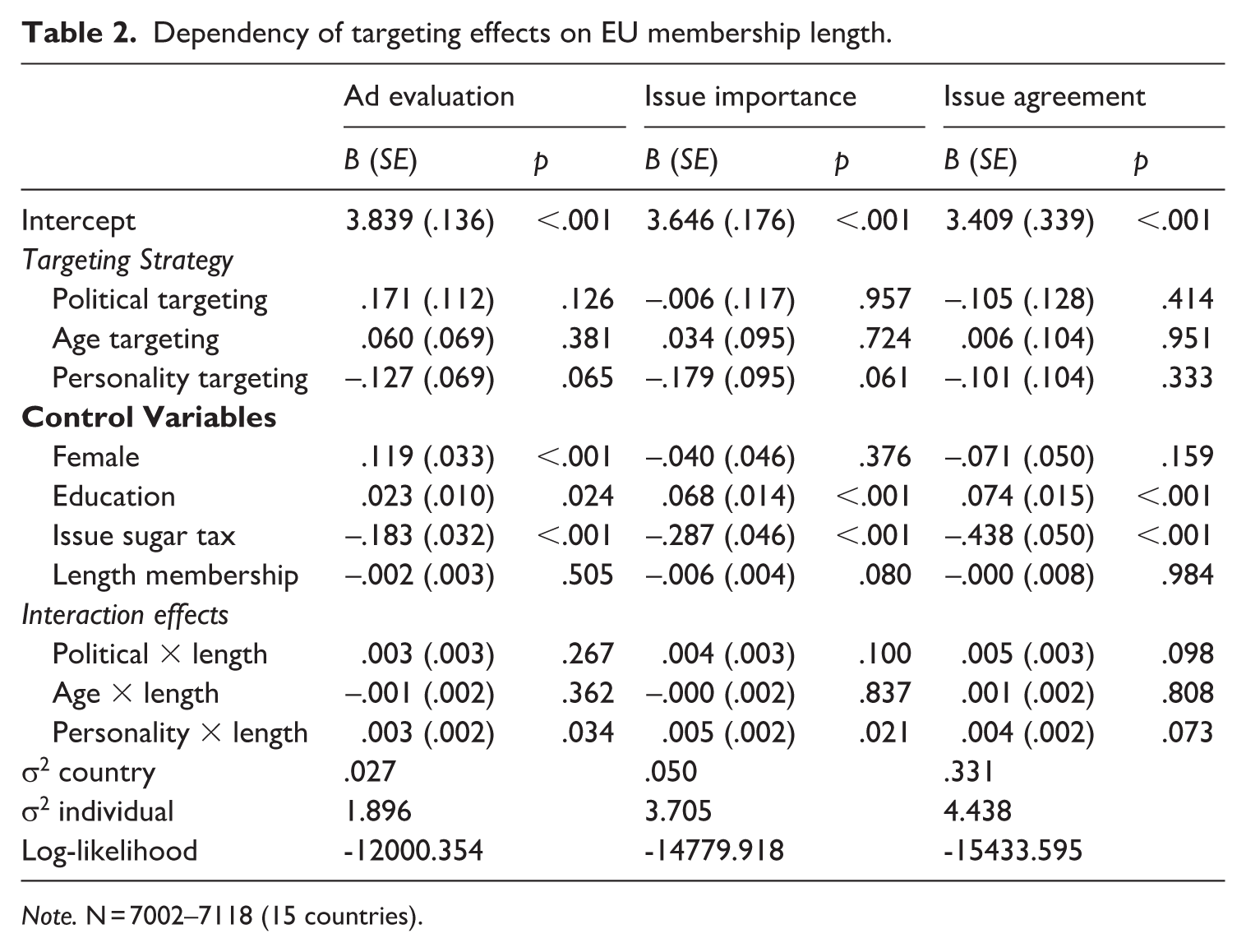
Finally, RQ2 addresses how targeting effects differ across countries with varying lengths of EU membership. Table 2 presents the results for the three dependent variables. We find several indications that effects are stronger in countries with longer membership, though differences are rather small. More specifically, we see that the effects of personality increase for message evaluation, issue importance, and marginally for issue agreement. The same can be found for political orientation in the cases of issue importance and issue agreement. Figure 1 illustrates the conditional impact of the length of EU membership on the relationship between political orientation targeting and issue importance. We see a clear interaction, but also that differences between targeting and mistargeting remain largely in the margins of error across varying lengths of EU membership.
Dependency of targeting effects on EU membership length.
Note. N = 7002–7118 (15 countries).
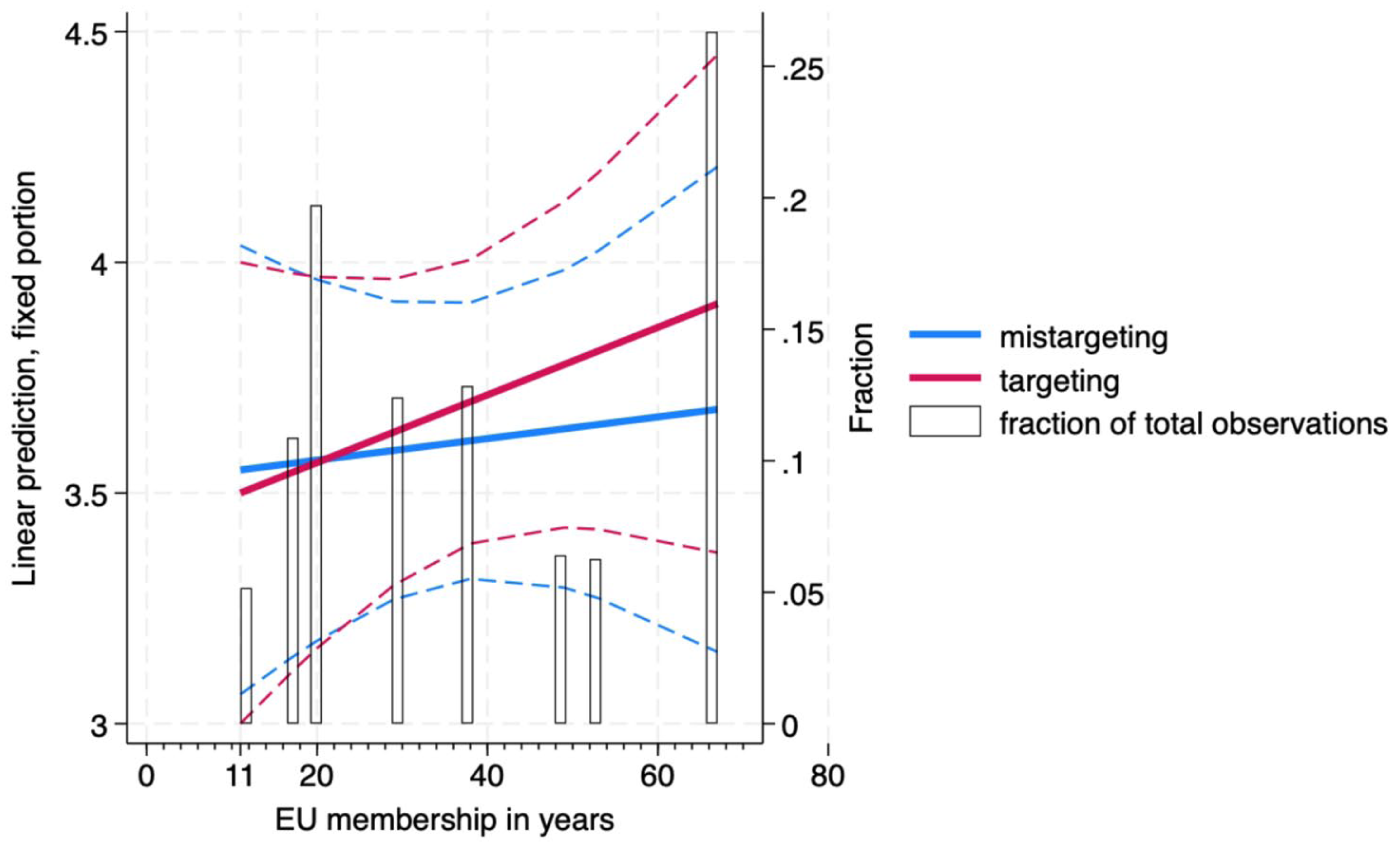
Cross-level interaction of political orientation targeting and length of EU membership on issue agreement.
Discussion and conclusion
Strong claims have been made about the potential detrimental influence of targeting using AI techniques, in particular in combination with targeting strategies (Simchon et al., 2024). However, research on the effects of AI in the context of data-driven campaigning is scarce. This study fills this gap by (1) enhancing our understanding of the effectiveness of distinct and combined strategies in online political targeting, (2) using AI to craft targeted messages, and (3) conducting a comprehensive experimental design across 15 countries in the EU to explore conditional effects.
Key outcomes
The key outcome is that political targeting based on political identification has a small persuasive effect across the board. More precisely, we find a consistent main effect within countries that shows that targeting based on political preferences enhances persuasion; voters like those messages more, find the issues mentioned more important, and are, to some extent, more likely to adapt their standpoints on these issues (although marginally significant). This is also in line with other work that argues that targeting party preferences plays an important role (Chu et al., 2023). This underlines the notion that ideas formulated in the motivating reasoning approach are of crucial importance when examining the impact of targeting (Kunda, 1990). Therefore, we largely find additional support for the argument that “effects of targeting are not that pervasive and arguably more important in strengthening partisan attachment than in moving voters’ preferences” (Lavigne, 2021: 972). This finding holds in all 15 countries that were included. These findings suggest that it is rather unlikely for political elites to be successful at persuading voters who do not already support them.
Although often assumed in the literature, the impact of contextual factors on the effectiveness of politically targeted messages has rarely been tested empirically (Vliegenthart et al., 2024). Intriguingly, we found some tentative support for the idea that EU membership played a conditional role here. Hence, we discovered that voters from older EU member states are more likely to be affected by political and personality targeting. In other words, when receiving targeted messages that match a voter’s personality (based on anxiety) or orientation, the targeted messages were, to some extent, more likely to be perceived as persuasive compared to mistargeted messages. This may be because voters in countries with longer EU membership are more accustomed to EU (targeted) messaging, leading to reduced resistance to EU-focused campaigning. Importantly, these effects are, in several cases, only marginally significant and quite small, highlighting the need for cautious interpretation. Hence, the finding is in line with previous findings (Zarouali et al., 2022, 2024) but also contrasts with others who find no effect of personality targeting in specific countries (Decker and Krämer, 2023).
Perhaps the most unexpected finding is that, contrary to common belief, we did not find persuasive outcomes of matching based on age, even in a large sample collected in many different countries. While one explanation might be that the stimulus material was not strong enough to instigate effects, targeting based on age – one of the most popular ways to target citizens in many countries (Votta et al., 2024) – may simply be less effective. This could have two reasons. Age might be a very broad category that might be less usable, as it could fail to trigger a referencing effect. In addition, age-based identification may be a weaker form of self-identity compared to party-based identification. However, future work needs to test these assumptions.
Another notable finding is that, as of now, the use of AI in targeting is not yet able to have a significantly large impact. This is in line with others, who argue that LLM-targeting could be persuasive, but not more persuasive than non-LLM-targeting (Hackenburg and Margetts, 2024). This might be reassuring, but developments go fast. It might well be that when these tools become more sophisticated, the effects might become larger. Specifically, we found some evidence that personality targeting does seem to work in some countries, although with small effects. However, if platforms keep refraining from sharing how data is collected and used to target citizens, it is difficult to assess the real-world impact of these strategies.
Limitations
To conclude, this study employs a novel design to explore the impact of targeted messaging across multiple European countries, allowing us to make generalizable claims about the impact of political targeting and to understand differences. While the cross-country setup enabled an examination of targeting factors on a broader scale, the study has, of course, some limitations. First, while our study was designed with a strong focus on internal validity, enabling us to make an extensive comparison, we could not display targeted messages in varied and more personal timelines. As a result, the study cannot fully account for how context, platform, delivery system, timing or other content, and interactions might influence the impact of targeted messages. Incorporating a timeline in people’s own digital networks would make our experiment more ecologically valid. Future research employing a more naturalistic, longitudinal design to examine the effects of repeated targeted message exposure is therefore highly recommended. Second, while we included 15 countries, including more countries outside of the EU would allow us to test more contextual factors at the country level. For instance, it would be interesting to test the implications of the regulatory level or the competitiveness of the election system. Regarding the role of different country contexts, we must acknowledge that our relatively small sample sizes per country do not allow us to detect small effects at the country level. Future work that includes a larger sample size might address this limitation. Third, even though our interest is in multi-party systems, our design only included two political parties. We argue that this is a valid operationalization to measure differences in effects between liked and disliked parties, given that feelings of sympathy toward other parties generally follow the lines of left-right ideological divides (Gidron et al., 2023). However, this design does not allow us to capture the effects of receiving ads from political parties that the receiver neither particularly likes nor dislikes, which is particularly relevant in a multi-party context. It is likely that factors beyond ideological distance influence message evaluation (Schwalbach, 2023). Future research should focus on how targeting works in a multi-party context with a less binary focus. In addition, we now focus on anxiety, yet other personality traits could influence persuasiveness. Future work should also examine the effects of targeting other personality traits. Furthermore, as selected the largest left-wing and right-wing parties by predicted vote share per country, it is a limitation of this study that the size and relevance of these parties are not exactly the same across all countries. We argue that our method of selecting the largest parties by predicted vote share allows us to compare across countries. Future research could employ fictional parties to eliminate any effects of party size or relevance. Furthermore, we focused on two issues (subsidies for electric cars and a sugar tax) on which right and left-wing parties do not hold strong predefined positions (compared to issues like climate change and immigration). Because these issues are less salient compared to issues like immigration, we expect that people are more likely to be affected by such messages, as they do not hold strong predispositions on these topics. Based on previous literature (Bakker et al., 2021), we expect that people are more likely to change their opinions on less salient issues. Our study thus represents a more likely case that people change their opinion on issue importance and their attitude toward the issue. However, it would be interesting to test these effects on more wedge issues, to examine if targeted messages can be successful in influencing people’s opinions about more polarized issues. Finally, our findings have limitations regarding the generalizability of AI in political communication. Outputs from generative AI depend on factors such as the model version and the specific prompts used, making it difficult to evaluate the tool based on a single message. Nonetheless, our results suggest that AI-generated messages can shape perceptions of political communication, highlighting both the potential and the uncertainty of using AI in influencing political discourse. Future research should assess the quality and consistency of outputs across different AI tools and test the robustness of our findings with alternative AI-generated messages.
Concluding remarks
Despite these limitations, this study provides valuable insights into the potential effects of targeting in increasingly automated environments. Many scholars fear that these political targeting techniques are a harmful phenomenon. Although the effects are small, our findings indicate that targeting based on political orientation has an impact. In addition, our study is among the first to demonstrate that these effects, albeit marginally, vary by context. On one hand, this seems less concerning, as the effects of targeted messages mainly appear to reinforce existing preferences. On the other hand, if a message produces even a small, significant effect, what might the cumulative impact of repeated exposure be? Could that lead to increased polarization? Moreover, in tightly contested elections, even a minor impact of targeted ads over the course of the campaign could lead to a significant political shift. Based on our results, we urge others to adopt a more comparative approach in future research to better understand the political implications of targeted messaging.
Footnotes
Appendix 1
Appendix 2
Appendix 3
Appendix 4
ORCID iDs

Funding
The authors disclosed receipt of the following financial support for the research, authorship, and/or publication of this article: This project has received funding from the European Research Council (ERC) under the European Union’s Horizon 2020 research and innovation program (Grant agreement No. 949754).
Declaration of conflicting interests
The authors declared no potential conflicts of interest with respect to the research, authorship, and/or publication of this article.