



Abstract
Research on evening social media use and sleep has yielded inconsistent findings, partly because exposure-based measures overlook how such use is experienced in context. To address this issue, this study examines how people make sense of their evening social media use across different life stages. Using a 1-week diary combined with semi-structured interviews (N = 56; ages 14–87), data were analyzed through qualitative content analysis. Evening social media use emerged as a distinct practice during the transition between day and night, with experiences shaped less by duration or timing than by users’ situational appraisals and emotional goals. Ambivalence was common: Routines could soothe and connect—yet also evoke obligation, time loss, or guilt—often reflecting cultural norms surrounding healthy use. Patterns varied across life stages, though age itself did not determine experience. The findings highlight evening media use as a contextual and interpretive process grounded in everyday meaning-making.
Keywords
The glow of a screen is the last thing many people see before falling asleep (Bengtsson and Johansson, 2022; Hartstein et al., 2024; Toh et al., 2019). Evening social media use has become a quiet, private ritual—one that can soothe or stimulate, connect or alienate. While some describe it as a comforting end to the day, others experience guilt or restlessness that prevents them from getting a good night’s sleep (MacKenzie et al., 2022; Zarhin, 2024). This ambivalence—recently described as a duality of effect (Kaur et al., 2021)—is reflected in empirical research: Although previous studies often suggested clear negative effects, more recent ones using refined methods have produced weaker and less consistent associations between evening media use and sleep (Brautsch et al., 2023; Burnell et al., 2024; Mac Cárthaigh et al., 2023; Sumter et al., 2024). This shift raises the question of whether social media’s effects on sleep may depend less on how much or when it is used, and more on how specific evening interactions are experienced and appraised in context (van der Schuur et al., 2019; van der Wal et al., 2024).
This perspective aligns with developments in media effects research, in which subjective appraisal processes—how media use is emotionally experienced and retrospectively perceived—increasingly are discussed as mechanisms in explaining media-related outcomes (Lee and Hancock, 2024; Valkenburg et al., 2022; Wolfers, 2024). For example, van der Wal et al. (2024) found that while adolescents shared similar motives for using social media, their emotional experiences varied widely and often contained ambivalent elements—such as feeling both connected and isolated, or inspired and envious. This perspective highlights the importance of considering individual variability in how social media is experienced, yet it rarely has been examined in relation to sleep.
Extending this focus on subjective experience to sleep, it is not only a physiological process but also a subjective one, shaped by emotional and cognitive evaluations that go beyond what objective measures capture (Goelema et al., 2019; McCarter et al., 2022; Peach et al., 2018; Takano et al., 2016). This conceptual parallel suggests that evening social media use’s psychological effects may hinge not only on its immediate impact—such as cognitive and physiological arousal (Cain and Gradisar, 2010)—but also on how such use is interpreted retrospectively in light of personal routines, emotional needs, or cultural norms (Lee et al., 2021). Although appraisal-based models of media effects emphasize the importance of such interpretive processes (e.g. Lee and Hancock, 2024; Valkenburg and Peter, 2013; Wolfers, 2024), their relevance in sleep experiences remains underexplored. The present study builds on this perspective by exploring how evening social media use is experienced subjectively in relation to sleep.
Studying such evaluations poses methodological challenges—particularly in the evening context, when routines are shaped by habit and social expectations (MacKenzie et al., 2022). Standardized instruments often fall short in capturing the lived nuances of social media use (Meier and Reinecke, 2021) across individuals and contexts (Bengtsson and Johansson, 2022; Grady et al., 2022; Valkenburg et al., 2022).
To address these gaps, the present study combines diary-based reflections with qualitative interviews to explore which situational and content-related factors contribute to positive or negative social media experiences in the evening, and how these experiences and their meanings vary across different life stages. Adopting a qualitative, person-centric approach allows this study to move beyond identifying quantitative associations and examine how individuals make sense of evening social media use in relation to sleep.
Conceptualizing evening social media use: Situational and cognitive appraisal processes
How people use and experience social media varies widely, as the same activity can elicit very different emotional responses across situations and individuals (van der Wal et al., 2024; Weinstein, 2018). Grady et al. (2022) defined media experiences as encompassing ‘both media exposure and its attendant affective and cognitive processes, such as appraisal’ (p. 525). Building on this perspective, van der Wal et al. (2024) argue that these subjective, personally meaningful experiences are more relevant for understanding well-being outcomes than the objective content itself.
This perspective is particularly relevant in the evening—a transitional period shaped by emotional needs, social obligations, and culturally structured routines around rest and winding down (Koketsu and Pierce, 2024; Williams et al., 2010; Zarhin, 2024). In this context, social media use is not only an individual act, but also part of broader socio-technical practices.
To understand what shapes evening social media experiences, this study distinguishes between two layers: first, the situational conditions under which social media use unfolds—such as habits and platform-specific patterns, and second, the cognitive and reflective elements—including appraisals and beliefs—that influence how these episodes are interpreted and remembered.
Situational elements: The evening social media experience
Evening social media use often unfolds in routinized patterns—such as use in bed or at fixed time slots—that carry emotional significance and guide the transition to sleep (Bengtsson and Johansson, 2022; Zarhin, 2024). For example, adolescents describe scrolling as a relaxing part of their bedtime wind-down sequence, helping them disconnect from stressors and prepare for sleep (MacKenzie et al., 2022).
Evening social media use does not represent a uniform experience. The type of activity and the content it involves appear to be crucial to how users evaluate their experiences and how they relate to sleep outcomes. Bergfeld and Van den Bulck (2021) found that viewing sports-related Instagram posts before sleep was associated with reduced sleep latency and improved subjective sleep quality, and viewing posts from family and friends was linked to lower pre-sleep arousal. In contrast, Snapchat use was correlated with later bedtimes, and when evening social media use was assessed more generally—without specifying content or activity—it was associated with poorer sleep quality and longer sleep latency. To better account for such variation, Yang et al.’s (2021) Multidimensional Model of Social Media Use (MMSMU) offers a useful framework. The model differentiates between three core dimensions of social media use: activity type (e.g. active vs passive use), user motivation (e.g. enhancement vs compensation), and communication partner (e.g. strong vs weak ties). These dimensions do not operate independently, but instead jointly shape the psychological mechanisms through which social media use relates to well-being. Depending on their combination, use may involve processes such as social comparison (Verduyn et al., 2015; Yang and Bradford Brown, 2016) or social support (Frison and Eggermont, 2016; Manago et al., 2020), which can lead to both positive and negative well-being outcomes, operating through cognitive and emotional stimulation and subjective appraisals. For example, rapidly changing, algorithmically curated content streams may involve heightened stimulation through pace, novelty and emotional variability, which may shape pre-sleep arousal. In contrast, communication-oriented interactions with close ties may foster reassurance and relational closure, potentially supporting calmer pre-sleep states.
However, because the MMSMU does not account for the timing of use, an important contextual layer remains unaddressed—particularly the evening, a period marked by emotional winding down, reduced demands, and distinct social expectations. During this time, users often seek relaxation or light social contact before sleep—conditions that may amplify or dampen emotional responses to online interactions. Qualitative extant research complements this: Zarhin (2024) introduced the concept of sleepful sociality to describe how evening social media routines unfold in a context marked by fatigue, privacy, and a desire for calm connection. Under these conditions, social media interactions in the evening can feel both calming and connective, yet at other times effortful or intrusive.
Taken together, these findings emphasize that platform, content, motivation, and timing interact with broader temporal rhythms and social expectations—shaping how evening social media experiences are felt and ultimately interpreted.
Cognitive elements: How people make sense of their evening social media use
The cognitive component concerns how individuals interpret, evaluate, and rationalize their evening social media use, often in light of competing goals, such as relaxation, connection, disengagement, or sleep. Ellithorpe et al. (2024) explored this tension by contrasting two pathways: media as a tool for emotional recovery (Reinecke and Rieger, 2021; Sonnentag et al., 2017) versus media as a source of sleep displacement (Van den Bulck, 2010). Their findings showed that recovery-motivated use was linked to more recovery and better sleep experiences, yet these benefits frequently coexisted with delayed bedtimes or reduced sleep satisfaction. In direct comparison, displacement effects also proved more robust. Rzewnicki et al. (2020) similarly found that negative social media experiences were associated with greater sleep disturbances than positive ones, highlighting negative media experiences’ greater weight in relation to sleep. Negative experiences may include, for example, exposure to stressful or disturbing content or upward social comparison, both of which may trigger rumination and cognitive arousal before sleep. In contrast, positive experiences may involve supportive interactions or meaningful conversations with close friends that can foster feelings of connectedness and reassurance.
These findings point to an important interpretive layer: Evening social media use relates to sleep not only through behavioral mechanisms but also through meanings and evaluations that users attach to it. Extant research on recovery suggests that an activity’s restorative value depends less on the activity itself than on individuals’ satisfaction with it. For example, Tucker et al. (2008) found that satisfaction with evening activities—regardless of type—predicted better sleep and less fatigue. Such satisfaction may, in turn, be shaped by how well the activity aligns with users’ personal beliefs and goals. When evening media use is perceived as congruent with one’s need for relaxation or connection, it may enhance recovery, but when it conflicts with internalized expectations or values, it may evoke stress, guilt, or dissatisfaction.
These experiences of (mis)alignment could be shaped by broader personal beliefs about social media, recently referred to as social media mindsets (Lee and Hancock, 2024), which include agentic beliefs (sense of control) and valence beliefs (whether social media is viewed as beneficial or harmful). Positive mindsets correlate with greater well-being and perceived control, while negative mindsets are associated with feelings of guilt, dependency, or regret (Lee et al., 2021). While social media mindsets’ direct role in shaping sleep outcomes has not been studied empirically to date, they may influence how individuals frame and emotionally respond to their evening social media use—potentially affecting their pre-sleep states and retrospective evaluations.
From this perspective, the cognitive framing of evening social media use becomes central, as individuals interpret their own behavior within broader social discourses about ‘good’ media habits. As Wolfers (2024) argues, such appraisals are shaped by public narratives, rather than formed in isolation. Evening social media use often is portrayed as harmful or self-indulgent, even though many users experience it as relaxing or socially meaningful (MacKenzie et al., 2022; Zarhin, 2024). Such contradictions can foster negative reappraisals—such as guilt for not ‘switching off’ sooner—thereby complicating personal appraisals, particularly when individuals’ lived experiences diverge from dominant discourses, a tension that may be particularly salient in the reflective atmosphere of the evening.
The current study
As outlined above, evening social media use is shaped by a combination of situational routines, emotional goals, cognitive evaluations, and sociocultural expectations. These elements not only influence how media is used but also how it is subjectively experienced. This study starts from the premise that evening social media use cannot be understood through isolated metrics, but only through the meanings users attribute to their experiences within specific situational, cognitive, and social contexts.
To address this complexity, the present study combines two complementary perspectives:
A situational view, which conceptualizes evening social media use as embedded in habits, rhythms, and platform-specific practices;
A cognitive–affective lens, which integrates users’ emotional experiences with their interpretive appraisals, beliefs, and social narratives that shape them.
These perspectives are examined across different life stages, recognizing that social media use and sleep are situated within diverse developmental, social, and temporal contexts (English and Carstensen, 2014; Valkenburg and Peter, 2013; Zacher and Froidevaux, 2021). Adolescents may use social media in the evening to fulfill connection and validation needs (MacKenzie et al., 2022), whereas older adults may seek relaxation, continuity, or companionship (Zarhin, 2024). Such differences are tied not only to developmental goals but also to varying daily structures, emotional regulation strategies, and normative expectations around media use and sleep. By comparing users across age groups, this study explores how similar media practices can take on different meanings and affective consequences, depending on life context.
In doing so, the study moves beyond generalizing assumptions about evening social media use, offering a differentiated understanding of how such use is experienced and interpreted within everyday evening routines. By examining these experiences within situational, cognitive–affective, and life-stage contexts (see conceptual framework, Figure 1), the study contributes a meaning-oriented perspective that complements predominantly behavioral approaches to sleep and media use and helps explain heterogeneity in extant studies.
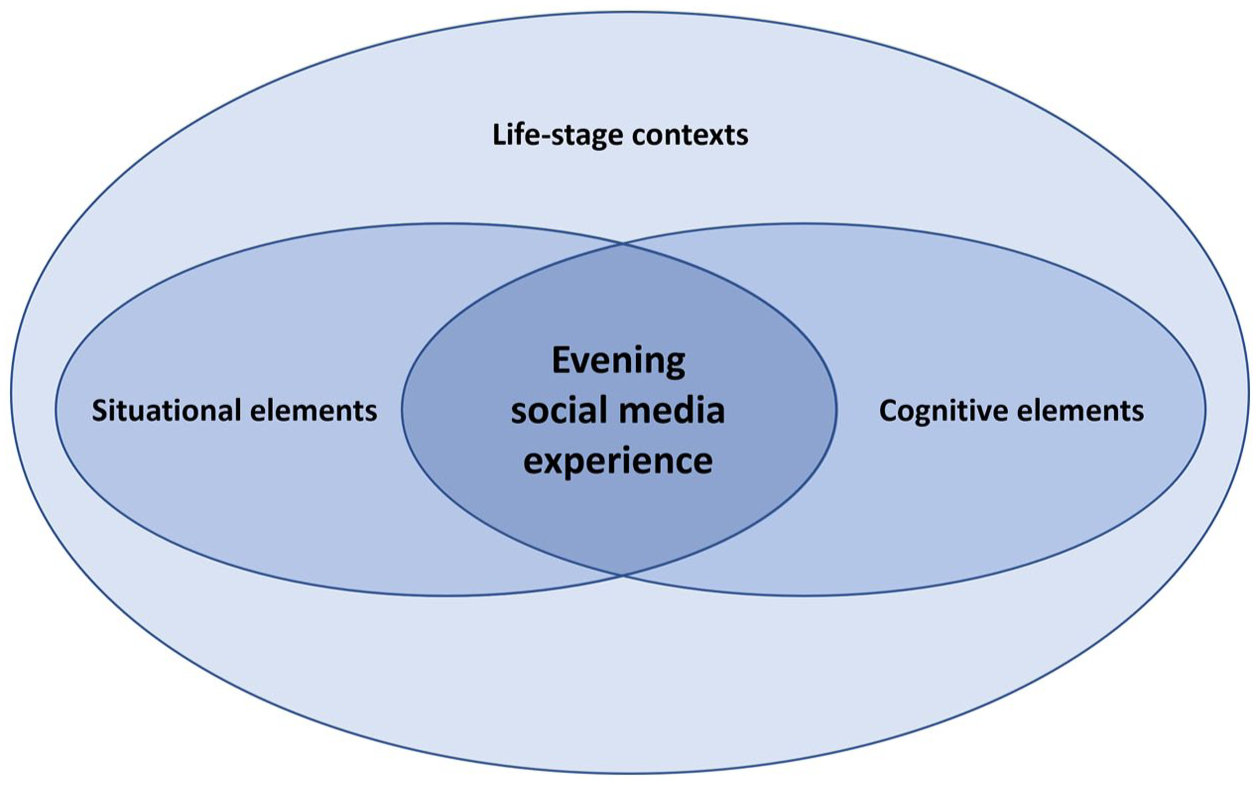
Conceptual framework illustrating how evening social media experience is shaped by situational and cognitive elements across life stages.
Methods
Study design
We conducted qualitative, semi-structured interviews with participants to explore their evening routines and experiences related to social media use. The study followed a narrative, problem-centered interview strategy situated within an exploratory framework (Döringer, 2021). To enhance ecological validity, participants completed a 1-week media use diary prior to the interview, capturing evening social media use (6 p.m. to bedtime) across seven consecutive days, including platforms, content, activities, duration, mood, and context (e.g. location, multitasking). The diary served as both a memory aid and a narrative prompt during interviews and was not included in the qualitative dataset. It was inspired by Kahneman et al.’s (2004) Day Reconstruction Method (DRM), which facilitates structured recall of daily activities. Compared with experience sampling, this approach reduces participant burden while still capturing situational and affective detail.
Supplementary materials, including the interview guide and the protocol for the media use diary, are available on the OSF project page (https://osf.io/3vnhx).
Procedure and participants
Participants were recruited in Germany via convenience sampling. The study was described neutrally as research on how people integrate social media into their evening routines. Inclusion required regular evening social media use (at least weekly). Quota sampling ensured variation across age groups.
The sample comprised 56 German participants aged 14–87 years (M = 46.1; SD = 22.3; 37.5% men), with diverse occupational backgrounds (e.g. students, managers, professionals in social services, design, and administration, retired and unemployed participants). To ensure broad representation across life stages, participants were categorized into decade-based age groups: 12–19 (n = 8), 20–29 (n = 8), 30–39 (n = 8), 40–49 (n = 8), 50–59 (n = 8), and 60+ (n = 16).
Before their interviews, participants submitted their completed media use diary. The interviews followed a sequential structure based on these entries and were conducted in person (typically at participants’ homes) or online via Zoom and lasted on average 24 minutes (SD = 7.45). After a brief introduction, participants began by narrating a typical evening from the previous week step by step from 6 p.m. until they fell asleep, supported by gentle prompts tied to the diary entries while preserving narrative openness.
During the second part, the focus shifted to social media’s role within the narrated evening. Participants were asked about the motivations behind their platform use, their emotional responses to content, the perceived impact on mood and rest, and how they reflected on their use afterward. At the end, they briefly summarized whether they viewed their evening social media use as generally positive, negative, or ambivalent.
According to German research regulations, this type of non-medical qualitative research does not require formal approval by an ethics committee. All participants provided informed consent (additional parental consent for minors). Participation was voluntary and not financially compensated. All data were anonymized prior to analysis, and pseudonyms are used throughout the manuscript.
Data analysis
Interviews were transcribed verbatim and analyzed in MAXQDA using a combined deductive–inductive qualitative content analysis (Gläser and Laudel, 2010; Mayring and Fenzl, 2019). Deductive guidance was drawn from the conceptual framework (Figure 1), which emphasized situational aspects of evening routines, platform-specific affordances, cognitive–affective appraisal processes, emotion regulation, and life-stage considerations. However, the concrete coding categories were developed inductively and refined iteratively through constant comparison (Mayring and Fenzl, 2019).
In a second step, the coded material was condensed according to the extraction logic proposed by Gläser and Laudel (2010), reducing it to thematically coherent units while retaining its narrative meaning. Codes were revised, merged, or differentiated based on their analytic salience and interpretive contribution, and recurring narrative patterns were identified across participants.
The analysis focused on emotional valence, perceived social expectations, moments of ambivalence, and participants’ evaluations of their evening social media use. This approach made it possible to trace not only how social media is used in the evening but also how these episodes are emotionally experienced, interpreted, and morally evaluated by users.
Results
Evening social media use emerged as a distinct digital practice. While daytime engagement was often instrumental or externally driven, evening use unfolded as a more self-directed space for reflection, connection, or winding down. Participants described how this period was shaped by situational conditions (e.g. time availability, caregiving responsibilities) and internal states (e.g. fatigue, emotional regulation), which provided the affective context for their practices.
Messaging applications such as WhatsApp were central for all participants in maintaining close social ties, whereas Instagram, Snapchat, and TikTok were more prominent among younger participants. Older participants relied more on YouTube or Facebook and engaged less with algorithmically curated entertainment content.
Social interaction
Across groups, positive evening experiences emerged when interactions felt emotionally grounded, reciprocal, and undemanding, whereas negative experiences were tied to social pressure or expectations of responsiveness—particularly when the desire for connection conflicted with the need for rest. Evening social media use was consistently described as a time for connection, yet age groups differed in the kinds of relationships they maintained, their interactions’ emotional tone, and the degree of obligation they felt.
For adolescents (ages 12–19), the evening offered a dense social window. Platforms such as WhatsApp, Snapchat, and Instagram were used to sustain peer bonds through rituals such as goodnight messages or reactions to stories, which felt meaningful and affirming: ‘Somehow I don’t feel so alone when I quickly say good night to everyone or check in on what they’re all doing’ (Sophie, 18). However, these rituals often came with a sense of social duty, reflecting internalized expectations to stay up to date on peers’ activities.
Young adults (ages 20–29) negotiated these expectations more selectively. Evening messaging helped them reconnect with close friends after busy days, but they described clearer boundaries and more awareness of cognitive and emotional limits. As one participant explained, ‘I sometimes watch [Instagram] Stories, but only from selected people. Scrolling through the feed is something I hardly do anymore because it feels exhausting in the evening’ (Lia, 24). Broader engagement (e.g. browsing Instagram Stories) mainly served to maintain a passive sense of social presence.
Among adults aged 30–49, evening communication often served instrumental purposes, such as family coordination or updates with friends. Emotional closeness remained relevant but was less frequent and more reactive: ‘To reflect on the day with family and friends, to somehow allow the family to participate in the day’ (Julia, 38). Many reported conflicting feelings about communication pressures, particularly around WhatsApp: ‘Sometimes I find that WhatsApp really keeps me on my toes in the evening. I notice that because I want to reply, I then end up not really doing anything else’ (Gabi, 35).
Participants aged 50+ used social media more sparingly but with deliberate emotional intent, often as part of a care-oriented routine. Short evening exchanges with family were described as calming and meaningful: ‘For me, it’s the moment when I can make sure that all my people are OK’ (Peter, 85). Rather than broad connectivity, they emphasized a few deep, intentional contacts as part of a wider ethic of care. In contrast to younger participants’ focus on maintaining ongoing peer presence, these exchanges were often described as brief moments of reassurance that family members were well, particularly among the oldest participants in the sample.
The evening social media ‘ritual’: Habits and routines
Across ages, evening social media rituals served dual functions: They provided emotional regulation and structure but also could reinforce habitual or fragmented use. Whether these routines felt positive or negative depended less on the activity itself than on users’ sense of control and alignment with their broader evening rhythms.
Evening social media use frequently was embedded in habitual routines, though levels of awareness and emotional tone varied. Among adolescents and young adults (12–29), use often felt automatic, involving rapid switching between apps while lying in bed: ‘You’re always on Instagram and Snapchat and WhatsApp, and I switch between those three apps. And it’s pretty much the same every evening’ (Julia, 22). These practices often co-occurred with other bedtime behaviors and were described as low-effort yet emotionally functional, helping users drift into sleep: ‘I kind of entertain myself to sleep—until I’m so numb and exhausted by what I’m seeing that my eyes just close on their own’ (Anna, 24). At the same time, participants reported feeling out of control, particularly when use extended beyond their intentions. As Ole (25) noted, ‘I actually want to go straight to sleep after I turn off the light, but then, out of reflex, I pick up my phone again and get lost in the depths of the Internet’. Feelings of time loss, regret, and diminished autonomy were recurring themes—particularly when participants described scrolling as ‘just happening’.
For adults in their 30s, evening routines were shaped by external obligations, such as childcare or work, with social media filling brief moments of autonomy: ‘It often just ends up happening because it’s one of the few moments I don’t have to deal with the kid, the household, or whatever else’ (Paul, 39). However, this brief sense of autonomy also could clash with users’ desire for rest or disconnection. Some described communication demands—particularly on WhatsApp—as stressful: ‘I feel compelled to respond immediately. I can’t stand the thought of saying, “I’ll get to it in a couple of days”’ (Petra, 38). Others described evening social media use as both a moment of closure and a source of disturbance.
In contrast, participants over 40 described more structured or intentional routines. Evening social media use often was limited to brief check-ins with family or calm content on platforms like YouTube: ‘Once I’m really in bed, being on my phone just feels like a way to close off the day. A final glance at the world—and then I basically fall asleep while doing that’ (Thorsten, 45). At the same time, the relevance of social media tended to decrease as the evening progressed, particularly among participants aged 60 and over. Some in this group reported deliberately keeping their phone outside the bedroom, making social media less present in late-evening routines.
Evening experiences with platforms and content
Across age groups, positive evening experiences were linked to predictable, low-stimulation formats—such as calming videos, music, or personal messages—that supported emotional regulation and a sense of closure at the end of the day. In contrast, fast-paced or emotionally unpredictable content, often algorithmically curated, was experienced as overstimulating and disruptive during the transition to sleep. Participants emphasized that these effects were shaped not only by content but also by platform design features, such as infinite scroll, autoplay, or push notifications.
Among adolescents (12–19), TikTok, Instagram, and Snapchat were central to evening routines, providing distractions after long school days. TikTok’s short-form, high-speed content was described as engaging, but its abrupt emotional shifts were particularly problematic during the transition to sleep: ‘It goes from something funny to something super sad without warning, and suddenly you’re thinking about stuff you didn’t want to think about before bed’ (Louise, 17). Snapchat’s ‘Streaks’ feature played a ritualized role, with users sending last-minute snaps to maintain the streak before sleeping: ‘It’s kind of stupid, but it’s also become part of how we stay connected—without really talking’ (Mia, 18).
Young adults (20–29) were more aware of the emotional effects of evening social media, reporting greater regulation of such use. TikTok was popular during the day but actively avoided at night due to its emotional intensity: ‘I don’t open TikTok after 10 p.m. anymore—it just wakes me up again or hits me with breakup videos I didn’t ask for’ (Tim, 25). Instead, YouTube, Spotify, or Pinterest provided calming formats, like ASMR, ambient music, or long-form vlogs. Messaging apps, such as WhatsApp or Telegram, remained relevant but could introduce tension when social expectations clashed with the need to unwind: ‘Sometimes I feel like I have to reply even if I’m already shutting down for the day. Otherwise, I feel guilty’ (Fiona, 26).
Participants in their 30s prioritized emotional regulation and low-stimulation content, frequently turning to YouTube for relaxing music, hobbies, or slow-paced videos. Algorithmic feeds, such as TikTok, largely were avoided because of their unpredictable emotional tone: ‘I tried TikTok once at night and ended up seeing five different sad Storytimes in a row. Not great for sleeping’ (Christine, 33). WhatsApp remained central in this age group, often used during the final hours of the day to respond to lingering messages or coordinate family matters—but it also was experienced as disruptive when communication felt excessive.
Participants in their 40s described their use as highly selective, structured, and purpose-driven. Short evening sessions on YouTube or Instagram focused on familiar or calming content. Participants emphasized the importance of emotional stability in the evening and sought predictable content: ‘Before bed, I’ll maybe watch one or two short things—news or something—to unwind. I don’t want anything loud or dramatic anymore’ (Michael, 46). WhatsApp primarily was used for brief check-ins with family and friends, often described as part of a deliberate evening closure ritual.
Older adults (50+) reported more restrained engagement, emphasizing emotionally meaningful contact via WhatsApp or Facebook: ‘My son sometimes sends a photo of the grandkids in the evening—that’s always nice to see, then I put the phone away’ (Helen, 61). Platforms with algorithmic entertainment features, such as TikTok or Instagram Reels, played no role in evening routines. Instead, older users often relied on YouTube for light content—music, hobbies, or short news clips—emphasizing control and emotional comfort in their media choices before bed. These preferences were particularly pronounced among participants aged 60+, who emphasized predictable and emotionally reassuring forms of media use.
Attitudes and beliefs toward social media use in the evening
Across age groups, attitudes toward evening social media use depended on how well it matched users’ emotional needs and ideals of restful leisure. Satisfaction was highest when use felt purposeful, calming, or socially meaningful, while dissatisfaction arose when it conflicted with personal or cultural expectations of ‘switching off’. Participants often reflected on these tensions in light of public narratives, framing screen use before bed as unproductive or harmful to sleep. However, rather than rejecting evening use outright, many distanced themselves from the image of the ‘problematic user’ by framing their own habits as moderate or intentional: ‘TikTok gets a bad reputation, but I don’t think it’s that serious. People act like it ruins your brain—I just use it to laugh a bit before sleeping’ (Jule, 16). This distinction between public narratives and personal practice appeared frequently. General statements about ‘social media’ reflected societal skepticism, focusing on overuse or distraction. In contrast, when participants referred to specific platforms (e.g. WhatsApp, YouTube), their tone was more nuanced and less moralizing: ‘Social media is mostly a waste of time, but WhatsApp is different—I use that to keep in touch with my family’ (Kevin, 39).
Critical self-reflection occurred particularly when users experienced negative consequences, such as time loss, delayed sleep, or lack of rest: ‘I always end up scrolling too long and regret it the next morning’ (Lisa, 33). For many, the dissonance between immediate satisfaction and long-term consequences led to mixed evaluations: ‘Sometimes I catch myself scrolling when I meant to read. I know it’s not bad in itself, but it’s not really what I wanted either’ (Ines, 37). However, many still framed these routines as emotionally meaningful—particularly when they offered calm, connection, or autonomy: ‘It’s a luxury for me—lying on the couch, catching up with the world, and just letting the stress go’ (Brigitte, 42). A recurring theme was the desire for moderation and emotional alignment. Positive self-perception emerged when use felt self-determined and aligned with personal values and goals, like winding down or connecting with loved ones. This was particularly evident among adults over 30, who described their evening use as more selective and grounded: ‘I keep my phone on silent—it’s there, but it doesn’t have priority unless something urgent is going on’ (Maria, 45).
Participants over 50 framed their use as family-oriented and meaningful. While aware of concerns about digital overuse, they did not perceive them as personally relevant: ‘I don’t really worry about it. I use it to talk to my kids or watch something relaxing—that’s not the same as wasting time online’ (Karl, 53). Rather than drawing on broader public discourses about problematic social media use, they tended to evaluate their practices in relation to their own routines and relationships. This was particularly evident among participants aged 60+, whose less functionally driven use led them to assess social media primarily in relation to their own relational practices rather than broader concerns about overuse.
Evening use also carried symbolic meaning for some participants—a protected moment of withdrawal from social obligations: ‘I think I like the routine because it’s a moment that’s just for me. When everyone else is gone. No work, no people, no family—just being with myself’ (Thorsten, 45).
Concluding reflections on evening social media use
When prompted to reflect on their evening social media use, the participants offered a range of retrospective evaluations—often more condensed or evaluative than earlier narrative accounts. Three recurring patterns emerged across age groups:
1. Positive framing: Relaxation, connection, autonomy. Many participants described their evening media practices as emotionally grounding and personally meaningful. When use felt intentional and aligned with needs for relaxation, social contact, or winding down, it was framed as a welcome part of the day’s closure. Messaging platforms such as WhatsApp often were cited for maintaining close ties, while YouTube offered calming, interest-based content:
It helps me slow down and just be by myself for a bit. (Ole, 25) It’s how I connect with people I care about before the day ends. (Maria, 45)
2. Ambivalence: Between experience and normative expectations. Despite positive emotional accounts, broader reflections often revealed ambivalence. Participants frequently referred to public discourse around screen time and sleep, acknowledging its influence while distancing themselves from the ‘problematic user’ stereotype. Many emphasized their own strategies—such as curating content or setting limits—to portray their use as self-regulated:
I know it’s not great in general, but I think I’ve found a way to make it work for me. (Julia, 22) Sure, screen time before bed is supposed to be bad, but I don’t feel like it affects me that way. (Anna, 24)
3. Critical reflections: Discrepancies between intention and outcome. Moments of regret surfaced when participants felt that their evening use was misaligned with their values or intentions. This included spending more time online than planned, sacrificing sleep, or replacing other activities they had wished to pursue. Such instances often were described with self-critical undertones:
I always end up scrolling too long and regret it the next morning. (Lisa, 33) Honestly, I wish I could just stop using it at night—it’s not helping. (Kai, 36)
These final reflections highlight the emotionally ambivalent terrain of evening social media use: simultaneously restorative and disruptive, desired and regretted. Across age groups, participants negotiated their practices between personal needs and cultural expectations, often constructing individualized justifications to maintain a positive self-perception. Importantly, this ambivalence often emerged from a tension between specific, situationally positive experiences with individual platforms and broader critical attitudes toward ‘social media use before bed’ as general behavior. While granular reflections on apps such as WhatsApp or YouTube frequently were positive or neutral, evaluations on a meta-level tended to align more with dominant societal discourses. This dissonance illustrates how subjective experiences and normative framing interact to shape how people understand and assess their digital routines.
Discussion
This qualitative study explored how people across different life stages experience social media use in the evening—its meanings, emotional relevance, and relation to rest and sleep. Overall, the findings demonstrate that evening social media use is a situated and emotionally charged practice that varies across individuals and situations. Across life stages, participants used social media at day’s end not only for information or coordination but also to regulate feeling at the threshold between daytime demands and nighttime retreat. Maintaining social connection emerged as a central aspect of these practices. Emotional responses depended less on the content encountered than on how individuals appraised their use in the moment—whether it felt connecting or demanding, calming or disruptive. While such appraisals reflect immediate experiences of stimulation or relief, they can also be shaped by internalized expectations about appropriate media use in the evening (Wolfers, 2024). This underscores the importance of appraisal processes as mediators between use and experience, reinforcing calls to move from exposure-based to meaning-based accounts of media effects (Lee and Hancock, 2024; Valkenburg et al., 2022). These dynamics extend the MMSMU (Yang et al., 2021) by demonstrating that similar motives—such as using media for enhancement or compensation—can carry distinct meanings and emotional outcomes in specific temporal–emotional contexts.
Ambivalence as a core affective experience
A key insight of this study is that ambivalence was not a sign of inconsistency or confusion, but rather a central affective mode through which participants navigated their relationship with evening social media use. Most participants experienced their use as neither good nor bad, but moved between emotional satisfaction, normative unease, and critical reflection—sometimes during the same evening. This ambivalence reflects a broader tension between situationally positive experiences and societal narratives that frame evening screen use as unhealthy or irresponsible. Such narratives, as Wolfers (2024) argues, shape how individuals evaluate their media habits—even when their own use feels meaningful. Rather than moralizing or rejecting evening social media use, many engaged in reflexive positioning, differentiating between platforms (‘YouTube is calming; TikTok is chaotic’), uses (‘I scroll to unwind, not to compare myself’), or moments (‘it’s OK today because I needed it’). These distinctions demonstrate how people align their digital routines with personal ideals of balance and control, maintaining a sense of coherence and agency even when they experience ambivalent feelings toward their evening social media use. Such ambivalent feelings should not be viewed merely as a sign of internal conflict, but also as an expression of affective complexity—a way of making sense of competing needs for connection and rest in the emotionally and socially charged context of the evening. This pattern echoes earlier arguments that emotional meaning, rather than frequency or duration, shapes how media use relates to well-being (Valkenburg et al., 2022; van der Wal et al., 2024).
Life stage as a structuring factor
While age differences were visible in platform use, motivations, and routines, life-stage patterns reflected broader temporal, social, and motivational differences that cannot be explained by age alone. Younger participants engaged in intense, socially embedded, multitasking forms of evening use, while older adults emphasized emotional selectivity and ritualization—resonating with socioemotional selectivity theory (Carstensen and Reynolds, 2023), which holds that emotional meaning becomes a central motivational goal with age. Older participants’ preference for calm, familial, and emotionally grounded content reflects this motivational shift, positioning social media not as a tool for exploration, but rather as a medium for emotional continuity and reassurance. These differences highlight that life stage structures—but does not determine—digital behavior. Across ages, individuals sought to align their media habits with emotional states and end-of-day rhythms, balancing the desire for connection with the need for rest.
From behavior to meaning
Taken together, these findings support a shift from viewing social media through the lens of universal harms or benefits toward understanding it as a practice of meaning-making embedded in everyday life. Evening use reveals how digital routines mediate emotional regulation, cultural expectation, and self-evaluation. Rather than categorizing behaviors as ‘good’ or ‘bad’, users made ongoing judgments about fit, purpose, and emotional alignment. This perspective challenges binary framings of ‘screen time’ as simply helpful or harmful by demonstrating that experiences depend on situational appraisal, emotional goals, and social context. It also highlights users’ reflexivity—their capacity to evaluate and recalibrate their digital routines in response to internal states and external norms. Thus, the findings contribute to a more nuanced understanding of the duality of effect regarding evening social media use (Kaur et al., 2021), when use can be both restorative and disruptive depending on its meaning and situational fit.
The evening emerges as a microcosm of these dynamics—a moment of lowered resistance and heightened sensitivity in which affective, cognitive, and normative dimensions of media use converge. Examining this temporal context expands existing models of social media engagement and contributes to understanding how digital practices intertwine with the rhythms and emotional infrastructures of everyday life.
Limitations and future directions
While the sample was diverse in age and occupation, future research could explore how cultural, gender, or socioeconomic factors shape evening media practices and their emotional framing. It could also examine how wellness and productivity discourses influence individuals’ appraisals of ‘healthy’ or ‘unhealthy’ use, and how such cultural narratives intersect with personal well-being goals. Finally, platform-specific investigations could illuminate how design features—such as infinite scroll, autoplay, or notification systems—interact with evening affective states to shape users’ sense of control and closure. Although the present study touched on these dynamics and identified certain push-and-pull tensions between design affordances and users’ regulatory efforts, this was not its primary focus and warrants more systematic exploration in future research. At the same time, the study did not account for individual differences in personality traits or emotion regulation styles, which may shape how people interpret their evening social media use and how susceptible they are to certain cognitive or emotional effects. Future research could integrate these dispositional factors to clarify how person-level characteristics interact with situational and temporal contexts.
Conclusion
This study demonstrates that evening social media use is a context-dependent and emotionally meaningful practice shaped less by specific activities than by how individuals appraise and integrate it into personal routines and social norms. Across life stages, participants used social media to manage the transition between day and night, seeking connection, distraction, or rest, often with ambivalent feelings. These dynamics varied with life stage, reflecting shifting emotional priorities and daily structures. By foregrounding appraisal, temporal context, and subjective meaning, the study builds on existing models of social media use beyond exposure-based approaches and highlights the need to conceptualize evening use as a situated practice embedded in everyday life.
Footnotes

Ethical considerations
This non-medical qualitative study did not require ethics committee approval under German regulations. All participants provided informed consent, and parental consent was obtained for minors. Participation was voluntary, and all data were anonymized.
Consent to participate
All participants provided written informed consent; written parental consent was provided when applicable.
Consent for publication
Not applicable.
Author contributions
The paper is the work of a sole author.
Funding
The author received no financial support for the research, authorship, and/or publication of this article.
Declaration of conflicting interests
The author declared no potential conflicts of interest with respect to the research, authorship, and/or publication of this article.