




Abstract
Despite the far-reaching impact of stress on overall well-being, current research offers little information on whether smartphone use (SU) is stress-inducing or stress-buffering for adolescents. Building on existing media effects theories and the transactional theory of stress, this study is the first to address the effect of SU on perceived stress in adolescents (17,152 observations, N = 184, 13–17 years old) with an experience-sampling design combined with trace data. We found no effects of time spent using smartphones on stress for approximately 80% of our sample. For 20%, SU was stress-inducing, albeit with a small effect size. The results point to the importance of smartphone usage patterns besides the time spent using smartphones. Furthermore, the results provide evidence that media effects are not universal and that adolescents cannot be regarded as a homogeneous group. Our work has important implications for future research, as well as for parents and educators.
Stress poses a significant risk to adolescents’ mental health (Jost et al., 2023; Thomée et al., 2011). During adolescence, the sources of stress increase due to the many changes and challenges related to development (Duvenage et al., 2019). However, adolescents also learn to navigate stress and self-regulate using various strategies (e.g. problem-focused coping to address stressors and emotion-focused coping to regulate emotions; Duvenage et al., 2019). A versatile tool to regulate stress may be a smartphone (Wolfers and Schneider, 2020), the most used technology among adolescents (Smahel et al., 2020)
Smartphones may have a dual role in managing stress (Duvenage et al., 2020). Using smartphones may induce stress due to screen time replacing or interfering with other activities (Kushlev and Leitao, 2020; Wolfers and Utz, 2022). On the other hand, they represent a tool to buffer stress, by complementing other activities and providing a source of positive distractions that may buffer negative emotions (Kushlev and Leitao, 2020; Lutz et al., 2022; Wolfers and Utz, 2022).
Despite the potentially pivotal role of smartphones in adolescents’ stress experiences and stress-coping strategies, little research has explored the link between adolescent smartphone screen time and stress. Most of the current research is cross-sectional and often assesses the role of smartphone use (SU) in managing stress as either uniformly effective or ineffective (e.g. Gilbert et al., 2022; Wolfers and Schneider, 2020), despite media theories suggesting individual and contextual conditionality of media effects (e.g. Schnauber-Stockmann et al., 2024; Valkenburg and Peter, 2013). We extend the current research by investigating the moderating role of online vigilance. Thus, we develop the Data Security Maturity Model (DSMM) within the context of stress research and test whether the relationships differ from adolescent to adolescent, emphasizing the separation of individual and contextual variance to advance the knowledge on SU and stress.
Experience sampling, which involves frequent repeated surveys to study individuals’ daily lives (Wrzus and Neubauer, 2023), is a recommended method for studying stress (Duvenage et al., 2019; Lazarus, 2000). Due to the intensity of the collected data, this approach is suitable for capturing the individual and contextual conditionality of smartphone screen time on stress. Yet, existing experience-sampling studies have not yet utilized trace data to investigate the relationship, even though such approaches are called for due to their methodological benefits (Freytag et al., 2021). Thus, we employ experience-sampling supplemented by trace data to advance the methodological approaches to investigating SU and stress.
This study investigates whether smartphone screen time, assessed via trace data from adolescents’ smartphones, induces or buffers stress and whether the relationship is moderated by online vigilance. Because dealing with stress is an interactive process that unfolds on a short time scale (Duvenage et al., 2019), we will focus on the short-term dynamics and immediate associations between SU and stress. To achieve this, we conducted an ecological momentary assessment (EMA) study to analyze intensive longitudinal data from Czech adolescents.
SU and stress
Lazarus and Folkman (1984: 19) describe stress as a relationship “between the person and the environment that is appraised by the person as taxing or exceeding his or her resources and endangering his or her well-being.” According to the transactional model of stress, individuals first appraise the environmental stimuli and their personal resources (e.g. sense of coherence or social capital; Schneider et al., 2021; Wolfers and Utz, 2022). The person experiences stress if there are insufficient resources to manage or overcome the environmental stimuli. During the second appraisal, the person evaluates their coping options—the efforts to manage stress—and implements one or more of them. In this model, smartphone screen time may challenge the environmental stimuli that exceed personal resources by displacing or interrupting other activities (i.e. inducing stress; Kushlev and Leitao, 2020). However, it may also be an option to manage stress by providing distractions and opportunities to solve the stressful situation (i.e. buffer stress; Kushlev and Leitao, 2020). Since it remains unclear when and for whom SU is stress-inducing or stress-buffering, we approach this problem with two opposing hypotheses, for which we provide evidence below.
Notably, the relationship between the person and the environment resulting in stress is characterized as “dynamic, mutually reciprocal, bidirectional” (Lazarus and Folkman, 1984: 293), which implies a varying process for appraisals and reappraisals. Consequently, it is plausible that the role of SU may change over time, with SU inducing stress at one moment and reducing it at another. This is supported by research on coping in adolescents, which concludes that dealing with stress unfolds momentarily (Duvenage et al., 2019); however, there may also be a carryover effect from one measurement point to another. Therefore, we focus on the immediate and lagged relationships between SU and stress.
The stress-inducing potential of smartphones
Adolescents are often permanently online and permanently connected (Vorderer et al., 2018): they constantly access media content, peers, family and acquaintances, and various mediated domains, such as school and work (Freytag et al., 2021; Wolfers and Utz, 2022). The need for constant connectedness to the Internet and other people may increase time spent on smartphones and result in stress because SU may displace other activities or interrupt them and create demands that are appraised as stressful (Klingelhoefer et al., 2024; Kushlev and Leitao, 2020; Schneider et al., 2021; Vorderer et al., 2018). Qualitative research on adolescents shows that time spent using smartphones may induce stress in many ways; for example, by interrupting activities due to feeling under pressure to respond immediately to important content, message, or being prompted by a notification (Weinstein and James, 2023), not losing a streak (i.e. using an application several days in a row), and being interrupted during SU (e.g. when gaming; De Groote and Van Ouytsel, 2022; Huang et al., 2022).
A third mechanism of how SU may be stress-inducing is overuse—spending more time using a smartphone than was intended (Klingelhoefer et al., 2024), especially given the fact that many platforms and applications are designed to maximize screentime (Weinstein and James, 2023): Quantitative research on adolescents found that higher stress levels are associated with higher SU (Nagata et al., 2022) and greater severity of problematic smartphone/social media use (Seo et al., 2021; Yang et al., 2022). Interestingly, no association of SU with stress was found when adolescents had screen time between 2 and 4 hours on a weekday, but exceeding the 4-hour threshold was positively associated with stress (Woo et al., 2021).
H1a: The SU is stress-inducing.
The stress-buffering potential of smartphones
Smartphones can be used to enact two main strategies to manage stress (Wolfers and Schneider, 2020; Wolfers and Utz, 2022): problem-focused coping and emotion-focused coping (Lazarus and Folkman, 1984). Problem-focused coping aims to solve a stressful situation by altering it (e.g. information-seeking; Duvenage et al., 2020). Emotion-focused coping aims to control the emotional distress caused by stressful situations (e.g. distracting oneself and eliciting specific emotions; Schmidt et al., 2021; Scott et al., 2023). Aside from that, some researchers recognize media use, including SU, as a distinct strategy (Eschenbeck et al., 2018).
Smartphone screen time may be stress-buffering as it may serve as a distraction by replacing or interrupting a stressful situation and providing pathways to solve stressful situations in ways that would not be otherwise possible (Kushlev and Leitao, 2020). Existing experience-sampling studies focus broadly on online coping; our knowledge of coping via SU remains limited. Results show that the effectiveness of different online activities in managing stress varies. A daily diary study of adolescents found that using smartphones (e.g. texting, browsing the Internet, and using social media) effectively recovered negative emotions on the same day but resulted in increased negative emotions and loneliness the next day (Scott et al., 2023). For adolescents who frequently coped with stress online, online coping was ineffective because it led to feeling worse at the subsequent measurement (Duvenage et al., 2020). In another study, moderate levels of online coping were effective because they led to a decline in negative emotionality (Modecki et al., 2021):
H1b: The SU is stress-buffering.
Given the breadth of opposing evidence, we posit the following research questions that test Hypotheses H1a and H1b:
RQ1a: Is an increase in SU associated with a decrease or an increase in perceived stress at the measurement immediately following the SU?
RQ1b: Is an increase in SU associated with a decrease or an increase in perceived stress at the next measurement occasion?
The role of online vigilance
Media effects are conditional upon individual traits (Valkenburg and Peter, 2013). Online vigilance reflects (1) salience, the “cognitive orientation to permanent, ubiquitous online connectedness”; (2) reactibility, the “chronic attention to and continuous integration of online-related cues and stimuli into their thinking and feeling”; and (3) monitoring, the “motivational disposition to prioritize options for online communication over other (offline) behavior” (Reinecke et al., 2018: 2). For online vigilant individuals, the stress-inducing potential of SU may be greater, because online vigilance (a) increases overall stress (Freytag et al., 2021; Steele et al., 2019) and (b) due to cognitive preoccupation, it strains individuals’ resources and subsequently hinders successful stress management (Freytag et al., 2021; Steele et al., 2019).
Research on SU, stress, and online vigilance is conducted on adults and conceptualizes SU not as smartphone screen time but as its features, such as communication load; thus, knowledge on online vigilance and its relevance to screen time remains limited. Through three studies with different designs, Freytag et al. (2021) found that online vigilance was positively related to perceived stress at person, day, and situation levels, even after controlling for the amount of online communication and media multitasking. In one experience-sampling study, online vigilance was associated with increased perceived stress at the person and situation levels (Gilbert et al., 2022). The studies support the theoretical mechanisms that online vigilance is directly stress-inducing and taxing for the individuals’ resources needed to manage stress effectively. Thus, formulate the following questions:
H2a: Adolescents with higher online vigilance perceive more stress.
H2b: The SU is more stress-inducing for adolescents with higher online vigilance.
Current study
This research investigates whether SU is stress-inducing or stress-buffering (H1a/b, RQ1a/b) and whether online vigilance is associated with increased perceived stress (H2a) and moderates the relationship between SU and stress (H2b).
We address the research aims using intensive longitudinal data from Czech adolescents followed through a year-long measurement-burst experience-sampling study (4 × 14 days) that combined with trace data of smartphone usage. By using this approach, we contribute several theoretical and methodological advancements. First, we test the theoretical assumptions of the DSMM (Valkenburg and Peter, 2013) by investigating the relationship between SU and stress as conditional (stress-buffering, stress-inducing, or none) and the moderating effect of online vigilance, thus developing the model in the context of stress research. Second, we develop the notion of situational variability over interindividual variability in media use (Schnauber-Stockmann et al., 2024) by examining the variance in SU and perceived stress. Third, we advance current research on SU and stress by combining the recommended experience-sampling design (e.g. Duvenage et al., 2019) with trace data from adolescents’ smartphones, thus providing more accurate data on the SU (Freytag et al., 2021).
Considering the dynamic relationship between SU and stress, we examine both the concurrent and lagged effects of SU and the person-specific effects at the within-person level. At the between-person level, we explored the potential associations between random effects without prior expectations and analyzed the role of online vigilance in relation to these random effects.
Methods
Sample
The data come from a larger project that followed 201 Czech adolescents over 1 year. Participants were required to have an Android OS (version 5 or later) smartphone with Internet access. They were recruited online via a research agency and social media ads that used convenience sampling (detailed information in Elavsky et al., 2022). Participants had the chance to win prizes in lotteries, including vouchers (US$22–US$88), smartphones (US$209–US$442), and a PlayStation 5 (US$597).
Out of 201 participants, 8 were excluded from the final sample because they had fewer than 10 measurements and 9 were excluded because they had no stress variation throughout the testing. Thus, 184 participants with 17,152 observations were included. Their ages ranged from 13 to 17 (M = 15.05, SD = 1.46), with 55.98% (N = 103) being boys.
Procedure
We used an EMA design. Data collection began in May 2021. Over 12 months, four 2-week bursts of intensive longitudinal data collection occurred every 3 months through a custom-built Android mobile app on the participants’ smartphones. The app passively captured trace data during the active collection period and administered short surveys four times a day. These surveys assessed real-time smartphone behavior and short-term well-being changes with self-report questionnaires within set time windows: 6–10, 10–15, 15–20, 20–24 (midnight). Participants chose their preferred time for the morning survey, while the other surveys were randomly scheduled within their respective windows. The app was successfully pilot-tested three times before the data collection. For more details, see the research protocol (Elavsky et al., 2022). This study was approved by the Research Ethics Committee of Masaryk University.
Measures
Perceived stress
Perceived stress was assessed with four items that asked about the extent to which participants experienced stress due to issues related to family, friends/classmates, school, or other factors in the preceding hour. The measure was created based on the Daily Inventory of Stressful Events (DISE; Almeida et al., 2002). Each item was rated on a visual analog scale (VAS) with anchor points of 0 and 100. The final perceived stress score was calculated as the sum of all items.
SU
The SU was assessed by trace data collected through an app installed on the participants’ phones. We used an overall screen-on metric to indicate SU, which included time spent using smartphones across all potential apps. We used the smartphone trace data from the hour before the stress measurement.
Online vigilance
The Online Vigilance Scale (Reinecke et al., 2018) consists of three subscales: salience (“My thoughts often drift to online content (e.g. social networks, video games, online discussions, etc.),” “I have a hard time disengaging mentally from online content,” “Even when I am in a conversation with other people, I often think about what is happening online right now in the back of my mind”); reactibility (“When I receive a message or notification, I immediately give it my full attention,” “When I receive a message or notification, it triggers an impulse in me to check it right away,” “When I receive a message or notification, I immediately attend to it, even if I am engaged in other things at that moment”); and monitoring (“I constantly monitor what is happening online,” “I often feel the urge to make sure I know what is happening online,” “I often start certain online applications (e.g. Instagram or Facebook) so I don’t miss out on any news”), items were answered on a Likert-type scale ranging from 1 = Definitely false to 5 = Definitely true. We treated online vigilance at the trait level as a time-invariant predictor, representing participants’ baseline level of online vigilance. The factor structure and composite reliability of the Online Vigilance Scale were verified using confirmatory factor analysis (CFA) with maximum likelihood with the robust standard errors (MLR) estimator, employing the R packages lavaan (Rosseel, 2012) and semTools (Jorgensen et al., 2022). Traditional criteria were applied: SRMR/RMSEA < .08 and CFI/TLI > .90 (Hu and Bentler, 1999).
In line with the original validation study (Reinecke et al., 2018) and due to the model’s parsimony, we opted for a hierarchical model with one second-order factor representing online vigilance. However, in our data, such a model did not fit well. After inspecting modification indices, we allowed one residual correlation between Item 3 and Item 8 (r = .377, p = .003), which resulted in an acceptable model fit: χ²(23) = 38.625, p = .022, CFI = .972, TLI = .957, RMSEA = .063 [.027, .095], SRMR = .044. The model also demonstrated sufficient internal consistency for both first-order factors (ωsalience = .710, ωreactibility = .829, ωmonitoring = .771) and the second-order factor (ωlevel1 = .727, ωlevel2 = .884). Therefore, factor scores were extracted and used as indicators of online vigilance.
Data analysis
The research questions were explored with dynamic structural equation modeling (DSEM). Before estimating the DSEM models, the stationarity of the data was verified using Kwiatkowski–Phillips–Schmidt–Shin (KPSS) tests with the R package tseries (Trapletti and Hornik, 2020), autoregressive parameters were verified through two multilevel AR(1) models, and an examination was made of the time trends (i.e. linear, quadratic, and cubic) at the within-person level. These procedures revealed minor trends of increasing SU and decreasing stress over the course of the study. However, these trends are considered negligible and do not affect the use of DSEM (Asparouhov et al., 2018), which is robust to minor stationarity violations (e.g. Asparouhov and Muthén, 2022). A detailed stationarity analysis is available in the supplementary materials at OSF: https://osf.io/64shd/. In addition, we conducted several robustness checks of the main model, including time as a time-varying covariate, detrending, and residual DSEM, all of which are also reported in the supplementary materials.
Two-level DSEM with time on Level 1 and individuals on Level 2 was applied in Mplus (v8.11, Muthén and Muthén, 1998[2017]) running from R (R Core Team, 2023) using package MplusAutomation (Hallquist and Wiley, 2018). The gradual process of building models, from the simplest to the most advanced, as recommended by Asparouhov and Muthén (2022), is documented in the supplementary materials. The final model contained random intercepts, random autoregressive slopes (i.e. inertia and carryover), a random contemporaneous slope (i.e. spillover), and random residual variances (i.e. innovations, disturbances, and dynamic errors).
Random intercepts and random slopes were crucial for addressing the proposed research questions. Random residual variance refers to the unpredictable and unmeasured variation in a person’s psychological state (such as stress) from one measurement session to another, potentially driven by external events or individual sensitivity to the events.
All random effects were correlated and predicted by the time-invariant predictor, online vigilance. The random effect for the dynamic cross-lagged slope was not modeled due to a lack of variance, which caused convergence issues (see Supplementary Materials for more details). Both SU and stress were decomposed via latent centration to between-person and within-person variance and then inserted into the model using both dynamic (lagged 1) and contemporaneous (lagged 0) approaches (see Figure 1).
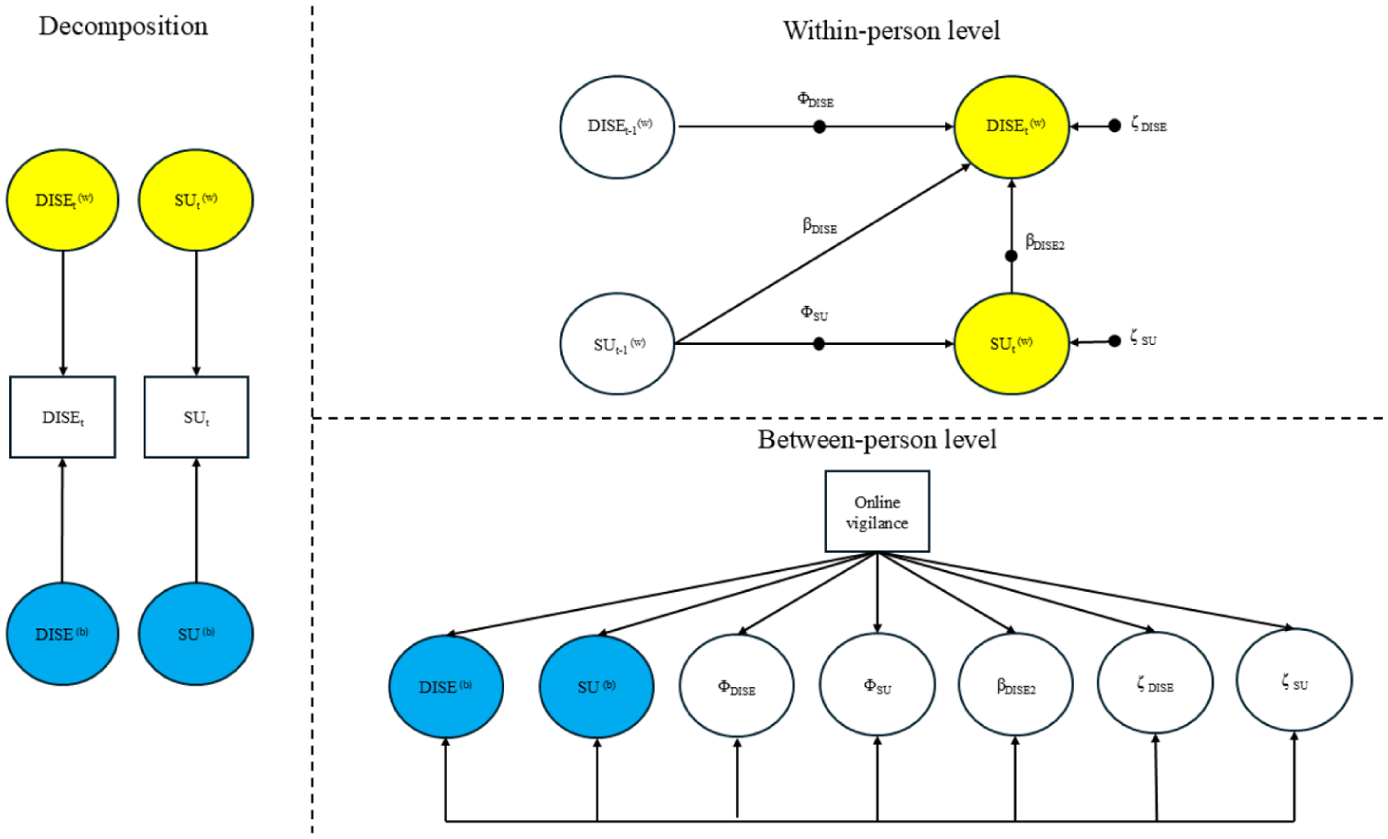
DSEM model visualization.
The findings were estimated using Bayesian Markov Chain Monte Carlo (MCMC) with Gibbs sampling. We conducted 25,000 iterations with eight chains, totaling 200,000 iterations. After discarding the first half of each chain as burn-in and using a thinning rate of 10 iterations (saving 1 in 10 iterations), our results are based on 10,000 iterations. We adopted default noninformative flat priors. Time was defined relative to the sample, with the first measurement of the entire sample set as T0 (Driver et al., 2017). The time variable was expressed in hours, with minutes rounded. We implemented the Kalman filter with the TINTERVAL option set to 3 hours, dividing days into eight blocks of 3 hours each. For imputing missing values, we used the default MCMC setting, which involves sampling a missing value at a specific measurement point from the conditional posterior distribution of that measurement, and considering other data in the series and various model parameters (Asparouhov et al., 2018; Hamaker et al., 2018).
The final model showed no convergence issues because the potential scale reduction (PSR) factor was below 1.10 (Asparouhov and Muthén, 2010). Visual inspections of Bayesian posterior parameter trace plots, distributions, and autocorrelation plots for each parameter showed no trends, spikes, or large irregularities. The median of the posterior distribution was used for point estimates, and 95% Bayesian credibility intervals were established with posterior quantiles. Standardized parameter estimates were utilized to evaluate the strength of cross-lagged associations, following the “within-person standardization” method by Schuurman et al. (2016), which involves standardizing all of the parameters per person first and then averaging them. Cross-lagged effect sizes were interpreted using guidelines by Orth et al. (2022), where effect sizes of .03 were considered small, .07 medium, and .12 large. Preprocessed data, all syntaxes, outputs (including diagnostic plots), and supplementary files are available online: https://osf.io/64shd/.
Results
Descriptive statistics
Comprehensive descriptive statistics are provided in Table 1. Intraclass correlations (ICCs) indicated that 31% of the variance in stress and only 13% of the variance in SU are due to stable differences between individuals over time. These intraclass coefficients across all target outcomes highlight the importance of investigating within-person associations.
Descriptive statistics of the variables used.
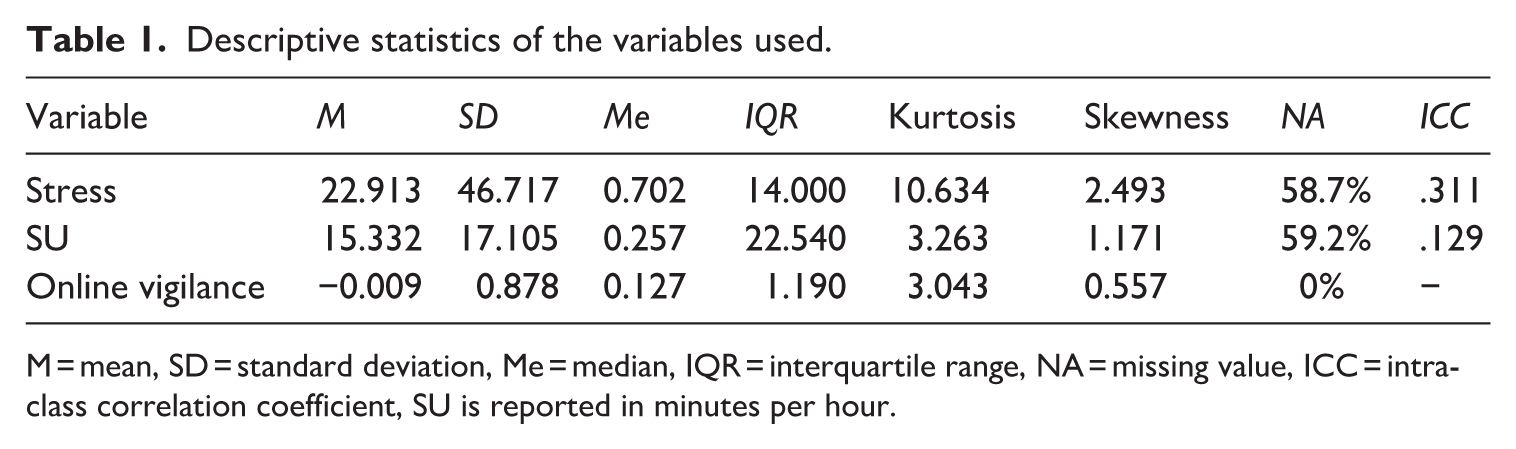
M = mean, SD = standard deviation, Me = median, IQR = interquartile range, NA = missing value, ICC = intraclass correlation coefficient, SU is reported in minutes per hour.
Within-person effects
Table 2 provides an overview of the within-person estimates. The within-person effects are crucial for answering whether SU has a stress-buffering (H1b) or stress-inducing (H1a) role (RQ1a/b). At the within-person level, the results showed a significant positive contemporaneous effect for SU on stress with a small effect size (b = .03), suggesting that participants who had spent more time than usual using the smartphone an hour prior perceived slightly more stress. Therefore, we found evidence for the immediate stress-inducing hypothesis (H1a, RQ1a). On the other hand, we found no evidence for a dynamic cross-lagged effect for SU at T − 1 on stress at T (b = −.01), as this effect was not only negligible, but its Bayesian CIs contained zero. Hence, we found no support for either the dynamic stress-buffering (H1b) or dynamic stress-inducing (H1a) role of SU (RQ1b).
Within-person estimates.
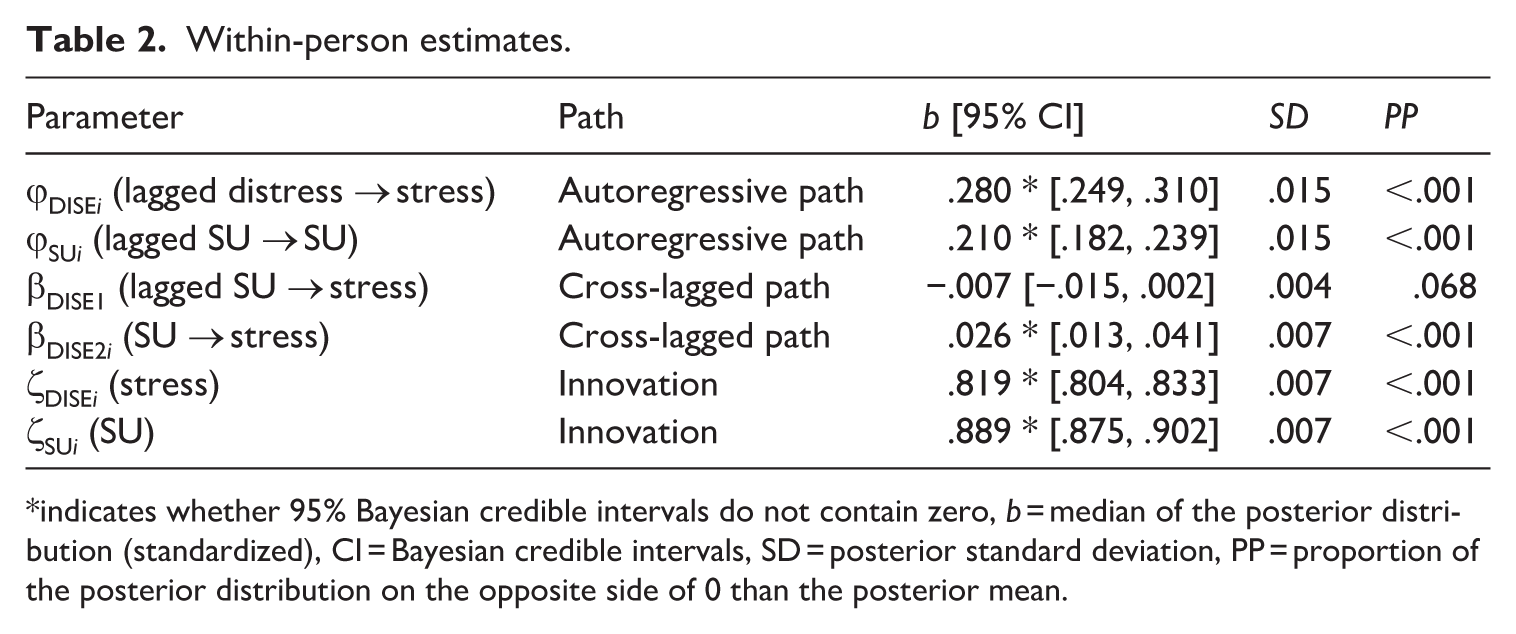
indicates whether 95% Bayesian credible intervals do not contain zero, b = median of the posterior distribution (standardized), CI = Bayesian credible intervals, SD = posterior standard deviation, PP = proportion of the posterior distribution on the opposite side of 0 than the posterior mean.
Furthermore, we found that both autoregressive paths showed relatively large effect sizes, which highlights the dynamic relationship between past and future levels of the measured variables. The significant inertia for both stress (b = .28) and SU (b = .21) suggests that changes in earlier measurements are strongly associated with changes in the subsequent measurements. In addition, the random innovation indicated a large dynamic error for both stress (b = .82) and SU (b = .89), implying that individual, unmeasured circumstances primarily drive within-person variability in these variables.
We also explored the person-specific effects of the significant contemporaneous effect of SU on stress. Given the low variance in the dynamic effect of SU on stress, this was possible only for a contemporaneous effect. Compared to the dynamic effect, the contemporaneous effect had a random slope, although its variance was still relatively low (σ² = .003). We found that a positive effect was observed in the vast majority of participants (N = 159, 86.4%), while only 13.6% (N = 25) of the participants showed the opposite effect. However, only 33 participants (17.9%) demonstrated an effect with Bayesian confidence intervals that did not include zero, thus indicating statistical significance. Specifically, three of these participants exhibited particularly large effect sizes (bs > .20), which were much larger compared to the average within-person effect (b = .03).
Between-person associations
In addition to the within-person associations, we explored between-person associations without specific expectations or research questions.
At the between-person level, no correlation between SU and stress was found (b = .05); participants who generally spent more time on their smartphones did not report experiencing more or less stress overall compared to those who spent less time. However, participants who generally experienced higher stress exhibited greater stress inertia (b = .32) and a larger dynamic error related to stress (b = .61). This means that participants who generally experience higher stress tend to have increasing stress levels over time, but their stress is more influenced by unmeasured factors, such as random events, leading to greater unpredictability. Similarly, participants who spent more time on smartphones showed a larger dynamic error in their SU (b = .64) but lower SU inertia (b = −.33), meaning their SU was less consistent throughout the day. The larger dynamic error suggests that their SU was more affected by unmeasured factors. Interestingly, the immediate effect of SU on stress was smaller for these participants (b = −.45), suggesting that, while participants who spend more time on their phones (but do so less consistently), their SU has a smaller impact on their stress levels compared to those who spend less time on SU (but do so more consistently). These SU patterns are further reflected in the association between SU inertia and the larger immediate effect of SU on stress (b = .26).
It is important to highlight that the immediate positive effect of SU on stress was strongly negatively linked to the unexplained, momentary variation in SU (b = −.94). This means that for participants who showed a stronger immediate increase in stress after using their smartphones, the changes in their SU were more predictable by the measured variables and less influenced by random fluctuations. Furthermore, we found that the inertia of SU—where current SU depends on prior use—was negatively associated with dynamic error (b = −.33). Together, these findings suggest that higher inertia in SU is linked to greater consistency in SU, resulting in a smaller dynamic error. The rest of the associations were insignificant (see Table 3).
Correlations at the between-person level.
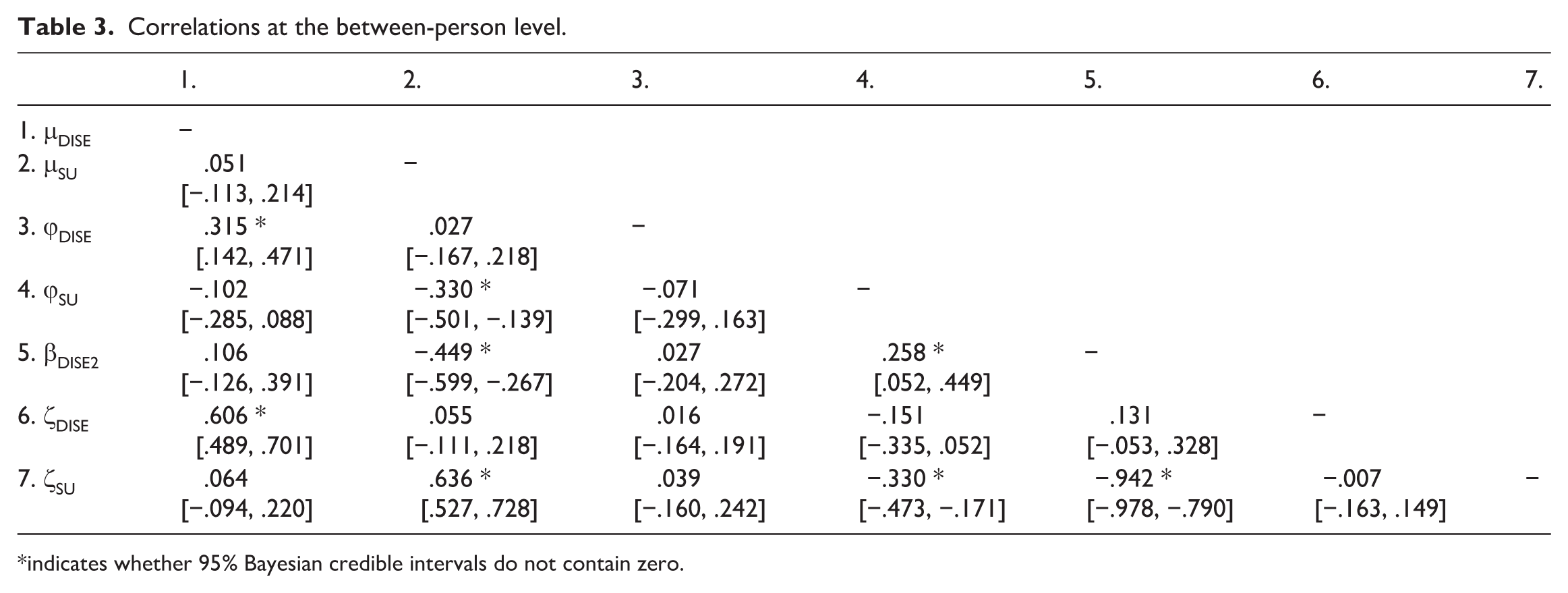
indicates whether 95% Bayesian credible intervals do not contain zero.
Effects of online vigilance
We examined the effects of online vigilance to address whether adolescents with higher online vigilance generally perceive more stress (H2a) and whether SU is more stress-inducing for these adolescents (H2b). H2a was explored using online vigilance as a time-invariant predictor, and H2b via cross-level interactions.
Online vigilance was not associated with random intercepts, random slopes, or random residual variances. This suggests that the effects of online vigilance were consistent across individuals with varying levels of online vigilance (see Table 4 for results). Consequently, we did not find evidence that online vigilance amplifies the effect of SU on stress. H2a and H2b were not supported.
Effects of online vigilance.
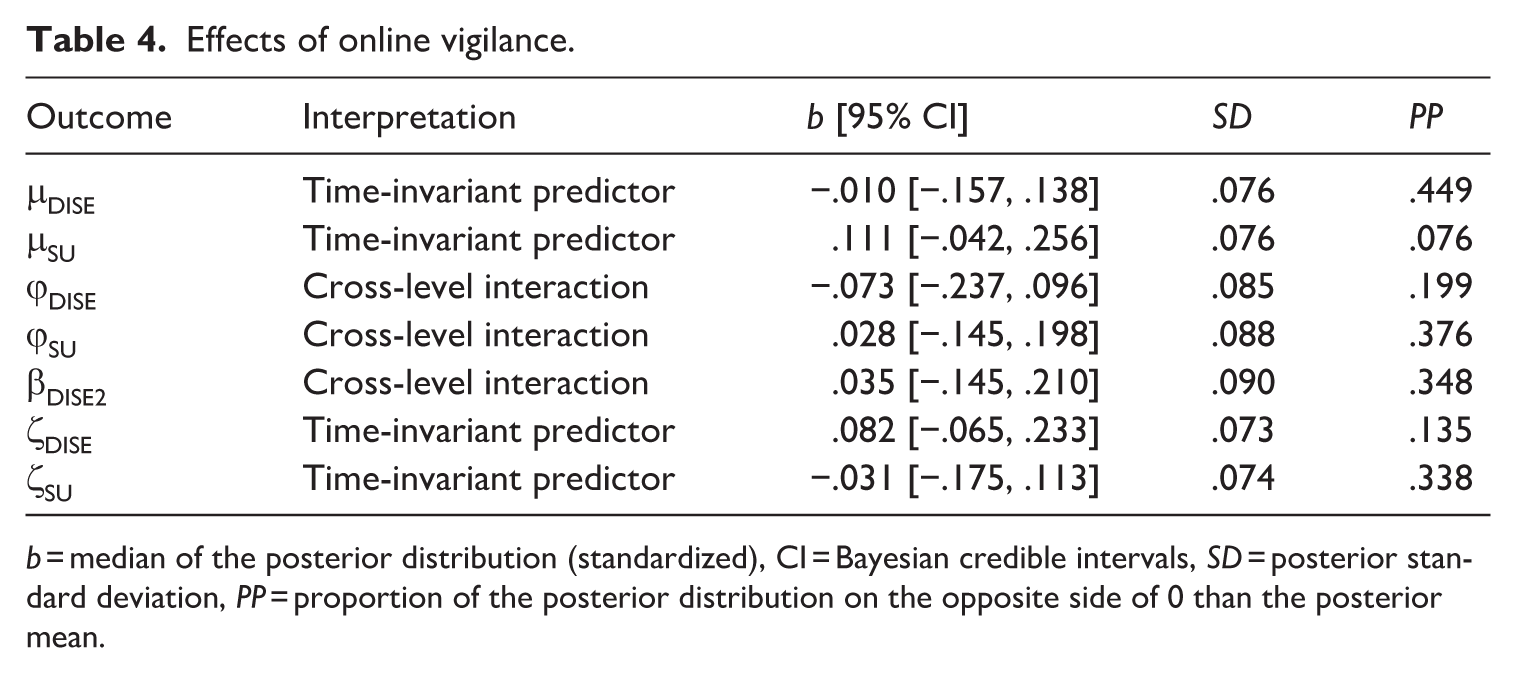
b = median of the posterior distribution (standardized), CI = Bayesian credible intervals, SD = posterior standard deviation, PP = proportion of the posterior distribution on the opposite side of 0 than the posterior mean.
Given that we found no effect of online vigilance, we additionally explored only the salience factor of online vigilance in a separate DSEM model. Since prior research (Freytag et al., 2021; Gilbert et al., 2022) indicated that the salience subfactor of online vigilance may play a key role in the examined variables and their associations, rather than the second-order online vigilance factor or the other two subfactors, we reanalyzed the DSEM model using only the salience subfactor (based on the factor scores). However, similar to the results reported above, salience was not associated with random intercepts, random slopes, or random residual variances. The full output can be found on OSF (https://osf.io/64shd/).
Discussion
In spite of the far-reaching consequences of stress on well-being (Jost et al., 2023), it is currently still unclear whether adolescents’ smartphone screen time is stress-inducing (Vahedi and Saiphoo, 2018) or stress-buffering (Duvenage et al., 2020; Scott et al., 2023). Building on the transactional theory of stress (Lazarus and Folkman, 1984) and the assumption of conditionality of media effects (Valkenburg and Peter, 2013), our study was the first to address this issue using trace data and experience-sampling data in adolescents. In line with the DSMM (Valkenburg and Peter, 2013), we found that the relationship is indeed conditional, as SU was neither stress-inducing nor stress-buffering for most adolescents.
The stress-inducing role of smartphone use
First, we found that for most of our sample, time spent on smartphones is not stress-inducing (H1a, RQ1a). Upon closer inspection, the effect was statistically significant, with a small effect size, for approximately 20% of adolescents. Within a small subgroup of three participants, the effect was particularly strong. Despite earlier evidence among adolescents (Duvenage et al., 2020; Modecki et al., 2021), we found no group of adolescents for which SU was stress-buffering (H1b). Research on SU and stress in adolescents is scarce, mixed, and cross-sectional (Nagata et al., 2022; Woo et al., 2021), yet the mechanisms of displacement and interruption suggest how time spent using smartphones might be stress-inducing (Kushlev and Leitao, 2020). With regard to the DSMM theory (Valkenburg and Peter, 2013), we found that the effect of time spent using smartphones on stress is conditional, as we found a negligible negative effect of SU on stress for 20% of the sample and no effect for the rest. Importantly, the stress-inducing effect highly depends on contextual factors, such as the pattern of spending time using a smartphone, particularly consistency (inertia) of use during the day, rather than the net effect of overall time spent using smartphones.
We found that smartphones were more stress-inducing for adolescents with less overall time spent on smartphones and higher consistency in their usage throughout the day. In contrast, adolescents who spent more time on smartphones but used them less consistently throughout the day reported lower stress levels. This is an important and novel finding, as it highlights that the regularity of SU during the day, rather than total screen time, plays a critical role in stress. We speculate that the consistency of SU may cause more consistent interruptions of other activities throughout the day, which may be stress-inducing.
Our findings suggest that the impact of SU is not universal but rather contingent on specific usage patterns. In line with existing research (Valkenburg et al., 2021), we see that the nature of smartphone usage, particularly its consistency, is as important as the general time spent using them. This also aligns with the IM3UNE model (Schneider et al., 2021), which proposes that SU under specific conditions may exhaust or satisfy basic psychological needs, impacting well-being, including stress.
We speculate that the crucial role of inertia in SU patterns may be due to the cumulative effect of regular interruptions that disrupt an individual’s sense of control, which calls again for simultaneous investigation of multiple SU indicators. Alternatively, it could be related to a tendency for dependence on smartphones, where individuals who use them regularly may experience stress when this constant connectivity is disrupted.
Our results suggest that a considerable amount of within-person variance in SU and perceived stress can be attributed to unmeasured characteristics that may be situational and trait-level. This finding supports recent systematic evidence that most variance in media use is situational (Schnauber-Stockmann et al., 2024). The SU is characterized by a highly individualized environment (Otto and Kruikemeier, 2023), resulting in usage episodes with bursts of activity that may differ for each individual. Future research should focus on two aspects in relation to SU and stress: (a) smartphone features and (b) individual characteristics. Regarding smartphone features, we operationalized SU as time spent using a smartphone, which may impact stress levels negatively by time displacement, interruptions, or positively by complementing other activities (Klingelhoefer et al., 2024; Kushlev and Leitao, 2020). However, adolescents also identify other stress-inducing features, such as information overload, amount of communication, or interruptions of SU (De Groote and Van Ouytsel, 2022; Huang et al., 2022). Here, platform and application design may play a role, since they are often designed to capture users’ attention and maximize their screentime (Weinstein and James, 2023). Future research could also examine various types of SU, including active and passive social media use. A recent meta-analysis revealed that both types of use are more often associated with increased, rather than decreased, stress levels (Godard and Holtzman, 2024). In adolescents, passive social media use has been linked to increased stress in both qualitative and quantitative research (Roberts and David, 2023; Winstone et al., 2022). As for individual characteristics, research suggested that online vigilance may play a prominent role, but we found no role for this variable on the trait level. Recent research suggests that online vigilance may also vary on a situational level (Freytag et al., 2021; Gilbert et al., 2022), which could more closely reflect the dynamic relationship between SU and stress, as theorized in the stress-appraisal theory (Lazarus and Folkman, 1984). Furthermore, online vigilance may induce stress via other smartphone affordances, such as communication load (Freytag et al., 2021), rather than the amount of screen time.
Next, we explored whether an increase in smartphone screen time is associated with a decrease (H1b) or an increase (H1a) in perceived stress at the next measurement occasion (RQ1b). We found no effect. In line with the stress-appraisal theory (Lazarus and Folkman, 1984) and empirical evidence (Duvenage et al., 2019), our results contribute to the theoretical notion that the effect of time spent on smartphones on stress is momentary and does not carry over to the next measurement occasion. That is an important finding because previous studies have focused on the link between SU and stress in varying time frames (Duvenage et al., 2020; Shi et al., 2023; Wolfers et al., 2023), and we are the first to compare the immediate and lagged effects. The results of our study corroborate the theoretical assumption that the relationship between stress and SU is best theorized as momentary.
As an additional exploration, we examined the associations on the between-person level. We found that adolescents who spent more time using their smartphones than their peers did not experience more stress. Our results add to the mixed findings of previous cross-sectional studies among adolescents: one found that higher stress was associated with higher SU (Nagata et al., 2022), and another found no effect of SU on stress for participants whose screen time did not exceed 4 hours a day. Only for participants who exceeded this threshold was SU stress-inducing (Woo et al., 2021). As our within-person results show, both time spent using smartphones and the pattern of SU seem to be important in relation to perceived stress, perhaps due to displacing or interrupting other activities (Kushlev and Leitao, 2020). Future research should, therefore, focus on other indicators of SU, such as consistency and related individual factors, to better understand what subgroups of adolescents are at risk of perceiving stress from SU.
The role of online vigilance
Contrary to the evidence of the relationship between stress and online vigilance (Reinecke et al., 2018; Steele et al., 2019), we found that online vigilance was not associated with higher overall perceived stress (H2a) and did not interact with the relationship between SU and stress (H2b). However, recent experience-sampling studies (Freytag et al., 2021; Gilbert et al., 2022) suggest a more nuanced role for online vigilance in the relationship between SU and stress. In the study of Gilbert et al. (2022), only the salience dimension of online vigilance directly predicted stress, and the two remaining dimensions, reactibility and monitoring, predicted stress only indirectly via communication load (Gilbert et al., 2022). Similarly, Freytag et al. (2021) found a mixed role for online vigilance across their three studies, with only the salience dimension emerging as directly predicting stress. Interestingly, the effect of the reactibility and monitoring dimensions disappeared after including the salience dimension. Freytag and colleagues suggest that each dimension could be prominent in different situations, which means that online vigilance consists not only of a time-invariant trait, but also a momentary state component. We propose that the stress-inducing potential of online vigilance is dynamic and may change based on the smartphone features (e.g. individuals prone to reactibility experience stress when they receive more notifications than usual). Future research should measure online vigilance as a momentary variable and interconnect its dimensions with different approaches to SU and individual traits, such as needs suggested by the IM3UNE model (Schneider et al., 2021).
Limitations and avenues for future research
This study focused on time spent using smartphones, which does not allow for distinguishing different types of activities (e.g. usage of specific apps) or types of use (e.g. active versus passive scrolling). Future research should aim to complement screen time data with this information and other smartphone features, such as the number of notifications or smartphone pickups. Next, we did not measure coping and different coping strategies. While this allowed us not to restrict ourselves to specific strategies, as people may employ several coping strategies that complement each other and interact in various ways (Lazarus, 2000), we could not assess whether a coping strategy was enacted. We included online vigilance as a time-invariant variable. A recent study shows that online vigilance may vary momentarily (Gilbert et al., 2022). Including online vigilance and other variables as time-varying moderators would help understand the momentary situational factors surrounding the relationship between SU and stress. Furthermore, the online vigilance scale had to be adjusted to perform adequately, likely because it was not specifically developed for adolescents. Although we cognitively tested the scale and adjusted selected items to better fit the target population (e.g. by adding examples of online content), adolescents may experience online vigilance qualitatively differently from adults, whose greater responsibilities and work-related expectations for constant connectivity may amplify vigilance (Sonnentag, 2017).
Conclusion
The goal of this study was to examine whether SU is stress-buffering or stress-inducing. Our study contributes to media effects theories by showing that the relationship between time spent using smartphones and perceived stress is conditional (Valkenburg and Peter, 2013) and the variance in SU and perceived stress amounts to situational factors at the within-person level rather than to between-person differences (Schnauber-Stockmann et al., 2024). Our findings are important for stress research as we show that SU impacts perceived stress momentarily and does not have effects that carry over several hours. We found that for most adolescents (80%), smartphone screen time was neither stress-inducing nor stress-buffering. Interestingly, for those who experienced negligible stress-inducing effects, not only time but also the pattern of SU was related to perceived stress: adolescents who used smartphones more consistently throughout the day were more stressed, perhaps due to more consistent interruptions of other activities throughout the day (Kushlev and Leitao, 2020). Therefore, the focus of parents, educators, and policy-makers should be on the patterns of usage (e.g. limiting checking behavior) and navigating smartphone stress with regard to the permanently online, permanently connected (Vorderer et al., 2018) society in which we live. A promising solution could be guiding adolescents to use smartphones intentionally, with the aim of recognizing the conditions under which they are stressful and promoting effective coping behaviors. Such media literacy exercises have been shown to be helpful in increasing adolescents’ overall well-being in relation to social media and smartphone application use (Stevic and Liu, 2025). Given that platforms and applications are often designed in ways that promote checking behavior and consistent use throughout the day (e.g. social media notifications that are designed to “pull” users in; Weinstein and James, 2023), with maximizing user screentime (e.g. providing endless content that is tailored to each individual; Weinstein and James, 2023). Both of these mechanisms (consistency and time spent using smartphones) were associated with higher stress in this study. Thus, we need to adopt policies that would encourage designers of applications and platforms to incorporate safer features. For example, checking behavior may be reduced by allowing batching of notifications (Fitz et al., 2019) and screen time through a less personalized feed (Dekker et al., 2025).
Footnotes
Ethical considerations
This study was approved by the Masaryk University Research Ethics Committee (approval no. EKV-2018-068). Both participants and their caregivers gave written consent prior to participating in this study.
Data availability statement

Declaration of conflicting interests
The authors declared no potential conflicts of interest with respect to the research, authorship, and/or publication of this article.
Funding
The authors disclosed receipt of the following financial support for the research, authorship, and/or publication of this article: This study was supported by the project “Research of Excellence on Digital Technologies and Wellbeing CZ.02.01.01/00/ 22_008/0004583,” which is cofinanced by the European Union. Data collection was supported by the Czech Science Foundation under Grant No. 19-27828X (Project FUTURE).