



Abstract
The rapid rise of streaming platforms has transformed how people consume video and audio content, yet little is known about how this shift affects news use. While prior work emphasizes social media’s role in shaping news consumption, the move from linear broadcasting to streaming introduces technological logics that may reshape opportunities for news exposure. This study examines those who use streaming entertainment more often than linear TV and radio, tests whether they are less likely to encounter news incidentally and asks whether they compensate via streaming platforms. Using nationally representative surveys from the United Kingdom and Brazil, we find that greater relative streaming use is associated with lower incidental exposure and lower traditional news use via TV and radio. It is, however, linked to higher news use on YouTube, but not through podcasts. These patterns, alongside streaming’s popularity among younger audiences, suggest it may reinforce age-related divides in news engagement.
Introduction
Streaming technologies have been widely adopted both for video (e.g. Netflix, Amazon Prime or other nation-specific platforms) and for audio (e.g. Spotify, Apple music) (Edison Research, 2023; Nielsen, 2024). The rise of streaming has come at the expense of time spent on linear broadcasting (Yamatsu and Lee, 2023), particularly when it comes to news and information seeking (Leiner and Neuendorf, 2022). The academic literature has long highlighted in the past how important linear broadcasting is for levels of political knowledge among the audience (e.g. Aalberg et al., 2010), especially among those with low interest in news (Prior, 2005), raising potential concerns for those who choose streaming over linear content.
Until now, scholars who are interested in news consumption in this complex digital media environment have been almost exclusively focused on the role of social media in encouraging or limiting news consumption frequency, particularly through incidental news exposure (INE) (e.g., Fletcher and Nielsen, 2018; Thorson, 2020). This focus is understandable, given that social media platforms are central to how people spend their time online and are often seen as key gateways to news encounters (Newman et al., 2025). However, comparatively little is known about the rapid transformation of audio and video consumption, especially the shift from linear formats such as broadcast television and radio towards streaming-based platforms. This change in media structures (Webster, 2009) can not only change the ways in which audiences allocate their attention but may also have important implications for the likelihood, contexts, and mechanisms of incidental news exposure – potentially reshaping patterns of news discovery in ways that are still not well understood. While the field is focused on the shift to social media, the present study addresses the disruption to legacy TV and radio as news outlets uniquely brought about by streaming services in particular.
Building on this gap, it is important to recognize that the shift from linear TV and radio to streaming is not merely about accessing similar content in a new format, but instead involves structures with distinct technological architectures and logics. Streaming offers flexibility in time, location, and device use (Leiner and Neuendorf, 2022), and its content is curated algorithmically rather than broadcast to all equally. This algorithmic curation gives streaming platforms significant control over what users see (Lüders et al., 2021), with recommendation systems reflecting promotional strategies rather than pure user preferences (Morris and Powers, 2015). These fundamental differences, along with the vast increase in available video and audio content (including news), underline the importance of studying (incidental) news exposure via streaming, starting with profiling those who prefer streaming over linear options.
In this study, we examine whether individuals who prefer streaming video and audio entertainment over linear TV and radio are less likely to incidentally encounter news on these traditional platforms. In addition, we explore whether a relative choice for streaming entertainment might lead to an increase in their overall news consumption, given the prevalence of news content via podcasting and YouTube. Podcasts are now widely used across platforms, and a sizable minority in many countries use them for news (Newman et al., 2025). YouTube is now used more frequently on smart TVs rather than on mobile and desktop devices (Mohan, 2025). These developments raise several important questions: Are audiences who favour streaming entertainment also more likely to consume news via podcasts or platforms like YouTube? And finally, do these shifts in consumption patterns disproportionately affect particular audience segments more than others?
Our analyses of two nationally representative surveys from the United Kingdom and Brazil show that (a) individuals who spend more time on streaming than on linear audio and video are less likely to be incidentally exposed to news on TV. Furthermore, (b) spending more time streaming than consuming linear entertainment is also negatively associated with TV and radio news use frequency. However, (c) relative video streaming use does translate into higher levels of news use via YouTube, but (d) relative audio streaming use does not translate into higher levels of news consumption via podcasts. Last, (e) streaming is much more popular among younger audiences, potentially increasing age-related news consumption gaps. These findings are strikingly similar between the United Kingdom and Brazil, two countries with different levels of digitalisation, suggesting that the relationship between streaming use and news exposure may be consistent across diverse media environments.
The remainder of this article proceeds as follows. First, we review the literature on incidental news exposure and the rise of streaming technologies. Next, we outline our hypotheses and research questions. We then describe the data and methods used in this study, followed by a presentation of the results. Finally, we discuss the implications of our findings for understanding news exposure in an increasingly complex and streaming-dominated media environment.
Literature review
(Incidental) news consumption
Research on high-choice media environments has suggested that they can exacerbate inequalities between those who are interested in news and those who are not: individuals who prefer entertainment over news are more likely to disengage from news when presented with a wider array of options (Prior, 2005). Prior’s study focused on the rise of cable TV in the United States and the effects of increased channel choice on news consumption. Since then, the number of media options both for news and entertainment has grown dramatically (e.g., Neuman et al., 2012). In light of this expansion, scholars have increasingly examined the extent to which people encounter news in high-choice environments, such as social media platforms.
Building on research on high-choice media environments, studies of news exposure in digital contexts have predominantly focused on incidental news exposure (INE), defined as exposure to news that is ‘not initiated by users but instead occurs incidentally as a by-product of other activities’ (Schäfer, 2023: 242). INE has rarely been studied in offline environments, like television (Baum, 2011). Instead, the vast majority of research has examined news exposure via social media (Fletcher and Nielsen, 2018; Goyanes, 2020; Heiss et al., 2020; Weeks et al., 2017; for a review, see Schäfer, 2023). The extensive focus on social media is justified: amid consistent drops in news use for offline sources, online news sources continuously grow across various countries, particularly for video platforms like TikTok and YouTube (Newman et al., 2025). Nevertheless, entertainment content still dominates audience attention. For instance, UK and US users spend, on average, only about 3% of their online time consuming news (Fletcher et al., 2020; Hindman, 2018).
The vast literature on social media use and incidental news exposure has produced mixed findings, showing that it can have both positive and negative outcomes. Some studies have found that using social networking sites for entertainment can actually increase incidental news exposure (Ahmadi and Wohn, 2018; Goyanes et al., 2023; Heiss et al., 2020; Lu and Lee, 2019). Conversely, other research has found that social media use either does not predict incidental news exposure (e.g., Lee and Kim, 2017), is negatively associated with offline and online news consumption (e.g., Park and Kaye, 2020), or that it is correlated with news avoidance (e.g., Marcinkowski and Došenović, 2021). These mixed results may in part reflect the algorithmic design of social media platforms, which tend to filter out news for users deemed uninterested in it (Thorson et al., 2021). Similar algorithmic logics are applied to streaming services, raising important questions about how these platforms may shape news exposure.
While most research on INE is focused on digital platforms, people still get (incidentally) exposed to news through their TV and radio devices. According to the 2024 Reuters Institute Digital News Report, 55% of respondents across 47 countries get news from their TVs and 23% do so through radio (Newman et al., 2024). In fact, Barnidge (2020) found that respondents in the United States reported more incidental exposure through traditional media (TV and radio) rather than social media. Palmer and Toff (2024) also find evidence of strong ‘pre-digital’ incidental exposure οn TV among their interview respondents in an even higher-choice TV environment: ‘Respondents described brushes with news on broadcast or cable television, despite mainly relying on streaming services’ (p. 762). These studies highlight the importance of examining incidental news exposure beyond social media platforms, particularly given that TV and radio environments have themselves undergone rapid changes.
The changing TV/radio environment
While audiences increasingly turned to social media, there were also radical changes in how people consume music, movies, and TV series. First, linear opportunities increased. Consumers can now be exposed to hundreds of broadcasters on their linear TV, catering to different interests. The free linear TV environments now in countries like the United Kingdom offer more than 100 choices for consumption that cater to various forms of entertainment and news (Freeview, 2025; Newman, 2011), resembling the Cable TV environment of the United States during Prior’s study, which focused on a high-choice environment (Prior, 2005). However, despite the proliferation of sources in the linear environments, linear TV audiences still congregate around the few large legacy networks: in July 2025, at any given point, 48% of British linear TV users were consuming only five channels: BBC1, BBC2, ITV1, Channel 4, and Channel 5, which contain a typical mix of entertainment and current affairs programming, as well as infotainment programming (BARB Audiences Ltd., 2025). While all these legacy brands have other specialized options for news or entertainment (e.g. ITV4 for sport or BBC News), their individual shares are very small (BARB Audiences Ltd., 2025). In addition, scholarly work has demonstrated strong inheritance effects in channel choice, meaning that people tend to stay on the same channel (including what was on when they turned on their TV), rarely switching during a television watching session (Kim and Viswanathan, 2015). Importantly, paying for content – as one typically does with streaming services – is another strong indicator of content choice, with people rarely moving from paid to free content (Kim and Viswanathan, 2015). Thus, incidental news exposure remains possible for most linear TV audiences (Andersen et al., 2019), either through stumbling upon news while watching one of the ‘large’ broadcasters, or by zapping through a specialized 24-hour broadcaster.
At the same time, streaming technologies became central to visual and audio media consumption, offering virtually unlimited entertainment choices. Netflix and other video-on-demand (VOD) services have hundreds of millions of subscribers, with country-specific platforms of national broadcasters also becoming central players in the industry. The rise of video streaming services started in the mid-2010s in many countries, with the COVID-19 pandemic becoming a catalyst for more people subscribing to VOD services (Grece, 2021). Nielsen ratings now suggest that streaming accounts for almost 40% of TV use in the United States, far surpassing cable (27%) and linear (23%) TV use (Nielsen, 2024).
Audio consumption, and most prominently music, has also radically changed, first through the explosion of Spotify as a music subscription service, but also with the entrance of newer players like Apple Music. Market research suggests that 75% of US adults listened to streaming audio in a given month in 2023, up 27 percentage points since 2018 (Edison Research, 2023).
The change from linear to streaming technologies reflects a difference in media structures. Webster’s (2014) application of Giddens’ structuration theory to audiences, suggests that analysing the interaction of broader media structures and media user agency can help us understand media selection in the current media environment. An important dimension of media structures is whether they are ‘open’ or ‘closed’. Digital technologies are often seen as open – allowing people to be exposed to cross-cutting content in terms of tastes, genres, or ideology. However, others see digital technologies as more ‘closed’ where people are exposed to content that is recommended to them because the algorithm suggests that it fits their taste (Pajkovic, 2022). A second dimension is related to audience preferences. Where do audience preferences come from? Many of these preferences are ‘exogenous’, coming from how the audience’s pre-existing interests in or needs for different types of content. However, Webster (2014) further highlights ‘endogenous preferences’: preferences that are not produced by the user but are ‘produced by the system itself’ (p. 136). These endogenous preferences could be made through an intersection of recommendation algorithms and a form of content advertising. Audience platform preferences are thus shaped by outside factors such as availability and access, social context, and embeddedness in other media, developing media repertoires beyond mere interest in one form or another (Taneja et al., 2012). A structuration perspective uncovers how media use is shaped by myriad cultural factors, such as language and geographic similarities (Taneja and Webster, 2016), which streaming services may take advantage of by pushing algorithmically curated content based on these factors rather than audience interest.
Linear TV and radio can introduce people to content they have not asked for, shaping their content preferences. However, the media structure of streaming technologies follows a different logic than broadcast television and radio, and could shape ‘endogenous preferences’ in different ways. Lüders et al. (2021) discuss the abundance of choice in the streaming environments in light of the significant agency that streaming platforms have in guiding users towards specific content. However, Morris and Powers (2015) highlight that in these systems control manifests itself partly through recommendation algorithms who are not some ‘objective’ reflection of an individual’s taste but reflect promotional priorities of the service. Pajkovic (2022) also found that the Netflix recommendation system does not reproduce one’s ‘pure taste’ but ultimately aims to retain users on the platforms by personalising the aesthetic experience of their home page, but ultimately recommends similar content to users with different tastes.
These differences in the logic of streaming compared with linear technologies, along with the dramatic increase in choices for video and audio entertainment, many of which include news-related content, underscore the need to examine incidental news exposure in the context of streaming. We begin by focusing on the profile of individuals who prefer streaming video and audio entertainment over traditional TV and radio offerings.
Despite this radical change in how people consume video and audio, academic research has paid little attention to the audiences of streaming. What traits are associated with those who prefer to consume streaming over linear audio and video? What are their characteristics in terms of age, gender, and socioeconomic background? The limited research on the profile of streamers suggests that in the United States, music streaming is more prominent among young audiences (Edison Research, 2023). In Norway, the most frequent users of video and audio streaming were younger and male (Lüders et al., 2021). These demographic patterns correspond in part with the Diffusion of Innovations Model (Rogers, 1962), which posits that early adopters of technology tend to be those with a high social status, openness to new ideas and a position as opinion leader in their communities. Furthermore, laggard adopters are typically older and more resistant to change, or less able to adopt new innovations (Rogers, 1962), which suggests that older individuals and those with lower levels of education or income may be less likely to choose streaming services over linear TV. Given the limited and fragmented information on streaming audiences, we therefore pose a research question focused on profiling these users in greater detail, aiming to provide a clearer understanding of who is most likely to engage with streaming video and audio content.
RQ1. What demographic traits comprise the profile of those who prefer to consume streaming over linear (a) video and (b) audio entertainment?
Our second research question focuses on the news diets of individuals who prefer streaming over traditional broadcast entertainment. Specifically, are people who spend more time streaming television and audio less likely to encounter news via TV and radio? To our knowledge, the only empirical study addressing this question found that those who stream video content spend less time on current affairs programmes than users of linear television (Leiner and Neuendorf, 2022). This pattern may reflect both the limited presence of news on streaming platforms and the vast abundance of entertainment choices available through these services. Time constraints also play a role, as individuals who dedicate time to streaming entertainment cannot simultaneously consume linear TV or radio, which inherently limits their exposure to current affairs on these traditional platforms. Drawing on Leiner and Neuendorf (2022), as well as research on the rise of media choice and its effects on overall news consumption (Prior, 2005), we hypothesize that individuals who are using streaming more often than linear video and audio entertainment will be less likely to consume news from TV and radio.
H1. Relative use of streaming over linear entertainment is correlated with lower (a) TV and (b) radio news consumption.
We further examine the possibility that individuals who spend more time on streaming rather than linear programming for video and audio entertainment may be more likely to consume news through YouTube and podcasts, respectively. YouTube is currently the largest video streaming application in the United States (Nielsen, 2024), and the primary device for YouTube usage has shifted to television, surpassing both mobile and desktop devices (YouTube, 2025). The Digital News Report (Newman et al., 2025) further identified that 30% of their sample spanning 48 countries now uses YouTube to access news each week. Even though YouTube is an environment where news consumption is frequent, and it can be promoted through recommended systems (Yu et al., 2024), it is more often filtered out by algorithms designed to favour entertainment content in a self-reinforcing manner (Huang and Yang, 2024).
In addition to YouTube, audio platforms such as Spotify host numerous podcasts that feature prominently on homepages and in recommender systems. 1 According to the Digital News Report, nearly one in ten people accesses podcasts weekly, with audiences skewing younger and more highly educated (Newman et al., 2025). Looking more broadly at the podcast landscape as a site for both news and entertainment, research in the United States found that nearly half of all Americans listened to a podcast in 2022, and of these listeners, two-thirds reported that the podcasts they followed included news content (Shearer et al., 2023). The combination of narrative storytelling, current affairs reporting, and high production values has been identified as a key attraction, blending features of entertainment with news content (Nee and Santana, 2022). These characteristics are in part why podcasts like the New York Times’s The Daily are able to grow a bigger audience than their corresponding news website (Nee and Santana, 2022) and lead to a disproportionately high number of downloads on streaming sites like Spotify in relation to their amount of available content (Newman and Gallo, 2020). Based on these considerations, we ask whether news exposure via YouTube or podcasts can compensate for the reduced time spent consuming news on TV and radio.
RQ2. Is relative use of streaming over linear video and audio entertainment associated with higher news consumption through (a) YouTube and (b) podcasts, respectively?
However, streaming ‘on-demand’ environments may also increase news consumption through incidental exposure. For instance, streaming platforms operated by public service or commercial broadcasters, such as the BBC iPlayer or ITV News in the United Kingdom, are now widely available in many countries and include a range of current affairs programmes, from bulletins to talk shows like Newsnight. These platforms often feature news and current affairs content on their homepages alongside entertainment programming, providing opportunities for both incidental and intentional news exposure. In contrast, the less flexible architecture of linear TV, combined with a broader abundance of scheduled news programming, has traditionally been associated with higher incidental exposure, as viewers may encounter current affairs programming before or after their preferred entertainment shows (Baum, 2011). On streaming platforms, the combination of user control and algorithmic curation may reduce the likelihood of incidental news encounters compared with linear television. We ask this only for TV and not for radio given that audio streaming is usually taking place through mobile phone devices and not through radio devices, unlike TV devices which are used widely both for linear and streaming content. Given the limited research on streaming platforms and incidental news exposure, we therefore pose the following research question:
RQ3. Is the relative use of streaming over linear video entertainment associated with higher or lower incidental news exposure on TV?
Method
Data and country selection
This research draws from two three-wave panel surveys in the United Kingdom and in Brazil, collected by Netquest. Brazil and the United Kingdom are particularly interesting contexts, as they both represent democracies with high penetration of digital news use, but different overall media systems and demographic and social inequality structures (Newman et al., 2024; UNDP, 2024). Furthermore, the prominence of public broadcasting services in the United Kingdom, perhaps best exemplified by the global presence of the BBC, is contrasted with Brazil’s limited public broadcasting service, which has been characterized by its ‘fragility’ and weak presence compared to commercial media in the country (Santos, 2024). In terms of their similarities, both Brazil and the United Kingdom have very strong streaming penetration compared to other countries, as suggested by industry projections (Advanced Television, 2025).
The study has received ethical approval from the Vrije Universiteit Brussel and the European Research Council. The surveys were fielded through the online panel company Netquest between November and December 2024, with approximately 1.5 weeks between waves. The number of valid responses for the United Kingdom was 1,034 for wave 3, while there were 1,248 respondents in wave 1, reporting an 82.8% retention rate. In Brazil, we had 1,552 respondents in wave 3, down from 1,998 respondents in wave 1, a 78% retention rate. The non-probability sample was collected via respondents enrolled in the Netquest online panel; respondents sampled in the first wave were targeted to meet demographic quotas that included an intended over-sampling of underprivileged groups (e.g., lower education, lower income). While Netquest attempted to meet representative demographic quotas in each country, our sample is reflective of most online samples in that it is slightly over-representative of older, middle/high income, and higher educated people in the population. In the supplementary materials, we have included a description of the demographics of the samples, and variable statistics are also included in the controls section below.
Measures
Relative use of streaming over linear entertainment
To measure the use of streaming over linear audio and video entertainment, we asked respondents in the United Kingdom and in Brazil the following question: ‘In the past week, how frequently did you consume entertainment content (e.g., music, movies, TV series) from the following sources or streaming services?’ The question was adapted from Leiner and Neuendorf (2022). In the responses we asked about television and streaming video services, as well as radio and streaming audio services. In brackets we used examples both from global services (e.g. Netflix or Spotify) and from national services (e.g. BBC iPlayer in the United Kingdom or Globoplay in Brazil). Respondents could choose their frequency of use on a 5-point Likert-type scale ranging between (1) ‘Never’ and (5) ‘Multiple times per day’. Both questions were asked in the second wave of our survey.
We then constructed the variables of relative use of streaming over linear by dividing each of the two streaming variables by the two linear variables. We opted for a measure of relative use over absolute frequency because frequent streaming users could also frequently use linear TV and radio. With this variable, higher scores indicate a greater relative use of streaming (highest possible score of 5 [5 – multiple times per day streaming/1 – never linear]) and lower scores indicating more relative use of linear (lowest possible score of 0.20 [1 – never streaming/5 – multiple times per day linear]), with exactly equal use given a score of 1 (e.g. 3 – a few days of the week streaming/3 – a few days of the week linear). These variables (relative use of audio streaming and relative use of video streaming) share a slight but weak correlation, r = .30. For relative use of video streaming (M = 1.19, SD = 1.01), we found that 25% prefer to spend their time with streaming television, 38% with linear television and 37% had somewhat equal use of streaming and linear television. For relative use of audio streaming (M = 1.34, SD = 1.15), 30% prefer to listen to streaming audio, 31% prefer to listen to radio and 39% report similar frequencies between the two.
News use
To measure news use through TV, radio, YouTube and podcasts we asked: ‘In the past week, how often did you get news using the following channels? By news we mean national, international, regional/local news and other topical events’, following Newman et al. (2024). Respondents could choose their frequency of use on a 5-point Likert-type scale ranging between ‘Never’ and ‘Multiple times per day’ (TV, M = 2.90, SD = 1.44; Radio, M = 2.33, SD = 1.43; YouTube, M = 2.55, SD = 1.52; Podcasts, M = 1.80, SD = 1.2). In the analyses, we used measures of media use from wave 2, to correspond with when the streaming variables were asked. For a robustness check using an autoregressive model, we used wave 3 measures for news consumption while controlling for wave 1.
Incidental news exposure on TV
To measure incidental news exposure on TV, we asked, ‘Sometimes people encounter or come across news and information on current events, public issues, or politics when they may have been using media for a purpose other than to get the news. How often does it happen to you when you are watching TV?’. Responses ranged from ‘Never’ to ‘Very Often’ on a 1–5 Likert-type scale (M = 3.3, SD = 1.25). This question was adapted from Borah et al. (2022). Incidental news exposure on TV was asked during the second wave of the panel survey.
Controls
In our models, we included controls for age (BR M = 43.83, SD = 14.15; UK M = 53.25, SD = 13.12), gender (BR 48.55% women; UK 46.07% women), education (BR 49.1% have a college degree; UK 43.99%), income levels (BR M = 3.00, SD = 1.04, on a 5-point scale; UK M = 4.11, SD = 1.57, on a 7-point scale), and interest in news (BR M = 3.51, SD = 1.01; UK M = 3.31, SD = 1.19, on a 5-point scale). We also control for news use other than TV, radio, social media and podcasts for each model by using a number of news media use frequency variables including print (broadsheet, tabloid and local/regional), online news websites/apps, blogs and alternative news, and the other relevant news variables (e.g. radio, social media, and podcasts for news use when running a model where TV news use is the dependent variable): (1) Other News Use (No TV) (BR M = 10.37, SD = 7.18; UK M = 6.98, SD = 6.31); (2) Other News Use (No Radio) (BR M = 11.03, SD = 7.02; UK M = 7.41, SD = 6.17); (3) Other News Use (No Social Media) (BR M = 9.74, SD = 7.34; UK M = 7.13, SD = 6.25); and (4) Other News Use (No Podcasts) (BR M = 11.34, SD = 7.12; UK M = 8.32, SD = 6.23).
Results
To address our research questions and test our hypothesis, we ran a series of linear regression models, controlling for age, gender, education, income, and interest in news. Our first research question examines the profile of individuals who prefer streaming over linear video and audio for entertainment (Figure 1; Table A1 in the Supplemental Appendix). The results suggest that those who prefer video streaming over linear TV tend to be younger (β = −0.15, p < .001), more educated (β = 0.07, p < .001), have higher income (β = 0.06, p < .001) and are less interested in news (β = −0.12, p < .001). As shown in Supplemental Table A2, where regressions were run separately for the United Kingdom and Brazil, the associations with age and interest in news remain consistent across both countries. In contrast, relative audio streaming use over linear radio was associated only with younger age (β = −0.27, p < .001), a pattern that is also significant in both Brazil and the United Kingdom (Supplemental Table A2).
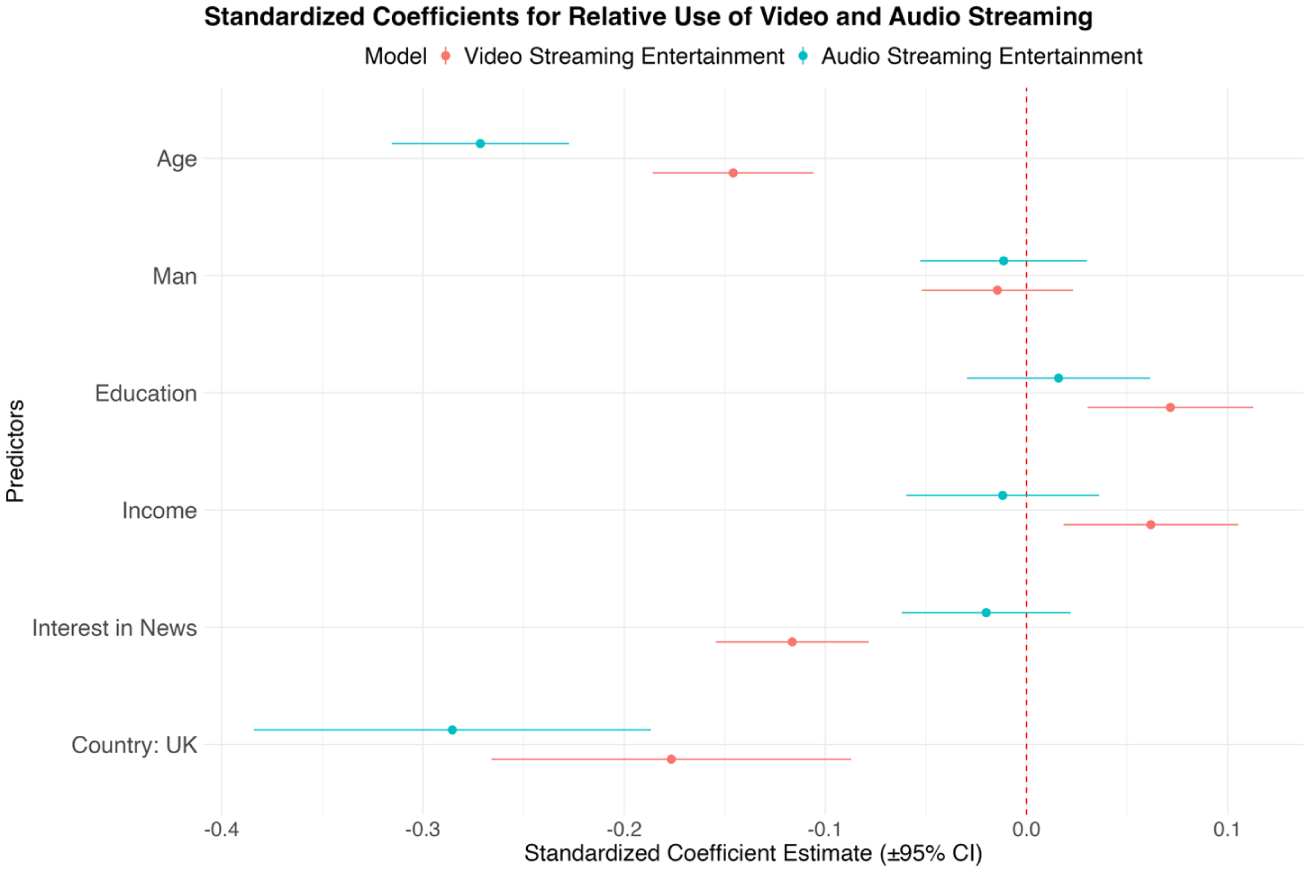
Standardized coefficients for relative use of audio and video streaming.
Our hypothesis (H1) proposed that greater relative use of video and audio streaming entertainment would be associated with lower levels of TV and radio news use, respectively. As shown in Figure 2 (Table 3 in the Supplemental Appendix), relative use of video streaming is a strong negative predictor of TV news use frequency (β = −0.38, p < .001), and relative use of audio streaming is a strong negative predictor of radio news use frequency (β = −0.36, p < .001), after controlling for various factors known to affect news consumption. These results are consistent when analyses are conducted separately for the United Kingdom and Brazil (Table A4 in the Supplemental Appendix) and provide support for both parts of our hypothesis.
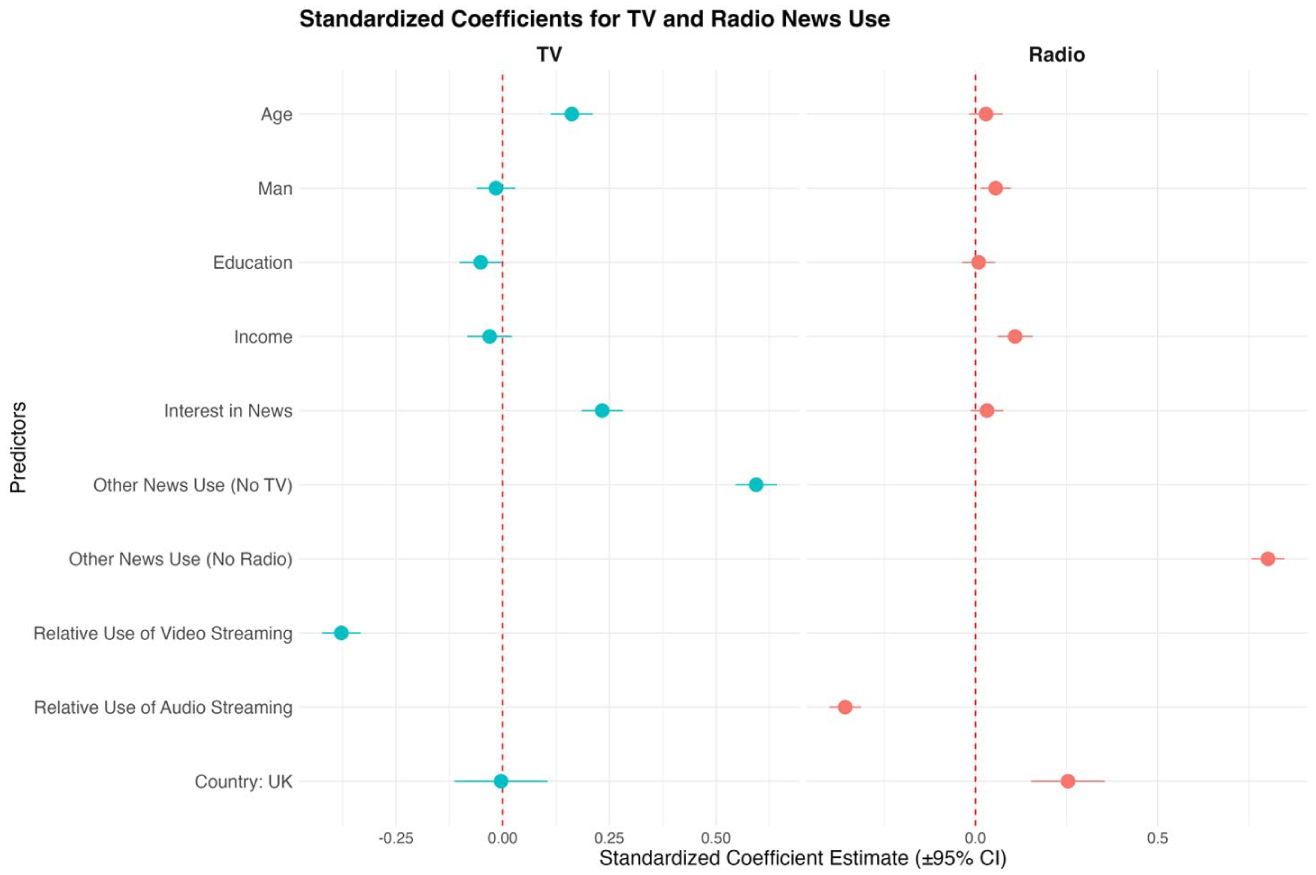
Standardized coefficients for TV and radio news use frequency.
Our second research question examines whether relative use of video and audio streaming is associated with YouTube and podcast news use, respectively. Our results (Figure 3, Supplemental Table A5) suggest that relative video streaming use has a positive association with YouTube news use frequency (β = 0.14, p < .001) and relative audio streaming use is not associated with podcast news use frequency (β = 0.02, p > .05). In regressions run separately in the United Kingdom and Brazil (Supplemental Table A6), we see similar results across countries.
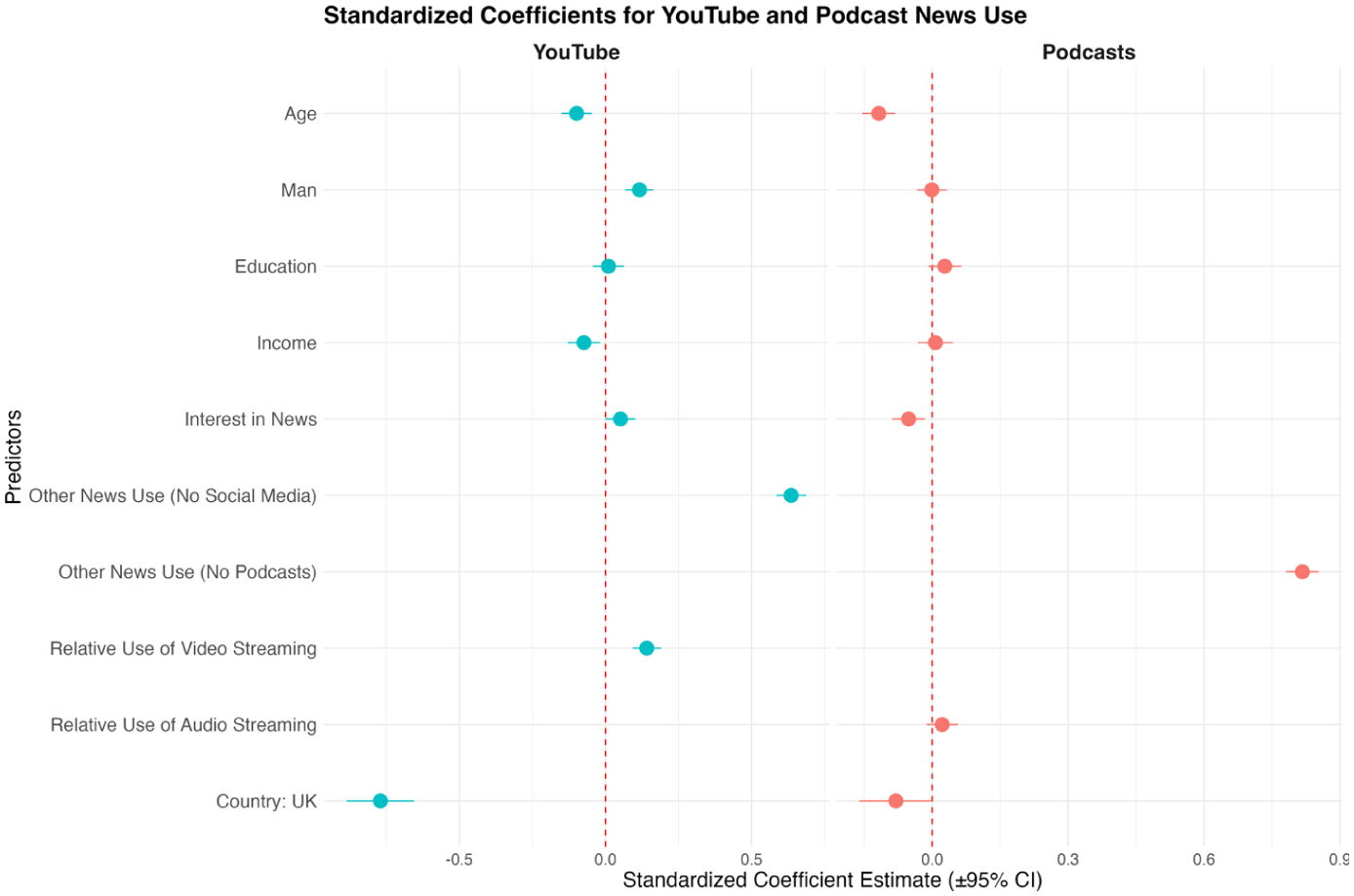
Standardized coefficients predicting YouTube and podcast news use.
Our third research question examines whether relative use of streaming video entertainment is correlated with incidental news exposure on TV. To answer this research question, we ran a linear regression predicting higher levels of incidental news exposure through TV (Figure 4, Supplemental Table A7). Our results suggest that relative use of video streaming is negatively associated with incidental news exposure on TV (β = −0.29, p < .001). In separate models for the United Kingdom and Brazil (Supplemental Table A8), we see that the correlation is also significant in both countries.
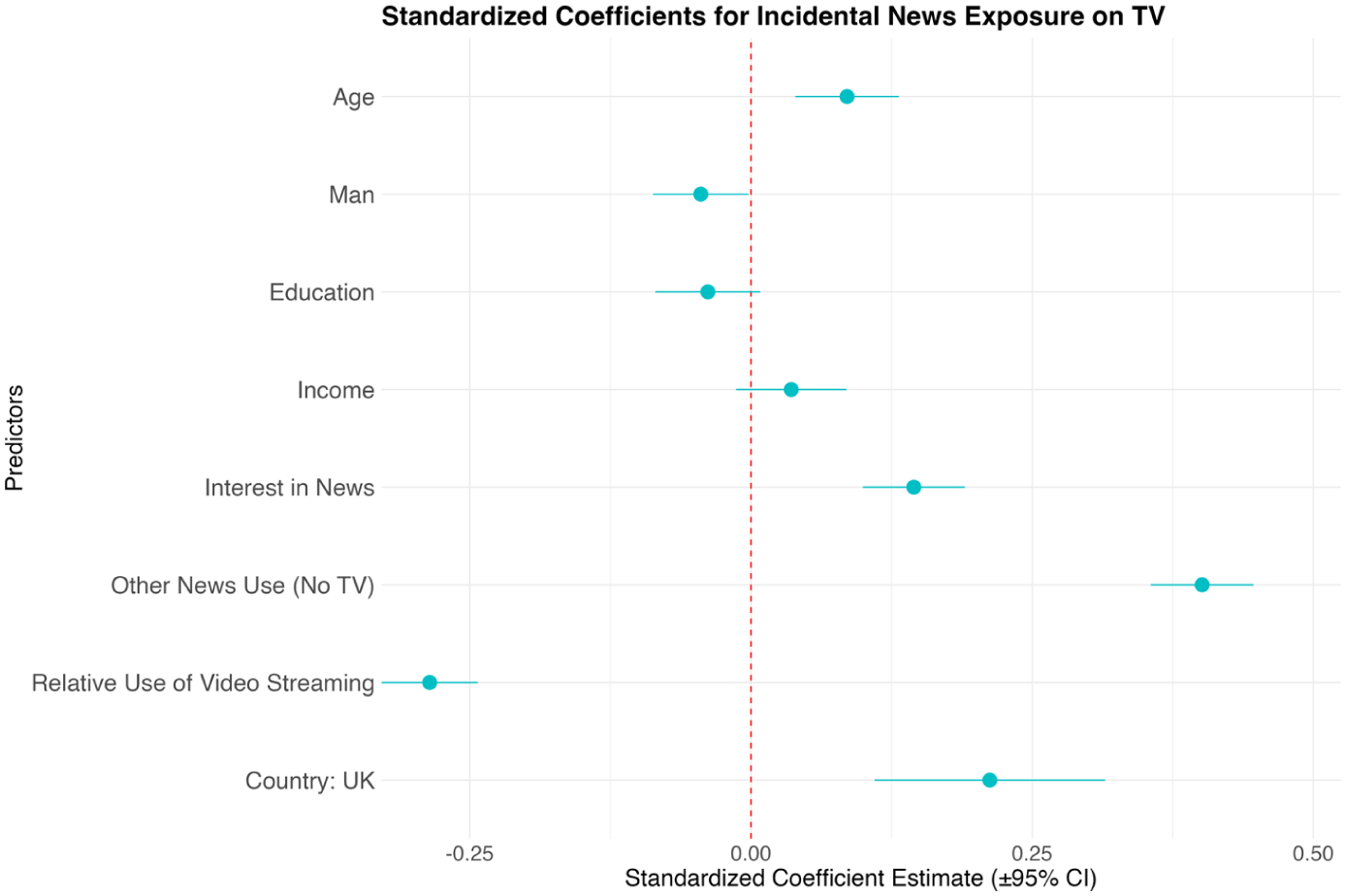
Standardized coefficients for incidental news exposure on TV.
Robustness check
As a robustness check, we used wave 3 measures of these outcomes, controlling for their corresponding values in wave 1. This approach was not intended to support causal claims, given the inherent limitations of survey data in establishing causality, but rather to examine whether the observed relationships hold in a more conservative analytical framework (Markus, 1979). The results, as seen in Supplemental Table A9, suggest that the negative correlation between relative use of video streaming and TV news use holds (β = −0.17, p < .001), as well as the negative correlation between relative audio streaming use and radio news use (β = −0.19, p < .001). Relative video streaming use is also significant in predicting YouTube news use (β = 0.08, p < .05), whereas relative audio streaming use remains not significantly associated with podcast news use (β = −0.02, p > .05). Further autoregressive models by country (Supplemental Tables A10 and A11) suggest similar results, other than relative use of video streaming being significant in predicting YouTube use only in Brazil (β = 0.11, p < .001) but not in the United Kingdom.
In addition, as another robustness check, we repeated all analyses but limited them to the subgroups that demonstrably have access to TV, radio, streaming video and streaming audio platforms, respectively (responded that they have used these at least once in the week leading up to the survey). We did this to account for access to different platforms and devices. However, we are aware that lack of use does not equate to lack of access. Across all models (Supplemental Tables A12–A15), the results do not substantially differ from those in our main models, indicating that (lack of) access is probably not a driving explanatory force in this relationship.
Discussion
This study examines news use frequency in light of the rise of streaming technologies for video and audio entertainment. Until now, most studies exploring news consumption in the increasingly high-choice digital media environment have focused on social media (Heiss et al., 2020; Schäfer, 2023; Thorson, 2020). While these contributions are valuable, as people have been increasingly using social media to find news during the past years, the literature on news use and incidental news exposure has not kept pace with recent developments in video and audio entertainment. As streaming services appear to replace linear programming for some users (e.g., Yamatsu and Lee, 2023), and platforms like YouTube and podcasts continue growing their audiences (Newman et al., 2025), we highlight the need to analyse the potential disruption these pose for (incidental) news exposure across contexts. This study addresses that gap by examining dynamics associated with preferences for streaming technologies relative to linear programming, developing a foundational understanding of streaming’s impact on news use in the United Kingdom and Brazil, which is particularly felt by younger audiences, streaming services’ key demographic.
As evidenced by our study, individuals who prefer video and audio streaming for entertainment (movies, TV series, music) over linear TV and radio are less likely to consume news via those traditional platforms. These findings could be explained by the notion that increased streaming time reduces time spent with linear media, where news content is more prevalent than in other environments, often due to regulatory requirements. The shift towards higher-choice environments is associated with a decline in time spent with news, consistent with what Prior (2005) suggested. Users who prefer to consume content from streaming services could be affected by the algorithmic structure of these platforms, which sets them apart from linear programming. Unlike traditional TV and radio, streaming services are designed to filter out content that they deem the user is uninterested in and thus users may be exposed to less news and, consequently, consume less news content, reflective of findings in previous studies concerning algorithmic infrastructures (Thorson et al., 2021). From a structuration perspective, it could also be the case that platforms shape their users’ endogenous preferences in the way they push specific content towards users based more on their own business agendas than on individual user interests (Taneja et al., 2012; Taneja and Webster, 2016; Webster, 2014). But our results could also be a result of the fact that many streaming platforms contain very little or no current affairs programming at all, like Netflix. Linear TV is, to this day, primarily an environment where people have access to both news and entertainment (BARB Audiences Ltd, 2025). As a result, many different needs could be gratified. The same is the case for some streaming platforms like the BBC iPlayer. However, platforms like Netflix or Amazon Prime Video are almost exclusively used for entertainment purposes.
A greater preference for streaming (indicated by relative use frequency) being associated with less news consumption via TV and radio thus expands upon prior knowledge that users tend towards entertainment offerings, with relatively little time spent on news given the alternatives available (e.g., Fletcher et al., 2020; Hindman, 2018; Prior, 2005).
However, some streaming environments also offer ample news content alongside entertainment programming. Individuals who prefer streaming technologies could still intentionally seek out or be incidentally exposed to news – whether via the smart TV app of their public service broadcaster, on YouTube TV, or through one of the thousands of news podcasts available on platforms such as Spotify or Apple Music. Yet our results suggest that streamers are less likely to encounter news incidentally on TV devices and are also less likely to listen to news podcasts. They are more likely to consume news on YouTube, however, suggesting a potential for news exposure. YouTube is a platform where people are more likely to see news from ‘online personalities and celebrities’ than news organizations, but also smaller and alternative news sources over traditional ones (Newman et al., 2024), suggesting an overall shift in news diets that has not yet been extensively studied in terms of its outcomes.
It is also important to interpret these findings in light of the profile of those who prefer streaming. Across both the United Kingdom and Brazil, the Diffusion of Innovations model (Rogers, 1962) was reflected in the demographics of streaming users: Young age emerged as the strongest and most consistent predictor of a preference for video and audio streaming, with higher education and higher income additionally associated with a greater streaming preference. This suggests that age-based inequalities in news consumption may increase as streaming technologies become more embedded in everyday media use. Moreover, generations socialized into streaming from a young age may develop weaker habits of news consumption altogether. The once-common belief among TV executives that young people would eventually ‘watch more TV’ as they aged may no longer hold (as also suggested by Nielsen and Sambrook, 2016), especially if ‘TV’ for these younger generations increasingly means on-demand streaming rather than scheduled linear programming.
Our findings also carry potential policy implications. In many countries, linear TV and radio broadcasters are legally required to provide news content, contributing to a more egalitarian media environment by offering high levels of incidental news exposure. As streaming technologies gain ground and people encounter less news – both in general and from traditional providers – there may be a growing need to consider equivalent digital regulations that ensure news is also prominent in streaming video and audio recommendations.
Finally, it is striking that the results are similar across two very different countries: the United Kingdom and Brazil. These countries differ significantly in terms of media systems, the reach of public service broadcasting and levels of Internet penetration (Newman et al., 2025). The consistency in our findings suggests that the global adoption of streaming technologies may be driving a shared transformation in how people consume entertainment and news, helping to explain the parallel patterns we observed.
Our study does not come without limitations. The primary limitation is that we did not explicitly measure exposure to news through the streaming platforms of public and commercial broadcasters in the United Kingdom and Brazil. YouTube, while heavily used on smart TVs (Mohan, 2025) and a strong source of news for many (Newman et al., 2025), does not capture the full range of video news content available on streaming devices. It serves more as an indicator than a comprehensive measure. Second, our analyses rely on cross-sectional analyses or short intervals between waves. Future research could build on this work by employing longitudinal designs and more detailed measures of news use across both traditional and streaming platforms, including distinguishing between incidental exposure on TV through streaming versus linear avenues.
Overall, our study highlights how shifts in entertainment technology shape patterns of news consumption. As streaming becomes more dominant, especially among younger people, maintaining widespread exposure to news may require new forms of policy intervention and renewed attention from both scholars and media institutions.
Supplemental Material
sj-docx-1-nms-10.1177_14614448261420788 – Supplemental material for Streaming the news away? Video and audio streaming entertainment and news use in the United Kingdom and Brazil
Supplemental material, sj-docx-1-nms-10.1177_14614448261420788 for Streaming the news away? Video and audio streaming entertainment and news use in the United Kingdom and Brazil by Antonis Kalogeropoulos and Courtney Tabor in New Media & Society
Footnotes
Funding
The authors disclosed receipt of the following financial support for the research, authorship, and/or publication of this article: This research was funded by the European Union (Project 101077310).

Supplemental material
Supplemental material for this article is available online.