




Abstract
News media can shape public perceptions of technology and meaningfully inform research on technology adoption. Yet, little is known about the news representations of a currently emerging technology: Virtual Assistants (VAs). By examining the Dutch news coverage (2011–2022; N = 2059) using the Analysis of Topic Model Networks, this study found that (1) news attention peaked in 2019 with a decline in the years thereafter (until 2022) and (2) discourse shifted from personal impact frames (niche interest) to societal impact frames (broader relevance). Findings inform media effect studies on VA adoption by illustrating what people might be learning about VAs.
Introduction
In today’s rapidly evolving landscape of technologies that are powered by Artificial Intelligence (AI), public portrayals of these innovations influence how individuals understand, interact with, and ultimately accept them in their daily life. As scholars have stated before us: “The way societies come to understand the potential and perils of technology is an inherently social process, in which mass media have played a central role” (Lane et al., 2024: 1). The media offer valuable information and orientation for the public (along de Vreese, 2005) to combat potential insecurities, to learn about the functionality of new technologies, and their influence on individuals and society (Hoy, 2018).
One emerging technology that has become popular in recent years are Virtual Assistants (VAs). VAs are conversational agents that engage in human conversation through Natural Language Processing and that reside in devices such as smartphones, smart speakers, and other Internet-powered applications (Hoy, 2018). To better understand their growing public adoption, scholars have looked at individual factors of people by investigating their specific motivations for as well as patterns of VA use (Beneteau et al., 2020; Kowalczuk, 2018; McLean and Osei-Frimpong, 2019; Wald et al., 2023a). Moreover, scholars have theorized about the role of certain perceptions of interactive AI technology as influential factors to explain user experiences and behavioral intentions (e.g. HAI-TIME model by Sundar, 2020; TAM by Davis, 1989). However, studies that extend this perspective to contextual factors, such as media representations of VAs, that may shape people’s motivations and perceptions remain scarce. This is problematic since theory in the Human–Machine Communication (HMC) field makes clear that how people feel attuned toward (new) technologies is crucial to explain people’s engagement with and acceptance of them (Ajzen, 1991; Davis, 1989; Venkatesh et al., 2012). Think, for instance, of a parent reading about a new home gadget (e.g. a smart speaker) in the news, debating whether to purchase one for the family home. What this parent reads in the news might influence subsequent adoption decisions. Or, think of a student reflecting on using a new application (e.g. ChatGPT) for his study. Depending on certain news messages, he might alter his use. So far, though, little is known about what the news media say about VAs as one of the fast emerging technologies of this time.
Looking at the early 1900s, when the radio found strong in-roads into the homes of many, scholars argued that it was the news media that fueled one of the first popular techno-panics about radios with their reporting about serious concerns, especially for children (Orben, 2020). In the 1990s, researchers studied the dominant media narratives of multimedia technologies, such as the Internet and mobile telephony, to understand what messages are spread about these new technological developments (Beck and Vowe, 1995). And also now media research naturally turns toward the tech of our current time: scholars have shown that the news media, particularly in the context of American politics, have created popular imaginaries of social media as emerging digital platforms (Lane et al., 2024).
So, what can we conclude from this history of research? People learn about new media technologies through media themselves, and especially so through the news media. Its coverage is therefore an essential element in the formation process of individual perceptions of emerging technologies and an important source of information to better explain user attitudes, motivations, and behaviors (Lecheler and de Vreese, 2018). Recently, scholarship emerged on news media portrayals of topics such as AI, automation, and robotics (Brantner and Saurwein, 2021; Chuan et al., 2019; Köstler and Ossewaarde, 2022; Vergeer, 2020) that could inform media portrayals of VAs. Yet, certain aspects are challenging to translate. Compared with these technologies, VAs are quite specific: They are typically disembodied conversational agents that are operated via human language (voice or text) and that are being deployed in smart speaker devices, as device features in existing devices (e.g. in smartphones, cars, etc.), or within online services on apps and websites (e.g. chatbots) to perform defined tasks (Ammari et al., 2019; Hoy, 2018; McLean and Osei-Frimpong, 2019). This distinguishes them from AI more generally, as well as automation and robotics (i.e. recommender systems on social media platforms, algorithmic decision-making, self-driving cars, social robots, or automated manufacturing) (Brantner and Saurwein, 2021). Eventually, this also means that the public portrayal of VAs is likely to be different. So, it is important to add knowledge about news media representations of VAs to the body of existing HMC literature.
To thus acknowledge the role of news media in the formation process of people’s attitudes toward VAs we ask: How have VAs been framed in the Dutch news media since their commercial rise (2011–2022)? This helps to better contextualize and understand the ongoing public adoption of VAs. Built upon the research tradition of emphasis framing (Entman, 1993), we inductively detect frames around VAs through the computational Analysis of Topic Model Networks (ANTMN)—an analytical approach specifically developed to analyze elements of emphasis framing by Entman (Walter and Ophir, 2019). We do this over the past decade, starting with the introduction of Apple’s Siri in 2011 and ending in 2022—the end point of conducting this study. We chose the Netherlands as our country of focus for two reasons: Empirically, the Netherlands is a European country that has recorded a recent increase in VA-adoption (Wald et al., 2023b) despite delays in the launch of US-originated products and services (Pridmore et al., 2019). Thus, this allowed us the opportunity to map the news coverage during an acute period of VA-adoption. Pragmatically, we had access to a database that comprehensively mapped the news body of the Netherlands, allowing us a robust assessment of the news space.
Theoretical framework
The role of news media frames for technology adoption
As noted before in the literature, successful diffusion of new technologies is driven by a change in beliefs about the technology (Vishwanath, 2009). These beliefs are formed through people’s own experiences, through interpersonal exchange with others (e.g. family, peers, etc.), and notably also through the mass media (Bronfenbrenner and Morris, 1998).
One specific type of mass media that is particularly powerful in the provision of information to the public are news media. News media stem from mass media organizations that provide information to the public about current events and developments (de Vreese, 2005). And the advent of a new technology represents such a development. Due to its novelty in society and potential for a disruption of the current order (what will change with the arrival of the new technology), technological innovations are something news media are naturally drawn to (Lee and Grimmer, 2013). News media reflect on how the public thinks about a new technology. At the same time, through how news media portray this technology, they might also influence public perceptions of it (Chuan et al., 2019; Walter and Ophir, 2019). And this can have consequences for people’s adoption decisions as research has shown: In an experiment, Vishwanath (2009) illustrates that different types of frames (i.e. positive vs negative, extrinsic vs intrinsic, combined) can have an influence on people’s intrinsic beliefs about an innovation, such as its ease of use and usefulness, and that these beliefs impact people’s intention to use the technology. As such, “the frames become the lens through which the innovation is evaluated” (p. 199).
Framing is a powerful way to curate information. It refers to the systematic selection and salience-making of specific aspects of reality in a given communication context (Entman, 1993), which subsequently shapes how audiences perceive and understand the issue being covered. From a conceptual perspective, a frame refers to the specific meaning conveyed in a message (Van Gorp, 2007). This meaning is expressed through certain linguistic elements, or “devices,” which often appear together over time and jointly form a frame. A single message can therefore contain multiple frames, each highlighting different aspects of an issue. The ANTMN approach was developed to study such emphasis framing in a computational way. As Walter and Ophir (2019) explain, topic modeling can be used to detect frame elements, which are then grouped into broader frame packages through community detection in a topic network. In this way, topic modeling serves as the starting point for identifying frames, while an additional step of categorization ensures that the detected topics align with the conceptual understanding of frames (Van Gorp, 2007). As such, it represents a valuable analytical approach for inductively studying frames around novel public issues, like VAs.
Thus, as a first step in acknowledging the news media’s role in the adoption process of VAs, we want to find out:
RQ1: What frames emerge from the Dutch news media coverage around VA-use?
History shows that the news coverage on emerging technologies typically orientates along two main directions—one positive and one negative (Cools et al., 2022). Underlying a positive benefit frame is often the idea of social progress that encompasses the creation of hope and the impression that technological opportunities are limitless (Brennen et al., 2018; Köstler and Ossewaarde, 2022). Negative risk frames illustrate dystopian pictures, often including risks of economic nature (e.g. job loss), ethics (e.g. misuse, privacy), and larger societal threats (e.g. technological singularity) (Brantner and Saurwein, 2021; Brennen et al., 2018; Chuan et al., 2019; Fast and Horvitz, 2017; Köstler and Ossewaarde, 2022). The latter appear to be more influential to change people’s technological beliefs (Vishwanath, 2009).
Based on the empirical picture that emerges from frames about different related innovations in the past year’s research, we expect to find a similar two-sided view on risks and benefit frames in the news coverage around VA use. However, given the differences in VAs to previously studied innovations (i.e. AI, automation, robotics), it is imperative to leave room for new and potentially different frames to emerge as well. We thus approach our first research question in an inductive manner, as in doing so we can uncover unexpected insights and nuances that may not have been apparent from a deductive analysis of predetermined frames.
The role of time
Looking at VAs as an emerging technology means looking at an innovation that receives changing attention in society over time. And this fluctuation can be expressed in two ways: One way is through the volume of the news coverage during specific time periods, so how much was reported about VAs. The other is through the content itself during specific time periods, so what was said about VAs over time.
According to the issue-attention cycle, news media attention to a public issue naturally rises and falls (Downs, 1972). The issue hereby goes through different stages that indicate an increase or decrease in news attention. Similar to this, previous research shows that a time pattern often seen is that of “hypes and busts cycles” in media attention (proxy for e.g. “AI-winters”) (Harguess and Ward, 2022), where public attention alternates between high and low levels. A period of extended coverage indicates a hype-period, and a period of little to no coverage suggests a bust-period.
First, as part of this cyclic pattern, public interest in a social problem or development tends to rise sharply after a dramatic event, creating a sense of urgency and enthusiasm for change. Then, over time, however, attention fades as people realize the costs of solutions, lose interest, or shift focus to newer issues, leaving the problem in the background (Downs, 1972). To illustrate, Vergeer (2020) previously detected a linear increase in media attention about AI in Dutch newspapers between 2000 and 2018, and a similar increase in attention was found to be exceptionally sharp in the Austrian coverage between 2015 and 2018 (Brantner and Saurwein, 2021)—both are signs that the issue of AI here moved in a space in which attention catalyzed.
Next to the volume of news coverage it can also be the content of the messages (i.e. frames) that can indicate certain issue dynamics over time. To again illustrate, an investigation on the ethical portrayal of AI in English media revealed an increase in critical viewpoints between 2013 and 2018 (Ouchchy et al., 2020), which can be a signal that, during this time period, ongoing developments were given particular (critical) attention.
What does this mean for the news media’s coverage of VAs? Although it is likely that we find a similar point of increase in news attention for VAs, given that in 2018 Google Assistant came to the Netherlands being the first and so far only VA available in Dutch language (NL Times, 2018), it remains to be seen whether this increase pattern holds and, in particular, what specific frame(s) might dominate in a particular timeframe. Furthermore, going beyond 2018, we aim to see how the volume and content of the coverage further unfolds. According to Downs (1972), society often realizes that the problem surrounding the issue is intertwined with the benefits that arise for some. This makes finding a solution to the issue complex and what typically follows is a gradual decline of interest. And indeed, previous work (Arifin and Lennerfors, 2021) finds initial indicators for a potential decline in news attention on VAs after 2019. Yet, these first insights specifically refer to ethical aspects in Indonesian media texts, thus leaving open how the broader coverage of VAs has evolved over time and specifically so in the Netherlands.
Altogether, depending on the volume and content of the Dutch news coverage on VAs over time we might be able to infer different stages of the issue-attention cycle as well as different VA-hype-periods and bust-periods. Our goal is therefore to identify cyclic patterns and validate whether the news attention resembles linear or even exponential patterns seen in previous research, or whether a change of this pattern (i.e. quadratic) can be observed. With this knowledge, we will allow the field to better understand people’s perceptions of VAs during that time period and beyond, help to understand potentially underlying mechanisms of opinion formation and the role news media play in this. We, respectively, ask the following:
RQ2: To what extent has the volume of news messages in the Dutch news media coverage around VA-use changed over time (2011–2022)?
RQ3: To what extent has the frequency of identified frames changed over time (2011–2022)?
Methods
Figure 1 shows the data collection and analysis procedure. The study’s proposal was officially approved by the university’s ethics committee (2021-YME-13887) and respective data management guidelines were followed. The preregistration plan, its amendment, as well as the supplemental materials including coding scripts can be found on OSF (https://osf.io/39tsh).
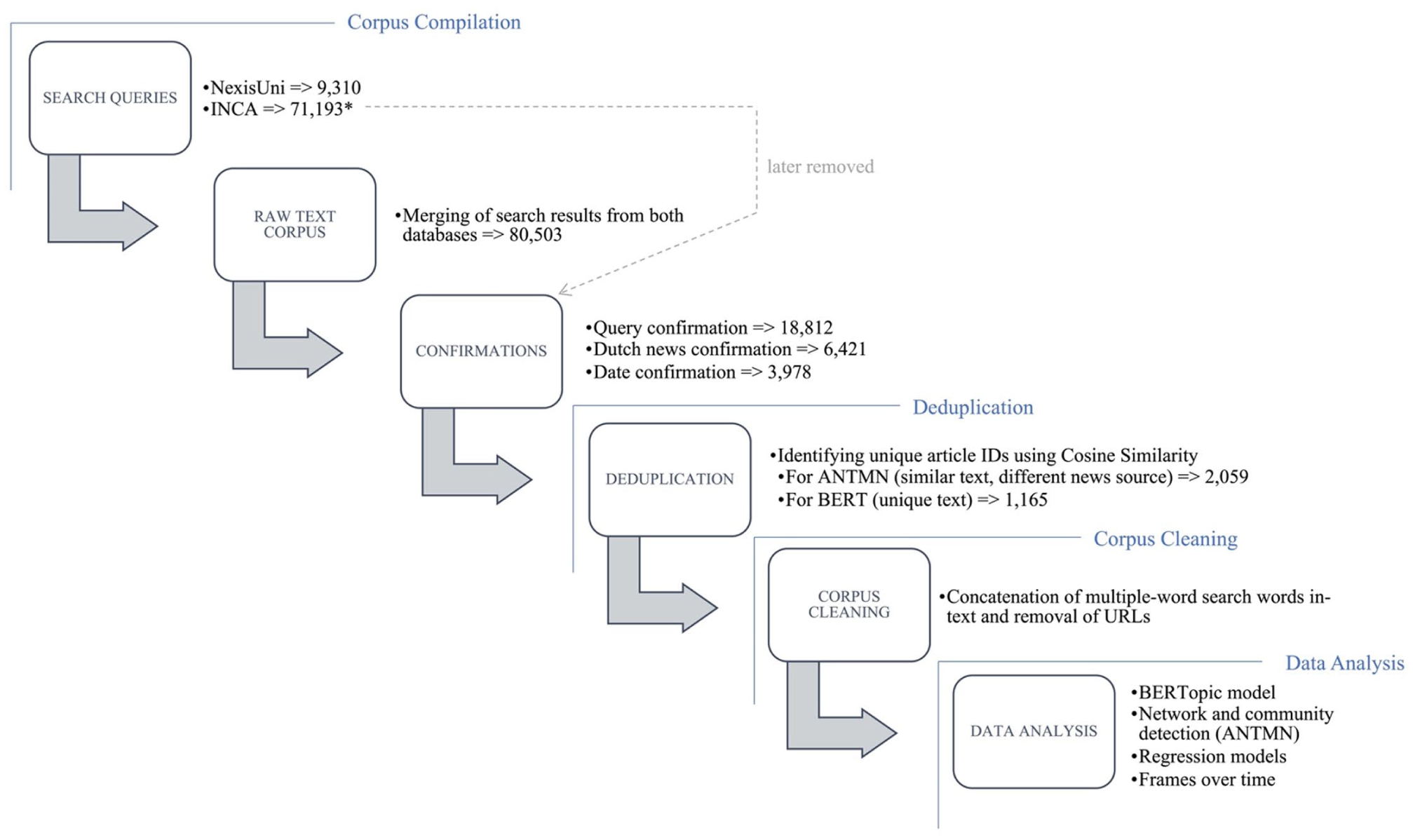
Coding pipeline.
Corpus compilation
We queried an existing database from a university full-text news article provider (i.e. NexisUni) for Dutch news media messages on VAs between 2011 and 2022 using the following search terms (issued in Dutch language): 1 voice assistant, house assistant, virtual assistant, voice-controlled technology, smart speaker, Alexa, Google Home, and Google Assistant. We considered news media messages in form of (1) written text that consisted of (2) title and main body text, messages that were (3) created by an individual or a group of individuals either (4) independently or as part of a publisher (5) with the intent to inform a public audience about an issue, event, or development. A message could hereby derive from a (6) traditional public or private news outlet, and from alternative sources that cover news, such as blogs, to align with the current shape of the Dutch media sphere (Costera Meijer and Groot Kormelink, 2021). Furthermore, the message had to be written (7) in Dutch language and it had to be (8) accessible online by the wide public.
We followed three main steps to compile our final corpus: (1) We removed search results where the title and/or body text did not contain the necessary combination of keywords (e.g. “Google” and “Home,” but not “Google Home”), and we checked whether keywords stood in relation to our study objective (i.e. “Alexa” standing in relation to “Amazon”). (2) We removed messages written in non-Dutch language with the help of a language detector. And we removed messages that did not meet our definition of news (e.g. press releases). In addition, (3) we removed messages that were published before 1 January 2011 and after 24 February 2022 to confirm our time-period of interest. Eventually, this led to a corpus of N = 9313 news media messages.
Deduplication
We differentiated between two types: (1) Similar text from the same news source, leading to a corpus that only contained unique news media messages, N(a) = 1165, and (2) similar text but not from the same news source, leading to a corpus that also contained similar news media messages published in different news outlets, N(b) = 2059. Different news outlets might, namely, pick up the same news from press releases, which means there might be similarity between messages but differences between news outlets. For our topic modeling (see below under section “Data analysis”), it was important to compile a corpus of unique news messages in order to infer topics and not give more weight to some because the message was more or less the same. This is why the smaller corpus (1) was underlying our topic model analysis. We did this deduplication by filtering for the news messages that showed uniqueness in the content of the article and news source. That means a similar article that was, for instance, published in the northern region of a newspaper and in the southern edition of it was only included once. In contrast to this, for our network and community detection analysis, from which we concluded the frames, it was important to consider similar messages that stem from related news outlets in order to better understand the density of the news landscape. This is why we used the larger corpus (2) in our frame analysis. We, respectively, compiled this corpus by filtering for the news messages that showed uniqueness of the article’s content alone; the news outlet could have been related or the same. The similar article that was published in the northern region of a newspaper and in the southern edition of it was therefore included in both versions.
In total, the final news media messages stemmed from 64 different Dutch news sources. In the supplemental materials on OSF, we list in detail all news outlets that are included in our corpus and the number of unique news messages that stem from each outlet.
Corpus cleaning
We concatenated words that resembled search terms of multiple words (i.e. virtual assistant = virtualassistantant) and removed any URLs from the text. No further text prepreprocessing was needed.
Data analysis
Analyses were conducted in Python (Python Software Foundation, 2023) and R (R Core Team, 2023). To answer RQ1 (emerging frames), we followed the analytical approach of ANTMN—the analysis of topic model networks—developed by Walter and Ophir (2019). We chose for this analytical approach given the size of our text corpus and the robust empirical background of ANTMN being already applied to a variety of different issues in the public discourse. To list most recent ones, see Walter et al. (2025) for using ANTMN to analyze conspiracy theory on Reddit and Twitter and Wang et al. (2024) for analyzing news app reviews on Google Play.
The first step of ANTMN is to identify topics in our corpus. Those are conceptualized to represent linguistic frame elements, which, when being organized in a network, reveal an overarching narrative (i.e., frame). To identify topics, we used an unsupervised machine learning technique called BERTopic modeling (Grootendorst, 2022) (Bidirectional Encoder Representations from Transformers). BERT is a language model that leverages a deep-learning approach using sentence transformers and TF-IDF (term frequency-inverse document frequency). To balance reproducibility and interpretive depth in our topic model, we compared two approaches for validation—one set of models was run without a random seed, the other set was run with random seed. To ensure robustness, we compared solutions across both approaches and further explored alternative modeling strategies, including different clustering algorithms, vectorization techniques, and forcing a fixed number of topics. None of these alternatives produced higher-quality results than the 12-topic model solution from approach one. This model we eventually judged to be the best fitting model, acknowledging hereby its reproducibility limitations but superior interpretive value. Two coders independently inspected, labeled, and described each topic of this final solution based on an additional inspection of the top word lists and a close reading of 10 full documents that were most representative per topic (Maier et al., 2018). Conflicts were resolved through discussion. The final topic model solution distinguished between 11 topics and these topics built the elements for the later identified frames.
The second step of ANTMN is to look at the topics and categorize them along their co-occurrences. We, thus, proceeded with inspecting the network of the identified topics to see how they cluster together (Walter and Ophir, 2019). Via network and community detection analysis we were able to visualize co-occurrences of topics across our entire corpus. After applying a selection of different alpha hyperparameters to the network, which determines how likely documents are to consist of many or few topics, the network with best interpretability as well as density and modularity measures was chosen through discussion within the research team. While a higher density indicates that more nodes (topics) in the entire network are connected to each other and less nodes are isolated, higher modularity signals a better-defined community structure whereby nodes within a community (frame) are more closely connected to each other than to nodes in different communities. The higher the modularity, the stronger the communities. Our final network (see Figure 2, created with Gephi) distinguished between two communities, resembling two frames, respectively. Frame labels were determined based on the understanding of topics previously identified. For reasons of reliability and credibility we share detailed memos of this qualitative inspection in the supplemental materials on OSF.
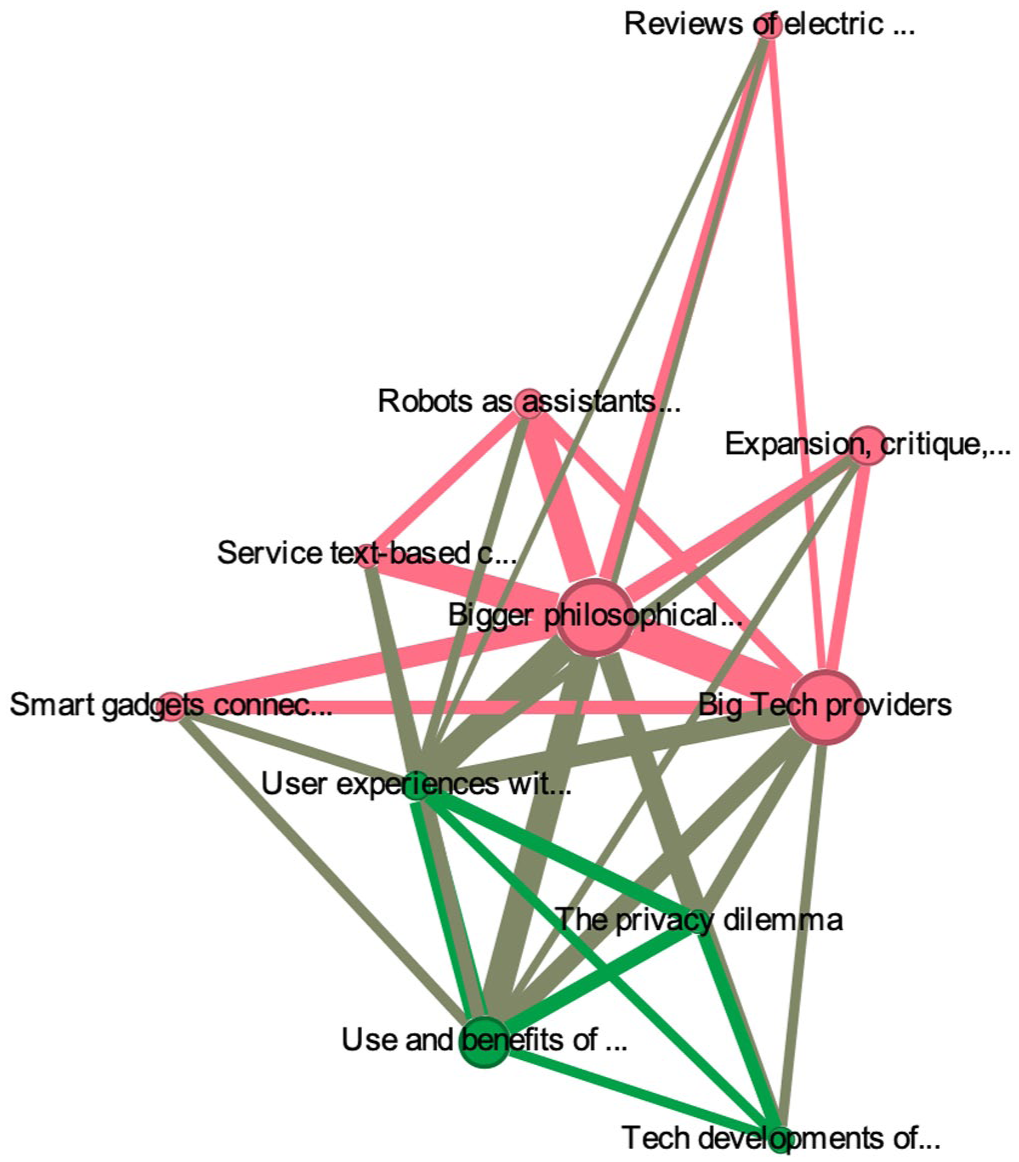
The topics network.
To answer RQ2 (change in volume over time), we performed four different regression models: linear, exponential, and quadratic regression as preregistered, and an additional polynomial (i.e. cubic) regression model post hoc. All models used time (year-month) as the independent and the number of articles about VAs (volume) as the dependent variable. The model with the best statistical fit served to answer the research question. Descriptive analysis was used to answer RQ3 (change in frequency of identified frames over time).
Results
Emerging frames (RQ1)
Topics
Our final topic model suggested 11 topics with 1 additional topic representing outliers (topic 1, 40%). We labeled the 11 topics as follows (see Figure 1; further topic visualizations are shared on OSF).
Bigger (philosophical) questions about ethics of AI
This topic (16%) relates to AI and society more broadly, highlighting ethical/moral questions that arise in the context of AI systems and in relation to VA products that support the creation of smart homes (e.g. lamps, curtains). It refers to the role and influence of AI in/on society, hereby in particular highlighting themes of societal diversity, equality, and responsibility.
Big Tech providers
This topic (15%) is about new developments by Big Tech companies, such as Facebook, Google, and Amazon. Many (legal) issues with regard to data privacy and abuse of societal as well as economic power are highlighted. VAs are, among others, mentioned as products and services provided by Big Tech players. Only sometimes news media messages refer to voice-assistant-specific issues (e.g. data privacy).
Use and benefits of smart speakers for voice and audio
This topic (9%) circles around the creation and consumption of audio media, whereby VAs offer a new form of access to voice products and voice services. In some parts, it refers to the benefits of smart speakers’ modality as a driving force for the music and radio industry (e.g. listening to radio, podcasts, and music). In other parts, the topic takes a futuristic stance describing how big voice technology may become and what one can use it for in (future) homes.
Expansion, critique, and power of Amazon
This topic (6%) is about Amazon’s corporation, its economic and political power, and growing range of products (e.g. marketplace, logistics, cloud storage, media, hardware). VAs are mentioned as one of the success products. Risks for users (e.g. employees listening in on conversations) are highlighted and critique about actions of Amazon’s former president and CEO Jeff Bezos (e.g. power abuse, working conditions, tax avoidance) is expressed.
Smart gadgets’ connectivity to VAs
This topic (3%) discusses a range of smart products (e.g. smartphones, watches, glasses, etc.) by Samsung as well as Apple, Amazon, and Google that allow access to VAs. Emphasis here lies on VAs as a product feature.
Robots as assistants helping humans
This topic (3%) deals with the emergence of robots and other smart appliances in everyday life (i.e. smart homes), ranging from functional to social robots that interact with humans (e.g. robots in education, robotic vacuum cleaners, Amazon’s Echo Show, Astro robot). Among the risks mentioned are technology misuse and data privacy. At times, robots and VAs are referred to as synonyms, other times, robots are described as a more sophisticated version of VAs.
User experiences with VAs (mostly Alexa)
This topic (3%) encompasses reviews and reports about new technological functions of VAs (mostly Alexa), how users experience the technology in their everyday life (e.g. efficient), and what type of (functional) challenges occur (e.g. unavailability in Dutch language, privacy issues due to eavesdropping).
Reviews of electric cars with access to VAs
This topic (2%) resembles reviews of electric cars and the integration of a VA (e.g. Google Assistant or Alexa). Added voice features in cars are hereby presented as a functional asset, being particularly suitable for hands-free control while driving. Functional access to VAs is also mentioned in the context of other smart (household) products, such as automatic curtain systems, air conditioning, and energy pumps, yet only rarely.
Tech developments of Apple
This topic (1.9%) centers around promotional announcements of new products from Apple that include, or can be used with a VA and smart speaker devices (i.e. Homepod). Siri is mentioned as the most important innovation of the iPhone 4; critique is issued rarely. Smartphones are compared with smart speakers, with the former said to remain most popular for the near future.
(Service) text-based chatbots
This topic (1%) is about (service) chatbots on specific platforms with a focus on text-based interactions. It discusses how chatbots are programmed, how well they can maintain (human) conversation, and for what purpose chatbots are used (e.g. information, companionship). Frequent conclusions are that chatbots cannot replace people and often need a human in the loop as back-up.
The privacy dilemma
This topic (0.1%) is about incidents or new regulations regarding privacy and data collection principles. Specific cases mentioned are data sharing with third parties, eavesdropping incidents, the need for required consent and more active involvement of users, and specific measures that are taken to prevent issues (i.e. child-abusive content). Privacy regulations of different providers are hereby contrasted (e.g. Google vs Apple).
Frames
Two communities (i.e. frames) were identified (Figure 2), which together answer RQ1 (see also Table 1).
Topics and frames.
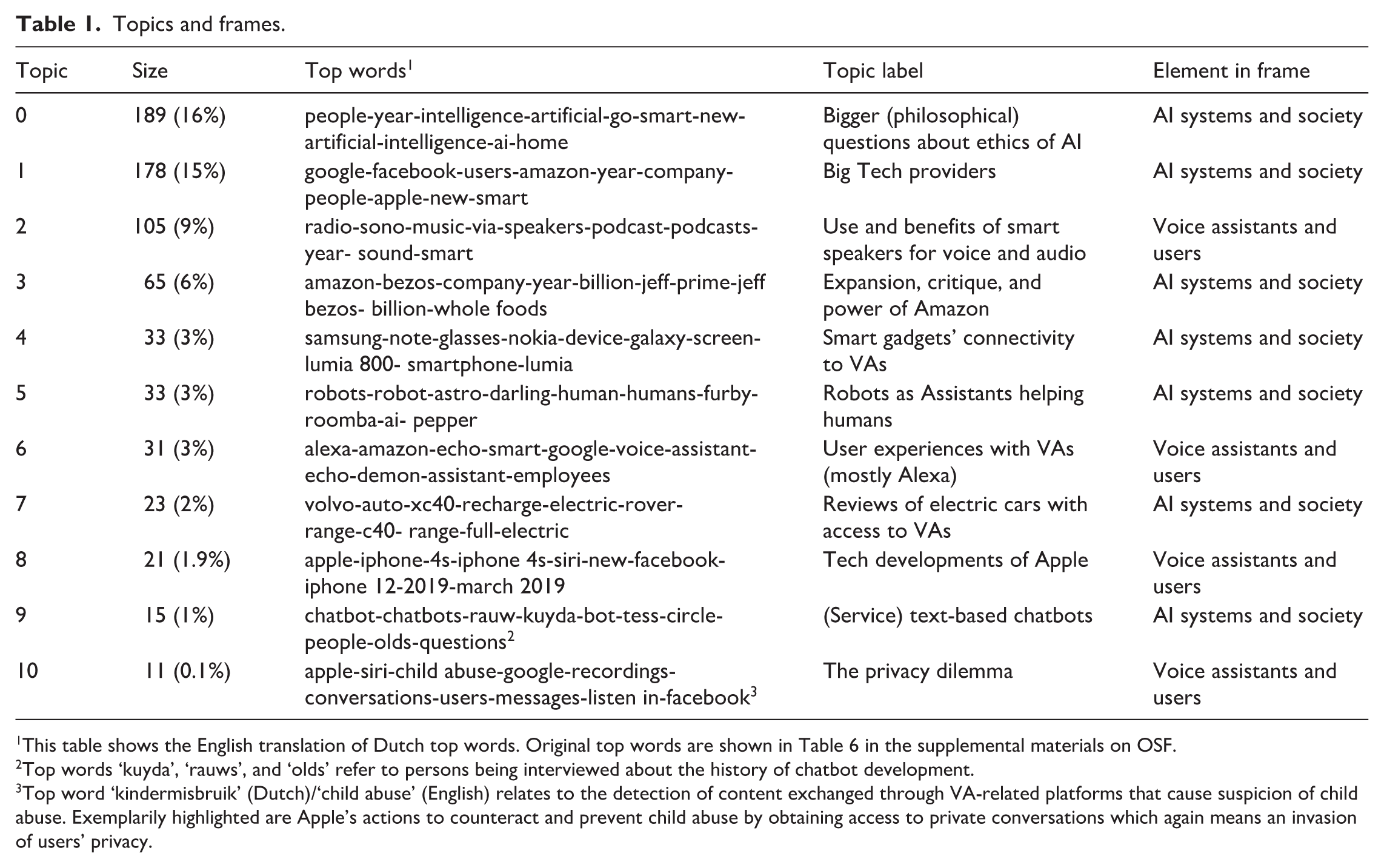
This table shows the English translation of Dutch top words. Original top words are shown in Table 6 in the supplemental materials on OSF.
Top words ‘kuyda’, ‘rauws’, and ‘olds’ refer to persons being interviewed about the history of chatbot development.
Top word ‘kindermisbruik’ (Dutch)/‘child abuse’ (English) relates to the detection of content exchanged through VA-related platforms that cause suspicion of child abuse. Exemplarily highlighted are Apple’s actions to counteract and prevent child abuse by obtaining access to private conversations which again means an invasion of users’ privacy.
AI systems and society
The narrative of this frame is formed by the bigger network community (72%) that consists of topics that either emphasize larger viewpoints on society and the impact of certain actors on the market, or that extend perspective on VAs to AI, including robots, chatbots, and other smart devices. Consequently, this frame speaks of VAs in a broader sense, presenting information from a societal perspective that goes beyond specific device functions and (individual) user scenarios. Critical reflections regarding sociopolitical and economic consequences, especially regarding ethics and the role of providers, come to the surface.
Voice assistants and users
The narrative of this frame is built up by the smaller network community (28%), including topics that specifically highlight voice-controlled agents, like Siri, Alexa, and Google Assistant. Information presented through this frame circles around concrete user experiences and emphasizes certain (launches of) devices, functions, and measures that relate to voice and audio. In that, this frame underlines the impact of VAs on a more individual user level.
Frame connections
Despite differences between the two frames, the topics network also showed several connections between both communities, illustrated through high edge weights that are frame-unassigned (i.e. see Figure 2). For instance, while the largest topics bigger (philosophical) questions about ethics of AI and Big Tech providers are anchored in the AI systems and society-frame, they also seem to co-occur in news media messages with topics that are grounded in the Voice assistants and users-frame (i.e. user experiences with VAs [mostly Alexa] and use and benefits of smart speakers for voice and audio). Corresponding to the moderate density (0.636) and low modularity score of the network (0.022), this means that the topics are fairly connected among each other and that there are instances in which messages contain elements of both frames.
Changes in volume over time (RQ2)
We see an increase starting in 2011 with a peak in 2019. A decline follows in the years thereafter (2020–2022), to the point that the volume in 2022 returned to a similar level as it was in 2016 (see Figure 3). Results of the linear regression model showed that time overall was a significant predictor of the volume of VA news coverage, R2 = 0.41, F(132) = 92.06, p < .001, CI = [0.26, 0.39]. Entering time as a quadratic term neither revealed significance nor improved model fit, R2 = 0.41, F(131) = 45.75, p = .78, CI = [−0.002, 0.002]. By contrast, the exponential regression model was significant and showed improved model fit compared with the linear one, R2 = 0.57, F(132) = 143.38, p < .000, CI = [0.022863, 0.031934]. Given the shape of the development of volume especially in more recent years, we additionally conducted polynomial regression with an added cubic term post hoc.
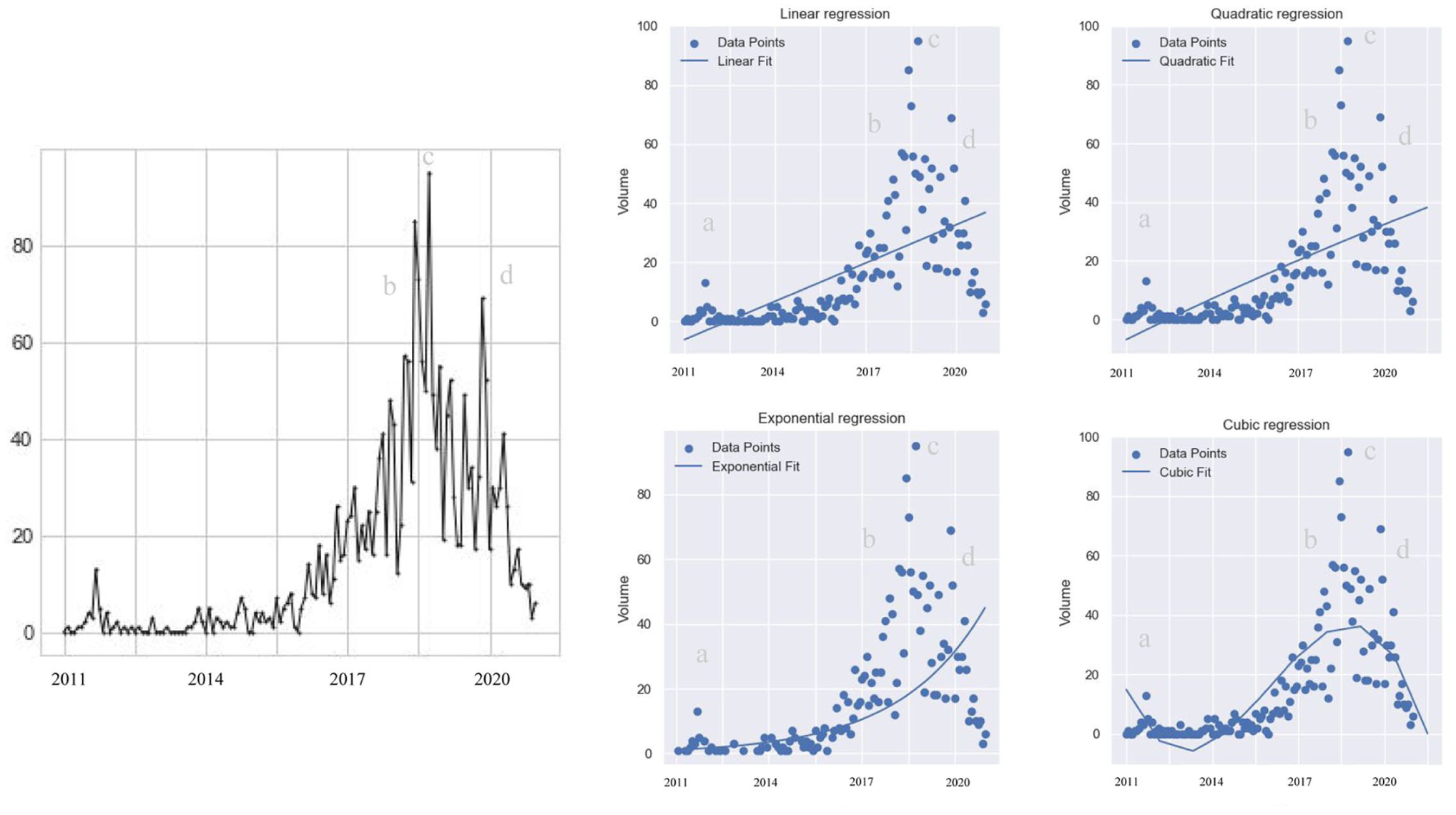
Number of articles (volume) over time with respective regression models (a = launch of Siri, b = GDPR came into effect, c = Google Assistant came to the Netherlands, d = start of the COVID-19 pandemic in the Netherlands).
Results were not significant and did not clearly improve the model fit, R2 = 0.42, F(132) = 47.33, p < .17, CI = [−1.62e-05, 2.81e-06]. Therefore, the exponential regression model fit best to how the number of articles (volume) about VAs has evolved over time and thus answers RQ2, even though not all statistical assumptions for this type of analysis were fully met (i.e. independence and normality of errors were met, linearity in the exponent and homoscedasticity were not; see script on OSF).
Changes in frequency of frames over time (RQ3)
Overall, the AI systems and society-frame was most prominent throughout the investigated time period. It started to appear more frequently between 2014 and 2016, with a peak in 2018. After 2018, the frequency of the AI systems and society-frame fell back to the same level as it was before 2018. In 2020, we see a drop in presence. Afterwards, the AI systems and society-frame gains attention again before declining parallel to the general decrease in volume in most recent years (see Figure 4).
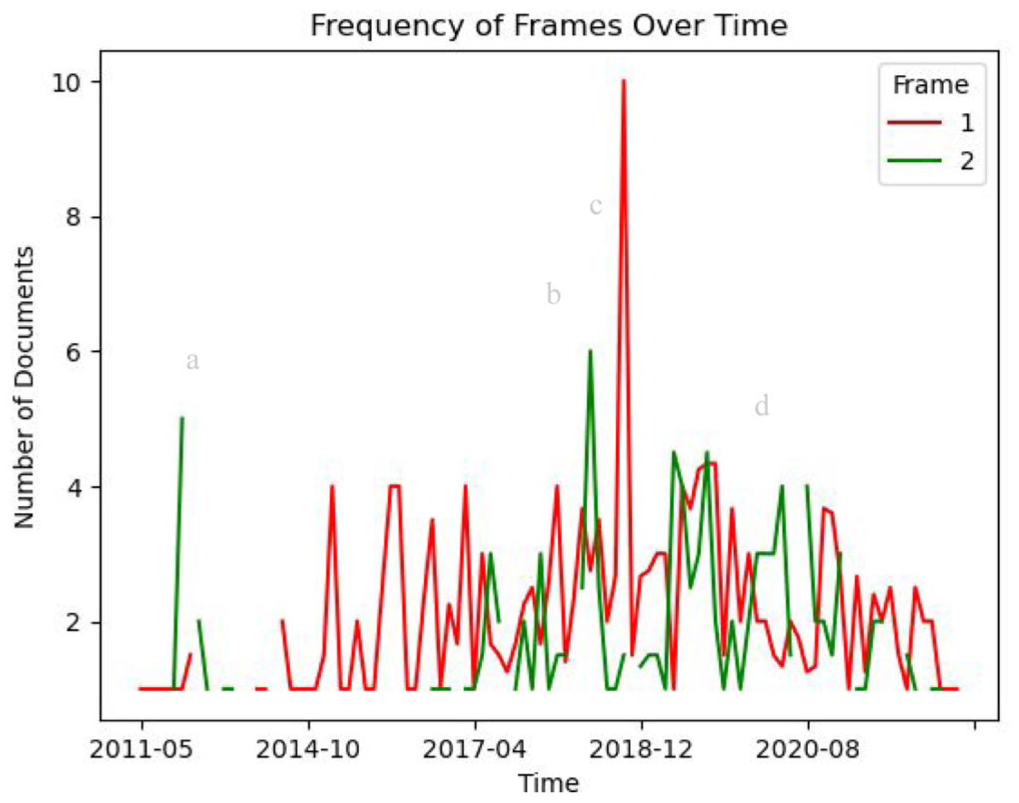
Changes in frequency of frames over time (frame 1 = AI systems and society-frame, frame 2 = Voice assistants and users-frame; a = launch of Siri, b = GDPR came into effect, c = Google Assistant came to the Netherlands, d = start of the COVID-19 pandemic in the Netherlands).
The Voice assistants and users-frame occurred once at the beginning of the investigated time period (i.e. 2011 and 2012) and then shows no presence until 2017. Only since 2017, this frame has become more established in the news, occurring concurrently to the AI systems and society-frame, particularly in 2017 and 2019. 2020 marks the only time period (except for 2011–2012) where the Voice assistants and users-frame was more prominent than the AI systems and society-frame. Again, parallel to the overall decline in volume, the frequency of the Voice assistants and users-frame decreased in most recent years (i.e. 2021–2022). Additional information about nuances detected within the two frames over time found post hoc are reported in the scripts on OSF.
Discussion
Previous research makes clear that news media form an important contextual factor for people’s adoption of new technology (Vishwanath, 2009) by reflecting and influencing how the public thinks and feels about technological advancements (Chuan et al., 2019). Yet, prior to this study, we lacked knowledge about media representations of VAs that can meaningfully inform research on adoption and use of this technology. To begin filling this gap, we investigated how VAs have been framed in the Dutch news coverage since their commercial rise (i.e. Siri in 2011). For this, we used ANTMN (Walter and Ophir, 2019) as an automated inductive approach to the study of frames in large text corpora. Our results highlight two frames and give rise to important public discussions about how VAs, and perhaps emerging technology more generally, are evolving in society. For reasons of readability and logical built-up of our findings, we first discuss our answers to RQ2 and then continue with the discussion of our answers to RQs1 and 3.
From hype to bust?
Over the past 11 years, we recorded an increase in news volume about VAs (RQ2), which aligns well with previous research (Brantner and Saurwein, 2021; Chuan et al., 2019; Vergeer, 2020) and the arrival of Google Assistant in the Netherlands in 2018. Results showed that an exponential trend describes this increase best. Yet, this growth in volume only lasted until 2019. Since then, we observe a decline in VA news coverage as was implied by Arifin and Lennerfors (2021). For the Netherlands, this is an interesting new finding: Previously, scholars uncovered a 34% VA adoption rate based on data from Dutch family households in 2020, concluding that VAs are indeed finding strong routes into Dutch homes, similar to the United States (Wald et al., 2023b). Considering our new knowledge about the Dutch news media coverage on VAs, we may further contextualize this finding now: On the one hand, the strong adoption rate might have potentially been fostered by the peak in public VA attention until 2019. On the other hand, given the recent change in news attention up until 2022, the adoption rate from 2020 might have undergone a different dynamic and will benefit from continued monitoring.
Detecting a recent downward trend in VA attention can mean that we are witnessing the natural flow of the issue-attention cycle and the occurrence of a beginning bust-period. As previously seen in the 1970s, late 1990s, and early 2000s, a drop in public AI attention has been interpreted as a sign for periods of “AI-winters” (Harguess and Ward, 2022). This new knowledge about the public perception of VAs helps us now to uncover hidden mechanisms in technology adoption-behavior and use-behavior that otherwise remain invisible. For instance, signs of resistance (e.g. non-adoption, fear, mistrust) might be, in parts, explainable by a lack of media attention and knowledge provision.
Besides these arguments that signal a potential bust-period, it is also likely that the presence of other socio(-political) issues around the globe in the years past 2018/2019 factored into the change in VA news coverage. We refer specifically to the COVID-19 pandemic or the conflict between Russia and Ukraine. Those events could have caused the news’ media attention to shift away. Either way, as Downs (1972) notes, once an issue has gone through this cycle it continues to typically have a higher average level of attention than pre-discovered issues. Furthermore, at the end of 2022, the first version of ChatGPT launched. Knowing about the rapid prominence that this new application reached globally, a new dynamic could have emerged in the years following our investigated time period (see Roe and Perkins, 2023 for details on news media headlines about ChatGPT in the United Kingdom). Together, this means that despite the signs of an eventual drop in news media attention in the Netherlands, the issue of VAs is likely to remain on the public agenda. To draw more robust conclusions about this, we need more research to keep monitoring the development of news attention during the time past our investigation, especially given the launch of ChatGPT later in 2022.
How VAs are framed
Societal and personal impact framing
We found two frames emerging from the Dutch news coverage around VA use (RQ1). The most frequent frame was the AI systems and society (72%) frame, in which VAs were recognized as one of many smart systems that are being implemented in society. Given that content presented through this frame mainly touched upon discussions around broader societal decisions (e.g. ethics, policy, and economics as seen, for instance, by topics 0, 1, and 3), we see resemblance to what scholars define as societal impact framing (Chuan et al., 2019). In this type of framing, consequences of a given development or event are communicated on a larger scale, not per se as affecting single individuals but rather society as a whole. In contrast to this, the other, less frequently detected frame was the one on Voice assistants and their users (28%). As this frame presented a narrower perspective on VAs, highlighting the modality of voice for individual users in specific contexts (as seen, for instance, by topics 2 and 6), it can be regarded as the respective counterpart, coined personal impact framing (Liberman and Chaiken, 1996). This type of framing communicates news stories with a stronger focus on the opinion of individuals, their experiences, and, as such, underlines specific impacts on smaller scale.
When looking more closely at the dynamic between the two frames over time (RQ3), we see that the Voice assistants and users-frame most often preceded the AI systems and society-frame. As such, VAs started out as a niche theme and slowly emerged to become an issue of wider interest with more and more people getting affected by it (Chuan et al., 2019). In 2011, Siri was introduced on Apple smartphones, marking an innovation, and the Dutch news media seemed to have presented it mainly by framing its unique voice aspects for individual users—possibly because a larger societal viewpoint was not yet in sight. Only in the years after, the AI systems and society-frame emerged and started to dominate the news discourse. Similarly, in 2018, the Voice assistants and users-frame peaked before the AI systems and society-frame reached its highest frequency. That year, Google Assistant was launched in the Netherlands, being the first and, at the time of conducting this study, only commercial voice assistant available in Dutch language (Pridmore et al., 2019). Presumably, the arrival of Google Assistant in the Netherlands has functioned as a catalyst for news attention on VAs (see also the development of topics over time on OSF). This first led to an emphasis on potential consequences on smaller scale for users personally, and then to a longer and bigger discussion about effects for society writ large. Finally, in 2020, when Amazon expanded its marketplace to the Netherlands (Day One Team, 2020), the Voice assistants and users-frame was again dominating the news discourse and shortly after the AI systems and society-frame took over. This follows the same pattern of the issue-attention cycle where a public issue typically starts out small before alarming or enthusiastic perceptions grow (Downs, 1972).
Finally, while it is rather typical to find the overall majority of information about a new technology as being presented through the societal impact frame (Chuan et al., 2019), the effect of information presented through personal impact frames should not be underestimated. Research shows that the consumptions of personally relevant information can have an even stronger influence on shaping attitudes, especially in contexts where existing knowledge about an issue is low (Liberman and Chaiken, 1996). In the Netherlands, public knowledge about AI-related technologies has recently been found to be poor across generations (de Vries et al., 2022). Thus, in that way, even few messages that frame information about VAs as personally impactful might have strong effects on attitude formation. First empirical indication for this is provided by another recent investigation in the Dutch context that found a link between people’s perception of personal impact frames in the news and alterations in their frequency of smart speaker use, whereby this link was more consistent for personal impact frames than it was for societal impact frames (Wald et al., 2025). Scholars are therefore advised to pay equal attention to both types of frames moving forward, regardless of their potentially varying prominence in news coverage.
A mixed view of risks and benefits
The juxtaposition of risks and benefits also formed, as expected, a substantial part in how the Dutch news reported about VAs. We mainly saw this in the inspection of frame elements (i.e. topics). Among the risks mentioned were points of social responsibility, a general lack of legal foundations for data sharing and privacy rules, as well as economic power abuse and technological misuse. This is in line with the previous literature on AI and other recent innovations discovering risk-oriented frames (Brantner and Saurwein, 2021; Chuan et al., 2019; Vergeer, 2020). In terms of benefits, we also see overlap with previous findings (Köstler and Ossewaarde, 2022), particularly regarding the economic driving force of the voice modality for the audio world and the growing convenience for consumers. At the same time, the increasing supply of voice technology in the Netherlands is a specific asset in the Dutch context in comparison to other previously investigated media spaces.
Interestingly, an opposing view of risks and benefits was not separately presented in the two frames, such that one frame would highlight risks whereas the other would emphasize benefits. A clear indication of a more benefit- or risk-oriented viewpoint could also not be seen on frame-element-level with certain topics reflecting risks and others predominantly benefits. Instead, both frames and topics showed a combination of the two views. Finding such mixed frames that include risks as well as benefits demonstrates the mission of news media as an information and orientation source. With the goal to educate citizens about VAs as a public issue, news media offer a balanced perspective. At the same time, it might also signal the remaining amount of public uncertainty around VAs, which might lead news media to weigh risks and benefits more often against each other rather than framing the technology as clearly offering one or the other. As a consequence of this, the public likely lacks clarity as to whether it is now a good or bad technological development (Borah, 2011). And this, in turn, may have different effects on audiences’ technological beliefs than specific positive and negative frames (Vishwanath, 2009).
Future research
Uncovering how the Dutch news media frame VAs was a first step in generating more knowledge about the potential origin of VA-relevant attitudes. For advancing theoretical work in HCI, it is important to pay closer attention to contextual factors—such as news media—that extend beyond individuals’ immediate surroundings and shape how technologies are adopted and used. Existing models, including TAM and its extensions (e.g. UTAUT), address this only to a limited extent. While they account for influences like social norms and image-related dynamics within people’s proximal environments (Venkatesh et al., 2003), they overlook more distal factors. These broader influences (e.g. through the news media) carry both, authoritative weight and the ability to (de)legitimize new technologies at the societal level (Turow, 2021).
Empirically speaking, a natural next step will be to test for concrete media effects of VA frames. Here, we see different ways in which future research can tie in. One is through the investigation of people’s media consumption habits and their recognition of the two identified frames. Experimental studies which test for effects of different impact frames (i.e. personal vs societal impact frame) would be equally interesting. Here, we would hypothesize that personal impact framing has a stronger effect on people’s VA attitude than societal impact framing, especially if applied in a context with poor existing AI knowledge.
Furthermore, despite the differences between the two frames, we pledge for caution to see them as fully distinct. Our topics network showed several strong connections between elements of the two frames, indicating that messages did, at times, contain elements of both. The framing literature has established that it is quite usual for news articles to contain more than one frame. Future research is further encouraged to disentangle when these connections between elements of both frames are indeed a sign for frame co-occurrence, and when the strength of those connections rather provides support for an additional frame that constitutes a combination of the two.
Finally, as the news media landscape is becoming more versatile in terms of outlets and journalistic roles, we see great value in exploring differences in frame attention between various types of news sources that write about VAs—similar to research by Cacciatore et al. (2012) on differences between print and online media coverage on emerging technologies. For instance, scholars may want to explore whether news texts produced by professional journalists focus on different frames than those that stem from bloggers or resemble user-generated content on online platforms (e.g. social media). Equally interesting would be the questions whether frames on Internet-only platforms differ from those that serve in online as well as offline spaces (i.e. newspapers) and what providers themselves spread in their advertising of their assistant(s). The recent developments on generative AI and the multitude of new language models and conversational interfaces that emerge on the market create an extremely rich context for such further exploration.
Limitations
Our investigation focuses on the Dutch news media landscape, which might make generalizability to other media contexts difficult. Comparative investigations from different countries as well as other media formats, such as social media or advertising, are therefore valuable additions. Methodologically, while our choice for an unsupervised machine learning approach was motivated by the underresearched topic of VAs’ media representations and the large text corpus available (Walter and Ophir, 2019), full objectivity in our findings is not guaranteed. The final manual interpretations of automatically identified frame elements (topics) and frame packages (frames) are based on previous knowledge and intuitiveness of the researchers. To combat this, we provide accompanying details and memos of the interpretation process to strengthen validity and reliability (see OSF).
Finally, another limitation lies in the robustness of the detected frames. Although interpretability of the two frames was coherent and in line with the existing literature, we cannot say with certainty how likely the frames are to appear in a second set of news media messages and to what extent the topics covered all essence of the content, as only 50% of the entire corpus was meaningfully captured by the topics. This is due to the inductive nature of the framing approach and further corroborated by the low modularity score of the community structure. Hence, scholars are encouraged to apply ANTMN to other VA-related text corpora and validate our results and method through confirmatory studies.
Conclusion
The growing body of literature on VA-adoption has left contextual factors, such as media representations of VAs, fairly neglected. Following theory highlighting the role of news media for technological attitude formation, this study investigated how VAs have been framed in the Dutch news between 2011 and 2022 to aid further empirical research on factors explaining VA-adoption and use. We uncovered an exponential increase in news attention on VAs starting in 2011 with a peak in 2019. Most recently, we notice a decline in volume, potentially indicating a bust-period as a natural development in the issue-attention cycle. Two central frames emerged: a frame on AI and society and on Voice assistants and users that resemble aspects of societal and personal impact framing, respectively. With this, the present study complements the existing body of literature on related developments like AI, automation, and robotics with insights about the (Dutch) news coverage on VAs. It enables the scientific community to continue monitoring the dialogue about VAs for comparison with other time periods, contexts, and technologies. Furthermore, this study builds the basis for theoretically motivated media effects research looking into the impact that VA frames have on people’s adoption- and use-behavior. Accounting for the role of news media in the public opinion formation process is crucial. Otherwise, we might be missing an important contextual influence in people’s environment that can provide us with answers to pressing questions about hidden mechanisms in the adoption of emerging technologies.
Footnotes
Acknowledgements
The authors thank Kirill Palenov, Yotam Ophir, Ayse Deniz Lokmanoglu, Shreya Dubey, Mónika Simon, Fabio Votta, Anne Kroon, Damian Trilling, Noon Fatah Elrahman Abdulqadir, and Margot van der Goot for their analytical advice and support, and Emma van der Goot for her conceptual input to this study.

Author contributions
Funding
The authors disclosed receipt of the following financial support for the research, authorship, and/or publication of this article: This work was supported by the Communication in the Digital Society Initiative (uva.nl/communication-digital-society).