



Abstract
This study employed virtual reality (VR) to examine how avatar embodiment (self vs stranger), virtual human race (ingroup vs outgroup), and contact valence (positive vs negative) influence intergroup attitudes. US participants (N = 262) assigned to avatars displaying a stranger’s face, rather than their own, showed greater acceptance of outgroup virtual humans. Perceived identifiability mediated the influence of avatar face on self-other overlap. Social dominance orientation moderated this effect, as mediation was strongest among individuals with average and high scores. Positive contact enhanced self-other overlap with virtual humans, whereas negative contact unexpectedly increased empathy for outgroup members. Ingroup negative contact boosted positive ingroup feelings among participants using avatars that mirrored their own face. Consistent with positive ingroup biases, individuals reported greater positive feelings and empathy toward ingroup members following ingroup (vs outgroup) interactions. The results provided evidence regarding the theoretical mechanisms through which VR contact reduces and boosts prejudice.
Keywords
Direct intergroup contact can reduce prejudice toward outgroup members (Allport, 1954; Pettigrew and Tropp, 2006). However, racial, religious, educational, occupational, linguistic, cultural, geographical, and institutional barriers decrease the odds of direct intergroup contact (Dovidio et al., 2011). Computer-mediated intergroup contact (CMIC) is a variation of direct contact in which communication technologies facilitate interaction between individuals who otherwise may not physically meet (Amichai-Hamburger et al., 2015; Kim and Wojcieszak, 2018; Walther et al., 2015). CMIC includes the use of texting tools (e.g. chat, email) (Schumann et al., 2017), social media (Kim and Harwood, 2020), video games (Stiff and Bowen, 2016), and virtual reality (VR) in which individuals embody avatars and interact in a lifelike environment with human- or AI-controlled virtual humans (Alvidrez and Peña, 2020; Herrera et al., 2018; Peña et al., 2021). CMIC may decrease anxiety and physical transportation costs, as well increase accessibility and availability of language translation tools (Amichai-Hamburger and McKenna, 2006). CMIC also allows individuals to emphasize or occlude their personal identity and group membership (Amichai-Hamburger and McKenna, 2006) as it affords anonymity (e.g. lack of pictures or names; uniform visual representation by means of using the same avatar) and identifiability (e.g. use of portrait photos, real names, or uniquely customized avatars).
CMIC can be an effective tool to reduce intergroup prejudice. Social media users with a greater number of outgroup friends hold more positive outgroup attitudes, and this relationship is mediated by augmented humanitarian-egalitarian values (Schwab and Greitemeyer, 2015). Text chats with Latin Americans who defied stereotypes (e.g. showing scientific rather than religious thinking) decreases prejudice by making them seem less typical of the group (Alvídrez et al., 2015). However, when they emphasized religion rather than scientific thinking, Latinos are seen as more typical, which increases prejudice. People also apply learned biases to CMIC. Caucasians keep larger personal distances with Middle Eastern instead of Caucasian virtual humans in VR (Dotsch and Wigboldus, 2008). In addition, individuals show more compliance to requests made by light-skinned instead of dark-skinned virtual humans (Eastwick and Gardner, 2009).
A meta-analysis with 23 studies (Imperato et al., 2021) finds that CMIC has a medium statistical effect size on improving intergroup relations (d = .36). In addition, a review of 64 VR intergroup contact studies (Tassinari et al., 2022b) shows that most studies focus on majority group members interacting with outgroup avatars. These studies often find reduced prejudice. In contrast, studies in which participants take the perspective of a minority outgroup member show mixed results (Tassinari et al., 2022b). In addition, the use of participants from ethnic minority backgrounds is rare in VR intergroup contact research (Tassinari et al., 2022b).
To further deepen our understanding about the effectiveness of VR group contact, this study examines the effects of avatar embodiment, social identity salience, and contact valence on ingroup and outgroup perceptions. VR is an ideal testing ground to study the effects of these factors. VR can expose individuals to simulated experiences that are representative of real-life scenarios in which causal factors are precisely manipulated in controlled experiments (Wang and Bailenson, 2024). For example, online anonymity fosters more self-disclosure but it can also encourage arguments and disagreement (Spears and Postmes, 2015). To interact with objects and communicate, individuals can select, create, or customize avatars that closely mirror their physical self (Ahn and Bailenson, 2011) or even possess supernatural abilities (Rosenberg et al., 2013). In addition, virtual humans may display visual cues to ingroup or outgroup identities based on race (Dotsch and Wigboldus, 2008; Groom et al., 2009; Tassinari et al., 2024a, 2024b) and political slogans (Peña et al., 2021). Virtual humans can also display positive and negative emotions and behaviors at a consistent frequency and intensity (Qu et al., 2014).
In addition, unique VR characteristics that may influence prejudice reduction remain understudied, including the effects of identification with the embodied avatar, body ownership, user affect, and immersion (Tassinari et al., 2022b). For example, politically liberal participants who customize their VR avatar to resemble their physical self instead of a stranger show increased perceived identifiability, which in turn reduces social distance toward a virtual woman displaying anti-immigration views (Peña et al., 2021). Perceived identifiability refers to an individual’s perception that their real-life persona can be recognized by others based on the features of their avatar (Peña et al., 2021). Moreover, participants with average and high pre-existing involvement with immigration show increased social distance after customizing a self-resembling avatar, thus implying statistical moderation (Peña et al., 2021). To expand on this research, we examine the moderation effects of social dominance orientation (SDO) because it is a well-established predictor of prejudice which reflects preferences for hierarchical instead of egalitarian group relations (Pratto et al., 1994; Whitley, 1999). Adding SDO allows this study to test whether VR contact effects generalize to individuals who do not endorse egalitarian norms. Consider that the positive effects of cross-group friendships on prejudice reduction is stronger among high SDO individuals, thus revealing that these individuals may respond favorably to specific instances of intergroup contact (Kauff et al., 2016). By examining the effects of avatar embodiment, social identity salience, and contact valence, along with charting the influence of perceived identifiability and social dominance orientation using a sample of minority participants, this study provides a more granular understanding of VR contact effects.
We examine contact effects on empathy, or sympathetic feelings toward other individuals (Batson et al., 1997), social distance, or degree of intimacy afforded to ingroup or outgroup members (Bogardus, 1925), feeling thermometer, or colder or warmer attitudes toward a social group (Converse et al., 1980; Lolliot et al., 2015), and self-other overlap, or perceived self-partner connection (Schubert and Otten, 2002). Compared with participants that embody a member of the ingroup (e.g. a fellow national) in VR, those who take the perspective of an outgroup member (an immigrant) report increased empathy and positive attitudes toward that outgroup (Chen and Ibasco, 2023). VR outgroup experience boosts empathy, which in turn leads to warmer feeling thermometer ratings (Chen and Ibasco, 2023). In addition, participants who experience increased co-presence in a cooperative interaction with a Black avatar (outgroup contact) show greater post-VR empathic interest relative to those who have a cooperative interaction with a White avatar (ingroup contact) (Tassinari et al., 2022a). Among Singaporean individuals, embodying an immigrant avatar boosts self-other overlap with the immigrant’s group relative to using a fellow national avatar (Chen et al., 2021b). Below we review the mechanisms that underlie the effects of these factors and propose empirical predictions.
Anonymity effects: deindividuation, depersonalization, and group salience
CMIC ranges from visually anonymous to visually identifiable contexts (Spears and Postmes, 2015). More specifically, visual anonymity is expected to foster deindividuation or a loss of self-awareness, which in turn decreases inhibitions and augments disagreements (Spears and Postmes, 2015). This factor should lead to more fraught intergroup relations. Early evidence indicates that online group decisions and partner impressions are more extreme relative to face-to-face teams (Spears and Lea, 1994; Walther, 1996). In addition, anonymity may dampen the effect of intergroup encounters. For example, text-based communication with anonymous outgroup members results in less interesting, satisfying, involving, and cheerful interactions, thus reducing positive feelings toward the outgroup (Schumann et al., 2017). Moreover, individuals who experience ostracism in VR are more likely to retaliate against identity-concealed than identity-revealed ostracizing partners (Segovia and Bailenson, 2012).
Instead of emphasizing how visual anonymity leads to deindividuation, the social identify model of deindividuation effects (SIDE) highlights how anonymity can cause depersonalization or a tendency to envision self and partners in terms of group norms and stereotypes (Spears and Lea, 1994; Spears and Postmes, 2015). Deindividuation implies reduced self-regulation whereas depersonalization denotes intensified group-level identity salience (Spears and Postmes, 2015). Accordingly, SIDE predicts that online anonymity reduces individual identity salience and increases group identity salience (Spears and Lea, 1994; Spears and Postmes, 2015). For example, the group decisions of anonymous individuals with common group salience (i.e. psychology majors) are more in line with pre-existing politically liberal group norms whereas anonymous individuals with personal identity salience show more dissent from group norms (Spears et al., 1990). Avatars can also activate a common group identity. Playing a video game in avatar teams dressed in participants’ school colors augments identification and social presence, which in turn increases enjoyment relative to playing with avatars lacking shared group symbols (Peña et al., 2017). In addition to an identity salience dimension, SIDE also proposes a strategic dimension which describes how individuals adjust their behavior when identifiability augments reputational accountability or compliance with group norms (Spears and Lea, 1994). Although this study does not directly test predictions from SIDE’s strategic dimension, it focuses on the accountability dimension of SIDE and the mediating role of perceived identifiability. Identifiability is expected to heighten accountability to others by strengthening the perceived link between online and offline selves (Walther and Parks, 2002), thus shaping intergroup contact outcomes.
VR contact research would benefit from untangling the effects of using technological features that decrease anonymity (e.g. assigning a face mug shot to one’s avatar) from the perception of identifiability that results from these features. Previous work shows that perceived identifiability mediates the effect of avatar self-customization on social distance toward an outgroup member, implying that greater identifiability in VR contact can decrease prejudice (Peña et al., 2021). In addition, in an online discussion about aboriginal compensation, participants who were identifiable by name expressed less anti-aboriginal sentiment and greater support for compensation than anonymous participants (Douglas and McGarty, 2001). Increased identifiability also provides a stronger warrant between an online persona and a real person, thus elevating reputational concerns (Walther and Parks, 2002). Thus:
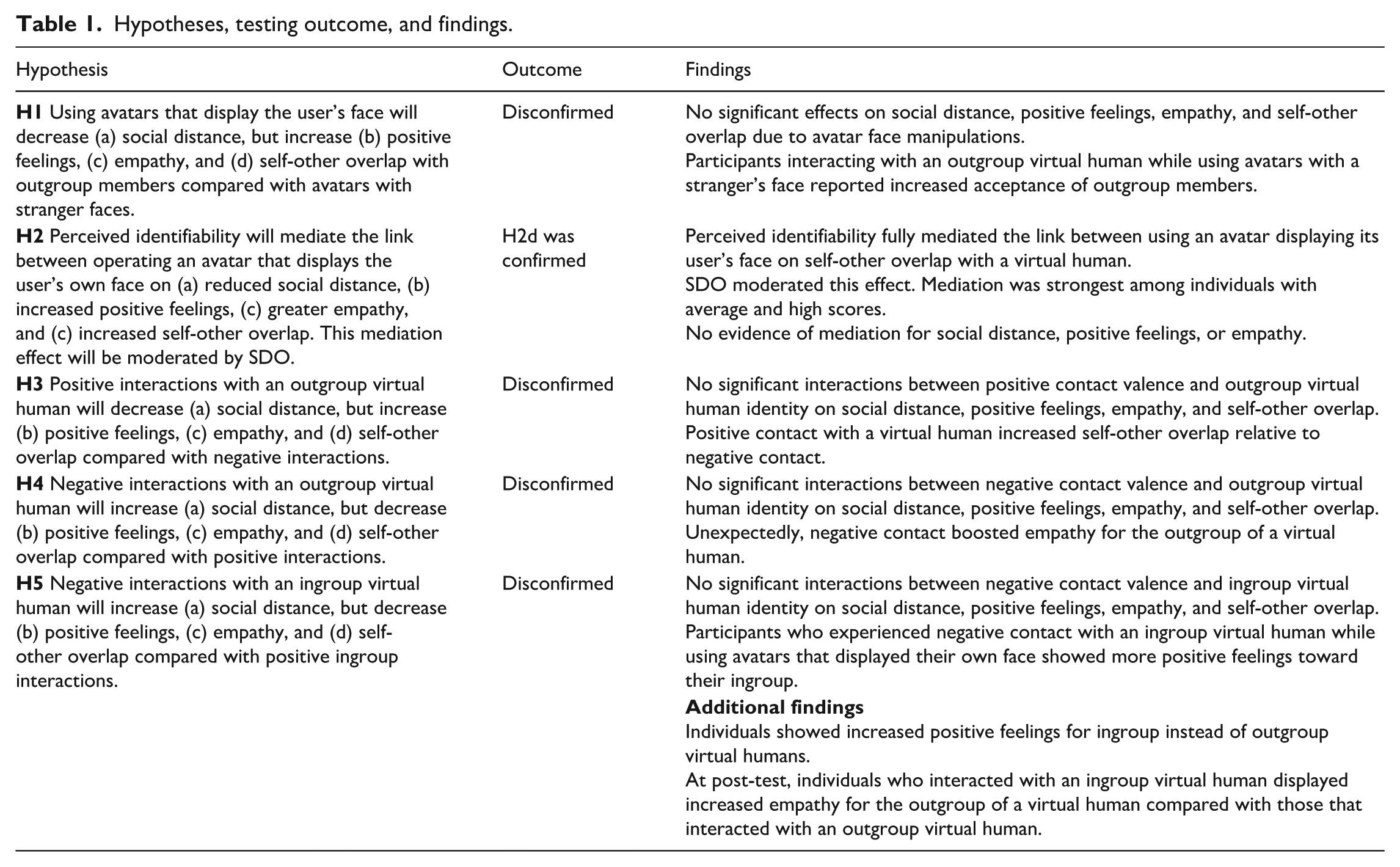
H1. In VR intergroup encounters, using avatars that display the user’s face will decrease (a) social distance and increase (b) positive feelings, (c) empathy, and (d) augment self-other overlap with outgroup members relative using avatars that do not display the user’s face.
H2. Perceived identifiability will mediate the link between operating an avatar that displays the user’s own face on (a) reduced social distance, (b) increased positive feelings, (c) greater empathy, and (d) increased self-other overlap. This mediation effect will be moderated by SDO.
The effects of contact valence on prejudice
Positive intergroup contact can decrease contact anxiety, augment empathy and perspective-taking, and increase knowledge about the outgroup (Davies et al., 2011; Pettigrew and Tropp, 2006). In particular, the common ingroup identity model predicts that positive behaviors may lead to the recategorization of outgroup as ingroup members (Gaertner and Dovidio, 2000). For instance, increased positive emotions are associated with augmented self-other overlap with new roommates both after 1 week and 1 month in college (Waugh and Fredrickson, 2006).
Positive CMIC that fosters cooperation has stronger effects than other known factors, such as presence of common goals or institutional support (Imperato et al., 2021). For instance, cooperative activities with outgroup avatars in VR can improve people’s attitudes (Tassinari et al., 2024a, 2024b). Relative to competitive play, cooperative play increases helping behavior among participants who play a violent video game with a confederate posing as an outgroup or ingroup member (Velez et al., 2012). Moreover, cooperation with an outgroup member reduces aggression more prominently relative to playing cooperatively with an ingroup member (Velez et al., 2012). Thus:
H3. Positive interactions with an outgroup virtual human will decrease (a) social distance but will increase (b) positive feelings, (c) empathy, and (d) self-other overlap with outgroup members relative to negative interactions with an outgroup virtual human.
According to Paolini et al. (2010), an emphasis on improving intergroup relations has led to fewer studies documenting negative contact effects even though such encounters may play a key role in shaping group attitudes. Negative outgroup contact may confirm existing negative outgroup expectations (Paolini et al., 2010). Consider that negative contact with Muslims, Black Australians, and asylum seekers has a stronger effect on increasing prejudice relative to the effect of positive contact with these groups on reducing it, thus suggesting a potential valence asymmetry (Barlow et al., 2012). In addition, a recent meta-analysis shows that while positive contact is linked to lower prejudice and negative contact is associated with increased prejudice, the deleterious effects of negative contact are significantly larger than the beneficial effects of positive contact (Paolini et al., 2024). This evidence provides context to the prediction that negative contact will produce less favorable outcomes than positive contact, all things kept equal. Thus:
H4. Negative interactions with an outgroup virtual human will increase (a) social distance and decrease (b) positive feelings, (c) empathy, and (d) self-other overlap with outgroup members relative to positive interactions with an outgroup virtual human.
Contact valence may override the effects of group salience. Regardless of the confederate’s outgroup or ingroup status, individuals are more attracted to virtual teammate confederates who show interpersonal likeability relative to those acting more dislikable (Wang et al., 2009; Yilmaz and Peña, 2014). Moreover, in the face of negative social comparisons, individuals with high ingroup identification may display more commitment to their group (Doosje et al., 1995). Contact valence may also interact with the effects of group salience. Although social identity theory predicts a positive ingroup bias (Tajfel and Turner, 2004), the black sheep effect instead predicts strong disapproval of uncooperative ingroup members (Marques and Paez, 1994; Reiman and Killoran, 2023). Based on the above:
H5. Negative interactions with an ingroup virtual human will increase (a) social distance and (b) decrease positive feelings, (c) empathy, and (d) self-other overlap with their ingroup compared with positive interactions with an ingroup virtual human.
Method
Participants
Participants (N = 262, n = 130 women, n = 132 men) from a large US West Coast university were randomly assigned to the conditions of a 2 (avatar face: participant or stranger) × 2 (group membership of a virtual human: ingroup or same race as participants, outgroup or African American) × 2 (contact valence: positive or negative) experiment with a pre-post test design. The study received IRB approval (1862875-1) and the data was collected in fall 2021–2023. An a priori power analysis (Faul et al., 2007) for an ANCOVA design with repeated measures with a within-between interaction and Power estimated at 1−ß = .80 with Cohen’s d = .25 recommended N = 179 participants for recruitment. The study was pre-registered https://osf.io/8xukc/?view_only=8bdaa2ac00e240ca8cceb3e2e9359513. The participants’ average age was 19.49 (SD = 1.66) ranging from 18 to 31. 60.3% of participants were Asian, 15.6% were Hispanic or Latino, 14.5% were Caucasian/White, 2.3% were African American, .4% were Native Hawaiian and Pacific Islander, and 6.9% chose other races.
Procedure
Participants completed a pre-experiment survey with demographic information questions and SDO (Pratto et al., 1994), intergroup anxiety (Stephan and Stephan, 1985), social desirability (Stöber, 2001), and ethnic group identification scales (Doosje et al., 1995). At pre-registration, these variables were listed as exploratory factors for statistical moderation analyses. The outcome variables that were measured before and after the VR experience included feeling thermometer (Converse et al., 1980; Lolliot et al., 2015), and social distance scales (Bogardus, 1925). Perceived user-avatar identifiability (Peña et al., 2021) and self-other overlap (Schubert and Otten, 2002) were measured after the VR experience.
Participants came to the lab for two sessions held on separate days. In the first session, each participant had their face photo taken. In the second session, participants were randomly assigned to an avatar featuring either their own face or a stranger’s face. To avoid confounds, avatars with a stranger’s face were of the same race and sex as the participant. Based on random assignment, a virtual human was then either shown as a member of the participant’s racial ingroup (i.e. same race and sex as the participant) or was shown as an outgroup member (i.e. African American). This outgroup was selected because studying prejudice toward African Americans is common in stereotyping, implicit bias, and group categorization research (Devine, 1989; Dovidio et al., 2002; Richeson and Shelton, 2003). The outgroup customer was of a different race but had the same sex as the participant to avoid compounding these two factors into a single manipulation.
Participants using the Oculus Rift headset were then immersed in a VR restaurant scenario and exposed to their avatar’s face while in a locker room (Figure 1). Participants took on the role of a server tasked with engaging with a virtual human customer who displayed positive (e.g. polite, helpful) or negative (e.g. impolite, unhelpful) behaviors (Figure 1). The contact valence manipulation was consistent with research that used confederates to behave cooperatively or uncooperatively (Wang et al., 2009; Yilmaz and Peña, 2014). The virtual human’s behavior was programmed to deliver a controllable and replicable server-customer interaction that remained consistent across trials. Participants’ head mounted display motion data was captured for future research.
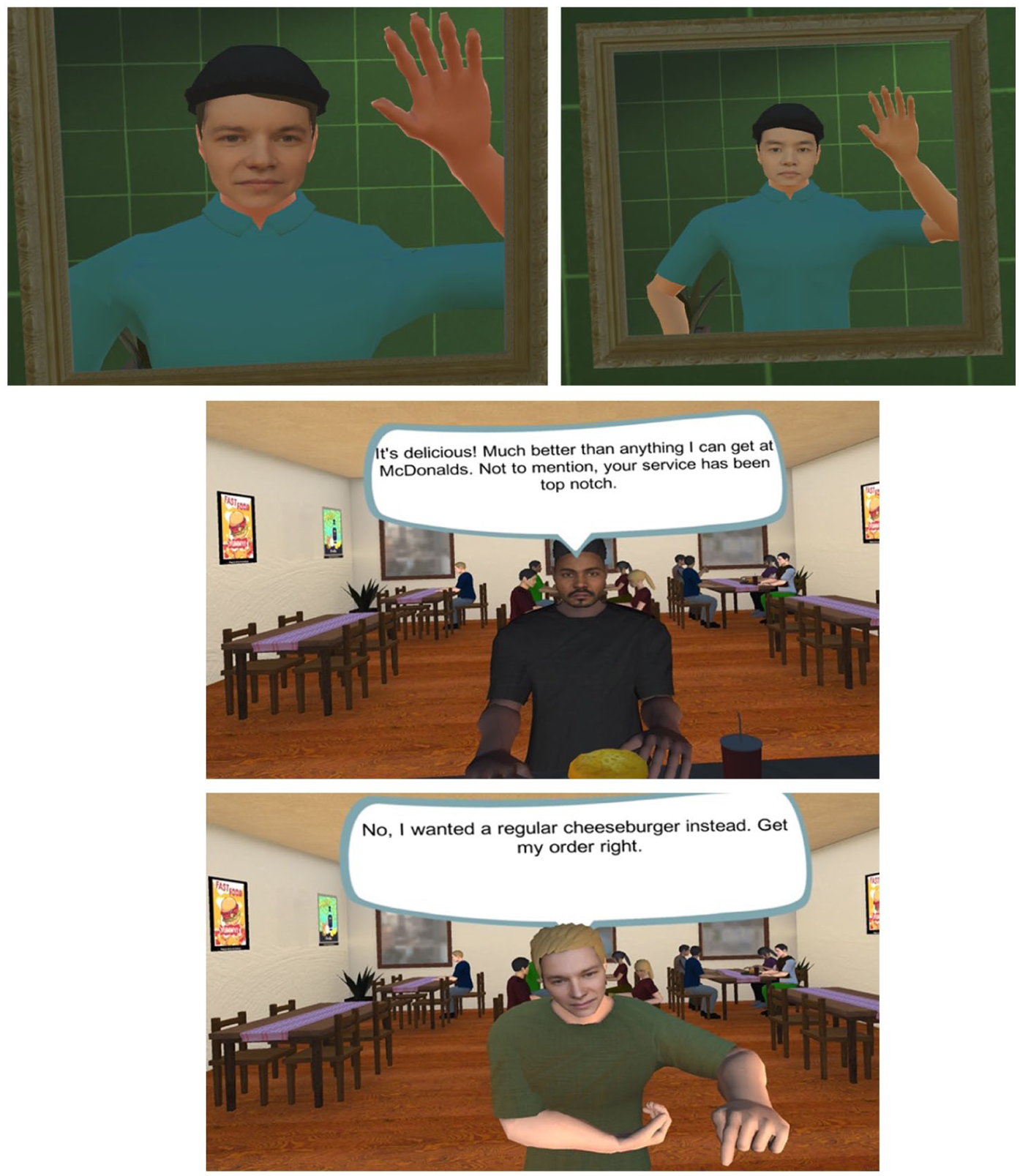
VR avatar face (top), social identity salience and contact valence (bottom) manipulations.
Each participant completed a training session in a VR locker room where they viewed their avatar’s face in a mirror (Figure 1). Participants then practiced object pick up tasks to get familiar with the headset and touch and move objects with the controllers. After training, participants entered a restaurant environment and embodied the role of a server. Participants then engaged in a semi-structured exchange with a virtual human customer, who delivered scripted positive (e.g. polite, friendly, helpful) or negative (e.g. curt, dismissive, unhelpful) behaviors (Figure 1). The contact valence manipulation was consistent with research that used confederates to behave cooperatively or uncooperatively (Wang et al., 2009; Yilmaz and Peña, 2014). Participants performed basic serving tasks (e.g. taking, adjusting, delivering, and charging for a food order) while attending and responding to the virtual human’s comments and requests. These actions determined the pacing of the interaction but not the programmed behaviors of the virtual human, thus ensuring experimental control and ecological validity.
Outcome variables
Social distance
This factor measured the degree of intimacy that characterizes social relations with specific racial groups (Bogardus, 1925). Target groups included Asians, Latinos, African Americans, and Caucasians. For each race, participants rated whether they would be willing to accept someone from this racial group as a neighbor, close friend, and close relative by marriage. Thus, lower scores implied more social distance and higher scores denoted increased acceptance. Pre- and post-test social distance scores were reliable for Asians (pre Cronbach’s α = .94, post Cronbach’s α = .84), Latinos (pre α = .92, post α = .91), African Americans (pre α = .91, post α = .93), and Caucasians (pre α = .92, post α = .88).
Feeling thermometer
Three items measured participants’ pre- and post-test stance toward Asians, Latinos, African Americans, and Caucasians (Converse et al., 1980; Lolliot et al., 2015). Each group was rated on attributes including cold-warm, negative-positive, and hostile-friendly framed in 0 to 100 scales. Pre and post-test feeling thermometer scores were reliable for Asians (pre α = .79, post α = .84), Latinos (pre α = .86, post α = .91), African Americans (pre α = .86, post α = .93), and Caucasians (pre α = .86, post α = .88).
Empathy
Participants rated how sympathetic, soft-hearted, moved, understanding, and compassionate they felt toward Asians, Latinos, African Americans, and Caucasians using 1–7 Likert-type scales (1 = not at all; 7 = Extremely). Pre and post-test reliability for Asians (pre α = .91, post α = .93), Latinos (pre α = .93, post α = .94), African Americans (pre α = .92, post α = .94), and Caucasians (pre α = .91, post α = .93) was good (Batson et al., 1997).
Self-other overlap
At post-test, a one-item pictorial scale assessed the degree to which participants felt separated or close to the virtual human customer (Schubert and Otten, 2002).
Mediator variable
Perceived user-avatar identifiability
Three items developed by Peña et al. (2021) measured participants’ perceived user-identifiability with a 7-point Likert-type scale where 1 = strongly disagree and 7 = strongly agree. The items were “If people who knew me saw my avatar, they would notice it looks like me,” “If people who knew me saw my avatar, they would recognize me through my avatar’s appearance,” and “If people who knew me saw my avatar, they would identify the character as bearing my resemblance.” This scale was reliable (α = .95).
Moderator variable
Social dominance orientation
This factor reflects whether an individual prefers group relations to be equal or hierarchical, such that social dominance-oriented individuals are expected to favor hierarchy-enhancing ideologies and policies, including meritocracy and racism (Pratto et al., 1994). The factor was measured with 16 items framed in a 1–5 Likert-type scale. Sample items included “Some groups of people are simply inferior to other groups” and “If certain groups stayed in their place, we would have fewer problems.” This scale was reliable (M = 2.19, SD = .86, α = .90). Although presence, immersion, and embodiment were pre-registered as moderators, these factors were not analyzed. Intergroup anxiety was also pre-registered but was not analyzed due to low reliability (α = .68).
Manipulation checks
Race categorization of virtual humans
Participants were asked “Did the customer appear to be of the same or different ethnicity as you?” Participants in the outgroup condition selected “different ethnicity” more frequently than “same ethnicity” (123 vs 10), χ2(1) = 64.56, p = .001. However, participants in the ingroup condition selected “same ethnicity” almost as frequently as “different ethnicity” (67 vs 59). When the virtual human was presented as African American, outgroup race categorization was almost unanimous but when the virtual human had the same race as participants then group categorization choices was evenly split. While ingroup recognition advantages are commonly observed (Meissner and Brigham, 2001), several conditions can augment outgroup salience. Participants showed increased recognition for angry outgroup faces, suggesting that threat amplified outgroup salience (Ackerman et al., 2006). In addition, outgroup face recognition improved when participants categorized targets as members of a shared university group, implying that task relevance and grouping context influence recognition (Hehman et al., 2010). In the present context, race-indicative visual cues paired with the restaurant order task framing may have increased attention to outgroup virtual humans.
Perceptions of virtual human behavior
This factor was assessed with three items framed as a 7-point Likert-type scales where 1 = very negative and 7 = very positive. Items included “How would you rate your experience with serving this customer?,” “What was the customer’s attitude toward you?,” “How would you rate the customer’s manners?” Scale reliability was very good (α = .98). Participants assigned to the positive contact condition rated the virtual human avatar more positively (M = 5.05, SD = 1.43) than those in the negative contact condition (M = 1.99, SD = 0.87), F(1, 258) = 1324.80, p = .001, η² = .84, 95% CI = [0.81, 0.86].
Results
The data was analyzed with repeated measures ANOVAs to account for within- and between-subjects effects before and after the experimental manipulations. The data was transposed such that, for example, if an Asian participant was assigned to the ingroup condition, then their ratings matched with Asians as a group for all dependent variables. This was also the case for participants from other races. If a participant was assigned to the outgroup condition, then their ratings corresponded to African Americans as a group for all dependent variables. Table 1 details the study’s hypotheses, testing outcome, and findings. Descriptive statistics and all F-tests appear in Additional Materials. In addition to the pre-registered analyses, we conducted exploratory analyses probing indirect effects on feeling thermometer, empathy, and social distance, as well as moderation effects of SDO.
Hypotheses, testing outcome, and findings.
Feeling thermometer
There was a significant between-subjects effect for the social identity manipulation, F(1, 227) = 8.56, p = .004, η² = .04. Estimated marginal means revealed significant pre-existing ingroup favoritism. Participants had increased positive feelings for the racial group of the virtual human that would be presented as an ingroup (M = 75.75, SE = 1.82) instead of an outgroup member (M = 70.58, SE = 1.76), F(1, 227) = 4.18, p = .04, η² = .02, 95% CI = [−10.17, −0.19]. Post-test scores showed an even wider difference in positive feelings favoring the virtual human with an ingroup (M = 78.83, SE = 1.75) instead of an outgroup identity (M = 70.61, SE = 1.70), F(1, 227) = 11.34, p = .001, η² = .05, 95% CI = [−13.04, −3.41]. In addition, participants that interacted with an ingroup virtual human showed increased positive feelings from pre- (M = 75.75, SE = 1.82) to post-test (M = 78.83, SE = 1.75), Wilks’ lambda F(1, 227) = 4.88, p = .03, η² = .02, 95% CI = [−5.83, −0.33].
There was also a significant 4-way interaction effect, F(1, 227) = 8.77, p = .003, η² = .04. Participants who experienced negative contact with an ingroup virtual human while using avatars that displayed their own face had more positive feelings toward their ingroup relative to the remaining conditions (M = 80.59, SE = 3.30), F(1, 227) = 9.86, p = .002, η² = .04, 95% CI = [−13.41, −3.07]. No additional effects were found.
Empathy
The social identity manipulation had significant between-subjects effects, F(1, 227) = 4.25, p = .04, η² = .02. Estimated marginal means for post-test empathy were higher for participants that interacted with an ingroup (M = 5.22, SE = 0.12) instead of an outgroup virtual human (M = 4.87, SE = 0.11), F(1, 227) = 4.41, p = .04, η² = .02, 95% CI = [−0.67, −0.02].
Contact valence had a main effect on empathy, F(1, 227) = 4.41, p = .04, η² = .02. Estimated marginal means revealed that negative contact increased empathy for the group represented by the virtual human from pre (M = 5.13, SE = 0.08) to post test (M = 4.94, SE = 0.08), F(1, 227) = 4.86, p = .03, η² = .02, 95% CI = [−0.28, −0.01]. No other effects were found.
Social distance
Participants who interacted with an outgroup virtual human while using avatars with a stranger’s face showed increased outgroup member acceptance (M = 1.51, SD = 0.08), F(1, 227) = 3.89, p = .05, η² = .02. No additional effects were found.
Self-other overlap
Positive contact increased self-other overlap (M = 4.19, SD = 1.62) relative to negative contact (M = 2.45, SD = 1.37), F(1, 227) = 88.27, p = .001, d = 1.16. No other effects were found. Overall, H1 was not supported as using avatars displaying user’s face did not reduce social distance and increase positive feelings, empathy, and self-other overlap compared with using avatars with a stranger’s face.
Moderated mediation analysis
Hypothesis 2 was tested with a moderated mediation analysis using Process model 59 macro (Hayes, 2022). The analysis was set at 10,000 bootstrapped samples. Mean centering was applied to all variables that defined products. Pre-test scores were used as a covariate for outcome variables assessed at pre- and post-test to isolate the effects of the avatar face manipulation. No direct or indirect effects were observed on feeling thermometer, empathy, and social distance (see Additional Materials). Participants assigned to avatars displaying their own face reported significantly higher perceived identifiability scores (M = 5.05, SD = 1.43) than those assigned to avatars with a stranger’s face (M = 3.46, SD = 1.59), b = 1.59 (SE = 0.19), t(259) = 8.38, p = .001, 95% CI = [1.22, 1.96]. In addition, perceived identifiability predicted increased self-other overlap with the virtual human, b = 0.21 (SE = 0.08), t(259) = 2.58, p = .010, 95% CI = [0.05, 0.38]. Indirect effects of avatar face on self-other overlap via perceived identifiability were significant at average b = 0.34 (BootSE = 0.14), 95% CI = [0.09, 0.63] and high SDO levels (+1 SD), b = 0.30, (BootSE = 0.16), 95% CI = [0.02, 0.63]. However, the indirect effect was not significant at low SDO level (−1 SD), b = 0.36, (BootSE = 0.23), 95% CI = [–0.06, 0.86]. These results appear in Figure 2. Pairwise contrasts indicated that the strength of the significant mediation effects did not differ between average and high SDO levels. The following section elaborates on the implications of these findings.
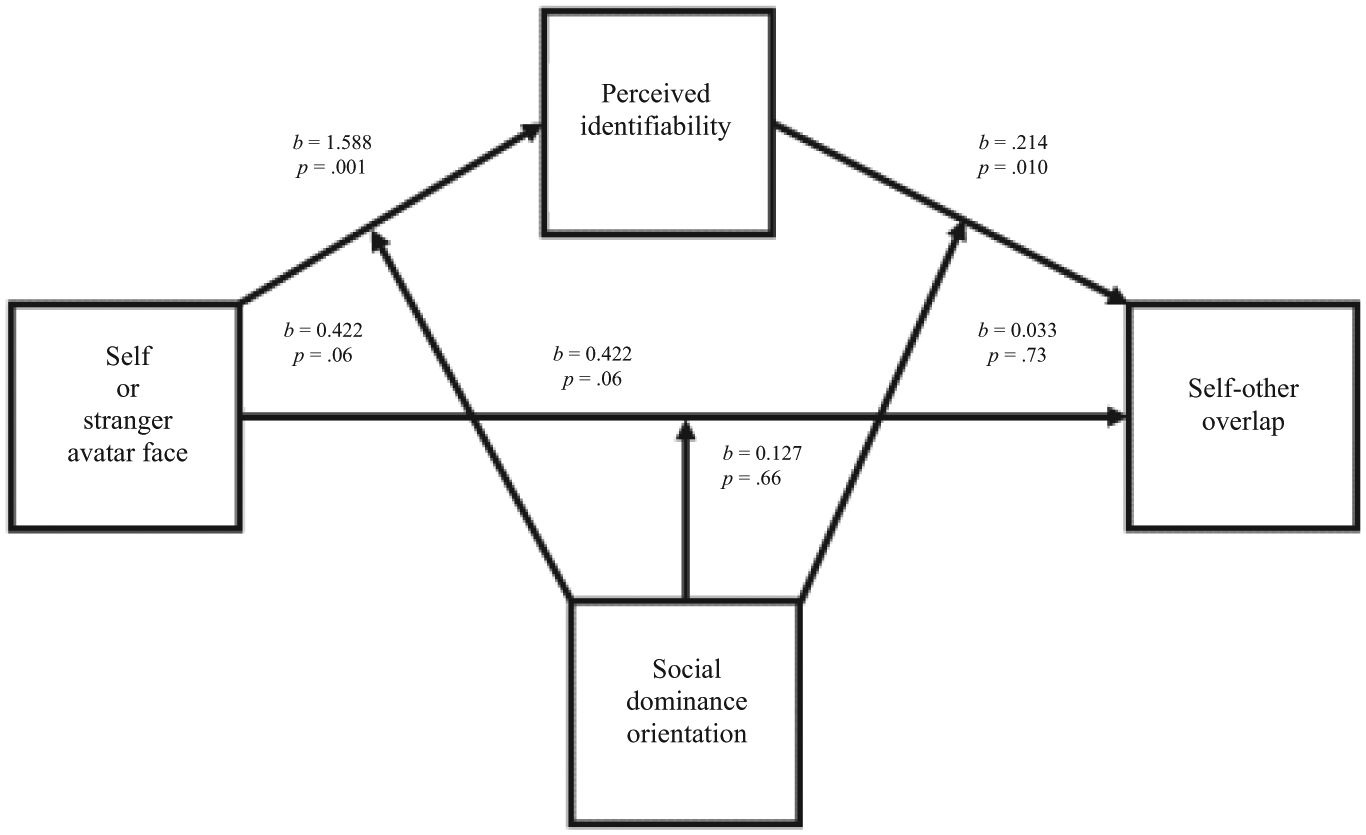
Moderated mediation effects.
Discussion
This study examined how VR contact influenced outgroup prejudice and ingroup perceptions. We expected that avatars representing the self or a stranger, social identity salience, and contact valence would impact positive feelings, empathy, social distance, and self-other overlap with a virtual human. The study also tested the assumption that heightened perceived identifiability would be associated with greater prejudice reduction, and that pre-existing SDO levels would moderate the effect.
Intergroup contact effects
Social distance decreased from pre- to post-test among individuals who experienced outgroup contact while using avatars featuring a stranger’s face. Controlling an avatar with a stranger’s face may have decreased anxiety (Amichai-Hamburger and McKenna, 2006) or facilitated depersonalization by lessening ingroup identity salience (Spears and Lea, 1994; Spears and Postmes, 2015), thus creating a more neutral ground for more empathetic outgroup interactions relative to individuals who used an avatar that displayed their own face.
Moreover, perceived identifiability mediated the effect of avatar facial resemblance on self-other overlap with a virtual human. This finding confirmed that perceived identifiability can reduce outgroup prejudice in VR settings (Peña et al., 2021). Though the direct effect of using avatars featuring participants’ faces on self-other overlap was negative and nonsignificant, the presence of a significant indirect effect suggested that merely using a self-resembling avatar was not sufficient to trigger an effect unless participants felt psychologically identifiable (Douglas and McGarty, 2001; Spears and Lea, 1994; Walther and Parks, 2002).
In addition, the mediation effect of perceived identifiability was stronger among individuals with average and higher SDO scores, a group typically more prone to prejudice (Pratto et al., 1994; Whitley, 1999). These results were consistent with how SDO can moderate intergroup contact, as high SDO individuals were more likely to show decreased prejudice after positive contact but also displayed more prejudice following negative contact (Dhont and Van Hiel, 2009). Heighted identifiability may have acted as a reputational cue that encouraged high SDO individuals to align themselves more with others. Same as in previous research (Peña et al., 2021), moderation effects operated only at average and high levels. It is possible that at low SDO levels, individuals were not invested enough in group hierarchies for VR contact to change their views. In other words, low SDO levels may have reflected greater egalitarian value endorsement that precluded further change. Future studies should clarify which cues and affordances (e.g. personalized avatars, names, publicly viewable social media profiles) can most effectively boost perceived identifiability, especially among high SDO individuals. Such research may inform the design of virtual environments that invite resistant users toward more inclusive attitudes by making social accountability more prominent.
Effects on ingroup perceptions
Several findings supported shared assumptions of social identity theory, self-categorization theory, and SIDE. Individuals displayed more positive feelings toward a virtual human when such entity shared their racial identity (ingroup) relative to when it represented an African American (outgroup). Our pre-post test design established that ingroup favoritism was in operation before the VR encounter, and such pre-existing preference was reinforced by a VR interaction with an ingroup virtual human. Moreover, individuals who interacted with an ingroup virtual human showed increased empathy compared with those who interacted with an outgroup virtual human at post-test. In conclusion, ingroup favoritism may be so ingrained that a one-shot immersive VR contact experience may not be able to defuse it and can even enhance it.
An ingrained positive ingroup bias (Tajfel and Turner, 2004) may also underlie the pre- to post-test increase in positive feelings among individuals who used avatars which displayed their face and experienced negative ingroup contact. Instead of rejecting ingroup members who displayed negative behavior as predicted by the black sheep effect (Marques and Paez, 1994; Reiman and Killoran, 2023), participants in this condition instead rallied around their ingroup. This is consistent with how individuals who highly identify with their ingroup stay committed to such identity even in the face of negative social comparisons (Doosje et al., 1995). When the ingroup is portrayed negatively, high ingroup identifiers may close ranks and recast the self as more representative of the ingroup, call out on perceived unfair treatment, engage in self-esteem restoration, and judge the ingroup as superior on an alternative attribute (Branscombe et al., 1999; Ellemers and Van Rijswijk, 1997). Future studies should replicate this effect and identify theoretical conditions and VR factors that may decrease resistance to negative information about the ingroup.
Contact valence effects
Positive contact with a virtual human increased self-other overlap, implying reduced perceived differences between self and others relative to negative contact. Positive contact can foster a sense of common ingroup identity and improve attitudes relative to negative interactions (Paolini et al., 2010). This finding resonated with a meta-analysis showing reliable effects for positive contact (Pettigrew and Tropp, 2006). This result was also consistent with how positive intergroup contact in VR enhanced outgroup attitudes (Tassinari et al., 2024a, 2024b). Unexpectedly, negative contact increased empathy for the group represented by the virtual human from pre- to post-test. Participants were cast as restaurant servers and as predicted by the Proteus effect, they may have internalized the behavioral expectations of their avatar’s role (Peña et al., 2009; Yee et al., 2009) and thus showed increased tolerance for rude behaviors. Overall, this study provided initial evidence that contact valence manipulations in VR can sprout nuanced effects. Positive contact only affected self-other overlap. Negative contact increased empathy toward a virtual human’s group and boosted ingroup positive feelings among individuals who used avatars showing their face. Complementing previous research (Tassinari et al., 2024a, 2024b), this study highlighted the importance of examining how the effects of contact valence interact with other basic factors, such as identifiability and group membership.
The present results also underscored the importance of studying minority participants as this population remains underrepresented in VR contact research (Tassinari et al., 2022b). This provides context to the findings linking ingroup interactions to increased feeling thermometer and empathy scores, positive contact increasing self-other overlap, and negative outgroup contact unexpectedly enhancing empathy. These findings suggest that minority participants were sensitive to group membership cues and contact valence effects, thus offering a broader view of intergroup dynamics in VR contact research. Since our study had a majority non-Caucasian sample, its findings reflect inter-minority contact effects. Future research should continue to increase minority-group samples as participants who place greater importance on their group memberships may show stronger VR contact intervention effects (Chen et al., 2021a).
Limitations
The results of the study were limited to one-shot VR interactions. Future studies should examine the effects of extended interactions. In addition, the study’s results apply only to interactions with virtual humans. Future research should investigate the effects of VR interactions with ingroup or outgroup human partners. Although participants interacted with computer-controlled virtual humans, they were not explicitly informed that these characters were not real people. However, the interaction was carefully scripted with behavioral cues to convey a positive or negative demeanor. While we cannot rule out that some participants may have believed they were interacting with another human, the use of scripted behaviors and single-participant physical lab setup helps to mitigate this concern. In addition, the experimental manipulations did not yield extensive support for the hypotheses. This implied that a single VR contact experience may lack the potency to neutralize chronic biases.
Manipulation checks showed that participants were more accurate in categorizing a virtual human as having a different ethnicity when presented as a racial outgroup than when presented as an ingroup member. Thus, another limitation was that intergroup salience was more prominent than intragroup salience. In addition to the present results representing the data of all participants to represent objective effects of condition assignment with full statistical power (N = 256), the Supplementary Results section reports findings with participants excluded if they incorrectly categorized the race of their randomly assigned virtual human (N = 173). Results that replicated across both samples included the increase in positive ingroup feelings after negative ingroup contact for self-face avatars, the increase in self-other overlap after positive instead of negative VR contact and, importantly, the moderated mediation effect involving identifiability and SDO on self-other overlap. Other effects were attenuated, which may be due to low statistical power after participant data exclusion. Future studies may attempt to more prominently feature majority ingroup salience though, though racial minority outgroup salience may likely draw more attention due to its infrequency relative to more frequent and familiar majority ingroup salience.
Another limitation involves the use of a single, relatively brief VR contact scenario. While this approach enhances internal validity and logistical feasibility, it may not be sufficient to drastically change deeply rooted attitudes. Studies using similar single exposure VR interventions also show measurable but modest changes in intergroup attitudes (Tassinari et al., 2024a, 2024b). Although our findings demonstrated reliable shifts in perceived identifiability, empathy, and self-other overlap, broader measures such as feeling thermometer ratings remained largely unchanged. Repeated or varied exposure to VR contact scenarios may be necessary to produce more robust attitude change. Future research should include comparisons across multiple VR encounters or longitudinal follow-ups to assess the strength of the results.
The ethical implications of exposing participants to negative contact with a stigmatized minority avatar were considered carefully. The interaction involved mild rudeness (e.g. curt, dismissive, and upset dismissive gestures), not overt hostility. Manipulation check items confirmed the contact was perceived as negative but not extreme. The study followed precent from previous research on how to display negative contact and social identity cues.
Conclusion
By simulating complex intra and intergroup dynamics, VR can reveal how identifiability, social identity salience, and contact valence influence positive feelings, social distance, empathy, and self-other overlap. The results underscored the importance of ingroup favoritism and contact valence. This study tested foundational concepts linked to the contact hypothesis in a controlled VR context and offered insights into how perceived identifiability may boost outgroup member acceptance.
Supplemental Material
sj-docx-1-nms-10.1177_14614448251411262 – Supplemental material for Intergroup contact in virtual reality: The influence of avatar identity, social identity, and contact valence on prejudice
Supplemental material, sj-docx-1-nms-10.1177_14614448251411262 for Intergroup contact in virtual reality: The influence of avatar identity, social identity, and contact valence on prejudice by Jorge Peña, Camren Allen, Jeffrey Tsifan Tseng, Vivian Hsueh Hua Chen, Gabrielle C. Ibasco and Wei Jie Dominic Koek in New Media & Society
Footnotes
Funding
The authors received no financial support for the research, authorship, and/or publication of this article.

Supplemental material
Supplemental material for this article is available online.