




Abstract
Online hostility has become increasingly common in digital public spaces, often to the detriment of marginalized groups. While prior research distinguishes between incivility and intolerance, little is known about whether users can recognize these forms as conceptually distinct. Moreover, the roles of prior digital hate perpetration and national context in shaping such perceptions remain unclear. This cross-national survey (N = 4041; Austria, France, Hungary, and Sweden) addresses these gaps. Participants rated uncivil anti-immigration content not only as more uncivil but also as more intolerant than explicitly intolerant content, indicating an alarming misreading of exclusionary messages. Recent perpetration was associated with weaker recognition of incivility and intolerance, as well as reduced differentiation between content types, suggesting desensitization and blurred perceptual boundaries. The findings were consistent across countries, indicating that these mechanisms transcend national contexts. Strengthening users’ ability to recognize subtle exclusionary rhetoric is essential to counter its normalization in public spheres.
Across Europe, rising political polarization has fueled an alarming increase in digital hate (Czymara et al., 2023)—an umbrella term for any kind of hostile content expressed by or directed toward individuals or collectives (Matthes et al., 2025). Immigrants are frequent targets of such content (Bormann, 2022), as right-wing populist movements gain influence and strategically construct them as cultural or economic threats to obtain political power (Shehaj et al., 2021). This rhetorical climate contributes to discrimination and even violence against immigrant communities (Dancygier, 2023). In this context, understanding how audiences perceive and interpret online anti-immigrant content is crucial for maintaining democratic resilience and upholding human rights (Arbeit et al., 2024). Individuals’ ability to recognize content as hostile or to dismiss it as mere opinion determines how digital hate spreads, shapes public debate, and whether it is contested or reproduced (Nortio et al., 2021). If audiences fail to identify digital hate as such, they may inadvertently allow anti-immigration narratives to enter mainstream discourse, thereby missing critical opportunities for intervening (Burnham et al., 2022).
Social media users typically encounter anti-immigration content that varies in tone, style, and severity (Ekman, 2019). While some of these expressions only violate interpersonal politeness norms, others explicitly challenge immigrants’ legitimacy (Rossini, 2022). Previous work has shown that audiences assess distinct types of digital hate differently (e.g. Kümpel and Unkel, 2023), but has primarily focused on evaluative judgments, such as how severe or harmful content appears (e.g. Kirchmair et al., 2024). Less is known about categorical perception—specifically, whether and how people distinguish between conceptually distinct forms of digital hate. Addressing this gap, the present study examines perceptions of uncivil and intolerant anti-immigration content—two conceptually distinct forms of digital hate that were recently reconceptualized by Rossini (2022). Incivility refers to violations of interpersonal norms, such as rudeness, name-calling, or vulgar language, while intolerance targets specific social groups and aims to delegitimize or exclude them through discriminatory or dehumanizing rhetoric (Rossini, 2022). Although these forms can co-occur in online conversations, they serve distinct functions (Rega et al., 2023). For example, incivility is frequently perceived as less harmful, often interpreted as a spontaneous emotional outburst, whereas intolerance is seen as more dangerous due to its structured rejection of group inclusion and its broader societal consequences (Kümpel and Unkel, 2023).
Understanding whether and how audiences can differentiate between these forms of hate is essential. Most importantly, individuals unfamiliar with the strategically calm or even seemingly reasonable tone of some anti-immigration rhetoric may engage with it, failing to recognize its underlying hateful intent (Burnham et al., 2022). This is particularly critical for intolerance, which often adopts a subtler tone than incivility yet is more harmful due to its exclusionary nature. When people fail to categorize intolerance correctly, their attitudes may be shaped by such content without them realizing it, increasing the likelihood that they will avoid counter-attitudinal information and further reinforcing existing biases (Knobloch-Westerwick and Jingbo, 2009). Moreover, since algorithmic moderation systems are less effective at detecting subtler language of intolerance (Kovács et al., 2021), where salient trigger words are typically avoided to circumvent content moderation, bystander intervention becomes a critical frontline defense against the spread of hate, highlighting once again the central role of user perceptions.
Next, perceptions are shaped not only by content features but also by perceivers’ individual characteristics and the broader context they live in (Bentivegna and Rega, 2024). In particular, one’s prior engagement in digital hate may act as a perceptual filter, potentially dulling users’ sensitivity to harmful content (Bormann, 2022). If these citizens, for instance, by reason of moral self-rationalization, become less able to recognize digital hate for what it is, they may lose the sensitivity necessary for realizing that the content they share online constitutes perpetration. As a result, they could underestimate the harm their actions cause to others. Understanding how perpetrators perceive incivility and intolerance is therefore essential for developing targeted countermeasures. These could include media literacy programs that address anti-immigration influences (Burnham and Arbeit, 2023), as well as interventions designed to reduce susceptibility, discourage participation, and foster counteraction (Arbeit et al., 2020).
Finally, cross-national comparison is vital for this endeavor. Citizens’ perceptions of digital hate are embedded within distinct political climates, media systems, and historical experiences with ideological extremism (Otto et al., 2019). Yet, much of the existing work remains US-centric, underscoring calls for more comparative research in other sociopolitical contexts (Bentivegna and Rega, 2024).
To address these gaps, the present study examines perceptions of uncivil and intolerant anti-immigration content across four European countries—Austria, France, Hungary, and Sweden. Specifically, we investigate (1) whether individuals recognize uncivil and intolerant communication as such, (2) how recent online perpetration is associated with these perceptions, and (3) whether these dynamics vary across countries. Overall, our study aims to inform debates on content moderation, platform responsibility, and societal resilience to digital hate.
Country selection
Given the ongoing polarization and rising anti-immigration sentiments across Europe (Czymara et al., 2023), it becomes increasingly important to examine how national contexts shape public perceptions of digital hate. People’s perceptions of uncivil and intolerant content may be affected by political discourse, legal frameworks, and media environments—factors that differ considerably across European countries and influence digital hate dynamics (Akdeniz, 2010). Yet, cross-national research on perceptions and perpetration of hateful communication remains scarce (Bührer et al., 2024). In societies where exclusionary rhetorics have been mainstreamed through political campaigns or partisan media, citizens may become desensitized to hate or perceive it as a legitimate form of debate (Kaskeleviciute et al., 2024). By contrast, in environments with stronger democratic norms and more inclusive public discourse, similar messages may be recognized and rejected more readily.
While prior research has found international variation in severity perceptions of hateful online content (e.g. Jiang et al., 2021), it remains unclear how perception variations manifest within Europe. To explore contextual differences, we focus on Austria, France, Hungary, and Sweden, which differ in key domains relevant to digital hate. According to the Migrant Integration Policy Index (MIPEX), these nations vary in immigration-related policies, integration efforts, and online regulations, with Sweden scoring highest, followed by France, Austria, and Hungary. Cultural dimensions such as power distance (the acceptance of hierarchy and inequality) and indulgence (the extent to which people freely pursue personal desires and express emotions), based on Hofstede’s framework, also differ across countries. Further, variations in perceived prevalences of ethnic discrimination (Müller et al., 2023) suggest broader differences in public discourse and societal norms surrounding immigration, which may stem from or reinforce country-specific perpetration.
Comparing these countries will enable us to determine whether perceptions of digital hate are universally patterned or context-dependent. Systematic cross-national differences would indicate that discourse norms and ideological climates influence how people interpret uncivil and intolerant content, whereas similar perception patterns would suggest that certain psychological mechanisms such as desensitization among perpetrators—operate largely independently of national context. In either case, cross-country comparison provides valuable insight into how societal and individual factors interact in shaping citizens’ understanding of digital hate.
Conceptualizing online incivility and intolerance
How to study incivility has been the subject of ongoing debate. While the concept of (political) online incivility has deep historical roots, there is little scholarly agreement on how exactly it should be defined or measured (Hopp, 2019). Most scholars agree that incivility is a multidimensional construct; however, the number, nature, and implications of these dimensions remain contested. For instance, early conceptualizations emphasized violations of social and conversational politeness norms, such as name-calling (Mutz, 2015). Others have argued that incivility should be more narrowly defined as discourse that undermines democratic values or fosters exclusion from public deliberation (Papacharissi, 2004). In response, scholars have proposed various typologies, such as those by Stryker et al. (2024).
Amid this conceptual debate, a consensus for further disentanglement has emerged—not only to clarify academic definitions but also to better understand distinct real-world consequences (Stryker et al., 2024). Rossini (2022) is considered an influential step in this direction, arguing that what has traditionally been grouped under the umbrella of “incivility” should be split into two conceptually distinct constructs: incivility and intolerance. In Rossini’s framework (conceptually very similar to Hopp, 2019), online incivility refers to violations of norms of respectful communication between individuals—for instance, the use of hostile tone or mockery. In contrast, intolerance denotes exclusionary rhetoric that seeks to delegitimize or marginalize specific social groups. This may include discriminatory claims, ideological justifications for exclusion, or dehumanizing language. While incivility disrupts the tone of conversation, intolerance undermines the substance of inclusive discourse.
In light of this distinction, the present study builds on Rossini’s conceptualization to examine how individuals perceive and differentiate between uncivil and intolerant anti-immigration content. This approach allows us to explore more nuanced questions of whether users can recognize these forms as distinct—and whether such recognition is linked to their own experiences with online perpetration or broader national contexts.
Perceptions of uncivil and intolerant content
Since the theoretical distinctions between incivility and intolerance have been increasingly recognized by other researchers (Pradel et al., 2024), a growing body of research has examined how audiences evaluate these communication styles. For instance, prior work has investigated variance in perceived severity (e.g. Meerson et al., 2025) or harm (e.g. Khaleghipour et al., 2025). However, these studies have primarily focused on evaluative perceptions—that is, how problematic or consequential content is perceived to be. Thus, despite evidence that incivility and intolerance elicit distinct evaluative responses (e.g. Saumer et al., 2024), it remains unclear whether individuals can reliably identify these communication styles and distinguish between them when confronted with actual examples. While these distinctions may seem self-evident conceptually, audience perceptions can extend beyond the literal content. Inferred intent, emotional cues, and broader social meanings can all influence interpretation, underscoring the need to empirically test whether individuals reliably differentiate between incivility and intolerance. Our study addresses this gap by proposing the following hypotheses:
H1a. Uncivil content is perceived as more uncivil than intolerant content.
H1b. Intolerant content is perceived as more intolerant than uncivil content.
The role of digital hate perpetration in perceptions of uncivil and intolerant content
Further, research suggests that individuals’ perceptions of hateful online communication are shaped not only by what is said (or inferred from it) but also by who is perceiving it (Bormann, 2022). Costello et al. (2019) found that individuals who are more accepting of social norm violations experience less discomfort when encountering hateful content. Given that digital hate perpetrators frequently violate social norms themselves, it can be assumed that they interpret such content through a similarly permissive lens. Supporting this notion, Vargiu et al. (2024) demonstrated that uncivil messages resonate more strongly with individuals high in populist attitudes (i.e. anti-elitist, people-centered beliefs grounded in a moral divide between in- and out-groups) and dark personality traits, both of which are commonly linked to digital hate perpetration (e.g. Frischlich et al., 2021). Perpetrators may, therefore, not only justify hateful content but also perceive it as less transgressive when it aligns with their ideological beliefs (Weber et al., 2024). Similarly, Kirchmair et al. (2024) showed that individuals with strong anti-migrant attitudes perceive hateful communication as less severe, while those high in empathic suffering (i.e. the tendency to feel distress in response to others’ pain) report greater sensitivity to such content. Since perpetrators often display lower levels of empathy and stronger exclusionary beliefs, they may be less likely to register hateful messages as uncivil or intolerant.
Perceptions can also be influenced by one’s relationship to the source or target of a message. For instance, van Duyn and Muddiman (2022) found that individuals rated hateful content as less uncivil when they felt connected to the online community in which it was posted. This suggests that perpetrators—who may identify with other aggressors—could be desensitized to the tone of such content (Bentivegna and Rega, 2024). In addition, incivility perceptions tend to increase when people disagree with a comment, especially when in-group members are targeted (Liang and Zhang, 2021). If perpetrators perceive the targets of digital hate as out-group members, as may be the case with anti-immigration content, their agreement with the message may further reduce perceptions of norm violations.
Taken together, these findings suggest that prior engagement in digital hate may act as a perceptual filter—dulling individuals’ sensitivity. We therefore hypothesize:
H2. Online perpetration is negatively associated with perceived (a) incivility and (b) intolerance of anti-immigration content.
Beyond its association with overall perceptions of incivility and intolerance, online perpetration may also relate to how distinctly individuals perceive these communication styles. Two competing mechanisms could help explain why perpetrators may perceive these distinctions more or less sharply. For one thing, perpetrators may regularly encounter more extreme forms of digital hate—such as threats or incitement to violence (Ekman 2019). In comparison, incivility and intolerance could appear milder (Pradel et al., 2024) and thus more interchangeable, reducing perceptual distinctions between them.
Conversely, perpetrators could also be attuned to the nuances of hateful communication. Research shows that incivility and intolerance appear rather rarely together in single messages (Novotná et al., 2023), suggesting that these styles are often used purposefully and separately. From this perspective, prior digital hate perpetration might sharpen rather than blunt content differentiation. Because the nature of this relationship remains unclear, we ask:
RQ1. How does online perpetration moderate the effect of content type on (a) incivility and (b) intolerance perceptions?
Supplemental Figure A1 on the Open Science Framework (OSF) illustrates the theoretical model.
Method
After approval by the Ethics Committee of the University of Vienna (ID 01174), data were collected between 28 August and 17 September 2024, by the market research company Kantar in Austria, France, Hungary, and Sweden. All materials, datasets, item-level statistics, R script, and outputs can be found on OSF (https://osf.io/6rva2/).
Participants
We collected quota samples per country based on gender, age, and education. Participants had to be (a) a citizen of Austria, France, Hungary, or Sweden, (b) at least 18 years old, and (c) an active social media user in the past 4 weeks. The following post hoc exclusion criteria were applied: (a) Incorrect answer of all three attention check items (nAustria = 46, nFrance = 71, nHungary = 78, and nSweden = 47), (b) being a speeder, that is, according to Greszki et al. (2014) taking less than one-third of the median duration to finish the survey based on the respective country sample (nAustria = 8, nFrance = 16, nHungary = 10, and nSweden = 12), or (c) choosing “other” (e.g. nonbinary) as gender category, which was insufficient for analysis due to small group sizes (nAustria = 5, nFrance = 0, nHungary = 2, and nSweden = 3). After exclusion, the dataset contained N = 4041 participants (nAustria = 1005, nFrance = 986, nHungary = 1062, and nSweden = 988), with Table 1 detailing the demographics.
Sample description in all four countries.
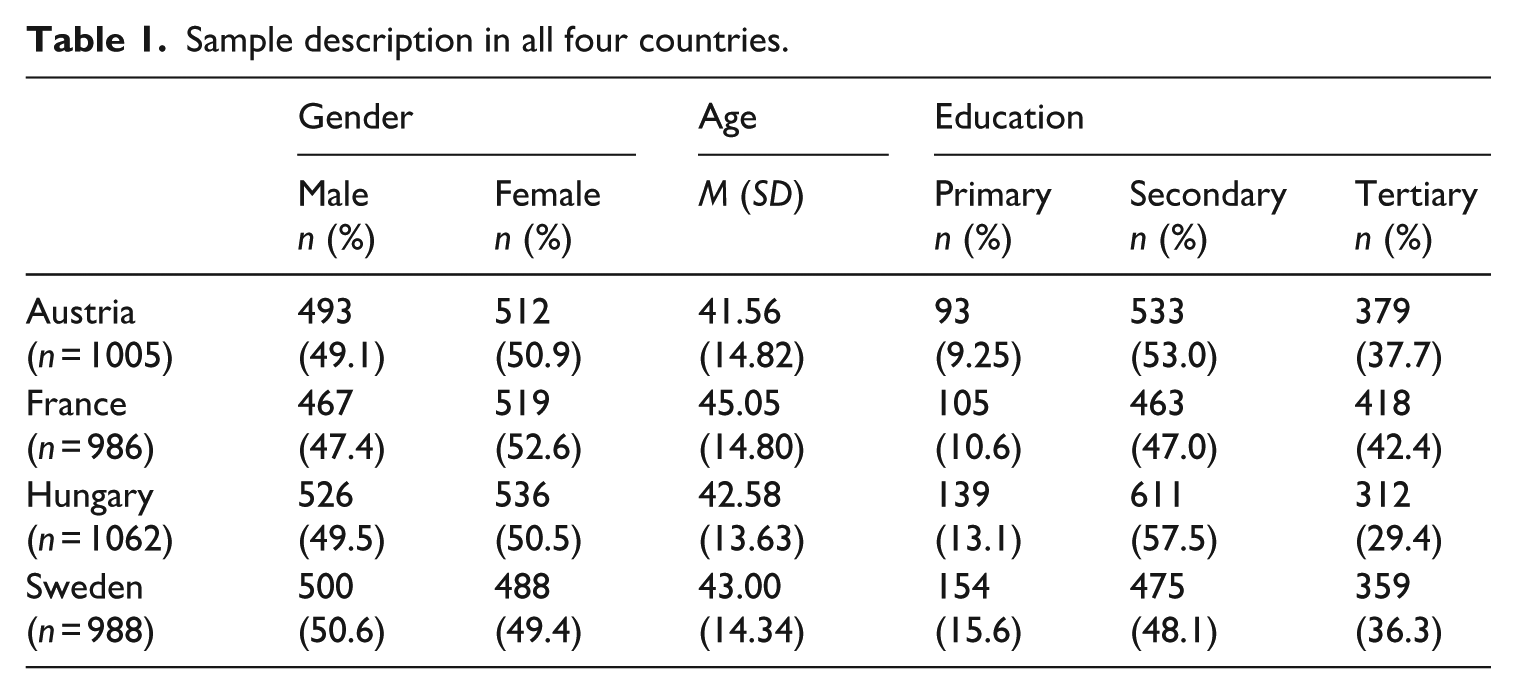
Country-comparisons of the demographics showed no gender differences, χ²(3) = 2.16, p = .539, Cramér’s V = .02, but significant effects for age, F(3, 4037) = 10.33, p < .001, η² < .01, and education, χ²(6) = 57.93, p < .001, Cramér’s V = .08, albeit with very small effect sizes, which are practically negligible according to conventional interpretation standards (e.g. Cohen, 1988; Lovakov and Agadullina, 2021). Thus, it can be considered unlikely that country variations regarding demographics are affecting the results in a meaningful way.
Procedure
The survey was prepared in English before being translated into German, French, Hungarian, and Swedish by native speakers. A second native speaker reviewed each translation for accuracy. All study materials, including multilingual instructions, stimuli, and items in English and the four languages, are available on OSF (Supplemental Figures A2–A21, Supplemental Tables A1–A10), along with descriptive item-level results (Supplemental Tables A11–A22).
Measures
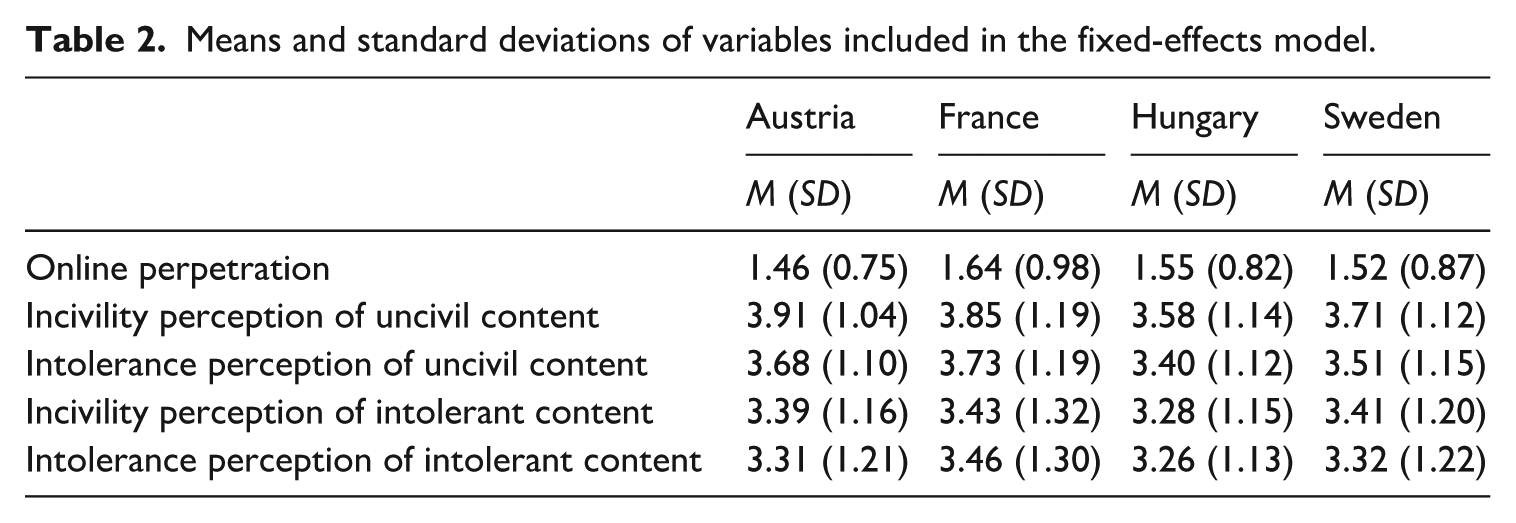
The overall project covered multiple research objectives, but this article focuses on the scales relevant to the present analysis. Table 2 presents the means and standard deviations of all variables used in the models. To examine the structural validity of these variables, confirmatory factor analyses (CFA) were performed, yielding good-to-acceptable model fit indices (see Supplemental Tables A23–A25 on OSF). Measurement invariance testing supported the robustness of these constructs, establishing configural and metric invariance while identifying minor variations in intercepts and means at the scalar and strict levels (Supplemental Tables A26–A28 on OSF). Analysis of variance (ANOVA) results (Supplemental Table A29 on OSF) reveal statistically significant cross-country differences, but the small effect sizes (η² < .01 to .01) indicate limited relevance, suggesting that the constructs remain largely stable across countries. Reliability scores and zero-order correlations of all variables are shown by country in Supplemental Tables A30–A33 on OSF.
Means and standard deviations of variables included in the fixed-effects model.
Incivility and intolerance perceptions of anti-immigration content
To assess perceptions of incivility and intolerance, participants were shown two self-constructed photomontages—one depicting uncivil and the other intolerant anti-immigration content (Supplemental Figures A12–A21 on OSF). While viewing each photomontage, they rated six self-developed statements assessing their perceptions of the content. Using a 5-point Likert-type scale (1 = strongly disagree, 5 = strongly agree), participants indicated whether they found the content impolite, rough, and vulgar (measuring incivility perceptions) as well as intolerant, dehumanizing, and undemocratic (measuring intolerance perceptions). Across all countries, reliability coefficients indicated good to excellent internal consistency.
Recent online perpetration
To measure recent online incivility and intolerance perpetration, participants were first introduced to brief definitions of both communication styles (available in all languages in Supplemental Tables A1–A5 on OSF) adapted from Rossini (2022). In addition, they were presented with two self-constructed photomontages depicting examples of uncivil or intolerant online content (see Supplemental Figures A2–A11 on OSF). Two identical, self-developed, three-item scales were used to assess incivility and intolerance perpetration across public, semi-public, and private communication channels. Participants indicated how often they had sent, used, or shared similar content in the past 4 weeks using a 5-point Likert-type scale (1 = never, 5 = all the time). Reliability coefficients again indicated good to excellent internal consistency.
Covariates
Gender (male/female), age (open response; modeled as a continuous variable), and education (recoded into with vs without university degree) were included as covariates.
Statistical analysis
To analyze the repeated-measures structure of the data, we conducted fixed-effects regression models separately for each country (Allison, 2009). The models were estimated in R using robust maximum likelihood estimation (MLR), combined with full-information maximum likelihood (FIML) to handle missing data (Lee and Shi, 2021). To ensure robustness, 5000 bootstrap samples were used to compute standard errors. Results were further validated through robustness checks using listwise deletion of missing data, which produced equivalent findings (see Output Files on OSF).
The fixed-effects models included content type (uncivil vs intolerant) as a within-subjects categorical predictor. All participants evaluated both photomontages and rated how uncivil and intolerant they perceived each one, which served as two separate outcome variables. Online perpetration was included as a continuous, mean-centered variable and tested both as a predictor and a moderator of the relationship between content type and perceptions of incivility and intolerance. While main effects show whether the two photomontages differ in perceived (a) incivility and (b) intolerance, interaction effects suggest whether these differences vary depending on individuals’ own online perpetration. In other words, we modeled how participants’ perpetration behavior affects the extent to which they perceive differences between uncivil and intolerant photomontages in terms of (a) incivility and (b) intolerance. A significant interaction indicates that individuals who more frequently perpetrate themselves perceive the two content types as more similar—or more dissimilar—than those with lower perpetration levels.
Covariates (gender, age, and education) were included. To examine potential differences between countries, we conducted multi-group analyses. Specifically, we compared model fit between unconstrained models (with all coefficients freely estimated across groups) and models with specific paths constrained to equality across countries, following Hayes et al. (2013).
Results
Results of the fixed-effects models are summarized in Supplemental Table A34 on OSF, while visualizations of overall effects are presented in Figure 1 and interaction effects in Figure 2.
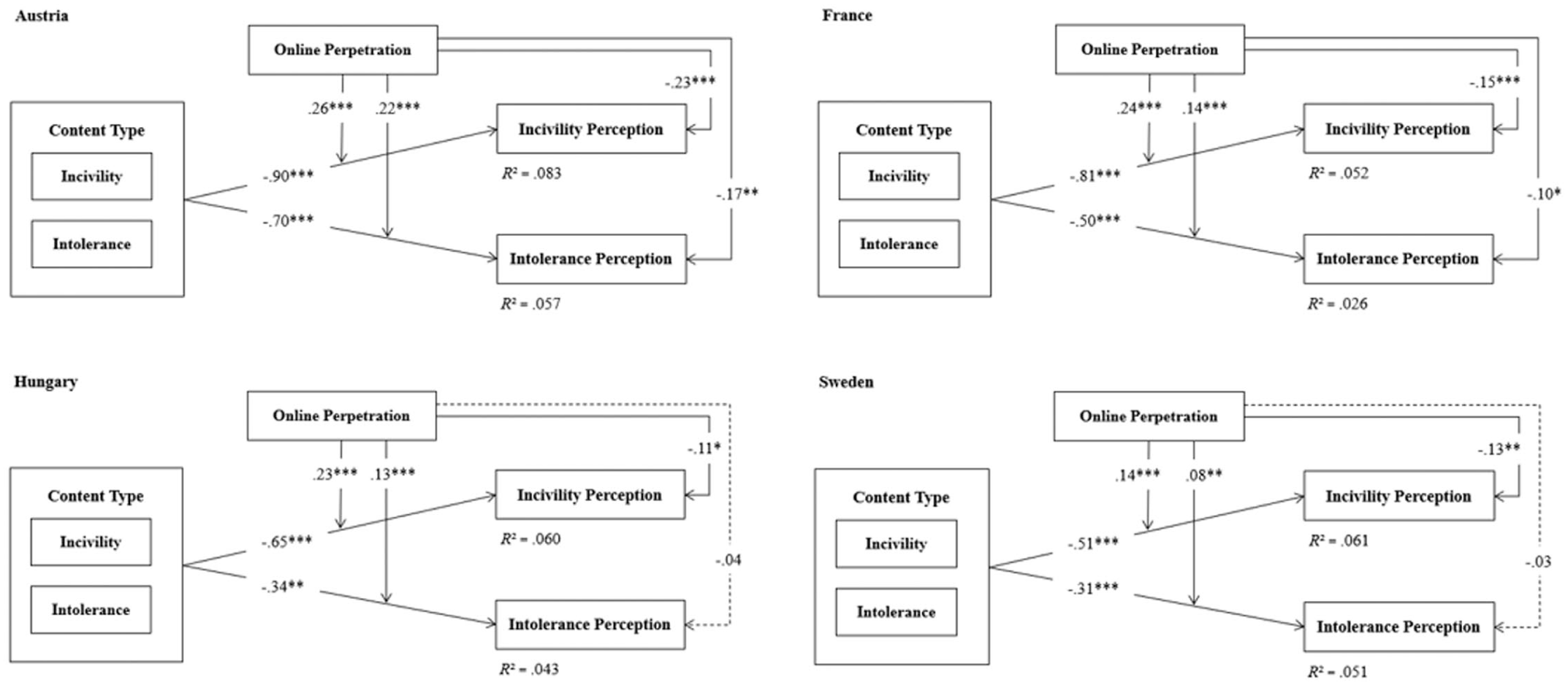
Overview plot for fixed-effects analysis results.
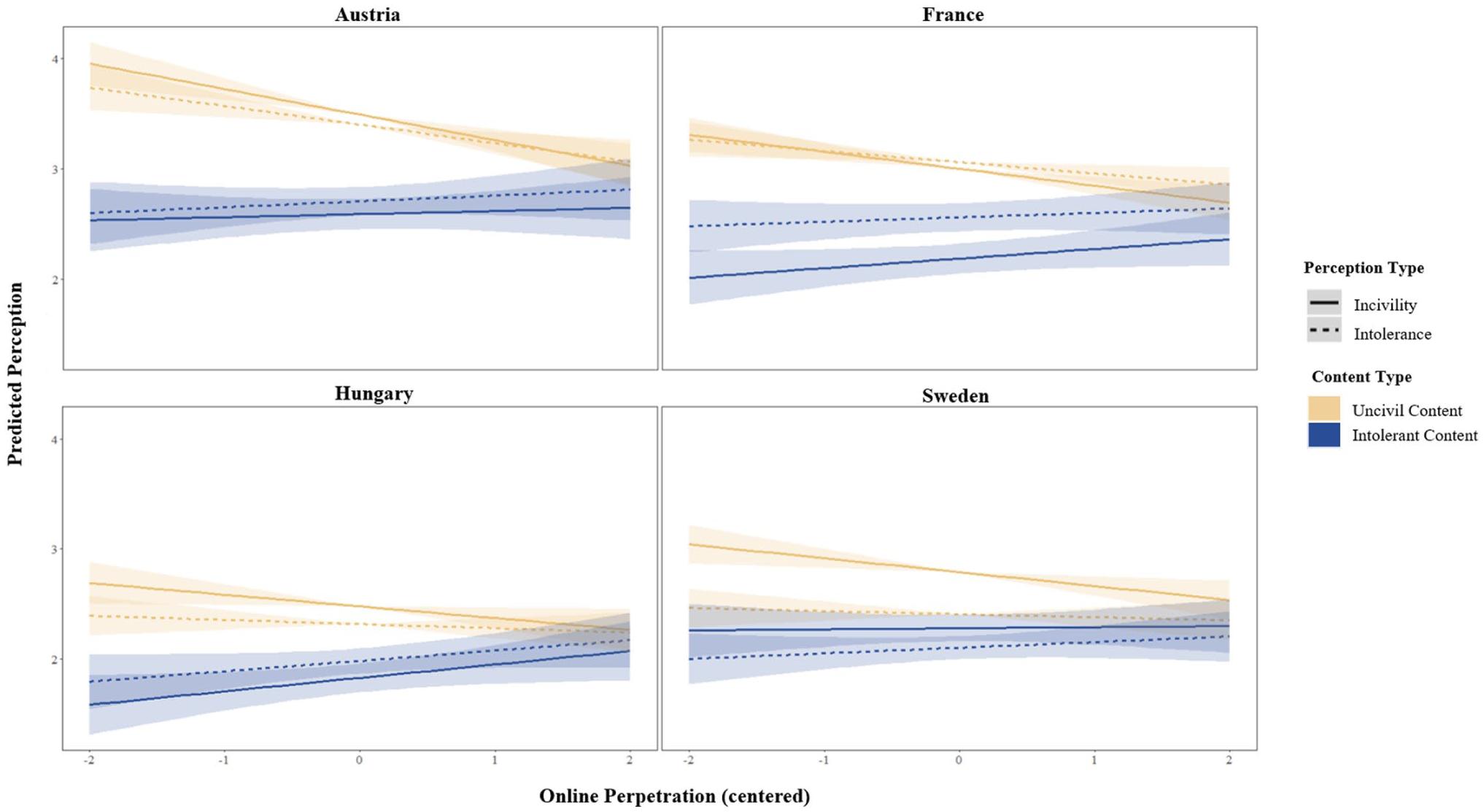
Interactions of digital hate type and online perpetration on perceptions of incivility and intolerance.
Effects of content type on incivility and intolerance perceptions
In all countries, content type significantly influenced participants’ incivility and intolerance perceptions. Overall, the incivility photomontage was perceived as more uncivil and more intolerant than the intolerance photomontage, thereby confirming H1a and rejecting H1b. Multigroup analyses indicated that these effects varied across countries. The path from content type to incivility perception differed significantly, Δχ²(3) = 7.93, p = .048, as did the path to intolerance perception, Δχ²(3) = 7.82, p = .0499. Regarding country-specific results, the most pronounced effects were found in Austria, where intolerant content was perceived as significantly less uncivil than uncivil content (B = -.90, SE = .07, β = -.40, p < .001), and this pattern also held for intolerance perception (B = -.70, SE = .07, β = -.30, p < .001). Similar results were found in France, where intolerance was rated as less uncivil (B = -.81, SE = .07, β = -.32, p < .001) and less intolerant (B = -.50, SE = .07, β = -.20, p < .001) compared to uncivil content. In Hungary, participants also perceived intolerant content as significantly less uncivil (B = -.65, SE = .07, β = -.28, p < .001) and less intolerant (B = -.34, SE = .06, β = -.15, p < .001). Finally, in Sweden, content type effects were weakest but still significant, with intolerant content again perceived as less uncivil (B = -.51, SE = .06, β = -.22, p < .001) and less intolerant (B = -.31, SE = .05, β = -.13, p < .001) than uncivil content.
Regarding covariates, gender showed consistent effects across countries. Women tended to rate content as more uncivil and more intolerant than men. This effect was strongest in Sweden (incivility: B = .37, SE = .07, β = .16, p < .001; intolerance: B = .44, SE = .07, β = .18, p < .001), followed by Hungary (incivility: B = .27, SE = .06, β = .12, p < .001; intolerance: B = .27, SE = .06, β = .12, p < .001), France (incivility: B = .23, SE = .07, β = .09, p = .001; intolerance: B = .21, SE = .07, β = .08, p = .004), and Austria (incivility: B = .18, SE = .06, β = .08, p = .004; intolerance: B = .22, SE = .07, β = .09, p = .001). Age effects were less pronounced. In Austria, older participants perceived content as slightly less uncivil (B <|-.01,| SE < .01, β = -.06, p = .047) and less intolerant (B = -.01, SE < .01, β = -.10, p = .001) than younger ones. No significant age effects (p ⩾ .114) emerged in France, Hungary, or Sweden. Education was positively associated with perceptions of both incivility and intolerance across all four countries. Participants with a university degree rated the content as more uncivil and more intolerant than those without. This association was strongest in Hungary (incivility: B = .42, SE = .07, β = .16, p < .001; intolerance: B = .42, SE = .07, β = .17, p < .001), followed by France (incivility: B = .28, SE = .07, β = .11, p < .001; intolerance: B = .21, SE = .08, β = .08, p = .006), Sweden (incivility: B = .27, SE = .07, β = .11, p < .001; intolerance: B = .25, SE = .07, β = .10, p < .001), and Austria (incivility: B = .24, SE = .06, β = .11, p < .001; intolerance: B = .21, SE = .07, β = .09, p = .003).
The role of recent online perpetration in content perception
Across all countries, prior online perpetration was negatively associated with incivility perceptions of content, confirming H2a. The more frequently participants engaged in online perpetration, the less uncivil they perceived the content to be. For intolerance perceptions, the effect was only significant in Austria and France, thus supporting H2b partially. However, multi-group analyses revealed no significant cross-country variation in the strength of these effects, neither for the path from perpetration to incivility perception, Δχ²(3) = 4.19, p = .242, nor to intolerance perception, Δχ²(3) = 5.83, p = .120. Nonetheless, the negative associations between perpetration and perception were descriptively strongest in Austria (incivility: B = -.23, SE = .05, β = -.15, p < .001; intolerance: B = -.17, SE = .05, β = -.11, p = .001), followed by France (incivility: B = -.15, SE = .04, β = -.12, p < .001; intolerance: B = -.10, SE = .04, β = -.08, p = .011), Hungary (incivility: B = -.11, SE = .05, β = -.08, p = .027; intolerance: B = -.04, SE = .05, β = -.03, p = .404), and Sweden (incivility: B = -.13, SE = .05, β = -.09, p = .005; intolerance: B = -.03, SE = .05, β = -.02, p = .537).
In response to RQ1a and RQ1b, results showed significant moderation effects across both perception types in all countries. Specifically, higher levels of perpetration were associated with smaller differences in perceived incivility and intolerance between the two content types, indicating that participants with more perpetration experience differentiated less between uncivil and intolerant content. Given the negative sign of the main effects of content type (i.e. participants rated uncivil content as both more uncivil and also more intolerant than intolerant content), positive interaction coefficients indicate that this perceptual gap narrows at higher levels of perpetration (see Figure 2 for visualization). According to multigroup analyses, these interaction effects did not differ significantly between countries, neither for incivility, Δχ²(3) = 2.55, p = .466, nor for intolerance perception, Δχ²(3) = 2.55, p = .466. Descriptively, the moderation effect was strongest in Austria (incivility: B = .26, SE = .04, β = .21, p < .001; intolerance: B = .22, SE = .04, β = .17, p < .001), followed by France (incivility: B = .24, SE = .03, β = .20, p < .001; intolerance: B = .14, SE = .03, β = .12, p < .001), Hungary (incivility: B = .23, SE = .04, β = .19, p < .001; intolerance: B = .13, SE = .03, β = .11, p < .001), and Sweden (incivility: B = .14, SE = .03, β = .11, p < .001; intolerance: B = .08, SE = .03, β = .06, p = .002).
Discussion
This study examined how individuals in Austria, France, Hungary, and Sweden perceive online incivility and intolerance in an anti-immigration context, and how these perceptions are linked to recent digital hate perpetration. Our results offer three key insights. First, across all countries, participants perceived uncivil anti-immigration content as not only more uncivil but also more intolerant than explicitly intolerant content. This suggests that salient language against marginalized individuals may elicit stronger perceptions than hateful communication that is more ideologically framed but can be less overtly expressed to circumvent content moderation. Second, prior perpetration was associated with lower perceptions of both incivility and intolerance, although this effect was stronger and more consistent for incivility. Third, individuals with more perpetration experience showed less differentiation between the two content types—indicating a potential convergence in how digital hate is categorized. These patterns appeared broadly consistent across countries.
Perceptions of uncivil and intolerant anti-immigration content
Across all countries, participants perceived uncivil anti-immigration content as not only more uncivil but also more intolerant than explicitly intolerant content. This finding supports H1a but contradicts H1b, raising questions about how audiences perceive and categorize different forms of digital hate. While both incivility and intolerance represent norm violations, our results suggest that the uncivil content used in this study may have been more immediately recognizable and, as a result, prompted more pronounced perceptions.
One potential explanation lies in the varying perceptual salience of these different hateful expressions. Specifically, uncivil language may have led to stronger perceptions of both incivility and intolerance because its direct and explicit tone makes hostility more immediately recognizable. Prior research supports this reasoning, showing that salience increases the likelihood that audiences perceive content as uncivil (Lu et al., 2023). Schmid et al. (2024) found that digital hate is often judged as especially negative when it is direct and unambiguous—suggesting a perceptual advantage for overt incivility. This aligns with research showing that threats are perceived as especially severe (Pradel et al., 2024). In contrast, intolerant expressions can be subtle, coded, or framed ideologically, making them more difficult to detect (Carvalho et al., 2024). While such messages can be even more harmful in the long run, they may not trigger immediate recognition or strong perceptual reactions. For instance, participants in Schmid et al.’s (2024) study initially failed to identify hateful intentions behind subtle intolerance but, upon reflection, judged it as particularly harmful due to its covert nature. Similarly, our intolerance photomontage may have appeared less salient at first glance, whereas the incivility montage—due to its directness—may have been more cognitively accessible.
Another contributing factor may be the immigration context itself. Since both photomontages were situated in this setting, the uncivil stimuli may have implicitly signaled intolerance by targeting a marginalized group. Gervais (2021) found similar patterns: incivility directed at out-groups triggered stronger aversion than intolerance alone, and the co-occurrence of incivility and intolerance produced additive effects. This suggests that incivility, when embedded in exclusionary contexts, may be perceived as especially hateful. However, intolerance—especially when presented in a calm tone, formal language, or ideological framing—may be misinterpreted as an informed or legitimate opinion rather than hostility.
Recent online perpetration as a perceptual filter
Our findings show that individuals who had recently engaged in digital hate were significantly less likely to perceive anti-immigration content as uncivil or intolerant. This confirms H2a and partially supports H2b, as the negative association was stronger for incivility than for intolerance. Moreover, perpetration also moderated the effects of content type on perception: individuals with higher perpetration experience showed less differentiation between uncivil and intolerant content. Addressing RQ1a and RQ1b, these results suggest that prior digital hate engagement not only reduces sensitivity to hateful content but also blurs perceptual boundaries.
Individuals who frequently engage in digital hate may come to normalize such expressions, internalizing them as acceptable communication. Perpetrators may also be more accustomed to severe forms of digital hate—such as threats—and may, therefore, view relatively “milder” expressions, like incivility or intolerance, as less noteworthy (Costello et al., 2019). In addition, perpetrators may justify such content by empathizing with the emotions behind it. As Monge and Laurent (2024) argue, some users interpret online flaming—the use of hostile or aggressive language in online interactions—as an understandable expression of moral outrage. Perpetrators may perceive hateful anti-immigration comments as emotionally or ideologically grounded rather than socially harmful.
Regarding the moderation effects, our findings suggest that individuals with more perpetration experience not only perceive incivility and intolerance to a lesser extent but also distinguish less clearly between the two. The more frequently individuals engage in digital hate, the more likely it is that they perceive incivility and intolerance as points along a single continuum. Alternatively, perpetrators may be especially attuned to the strategic use of hateful rhetoric (Carvalho et al., 2024) and thus evaluate content less in terms of formal features such as tone and more through an ideological lens. From this perspective, both incivility and intolerance may be perceived as serving similar communicative goals when directed against out-groups.
Finally, the perpetration effects we observed may also be shaped by how perpetrators perceive targeted groups. If they hold particularly negative views toward immigrants—a plausible scenario given the current political climate in many European countries—this may further blunt sensitivity. Supporting this idea, Obermaier et al. (2023) found that incivility evaluations vary across social groups, depending on the perceived legitimacy of targeting them.
Cross-country differences in perception and perpetration effects
Although some minor cross-national variation could be identified, our findings broadly revealed consistency in how individuals across Austria, France, Hungary, and Sweden perceived uncivil and intolerant anti-immigration content. Content type significantly affected perceptions of incivility and intolerance in all countries, although the strength of this effect varied. The distinction between the two content types was most pronounced in Austria and France, but less so in Hungary and Sweden, though differences were small in size. Furthermore, recent prior digital hate perpetration was consistently associated with lower perceptions of incivility across all four countries. For intolerance, this relationship was significant in Austria and France, but not in Hungary and Sweden; however, this inconsistent significance was not reflected in country comparisons of path coefficients. Finally, multigroup analyses revealed no statistically significant differences across countries in how perpetration moderated the effects of content type on either incivility or intolerance perceptions. This overall similarity across national contexts suggests that psychological mechanisms underlying digital hate perception operate largely independently of national context. While the studied countries differ substantially in their political climates and discourse norms, these results suggest that individual-level processes may play a more important role than contextual factors.
Implications
Our findings carry several societal implications. First, intolerance may pose an insidious risk, especially when expressed in a calm or covert tone. Such less salient expressions may typically fall into regulatory gray zones, escaping automated moderation (Kovács et al., 2021) and public scrutiny because it is often framed by users as personal opinions or protected speech. As a result, bystander intervention becomes an even more critical line of bottom-up defense. However, if individuals are unable to recognize exclusionary messaging for what it is, they are less likely to critically engage with it (Guo and Johnson, 2020) or prevent it from shaping their worldview—allowing intolerant ideas to gradually become normalized in public discourse (Rothut et al., 2024). Designing interventions that specifically target these subtly expressed, low-salience forms of digital hate could reduce susceptibility and increase other users’ willingness to step in (Arbeit et al., 2020). Such efforts could train social media users to better identify exclusionary framing through interactive online modules that simulate recognition scenarios and nudge reflection before sharing content.
Second, the distinct perception patterns of perpetrators indicate that societal responses must go beyond normative appeals or content removal. As digital hate, particularly in anti-immigration contexts, continues to rise (Czymara et al., 2023), coordinated countermeasures must consider targeting specific interpretative lenses through which perpetrators interpret content (Costello et al., 2019). Rather than addressing only visible symptoms of hostility, this calls for more profound intervention strategies, such as new media literacy approaches (Burnham et al., 2022) and reflective platform design. Platform features could, for instance, expose users to automated counterframes or provide immediate feedback that encourages reflection on intolerant language, even (or especially) when it is not overtly uncivil.
Third, the responsibility of public figures, institutions, and media platforms should be emphasized, as even subtle shifts in tone can influence public perceptions (Kaskeleviciute et al., 2024). Strengthening audiences’ ability to recognize hateful content is but one element; what is equally important is that influential policymakers model inclusive communication norms. They could be trained to avoid stigmatizing frames, set clear boundaries for acceptable discourse in comment sections or debates, and foster public discourse on where to draw the line between free and hateful speech.
Limitations
Despite its contributions, some limitations of our study should be acknowledged. First, the cross-sectional design precludes causal inferences. Second, all measures relied on self-reported data. Third, while incivility and intolerance are conceptually rich and multidimensional constructs (Bormann, 2022), our operationalization did not distinguish between specific subdimensions. Fourth, the study focused exclusively on anti-immigration content, and it remains to be explored how these mechanisms might shift across different targets (Weiss et al., 2024). Finally, although our sample included four European countries with distinct political and media environments, the overall cultural diversity of the study remains limited.
Directions for future research
In addition to addressing this study’s limitations, future research could extend our findings in several ways. First, larger and more diverse sets of uncivil and intolerant content should be tested to examine whether the results remain robust across stimuli and exposure frequencies. Second, future studies could compare different targets (e.g. immigration, sexism, or LGBTQ+) to assess whether perceptual mechanisms operate similarly across them. Third, potential moderators (e.g. social media habits, personality traits, political attitudes) and social mechanisms (e.g. in-group approval or group conformity) could be examined to better understand for whom and under which conditions perceptual differences are most pronounced. Fourth and fifth, panel studies could investigate how stable perceptions are over time, just as experimental research could further clarify causal relationships, for instance, between digital hate perpetration and perceptions of hateful content. Sixth, intervention studies could be designed to test how sensitivity to incivility and intolerance can be strengthened, and whether this also reduces perpetration or increases willingness to intervene. Finally, multi-method approaches (e.g. combining self-reports with eye-tracking) could provide deeper insights into lower- and higher-order cognitive processes underlying perceptions.
Conclusion
This study provides novel insights into how individuals perceive different forms of digital hate and how these perceptions are linked to recent online perpetration. By focusing on online incivility and intolerance in the context of anti-immigration discourse, our findings show that overtly hostile content against immigrants is more readily recognized as antinormative than more covert exclusionary messages. This pattern held across Austria, France, Hungary, and Sweden, suggesting that the psychological mechanisms shaping digital hate perception function similarly across national contexts. Our findings underscore the importance of considering communication style and prior user experiences when addressing digital hate. Crucially, audiences must be able to recognize digital hate before they can respond to it—just as preventing its spread requires understanding how perpetrators perceive and process such content. Without this dual awareness, both intervention and prevention risk falling short.
Footnotes
Acknowledgements
We want to express our heartfelt gratitude to the wonderful translators who supported the multilingual implementation of this project. For the French translation, we were lucky to collaborate with Melanie Hirsch and Jonathan Brendel; for Hungarian, we could rely on the expertise of Enese Ágnes Daróczi and Fanni Kovács; and for Swedish, we greatly appreciated the support of Vanessa Bengtsson and Linnea Sarkar. Your contributions made this cross-country research possible—merci, köszönjük, and tack!
Funding
The authors disclosed receipt of the following financial support for the research, authorship, and/or publication of this article: This research was supported by the European Research Council (ERC) as part of ERC Advanced Grant project Digital Hate: Perpetrators, Audiences, and (Dis)Empowered Targets (DIGIHATE; Grant Agreement ID: 101055073).
Ethical approval
This study was approved by the Ethics Committee of the University of Vienna (ID 01174) on 9 July 2024.
Informed consent
Respondents gave written consent before starting the survey questions.
