




Abstract
This study explores how digital humor functions as a form of critique in contexts where overt dissent is constrained. Focusing on memes shared by members of a Facebook support group for Israeli reservist soldiers’ wives during the 2023 Israel–Hamas war, the study analyzes how humor helps negotiate personal and collective tensions. Using thematic and critical discourse analysis, we identify four spheres of critique—targeting spouses, social circles, institutions, and broader expectations. These memes convey frustration and resistance not through direct confrontation, but via irony and satire, allowing women to express grievances while remaining aligned with hegemonic national narratives. We conceptualize this as quasi-political expression, where personal complaints, framed humorously, subtly challenge and reinforce dominant discourses. By introducing this concept, the study highlights how individuals in ideologically constrained settings use digital culture not only to resist or reproduce power, but to navigate the blurred boundaries between personal and political life.
Introduction
The rise of social media has significantly transformed the way individuals communicate, share experiences, and engage in political discourse. Among the various forms of digital expression, Internet memes—particularly image macros, which combine images with overlaid textual captions (Wiggins and Bowers, 2014)—have emerged as a dominant mode of communication, serving as tools for humor, identity construction, and social critique (Shifman, 2013). While early scholarly work conceptualized memes primarily as vehicles for political activism and subversion (Ask and Abidin, 2018; Gal et al., 2016), recent research highlights a more nuanced reality in which memes can function as tools for depoliticization, or even reinforcement of hegemonic narratives (Cui, 2024; Zhang and Kang, 2024).
However, what happens in situations where individuals navigate conflicting identities, compelled to align personal experiences with collective expectations, yet do not fit neatly into existing frameworks of either political subversion or depoliticization? In such cases, do memes serve as a space for negotiating tensions rather than simply resisting or reinforcing dominant discourses? While previous research has framed memes as either politically subversive or depoliticizing, less attention has been given to how memes function in contexts where political expression is neither fully oppositional nor entirely neutral. This study seeks to fill this gap by examining how memes mediate identity struggles in spaces where political expression is constrained or ambiguous.
To achieve this goal, the study analyzes memes created by members of a prominent Facebook support group for the wives of Israeli reservist soldiers during the 2023 Israel–Hamas war, which became an active space for mutual support, humor, and shared reflection. This study analyzes 123 memes shared by members of the group between October 2023 and October 2024, combining thematic analysis with Critical Discourse Analysis tools. We combined a grounded theory framework of open, axial, and selective coding (Corbin and Strauss, 1990) with Critical Discourse Analysis tools to explore how memes construct and contest power relations by embedding ideologies in language and imagery (Fairclough, 2015; van Dijk, 2008). We drew on three key dimensions: the role of humor in identity and resistance (Milner, 2018; Shifman, 2014), the rhetorical use of visual and textual elements (Highfield and Leaver, 2016; Wiggins and Bowers, 2014), and the function of memes as spaces of both ideological reproduction and critique (Denisova, 2019; Hristova, 2014).
In a climate of heightened national solidarity and strong public support for the war effort (Elran et al., 2024), these women navigate a constrained discursive space where overt political critique is often discouraged. Examining how humor on digital platforms mediates expressions of identity and frustration in politically sensitive environments sheds light on the ways individuals articulate grievances while maintaining alignment with collective expectations. Rather than framing memes solely as acts of resistance or reinforcement, the analysis explores their role as a means of negotiation within ideological constraints. This dynamic reflects what we conceptualize as quasi-political critique—a mediated form of political expression that critiques social structures without overtly confronting institutional power. By addressing these dynamics, the study contributes to a broader understanding of digital communication as a space where personal experience and ideological pressures intersect, particularly in contexts that limit direct political activism.
Collective identity in the digital age: discursive construction and online dynamics
Collective identity has been conceptualized as a dynamic process through which individuals develop a shared sense of belonging and purpose via symbolic, emotional, and discursive practices (Polletta and Jasper, 2001). In digitally mediated contexts, these processes unfold within sociotechnical infrastructures that shape how meanings are produced, negotiated, and made visible. Scholars have highlighted the role of social media as more than neutral platforms: they act as material agents that structure participation through their algorithmic logic, interfaces, and communicative conventions (Khazraee and Novak, 2018; Milan, 2015). These affordances—such as visibility, persistence, and connectivity—not only expand the symbolic repertoire available to users, but also blur boundaries between private and public, individual and collective (Bimber & Gil de Zúñiga, 2020). Within this environment, identity work becomes both expressive and performative, as individuals curate their online presence in ways that often align with broader group narratives. Practices such as self-branding (Marwick, 2010) exemplify how personal identity construction is entangled with collective belonging and political positioning. Thus, the construction of collective identity in the digital age is inextricable from the material and symbolic architecture of the platforms that mediate it.
Building on these theoretical insights, numerous empirical studies have illustrated how digital platforms enable the articulation of collective identity in diverse sociopolitical contexts. Khazraee and Novak (2018), for example, showed how Iranian women’s rights activists used personal narratives on Facebook to foster collective identity. Gaudette et al. (2021) analyzed how Reddit’s voting system facilitated “othering” and identity formation in the r/The_Donald community. Similarly, Lowenstein-Barkai (2024) examined how Palestinian citizens of Israel used the Facebook page "Write it down! I am Arab" to voice experiences of marginalization and build a shared sense of identity.
Beyond facilitating discourse, online spaces enable the use of distinct digital artifacts that reinforce collective identity. One such artifact is the Internet meme, a genre of digital expression that integrates humor, visual rhetoric, and intertextuality to shape and solidify group identity. As Silvestri (2018) argues, political memes function not only as vehicles of commentary or resistance, but also as “mnemonic devices” that sustain collective memory and identity. By invoking shared cultural references and emotional resonance, memes contribute to the ongoing negotiation of “who we are” within a group. This interplay of memory, affect, and performative digital practice reflects the embeddedness of identity construction in the sociotechnical fabric of online platforms.
Memes as cultural markers: defining group identity and political expression
Internet memes are widely recognized as dynamic cultural artifacts that propagate through imitation and transformation in digital spaces (Shifman, 2013). Originally conceptualized by Dawkins (1976) as a cultural parallel to genes—units of cultural transmission that replicate and evolve—memes have since been redefined in the context of digital media. Contemporary scholarship characterizes Internet memes as clusters of digital items that maintain a recognizable core structure while evolving through user-driven modifications (Shifman, 2013; Wiggins, 2019).
While humor is not a mandatory feature of memes, it is nevertheless one of their most prevalent and influential characteristics. Humor often enables memes to serve as means of processing social fears, tragedies, and crises, providing a platform for users to creatively modify and convey their messages in a visually engaging and culturally resonant manner (Shifman, 2013). In digital environments, where direct confrontation may be discouraged or risky, humorous expression allows individuals to navigate ideological ambiguity and articulate sensitive social tensions while preserving the appearance of playfulness (Mortensen and Neumayer, 2021).
This process positions memes at the intersection of individual creativity and collective identity formation. As participatory digital artifacts, reinforced by affordances such as replicability and brevity (Milner, 2018; Wiggins and Bowers, 2014), memes enable users to collaboratively create, modify, and circulate symbolic content that reinforces group identity (Nissenbaum and Shifman, 2017). Wiggins and Bowers (2014) argue that memes function as dynamic expressions of participatory digital culture, establishing a shared symbolic language that differentiates in-group members from outsiders. Just as linguistic and visual symbols delineate social groups in offline contexts, memes operate as digital identity markers, reinforcing group cohesion and signaling belonging (Nissenbaum and Shifman, 2017).
Beyond their role in shaping social identity, memes serve as a bridge between personal expression and political discourse. Initially regarded as ephemeral digital humor, memes have increasingly been recognized as vehicles for political and social engagement (Penney, 2020). Political memes, in particular, facilitate accessibility to political discourse by transforming complex issues into shareable, engaging content. Highfield and Leaver (2016) highlight that meme culture is inherently politicized, as digital self-expression frequently intersects with ideological stances and social critique. In this sense, memes also contribute to the formation of collective memory, embedding individual experiences within broader cultural narratives. As Silvestri (2021a) argues in her study of war-related social media posts, digital expressions—however personal—can function as “memory cairns” that mark the convergence of private experience and public discourse. This dual function—simultaneously fostering community identity and enabling political engagement—raises critical questions about the role of memes in contemporary political discourse.
The political role of memes: between subversion and depoliticization
Internet memes have emerged as central artifacts in digital political discourse, oscillating between tools of subversion and mechanisms of depoliticization. On the one hand, memes serve as counter-hegemonic instruments, challenging dominant narratives, critiquing institutional authority, and providing marginalized groups with a platform for resistance (Denisova, 2019). On the other hand, memes can also function as agents of depoliticization, diverting users from substantive political engagement by reframing political discourse as entertainment or passive consumption, thereby serving as a tool for reinforcing the hegemonic social structure (Cui, 2024). This duality underscores the ambivalence of memes as both disruptive and stabilizing forces within political culture.
Memes as agents of political subversion
Numerous studies highlight the role of memes in undermining dominant ideologies and legitimizing counter-discourses. As participatory digital artifacts, memes enable users to reframe political events and actors through humor, satire, and intertextual remixing (Milner, 2018; Nissenbaum and Shifman, 2017; Penney, 2020). Scholars have argued that memes serve as “discursive weapons,” employing ridicule, irony, and exaggeration to delegitimize political opponents (Huntington, 2015; Mortensen and Neumayer, 2021).
Beyond electoral politics, memes have been instrumental in social movements and grassroots activism. Plevriti (2014) contends that memes have become a powerful means of political commentary, allowing users to challenge dominant ideologies while maintaining a sense of humor and accessibility. This aligns with research on protest movements, where memes have been shown to facilitate the circulation of counter-hegemonic narratives and foster solidarity among activists (Penney, 2020; Ross and Rivers, 2017). However, while memes have been widely recognized as tools for political subversion, their role is not limited to resistance. In many cases, rather than challenging dominant narratives, memes contribute to the dilution of political discourse, blurring the boundaries between engagement and disengagement.
Memes as mechanisms of depoliticization
The origins and motivations for creating memes are not always political. While memes can emerge as playful appropriations of political imagery, they are often driven by an impulse for entertainment rather than ideological engagement (Jensen et al., 2020; Seiffert-Brockmann et al., 2018). Denisova (2019) argues that memes, at their core, lack inherent political or cultural significance beyond their function as a source of amusement. In political contexts, this very emphasis on humor and entertainment can serve as a mechanism of depoliticization (Mortensen and Neumayer, 2021). Rather than fostering engagement, the aestheticized and shareable nature of memes may divert attention from substantive issues and turn politics into consumable content. In this sense, memes can function not only alongside politics but also as a retreat from it.
This depoliticizing effect can be strategically leveraged to neutralize political discourse. Cui (2024) shows how the Youth Study campaign in China uses memes to frame political engagement as lighthearted social activity, embedding state narratives in humor and irony. Hristova (2014) similarly describes memes as a “pressure valve” that enables limited subversion while ultimately reinforcing existing power structures. Zhang and Kang (2024) analyze “sassy socialist memes” that remix propaganda with Internet culture, stripping slogans of ideological weight and repurposing them for casual, humorous interactions. This strategic ambivalence is echoed in Silvestri’s (2021b) analysis of nihilist memes, which function simultaneously as expressions of affective withdrawal and as critiques of the sociopolitical status quo, offering users a way to disengage emotionally while still signaling discontent.
Mitman and Denham (2024) expand on these insights by theorizing the meme stream—a process through which memes, as they circulate, undergo a shift from potentially critical artifacts to commodified cultural content. Drawing on Marcuse’s concept of repressive tolerance and Debord’s theory of the spectacle, they argue that the very mechanisms that grant memes visibility—brevity, humor, shareability—also dilute their subversive potential. As memes are increasingly absorbed into dominant media logics, their critical edge is blunted, and political meaning is replaced by symbolic value within a system of attention and exchange. This perspective is further enriched by Phillips and Milner’s (2020) analysis, who highlight the problem of ambivalence in online content. They argue that even critically intended content can be interpreted and amplified in contradictory ways, as users engage with it for reasons ranging from true belief, furrowed skepticism, or an ironic chuckle. Consequently, this co-optation of content, combined with its inherent ambivalence, plays a crucial role in blunting its critical edge and transforming its political meaning.
While memes have been widely studied as either tools of resistance or means of political disengagement, this binary approach overlooks more ambiguous expressions that lie in between. In ideologically constrained environments, individuals often balance conflicting social expectations while seeking forms of self-expression. The present study explores how memes operate in such in-between spaces, offering mediated critique that neither openly confronts hegemonic structures nor fully aligns with them. The case of Israeli reserve soldiers’ wives illustrates this dynamic: positioned within a national context that demands resilience yet suppresses discontent, these women use digital humor to navigate personal and collective tensions.
Navigating military spousehood: between public expectations and personal realities
Military families worldwide face distinct challenges that differentiate them from civilian families. Within this context, military spouses play a particularly complex role, existing at the intersection of military culture and civilian life (Ledberg and Ruffa, 2020). Research has documented the psychological and social tolls that military spousehood imposes, including loneliness, financial instability, and the psychological burden of separation (Dursun et al., 2019; Fields et al., 2012). Extended deployments, in particular, have been linked to increased anxiety, depression, and stress disorders among military spouses (Larsen, 2015).
The wives of reserve soldiers occupy a distinctly different position from those of active-duty soldiers. Unlike full-time military families, who live near bases and benefit from a continuous support network (Clever and Segal, 2013), reserve soldiers’ families reside in civilian communities and engage with military life only intermittently. This results in a unique form of disruption: rather than adapting to the routine of ongoing military service, these women must navigate abrupt and unpredictable mobilizations that separate them from their partners for extended periods. These challenges are further intensified during wartime reserve deployments, where uncertainty becomes even more acute, compounded by the immense stress of fearing for their partner’s safety. Research suggests that this sporadic exposure to military life—without the institutional support structures available to active-duty families—can exacerbate emotional and financial strain (Faber et al., 2008; Segal and Segal, 2003).
The Israeli context: Reservist spousehood in a nation of citizen-soldiers
The Israeli reserve system is deeply embedded within national identity and civic duty (Nevo and Shor, 2002). Unlike many Western militaries, which rely primarily on standing professional armies, the Israel Defense Forces (IDF) maintains a conscription-based model, requiring men to serve three years of mandatory military service, followed by decades of reserve duty. Israeli reserve soldiers typically serve for about one month per year, but during times of war or national emergency, they can be suddenly called up for prolonged service (Rein-Sapir and Ben-Ari, 2021).
This system places unique sociocultural pressures on reservists’ families. Since reserve duty is framed as a national obligation, there is a widespread expectation that both soldiers and their families will accept these disruptions without complaint. Wives of reservists, in particular, navigate a complex dual identity: they are expected to function as civilian citizens while simultaneously embodying the resilience and sacrifice associated with military families (Desivilya and Gal, 2019). This expectation is heightened in times of war, when public discourse often emphasizes national unity and the need for unwavering support of the military effort.
The Israel–Hamas war, 1 which has been ongoing since October 2023, placed an unprecedented burden on reservists and their families. Following the October 7 attack, the Israeli government activated the largest reserve call-up in the country’s history, mobilizing approximately 295,000 reservists, many of whom served for extended periods under highly stressful conditions (IDF, 2025). This prolonged absence left numerous wives and families to cope with everyday responsibilities alone while managing high levels of uncertainty and emotional strain.
Case study: the “Women of the Reservists” Facebook group
One of the primary platforms where these experiences were articulated was the Facebook group “Women of the Reservists” (https://www.facebook.com/groups/829445302194033). Launched at the outset of the war, the group defined itself as “an inclusive and supportive space for women [. . .] who—while their hearts are defending the country—are fighting their own battle for home, children, routine, and daily life.” Rapidly growing to over 14,000 members, it became a central arena for emotional expression, peer support, and the negotiation of personal and collective identity in real time.
The group is moderated by a small team of administrators and governed by clearly defined rules that aim to preserve its supportive character. One of these explicit rules (Rule 4) prohibits political discussions, which might ostensibly constrain the appearance of political content. However, based on our correspondence with the group administrator and interviews with meme creators, this rule is primarily understood as discouraging overtly partisan or ideological debates—such as those concerning specific political figures or controversial state policies. It does not appear to suppress emotional, civic, or justice-oriented concerns, which were frequently expressed in the group.
A prominent form of participation within the group was the creation and sharing of memes—used to convey shared frustrations, navigate social expectations, and strengthen group solidarity. These humorous texts operated both as tools for emotional coping and as subtle critiques of the societal and national burdens imposed on reservists’ wives. By analyzing this meme discourse, the study explores how digital humor functions in ideologically constrained environments, where overt political dissent may be unwelcome, yet personal and communal grievances still seek expression.
Methodology
Data collection
The data collection process encompassed all memes shared in the group between October 2023 and October 2024. For this study, we defined memes as digital content units that combine visual elements (images, graphics, or video stills) with textual elements, designed for sharing and often incorporating humor, cultural references, or emotional expression (Lemish and Elias, 2020; Shifman, 2013). This definition corresponds to what Wiggins and Bowers (2014) term image macros—images with overlaid captions—which represent one of the most widespread formats of meme-based communication. All the memes included in our analysis conform to this format.
The memes were systematically collected through the group’s media section, including both standalone posts and memes embedded in comment threads. Based on the personal tone of many of the memes and the absence of external attribution or prior circulation, we consider them to be original creations by group members. Since the Facebook group is private and its content cannot be shared externally, circulation beyond the group could not be tracked. However, we documented intra-group engagement by recording the number of reactions and comments each meme received. All memes had at least one engagement marker (like or emoji), with response levels ranging from minimal engagement to several hundred reactions per meme. While we did not conduct a systematic analysis of correlations between meme types and responses, a general review indicated that reactions were overwhelmingly supportive. Emojis typically conveyed empathy or recognition (likes, hearts, smiling faces, or angry faces when frustration was depicted), and comments often expressed solidarity and identification (“me too,” “exactly,” “sending hugs”). These patterns indicate that the memes did not circulate in a vacuum, but resonated with group members and were received as expressions of recognition and communal validation.
The full dataset comprised 326 memes that met these criteria. To define the subset for analysis, all three researchers collaboratively reviewed the dataset to identify memes that expressed some form of critique, grievance, or social tension. This preliminary screening was guided by shared indicators such as ironic tone, expressions of frustration or injustice, depictions of unequal burden, or implicit challenges to prevailing norms. Memes that exhibited these features were classified as critical memes. This joint process yielded 123 items that formed the basis for the subsequent thematic and discursive analysis.
Data analysis
The subset of 123 critical memes was subjected to a thematic analysis combined with tools from Critical Discourse Analysis. Thematic analysis was based on close reading of the memes, drawing both on grounded theory (Glaser and Strauss, 2014) and abductive reasoning in which coding constitutes a negotiated dialogue between deduction from theoretical frameworks and induction to create categories that emerge from the data, enabling the researcher to look for meaning-creating rules (Reichertz, 2019). Our coding drew upon the above-described theoretical frameworks related to memes and collective identity formation. A step-by-step coding procedure was employed, utilizing the grounded theory framework of open, axial, and selective coding (Corbin and Strauss, 1990).
Beginning with open coding, we assigned descriptive labels to memes, summarizing their essence (for example, lack of consideration from children’s educators or colleagues at work). The second step involved axial coding, in which relationships were developed between the open codes (for example, inappropriate responses from close surroundings). We merged codes and organized them into higher-order codes that detached the open codes and related them to theoretical materials, thus applying the above-described abductive approach. As such, we developed four overarching thematic spheres of critique: intimate, interpersonal, institutional, and societal, which will be described in the Analysis section.
For the sake of clarity, the following is an example of how a specific meme was coded according to these steps. For Image 13 (see Appendix 1), we first added the descriptive label “the frustration of indefinite release date.” Next, we found similar memes and coded them according to the axial code “lack of a clear timeline or future vision.” Two of the researchers independently coded all 123 memes. Intercoder reliability was calculated using Cohen’s Kappa, yielding a score of .88. Discrepancies were resolved through discussion, based on the most prominent thematic domain expressed in each meme. While some memes touched upon multiple spheres of critique, each meme was ultimately classified into a single thematic category that best reflected its dominant message. The following Table 1 presents the distribution of the 123 memes across the four spheres of critique:
Distribution of critique spheres (N = 123).
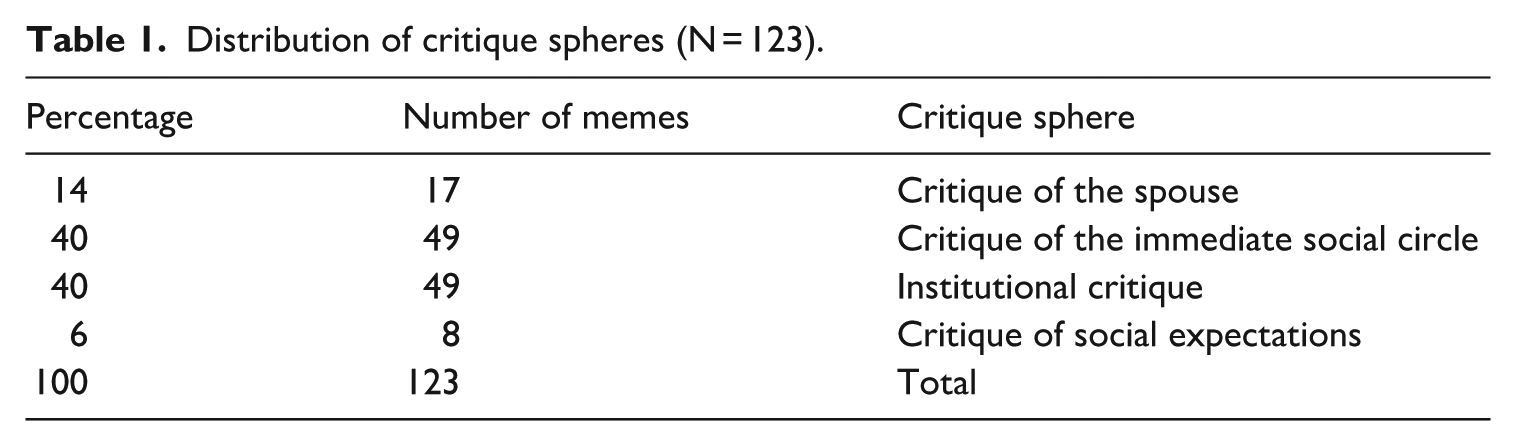
Within the themes established, we utilized a Critical Discourse Analysis approach to explore how memes construct and contest power relations by embedding ideologies in language and imagery (Fairclough, 2015; van Dijk, 2008). Our analysis drew on three key dimensions: the role of humor in identity and resistance (Shifman, 2014; Milner, 2018), the rhetorical use of visual and textual elements (Highfield and Leaver, 2016; Wiggins and Bowers, 2014), and the function of memes as spaces of both ideological reproduction and critique (Denisova, 2019; Hristova, 2014).
Ethical considerations
After explaining our research objectives and committing to use the data exclusively for academic purposes with strict anonymity protocols, the group administrators added one of the female researchers to the Facebook group. All collected memes were thoroughly anonymized to protect the identity of group members. We removed any identifying information, including names, profile pictures, and other personal identifiers from our database. Prior to publication submission, we provided the group administrators with the opportunity to review all meme examples included in the manuscript, giving them final approval over which content could be used as illustrations in our research. The study was approved by our institution’s ethics committee (approval number: AU-COM-HL-20250106), which is compliant with the Helsinki Accord.
Analysis
The memes analyzed in this study reveal a complex interplay of critique and negotiation within the unique sociocultural context of Israeli reserve soldiers’ wives during a security crisis. The critique expressed in these memes operates across four interconnected spheres: the intimate sphere (spouse/partner), the immediate social circle (friends and family), institutional frameworks (military and governmental decision-making, particularly regarding insufficient financial benefits for reserve soldiers’ families or the uncertainty surrounding service duration), and broader societal discourse (social expectations, gender roles, and national narratives). While these critiques often appear directed at immediate social surroundings, they simultaneously serve to articulate broader statements about social values in a mitigated manner. This dynamic reflects what we conceptualize as quasi-political critique—a mediated form of political expression that critiques social structures without overtly confronting institutional power.
Critique of the spouse: personal grievances and domestic inequities
The first sphere of critique focuses on the direct criticism reservist wives express toward their spouses. Unlike broader social critiques that address systemic gender expectations, these memes target the individual behavior of the husbands during and after their military service. The primary grievances articulated in these memes revolve around the perceived neglect of paternal responsibilities, the emotional and logistical burden placed on wives, and the stark contrast between the hardships endured at home and the relatively comfortable conditions enjoyed by soldiers in reserve duty.
One recurring theme in the memes is that reserve duty serves as an escape from the domestic responsibilities of fatherhood, particularly during challenging periods such as school vacations. One meme captures this sentiment with the caption: “My husband when he receives a reserve duty call-up during summer break: ‘More, more, more!’” (Image 1). This meme conveys the frustration of wives who appear to feel that their partners welcome reserve duty as a reprieve from the overwhelming responsibilities of childcare at home.
Similarly, another meme contrasts the chaotic demands of the home front with the seemingly relative ease of military life, comparing the “front line,” depicted as a barbecue with soldiers playfully swinging and eating pizza, with the “home front,” where a mother is shown at her wits’ end, surrounded by her children (Image 2).
A related set of memes focuses on the aftermath of reserve duty when husbands return home. Unequal division of labor between parents due to long periods of mobilization can seep into feelings of resentment toward how children may adulate their fathers upon their return home. For example, one meme, using a SpongeBob template, features the headline: “When he comes home for off-duty time” and depicts the children excitedly shouting “Daddy, daddy!,” while the mother watches from a darkened room, embodying her sense of being overlooked (Image 3). This meme sharply conveys the mother’s apparent frustration as her children enthusiastically welcome their father, despite her being the one who single-handedly maintained the household for months.
Other memes that focus on husbands returning home highlight their inability to reintegrate into their familial roles. One meme illustrates the emotional disconnect between spouses, depicting a wife calling her husband in distress to lament her hardships, only to receive the dismissive response: “So just go rest” (Image 4). The humor in this meme underscores the perceived insensitivity of husbands, who are experienced as lacking the ability to grasp the extent of their wives’ exhaustion and frustration.
The perceived lack of paternal engagement is also a significant point of contention. One meme presents a scenario in which a husband, upon returning home, asks his wife for help in putting the children to bed: “My husband: ‘Can you come help me put them to sleep? I can’t do it alone.’ Me: ‘I don’t understand the syntax of this sentence’” (Image 5). This response humorously conveys the wife’s incredulity at her husband’s inability to assume sole responsibility for a task she has managed alone for an extended period. Another meme critiques the apparent superficial empathy expressed by husbands, featuring a conversation where a husband tells his wife, “I understand you,” to which she sarcastically replies, “Nice. Pretty nonsense words” (Image 6). These memes reinforce the perception that husbands remain detached from the full scope of their wives’ struggles, offering empty words rather than substantive support.
Collectively, these memes illustrate the specific grievances of reservist wives regarding their husbands’ behavior, emphasizing how men fail to fully support their partners, neglect their parental roles, and struggle to re-engage with domestic responsibilities after extended periods of service.
Critique of the immediate social circle: friends, family, and the limits of empathy
The second sphere of critique extends beyond the spouse and targets the immediate social environment of reservist wives, including family members, friends, and acquaintances. These memes focus on the perceived lack of understanding, empathy, or meaningful support from those closest to them. They highlight the frustration wives feel when their emotional and logistical struggles are met with superficial or performative concern rather than substantive assistance, while indirectly challenging a value system that expects reserve soldiers’ wives to bear the full domestic burden in service of the war effort.
One such meme uses a hypothetical conversation: “People: What’s going on? Are you okay?” followed by “Me: My partner is in Rafah and all that.” The punchline, depicted through the “That’s rough, buddy. Anyway . . .” meme template, underscores the shallow nature of the response, suggesting that the question was asked out of politeness, with no real intention to offer meaningful support (Image 7).
Some memes express frustration with remarks that downplay the challenges faced by reservists’ families, such as surprise that the partner hasn’t been discharged. A common format is “You are this close to getting slapped,” with one version reading: “When they tell me, ‘Tell him to be discharged already, it’s been long enough’” (Image 8), reflecting the anger at such obliviousness.
Others mock perceived misguided solidarity from women who compare their partners’ late hours to life with a reservist. One meme uses the “What, am I a downgraded version of you?” template: “When they say to me, ‘I understand you, my husband also comes home late and doesn’t help with the kids’” (Image 9), exposing the absurdity of such comparisons.
In addition to criticizing the apparent false empathy shown by those outside the reserve soldiers’ wives’ in-group, some memes target individuals who complain despite not bearing the burden of reserve duty. One such meme uses the “It doesn’t interest me!” template, with the added text: “Complaints of those whose husbands have not been mobilized” (Image 10). This meme establishes a clear boundary between whose grievances are considered legitimate and whose are not, reinforcing the notion that reserve soldiers’ wives hold a unique entitlement to voice their frustrations.
While these memes target the immediate social environment, often questioning the legitimacy of others’ complaints or opinions, they ultimately serve to sublimate criticism of a broader social norm by expressing political frustrations through the personal realm: the expectation that some individuals must dedicate significant time to reserve service, while others are exempt. By directing their frustration toward more accessible, convenient targets rather than addressing the root of this inequality, these memes inadvertently contribute to silencing deeper criticism that might challenge established social structures and the systemic injustices they perpetuate–for example the heavy burden incurred by reserve soldiers who are recruited for several rounds of service, while other groups, for example, Ultra-Orthodox seminary students, are fully exempt from military service.
Institutional critique: military policies and state neglect
The third sphere of critique shifts the focus from interpersonal frustrations to systemic grievances concerning the treatment of reservist families by military and governmental institutions. These memes address issues such as inadequate financial compensation, bureaucratic inefficiencies, and the prolonged uncertainty surrounding reserve duty service.
Inadequate financial compensation
When addressing government decisions, meme creators often critique the economic consequences of these decisions rather than the underlying systemic issues that contribute to them. For instance, numerous memes highlight the shortcomings of state institutions and businesses in providing adequate financial support to the families of reserve soldiers. Some specifically express frustration over bureaucratic loopholes that hinder families from receiving the assistance to which they are entitled.
One such meme reads, “The government unveils a program of grants, compensation, and more benefits to reserve soldiers and their families,” followed by the punchline: “I recall that I’m a member of a collective Kibbutz [a communal village],” highlighting the exclusion of certain groups from these benefits (Image 11). This meme underscores inequalities embedded in the state’s compensation programs that leave some families without the support they need.
Similarly, the following meme utilizes the template “enough with this lie” adding the statement “The compensation fund will help with the weight of expenses that have befallen us following reserve duty” (Image 12). This meme points out the inadequacy of the government funds allocated to compensate for additional familial expenses following the mobilization of their husbands.
While these memes do not contest the hegemonic values that legitimize the prolonged mobilization of reservists for the war effort, they reflect dissatisfaction with the inadequate recognition and support provided to their families. Rather than directly challenging the ideological framework, they expose the consequences of systemic injustices.
Lack of a clear timeline or future vision
A recurring theme is frustration with the uncertainty surrounding the end of reserve duty and the seemingly endless nature of the war. These memes often portray a Kafkaesque reality of broken promises, scarce information, and suspended everyday life. While avoiding direct blame toward political or military leaders, the memes express passive resistance, pointing to dissatisfaction with the lack of clear policy. By highlighting the absurdity faced by wives who don’t know when their partners will return, the memes reflect a deeper frustration with the state’s failure to provide stability or direction. For example, the following meme, which includes the text “when I’m asked when is his expected release” depicts a reality in which the protagonist attempts to find direction through the use of a map, but cannot find indicators as his location or a way out of a directionless reality (Image 13).
The endless nature of the war is satirized through a Lion King meme, where Mufasa’s line about inheriting the kingdom becomes: “You see the third round [of reserve duty] on the horizon, my child? Soon, all this anxiety will be yours” (Image 14). The vast landscape evokes the boundless cycles of reserve duty, while the passing of anxiety from father to son highlights the intergenerational toll. This meme critiques the normalization of perpetual service and its emotional cost, even as it presents it as an almost natural, accepted reality.
Some memes invite the community to embrace a contradictory, absurdist reality. One meme uses the template “There is, of course there is . . . But there is not,” with the added phrase “The expectation of release” (Image 15). It captures the illogical bureaucracy whereby soldiers are promised release, only for it to be revoked—creating false hope and reinforcing a sense of unpredictability. This state of indefinite limbo, where neither home life nor extended service is assured, particularly affects their partners. The nominal phrasing (“expectation”) further diffuses criticism by obscuring who is hoping, softening the meme’s subversive edge.
In contrast to memes that cope through irony, others present a more direct cry for help. One meme uses the template “Lord, you should know that this is a stinking move,” adding, “When, in the second round, he is recruited for longer than in the first” (Image 16). Departing from absurdist humor, this meme voices frustration and despair, appealing to a higher power rather than human decision-makers. By directing the complaint to God, the author laments the injustice and implicitly accepts the war’s persistence as a given, thus contributing to its naturalization.
One meme stands out as the only example in the corpus to directly express anger at institutional injustices surrounding unlimited reserve duty. Using the “Israeli, take note, if you’ve reached here, you’ve erred” template—borrowed from warning signs at entrances to Palestinian-controlled areas—the author adds: “We’ve reached 70 days of reserve duty” (Image 17). This sharp repurposing signals that such prolonged service is not only unsustainable but endangers family stability. Unlike subtler critiques, this meme openly targets state policy, though it blurs agency by addressing a generic “Israeli” rather than the system itself, leaving responsibility implicit.
These and similar memes reflect deep disappointment with the state—whether over inadequate compensation or the Kafkaesque uncertainty surrounding the end of reserve duty. Criticism is often directed at abstract forces like “reality” or God, rather than specific decision-makers. In doing so, the memes contribute to the naturalization of conflict, portraying it as inevitable or divinely ordained rather than the result of policy. This diffuse critique, lacking a clear human target, reinforces the perception of war and reserve duty as a permanent, unquestioned part of life.
Critique of social expectations: gender roles and national narratives
The fourth and outermost sphere of critique shifts from personal grievances and institutional neglect to a broader societal critique of gendered expectations and norms. These memes focus on how reservist wives are perceived and treated by society at large, particularly in contrast to the veneration afforded to their husbands. Rather than expressing dissatisfaction with their spouses’ behavior, these memes target the systemic ways in which women’s labor and sacrifices are overlooked or diminished.
One of the most prominent themes in this category is the socially driven heroization of reservist soldiers and the simultaneous invisibility of their wives. This theme is exemplified in a meme featuring the caption: “When we go out of the house with my husband,” paired with an image portraying the soldier as a saintly, Christ-like figure (Image 18). The exaggerated reverence given to the reservist husband stands in stark contrast to the lack of recognition for the wife’s sacrifices, highlighting the disparity in social valuation between the home front and the battlefield.
A particularly sharp critique is directed at the common label “lionesses” used to describe reservist wives, a term that entered the cultural lexicon after the October 7 attack, positing a romanticized depiction of women who have mobilized in various ways in support of the war effort—by taking care of their children alone, tending to the needs of soldiers and refugees of war, and providing a range of health and welfare services (Hager, 2024). Rather than embracing this term, many memes mock and reject it, portraying it as an empty platitude that romanticizes their struggles while failing to acknowledge the real hardships they endure.
One meme captures this sentiment by depicting a character surrounded by effusive compliments—“You are a lioness, a champion, a hero, a queen!”—only for her to respond: “Can I take off my crown? I have a headache” (Image 19). The implication is clear: the glorification of these women’s endurance does nothing to alleviate their suffering. Another meme takes a more aggressive stance, showing that the meme writer will roar at the next person who calls her “heroine, champion or lioness” (Image 20).
At first glance, the complaint against the glorification of these women might seem to contradict the previous critiques of the heroization of reservist husbands—but we argue that this is not the case. Rather, the underlying frustration in these memes stems from the perception that such compliments serve to pacify and normalize an unjust situation rather than offering meaningful recognition or support.
Together, these memes illustrate how reservist wives grapple not only with the direct burdens of managing their families alone but also with the broader societal structures that fail to recognize their contributions. Through humor and satire, they expose the systemic inequalities embedded in the discourse surrounding military service, challenging the glorification of soldiers at the expense of those who sustain the home front. This critique does not necessarily call for radical change, but it does seek to highlight and question the taken-for-granted assumptions that underpin gendered expectations in times of conflict.
Discussion
This study examines how the wives of reserve soldiers in Israel use memes within a dedicated Facebook support group, where humor and shared frustrations provide a platform for expressing personal and social grievances. While the group was not established for the purpose of critique, the analyzed memes reveal how its members navigate between support, solidarity, and subtle forms of criticism directed at social and institutional structures. We develop the concept of quasi-political criticism to describe this mediated form of political expression—one that challenges structural conditions while avoiding direct confrontation with institutional power. Building on our empirical findings, this section elaborates the theoretical grounding of this concept, drawing from relevant literature on discourse, resistance, and digital communication, while also considering the broader implications of the findings.
Quasi-political criticism as mediated expression
We conceptualize quasi-political criticism as a mode of mediated critique that challenges social norms, values, and institutional practices without explicitly targeting political and military elites. Unlike overt political dissent, which directly confronts dominant power structures, quasi-political criticism operates within a constrained ideological space, framing grievances through personal experiences, interpersonal relationships, and everyday frustrations.
Drawing on Hristova’s (2014) insights into how digital texts can diffuse the radical potential of political critique, we argue that quasi-political criticism gives voice to marginalized perspectives through humor and satire, while remaining within the boundaries of hegemonic discourse. In the context of the Facebook group analyzed, this mechanism allows reservist wives to express dissatisfaction with institutional norms—particularly regarding gender roles, military service expectations, and the lack of structural support—without challenging the legitimacy of the military institution itself. The privatization of public criticism (Schröter and Taylor, 2018; Wetherell and Potter, 1992) ensures that grievances remain within the realm of personal expression rather than articulated as broader political critiques.
Humor, affordances, and the naturalization of quasi-political criticism
The power of quasi-political memes lies in their ambivalence: they voice critique while simultaneously reinforcing hegemonic norms. This capacity to balance dissent and conformity is enabled by the affordances of digital humor, allowing grievances to surface without directly challenging dominant structures. As such, these memes exemplify the dual role of humor in both community-building and mediated resistance (Nissenbaum and Shifman, 2017).
The affordances of memes—brevity, humor, and replicability (Milner, 2018; Wiggins and Bowers, 2014)—play a central role in shaping quasi-political criticism. These features enable users to articulate grievances in socially acceptable ways that diffuse confrontation while reinforcing group cohesion. Memes often pair a familiar cultural template with a humorous take on a shared experience (Gal et al., 2016), allowing participants to frame frustration through satire and relatability rather than direct opposition. As such, the genre lends itself to personalized, everyday expressions of discontent that resonate with others, rather than explicit critique of external authorities—further reinforcing the quasi-political character of the discourse.
While previous research has highlighted memes as tools for both resistance and reinforcement of societal norms (Huntington, 2015; Kassing, 2020), many studies emphasize their potential to give voice to marginalized groups and challenge hegemonic discourse through moral and political critique (Mortensen and Neumayer, 2021; Plevriti, 2014; Ross and Rivers, 2017). Our study, however, shows that in social contexts where solidarity is paramount, the critical function of humor tends to be sublimated. By framing critique through irony and relatability, memes enable expressions of frustration that ultimately uphold dominant structures (Cui, 2024; Hristova, 2014).
Our analysis illustrates how quasi-political criticism emerges in part from the humorous affordances of memes, but also from the need to navigate tensions between personal hardship and a social environment that demands solidarity with national aims and emotional support for a mobilized spouse. These humorous texts contribute to social cohesion and group identity (Ask and Abidin, 2018; Nissenbaum and Shifman, 2017), sometimes at the expense of deeper social or political critique. We posit that the desire to generate humor as a form of social lubricant (Meyer, 2000) may, paradoxically, help perpetuate hegemonic narratives even when the content appears critical on the surface. This dynamic aligns with the concept of hegemonic naturalization (Barthes, 1977), wherein discourse frames structural realities—such as prolonged military service and national sacrifice—as inevitable conditions rather than contestable policy decisions (Gavriely-Nuri, 2015).
By directing frustration toward socially acceptable targets—husbands, family members, and bureaucratic inefficiencies—rather than structural agents like political leaders or military officials, these memes reinforce the notion that such circumstances are simply “the way things are” rather than the result of intentional policy choices (Mortensen and Neumayer, 2021). In addition, the Facebook group’s rule mentioned above, which discourages overtly partisan or ideological debates, may also contribute to aiming frustrations at such targets rather than specific political agents.
Thus, the affordances of memes not only enable subtle critique but also contribute to the naturalization of structural conditions, shaping how grievances are articulated and contained.
Silencing and the boundaries of acceptable critique
A crucial aspect of quasi-political criticism in this context is the way it navigates the limits of acceptable critique. The memes analyzed in this study illustrate how reservist wives primarily direct their frustrations toward their immediate social surroundings and toward reality itself, the given and abstract situation, rather than at institutional power structures. While these memes challenge social values and expectations, they often refrain from explicit criticism of the elite decision-makers responsible for shaping these structures.
Following van Dijk’s (2008) approach, which focuses on how ideological structures embedded in language reproduce dominance by aligning with dominant knowledge frameworks, even in ostensibly critical texts, these memes function as a form of silencing: meme authors, as wives of reservists, may perceive themselves as lacking legitimacy to directly challenge military or political leadership. Instead, their grievances focus on the unequal distribution of burdens within their personal and social circles. For example, memes critique the lack of recognition for their role, the superficial empathy from their surroundings, and the absence of a clear timeline for their husbands’ return—yet they stop short of questioning the necessity of the war itself or the militaristic policies shaping their reality.
This type of discourse reflects a broader dynamic in Israeli society, where open criticism of military operations is often discouraged, encapsulated in the well-known slogan “Quiet, we are shooting” (Peri, 2001). This concept taps into the broadly researched view of Israel as a “mobilized society,” in which civil–military fusion, embeds the army within everyday life, education, and civil culture (Levy, 2007) and Israeli public discourse is organized to mobilize society emotionally, cognitively, and morally around national narratives and security concerns, resulting in a highly mobilized national media discourse (Peri, 2004).
Consequently, rather than challenging the political logic that sustains prolonged reserve duty, these memes redirect criticism toward the social experience of enduring it. In doing so, they reinforce solidarity within the in-group while diffusing the potential for structural critique.
Quasi-political criticism enables meme authors to vent frustrations at various convenient targets, without jeopardizing the supportive, mobilized role expected of reserve soldiers’ wives. Engaging in structural critique of their partners’ extended service or the legitimacy of the war effort itself could be viewed as calling into question the significance of their husband’s service, a stance that could put group solidarity at risk. As such, quasi-political criticism can serve as a type of “griping party” (Katriel, 1991: 35), a common ritual in Israeli society, in which complaining serves a social function of affirming communal participation, commitment to the collective, and acceptance of a common fate (by griping about this very fate). While Katriel’s griping parties take place around the Friday night family dinner and quasi-political criticism through memes, both tend to serve as the “antithesis to social action” (Katriel, 1991: 47), serving to establish solidarity through venting one’s grievances at convenient targets.
At the same time, while the memes analyzed here express emotionally ambivalent responses—combining frustration, irony, and restrained critique—their quasi-political character was also shaped by the specific affordances and governance of the Facebook group. Posting memes within a closed group not only provided technical affordances such as anonymity or shareability; it also entailed normative and governance affordances that structured what forms of expression were legitimate. One of the group’s explicit rules (Rule 4) discouraged overt political discussion, thereby shaping the discursive conditions under which memes were created and shared.
Importantly, this constraint was not strictly enforced in a top-down manner; rather, it was negotiated by members themselves, who sought to maintain a supportive atmosphere while still voicing frustrations and concerns. The resulting discourse was thus co-constructed—emerging both from platform affordances and from users’ own communicative strategies—and can be understood as a negotiated compromise: a form of critique that balances the desire to voice frustrations with the need to maintain cohesion and avoid breaching group norms. As such, the quasi-political critique of these memes serves as a negotiated compromise among various pressures that include (a) the experience of an unsustainable, challenging, and unclear reality; (b) meme affordances that value humor and social solidarity over dissent; (c) group rules that limit political expression; (d) being a member of a mobilized society in a role that is expected by supportive. These dynamics do not diminish the significance of the findings, but they do suggest that the analytical model proposed here may be especially applicable to ideologically constrained spaces, such as support-oriented communities, where critique must be carefully calibrated to preserve group cohesion.
Limitations and future research
While this study provides valuable insights into the role of memes in navigating quasi-political criticism, several limitations should be acknowledged. First, the study focuses exclusively on meme discourse within a single Facebook support group. Future research should expand this scope by comparing different types of supportive online communities to determine whether similar patterns of critique and self-censorship emerge in other solidarity-driven spaces.
In addition, this study primarily examines visual and textual elements of memes but does not systematically compare them to other forms of digital discourse, such as textual posts within the same group. Future research could explore whether the affordances of memes—such as humor, brevity, and virality—shape the nature of criticism differently than written commentary. A comparative analysis between meme-based and text-based discussions could provide deeper insights into the constraints and possibilities of digital political expression in constrained environments.
Although our primary focus was on the memes themselves rather than their circulation, we did examine the engagement they generated at a general level (as noted in the methodology section). Emoji reactions and comments consistently conveyed supportive and empathetic responses, indicating that the memes resonated with group members and were validated within the community. This supplementary observation strengthens our interpretation of the memes’ quasi-political role by showing that such indirect critiques were not only produced but also collectively endorsed. At the same time, this examination was limited to a descriptive overview: we did not conduct a systematic analysis of the relationship between meme topics and types of reactions, nor did we explore the nuanced motivations behind members’ responses. Future research could therefore address these gaps by systematically comparing engagement patterns across themes and by investigating more closely how members interpret and react to different forms of indirect critique.
Finally, while this study focuses on Israeli reservist wives during the 2023–2024 Israel–Hamas war, future research could examine similar dynamics in other national and cultural contexts. Comparing how military spouses in different countries use digital humor to negotiate their roles and identities could yield a broader understanding of the intersection between digital communication, political constraints, and social identity.
Beyond these aspects, future research could also contribute by analyzing the production perspective of these texts. In this study, we briefly referred to interviews with group administrators and meme creators as supplementary context for understanding the quasi-political nature of the memes, but we did not analyze these interviews systematically. Conducting in-depth interviews with meme creators (reservist wives) could provide a deeper understanding of how they perceive both the function of the group and the nature of the critique expressed within it. Investigating their motivations for meme creation and engagement, as well as their reflections on the boundaries of permissible discourse, could offer critical insights into the dilemmas of digital expression in politically and socially constrained environments. By addressing these limitations, future research can further illuminate the nuanced ways digital humor operates as a mechanism of identity negotiation and constrained political critique.
Footnotes
Appendix 1
Funding
The authors received no financial support for the research, authorship, and/or publication of this article.
