




Abstract
Social media influencers (SMIs) develop unique relationships with their followers, including high levels of trust and credibility. This study examined how these influencer–follower relationships affect news media trust with a focus on actual self-congruence, ideal self-congruence, parasocial interaction (PSI), and source and message credibility. Data showed that respectively, positive correlations exist between each of these variables and news media trust. However, ordinary least squares (OLS) regression only showed direct effects of actual self-congruence and PSI on trust, while message credibility had a negative effect. Structural equation modeling showed that actual self-congruence positively mediated the relationship between PSI and trust. Overall, consuming SMI-based news and information increased news media trust among followers, suggesting that SMIs play a complimentary rather than a disruptive role regarding news media trust.
Keywords
“Before making decisions individuals often seek to reinforce their opinions through ‘consensual validation’ with certain others.” This quote from Rogers and Cartano’s (1962: 435) seminal paper on measuring opinion leadership aptly describes the unique relationship between contemporary social media influencers (SMIs) and their followers. Rogers and Cartano continue to define opinion leaders as “those individuals from whom others seek advice and information” (p. 435). Their definition further exemplifies the key functions of contemporary influencers, namely, content creation, information sharing, and opinion leadership. As I discuss in detail later, these functions have plethora of effects on followers’ values, beliefs, and behaviors, which manifest in the form of brand preference, wishful identification, behavior mimicry, parasocial interaction (PSI), and self-congruence. However, it is the trust that followers have in the influencers, and the perceptions of credibility that followers have of the content the influencers share that drive these effects. Research shows that these effects reverberate beyond the influencer–follower dyad to affect mainstream institutions such as the news media, and specifically, news media trust. Here, influencers have overtaken mainstream media agencies as the trusted sources for news and information even as trust in the news media plummets to historical lows (Brennan, 2024; Newman et al., 2024). It is the confluence of this emergent influencer role, its effects upon followers, and the declining trust in the news media that is the focus of this study. Generally, this study examines how influencer–follower relationships affect the news media trust. Specifically, the study examines how self-congruency and PSI with an SMI as well as the perceptions of the credibility of influencer content affect news media trust among followers.
Self-congruity theory is centered in marketing and advertising research, and it refers to how much the symbolic message of a product or a brand matches a consumer’s self-concept, or how the consumer perceives their self-image (Johar and Sirgy, 1991). As I discuss later, research shows that self-congruence affects consumer opinions and trust (Aguirre-Rodriguez et al., 2012; Kumar and Kaushik, 2022; Roy and Rabbanee, 2015), and SMIs play a role in this process (Casaló et al., 2020; Koay et al., 2024). PSI refers to the imaginary relationships that people develop with figures they encounter in the media (Horton and Wohl, 1956). Like self-congruence, research shows that PSI affects opinions and that influencers affect this process as well (Lin et al., 2021; Yuksel and Labrecque, 2016). PSI is also associated with trust (Bhattacharya, 2023; Chung and Cho, 2017). Furthermore, self-congruence and PSI are associated (Gabriel et al., 2023; Garcia et al., 2022; Tafheem et al., 2022; Turner, 1993). Credibility also plays a role as it is associated with both PSI and self-congruence (Casaló et al., 2020; Koay et al., 2024). Credibility refers to the perceptions of expertise and trustworthiness of a source, how much they appear to know facts about an issue, and how honest they appear to report these facts (Rice and Atkins, 2015).
Several reasons merit this study. As mentioned, the historical decline in news media trust (Brennan, 2024) requires continued scholarly inquiry, not just to uncover the underlying dynamics, but also to find appropriate solutions. Second is the rise of SMIs, not only as major purveyors of information, but as the preferred sources for news among followers such that they now compete with mainstream news sources in that role (Matsa, 2023; Newman et al., 2024: para. 3). Case in point, while 40% of U.S. Gen Zers get their news from newsfluencers, or the narrower band of influencers who exclusively deal in news content, 63% of US adults under 50 get news from newsfluencers (Stocking et al., 2024). Third, the rise of influencers as news sources must be taken in the context that they enjoy unprecedented levels of trust and credibility among their followers (Leite and de Paula Baptista, 2021; Lou, 2022). Finally, by incorporating self-congruence, a marketing and advertising theory, this study uniquely adds to news media research.
News media trust
As a theoretical concept, news media trust is rooted in the larger framework of trust. In its broader conceptualization, trust refers to how vulnerable someone (the trustor) is willing to be to the actions of another (the trustee) with the expectation of a return even in the absence the trustee being monitored (Mayer et al., 1995). Applied to news media, trust refers to “the willingness of the audience to be vulnerable to news content based on the expectation that the media will perform in a satisfactory manner” (Hanitzsch, Van Dalen, and Steindl, 2018: 5). The vulnerability aspect of trust derives from the asymmetry in the trustor and trustee relationship. Here, the trustor lacks the resources and competencies the trustee possesses, and therefore, they must take a risk when placing their trust in the trustee when anticipating returns based on the related resources and competencies (Sapir, 2022; Yamagishi and Yamagishi, 1994).
Regarding the news media, the audience expects fair, objective, balanced, accurate, comprehensive, and credible information (Prochazka and Schweiger, 2019; Strömbäck et al., 2020). Polling data in the United States shows low public trust in the media’s ability to perform these functions. The introduction mentioned the historically low trust levels of the news media. As of writing, Gallup reports that public trust in the media’s ability to provide accurate and fair news sits at an all-time low of 31% (Brennan, 2024). This reflects the 32% trust rating from the Reuters tracking of the issue (Newman et al., 2024) and the 28% from YouGov’s polling (Ballerd, 2025: para. 2). In addition, Gallup’s tracking of media trust indicates a 41-point drop between 1976 and 2024 (Brennan, 2024, para 3). While scholarly inquiry into this trend is ongoing, scholars have identified several contributing factors. These include negative perceptions of the news media such as political bias, racial/ethnic indifference, lack of transparency, conflicts of interest, general skepticism, and the pursuit of profit margins at the expense of editorial independence, and so on (Fisher et al., 2021; Nelson et al., 2024; Peterson- Salahuddin, 2023). Other factors include partisanship (Jurkowitz et al., 2020: para 10–12; Hanitzsch et al., 2018) and social media use (Anspach and Carlson, 2020; Park et al., 2020; Xiao et al., 2021). Partisanship and social media use may exacerbate misinformation susceptibility, which by itself undermines media trust (Ognyanova et al., 2020; Vaccari and Chadwick, 2020). This is important because political Conservatism increases misinformation susceptibility (Calvillo et al., 2020; Pew Research Center, 2020) and Conservatives trust the mainstream media less than Liberals do. In the United States for instance, only 12% of Republicans trusted the media in 2024 as opposed to 54% of Democrats (Brennan, 2024: para 6). In addition, Republican media trust fell by 56 percentage points between 1972 and 2024 compared to a 24-poimt drop among Democrats un the same period (Brenan, 2024). The rise of alternative news sources on social media, some of which peddle partisan misinformation, may also undermine media trust (Baines et al., 2021; Klepper and Seitz, 2021: para 6–7; Stocking, et al., 2022: para. 5). These factors combine to make the U.S. media one of the least trusted in the world, where at a 32% trustworthiness rating, it ranks 37 out of the 46 countries polled by Statistica in 2024 (Watson, 2024).
A changing media ecosystem may also explain this trust deficit. For one, the low trust in the news media stands in contrast to the ascendancy of SMIs who are highly trusted by their followers (Leite and de Paula Baptista, 2021; Lou, 2022). This trust deficit has real-life effects. SMIs are now the trusted sources for news generally (Matsa, 2023: para. 3). In fact, the 2024 Reuters Institute’s Digital News Report shows that influencers have overtaken mainstream sources as the preferred sources for news in the United States and in many other countries across most social media platforms (Newman et al., 2024). This makes sense because some influencers now deal exclusively in news content, further complicating the media ecosystem. Popularly known as newsfluencers, these digital news creators share news content on popular social media sites like TikTok, YouTube, and X, as well as on direct-to-subscriber platforms like Substack (Hurcombe, 2024). The Pew Research Center reports that 63% of US adults under 50 regularly get their news from such influencers (Stocking et al., 2024). While some newsfluencers like former CNN anchor Don Lemon have professional journalistic backgrounds (The Daily Beast Podcast and Seinfeld, 2025: para. 7), others like 26-year-old Carlos Espina with 9.4 million followers on TikTok have little to no journalistic backgrounds (Maheshwari and Bensinger, 2024).
Despite of the lack of journalism training, newsfluencers still exert heft buoyed by trustful followers who also perceive their content to be more credible than mainstream news (Salcius, 2025, para 12). In turn, mainstream journalists must now adapt by posting on social media and incorporating some influencer-type of tactics such as unique branding to better compete regarding audience engagement (Finneman et al., 2019; Hedman and Djerf -Pierre, 2013). In addition, it is not uncommon for mainstream news to use influencers as sources (Anđelić, 2021). Even then, research shows that influencers play a complementary rather than a disruptive role to journalism (Wasike, 2025). However, competing with newsfluencers puts mainstream journalists in a precarious position because newsfluencers are not bound by professional journalism mandates like accuracy and objectivity, or the demands of digital journalism like the speedy dissemination of vetted news (Drok and Hermans, 2016; Perreault and Hanusch, 2024). This means that violations of these standards adversely affect trust among journalists more than among influencers (Beede and Mulnix, 2017).
Self-congruence
Self-congruence focuses on the extent to which the symbolic message accompanying a product or a brand matches a consumer’s self-image when they consider using the product or engaging with the brand (Johar and Sirgy, 1991). It is important to point out that the symbolic product message differs from the utilitarian message emphasizing the practical function of the product (McCracken, 1986). Therefore, self-congruence occurs when the consumer successfully matches this symbolic message to their self-concept. Self-concept is how people perceive themselves when using a product or engaging with a brand (Johar and Sirgy, 1991; McCracken, 1986). People develop self-congruence based the two components of self-concept, that is, actual self-image (actual self-congruence) and ideal self-image (ideal self-congruence). Actual self-image refers to how people perceive themselves to be in reality while ideal self-image refers to who and what they aspire to be (Malär et al., 2011).
Research shows association among self-congruence, trust, and loyalty. For instance, self-congruence is positively associated with brand attachment (Japutra et al., 2019). Brand attachment is the emotional bond that consumers develop toward a brand, and it involves emotions like affection, passion, and a sense of connection with the brand (Malär et al., 2011). An example is how luxury brand messaging improves ideal self-congruence by inducing self-perceptions of uniqueness and desirability among consumers (Roy and Rabbanee, 2015). Likewise, actual self-congruence improves brand attachment regarding feelings like affection, connectedness, friendliness, and passion toward a brand (Huang et al., 2017). Self-congruency also improves loyalty, especially when recipients perceive high relevance to their ideals in the product and brand messages they receive (Zogaj et al., 2021). Loyalty also increases when people deem a brand to be consistent in how it reflects their actual and idealized self-images (Huber et al., 2018). In addition, ideal-self-congruence positively moderates among brand credibility, brand integrity, and brand engagement to improve the perceived credibility and integrity of a brand (Kumar and Kaushik, 2022). Other research shows the same regarding the positive effects of both actual self-congruence and ideal self-congruence on the perceived authenticity of brand messages (Olk, 2021).
Self-congruence and SMIs
Just like self-congruence with a product or brand improves trust in the product or brand, self-congruence with an SMI also improves trust in the influencer. SMIs are self-made, do-it-yourself social media personalities who engage in unique branding using distinctive narrative styles to create and share specialized monetized content to multitudes of followers (Abidin, 2015; Geyser, 2022; Ruiz- Gómez, 2019). SMIs differ from traditional public figures like celebrities in that they are self-made, do not depend on institutional media or prior fame, and they develop highly personalized relationships with their followers (Abidin, 2015; Cornwell and Katz, 2021; Rojek, 2015). In addition, followers generally deem them to be trustworthy and to have expertise in the content they create and share (Campbell and Farrell, 2020; Cornwell and Katz, 2021). This leads to tight bonds with their followers via loyalty, PSI, and even wishful identification where followers mimic influencer behaviors and habits (Leite and de Paula Baptista, 2021; Lou, 2022; Tolbert and Drogos, 2019). This makes SMIs powerful opinion leaders among their followers such that it is now common for brands to deploy them as third-party endorsers of products and services (Dhanesh and Duthler, 2019; Enke and Borchers, 2019).
The previous section discussed how self-congruence is associated with self-image, brand attachment, loyalty, trust, and credibility. These characteristics mirror those in the above-discussed SMI–follower relationships. It is unsurprising therefore, that followers develop self-congruence with SMIs. The SMI-follower self-congruence is called self-influencer congruence. This refers to “the perceived match between the consumers’ actual or ideal personality and the influencer’s actual or ideal personality” (Koay et al., 2024: 4). For instance, Zogaj, Tscheulin, and Olk (2021) found that a follower’s actual self-congruence with an SMI improved the follower’s perception of the influencer’s trustworthiness while a follower’s ideal self-congruence with the influencer improved the follower’s perception of the influencer’s competence. In addition, their study found that these perceptions of trustworthiness and competence improved the chances of a follower to purchase a product or brand the influencer promoted.
Likewise, Zogaj (2023) found that actual self-congruence improved perceptions of an SMI’s integrity such as being honest and truthful while ideal self-congruence improved perceptions of an SMI’s competence. This reflects Venciute et al.’s (2023) study showing not only that actual self-congruence was positively correlated with trust and competence but that it also positively moderated the relationships between perceptions of influencer experience and the usefulness of their content and purchase intention, respectively. Other research indicates that ideal self-congruence with an influencer has a larger effect on follower attitudes than actual self-congruence (Zhu et al., 2019). In addition, this effect is pronounced among follower’s who are highly self-congruent with the influencer and the brands they promote (Belanche et al., 2021). Finally, self-influencer congruence improves wishful identification and behavior mimicry among followers (Xiao et al., 2021).
SMIs, PSI, and credibility
Trust in an influencer may also develop via PSI with the influencer and the perceptions of credibility in the content the share. This makes sense because generally, PSI and credibility shape SMI-follower relationships (Abidin, 2015; Leite and de Paula Baptista, 2021). PSI is the illusionary social interactions that media users develop with personalities they encounter during media use (Horton and Wohl, 1956). Here, the media personalities, in their designated role such as a TV actor, initiate an on-camera conversation with an invisible audience. PSI occurs when the audience reciprocates over time to build a relationship even though it is illusionary and imaginative (Horton and Strauss, 1957). Therefore, PSI is an illusionary social interaction that is “is one-sided, nondialectical, controlled by the performer, and not susceptible of mutual development” (Horton and Wohl, 1956: 215).
Just like with the media personalities mentioned above, followers develop PSI with SMIs. One way they do this is by reciprocating intimate actions that SMIs initiate such as when the influencer invites followers into their private lives via behind-the-scenes clips (Abidin, 2015). SMIs also share private details via self-disclosure. Not only does this improve PSI, but it also improves the perceptions of trustworthiness, credibility, and authenticity among the followers (Chung and Cho, 2017; Ferchaud et al., 2018). Influencers also personalize their relationship with their followers by projecting an authentic everyday persona such as “just being me” (Duffy and Wissinger, 2017: 4659). Research shows that the PSI between SMIs and their followers is consequential. For one, PSI is positively associated with an influencer’s credibility, their popularity, and the likelihood of the followers to share the influencer’s content with others (Manchanda et al., 2022). In addition to improving the influencer’s trustworthiness, PSI also improves the followers’ brand preference and purchase intent of the products and brands the influencer endorses (Bhattacharya, 2023; Chung and Cho, 2017). These effects go beyond purchase intention and interaction with brands. Research shows that PSMIs, or political SMIs, who predominantly create and share political content (Bause, 2021), affect political values, attitude, and behaviors. Some research shows that such influencers improve political participation among young followers (Dekoninck and Schmuck, 2022). Other research shows that PSMIs improve political interest and political trust among their followers as well as boosting the perceptions of political efficacy (Wasike, 2023). It is no wonder that these influencers now play active roles during elections, not just as information providers, but in endorsing candidates as well (Duffy and Fung, 2024; Kelly, 2024).
Method
Sampling
The sample (n = 1244) composed solely of SMI followers randomly selected from a Qualtrics panel. The sample was designed to reflect U.S. Census demographics regarding age, gender, race/ethnicity, income, region, and income. Using Qualtrics panels and similar sampling pools is a common and proven approach (Brandon et al., 2014; Kalmoe et al., 2018). Two screening questions were used to identify SMI followers. First, respondents were asked how frequently they used social media (multiple times a day, once a day, often, but not daily, and rarely/never). Respondents who indicated that they rarely or never used social media were eliminated. The rest were then asked about following an SMI. First, they read a definition of an SMI after which they indicated whether they followed one. Only those who followed at least one SMI were retained. The study was approved by the author’s Institutional Review Board (IRB) before data collection and all ethical considerations were implemented during recruitment and data collection. Data were collecetd between August 12–23, 2024.
The sample demographics were as follows. The average age was 46.14 years (SD = 15.83). Fifty percent were female and 0.4% non-binary. Ethnically, the sample consisted of: non-Hispanic white = 62%, non-Hispanic Black = 10%, Hispanic = 16%, Asian = 4%, Native Hawaiian or Pacific Islander = 1%, American Indian and Alaska Native = 2%, and mixed race or other = 6%. Annual household income was: Less than $50,000 = 36%, $50,000–$100,000 = 33%, and $100,000 or more = 31%. Region was: The East 17%, The Midwest = 22%, The West = 24% and the South = 37%.
Variables
The lone dependent variable was news media trust. The independent variables were self-congruence, PSI, and credibility.
News media trust
Strömbäck et al.’s (2020) 25-item news media trust scale was used to measure this variable. The scale queries about trust at different levels of analysis such as media institutions, journalists, and news content, among others. Therefore, respondents read a series of statements about trust in various media types such as radio, TV, and newspapers, trust in specific outlets such as CNN, Folx News, and the Wall Street Journal, trust in journalists, and trust in the coverage of topics such as the economy and national security. Responses were captured on a 1–5 scale (totally disagree/totally agree or no trust at all/totally trust where applicable). A composite trust score was then computed from the average of the responses (Cronbach’s alpha = .98). See Appendix 1 for full questionnaire.
Self-congruence
Actual and ideal self-congruence were measured using scales adopted from various studies (Malär et al., 2011; Zhu et al., 2019). Before answering the questions, respondents were first asked to think about the influencer they follow the most. For actual self-congruence, respondents read a pair of statements about how much that influencer’s personality was consistent with how they saw themselves and if the influencer’s personality was a mirror image of them. For ideal self-congruence, they read similar statements, but these mentioned, not how they saw themselves, but how the influencers’ personality was consistent with or mirrored the person they would like to be. Responses were captured on a 1–5 scale where: 1 = strongly disagree and 5 = strongly agree. Composite scores were then calculated for both types of congruence (Actual self-congruence Cronbach’s alpha = .80; ideal self-congruence Cronbach’s alpha = .83).
PSI
Because this study measures relationships built over time, a modified version of Dibble et al.’s (2016) 15-item long-term PSI scale was used. The first modification was to change questions originally oriented toward a video stimulus to address SMIs. An example of such a modification is “while watching the video clip, I felt as if I were part of a group” versus “following the influencer makes me feel as if I am part of a group.” Second, two questions that did not apply to the current study’s context were eliminated. Responses were captured on a 1–5 scale where: 1 = strongly disagree and 5 = strongly agree. A PSI score was then computed from the average of responses (Cronbach’s alpha = .93).
Credibility
Credibility was also measured using scales adopted from previous studies (O’Keefe, 1990; Rice and Atkins, 2015; Tandoc, 2019) and questions were modified to suit an SMI-oriented context. An example is, “the person was sincere” versus “the influencer is sincere.” Because using distinctive narrative styles is one way that SMIs build unique brands (Ruiz- Gómez, 2019 and because non-fluency reduces perceptions of credibility (O’Keefe, 1990), a fluency question was added to credibility scale. Here, respondents indicated how much they perceived the influencer to speak fluently without vocalized pauses like “uh,” “uhm,” the unnecessary repetition of words and sounds, slips of the tongue, and mispronunciations, and so on (O’Keefe, 1990). Therefore, the nine-item credibility scale queried about source (SMI) and message (SMI content) factors. Source factors referenced the SMI’s sincerity, expertise, honesty, trustworthiness, and fluency. Message factors referenced the SMI’s content’s effective argumentation, reliability, ease of comprehension, and accuracy. As before, a composite credibility score was computed from the average pf responses (Cronbach’s alpha = .93).
SMI news use
This variable measures how often the followers got news and information from SMIs generally and was measured on a 1–5 scale where 1 = rarely and 5 = very frequently.
Results
On average, news media trust was 2.92 on a 1–5 scale. This denotes moderate trust unlike the SMI-related variables that were moderately high, ranging from 3.12 for actual self-congruence to 3.90 for credibility. See table 2 for descriptives and correlations. Research questions 1–4 resepctively queried about the effecst of credibility, using SMIs for news and information, self-congruence, and PSI on news media trust. Data indicated positive correlations for all mentioned variable associations, but direct effects emerged only for some (see tables 1 and 2). Both actual self-congruence (r = .45, p < .01) and ideal self-congruence (r = .36, p < .01) were positively correlated with news media trust, with a larger effect for actual self-congruence. However, ordinary least squares (OLS) regression indicated direct effects only for actual self-congruence (β = .30, p < .001, t = 7.96) and none for ideal-self-congruence. Like actual self-congruence, PSI was also positively correlated with news media trust (r = .40, p < .01) and directly improved trust (β = .27, p < .001, t = 6.14). Regarding credibility, there was a higher correlation between source credibility (r = .22, p < .01) and trust than message credibility with trust (r = .12, p < .01). However, only message credibility had a direct, albeit negative effect on news media trust (β = −.12, p < .001, t = 2.15). Using SMIs as news and information sources was positively correlated with trust (r = .28, p < .01) and but had no direct effect on it.
Correlations Among Variables.
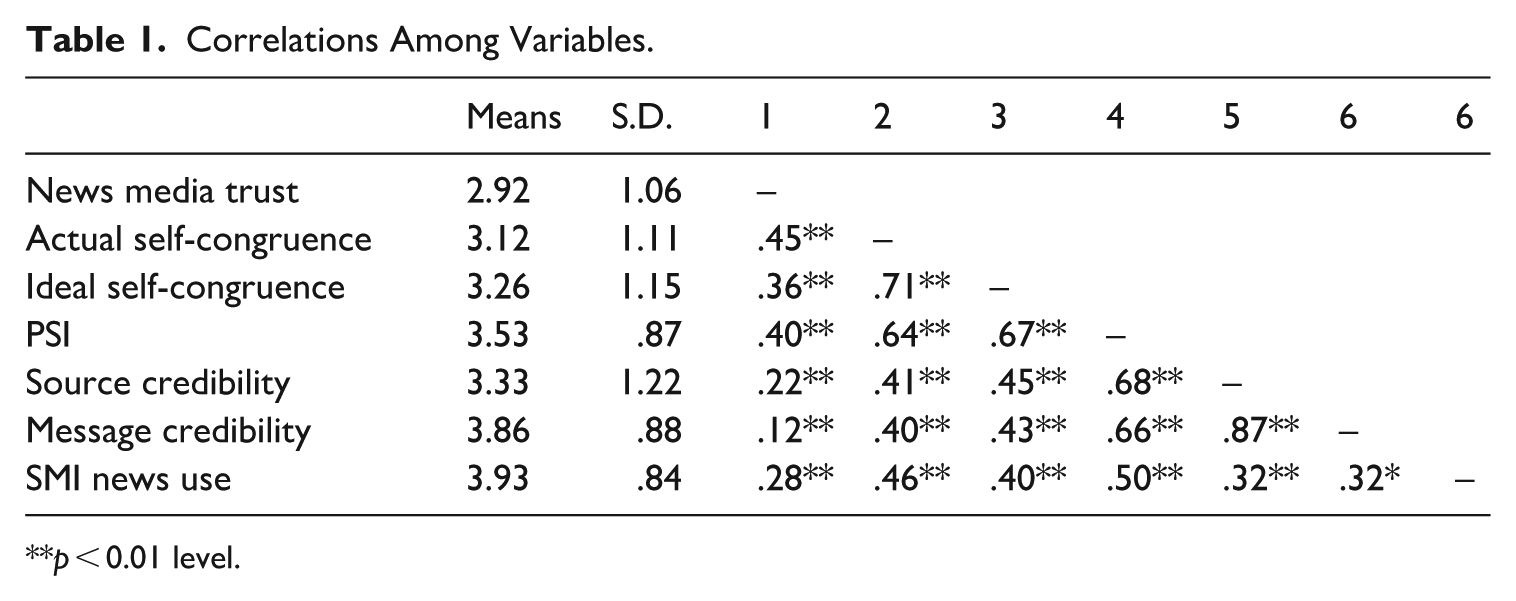
p < 0.01 level.
OLS Regression Predicting News Media Trust.
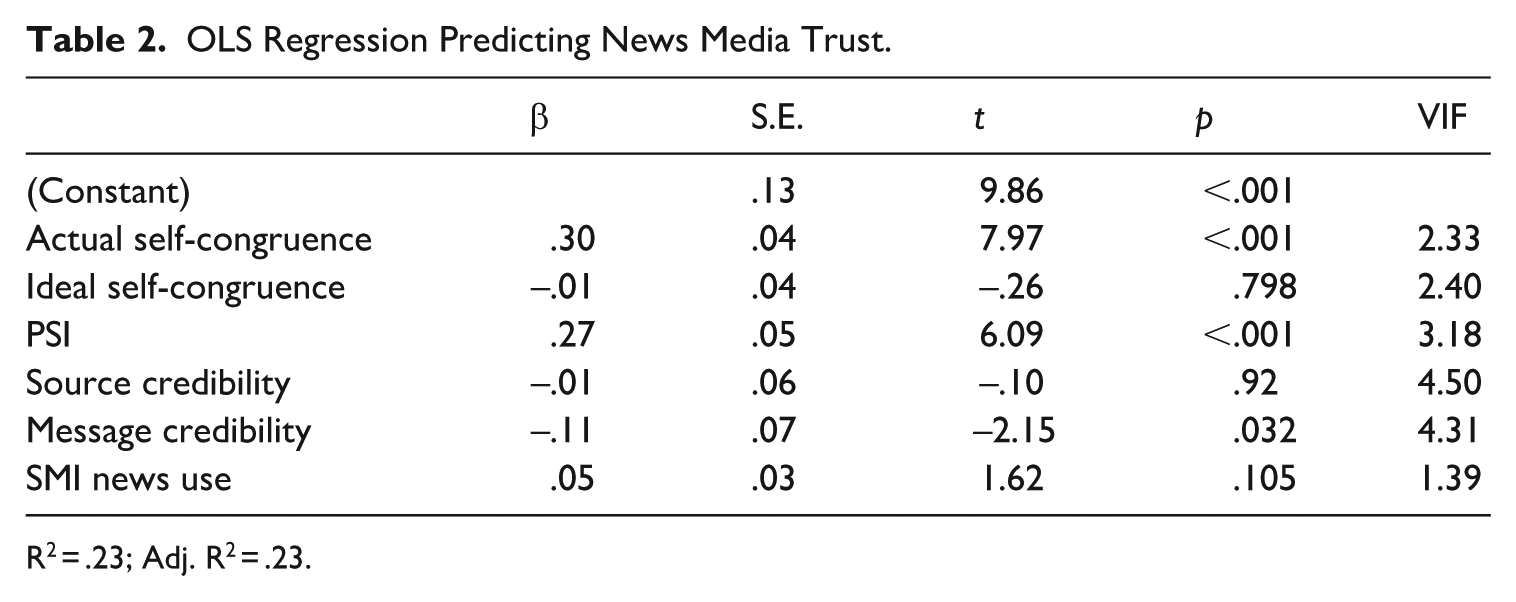
R2 = .23; Adj. R2 = .23.
Hypotheses 1–3 predicted associations among the independent variables. First, credibility was positively correlated with both actual self-congruence (r = .42, p < .01) and ideal self-congruence (r = .45 p < .01) – H1. Likewise, using SMIs as news and information sources was positively correlated with both actual self-congruence (r = .46, p < .01) and ideal self-congruence (r = .40 p < .01) – H2. In addition, PSI was positively correlated with both actual self-congruence (r = .64, p < .01) and ideal self-congruence (r = .67 p < .01) – H3.
Finally, Hypotheses four and five predicted that self-congruence would mediate between PSI and news media trust and between credibility and news media trust respectively. Therefore, I ran structural equation modeling analysis using SPSS AMOS to check for direct and mediated effects. First, the model indicated a good fit (confirmatory fit index (CFI) = .99; Tucker–Lewis Index (TLI) = 98; root mean square error of approximation (RMSEA) = .076, p = .14; χ2 = [df = 1] 8.18; p < .004). As shown in Figure 1, only PSI and not credibility had direct effects on self-congruence. Here, PSI equally increased both actual self-congruence (β = .68, p < .001) and ideal self-congruence (β = .68, p < .001). However, only actual self-congruence, and not ideal-self-congruence, directly improved trust (β = .34, p < .001). In addition, only actual self-congruence showed mediated effects by positively mediating the relationship between PSI and trust (β = .28, p < .001). This means that the presence of actual self-congruence significantly amplified the effect of PSI on trust while ideal self-congruence did not have an effect.
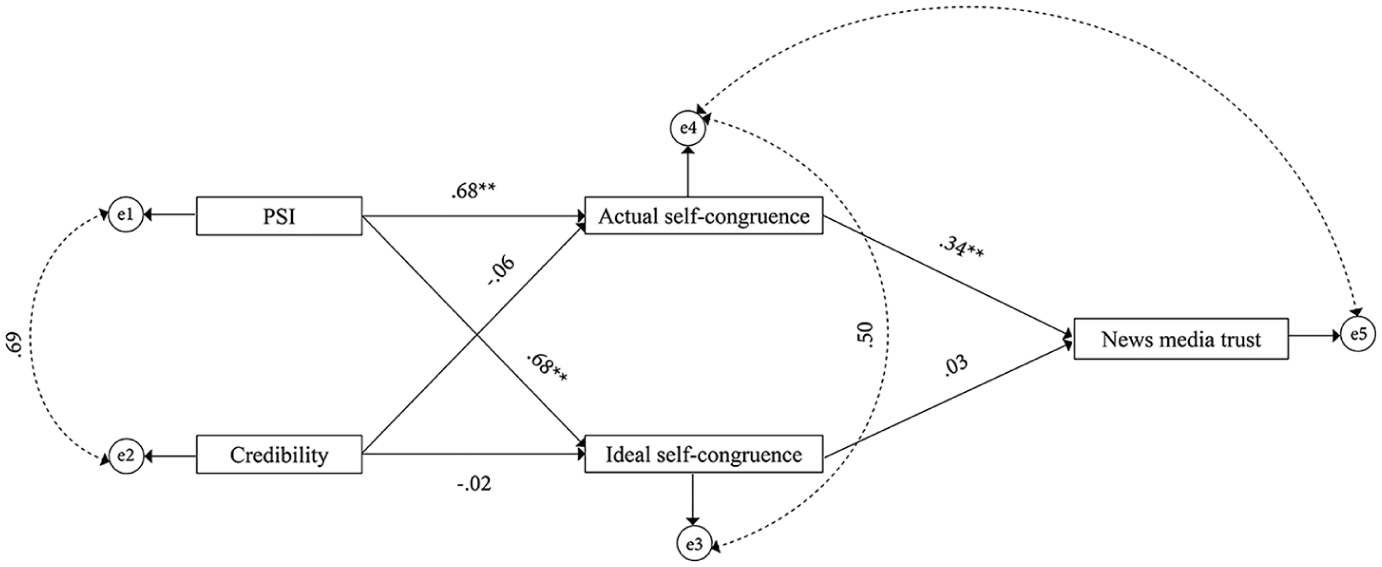
Structural Equation Modeling Chart.
Discussion
This study examined how following SMIs affects news media trust. This is a worthwhile endeavor given that SMIs have emerged as major players in contemporary communication (Abidin, 2015; Geyser, 2022; Ruiz-Gómez, 2019) where they enjoy high levels of trust and credibility among their followers (Campbell and Farrell, 2020; Cornwell and Katz, 2021) even as the trust in mainstream news media plummets (Brennan, 2024). The data revealed new findings. First, following an SMI improved rather than undermined news media trust. Here, not only were actual self-congruence and ideal self-congruence positively correlated with trust, but actual self-congruence had a direct and positive effect on trust. This means that followers who deemed their personality to be like the influencer’s personality and the influencer’s personality to be a mirror image of theirs’s, were more likely to trust the news media. This is important because self-congruence is associated with trust, credibility, and brand attachment, and these associations increase the likelihood of engaging with and consuming influencer content (Japutra et al., 2019; Kumar and Kaushik, 2022; Zogaj, 2023; Zogaj, Tscheulin, and Olk, 2021). The influencer content in this case was news and information. It is noteworthy, therefore, that even in the face of increased engagement with and consumption of influencer news content, self-congruence still improved news media trust. In addition, data showed that using SMIs as sources for news and information was also positively correlated with news media trust.
PSI, another unique characteristic of the influencer–follower relationship, also improved news media trust. Not only was PSI positively correlated with news media trust, but it also directly increased trust. Research shows that PSI uniquely improves influencer–follower relationships by improving perceptions of trust, credibility, and authenticity (Chung and Cho, 2017; Ferchaud et al., 2018). Like with self-congruence, PSI with influencer’s increases follower brand preference and the likelihood of purchasing influencer-promoted products (Bhattacharya, 2023; Chung and Cho, 2017). This is important to this study because in addition to purchase intent, other parameters measuring PSI were looking forward to watching, reading, and/or listening to the influencer’s content, missing the influencer if they did not post any content, and reading about the influencer if a story featuring them appeared in a newspaper or magazine. Given that overall, PSI with influencers was 3.53 (on a 1–5 scale), it is noteworthy that PSI benefited both the influencers and the news media.
Another important finding was the contradictory role of credibility, which was also the weakest predictor of news media trust. Here, source credibility was more correlated with trust than message credibility. However, source credibly, even with a stronger correlation with trust than message credibility, did not directly affect trust. Rather, message credibility did, but with a negative effect of trust. This is unsurprising given the low correlation between message credibility and trust (r = .12). This suggests that followers associated trust more with the SMI content than with the SMI themselves. This is contrary to research showing a positive association between credibility and trust (Manchanda et al., 2022; Matsa, 2023: para. 3; Newman et al., 2024). Another contradictory finding was that actual self-congruence increased media trust while ideal-self-congruence had no such effect regardless of the high correlation between the two variables (r = .71). This may also contradict research on the effect of similar behavior such as wishful identification on trust (Schouten et al., 2019; Shoenberger and Kim, 2017). This suggests uniqueness in the relationship between followers and newsfluencers, where perceiving actual congruence with the influencer affected media trust more than idealizing congruence with the influencer. It may also reflect the uniqueness of news-related content as opposed to other influencer-generated content. Because little research has yet to examine these angles among newsfluencers, the author recommends further inquiry into how variables such as self-congruence and related variables such as wishful identification affect follower and newsfluencer relationships and whether such effects are unique to newsfluencers.
Implications and limitations
This study contributes both theoretically and practically. Theoretically, it brings a new perspective to extant research. By focusing on SMIs and news for instance, the study contributes to news consumption scholarship while addressing news media trust, which is a pressing concern for contemporary news media. Besides, examining SMIs and news in any capacity is timely. Second, by deploying three theoretical frameworks (self-congruency, PSI, and credibility), the study adds a unique angle to related theory. Because self-congruence is a marketing and advertising theory, it is inclusion here adds to news consumption research. Examining self-congruence vis-à-vis news media trust enhances this uniqueness. It is also worthwhile to mention that the unique associations among the variables contribute theoretically. For instance, actual self-congruence (r = .64) and ideal self-congruence (r = .67) were highly correlated with PSI and moderately correlated SMI news use – r = .46 and r = 40, respectively. This extends the applicability of self-congruence theory to news consumption scholarship. Practically, the data indicated that even though SMIs now play an important role in news dissemination even at the expense of mainstream news media, this role benefits rather than takes away from the media. It means that followers can trust SMIs, form unique bonds with them, consume their content faithfully, and not jeopardize their trust in the news media. This suggests that SMIs play a complementary and compatible rather than a disruptive role in the news-making process.
Regardless of the uniqueness of the findings discussed above, they should be interpreted within the context of certain limitations. One limitation is the use of self-reported responses. Such data are susceptible to validity and reliability weaknesses due to response biases (Kreitchmann et al., 2019). Also, the study focused on SMI followers. Therefore, the data did not capture opinions from those who consume influencer content without explicitly following them. In addition, the Strömbäck news trust scale used here is but one of the many such scales, so the validity and reliability of the data are dependent on this one cale. Finally, the study did not examine other variables related to news media trust such as ideology and news literacy.
Footnotes
Appendix 1
Data availability
Data are available from the author upon request.
Funding
The author disclosed receipt of the following financial support for the research, authorship, and/or publication of this article: College of Liberal Arts, University of Texas Rio Grande Valley.
