



Abstract
This article introduces the concept of normative dislocation to explain how platform moderation during Brazil’s 2022 presidential elections failed to account for local histories of political violence. Drawing on a digital methods analysis of militaristic discourse across Telegram, YouTube, X, Facebook, Instagram, and Gettr, we show how moderation standards—rooted in US electoral experiences—prioritized electoral “misinformation” over calls for a military coup. As these circulated, especially on Telegram, platforms operated outside local moderation frameworks developed through processes of reconciliation, dialogue, and democratic reconstruction. In doing so, they risked dislodging institutional processes by reigniting historical conflicts without adequate measures for public dialogue. We conclude by proposing moderation models that integrate various forms of consensus-building and locally embedded understandings of historical violence
Introduction
In the first hours after the depredation of Brasília’s national congress on 8 January 2023, it was widely assumed by news media worldwide that the riots were a tropical simulacrum of the January 6 riots in Capitol Hill (see e.g. Cameron, 2023; Nicas, 2024). Social media platforms themselves had perceived this event in similar terms (Meta Oversight Board, 2023). Content related to the riots had, throughout the 2022 Brazilian election year, been moderated as a byproduct of “electoral misinformation” similar in nature to what had spread online in the lead up to the Capitol Hill riots of 2021.
Diagnoses like these are subject to a certain misunderstanding of political violence outside of North American histories. Content moderation policies tend to classify violent content as a phenomenon restricted to interpersonal relationships (harassment, doxxing, hate speech); violent imagery; terrorism; or some but not all forms of historical revisionism, particularly Holocaust denial (DeCook et al., 2022). In South American histories, violence is often diagnosed as a byproduct of social and economic inequality and state violence (Solimano, 2004). It is also identified in the historical legacy of military dictatorships (Holston, 1999). During the Cold War, the Brazilian military regime took power after a coup in 1964, under the pretext of local and US concerns for left-wing influences throughout the continent. It lasted until around 1988 by partly ceding to public calls for the return of direct elections. Throughout its tenure, it made widespread usage of extrajudicial torture and the forced disappearance and assassination of thousands of civilians suspected of subversion, particularly left-wing political activism (Maia, 2023; Yeomans, 2022).
Following a string of corruption scandals in the late 2010s, Brazilian military political culture (“militarism” in short) re-emerged from a period of relative cultural and political marginalization (Messenberg, 2019). The argument on the far right—symbolized by Jair Bolsonaro as a common and straight-talking man—was that a strong, executive and technocratic military rule, like that of the military regime, was after all the only way to expunge the governance from opaque, corrupt and moral failures. It tapped into a deep well of far-right militaristic ideology, according to whom the army is the ultimate guarantor of the Brazilian constitution and, as such, beholds a moral, patriotic, and historical duty to intervene in moments of historical exception, independent from parliamentary norms and civil society (Santos et al., 2024: 112–113). Central to this narrative is the idea that what mainstream historians qualify as a “coup” was in fact the result of a popular (and thus democratic) revolt against the threat of communism, which the army supported by lending a protection to the state against left-wing insurgencies and their totalitarian policies (Santos et al., 2024: 113; Martins Filho, 2009). Swathes of rioters attacked Brasília’s administrative nexus, the Three Powers Plaza, with this mission in mind: to “save” Brazil from what they thought were elections stolen from the same left-wing forces they once expelled in 1964.
The unresolved nature of this Cold War conflict is arguably the driving force of profoundly polarized public debates, particularly with regards to how the law should handle public calls for the return of a military regime (apologia à ditadura militar). By a logic similar to Germany’s post-war constitution (Fuchs, 2015), Brazil’s re-democratization process has seen the development of some legal sanctions and political norms against the return of military rule. More recent legislation has tended to sanction public calls for the return of a military regime as “attacks against the democratic rule of law” (Presidencia da República, 2021) or a form of “disinformation.” Before them, various truth, amnesty, and reparation led by state and civil society actors sought to address and redress the regime’s human rights violations.
Still, military coups are no anomaly in modern Brazilian history (Roniger, 1987) and a certain nostalgia for the regime has re-emerged across online public spheres as an authentic and influential voting block. At the time of writing, Bolsonaro may suffer strong penalties for his involvement in the 2023 riots and an allegedly botched coup attempt. But the conviction and capacity of organization of his supporters—be they public or political—are among a handful of factors that make sanctioning pro-militaristic speech unsustainable in the long term, especially in the event they regain power.
Another complicating factor is, of course, platforms themselves. With no specialization in the history and particularities of political systems outside of spheres of power, they have actively or accidentally partaken in the above conflict. Musk, for example, has operated X in Brazil as a self-perceived vector for free speech and direct democracy (Elon Musk [@elonmusk], 2024a, 2024b, 2024c). So have alt-tech platforms like Rumble (2025). The embrace of social media platforms as a way to liberalize political speech from institutional processes marks a rupture from a relatively compliant “platform discourse” (Gillespie, 2010) into one that pits sovereign states against platforms as more direct and legitimate servants to local demands and sentiments.
Naturally, platforms are not the causes of such crises but the spaces where historical conflicts are transformed. In and out of these spaces, the role of moderation is not just to demarcate what can from what cannot be said, but, as the very term suggests, to find formats for sustainable public debate where all kinds of sentiments and lived experiences collide. While information-sorting mechanisms are designed to facilitate the discovery of content, moderation is, at its core, a debate management mechanism (Edwards, 2002; Grimmelmann, 2015): it mediates user interactions in accordance with normative directives by operationalizing notions of civility, fairness, balance, mutual understanding, consensus, or more historically-derived norms against political violence (as in the case of democratic rule contra military regime; or, in others, anti-discrimination, and so on).
As such, we are interested in how the moderation strategies of Telegram and US-based platforms—YouTube, X, Facebook, Instagram and Gettr—have compared and competed with local moderation efforts and their wider historical legacy. Our argument is that platform moderation was prone to a “normative dislocation,” in the sense that it focused on what was problematic by US standards while lacking a conceptual framework to address local conflict and political violence. By “normative dislocation,” we refer to a phenomenon where social networking and equivalent services exercise other speech moderation standards than those exercised or cultivated locally, given their historical, political, or social premises. This dislocation enabled the normalization of discourses relatively contained in legacy media systems. This constitutes an important challenge for institutional efforts designed to prevent militarism—as a political and historical threat to post-1988 democratic rule of law—from returning, as dislocated moderation standards, compounded by a lack of consensus-building mechanisms, arguably enabled the repetition of such harms within contested and precarious speech governance standards.
We conclude by considering what a local and consensus-based form of online speech governance could be by exploring ways in which platform trust and safety teams translate local institutional norms into moderation policies (Takhshid, 2021), or even compete in a wider marketplace of mechanisms designed to moderate beyond punitive or adjudicate logics (Dvoskin, 2024). Moderation as adjudication alone may be an insufficient means for resolving the deeper historical disputes that continue to fuel popular attraction for militaristic content. This is why we propose a sustainable form of content moderation based on local public dialogue mechanisms that address the unresolved memorial and political conflict between pro-military and pro-democracy actors. Extending historical transitional justice efforts, this approach may, in turn, legitimize adjudicative decisions by grounding them in broader democratic dialogue.
Locating histories of political violence in Brazil
Thus far, scholarship on content moderation has tended to examine the governance, concepts, definitions, and categories associated with a broad array of “objectionable” discourses (variably defined in time and space). There have been increasingly vocal objections about how US-based content moderation is administered outside Western hemispheres—be that dubbed the Global South (De Gregorio and Stremlau, 2023; Udupa et al., 2023), global majority (Gorwa, 2024), or non-WEIRD countries (Western, Educated, Industrialized, Rich, and Democratic) (Vinhas and Bastos, 2025). Part of that objection is that moderation standards, informed by American legal norms (Takhshid, 2021: 17), tend to lack a historical comprehension of local violence and conflict, and thus reduce its applications into approximative assessments that can inadvertently enable and reproduce them (DeCook et al., 2022). Below, we briefly revisit the broad notions of violence targeted by platform policies and go on to explain how they may not capture the type of violence witnessed in Brasília on 8 January 2023.
The kinds of violence moderated by US-based platforms have been placed into three broad categories (de Keulenaar et al., 2023). The first is content that is widely illegal and unacceptable by general public standards, and is therefore consistently sanctioned by moderation policies with a zero-tolerance policy. This includes pedophilia, life threatening behavior, and visually graphic material, irrespective of geographical location. The second type is prone to conceptual differences over time and across platforms, and includes much-debated definitions of “hate speech,” “abusive behavior,” or “hateful conduct.” These policies generally sanction rhetoric problematized in human rights documentation (Siapera, 2022: 57), ranging from the United Nations Guiding Principles on Business and Human Rights (UNDPs) (Hatano, 2023: 134), to anti-terrorism and hate speech conventions like the Santa Clara Principles and Christchurch Call established between 2018 and 2019. These conventions act as historical guardrails against collective violence on the basis of ethnic, religious, sexual or other attributes. Under them, platforms have taken issue with historical derivatives of discriminatory rhetoric that echo normative debates with particular meaning to Western history, particularly the revisionism of genocidal events as “references to mass murder [. . .] where protected groups have been the primary targets [. . .]” (Twitter, 2017) or “content denying that well-documented violent events, like the Holocaust [. . .], took place” (YouTube, 2019).
The policies applied to the violence witnessed on 6 January 2021 in Washington DC or 8 January 2023 in Brasília belonged to a third category designed to protect broader institutional processes, such as public health emergencies and “electoral” or “civic integrity” (Meta, 2023; Twitter Help Center, 2021, X, 2025). In the context of US Capitol Hill riots, this concept was specifically applied to physical efforts to prevent the certification of electoral results. “Incitement to violence” was sanctioned in extremis, in the specific context where the riots were unraveling with the expressed support of then-president Donald Trump. On Twitter, similar content was sanctioned in the context of the Black Lives Matter protests of 2020, when Trump used a phrase of specific historical resonance to US civil rights movements: “When the looting starts, the shooting starts” (Sprunt, 2020).
The violence witnessed in Brasília on 8 January 2023 was similar in scope but resonates in turn with a distinct political history. Below, we revisit conceptions of political violence from Latin American studies and its applications in the Brazilian context, particularly by highlighting the legacy of the military regime and its historical revisionism.
Military political violence in Brazil
Within the social sciences, the concept of political violence has tended to be defined as a “heterogeneous repertoire of actions oriented at inflicting physical, psychological, and symbolic damage to individuals and/or property with the intention of influencing various audiences” (Bosi and Giugni, 2012: 85). Under this definition, Latin American scholars have tended to focus on conflicts resulting from structural inequality and the insufficient presence of “conflict management institutions” to tackle them beyond economic or developmental policies (Caldeira and Holston, 1999; Soares, 1993; Solimano, 2004: 7). Yet others focus on the political violence deriving from the legacy of military regimes active in most of Latin America throughout the twentieth century. Here, violence is identified in at least two ways: the taking of power by force and outside of parliamentary approval (D’Araújo and Castro, 2000); and a “bureaucratic” (O’Donnell, 1988) albeit strong-handed authoritarianism enforced by the suppression of civil liberties, electoral participation, freedom of expression and other fundamental rights (Yeomans, 2022).
In Brazil, the longest military regime came to power after a coup d’État in 1964, with the support of more conservative population strata and US foreign policy at the time. It lasted until around 1985–88, when, pressured by popular demonstrations and low approval numbers, elections were held and a new constitution marked a return to democratic rule of law. The coup was partly justified by popular and political fears of a “communist threat” (Pedretti, 2023: 170), and in its first few decades used this as a pretext for repressing individuals suspected of political subversion (Viz Quadrat, 2016). Those captured were subject to interrogations, extrajudicial assassinations, enforced disappearances and over 283 forms of physical torture (Comissão de Direitos Humanos da Câmara dos Deputados, 2000). There is no consensus over the total number of disappeared and assassinated individuals (Viz Quadrat, 2016: 126), but various efforts to document them estimate thousands of victims (Arns, 2014).
Unlike in Argentina and Chile, Brazil’s return to democratic rule tends to be characterized as a “regional outlier” (Arns, 2014: 9) in the sense that it was not facilitated by a process of transitional or restorative justice—at least not consistently. Dominated by military affiliations, the Brazilian Congress of 1979 opted instead for an amnesty law, departing from the premise that acts of repression were part of an armed and political conflict between the government and opposition groups. The idea was to transition to democratic rule via “national pacification” (Abrão, 2012: 122), where a truce between opposition groups and armed forces would ultimately allow the country to “move on.”
For those affected by acts of repression, the amnesty law has been described as a “dislocation of senses” (Abrão, 2012: 126–127; Viz Quadrat, 2016: 131), in that perpetrators absolved themselves of crimes caused by their own coup (Pedretti, 2023: 173). In another sense, the amnesty law did not address the concerns of the wider population, who, even without links to opposition groups, had rights curtailed by censorship laws and the threat of extrajudicial repression. In this context, a variety of restorative justice processes and truth commissions have come to complement the initial amnesty law more or less informally since the late 1970s. These processes did not consist in punishing armed forces for human rights abuses, but formulating a common “vocabulary of human rights” (Pedretti, 2023) that could universalize the memory of tortured dissidents as a matter of national history and reconfigure relations between militaries, ex-dissidents and civilians.
Moderation: amnesty, reparations, and truth commissions
Put together, the amnesty, restorative justice, and truth commission processes can be seen as moderation mechanisms within a larger process of re-democratization. Here, we think of moderation as a societal process whose history and applications stretch far beyond the boundaries of platform governance. While moderation is mostly defined as a “filtering” or adjudicative mechanism intended to sanction that which exceeds a norm (by removing and ostracizing “objectionable” speech), it has also tended to be defined as the management and facilitation of public debate (Edwards, 2002). On a micro scale, the moderator is tasked with ensuring a level of fairness, balance, politeness and other measures for sustainable dialogue and civility (Allan, 2016; Edwards, 2002). On a macro scale, moderation acts as an arbitration mechanism that gives a normative orientation to political speech (McIntosh, 2020), grounded in a normative status quo (Pohjonen and Udupa, 2017).
In the latter case, these processes are often the result of societal transformations that redefine the normative foundations of the nation, state, and public sphere (Vincent, 2008). One may remember modern processes like the denazification of Germany and its subsequent Vergangenheitsbewältigung (“work of coping with the past”); the “decommunisation” or “derussification” of Central and Eastern Europe; various processes of decolonization in South, South-East Asia, Africa and the West; initiatives to address and “uproot” discrimination from public culture; the demilitarization of Latin American public institutions; not to mention the profound normative transformations of several revolutions across history. These processes may sometimes carry a conciliatory objective and operate alongside truth, reconciliation, and reparation commissions (e.g. Truth and Reconciliation Commissions, transitional and restorative justice) as part of broader conflict mediation strategies aimed at resetting and reconstituting political-social relations. They are never entirely complete relative to their goal (Vincent, 2008), and their internal tensions and contradictions require sustainable public dialogue and consensus-building mechanisms.
The processes described here have played some of these roles in at least four stages of Brazilian re-democratization (see Figure 1). The first stage was a process of building common historical memory upon which political norms could then be exercised. The documentation of political repression, be that by civil societies or truth commissions, played a central role in this process because it sought to complement official historical narratives with that of actors marginalized by official military sources. The goal was to hone a collective historical “ground truth” (Yeomans, 2022: 19) constituted by pluralistic sources. The first of such efforts was by two civil society groups by the name of “Tortura, Nunca Mais” (Torture, Never Again) and “Brasil, Nunca Mais” (Brazil, Never Again—in reference to an analogous movement in Argentina, Nunca Más), which began to clandestinely document in cases of torture and assassination withheld by military officials (Viz Quadrat, 2016: 129). This work of documentation later served regional truth commissions; the final, official National Truth commission of 2014; and various national archives that remain open to this day.
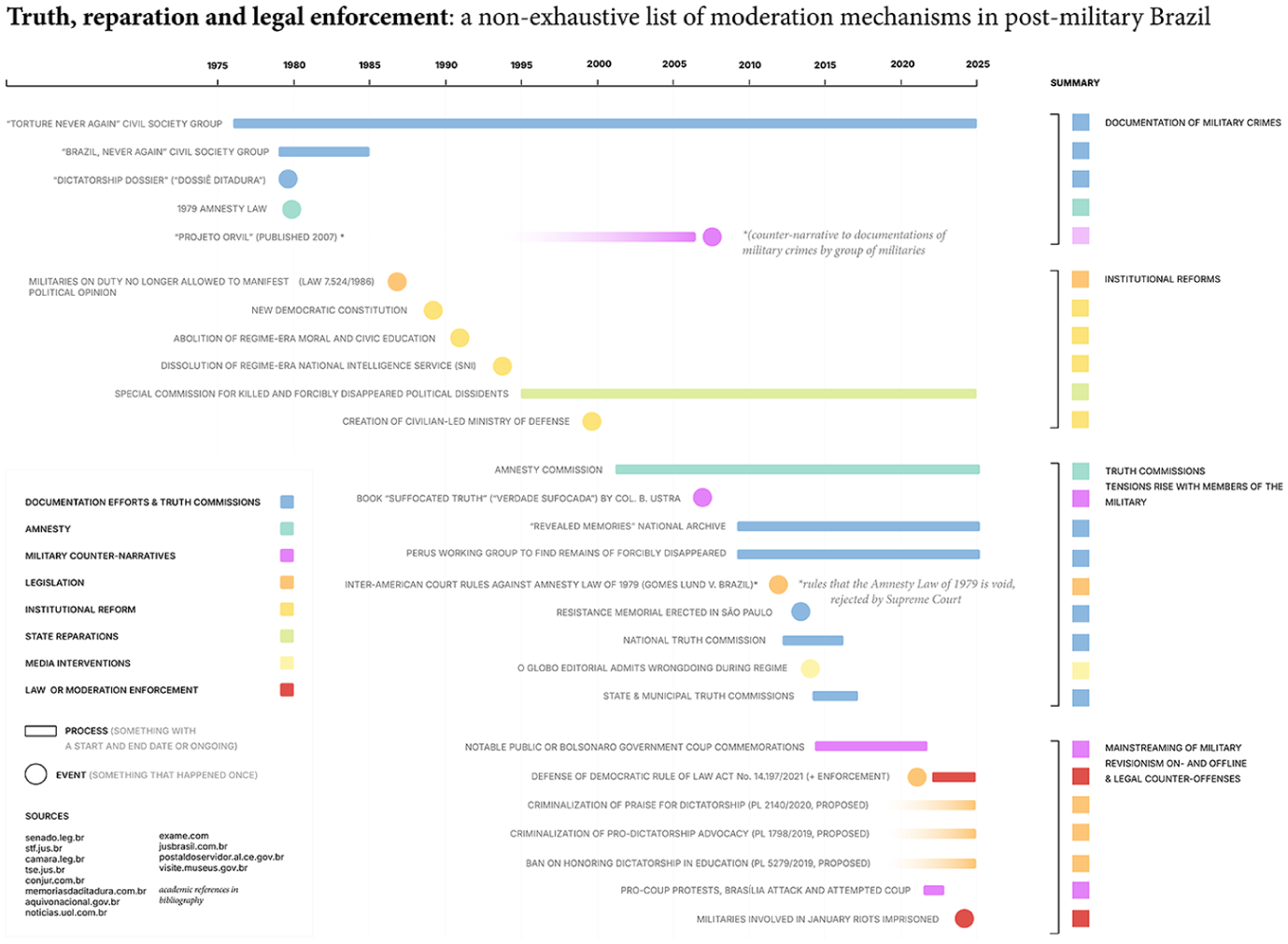
Truth, reparation and legal enforcement as “moderation mechanisms” of the Brazilian re-democratization process.
As a result of these processes, more fundamental norms began to take shape through the language of human rights (Pedretti, 2023). Following the widespread exposure of its crimes, defending the regime or its historical legacy became increasingly untenable (Pedretti, 2023). By the late 80s, for example, widespread campaigns exposed the violence of the military regime and slowly shifted public opinion, even by sectors and actors who, in the 1960s, may have accepted extrajudicial killings as a justified measure against “terrorists” and “dissidents” (Pedretti, 2023: 174). This shift reinforced the idea that political violence should be formally acknowledged and redressed, helping to establish what Pedretti describes a “normative grammar” that partly shaped public and political discourse on the military regime in Brazil.
As such, the second process was the marginalization of the regime from the political sphere. First, the memory of persecuted or exiled citizens who began to return by the mid-1980s became a predominant historical reference for legal and political deliberation, gradually confining the army’s narratives to its own spaces (military schools and other institutions). Second, militaries were demoted to a defensive function, and since 1988, they were barred from joining a political party, partaking in electoral politics, or manifesting their political beliefs while on duty (Marinatto et al., 2023). This was done through a reform of various ministries, including in the defense, education, intelligence and legal sectors.
Within this framework, the third process involved creating spaces for reparations and tentative dialogue with militaries. This included state compensation for the families of those who were disappeared or assassinated (Abrão, 2012: 120), followed by official acknowledgments by the state and Armed Forces of their responsibility for human rights violations during the Amnesty Commission of 2002 and the National Truth Commission of 2014 (Éboli, 2014).
Still, one fundamental vulnerability to these moderation processes is that it did not benefit from widespread consensus within the army itself, or political actors aligned with the historical narrative of the regime. The official National Truth Commission lasted 3 years with significant opposition from a portion of far-right actors, who were moved by a rather positive memory of the regime’s “economic miracle” of 1960s and 1970s, its emphasis on public security and social order, or its general political culture. Jair Bolsonaro, an ex-army captain who stood out from other congressmen for his adulations for the regime’s use of torture and authoritarian rule, fit this profile. He emerged in a context of profound disillusionment with Lula’s Labor Party, embodying through his rhetoric and ideas a radically transgressive symbol of historical revenge against left-wing political culture as the principal cause of economic, moral and social decadence.
Although Bolsonaro was frequently understood to be a fringe and loud pamphleteer of low congressional rank (“baixo clero”), he became the face of an increasingly disinhibited pro-militaristic discourse on and offline. By the time of the 2021 Brazilian elections, this discourse had taken a more serious turn toward what established historians would qualify as historical revisionism (Zimmermann, 2023), in the sense that it justified, denied, or absolved the crimes of the military regime while rejecting the accounts of dissidents as the product of a left-wing “psychological warfare” (Pedretti, 2023: 168), which merely replaced one hegemonic narrative (that of military sources) with another (left-wing sources) (De Albuquerque, 2020; Meyer, 2020; Rocha et al., 2021).
Social media platforms became key battlegrounds for these disputes, with some narratives advocating the return of military rule (Bastos and Recuero, 2023) alongside more or less coordinated campaigns in defense of Bolsonaro’s government (Omena et al., 2024; Recuero et al., 2020). Once in power, Bolsonaro had at times distanced himself from public calls for a military coup or “intervention” from his supporters (JN entrevista Jair Bolsonaro (PL), candidato à reeleição, 2022). But his own actions to normalize military rule (by officially celebrating the day of the coup and challenging other government branches; see DW, 2022) pushed the Supreme Federal Court to take vertical measures against pro-militaristic speech as a form of “disinformation” or “attacks against the democratic rule of law” (Presidencia da República, 2021).
This is the fourth and final moderation process we identify within this timeline (see Figure 2). It consisted of efforts to enforce existing or new laws to defend the fundamental norms of the constitution of 1988 (De Carvalho and Gileno, 2018), and thus aims to “defend Brazilian democracy” from militarism and related content as an “existential” and “constitutional threat.” In 2019, for example, a group of Brazilian senators proposed a law to criminalize calls for the return of a military regime as an “institutional rupture” (Senado Federal, 2019) to the democratic rule of law. Federal judge Alexandre de Moraes made frequent use of an adjacent bill passed in 2021, which explicitly criminalized any attempt to “violently subvert the democratic rule of law” or “restrict constitutional powers” (Presidencia da República, 2021) in reference to insurgent discourses by Bolsonaro and his supporters at the time. He would use this law to order the suspension of hundreds of social media posts and accounts, and eventually suspend entire platforms in case of non-compliance—particularly those with minimal moderation policies (Supremo Tribunal Federal, 2023).
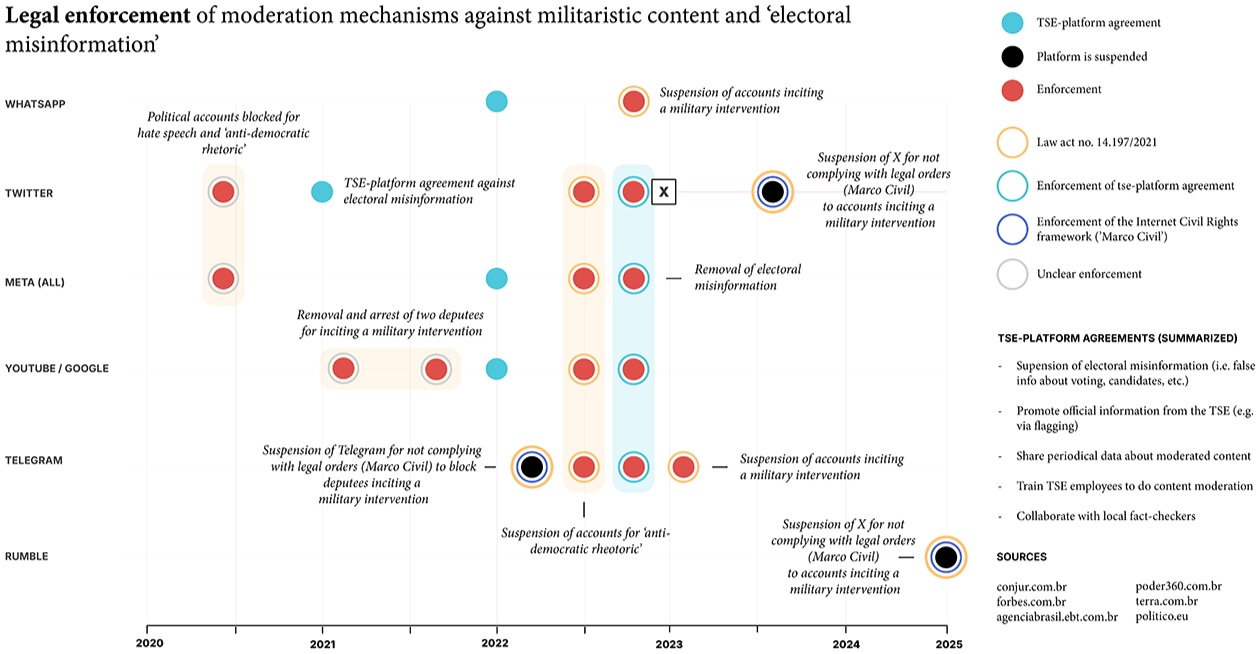
Legal enforcement of moderation measures on platforms.
As we now know, these measures have been met by significant resistance by sanctioned actors being sanctioned and platforms themselves. Moderation as enforcement is thus faced with a problem of sustainability: for how long can it keep removing problematic content until it loses public legitimacy and is ultimately reversed by an alternative speech governance system? We explore this question by looking at how militaristic speech (in the sense of active calls for a military coup) were first normalized online under policy platforms that did not (always) problematize let alone detect this kind of speech, and how legal and platform enforcement eventually dealt with this content as the riots of 8 January 2023 approached. Our concern is not whether Brazilian law prevailed over platform moderation as an assertion of national or legal sovereignty, but how platform moderation mechanisms compared with historical moderation strategies. We will discuss examples toward the end.
Method
Query design and data collection
We began with a list of queries designed to capture discourses in support of Brazilian militarism. This included calls for a military coup (“#intervençãomilitarjá”); calls to join the January 8 riots (“#festadaselma,” “#brazilianspring”); and calls to join the pro-military strikes of November-December (“#vemproquartel”) (Figure 3). As noted by Bastos and Recuero (2023), these discourses were often mentioned alongside allegations of electoral fraud (“#BrazilWasStolen,” “#BrazilWantsTheCode,”) and attacks against the Brazilian judiciary (“#forastf,” “Barroso na cadeia,” “#forarepublica”). To capture more posts, we used the queries as an initial “seed list” from which we then snowballed the 500 most mentioned hashtags or n-grams (words) across Facebook, Instagram, Twitter/X, YouTube, Gettr, and 250 Telegram channels (see Supplemental Annex), and then filtered results to only contain mentions of military titles (“general,” “brigadeiro,” “tenente,” “major,” “soldado,” “comandante” or “coronel”) or references of a military intervention.
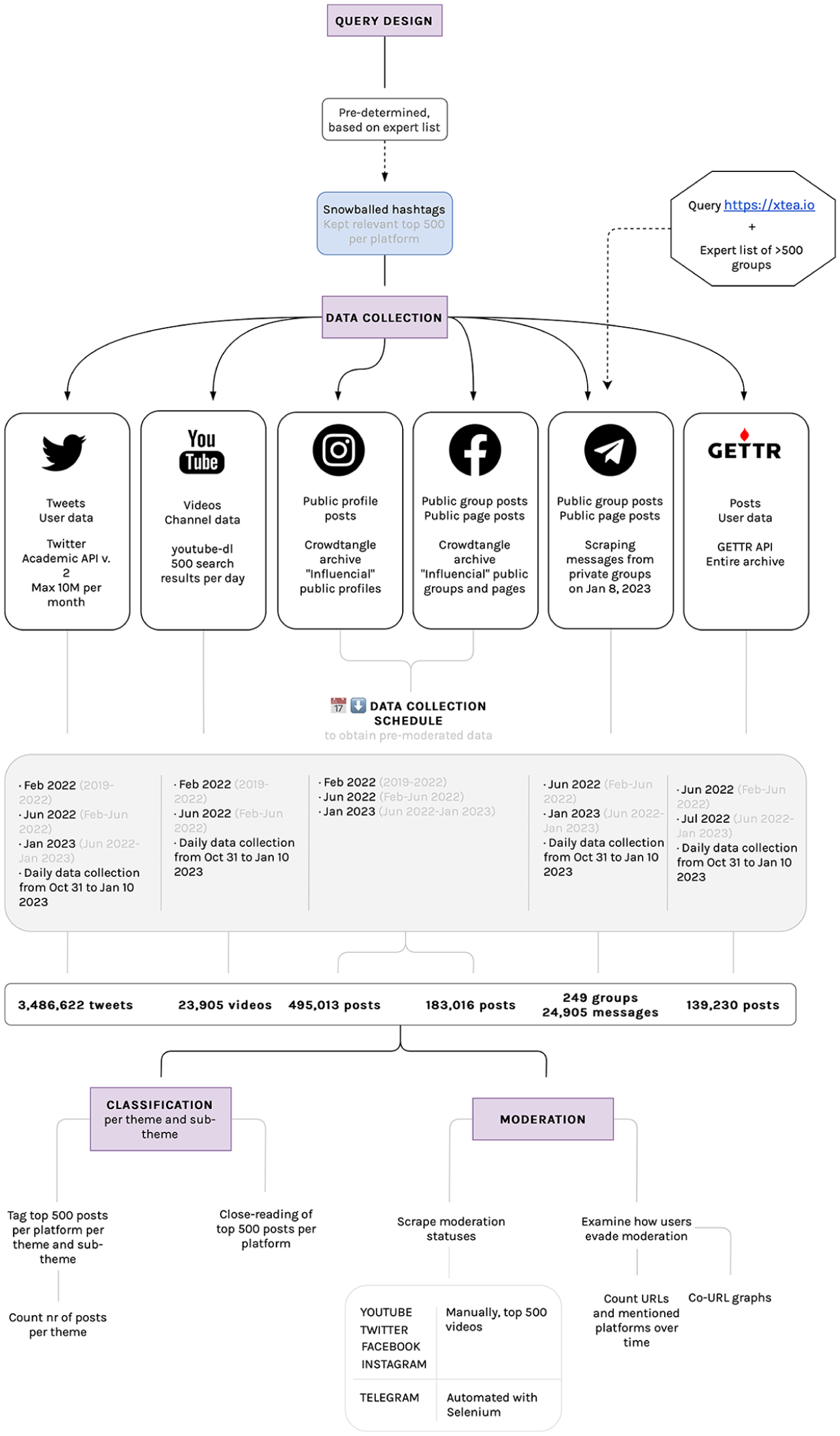
Method diagram.
Our resulting datasets, which range from early 2022 to late January 2023, comprise: 24,905 Telegram messages from a list of 249 pro-Bolsonaro Telegram groups compiled by an expert list of disinformation researchers from the Federal University of Rio de Janeiro; 183,016 Facebook posts; 495,013 Instagram posts; 3,486,622 tweets; 23,905 YouTube videos; and 139,230 Gettr posts. Telegram messages were obtained with the Telegram API; Facebook and Instagram posts with Crowdtangle; tweets with the Twitter Academic API v. 2; YouTube videos with youtube-dl (Garcia Gonzalez et al., 2023); and Gettr posts with the Gettr API. For consistency, we filtered all results from all platforms to posts dating from 15 August 2022 to 10 January 2023. What remains of deprecated APIs, namely Crowdtangle and the Twitter Academic API, are datasets that could serve as historical archives or data donations for historical research (de Keulenaar, 2025).
Some of these platforms were selected on the basis of their popularity in Brazil as of 2023 (Similarweb, 2023). Others, such as Telegram and Gettr, were included due to the nature of the discourses under analysis, which were more likely to be subject to platform or judicial content moderation on the former set. Data collection on Telegram faced several limitations: channel administrators frequently used auto-deletion features to systematically erase incriminating content in the period surrounding the 8 January 2023 riots, and some channels closed public membership, thereby restricting access through the platform’s open API. To mitigate these challenges, we collected Telegram posts daily and used Selenium-based web scraping to retrieve content from closed channels.
Distant reading militaristic discourses
Before looking at instances of content moderation, we decided to maintain a distant reading of how militaristic discourse evolved throughout the elections (2022). This analysis consisted in counting the relative number of posts, per platform, that mention keywords associated with a type of rhetoric. This is done with semi-automatic tagging. If a post mentions the hashtag “#SOSFFAA” (“SOS Army Forces”) in conjunction with other such keywords, it will be classified as a “call for a military coup.” On the occasion that posts contain multiple keywords of different themes, we assign that post multiple themes. This analysis is rendered in Figure 2, which shows the relative number of posts per theme across all six platforms (Facebook, Instagram, Twitter, Gettr, and Telegram).
Capturing content moderation practices
Before capturing traces of content moderation, we sought to understand what each platform sanctioned and how by close reading relevant policies. The aim was to discern whether these policies were tailored to national contexts or were applied more broadly and how political violence was defined within their frameworks. We used the Internet Wayback Machine to retrieve Meta, X and YouTube policies most relevant and nearest to the elections and the riots of January 8th, 2023. We selected guidelines written in Portuguese. The policies we selected were Meta’s Disinformation and Violence Policy, X’s Civic Integrity and Violent Speech Policy, and YouTube’s Electoral Misinformation Policy. We did not look for Telegram or Gettr policies, as neither platform applied any specific moderation policy to this case.
The kinds of content moderation we capture for analysis depend on the platform. On Twitter, moderation may be visible in post or user statuses. Over time, some posts may gain labels, while others may have been removed or temporarily suspended (making their status prone to change). The same can be said about Facebook and Instagram, which assign “context labels” to posts about electoral information or remove them entirely. On YouTube, moderation is visible on video statuses and demotions, which can be captured via search or recommendation rankings over time. On Telegram, content moderation is done primarily by users or under the extraordinary order of the Superior Electoral Court (Supremo Tribunal Federal, 2023). As mentioned above, users also began to moderate their own content with cryptic language, automated post deletions, turning their channels to private, or deleting entire channels for fear of judicial incrimination.
To collect these content moderation practices, we used “dynamic archiving” (de Keulenaar and Rogers, 2025), a data collection procedure used to collect posts before or during moderation every few months, weeks or days (see “Data collection schedule” section in Figure 2). This implies using the above-mentioned queries to collect posts from each platform—including traces of content moderation—on a daily basis, and then comparing their moderation statuses and other relevant metadata over time. We focused on suspension and flagging. Post suspensions were captured by verifying the availability of a post using Selenium, a web scraper, to automatically access every post and capture a moderation status (e.g. “This post has been temporarily suspended”). Because some posts are removed by law and become inaccessible only in Brazil, this procedure was done with a Brazilian VPN. Flagging—the action of placing banners or “context labels” on posts for “election integrity” and “counter-speech” purposes (Crawford and Gillespie, 2016)—was captured with the same procedure. The results indicate what types of content Meta, YouTube, and Twitter sanctioned at what time, and where loopholes existed in relation to Brazilian legal and other efforts at moderating content that infringed upon laws against the “democratic rule of law” (Presidencia da República, 2021), often used by Alexandre de Moraes. Telegram auto-deletions were captured by collecting group posts every day from 1 January until 10 January 2023.
Our analysis consisted in tracing platform and legal content moderation on the 500 top most engaged posts per platform, per theme. The themes were (a) posts engaged in planning the January 8th attacks and (b) posts by or about military personnel theorizing, planning or supporting the attacks. Moderation derived by law was indicated by statuses such as “[users] account has been withheld in Brazil based on local law(s),” while platform-specific moderation would redirect to platform policies. Samples are visible in Figures 5–9 and our interactive visualisation (https://edekeulenaar.github.io/normative_dislocation/), which offer a holistic view over all 500 most engaged with posts involved in the riots and military attempts at overthrowing the newly elected government.
Moderation policies
Policies addressing electoral disinformation and democratic integrity adopted a pragmatic approach to moderation. Informed by their experience of the US elections of 2019–2020, the focus was on the material obstruction to electoral processes nurtured by narratives of systematic electoral fraud. Meta’s (2022a,b) Disinformation Policy, particularly in Section III on “Integrity and Elections,” concentrated on sanctioning procedural and instrumental aspects such as logistics, eligibility, and participation. YouTube’s electoral misinformation policy delved deeper into voter suppression, candidate eligibility, incitement to interfere with democratic processes, and electoral integrity. Although they mention Brazil and Germany, they do not specify which kinds of interferences on “democratic processes” those were.
X’s Civic Integrity Policy concentrated on four categories: (a) misleading information regarding participation procedures; (b) suppression; (c) intimidation; and (d) false or misleading affiliation. Examples provided under the intimidation category were specifically contextualized within the electoral framework, such as “inciting disruption or destruction of procedures, infrastructure, or electoral equipment necessary for participating in a civic act” (X, 2022). Policies intended to moderate violence in relation to elections predominantly focus on physical assaults and the obstruction of electoral procedures, such as voting and ballot counting. Meta sanctioned posts that threatened the use of weapons at polling stations and electoral tallying sites and banned threats of violence related to electoral results, even in the absence of a specified target. YouTube referenced terms from related policies on violence and hate speech to prohibit content that encourages harassment of judicial officials or attacks at polling places. X’s policy on Violent Speech lacked specific provisions addressing violent actions against the democratic rule of law; it prohibited the glorification of violence and the exaltation of perpetrators of violent attacks.
With policies in place, how was content relating to Brazilian militarism and calls for the January 8 riots moderated? We begin by describing the role of pro-military content during the planning of the riots, and then outline some of the ways in which each platform moderated that content throughout the elections.
Moderation practices
By the time that Lula won the elections on October 31, the majority of pro-Bolsonaro content was involved in highly polarized discourses against a set of establishment forces, particularly the Supreme Federal Court (Figure 4). In this context, one the most widespread types of content in our dataset was the belief that the votes were fraudulent or conspired to boot Bolsonaro from power. Fearing a coup against their president, users begin to explicitly call for a military intervention. Thousands set up camp in front of military barracks across the country, supported by kilometers of truckers on strike. The strategy was to wait for Bolsonaro to confirm electoral frauds and push a military intervention, in an imagined prophecy that 1964—the year of the original coup—would repeat itself.
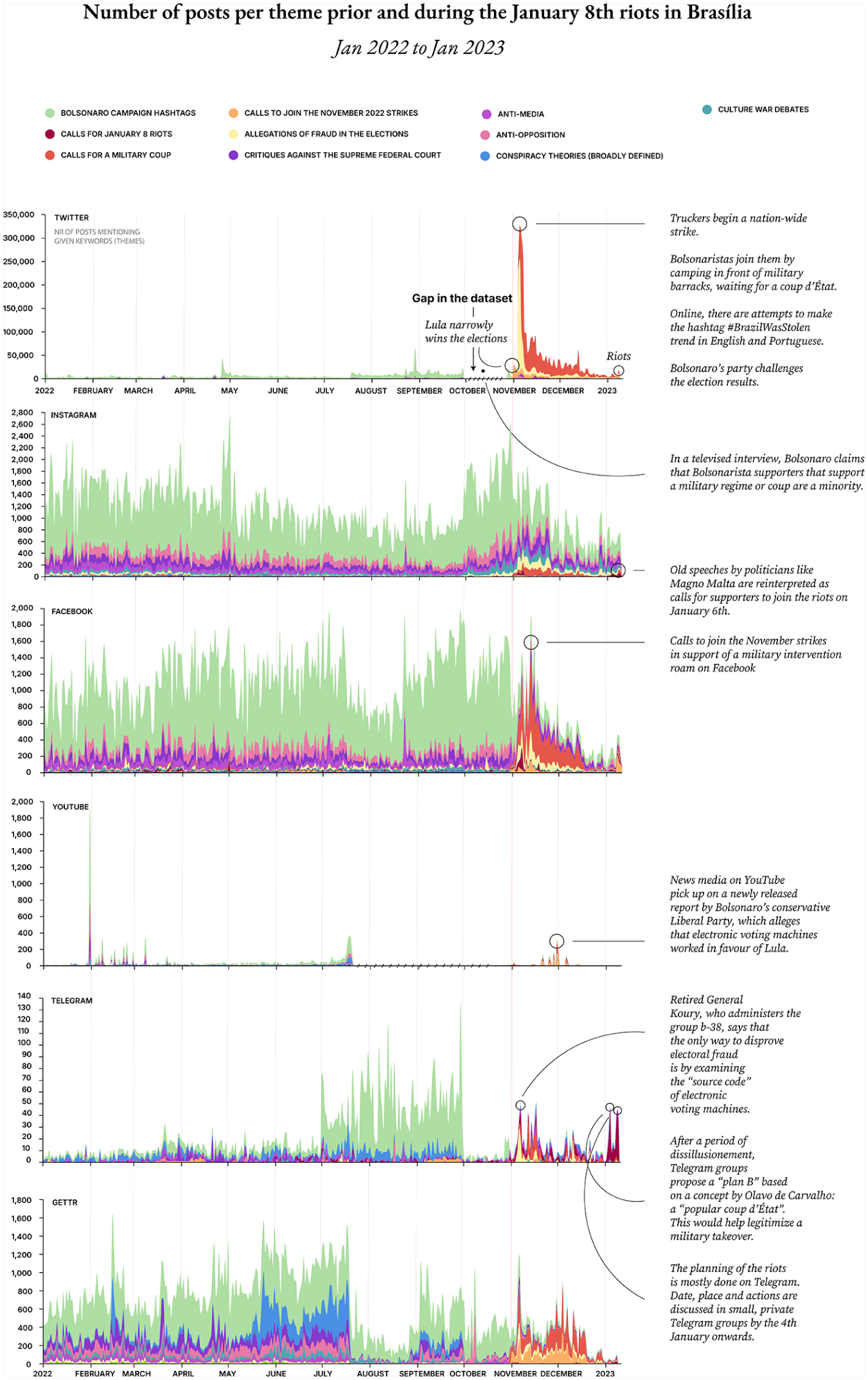
Absolute and relative number of posts per platform and theme (January 2022 to January 2023).
By November 2022, Bolsonaro entered 2 months of silence. Perplexed, Telegram users try to read between the lines of messages left by Bolsonaro or allies on their social media pages. Some of these allies are militaries or politicians considered trusted sources within the frameworks of the above-mentioned prophecy. Though they were not allowed to express political opinions, they are seen in shared videos and pictures supporting the strikes and giving tips on how to best interpret the Brazilian constitution of 1988 in favor of a military intervention (see https://edekeulenaar.github.io/normative_dislocation/). Some Telegram users also recount that military personnel came to defend them against attempts by the federal police to evict protesters.
When Lula is inaugurated, the hypothesis of a military intervention led by Bolsonaro is suddenly void: no one stops Lula’s inauguration and everything indicates Bolsonaro is no longer in power. In the face of disappointment, videos resurface of conservative polemicist Olavo de Carvalho offering an alternative interpretation of the Brazilian constitution according to which the military, a “neutral institution,” will only intervene and be legitimized if propelled by a “popular coup.” A popular coup implied invading Congress and not letting any deputies and senators circulate until the military intervened. As some expressed exasperation at the ineffectiveness of “pacific” protests at military encampments, Telegram users began to argue that the use of violence was the only way to facilitate this coup (see https://edekeulenaar.github.io/normative_dislocation/).
In the “private sociality” of Telegram channels (Rogers, 2020), users began to plan an “invasion” of Brasilia. This form of secrecy was an instrumental affordance for exchanging information that could potentially incriminate users, such as the time, date and place of the “invasion”; transportation to Brasília; and financing by entrepreneurs from the agricultural sector. Coded language was used to maintain coordination with more moderated and front-facing platforms, where explicit language was suspected to be actively surveilled by law enforcement. One was “Selma’s party” (festa da selma): users urged the term be disseminated across public-facing platforms and slide it through their active moderation systems, as seen in Figure 5.
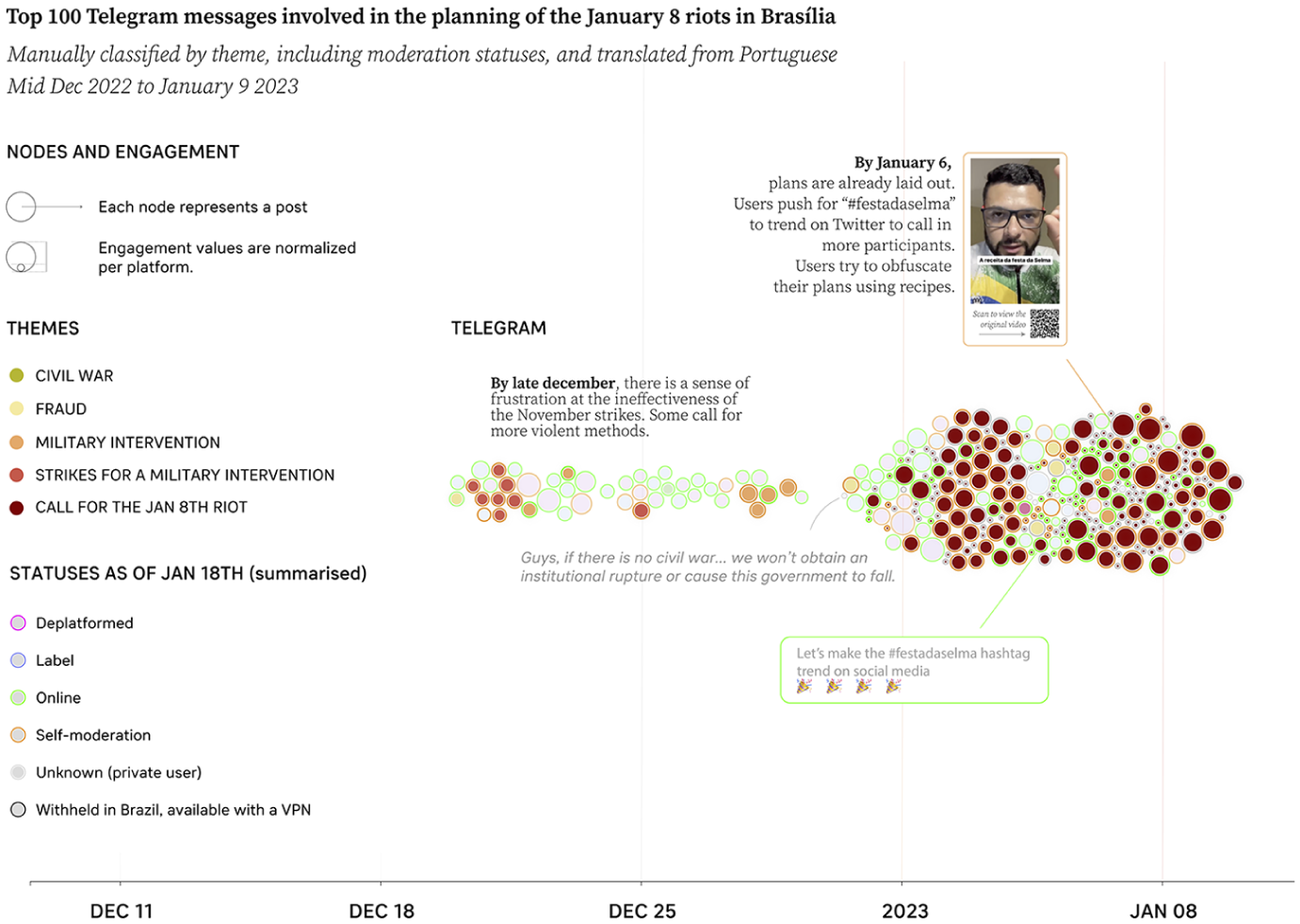
Auto-deletion of the top 500 most engaged messages planning for the January 8th riots of 2023 on Telegram.
Another crucial affordance was self-deletion. Users activated an auto-deletion feature that retained messages for no more than 24 hours, such that most posts that were directly involved in planning the riots were deleted. This feature allowed users to regain control of moderation as an affordance exclusively relegated to platform and judicial authorities, making Telegram an ephemeral but central subterfuge for political coordination across a network of variably moderated spaces.
In more public-facing platforms like Twitter, Facebook, and Instagram, code words were used to broadcast calls to join the riots to an audience ignorant of the practical and political know-how of Telegram subterfuges. In this context, hashtags such as #BrazilWasStolen and #MilitaryInterventionNow (#intervençãomilitarjá) began to trend on Twitter. This was done with the coordination of Telegram channel administrators, who would take the lead in broadcasting theories and plans of the riots across a network of more-or-less moderated spaces. Once on Twitter, some of these messages were intercepted by the Supreme Electoral Court, specifically one partaking in earlier truck driver strikes in favor of a coup and asking to “invade” Brasília’s Three Powers Plaza (see Figure 6). However, other messages that purported to communicate orders from the armed forces to take over Brasília were not suspended. It was only during the riots that X took notice of such plans, suspending even seemingly benign messages about Selma’s “afterparties” in São Paulo.
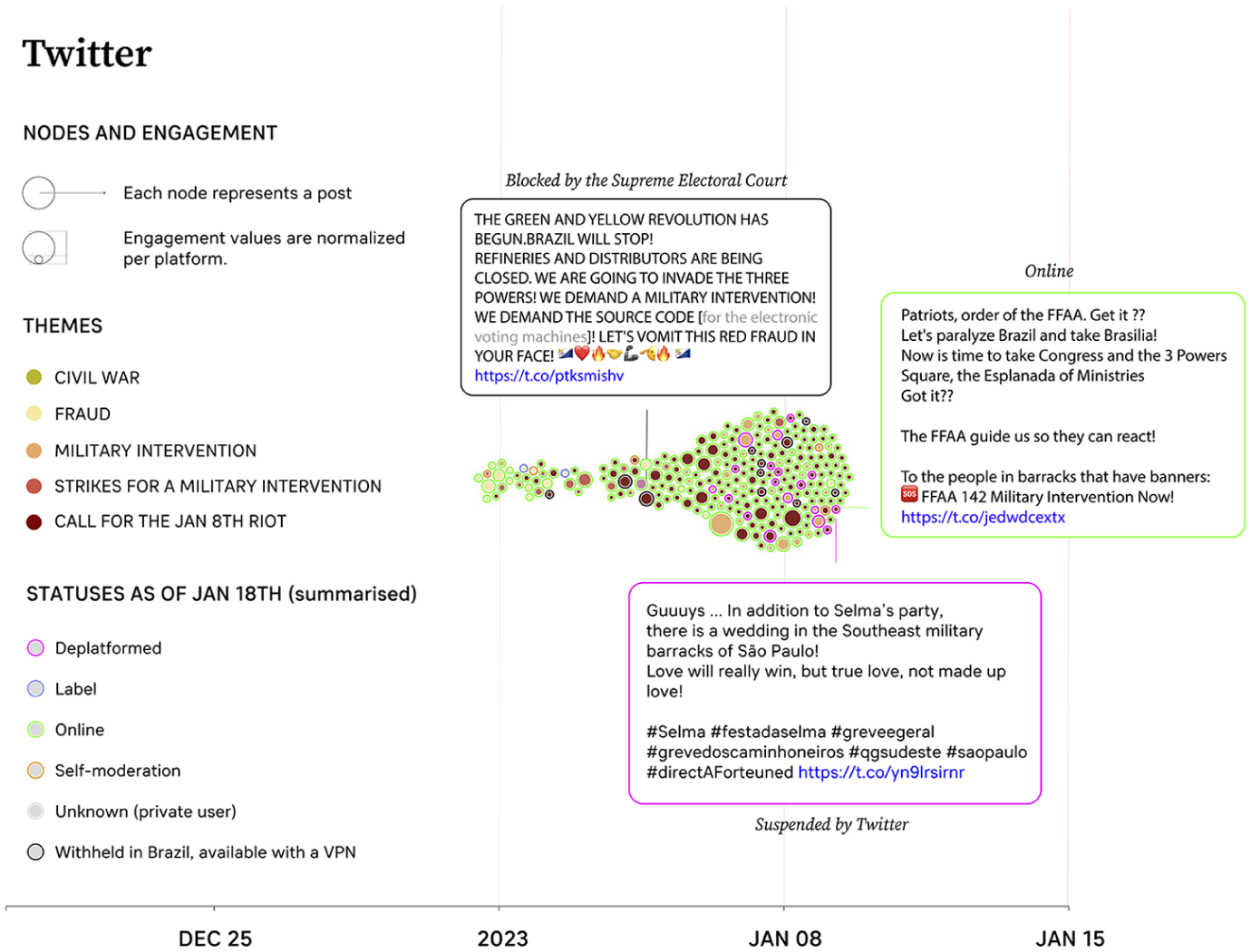
Platform and judicial content moderation of the 500 most engaged Twitter/X posts.
In the more front-facing spaces of Facebook and Instagram, one could find rehashed content by high-profile politicians or pundits encouraging the riots to take place as a legitimate form of protest (see https://edekeulenaar.github.io/normative_dislocation/). Unless they contained allegations of electoral fraud—which would warrant a flag on Facebook and occasional suspensions—very few calls to join the riots were moderated consistently or at all. On Instagram, one message posted around January 6th calling to “strengthen right-wing profiles” and publishing news about a Ministry’s efforts to “contain demonstrations in Brasília” was labeled with a context message advising to consult electoral information from the Supreme Electoral Court (see Figure 7). Meanwhile, on Facebook, messages indicating the exact place to “fill” in and outside Congress in order to “overthrow” the nearly elected government were left online.
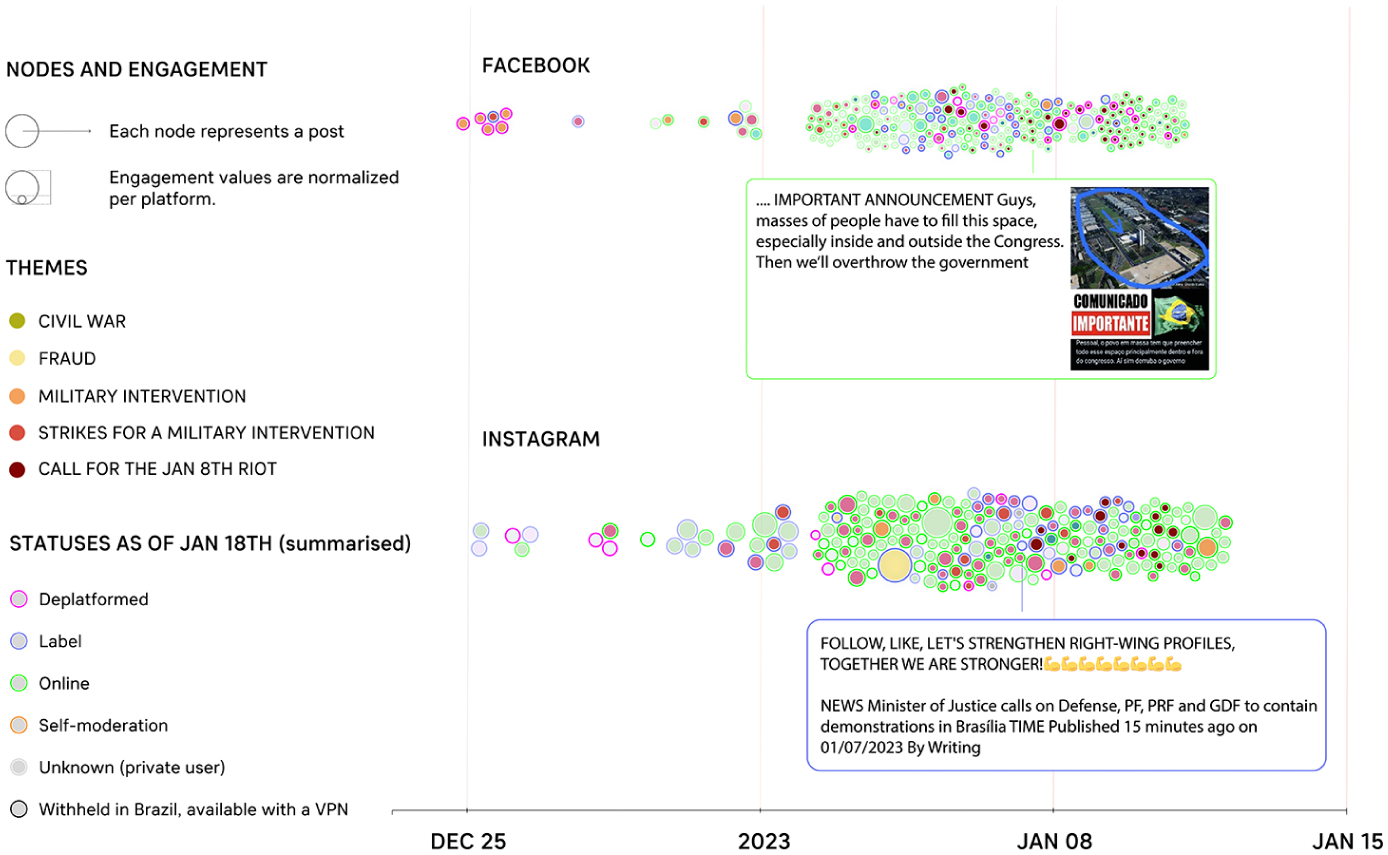
Platform and judicial content moderation of the 500 most engaged posts on Facebook and Instagram.
On YouTube, one could find channels of military content creators prophesying a coup d’état. There, one of the Telegram administrations involved in planning the riots—an alleged retired general—was seen publishing “insider” information about military support for the attacks (see Figure 8). By 31 October 2022, militaries inadvertently took a position of leadership in the riots, as they were perceived by users to be historical mentors for overthrowing the government (see https://edekeulenaar.github.io/normative_dislocation/). Some militaries were themselves actively involved in theorizing the attacks under beliefs that a “popular coup” like in 1964 could be enacted anew. Some of them produced pedagogical material for users on Telegram to re-educate themselves over the history of the coup as part of a trove of authentic but repressed documents of Brazilian history (see https://edekeulenaar.github.io/normative_dislocation/).
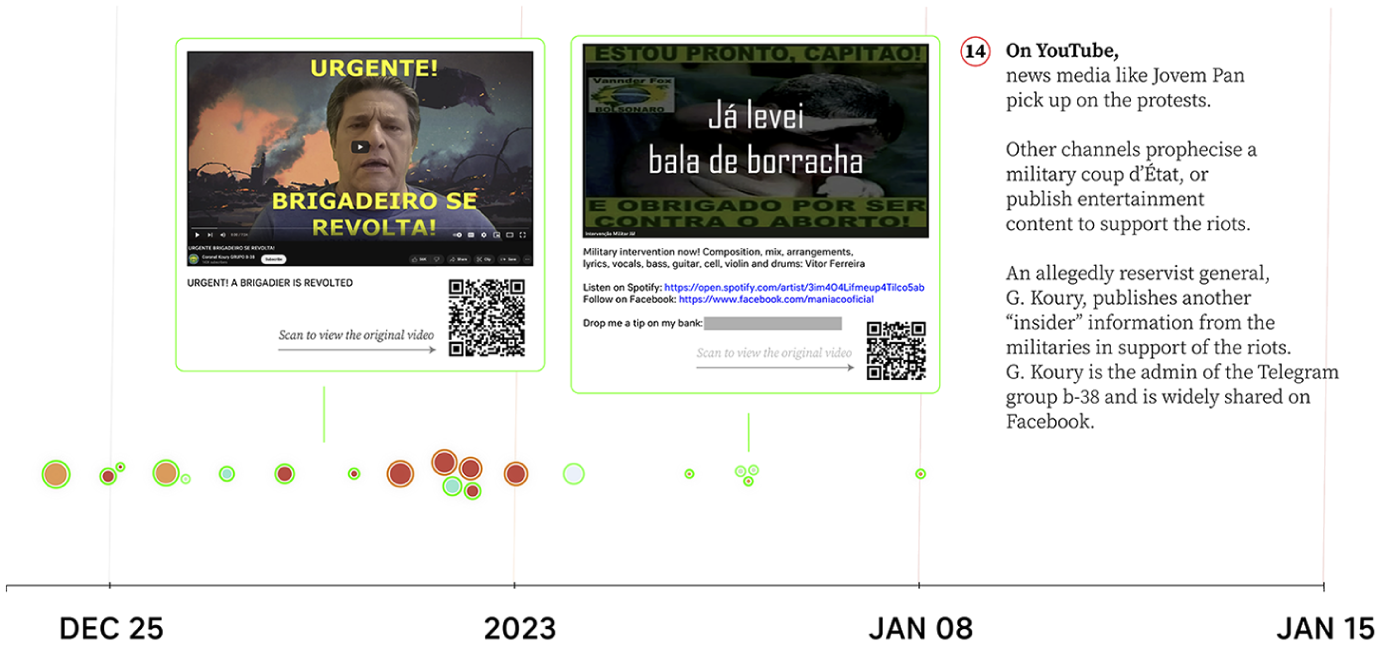
Platform and judicial content moderation of the 500 most engaged videos on YouTube.
All in all, a majority of content calling for a military intervention or to join the riots in a bid to overthrow the newly elected government were not moderated in any way (Figure 9). Over 203 of these posts were suspended by Facebook, Instagram, Twitter, and YouTube, while 281 were labeled by Instagram, Facebook, and Twitter. Labels consisted in debunking “misleading” or “false information” with “missing contexts” via fact-checking agents. Fifteen posts, on Twitter especially, were removed due to orders from the Supreme Electoral Court. Under their moderation, 191 posts were removed by users on Telegram and YouTube for fear of prosecution for partaking in the riots. For the rest, the majority of this content was not moderated for inciting a military coup, but for spreading “misleading” information about the electoral process. In this sense, platforms relied primarily on the moderation framework they developed for the U.S. elections of 2020, where content was problematized as a form of “misinformation” rather than calls for a coup d’état in this specific Brazilian context.
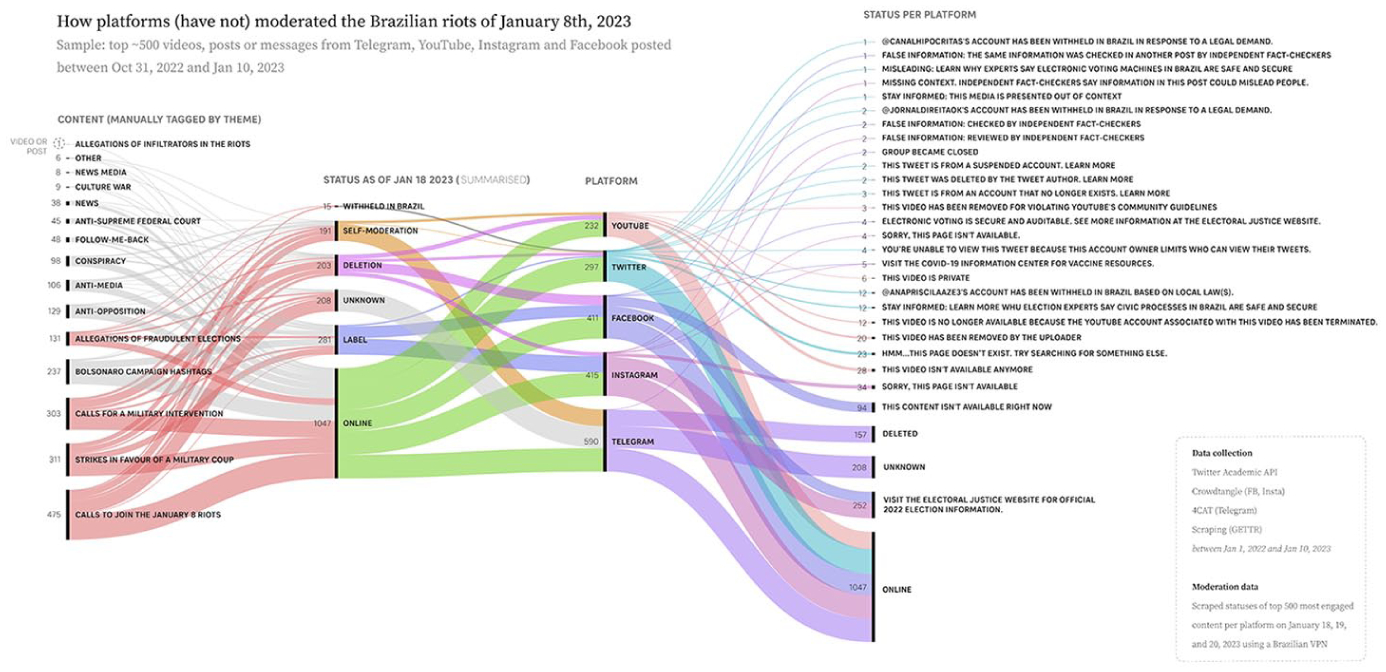
What was and wasn’t moderated among the top 500 posts per platform.
Dislocated moderation, dislocated histories
In sum, our findings indicate that most content moderation policies (and practices) were enacted through the lenses of the US elections of 2021 and penalized a majority of “misleading information” on the elections rather than militaristic or insurrectionist discourses. No existing policy comprehensively and specifically prohibits claims promoting democratic suppression, military intervention, or the dissolution of governmental regimes. Although certain platforms incorporate related terms, the absence of precise and clearly defined concepts enables a dislodging of national institutional efforts to prevent a military past from being normalized anew.
In this sense, we propose the concept of “normative dislocation” to describe a situation in which foreign content moderation ceases to partake in the local moderation process of local historical issues (informal or formal). This applies both to the definition of “harmful” content (and deliberation thereof), and to local approaches to moderation as a practice. The risk of this dislocation is the destabilization of (fragile) institutional processes of re-democratization, including of truth, reparation or reconciliation, evidenced here by a dramatic institutional crisis leading to January 8th and the fragile enforcement of judicial moderation without broad public support.
In the case of Brazil, we have seen how various sectors led complicated and often contentious efforts to reconcile the historical memories of pro-democratic and military actors (Martins Filho, 2009). Moderation enforcement through the law is one of the mechanisms used for this process, but it should not be the only strategy available for platform content moderation if the concern is for sustainability. Within a localized setting, one could consider extending key elements from historical moderation strategies into various moderation mechanisms.
First, one could devise ongoing collaborative efforts—as the Federal Electoral Court did during the 2022 elections—for participative content moderation and platform design conventions. This could reunite key actors (civil society, political representatives, legislators, historians) to localize, contextualize, and democratize policy-building approaches for platform governance, without reproducing stark power asymmetries and imposing top-down guidelines disconnected with local histories (Dvoskin, 2024: 4), particularly as platforms inadvertently become political actors in their own right. These actors can facilitate public deliberation processes with a representative section of the population to consult them and find consensus on the key norms they would like enforced in online public spheres (similar, for example, to Taiwan’s use of Polis, a deliberative platform, in 2015). They can then remodel proposed outcomes into both legislation and platform design conventions, such as features for dialogue between polarized clusters of users; bridging and social provenance mechanisms; and so on (Weyl et al., 2025).
In the latter case, platform design conventions would involve consensus or bridging techniques (Ovadya and Thorburn, 2023) for historical content, as a way of fostering consensus about disputed histories, and social provenance techniques, to make more transparent the premises, arguments, and underlying experiences of each user and user groups. Because of their concern for sustaining public dialogue, these features act as sustainability or “cooler” mechanisms that could act to maintain some consensus, and thus legitimacy, in the basic norms of platform (and speech) governance. This could encourage the creation of a marketplace for alternative platform design that offers local operationalization of speech moderation conventions, especially as social media becomes increasingly decentralized and customisable via middleware (Hogg et al., 2024). Overall, such processes bear fundamental importance to the design of political and legal normative standards, but must rest of public consensus maintained by continuous deliberation.
Supplemental Material
sj-csv-1-nms-10.1177_14614448251364814 – Supplemental material for Normative dislocation: When platforms moderate without memory
Supplemental material, sj-csv-1-nms-10.1177_14614448251364814 for Normative dislocation: When platforms moderate without memory by Emillie de Keulenaar and Marcelo Alves dos Santos in New Media & Society
Supplemental Material
sj-pdf-2-nms-10.1177_14614448251364814 – Supplemental material for Normative dislocation: When platforms moderate without memory
Supplemental material, sj-pdf-2-nms-10.1177_14614448251364814 for Normative dislocation: When platforms moderate without memory by Emillie de Keulenaar and Marcelo Alves dos Santos in New Media & Society
Supplemental Material
sj-pdf-3-nms-10.1177_14614448251364814 – Supplemental material for Normative dislocation: When platforms moderate without memory
Supplemental material, sj-pdf-3-nms-10.1177_14614448251364814 for Normative dislocation: When platforms moderate without memory by Emillie de Keulenaar and Marcelo Alves dos Santos in New Media & Society
Footnotes
Appendix
Acknowledgements
The authors would like to acknowledge the methodological, analytical, and design contributions of Ivan Kisjes, Francisco Kerche, Betsy Grossman, Sarah Vorndran, and Angeles Briones. Ivan Kisjes and Francisco Kerche were instrumental in designing and executing the method, including data collection and analysis. Betsy Grossman and Sara Vrondran have contributed to painstaking analysis during the DMI Winter School data sprint of early 2023. Angeles Briones brought to life the various visualisations of this project. Richard Rogers and Sabine Niederer encouraged the focus on the notion of normative dislocation. We would also like to thank the reviewers for their constructive feedback, which has greatly enriched this work.
Data availability statement
Due to the presence of personal information, the authors cannot share the data used in this research.
Declaration of conflicting interests
The author(s) declared no potential conflicts of interest with respect to the research, authorship, and/or publication of this article.
Funding
The author(s) disclosed receipt of the following financial support for the research, authorship, and/or publication of this article: Emillie de Keulenaar was funded by the Groningen Research Institute for the Study of Culture (Instituut voor Cultuurwetenschappelijk Onderzoek Groningen: ICOG) as part of her PhD in Media Studies. Marcelo Alves is funded by the Fundação Carlos Chagas Filho de Amparo à Pesquisa do Estado do Rio de Janeiro APQ1, process number 260003/006286/2024; and by the National Institute of Science and Technology on Sovereignty and Informational Disputes.
Ethical approval and informed consent statements
Ethics approval was not required.

Supplemental material
Supplemental material for this article is available online.
Author biographies
References
 Free Brazil!
 is the most used news source in Brazil. It is what the people want. Now, the tyrant de Voldemort is crushing the people’s right to free speech