



Abstract
Friendships are important throughout the lifespan, but groups of friends who disperse geographically need communication media to stay connected. Prior research on the use of media in long-distance communication focused on dyads, thereby neglecting issues like the heightened coordination effort in groups. We conducted a survey on a representative sample of German adults to discover the media ensembles of (geographically dispersed) friend groups and to explore the relationship between these ensembles and connectedness. A cluster analysis revealed four clusters, ranging from a traditional cluster occasionally communicating through emails and voice calls to a cluster that frequently uses several media, including games and discussion forums. The use of group chats was common in three clusters. Feelings of connectedness increased with communication frequency and number of media used. Psychological processes, namely social presence and ambient awareness, influenced connectedness as well.
Introduction
Friendships are important to humans throughout the entire lifespan (Lee, 2022).
Today’s society is characterized by increased mobility (Teichert, 2023); many people relocate several times throughout their lives. Consequently, groups of friends who used to live in geographical proximity are often torn apart, and friends must use media if they want to stay in touch. Even groups of friends living in the same city are increasingly engaging in mediated communication or were forced to rely on media during COVID-19 lockdowns. The purpose of the present study is to discover via which media (dispersed) friend groups stay in touch and how these media ensembles, that is, the “communicative figurations” of media used within groups (Hasebrink and Hepp, 2017: 362), are related to feelings of connectedness.
Our study addresses two key gaps in the literature on media use in friendships. First, prior work focused predominantly on media use in dyadic relationships, either romantic relationships (Holtzman et al., 2021) or dyadic friendships (Ledbetter, 2008; Utz, 2007). Communication in groups requires more coordination to reconcile time schedules and media preferences of all group members (Schuler et al., 2014), so the results of these studies might not generalize to groups. There are only few and mostly qualitative studies on friend groups (Teichert, 2021; Van Cleemput, 2012). Second, prior work often assessed only how frequently various media were used and how these frequencies were correlated but did not identify clusters or media ensembles (e.g. Cummings et al., 2006; Utz, 2007). Third, we do not know how the set of media used by a group (i.e. their media ensemble) contributes to the perceived connectedness of the members.
To overcome these limitations and identify the most common media ensembles of friend groups, we surveyed a quota sample representative of the German population regarding gender and age. We specifically targeted geographically dispersed friend groups, but also included participants with geographically close friend groups. We, thus, first provide a valuable descriptive data set on media ensembles to then test for effects of individual and group characteristics on media ensembles. Third, we aimed to find out how the usage of these media ensembles affected perceived connectedness. Finally, to shed light on potential underlying processes, we explored how social presence and ambient awareness of friends’ everyday activities are related to media use and connectedness.
Theoretical background
When individuals wish to communicate with their group of friends, they can choose from several media: In addition to traditional media such as voice calls and emails, instant messaging, social networking services (SNS), video calls, online games, and discussion forums can be used for staying in contact. These media differ in various aspects, such as their modality (text, audio, video), where they are placed on the (a)synchronicity continuum, or whether they allow one-to-many communication. However, individuals typically do not utilize one but several channels to communicate with friends (Ledbetter, 2009b). On the individual level, cross-media research called the combination of media individuals use their media repertoire (Hasebrink and Hepp, 2017). When extended to groups of users, these repertoires are termed media ensembles.
Maintaining social relations through communication media: media ensembles
Media ensembles are defined as a shared set of media used for communication within groups of interacting individuals who build a “communicative figuration” (Hasebrink and Hepp, 2017: 362). For example, a family’s media ensemble could consist of phone calls, a group chat, and face-to-face (FTF) interactions. Media ensembles are often more limited than the media repertoires of the individual group members because some media might not be used by all group members (Hasebrink and Hepp, 2017). To our knowledge, there are no large-scale studies on media ensembles used in groups of friends.
Older research on media use in long-distance friendships only looked at the frequency of media prevalent at the time, explored their complementary use by reporting correlations, but did not infer media ensembles (Ledbetter, 2008; Utz, 2007). Zhou et al. (2021) clustered individuals according to the frequency of FTF and mediated communication but did so across six different relationship types. With regard to close friendships, they found that people use more media and more complex communication patterns with closer friends. Younger, more educated and female participants were more likely to use a versatile set of media. Juvonen et al. (2021) reported that during the COVID-19 pandemic, the most prevalent forms of digital communication with friends were text messaging, liking and commenting on friends’ social media posts, and with increasing popularity, video calls. However, these studies did not focus on groups of friends who need to agree on communication channels that are used by all members. Given the paucity of empirical research on the media ensembles of friend groups, we pose an open research question:
Research Question 1 (RQ1). Which media ensembles do German individuals use to communicate with their group of friends?
Associations with individual factors
Next, we explore whether using certain media ensembles is influenced by individual characteristics of users, such as their demographics. Age might matter: Younger (vs older) users generally are more inclined to utilize SNS (Elena-Bucea et al., 2021), have a broader media repertoire (Zhou et al., 2021), and exhibit a greater always-on connected presence (Matassi et al., 2019). Assuming that individuals group with people who are similar to themselves (McPherson et al., 2001), relations with age can also be expected for the media ensembles of the friend group. Regarding gender, women were found to have a more diverse communication pattern and communicate more frequently (Zhou et al., 2021). Ledbetter (2009b) found that women called their friends more often and used SNS more, whereas men preferred blogs and discussion forums. We explored whether the gender of the surveyed individual influenced their media ensemble.
A third sociodemographic factor that, in earlier work, was associated with differences in media use is education level: Individuals with higher education levels tended to use more media (Elena-Bucea et al., 2021; Zhou et al., 2021).
The cited studies only assessed mediated communication with friends in general, not within friend groups. Thus, we formulated an open research question:
Research Question 2 (RQ2). Do media use patterns vary as a function of participants’ (a) age, (b) gender, or (c) education level?
We also explored the role of digital skills, that is, individuals’ technological and cognitive abilities “to perform tasks and solve problems in digital environments” (Reddy et al., 2020: 66). Those with higher digital skills tend to utilize digital media for a more diverse range of activities (Hargittai, 2010). Consequently, we predict:
Hypothesis 1 (H1). Individuals’ digital skills are positively correlated with the breadth of their media ensemble and their frequency of communication with their friend group.
Associations with group characteristics
Next, we consider the potential relationship between characteristics of the friend group and their media ensemble. We focus on the duration of their friendship and the spatial distribution of group members. Some authors demonstrated that the duration of a friendship positively predicts the closeness between communicators (Ledbetter et al., 2007). In Lee’s (2022) study, however, many participants reported having long-term friends with whom they did not interact or feel close. This highlights the risk for friendships to fade out over time.
Geographic distance may influence communication frequencies and media selection. Friends who live close together are in contact more frequently than those who live further apart, both through FTF and mediated interactions (Mesch et al., 2012; Sutcliffe et al., 2023). Distant friends, especially those in disparate time zones, may be more inclined to rely on more asynchronous media.
Research Question 3 (RQ3). Do individuals’ media ensembles and communication frequencies vary as a function of characteristics of their friend group, namely (a) the group’s friendship duration or (b) their geographical distribution?
Media use and connectedness
Next, we turn to the question how media ensembles are related to connectedness. Connectedness is “a short-term experience of belonging and relatedness” that results either from recent interactions or perceiving awareness information about others (Van Bel et al., 2009: 66). It involves satisfaction with one’s relationships and feelings of being together outside of contact. Licoppe and Smoreda (2005) identified two general patterns of media use to connect with others: Relational communication consists of long and intimate phone calls and emails. This communication pattern appeared to be particularly relevant for long-distance communication: Licoppe and Smoreda (2005) found that phone calls became longer as the distance between communicators increased.
However, with the advent of mobile communication and instant messaging, a second communication pattern evolved: Interstitial communication is characterized by short and frequent units of communication, often superficial messages, which form the “connecting tissue” of friendships. Licoppe and Smoreda (2005) posit that in this always-on communication pattern, the specific content of messages is less important than the act of conveying sociability. Newer work confirms that less intimate communication, as it is practiced on SNS, can also foster connectedness (Utz, 2015). This suggests that different patterns of communication can foster connectedness. Given that our research focuses on media use in groups and that we do not know whether additional patterns have emerged, we formulated an open research question:
Research Question 4 (RQ4). Do individuals’ media ensembles for communication with their friend group differ in the degree of connectedness their users report?
Predictors of connectedness
The following section addresses potential mechanisms through which media use can foster connectedness. We first test the effects of frequency and number of media used, before turning to psychological processes. The extent to which long-distance friendships endure is presumed to depend on communication frequency (Cummings et al., 2006; Shklovski et al., 2008; Sosik and Bazarova, 2014). Despite conflicting findings (e.g. Sutcliffe et al., 2023), the majority of studies indicate that participants who are in more frequent contact with their long-distance friends score higher on perceived connectedness (Cummings et al., 2006). We, therefore, propose:
Hypothesis 2 (H2). Individuals’ frequency of mediated communication with their friend group is positively related to their level of connectedness.
According to media multiplexity theory (Haythornthwaite, 2005), tie strength, that is, the closeness between communicators, influences the number of media they use. Closer ties use more communication channels. In turn, using more channels also increases tie strength. Evidence for this reciprocal relationship between tie strength and media multiplexity comes from a recent longitudinal study of friend dyads (Ledbetter, 2025). We expect to replicate the positive correlation between the breadth of media ensembles and connectedness also for friend groups.
Hypothesis 3 (H3). The breadth of individuals’ media ensemble (the number of media they use) is positively correlated with their level of connectedness.
This study aims to identify mechanisms that facilitate connectedness across geographical distance. Groups of friends who live in proximity often do activities together to maintain a sense of closeness (Schuler et al., 2014; Van Ingen and Van Eijck, 2009). This is not a viable option for dispersed friends. One of the main functions of media ensembles of groups of friends may therefore be to maintain this sense of being together and knowing what the others are up to. Thus, we focus on the role of social presence and ambient awareness.
Social presence
Social presence is the “degree of salience of the other person in a mediated communication and the consequent salience of their interpersonal interactions” (Short et al., 1976: 65). It is evoked by behaviors that signal immediacy and intimacy. The use of Snapchat and instant messaging can convey social presence and thereby help to maintain friendships (Fester-Seeger and Cowley, 2018; Kahlow et al., 2020). Technologies that facilitate the experience of being together here-and-now may be particularly appealing for geographically dispersed friend groups. Replacing joint embodied activities with interactions in a shared virtual space might be an important mechanism to enhance connectedness (Heshmat and Neustaedter, 2021). As social presence implies the perception that interaction partners are present at the same time, it should be higher for synchronous media (Moallem, 2015).
Hypothesis 4 (H4). Individuals’ level of social presence is positively correlated with their level of connectedness.
Hypothesis 5 (H5). Individuals’ (a) number of synchronously used media and (b) the frequency of their use are positively correlated with their levels of social presence and connectedness.
Ambient awareness
In contrast to the perception of simultaneous togetherness, research on interstitial communication argues that a sense of connection can also be induced by browsing through mundane SNS broadcasts about friends and their whereabouts (Krämer et al., 2017; Levordashka and Utz, 2016). Ambient awareness describes the phenomenon of individuals gaining a fairly accurate picture of their network members’ lives by regularly skimming their SNS updates (Levordashka and Utz, 2016). Ambient awareness can facilitate connectedness across distance (Riedl et al., 2013; Sosik and Bazarova, 2014) by fostering ambient intimacy (Lin et al., 2016). Teichert (2023) used the term “mediated everyday intimacy (p. 58)” to describe how friends stay connected through exchanges of trivial daily occurrences. Given that ambient awareness can arise without synchronous communication, it may be particularly well-suited to maintaining connectedness with distant friends. Therefore, our hypothesis is:
Hypothesis 6 (H6). Individuals’ level of ambient awareness is correlated with their level of connectedness.
Method
Open science practices
We preregistered the study on https://osf.io/jtzsq?view_only=a3104872878a46cda277c53a80e60791.
Participants
Adult German citizens were recruited by a panel provider to obtain a quota sample representative for the German population regarding gender and age between 18 and 74 years. To compare the media use of groups of friends who lived in proximity with those living at a distance, we included participants from both groups.
The quota sample comprised N = 1001 German participants (age: M = 45.1, SD = 15.0), with 46% identifying themselves as female, 53% as male, and 1% as diverse or other. Regarding education, 40.3% of participants had a high-school degree, 26.1% a vocational training, and 32.2% a graduate degree. From all participants, 65.9% were part of one or more groups of friends residing at a distance, while 34.1% had their friend group living nearby. See supplement for a further breakdown of the types of dispersed friend groups. The size of friend groups ranged from 3 to 503 (Md = 8, M = 11.7, SD = 21.7).
Procedure
The survey was approved by the ethics committee of the institute. Participants were compensated with a predetermined monetary reward of 3.17€.
After giving informed consent, subjects indicated whether they belonged to a group of friends, defined as a group of at least three friends who are still in contact. Second, they indicated whether the group was geographically dispersed, that is, whether some or all members—including or excluding themselves—lived in different places, or whether they lived in proximity. Respondents with a dispersed group were asked to report on this group. Respondents with only a local group reported on this group. Next, participants indicated how connected they felt when in contact with their group in general (general connectedness). Then they reported which media they used for one-to-one communication and, central to this study, for communication with their entire friend group, and whether and how often they met FTF. They also indicated how connected they felt when communicating through each channel (i.e. channel-specific connectedness), their ambient awareness, and social presence. The survey was part of a larger research project and included additional questions not relevant to this study (see other project at https://osf.io/cgj29/?view_only=cec8abd21d0546f182ad2e0f99e8db1e). It also contained exploratory questions on hypothetical tools to be designed for distant friends. See https://osf.io/3cz5f/?view_only=ca8b5f9bcf4641f8a1e038e6e2f8f6a9 for the complete questionnaire (in German).
Measures
Unless otherwise stated, responses were given on a 5-point-Likert-type scale, with 1 representing does not apply and 5 representing fully applies.
Friendship characteristics and demographics
Participants with a dispersed group indicated the geographical distribution of their group by selecting one of several schematic maps of friends’ locations (see Supplemental Material). These maps differed according to (a) whether group members were spread across Germany or the world, (b) whether participants themselves lived near or far from other group members, and (c) whether only one or more members lived elsewhere. They stated the gender composition of their friend group as well as the duration of their friendship (i.e. how long participants had already been friends with the group). With regard to individual demographics, participants’ age, gender, and educational level were assessed.
Media use
Participants selected from a list which media their group used for communication. We chose channels that in prior literature were used for friendship maintenance (e.g. Ledbetter, 2009a) and added games and news/discussion platforms, as these channels are highly used but rarely investigated in terms of their qualities for communication. The channels were then categorized according to their primary modality (text vs audio vs video) and whether they support more public or private communication (Ledbetter, 2009a, 2009b). The resulting categories were: group chats in a messenger application (e.g. WhatsApp), emails, SNS (e.g. Instagram), voice calls, video calls, games, news/discussion platforms (e.g. Twitter), FTF meetings, and a free text option (“other”). To distinguish SNS from messenger applications, we defined them as “platforms for sharing content, such as images, videos, or text,” referring to their affordances of (semi-) public broadcasting and commenting. Messenger applications referred to “messages in group chats,” meaning direct and private communication to a limited number of mostly strong ties. For each channel used, they quantified the frequency of usage on a scale from 1 = less than once a month to 6 = several times a day. If they did not use a channel, a value of zero was assigned.
Connectedness
General connectedness with the friend group was measured with 11 self-translated items from the subscales “Knowing the others’ experiences” (e.g. “I often know what my group of friends thinks”), “Dissatisfaction with contact quantity” (e.g. “I feel a lack of company”), and “Relationship salience” (e.g. “Aside from our contact, I often feel “together” with my group somehow”) of the Connectedness at the overall level Scale (Van Bel et al., 2009). The items formed a reliable scale (Cronbach’s α = .88). In addition, participants rated their channel-specific connectedness on a shortened version (7 items) of this scale (α’s between .62 and .86).
Social presence
Social presence was assessed with three items based on definitions by Rettie (2003) and Short et al. (1976): “When we are in touch via media, I feel like my friends are there–even if we are in different places”; “When we communicate through media, I sometimes forget that my friends are far away”; and “My group of friends is present in the contact, even when we are not together” (α = .80).
Ambient awareness
Ambient awareness was measured with the two self-developed items “I usually know what my friends are currently doing” and “I know what is going on with my friends” (r (649) = .60, p < .001).
Digital skills
Digital skills were assessed using a self-translated and adapted version of the digital literacy scale (Rodríguez-de-Dios et al., 2016). The ten items (e.g. “I feel capable to participate in video calls”) were answered on a five-point scale ranging from 1 = I do not feel capable to 5 = I feel completely capable (α = .91).
Results
Descriptives
Means and standard deviations of usage frequencies for each channel are displayed in Table 1; means, standard deviations, and correlations between the central variables are displayed in Table 2.
Number of participants using each channel, means, standard deviations, and intercorrelations of usage frequencies.
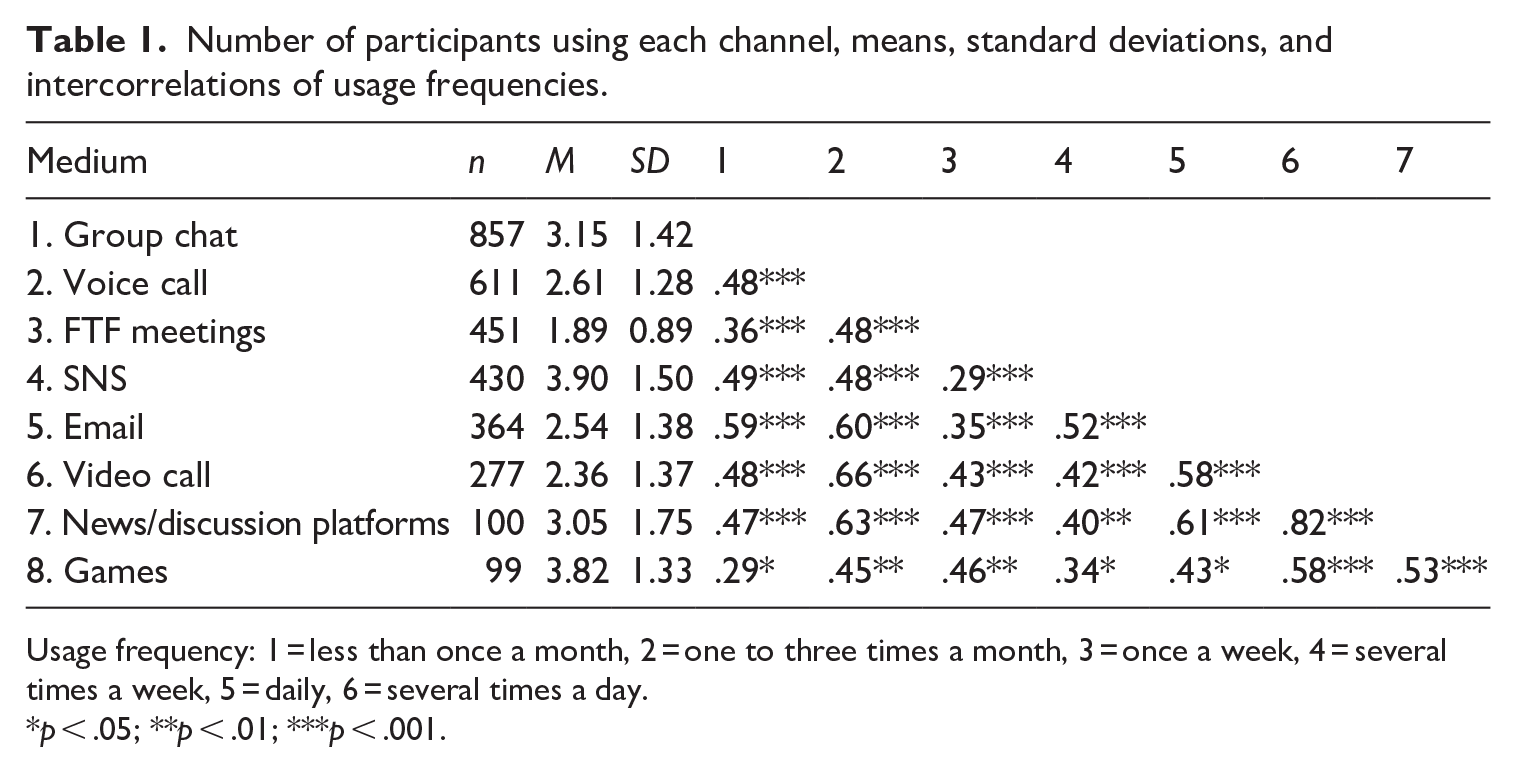
Usage frequency: 1 = less than once a month, 2 = one to three times a month, 3 = once a week, 4 = several times a week, 5 = daily, 6 = several times a day.
p < .05; **p < .01; ***p < .001.
Means, standard deviations, and correlations between patterns of media usage and sociopsychological variables.
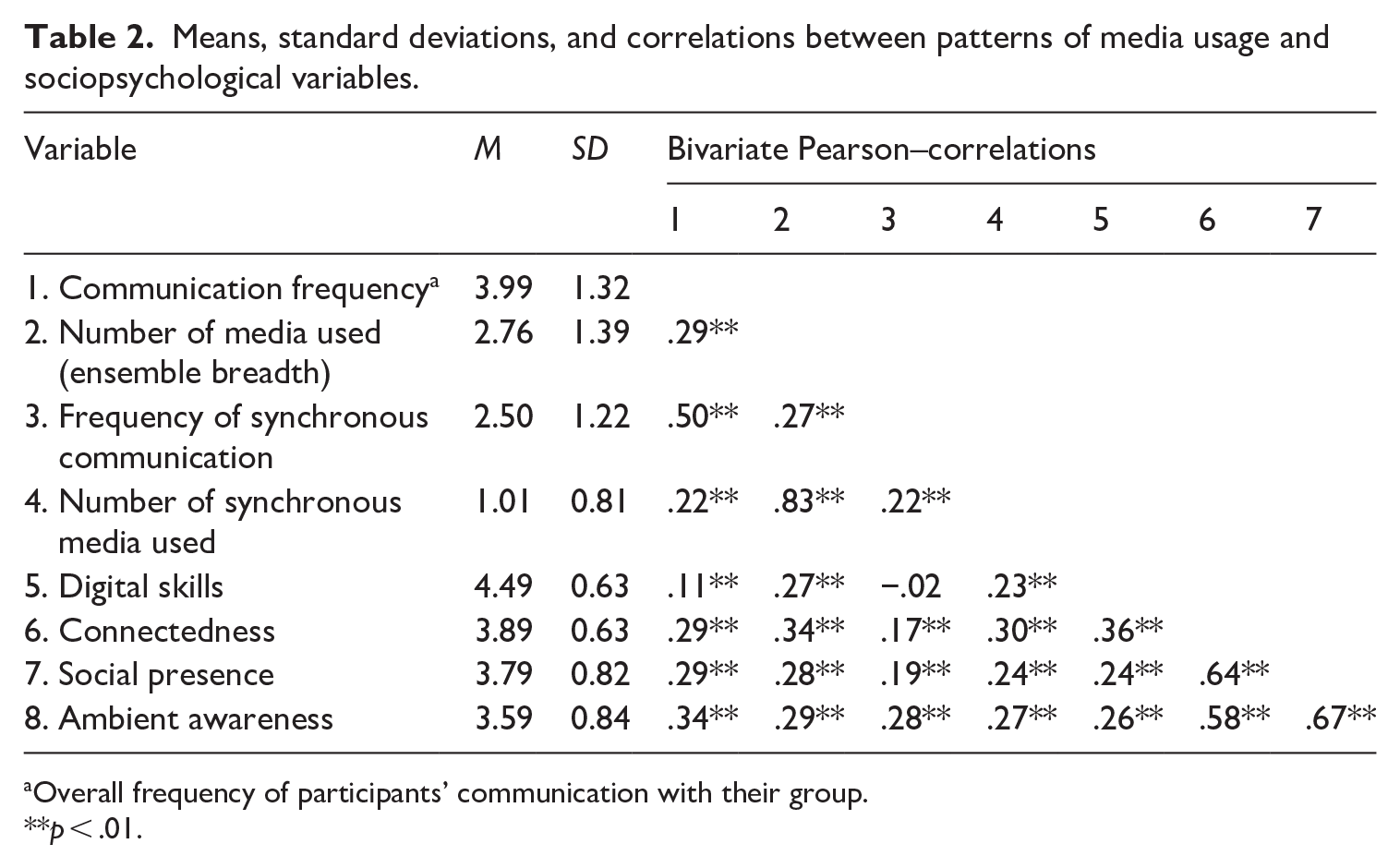
Overall frequency of participants’ communication with their group.
p < .01.
The group chat emerged as the most popular channel among friend groups, with 86% of the sample indicating its use. The second most popular channel was voice calls (61%), followed by SNS (43%), email (36%), and video calls (27%). The least popular channels were news/discussion platforms and games (each used by about 10%). Regarding frequency of usage, SNS and games were used most often. About half of the sample reported having FTF meetings, but the average frequency was rather low (see Table 1).
Media ensembles
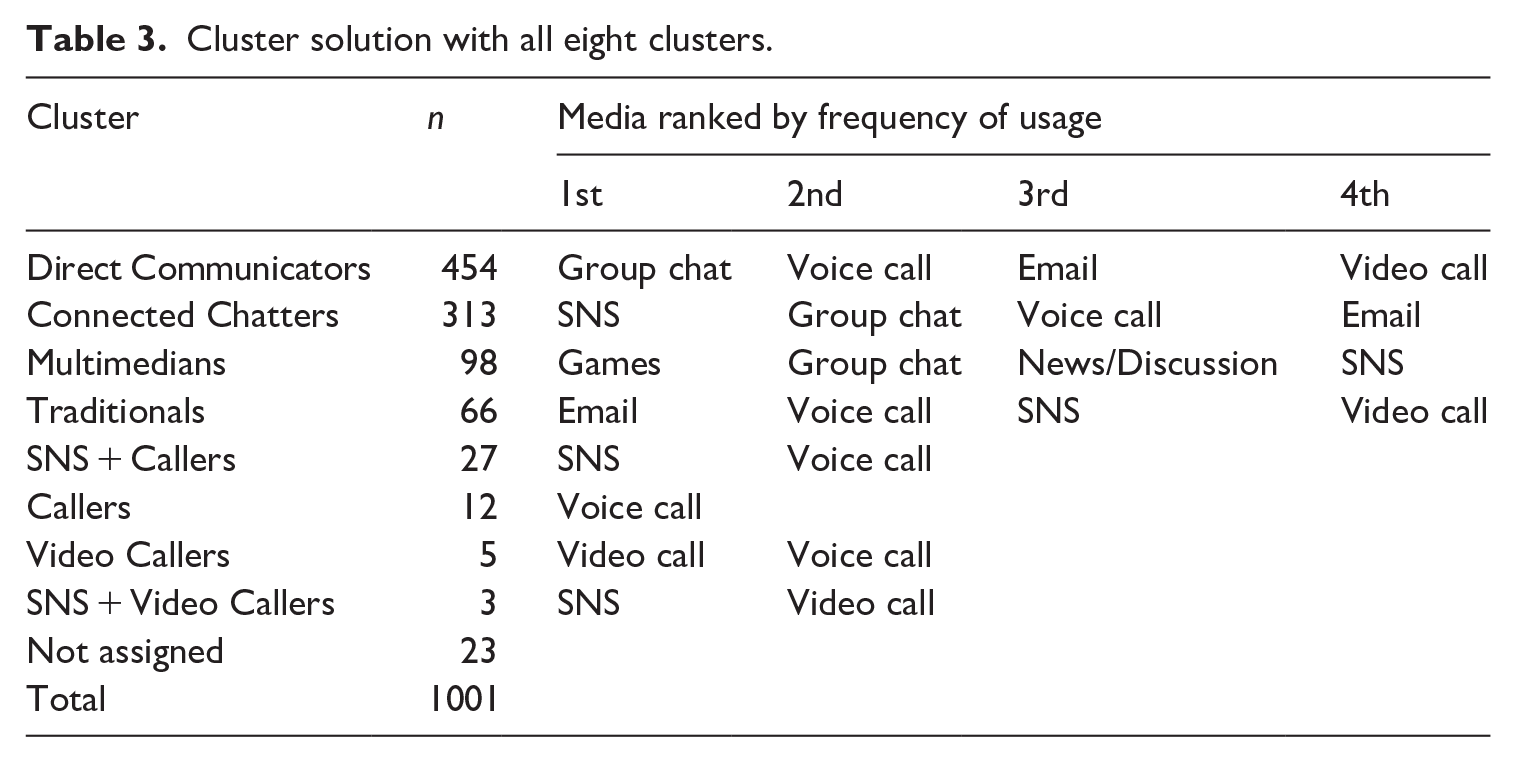
To answer RQ1, which media ensembles participants report, we initially ranked the frequencies of channels use per individual. Subsequently, we conducted a hierarchical cluster analysis, whereby the ranked frequencies were grouped using agglomerative clustering
To calculate the distance between observations, Canberra distance metric was selected. The average linkage algorithm grouped similar observations into clusters by calculating the average distance between two clusters during grouping. To select the most appropriate clustering algorithm and find the optimal number of clusters, as well as to validate each clustering solution, we conducted comparative analyses of dendrograms, gap statistics, internal measures, and means for each medium in each cluster across various clustering solutions. The clustering solution that was ultimately selected yielded eight clusters, each representing a distinct media ensemble. This solution demonstrated a high degree of similarity in usage patterns within clusters, as well as a high degree of distinctiveness between clusters. Table 3 provides an overview of the number of subjects in each cluster and its media composition. Figure 1 illustrates the composition and usage frequencies of media within each cluster.
Cluster solution with all eight clusters.
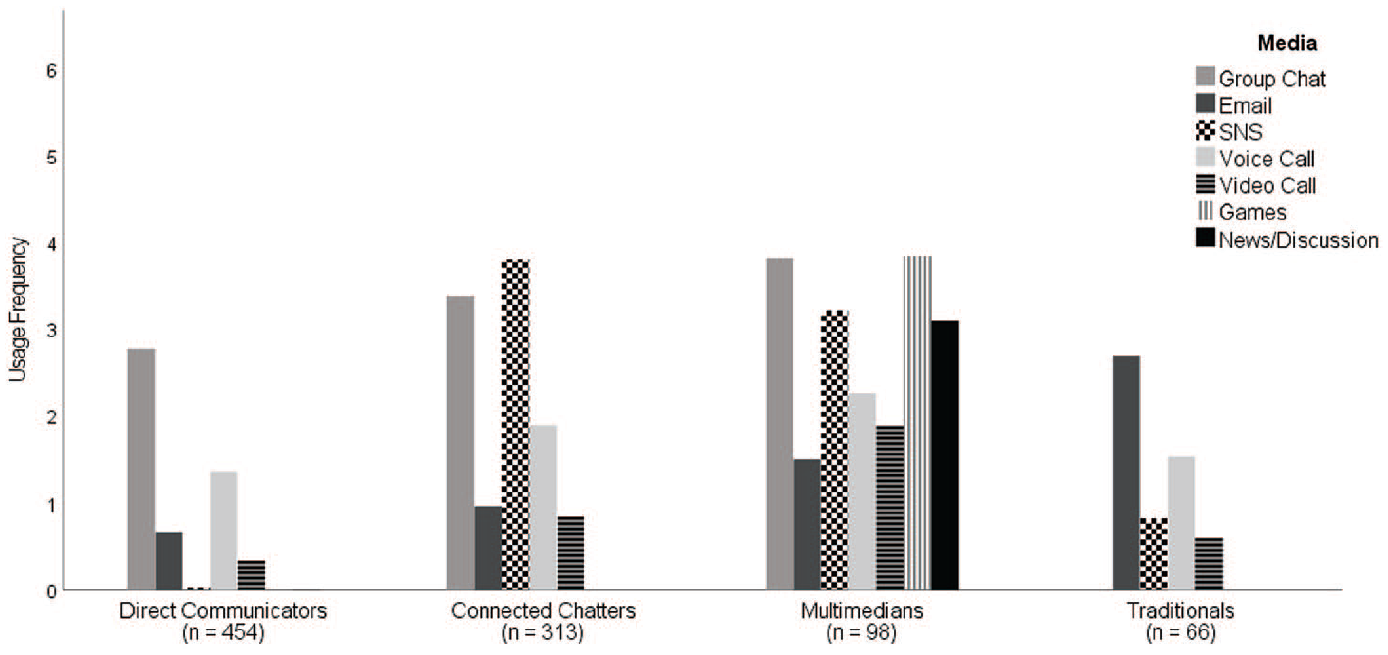
Composition of media ensemble for each of the four big clusters.
As illustrated in Table 3, some clusters were small (n < 10), combining only two media. We will concentrate on the four largest clusters, which collectively accounted for 93% of the sample.
The participants in the largest cluster communicated with their friend group on a sporadic basis, primarily through a group chat (average usage frequency: M = 2.78, with 2 = “one to three times per month” and 3 = “once a week”). Group messaging was complemented by voice calls (M = 1.36), emails (M = 0.65), and video calls (M = 0.33). As communication through these channels is rather direct and targeted (in contrast to SNS, news/discussion platforms, and games), we designated this cluster as Direct Communicators.
The second largest cluster consisted of participants who interacted with their friend group more frequently. Their media ensemble encompassed SNS (M = 3.79, with 4 = “several times a week”), group chats (M = 3.38), voice calls (M = 1.89), emails (M = 0.96), and video calls (M = 0.84). In accordance with the two most prevalent media, we refer to these users as Connected Chatters.
The third cluster was characterized by a frequent usage of all channels, including games and news/discussion platforms, and designated as Multimedians (n = 98). The smallest cluster (n = 66) primarily used email, complemented by voice calls and occasionally by SNS and video calls (Traditionals).
Individual factors
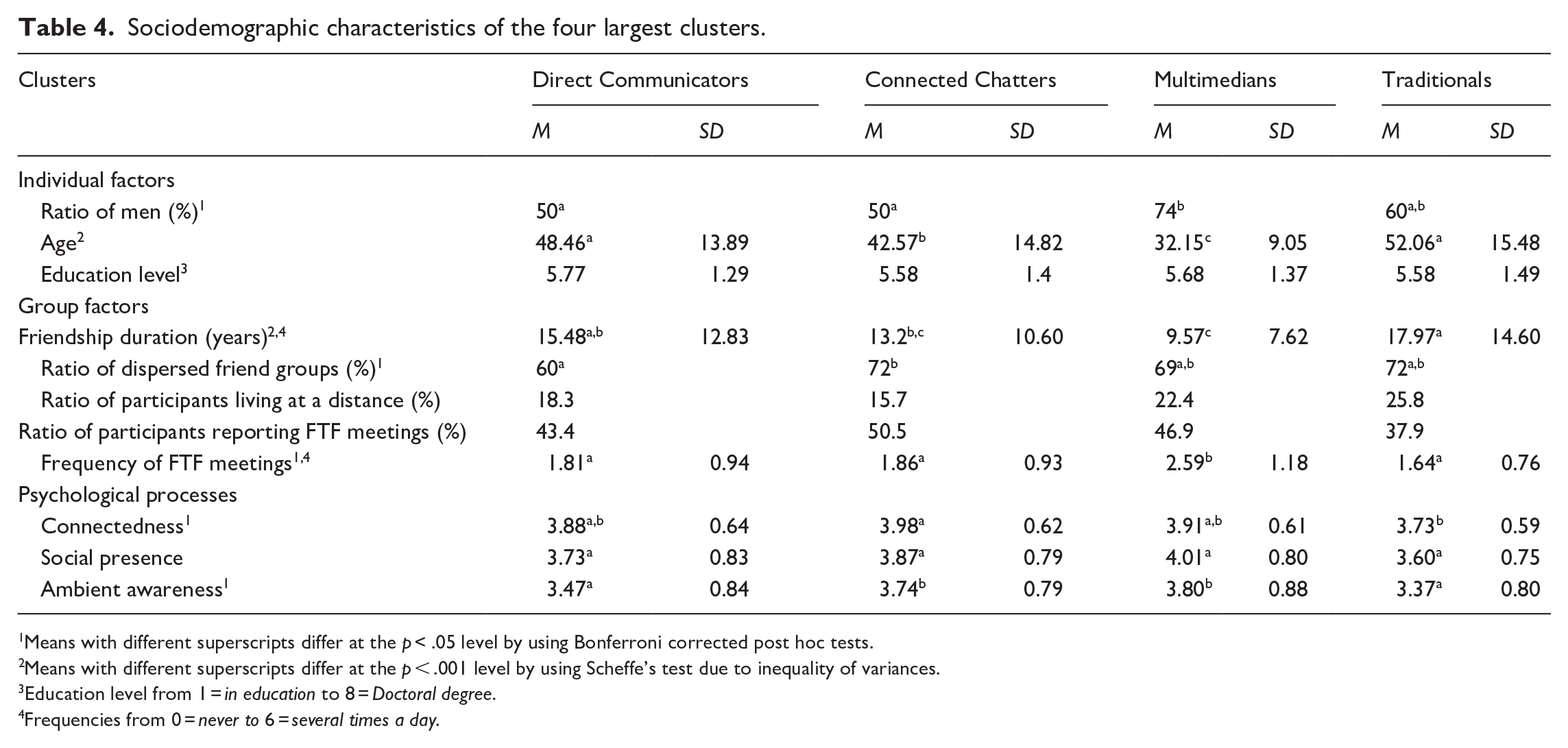
To address RQ2, whether users’ media use patterns differ as a function of their demographic characteristics, a one-way ANOVA with media ensembles as the independent variable and age as the dependent variable was conducted. It revealed significant differences in age, F(3, 907) = 44.59, p < .001, η2 = .13: As shown in Table 4, the Traditionals and the Direct Communicators were older than the Connected Chatters, who were in turn older than the Multimedians. Regarding gender, a chi-square test revealed that the Multimedians (73.5%) had a significantly higher proportion of men than the Direct Communicators (50.2%) and the Connected Chatters (49.5%; χ2(3) = 21.52, p < .001). The Traditionals fell in between these two extremes with 63%. In terms of education, a chi-square test showed no significant differences between the clusters, χ2(21) = 4.49, p = .61. To answer RQ2, there were age- and gender-differences between the clusters, but no differences in education.
Sociodemographic characteristics of the four largest clusters.
Means with different superscripts differ at the p < .05 level by using Bonferroni corrected post hoc tests.
Means with different superscripts differ at the p < .001 level by using Scheffe’s test due to inequality of variances.
Education level from 1 = in education to 8 = Doctoral degree.
Frequencies from 0 = never to 6 = several times a day.
Group characteristics
RQ3 asked whether the media ensembles of participants varied as a function of the duration and geographical distribution of their friendships. A one-way ANOVA revealed a statistically significant relationship between the duration of friendship and participants’ media ensembles, F(3, 857) = 10.02, p < .001, η2 = .02. As can be seen in Table 4, the Multimedians reported a significantly shorter friendship duration than the other clusters. However, when controlling for participants’ age, the effect disappeared. For geographical distribution, an ambiguous pattern emerged: As a chi-square test revealed, there was a higher proportion of participants indicating that they were part of a dispersed friend group among the Connected Chatters than among the Direct Communicators, χ2(3) = 12.06, p < .01 (Table 4). Participants were also explicitly asked where they lived in relation to the other group members. Participants who lived close to most other members, while at least one other member lived elsewhere, were categorized as “close.” Those who lived elsewhere than most other members were categorized as “distant.” A chi-square test demonstrated that the clusters did not differ the proportion of participants living far (vs close) to the other members, χ2(3) = 4.85, p = .18.
Connectedness
A one-way ANOVA tested whether different media ensembles were associated with varying degrees of connectedness (RQ4). The results revealed that the Traditionals reported lower levels of general connectedness than the Connected Chatters, F(3, 924) = 3.37, p < .05, η2 = .01, with the other two clusters falling in between (see Table 4).
To assess the breadth of the groups’ media ensembles, we counted the number of channels used. For overall media usage frequency, we calculated the average usage frequency across all channels. As a measure of synchronicity, we averaged the usage frequencies of the channels that are typically used synchronously (voice calls, video calls, games).
For H1, predicting a positive relationship between digital skills and breadth of media ensemble as well as communication frequency, bivariate Pearson correlation analyses revealed small correlations, both for ensemble breadth and communication frequency (see Table 2 for exact statistics). Therefore, H1 is supported.
Underlying processes
For H2 which predicted that the frequency of mediated communication within one’s friend group is correlated with the perceived general connectedness a moderate positive correlation was found (see Table 2).
The next step was to gain a deeper insight into the relationships between communication frequency and connectedness for each channel. To do this, a Mixed Effects Model was fitted to examine the effects of channels and channel-specific frequency of use on channel-specific connectedness with random slopes. News/discussion platforms and games were not included due to the small number of participants using them. The model showed main effects for channels and frequencies, as can be seen in Figure 2.
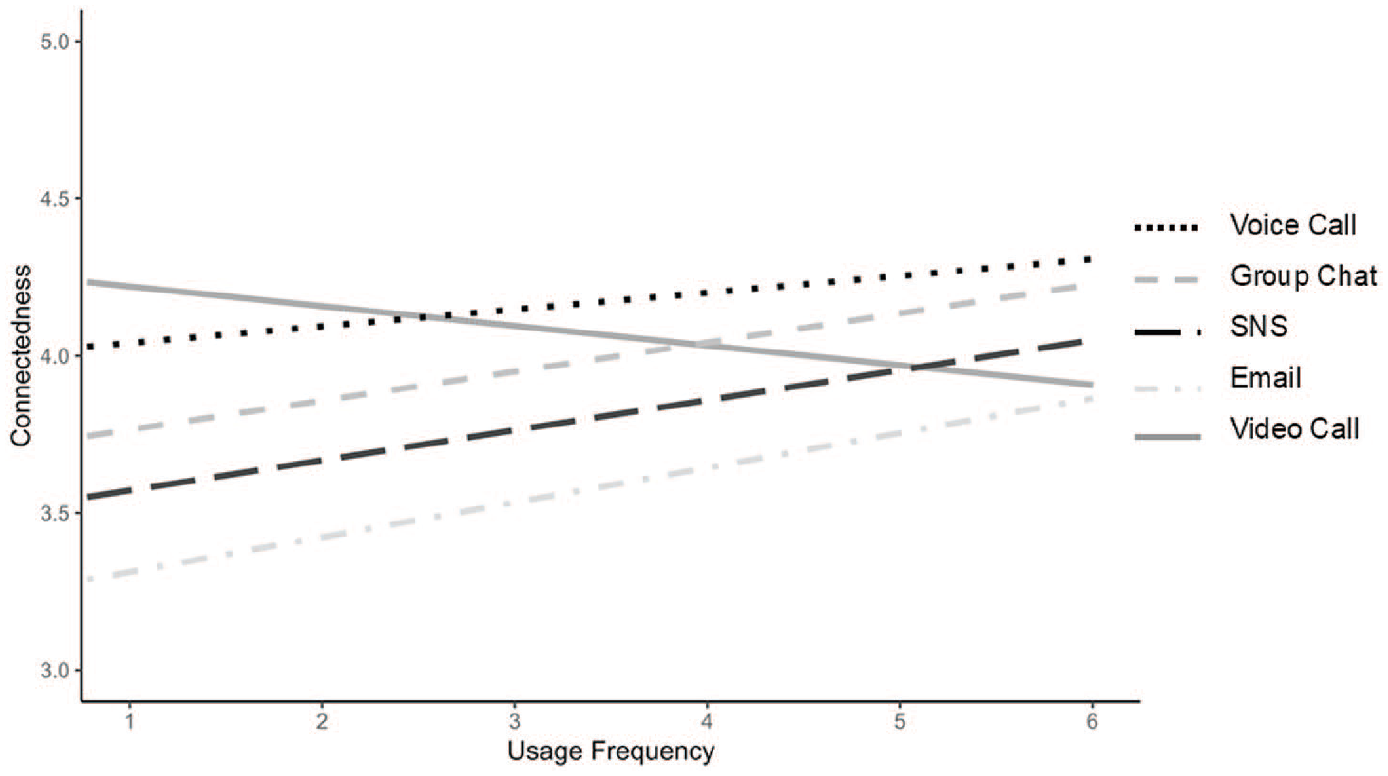
Relationship between usage frequencies and connectedness for each medium.
The main effect of channel indicated that across usage frequencies, participants felt most connected with their friend group through video calls, followed by calls (see exact statistics in Supplemental Material). As can be seen in the intercepts in Figure 2, channel-specific connectedness levels when communicating in group chats and through SNS were lower than those during calls but did not differ from each other. Email conversations resulted in the lowest channel-specific connectedness.
The main effect of frequency indicated that higher frequencies were related to higher levels of connectedness, ß = .06, SE = .01, p < .001. There was an interaction between medium and frequency, χ2(6) = 91.58, p < .001: As shown by the steepness of the lines in Figure 2, an increase in email frequency was more strongly associated with channel-specific connectedness, ß = .07, SE = .01, p < .001, than an increase in SNS frequency, ß = .03, SE = .01, and group chats, ß = .01, SE = .01. Voice call frequency showed a lower association with connectedness than the average frequency across all media, ß = −.02, SE = .01, p = .048. For video call frequency, there was a negative relationship with connectedness, ß = −.09, SE = .02, p < .001. H2, predicting a positive relationship between usage frequency and connectedness, is thus supported at the overall level and at the channel level for all channels except video calls.
H3 hypothesized that the breadth of participants’ media ensembles is correlated with their perceived connectedness. Indeed, ensemble breadth was moderately correlated with connectedness, as displayed in Table 2. Thus, H3 is supported.
Regarding psychological processes, we expected a positive correlation between social presence and connectedness (H4). As can be seen in Table 2, the two variables were highly correlated and therefore, H4 was supported. H5 postulated a relationship between the use of synchronous media and social presence and connectedness, respectively. This hypothesis was supported: Social presence as well as connectedness were weakly correlated with the number of synchronous media used and the frequency of using them. H6, which postulates a positive correlation between ambient awareness and connectedness, was also confirmed (Table 2).
Exploratory analyses
An exploratory one-way ANOVA revealed that those who met FTF indicated a higher level of connectedness (M = 4.06, SD = 0.6) than those who did not (M = 3.78, SD = 0.62), F(1, 926) = 49.73, p < .001, but the effect was small (η2 = .05). In addition, linear regression analysis showed that the frequency of FTF meetings did positively influence connectedness, ß = .12, SE = .03, p < .001. However, the effect was small (R2 = .04).
We exploratively tested for differences in social presence and ambient awareness between the four largest clusters using one-way ANOVAs. As displayed in Table 4, only ambient awareness differed between clusters, F(3, 603) = 6.89, p < .001, η2 = .03: The Connected Chatters and the Multimedians indicated a higher ambient awareness than the Direct Communicators and Traditionals.
Discussion
This study examined which media ensembles groups of friends use to maintain contact. Moreover, we explored how the use of these ensembles relates to connectedness, and the role of social presence and ambient awareness. A large quota sample of German adults provided information on their media use. Four prominent media ensembles emerged.
Media ensembles
Although many (combinations of) channels are available, the cluster analysis revealed that 93% of the participants fell into one of four clusters. The fact that most participants used more than one medium confirms our view that research is needed on media ensembles rather than individual channels.
The relational pattern of infrequent emails and voice calls (Licoppe and Smoreda, 2005) was reported only by the smallest cluster, the Traditionals. The members of this cluster were also the oldest participants, indicating that the use of traditional media could decline further.
The Direct Communicators were also older than the average participant and exhibited a modernized version of the relational pattern, replacing emails with group chats. Communication frequency in this cluster was rather low, on average once a week. This relatively slim media ensemble was used by almost half of the sample. The relatively low contact frequency may be due to the limited time available in the everyday lives of working adults. Interestingly, the Direct Communicators as the largest cluster did not utilize SNS for group communication. This could be due to a preference for more private one-to-few communication or the fact that not all members of the friend groups use SNS. The latter argumentation is supported by the finding that roughly 20% of the Direct Communicators said that they use SNS for one-to-one communication. Collective media ensembles are often smaller than individuals’ media repertoires because they must be accepted by all communicators (Hasebrink and Hepp, 2017).
The Connected Chatters, in contrast, communicated more frequently (several times a week) via both traditional and newer media: They regularly used SNS and a group chat, complemented by occasional voice calls, emails, and video calls. They reported descriptively the highest connectedness. The Connected Chatters engage in a communication pattern that comes close to interstitial communication (Licoppe and Smoreda, 2005), but the average frequencies are too small to warrant the term always-on-connectedness. Nevertheless, this cluster supports the notion that relational closeness is a function of the frequency of media use (Cummings et al., 2006).
The second-smallest cluster, the Multimedians, employed the broadest and most diverse media ensemble, with high usage frequencies of all media. They were the only cluster using games and news/discussion platforms. Although games in general were used by few participants, those who used them did so with a high frequency. This supports our view of games as an essential communication medium. In contrast to the short and often superficial updates that are typical for SNS and chat messages, gaming represents a shared activity and the discourse on discussion platforms also tends to be topic centered. We can conclude that the Multimedians use media not only for communication, but also for joint activities. In line with the typical demography of gamers (Ghuman and Griffiths, 2012; Potzel et al., 2024), the Multimedians were younger and mostly male. These age- and generation-related differences in media use mirror the second level digital divide: Gaming sites and discussion forums remain channels utilized primarily by young males and those with a high level of digital skills (Elena-Bucea et al., 2021). Future research could examine whether using media for joint activities with friends will become more prevalent in the general population.
In contrast to age and gender, participants’ level of education did not influence their media choices (RQ2). This finding was unexpected, given that digital skills were at least weakly associated with the breadth of media ensembles and communication frequency (H1). However, the most popular medium, the group chat, does not require specific digital skills and displayed a high adoption rate across all age and education levels.
The four clusters did not differ in the duration of their friendships when controlling for age. It should be noted that the average duration of friendships in the sample was with 15 years quite high; the results of our study thus complement prior studies employing student samples. The proportion of dispersed friend groups was slightly lower among the Direct Communicators than among the second largest cluster, the Connected Chatters. Thus, they might use their media ensemble not only to stay in touch, but also for the coordination of FTF activities.
Differences in connectedness
The central question of this study was whether different media ensembles correspond to varying levels of connectedness. Interestingly, connectedness differed only between the Traditionals and the Connected Chatters, with the latter reporting a higher connectedness. Thus, the cluster which engaged in relational communication demonstrated a lower connectedness than the cluster engaging in interstitial communication. Prior research assumed that both interstitial and relational communication patterns can convey connectedness (Licoppe and Smoreda, 2005); our results indicate that the relational pattern might not work as well nowadays, at least for groups. When interpreting the results, one should keep in mind that connectedness was high across all groups, with a mean score of approximately 4 on a 5-point scale, and the average friendship lasted 15 years. Thus, the results indicate that people can maintain connectedness with their friend group over a long time, regardless of which media they use and how often. They also refute concerns that the shorter and more mundane updates in group chats or on SNS impair intimate friendships. Descriptively, connectedness was higher in the clusters that regularly used group chats.
Underlying processes
When looking at predictors of connectedness, our results replicate prior findings that more frequent communication (H2; Cummings et al., 2006; Shklovski et al., 2008) and broader media ensembles (H3; Haythornthwaite, 2005; Ledbetter, 2023) are associated with higher connectedness. At the channel-level, the relationship between frequency of use and connectedness was strongest for email, the medium that evoked the least connectedness when used irregularly. It seems that in text-based communication, a high frequency can compensate for reduced cues when it comes to creating connectedness. In contrast, video calls were perceived as connecting when used irregularly, but an increase in frequency was associated with a decrease in connectedness. Frequent video calls may be experienced as a burden, reducing connectedness. This might be because they require coordination in terms of timing and appropriate settings or because after the pandemic, people are tired of video calls (Heshmat and Neustaedter, 2021). It is noteworthy that despite the widespread use of group chats, increases in their usage frequency were only moderately associated with increases in connectedness. Convenience and ease of use may be more important factors in choosing the group chat than its connective qualities (Ledbetter, 2009a). This tenet could be tested in future studies.
Regarding psychological processes, the Multimedians indicated the descriptively highest social presence and ambient awareness. The observation that the Multimedians and the Connected Chatters, the two clusters using SNS, reported a higher ambient awareness than the other two clusters is consistent with the conceptualization of ambient awareness as arising from skimming SNS feeds (Krämer et al., 2017; Levordashka and Utz, 2016).
Interestingly, social presence did not differ significantly between the four clusters. Furthermore, it was only descriptively, but not significantly higher for the cluster playing games together. In conjunction with the weak correlation of social presence with indicators of synchronous communication, we can conclude that long-term friends perceive each other as present, even without synchronous communication. The high correlation between social presence and ambient awareness suggests that knowing what one’s friends are doing may also provide a sense of social presence. Ambient awareness and social presence were both associated with connectedness, consistent with previous research (Riedl et al., 2013). These associations were stronger than the correlations between connectedness and media use factors (i.e. frequency of (synchronous) communication and ensemble breadth). We can conclude that psychological processes, namely social presence and ambient awareness, are better predictors of connectedness than the frequency and type of media use.
Interestingly, there were hardly any differences between members of dispersed and geographically close groups in terms of their media ensembles. It seems that even when members move away, friend groups maintain their media use practices.
Limitations and strengths
Given that only one member of each friend group was surveyed on the group’s media ensemble, other group members might have reported a different pattern of media use. However, recruiting whole groups was not feasible and would have led to selection effects, as the whole (often dispersed) group would have had to agree to participate. A second limitation is that the cross-sectional data collection, and the reliance on correlation analyses do not permit drawing causal inferences on the relationship between media use and connectedness. Indeed, some theories, such as media multiplexity theory, posit bidirectional relationships between these two variables (Haythornthwaite, 2005). Our results can only provide a starting point for future (longitudinal) studies that examine cause-effect relationships. Third, the ambient awareness scale was too short to provide a reliable measure. Future studies could use a more comprehensive scale. Fourth, the distinction of channels in the survey may not have been completely clear, as the functions of messaging applications and SNS overlap (e.g. both allow for private messaging or sharing of multimodal content).
One unexpected finding was the high popularity of using voice calls with a group. Voice calls are typically used for one-to-one communication. Possibly participants haven’t read the instructions carefully. Alternatively, the ease of making group calls via messengers compared to conference calls may have contributed to their renewed popularity.
A notable strength of this study is its focus on media ensembles of groups of friends, rather than dyadic friendships or families, and its inclusion of channels that are often neglected in communication research, namely games and news/discussion platforms. Furthermore, this study’s sample is representative for the German adult population regarding age and gender. Thus, it allows for a comprehensive overview of media ensembles in the German population. Our quantitative approach could be combined with qualitative in-depth analyses, such as the longitudinal study on media repertoires by Potzel et al. (2024). Future work could, for example, involve qualitative interviews with groups of friends drawn from the four clusters we have identified.
Conclusion
This study explored the media ensembles used by a quota sample of German adults for communication with their friend groups. Most respondents could be classified into one of four clusters. The relational communication pattern, consisting of infrequent emails and voice calls, was used only by a small group of older participants. They also reported the lowest levels of connectedness. All other clusters relied heavily on group chats and indicated comparable levels of connectedness. Although group chats only moderately contributed to a sense of connectedness, they appear to play a central role for the maintenance of friendships. This is likely due to the convenience they offer. Social presence and ambient awareness were stronger correlates of connectedness than the frequency of (synchronous) communication and the breadth of media ensembles. This finding indicates that the psychological perception of communication is what matters for connectedness.
Supplemental Material
sj-docx-1-nms-10.1177_14614448251351282 – Supplemental material for Media use in groups of friends: Relationships with connectedness
Supplemental material, sj-docx-1-nms-10.1177_14614448251351282 for Media use in groups of friends: Relationships with connectedness by Carolin Lehmann and Sonja Utz in New Media & Society
Footnotes
Author contributions
S.U. developed the study idea. Both authors prepared the questionnaire. Under the supervision of S.U., C.L. collected the data, conducted the analyses, and wrote the methods and results section. S.U. wrote the theoretical framework and discussion, and C.L. contributed to it. C.L. revised the manuscript and implemented the reviewers’ suggestions under supervision of S.U. All authors approved the final version of the manuscript.

Declaration of conflicting interests
The author(s) declared no potential conflicts of interest with respect to the research, authorship, and/or publication of this article.
Funding
The author(s) disclosed receipt of the following financial support for the research, authorship, and/or publication of this article: This work was supported by the Federal Ministry of Research, Technology and Space in Germany (grant number 16SV9085).
Ethics approval
This study was approved by the ethics committee of the institute (approval no. LEK 2023/048) on September 06, 2023.
Consent to participate
All participants provided written informed consent prior to participating.
Consent to publish
All participants provided written informed consent to publish the findings derived from the study.
Supplementary material
Author biographies
References
Supplementary Material
Please find the following supplemental material available below.
For Open Access articles published under a Creative Commons License, all supplemental material carries the same license as the article it is associated with.
For non-Open Access articles published, all supplemental material carries a non-exclusive license, and permission requests for re-use of supplemental material or any part of supplemental material shall be sent directly to the copyright owner as specified in the copyright notice associated with the article.
