



Abstract
Messaging groups are emerging as “meso-spaces”—digital environments that enable sustained dialogue and collective action through their distinct affordances. We examine how such spaces facilitate civic self-organization through their hybrid online/offline, public/private, and local/global dynamics and how they function as local civic infrastructure during times of crisis. Using a mixed-methods analytical approach, we examined 47 public Telegram groups from Germany during the COVID-19 pandemic. We identified a fundamental tension between political discussion and practical help in these spaces, resolvable through active horizontal participation (including norm negotiation and self-moderation), or strict vertical moderation. Additional challenges included a lack of access to vulnerable groups and limited outreach to local civil society actors, both of which hindered group activity and structural connections within local civic infrastructure. Despite these challenges, our study highlights the potential of local chat groups for self-organization, albeit primarily among privileged urban individuals. We discuss the implications for democratic theory and practice.
Introduction
From organizing playground meetups to everyday news sharing and coordinating emergency response efforts, messaging apps have become a critical part of communication infrastructure around the globe (Kalogeropoulos and Rossini, 2025; Newman et al., 2023; Wijermars and Lokot, 2022). Specifically, during the COVID-19 pandemic, messaging groups served as digital lifelines, with platforms like Telegram hosting a web of neighborhood support networks, helping citizens to access digital solidarity networks and bypass lumbering institutional bureaucracies (Carlsen et al., 2021; Chevée, 2022). While ample research has focused on the infrastructural role of social media in political movements and protests (Boulianne and Ohme, 2022; Lokot, 2021), the growing importance of messaging apps as semi-public communication spaces opens new avenues for studying civic participation. Messaging chat groups combine the affordances of connectivity and “safety” for civic engagement (Zhu et al., 2024), while remaining uniquely tied to particular localities (Pfetsch et al., 2021). Hence, this type of communication space is constituted through the constant interplay between online/offline, global/local, and private/public dimensions (Pfetsch et al., 2021; Tenenboim and Kligler-Vilenchik, 2020).
While research has established the role of digital media in providing “civic infrastructures” (Couldry et al., 2010; Thorson et al., 2020), we still know little about how the specific affordances of semi-public communication spaces (a) enable and shape civic engagement, and (b) shape the capacity of these spaces to function as civic infrastructure. So far, most of the research on messaging platforms is based on self-reported activity in chat group conversations (Chadwick et al., 2025; Kalogeropoulos and Rossini, 2025; Swart et al., 2019; Zhu et al., 2024), making our study of actual chat content a relevant contribution to the field. We advance this field of research by investigating the role of neighborhood chat groups for local civic self-organization, focusing specifically on the tensions and synergies inherent to their hybrid online/offline, global/local, and private/public nature. Through analyzing “Solidary neighborhood help” Telegram chat groups that emerged across German cities during the COVID-19 pandemic, we examine whether and how these digital spaces functioned as civic infrastructure during the crisis. Methodologically, we adopted a mixed-methods approach, combining computational and qualitative content analysis of 47 publicly available chat logs.
Theoretical framework
Telegram groups as meso-spaces for civic participation
Against the backdrop of academic and mainstream dissatisfaction with the democratic role of social media (e.g. Lane et al., 2024), and the increasing unwillingness of users to talk politics on these public fora (Swart et al., 2019), messaging apps have emerged as a possible (semi-)private alternative for political discussion and participation (Swart et al., 2019; Valeriani and Vaccari, 2018). Research indicates that the “privateness” of messaging platforms can be beneficial for civic participation by enabling a safer and more sociable discourse (Chadwick et al., 2025; Zhu et al., 2024). Accordingly, Tenenboim and Kligler-Vilenchik (2020) contended that messaging groups have distinctive affordances and can function as a “meso-space” for sustained dialogue and active participation. The semi-publicness of Telegram chat groups affords a “safer” and more personalized environment in contrast to “public” platforms like Facebook or X (Tenenboim and Kligler-Vilenchik, 2020). Furthermore, conversational affordances such as scalability of message reach, information personalization and the possibility to develop group-specific moderation styles make such chat groups effective tools for different forms of organization (Buehling and Heft, 2023; Pasitselska, 2024). However, we should note that chat groups do not automatically act as meso-spaces; instead, they can become meso-spaces when they facilitate discussion, involve heterogeneous social circles, and establish and negotiate their own rules (Pasitselska, 2024).
Despite the recognition of messaging apps’ growing importance for civic participation, we know relatively little about conversation dynamics within weak-tie groups, where most news exposure occurs (Swart et al., 2019), and where information verification can become shared practice and value (Kligler-Vilenchik, 2021). Recent research suggests that user-led moderation can foster collective reflection and epistemic vigilance, though their effectiveness varies with group composition (Chadwick et al., 2025; Kligler-Vilenchik, 2021). This line of research expands the previous literature on moderators’ civic labor on social media (Matias, 2019) by examining how grassroots platform governance functions within semi-public spaces with often more egalitarian chat space organization (Zhu et al., 2024). Notably, current literature mostly focuses on disruptive communication on messaging platforms (Buehling and Heft, 2023; Kalogeropoulos and Rossini, 2025), leaving a gap in understanding how group activity relates to democratically functional participation. As for the type of discourse, existing studies shed some light on the constellation of actors and topics discussed in the groups (e.g. Buehling and Heft, 2023), yet the negotiation dynamics concerning the purpose and scope of group activity remain underexplored.
Local chat groups in civic infrastructure
Communication Infrastructure Theory (CIT) provides a foundational framework for understanding how communities organize and communicate through intertwined physical and digital resources. According to CIT, community communication comprises a multilevel storytelling network embedded in a specific communication action context, with storytelling occurring at micro (resident interactions), meso (community organizations and local media), and macro (mainstream media) levels (Kim and Ball-Rokeach, 2006). Specifically, through local storytelling practices, residents develop understandings of shared concerns and maintain community bonds (Breek et al., 2021; Kim and Ball-Rokeach, 2006). In the language of CIT, local chat groups can be understood as emerging meso-level actors that bridge individual residents’ conversations with broader community narratives and institutional communications. This aligns with their conceptualization as meso-spaces that facilitate discussion, involve heterogeneous social circles, and establish their own moderation practices (Pasitselska, 2024; Tenenboim and Kligler-Vilenchik, 2020).
Building on CIT, Thorson et al. (2020) defined the concept of local information infrastructure, as “dimensions that define the production and circulation of politics and policy information in a given community: the social and technical actors, their interactions and practices, and their technical and material aspects” (p. 1235). By looking at how users utilize their information environment to perform civic action, we shift from the information to the civic infrastructure: the infrastructure that provides citizens with resources (including information, social capital, and techno-material aspects) to maintain their public connection (Couldry et al., 2010). Thus, studying messaging apps as a part of local civic infrastructure means considering how local communities can leverage the cross-platform infrastructure to perform civic action and connect with the broader information ecology, such as the media, NGOs, or governmental actors.
The quality of local civic infrastructure hinges on several factors: social trust, neighborhood belonging, and social cohesion (Kim and Ball-Rokeach, 2006). Social trust—the belief that others in society can generally be trusted—emerges through the community’s ability and willingness to maintain common goals that foster social control and safety (Sampson et al., 1997). Having a space for everyday exchange strengthens citizens’ attachment to a residential area—their neighborhood belonging—and, in turn, increases their willingness to participate in civic action on behalf of their local community (Kim and Ball-Rokeach, 2006). The resulting social cohesion, encompassing social relations, community attachment, and orientation toward the common good (Robaeyst et al., 2022), forms the foundation for civic participation.
Within the meso-space of local chat groups, trust, belonging, and cohesion are shaped not only through participants’ communicative practice but are also actively steered through the civic labor of volunteer moderators, who become crucial actors in grassroots-organized chat groups. Given that messaging platforms hosting neighborhood communication are virtually devoid of moderation (Wijermars and Lokot, 2022), volunteer moderators “must negotiate the meaning of their civic role and power” (Matias, 2019: 11), which can result in a more democratic or more oligarchic governance of an online community (Shaw and Hill, 2014). The recent findings of Chadwick et al. (2025) and Kligler-Vilenchik (2021) on group rules and epistemic vigilance underline the challenges that especially large groups may face in fostering trust and establishing norms among strangers or weak ties who gather around shared civic goals.
Local chat groups at the intersection of private/public, local/global, and online/offline
Within the civic infrastructure framework, local chat groups are constituted through an ongoing negotiation of its boundaries along the axes of private/public, local/global, and online/offline (Pfetsch et al., 2021; Tenenboim and Kligler-Vilenchik, 2020). We briefly discuss each intersection.
The mediation of neighborhood life through chat groups fundamentally reshapes the traditionally liminal position that neighborhoods occupy between public and private spaces. While neighborhoods have always been core settings of informal public life outside home and work (Gieryn, 2000), messaging apps introduce new affordances of visibility and persistence in neighbor interactions. In addition, due to the specific normative demands in relationships with neighbors (Cheshire, 2022), they include a dimension of civic obligation that further incorporates them into public life.
While micro-mobilization of civil society is often rooted in local communities and issues (Friedland et al., 2007), digital communication transcends global boundaries, creating a particular spatial constellation (Pfetsch et al., 2021). Some studies suggest that Facebook neighborhood groups, akin to hyperlocal media, circulate local information, foster local attachment, and drive civic participation (De Meulenaere et al., 2021). Pfetsch et al. (2021) found, however, that different localities and topics might be differently embedded in the global communication environment. The COVID-19 pandemic enhanced this tension between local and global dynamics. While the pandemic affected communities worldwide, effective responses often emerged through hyperlocal coordination (Carlsen et al., 2021; Chevée, 2022).
In terms of online/offline, interactions in both online and physical realms coexist and complement one another. Some issues exist only online, and some actualize in offline actions; some offline interactions continue online, thereby widening participation and expanding the debate; and some online interactions lead to offline connections (De Meulenaere et al., 2021). At the same time, studies note that the desired attributes of intimate neighborhood communication in physical space misalign with social media affordances (Johnson and Halegoua, 2017). However, local chat groups’ affordances might mitigate these contradictory requirements. While these intersecting dimensions shape the positioning of local chat groups, their success as civic spaces ultimately depends on social dynamics and governance practices that foster or hinder community engagement.
As neighborhood chat groups become a part of local civic infrastructure, their communication affordances shape how local communities organize and respond to challenges. This refers not only to patterns of who participates and how, but also to the emergence of new forms of civic engagement that transcend traditional boundaries between private and public, local and global, online and offline spheres. During the COVID-19 pandemic, the specific position of chat groups as meso-spaces became particularly salient as communities leveraged digital tools to coordinate grassroots responses within existing civic infrastructures. Building on this understanding of neighborhood chat groups as potentially transformative civic spaces, we formulate the overarching research question: How do users’ socio-technical practices transform neighborhood chat groups into civic infrastructure during crises?
Case study: neighborhood chat groups in Germany amid the COVID-19 pandemic
To answer our RQ, we take the case of neighborhood chat groups that emerged during the COVID-19 pandemic in Germany. In times of an emergency, when citizens’ mobility is restricted, so is their access to conventional support networks. In such circumstances, neighbors emerge as a crucial resource that individuals turn to for assistance (LaLone, 2012). The sense of urgency can catalyze civic engagement, either activating the latent potential within pre-existing neighborhood support networks or leading to the formation of entirely new networks.
Studies investigating grassroots civic action during the COVID-19 pandemic underscored local communities’ resilience and adaptability during societal crises (Carlsen et al., 2021; Chevée, 2022). Small, horizontally structured groups were able to rapidly mobilize neighbors and quickly adapt to changing lockdown regulations, in contrast to slower governmental organizations. These social media groups negotiated their position with existing civic actors between collaboration opportunities and risks of overlap.
Germany presents what Flyvbjerg (2006) would characterize as a “most likely” case for studying digital neighborhood solidarity, due to three key contextual factors. First, the country has a rich history of community involvement through voluntary associations and clubs, including sports clubs, cultural associations, and local community groups (Olk and Hartnuß, 2011). Second, Germany’s federal structure incorporates a well-established system of local governance that enables community participation at the municipal level (Zimmer, 2009). Third, the societal value of Gemeinschaft (community) emphasizes communal well-being, fostering a cultural predisposition toward community-oriented activities. Germany’s digital landscape requires additional considerations: although messenger use is widespread in Germany (80%, Strippel et al., 2024), Telegram’s reach is relatively limited at 10% of the population—comparable to X (10%) but significantly lower than WhatsApp (62%) (Newman et al., 2023). This platform distribution may influence the socio-demographic composition of chat groups (discussed more below). Nevertheless, Germany’s strong community orientation suggests that crisis-driven mobilization is likely to emerge at the local level, potentially facilitated through digital means.
In light of the existing scholarship, we can refine our RQ to focus on four key aspects: How did chat group participants construct and negotiate the meanings of neighborhood solidarity? What patterns of collective action emerge in chat groups? How did these groups connect to other actors in the local infrastructure? What constrained the groups’ solidarity efforts?
Methods
Data collection and ethical considerations
The group chats were scraped from the open repository “Solidarische Nachbarschaftshilfe” 1 (eng. “Solidary neighborhood help”). This website served as a community-based aggregator of solidarity groups during the COVID-19 crisis, where neighborhood initiatives could make their groups public. The listed initiatives ranged from closed chats on WhatsApp to open Facebook and, predominantly, Telegram groups. After reviewing the sample of more than 120 groups we selected the ones that had a substantial amount of content and user interaction, i.e. not primarily spam, scam, or irrelevant messages. Our remaining sample consists of 47 public Telegram group chats (N = 48,392 messages) that were publicly accessible and active during the last three months at the time of data collection (24 February 2023). These groups are considered public according to the platform settings, meaning that everyone can find, read, and join them without administrators’ approval, and can be part of the group unless they are manually removed by a group administrator. We have exported the data that is publicly available without joining the groups. Upon inspection of the data, we found that all groups we scraped were created in one wave of “connective action” at the beginning of the COVID-19 outbreak in Germany in the period between 13 March 2020 and 23 March 2020.
Before proceeding with the explanation of our methodology, we want to outline our ethical considerations. We understand that the “publicness” of social media and messaging app data, both factual and how it is perceived by users, is an ongoing debate (Sehat et al., 2021), raising important questions for ethical research practices. Since the groups we are studying were active primarily during the COVID-19 pandemic, with many users being inactive or having left the group at the time of data collection, it was not possible to ask for informed consent. We have no definitive answer as to the users’ awareness of the accessibility of the chat logs. Since the groups aimed to facilitate neighborhood interactions, their accessibility and content circulation suggest some user awareness of their public nature. With the goal to benefit the public, the groups were shared broadly online with open invitation links, which were also posted within the groups to encourage further circulation. Accordingly, for the purpose of the present study, we argue that the “privateness” of the groups pertains primarily to the visibility affordance of the platform, while the intention of the users was rather to exploit these groups as (at least) semi-public fora. Despite the public accessibility of all contents studied below, we have carefully anonymized all data. User handles were replaced by markers (e.g. “User 1”) to trace contributions without revealing identities. Publicly shared phone numbers were blanked during the data pre-processing. Throughout this paper, when quoting group content, we removed sensitive content, such as specific locations, organizations, or people. All quotes were translated from German by the authors and adjusted to prevent backtracking. The described procedures were approved by the Institutional Review Board at the University of Groningen.
Data analysis
Given both the substantial volume of data and the complexity and variability of interactive natural discourse in chat groups (Baden et al., 2020), we developed a three-phase analytical approach that combines qualitative and quantitative methods (Figure 1). In doing so, we combine a systematic identification of broader patterns with a detailed examination of specific cases (Tanner, 2023). Rather than aiming for statistical generalization or representativeness, our goal was to systematically explore the range and variety of interaction and solidarity practices that emerged in these digital spaces.
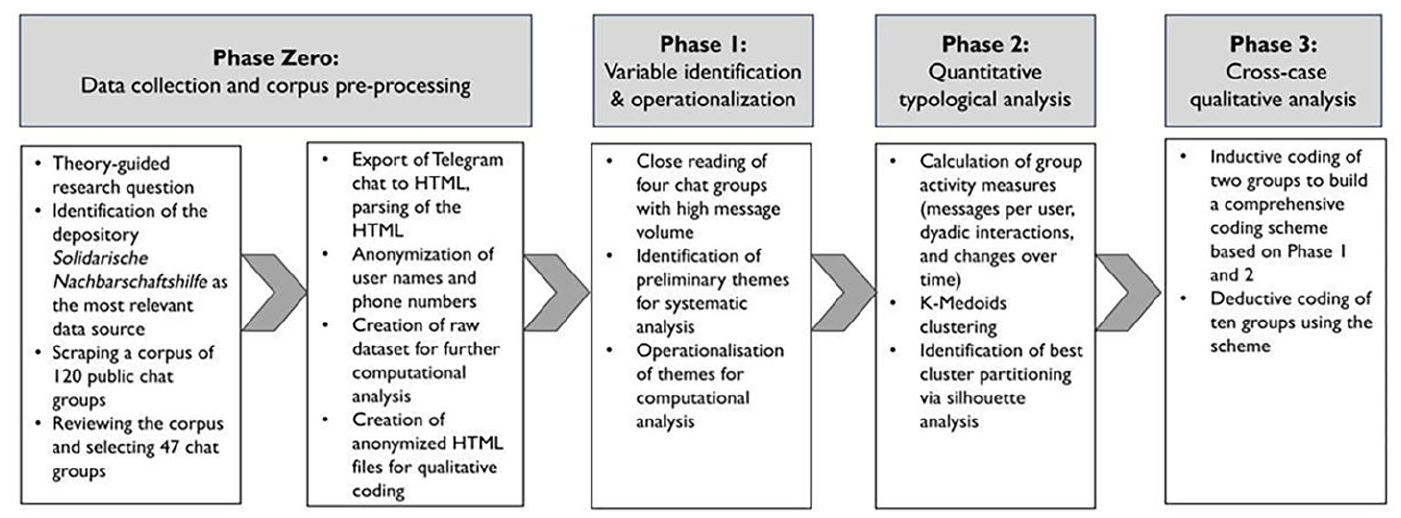
Methodological steps.
Phase 1: Variable identification and operationalization
The initial inductive examination served a twofold goal: (a) to familiarize ourselves with the data through close reading, and (b) to identify and operationalize key variables that would later guide quantitative clustering. Through close reading of selected chat groups guided by our RQs, we developed an initial understanding of group dynamics and solidarity practices. The analysis was guided by such concepts as action mobilization, social trust, neighborhood belonging, group cohesion, and epistemic authorization. This process followed mixed-methods principles of establishing conceptual linkages between data types (Tanner, 2023). The analysis yielded four dimensions of group activity: (1) information sharing, (2) action coordination, (3) community building, and (4) group communication, forming the basis for the creation of an early codebook (final version in Appendix A). For each dimension, we derived quantifiable indicators including message volume, conversation patterns, and user roles. These indicators were then operationalized into specific measures such as message frequency and user engagement patterns, providing the foundation for our subsequent clustering analysis.
Phase 2: Quantitative typological analysis
Next, we operationalized the patterns of “sustained interaction” (which is a theoretical characteristic of meso-spaces, Pasitselska, 2024; Tenenboim and Kligler-Vilenchik, 2020) to quantifiable measurements, such as the volume of messages or the number of contiguous conversations. To arrive at a diverse sample that would represent different activity patterns of the groups, we used K-Medoids clustering (Rdusseeun and Kaufman, 1987). Avoiding a priori assumptions about concrete group functions and activity over time, this method is a data-driven approach to group chats by means of measuring different dimensions of activity without imposing categories or being susceptible to extreme outliers (Jin and Han, 2011). In contrast to the often applied K-Means clustering, K-Medoids calculates clusters around single, central observations (medoids), aiding the interpretability of clusters. Furthermore, the medoids themselves can be interpreted as exemplary for their respective cluster. The clustering procedure was used, first, to systematically identify differences between groups, and second, to create a ground for meaningfully selecting groups for qualitative in-depth content analysis. Given the unrepresentative and unsystematically formed data set, selecting groups based on neighborhood or city rather than based on groups’ activity patterns would not result in identifying meaningful differences between groups. Moreover, we assume that variations in neighborhood solidarity stem from the chat groups’ communication patterns, not neighborhood characteristics, since all neighborhoods in the sample have residents interested in creating and joining local solidarity chat groups. For the clustering procedure, each group was represented by (a) the total number of messages posted to a group, (b) the number of active users, (c) the average number of messages per user, and (d) the Gini coefficient of user engagement, to account for (un-)evenly distributed chat participation by group members. Furthermore, we obtained a count of (e) contiguous conversations, which we defined as all interactions wherein users either directly replied to previous messages (using Telegram’s reply feature) or posted their contribution within 15 minutes after another message, 2 as well as a normalized count of conversations per user in the group. All of these activity measures of each group were determined (i) over the entire duration of the group’s activities; (ii) over the course of the year 2020, the year when the chat group was created, and (iii) during 2022, to capture the extent to which groups sustained their activity in the long term. The overall summary statistics of these clustering dimensions are described in Appendix B, alongside a detailed stability analysis of the clustering.
To determine the optimal number of clusters for the chat group sample, we relied on maximum silhouette width. While the result of this approach shows that there is a global optimum of two clusters (see Appendix C), the procedure indicates that one of these clusters can be further subdivided, resulting in a total of five clusters of groups with characteristically distinct activity patterns, allowing for a more fine-grained sample selection. Figure 2 shows the result of the K-Medoids clustering projected on a 2D-plane. For better visibility, only the medoids of each cluster, that is, the most central and representative group, are labeled. The clusters from Cluster 1 (19 groups) to Cluster 5 (2 groups) are labeled according to their size. A detailed account of chat groups included in each cluster, as well as their activity measures, can be found in Appendix C.
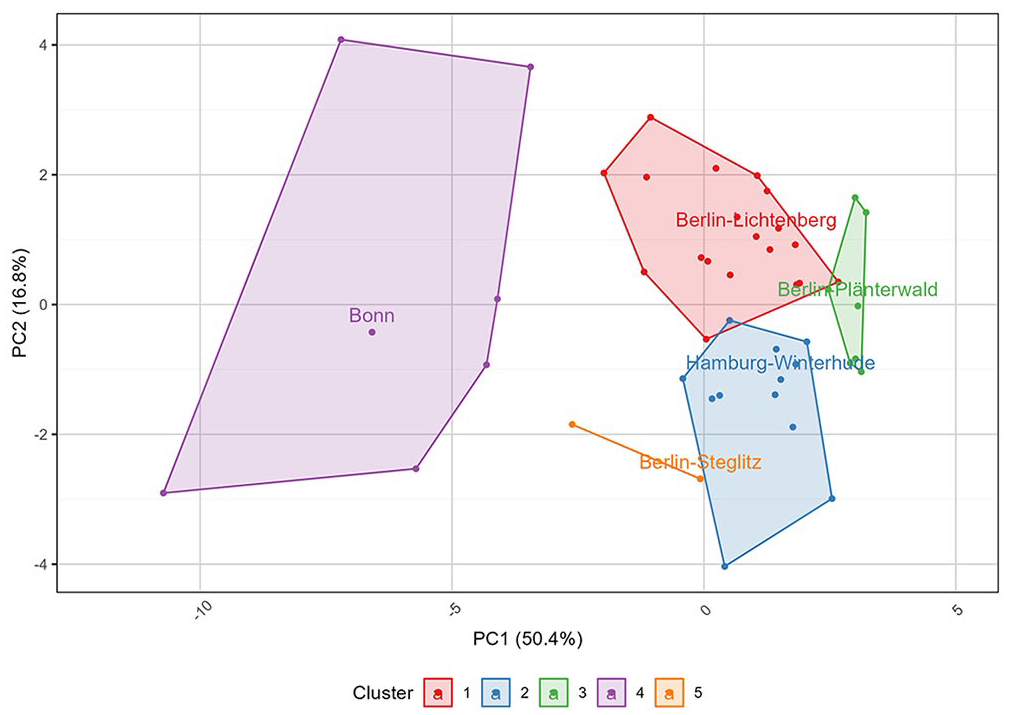
2-Dimensional visualization of k-medoids clustering results.
Figure 3 summarizes the key activity differences between clusters. Group chats in Cluster 4 post the highest number of individual messages, but their activity declines rapidly between 2020 and 2022, while other clusters have lower, but more consistent activity. Cluster 1 has a high author count, but this metric varies considerably between groups and over time. Cluster 3 has the most equally distributed user participation as measured by the Gini index, and Cluster 5 has the most unequal. Groups in Cluster 4 have the highest count of conversation events overall and in 2020, only superseded by groups in Cluster 5 in 2022. 3 Combining these insights with the initial close reading, we can see that some chat groups have managed to achieve consistent activity and equally distributed user participation, while other groups had a short life span and had only a small share of active users.
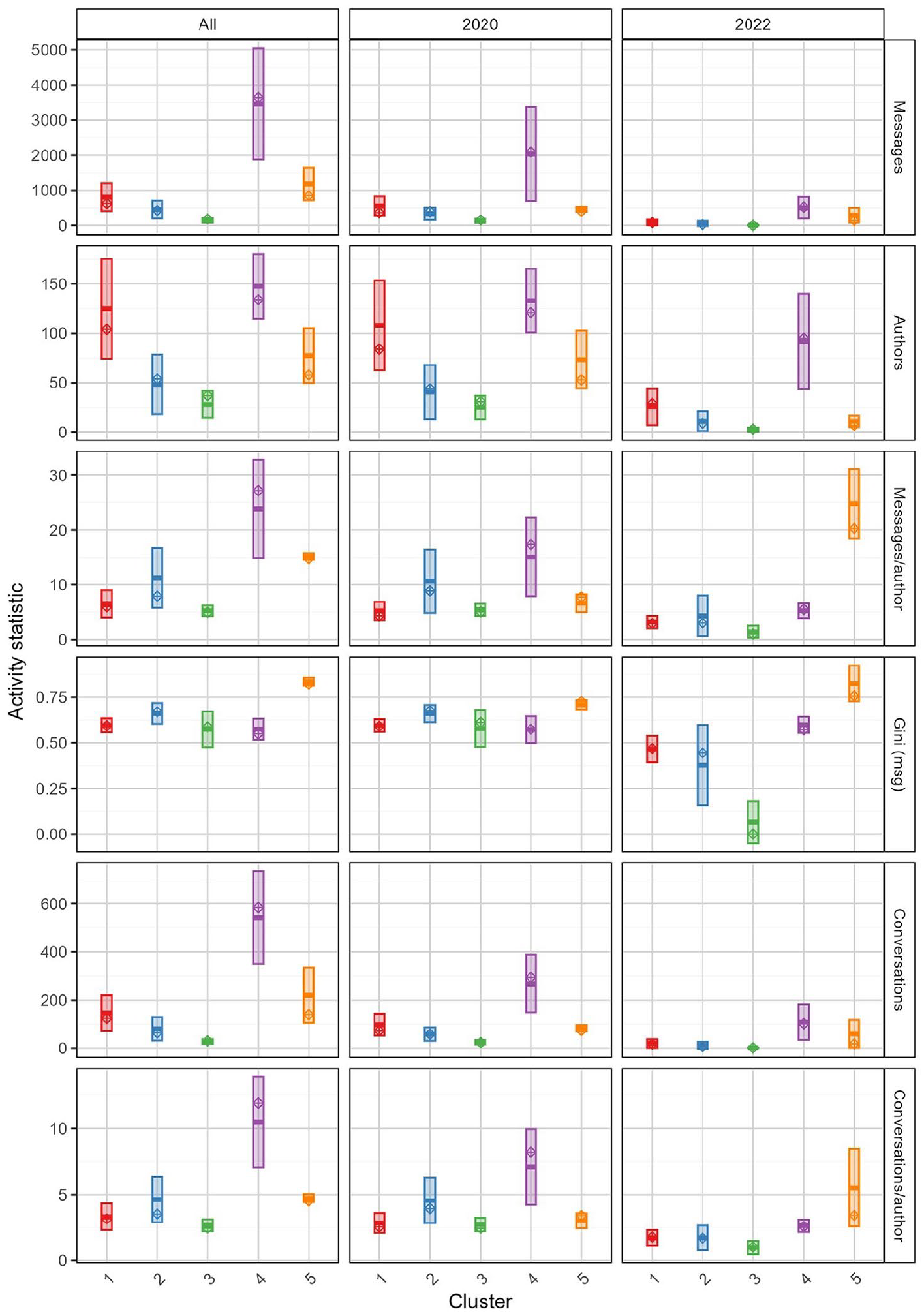
Summary statistics of activity patterns across clusters.
It is likely that drawing a sample from each of these clusters, containing the respective medoid and another random group chat (resulting in a total of 10 analyzed group chats), provides a set of neighborhoods and group chats covering a wide range of activity patterns.
Phase 3: Cross-case qualitative analysis
Following mixed-methods principles for nested sampling (Tanner, 2023), we conducted in-depth qualitative analysis of strategically selected cases from each cluster (n = 10, two groups per cluster). Two coders independently analyzed five groups each. Through regular team meetings, we iteratively refined the initial coding scheme to ensure that our empirical observations link back to the theoretical concepts (Corbin and Strauss, 2008). For example, posts that contained informational content or discussed handling information were divided into the categories of official information, community knowledge, and information organization, which all linked to the broader theme of epistemic authorization. Combining quantitative and qualitative analyses, we then identified the dimensions of users’ socio-technical practices that could explain differences in groups’ sustained activity, durability, and their potential for joint civic action.
Findings
Our analysis revealed how different group dynamics shaped these initiatives’ capacity to initiate civic action and integrate into local civic infrastructure. The groups clustered into five distinct types, characterized by users’ socio-technical practices along six key dimensions: normative governance, formation of shared group discourse, hierarchical organization, local or global orientation, formation of collective action agenda, and affective or instrumental organization of group space (see Table 1). These dimensions critically influenced how effectively groups could leverage Telegram for civic action.
Overview of chat groups for in-depth analysis.
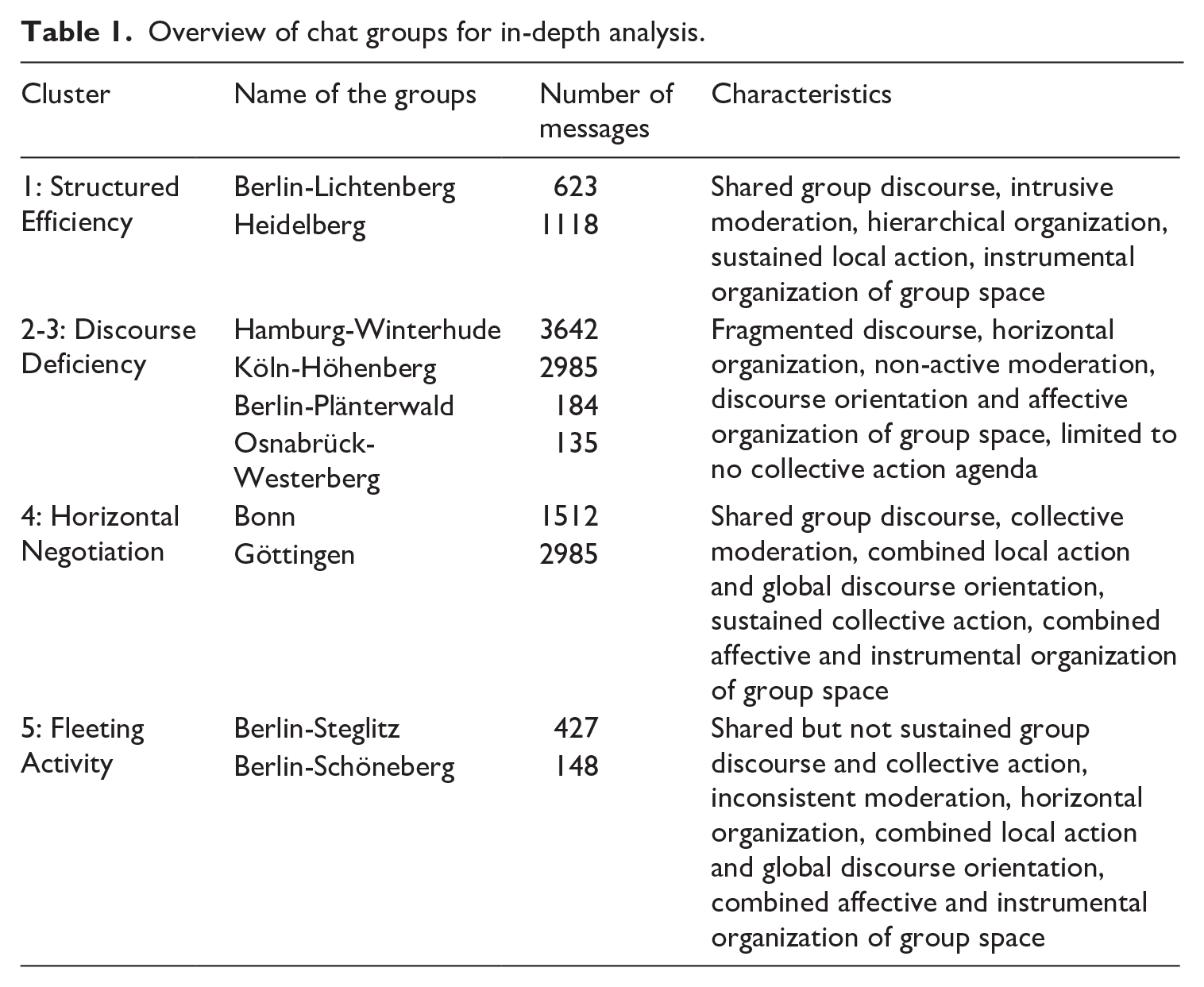
Groups in Cluster 1 achieved effective structuring through interventionist moderation via the use of platform features and instrumental organization of the group space. These groups developed a shared discourse and action agenda through moderator-imposed norms and assumed a restrictive orientation on local action. Chat groups in Cluster 4 utilized collective moderation through reply chains and reaction features for horizontal negotiation of group norms and boundaries. Groups in this cluster managed to develop an action agenda on the local level, while also permitting affective communication and discursive orientation on global issues. In contrast, Clusters 2 and 3 were marked by discourse deficiency, expressed in fragmented conversations, hands-off moderation, and little to no collective action agenda. Cluster 5’s fleeting activity comprises a middle-ground: while these groups managed to produce a shared discourse and collective action agenda, they could not sustain it, and their activity quickly deteriorated.
In the following, we examine how these differently patterned socio-technical practices shaped three key aspects of civic infrastructure integration: the definition of neighborhood solidarity, the facilitation of civic action, and the connection to other actors and networks. We will then discuss the factors that limited the groups’ infrastructural integration.
Definitions of “solidarity”
To understand the character, scope, and limits of civic participation enabled by the chat groups, it is essential to first unpack their definitions of “solidarity” and group functions. All groups worked under an explicit normative framework from the start. Almost all of them copied, pasted, and pinned a similar set of rules. The rules included the explanation of primary group use (“to be a forum of solidarity and exchange for all people who live in [X] and want to show solidarity with their neighbors”), what constitutes “bad” behavior (“isolation and panic purchases,” “discrimination and scaremongering”), and what constitutes “good” behavior (“solidarity and support,” “calm and facts”). Furthermore, some moderators included guidelines for what not to post (including “fake news” and discriminatory statements, as well as queries of a personal character (“where can I get my favorite pesto?”).
The groups that did not enforce basic rules (such as “no spam” and “no advertisements”) or had minimal activity deteriorated quickly, failing to develop a shared agenda (Clusters 2 and 3). In the remaining clusters, as group membership and posting activity increased, the broad and abstract notion of “solidarity” became more contentious, prompting calls for a clearer definition and stronger boundaries around inappropriate—though not explicitly prohibited—content. Tensions quickly emerged between the participants who wanted to preserve the groups “practical” purpose (“This channel is for providing help, whether it’s practical assistance or information”) and those who engaged in argumentative discussions on political matters (such as homelessness, racism, refugee crisis, or Israeli–Palestinian conflict), or extended network-building with activists beyond the neighborhood. Next, we review these tensions across three identified primary functions: local and global action coordination, epistemic authorization (including debates on political matters), and building networks within and beyond the local activist scene.
Functions and tensions
Action coordination
From the start, the groups were intended for coordination or “match-making” between those who offered and those who required help. Soon, however, the groups revealed that supply largely exceeded demand, which had to do with a rather homogeneous composition of group participants that will be discussed later. Given the lack of demand, the action coordination function diversified and extended from individual to group level. The groups performed coordination of online and offline activities, from purely affective and symbolic, such as expressing solidarity with medical workers (e.g. through coordinated clapping) to material and practical, such as organization of the so-called “donation fences” (see below for a picture).
The distinction between the clusters became evident in their capacity to move from affective and online exchange to coordinated action offline. Nearly all “Solidarity” groups offered opportunities for symbolic solidarity actions, as shown in this example from the Discourse Deficiency cluster group (which otherwise showed limited activity):
Wow, [anonymized neighborhood name] just applauded a lot
there was more here too :)
Here too, how about singing or playing “Ode to Joy” tomorrow.
I was the only one. I haven’t heard of any others far and wide
I almost forgot, but today the applause was so big that I still heard it despite the music 

 At least three [people clapped] in my backyard today
A higher level of organization was needed to perform offline coordination, which required dedicated moderation, a larger pool of “activists,” and sustained engagement over time. One of the most successful collective actions across the groups was the organization of “donation fences.” By placing packages of food, medications, and clothing items on the fences or other publicly accessible spots in the neighborhood, groups could distribute aid while maintaining social distance to prevent virus transmission. The group’s task was then to find appropriate locations and keep them tidy when the donations accumulated. This project required ongoing accountability—members had to regularly check the sites, photograph their condition, and report back to the group. Even groups in the outlier Fleeting Activity cluster managed to achieve this relatively sophisticated level of self-organization, as shown in the following example:
hey everyone, update from me this evening: there’s tons of stuff here, but lots of it is unpackaged, including loaves of bread for example. [. . .] maybe we could all bring extra bags to pack loose items. just a bit from everyone, [. . .] you’re awesome!
Thanks for the update! Hm..yeah it looks a bit messy.. would be great if we could pack it in bags :)
Suggestion: Bread or rolls that can’t be used anymore could be collected and distributed to circuses or wildlife parks in and around Berlin.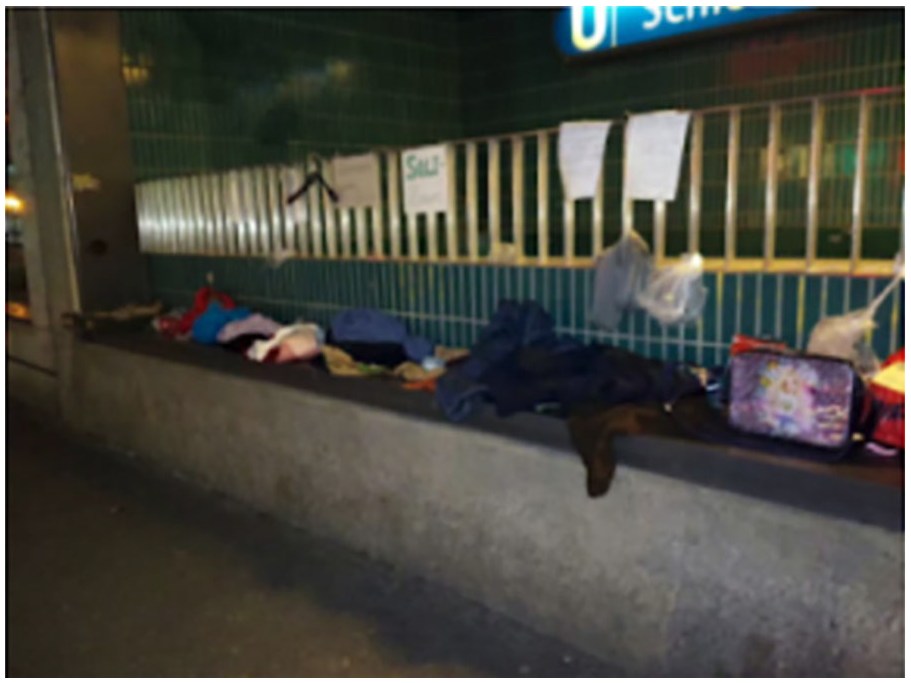

Groups that reached higher levels of self-organization through sustained activity also engaged in active metacommunication about their function and scope. As shown below, such metacommunication could lead to both productive expansion of group activities and significant tensions.
Epistemic authorization
Alongside help requests and offers, the groups shared information from external sources, including mainstream and social media, and governmental websites. As a result, they generated local knowledge based on the group members’ expertise about available supplies, strictness of curfew and social distance regulations, navigation in the city etc. The groups also conducted joint research and created and maintained archives of useful links, governmental regulations, and other information. However, these collective epistemic processes were contested by some users who regarded this as a divergence from “practical help” as primary purpose:
Please don’t take this the wrong way, but in my opinion this group should serve as a mutual aid group and not for gathering information. By doing this we’re just unnecessarily “cluttering” this communication channel with things that you could google yourself or–even better–look up on the Robert Koch Institute’s website.
In the groups of the Structured Efficiency cluster, characterized by a stricter and more interventionist moderation style, moderators provided a narrower definition of “information” and policed any divergences from it:
On the occasion, once again for everyone: This channel is for providing help, whether it’s practical assistance or information etc. Information can of course be helpful, but: Information should have a source. Opinions are not information. Moralizing and passing judgment is not information. Rumors are not information. In the discussion group [link to the discussion group] things can be discussed for longer.
In line with this moderation style, the groups limited informative function by requiring members to post queries in a certain format and restricting their further discussion, or by restricting the amount or types of links to external sources. This sometimes led to one-way posting and the loss of the shared discourse around the group agenda. The emphasis on “practical information” often clashed with the desire of participants to discuss political matters and share opinionated content. In addition, many users positioned themselves as relatively privileged in relation to vulnerable populations, making the sharing of petitions and activist calls a natural extension of their engagement:
[reposting their own earlier post] Dear people–I mainly want to remind you that most of us have nothing to fear and that those who suffer most are especially homeless people and people seeking protection, [. . .] I don’t even want to know what happens when in moria or in the informal camps. . .
Almost every group at some point encountered this problem, and most of them addressed it by opening another group solely for discussions and political talk in order to keep the “main” channel “noise-free”:
This seems to be developing into a lengthy discussion. Many other districts have extra discussion groups for this, so that the main chat for mutual aid remains uncluttered.
However, the discussions still arose from time to time in the “main” channel, often foregrounding political (and sometimes ethnic) identities and bringing conflict, which contrasted with the seemingly non-controversial agenda of “solidarity practical help” groups. Political disagreement, together with a strict moderation policy, led to the quick deterioration of group dynamics in the case of one of the Structured Efficiency cluster groups. After heated discussion and the moderators’ decision to limit posting to one post per hour per participant, posting stopped almost entirely. This demonstrated that sustaining and handling disagreement was important for groups’ ability to survive, given the weak base for group cohesion. In another example from the Horizontal Negotiation cluster group, participants embarked on a political discussion that touched upon the issues of homelessness and racism. While some users deemed the discussion valuable, other users called to end it or transfer to another group, but the moderators did not erase the messages or otherwise police the discourse. Importantly, soon after this discussion, the group organized an offline effort to help a homeless person in the neighborhood, and the issue was later continued by organizing donations to a local homeless shelter. This type of negotiated group functionality that combines political discussion with practical help is what distinguishes the groups in Cluster 4.
Network-building
With the intensive information exchange, the groups could not exist in isolation from the broader civil society and online networks. The largest share of network-building happened within Telegram’s own infrastructure. Users from other groups “visited” to invite new members and establish cross-groups connections, group members requested links and were referred to other groups according to their physical location, and new groups branched from the “main” channel, based on shared interests. Importantly, some NGOs and labor unions had their own Telegram groups, enabling a smooth integration with the newly established “solidarity” network on the same platform. Most of the NGO interactions had a one-off character, so the group space often looked like an announcement board. When users started noticing the scarcity of help requests, alternative platforms (often NGOs’ own requests/offers web aggregators) were suggested instead of coordinating further activity in the group chat. Very limited coordination of network-building happened around the organization of donations, for example, by establishing a prolonged contact with local food banks and sending notices in the group whether help was needed. Another type of networking coordination included mobilizing users’ personal networks to establish connections:
What do you think about setting up a donation fence in [street]? Or is there already one in the area?
Great idea. Which location would be good for this?
I think the fence at [local community center] was used for this before–and it’s pretty central too. Maybe just ask them..?
[Tagging User 4] could you ask at the [local community center]? Maybe [tagging User 3] could help a bit with the organization through the citizens’ association?
With that, the establishment of two-way, sustained connections with other local civic actors was beyond the scope of the groups’ activity. The primary difference between the clusters in terms of network-building can be noted in the way the Structured Efficiency cluster groups handled network-building, by yet again creating a separate group:
We’re creating a separate channel for information, invitations, and mobilizations that are good, right, and important, but don’t directly relate to Corona and the lockdown in the neighborhood, and we’d be delighted if many people would also use it to advocate for more exchange in the neighborhoods, even without reference to Corona.
While the tensions between (online) discourse and (offline) action orientation, as well as between global and local activism were apparent, we did not find similar controversy around the private versus public positioning of the groups and the chats’ contents. It was rather a tacit outcome of platform affordances than a result of users’ practices or reflection. While group members aimed for the broadest possible spread of their call for solidarity, they time and again stumbled upon the problems of fragmentation and information overload of the platformized infrastructure.
Trade-offs and limits of solidarity and action in chat groups
Upon revisiting the development of group discourse, we can distinguish three sources of limitations that impede the realization of the groups' potential: narrow focus, discourse structure, and participant homogeneity.
Narrow focus
The groups’ initially stated goal was to provide local and practical help. Gradually, however, the groups’ thematic scope extended to global injustices and/or global political issues. This tension was resolved either by strict moderation, which harmed the sociability of group discourse, or by permitting discussion and conflict, which also weakened the initial impetus to overarching solidarity in some groups. On the one hand, many users valued a “niche” focus of the groups and tended to disengage if their focus extended beyond the neighborhood practical help:
Hey, I think it’s great that there are so many politically engaged people here! However I don’t have much time and I already receive so many requests through email, Insta, and Facebook [. . .] I can’t possibly keep up. This group is meant for solidarity in neighborhood assistance, so I’d prefer to receive only local requests. Otherwise I (and probably many others) will mute this group.
On the other hand, focusing only on the neighborhood issues impeded network-building processes and the identification of problems that could be addressed by the group during periods of low demand for neighborhood help. Concurrently, varying perceptions of the group’s purpose (e.g., some users viewed it as a general information channel while others considered it a platform for practical help requests) resulted in conflicting expectations and diverse use patterns.
Discourse structure
Platform affordances dictated a certain discourse structure: the absence of chat structure and the rapid, chaotic flow of conversations posed challenges for coordination and organization (see Zhu et al., 2024, for a more in-depth discussion of these challenges). This, in turn, demanded either stringent moderation or a significant investment of time and effort to negotiate norms and boundaries on the part of the group activist core, both of which could potentially disrupt the group’s amiable and collaborative dynamics (see Appendix D for explanation of identification of moderators and activists from observational data). The absence or quick dissipation of an activist core (notably, in Clusters 2 and 3 Discourse Deficiency and Cluster 5 Fleeting Activity) severely impeded the groups’ functional capacity.
Access and user homogeneity
As can be inferred from the groups’ discourse, they were predominantly composed of younger and more privileged individuals who did not face substantial hardships during the lockdown and could afford to volunteer their time and resources (see Appendix D for examples used to infer groups’ demographics from observational data). Consequently, this demographic makeup limited the groups’ capacity for match-making between those seeking and offering help. While groups recognized the absence of those who needed help most (older people, those without Internet access, homeless), they quickly ran into the issue of access to people they wanted to aid. Telegram affordances facilitated quick initial connections in and between the “solidarity” groups, but the target populations were expected to be found on other platforms (like Facebook), or offline. In some cases, however, sophisticated coordination between online and offline allowed to overcome this barrier, like in this effort to locate the homeless person the group tried to aid:
Yes, exactly, in front of the city hall just before the traffic light. He’s sitting there today, I spoke with him about an hour ago. A young person, I’d estimate around 30 years old, wearing a hoodie. [adds a picture of an online map with a cross on it that shows the location of a homeless person].
Discussion
This study has investigated how messaging groups afforded a space for civic action during the COVID-19 pandemic in Germany. The analysis revealed tensions that both resemble and deviate from the dimensions of public/private, local/global, and online/offline, introduced in the theoretical framework. The groups ultimately struggled to resolve their liminal position between local and global political agendas, between unlimited online reach and localized material action, and between open political discourse and the need to maintain sufficient consensus for practical help.
These findings contribute to the discussion of the relations between cross-cutting political talk and political participation (Matthes et al., 2019), specifically addressing the dilemma of “fundamental incompatibility” between participatory and deliberative democracy (Mutz, 2006: 2). This dilemma states that talking to fellow citizens with whom a person disagrees politically is key for deliberative democracy but dampens participation. We want to enter this debate by redefining participation and talk in digital spaces and paying closer attention to users’ motivations.
On the one hand, this tension might be the result of the collective curation of a common discursive space (Gagrčin, 2024) rather than contradicting ideological views or fear or discomfort of talking politics (Zhu et al., 2024). The tension between “practical help” and information or opinion sharing suggests that epistemic vigilance in these groups is not just about evaluating truth claims; instead, it is entangled with questions of relevance and group purpose. Users and moderators who invest civic labor in maintaining their discursive space as a shared commodity, free from all sorts of “clutter,” would censor political discussion out of care and respect for the group (Butler et al., 2002; Matias, 2019). From our results we can also see that when the moderation is done as a collective practice of norm negotiation rather than through platform-supplied tools, the group’s activity remains uninterrupted. While Chadwick et al. (2025) suggest rulemaking can foster collective reflection, our findings show this can also lead to rigidity. In the Structured Efficiency cluster, strict rule enforcement actually reduced group engagement to the point of deterioration. The Horizontal Negotiation cluster presents an interesting counterpoint—their more flexible approach to epistemic rules actually enabled productive combinations of discussion and action.
On the other hand, users’ motivation for excluding political topics could be the need to depoliticize the space to establish rapport with fellow neighbors and facilitate collaboration (similar to silencing political conversation among volunteers in Eliasoph, 2003). In our data, especially the discussions of national and global political issues (such as homelessness, racism, or the refugee crisis) often led to negotiation of group boundaries, and sometimes to exclusion of individuals and topics from the group discourse, with subsequent decline in willingness to converse. We can see that discussions were important for group-building, but also divisive and alienating, which in turn impaired the group’s ability to gather and distribute practical help. With that, some groups were evidently still able to sustain both political debate and local civic action. These groups can be seen as a version of Fraser’s (1990) “strong publics” that participate in decision-making in addition to discussion and demonstrate participatory parity. We can add to Fraser’s framework that the ability to sustain and overcome conflict is another important trait that allows a public to preserve engagement overtime. Future studies should compare democratically oriented groups with the anti-democratic groups (Buehling and Heft, 2023) to understand whether political orientation prescribes different group norms and moderation practices and results in different dynamics.
In contrast to very apparent tensions between local/global and online/offline dimensions of groups’ activity, the tension between private and public dimensions was rather tacit. This calls for revision of our starting point, the concept of “meso-space” (Tenenboim and Kligler-Vilenchik, 2020). Our case study focusing on public Telegram groups with intended local outreach expands this theory from two aspects.
First, we did not find that group members were concerned with safety of their discourse or associated Telegram with the affordances of semi-public or private conversation (cf. Zhu et al., 2024). Indeed, the publicness of the groups was embraced by users as demonstrated by active sharing and intent for broadest possible outreach. At the same time, the activist context and the situation of crisis, their local positioning, and relative ideological homogeneity has undoubtedly contributed to reciprocity and sociability in the groups. After all, group members in all clusters engaged in affective place-making practices (Breek et al., 2021) and shared sensitive information (such as medical diagnoses, location, political views) relatively freely despite the groups’ public accessibility. This liminal position made the chat groups vulnerable to misuse (hence, so many groups filled with spam quickly deteriorated) but in some cases, it resulted in horizontal curation of discursive space with no entry barrier and equally visible and valuable individual contributions. Equalization of discursive space can then be regarded as an additional characteristic of meso-spaces, that is both afforded through platform design (unstructured chat layout) and is an outcome of a collaborative and civil discussion.
Second, the meso-spaces theory demonstrated limited ability to predict how a group will evolve and explain why certain groups were better at resolving tensions and sustaining collaborative discourse and action through time. Notably, the groups in five clusters developed differently despite their similar context and affordances. As previously argued (Pasitselska, 2024), the conceptual classification of meso-spaces should go further and look into interactive practices and group dynamics when aiming to delineate spaces that afford sustained reciprocity, and foster trust and social capital. In our case, beyond the systematic moderation and presence of an activist core, the distribution of responsibility for the discursive space, instead of rigid and hierarchical moderation practices, contributed to the groups’ development. The division of civic labor in discursive curation of meso-spaces is then another important characteristic that should be accounted for in the study of social media and messaging platforms as spaces for political and civic participation (see also Gagrčin, 2024; Moe, 2020).
Methodologically, this study expands the mix-methods toolkit for analysing meso-level chat group discourse, by computationally comparing the activity in many average-size groups and using the output as sampling for granular qualitative analysis. We argue that this approach allows for a more nuanced understanding of the data than a macro bird-eye view (Buehling and Heft, 2023), but also for larger-scale, more generalizable results than in-depth analysis into conversational dynamics (Pasitselska, 2024).
Finally, on the practical level, the study has shown that quite a high level of self-organization was possible in weak-tie chat groups, and some of them managed to identify and address local problems such as the lack of supplies for vulnerable populations. However, the absence of such vulnerable users within these spaces points to a problem of epistemic inequalities that persist despite the relative accessibility of Telegram (Gagrčin and Moe, 2024). Drawing on Dotson (2012), we can understand this absence not only as vulnerable populations’ inability to gain access but also as a form of complacency among more privileged participants. Despite good intentions, participants mostly stopped at acknowledging vulnerable populations’ absence, thereby settling for their existing communicative practices and interpretive schemas rather than actively transforming them, which ultimately reproduced exclusionary patterns despite awareness of them. The “Solidary neighborhood help” groups remained an “issue public” (Kim, 2009) and did not transform into neighborhood-based community groups after the crisis was over. The chat groups occupied the gap between the general public and municipality-level activists and non-governmental organizations (Chevée, 2022) as a temporary addition to the local civic infrastructure. The community became actualized through messaging groups as a crisis response, falling dormant when life returned to normal, and leaving unaddressed the challenge of creating more epistemically inclusive spaces during future crises.
Limitations
This study has several limitations concerning data collection, sampling, and the nature of the groups studied. First, we want to note the limitations of the data scraping method. Since we collected data 3 years after the groups were created, an undetermined amount of data was lost due to deletion of Telegram messages by their authors or by the group chat administrators (see also Buehling (2024) for a discussion of this issue). Furthermore, the group sample is limited to German Telegram group chats referenced in the aforementioned repository, meaning that neighborhood or city chats that are not included in this repository or are active on other messaging platforms were not considered. Accordingly, we acknowledge that our sample is not statistically representative of all “Solidary neighborhood help” Telegram groups. Yet, the underlying assumption that groups sharing similar goals and organizational capabilities would be likely enlisted in the repository justifies our treatment of this sample as a meaningful share of local solidarity initiatives.
Regarding the sample composition on the microlevel, we recognize that the groups under investigation comprised a specific segment of urban Telegram users, likely to lean left politically and be more civically active than the general population (see Appendix D for clarification). Overall, while our findings are specific to this crisis period in Germany, they illustrate various mechanisms of how digital platforms can support or hinder community solidarity under heightened pressure for collective action. As such, they can be used for comparison with other national cases of similar mobilization efforts. Future research could help disentangle (infra)structural from cultural and socioeconomic factors structuring this type of collective action, in line with Costa’s (2018) affordances-in-practice approach.
Finally, we acknowledge that studying social phenomena like trust and solidarity through content analysis alone has inherent limitations. Interviews with group members and moderators would have provided additional insights into how solidarity was experienced and enacted beyond what is visible in the message content. Despite these limitations, we believe that this study contributes to both theoretical and empirical research on digital citizenship within the unique context where the normative requirement was the mobilization of all available civic resources.
Supplemental Material
sj-docx-1-nms-10.1177_14614448251349426 – Supplemental material for Chat groups as local civic infrastructure: A case study of “Solidary neighborhood help” Telegram groups during the COVID-19 pandemic in Germany
Supplemental material, sj-docx-1-nms-10.1177_14614448251349426 for Chat groups as local civic infrastructure: A case study of “Solidary neighborhood help” Telegram groups during the COVID-19 pandemic in Germany by Olga Pasitselska, Kilian Buehling and Emilija Gagrčin in New Media & Society
Footnotes
Acknowledgements
We are grateful to Christian Baden for his insightful feedback on an earlier version of this manuscript.
Correction (August to October 2025):
In the published version of the article, the subheading “Telegram groups as meso-spaces for civic participation” on page 5 was inadvertently added. This has now been removed from the text and the article has been updated online to reflect this change.
Authors’ note
Emilija Gagrčin is also affiliated to University of Bergen, Norway.
Data availability statement

Funding
The author(s) disclosed receipt of the following financial support for the research, authorship, and/or publication of this article: The second author received funding from the German Federal Ministry of Education and Research (grant nos. 13N16049 [in the context of the call for proposals Civil Security – Societies in Transition] and 16DII135 [in the context of the Weizenbaum Institute]). The third author received funding from the European Union (ERC, PREPARE, grant no. 101044464).
Supplemental material
Supplemental material for this article is available online.
Notes
Author biographies
References
Supplementary Material
Please find the following supplemental material available below.
For Open Access articles published under a Creative Commons License, all supplemental material carries the same license as the article it is associated with.
For non-Open Access articles published, all supplemental material carries a non-exclusive license, and permission requests for re-use of supplemental material or any part of supplemental material shall be sent directly to the copyright owner as specified in the copyright notice associated with the article.
