




Abstract
Within the context of three-dimensional simulations of urban space and their variables within, digital twin technologies (DTs) are touted as making urban governance and planning effective, calculable, evidence-based while reducing costs and complexity. We conducted 3 years of in-depth fieldwork on the application of DTs for urban governance in the Netherlands. Our empirical and critical analysis shows that DTs are not characterized by a novel quality of technological promise, but rather conform to prevalent narratives wherein technologies are marketed and advertised through specific imaginaries. Deconstructing the sociotechnical imaginaries through empirical evidence of real uses cases highlights the gap between the promise of the digital twin narratives and the emerging responses and practices in government. Therefore, through deconstruction, we call for practical, realistic, and responsible uses of DTs for urban governance and provide preliminary regulatory steps.
Keywords
Introduction
In 2021, an ambitious investment proposal for a National Digital Twin for the Physical Living Environment (DTFL) was brought forward (Geonovum, 2021). This proposal, commissioned by the GI Council (The Dutch Council for Geo-information), aimed to tap into the €5.6 billion Recovery and Resilience Facility (RRF) funds (VNG, 2022). Developed by a consortium of Dutch provinces, research institutes, the Ministry, and semi-public entities, the plan requested €37.6 million over 5 years, promising an impressive annual return on investment of €82.8 million. The envisioned National Digital Twin was set to revolutionize the way the Netherlands visualizes its living environment, serving as a powerful tool for governments, citizens, businesses, and knowledge institutions. It aimed to tackle societal challenges and devise innovative solutions by providing a comprehensive, nationwide digital representation of the physical living environment. However, despite its grand vision and potential, the investment proposal was rejected. It remains unclear whether the proposal was rejected because its ambitions appeared too lofty, or whether its goals were unachievable?
Besides this grand national investment proposal, Dutch governments on a local and provincial level are also experimenting with urban digital twin technologies (DTs) (e.g. Geonovum, 2021; VNG, 2022). Urban DTs are being rolled out in dozens of municipalities in the Netherlands and can be found in the 40 biggest cities of the country. 1 Such urban DTs consist of multiple maps, datasets, and models that together provide a simulation of a wide range of aspects in urban governance and planning. They promise, among other things, the optimization of public governance and policy processes, as well as environmental and building regulations. What is more, urban DTs are claimed to contribute to citizen participation processes. For instance, the public DT of the municipality of Alkmaar aims to provide a consistent and up-to-date digital representation of all plans and projects related to the Alkmaar Canal. This platform should allow citizens to respond digitally, engage with project developers or policymakers, and contribute to a safe, healthy, sustainable, and democratic city (Alkmaars Kanaal, n.d.; see Erasmus Centre for Data Analytics, 2020 for a similar European Union [EU]-funded project).
However, several scholars from different disciplines such as critical data studies (Crawford, 2021; Iliadis and Russo, 2016; Kitchin, 2014), smart city literature (Gabrys, 2014; Powell, 2021), science and technology studies (Mager and Katzenbach, 2021; Sadowski and Bendor, 2019) and public administration (Meijer, 2018; Van Zoonen, 2020) have warned to approach such governance ambitions of system technologies critically. Building on this literature, we argue that these various aspirations concerning DTs in Dutch urban governance are shaped by sociotechnical imaginaries and are in need of deconstruction. Sociotechnical imaginaries encompass intertwined narratives speculating on the diverse uses and societal impacts of technologies (Flichy, 2007; Jasanoff and Kim, 2015). These imaginaries help develop, implement and utilize DTs. To deconstruct such imaginaries, Sheikh et al. (2023) highlight significant challenges for both government and society, among the imperative to demystify technologies as AI. This involves fostering a realistic understanding of technologies and moving away from the notion that such technologies are inherently rational and objective. This appears to be especially relevant for DTs practices in the Netherlands, where these technologies raised concerns about the risk of succumbing to exaggerated tech-optimism (e.g. VNG, 2022).
Though there is a grand pool of literature on the deconstruction of sociotechnical imaginaries and a growing body of literature on DTs, a significant gap exists in understanding the tangible impacts and challenges associated with developing and deploying DTs in the context of public administration, including the interactions, ways of working and the data literacy of public administrators (with the notable exception of the examples in Schäfer et al., 2023, 2024). This knowledge gap hinders a demystified and realistic understanding of DTs, but also the embedding of these understandings in practical actions, which impacts public organizations and society more generally. Therefore, this study aims to address this gap by conducting fieldwork to deconstruct DTs, exploring their technical frameworks, data origins, implementation processes, and user groups. Through this endeavor, our goal is to illustrate how discourses surrounding DTs in government may be misconstrued and embedded within sociotechnical imaginaries. This inquiry leads to the central question of our article: To what extent do sociotechnical imaginaries of urban digital twin technologies collide with practical applications of these technologies in Dutch urban governance?
To address our central question, we undertake empirical and critical examination into how DTs are introduced within government organizations, analyzing emerging concerns across the development and (envisioned and actual) deployment phases of DTs in governmental organizations, their funding mechanisms and providers. We conduct qualitative, transdisciplinary, and collaborative research and draw on 3 years of extensive fieldwork within various Dutch local and provincial governments (Cornish et al., 2023; Schäfer et al., 2023). Despite public administrators’ increasing interest in DTs, we argue that DTs are not characterized by a novel quality of technological promise—especially given that they are not fundamentally new technologies (Grieves, 2023; Ketzler et al., 2020)—but rather conform to prevalent narratives wherein technologies are marketed and advertised through specific imaginaries (cf. Flichy, 2007; Mosco, 2004; Schäfer, 2011). Therefore, our in-depth understanding of digital twin discourses, grounded in tangible use cases, procurement insights, and technology development, provides an empirical contribution to current debates about DTs in governance by demystifying their promise and highlighting the potential for practical and responsible applications of DT for urban governance. To date, such empirical accounts are lacking in academic, professional, and practical debates, despite their critical need. For instance, Sheikh et al. (2023), emphasize that fundamental research on AI in the public sector remains necessary, both to overcome various limitations and shortcomings and to further develop the techniques. For that reason, our empirical and critical examination responds to this call, by researching DTs practices in the context of public administration.
In the following section, we touch upon the theoretical lens of this study, focusing on the definition and uses of DTs, sociotechnical imaginaries and their connection to DTs, alongside the steps toward responsible AI use outlined by Sheikh et al. (2023). We then outline our methodological approach, which involved 3 years of extensive fieldwork using action research methods across various local and provincial governments in the Netherlands. This approach allows us to deconstruct these DTs practices, following the five steps—demystification, contextualization, engagement, regulation, and positioning. We conclude by highlighting that demystification is the first pressing step for developing practical and responsible use of DTs.
There is no such thing as a digital twin
The body of literature on DTs is growing and as of now has focused on aspects such as their representation (e.g. Korenhof et al., 2021, 2023), definitions (van der Valk et al., 2020), and technical functions within fields like computer science and smart city development (e.g. Deng et al., 2021; Schrotter and Hürzeler, 2020). Alternatively, in our article, we focus on understanding how DTs are developed and deployed in governmental contexts. We argue that there is not one shared understanding of DTs for urban governance and planning.
The promises communicated in advertisements and corporate presentations of tech companies are that first, DTs for urban governance and planning are often easy to use software applications with comprehensible interface design to monitor and navigate three-dimensional (3D) representations of urban space in which all kind of activities (e.g. traffic mobility, construction of buildings and other artifacts, planting of trees), and phenomena (e.g. heat, noise, water, subsidence, shadows) can be simulated (Mihai et al., 2022). However, DTs are much more complex and often require a wide range of data sources, different interfaces to work in, and for developing accurate simulations that provide actionable intelligence, it also requires training and skills. The notion of DTs as accurately representing the territory is thus dependent on the available and accurate data (Rodríguez et al., 2023). The use scenarios of these technologies are dependent on specific configuration and features.
Second, the promise is that the simulation DTs provide is comprehensive and easy to understand also neglects the different use scenarios of DTs and the wide range of media literacy of different user groups (Shin et al., 2021). DTs, especially for urban planning, are rarely a single software solution with one interface but often provide a range of different interfaces that are needed for different purposes when working with DTs. The most public-facing appearance is often a 3D simulation not unlike the game SimCity (see Figure 1). However, for other purposes, different maps might be needed, such as a map of the electric grid, the sewer system, the different altitudes to simulate floods, or the distribution of heat to calculate heat stress. The latter actions require rather advanced digital literacy in operating the software.
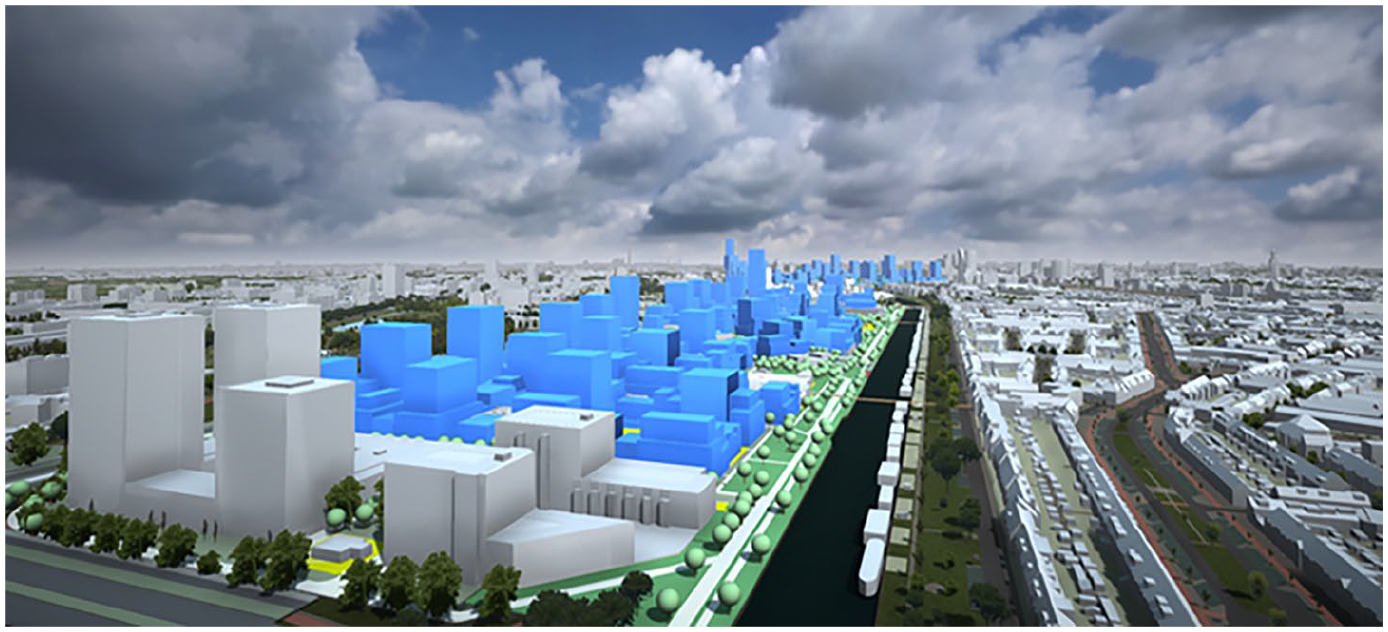
Utrecht 3D (Gemeente Utrecht, n.d.).
Several companies operate in the Netherlands developing and marketing DTs, among Unity, Imagem, Tygron, OMRT, Future Insight, The People Group, and others. In our exploration of the DTs for urban governance in the Netherlands, we identified two design paradigms in the landscape of DTs: the single software application of a 3D simulation software that focuses mainly on the representation of the urban space, and a platform-based approach that provides mainly processing power for simulating all kinds of different scenarios in different maps. The first approach is mainly represented by Unity, and the second by Tygron. Both use a game engine for simulating the 3D environment, but they differ profoundly in functionality and design. Providing a very versatile platform, Tygron’s focus on data professionals who work intensely with GIS data and develop their own models for different simulation purposes is apparent. Unity provides a more interface-focused 3D simulation that seems to limit the expert users’ integration of different models and applications. Both principles raise issues concerning usability and functionality, transparency of the models used, the data, issues of vendor independence, and interoperability.
Consequently, DTs appear to be much more than merely an accurate simulation of urban space (see van der Valk et al., 2020). They consist of many different maps, data sources, and are connected to an ecosystem of different, public and private, data providers: Geo data which frequently derives from the quasi-monopolist ESRI, data from the basic register of addresses and buildings provided by the cadastre, demographic information from the Statistics Netherlands and the municipalities, different data for simulation and viewpoints, such as lidar data and aerial and street-level photography (both often provided by different private providers). This raises issues regarding application programming interfaces for data access and standards for exchanging data, as well as data sovereignty and vendor dependence. In addition, DTs make use of a plethora of models, some are already “on board” when installing the DTs for a designated area (such as shade, heat, noise and emissions, vegetation growth), others are user developed or provided by third parties (e.g. modeling traffic, waste management, specific noise detection). This raises questions about veracity of models, sharing and re-use, interoperability of models in different digital twin solutions, the availability of documentation, and possibility for peer review. In view of the much-needed demystification of DTs, the plethora of maps, data sources, and different parties involved in a single digital twin paints a more complex image and renders the term digital twin in its singular useless. We deal with a wide range of technologies, use cases, interfaces, data providers, and users even in a single digital twin application. Therefore, we prefer speaking in plural of DTs.
DTs, sociotechnical imaginaries, and deconstruction
Technologies such as DTs are inseparable from narratives speculating about their distinct uses and social impact. These narratives have been labeled sociotechnical imaginaries (Flichy, 1999, 2007; Jasanoff and Kim, 2015). Sociotechnical imaginaries lay bare the relation between science, technology, and society, and through the framework of coproduction, relate the idea of how the world is with what it ought to be (Jasanoff and Kim, 2015). The narratives surrounding DTs paint an ambitious image of technology overcoming geographical distances, balancing power asymmetries, connecting people and marketplaces around the world, and opening possibilities for broad prosperity even for the disadvantaged persons and communities. Imaginaries often include strategies for product marketization and thus manifest in, for example, corporate communication and advertising, political rhetoric, popular culture, and governance approaches (e.g. Flichy, 2007; Rahm and Rahm Skågeby, 2023; Schäfer, 2011).
These imaginaries of DTs are also performative. In terminology of Mol (2002), DTs could be understood as multiples: “unstable objects that are enacted through the varied practices that people use to engage with them” (Seaver, 2017: 1; Wieringa, 2023). In other words, how DTs are developed, implemented, and utilized in organizational practice also shape DTs and their imaginaries, and more generally, urban governance and planning. In this way, DTs carry and transform values. DTs are therefore criticized for their alleged objectivity, the inherent notion of providing a representative and comprehensive overview of the areas they simulate (Korenhof et al., 2021; but also see Sadowski and Bendor, 2019). Some of these values become apparent in the imaginaries that are used to promote their use.
This discussion on the underlying values and impact of the so-called “urban sociotechnical imaginaries” is widely held in critical data studies and smart city literature (cf. Crawford, 2021; Gabrys, 2014; Kitchin, 2014; Powell, 2021; Sadowski and Bendor, 2019). Accordingly, urban sociotechnical imaginaries incorporate both reactionary narratives on urban crises and visionary narratives on technological solutionism or “smartness” (Sadowski and Bendor, 2019; Schuilenburg and Peeters, 2021). Smart city scholars criticize the essentialism that such imaginaries carry as they neglect possible alternative narratives and prevent critical democratic discussion (Powell, 2021; Sismondo, 2020). These imaginaries render urban spaces and citizens within them governable as urban planning practices are made more efficient and streamlined (Gabrys, 2014; Powell, 2021; Scott, 2020). Similarly, DTs have come to act as “metaphors” embodying this utopian mission of optimizing public governance and policy processes in urban planning (see Boomen, 2014 on metaphors). As a result, the imaginaries of DTs often promote economic values and serve the economic interests of those who intend to sell DTs which can contradict public values and stifle accountability (Van Zoonen, 2020, but see also Mosco, 2004; Schuilenburg and Peeters, 2021). This conflict becomes apparent when deconstructing the imaginaries, the sales pitches, the promises made in presentations, and the narratives about DTs.
Deconstructing such narratives has become a relevant endeavor of media and culture studies (Chun, 2006; Galloway, 2004 Deibert et al., 2008; Zittrain, 2009); for big data and AI, this critical work of deconstruction has been largely formulated in the emerging field of critical data and AI studies in order to correct the claims of objectivity, effectivity, and accuracy that were touted when presenting the so-called big data or AI applications (e.g. Crawford, 2021; Iliadis and Russo, 2016; Kitchin, 2014). Drawing from these perspectives, we critically look at DTs to identify their accompanying sociotechnical imaginaries. This connects to a recent report on AI as a systems technology (Sheikh et al., 2023). 2 In the report, the authors explore the growing adoption of AI technologies across various sectors, fueled by increasing interest from businesses and governments. It highlights how AI is now embedded in the economy and society, influencing citizens’ daily lives in numerous ways. Given this pervasive impact, they argue that the primary objective for societal actors, particularly governments, is to develop ways to adequately embed AI in society. Subsequently, the authors identify five most pressing practical steps: demystification, contextualization, engagement, positioning, and regulation. Demystification explicitly addresses the deconstruction of imaginaries. Our examples below show that the narratives touted about DTs lead to misunderstanding the technology and its uses. It is thus a knowledge matter. They prevent an effective contextualization (a strategic matter: e.g. how to fit DTs into the work processes of a municipality), engagement (a social matter: how can municipal employees, policy makers or citizens engage with DTs), positioning (a political matter: e.g. how can governments formulate their perspectives on acquiring, implementing and using DTs and for which purposes) and regulation of DTs (a legal matter: e.g. which governance frameworks should be applied, and which rules are needed).
DTs in Dutch urban governance
As municipalities in the Netherlands face increasingly complex governing tasks, DTs are touted as appropriate means for tackling them: the housing agenda of regions and municipalities is promised to be more effectively and sustainably executed when using the simulation capacities of DTs (Geonovum, 2021; Microsoft, 2023; VNG, 2022). Citizen participation, which is increasingly on the political agenda of municipalities, is promised to be better facilitated using DTs to simulate urban planning in dialogue with citizens. DTs have also been presented as facilitator of the highly complex Dutch Water and Planning Act, a combination of 23 different laws, which also forces municipalities to speed up permit procedures, and ensure citizen participation. As mentioned in the introduction, several municipalities and provinces already actively use DTs, such as the Province South Holland for simulating a so-called Natura 2000 area and its biodiversity, or the City of Almere for simulating mobility and traffic in its inner city. Even though the expectations for DTs in public governance, pushed by various tech companies and other stakeholders, are exceedingly high, current information about the actual usage of DTs is very limited. To complicate this even further, apart from DTs being very complex and best viewed in plural form, the organization of urban governance projects in the Netherlands are often very unconnected (WRR, 2024). In the same regard, projects with DTs are contextual. For example, in the city of Amersfoort, the authors did fieldwork in different projects, with different fundings and different public administrators. Because of these characteristics, we argue that the Dutch context of the adoption and deployment of DTs for urban governance is a typical case—or in the words of Flyvbjerg (2006) a rather paradigmatic case—for studying the empirical variety of sociotechnical imaginaries of DTs in public organizations.
Qualitative, transdisciplinary, and collaborative research
In studying this Dutch context, we deploy a qualitative, transdisciplinary, and collaborative research design. A qualitative research design enabled us to study how different stakeholders actively construct and enact sociotechnical imaginaries in practice (Haraway, 2013; Yanow and Schwartz-Shea, 2015). We focused on studying the diverse values, experiences, observations, and actions in the development, implementation, and utilization of DTs in public organizations. Next to that, our transdisciplinary research design entails that we integrate not only different interdisciplinary (academic) disciplines, but also knowledge from non-academic stakeholders such as municipal, (semi)governmental entities, software developers, and data providers (e.g. Baber, 1995; Gibbons and Nowotny, 2001; Jahn et al., 2012; Ettlinger, 2021). These selected stakeholders mirrored the multifaceted user layers inherent in DT technologies (Halontka, 2020). On top of that, we engaged in collaborative research (Schäfer, Van Es, and Lauriault, 2024), which closely aligns with entrepreneurial (Schäfer et al., 2023) and participatory action research (Cornish et al., 2023). To be precise, we conducted our fieldwork within two research collaborations, namely the Data School (Schäfer et al., 2024, chap. 4) and the DataWorkplace (Ettlinger et al. in Schäfer et al., 2024, chap. 14). A collaborative research design entailed not only the aforementioned participation of different stakeholders to generate data, but also the collaborative identification of practical problems, the development of new insights, and the (often immediate) application of these insights in practice through, for example, interventions (Hennen, 1999; Schäfer et al., 2023, 2024; Stringer, 1997). This approach largely follows from the objective to improve the surroundings or organization of which the stakeholders are taking part (Reason and Bradbury, 2008). Together, the deployment of a qualitative, transdisciplinary, and collaborative research design helped construct a rich and detailed account of these imaginaries, remain close to empirical reality, compare between different cases, and triangulate with different data sources and stakeholders (Schäfer et al., 2023, 2023; Yanow and Schwartz-Shea, 2015). Though this close collaboration between researchers and stakeholders is valuable, it requires a critical reflection of the possible biases and positionality of the researcher that influence the research process (Berger, 2015). To ensure reflexivity, we frequently distanced ourselves from our research and during the research process wrote various memos to reflect on our biases (Corlett and Mavin, 2017; Klag and Langley, 2013; Yanow and Schwartz-Shea, 2015).
Intensive embedded fieldwork and abductive analysis
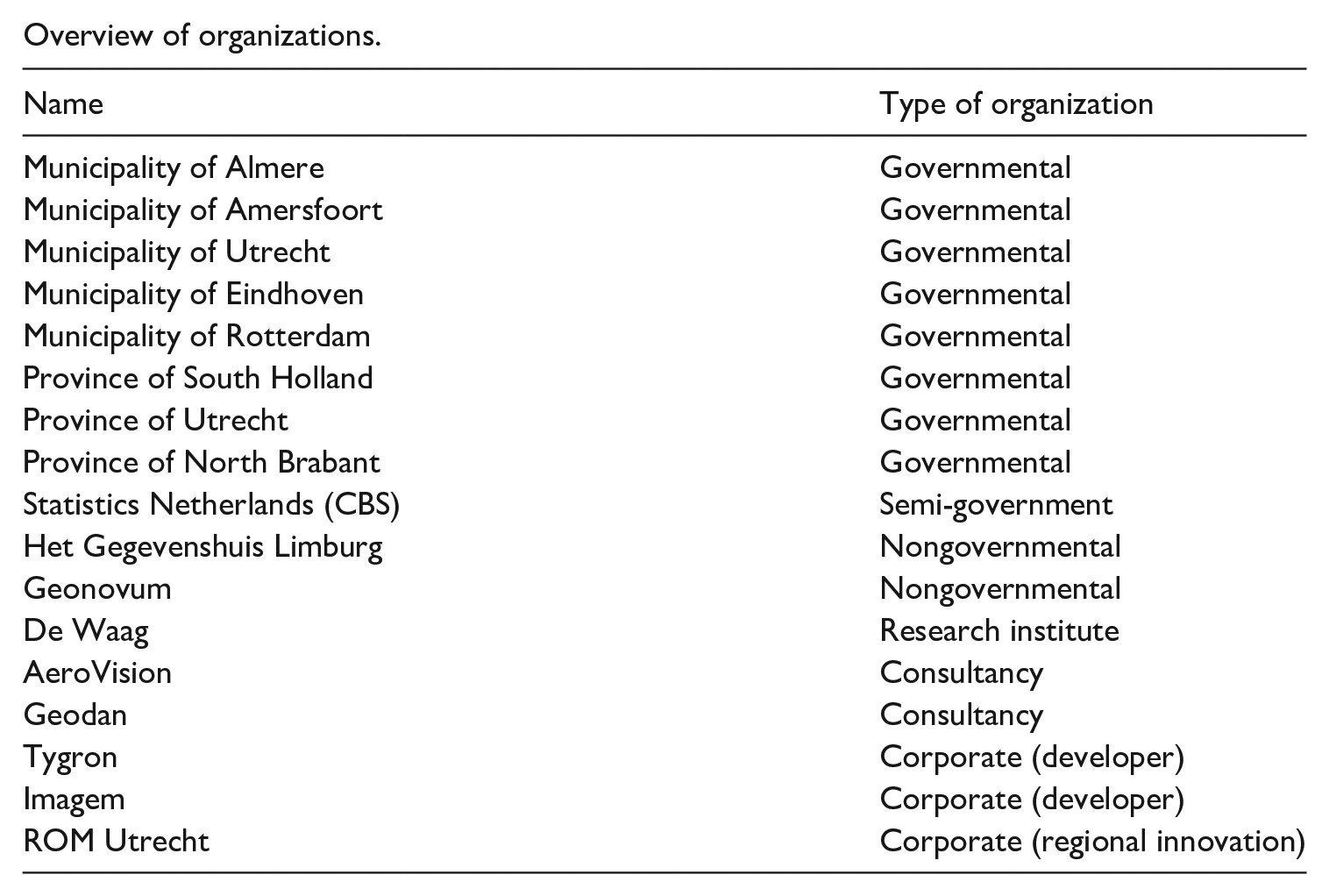
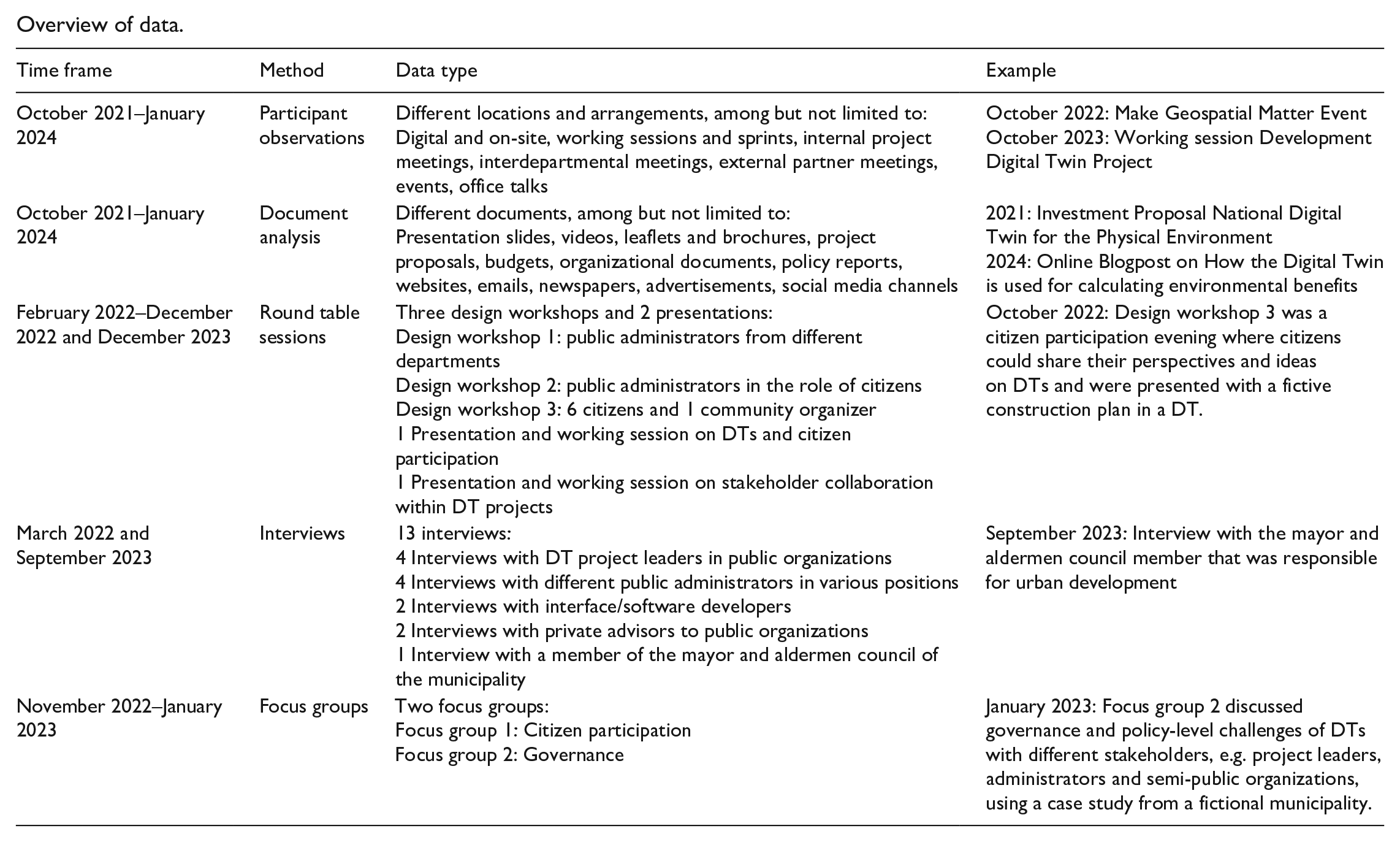
Though our collaborative research design provided us with organizational access, to study sociotechnical imaginaries is rather complicated because of its rather tacit, uncodified, and often intentionally hidden practice (Seaver, 2017; Sismondo, 2020; Wieringa, 2023). For that reason, our fieldwork was conducted at varied sites and timeframes, obtained through different methods and resulted in different data types. Such approaches are often common and encouraged in the study of datafication, algorithmization, and system technologies more generally, for example, through “blended ethnographic approaches” (Korenhof et al., 2023; but see also Sismondo, 2020), “scavenging” (Seaver, 2017; Wieringa, 2023), or “polymorphous engagement” (Gusterson, 1997). We draw from 3-year on-site fieldwork conducted between October 2021 and January 2024 investigating DTs and projects with DTs in public sector organizations in the Netherlands, mainly on the regional and local level (for a complete overview see Appendix 1). This longer time course allowed us to become deeply embedded in the DTs dynamics in the Netherlands. We have conducted participant observations, interviews, focus groups, round-table sessions, and document analysis (a detailed overview is provided in Appendix 2). Based on this fieldwork, we have constructed different publications on topics as responsible DTs (de Wilde de Ligny and Korenhof, 2024; De Wilde De Ligny and Schäfer, 2023), DTs for citizen participation (Van Geldere et al., 2023), and the complexities of working with DTs in public organizations (van Geldere and Steenks, 2024).
In this article, we focus on bringing together this rich and diverse fieldwork data to construct a detailed account of urban DTs’ imaginaries in the Netherlands. By qualitatively analyzing these fieldwork data through the earlier presented system-level lens of deconstruction, we can critically assess how such DTs are enacted in the practice of urban planning and urban governance. This lens not only allows us to relate the narrative dimension of imaginaries to practice and actual events, but also contributes to bringing our research findings in practice as it opens possibilities for establishing deconstructing practices in collaboration with stakeholders (Gusterson, 1997; Seaver, 2017; Sismondo, 2020; Wieringa, 2023). In this research endeavor, we therefore worked abductively: we iterated between developing insights from theory, generating empirical data and analyzing these data. Within abductive analysis, empirical data and theory interact. We logically cannot approach the field without certain existing theoretical knowledges or experiences and thus ensured to work pragmatically, flexibly and constantly searched for surprises and conflicts between our theory and data, but also engaged with a diversity of stakeholder perspectives (Van Hulst and Visser, 2024; Yanow and Schwartz-Shea, 2015). In this way, our theoretical concept of sociotechnical imaginaries and analytical lens of deconstruction acted as both sensitizing concepts, but were also shaped by our data generation.
The mystification of DTs in urban governance
To deconstruct the imaginaries of DTs, we empirically illustrate the five primary steps of deconstruction: demystification, contextualization, engagement, positioning, and regulation (Sheikh et al., 2023). This entails that we give different instances of how imaginaries of DTs are constructed and enacted upon in the development and implementation of DTs for urban planning and governance. To start, demystification implies the deconstruction of the myths surrounding DTs. Myths actively conceal values and power structures through depoliticization, often by introducing an utopian or escapist ideal (Mosco, 2004). As earlier mentioned, the narrative surrounding DTs promises substantial benefits, such as creating a digital reality, speeding up processes, and enhancing citizen participation. This optimistic view is highly persuasive, flowing seamlessly from corporate communications to public administrators (Flichy, 1999; Mosco, 2004; Schäfer, 2011, but also Sadowski and Bendor, 2019 on, e.g., IBM’s role). Sales pitches, presentations, and project descriptions thus play a crucial role in mystifying DTs (cf. Microsoft’s blogpost on a renounced platform for Dutch public administrators at Microsoft, 2023). In addition, we observe a significant presence of individuals we refer to as “believers” who uphold this narrative. These believers embody and are captured by the mystification of DTs and are present not only within corporate organizations but also prominently within government agencies. They are the primary advocates for DTs and have a strong conviction in their promised benefits. For these believers, it is crucial to transform a DT-business case into a societal case to, for instance, effectively persuade policymakers or board members.
We argue that three myths play an important role in informing public administrators’, policy advisors’, and decision makers’ perspective of effective, complexity-reducing, and evidence-based and data-driven public governance. The first myth is the myth of objective presentation. DTs are mystified as an accurate and objective replica of the physical environment, a single copy. This representation is made possible through 3D visualization of the environment and is promised to be easily understood. The representation would provide a “common operational picture” or same standing point regarding issues and solutions from a digital perspective: “Observe how the changes in reality reflect in your digital copy and analyze whether the ambitions or objectives are being realized. (. . .) A digital copy of reality that enables ‘what if’ scenarios.” 3
This myth reflects a belief in the “objective quantification” offered by data collection and processing (see, for example, Korenhof et al., 2021; Meijer, 2018; Van Dijck, 2014). However, data are not neutral phenomena but products of human–technology interaction: “the map is not the territory” (de Wilde de Ligny and Korenhof, 2024; Korzybski, 1933). Creating a high-fidelity representation through digital modeling and data analytics is not evident (Korenhof et al., 2021). Korenhof et al. (2023) argue that the creation of data collections involves the act of “seeing and recording” which influences how reality is represented in data, conferring a certain legitimacy and authority to the data collection.
Second, underlying DTs is the myth of high understandability and trustworthiness of digital representations, which are believed to foster an “equal viewpoint of information” for various stakeholders. This sentiment is illustrated by the different slogans used to describe DT projects. For example, a geodata department at a Dutch municipality uses slogans like “giving data a face” to highlight the goal of making the collected data “valuable” and integrating it into information systems. They approach DTs as an opportunity to make data resonate with citizens’ experiences and to build a common understanding between the government and citizens. Their DT would act as “digital coat rack where we can hang information on, to bring the digital reality inside.” Curiously, providers of DTs use similar connotations in their marketing: “Everyone understands it with a Digital Twin. You can describe decisions in words, but an image is worth a thousand words,” and “bringing the physical outside world inside, into your office” (Van Geldere et al., 2023).
A third myth that we identified in the research is the myth of digital innovation via DTs. This narrative is framed as a necessity; governments cannot afford to fall behind in technological innovation. A DT is depicted as a “game changer,” and there is encouragement to adopt a “Digital Twin-minded” approach. This imperative to innovate is strongly emphasized by providers of DTs: [A DT] will eventually pay off in the future; therefore, it is essential to invest. If you communicate through the DT and integrate all processes within it, understanding will be significantly enhanced, and decision-making will become much faster. People think in 3D; we do everything in 3D. It is quite strange that we have not applied this to work processes (cf. De Wilde De Ligny and Schäfer, 2023).
Contextualization: navigating the journey from promise to practice
Contextualization highlights the digital transformation and strategical challenges when developing, implementing, and using DTs and, as such, contextualization is a key element in the demystification of technological systems. Often DTs can be purchased as software packages with various subscription models and functionalities, such as access to premium data (e.g. location data or street view), access to different APIs, technical services (e.g. data processing), integration with other software solutions or broader infrastructures, and computational models. Consequently, DTs are often marketed as “Digital Twins as a Service.” This service highlights the interoperable technological infrastructure and access to this so-called “data ecosystem.” However, despite these provided services and visions, the mundane practice of using DTs in organizations is certainly not fully in line with the mythical promises of DTs.
With regard to contextualization, the main imaginary is that DTs facilitate the creation of collaborative environments where various stakeholders, including government officials from different domains and citizens, can work together effectively and accelerate work processes. DTs could provide “a virtual collaboration environment for integrated interest balancing to achieve coherence in policy.” However, collaboration through DTs presents certain challenges, especially when serving different user groups. As earlier mentioned, these challenges primarily arise from the differing needs and skills of various user groups and the technical capacity or functionalities of systems they already work with. 4 For example, a GIS data analyst has different technical requirements than an administrator who needs to issue permits to citizens. This became evident when we observed that not all departments within a Dutch municipality welcomed the push for 3D visualizations: “The added value of 3D is sometimes less apparent; 2D is easier and more familiar to many people, making collaboration simpler with 2D” and “A Building Information Model costing 50,000 euros? We prefer 2D models, as they are much more workable for us” (cf. De Wilde De Ligny and Schäfer, 2023).
This discrepancy becomes evident when DTs are promoted as an environment for direct interaction between the municipality and its citizens. However, it became apparent that citizens do not operate within the same digital environment as the civil servants: “For civil servants, there are additional features and checks that are not relevant to citizens.” The reason for this is straightforward: the software employed by governments can be too resource-intensive for an average consumer-grade computer due to their processing intensive visual components. Running DTs requires substantial processing power, which the average citizens’ devices typically lack. Consequently, the digital environment for citizens not only included a much simpler interface, but also, more problematically, provided a deviating representation of what civil servants worked with themselves (cf. Korenhof et al., 2021; de Wilde de Ligny and Korenhof, 2024).
Taken together, the ambition to collaborate comprehensively and serving various user groups on a national scale, within a digital environment is–to say the least–a challenging objective to achieve. These observations therefore prompt the question: Why do these providers and governments seek collaboration in a digital environment among different user groups? The challenges related to contextualization underscore the diverse needs of the various user groups already and the discrepancies with the promises of DTs (for similar arguments see De Wilde De Ligny and Schäfer, 2023; Van Geldere et al., 2023; van Geldere and Steenks, 2024).
Engagement: connecting with stakeholders through technology
In developing, implementing, and using system technologies like DTs, Sheikh et al. (2023) highlight the importance of engagement. Engagement is understood as a “democratization” process through the involvement of relevant actors, for example, through organizing citizen participation. In our research, we specifically focused on the engagement of three types of actors: the internal public organizational actors (e.g. civil servants, policy makers), external stakeholders such as private sector developers, and citizens who are affected by the executive practices of such public organizations.
One primary imaginary is that DTs can facilitate citizen participation. As mentioned before, in projects with DTs, public organizations often work together in different collaborations, for example, with different data providers and geo-ICT corporations, to fulfill their urban planning and governance imaginaries. In these projects with DTs, however, citizens are often not immediately approached as stakeholders. On top of that, how exactly citizen can engage with urban planning and governance through DTs is often undefined. Should citizens be part of designing DTs or should citizens actively use DTs themselves, for example, “to report broken or loose pavement tiles in public space” as was posed by public administrators in the municipality of Almere? Yet, other civil servants imagined DTs as instrument to reassure political and public support. The compelling visual presentations and simulations would ensure citizen agreement with new building plans (cf. Akbar et al., 2020; Al-Kodmany, 2000). For example, a public administrator claimed that with DTs, citizens could be pursued into accepting fewer parking spots in their neighborhood. It can thus be questioned whether public administrators are genuinely interested in engaging with citizens’ input, or more motivated to fabricate support for their work—the so-called alibi participation (cf. MacCoun, 2005).
A second imaginary is that DTs have democratizing effects. Based on the myth of understandability and trustworthiness, citizen engagement would be made more accessible as the 3D visualization DTs provide would simplify and clarify the communication of information from governments to citizens. DTs could contribute to “better informed deliberation and decision-making.” As citizens would gain more “objective” insights of the decision-making context, they reach consensus more quickly and subsequently make better decisions (for similar arguments see, for example, Ananny and Crawford, 2018; Dervin, 1994; Winner, 2020 on transparency, but also Ruijer et al., 2024; Schrotter and Hürzeler, 2020). However, in fact, DTs were often perceived as hard to understand as they do not appeal to citizens’ or public administrators’ own world and experiences. For example, in a citizen consultation meeting, a citizen mentioned how it was difficult to form an opinion on the use of DTs for decision-making processes as they were far from her own experience: “IT people have created these [DTs] and then they ask our opinion as citizens. That doesn’t add up for me. It really doesn’t do much for me.” This comment caused disorder in the citizen consultation meeting. Citizens felt they were invited under “false pretenses” to comment on new building plans in their neighborhood, but were actually invited to share their opinion on DTs. Another citizen whispered to her neighbor: “I find it way too difficult to use such a DT. Why am I here? I want to watch television.” In their perspective, rather than being enabled to participate in decision-making processes, they felt that they were sidelined: “I am afraid that decision-making happens more quickly with DTs and I am worried that building plans will be forced upon us” (Van Geldere et al., 2023, but see also De Jaeger, 2024 for a similar observations of urban DTs for citizen participation in another Dutch municipality Rotterdam). Such comments illustrate earlier criticisms of how citizens are given limited opportunities for contesting and resisting future urban plans and imagining alternative futures (Flichy, 1999; Mosco, 2004; Powell, 2021).
A third imaginary is DTs can logically convince and receive support from public administrators in urban planning and governance. Like citizens, DTs appeared hard to comprehend for some public administrators. We witnessed administrators googling the definition of DTs while in a meeting on the topic, or repeatedly asked for someone to explain DTs “in plain and simple language.” Next to that, the enthusiasm for DTs at the management level was not always shared with administrators on the ground: “Someone higher up sees a lot of possibilities [for DTs], whilst we stumble across a lot of obstacles in our daily tasks [for DTs].” Some administrators were cautious: “We must prevent that the DTs only become ‘a nice project’ for the geo-data department.” And others were skeptical: “It [the DTs] is a technology searching for a problem to solve, a problem which does not exist.” Sometimes the criticism was even rather destructive: “I find it very unfortunate that I am not excited about the project [. . .] Perhaps we should conclude that it is a nice project for just the developers” a public administrator stated. These questions about whether they were “really going to continue the DT projects” were also shaped by the issues of contextualization as earlier mentioned. To be precise, public administrators encountered great difficulty in incorporating DTs into existing governance practices as the Dutch Digital System Urban Planning Act (DSO) for the earlier mentioned highly complex Dutch Water and Planning Act (Van Geldere et al., 2023).
On the other side, the “believers”—expert users and administrators tasked with DT projects—often felt this organizational resistance. For example, a team of public administrators used the myth of Sisyphus—who was punished by rolling a heavy rock on a hill—to express their senselessness and the obstacles they encountered in their projects on DTs (Van Geldere et al., 2023). As a result, these believers often focused on drumming up support. They appealed to stakeholders by using communication instruments not only through changing the term “digital twin” to “digital mirroring city,” but also through social media posts and filming attractive videos of grand collaborations. They also organized different demonstrations of the DTs (presentations, working sessions, and other events) to spark the interests of stakeholders: “making them want more by giving them an experience.” What is more, a project leader aimed to increase participation in their introduction meeting to DTs by handing out ice cream in the hallways on a hot summer day. Besides that, round-table participants were rewarded with self-made cookies if they joined the meeting on DTs, and in a citizen consultation meeting, participants were promised apple pie if they would attend. Such actions aimed at constituting organizational support often yielded mixed results, also partially because the different stakeholders envisioned different ways of success with the development, implementation, and usage of DTs (see also van Geldere and Steenks, 2024). These mixed reactions to DTs are very much caused by techno-solutionist overpromising narratives of DTs (see also Sadowski and Bendor, 2019).
Positioning: strategic planning of technology adoption
The analysis of contextualization and engagement focused on more operational issues related to the implementation of DTs in public governance. At the same time, there are also political considerations: the imaginaries of DTs require an adequate positioning of governments on how they aim to acquire, implement, and use DTs and for which goals (Sheikh et al., 2023). Positioning sheds light on these political questions of digital transformations in the public sector.
In our observations of the Dutch public sector, DTs were mainly implemented by executive powers, namely the geodata units of local governments. Approaching this adoption and implementation of DTs as an executive issue risks depoliticizing possible discussions surrounding DTs (for similar arguments see Sismondo, 2020). Public administrators were often not aware that they were responsible for ethically designing the technologies that they used. As a result, they hardly ever posed their political dilemmas surrounding DTs to City Councils as that was perceived as slowing down the innovation process. This push for innovation was paramount within the public sector. For example, DTs were taken up in many different municipal digital innovation strategy reports. But also internationally, governments could not be left behind in the hype: “Everyone was talking about digital twins.” For one of the DT projects we followed, such international exposure was seen as important because it was a requirement for the EU financing they received. Other objectives were, for example, that local governments wanted to create an attractive business climate for local corporations after COVID or because governments wanted to showcase how they tackled complex integral policy questions with datafication.
Upon reflection, a strategic positioning could help public administrators with developing leverage and use synergies with other public organizations, sketching procurement requirements, and identifying needs for competences and capacities for the implementation and use of DT technologies. However, in discussions on strategic positioning in public organizations, the technological experts and geodata science departments dominate. We observe that such actors are successful in creating networks and obtaining funding for ambitious projects but lack anchoring these projects in strategic visions as formulated by senior administrative leadership, politicians in government, and other decision makers (see also De Jaeger, 2024). Consequently, it can be questioned whether the ethical issues related to the responsible usage of DTs in government are adequately addressed in the discussions on DTs in public organizations.
Regulation: small steps toward deconstruction
The final aspect of this analysis concerns regulation. However, clear findings regarding regulatory frameworks for the use of DTs are limited or only addressed in our study on a conceptual level. Despite this, we identified a notable willingness among practitioners to engage with and address this gap. In light of this, we briefly outline several regulatory practices and concerns that emerged from our findings. For example, we consistently observed a need for ethical evaluations of DT practices, particularly with regard to their impact on democratic processes. Specific concerns were raised regarding vendor lock-in, the preservation of bureaucratic dissent, and the implications for knowledge production. In addition, early initiatives aimed at regulating the use of DTs within government agencies were noted, though these efforts often remain conceptual and limited to frameworks. A notable example is the ethical framework developed by Geonovum, which provides guiding principles for DT and stakeholder engagement (Geonovum, n.d.). Another example is the Digital Twins Lab, where government entities, researchers, and students collaborate on the responsible deployment of DTs in the Netherlands (Hogeschool Utrecht, n.d.). These initiatives vary in their level of advancement, which may reflect differing levels of awareness among governments regarding the (ethical) challenges associated with DTs. While formal regulations remain in their nascent stages, our findings suggest that a process of deconstruction may already be underway. At the very least, these results reflect an increasing willingness to engage with the ethical and practical implications of DTs, pointing toward the potential for their responsible application in urban governance.
Conclusion and discussion: toward practical and responsible DTs for Dutch urban governance?
In our article, we deconstruct the sociotechnical imaginaries of DTs by focusing on how these imaginaries are constructed and enacted in practice. The bold promises made to advocate for the procurement and implementation of DTs appear not only unrealistic, but they also even seem to undermine the efforts of disseminating DT applications. Using the framework of Sheikh, Prins, and Schrijvers (2023) provides a way to critically assess how the technological imaginaries stifle the much-needed contextualization of DT technologies in their respective use contexts. The demystification, contextualization, engagement, positioning, and regulation of system technologies underscore the complex context of our public governance when developing, implementing and using DTs. We argue that there is not a single digital twin, but always a multitude of interfaces, maps, models, and data resources which are differently configured in the various use contexts. DTs are plural and are not characterized by a novel quality of technological promise, but rather conform to prevalent narratives wherein technologies are marketed and advertised through specific imaginaries (cf. Flichy, 2007; Mosco, 2004; Schäfer, 2011).
This study provides an in-depth and empirical account of the impacts and challenges associated with developing and deploying DTs in the context of public administration and urban planning. Though such an approach has merit, it also has certain limitations. Our qualitative, transdisciplinary, and collaborative research design is beneficial for studying the construction and enactment of imaginaries in the Dutch case, our findings might lack transferability to different cases and therefore specific regulatory recommendations. In addition, our study can say little about useful and responsible DT application which might be implemented after thorough contextualization and the constitution of the very much-needed contestability. Future research should therefore supplement our account with empirical findings from examples of successful and effective procurement, implementation, use of DT technologies to promote the study of more general transferable findings and construction of precise regulations, for example, through financing and funding streams (e.g. Susha et al., 2024). Next to that, our study insufficiently addressed the agency DTs itself and their different users might have and therefore differentially affect actors and organizations, as underscored by actor–network theory (ANT). Future avenues of research should therefore focus on such ANT perspectives.
When taking this complex context into account, such as the various characteristics of user groups, the Rotterdam case exemplifies how DTs could be of value as a supporting tool when tackling societal challenges. The city of Rotterdam uses its digital twin to collaborate with citizens on tree planting to reduce heat stress, understand how people use urban space, and identify preferred spots for park benches (Rotterdam in Actie; Samenwerking en Participatie als antwoord op Hittestress, 2023). A 3D simulation shows heat and shade, allowing the city’s sustainability consultant and a local resident, who knows community needs, to explore and redesign the area together. This method facilitates mutual sharing of knowledge, enabling both parties to address neighborhood challenges effectively. However, De Jaeger’s (2024) critical account of DTs for citizen participation in a different neighborhood in Rotterdam shows how such efficient and valuable adoptions of DTs in urban governance are also highly context-dependent and therefore require careful contextualization.
Taken together, the practical and responsible development and implementation of DTs for urban governance requires governments—and the various stakeholders involved—to assess the various myths more critically and take the activities of contextualization, engagement, positioning, and regulation seriously. This will then lead to the implementation of DTs for specified purposes. Ideally, they are embedded in a use context that allows for contestability and accountability of these technologies.
Footnotes
Appendix 1
Overview of organizations.
| Name | Type of organization |
|---|---|
| Municipality of Almere | Governmental |
| Municipality of Amersfoort | Governmental |
| Municipality of Utrecht | Governmental |
| Municipality of Eindhoven | Governmental |
| Municipality of Rotterdam | Governmental |
| Province of South Holland | Governmental |
| Province of Utrecht | Governmental |
| Province of North Brabant | Governmental |
| Statistics Netherlands (CBS) | Semi-government |
| Het Gegevenshuis Limburg | Nongovernmental |
| Geonovum | Nongovernmental |
| De Waag | Research institute |
| AeroVision | Consultancy |
| Geodan | Consultancy |
| Tygron | Corporate (developer) |
| Imagem | Corporate (developer) |
| ROM Utrecht | Corporate (regional innovation) |
Appendix 2
Overview of data.
| Time frame | Method | Data type | Example |
|---|---|---|---|
| October 2021–January 2024 | Participant observations | Different locations and arrangements, among but not limited to: Digital and on-site, working sessions and sprints, internal project meetings, interdepartmental meetings, external partner meetings, events, office talks | October 2022: Make Geospatial Matter Event October 2023: Working session Development Digital Twin Project |
| October 2021–January 2024 | Document analysis | Different documents, among but not limited to: Presentation slides, videos, leaflets and brochures, project proposals, budgets, organizational documents, policy reports, websites, emails, newspapers, advertisements, social media channels |
2021: Investment Proposal National Digital Twin for the Physical Environment 2024: Online Blogpost on How the Digital Twin is used for calculating environmental benefits |
| February 2022–December 2022 and December 2023 | Round table sessions | Three design workshops and 2 presentations: Design workshop 1: public administrators from different departments Design workshop 2: public administrators in the role of citizens Design workshop 3: 6 citizens and 1 community organizer 1 Presentation and working session on DTs and citizen participation 1 Presentation and working session on stakeholder collaboration within DT projects |
October 2022: Design workshop 3 was a citizen participation evening where citizens could share their perspectives and ideas on DTs and were presented with a fictive construction plan in a DT. |
| March 2022 and September 2023 | Interviews | 13 interviews: 4 Interviews with DT project leaders in public organizations 4 Interviews with different public administrators in various positions 2 Interviews with interface/software developers 2 Interviews with private advisors to public organizations 1 Interview with a member of the mayor and aldermen council of the municipality |
September 2023: Interview with the mayor and aldermen council member that was responsible for urban development |
| November 2022–January 2023 | Focus groups | Two focus groups: Focus group 1: Citizen participation Focus group 2: Governance |
January 2023: Focus group 2 discussed governance and policy-level challenges of DTs with different stakeholders, e.g. project leaders, administrators and semi-public organizations, using a case study from a fictional municipality. |
Acknowledgements
This research would not have been possible with the support and network of the DataWorkplace and the Data School, two platforms for participatory research at Utrecht University. We thank Koen Steenks, Fleur Stalenhoef and Iris Muis for connecting us to the relevant public administrators and for their contribution to translating academic research to governmental practice. We acknowledge the local and regional governments that co-produced our research, especially (but not limited to) the municipalities of Almere and Amersfoort. We also acknowledge the software developers who explained their software and business models to us. We are indebted to Paulan Korenhof for her active participation in our focus groups and her input. We also want to thank the anonymous reviewers for their helpful comments.
Funding
The author(s) disclosed receipt of the following financial support for the research, authorship, and/or publication of this article: This research was partially made possible through a team science grant of the Digital Society program of the Universities of the Netherlands, and the DataWorkplace at Utrecht University.
