




Abstract
In 2010, the EU Kids Online project, and aligned AU Kids Online study, interviewed one parent and one child (9–16) from 25,542 families across 26 countries. Information gathered included parents’ awareness of their child’s experiences of sexual content online. This dataset has since been updated by recent ethnographic work in Australia and Ireland, capturing parents’ approaches to managing their children’s (11–17) digital engagement with sexual content. Parents identified risks and benefits in their children’s encounters with adult content online. This article concludes that parents do not judge the efficacy of their digital parenting around preventing their child from seeing restricted 18+ content or, indeed, knowing whether their child has encountered sexual content online. Instead, they adopt a nuanced approach that reflects knowledge of their child and the child’s relative maturity, with a view to supporting their child’s progressive development towards full digital and sexual citizenship.
Keywords
Digital parenting and sexual content
Introduction
This article argues that while Australian parents are concerned about their teenage children having access to sexual content online, it is only one of the many concerns they juggle when parenting digitally. Furthermore, they view digital parenting as a more nuanced task than enabling or preventing their child’s access to certain types of content. The discussion is especially timely given that aspects of digital parenting are increasingly taken out of parents’ hands by decisions made by others. Parents negotiate, for example, rules around ‘bring your own device’ mandated by some schools while, in Australia, the government has announced a forthcoming ban on social media use by under-16s (Ritchie, 2024) to take effect from December 2025, with children’s access to sexual content via digital media a key concern for the relevant regulators (Parliament of Australia, 2017).
The overarching Australian Research Council-funded project (DP190102435 “A comparative investigation into Australian adolescents’ perceptions of harm from accessing online sexual content”) identified three ‘comparison’ countries from which data collected would be compared to Australian data. This article draws from in-depth interviews (2022–2024) with parents and teens in the two Anglosphere nations, Australia (24 families) and Ireland (4 families), considered together because intragroup variability within each dataset was greater than the variability between the two datasets. Families were recruited via social media posts aimed at parents, preferring face-to-face interviews and privileging parents interested in discussing these issues. Participants have been anonymised and all names are pseudonymous. Children under 13 are described as ‘preteen’ to further protect them from identification.
In earlier research with a ‘random walk’ randomised recruitment approach (Livingstone et al., 2011a), children in Australia and Ireland were more likely than the average European child to say they had been ‘bothered’ by encountering sexual content online. This recruitment method takes a randomly assigned starting point in a randomly identified location in a country and then follows a set pattern of knocking/not knocking (‘skipping’) to identify the target homes to approach. If the home contains an eligible family who are willing to take part, they are recruited. If not, the next home is identified via the same pattern of knocking/skipping. Each eligible home is approached on four distinct occasions before being relinquished, without allowing any substitution (Livingstone et al., 2011b: 18). The term ‘bothered’ – and its translated variants – was deliberately used to capture mild discomfort, as well as more emphatically negative responses. Using data from the contemporary interviews in both Australia and Ireland offered advantages over Australian data alone when exploring parents’ responses to teens’ encounters with sexual content. (Please see Dinh et al., 2024 for more information on the Irish case study.)
Literature review
Drawing on national case studies
Although the qualitative research is recent, this project has its genesis in the EU Kids Online study (Livingstone et al., 2011a) and a parallel – but smaller – investigation in Australia, which adopted the same methodology AU Kids Online (Green et al., 2011). The 2010 EU Kids Online data remains important because of its scale and depth, and because policy makers, and parents, continue to have concerns about children and adolescents accessing sexual content via digital means (Ritchie, 2024). With the 25-nation EU Kids Online study of 25,142 families – a parent and a child aged 9–16 – alongside the smaller AU Kids Online study of 400 Australian families, the project resulted in 26 separate national datasets, with some interrogation of the overall dataset to follow.
In the contemporary Australian context, parents accept that ‘healthy sexual development includes natural curiosity about sexuality’ (McKee, 2010: 17), yet worry that young people may find it difficult to distinguish potentially unrealistic depictions of sex in adult content online (commonly ‘porn’ or ‘pornography’) from what parents believe constitutes ‘normal’ and ‘natural’ sexual practices (Byron et al., 2021). These perspectives align with ‘news media panics and [the] responses to these from policymakers, educators, parents, and academics alike’ (Byron, 2023: 34). Moreover, concerns relating to children’s access to online sexual content can be understood as one element in a broad range of anxieties associated with increasing expectations that parents should mediate their children’s access to digital content. Page Jeffery (2022), drawing on qualitative research with Australian parents, argues that
parental anxieties did not neatly map onto the major risks that are routinely foregrounded in the cyber safety discourse in Australia – for example, online predators, pornography, sexting, and cyberbullying. Rather, parents’ anxieties were complex, nuanced, and multifaceted, and didn’t always fall within the traditional definitional parameters of risk at all. (p. 476)
The sentiment that pornography is indeed a source of anxiety, but one to be contextualised within a whole host of complex digital concerns, was reflected in the 28 families interviewed in this study.
Parents as sexuality educators
The focus on parents as well as teens recognises parents as having a specific role in their child’s sexuality and relationship education, beginning with discussions in children’s early years and continuing, hopefully, as a healthy channel of communication. This is the model suggested in the highly regarded Healthy WA-commissioned 116-page book Talk soon. Talk often. A guide for parents talking to their kids about sex (Healthy WA, 2021). That guidance notes that ‘Open discussion at home gives children permission to talk with you about sex and sexual body parts which makes them feel safe to ask questions and let you know if they are worried about something’ (Healthy WA, 2021: 7). Such openness is important throughout childhood. As the guide continues, ‘Regular reminders that their body is their own and that no one can touch them without their consent helps protect them [children] in both their early and later years’.
Although parents are recognised as children’s early sex educators, recent research with parents of school-aged children indicates that almost 90% (Hendriks et al., 2023: 5) of Australian parents from a cross-section of faith communities, school types and political persuasion also support school-based relationships and sexuality education (RSE). Parents’ views, attitudes, and strategies are crucial elements of an integrated approach to sexuality and relationships education. At the same time, parental responsibility encompasses a range of expectations, roles and obligations placed on adults who are raising children (Bridgeman and Lind, 2016). The manifestation of this responsibility, however, is shaped by societal norms, values and legal frameworks, which in turn play an important role in defining parent–child relationships (Bain, 2009; Wyness, 1997).
Notably, there has been little qualitative work with teens themselves about these issues and the study reported here addresses that gap by conducting 49 in-depth interviews with 30 children aged 11–17 (with 19 of these 30 teens interviewed twice, a year apart), drawn from 24 Australian families; plus teens from four Irish families. The disparity between the 24 Australian families and 30 teens relates to some parents enabling (separate) participation by more than one teen per household. These parents’, and teens’, interviews were funded by the Australian Research Council, which sought to understand the contexts for Australian teens’ access to sexual content online, the meanings teens draw from such encounters, and their perceptions of any resulting harm.
Policies around parents’ online safety responsibilities
Online safety policy positions parents as promoting digital safety for their children (Livingstone and Blum-Ross, 2020; Livingstone et al., 2017). This has especially been the case in mediating children’s access to sexual content online, with policymakers seeking to support parents by educating them, rather than making definitive statements about how parents should respond (Keen et al., 2020). While the Australian under-16 social media ban removes parents’ discretion relating to social media accounts, parents’ responses to their child’s encounters with sexual content remains a family matter.
Surveys of parental concerns about the Internet, which sometimes inform policy development, consistently indicate that children’s exposure to sexual content ranks among the top issues that parents worry about. In Ireland, a national survey of parents found that exposure to pornography was parents’ top online safety concern. Fifty-nine percent of parents with children aged 9–17 years worried about their children’s exposure to pornography, while 54% worried about their child being contacted by a stranger for sexual purposes and 50% worried about their child being asked to send sexual images to someone (National Advisory Council for Online Safety, 2021). Research by the eSafety Commissioner’s Office in Australia similarly found that accessing or being exposed to pornography was among the top five concerns reported by Australian parents. This was deemed less of a concern, however, than access to inappropriate content other than pornography (such as violence and extremism), contact with strangers and being bullied online (eSafety Research, 2018).
In providing advice to parents about how to support their child in relation to sexually explicit content, policymakers reflect parents’ approaches by scaling their advice according to the age of the child. For children under 12, policymakers tend to suggest parents use technological controls, securing devices in the home, setting rules about technology use and building resilience through age-appropriate conversations about sexualised content. Advice for parents of teenagers similarly urges proactive talks with children about sexual content they (may) encounter online, underscoring the message that ‘pornography is not real life’, as well as raising the topics of consent, respect and safety (eSafety Commissioner, n.d.).
When it comes to parents’ confidence about their ability to act in this way, most parents appear willing to accept the ‘helping’ role suggested by policymakers. For example, 57% of Irish parents said they were ‘definitely’ able to help children cope with things online that bother or upset them, while a third said they could help ‘a fair amount’ (National Advisory Council for Online Safety, 2021). Australian research (eSafety Commissioner, n.d.) also found that most parents felt confident they knew what to say if their child encountered sexually explicit content online (78%) and knew where to access parenting resources about children and pornography.
A 2023 Child Online Safety Index (COSI) report (DQ Institute, 2023) ranks Australia in the top quartile of over 100 countries in terms of their Child Online Safety initiatives, compared with Ireland, which is in the second quartile. The country report on Australia indicates a top score for: Children’s safe use of technology; Technology infrastructure; Policies and regulations, School education, and Family support, with third quartile performance in ICT (information and communication technology) company responsibility. The same schema ranks Ireland as top quartile in School education; second quartile in Children’s safe use of technology and Technology infrastructure; third quartile in Policies and regulations and ICT company responsibility; and fourth quartile in Family support.
Australia and Ireland offer policy-informed guidance to parents via the National Advisory Council for Online Safety in Ireland, and the Office of the eSafety Commissioner in Australia. Both Australia and Ireland fall below the global benchmark of the requirements placed by most of the 100+ COSI nations upon ICT companies to support children’s safe online engagement via ‘the level of company commitment, such as through transparency reporting, to child online safety’ (DQ Institute, 2023).
Parents’ perspectives
This article focuses on the teens’ primary caregivers: the people most likely to know when their teens are ‘bothered’. In practice, these caregivers were mainly the teens’ parents but the term ‘parents’ should be taken hereafter to include other recognised caregivers. Given the complexities of talking with teens about content they are not legitimately permitted to access, young people could only be invited to participate with the prior (written) consent of their parents. Once parent and teen had consented, the parent and the teen were interviewed separately, but concurrently, using different interviewers to help maintain confidentiality. Families involved in qualitative research projects are essentially self-selecting volunteers, and the quality of data depends upon creating genuine rapport in the in-depth interviews. Such rapport is compromised by intrusive questions about parents’ educational level and income brackets, so there is no collection of overt socioeconomic or demographic data. Parent interviews included one or both parents/caregivers, and ‘additional’ parents sometimes dipped in and out of the discussions.
The qualitative data from these interviews, and the quantitative data from the combined EU Kids Online/AU Kids Online studies, together provide insights into parents’ responses to concerns about teens accessing sexual content online and address the following research question:
RQ: Do parents use their own judgement when managing their children’s (non)-engagement with sexual content online? (i.e. Do parents act as if they know best when parenting digital access to sexual content?)
Do parents know when their child has seen online sexual content?
In 2010, 23% of child respondents to the EU Kids Online project said they had seen obviously sexual images in the past 12 months, whether online or offline (Livingstone et al., 2011a). The likelihood of having seen such images was strongly related to age, with 36% of 15- to 16-year-olds having seen such images compared with 11% of 9- to 10-year-olds. The teenagers had also seen such images more often. The percentage of children who reported having seen sexual images in the past 12 months varied greatly between countries; from as little as one in ten children in countries such as Germany and Italy to almost half the child respondents from Norway and the Czech Republic. In the comparable survey conducted in Australia in the same year, AU Kids Online, the percentage of children saying they had seen sexual images in the past 12 months was at the higher end of the range seen in Europe (44%).
Questions asked of children in 2010
The child respondents’ question specifically references the 12 months before the survey and contains the following definition: ‘In the past year, you will have seen lots of different images – pictures, photos, videos. Sometimes, these might be obviously sexual – for example, showing people naked or people having sex’ (EU Kids Online II Toolkit, 2010: 17). The children complete subsequent questions themselves, on a tablet, unobserved by the interviewer. If Question 1 ‘Have you seen ANYTHING of this kind in the PAST 12 MONTHS?’ is answered in the affirmative, this eventually leads to ‘Have you seen these kind of things on any websites in the PAST 12 MONTHS?’ and ‘Seeing sexual images on the internet may be fine or may not be fine [. . .] have you seen any things like this that have bothered you in any way? For example, made you feel uncomfortable, upset, or feel that you shouldn’t have seen them?’ (EU Kids Online II Self-Completion Questionnaire for Child 11-16, 2010: 19–24). Parents were separately asked whether their child had seen sexual images in the previous 12 months.
Updating the 2010 data
A subsequent EU Kids Online survey (2014) found no marked increase in the percentage of children having seen sexual images in the 12 months prior to the survey. It used the same formulation and compared data from a subset of seven countries included in the previous survey (Livingstone et al., 2014). Furthermore, an aligned dataset collected in 19 European countries between 2017 and 2019 (see Smahel et al., 2020) stands at a 33% average response of children seeing sexual images in the previous year across the countries, as compared with 29% in 2010 when considering the same set of countries.
The 2010 data appear from these subsequent studies to retain value. Having established this, we revert to that dataset to explore whether parents were accurate (or not) in thinking that their children had encountered sexual images online. This allows analysis of parents’ awareness of their child’s exposure to adult content, compared to their child’s reporting of such exposure.
Interrogating the 25 EU nations and AU dataset as to the (mis)match of parents’ perceptions of children’s exposure to sexual content, it is difficult to say if parents’ answers are based on actual knowledge or if they are making an educated guess using factors such as the age and gender of their child and, perhaps, their child’s Internet use patterns.
What predicts parents knowing their child has seen online sexual content?
To examine the possible factors that influence how the 2010 parents chose to answer this question, three logistic regression analyses were conducted. These three analyses used the same set of independent variables for a range of parent and child characteristics. The first analysis investigated the probability of parent and child both saying the child had seen sexual images on the Internet in the past 12 months. The second analysis interrogated the probability of the parent saying their child has seen sexual images on the Internet, but the child saying that this had not happened. The third analysis examined the probability of the parent saying their child has not seen sexual images on the Internet, but the child saying they have.
Using regression analysis, Figure 1 predicts the probability of the parent saying YES my child has seen sexual images on the Internet for children who themselves say that they have seen such images and then examines how that probability varies by age and gender of the child, and by whether the child says that when they are bothered about something, they talk to a parent (see EU Kids Online II Self-Completion Questionnaire for Child 11-16, 2010: 27). Interestingly, it is the parents of teenage boys who say they do not speak with their parent when they are bothered by something who have the highest likelihood of being in alignment with their child. And it is the parents of younger girls who say they do speak to their parents when bothered by something who are most likely to be wrong when their daughter has seen sexual images online. One possible interpretation of these results is that many children who see sexual images on the Internet are not bothered by what they see.
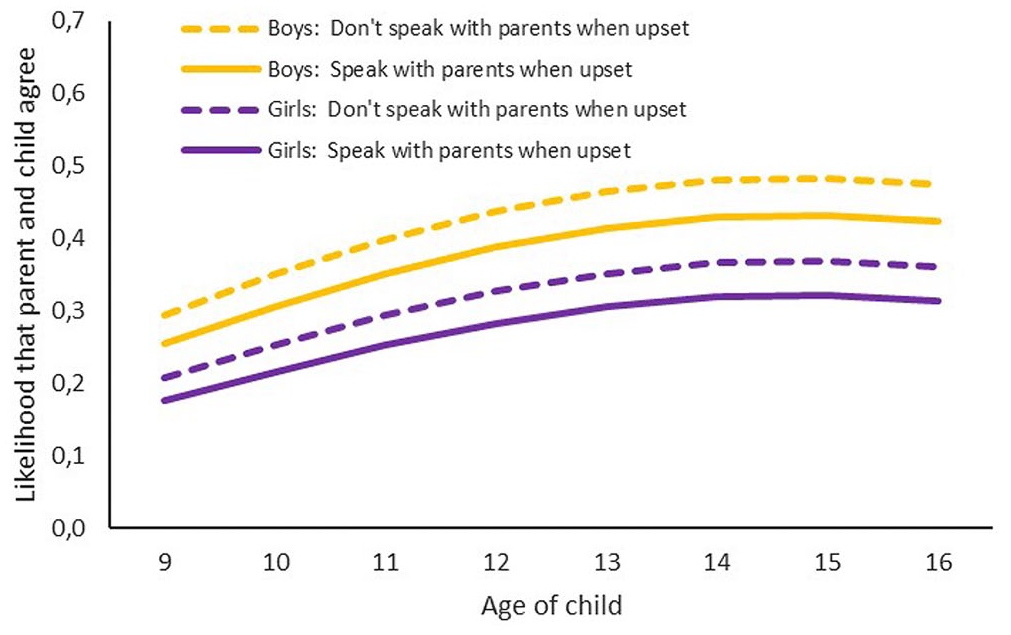
Likelihood of parent and child agreeing the child has seen sexual content online by age of child, gender, and whether the child speaks to their parent when feeling bothered.
The results also indicate that the age of the child has a positive impact on the likelihood of the parent’s and child’s answers agreeing that the child has seen sexual images. In the research findings, that correlation increased for older children, meaning that the responses by parents of older children are more likely to align with their child’s response than is the case with parents of younger children.
Parents of girls are less likely to end up agreeing with their child in all the categories considered than is the case for parents of boys. Mothers are less likely than fathers to agree with their child about whether or not their child has seen sexual images. In a further indication that many children may not be bothered by accessing sexual content online, where children say they talk to their mother or father when they are bothered by something, parents are less likely to identify that their child has seen sexual content online.
This 2010 data is now considered in the context of in-depth interviews with parents conducted between 2022 and 2024.
Do parents know best when it comes to supporting their child after encountering sexual content online?
Positioning the interview data
The qualitative data discussed below address parents’ perceptions of their responsibilities when dealing with teens’ exposure to sexual content in digital contexts, and what knowledge or information they value when deciding what is best for their child. Drawing upon the 24 (Australian) and four (Irish) parents interviewed for DP190102435 “A comparative investigation into Australian adolescents’ perceptions of harm from addressing online sexual content”, most parents implicitly adopt the position of ‘knowing what is best’ when reacting to children’s experience of online sexual content and pornography, with many guessing rather than knowing whether their child has indeed encountered sexual content. Where parents said they knew (and interviewers did not prompt as to how, but parents sometimes divulged this), the degree of reaction varied from parent to parent, with some being almost unfazed at the prospect of their child encountering sexual content. Parents’ reactions generally correlated with the age and gender of their child, and with how parents define, and thus use, the term ‘pornography’ in interviews. For some, this term denotes softcore imagery or videos, for others, it includes hardcore pornography. In their interviews, parents outlined reasons for their responses to children accessing sexual content. For instance, they offered anecdotes of family and friends’ similar experiences and, less frequently, media reports of the potential harms of teens viewing online pornography.
Parents’ interviews were semi-structured, and while there was no specific question asked of all interviewees, parents were prompted to talk about their views on their child accessing sexual content online and whether and how the parent felt they should respond to this. Eight key themes (each with a set of sub-themes) emerged inductively through thematic analysis (Braun and Clarke, 2021). The research team assigned the codes most relevant for this article as follows: ‘Code 1: perceptions of sexual content’ and ‘Code 4: learning or discussing sex, sexuality and/or relationships, or sexual content’ (specifically, ‘Code 4B’ which was in the context of dialogue with parents or guardians). During interviews, parents were asked whether they thought their child had accessed pornography, as well as whether this was something they were worried about. Parents who believed their child(ren) had encountered pornography offered a range of evidence, such as finding it on digital devices, being informed by the parents of their child’s peers, or teachers, or via their child telling them directly. Alternatively, and without evidence, many parents simply assumed their child had encountered, or would eventually encounter, pornography at some stage due to its prevalence.
Which sources do parents draw upon when mediating sexual content?
Parents primarily drew upon their own life experiences and knowledge of their child when deciding what was an appropriate response. Parents rarely cited academic research or other credible sources that might justify their perspective. Occasionally, however, parents linked their approach to unspecified, remembered, news stories or online blogs. Leonard, for example, said,
I worry – as much, because of what I read in the media – like the article from ABC News [. . .] people are increasingly giving up on sex, or young people are, because their experiences of it have been violent and aggressive because that’s what’s being taught online [. . . . they’re] not interested in sex ‘cause their first experiences are unpleasant and [they] think that’s what’s expected of them. (Leonard, parent of Roy, 16, and Thomas, 14)
Parents rarely said they actively sought trustworthy sources of information; more commonly their response was informed by ‘something’ they heard, read or watched. The exception to this was when they used technical means of mediation such as blocking, filtering and/or monitoring content, and household rules for device use. Information that supports technical mediation is comparatively accessible as such strategies are frequently advocated and supported by policymakers. Many parents argued that online platforms, specifically social media, should do more to help them by limiting sexual(ised) content. They felt it was unrealistic to expect children to self-regulate their access to material that was so readily available.
The most common assertion by parents was that pornography models misleading, unrealistic, false and/or harmful expectations of sex and relationships:
Well, they talk about men being overexposed to so much porn that when they have sex for the first time, they can’t get an erection because they’ve been so exposed to this really sexy stuff that normal sexual experiences don’t cut it [. . . .] Don’t know how true it is. (Holly, parent of Jamison, 13)
Parents widely regard online pornography as offering disturbing representations of sex. They argue that exposure to porn which crosses the boundaries of right and wrong, moral and immoral, acceptable and unacceptable, has the potential to skew adolescents’ perceptions of what is ‘normal’ sex/sexuality, and what might be ‘wrong’ or ‘risky’. A subsection of parents also construct porn as a catalyst for violence. One Irish parent referred to a recent murder that had been described in the national news, sharing his belief, without explaining why, that the tragedy may be associated with porn – ‘We’ve heard all on the news lately of the killings around Ireland with a woman just being brutally abused and killed for no reason, and it probably stems down from [porn]’ (Lee, parent of Niamh, 17).
While parents recognise the prevalence of online pornography and express the widely shared view that it is problematic content for under-18s, they often note they cannot draw upon equivalent experience from their own teen years. Parents reluctantly admit that they ‘don’t always know best’ about the specific strategies for managing children’s access to sexual content and/or managing potential harms, saying they were ‘just trying to do the best that they could’. Indeed, some admit they may be ill-equipped to take up the parental responsibility that policymakers wish them to embrace.
Not knowing what their children might have seen, or what sense they made of the content encountered, fuelled parents’ fears about the accessibility and acceptability of porn, and the potential impact of adolescents’ unregulated or unrestricted access. Irish mum Tara, parent to Cillian (16) said,
. . . when I was younger, I mean, I wouldn’t have had access to any of this. I mean like we didn’t have internet, we didn’t have phones so your only access is TV and that’s already regulated. So, the only thing you’d maybe see – maybe there might be a porn magazine somewhere in a shop or somewhere. [. . .] For like, myself, or people that are in their adult [years], they’re wise enough, okay, whether to look at it or not look at it, whereas when they’re teenagers they’re impressionable.
Parents say they feel overwhelmed by the vast amount of content their children can access digitally. A lack of knowledge of what their child can access, a lack of digital and media literacy and a lack of same-age sexual content exposure were all cited as key impediments to mediating their child’s encounters with sexual content. One parent, Savita (parent of Shelby (17)), says, ‘I’m very unaware of – I don’t know – I have absolutely no idea what is online for that or what my kids have seen and I’m naïve in that respect’.
In relation to a daughter’s use of mobile phone apps, one parent says, ‘I’ll admit, I don’t feel like I’ve got enough control or knowledge about her usage of it. I know she’s on the phone a lot, and I know she tends to want to hide it’. Another states, ‘I just feel like I’m always on the back burner; I’m always trying to catch up’. Parents’ concerns include their child’s ability to self-regulate access to digital devices, and this was especially complicated by educational practices such as ‘bring your own device’, and with regard to supporting their child in interactions with their peer group (see also Page Jeffery, 2022).
‘Normal’ and ‘healthy’ sexual behaviour online
As caregivers, parents generally said they were responsible for teaching their children about healthy sexual development. While parents did not explicitly state they knew best about their child’s encounters with sexual content, the language they used indicated they knew what was ‘normal’ or ‘healthy’ or ‘right’ (or their antonyms). As Nadia (parent of Bethany (14) and Meredith (15)) noted, ‘What, you’re going to go watch porn for reference? It’s not normal’. In other interviews, parents admitted to struggling to explain what was normal: ‘I’m trying to find words about what’s normal and what’s not normal, that sort of stuff’ (June, parent of Heath, 13).
‘Normal’ and ‘healthy’ were often interrelated in parents’ explanations. For example, when parent Adele (mother to daughter, Ruby, 13) was talking about the ‘normalisation’ of porn she said: ‘growing up thinking that that’s normal is not healthy’. When used in aligned contexts with ‘normal’, ‘healthy’ often encompassed ideas and concepts bigger than sex, such as social standards, sexuality and relationships:
Their access to sexual content – sexuality’s such a weird thing for people anyway, that it develops however it develops, for people, and I’m sure [. . .porn] can bend it in the wrong ways or unhealthy ways but I don’t know what forges different people’s sexuality going in different ways, or attracting to certain things or not, I genuinely don’t know. (Leonard, parent of Roy, 16, and Thomas, 14)
Parents offered anecdotes of how children’s exposure to online sexual content had altered the child’s real-life experiences or perceptions. For example, April recounted an instance where her son, Jeremy (preteen), had watched a porn video featuring a male PE teacher having sexual relations with a student: ‘I got a call from his PE teacher saying, “I don’t know why [Jeremy] won’t go near me” [. . .] I went through his search history and found a video that he’d watched, and I understood exactly why he didn’t go near his sports teacher . . .’
Simultaneously, parents were often critical of other parents who deviated from their own approaches, perspectives and values – for example, parents who did not restrict access to, or comment on the appropriateness of, sexual content. Agreeing they needed help in mediating children’s access to porn, and while suggesting this should be a team effort with schools, parents nonetheless had criticisms of how schools sometimes implement sexuality and relationships education. Several parents suggested that although schools were a conduit for informing children about sex and relationships, parents had a greater influence (and, especially, a greater obligation) concerning their child’s healthy sexual development.
At the same time, parents noted they could not mediate everything their children did. Most parents consider formal sex education in schools to be vital, especially when teaching core values such as consent. However, this could also be problematic due to misalignments between schools and parents on curriculum content, acknowledging also the differential competence of teachers with regards to sexuality and relationships, and the relative maturity and comfort of children participating in sex education classes. To focus entirely on parental concerns about porn, however, is to ignore the nuance that many parents brought to their responses. Some parents identified possible benefits relating to their child’s engagement with porn; those perspectives are explored in the next section.
Do parents see benefit in their child accessing sexual content, for what reason, and with what anticipated impact?
Supporting teens’ development as healthy sexual citizens
Asked about any possible benefits of porn, parents say they want their teens to develop a healthy view of sex and sexuality. Many indicate comfort with a child’s access to low-level sexual content and/or low levels of exposure to sexual content as part of preparing a child for healthy sexual relationships. For example, Kayla, parent to Owen, 16, and Noah, preteen, suggested that porn was:
Probably just a part of growing up, especially for boys. I don’t make a big deal of it. Like I say, I just make sure they know that it’s acting. [If] I had a girl on the other hand, and she was sending photos of herself, well that would be – I think having a girl in today’s times would be quite hard because it’s self-image as well.
With a range of views as to what constituted ‘healthy sex’, parents nonetheless agreed on the value of depictions of consent, respect and empathy. The importance accorded to these issues was typically understood within a dynamic that sought to protect girls, with some parents also incorporating a sex-positive lens that encouraged depictions of sexual agency, curiosity/self-discovery, pleasure and self-confidence, regardless of gender. This led to some tension in the parenting role as certain parents attempted to reconcile sexual empowerment with sexual protectionism. This dynamic was expressed, implicitly and explicitly, as boys being taught not to sexualise or objectify girls and women; and girls being taught not to present themselves as overly sexualised or as being willing to please others without recognising their own wishes, desires and the right to say ‘no’.
Parents’ nuanced contributions emphasised that any support they felt for children accessing sexual content was contingent on the child’s age. There was an overarching sentiment concerning children ‘not being exposed too early’ to inappropriate sexual content; with the criteria for ‘too early’ and ‘inappropriate’ varying between parents.
A positive sexual imaginary?
There were some positive value judgements around sexual themes in popular culture. As Destiny noted in relation to her co-viewing activities with her son Abraham (15),
we’ve watched Vikings when [. . .] there’s loads of sex in that. I wouldn’t watch Game of Thrones with him though because I don’t think the sex in that is a very nice sex, where[as] in Vikings they’re always very much in love. In Vikings, they respect their women and so I’m like ‘okay’: we’ve watched it.
Several parents asserted a distinction between written and visual sexual content. They suggested that books relied on the limits of a child’s ‘imagination’, and this made them less of a risk. This was contrasted with the power of the visual image and accompanying soundtrack, along with comments around ‘you can’t unsee things’.
For example, Helga (parent of Maya, 17) argued,
I think if it’s visual, there’s probably more risk, yeah ‘cause if you’re reading it, a lot of it’s down to your imagination and how you put it in context and things like that [compared with] if you’re getting images shown to you.
Irish respondent Patrisha, mother to 17-year-old Orla, views porn as ‘not something that I’d encourage them to access’, but she does encourage her daughter to think about what she might want to get from consuming adult content as part of deciding whether or not to watch it.
I said to her, I says ‘Pornography’s been around for a long time, it can be the written word, it can be sight’, you know, [speaking to her] that sort of a way. ‘There’s different ways of doing it. You don’t have to go online, you can get a book for god’s sake [. . .] Because when you’re viewing porn there’s an industry behind it. There has to be abuse, there’s people being subjected to – it’s somebody’s daughter, sister, all that sort of thing. I don’t like that and there’s people making money out of that sort of thing, and it won’t end well and that’s the end of it’. Whereas, I said to her, ‘the written word is in your head and is in the imagination’.
Harietta, parent to Kayden, 17, and Jonny, 13, positions herself as ‘pretty open’, adding that she talks ‘about porn and stuff like that with them’. She sees this approach as not endorsing pornography, but living with the reality that her children will encounter it at some point: ‘I imagine that they would all have some kind of exposure to porn; not that you want them to, but you just accept it’s a part of the reality’.
Parents, children and porn-related harms online
Generally, parents did not construct their children as able to self-regulate their access to sexual content because hyperlinks, search engines and YouTube recommendations could mean that an appropriate link or acceptable page was only ‘three clicks’ away (June, parent of Heath, 13) from something harmful. This was identified as being specific to connected media, and not faced by parents themselves as teens when navigating sexual content via magazines and other analogue sources. As Lee, the Irish parent of Niamh, 17, comments, ‘one wrong keystroke, one wrong search word and horrendous content can appear in front of you’.
Parents generally believed that explicit content combined with violence could only be harmful. Some argued that some rap music lyrics and sexualised MTV music clips were as problematic as porn, if not more so, due to their increased mainstream accessibility. Ryan, whose daughter Avery is 15, said that ‘when she [is] watching movie or video with more violent things, I [am] concerned [about] that more than sex scene’. This more-less harmful perspective also extended to parents’ judgements when they were asked about the relative harm to their child of something they might have mentioned alongside pornography. For Lee, parenting 17-year-old Niamh in Ireland, the primary concern is cyberbullying:
Bullying obviously, again, I’ve experienced that with my own kids. They’ve experienced bullying and I’d say we have taken it as far as we can, and again, try to teach them and get them out of it. . . . Yeah, bullying, definitely, online bullying of our children. Definitely the biggest [concern].
For some parents supporting a child’s development into non-heteronormative sexuality, certain kinds of sexual content offer specific benefits:
Some sort of limited exposure to the lighter side of sexuality and sex, not full-on hard-core movie-watching so [that’s what I meant] when I said ‘on the fringes’. If she’s done anything, that’s probably where I think her, and her friends, may have explored or investigated maybe. I just don’t think she’d go much further than that. [. . .] But possibly with some searches, if the word ‘Lesbian’ had been in there, maybe that she’s come across pictures of two women together, but I don’t think she would have been watching movies.
For dad Rupert, parenting non-binary Max (preteen), this hope might be constructed as his best-case scenario, rather than a clear-eyed evaluation of possible benefits, risks and harm.
In summary, parents sought to balance any perceived benefits, or appropriateness, of digital sexual content against the widely publicised harms through a combination of age-appropriate education and contextualisation, including progressive exposure and supportive discussion, and via restricting and mediating access to porn. Varying in how they assigned responsibility for such restrictions, parents took some responsibility themselves while judging the activities of other parents, and while suggesting that schools, Internet service providers, government agencies and policy makers – alongside online platforms – all had important contributions to make. It is to this aspect of shared responsibility that the discussion now turns.
Discussion
Preventing and mitigating teens’ engagement with online sexual content is a challenge for families, and for policy makers. The matched research samples of parents and children, conducted as part of the 25-nation, 25,142-family EU Kids Online survey, indicate that parents aren’t always aware of when their child has seen sexual content online. While parents of older children were more likely to correctly predict whether their child had seen sexual content online in the previous 12 months, that success may reflect parental assumptions that older children, particularly teen boys, are more likely to have accessed such content. Data from recent interviews in Australia and Ireland indicate that parents worry less about these matters in relation to older teens.
Parents suggest their overarching role is to help their child develop a ‘normal’, ‘healthy’ and appropriate relationship with both their gender and sexuality. These normative terms often meant parents searched for the specifics of what they mean by ‘normal’ and ‘healthy’, finding it difficult to specify exact descriptions. Parents’ practices of worrying less about older children’s access to pornography might indicate that they see such access as ‘less unhealthy’ as the child matures. Some parents saw benefits in teens accessing sexual content online, suggesting it could offer lessons that could help protect girls from exploitation, warn boys against sexualising and objectifying behaviour, and raise issues such as the centrality of consent.
In navigating these challenging conversations, parents revealed nuance around what was considered to be acceptable sexual content. For example, parents would use co-viewing of broadcast media (outside the recommended age classifications) to engage with their child around their perception of ‘healthy’ representations of sexual experience while avoiding, or critiquing, ‘unhealthy’ representations. While most parents were concerned about children accessing porn ‘too early’ and, particularly, about it possibly influencing children’s developing sexuality in negative ways, they also suggested there was no specific ‘appropriate’ age. Instead, parents indicated that relative ‘appropriateness’ may be related to the specific characteristics of their child. Parents tended to construct written sexual content (which can be Internet delivered, for example, via fanfiction sites Green & Guinery, 2004) as comparatively benign, suggesting that print-based sexual content means children can only imagine things they are ready to imagine, compared with being unable to ‘unsee’ activities presented visually.
One apparent non-sequitur in this article’s revisiting of the 2010 EU Kids Online data is that parents were more likely to be wrong about whether or not their child had seen sexual images when their child said they could talk with their parent if they felt bothered by something. A possible interpretation is that a child’s belief they can talk with their parents about things that bother them is, in itself, a protective factor. A supporting example of this is provided by the child (Jeremy, preteen) who hadn’t confided in his mother and whose behaviour after accessing pornography indicated his distress at encountering (that particular) sexual content online.
Parents are positioned by society, by educators, and by policymakers to take a leading role in supporting their child’s sexuality and relationships education and in helping their child move towards full participation in society as a sexual citizen. This positioning indicates to parents that they are well placed to know what is best for their child, and many parents seem to take such competence as axiomatic. Interview data cited in this article demonstrates that parents construct teens’ access to online sexual content in nuanced ways, with the parenting approach reflecting both the age and sex of the child.
These discussions also foregrounded a range of aligned parental concerns, including the capacity of young people to self-regulate their digital consumption; sites that link acceptable media to unacceptable sexual content; portrayals of violence; impacts of social media upon young people’s self-image; the (lack of) responsibility taken by ICT companies; depictions of misogyny; the sexualisation of youth; an apparent absence of consent; and young people’s experience of peer-led cyberbullying.
Parents said they were not informed by peer-reviewed, evidence-based literature. Instead, they tended to gather evidence from their child, from other parents, from teachers and from media stories and social fables about harm that some children experience through accessing sexual content online. They speculated about the impacts of pornography while acknowledging their lack of specific expertise. Some parents suggested to their child that they should consider the exploitative/abusive dynamics of producing and marketing much commercial porn as part of educating them in an ethics of consumption.
Australian and Irish parents contributing to DP190102435, “A comparative investigation into Australian adolescents’ perceptions of harm from accessing online sexual content”, demonstrated that they approach these issues with nuance and sensitivity and, in the main, expressed confidence in the way they acquitted their responsibilities, even if there are comparatively few indications of schools and other agencies affirming their positive contribution.
Conclusion
The blanket policy prohibiting under-18s accessing sexual content contrasts with the nuanced approach that parents take to teens’ engagement with sexual content online. While many parents felt it a burden to negotiate these issues within the context of raising younger children, they indicated the task got easier as the children matured, even as this increased the likelihood of exposure. Teens who said they were able to talk with their parents about things that bothered them appeared less likely to be in alignment with their parents about whether they had accessed sexual images online than similar-aged contemporaries of the same gender. Parents demonstrate a progressive approach to supporting adolescents’ engagement with sexual content through comments indicating a preference for written materials about sexual activity, and co-viewing strategies for younger teens. Parents were less concerned about boys’ access to sexual content than girls’, using ‘unhealthy’ sexual materials as exemplars around protecting girls and warning boys against sexualising, objectifying, and exploiting intimate partners.
Parents tended not to verbalise explicitly that they ‘know best’ when it comes to supporting their child’s progression to full sexual citizenship, including informed choice around accessing sexual content. Parents’ responses indicate, however, their belief that they are better positioned than policy makers to judge whether and when to be concerned about teens’ engagement with sexual content online.
This research suffers from both a small sample size and a disparity in sample size between the two national contexts. Furthermore, participants are essentially self-selecting and are volunteers. Although large, and irregularly and partially updated, the EU Kids Online dataset is out of date and represents a time before children’s widespread access to smartphones and other personal portable devices. Future research could investigate the possibility that children who feel able to talk to their parents are less troubled by encounters with sexual content, alongside the efficacy of the implied progression of younger children’s exposure to text-based sexual content and co-viewing strategies as a support for older teens’ eventual engagement with sexual content online.
Footnotes
Acknowledgements
We gratefully acknowledge the contribution to this international project made by our co-Chief Investigators: Associate Professor Debra Dudek, Professor Elisabeth Staksrud and Professor Liza Tsaliki; and our co-Research Officers: Dr Despina Chronaki, Dr Thuy Dinh, Dr Niamh Ní Bhroin and Giselle Woodley.
Funding
The author(s) disclosed receipt of the following financial support for the research, authorship and/or publication of this article: The Australian Research Council’s Discovery Project grant scheme and, specifically, their funding of DP190102435: “A comparative investigation into Australian adolescents’ perceptions of harm from accessing online sexual content”.
