



Abstract
Parents in Australia today have to make decisions about what counts as appropriate digital media use for their young children in a cultural context characterised by conflicting advice, impractical screen use recommendations and risk-focussed media messaging. These conditions make it challenging for parents to purposefully approach and plan not only their children's current digital engagements but also their futures as digital citizens. How parents negotiate these tensions in managing their young children's digital presents, and how they approach planning for their digital futures, remains underexplored. This paper presents the findings of two rounds of qualitative interviews and three focus groups with 23 Australian first-time parents of children from 0 to 4 years old. It outlines parents’ hopes for and understandings of ‘quality’ digital engagements, their fears and frustrations and how parents balance children's emerging capacities, social expectations of screen use restriction, and their own anxieties, in planning for their children's digital futures.
Introduction
Australian parents tend to be cautious of their young children's digital engagements and are acutely aware of the social and cultural expectations of parental ‘screen time’ management (Mallawaarachchi et al., 2022b). A sense that young children need to be ‘protected’ from excessive screen time is reinforced by Australian national screen use guidelines, which echo those of the American Academy of Paediatrics (AAP) – recommending ‘no screen time’ for children under two years old, and ‘no more than one hour’ per day for children under five (Joshi and Hinkley, 2021; Reid Chassiakos et al., 2016). Screen use is commonly associated with physical inactivity, due to the current integration of Australian screen use guidelines with 24-h movement guidelines (Straker et al., 2023), and with a lack of cognitive stimulation (Duch et al., 2013; Stiglic and Viner, 2019) – harking back to the days of television as the primary mode of ‘passive’ screen-based media engagement (Livingstone, 2021). Additionally, Australian news media reporting on children's use of digital technologies has become increasingly negative and alarmist in tone over the past decades (Duffy et al., 2024), reflective of predominantly protectionist perspectives (Zaman et al., 2020). These conditions make it challenging for parents to develop purposeful approaches to plan and promote opportunities for ‘quality’ digital engagements for their young children.
In the context of family life, parents’ use of technology varies depending on their own and their children's perceived needs. These needs can include practical and behavioural factors: ‘to get things done’, to not ‘listen to yet another tantrum’, or for ‘quiet time’ (Jaunzems et al., 2017: 72). Further, screen use can be perceived as appropriate, even beneficial, in some situations such as video-calling relatives (Green et al., 2019). The length of time young children spend on daily digital engagements frequently exceeds ‘screen time guidelines’ (McArthur et al., 2022), leading many parents to feel guilty and overwhelmed when attempting to manage their children's screen use (Mallawaarachchi et al., 2022b). These feelings in turn can lead to extensive self-stigma through a perceived inability to comply with social expectations, and subsequent feelings of shame and powerlessness that negatively impact parental self-efficacy when managing children's digital engagements (Milford et al., 2025). Green and colleagues (2019) and Livingstone and colleagues (2018) have observed that tensions around screen use are a common cause of family conflict, especially as children grow older. Green and colleagues (2019: 1) therefore raised concerns regarding parents’ apparent ‘failure to plan for their children's digital futures’. A ‘reactive approach’ (Green et al., 2019: 14) to digital parenting was thought to potentially compromise children's ability to develop skills in digital citizenship, or ‘the skills and knowledge [needed] to effectively use digital technologies in a positive way’ (NSW government, 2024). Yet, parents’ perceptions and rationales regarding their approaches to planning their children's digital engagements remain underexplored.
This paper presents findings from a research project that sought to (1) explore whether, and how, first-time parents plan for their young (0–4 years old) children's digital futures; (2) analyse parents’ perceptions of their children's digital engagements in relation to raising well-balanced, healthy, educated and connected children, (3) build parental awareness of the benefits of developing purposeful plans for their children's digital futures. To this end, the project investigated parents’ perspectives through research interviews and focus groups with first-time parents in Australia. The findings presented herein discuss key themes that emerged from the research data, providing insights into: parents’ hopes and approaches to enabling ‘quality’ digital engagements for their children; their fears and frustrations regarding screen use; parents’ plans for children's digital presents and futures, and situates these perspectives within prevalent cultural trends. As noted by Livingstone and Third (2017), children are often seen as disproportionally vulnerable and in need of protection in digital environments, whereas a broader picture informed by Children's Rights in Relation to the Digital Environment (United Nations, 2021), would suggest a three-pronged approach that includes protection, as well as ‘provision and participation’ (Livingstone and Third, 2017: 662). The findings presented here prompt reflection on how parents’ perceptions and plans for their children's digital engagements relate to and balance these approaches.
Literature review
Framing parents’ perceptions: parenting culture in a risk society
The many perceived risks associated with children's screen use in public discourse, and the provision of guidelines for parents to manage digital engagements, illustrate two key aspects of contemporary parenting culture. Firstly, modern parenting culture is characterised by a high level of risk consciousness – a vague, yet constant sense of children being at risk (Lee et al., 2023) that casts parents in the role of ‘risk managers’ rather than nurturers. Additionally, assumptions of parental determinism (Furedi, 2002), hold parents directly responsible for their children's health outcomes and life opportunities. Yet, a constant sense of anxiety at the prospect of having to manage some indeterminate impending hazard is not unique to parents but is reflective of deeper social trends that give rise to what Beck (1992) terms contemporary risk society. In risk societies, human-made hazards take ‘a central and previously unpredicted role in the public eye and debate’ (Sørensen and Christiansen, 2013: 35), as contemporary society is forced to reflect on the problems arising from processes of innovation, that have resulted in unanticipated side effects. Examples include human contribution to climate change, microplastics in our food and water supplies – or the unwelcome changes in family routines resulting from the ubiquity of digital technologies. The unanticipated nature of these trends means that long-term implications are similarly difficult to predict, engendering an overall sense of diffuse risk and a conflation of potential with actual risk (Beck, 1992). Current screen time debates illustrate how the defining elements of a risk society manifest in the concerns of contemporary parenting culture. A sense of unpredictability in the potential long-term impacts of children's digital engagements amplifies parental risk consciousness (Lee et al., 2023), while cultural and institutional expectations on parents to prevent negative outcomes normalise assumptions of parental determinism (Furedi, 2002). Livingstone and Blum-Ross (2020) similarly draw on the concept of the risk society to situate contemporary experiences of digital parenting within the context of ‘an [individualised], and increasingly neo-liberal society’ in which parents are responsibilised to ‘[make] decisions under conditions of radical uncertainty and contradictory expert advice’ (Livingstone and Blum-Ross, 2020: 18).
Parents’ perspectives on ‘quantity versus quality’ in children's digital engagements
Increasingly, studies recognise the importance of taking a whole-of-family approach when investigating the impacts of children's digital engagement (Livingstone et al., 2018) – thereby emphasising the role of content and context (Stiglic and Viner, 2019). Role-modelling of screen use by parents, for instance, has been reported as a significant predictor of children's media routines (Dy Angel Belle et al., 2023; Tay et al., 2021). These factors are also recognised by parents (Mallawaarachchi et al., 2022b), whose attitudes and perspectives concerning digital technologies are important determinants of children's technology use at home (Mascheroni and Zaffaroni, 2023; Milford et al., 2024). However, parental practices and perceptions are also influenced by public media narratives, and by time-focussed guidelines based on studies that highlight potential risks over benefits, despite weak correlations (Mallawaarachchi et al., 2022a).
When a quantitative, screen-time-based focus is used to evaluate children's digital engagement, Australian parents’ perspectives tend towards negative associations, including worries about screen ‘addiction’ (Mallawaarachchi et al., 2022b). Similar associations are prevalent in other cultural contexts, including in South Korea (Seo and Lee, 2017), illustrative of wider societal expectations on parents to protect their children from the risks of ‘excessive’ screen use (Jae-hee, 2023). ‘Quality’ engagement outside of a focus on time is commonly defined via narrow parameters, such as technology use for effective learning and education to improve life opportunities (Green et al., 2019; Papadakis et al., 2019; Reich et al., 2019), while sidelining use for leisure, pleasure and play. Favourable associations are also linked to digitally scaffolded joint engagement or co-viewing between children and parents (Ewin et al., 2021). Video calls in particular are valued for their ability to promote connection and familial bonding with distant family members (Livingstone et al., 2018; Mallawaarachchi et al., 2022b).
Current government guidelines and approaches to ‘screen time’ moderation
Since contextual social factors are difficult to account for, public health recommendations that incorporate screen use guidelines focus on quantifiable measures. Accordingly, many national and international guidelines focus on the management of measurable factors, such as the time children spend on digital engagements, to ensure sufficient time is spent on other behaviours known to promote healthy development (Chong et al., 2022; CSEP, 2021; Joshi and Hinkley, 2021; klicksafe, 2023; WHO, 2019). In China and South Korea, governments take an actively role in restricting ‘screen time’ for older children – enforcing weekly quotas for online gaming (Ye, 2023), or restricting internet access at night to curb ‘internet addiction’ (Jae-hee, 2023). The Australian government has gone as far as legislating to ban children under the age of 16 from the use of digital platforms it considers ‘social media’ (Angus, 2024). The ban is a response to popular media coverage of alarmist pop-psychology books, and subsequent media campaigns blaming digital media for poor mental health in children (Rodriguez et al., 2024). Evidently, these examples of ‘screen time’ moderation differ significantly in the level of restriction. What they have in common however, is their overall focus on the potential risks of digital engagement, and a lack of consideration of children's rights to participate in digital environments as spaces that provide crucial access to play, social connection, information and civic participation (Australian Human Rights Commission, 2024; Przybylski et al., 2020; United Nations, 2021). To determine how first-time parents make sense of public health guidelines and dominant risk narratives while managing their children's current and future digital engagements, this research investigated parents’ perspectives at the early stages of their parenting journey, shaped by their lived experience of family life.
Methodology
Qualitative data from interviews and focus groups was collected from (n = 23) Australian participants from a total of 21 families (Table 1) with first-time parents of children 0–4. A total of 22 parents participated in the first-round interviews, with 20 returning for a second-round interview about six months later. Additionally, a series of three focus groups – with two of these occurring online – was conducted, which included 1 newly recruited parent. Interviews and focus groups took place between February 2022 and June 2024. All participants were parents of children aged 0–4, at the first round of interviews (see Table 1). A callout for participants was made via flyers posted on social media and online community pages Australia-wide, and through snowball sampling via the researchers’ own networks. Since the research team was predominantly based in Perth (Western Australia), physical flyers were placed on local community noticeboards and shared with mothers’ groups in metropolitan Perth. Recruitment was particularly effective via ‘born in month’ Australian Facebook support groups and online and in-person mothers’ groups. The resulting sample consisted of mostly female, university-educated professionals. This research project received the approval of Edith Cowan University's Human Research Ethics Committee; the approval number is 2021-03027-GREEN.
Overview of participant characteristics.
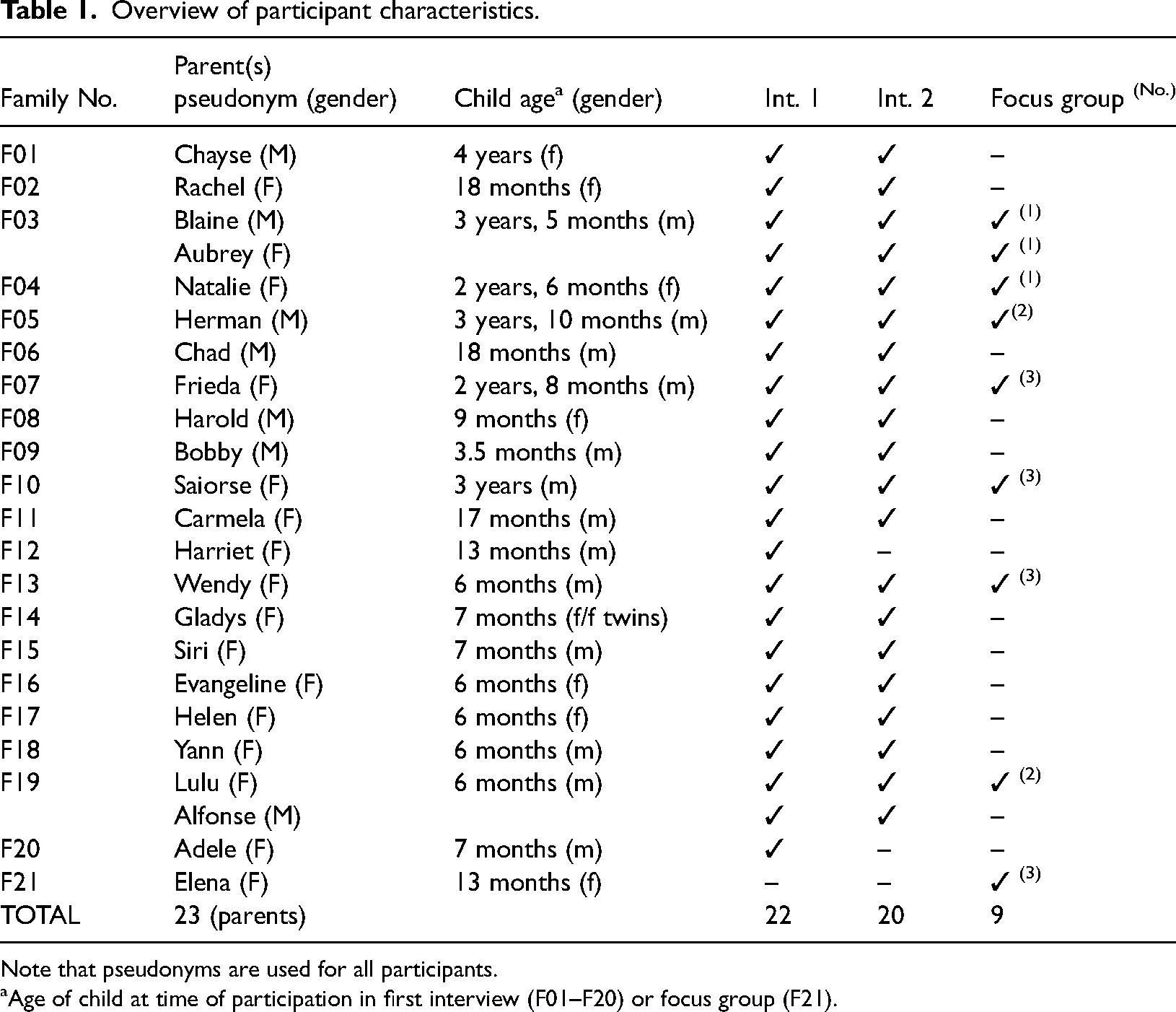
Note that pseudonyms are used for all participants.
Age of child at time of participation in first interview (F01–F20) or focus group (F21).
The interviews were semi-structured with open-ended questions. The questions’ themes address the research project's aims, centred on exploring parental perceptions of ‘quality’ in digital engagement, their perspectives on implications from their young children's digital media use, and parental approaches to planning children's current and future digital engagements. The project aims and any questions asked were also informed by, and build on, extant literature in this area, particularly the ‘Toddlers and Tablets’ study (The London School of Economics and Political Science, 2025), which raised questions about whether parents were taking a purposeful approach to planning for their children's ‘digital futures’ (Green et al. 2019). The themes used in coding emerged inductively from the data after the first-round interviews had concluded. Prior to coding, themes were negotiated through discussions between members of the research team, including the interviewers – taking into account both: (1) the aims of the research, and (2) unexpected insights and/or patterns. The same themes were used to code all interviews and focus groups.
The second round of interviews employed the same methodological tools as in round one, but with the aim of following up on the first interview by (1) prompting participants to reflect on their responses from interview one, and how their perspectives and lives had changed since then, and (2) asking participants to elaborate themes that emerged in the first conversation. Focus groups were conducted after the first round of interviews had been completed, to gauge similarities and differences in parents’ collective responses to the same topics explored in the individual interviews.
As data was collected, it was transcribed and de-identified before coding in NVivo software. The study used reflexive thematic analysis to interpret the data (Braun and Clarke, 2006), and the researchers acknowledge that their differing backgrounds and life experiences affect their interpretations. The research team's expertise also stems from a range of disciplines – including communications, sociology, cultural studies and practice-led research – offering different perspectives that result in inter-disciplinary interpretations of the data. Initially, six main themes were identified through negotiation between the two authors who conducted most of the interviews and subsequent coding while immersed in the data. Initial themes were refined through further negotiation between authors, whose differing disciplinary backgrounds and lived experience offered the opportunity to interpret data and re-think codes from a range of perspectives, with the final themes resulting from multiple rounds of iterative discussions, to ensure rigour. Themes explored in this paper include perceptions of ‘quality’ versus ‘non-quality’ digital content and engagements, and ‘changes’ in parental plans and practices regarding their children's screen-based media use.
We asked the following research questions:
What are parents’ hopes and current approaches to their children's ‘quality’ digital media use? What are parents’ fears and frustrations related to their children's current and future digital media engagement? What are parents’ plans for their young children's current and future digital engagement (if any)?
The quotes included in the following sections stem from both individual interviews and focus groups. Each section seeks to provide an overview of recurring themes and common perspectives, and examples that illustrate the differences and diversity in parents’ experiences, shaped by their specific family context.
Findings
This section begins with a brief overview of the prominent sentiments expressed by parents in this study when reflecting on their children's digital engagements. This introductory framing is followed by three sub-sections, addressing each of the three research questions in turn – focussing first on parents’ hopes and attempts at enabling ‘quality’ screen use for their children, then discussing their fears and frustrations, and finally outlining their approaches to planning for their children's digital futures. Key points are summarised at the end of each sub-section.
Participating parents’ accounts and reflections on their children's digital engagements were suffused with a general sense of anxiety and uncertainty. Particularly prevalent were concerns of ‘addiction’ to screens, and perceptions of an ever-present risk of negative impacts on children's behaviour, health and development, from excessive screen use – although a coherent rationale or concrete source for these concerns was rarely evident.
I’m quite concerned about him getting addicted to TV or iPad or that type of thing ‘cause I think it definitely can be addictive. Then maybe just struggling with parenting along the line [of him] having tantrums or maybe his emotions [being impacted negatively] from watching TV. I did read – I don’t know if this is true – but that they might struggle to regulate their emotions more if they’re watching a lot of TV. (Yann, mother of 6-month-old boy)
I can’t remember exactly but probably just random articles, parenting articles on the internet ‘cause as first-time parent I read a lot about this […] they say [your child] might develop autism if you introduce a screen. (Gladys, mother of 7-month-old daughter)
Even prior to their children's first intentional exposure to digital technologies, parents’ attitudes are shaped by the often-hyperbolic public discourses on associated risks, including addiction narratives and potential impacts on cognitive development. As suggested by Yann's response, parents may not ‘know if this is true’, but the perception of a potential risk of detrimental outcomes – even if far-fetched – seems to significantly shape parental attitudes.
Parents’ hopes and approaches to enabling ‘quality’ digital engagements for their children
Parents’ aspirations regarding their children's digital media use frequently revolved around themes of education and learning, but also connection and sociality – including digital engagements that contributed to a sense of belonging, and shaped children's social and cultural identities. Although perceptions equating ‘quality’ engagement with educational uses of digital media were a prominent theme, parents demonstrated diverse conceptions of what constitutes valuable screen use for their children.
Connection with kin and culture
Participating parents generally aimed to minimise the duration of their children's screen use. Yet, some digital engagements were considered so valuable, they were not evaluated against time-bound measures. Even parents like Evangeline, who based her digital parenting practices on recommendations that suggested no digital engagement for her infant daughter, made exceptions: We do FaceTime my mum a couple of times a week just because it's really important for them to have a really close relationship and I don’t get to see my mum every day. (Evangeline, mother of 6-month-old girl)
Many participants in this study similarly described video calls with close family members as a kind of ‘gold standard’ in digital engagements, enabling children to build and maintain connections to distant family members – benefits that had become especially apparent during the COVID-19 pandemic, when travel and in-person interactions had been limited. The ability of screen-based devices to engage even the youngest and pre-verbal age groups, was deemed a particular strength in this context.
Migrant parents especially valued the ability to offer digital engagements that introduced their children to their native language or other aspects of their culture. Chayse for instance commented on the benefits observed from his daughter's access to digital content that was designed for entertainment, but was used as a vehicle for learning: Well, the best thing that I get out of it is just her learning [Russian] […] we went through a phase where we’d only watch Disney movies in [Russian] and whatnot and now, she's starting to speak a little bit here and there. But that's my main benefit, is that I just want her to be able to speak two languages and it's pretty cool that she has started to do it. (Chayse, father of 4-year-old)
Chayse and Evangeline's descriptions of the kinds of regular screen use they perceived positively included digital engagements they felt were integral to the formation of their young children's social and cultural identities – facilitating communication, bonding and learning that formed prerequisites for a sense of belonging with kin and culture. These uses emphasise the importance of considering context in children's digital engagements, and the difficulty of placing content into discrete categories of ‘quality’ educational content or ‘bad’/mindless entertainment. The sometimes-unexpected benefits that parents perceived in these engagements made them question the validity of screen use guidelines in which ‘every single minute you look at a screen, regardless of what's on it, is counted in a negative’, as observed by Blaine.
At the same times, as digital technologies can promote connection, screen use can also be divisive and require constant negotiation – especially when parents have to navigate complex family dynamics and caregiving constellations. For single father Chayse, for instance, maintaining control over the duration of his daughter's screen use and the content she is watching, means needing to agree with his ex-partner on a set of rules that can be maintained at both households.
Joint engagement and enjoyment
Participants described digital engagements as particularly valuable when they led to instances of sociality and joint engagement. For instance, selecting and listening to music through a smart home assistant, or co-viewing content together:
The main time we use it is when she's tired or we’re tired at the end of the day, and we just got to get through that extra half hour to dinner or something. We just put it on and cuddle and watch it together. (Wendy, mother of 6-month-old girl)
Parents’ recounts suggest that they perceived a range of shared digital experiences as enabling ‘quality’ time through social connection. A sense of familiarity and relatability around their children's digital engagements also influenced parental evaluation. I downloaded a [video] game for him […] my wife hates it, she doesn’t like the video games and things like that but I’m like ‘oh it's just teaching hand eye coordination’ […] I know it might be a bit silly but I’ve always played games and things with my siblings […] I just feel like it would be something that maybe he and I could do together, just play fun silly games. (Herman, father of 3-year-old boy)
Herman's recollections and familiarity with videogames as a scaffold for joint engagement and sociality, prompted him to provide additional rationales to convince his wife to let their son engage in digital play. Lulu, mother of a 1-year-old-boy, shared similar memories of digitally scaffolded family time playing videogames with her family, emphasising that ‘It's definitely a way to bond’. Evidently, biographical factors such as growing up in a media-rich household, can afford parents a high level of digital literacy, and influence their perceptions and attitudes towards digital engagement. Yet, these factors are likely to differ significantly between parents even within the same family, leading to different opportunities for children to develop skills in digital literacy and citizenship, guided by their parents.
Notably, parents drew on a range of life experiences to situate children's digital engagements in the context of contemporary life. Wendy, mother to a 6-month-old girl, reflected on how the use of screen-based devices had superseded – but not quite replaced – familiar analogue activities, such as looking through photo albums. Imbuing these digital engagements with simultaneous nostalgia and novelty, Wendy observed how ‘it's just a bit different, not something we had to think about, or our parents had to think about, when we were kids’, exemplifying how similarities and differences in the use of different technologies for similar purposes over time, can also be understood as a defining feature of different generational experiences, without necessitating evaluations of ‘better’ or ‘worse’.
Education, in a broad and varied sense
When asked explicitly about what participants perceived to be ‘quality’ content, their answers aligned closely with normative advice on appropriate screen use, such as understandings of ‘quality’ content as educational by design. This ‘quality’ content could be accessed via a range of digital services, including TV programming, streaming services and a variety of platforms and apps, developed to: promote literacy and numeracy skills; ‘teach’ basic concepts like shapes and animals; deliver ‘edutainment’ shows; and to promote or compliment creative or play-based activities beyond the screen. Yet, similar to Chayse's family, many participants noted that educational digital engagement for young children could come from material that fell outside of normative ideas of ‘quality’ content:
I always find the thing around educational very interesting in young children because everything is new to them […] I immediately think Play School is educational but then I sit and I watch an episode of Bluey with my daughter or five episodes of Bluey with my daughter and I’m like man, there is so much to be learnt from this and I would 100% see Bluey as an educational thing even though it would probably be more classified as entertainment. But in terms of life values and relationships with people it's completely educational from a social perspective. (Natalie, mother of 4-year-old)
Natalie's reflections touch on important considerations – that young children learn from a wide range of engagements and experiences, both analogue or digital – whether designed to be educational or not.
Bringing together the range of participant perspectives in this study, parents overarchingly evaluated screen-based activities as being of ‘quality’, if they:
Supported the development of children's social and cultural identity, perceived as important to their sense of belonging, both within the family unit and beyond Scaffolded a diverse range of social, educational, or creative activities, including joint engagement for relaxation and entertainment
Importantly, while perceptions of ‘quality’ in young children's digital engagements may differ between families, and despite the many negative ‘screen time’ narratives that parents alluded to, all participants were able to identify digital engagements they felt were valuable, and could be integrated beneficially into their lives.
Parents’ fears and frustrations regarding their children's current and future digital engagements
Fears – screen-dependent zombies?
Parents in this study seemed especially worried about patterns of digital engagement that could be habit-forming – leading to concerns around ‘addiction’, including unwanted expectations of access to devices and content. Bobby, father of a 3-month-old boy, shared his unease when thinking about his child becoming ‘zombified by [digital devices]’, recounting his observations of ‘kids who get really grabby with an iPad, and when it's time for screen time to end there's big meltdowns’. Bobby feared his son may become ‘dependent on that sort of dopamine hit’ and worries whether there ‘is actually some good benefits in that’. Bobby's reflections illustrate how pseudo-scientific concepts and terminology have entered parents’ everyday vocabulary – amplifying perceptions of tangible harms, and validating narratives of young people's ‘internet addiction’ (Mackinnon and Shade, 2020). Some parents therefore justified time-based restrictions on digital engagements by referring to the idea of a dose-response: that increased time spent using digital technologies was associated with increased risk of addiction and other negative impacts. Other problematic content was described as ‘overstimulating’ – fast paced, brightly coloured, ‘flashy’ content, deemed to unsettle children and interfere with sleep and emotional regulation. Parents’ perceptions were often informed by their own experience of device use. Many participants recalled instances when they felt they had poor self-control or found it difficult to relax after digital engagements. Parents reported feeling particularly conflicted when they felt they had little choice but to utilise digital engagement as a parenting tool that was both valued and feared for its ability to draw and hold their children's attention:
We have one [iPad] and we only have used it with him on flights overseas… In the car if I have to pull the phone out and put something on then I will, but I just think the less he has the device in his hand the better. (Saiorse, mother of 3-year-old)
These recounts suggest a sense of internal conflict linked to parental risk consciousness regarding screen use, and a sense of responsibility to minimise their children's digital engagements. Parents displayed a strong awareness of the many ‘screen time’ narratives prevalent in popular culture and prominent national and international health recommendations – particularly an understanding that ‘less is better’ (WHO, 2019: ix). Additionally, participants worried about the displacement of other healthful activities through screen use – such as sleep and physical activity – and about children's unsupervised engagement with screens. However, rather than supporting or empowering parents, existing guidelines were commonly spoken about as unhelpful.
Frustrations
Although parents commonly evaluated their digital parenting practices against screen use guidelines, they also criticised their messaging as unrealistic and guilt-inducing: I think there's a lot of limitations with the guidelines. Whether it be the AAP guidelines or the Australian guidelines or the World Health Organisation guidelines I think they’re very, very limited at the moment, in that they focus solely on screen time as opposed to those other things that people have recognised, the quality and the content that people are engaging with and the way in which people are engaging with it as well. (Natalie, mother of 2.5-year-old girl) I think we’re advised nowadays to only give the kids 15- or 20-minutes’ screen time maximum and not before a certain age and things like that from the child health nurse and whatnot. I see a post in the mothers’ groups but it's just unrealistic, I think, to be putting that onto new mothers when babies are born and they say don’t do this, don’t do that, don’t do the other and you think but I need to get things done like I can’t just sit looking after a baby for the entire time. You’ve got to have some sanity. I think most parents now are going that way but feel guilty for it. (Carmela, mother of boy under 2yo)
These comments highlight frustrations with guidelines that prescribe strict time-based limits and include implicit expectations that parents are able to give their children their undivided attention at all times. Participants’ attempts at ensuring ‘appropriate’ digital engagements for their children were commonly described in terms of parental struggles – to balance unrealistic guidelines, social expectations and their own needs. Parents seemed to worry and feel most guilty about young children's digital engagements when these were:
Regular enough to form habits and expectations which was associated with a risk of over-dependency and addiction-like symptoms; Exceeding the recommended screen use durations for a child's age group; which was associated with increased risk of detrimental impacts; Unsupervised, associated with a lack of parental care and attention.
At times, parents implemented ‘risk-mitigation’ strategies that reduced these concerns, such as allowing digital device use during exceptional situations (illness, social engagements, travel), which were unlikely to be habit-forming and offered immediate solutions to challenging circumstances. Other parents reduced digital engagements to the shortest possible timeframes and carefully curated the content that children could access. These strategies were especially prevalent when screen-based devices were used to occupy children by themselves, to allow parents to ‘get things done’.
As suggested by Carmela, the implicit expectation that parents can invest extensive amounts of time providing alternatives to screen use, or to supervise, monitor and curate their children's digital engagements, are ‘just unrealistic’ for many parents. Access to the necessary resources to meet these expectations, such as caregiving support from others, or economic resources – including both financial and time-based ones – are commonly limited and uneven across different families.
Parents’ plans for their children's digital presents and futures
Participants’ accounts confirmed Livingstone and Blum-Ross’ (2020) observations that there are as many different approaches to managing children's digital engagements, as there are families. Nevertheless, some common themes emerged regarding parents’ approaches to planning their children's digital engagements.
Pragmatism and flexibility as guiding principles
Notably, participants commonly reported that their digital parenting plans and practices had changed little between the first and second interview conducted six months apart. The most significant changes in digital parenting plans were recounted in connection with parental expectations before versus after becoming parents – shifting from aspirational ‘pre-children’ ideals to pragmatic approaches informed by the lived experience of parenthood.
Yeah, with most parenting things pre-kids I was like I would never do this, I would never do that and then you get in that situation and you’re like oh well […] sometimes you’ve just got to put the TV on for 10 minutes or long flights, I’m definitely going to download some games to get through and things like that. Then my friend yesterday saying oh I’d never thought I’d let my one-year-old watch TV but sometimes I put it on for five minutes and I can just get stuff done. (Rachel, mother of 18-month-old daughter)
While a comparatively small number of participants avoided digital engagements for their children altogether, the predominant approach described by parents – especially for 0–2-year-olds – was a preference for flexibility:
I guess I don’t know what's going to happen so it's hard to know. That's I guess why I don’t have a strict plan in place, because it depends how she goes. I mean she could really love things that I was anti before and I could change my mind, who knows? So, I don’t want to put strict rules in place. (Helen, mother of a 6-month-old)
Still, remaining flexible did not mean that parents had no plans to manage their children's digital engagements. Participants with older children provided examples of how a flexible approach could be practically implemented in the context of families’ and children's changing needs.
[We decided to] start limiting her engagement with digital media a little bit more [….] Originally, we didn’t really have any limits to what she could engage with in digital media, whereas now we’ve decided to limit it a lot more because we thought it might be hindering a little bit of […] her verbal communication development. So now we’ve limited her to once every two or three days, having a two-hour session of digital media like watching a YouTube video or a TV show. (Harold, father of a 4-year-old daughter)
Harold's comment shows how he and his partner decided on changes to their digital parenting approach together and adapted their screen use routines in response to their observations and experiences of their daughter's changing needs. Flexible and pragmatic approaches also seemed informed by a sense of hope and cautious confidence in children's growing abilities to use technologies in ways that benefit them – despite significant generational differences that could make parents feel uneasy. These understandings indicate parents’ attempts at balancing protection with access and participation: I also think that they’re going to be teaching us a lot of the norms for age groups as well so while I don’t want to just give them everything because they want it. I think we’ll – in my time we were probably asking for phones around Year 8. I know my niece is now asking for a phone and she's earlier and to me initially I thought that was out of control but then when you look at it you realise that these things are happening younger and younger, so […] I do think it's important for them to stay connected and fit in with their peers as well. (Harriet, mother of 13-month-old boy)
It's like you want to balance their safety and protection with their opportunity, I think, because obviously they’re going to miss out on all this opportunity for socialising and building bonds and friendships online. So, these are just things I’m grappling with. (Lulu, mother of a 1-year-old boy)
As reflected in these responses, key advantages of a flexible and pragmatic approach to young children's digital engagements included being:
Child-led: responding and adapting to children's changing developmental needs and preferences; Collaborative: promoting input and negotiation between parents on how to manage digital engagements, remaining responsive to family dynamics; Reflexive: Regular evaluation of the changing roles and opportunities of digital engagements in children's lives; including re-evaluation of digital parenting plans and practices
This section showcases how despite prevalent concerns and conflicts between popular opinions, unrealistic guidelines and strong perceptions of risk and parental responsibility, parents remain resilient and realistic in developing digital parenting practices to meet their families’ needs. Parents also maintained a sense of optimism regarding their children's screen-use by seeking to facilitate experiences they recognised as ‘quality’ digital engagement. Flexible and pragmatic approaches to digital parenting plans also enabled a sense of self-efficacy despite the uncertain outcomes of their children's digital engagements, in a context of rapid social and technological change.
Discussion
Despite their fears and frustrations, parents often adopt a pragmatic and flexible approach to digital parenting that reflects their own families’ values and situations. While these findings align with recent work by Green and colleagues (2024) and Livingstone and Blum-Ross (2020), that explored digital parenting and childhoods for a wider range of age groups, our study – conducted in 2023 – focussed on new parents of very young children (babies to four-year-olds), to specifically explore the early views that would set the scene for families’ digital engagements as children develop, and as their agency and capacities increase. As is characteristic of contemporary risk societies (Beck, 1992), participants in this study tended to conflate a sense of vague, potential risks of digital engagements for their children, with actual risks – a tendency reinforced by negative media portrayals and anecdotal evidence. Participants described inappropriate digital engagements for their young children as those they perceived as causing behavioural anomalies, which was understood as an indicator of actual risk. Parents for example recounted instances of ‘zombification’ during which their child could get ‘sucked into’ their digital activity, resulting in tantrums and other undesirable behaviours, which seemed to confirm prevalent addiction narratives in connection with screen use.
Nevertheless, participants in this study recounted what they viewed as ‘realistic’ approaches to digital parenting for their young children, based on their lived experience of family life. This lived experience included observations and reflections on the changing needs of individual children, to enable flexible adaptation and negotiation of the realities of digital childhoods. These findings resonate with Willett and Zhao's (2024) work on pandemic parenting. While many parents felt uneasy about their children's increased screen use during the COVID-19 pandemic, having their children use screens in physical proximity to parents and over extended periods, provided opportunities to observe and learn about what children valued about digital engagements. Deeper parental involvement and interest in children's online activities, surfaced unexpected benefits – such as the sociality in online gaming, or the interest-based rather than random nature of YouTube videos that children enjoyed watching (Willett and Zhao, 2024), and which engaged their minds and imaginations well beyond the digital space. These considerations are important reminders of how difficult it is to evaluate what kinds of digital activities are appropriate for young children, who cannot necessarily articulate or reflect on their digital engagements.
The first-time parents in this study can be described as using flexible strategies of ‘good enough’ parenting (originally developed by Winnicott, 1953), a term and approach that has had a long usage in health, nursing, psychology and social work disciplines as well as being popularised by parenting influencers. Following along the ‘good enough’ parenting philosophy, parents’ flexible approach may see them allowing their children to take greater risks as they grow older – including in digital engagements. Parents’ strategies often aligned with recommendations from current research, such as a recent meta-analysis of 100 studies investigating the ‘effects’ of screen use on young children (Mallawaarachchi et al., 2024), which recommends intentional and ‘productive’ screen use, age-appropriate content and co-use. However, for our participants, sometimes ‘good enough’ meant allowing children digital engagement that may not always follow these dictums.
Parents have previously been critiqued for a ‘failure’ to plan for their children's digital futures (Green et al., 2019) – a perspective which is challenged through the accounts of participants in this study. Expanding on Green and colleagues’ (2019: 9) observations that problematise a ‘just in time’ approach to digital parenting as ‘reactive’, our participants explained they purposely chose not to make any strict plans, and provided rationales for their choices. Parents were reflective about generational differences in experiences of childhoods – thinking about the role of digital technologies in their own lives and acknowledging the rapid changes in digital environments that they had already experienced, and that they were anticipating going forward. Participating parents seemed to want to reserve the right to change their minds, to enable flexible responses to their children's developing agency in a fast-changing media environment. Parents based their digital parenting approaches on observing their children's behaviour in relation to screen use, and – where possible – on joint decision-making with their partner. However, these within-family negotiations frequently had a protectionist starting point, shaped by a strong parental awareness of anecdotal evidence, media narratives and screen use guidelines presenting digital engagements as ‘risky’. A flexible approach therefore necessitated constant emotional and cognitive labour of balancing parental anxieties, while aiming to provide opportunities for ‘quality’ digital engagement. Although educational and creative screen use were preferred, parents reported broad conceptions of ‘educational’, that frequently overlapped with digital engagement for leisure and play, including joint engagement as a way to bond with their children. Similarly, parents encouraged uses of screen-based devices to connect with kin and culture – laying the groundwork for children's positive engagement with technology as digital citizens. Notably, several parents’ reflections also suggested a sense of trust and confidence in their children's emerging abilities to ‘teach their parents about appropriate norms’ in digital engagements as they got older – indicating parental preparedness to listen to children's own perspectives and recognise their emerging capacities when negotiating ‘appropriate’ digital engagements. These findings confirm Green and colleagues’ (2019: 15) suggestion that parents may expect that flexible approaches to digital parenting will better equip children to be ‘empowered’ digital media users. Additionally, by resisting rigid time-based guidelines, and by approximating a ‘good enough’ approach to digital parenting, many parents in this study followed a children's rights approach more effectively than government recommendations – by constantly seeking to balance principles of protection, provision and participation.
Conclusion
This research indicates that while parents are often hyperaware of existing screen-time guidelines and relevant messaging, families are sensitive to their individual children's needs and seek to integrate ‘quality’ digital engagements into family routines. Walking what could be described as a ‘digital parenting tightrope’, parents seek to strike a balance with giving their children access to ‘quality’ digital engagements, while sometimes practising ‘screen-assisted’ parenting (Mascheroni and Zaffaroni, 2023) and allowing children to complement play and wind-down time with screen use. This article contributes to research regarding families’ everyday digital media use, giving a glimpse into the everyday worlds of parents as they grapple with advice from a range of sources. We echo Green and colleagues’ (2024) view that governments and other key sources of information for parents should offer advice that supports parents as they go along, rather than being ‘content blind’ and screen metric focused.
Contributions, limitations and future research
Prior media and communications’ studies outlining parental perceptions and management practices of children's ‘screen time’ provide insights into participants’ views at only one point in time (Livingstone and Blum-Ross, 2020; Mallawaarachchi et al., 2022b; Milford et al., 2024, 2025; Willet and Zhao, 2024). The specific contribution of this paper lies in how the multiple moments of data collection provide participants with opportunities to not only reflect on the current and future roles of digital technologies in their children's lives but also surface contextual layers of influence that shape their perceptions and practices of digital parenting. These influences include socio-cultural trends – such as the prominent media narratives and cultural beliefs that promote the internalisation of anxieties and expectations of ‘good’ (digital) parenting; social positioning determining access to resources, including financial and time-based; family dynamics including family structure and availability of inter-generational support; as well as biographical factors such as (digital) media experiences throughout the life-course. Understanding how parents come to hold certain attitudes and perspectives towards ‘screen time’ can usefully inform how better screen use guidelines should be framed. Countering hyperbolic media narratives, taking a compassionate approach that recognises the many contextual challenges of contemporary parenting, and drawing out the roles of digital technologies in children's lives that parents can relate to, would be suitable starting points.
The limitations of this study include that its participants came from one country, Australia, which has a relatively advanced standard of living. The participants were predominantly based in cities, and therefore more likely to come from a higher socio-economic background, and to enjoy reliable access to digital infrastructures. The study sought to capture parents’ views, but most participants were mothers and in ‘traditional’ two-parent homes. This relative homogeneity of the sample population results in a limited ability to provide comparative findings and analysis of how parental perceptions of children screen use, and practices of digital parenting and planning for a digital ‘future’ are enacted in families from a wider range of social positions and geographical locations, who have different levels of access to financial, cultural, educational, or infrastructural resources. The project also did not capture children's views on their digital futures, but centred parents’ perspectives on children's activities. We can only interpret ourselves (as adults) how the perspectives featured in this work consider, or compare to, a view of children's rights from their own perspective.
Pursuing research related to the concept of ‘good enough parenting’ and parents’ own perception of this term in the digital age may prove fruitful. Future research should focus on amplifying the voices not yet represented here, including those of parents from a range of genders and socio-economic backgrounds, as well as children's own perspectives on their digital presents and futures. Research that may be co-designed with parents and children on their digital futures would be valuable. The concept of risky play, now popularised as a way for children to have healthy development through extending themselves – including in online spaces (Mensonides et al., 2024) – could be a useful concept to build on parents’ sense of trust in children's abilities, which came up in our study. This concept could provide useful provocations regarding understandings of children's vulnerability and their developing capacities, to inform how parents and regulators may balance ‘protection’ of children in digital spaces, with aspirations for ‘provision and participation’, in line with children's digital rights approach.
Footnotes
Acknowledgements
The research team would like to thank Chief Investigator Professor Lelia Green, research assistant Dr Carmen Jacques and the anonymous reviewers of this paper, whose generous feedback improved the clarity and contribution of this work.
Declaration of conflicting interests
The authors declared no potential conflicts of interest with respect to the research, authorship, and/or publication of this article.
Funding
The authors disclose receipt of the following financial support for the research, authorship, and/or publication of this article: This work was supported by the Australian Research Council Centre of Excellence for the Digital Child (grant number 2021-02205-GREEN).
