



Abstract
The digital world is a vital place to connect with others. This study investigates individual differences in experiencing relatedness through new technologies, or “digital relatedness.” The study is grounded in a novel framework that combines social and digital capital and self-determination theory perspectives. We used a three-wave survey conducted from 2021 to 2023 involving 1226 Finnish adults and applied random effects within-between models for data analysis. The results show positive within- and between-person effects of a preference for interacting with artificially intelligent systems (over humans) and the use of smart technology on digital relatedness as well as positive between-person effects of a sense of local community belonging. The positive effect of using smart technology was particularly evident for individuals with a lower or medium level of local community belonging. The results suggest that frequent technology use can enhance digital relatedness, especially for those less connected to their local community.
Introduction
Social interactions are increasingly taking place online, and the digital world has become a vital place for experiencing a sense of belonging with others. Individuals can experience relatedness to others through digital forms of communication, such as social media (Ahn and Shin, 2013; Grieve et al., 2013; Sheldon et al., 2011), in a phenomenon we conceptualize as “digital relatedness.” Research has shown that both stronger and weaker offline social resources can be linked with varied levels of online social resources (Cheng et al., 2019; Pouwels et al., 2022). Since individuals differ in their motivations, access, and skills to use digital technology, such technology poses unequal opportunities for people to benefit from its use (Scheerder et al., 2017; Van Deursen and Helsper, 2015). However, it is not clear who benefits the most from digital communication (Pouwels et al., 2022; Ragnedda et al., 2020), and there is a need for more nuanced investigations of individual differences in experiencing digital relatedness.
Digital relatedness is defined as experiencing connection and care with others within the context of technology use. Here, “others” can refer to humans or to other kinds of figures in the online context. The use of digital technology (e.g. social media) has been associated with online social resources, such as bridging and bonding social capital and social connectedness (Liu et al., 2016; Phua et al., 2017; Sheldon et al., 2011; Spottswood and Wohn, 2020; Williams, 2019), and perceived benefits of online services (Heponiemi et al., 2020). However, the effects of digital technology on social resources can be contradictory and vary among users and technological environments and features (Ellison et al., 2022; Phua et al., 2017; Ryan et al., 2017; Waytz and Gray, 2018). Methodologically, there is a need for longitudinal within-person and person-centric analyses to better understand who benefits the most from online interactions (Pouwels et al., 2022).
In this three-wave longitudinal survey study, we draw on a novel framework that combines perspectives of social and digital capital and self-determination theory to investigate individual differences in digital relatedness. Our study responds to the need for theory and empirical research to analyze and understand the growing importance of online social relations and their connection to offline social relationships. The study fills the gap in existing research on longitudinal evidence on who benefits the most from digital communication (Pouwels et al., 2022). In addition, it provides empirical insights into the significance of technology access and use preference in the link between offline and online social resources (Helsper, 2012). The study also contributes to the theoretical discussions on social ties and resources in the digital era. Digital relatedness addresses the pressing need for new concepts to understand and analyze social relationships in an increasingly digitalized world.
Theoretical framework
Digital relatedness is a new concept that is theoretically grounded in the notion of relatedness outlined in self-determination theory (Ryan and Deci, 2017). In this theory, relatedness refers to experiences of care, bonding, and connection and is considered one of the three basic psychological needs (Baumeister and Leary, 1995; Ryan and Deci, 2017). Satisfaction of the relatedness need has been linked with a feeling that one is significant and connected to others, while an unsatisfied relatedness need has been associated with a sense of social exclusion, loneliness, and alienation (Vansteenkiste et al., 2020). Self-determination theory predicts that basic psychological needs mediate the links between technological experiences and well-being, motivation, and meaningful engagement (Peters et al., 2018; Ryan and Deci, 2019). Basic psychological needs are not fulfilled automatically, and they require a supportive environment to be consolidated (Ryan and Deci, 2017).
Individuals differ in the extent to which their relatedness need is met in different environments, including online ones, which play a central role in digital relatedness. Empirical evidence on the relationship between offline and digital relatedness is still emerging, but there are some evidence that offline and online social resources are interconnected (Pouwels et al., 2022; Ragnedda et al., 2022). While the online world often mirrors the offline world, factors such as the quality, relevance, ownership, and sustainability of engagement with digital resources may influence how this engagement affects offline resources (Helsper, 2012).
In our framework, we connect digital relatedness to the broader concept of digital capital, which has recently gained attention in research literature. Digital capital is grounded in Bourdieu’s capital theory (1979, 1980) but updated for the digital world. It covers social networks, access, and competence online (Bakken et al., 2023; Calderón Gómez, 2021; Merisalo and Makkonen, 2022; Park, 2017; Ragnedda et al., 2020). Digital capital has been presented as a bridge capital between online and offline spheres covering social capital (social networks and assets), cultural capital (cultural assets, for example, education and cultural knowledge) and economic capital (material resources; (Bakken et al., 2023; Ragnedda, 2018). From this perspective, digital capital also includes personal capital that refers to cognitive aspects, such as motivations and preferences related to the use of digital technology (Helsper, 2012; Ragnedda, 2018). Overall, having digital capital means that a person has social networks within the digital space, knows how to use digital tools, has the interest and motivation to use different technologies, and is aware of how to behave in different digital settings. This concept is comparable to Bourdieu’s (1979) concept of “habitus,” which encompasses the internalized habits, skills, and dispositions that individuals possess and develop.
By employing the concepts of digital relatedness and digital capital, we respond to the need to investigate the growing importance of the digital domain today. We reflect on the topic not only from the social-psychological perspective of self-determination theory but also from sociological perspective of digital capital. Both concepts address the need to understand people’s social positions in the present era. We live in a world with different forms of the “digital divide,” which signifies the gap between those who do and do not have the access and skills to use and benefit from digital technologies (Ragnedda et al., 2022). While the concept of the digital divide has traditionally been applied specifically to the possibility to use technologies, current discussions have been focusing more on the benefits gained from these technologies as well (Van Dijk, 2020).
Individual factors predicting perceived digital relatedness
Regarding individual differences in digital forms of communication, there have been lively discussions about the social enhancement and social compensation hypotheses (Pouwels et al., 2022; Ragnedda et al., 2022). The social enhancement hypothesis suggests that individuals with rich offline social resources use online platforms to enhance their social networks and connections. In contrast, the social compensation hypothesis indicates that people with weaker offline social resources use online platforms as an additional or alternative venue for creating social contacts (Pouwels et al., 2022; Smith et al., 2021). Likewise, the “rich-get-richer” hypothesis predicts that those who are already rich in offline social resources benefit the most from their use, while the “poor-get-richer” hypothesis proposes that individuals with the opposite characteristics derive the most benefit (Cheng et al., 2019; Pouwels et al., 2022). While conflicting, each hypothesis has received some support from empirical research (Cheng et al., 2019; Pouwels et al., 2022).
Some previous studies have suggested that a sense of belonging to a local community and digital relatedness may be connected to each other. For example, research has shown that high levels of belonging to the general community and a group of friends are associated with social Internet use (Kavanaugh et al., 2005). Research focusing on older adults’ neighborhood connections has demonstrated that the initial level of social connectivity influences the relationship between the use and benefits of communication tools (Hage et al., 2016). Generally, the dynamics of offline and online social relationships are complex, with some studies reporting predominantly positive outcomes (Vella et al., 2019), while others highlight more negative ones (Stevens et al., 2017). The benefits of online interactions and relationships may be more pronounced when they also lead to offline encounters (Nowland et al., 2018; Rufas and Hine, 2018; Vella et al., 2019).
In addition to considering the relationship between offline and online social resources, it is important to examine the motivations and resources behind the use of technology. Research has shown that people have different preferences regarding technology-enabled or face-to-face interactions, with some favoring digital forms of communication over offline alternatives (Caplan, 2003; Immonen et al., 2018; Nowland et al., 2018). Access to digital technology and a positive attitude toward online social interaction can increase the likelihood of experiencing digital relatedness. However, these factors do not guarantee such an experience. The corresponding fields model generally supports this idea by highlighting the roles of digital technology access, skills, and attitudes in mediating the links between offline and digital resources (Helsper, 2012; see also Heponiemi et al., 2023).
As the digital world, including artificial intelligence (AI)-based conversation systems (e.g. Brandtzaeg et al., 2022), provides an important means of experiencing a sense of belonging with others, those who do not use digital technology cannot enjoy its potential benefits in terms of digital relatedness. Especially now, when many AI-driven platforms and generative AI applications are available to the public without requiring specific coding skills, individual preferences and attitudes toward AI interactions can greatly affect the digital capital of individuals. Interactions offered by AI are also becoming more personalized. Chatbots and virtual assistants can enhance user engagement and satisfaction by tailoring responses to individual needs (Shumanov and Johnson, 2021). This personalized approach not only improves digital competency but might also strengthen connectedness among users or other figures in the online space, thus contributing positively to digital relatedness.
Sociodemographic factors and other individual characteristics likely play a role in digital relatedness. Factors related to higher socioeconomic status—for example, being employed, earning a higher income, and having more educational attainment—are likely linked with digital relatedness because they can increase access to digital technology as well as the skills and opportunities to use it (Scheerder et al., 2017). The personality traits of extroversion and neuroticism may also be related to digital relatedness because they can influence a person’s preference regarding interpersonal communication (Bowden-Green et al., 2021; Cheng et al., 2019). Furthermore, digital relatedness may be related to gender, as research has documented gender differences in the use of social networking sites (SNSs), including a higher tendency of female individuals to use SNSs to maintain social relationships and gain social information (Krasnova et al., 2017; Liu et al., 2016; Muscanell and Guadagno, 2012). Finally, given that young people generally use digital technology more than older people (Addeo et al., 2023; Faverio, 2022; Ragnedda et al., 2020), experiences of digital belonging could vary depending on the ages of individuals. We assessed these factors through hybrid modeling based on survey data from Finland, a technologically advanced country that is the focus of the study.
Research design
In this study, we sought to obtain longitudinal evidence on who benefits the most from digital technologies in terms of experiencing digital relatedness. Digital relatedness is a new concept grounded in self-determination theory (Ryan and Deci, 2017) that is closely linked with the theoretical perspectives of social capital and digital capital (e.g. Bakken et al., 2023; Bourdieu, 1979, 1980; Ragnedda et al., 2020). Regarding individual differences in digital relatedness, we focused on the effect of offline social resources, as measured by participants’ sense of belonging to their local community. Furthermore, we considered the possible moderating roles of technology use and preference as proxies of digital capital in the relationship between offline and online social resources. Given the limited prior evidence on the same constructs as those in our study, we did not formulate hypotheses. Instead, we defined the following research questions:
To what extent do a sense of local community belonging, AI interaction preference, and use of smart technology predict digital relatedness?
Do AI interaction preference and use of smart technology moderate the relationship between a sense of local community belonging and digital relatedness?
Sampling
The data for this study derive from a longitudinal survey on AI in society that has been administered at three time points to date. The first time point was May to June 2021 (T1; N = 1226), the second time point was May to June 2022 (T2; n = 828), and the third time point was May to June 2023 (T3; n = 717). The dataset offers rich information about participants’ experiences with and views on new technologies, such as AI, as well as their social relationships, well-being, and demographics. The target group of the survey was Finnish adults between 18 and 80 years of age. The participants were recruited from an online panel operated by Norstat Finland. The response rate in T1 was 30.8% of all people invited to the survey. Of those who answered the first survey, 67.6% answered the T2 survey, and 54.0% answered the T3 survey. The median response times for the surveys were 16.1 minutes (T1), 17.1 minutes (T2), and 16.2 minutes (T3).
We used population census figures provided by Statistics Finland (StatFin service; https://pxdata.stat.fi/PxWeb/pxweb/en/StatFin/) to first compare our T1 sample to the Finnish population aged 18 to 80 in the year 2020. We observed no significant biases regarding age, gender, education, or regional distribution. The age distribution was identical to that of the Finnish population (48.4 years in our sample vs 48.4 years in the population). The gender distribution also mirrored that of the general population (50.1% female in our sample vs 50.1% in the population). Regional representation showed only a slightly higher proportion of participants from the Helsinki-Uusimaa region (34.0% in our sample vs 31.2% in the population) and a marginally lower representation from Eastern Finland (14.8% in our sample vs 15.4% in the population) and Northern Finland (10.5% in our sample vs 12.9% in the population). Our sample contained a marginally higher percentage of individuals with at least a BA degree from a university or university of applied sciences (38.3% in our sample vs 36.8% in the population). Our non-response analysis showed that the participants in T3 were, on average, older than the T1 respondents (53.1 years vs 48.4 years). No major dropout occurred based on gender (50.4% female at T3 vs 50.1% female at T1). Regarding regional data, we noted minimal fluctuations in representation from Helsinki-Uusimaa (34.9% at T3 vs 34.0% at T1), Eastern Finland (14.4% at T3 vs 14.8% at T1), and Northern Finland (10.3% at T3 vs 10.5% at T1).
Participants received information about the research aims and were informed of their right to stop the survey at any time. They were also provided with the contact details for the research projects and a link to the privacy notice. For data cleaning, we ran quality-check analyses according to the research lab’s protocol, which included checks for patterned and abnormal responses. In the final dataset, we included only answers from participants who had filled out the entire survey. Prior to the data collection, ethical approval for the research protocol was granted by the Academic Ethics Committee of Tampere region in Finland.
Measures
Digital relatedness was measured with a three-item scale used in previous research (Bergdahl et al., 2023). Participants used a scale ranging from 1 (totally disagree) to 7 (totally agree) to indicate their level of agreement with the following statements: “New technologies give me more opportunities to interact with others,” “I feel close to others when using new technologies,” and “I have more opportunities to experience closeness with others when using new technologies.” The items were summed up to scales. McDonald’s omega coefficients were 0.87 (T1), 0.88 (T2), and 0.89 (T3) for internal consistency of the scale.
A sense of local community belonging was measured with a statement used in previous research (Hawdon et al., 2014; Räsänen et al., 2014), “I feel I am part of the community,” which is adapted from the Sense of Community Scale (Bachrach and Zautra, 1985). Participants indicated their agreement with the statement on a scale from 1 (strongly disagree) to 7 (strongly agree).
AI interaction preference (over humans) was measured with a single item from the General Attitudes Toward AI Scale (Schepman and Rodway, 2020): “For routine transactions, I would rather interact with an artificially intelligent system than with a human.” Participants rated their level of agreement with the statement on a scale from 1 (totally disagree) to 7 (totally agree).
Use of smart technology was investigated with the question, “How often do you use the following technologies?” The technologies listed were, a smart home system (e.g., smart lighting), immobile smart home appliance or other appliance (e.g. smart TV), mobile robot or another smart device (e.g., robot vacuum cleaner, robot lawn mower, assistance robot), virtual assistant via smart speaker, computer, or a phone app (e.g., Siri, Alexa), and wearable smart technology (e.g., smart watch, smart ring).
Answers were given on a scale from 0 to 4 (0 = never, 1 = less than weekly, 2 = weekly, 3 = daily, 4 = many times a day). The items were summed up to scales. The omega coefficients were 0.70 (T1), 0.65 (T2), and 0.68 (T3). In an additional analysis, we tested the individual contribution of each component by incorporating it into the model as an independent variable on an initial scale ranging from 0 (never) to 4 (many times a day).
Monthly gross income was reported using a scale from 1 to 8 (below €1000, €1000–1999, €2000–2999, €3000–3999, €4000–4999, €5000–5999, €6000–6999, above €7000).
Employment status was examined with a question about the participant’s current work situation. From the answers, we created a dummy variable for employment status (0 = not working, 1 = working).
Extroversion and neuroticism personality traits were measured with items from the Big Five Inventory (Hahn et al., 2012). The statements measuring extroversion were “I am talkative,” “I am outgoing and sociable,” and “I am relaxed and handle stress well.” The statements measuring neuroticism were “I worry a lot,” “I get nervous easily,” and “I am reserved.” The participants indicated their level of agreement with the statements on a scale from 1 (does not describe me at all) to 7 (describes me completely). For both dimensions, the items were summed up to scales. The omega coefficients were 0.88 for extroversion and 0.78 for neuroticism.
Other control variables included age (in years), gender (male or female), and education (no college or university degree or a college or university degree).
Statistical techniques
We first collected descriptive statistics and produced a correlation matrix of all study variables. In the subsequent modeling phase, we addressed the clustering nature of our data with consideration to both fixed and random effects. We focused on capturing the temporal changes occurring among individuals and differences across individuals regarding digital relatedness.
To account for the nested structure of our sample, we employed random-effect within-between models, also known as hybrid models (Bell et al., 2019). These models estimate the relationship between predictors and outcome variables at different levels by distinguishing within-individual (Level 1) and between-individual (Level 2) components in time-varying variables. To determine within- and between-level effects, we recoded time-varying predictors to represent the deviation from their mean at each time point (Level 1) and their individual mean across waves (Level 2), respectively. The models also allowed us to consider the covariate effects of control variables and explore cross-level interactions between Level 2 and Level 1 variables. All analyses were conducted using Stata 18. The random-effect within-between models were computed using the xtreg command following Schunck (2013), and the interactions were visualized using the coefplot command.
Results
Table 1 presents the descriptive statistics of the study variables. The correlation matrix of study variables is presented in Appendix A. The descriptive results of the present study reveal a marginal decline in the perception of digital relatedness at T3 compared to T2 (B = 0.657, p < 0.001). The AI interaction preference was higher at T2 than at T1 (B = 0.212, p = 0.009); however, at T3, it reverted to the level observed at T1. Furthermore, the mean income of participants exhibited a gradual increase across the measurement points and reached a statistically significant elevation difference at T3 compared to T1 (B = 0.321, p < 0.001). Otherwise, there was no noticeable change in the variables used across the measurement points.
Descriptive overview of study variables (n = 1225).
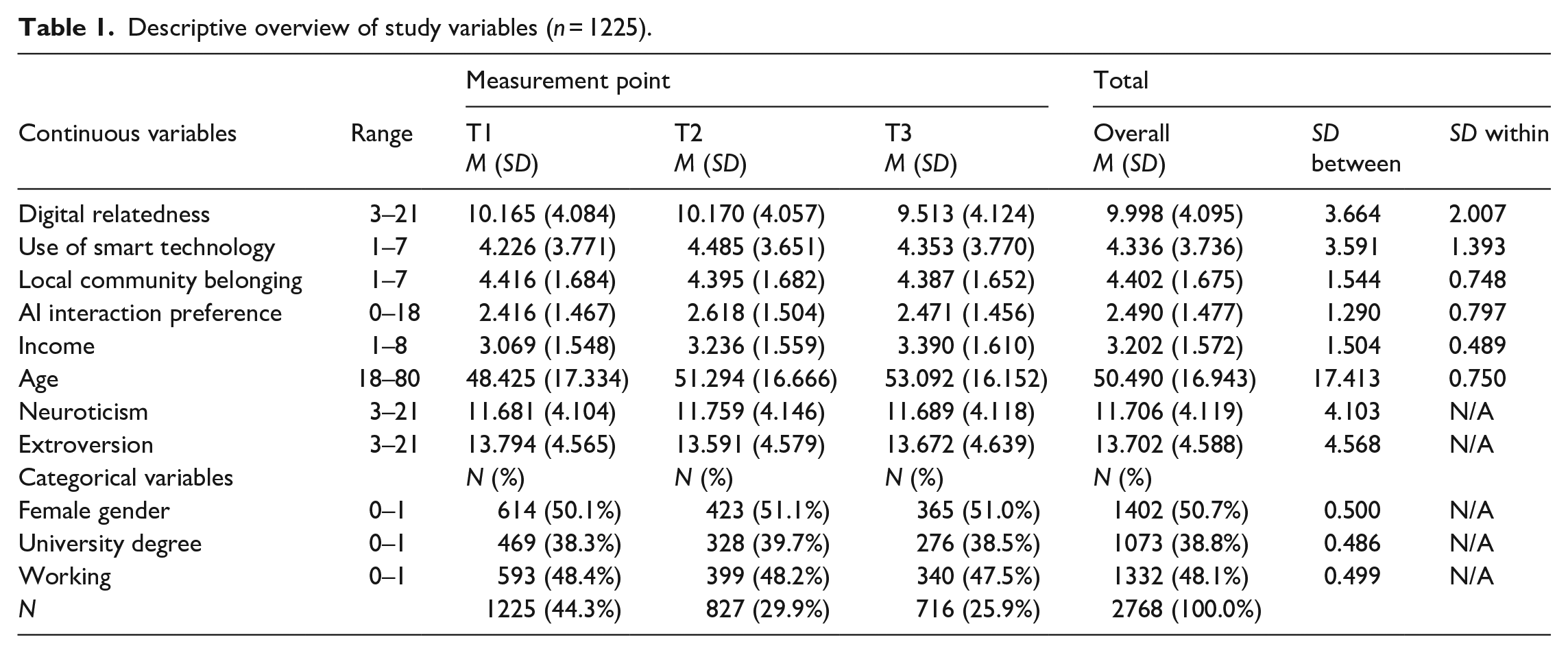
The multilevel analysis began with fitting the null model, in which the intra-class correlation (ICC) was estimated to reflect the extent of variation explained by the random effects. The results revealed an ICC of 0.567, which indicated that 56.7% of the variability in digital relatedness could be attributed to individual differences. However, a substantial portion of the variation was associated with within-level differences over time, which emphasizes the critical role of multilevel modeling in finding both within- and between-person effects.
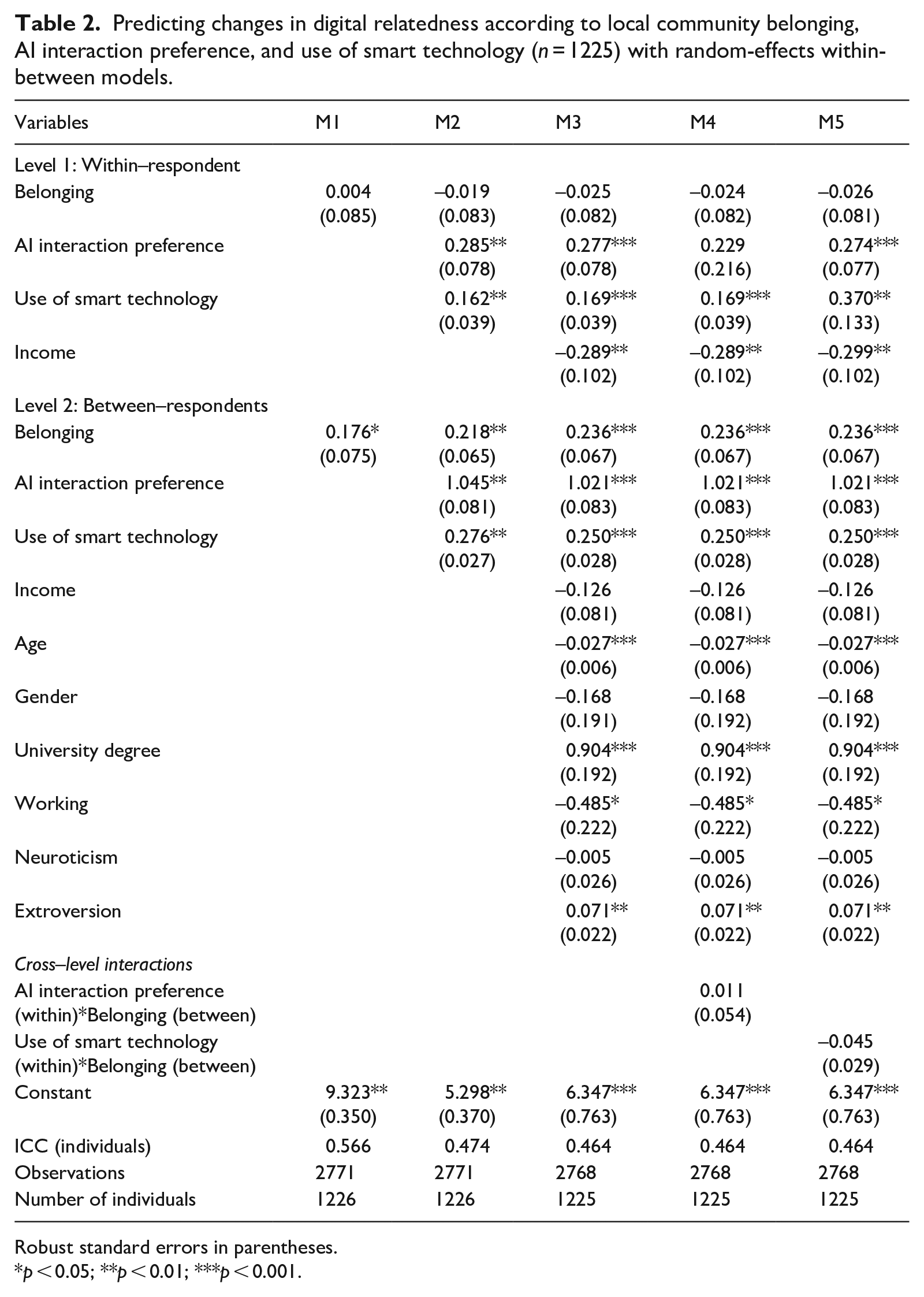
The models are shown in Table 2. The first model integrated the within- and between-level effects of local community belonging. No within-person effect was found (B = 0.004, p = 0.965), but the between-level effect was notable (B = 0.176, p = 0.019). These results suggested that individuals with a stronger sense of local community belonging had greater digital relatedness on average across the observed waves.
Predicting changes in digital relatedness according to local community belonging, AI interaction preference, and use of smart technology (n = 1225) with random-effects within-between models.
Robust standard errors in parentheses.
p < 0.05; **p < 0.01; ***p < 0.001.
Technology-related variables were introduced in the second model. The outcomes revealed that within-level increases in AI interaction preference (B = 0.285, p < 0.001) and use of smart technology (B = 0.162, p < 0.001) were associated with an increase in digital relatedness. In addition, the results confirmed that higher mean levels of AI interaction preference (B = 1.045, p < 0.001) and use of smart technology (B = 0.276, p < 0.001) were linked to increased digital relatedness.
In an additional analysis, we found that all individual technology types contributed positively to digital relatedness, but there were notable differences in magnitude at both the within- and between-individual levels. The use of virtual assistance had the most pronounced effect (Bwithin = 0.587, p < 0.001; Bbetween = 1.004, p < 0.001) followed by wearable technology (Bwithin = 0.262, p < 0.001; Bbetween = 0.430, p < 0.001). No significant effect was observed at the within-person level, but at the between-person level, positive contributions were observed from the use of smart home systems (Bwithin = 0.189, p = 0.090; Bbetween = 0.860, p < 0.001), smart home appliance (Bwithin = 0.114, p = 0.125; Bbetween = 0.498, p < 0.001), and robots (Bwithin = 0.111, p = 0.482; Bbetween = 0.548, p < 0.001).
The third model showed that the control variables did not affect the main associations found in the previous models. Among the control variables that reached statistical significance at the 95% confidence level, income (Bwithin = –0.289, p = 0.005), age (Bbetween = –0.027, p < 0.001), and working status (Bbetween = –0.485, p = 0.029) were negatively associated with digital relatedness, while university degree (Bbetween = 0.904, p < 0.001) and extroversion personality trait (Bbetween = 0.071, p = 0.001) were positively associated.
Cross-level interaction models were then computed to estimate the effects of AI interaction preference and use of smart technology according to the mean level of local community belonging. As seen from the fourth model in Table 2, the interaction between AI interaction preference and local community belonging was not significant (B = 0.011, p = 0.863). Although the standard errors increased, the inclusion of the interaction did not markedly affect the main effects, which suggested that the positive impact of AI interaction preference on digital relatedness persisted regardless of the level of local community belonging, as depicted in Figure 1.
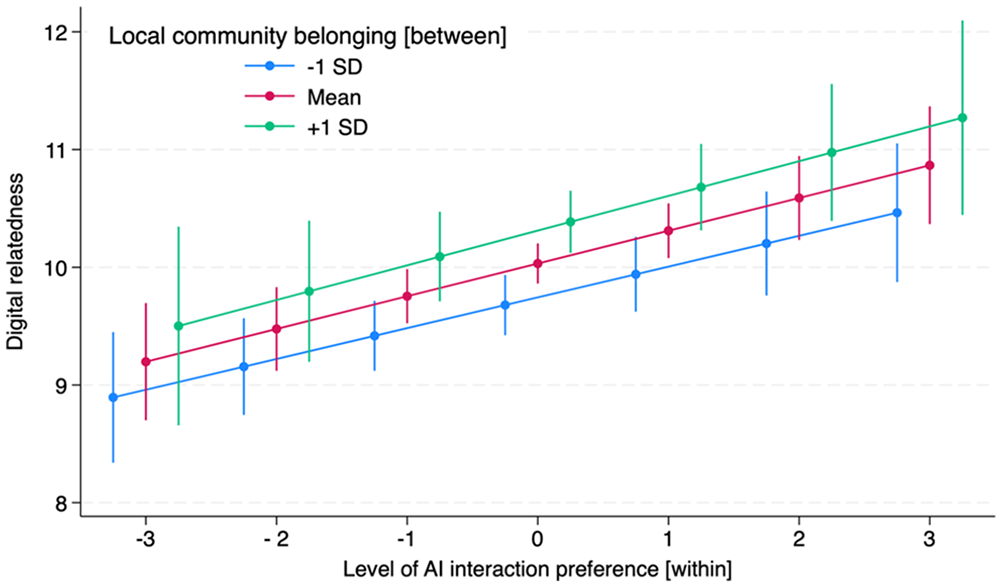
The effect of AI preference (within) on digital relatedness according to level of local community belonging (between).
The interaction effect between use of smart technology and local community belonging was slightly larger but not statistically significant at the 95% confidence level (B = –0.045, p = 0.114). However, including the interaction strengthened the within-level main effect of smart technology use (B = 0.370, p = 0.005). This, coupled with the negative interaction term, suggested that the significance of smart technology use varied somewhat based on local community belonging. Figure 2 illustrates how the effect of smart technology was more pronounced at low and mean levels of local community belonging. Additional analysis of the fifth model revealed that the positive effect of increased technology use was particularly evident among individuals at one standard deviation below the mean level (B = 0.238, p < 0.001) and the mean level (B = 0.169, p < 0.001) of local community belonging. Conversely, at high levels of local community belonging (at least one deviation above the mean), increased use of smart technology had no apparent effect on digital relatedness (B = 0.102, p = 0.079).
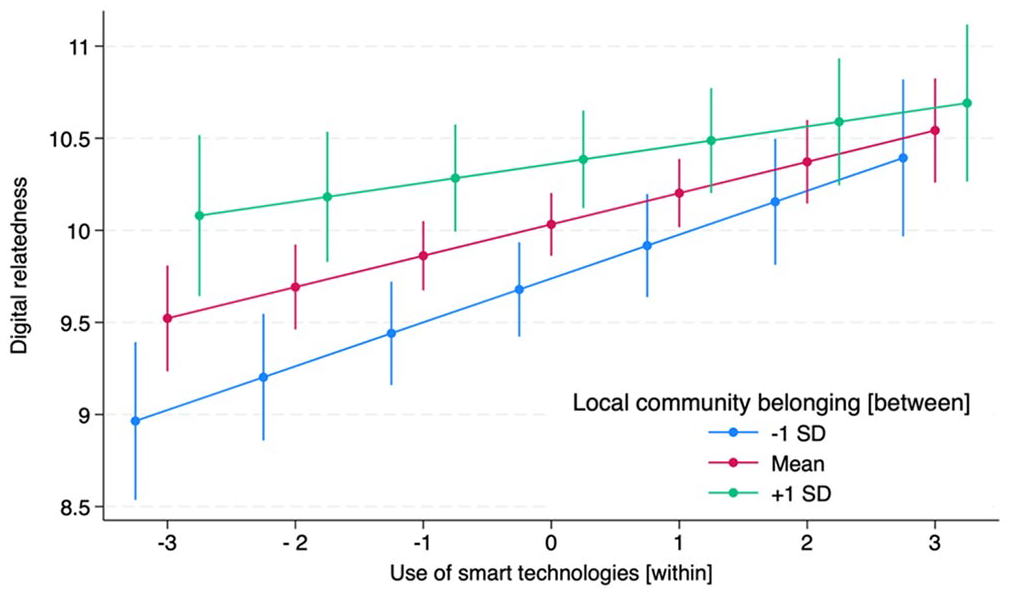
The effect of use of smart technology (within) on digital relatedness according to level of local community belonging (between).
Discussion
In this study, we used longitudinal survey data from Finland to investigate individual differences in digital relatedness. The study is grounded in the theoretical perspectives of social and digital capital and self-determination theory. The results of the random-effect within-between models showed positive within- and between-person effects of AI interaction preference and use of smart technology on digital relatedness. We also detected a positive between-person effect of sense of local community belonging on digital relatedness. We observed a trend indicating that the positive impact of increased use of smart technology was particularly evident among individuals who felt a lower or medium level of local community belonging.
Previous literature has often discussed individual differences in the use of digital technologies from the perspective of the social enhancement (“rich-get-richer”) or compensation (“poor-get-richer”) hypothesis (Cheng et al., 2019; Pouwels et al., 2022). Our results partially supported the compensation (“poor-get-richer”) hypothesis. Specifically, we found that a sense of local community belonging had a between-person effect on digital relatedness but had no within-person effect on it. In examining the ways that individuals use technology, we observed that smart technologies enhanced digital relatedness for all people but especially those who had a weaker sense of belonging to their local community. In this sense, people who felt less connected with their local community benefited the most from actively using technology to experience digital relatedness. One interpretation of this result is that technology-enabled interactions may present more opportunities for meaningful social contact, particularly for those who have fewer offline social resources, which might be related to finding an online context that is suitable for self-disclosure (Luo and Hancock, 2020; Smith et al., 2021). To our knowledge, this study is the first to explicitly show how varied levels of a sense of local community belonging relate to benefits gained from technology use, particularly in terms of digital relatedness and within the context of smart technologies.
The results showed that smart technology use and AI interaction preference had positive within- and between-person effects on digital relatedness, which suggested that both frequent technology use and AI interaction preference can enhance digital relatedness. A possible explanation of this result is that frequent technology use and preference for AI interactions over human alternatives imply access to technological interactions and a willingness to engage in them, which can lead to experiencing digital relatedness. The results align with broader discussions of the digital divide suggesting that both the actual use and the motivation or willingness to use digital technology play a role in how individuals benefit from digital technologies (Scheerder et al., 2017; Van Deursen and Helsper, 2015; Van Dijk, 2020).
The additional analysis indicated that the most significant individual smart technologies were virtual assistants and wearable technologies. This finding is consistent with those of previous studies reporting that virtual assistants can enhance group identification (Mirbabaie et al., 2021) and that wearable technologies stimulate social interactions (Girginov et al., 2020). However, all individual aspects of smart technologies contributed to digital relatedness in the between-person comparisons, which reinforces the value of analyzing their accumulation and diffusion. From a digital capital perspective, we can conceptualize the diverse use of different smart technologies as part of a user’s habitus in online environments, which is further reflected in the accumulation of various benefits, such as digital relatedness, from those online environments (Bourdieu, 1984; Helsper, 2012; Ragnedda, 2018).
We found that AI interaction preference tended to have a stronger positive effect on digital relatedness than frequent use did, which implied that preferring technology-enabled interactions is particularly conducive to experiencing digital relatedness. Studies have shown that some individuals prefer technology-mediated interactions over offline alternatives (Caplan, 2003; Immonen et al., 2018; Nowland et al., 2018). Our study adds related insights regarding the preference for AI interactions more specifically. The preference for AI interactions over human alternatives could relate to a person’s own characteristics or to the characteristics of a technology (Immonen et al., 2018) or to the reality of having different options for interaction mediums. Finland has relatively good levels of digital infrastructure and digital skills (European Commission; Directorate-General for Communications Networks; Content and Technology, 2023), which provides people with some freedom to decide which technology to use. Nevertheless, in Finland and other technologically advanced countries, it is nearly impossible to fulfill one’s daily activities without interacting through or with digital devices or software. Therefore, it is crucial to support people in accessing digital technologies and building competencies for their use.
Our results also showed that indicators of socioeconomic status (income, education, age) and personality trait were linked to digital relatedness, contributing to the growing evidence on determinants of the social outcomes of using digital technology (Scheerder et al., 2017). Surprisingly, higher income negatively affected digital relatedness, possibly due to less interdependence or perceived similarity to others. Extroversion was positively associated with digital relatedness, suggesting that extroverts may find it easier to connect online due to their preference for interpersonal communication (Cheng et al., 2019).
Our study provided much needed longitudinal evidence on who benefits the most from digital communication (Pouwels et al., 2022). Our results generally supported the theorization of the corresponding fields model (Helsper, 2012), which highlights the mediating effects of digital technology access, skills, and attitudes on the relationship between offline and digital resources. We introduced a novel framework that combines perspectives from social and digital capital and self-determination theory. Importantly, our study contributes to theoretical discussions of social relationships online by introducing the new concept of digital relatedness. By emphasizing the links between digital capital and digital relatedness, our study lays some groundwork for further investigations into digital capital and basic psychological needs online. It also paves the way for future studies exploring the relationships between offline local community belonging and digital relatedness. An important practical implication of our study is that frequent technology use can enhance digital relatedness, especially for those less connected to their local community, suggesting that digital technology may increase feelings of relatedness by offering alternative ways to connect with others.
Given the importance of social relationships and social connectedness for human health and well-being (Berkman et al., 2000; Cohen, 2004; Hawkley and Cacioppo, 2010), experiencing digital relatedness can be seen as a positive outcome. However, there are also potential drawbacks of digital relatedness. Strong digital relatedness can exacerbate unhealthy usage of digital technology; for instance, research has linked heavy involvement in online social networks and a preference for technology-mediated interactions with compulsive use of the Internet (Caplan, 2003; Turel and Osatuyi, 2017) and has associated higher emotional support from social media with problematic use of social media (Fang et al., 2020). Problematic use of the Internet and social media has, in turn, been found to predict loneliness and lower well-being (Latikka et al., 2022; Marttila et al., 2021; Moretta and Buodo, 2020). Researchers have also expressed concerns that digital technology may displace face-to-face human social contact, although the amount of robust empirical evidence supporting this causality is limited (Hall and Liu, 2022; Sharkey and Sharkey, 2012). While the outcomes of digital relatedness were beyond the scope of our study, it is vital to remain mindful of technology usage and its interplay with and effects on the offline world.
Strengths, limitations, and directions for future research
The strengths of this study include the use of three-wave longitudinal survey data and an analysis method that enabled us to model both within- and between-person effects on digital relatedness. Our framework was effective for exploring the relationship between offline and online social resources with AI interaction preference and smart technology use as moderators. In general, this study responded to the need for theory and empirical research to analyze and understand the growing importance of online social relations.
This study had some limitations. The first was the use of single-item measures for sense of local community belonging and AI interaction preference. Second, as the timeframe of the study was from May to June 2021 to May to June 2023, we cannot rule out the possibility that the COVID-19 pandemic affected the survey responses to some extent. Third, our study was limited to the Finnish context, and any generalizing of the results must be done with caution. Fourth, the original survey had a relatively low response rate of around 30%, and the dataset may therefore be subject to some respondent bias. Finally, our technology-related measures included a statement referring to AI interaction preference in routine transactions specifically and the frequency of using of digital technology, and no explicit information was available on skills related to technology use. Therefore, no robust interpretations can be made in relation to all aspects of digital capital.
Future research could continue to investigate this topic using different samples and timeframes to produce more robust results. In addition, future studies can explore the outcomes of digital relatedness in greater depth to understand its potential benefits and pitfalls in regard to well-being and meaningful engagement. More nuanced research is also needed on aspects of digital environments, such as the mechanisms and practices that support the need for relatedness and help people feel connected to others. An interesting approach would be to explore what individuals can do to find relatedness in online environments, which can sometimes be harsh and fail to meet people’s needs. Moreover, investigating the links between strong and weak ties in local community (Granovetter, 1973; Henning and Lieberg, 1996) and digital relatedness is also a potential avenue for future research. Finally, the current rapid development of AI technologies may further exacerbate the digital divides in the future (Van Dijk, 2020), making this a crucial area for further study.
Conclusion
The study provided a novel theoretical framework of digital relatedness which combines social and digital capital and self-determination theory perspectives. It is increasingly important to understand the interplay between offline and online social resources and individual differences in online social experiences. This study contributed to discussions of these issues by illustrating how digital capital, conceptualized in terms of the diverse use of new technologies and preference for AI interaction, can contribute to people’s digital relatedness. Our results indicated that the social benefits of using new technologies for digital relatedness were particularly evident for individuals who felt less of a sense of local community belonging. In this respect, our findings supported the social compensation (“poor-get-richer”) hypothesis and the idea that digital capital can compensate for relatedness to others when offline social resources are limited. Overall, the findings imply that conquering the digital divide can facilitate relatedness to others—an experience that is vital to human well-being.
Footnotes
Appendix 1
Correlation matrix of study variables.
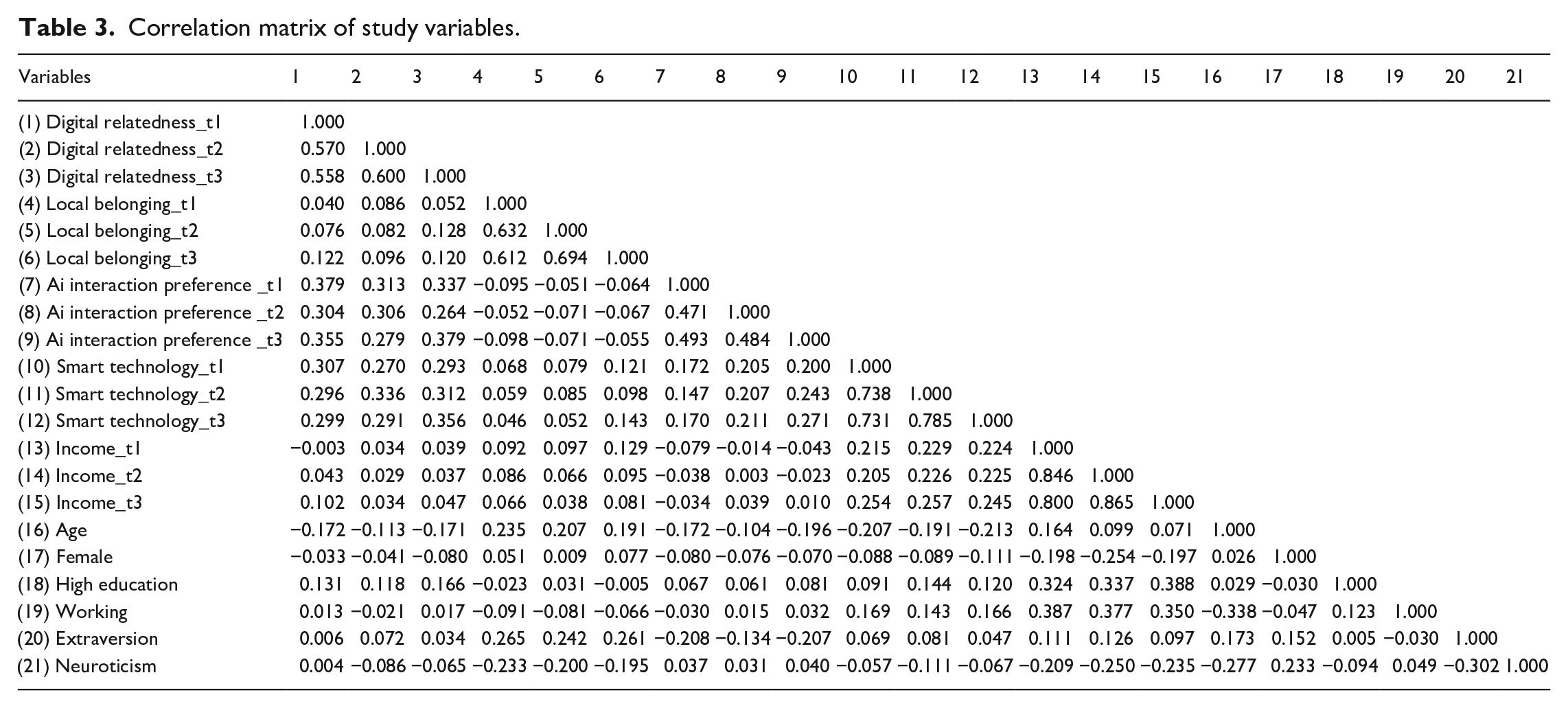
| Variables | 1 | 2 | 3 | 4 | 5 | 6 | 7 | 8 | 9 | 10 | 11 | 12 | 13 | 14 | 15 | 16 | 17 | 18 | 19 | 20 | 21 |
|---|---|---|---|---|---|---|---|---|---|---|---|---|---|---|---|---|---|---|---|---|---|
| (1) Digital relatedness_t1 | 1.000 | ||||||||||||||||||||
| (2) Digital relatedness_t2 | 0.570 | 1.000 | |||||||||||||||||||
| (3) Digital relatedness_t3 | 0.558 | 0.600 | 1.000 | ||||||||||||||||||
| (4) Local belonging_t1 | 0.040 | 0.086 | 0.052 | 1.000 | |||||||||||||||||
| (5) Local belonging_t2 | 0.076 | 0.082 | 0.128 | 0.632 | 1.000 | ||||||||||||||||
| (6) Local belonging_t3 | 0.122 | 0.096 | 0.120 | 0.612 | 0.694 | 1.000 | |||||||||||||||
| (7) Ai interaction preference _t1 | 0.379 | 0.313 | 0.337 | −0.095 | −0.051 | −0.064 | 1.000 | ||||||||||||||
| (8) Ai interaction preference _t2 | 0.304 | 0.306 | 0.264 | −0.052 | −0.071 | −0.067 | 0.471 | 1.000 | |||||||||||||
| (9) Ai interaction preference _t3 | 0.355 | 0.279 | 0.379 | −0.098 | −0.071 | −0.055 | 0.493 | 0.484 | 1.000 | ||||||||||||
| (10) Smart technology_t1 | 0.307 | 0.270 | 0.293 | 0.068 | 0.079 | 0.121 | 0.172 | 0.205 | 0.200 | 1.000 | |||||||||||
| (11) Smart technology_t2 | 0.296 | 0.336 | 0.312 | 0.059 | 0.085 | 0.098 | 0.147 | 0.207 | 0.243 | 0.738 | 1.000 | ||||||||||
| (12) Smart technology_t3 | 0.299 | 0.291 | 0.356 | 0.046 | 0.052 | 0.143 | 0.170 | 0.211 | 0.271 | 0.731 | 0.785 | 1.000 | |||||||||
| (13) Income_t1 | −0.003 | 0.034 | 0.039 | 0.092 | 0.097 | 0.129 | −0.079 | −0.014 | −0.043 | 0.215 | 0.229 | 0.224 | 1.000 | ||||||||
| (14) Income_t2 | 0.043 | 0.029 | 0.037 | 0.086 | 0.066 | 0.095 | −0.038 | 0.003 | −0.023 | 0.205 | 0.226 | 0.225 | 0.846 | 1.000 | |||||||
| (15) Income_t3 | 0.102 | 0.034 | 0.047 | 0.066 | 0.038 | 0.081 | −0.034 | 0.039 | 0.010 | 0.254 | 0.257 | 0.245 | 0.800 | 0.865 | 1.000 | ||||||
| (16) Age | −0.172 | −0.113 | −0.171 | 0.235 | 0.207 | 0.191 | −0.172 | −0.104 | −0.196 | −0.207 | −0.191 | −0.213 | 0.164 | 0.099 | 0.071 | 1.000 | |||||
| (17) Female | −0.033 | −0.041 | −0.080 | 0.051 | 0.009 | 0.077 | −0.080 | −0.076 | −0.070 | −0.088 | −0.089 | −0.111 | −0.198 | −0.254 | −0.197 | 0.026 | 1.000 | ||||
| (18) High education | 0.131 | 0.118 | 0.166 | −0.023 | 0.031 | −0.005 | 0.067 | 0.061 | 0.081 | 0.091 | 0.144 | 0.120 | 0.324 | 0.337 | 0.388 | 0.029 | −0.030 | 1.000 | |||
| (19) Working | 0.013 | −0.021 | 0.017 | −0.091 | −0.081 | −0.066 | −0.030 | 0.015 | 0.032 | 0.169 | 0.143 | 0.166 | 0.387 | 0.377 | 0.350 | −0.338 | −0.047 | 0.123 | 1.000 | ||
| (20) Extraversion | 0.006 | 0.072 | 0.034 | 0.265 | 0.242 | 0.261 | −0.208 | −0.134 | −0.207 | 0.069 | 0.081 | 0.047 | 0.111 | 0.126 | 0.097 | 0.173 | 0.152 | 0.005 | −0.030 | 1.000 | |
| (21) Neuroticism | 0.004 | −0.086 | −0.065 | −0.233 | −0.200 | −0.195 | 0.037 | 0.031 | 0.040 | −0.057 | −0.111 | −0.067 | −0.209 | −0.250 | −0.235 | −0.277 | 0.233 | −0.094 | 0.049 | −0.302 | 1.000 |
Author contributions
Data availability statement
The data that support the findings of this study will be made available in the Finnish Social Science Data Archive after the UrbanAI project.
The manuscript has not been published previously and is not under consideration elsewhere. All the authors are responsible for the reported research, all have contributed to the article, and all have agreed to its submission to the journal.
Funding
The author(s) disclosed receipt of the following financial support for the research, authorship, and/or publication of this article: This research received funding from the Kone Foundation (Urban utopias and dystopias: artificial intelligence in art and society [UrbanAI] project 2021–2024, Grant 202011325, PI: Atte Oksanen) and the Academy of Finland (INVEST Flagship, Grant 320162).
Ethical approval
The ethics committee of the Tampere region in Finland declared in a 2021 statement that the protocol for this research did not present any ethical issues (Statement 29/2021).
