




Abstract
Misinformation thrives on social media, prompting much research into social media interventions such as debunks. This paper tests debunking’s effectiveness against an understudied but prominent form of online misinformation: misleading organizational claims of corporate social responsibility, or CSR-washing. British participants (N = 657) took part in a preregistered experiment with a 2 (debunk: present, absent) x 3 (CSR-washing: greenwashing, bluewashing, purplewashing) between-subjects design. They saw an Instagram ad from a fictional clothing company that showcased its dedication to environmental sustainability, gender equality in the workplace, or the elimination of child labor. Half of the participants then received a debunk. Unlike most previous research which showed continued influence of misinformation after debunking, we found that the debunks were very effective: they reversed the persuasive effects of CSR-washing, resulting in negative brand attitudes and low purchase intentions. Several explanations for this finding are discussed, highlighting CSR-washing’s distinctiveness from many other forms of misinformation.
Misinformation research is crucial to advance our understanding of the characteristics, distribution, and effects of false and misleading information that influences public opinion. Much of this research addresses misinformation on social media platforms specifically, given their notorious reputation of being breeding grounds and echo chambers for misinformation (e.g., Allcott et al., 2019). An important insight of this research has been that misinformation on social media can originate from various sources, such as the media and interest groups, as well as individuals including politicians (O’Connor & Weatherall, 2019). Our paper aims to draw attention to a generally overlooked but prominent source of misinformation on social media: companies or businesses whose primary objective is to make a profit.
For-profit organizations are increasingly expected by the public to demonstrate their commitment to taking responsibility for the impact of their activities on society and the planet (e.g., Velte, 2022). While some organizations indeed dedicate themselves to making the world a better place, others seem to exploit corporate social responsibility (CSR) as a marketing strategy by capitalizing on the concerns and interests of the general public (Vredenburg et al., 2020). When organizations deliberately deceive the public about their level of support for a sociopolitical cause, this has been labeled CSR-washing (e.g., Martin et al., 2024).
The literature distinguishes between different forms of CSR-washing. Greenwashing, for instance, refers to misleading claims made by organizations about their support for environmental sustainability (e.g., stopping climate change; e.g., De Freitas Netto et al., 2020). Purplewashing pertains to misleading corporate communication about support for the emancipation and empowerment of women (e.g., achieving gender equality; e.g., Chiru et al., 2022). Bluewashing involves misleading claims about an organization’s support for economic (e.g., reducing poverty) as well as social change (e.g., promoting legal justice), and is sometimes seen as an umbrella category that includes most forms of washing (e.g., Sailer et al., 2022). We argue that CSR-washing’s misleading nature qualifies it as a type of misinformation.
Within misinformation research, considerable attention has been devoted to neutralizing the persuasive effects of misinformation on social media (for overviews, see e.g., Ecker et al., 2022; Lewandowsky & Van der Linden, 2021; Yu et al., 2023). A much-studied intervention involves presenting users with post-exposure corrections of misinformation that are also known as debunks. Some effectiveness of debunking in the case of politics-, health-, and science-related misinformation has been found (e.g., Walter & Tukachinsky, 2020). Comparatively, however, corporate misinformation such as CSR-washing has been overlooked in these studies. The current study’s novel contribution is that it tests to what extent debunking could also be a promising strategy for addressing CSR-washing, thereby bridging the gap between the CSR-washing and misinformation literatures. Moreover, we take a comparative approach by comparing debunking effectiveness between different types of CSR-washing: greenwashing, purplewashing, and bluewashing. In doing so, this research shows the extent to which findings are robust across various organizational contexts.
CSR-washing as misinformation
In modern society, there is a public expectation that organizations should not exclusively prioritize their financial performance. Instead, they should also place considerable emphasis on operating in an economically, socially, and environmentally sustainable manner (Van der Meer & Jonkman, 2021; Velte, 2022). In order to show stakeholders (e.g., consumers, shareholders, employees) that they comply with or maybe even excel in CSR, organizations often publicly communicate about their CSR efforts on their website, in their annual reports and newsletters, and in advertising (e.g., Schaefer et al., 2020), including on social media (e.g., Kwon & Lee, 2021).
Previous research found that CSR communication, when perceived as authentic (e.g., Vredenburg et al., 2020), results in positive outcomes for organizations, such as an enhanced corporate reputation (e.g., Yoon et al., 2006), more positive brand attitudes (e.g., Kim et al., 2020), and greater purchase intentions among consumers (e.g., Lee & Shin, 2010). When organizations genuinely practice CSR, this thus supports their maintenance and growth. Some organizations, however, communicate dishonestly about their CSR commitment. In these cases, organizations leverage the public’s positive stance toward CSR for their own benefit.
Studies have shown that CSR-washing is a widespread phenomenon (e.g., Sterbenk et al., 2022). Social media are prominent platforms for CSR-washing (e.g., Sailer et al., 2022), given how social media provide a space where organizations can shape their public image as they see fit (e.g., Kwon et al., 2023). Unlike traditional news outlets where journalists have a gatekeeping role, social media allow organizations to share CSR communication directly with stakeholders without external scrutiny. Kwon et al. (2023) conducted a content analysis of green claims posted on social media by global corporations between 2019 and 2021 and found that more than two-thirds of the green claims were misleading. For instance, many clothing brands advertise with the term “organic” (Tonti, 2023). Although the term should indicate the absence of synthetic chemicals in items such as pesticides, it is often misapplied to natural fibers like cotton and linen. Similarly, the terms “circular” and “zero waste” are often overstatements (Tonti, 2023).
CSR-washing thus refers to “the distortion of internal practices to promote the projected image of CSR to stakeholders” (Martin et al., 2024, p. 200). Based on the available literature (e.g., Martin et al., 2024; Pope & Wæraas, 2016; Sterbenk et al., 2022), we define CSR-washing as a deceptive practice in which organizations misrepresent their CSR commitment or performance by disseminating false or misleading statements about its responsible business practices. We hold that this establishes CSR-washing as misinformation.
According to some researchers, misinformation can best be identified “based on the best available evidence from relevant experts at the time” (Vraga & Bode, 2020: 138). From this perspective, the term misinformation refers to information that factually misinforms people upon exposure to it, regardless of whether the information has always been inaccurate or lost its accuracy over time. In addition to false claims, CSR-washing often involves empty promises or hollow assurances (Seele & Schultz, 2022) that technically cannot be described as inaccurate statements. However, other researchers argue that limiting the definition of misinformation to the presence of contradictory empirical evidence and expert opinions is problematic because it overlooks the potential for information to mislead in other ways (e.g., Loftus, 2005), for example through implicit suggestion. Many misinformation researchers therefore define misinformation as false or misleading information (e.g., Van der Linden, 2022). CSR-washing perceptions are commonly driven by subjective judgment, such as about whether the company is being deliberately vague or uses language that is deliberately too complex for stakeholders to understand (e.g., De Freitas Netto et al., 2020; Seele & Schultz, 2022). From this perspective, which considers both objective and subjective judgments of the quality of information, CSR-washing thus classifies as misinformation (e.g., Oppong-Tawiah & Webster, 2023).
Misinformation tends to be distinguished from disinformation. The most important difference between the two is that, contrary to misinformation, disinformation is an intentional act. It refers to the deliberate spread of false or misleading information for strategic purposes (e.g., Benkler et al., 2018), whereas misinformation is disseminated unintentionally as a consequence of misinterpretations or mistakes for example (Lazer et al., 2018). Proving that an act of CSR-washing is intentional can be challenging. In some cases, the members of the organization responsible for communicating about the organizations’ CSR initiatives (e.g., PR teams, senior management) might genuinely believe their CSR claims to be accurate, especially when violations occur without their direct oversight or control, such as in supplier or subcontractor facilities (e.g., factories, plantations). This can result in “accidental” CSR-washing (Stewart, 2021: 47). Therefore, we prefer to categorize CSR-washing as misinformation because this term encompasses all possible instances of it.
The debunking of CSR-washing
There is a growing literature that centers on the question of what happens when people suspect an organization engages in greenwashing, specifically. These studies show that public perceptions of the (lack of a genuine) green history and green norms in an industry can influence how individuals interpret any green communication by organizations within the industry (Farooq & Wicaksono, 2021; Leonidou & Skarmeas, 2017), including the nature of their motives. Greenwashing perceptions, in turn, typically lead to adverse outcomes for organizations. For instance, greenwashing perceptions can harm consumers’ evaluations of the organization (e.g., Chen & Chang, 2013; Chen et al., 2022), greatly reduce their willingness to buy its products (e.g., Lim et al., 2013; Nyilasy et al., 2014), and foster perceptions among individuals that similar organizations are doing the same thing (e.g., Wang et al., 2020).
Some of these studies bear a resemblance to studies that focus on making people aware of misinformation through debunks (i.e., post-exposure corrections of misinformation), which is a widely adopted strategy against misinformation (e.g., Lewandowsky & Van der Linden, 2021). De Jong et al. conducted two experiments in which participants were made aware of greenwashing by fictional organizations through a review in a consumer magazine (2018) and a news article (2020). Keilmann and Koch (2024) also used a consumer magazine and news article in their two experiments. All four studies (i.e., De Jong et al., 2018, 2020; Keilmann & Koch, 2024) found negative effects on the organization’s reputation when greenwashing was revealed. By contrast, the 2018 study by De Jong et al. found no significant differences between the greenwashing and truly green conditions with regard to purchase intentions.
While it was perhaps surprising that greenwashing awareness did not result in lower purchase intentions, it corresponds to previous research that examined the effectiveness of debunking for political, health, and scientific misinformation (Walter & Tukachinsky, 2020). These studies showed that people tend to cease believing misinformation after exposure to a correction (e.g., Cook et al., 2014; Ecker et al., 2022). However, although debunking reduces the persuasiveness of misinformation, it does not completely neutralize its persuasive effects (e.g., Van Huijstee et al., 2022; see Walter & Tukachinsky, 2020, for a meta-analysis).
This remaining persuasive impact is called the continued influence effect of misinformation, which may be explained by the varying verifiability of concrete (factual, behavior-related) versus abstract (general, trait-related) beliefs. Our natural tendency is to shape our perceptions of individuals and organizations based on the behaviors we have observed them engage in, a phenomenon referred to as spontaneous trait inferences (Uleman et al., 1996). Concrete beliefs, grounded in observable actions, can be easily verified (Semin & Fiedler, 1988) and corrected with new data. In contrast, abstract beliefs, such as judgments about a person’s character or an organization’s reputation, are more difficult to challenge. Hence, although abstract beliefs might stem from concrete ones, they are generally more persistent and stable over time than concrete, observable ones. A debunk can alter someone’s belief in misinformation but cannot completely neutralize its persuasive impact because of the remaining general inferences someone has made before exposure to the misinformation. After a greenwashing debunk, this could for instance imply no decrease in purchase intentions because people might have made inferences about how socially responsible the organization was on other levels as well, and thus, the beneficial impact of the initial green claims remains.
In this study
It is important for social media users to be more aware of CSR-washing since it thrives on social media (e.g., Kwon et al., 2023) and subsequently holds them back from making informed consumer decisions. Social media platforms like Instagram have started demoting, removing, and labeling posts that third-party fact-checkers have identified as false or misleading since the COVID-19 pandemic (Cotter et al., 2022). However, their debunking efforts have been criticized for being too laissez-faire and focused on low-hanging fruit, such as conspiracy theories (Cotter et al., 2022), for instance overshadowing corporate misinformation. A recent systematic review by Pérez-Escolar et al. (2023) of publications that explicitly focused on misinformation also found (p. 81) that as little as 2.7% (n = 19) of them paid attention to “Economics, development, and business”. Previous misinformation research mostly addressed misinformation about politics, health, and science instead (Pérez-Escolar et al., 2023). Thus, CSR-washing has been overlooked as a type of misinformation by both social media platforms and researchers, resulting in a lack of knowledge about the effectiveness of misinformation interventions against CSR-washing on social media. The current study aims to integrate the CSR-washing and misinformation literatures by testing whether debunking could be a useful strategy. Moreover, we used a pre-post measure design to test whether CSR-washing would have continued influence.
Drawing from previous research which demonstrated that CSR communication has beneficial effects for the organization (e.g., Kim et al., 2020; Lee & Shin, 2010; Yoon et al., 2006) but that greenwashing awareness has adverse effects (e.g., Chen et al., 2022; Lim et al., 2013; Nyilasy et al., 2014), we first expected that exposure to a debunk of CSR-washing would make people respond more negatively to the organization than if no debunk is present.
H1: the persuasive impact of CSR-washing on (a) brand attitudes and (b) purchase intentions is lower after debunking than after no debunking.
Based on a wealth of empirical evidence in the debunking literature for the continued influence effects of misinformation (Walter & Tukachinsky, 2020), we hypothesized that we would also find continued influence of CSR-washing after debunking. This meant that we expected some persuasiveness of CSR-washing to remain (i.e., some beneficial effects) even after people are informed that the organization’s CSR claim was false:
H2: after debunking, there is a continued persuasive impact of CSR-washing on (a) brand attitudes and (b) purchase intentions.
Finally, comparative studies in CSR-washing research are scarce. With most studies focusing on greenwashing only, we still know little about the extent to which findings from greenwashing research generalize to other types of CSR-washing. Different CSR claims may resonate differently with people as they tap into different concerns people have about society and the world around them, and so could different types of CSR-washing. To address this research gap, we also posed a research question to investigate potential differences in persuasive impact between debunks of greenwashing, purplewashing, and bluewashing:
RQ1: to what extent does the type of CSR-washing (greenwashing, purplewashing, bluewashing) moderate the relationship between debunking and the persuasive impact of CSR-washing on (a) brand attitudes and (b) purchase intentions?
Method
An experiment with a 2 (debunk: present vs. absent) x 3 (CSR-washing: greenwashing vs. bluewashing vs. purplewashing) between-subjects design was conducted in January of 2023. Ethical approval was granted by the home institute of the first author (under number FMG-419) and the study was preregistered on the Open Science Framework (OSF). 1
Participants
Based on a meta-analysis of the continued influence effect of misinformation, we assumed an effect size estimate of r = 0.05 (d = 0.10; Walter & Tukachinsky, 2020). Power analysis, using G*power 3.1, suggested a required sample size of 620 to conduct the statistical analyses. A total of 680 British citizens were recruited using Prolific (https://www.prolific.com/; standard participant reward paid). Only native speakers of English were recruited to ensure a strong enough command of the language used in the stimuli.
Three attention checks were included in the survey to check whether participants focused on the task they were completing. Two attention checks involved a mock vignette participants had to read between the two times in which we measured the dependent variable (as a filler task). They consisted of two multiple-choice questions: one about the general topic of the vignette and one about a specific percentage that was mentioned. A third attention check was incorporated earlier in the questionnaire where participants had to select “agree”. We decided to not consider the attention check that checked whether participants remembered the percentage that was mentioned in the vignette because answering it accurately was found to be too challenging. Ultimately, 657 participants passed our attention checks and were included in the analyses.
Participants had an average age of 41.85 years (ranging from 19 to 81, SD = 13.10), and a majority were female (65.30%). 51.29% of participants completed college education (a Bachelor’s degree or higher). 55.25% of our sample had an average income over the past 12 months at the time of data collection below £3000 per month. In 2022, the average household disposable income per month in the UK was £3277 (Office for National Statistics, 2023), which indicates that our participants had a somewhat below-average income.
Stimuli
The stimuli used in this study consisted of (1) a CSR Instagram ad, mentioning how socially responsible the organization was, and (2) a debunk.
CSR Instagram advertisement
Three Instagram ads of a fictional clothing company called SweaterDays were created (see Figures A1 -A3 in the Appendix). We used a fictional brand to avoid harming existing brands and to keep the ads as similar as possible without compromising their realism. We settled on a clothing brand because the fast fashion industry often uses CSR-branded advertising on Instagram. For each type of CSR-washing, we formulated three inflated claims about the organization’s CSR behavior and included them in the ad. These claims pertained to sustainable production (i.e., greenwashing), gender equality in the workplace (i.e., purplewashing), and child-free labor (i.e., bluewashing). In the case of greenwashing (n = 215), the Instagram ad emphasized that SweaterDays used 100% eco-friendly materials and that it was manufactured locally. For purplewashing (n = 218), SweaterDays claimed to be 100% supportive of inclusion and diversity, including gender equality in the workplace. In the bluewashing version (n = 224), SweaterDays produced 100% child-labor-free clothing and claimed to be fully transparent about its supply chains. The Instagram ad showed a picture of hands that were united, with distinctly colored sweater sleeves. The caption ended with the sentence: “Shop your winter outfits now and make the world a better place.” This product category aligned well with the month of data collection (i.e., January; the Dutch winter runs from December to March). We drew overall inspiration for the ad design from posts from multiple clothing brands on Instagram.
Debunk
For every CSR ad, we created a correction similar in content and design to the third-party fact-checks that Instagram showed at the time of data collection (see Figures A4-A6 in the Appendix). All debunks mentioned that the post contained false information, stating that “Independent fact-checkers say this post contains false information.” For every type of CSR-washing, the subsequent sentences differed depending on the topic. In the case of greenwashing, the debunk mentioned that “A number of the clothing materials used by SweaterDays have been found to be environmentally unfriendly and damaging the planet.” For bluewashing, the debunk mentioned that “A number of factories of SweaterDays have been found to violate child labor regulations by employing children to produce the clothing.” Finally, for purplewashing the debunk mentioned that “A number of female employees of SweaterDays have accused the brand of systemic discrimination and harassment in the workplace.” In total, 329 participants saw a debunk after the stimulus presentation, while 328 participants saw no correction.
A manipulation check for the debunking was conducted by measuring to what extent participants thought the information in the ad was true, using a slider ranging from certainly not true (-10) to certainly true (+10). The results of an independent t-test analysis showed that participants in the debunk conditions perceived the CSR ads as less true (M = 3.69, SD = 3.37) than participants in the no debunk condition (M = -3.50, SD = 4.59; t(600.44) = 22.86, p < .001, d = 1.79). This indicated that the debunking manipulation had been successful.
Procedure
The study was advertised on Prolific as a study about how consumers form opinions about brands and products. We made sure to emphasize that we were interested in people’s personal thoughts and that there were no right or wrong answers. After participants provided informed consent, we asked them questions about their age, gender, level of education, political orientation, income, shopping behaviors, and general attitudes toward clothing brands. Participants then provided their general impression (i.e., brand attitude) of five fictional clothing brands after seeing their logos, as well as their likelihood to buy clothing from these brands in the future, either for themselves and/or for others (i.e., purchase intention). This evaluation was followed by a mock vignette, disguised as a magazine article about music streaming, which was followed by two multiple-choice questions (i.e., attention checks). We incorporated this mock vignette to serve as a filler and distractor task between the measurement of brand attitudes and purchase intentions at Time 1 and Time 2, which additionally gave us the opportunity to insert attention checks. The Instagram ad for SweaterDays followed, after which we measured participants’ attitudes toward the ad. Participants then either saw a debunk in the correction condition or did not in the no-debunk condition. This was followed by the manipulation check. Participants then reevaluated the same five clothing brands by answering the brand attitude and purchase intention questions, after which they were debriefed.
Measures
Participants assessed the five clothing brands both before (T1) and after (T2) exposure to the stimuli (i.e., the Instagram ad of SweaterDays). Both dependent variables were measured using a slider from -10 to +10, ranging from very negative to very positive for brand attitudes, and from very unlikely to very likely for purchase intentions. The persuasive impact was quantified as the difference in evaluations between T1 and T2. We calculated the persuasive impact scores for both participants’ brand attitudes and purchase intentions.
Ad attitudes (cf. Lee & Mason, 1999) were measured right after stimulus exposure at T1, before the debunk was shown to those in the CSR-debunking condition. Participants were asked to what extent they agreed with five statements about the ad, on a 7-point scale ranging from strongly disagree to strongly agree. Examples of these statements included “The ad was attractive to me” and “I disliked the ad” (reverse-coded).
Results
Access to the data, syntax, and output is provided on the OSF. 2
Randomization checks
Before conducting the main analyses we performed several randomization checks to examine whether the participants were evenly distributed across the six experimental conditions in terms of relevant demographics, shopping-related variables, and CSR-related variables that we measured before CSR ad exposure (see our preregistration for more details). The analyses showed that the participants in the conditions did indeed not significantly differ regarding age (F(5, 651) = 1.42, p = .214), gender (χ2(15) = 12.40, p = .648), educational level (χ2(25) = 22.26, p = .621), household income (χ2(45) = 41.95, p = .602), shopping frequency (χ2(25) = 37.32, p = .054), shopping enjoyment (F(5, 651) = 0.27, p = .931), price consciousness (F(5, 651) = 0.30, p = .916), social adjustment (F(5, 651) = 0.32, p = .900), perceived corporate hypocrisy (F(5, 651) = 0.61, p = .694), and CSR attitudes (F(5, 651) = 0.75, p = .589). This meant that potential effects of this study’s manipulations could not be attributed to differences in these personal characteristics between the experimental conditions, which is why none of these variables were controlled for in the main analyses.
However, we did find a significant difference between the conditions in participants’ political leaning (F(5, 651) = 2.96, p = .012). Post-hoc Bonferroni multiple comparisons showed that participants in the bluewashing+no-debunk condition leaned significantly more to the right side of the political spectrum (M = 5.11, SD = 1.97) than those in the greenwashing+debunk condition (M = 4.19, SD = 1.75, p = .004). No other differences in political leaning between the conditions were found. To reduce the heterogeneity in participant characteristics between conditions, we included political leaning as a covariate in the main analyses.
Main analyses
To test whether the persuasive impact of CSR-washing on (a) brand attitudes and (b) purchase intentions was lower after debunking than after no debunking (H1), we ran two one-way ANCOVAs with (a) brand attitudes and (b) purchase intentions as the dependent variables, the debunk vs. no debunk conditions as the independent variable, and political leaning as a covariate. The results showed significant differences between the debunking and no debunking conditions for both brand attitudes (F(1, 654) = 444.16, p < .001, η2p = 0.40) and purchase intentions (F(1, 654) = 373.32, p < .001, η2p = 0.36). We indeed found that the persuasive impact on brand attitudes and purchase intentions was significantly lower for participants in the debunking conditions (brand attitudes: M = -4.34, SD= 4.47; purchase intentions: M = -3.91, SD = 4.50) than for participants in the no debunking conditions (brand attitudes: M = 2.56, SD= 3.85; purchase intentions: M = 2.69, SD = 4.24), thus supporting H1.
Next, we tested if there was a continued persuasive impact of CSR-washing after debunking on (a) brand attitudes and (b) purchase intentions (H2), by running two one-sample t-tests on participants in the debunking conditions only. The results showed that participants’ brand attitudes and purchase intentions did significantly differ from zero (brand attitudes: M = -4.34, SD = 4.47, t(327) = -17.57, p < .001, d = -0.97; purchase intentions: M = -3.91, SD = 4.50, t(327) = -15.74, p < .001, d = -0.87). However, no continued influence effect of the CSR ad was found. Surprisingly, we found debunking to significantly reverse the initial positive persuasive effects of the CSR ads. This means that the debunking of CSR-washing ads led to more negative brand attitudes and lower purchase intention than was the case before stimuli exposure, indicating no (positive) persuasive impact. Therefore, H2 was not supported.
To analyze to what extent the relationships between debunking (vs. no debunking) and the persuasive impact of CSR-washing on (a) brand attitudes and (b) purchase intentions differed between the types of CSR-washing (greenwashing, purplewashing, bluewashing; RQ1), we conducted two Hayes moderation analyses (model 1: Hayes, 2017) with the same variables we used to test H1, except that this time CSR-washing type was included as a moderator. Because we manipulated three types of CSR-washing, we used multicategory indicator coding with bluewashing as the reference category (based on the mean differences in persuasive impact between the three types of CSR-washing; see Table 1). The results showed significant interaction effects between the debunking and CSR-washing types for both brand attitudes and purchase intentions. That is, the effect of debunking vs. no debunking on brand attitudes and purchase intentions was stronger when participants saw a bluewashing ad compared to a greenwashing ad (brand attitudes: b = 1.60, SE = 0.80, t = 2.00, p = .045; purchase intentions: b = 1.80, SE = 0.83, t = 2.16, p = .031) or purplewashing ad (brand attitudes: b = 1.81, SE = 0.80, t = 2.28, p = .023; purchase intentions: b = 2.30, SE = 0.83, t = 2.77, p = .006). This means that the debunking of bluewashing had more pronounced negative effects than the debunking of green- or purplewashing. Figure 1 provides an overview of these results.
Results of the Indirect Effects Analysis.

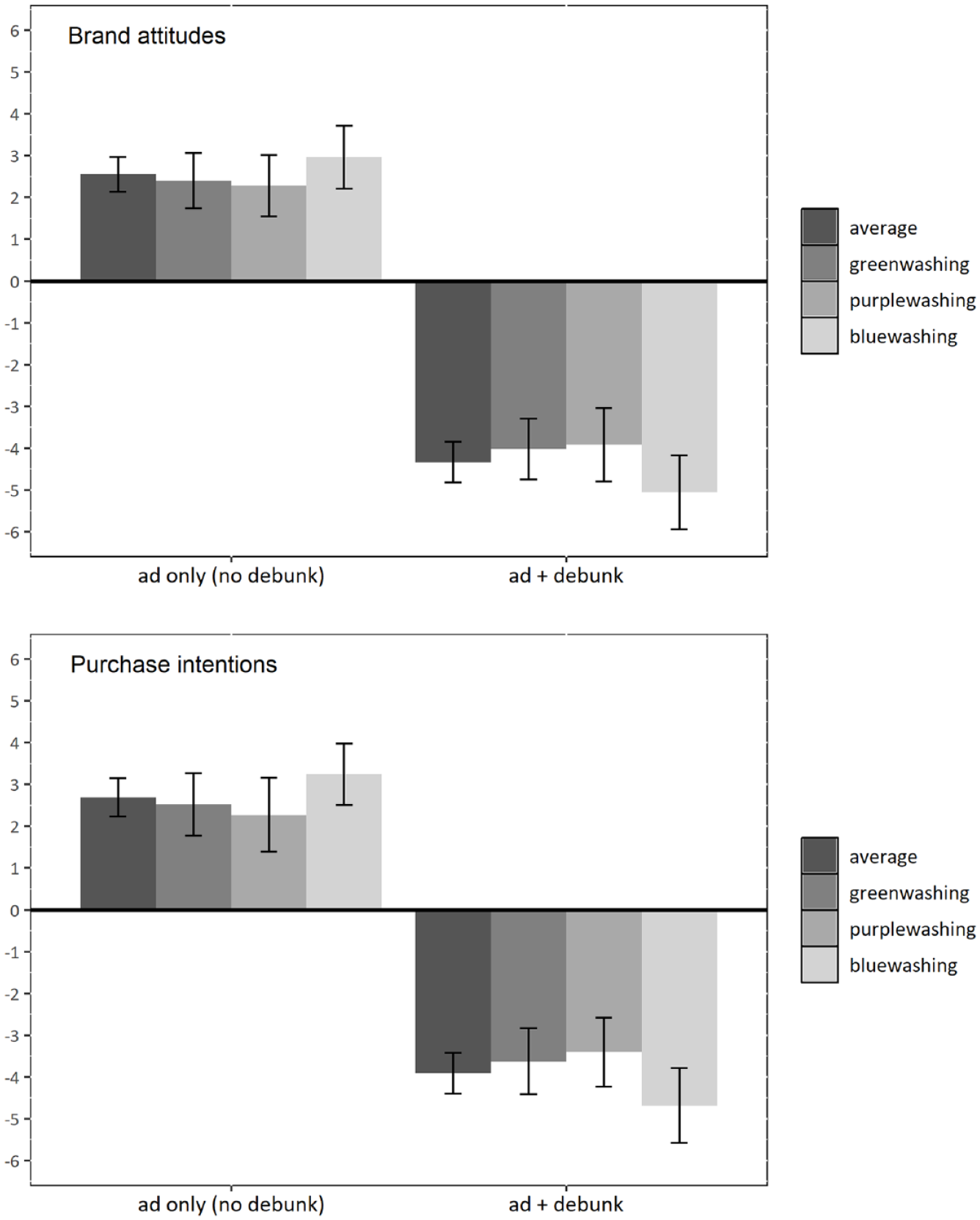
No Evidence for Continued Influence (T2-T1, with 95% Confidence Intervals) of CSR-Washing.
Exploratory analyses
To better understand why the negative effect of debunking CSR ads was stronger for bluewashing than for green- or purplewashing, we explored how the types of CSR ads might have originally influenced participants’ attitudes toward the ads differently. Perhaps individuals placed more importance on certain types of CSR than on other types, which subsequently brought about varying risks of being disappointed (when faced with a debunk).
We conducted two Hayes indirect effects analyses (model 4: Hayes, 2017) in which we examined whether the different types of CSR ads (independent variable) resulted in different ad attitudes (mediator), and whether these ad attitudes in turn influenced brand attitudes and purchase intentions (dependent variables). Political leaning was added again as a covariate and we used multicategory indicator coding with bluewashing as the reference category. The results showed that CSR-washing effects on brand attitudes and purchase intentions were mediated by ad attitudes (see Table 1). Bluewashing ads led to more positive ad attitudes than both greenwashing (b = -0.36, SE = 0.12, t = -3.08, p = .002) and purplewashing ads (b = -0.61, SE = 0.12, t = -5.27, p < .001). Higher ad attitudes, in turn, were associated with more positive brand attitudes (b = 0.69, SE = 0.17, t = 4.02, p < .001) and higher purchase intentions (b = 0.81, SE = 0.17, t = 4.63, p < .001). Thus, participants had more favorable attitudes toward the blue ad initially, which could suggest that individuals assigned greater significance to the topic of eliminating child labor in the clothing industry than promoting environmental sustainability or gender equality in the workplace. When the blue ad was debunked, individuals might have experienced more indignation compared to the other types of washing.
Discussion
The objective of this paper was to bring together research on CSR-washing and social-media interventions against misinformation by testing the continued influence effect of misinformation after debunking (e.g., Walter & Tukachinsky, 2020, for a meta-analysis) in case of greenwashing, purplewashing, and bluewashing. We conducted the study in a social media setting, since this is eminently the space where people encounter CSR-washing.
Theoretical and practical implications
Our findings contradict previous misinformation research that found continued influence of misinformation when it is debunked (e.g., Walter & Tukachinsky, 2020). Debunking effectively neutralized, even reversed, the persuasiveness of CSR-washing (H1-H2). We believe that several differences between commonly studied forms of misinformation, on the one hand, and CSR-washing, on the other hand, could explain this conflict in findings.
First, it seems that the valence of misinformation is a decisive factor in the effectiveness of debunking. Negative misinformation refers to misinformation that portrays an issue, event, or person in a negative or unfavorable light. Positive misinformation presents the topic or target in a positive or advantageous manner. In a study focusing on health misinformation regarding hospitals, Van Huijstee et al. (2022) for instance found that debunking negative misinformation does not completely neutralize its persuasive impact, while debunking positive misinformation causes a reversal of the persuasive impact. Van Huijstee et al. (2022) argued that negativity bias (i.e., the ability of negative information to capture attention and enhance memory more than positive or neutral information; Baumeister et al., 2001) could explain why the valence of misinformation plays a role in debunking effectiveness. Because of this negativity bias, negative misinformation tends to be more persuasive than positive misinformation, and therefore positive misinformation is easier to debunk. CSR-washing can be characterized as positive misinformation by default because CSR-washing is meant to portray the organization favorably. At the same time, misinformation is often negative (Thorson, 2016). This could explain why our findings deviate from those usually found in the misinformation literature.
A second reason we found a large reversed effect of debunking rather than continued influence of CSR-washing after debunking is related to identity politics. Individuals’ political leaning often colors the way they view both the misinformation and subsequent debunks (e.g., Jennings & Stroud, 2023). When debunks directly challenge people’s political beliefs and attitudes, they tend to be less receptive to the corrective message. Conversely, debunks of CSR-washing may carry less personal weight than other debunks because most individuals find their sense of identity and group membership(s) tied to ideas about politics and society but less so to the organizations they like or endorse. This could also explain why, in our study, we found the debunks to be more persuasive than the CSR-washing advertisements.
Third, what is particularly unique about CSR-washing is that the target of the misinformation almost always is the same as the source. In the case of other kinds of misinformation on social media, we rather find that misinformation for instance originates from non-traditional partisan media (Shin et al., 2018). This is important because source judgments often serve as a basis for individuals to determine whether information is true or false (e.g., Tandoc et al., 2018). Lower scores on source credibility lead to lower scores on misinformation credibility (e.g., Ecker et al., 2022). When CSR-washing is debunked, this automatically discredits the organization as the source of the misinformation. Earlier studies on greenwashing perceptions similarly found negative effects of greenwashing awareness on general brand evaluations (e.g., Chen et al., 2022). As a result of lower source credibility, people may be more likely to completely accept the debunk and change their opinions.
Finally, what also particularly characterizes CSR-washing is that many CSR-washing claims ultimately boil down to the organizations asserting their above-average adherence to certain laws and regulations. In line with earlier studies on greenwashing perceptions (e.g., Chen et al., 2022; Lim et al., 2013; Nyilasy et al., 2014), our results indicate that individuals hold organizations accountable for breaches of vital standards we expect them to uphold, such as refraining from capitalizing on environmental pollution, discrimination, and labor exploitation. Promoting a socially responsible image while exploiting child labor for financial gain is one of the more severe transgressions on this list, possibly leading to stronger perceptions of hypocrisy among consumers than milder transgressions. This could explain the stronger effects found for the bluewashing than green- and purplewashing debunks in our study. The regulatory connotation of CSR-washing could thus be another reason why, when confronted with a debunk, individuals are more quickly convinced of the debunk’s implications.
Another explanation for the differences in debunking effectiveness between the types of CSR-washing is the level of controversy associated with the CSR claims. Most people would agree that child labor is unequivocally wrong, whereas the need for climate action and gender equality is debated more. Future research is advised to take individuals’ issue stances into account when testing misinformation interventions against CSR-washing.
This study also has clear practical implications for social media platforms. Our findings show the value of debunking in case of a prominent type of misinformation that social media platforms have paid little attention to thus far. We encourage social media platforms to also consider enabling consumers to make well-informed decisions their priority by more often labeling obvious CSR-washing claims as false or misleading information.
Limitations and future research
While this study advanced our insight into how persuasion by CSR-washing on social media can be countered, its limitations warrant consideration. First of all, it is important to note that we used a fictional brand to avoid both that existing predispositions toward a real organization would influence results and that our study would potentially impact the reputation of that organization. This choice additionally allowed us to manipulate the different types of CSR-washing in a way that ensured both internal and external validity (i.e., by keeping the manipulations as similar as possible, while preserving their credibility). Many debunking studies also use fictional targets for these reasons (e.g., a fictional hospital, Van Huijstee et al., 2022). A disadvantage of this methodological decision is that the nature of the brand may have limited participants’ ability to make general inferences about the brand previously. It is precisely those abstract beliefs about the organization that can cause continued influence of misinformation to occur. Therefore, future research is advised to extend its investigation to real-world cases to assess the ecological validity of the findings from this study.
Relatedly, real-world exposure to CSR-washing encompasses diverse platforms and contexts. Alongside the studies by De Jong et al. (2018, 2020) and Keilmann and Koch (2024), this study is among the few that examine the effectiveness of debunking CSR-washing, and perhaps is among the first to do so in a social media setting. We focused on Instagram advertising posts and the clothing industry, but CSR-washing is similarly prevalent on other social media platforms (e.g., Facebook, TikTok) as well as in other sectors (e.g., aviation, food products, tech). More research is needed to map out when and how CSR-washing can be effectively debunked in all of these contexts.
More attention should also be devoted to the diverse forms of CSR-washing. While this study focused on debunking false claims, CSR-washing can manifest differently, such as in the form of falsehoods (as in this study) and vague/ambiguous claims (De Freitas Netto et al., 2020). The extent to which our findings extend to other forms of CSR-washing remains an open question and therefore represents another avenue for future research to explore.
Finally, it is worth noting that not all accusations of CSR-washing may be accurate. Organizations can also fall victim to fake news (e.g., Appiah, 2023) or pranks and hoaxes on social media (e.g., Veil et al., 2012) that falsely accuse them of engaging in dishonest CSR communication. When debunks of CSR-washing are informed by such unfounded accusations, there is a risk that they themselves become misinformed. Since this study demonstrates the effectiveness of CSR-related debunks, they could be misused by malicious individuals, activist groups, or competitors to unjustly damage organizations. Thus, it is important for future research to also address such cases of false and misleading debunking.
Conclusion
Our study has demonstrated that debunking is an effective intervention to counteract the persuasive impact of CSR-washing on social media, across different types of CSR-washing (i.e., greenwashing, bluewashing, purplewashing). Our findings contradict previous research, which often showed continued influence of misinformation after debunking. We have argued that this discrepancy in findings may be attributed to the unique nature of CSR-washing as a form of misinformation, in terms of its positive valence, the relatively low significance of identity politics, the intertwined source-target relationship, and its regulatory connotations. We hope that our paper serves as an inspiration for future research aimed at mitigating the persuasive effects of CSR-washing on social media.
Footnotes
Appendix
Means and Standard Deviations Belonging to the Persuasive Impact Variables (T2-T1).

| DV | Brand attitudes |
Purchase intentions |
||||||||||
|---|---|---|---|---|---|---|---|---|---|---|---|---|
| Debunk | No debunk | Debunk | No debunk | |||||||||
| M | SD | n | M | SD | n | M | SD | n | M | SD | n | |
| Average | -4.34 | 4.47 | 328 | 2.56 | 3.85 | 329 | -3.91 | 4.50 | 328 | 2.69 | 4.24 | 329 |
| Greenwashing | -4.02 | 3.86 | 108 | 2.40 | 3.52 | 107 | -3.63 | 4.18 | 108 | 2.52 | 3.96 | 107 |
| Purplewashing | -3.92 | 4.67 | 109 | 2.28 | 3.92 | 109 | -3.40 | 4.40 | 109 | 2.28 | 4.70 | 109 |
| Bluewashing | -5.05 | 4.77 | 111 | 2.96 | 4.09 | 113 | -4.68 | 4.83 | 111 | 3.25 | 3.99 | 113 |
Funding
The author(s) received no financial support for the research, authorship, and/or publication of this article.
