




Abstract
This article explores how podcasters address their invisible—and thus imagined—audience. Based on in-depth interviews, we examine how different ways of imagining the listener evoke specific strategies of addressivity and analyze the connection between these imaginaries and the concept of intimacy as understood and performed by podcasters. We introduce a working definition of the “imagined podcast listener” and present a typology of eight types of imagined relationships between podcaster and audience. By juxtaposing these findings with the contexts in which podcasters describe “intimacy,” we argue that while podcasters may envision a diverse audience, their perception of intimacy within their podcasts often reflects a self-centered imaginary of the listener. We describe this phenomenon as an inverse parasocial relationship, as it reverses the direction of the illusory connection between media personae and their audiences. Despite the potential of podcasting to foster dialogue, we highlight its tendency to promote inward-directed addressivity.
In 2005, local radio presenters for the BBC were told to target “Dave and Sue” when speaking into the mic: Dave and Sue are both 55. He is a self-employed plumber; she is a school secretary. Both have grown-up children from previous marriages. They shop at Asda, wear fleeces and T-shirts, and their cultural horizon stretches to an Abba tribute show. They are “deeply suspicious” of politicians, think the world is “a dangerous and depressing place,” and are consequently always on the lookout for “something that will cheer them up and make them laugh” (Self, 2005, cited in Wolfenden, 2014: 9–10).
Nearly fifteen years earlier, Ed Shane, a radio consultant, recommended that announcers “visualise their typical listener as if that person were sitting right there in the control room. When the image is clear, we tell them, talk to that person in a natural, conversational way” (Shane, 1991: 80, cited in Lister et al., 2009).
These two quotes illustrate different approaches to a shared dilemma: how to address an invisible audience in a manner that fosters a personal connection (speaking to “me”), while also nurturing an Andersonian sense of “imagined community” (addressing “us”). More specifically, they offer different instantiations of broadcast media’s “for-anyone-as-someone” structure (Scannell, 2000), arising from the intention to create a tie between audience members and presenters that will retain the former’s attention. Throughout the history of broadcasting, producers and presenters have crafted addressing strategies that acknowledge the role of technology in shaping their imagined relationships with their audience, establishing “telemediated intimacy”: a type of intimacy that does not replace physical intimacy but rather complements and merges with it in our everyday lives (Tomlinson, 1999).
However, how does intimacy operate within a medium lacking the same public nature as broadcasting? How does disembodied intimacy manifest when the underlying tensions defining it change? What distinct challenges emerge when presenters address a select few, perhaps personally known individuals or those whose data they can gather, instead of a wide audience? What does it mean to imagine an audience in a personally-curated media setting?
To address these questions, this article shifts from traditional notions of the imagined broadcast audience, offering a new conceptualization of the imagined listener in a digital setting by examining the considerations involved in addressing the unseen podcast audience. Through in-depth interviews with diverse podcasters, we scrutinize how different ways of imagining the listener evoke particular strategies of addressivity. Then, we examine the connection between these imaginaries and intimacy, as understood and performed by podcasters. As podcasts revolve around choice, podcasters face the challenge of attracting individual listeners with diverse tastes, consumption preferences, and listening routines (Sharon, 2023). Primarily, podcast listeners need to seek out and subscribe to podcasts as a precondition for forming a connection with the creators who address them. Unlike traditional broadcast media, which offer a fixed schedule and a communal live experience, podcasts require a different approach to audience engagement, raising the question of whether podcasters even aim to address anyone (as someone or otherwise). Podcasts’ open distribution architecture via RSS allows them to define their identity by breaking free from scheduling constraints and thriving in a long-tail market. Given these differences, we position this study within the broader context of imagined media audiences, extending beyond the context of radio and focusing on the dispositions that potentially evoke specific types of relationships with listeners, culturally coded as “intimate.”
The problem of the unseen audience and intimacy at a distance
The problem of the unseen audience is not new. As Scannell (2000) observed, “[h]ow to speak to its unknown, invisible absent listeners and viewers was and remains the fundamental communicative dilemma for broadcasters” (p. 10). Moreover, as argued by Terry Eagleton (1983), “[E]very work encodes within itself . . . an ‘implied reader,’ intimates in its every gesture the kind of ‘addressee’ it anticipates” (pp. 72–72). One might say that this is true of every text. Indeed, the problem of the imagined audience—“the mental conceptualization of the people with whom we are communicating” (Litt, 2012: 331)—has also been brought to the sphere of social media. Thus, when Marwick and boyd (2011) wrote that “[t]he imagined audience affects how people tweet” (p. 124), they were making a similar argument to Eagleton’s.
Creators also invoke audiences, deploying “cues which help to define the role or roles the writer wishes the reader to adopt in responding to the text” (Ede and Lunsford, 1984: 160). In the context of podcast audiences, the notion of the imagined audience has been discussed in relation to the adult coloring book and guidelines for hosting a listening party published by NPR to accompany the podcast Invisibilia (Sharon and John, 2019). The argument goes that those texts make assumptions about the podcast’s audience and, by making those assumptions explicit, call that audience into being. Subsequently, the relationship between the two originates in a complex process of imaginative articulation, whereby an unseen anonymous “someone” is invented to tune in and listen.
In this process, we know that podcasts communicate “the feeling of closeness,” which is culturally constructed as intimacy (Euritt, 2022: 1). Indeed, in the two decades since the establishment of podcasting, the word “intimacy” has become pivotal in scholarly, journalistic, and industry circles, serving as the key descriptor to capture the profound host-listener relationship for which the medium is argued to be particularly apt (Euritt, 2022; Spinelli and Dann, 2019; Swiatek, 2018). This relationship is characterized by closeness and emotional bonding (Murray, 2019; Shackleford, 2021), fostering deep engagement (Cwynar, 2024; Florini, 2015), and evoking empathy (McHugh, 2017).
Podcast intimacy can be seen as rooted in the long history of intimacy within radio. McLuhan (1964) famously dubbed radio “the tribal drum,” emphasizing its inclusive “hot” auditory power. Peters (1999) observed radio’s ability to bring us into a new kind of quasi-physical connection across barriers of time and space, suggesting that “the microphone makes audible a vocal range that historically would have required not just physical proximity, but intimate contact, the distance of a mother or lover” (Peters, 2004: 97). The broadcast voice, embodying a personal presence in mass communication, often fosters a sense of intimate, one-to-one or one-to-few connection. Johnson (1983) argued that early private Australian radio stations gained approval by cultivating a familiar voice style, treating listeners as “eavesdroppers” rather than an audience. Conversely, Kuffert (2009) suggested that in Canada, early broadcasters crafted affable yet polite radio personalities who harnessed radio’s intimacy—marked by the illusion of presence and exclusive conversation—to represent various entities such as networks and sponsors, and to promote national cohesion. In broader terms, radio provides a space for imagination and fantasy, wherein listeners can discover pleasure, joy, or comfort and engage in various embodied expressions as they collectively imagine and feel things (Birdsall, 2023: 191; see also Barfield, 1996; Douglas, 1999).
While this context certainly contributes podcasts’ portrayal as intimate, it is important to recognize that podcast listening is associated with intimacy for other reasons. These include the use of earbuds, creating physical closeness to sound (Spinelli and Dann, 2019), mobility and environmental engagement, which strengthens parasocial relationships through narrative transportation (Harrison et al., 2023; Scherer and Cohen, 2024); the intertwining of podcasts with personal routines (Heshmat et al., 2018; Vickery and Ventrano, 2021); the positioning of podcasting as a hyper-niche cultural form that captivates highly-involved listeners (Sullivan, 2023: 26); and communal engagement among fans and interactions with hosts in digital spaces (Wrather, 2016). However, we argue that preceding all this, the very act of recording a podcast generates an idea of an addressee—an imagined listener—who is summoned to meet certain expectations that are ostensibly associated with intimacy. This listener exists as an idea encoded in the way podcasters speak into the microphone and think of the individuals listening to them, which, in turn, is met with actual listeners who are introduced to what podcasters perceive as “intimate.”
In this article, we bring together the notion of the imagined listener and the construction of podcasts as intimate. We ask: How do podcast creators imagine their audience, and what role does “intimacy” play in their imaginings? What sources do podcasters use to envision their listeners? Whom do they believe or hope they are speaking to in order to foster a sense of emotional closeness? To answer these questions, we first offer an operative definition of the imagined listener, contextualized within the platform age of podcasting (Sullivan, 2023).
Defining the imagined podcast listener
We define the figure of the imagined podcast listener as emerging from the interplay of three distinct perspectives: the ideal listener, the quantifiable listener, and the interacting listener.
The ideal listener refers to the recipient whom the podcaster hopes will listen to their podcast. This is the listener that the podcaster has in mind when making their very first recording, before they even have an audience. This mental frame guides the podcaster as they gradually gain insights into their actual listenership. While podcasters are likely aware that not everyone will love their podcast, that is not the audience for whom they are recording. Instead, they imagine listeners who will find their podcast captivating, thought-provoking, funny, or useful—essentially, those who will experience the podcast in alignment with the podcaster’s aspirations. Hence, this is an ideal figure that serves as a foundation upon which additional assumptions are layered.
The next element of the imagined listener is the quantifiable listener. This listener is constructed by the podcaster from basic data points, such as download numbers, or from more complex insights gleaned from data dashboards provided by platforms such as Spotify. It is important to acknowledge that, for numerous podcasters, especially those who began podcasting before dedicated podcast listening apps were prevalent, listenership data would have been limited. Hence, we propose that the quantifiable aspect of the listener contributes to the overall construction of the imagined listener but does not exclusively define it.
The interacting listener is the listener who enters into an active interaction with the podcaster. This might be because the podcaster invited listeners to send in emails, or because they held a live recording, or because the podcaster opened a social media channel for their podcast. These interactions are with real (not imagined) people, who, in turn, may come to occupy a place in the podcaster’s mind when recording. Presumably, though, the podcaster retains the understanding that interacting listeners are only a minority of the audience. To the extent that they metonymize the broader listenership, this entails an act of imagination by the podcaster.
Together, these three viewpoints converge to form a listener archetype, here called the “imagined listener.” We argue that while podcasters can acquire insights about their audience through data and engage with certain individuals, their understanding of listeners remains inherently limited and shaped by a combination of assumptions, interactions, ideals, and projections.
The formation of an imagined listener in the podcaster’s mind is crucial, even if not always explicitly articulated, as it serves to manifest an actual listener who will hopefully hit the subscribe button. However, the distinctive nature of the medium makes it hard to pinpoint a specific and fixed imaginary listener to whom the podcaster can address their content. If podcasting combines elements of radio speech, private phone conversations, and personal diary-like blog writing (Bottomley, 2020: 124), it is essential to explore how podcasters cultivate and navigate the sense of conversing privately with someone while also speaking to themselves as if no one is listening. What kinds of listener do podcasters envision? Do they imagine loyal podcast listeners as sophisticated enthusiasts of niche interests, or as individuals they can mentor, advise, and educate? Do they believe that in order to effectively convey “that magic, that storytelling, that passion” of podcasting (Washington in Sullivan, 2018: 42), they should intentionally disregard their listeners? In the following, we engage with these questions by characterizing the types of listener that podcasters imagine, speak to, and perceive as having intimate connections with. By juxtaposing the types of imagined listener that emerge from interviews with podcasters, and the elements they believe to foster “intimate” connections, we expose an inherent tension between a self-centered logic and a perceived listener-oriented approach adopted by podcasters.
Method
We conducted in-depth interviews with 12 leading Israeli podcasters (six men, six women), both amateur creators and podcasters with professional media backgrounds, including those who podcast as a hobby and those who make a living from it. While podcast studies have mostly focused on North America, the Israeli context offers a unique view of the development of podcast conventions. Israeli podcasters, a growing community of independent entrepreneurs, face challenges such as limited sponsorship and institutional support, a lack of instructional resources (such as “how-to” guides), and language marginality that reduces their chances of discovery. At the same time, some of the most popular Israeli podcasts closely emulate American models, including local versions of Song Exploder, Planet Money, Hardcore History and more. This makes our chosen case studies relevant to the broader international context.
Most of the interviewees chosen for this study started podcasting before 2018, establishing themselves as pioneers in their respective genres and within the growing Israeli podcasting scene that emerged in 2017. Their podcasts range from long-form history storytelling to carefully crafted narratives, expert parenting advice, true crime chit-chat, and fully-scripted “politics for dummies” monologues (see Table 1). Our interviewees are the creators behind the podcasts, and, in nearly all cases, are also the hosts and editors. All interviewees gave written consent to participate in this study. Because they were deliberately selected to represent popular podcasts in Israel, the participants had identifiable profiles. Therefore, the consent form confirmed their agreement to be identified in research outputs.
Overview of the Interviewees.

Semi-structured interviews covered five key areas: the podcaster’s personal background and introduction to the podcasting scene; creative processes and production workflows; perceptions about and interactions with listeners; their own experiences as podcast listeners; and listening metrics and sponsorship. All interviews were conducted between 2021–2022 via Zoom, and lasted 60–120 minutes. The interviews were transcribed and then coded using MAXQDA. We thoroughly examined an extensive collection of quotes relevant to the aforementioned key areas. These quotes were analyzed using a grounded theory approach (Pandit, 1996; Strauss and Corbin, 1990), identifying and assigning thematic codes and sub-codes, such as community, amateur, curiosity, aspirational labor, marketing, planning, playfulness, self-awareness, emotional bond, and more.
This article focuses on a specific cluster of themes associated with quotes about the imagined audience and the podcaster’s perceived relationship with the listener. This methodology, referred to as the selective coding stage (Pandit, 1996), allowed us to employ a more focused coding approach once the core categories were established. We narrowed our focus to quotations that pertained to the question “Who is the podcaster speaking to?” and sub-categorized the various concepts, roles, and generalizations the interviewees used to describe their listening subject. During that phase of the analysis, we had a specific interest in examining the associations between the “imagined listener” along with its sub-categories, and the code, “intimacy.” Drawing on definitions of intimacy in podcast studies (Euritt, 2022; Spinelli and Dann, 2019), this code was attributed not only to quotes that explicitly mentioned the word “intimacy,” but also to those where interviewees discussed podcasting in relation to closeness, familiarity, and emotional connection. Our objective was to gain insights into the specific type of listener that evoked these connotations in the minds of podcasters and understand the underlying reasons behind it.
Findings
The imagined listener
Through the interviews we identified eight types of imagined listener, each implying a different kind of relationship between creators and their audiences. We present these in Figure 1, noting that a number of creators referenced a number of types of listener.
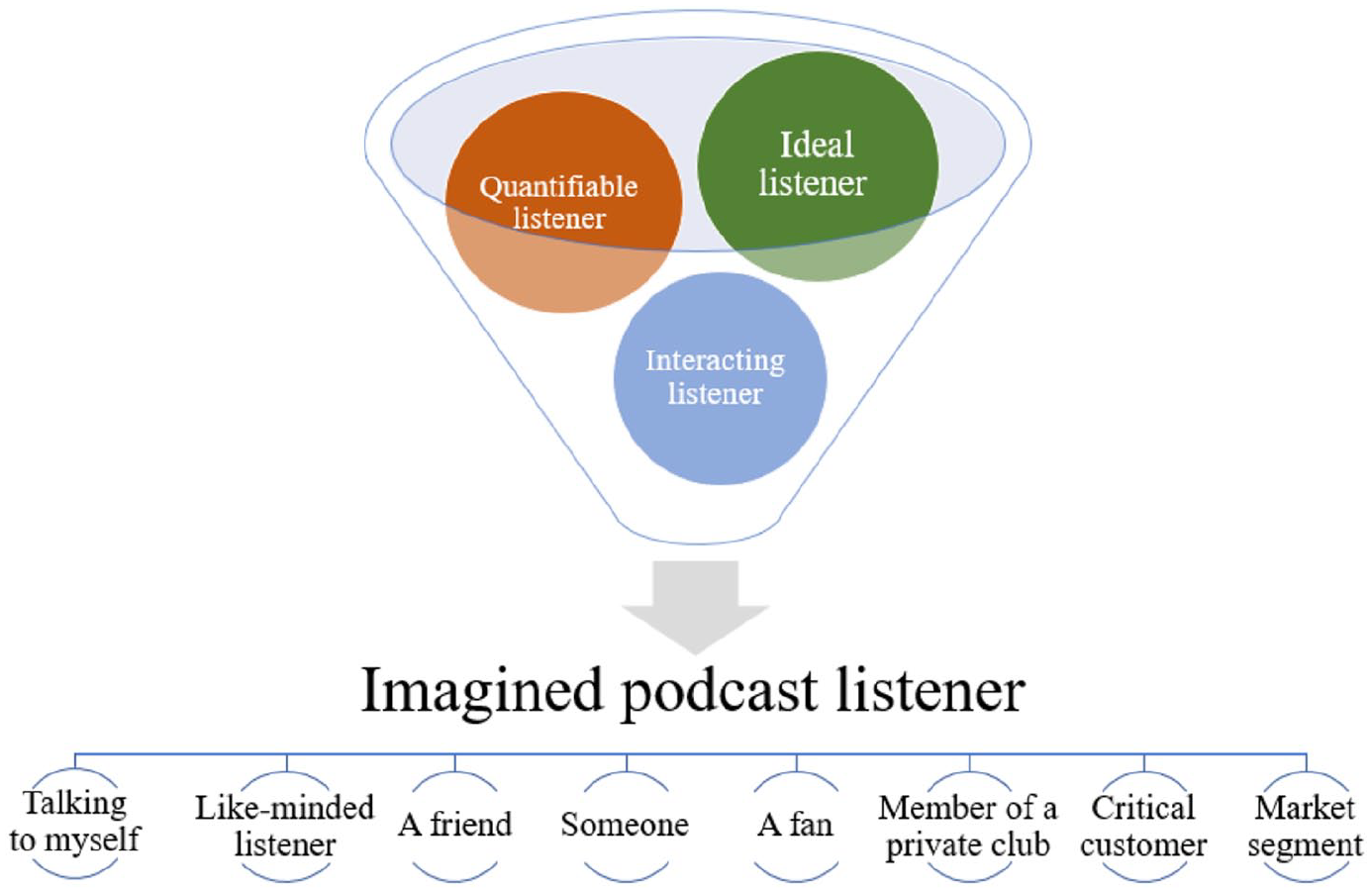
Types of imagined listener.
1. Talking to myself
The idea of conceiving the audience as oneself was variously expressed by a number of interviewees. For instance, Danit Ben David, a digital marketing entrepreneur, said that when she started working on Podcast in Heels, “I really tried to imagine my audience so that it would be easier to lock in on the relevant content.” However, this focus on external listeners stressed her out, and she eventually realized that the best approach is to “ask the questions that interest me.” Einat Nathan, parenting expert and media personality, also put herself in the position of a listener, saying that “ultimately, the primary objective is . . . to interest myself.”
For others, the most profound identification with the audience occurs at the moment of recording. For example, Ran Levi—a former software engineer and long-time fan of Hardcore History, who launched a long-form history podcast in 2007—described his recording experience by saying, “I think I’m talking to myself.” Maya Kosover, a veteran radio professional and one of the creators of the Israeli equivalent of This American Life, also said that she does not feel she is talking to an audience, but rather to “all sorts of characters that are made up from parts of my self.” For Kosover, recording a podcast is “very, very personal, and very much between me and myself,” expressed in the way she uses her voice when recording as opposed to lecturing in front of an audience, for example. For these podcasters, whether thinking about the content of their podcasts, or talking about the very act of recording them, they themselves are the central figure in their audience.
2. The like-minded listener
Related to the idea of talking to oneself is the conception of the listener as separate from but similar to oneself. Shelly Shmurack, co-host of the first Israeli true crime podcast, Let’s Talk Murder, expressed this when talking about the early days of her true crime podcast: “I think that the people who were listening to us at the beginning were like us, in that they like true crime.” Over time, as the podcast grew in popularity, and its audience took on a more general nature, this became less true. Ran Levi continues to see himself and his audience as “very, very similar,” just as he sees himself as similar to his podcasting hero, Dan Carlin of Hardcore History. This listener is perhaps most akin to the imagined audiences of Marwick and boyd’s (2011) Twitter respondents, one of whom said “I assume people like me that are reading my tweets,” instantiating the authors’ observation that the audience “is often the mirror-image of the user” (p. 120).
3. The listener as friend
There are two ways in which the listener is imagined by podcast creators as a friend. First, some creators really did know many of their early listeners. Relatively early on, for instance, Shmurack and Siordia (Let’s Talk Murder) organized a listeners meet-up at a bar—which they also attended. Carmel Vaisman, host of a high-brow podcast about posthumanism, said that “my initial audience was my friends.” We note that even if these podcasters felt that they knew their audience—that they were literally their friends—they still had to imagine them when recording. Second, Dalit Ben David, who launched her podcast during maternity leave, said that one of her main motivations was to create a social space that would assuage her loneliness. Her initial audience was thus comprised of imagined friends: “I wanted company,” she said.
4. The listener as someone
Even when they did not know the listeners in person, some podcasters still talked about recording for someone (Scannell, 2000). Maya Kosover conveyed this idea when describing how she records: “I don’t talk to a large audience. I’m talking to an individual.” For Ido Kenan, veteran tech journalist and host of a cybersecurity podcast, a good podcast host creates a feeling among listeners “that someone is talking to you.” Carmel Vaisman goes further: the “someone” she addresses is actually a specific person whom she named in the interview. Haggai Elkayan also said that he imagines specific “names and faces” of people he knows and that this features heavily in how he makes his podcast. Rom Atik, formerly CEO of Kan Podcasts,
1
and since 2021 the managing director of the N12 news broadcasting podcast initiative, offered a simile of podcaster/listener relations in which the podcaster has a one-on-one relationship with a listener: We always say that the presenter is like a guide who takes the listener by the hand and you say, you need to point things out to him. We’re driving together in a car, and here are the giraffes, and look at this tree over there. You always have to show the listener where to look.
This hand-holding approach to podcasting (McHugh, 2016), unmistakably inspired by the American host-driven linear narrative delivery of This American Life (see Glass, 2004), aligns with the idea of shaping the “audience” into a distinct listener. To this effect, the listener cannot be everyone, but a particular someone whose hand can be held.
5. The listener as member of a private club
Kenan talked about his listenership as constituting a kind of private members club. One of his podcasts, CyberCyber, includes a multitude of long-running inside jokes that first-time listeners are liable to find perplexing. He thus talks about himself, his co-host, and their listeners as members of a “club.” He said, “We’re in a club, and this club has members, and they are familiar with the language.” For Kenan, podcasts are not the electronic campfire that television has been viewed as, but rather a “niche” product tailored for individuals who share similar interests. Furthermore, he sees his listeners perceiving themselves as members of an exclusive club: The way I see it, quoting something from a podcast is like saying, “I saw this on Channel 8” [Israel’s documentary TV channel], or “I read it in a book.” I mean, it’s exclusive. “I heard it on a podcast, and you didn’t.”
6. The listener as fan
Einat and Yuval Nathan, hosts of the parenting podcast, Mommy, Mommy, were aware that their podcast has fans, even “hardcore fans,” as Einat put it. This is a conceptualization of the listener that places them at some distance from the hosts. Thus, while Einat talked about the “unmediated encounter with hardcore fans” at live podcast recordings, she also mentioned that the content at such events tends towards “clickbait” as a way of saying “thank you for coming.”
This type of imagined listener differs from the previous ones: rather than talking about “the listener,” hosts talk more about “listeners” as a group. Keren Siordia (Let’s Talk Murder) talked about an audience that “really, really loves us,” and that engages in fan-like behaviors, such as asking for video messages for friends’ birthdays.
Having fans can also be embarrassing, though. Maya Kosover talked about how odd it was when friends started telling her that friends of theirs had talked to them about her, suggesting that the listenership had become a more anonymous mass. It also led Kosover to feel that there was a gap between who she is and who she is for her listeners. Haggai Elkayan made a similar point when acknowledging that some of his fans are drawn to his podcast persona rather than his true self.
7. The listener as critical customer
In discussing the listener as customer, we are referring to a relationship in which the podcaster feels somehow beholden to their audience. For instance, after hearing an adult-themed sound effect in a podcast, a religious listener complained to Ido Kenan. Rather than rejecting this criticism out of hand, which was Kenan’s instinctive reaction, he instead used it to think about other listeners and what they might feel uncomfortable with.
Carmel Vaisman also spoke about her sense of responsibility towards her listeners: because she is “in his ear, . . . taking up that space,” she feels that she must not “say anything superfluous, not to waste their time.” Yuval Nathan took this further and talked explicitly about a contract he feels that exists between podcast creators and audiences: “You give me your ear for 50 minutes, I’m going to be inside your head . . . and I need to be very, very precise and provide a lot of value in that time.” His co-host Einat put it even more bluntly when talking specifically about live podcast recordings: “You need to understand the product that you’re selling to the audience.”
8. The listener as a market segment
Some of the podcasters viewed their audience through a marketing lens, such as when Carmel Vaisman characterized her audience as “twenty-somethings . . ., an intelligent audience who reads non-fiction.” Kobi Melamed, co-host of What’s There To It?, similarly said that “residents of Tel Aviv” and “18–24 year olds” are the “strongest segments” of his audience. Likewise, Ran Levi spoke of “a mostly male audience, aged 25–45, from the field of high tech, university graduates.”
These conceptualizations of the audience are at least partly based on data, supporting Coddington et al.’s (2021) observation that the rise of metrics in newsrooms and online has reshaped how journalists imagine their readers. Ido Kenan explained: “The data come from (a) our server—how many hits the file got—and (b) from Google, Spotify and Apple, who . . . provide slightly more detailed information, like how many people listened.” We found that the above eight types of imagined listener emerged intermittently throughout the interviews, often with multiple types appearing within the same interview. Yet, the interviewees did not perceive their various conceptualizations of their listeners as conflicting. A notable example was observed during an interview with Einat Nathan, who described a good episode as one that sparks her own curiosity: “[I prefer] hearing the wheels turning in my head and not necessarily looking at the page that I prepared in order for people to know x or y.” In contrast, her co-host, Yuval, emphasized the more business-like nature of their relationship with the listener. During their joint interview, they supported each other’s statements and did not acknowledge any tension between the intimate “talking to myself” delivery and the more distanced perception of the listener as a customer.
How do we reconcile this with the many instances in which the listener was described as a customer, a segment of the marketing audience, or as a fan? One possible explanation is that as their podcasts gained popularity, interviewees began to view their listeners as anonymous strangers (such as fans, customers, and an abstract marketing audience), rather than as similar to themselves. As Haggai Elkayan put it: “Somewhere after 3,000 [listeners] you reach a stage where . . . I was in a restaurant and someone said, “Wow, you’re Haggai”. And I said, “OK, something’s changed”.” Similarly, Carmel Vaisman spoke about her larger audience as “faceless, shapeless.”
Imagined intimacy
In order to gain insights into the communicative stance of podcast creators when addressing their unseen audiences—a stance culturally constructed as “intimate” (Euritt, 2022)—we now turn to the podcasters’ use of the term “intimacy” and their understandings of what makes podcasts intimate. Our objective was to contextualize how podcasters envision their listeners vis-à-vis their overall notion of podcast intimacy, without explicitly referencing these imagined relationships as intimate. Given our agnostic position, we avoided using the word “intimacy” during the interviews until brought up by the interviewees.
It can be argued that the intimacy experienced in podcasting, as “a specific learned strategy for communicating with podcasts” (Euritt, 2022: 21), is influenced by the socio-technological conditions of the medium. These conditions facilitate the potential for direct communication with listeners across multiple channels, and immediate and continuous interaction with the podcast host, blurring the barriers that once separated broadcast media personas from their audience. However, we observed that the interviewees often discussed ideas associated with intimacy, such as closeness, proximity, emotional bonds, and familiarity, not in relation to actual communication with real listeners. Instead, we noticed that for the majority of our interviewees, intimacy was inextricably linked with their own authenticity, and was self-centered rather than listener-oriented and interactional.
For instance, some interviewees perceived intimacy in their podcasts as the ability to convey their own genuine and authentic relationship with their co-hosts to the listeners. As Shelly Shmurack explained: I think there’s something a bit intimate that the dynamic of our relationship creates, um, and it comes through . . .. The dynamic of our relationship is part of this podcast, it’s something that really helps people connect.
For other podcasters, demonstrating to the listener what an intimate relationship sounds like sometimes means offering them a metaphorical seat in the podcaster’s private space. For example, Einat Nathan told us: The podcast . . . says, come in, we will open the door for you, you can sit in our living room, restaurant, in our bed even, in our intimate conversation. You’re welcome to join. It’s going to be interesting, exciting, and authentic.
According to other interviewees, intimacy is generated when reflecting the listener back to themself, by embodying a sense of similarity or shared identity. This identity is represented by the podcaster, as Ran Levi explained: Podcasting is a very intimate medium. There is no barrier between the podcaster and his listeners. When a podcast succeeds, I reckon, it’s mostly because the listeners feel that the podcaster represents a certain aspect of their personality. He [the podcaster] represents something that is them, themselves.
Rom Atik expressed the importance of embodying the listener’s experience through the body of the podcaster as medium: The technique is really, first of all, listening to your own body, as it resembles the listener the most. Like, [asking yourself] where did you smile, where did you lose concentration . . .? This is the first thing you do when you listen to your podcast: documenting your own feelings to mimic the listener.
It is worth noting that this was the only case where creating intimacy was described as a “technique” applied after recording the podcast, unsurprisingly from the interviewee with the most professional industry background. However, taken together these quotes imply that intimacy is understood as the total immersion of the addressee with the podcaster’s own identity or body. It is not an imagined dialogue or a trade-off, but rather a merger of the two. Along the same lines, if intimacy is perceived as profound similarity, to the point of erasing the notion of “other” when addressing the listener in an “intimate” way, it is unsurprising that several interviewees also assume a symmetry in the conditions of production and consumption. Consider, for instance, the following quote from Maya Kosover: I constantly think about being inside people’s ears, really inside their ears, and how the intimacy duplicates itself: the intimacy in which I create the podcast, and then the intimacy in which they consume it, and what they’re going through while listening. There’s this beautiful poem . . . about a person on a train, traveling alone as the scenery around him changes, and he experiences the scenery in relation to his own emotional state. I believe this is a very accurate description of podcast listening: you consume it while driving your car, washing the dishes, or tidying up your kids’ toys at the end of the day. You enter a certain state of consciousness, an almost meditative emotional state, and into this state, a soundtrack emerges—another person’s life story that meets you in the situation you’re in.
This poetic depiction of the listener and her listening conditions is inherently connected to certain assumptions about how people engage with podcasts. Although it is well established that podcast listening often accompanies other activities (Perks and Turner, 2019), it should be noted that this does not imply that podcast listening is always solitary or characterized by the intense level of attentiveness described by Kosover. Moreover, it appears that the feeling Kosover describes here is the intimacy she experiences with herself, or the intimacy the listeners feel with themselves. The meeting of these two experiences appears to amplify each of their individual emotional states, rather than facilitating engagement or communication between them.
Nevertheless, for podcasters like Ido Kenan, the solitary act of making a podcast is viewed as affecting the listener: “There is a person sitting in front of a microphone, alone in a room, speaking to himself. And this affects not only the listeners but also the presenter.” Einat Nathan provided a reverse example that demonstrates how the assumption of private consumption of a podcast influences the “intimate” production of podcasting. This came up when we asked her about her decision to wear pajamas for a live episode: We said, “People listen to us in the comfort of their own . . . at least symbolically, it’s their comfort zone, in their own homes, wearing pajamas, in a space where no one dresses up for anything.” It’s like the pajamas were the most symbolic thing, in this sense. By the way, we also recorded all of the podcasts with [former co-host] Hila in the evening, when that’s what I would be wearing.
When we consider these descriptions of intimacy and the ideas associated with it, it becomes evident that the term is strongly, if not exclusively, tied to the podcaster’s personal dispositions and experiences. For them, conveying intimacy involves first and foremost staying close to themselves. This can be achieved through various means, such as asking podcast guests “questions that I myself find interesting” (as Danit Ben David put it); displaying their intimate relationships on the podcast for their listeners to hear; envisioning the listener engaging with the podcast in a private setting similar to the creators’ own recording conditions; and embodying the listener’s emotional and physical reactions through their own bodily reactions.
Discussion: Inverse parasocial relationships
We posit that in order to construct “intimacy,” podcasters must imagine an audience with whom a certain kind of relationship can potentially be built. While listeners can indeed form real relationships with podcast hosts, we argue that the type of connection summoned by the interviewees’ approach to “intimate” podcasting is mostly an imagined construct. To better understand this, we propose conceptualizing it as an inverse parasocial relationship, where the podcast host has a misleading sense of familiarity with the listener. This goes beyond simply imagining the listener, but in fact involves assumptions about certain relationships with them.
Horton and Wohl (1956) coined the term “parasocial interaction” to describe the one-sided, quasi-social connections individuals form with media figures, creating an “illusion of intimacy.” Initially introduced in the context of television, this concept has since been applied to various media, as the audience’s access to media figures has grown through call-in shows, live audiences in talk shows, and direct communication with politicians and celebrities via social media (e.g. Abidin, 2015; Quintero Johnson and Patnoe-Woodley, 2016; Savage and Spence, 2014).
The notion of parasocial relationships has been referenced in capturing the perceived connection between podcast listeners and their favorite podcasters (Boling et al., 2021; Heiselberg and Have, 2023; Scherer and Cohen, 2024; Schlütz and Hedder, 2021). Listeners sometimes describe their connection to the podcaster as profound, with statements like “it’s just like having your friends talk to you” (Heshmat et al., 2018: 71), and “these are people I know intimately, extensively, profoundly” (Aroesti, 2021). Conversely, we propose that the characteristics of the parasocial interaction as outlined by Horton and Wohl can be used for depicting the mirrored nature of these relationships from the podcasters’ perspective. Specifically, we conclude that our interviewees perceive the relationship with their imagined listeners in a way that inherently carries the potential of being one-sided and illusory, based on the following characteristics.
One-sided and non-dialectical
Horton and Wohl (1956) use the concept of the media “persona” to describe a figure constructed from a standardized formula, whom the audience perceives as a friend: “In time, the devotee—the “fan”—comes to believe that he “knows” the persona more intimately and profoundly than others do; that he “understands” his character . . . and motives” (p. 216). Our findings imply that podcasters view the listener as a distinct “persona,” to whom they intuitively attribute a sense of familiarity and shared cultural patterns, a persona that lies between a like-minded listener and the notion of “talking to myself.” Specifically, our interviewees only spoke about intimate connections with listeners they feel they know well enough such that they can meticulously describe their listening experience, what they wear, and where they listen. We suggest that podcasters initially control and shape the potential interaction with the listener by envisioning them in a particular manner. Over time, the podcaster comes to believe that they “know” their listener, drawing on a blend of personal aspirations and assumptions about the audience, data from listening apps, and interactions with specific individuals who consume the podcast—what we defined above as the “imagined podcast listener.” However, from the various descriptions of this kind of bond, we claim that it can only be experienced as intimate insofar as the listener is similar to the podcaster, and “there is no barrier” (as Ran Levi puts it) between them because they are perceived as the same person.
Continuous
Horton and Wohl (1956) observed that the persona’s appearance “is a regular and dependable event, to be counted on, planned for, and integrated into the routines of daily life” (p. 216). Despite being a disentrained medium, podcasts still facilitate the perception of ongoing communication, especially via their seriality (Groß, 2023). Notably, the subscribe button symbolizes and creates the expectation of ongoing communication with an addressee who has presumably integrated the podcast into their day-to-day routine. This assumption in turn contributes to the formation of the following characteristic of the inverse parasocial relationship.
Predictable
Similarly to the “ordinarily predictable” nature of the media persona (Horton and Wohl, 1956: 217), we found that the imagined listener located within the context of podcast intimacy is considered to be highly predictable. Our interviewees assume that they know their listeners well enough to anticipate what will interest them, and how they consume the podcast. Where a media persona “gives his adherents no unpleasant surprises,” so does the podcaster assume an intimate connection with their audience, relying on a predictably reassuring type of imagined listener. Imagined as steadfast and reliable listeners, they are assumed to be engaged in a recurring ritual with the podcaster, where emotional and bodily responses to the podcast are expected and never surprising. This logic operates a priori, guiding the podcaster in crafting what they perceive as an intimate addressing mode. The type of listener capable of developing true intimacy with the podcaster is conceived as the latter’s mirror image. In other words, the podcaster automatically attributes certain predictable listening habits to the imagined listener, based on the podcaster’s own experience as a podcast listener.
Experienced as unmediated
Based on the quotes discussed above, it seems that when podcasters talk about perceived intimacy, they assume a listener who listens in a very specific way: privately, enveloped in their own individual “sound bubble,” akin to how the podcaster records in a small, enclosed space, evoking a sense of solitude. In other words, the conditions of the podcast’s production and consumption are assumed to be similar, though there is no inherent reason to assume this. This assumption fosters a feeling of unity among podcasters and listeners. We argue that this feeling is misleading because the podcaster is aware of the barrier that still exists between them (the listener is not really invited to “sit in our bedroom”). Additionally, the various ways listeners consume podcasts (on speakers, with others, on double speed, etc.) highlights this difference. While there may be some similarities between how podcasts are made and listened to, it is not something the medium requires.
Conclusions
We define the perceived connection between podcasters and their listeners as an inverse parasocial relationship, as it draws on a self-centered imaginary of a listener, leading to communication that is inevitably recursive. It is described by the interviewees as intimate because it creates a profound sense of closeness and familiarity: essentially communication with oneself. While some aspects of Horton and Wohl’s (1956) theory of parasocial interaction may not directly apply to this relationship, we still find their framework useful in highlighting an overlooked aspect in podcast studies, namely, the reverberating and egocentric potential that exists, at least to some extent, within podcasting culture. This aspect of the cultural construction of podcast intimacy can be seen as a fifth pillar, adding to the four recognized by Adler Berg (2023): listening circumstances, what is said, how it is said, and cross-media interactions between hosts and listeners. The creators’ assumptions about how this intimacy plays out and the types of listeners it can engage gesture towards an additional pillar that emphasizes an inward tendency of podcast intimacy, a critical perspective that is rarely explored in podcast studies.
Notably, indications of an inverse parasocial relationship from the podcasters in this study regarding their imagined audience do not rule out mutual relationships with some listeners. These relationships can coexist alongside the broader assumption of “the” podcast listener, a persona intuitively linked with particular listening experiences. However, this article focuses on the conditions that evoke a culturally coded “intimate” relationship, rather than actual host-listener interactions. As such, it refers to but does not closely discuss the growing literature on listeners’ parasocial relationships with podcasters and the contributing factors behind them, which lie beyond the scope of this work. While this research focuses on a relatively small group of podcasters in one country, it provides in-depth insights from nearly 20 hours of recorded conversations with influential podcast pioneers in their local context. Our deep dive into their perceptions of the figure of the imagined listener prompts us to reassess the immediate linking of podcasting with cultural tropes such as intimacy, engagement and compassion (Neil and Taylor, 2023). It emphasizes the importance of adopting a more critical perspective when framing podcasts as facilitators of empathy (McHugh, 2017), as bridging socio-cultural divides (Swiatek, 2018), or as possessing the power to bring us closer together (Sharon and John, 2019).
Several researchers have highlighted the self-centered nature of podcasting. Cwynar (2019) explains how public radio-personalities-turned-entrepreneurs romanticize risk and sacrifice, framing success as achievable while downplaying their privileged positions. He argues that through careful editing and storytelling, a crafted authenticity emerges, fostering self-disclosure that focuses more on personal narratives than on the broader political economy of startups (p. 9). In a more recent work, he raises ethical concerns about the narrator-protagonist mode in nonfictional storytelling podcasts, arguing that while it privileges intimacy, it may undermine the journalistic duty to give agency to featured voices (Cwynar, 2024). Sullivan (2018) similarly notes the podcasting industry’s focus on “authenticity” and “being true to yourself,” as observed at the Podcast Movement convention, where themes of “self-expression,” “self-branding,” and “self-exploration” resonate with both professional and indie creators (see Duffy, 2017). Murray’s (2019) research on the negotiation of collaborative and individualistic identities within podcast collectives highlights the critical importance of the self in the entrepreneurial labor of The Heard podcast collective, noting that “For many producers, their own self-discovery occurs alongside their subjects or blends with how they envision their listeners’ personal journeys” (p. 304). She also points out that the act of self-discovery has traditionally been associated with “white, middle-class enterprise, building the popularity of podcasting largely from audiences who ‘hear’ themselves in default” (p. 312).
What could be the implications of a podcasting mythology being told, and experienced by its creators, as an extension of oneself, primarily calling into being self-like listeners? Taking into account the above perspectives and the findings in this article, we conclude by wondering: Can the type of relationship culturally characterized as intimate be nurtured with a listener who is profoundly different from the podcaster? How can this “other” listener establish closeness with the podcaster, leading to engaging conversations? Do podcasts challenge or, in fact, contribute to an unproductive self-echoing?
Alongside the exciting possibilities offered by podcasting for dialogue, such as using podcasts for scholarship to attract diverse knowledge and participants for discussions (Cook, 2023; McGregor, Cook, and Beckstead, 2024), it is crucial to recognize its inclination to foster an inward-directed addressivity: the seeking of a comforting echo rather than engaging with audiences who might challenge the ideas propagated by the RSS feed. As long as the discourse associated with podcasts by default implies relations, the underlying construction of a mirroring listener remains veiled and under-addressed. This is to the extent that even passionate, independent podcast creators fail to acknowledge the limits of their imagination in shaping their listening subject. Just as it was never inherently necessary for radio to be one-sided (Brecht, 1932), but rather an outcome that emerged from long-term cultural, social and economic processes, we should be cautious about immediately framing podcasting as a dialectical, conversational alternative.
Footnotes
Acknowledgements
We are deeply appreciative of Amit Pinchevski, Blake Hallinan, and Dario Llinares for their insightful feedback on various drafts of this article. We are also grateful to the editors and the three anonymous reviewers for their invaluable input.
Funding
The author(s) disclosed receipt of the following financial support for the research, authorship, and/or publication of this article: This study was supported by Israel Science Foundation (ISF) [grant number 482/20].
