



Abstract
This article presents a study of how and to what extent gig workers in Sweden experience a mediatization of work. We contend that previous mediatization research has assumed extensive and unified effects of mediatization, and that previous gig work research has focused on users of large-scale, transnational platforms. We conducted a set of qualitative, semi-structured interviews (N = 28) with Swedish users of four different gig apps (all produced by very small companies active only in Sweden). We analyzed their experiences of mediatization along five dimensions: extension, substitution, amalgamation, accommodation, and datafication. We found that our respondents had much more varied, far less all-encompassing, experiences of mediatization than indicated in previous research. We also found respondents’ experiences clearly framed by the smaller size of the local, Swedish gig work companies.
Introduction
In this article, we investigate if and how gig workers experience a mediatization of work. Specifically, we use a set of qualitative interviews with Swedish gig work app users (N = 28) to distinguish media-related experiences from experiences rooted in other factors, as well as to empirically assess and critique some of the extensive claims of mediatization research. Furthermore, we also contribute to the field of gig work research by focusing on the experiences of users of national gig work platforms, which are produced by companies significantly smaller than the huge transnational conglomerates that have hitherto captured most of the scholarly interest. User experiences of platforms that are much smaller in scale are potentially very different from the experience of those using platforms relying on vast technological and human resources.
Studying gig work—platforms as media and corporations
The term gig work commonly refers to work that is short-term, task-based, frequently precarious, and—crucially—where digital platforms connect workers and employers, commonly via a mobile phone app interface. Many definitions and overviews (e.g. Kaine and Josserand, 2019: 479; Vallas and Schor, 2020: 276; Watson et al., 2021: 332–333) emphasize the role of digital media platforms in defining gig work. Gig work platforms and their mobile app interfaces appear to impose various demands on workers and employers alike, demands that are frequently described as transforming the sphere of work. However, despite previous research identifying digital media platforms as central in the analysis of the gig economy, much of current research on gig work tends to conflate technological and corporate organization. Scholars frequently use terms like “platforms,” “platform companies,” and “apps” interchangeably, ignoring or at least blurring the boundaries between technological infrastructures (“back end”), the interfaces with which the user–worker interacts (“front end”), and the corporation(s) that produces these artifacts. It is thus often unclear whether any given identified feature of the “gig economy” or “gig work” is a feature of the media–technological interface and its affordances, or of the fact that this interface is produced and maintained by a corporation that often has global reach and vast resources (this tension is evident in, for example, Duggan et al., 2020; Schor and Vallas, 2023; Vallas and Schor, 2020). In fact, many frequently used gig work platforms are created by companies much smaller than Uber, Deliveroo, and the like (see Huws et al., 2017 for an overview of smaller, nationally-based gig work platforms and companies in seven European countries)—while their apps (i.e. the interfaces the users meet) might look very similar to those produced by larger actors. There is thus a lack of attention to what parts of gig worker’s experiences are rooted in platform or media features (as we will explain, we see platforms as a kind of media), and what parts are rooted in features of the corporations creating the platforms. We propose mediatization as a framework that helps us to analytically separate features of users’ experiences of gig work that have to do with media/platform characteristics and functionalities from other features (e.g. that have to do with underlying labor market structures, or how the platform company is organized). Our overarching research question is: to what extent and in what ways can Swedish gig app users’ experience their gig work be described in terms of mediatization (specifically, along the dimensions of extension, substitution, amalgamation, accommodation, and datafication)? By asking this question we draw attention to the more media- or platform-specific features of gig workers’ experiences, and seek to arrive at a more precise understanding of gig work that help us distinguish between different kinds of factors that organize users’ experiences.
What is mediatization?
Mediatization is a concept used by media scholars to describe a process by which other spheres of society are increasingly affected by mediation. Mediatization research holds that other societal spheres adapt to media institutions, thereby changing socio-cultural practices by subordinating these other spheres to demands of media–technological affordances, media formats, and media production processes (Couldry and Hepp, 2013; Hjarvard, 2008, 2013, Lundby, 2014; Schulz, 2004; Strömbäck, 2008). Related to mediatization is the older term media logic, which originally specifically referred to the production and format demands of (commercial) television and how these demands—“logics”—have affected spheres as diverse as politics, sports, and religion (Altheide and Snow, 1979). Key to the notion of mediatization is that the media features encroaching on other spheres of society are largely independent from the mode of media organization, that is, most media logics work the same regardless of whether media organizations are public or private; or whether they are large and small.
Scholars have adapted the mediatization concept to include the presumed causal influence of new digital media, in particular new media platforms like search engines, social media, and e-commerce platforms, on other spheres of society (Couldry and Hepp, 2018; Driessens et al., 2017; Nowak-Teter, 2019). This scholarly discourse has spawned successor concepts of its own, for example, “platformization” (Helmond, 2015; Nieborg and Poell, 2018) or “social media logics” (Enli and Simonsen, 2018; Van Dijck and Poell, 2013), capturing the impact of new media on other spheres of society, indicating somewhat different demands yet with the same assumed causal force.
A recurring critique of the mediatization concept (and its relatives) is its grand yet often unspecified claims of media power (Corner, 2018; Deacon and Stanyer, 2014; Pallas and Fredriksson, 2013). Mediatization research has also been light on clearly operationalized empirical studies that support claims of socio-cultural adaptation to media logic; in a review of articles on the topic in 14 leading media and communication journals, 2002–2012, David Deacon and James Stanyer noted that out of the 93 articles found, only 13 were empirical studies (Deacon and Stanyer, 2014: 1034; politics was the societal sphere of greatest empirical interest. This focus on theory and (presumed) macro-level changes has persisted in the past decade. Recently, Stina Bengtsson and colleagues have also called for—and conducted—more empirical work focusing on people’s everyday life experience of different aspects of mediatization (Bengtsson et al., 2021; Jansson et al., 2021). This study responds to the call of Bengtsson and colleagues by asking how and to what extent gig workers in Sweden qualitatively experience their work and app use as mediatized. In other words, we wish both to contribute to the study of gig work by distinguishing mediatized aspects of workers’ experiences, and contribute to the study of mediatization through a case study of micro-level experiences of mediatization (or the lack of such experiences) in the sphere of work.
Gig work as mediatized work
The term gig work commonly refers to work that is short-term, task-based, frequently precarious, and—crucially—where digital platforms connect workers and employers, commonly via a mobile phone app interface. Because of the centrality of digital platforms to the gig work experience, it is a potential example of mediatization (in this case, of the sphere of work). Gig work platforms and their mobile app interfaces appear to impose various demands on workers and employers alike; demands tied to their mediated nature. Although gig work scholars have not used the precise term “mediatization,” many have still observed various production and format demands imposed by gig work platforms and suggested that they may have a transformative impact on the sphere of work in general, for example, Sutherland et al (2020) on the effects of the digital intermediary role of gig work platforms; Gerber and Krzywdzinski (2019) on the controlling effects of gamification; and Wiener et al (2023) on the effect and perception of algorithmic control through gig work platforms more generally. Yet all these studies fall victim to the aforementioned conflation of technology and corporate organization, in that it is frequently unclear whether effects/experiences are due to media/platform affordances, or to the fact that the corporations behind these platforms have transnational reach and considerable lobbying influence.
These and many other empirical studies of gig work thus seem to support that a mediatization (again, even of this particular word is not used) of work exists. However, as we have already hinted at, almost all such empirical studies focus on just a few, large-scale transnational actors, with ride share/taxi platform Uber being particularly prominent (a review of research on the sharing economy, while a more encompassing concept than gig work, found that Uber and AirBnB decisively dominated as objects of study, see Hossain, 2020: 9). Woodcock & Graham acknowledge the important role of Uber in modeling gig work, yet simultaneously criticize the outsize scholarly interest in this particular platform (Woodcock and Graham, 2020: 46–50, 83). If scholars mostly study powerful and resource-rich transnational actors (who have the resources to develop vast infrastructures of data and very advanced user interfaces/apps), it is perhaps more likely that they find wide-ranging, transformative effects. Studies of the workers and activities of smaller-scale gig work platforms (active on just a single national market or in a particular region) and/or which focus more on national digital ecologies of gig work are more rare, but unsurprisingly find a greater variety of user experiences and less comprehensive platform surveillance (see, for example, Graham et al., 2017). Thus, studying Sweden, where smaller-scale, nationally based companies and their platforms dominate the gig work landscape, becomes a corrective to earlier characterizations of the gig worker experience that have primarily been based on users of the very largest transnational gig platforms.
Gig work platforms and the mediatization of work? An analytical framework
Mediatization refers to the notion that mediation exerts pressure on other spheres of society to adapt to “the way media do things,” and that this leads actors within these spheres to prioritize adapting to the media rather than (say) adapting to the needs and demands of citizens. For example, politicians speak in soundbites and make policies that will play well on TV (Mazzoleni and Schulz, 1999: 250–251); organized sports implement rules changes to make it possible to fit more commercial breaks into televised games (Altheide and Snow, 1979: 58). New media innovations introduce new logics, for example, social media logics (“. . . social media logic refers to the processes, principles, and practices through which these platforms [social media platforms, authors’ note] process information, news, and communication, and more generally, how they channel social traffic,” Van Dijck and Poell, 2013: 5).
Yet how should we concretely operationalize mediatization? How does mediatization manifest empirically? In addition—of particular relevance to our research question—how and to what extent do people (as users, consumers, citizens, etc.) experience mediatization, if it all? Is mediatization naturalized or resisted? One of the most well-known definitions of mediatization, that of German scholar Winfried Schulz (2004: 88–90) proposes four dimensions along which mediatization structure and potentially change the activities of individuals and institutions (expressed differently: there are four aspects of media logic): extension, substitution, amalgamation, and accommodation. To these, we add the dimension of datafication, suggested by scholars as a complement to Schulz’s categorization (Couldry and Hepp, 2018; Van Dijck and Poell, 2013). These aspects are, as we shall see, a mix of technological affordances and the attendant format and production demands they impose; a mix that is “built into” the way mediation works and thus distinct from the ways in which individual media organizations may be organized.
Our discussion of these dimensions and their operationalization is mostly based on Schulz’s own work and a later commentary by Fredriksson et al. (2015). This latter commentary includes an overview and discussion of how Schulz’s four dimensions of mediatization have been operationalized by previous research (albeit with a focus on the mediatization of politics, reflecting the centrality of this area in mediatization research).
Dimensions of mediatization
Extension is the traditional function of mass media, extending communication across time and space. In addition, according to Schulz, “the media help to surmount limitations of encoding” (Schulz, 2004: 88), that is, the media also help extend sensory input quality in the widest sense of the word (e.g. including both when HDTV improves the quality of images, and when users use media as a source of information on things outside their own personal range of experience). This aspect of mediatization is present when actors (which can be individual users and institutions as a whole) use the media as their preferred channel of communication, and when actors implicitly assume that communication via media is an effective and useful way to achieve their goals (Fredriksson et al., 2015: 1052).
Substitution is when “media partly or completely substitute social activities and social institutions and thus change their character” (Schulz, 2004: 88), particularly when actors use media instead of other forms of social interaction and information exchange. In previous mediatization research, this has been operationalized as using media instead of other sources of information (or instead of other avenues of expression, or channels of action), and when media is used to display the activities of the actor (rather than other forms of display) (Fredriksson et al., 2015: 1052). One example of the latter from the literature is in Kepplinger’s (2002) study of German MPs, where he found that many MPs thought it more important to issue statements to the media than to draft legislation.
Amalgamation is when “[m]edia activities not only extend and (partly) substitute non-media activities; they also merge and mingle with one another” (Schulz, 2004: 89); that is, when activities of actors that have not previously been mediated, take on mediated aspects, and/or media become integrated into said activities. Common operationalizations in earlier research are when media activities become integrated into individuals’ everyday practices (e.g. work tasks, other communication practices); and when media activities become amalgamated in more general activities of (political) institutions (as when communication professionals become involved in drafting policies, see Fredriksson et al., 2015: 1052). Since gig workers primarily interact with gig platforms via mobile phone apps, it is of particular interest to look at if/how users amalgamated gig apps into general mobile phone use patterns, for example, “checking cycles” (a term used by Costera Meijer and Groot Kormelink, 2015: 670; to describe the common mobile habit of checking one’s messages, emails, and social media accounts in rapid succession in one consecutive session).
Accommodation occurs when social actors adopt media logics; Schulz uses political actors as an example: “Political actors adapt to the rules of the media system trying to increase their publicity and at the same time accepting a loss of autonomy” (Schulz, 2004: 89). This is found when actors explicitly organize their activities so that these activities will fit media demands, effectively subordinating their organization to the requirements of media. This happens both when actors create new practices for adapting to the media, and when general institutional activities and rules are adapted to the media (Fredriksson et al., 2015: 1053); examples from the political sphere include giving politicians media training, and creating routines that make political institutions more responsive to media attention (Esser and Matthes, 2013).
Finally, datafication has been proposed as an additional dimension of mediatization that captures the rise of digital media platforms (which largely happened after Schulz’s 2004 article) as a further “deep mediatization” (Couldry and Hepp, 2018: 34), where “. . . an increased proportion of communication relies on infrastructures of communication based on the collection and processing of data” (Couldry and Hepp, 2018: 52). Datafication also potentially entails a shift in what should be considered “media” under mediatization theory, as noted by Kaun (2023). Datafication at the platform level is often difficult for scholars to capture (because of the platforms’ lack of transparency about their algorithms and data gathering processes), but scholars have also studied audiences’ perceptions of algorithms and data gathering practices (see Flensburg and Lomborg, 2023: 1463–1465 for an overview). In such research, datafication is operationalized primarily as users forming beliefs and theories about the functioning of algorithms and platforms’ use of data—beliefs and theories that may not be correct, but still guide behavior (Bucher, 2017; Ytre-Arne and Moe, 2021).
The case of Sweden: an overview of Swedish gig platforms
Sweden is in many ways very different from the United States/United Kingdom (which dominates gig work research): a strong welfare state, extensive legal protections for workers in many aspects of working life, and strong unions active in most sectors of the labor market. At first look, Sweden may seem an unlikely country to even develop a gig work sector. However, in the past couple of decades, Sweden has seen many labor market deregulations, a weakening welfare state, decreasing union membership numbers, and a general individualization of working life that has made it more similar to an increasingly neoliberal Europe (see, for example, Davidsson, 2018; Kjellberg, 2011; Zijderveld, 2018: 112–113, 140–144, for overviews of these trends). Still, the image of the Swedish welfare state remains salient in people’s minds, something that is likely to impact our respondents’ general views of work and working life.
The four main gig platforms—all with their own mobile apps at the time of the study—that feature in this study are Gigstr, Instajobs, Taskrunner, and Yepster (we originally planned to include a fifth platform, Workish, but they went out of business). They all have slightly different profiles. On Gigstr and Instajobs, corporate clients advertise short-term jobs for individual workers. The corporate advertisers pay to use the service but it is free for workers. Typical jobs advertised are event hosting/assistance and handing out promotional samples (mostly food products). On Taskrunner and Yepstr, the advertisers are individuals rather than corporations and the app companies make their money by taking a percentage of workers’ earnings. Typical jobs advertised are babysitting and other household tasks, for example, gardening, assembling furniture, and simple repairs. All platforms thus focus on low-skilled service work, performed in-person rather than remotely.
Yepstr specifically targets high-school-age youth as workers; Gigstr and Instajobs market their services primarily to university students. Taskrunner has no particular target worker group. It therefore seems likely that the overall user base of these platforms would skew the young (circa < 25), but this is strictly speaking speculation—there is no survey of the total population of Swedish gig workers, and the platform companies themselves are not releasing any data about the demographic composition of their user bases. It is also difficult to find reliable, comparable data on how many users these platforms have. In 2018, 2 years before data gathering for this study began, Yepstr had 30,000 registered users (Andersson, 2018) and Taskrunner 25,000 (Taskrunner, 2018); 2 years later, in 2020, Yepstr stated that they had hit 10,000 active users (Yepstr, 2020). In 2020 (around the time of the data gathering period), 25,000 unique users had downloaded the Gigstr app (Kvarntorp, 2020). Instajobs had 900 users in 2019 (Instajobs, 2019), making them the smallest actor of the four even considering that the number of active users on the other platforms is far smaller than the number of registered users. As a point of comparison, the total number of unemployed persons aged 15–74 years in Sweden in 2020 was 459,000 (SCB, 2020).
Compared with international gig work giants, Swedish gig work platforms are very small companies. In 2020, Yepstr employed 8 people; Gigstr, 5; Taskrunner, 2; and Instajobs, 2 (all numbers from company annual reports compiled by Swedish corporate information site allabolag.se)—all a far cry from Uber’s 32,800 employees worldwide (SEC, 2023). Whereas Uber frequently announces publicly when they enter into data sharing partnerships, a careful online search revealed no such public announcements from Swedish gig platforms in the period 2017–2021. Monetizing user data does not seem to be a core part of the business model of these four platforms. Simply put, they are a very different kind of beast compared with the transnational giants that almost all gig work research focuses on.
Methods and data
The empirical material of the study is a set of qualitative, semi-structured interviews with 28 Swedish app worker respondents (17 F, 11 M), all using one of or several of the previously listed gig apps. The respondents range in age from 18 to 58; 23 of the respondents are 27 or under, so there is a focus on young(er) workers, which is a limitation of the study. For purposes of anonymization, we only provide age range (e.g. “20s,” “30s”) in Table 1. Interviews were between 40 and 151 minutes long and the median interview time was around 60 minutes.
List of respondents.
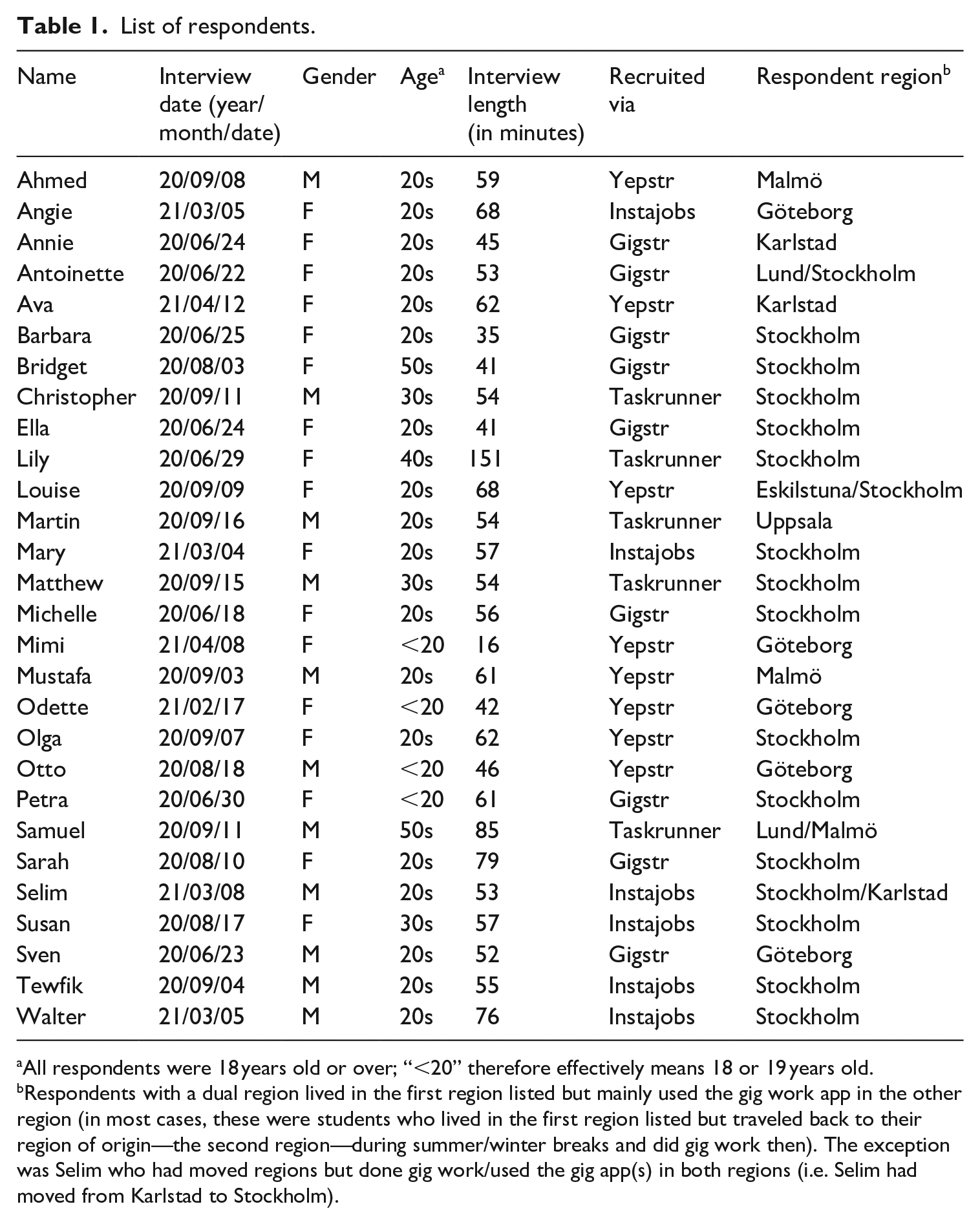
All respondents were 18 years old or over; “<20” therefore effectively means 18 or 19 years old.
Respondents with a dual region lived in the first region listed but mainly used the gig work app in the other region (in most cases, these were students who lived in the first region listed but traveled back to their region of origin—the second region—during summer/winter breaks and did gig work then). The exception was Selim who had moved regions but done gig work/used the gig app(s) in both regions (i.e. Selim had moved from Karlstad to Stockholm).
We recruited respondents directly via the gig work apps and paid them a fair fee/salary for their participation (as in Dunn, 2020; Graham et al., 2017). Our main reason for recruiting is this way is ethical; as exploitation is a big concern in both scholarship and public debate on gig work, we think it is important that we as scholars do not contribute to such exploitation. There are obviously potential methodological problems with recruiting in this way. The sample may be biased toward active or even very active users—certainly active users dominate our sample, but there are also users in our sample who are less active, so such users were not entirely excluded. Gig apps frequently direct users to list preferred types of work in order to match them to employers, which may further limit a recruitment-based sample; in our case only two of the platforms (Yepstr and Taskrunner) employed such sorting mechanisms, and in those cases, we were able to indicate that our job ad should be visible across all categories when buying the ad. Finally, gig app ranking algorithms may restrict who sees any given job ad/offer; in our case, only Yepstr used a tiered system for users where more high-paying jobs were displayed only to more experienced users. As we hinted at in the previous section when we discussed how small these companies are, none of them have the capacity to implement very advanced ranking algorithms, nor do they have to (Uber’s algorithm has to work in real-time, for example). In summary, our sample is likely skewed toward young and active users, yet on balance, we think ethical considerations outweigh these limitations.
The ads we placed yielded nine respondents via Gigstr, seven via Instajobs, five via Taskrunner, and seven via Yepstr. We paid respondents an hourly rate of 300 SEK (≈ 27 EUR). This was about three times the minimum hourly salary paid by our university and part of the collective agreement. We paid participants for a minimum of 1 hour (even if the interview did not last a full hour) and for full hours only (i.e. if an interview lasted 1 hour and 5 minutes, we paid the respondent for 2 full hours). This policy (which we explicitly told the participants about at the outset of the interview), combined with the relatively high compensation, could potentially have induced participants to end the interview quickly (since they would be paid anyway) or to extend the interview to just over 1 hour (in order to be paid for 2 hours). However, all respondents made a good-faith effort to engage with us and answer all our questions; none of the interviews ended before we had gone through our full interview protocol. As can be seen in Table 1, nine of the interviews lasted over an hour and six of these “just” over 1 hour (61–68 minutes). This may of course have been a strategic behavior on the part of these interviewees, but the impression of the interviewers was not that any respondent was trying to “fill time.”
We have anonymized all respondents using pseudonyms. Table 1 presents a summary list of respondents.
There is no systematic, representative survey of the demographic characteristics of gig workers in Sweden, so it is impossible to say definitively how our sample relates to the population of gig workers as a whole. We do note that the “typical” app worker in our sample is not someone forced into gig work because they are unable to find other forms of employment (though a few of our respondents do match this description), but rather someone—often a student—who is using app work to earn a side income/extra money. Most (though not all) of our respondents are thus not dependent on app work, meaning that they are more “privileged” than those app workers who have few or no other ways to earn their income.
We conducted interviews during two periods: June to September of 2020 (21 interviews) and March to April of 2021 (7 interviews). Both periods were during the COVID-19 pandemic. Sweden, as noted globally, is one of the few countries in the world which did not implement any kind of Covid “lockdown” and also imposed very limited Covid restrictions in general (e.g. shortened evening opening times for bars and restaurants; audience limits on some—but not all—types of public events). There were thus no legal or other formal limits on advertising jobs that would require close personal proximity to clients (e.g. babysitting). Apouey et al (2020) reported decreased gig work availability in France during the pandemic, whereas Fiers and Hargittai (2023) reported an increase in gig work in the United States. For the reasons outlined, any kind of increase/decrease effect is likely to be less pronounced in the Swedish case, though such effects are not non-existent—Gigstr went bankrupt as a consequence of the pandemic, for example (Blixt, 2022). The main “pandemic effect” mentioned by users—some, not all—was a perceived decrease in available jobs (yet all respondents who mentioned this continued to use the gig platforms successfully during the period of study).
We conducted all interviews via Zoom, eliminating the need for respondents and interviewers to travel anywhere for the interviews. Despite there being no formal travel restrictions in place in Sweden during the pandemic, for ethical reasons we considered Zoom interviews to be the better alternative (to in-person interviews) as that made the process safer both for our respondents and for ourselves.
Half of the interviews were conducted with two interviewers (which has advantages such as amplified rapport and better conversational rhythm, see Monforte and Úbeda-Colomer, 2021), and seven of the interviews were conducted in English (as one of the interviewers has limited knowledge of Swedish); the rest were conducted in Swedish. The first author has translated all the quotes in English in the text from the Swedish-language interviews.
The interview manual had three parts; the first dealing with descriptive details as well as reflections on their app use (e.g. when did they start using a particular app; how did they use it; how did they find the experience; how did they make use of the various features of the app [if at all]); the second dealing with their experience of work (e.g. what types of work did they perform; how often; how was their experience; what other types of work besides gig work did they do; how would they generally find work); and the third dealt with the intersection of app use practices and work practices (e.g. use and impressions of any rating features used in the app; experiences on clients commenting on their profile; how they see the future of their app use and gig work). Since we wanted to assess the extent to which gig workers experience mediatization of work, as well as assess if and how mediatization is embedded in everyday practice and whether it is perceived as positive or problematic, we did not want to predetermine respondents’ answers by creating lists of potential practices and then asking respondents whether they engaged in them. Rather, we preferred an “open” interview around a set of overarching themes (as above), as we wanted to find out what, if any, aspects of mediatization respondents would spontaneously mention and discuss (though we did include some more specific prompts to use if conversation stalled). That is, we did not want to assume that experiences of mediatization would exist, as in our view, it is an empirical question whether such experiences exist and if so, what their nature is.
The study has been approved by the Swedish Research Ethics Review Board (EPN; decision numbers 2019-00934 and 2020-01110) and as such meets Swedish and international standards for ethical research conduct.
Coding of the interviews was thematic, using the aforementioned mediatization aspects (extension, substitution, amalgamation, accommodation, and datafication). We conducted manual coding parallel with coding using the NVivo software package and later compared and collated codings; this ensured an appropriate level of rigor in the coding as all project participants were involved in the coding (see Maher et al., 2018).
Results
We present our results using the five dimensions of mediatization outlined earlier as subheadings, focusing on the existence and extent of key elements of each dimension as presented in our theoretical framework and analyzing the salience of mediatization-related factors relative to other potential factors organizing users’ experiences. Together, these results provide an understanding of concrete, micro-level user experiences of the mediatization of work; that is, precisely the kind of mediatization research called for by Bengtsson et al. (2021) and Jansson et al. (2021).
In line with our aim of disentangling media/platform-related factors from other factors (e.g. corporate organization, societal structures, and institutions), we mostly use the term “gig app” (or just “app”) throughout the analysis in order to specifically refer to the user interfaces directly encountered by gig workers (i.e. as mobile apps). The app is the medium in this case, so it is at this analytical level most mediatization-related experiences—or the lack of them—happen). We occasionally use the term “gig platform” or “platform” to refer to the back end, technical infrastructures behind the gig apps, and we use the term “gig companies” when referring to the companies that produce the plaforms/apps.
Extension—channel preferences and assumptions of efficiency
Gig apps do obviously extend users’ ability to apply for jobs in the first place by compressing time and space, much as all other mass media do. For example, student giggers Antoinette (20s) and Michelle (20s) both studied in a city different than the one where they were born and raised, and they both pointed to gig apps as a quick and convenient way to find employment while back home for summer and other holidays. However, some users experienced what was virtually the opposite of extension: a pronounced geographic inequality of job availability. Gig jobs available via the app were heavily concentrated to Stockholm and to a somewhat lesser extent Gothenburg and Malmö (the three biggest cities in Sweden). For people outside these areas—even those living in other major cities or sizable towns—the promise of geographic extension of job opportunities has distinctly not been fulfilled. Annie (20s), who lives in a town of 90,000 inhabitants in Western Sweden, was what we call a “failed user.” She heard about the Gigstr app, was excited about the opportunity for easily available, flexible job opportunities, downloaded the app—and then discovered there were no jobs in her geographic area. Ava (20s) used Yepstr as a teenager but did not have much success in her home town: “. . . it was pretty dead there,” as she put it.
These experiences can be compared with those of a user based in Stockholm (Tewfiq, 20s), who at the time of the interview had gotten about 80 jobs in the 3 years he had been using the app, and applied for about twice as many. Tewfiq and other Stockholm-based users generally described an abundance of jobs, a stark contrast to the lack of coverage gig apps provide in smaller cities and towns.
This geographic inequality meant users had varied channel preferences and assumptions of efficiency. Respondents based outside the three major metropolitan regions of Sweden did not view gig apps as a very useful way to get extra work. They readily perceived the apps as inferior to other sources of jobs (e.g. employment agencies, personal contacts). By contrast, respondents based in big cities (particularly Stockholm) could readily use the benefits of mediated job search, frequently preferred the flexibility afforded by the gig apps, and could in some cases make gigging into the more all-encompassing lifestyle noted by some research (e.g. Hensellek and Puchala, 2021; Thompson, 2019)—in particular, this applied to “super-users” like Tewfiq (20s), Lily (40s), and Matthew (30s).
Respondents had mostly naturalized that mediatization affords—and should afford—extensions not only of spatial range, but also of your overall range of experience. Respondents took for granted that they should be able to find jobs using gig apps. Many users thought that the gig apps were not as efficient as they could be. One key aspect of the extension aspect of mediatization (i.e. the expectation of mediation efficiency) is that for users to expect a certain level of functionality and service when using mobile apps. Users judge apps produced by small companies (like the gig apps in this study) by the same standards as apps produced by multi-billion-dollar, transnational operations like Google and Spotify (i.e. users do not always “see” the gig companies or even the gig platforms “behind” the gig apps). Susan, a demanding user, preferred a specific gig app because she perceived its user interface as superior to others she had used: “Yes, I’m an app snob,” she noted (Susan, 30s). Users complained about a range of app shortcomings: lack of easy-to-use geographic sorting; lack of information on requirements for jobs (e.g. does one need a drivers’ license); lack of responsiveness using the chat/message functions of the app; problems with app updates; and lagging apps. The issue for many users was not excessive mediatization, but rather a lack of it: users expected more extensive functionalities than the app could provide.
Substitution—gig apps as alternative on the job market
Respondents generally considered gig apps/gig platforms attractive substitutions for more traditional labor market intermediaries, in particular the Swedish Public Employment Service (Arbetsförmedlingen), which users perceived as bureaucratic and inflexible: Well, I do think that the Employment Service [i.e. Arbetsförmedlingen] maybe is the hardest [place] for finding the kind of odd jobs I want. They have almost none of them. I really like the format and idea behind Yepstr. I think it is really good. (Odette, <20) And where things like the Employment Service would do things where . . . you know, expect you to apply for a certain amount of jobs and be able to prove that you’ve applied for a certain amount of jobs if you want a certain benefit. [On Instajobs] you still get to . . . as long as you are eligible for the temp pool you get to stay in it and apply to the jobs you would like to. (Angie, 20s)
In the eyes of users, the conveniences of extension discussed in the previous section make gig apps superior to other ways of securing employment and therefore good substitutes for other labor market intermediaries (and indeed good substitutes for contacting potential employers directly, as well).
Some users did have trouble getting permanent jobs and relied on a combination of gig work and other types of short-term employment to earn money. For them, gig platforms were clearly inferior to alternative ways of securing employment and inadequate substitutions for “real” job; “. . . it’s very hard to get up to even half-time work, unless you get a longer assignment,” said Barbara (20s). Ahmed (20s) particularly noted the insecurity that came with not getting enough gigs: “But other weeks, I get maybe once, so that’s not enough for me.”
Just as the gig apps allow for greater flexibility and that users like, some features make gig apps inferior (in the eyes of some users) to traditional ways of interacting in the labor market (and therefore less suitable for substitution). The most obvious lack is that the gig apps do not allow for face-to-face contact prior to taking the job, with all the attendant lack of feedback opportunities: ”[B]ut there’s no feedback, so it’s hard to know like, ‘okay, but what am I supposed to do to get this job?’” (Sarah, 20s). This is a clear indicator that the respondents frequently do not prefer gig apps as a display tool (i.e. in this case, a tool for displaying themselves as job seekers) because they are perceived as lacking key features (notably lack of interactivity and personal contact) other forms and channels of display have.
Substitution in terms of choosing to display yourself or your activities in or through the gig apps rather than other channels existed along a spectrum among the respondents. Most users did not substitute gig apps for other labor market intermediaries and other ways of getting jobs (except for the Swedish Public Employment Agency, which responsents happily avoided dealing with), bur rather used gig apps to display themselves as job seekers alongside many other possible channels. Many perceived that the digital environment provided such a plethora of opportunities for money-making via apps and platforms (even besides the gig apps) that it was difficult to overview, assess, and select apps (Ava, 20s; Barbara, 20s; Louise, 20s; Mustafa, 20s; and Samuel, 50s, expressed such sentiments, for example). Hence, they hedged their bets and created profiles on all of them, in order to maximize their “display window,” so to speak. At the other end of the spectrum (where there was fewer users), some respondents had started using one app and just kept using that app as their digital display window; in one case, a user was not even aware that other apps for getting gig work existed (like Christopher, 30s).
Amalgamation—integration into media and work practices
Our sample provides examples of the full range of amalgamation of gig apps with other aspects of mobile media use. Some users feel compelled to check for new jobs constantly (or make use of the push notification feature of most gig apps to get the phone to “ping” whenever a new job becomes available). Other users install the app, create a profile, do not succeed in finding a job immediately, and then promptly forget that they have the app installed. To the extent a pattern can be found, it is that users are opportunistic about amalgamating the gig apps into their regular, daily checking cycles: they check the app intensively when they need to get a job, and then ignore it until they need a new one. Sarah’s (20) experience is typical: she describes checking the app every day—sometimes both in the morning and in the evening—around the time when she first started using it (in 2018–2019), but then as she got other (not app-mediated) freelance jobs she liked better, she started checking the app less frequently (every or every other week). Some users did find that chasing jobs via gig apps added some pressure to both app use and job seeking: “So if you’re not at your phone or have access to it when the notification comes, you have no chance of getting the job, most times” (Olga, 20s). When users experienced a decrease in jobs offered via the app, the amalgamation of app use into their regular mobile phone use also changed: “When it was at its most, and I got the most push notices [for jobs; authors’ note], I could get like five, ten a day, and now it’s maybe five a week, at most” (Susan, 30s).
Another potential form of amalgamation is integrating the app into other practices directly related to the gig work itself; notably keeping in touch with the employer (if the work situation itself does not include direct contact with the employer, as was common for some types of work). Interestingly, some users even found it difficult to interact with employers on the app (due to lack of features and/or due to poor app performance), which obviously made it more difficult to amalgamate app use even into work routines directly to respondents’ gig work. It is a common demand made by the gig companies, and built into the gig platforms/apps, that all contact between worker and employer is conducted via the app (presumably in order to make sure the parties do not just use the app to connect and then make employment arrangements outside the app). This demand sometimes amounts to a de facto prohibition of amalgamation that creates practical difficulties: You don’t get each other’s contact details /. . ./ Even when you have approved it, you don’t get it, they’ve redesigned the app so that you can only call via the app but that number just goes to a switchboard that doesn’t work at all, I have to write things in the comments field and just hope that they respond, like I have to write “What’s the name on your door?” “How do I get through your gate?,” (Matthew, 30s)
The app making it more difficult to contact employers directly sometimes also worked to the workers’ advantage. Petra (<20) reported using an app where workers clocked in and out of work through the app, without the direct supervision of an employer (i.e. a kind of honor system). She frequently “forgot” to clock out using the app, thereby getting paid for a few extra hours, and one of her friends who used the same app simply did not show up for work tasks sometimes but instead clocked in and out from home (still getting paid, suffering no apparent sanction).
Accommodation—practices of adaptation and circumvention
All the four gig companies in our study (Yepstr in particular) have used their social media channels to encourage users to post about their gigging in their own social media feeds. None of our respondents reported having taken part in this type of very direct and explicit accommodation activity, though a few (like Antoinette, 20s) said that they would consider doing it if it did not affect their work. A few emphatically said that they would never consider doing so (this could of course have been due to an interviewer effect but reactions seemed spontaneous enough in the interview). Overall, respondents were uninterested in using any media functionalities of the apps (e.g. cross-posting to social media, recording personal presentation videos) beyond those necessary to apply for jobs and administrate their employment, in the cases where apps provided such functionalities. This is in stark contrast to the Swedish cultural workers described in Fast & Jansson’s study, who felt a pervasive pressure to build their personal brands on various platforms (Fast and Jansson, 2019: 99–104).
The respondents had entirely naturalized other forms of accommodation, however. No one questioned the need to create a profile that included a photo, some (limited) level of personal information, and in some cases one or a few self-promotional presentation phrases. Some even explicitly commented on the similarity to social media apps/platforms, for example, Odette (<20): So you also have to tag, like, your interests, what jobs you would consider doing. And if you have a driver’s license. Like little details like that. So it’s not super different from creating a profile on any other social media site.
Respondents largely considered it self-evident that profile information, photos in particular, should display some level of professionalism and effort and be promotional in the sense of “putting your best foot forward,” for example: “So basically a picture, you’re smiling, you’re giving off good vibes, and you look tidy” (Mustafa, 20s). By contrast, respondents were uninterested in or unwilling to participate in more “intense” forms of accommodation like active mediated self-promotion.
Some of our respondents also actively sought to circumvent the gig apps rather than accommodate to them. Four respondents (Barbara, Bridget, Michelle, and Petra; all based in Stockholm; none of them knew each other) actually reported both calling the one of the gig app offices and physically visiting the gig app office in order to increase their chances of getting jobs: Now that I think of it, it was more effective to just go to their office than actually applying for the job in the apps, because there are so many applying, but when you are at the office they have to give you something at least,
as Petra (<20) put it. In contrast to the experiences we described when discussing extension, these users evidently perceived that there was a company behind the app. The circumvention strategy clearly worked for them as the company employees did not discourage them or direct them to apply via the app instead. Rather, the gig company seems to have rewarded this behavior by giving these four respondents preferential access to gig jobs. Other respondents engaged in other forms of platform circumvention, for example, contacting the CEO of the gig company directly in order to get jobs (Olga, 20s). This strategy was likewise rewarded with preferential treatment. Despite the best efforts of the companies and the affordances built into the apps, some respondents also reported sometimes using the app only to get the initial contact with an employer and then arranging further work for the same employer outside the app (e.g. Christopher, 30s; Otto, <20; Samuel, 50s).
Datafication—perceptions of algorithmic control
All 28 respondents, without being prompted, offered some type of lay or folk theory on the workings of the algorithms of the platforms behind the apps they used. It was a key feature of their experience of the apps: all felt, to varying degrees, a practical need to theorize how the ranking and display algorithms worked. Respondents frequently linked this need to a perceived lack of transparency—since the apps did not explicitly explain their selection and display criteria, the users had to figure out the workings of the platforms for themselves using a variety of cues (which may or may not have been indicative of the actual functioning of the algorithms). Users perceived it as unclear how the platform determined who should get a job or task if there were multiple applicants; how platforms determined which jobs would be visible to the applicant in the first place; and in some cases what the job even entailed in the first place. Speculations on how the platform worked were common: No, I think maybe [I get more jobs because] I have been loyal and flexible. So it’s probably those things that have made me climb the rankings. /. . ./ I don’t know at all how their system works, but I guess it’s mostly that I’ve been prepared to work a lot. (Antoinette, 20s) I think they try to be kind of fair when they select [candidates], so for example if it’s me and some other person who is applying for a lot of gigs, they don’t give all of them to me, or all of them to the other person. I try not to think too much about it. . . I suppose they try to be fair, at least. (Ella, 20s)
Words and phrases like “I think . . .,” “I guess . . .,” and “I have no idea” recurred among all respondents when they talked about the (presumed) inner algorithmic workings of the gig platforms. A few respondents had thought quite a bit about how the algorithm might work and had tried to adapt to it in order to better their chances of getting job offers. Louise (20s), for example, talked about how she surmised that it was important to have an attractive profile, have good reviews from former employers, have appropriate profile settings, and to be particularly active when you start using the app—and at the same time readily acknowledged that most of what she thought was just guesswork. However, more common was an attitude of quiet resignation in the face of non-transparent, unpredictable algorithms (“I try not to think too much about it,” as we quoted from Ella earlier)—not unlike the resignation among users of enterprise social media in Bagger’s (2021) study of Danish knowledge workers.
By contrast, none of the respondents expressed explicit concern about the platforms gathering personal data and information about them, and nor did they directly report having noticed signs of any such practices. Users may on some level be aware that data gathering is taking place (e.g. if the ratings you get from employers make you more likely to get other jobs, then it can be assumed that the platform gathers and collates these rankings and make them visible to other employers), but they do not explicitly (or only vaguely) connect this data gathering to algorithm functionality. Users do realize that there is some kind of algorithm that controls what jobs they see on the app and how jobs are assigned, but as they cannot figure out how they work, users generally do not care that much about them. The perception of datafication as an aspect of mediatization among respondents is thus limited and not very salient to their everyday app use (even though such datafication may well occur, invisible to the user).
Discussion and conclusions: experiences of mediatization on Swedish gig apps
Our overall observation on how and to what extent Swedish gig app users experience mediatization, is that their experiences are very different from the all-encompassing phenomenon causally affecting people described by mediatization theorists. When Couldry and Hepp describe the role of digital media and smartphones in creating a new role for the self focused on performance and image management (Couldry and Hepp 2018: 145–146), they treat “digital media” and “smartphones” as if they are singular things rather than multifaceted phenomena (i.e. “smartphones” and “digital media” are assumed to have rather unified and unitary effects at the aggregate levels). Krotz characterizes smartphones in a similar way (Krotz, 2014: 81). For the most part, users do not “think beyond” the apps (i.e. that there is a platform infrastructure produced by a company behind the user interface) except in specific circumstances—mostly when trying to optimize their profiles and app use by adapting to a non-transparent algorithm, and—in the case of a few enterprising gig workers—when visiting the office of the gig work company in order to better their chances of getting jobs.
In terms of extension, respondents certainly experience their app use as to some extent transcending space and increasing their range of experience. Yet there are limits to the extension: respondents outside the major metropolitan areas still experience the common geographic inequality of labor markets, as the apps are unable to compensate for it. Users still express appreciation of the flexibility afforded by extension, and to a great degree take it for granted. Being able to use a variety of services whenever and wherever you like via your mobile device or laptop computer is simply perceived as the normal state of things (as noted by Ling, 2012, more than a decade ago). Users have definitely naturalized these aspects of gig app use, as they expect a level of functionality from gig apps that they do not always deliver. Lack of features like geographic sorting, transparent search functions, and instant and always-available communication with employers (combined with the geographic inequality already mentioned), cause users to come up against the limits of extension almost as frequently as they experience the advantage of it.
In terms of substitution, respondents are highly opportunistic. They use gig apps instead of other labor market intermediaries, in particular the Swedish Public Employment Agency, which is perceived as overly bureaucratic. More often users do not substitute traditional job search avenues for gig apps but rather use them as a complement to traditional labor market intermediaries—as and when it suits them, depending on current needs, wants, and circumstances. This opportunism was most obvious when respondents were very clear that while they may use gig apps and gig work as substitutions for more traditional labor market participation currently, they would not do so in the future (when they are finished with their education). The end goal was thus not to be a gigger–entrepreneur for the rest of your career, but rather the opposite: you can substitute gig app use and gig work for “real work” during a period of your life (i.e. when studying) when it is convenient, but as soon as you can get a real job, you leave gigging.
In terms of amalgamation, respondents do integrate gig app use into their regular media habits, in particular, their mobile phone habits—but to varying degrees. Again, respondents are guided by opportunism and current circumstances. When users really need work, they engage more intensely with the app, checking it often, enabling push notifications, perhaps updating their profiles more often. When job opportunities and employment seem plentiful and secure, they scale back their app use—sometimes even forgetting they have the app on their phone. They have installed the gig apps for a particular purpose (getting jobs) and perceive job searching as a practice distinct from other mobile media practices, and do not particularly want to integrate their gig app use into their regular mobile media habits. Moreover, similar to the observations on extension, respondents generally wish amalgamation were easier when it comes to integrating the apps into their work practices, in particular contact with employers and other aspects of administrating their own work.
In terms of accommodation, the naturalization of media described elsewhere by Couldry and Hepp (2018: 32) is clearly present in the sense that gig workers expect to be able to manage (part of) their working life via apps (using profiles, rating/being rated, etc.). On the contrary, most of our respondents actively opt out of the image management functionalities of the gig work apps and do not engage in posting about their gig work on social media; that is, they decidedly do not accommodate to this particular form of media logic. Concerns about workers being pressured to more carefully manage their app profiles and engage in more social media-style self-marketing seem unfounded based on our respondents. Furthermore, a few workers also devised a strategy opposite of accommodation when it came to increasing their chances of getting jobs, that is, physically visiting the gig app office.
In terms of datafication, a key part of the experience of using the gig apps was a profound lack of transparency surrounding the algorithm or algorithms guiding many aspects of the performance of the platform (though the users were generally not too concerned about any data gathering conducted by the apps). All respondents engaged in guesswork about the algorithm, but did not necessarily adjust their behaviors based on these guesses—they perceived the apps as so inscrutable and ever changing to make most such adjustments meaningless. Users clearly perceived this dimension of mediatization as the most foreign and least naturalized, and they were keen to discuss it with us interviewers. As suggested by more recent mediatization research, datafication does represent something new and characteristic of the digital media experience—and as such is more visible to users, and something they are more likely to reflect upon (at least for now).
As we noted at the outset of this article, mediatization scholars most often conceive of mediatization as a macro-level process with great impact on society and individuals—but the perceptions and practices of these individuals are rarely studied. Part of this is because the research is mostly theoretical, but also because the sphere most often studied empirically in mediatization research—politics—is a sphere where mediatization and media logics have had great impact. In the sphere we have studied, mediatization appears less encompassing. To be sure, our study shows that certain dimensions of mediatization are an important part of some aspects of the experience of gig workers—hardly a controversial conclusion, yet one that adds empirical nuance to statements such as this one from mediatization scholar Andreas Hepp: “Deep mediatization is an advanced stage of the process in which all elements of our social world are intricately related to digital media and their underlying infrastructures” (Hepp, 2019: 3). Sure, but “intricately related” exactly how? How do actual people experience this? Our respondents variously accept, internalize, resist, negotiate, and critique the mediatization of work created by gig work apps—not only is there a wide range of individual experience, but the mediatization of work clearly looks different from, say, the mediatization of politics. Rather than thinking of mediatization as one process that affects all social spheres equally and in the same way, it is more fruitful to think of many different expressions of mediatization across many different spheres (as suggested by other critics of mediatization as well, for example, Ekström et al., 2016: 1098). In fact, it may well be that the focus on politics in mediatization research has led scholars to implicitly assume that mediatization mechanics in politics will apply equally to other spheres of society—whereas our study shows that existing social structures and institutions in another sphere (work/labor markets, in our case) limit the transforming influence of mediatization (gig apps cannot compensate for existing geographic inequalities in labor markets, for example).
Analogously, our study also provides nuance to the overall scholarly picture of gig work that to a great degree emerges from studies of a few transnational, datafied, and highly exploitative companies (e.g. Uber, Deliveroo) and a focus on particular types of work (notably transport and delivery work). Previous qualitative studies of the experiences of users of such platforms find experiences of quite comprehensive algorithmic control as well as more comprehensive resistance and activism among workers (e.g. Cameron and Rahman, 2022; Chen, 2018; Popan, 2021). While our respondents consistently express mystification regarding the inner workings of platform algorithms, they do not feel particularly controlled or monitored. Persistent complaints about poor app performance and lack of features show that our respondents, just like those in other studies, have to “work around” the apps, but for an entirely different reason. They do not seek to escape worker surveillance and control (a few users could even easily deceive the platforms without consequences), but rather engage in workarounds in order to simply get the apps to work as marketed and provide them with the flexible working life experience they desire. It is also difficult to conceive of some of the practices our respondents engage in working in relation to transnational gig platforms. We cannot imagine an Uber driver walking into the Uber head office in San Francisco and ask for preferential treatment when being assigned rides, for example. Gig work research and more recent mediatization research share the implicit view that all “platforms” are the same, and that all platforms engage in wholesale datafication and algorithmic control. The experiences of the users in this study clearly show that smaller (in this case, significantly smaller) platform operations generate a very different set of experiences. These differences in scale, and the attendant limits of both mediatization and platform effects, deserve to be explored more in future research.
Footnotes
Funding
This work was supported by the Swedish Research Council for Health, Working Life and Welfare (FORTE) under Grant Number 2018-00261.
