




Abstract
Good jobs that allow remote work have enabled white-collar professionals to stay home during COVID-19, but for precarious workers, online advertisements for work-from-home employment are often scams. In this article, based on in-depth interviews conducted between April and July 2020 with nearly 200 precarious workers, we find that precarious workers regularly encountered fraudulent job advertisements via digital media. Drawing on Swidler’s concepts of the cultural tool kit and cultural logic, we find that in this time of uncertainty, workers defaulted to the focus on personal responsibility that is inherent in insecurity culture. Following the cultural logic of personal responsibility, job seekers did not place blame on job search websites for allowing the scams to be posted, but normalized the situation, deploying a scam detection repertoire in response. In addition, the discovery that advertised “good jobs” are often scams affecting workers’ desire to continue job hunting and perceptions of potential future success.
Keywords
Introduction
The difference between “good jobs” and “bad jobs” has been well documented (Kalleberg, 2009; Kalleberg and Dunn, 2016; Ravenelle, 2020). “Good jobs” offer an opportunity for advancement and a source of stable employment with workplace protections and benefits, while “bad jobs” have few protections, benefits, or advancement opportunities (Kalleberg, 2009). The COVID-19 pandemic has added an additional element to this dichotomy: workers in “good jobs” can do their work remotely and shelter-in-place to avoid the coronavirus (Baker, 2020). Meanwhile, workers in “bad jobs” have faced the brunt of shutdown-related lay-offs, or been deemed essential workers and required to continue working face-to-face.
In New York City, an early epicenter of the coronavirus pandemic in the United States, the chasm between good jobs and bad jobs and their impact on life chances has been stark. Between 1 March and 25 June 2020, there were 213,699 cases of COVID-19 in New York City, and at least 24,800 deaths (Intarasuwan et al., 2020). By July 2020, the city’s unemployment rate was nearly 20% (McGeehan, 2020). In addition, neighborhoods with high concentrations of Black, Latino, and low-income residents faced some of the highest death rates (Goldbaum and Rogers Cook, 2020). Job losses have also disproportionately affected lower-income workers, especially those employed in leisure and hospitality, nonessential retail, performance, and personal care.
While the CARES Act and the Pandemic Unemployment Assistance (PUA) were intended to reduce the impact of unemployment on workers, many precarious workers believed that they were ineligible for unemployment, did not apply due to the stigma, or faced extensive delays in receiving unemployment assistance (Ravenelle et al., 2021). As a result, many precarious workers found themselves looking for jobs online, with a particular focus on well-paid work that could be done remotely—the type of work most often advertised in fraudulent job advertisements (Vidros et al., 2016).
We define scam jobs, or fraudulent job postings, as falling into two categories: the “Financial Mark,” online advertisements for jobs that do not exist, and where responses are used to scam members of the job-seeking public, or the “Scapegoat,” positions where the activity itself is illegal or associated with illegal behavior. While gig platforms such as TaskRabbit and Uber have been associated with worker involvement in criminally questionable behavior (Ravenelle, 2019), we focus on worker efforts to find dependable, nonplatform-mediated work, on sites such as Indeed, Google Jobs, and Craigslist.
We ask, how do workers weigh the risks of a fraudulent job posting versus the potential opportunity for a well-paid, work-from-home position? What strategies do precarious job seekers utilize to identify and avoid potential scams? And how do workers protect themselves when a position turns out to be a scam?
In this article, based on in-depth interviews and surveys conducted from early April 2020 through July 2020 with nearly 200 precarious and gig workers, we find that workers regularly encountered fraudulent job advertisements and accepted avoiding fraudulent job advertisements as a normal part of the job hunt. Drawing on Swidler’s (1986; 2002) concepts of the cultural tool kit and cultural logic, we argue that in this time of uncertainty, workers defaulted to the focus on personal responsibility that is inherent in insecurity culture (Pugh, 2013). Following the cultural logic of personal responsibility, job seekers did not place blame on job search websites for allowing the scams to be posted, but instead normalized the situation and deployed a scam detection repertoire in response. In the following section, we outline the theoretical premise of our article within the literature on the responsibilization of risk; cultural tool kits and cultural logic; and the use of digital media in job hunting, scams, and frauds.
Literature review
Background on the individualization of responsibility and risk in the US labor market
Since the 1970s, researchers have documented an increased individualization of responsibility and risk in the United States (Hacker, 2008; Kalleberg, 2009). This risk shift (Hacker, 2008) has led to an insecurity culture (Pugh, 2013), in which workers expect meager pay and little else from their employers, reflecting long-standing trends in employment (Kalleberg, 2009). Since the 1980s, workplace casualization and rapid expansion of the secondary labor market have exposed workers to growing levels of risk including financial (Kalleberg, 2009) and physical and psychological risks (Benach et al., 2014). Coupled with welfare retrenchment, these circumstances have produced a nearly unprecedented degree of economic instability for American workers. Workers increasingly find themselves engaged in precarious work, which includes temporary, contract-based work, and involuntary part-time work that is often insecure; provides limited economic and social benefits; and is covered by few labor law or regulatory protections (Kalleberg, 2018).
In addition, workers in the United States often take an individualized approach to navigating periods of unemployment, adopting an ethos of self-blame when they find themselves out of work, which has negative consequences for worker stress and anxiety (Chen, 2015; Newman, 1999; Pugh, 2013; Sharone, 2013). Building on Newman’s (1999) foundational work on the subject, as well as Smith’s (2002) finding that job seekers link job loss to structural factors but the difficulty of securing new work to personal factors, Sharone (2013) finds that white-collar workers’ applications of self-blame develop in institutional contexts embedded within Swidler’s (1986) American cultural “tool kit.” This cultural logic encourages individuals to assume personal responsibility for the physical and financial market risks shifted onto them from corporations in a risk society. In other words, insecurity culture is intertwined with workers’ responsibilization of risk and their responses to it.
According to Swidler’s (1986) “tool kit” metaphor, culture shapes actors’ “strategies of action” within given contexts, forming cultural repertoires “from which actors select differing pieces for constructing lines of action” (p. 277). The availability of cultural repertoires is delimited by prevailing “cultural logic,” or widely shared codes and principles that attribute meaning to action (Swidler, 2002). These interpretive rules usually constrain the deployment of repertoires by delineating the range of legitimate and socially acceptable meanings applicable to behavior (Tavory and Swidler, 2009). Swidler explains that “. . . People do not build lines of action from scratch . . . Instead, they construct chains of action beginning with at least some pre-fabricated links. Culture influences action through the shape and organization of those links” (Swidler, 1986: 277). Because of this, a culture, and the actions of the actors moving within it, can contain contradictions as actors strategically choose which actions to take. During major social upheavals or other “unsettled times,” conventional cultural logics can loosen and change, enabling individuals to “establish new styles or strategies of action” (Swidler, 1986: 278).
Labor market experiences and scams mediated through digital platforms
As the standard employment relationship deteriorated and insecurity culture has expanded, workers constantly compete for jobs in a “spot market” that resembles a trading floor (Hacker, 2008) and, since the early 2000s, increasingly utilizing online platforms for job matching (Autor, 2009). Labor historian Louis Hyman (2018) argues that the expansion of Craigslist in the late 1990 led the migration of job advertisements from newspapers to the Internet a few years later and paved the way for platforms like Upwork and TaskRabbit to connect consumers and job seekers through one-off labor transactions.
Online forums, social media, and job boards are now a fixture of the search process (Gager et al., 2020). Craigslist is one of the top 20 websites in the United States (Johnson, 2019), while popular listing website Indeed.com receives 250 million unique visitors every month (Indeed, 2022). Scammers have capitalized on this traffic by posting false or misleading listings using sophisticated methods that often elude content moderation (Vidros et al., 2016). The managers of job sites are aware that scam postings are prevalent: LinkedIn estimates that 1% of its job listings are fraudulent, roughly 60,000 at any given time (Benitez and Messer, 2016) and the Craigslist and Indeed websites provide advice on avoiding scams and frauds while using the sites.
Early efforts to combat online scams defined them as a social problem, societalizing them through public outreach and law enforcement measures. So-called “419 scams,” advance-fee schemes that promise access to wealth from a Nigerian prince, were the subject of extensive public awareness campaigns across the United Kingdom and the United States throughout the 1990s and early 2000s (Smith, 2009). Similarly, US media reporting on “computer crimes” throughout the 1980s prompted public outcry that prompted a new branch of law to prosecute these activities (Hollinger and Lanza-Kaduce, 1988). Today, prescriptions to combat online scams like fraudulent job listings echo this history (Button et al., 2014).
The coexistence of widespread public awareness, with the unabated growth of job scams represents a new development in the cycle of social problem identification and criminalization that has characterized the history of US cybercrime enforcement. Typically, conditions are first collectively defined as social problems within institutional, media, or political discourses (Blumer, 1971). Heightened public awareness “societalizes” the social problem beyond its initial context, leading to demands for redress by public institutions (Alexander, 2018). Perceived perpetrators are stigmatized and potentially criminalized, influencing how resources are mobilized to address the problem (Becker, 1991). Yet, in the case of scam jobs, perpetrators are not being adequately stigmatized or punished. Instead of punishing perpetrators, targeted workers are burdened with avoiding these scams, as illustrated by the “guidelines for a safe job search” posted by Indeed (2020) or the Craigslist (2020) “Avoiding Scams” page.
The lack of punishment for scam job posters and the increased responsibility placed on job seekers is particularly glaring given that workers must constantly quell potential employers’ distrust of them in digital marketplaces (Ticona and Mateescu, 2018). Digital platforms’ surveillance of workers can influence workers’ decision-making in ways that align with company interests (Shapiro, 2018). This pattern of influence often occurs when platforms surveil workers in part by withholding information from them (Shapiro, 2018).
This juxtaposition between the safeguards for employers with the lack of safeguards for workers/job seekers is especially vivid when comparing experiences between workers in digital marketplaces. Gig work platforms, which earn commissions based on worker income, have numerous policies to ensure workers are working (Wood et al., 2019), many of which are conducted under threat of deactivation for the worker. By comparison, job search websites such as Indeed and Craigslist earn fees from the posting of job advertisements, and there is little focus on protecting workers from employment scams. Leery applicants are simply recommended to not give money to anyone they have not met in person, and to never give out financial information (Craigslist, 2020).
The pandemic’s effects on the labor market
Before the pandemic, work-from-home scams could be regularly found in newspapers, on fliers, and on the Internet (Federal Bureau of Investigation, 2009; Federal Trade Commission, 2020). While government regulatory efforts have attempted to suppress employment scams, the focus remains on how job seekers can identify scams and protect themselves (Better Business Bureau, 2020; Federal Trade Commission, 2020). Online schemes that prey on unemployed people have greatly increased since the pandemic’s onset in March 2020. Citing the security firm ZeroFox, Popper (2020) notes “online human resources schemes where criminals pose as potential employers have soared 295% from a year ago, while schemes used for money laundering have skyrocketed by 609%.” The Federal Trade Commission reported that consumers lost $150 million to these scams in the first 9 months of 2020 (Méndez, 2020).
Low-income and precarious workers experience the double jeopardy of being employed in service jobs with a high risk of lost income due to COVID-related closures, or—if they were still employed—facing increased health risks due to the face-to-face nature of their work (Garfield et al., 2020). A Kaiser Family Foundation analysis of low-wage workers found that nearly one in ten (9%) were in fair or poor health, which may put them at increased risk for serious illness if they contract COVID-19. While precarious workers have regularly experienced greater risk for work-related adverse effects on physical and mental health (Benach et al., 2014), the pandemic has heightened their experience of workplace risk.
This increase in risk and financial challenges is especially vivid when comparing the experiences of precarious workers with those employed in stable white-collar or professional positions. By the middle of August 2020, a resurgence of home and stock prices, and a return of jobs for the highest wage earners, contributed to large financial gaps between the wealthy and poor, and white and minority households (Long, 2020). The Pew Foundation found that among lower-income adults, nearly half “had trouble paying their bills since the pandemic started” and 32% experienced challenges in making rent or mortgage payments, compared to 19% or fewer middle-income adults, and 3% of those in the upper-income tier (Parker et al., 2020).
Although the CARES Act and PUA were applauded for providing increased access to unemployment insurance, the CARES Act $600 a week supplement expired at the end of July, and the PUA program only provided gig workers with half of the usual weekly benefit offered to former W-2 employees. Unemployment insurance limits were extended in December 2020, along with a temporary $300 supplement. Facing precarious employment and limited governmental assistance, it is not surprising that jobseekers are tempted by fraudulent job listings that promise predictable, decent wages, and safe working conditions—in other words, a good job.
Research methodology and analysis
The data for this mixed-methods study was collected from April through July 2020, with most interviews conducted between April and June 2020, when New York City was considered the epicenter of the outbreak in the United States (Sandford, 2020). Precarious workers were recruited via multiple advertisements on Craigslist; posts on Facebook groups for gig workers, unemployed workers, and creative professionals; posts on New York City-focused Reddit; postings on OffStageJobs.com and Dance/NYC; and snowball sampling. Workers were eligible if they utilized gig-platforms for work, or were in precarious jobs such as retail, restaurant, or freelance work. Recruiting respondents through online forums of workers and referral sampling allowed the research team to speak with respondents with similar experiences across platforms, which strengthened the team’s ability to conclude that theoretical saturation had been reached.
Interviews and surveys were conducted remotely with 192 precarious or gig-based workers. Participants included 60 creative freelancers, 28 nonmedical low-wage workers, 33 restaurant workers, and three truck/warehouse workers. Fifty-three gig workers were included from platforms such as TaskRabbit, DoorDash, Instacart, and Uber, in addition to 15 nonplatform-based gig workers who secured work via websites such as Craigslist. All workers had worked face-to-face before the pandemic, with 76.5% reporting experiencing job or income losses due to the pandemic, and most desired the opportunity to work remotely.
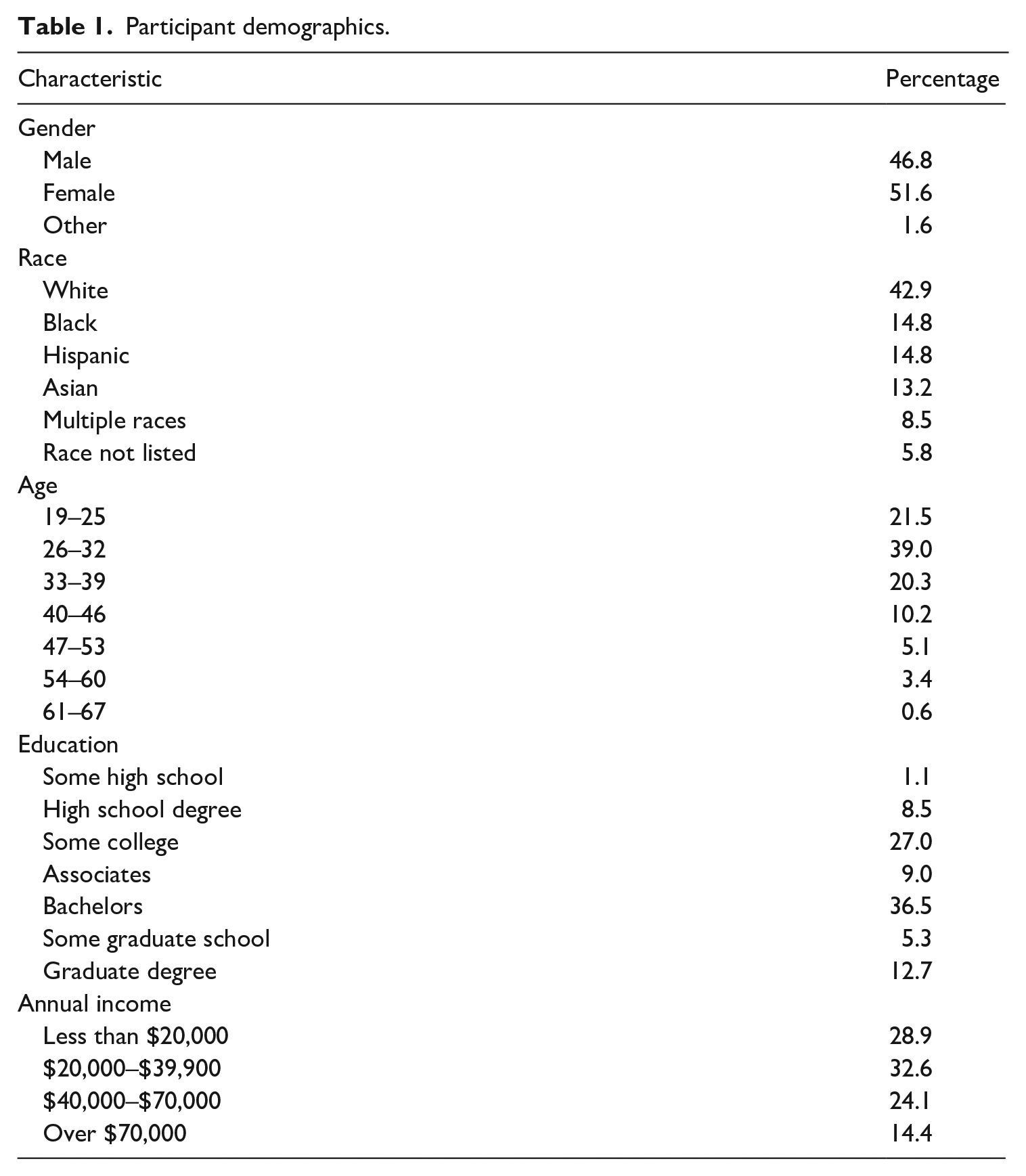
Slightly more than half of the respondents (51.6%) were women, 46.8% were men, and 1.6% were another gender. Under half (42.9%) identified as white, 14.8% as Black, 14.8% as Hispanic, 13.2% as Asian, 8.5% as multiple races, and 5.8% as a race not listed. The interviewees ranged in age from 19 to 64 years with an average age of 33. Just over a third of respondents (36.5%) held a Bachelor’s degree, 9% held an Associate’s degree, and 27% had some college experience. Eighteen percent of respondents held a graduate degree or had some graduate school experience and 8.5% held a high school degree. Nearly two-thirds (61.5%) of interviewees made less than $40,000 per year (28.9% earning less than $20,000 per year), and about a quarter (24%) of interviewees made between $40,000 and $70,000 per year (Table 1).
Participant demographics.
All participants were asked to complete a demographic survey and participate in a respondent-directed interview (Weiss, 1995). The telephone interviews focused on open-ended questions: what workers were doing before the coronavirus and their income source(s) during the pandemic; their involvement with gig based or precarious work and the challenges they experienced working, looking for work, or seeking unemployment during the pandemic; and their perceptions of how platforms, clients, and/or employers were handling the pandemic.
Interviews were audio-recorded, transcribed, and analyzed using flexible coding (Deterding and Waters, 2018), an iterative coding method that is well suited for collaborative analysis of in-depth interviews. Respondents were assigned pseudonyms and offered a $25 gift card incentive.
Findings
Even before the novel coronavirus, roughly 70% of job seekers used online job sites such as Indeed, Monster, and Craigslist in order to find work (Gager et al., 2020). Many precarious workers mentioned using Craigslist, which offered opportunities for gainful employment, but could also be a dependable source for quick gig-based cash. In addition, before the pandemic, workers had more options for job hunting, including applying in person. As Ameera, a laid-off personal assistant, explained, before the pandemic, if you wanted to work in a restaurant, good chance that you could just walk in there and you could see if it’s legit or not. Or you could just talk to them up front, be like, ‘Hey, are you hiring? I want to work here. I’m looking for something,’ instead of now, where are you going to go?
The coronavirus pandemic, partnered with shutdown orders in New York that resulted in all nonessential businesses being closed, led to many precarious workers being furloughed or laid off, which increased worker reliance on online job boards and their exposure to scam jobs. Whereas Swidler suggests that “unsettled times” motivate individuals to “establish new styles or strategies of action” (Swidler, 1986: 278), we find that in the early months of the pandemic, jobseekers’ strategies continued to be constrained by the preexisting cultural logic of individualized risk. As a result, job seekers looking for work online during the pandemic built a repertoire of tools for scam detection, anticipating fraudulent job postings as just another hurdle of the job search. Isolated at home and facing a risk-filled job market online, these job seekers internalized responsibility for avoiding scams and unconsciously developed common understandings of how to protect themselves while job hunting.
A taxonomy of scam jobs
We define scam jobs, or fraudulent job postings, as falling into two categories: the Financial Mark and the Scapegoat. In the following section, we outline the types of scams that workers encounter and the types of detection strategies and red flags utilized in their scam detection repertoire.
The financial mark
Jobs in the Financial Mark category include online advertisements for jobs that do not exist, and where applications are used to scam members of the job-seeking public, often with a focus on bilking workers out of funds. Scams in this category include “credit score checks” that required applicants to complete online forms requesting sensitive information such as social security number and birthday. Mariah, 28, explained, I have had friends who have gotten emails about weird, what do they call them? Credit check jobs . . . “oh, we need to check your credit and then we will hire you if it’s high enough,” which makes no sense. Why does my credit matter if you need a receptionist?
The information-collecting focus of these credit checks job scams was especially apparent when Alya, 28, a recently laid-off grocery store clerk, tried to sidestep the requirement.
They were saying that they needed my numbers, the credit report. I was like, “Okay, well, I have my own credit app. I can send you a screenshot of what my actual score is, and I’ll just erase whatever else information is on there.” They’re like, “No, you have to use our link,” and then I was like, “No, I’m sorry. I don’t recognize your link and I’m not going to use it.”
Two other Financial Mark job scams included overpayment schemes and item purchase requests, both of which could lead to financial ruin. In the overpayment schemes, workers were told to buy items and were assured that they would be reimbursed through check, which would inevitably bounce and leave the worker financially responsible. In the item purchase requests, the reimbursement was not especially clear. For instance, Ashley, 30, noted, It’s a scam because it sounds way too good to be true, like . . . “I’m a realty investor, have a ton of money, can you buy kids toys?” But then they say I have to do a bank transfer from my account to their account . . . And that’s when I’m like, “Serious?”
The Scapegoat
In the Scapegoat scam, workers applied for a job where the activity itself turned out to be illegal or associated with illegal behavior. In many cases the job appeared legitimate based on the job ad, but soon took a turn. Two of the scams included in this typology included package fraud, where workers were asked to pick up or ship packages, and work-from-home check-printing. As Hidaya, 30, former Uber/Lyft driver explained, Somebody was offering a data entry job for $23 [per hour]. I applied and then I got back some response to click on some links. And then the link tells me that I would get paid $750 a week for 10 hours work. And I just had to pick up packages that would already be in someone else’s name. I was just like “no.” If you’re paying me $75 an hour, there’s something wrong with the packages.
While workers often assumed that the packages had drugs or other contraband, stolen items are equally likely. The USPS (2019) identifies package pick-up jobs as part of reshipping scam whereby goods purchased online with a stolen credit card are delivered to an address in the United States, but then are repackaged and reshipped to an international address, making it harder to track and retrieve the stolen merchandise.
Likewise, twenty-something Ameera thought that she was well on her way to a good job, until I got to the end where the guy was basically like, “Oh, it’s a payroll company in Canada. We’re going to pay you through PayPal. We’re going to send you all the supplies . . . you’re going to print all the payroll checks.” I was like, ‘I’m not doing this.’
Check printing jobs may involve stolen or fraudulent checks, and directions to cash a large check and forward on the overpayment (Zimmerman, 2018). Or, workers are used as “money mules” in schemes where they are asked to transfer a payment to their checking account, then forward a portion of the funds (Popper, 2020).
In addition to scam jobs that tried to recruit workers to participate in illegal activities, workers found that some of the jobs that appeared to be reputable were just sex work recruitment tools. While seeking a remote position, Alya found a nanny job that seemed desirable until she spoke to the client a bit more. Then her views changed, and she realized they “want you as a personal slave, I guess, just to hook up with . . . They say, ‘Oh, it’s a live-in position. It would pay so well,’ but no, thank you. . . It was a prostitution thing.”
Aretha, 52, a former TaskRabbit, found that one scammer kept changing the content of his advertisement. She applied for one particular scam job several times, each time thinking she was applying for a legitimate job. “But it’s been the same man calling me back asking me if I’d like to watch porn. . .,” she said.
Me, I’m like, “Do you want me to review porn?” . . . I don’t have a problem watching it and giving you a review, to be honest with you, because of the situation. “No, we will be watching it by Zoom together.” “No. Goodbye . . .” That’s not what the ad said at all. Three times with the same person.
Scam detection repertoire: “Nope, that’s a red flag.”
Drawing on Swidler’s concepts of the cultural tool kit and cultural logic, we find that during the first months of the pandemic in New York, a period of extreme uncertainty, workers defaulted to the focus on personal responsibility that is inherent in insecurity culture. In contrast to Swidler’s suggestion that “unsettled times” motivate individuals to “establish new styles or strategies of action” (Swidler, 1986: 278), we find that in the early months of the pandemic, jobseekers’ strategies remained constrained by the pre-existing cultural logic of individualized risk. As part of their repertoire of scam detection, workers strove to identify scam jobs by identifying red flags in job descriptions, such as jobs that seemed “too good to be true,” or applications that required too many steps.
While workers encountered fraudulent job advertisements before the pandemic, as Alya noted, the red flags “were a little bit more obvious” before the pandemic. She explained, I feel like most of the time when most legit businesses post ads, they usually spell-check and things like that, so if there’s a crazy spelling error, I just take it as the scammers kind of telling you, “Look, hey, I’m a scammer, and if you do this, you’re an idiot.” So, I just wouldn’t respond to the ads that have the crazy spelling errors.
Experienced online job seekers were also quick to identify requests for personal information as a red flag. Diamond, 27, a self-described “Craigslist queen,” because of her ability to “figure out which [postings] are scams and which ones are legit,” identified a number of forms of personal information requested by scammers.
In the ad, they’ll say, “Give me your name. What’s your gender? What’s your age? Also send me some form of ID so I can verify your age.” Like you gotta be kidding me. You want a driver’s license and I don’t even know who you are and you’re going to have my face, my date of birth, all these things that you can use to then fish around for my identity in the dark web and use it against me? No, absolutely not . . . Some of the jury duty ones said, “You have to send me a driver’s license so I know you’re a California state resident to be considered and also send . . .” it was weird. It asked for your social security too, which was strange. I was like, “Nope, that’s a red flag.” Diamond, 27, physical therapist and gig worker
While these general red flags remained helpful, during the pandemic workers expanded their scam detection repertoires to identify two additional red flags: jobs that seemed “too good to be true” and employers who seemed too persistent, repeatedly messaging the job seeker with unrelated questions or sending a series of links. The too good to be true jobs offered high pay and employer-provided training, a benefit that has largely been phased out of even white-collar positions (Kalleberg, 2018). For instance, 19-year-old Anna, a modeling gig worker and college student, explained, “There’s a lot of really sketchy [ads] where it’s like, “No experience or training needed. We’ll train you, and you’ll earn $3000 a month.” . . . A lot of the advertisements that sound like that, are just big red flags to me.
For Daayini, 52, who had fallen for a scam during an earlier period of unemployment that cost her thousands of dollars in cell phone charges, “I’m very cautious whenever somebody says you can make $300, $400 in an hour, 30 minutes. I don’t even bother to open those.”
Another pandemic specific red flag was if the potential employer asked too many questions, or kept adding steps to the interview process. As Alejandra, a former restaurant worker, explained, They’re asking you so many questions, and the questions don’t go anywhere, it means that it is fake. Otherwise it will be some kind of action. If you are telling me, “Oh, can you open an account in Google and use that to ask me more questions?” The job should be “open an account” and you should pay me for that. If there is more behind that, it’s a scam.
It should be noted that scam jobs often involved numerous red flags. For instance, Ameera, applied for a mail clerk job that was offering $25 an hour and that seemed legitimate and low risk.
They keep emailing me. Basically they’re saying, “Oh, we like you for the position. We love your resume,” this and that. “We just need to know your credit score. You just need to file out this form.” I was like, “That makes no sense.” No job is going to ask you for your credit score and tell you to click on this link, and when you click on the link . . . I clicked on a link because I just wanted to see what it was. It was basically another form . . . that basically says, “Oh, 10 hours a week, $550 cash, and all you have to do is pick up their packages from the post office. They’re already paid for.”
The constant emailing, partnered with the request for credit score information and the switch to a package pick-up job all served as red flags to convince her that she had accidentally applied for a job scam (Table 2).
Typology of scams, “red flag” detection strategies, and immediate worker protective strategies.
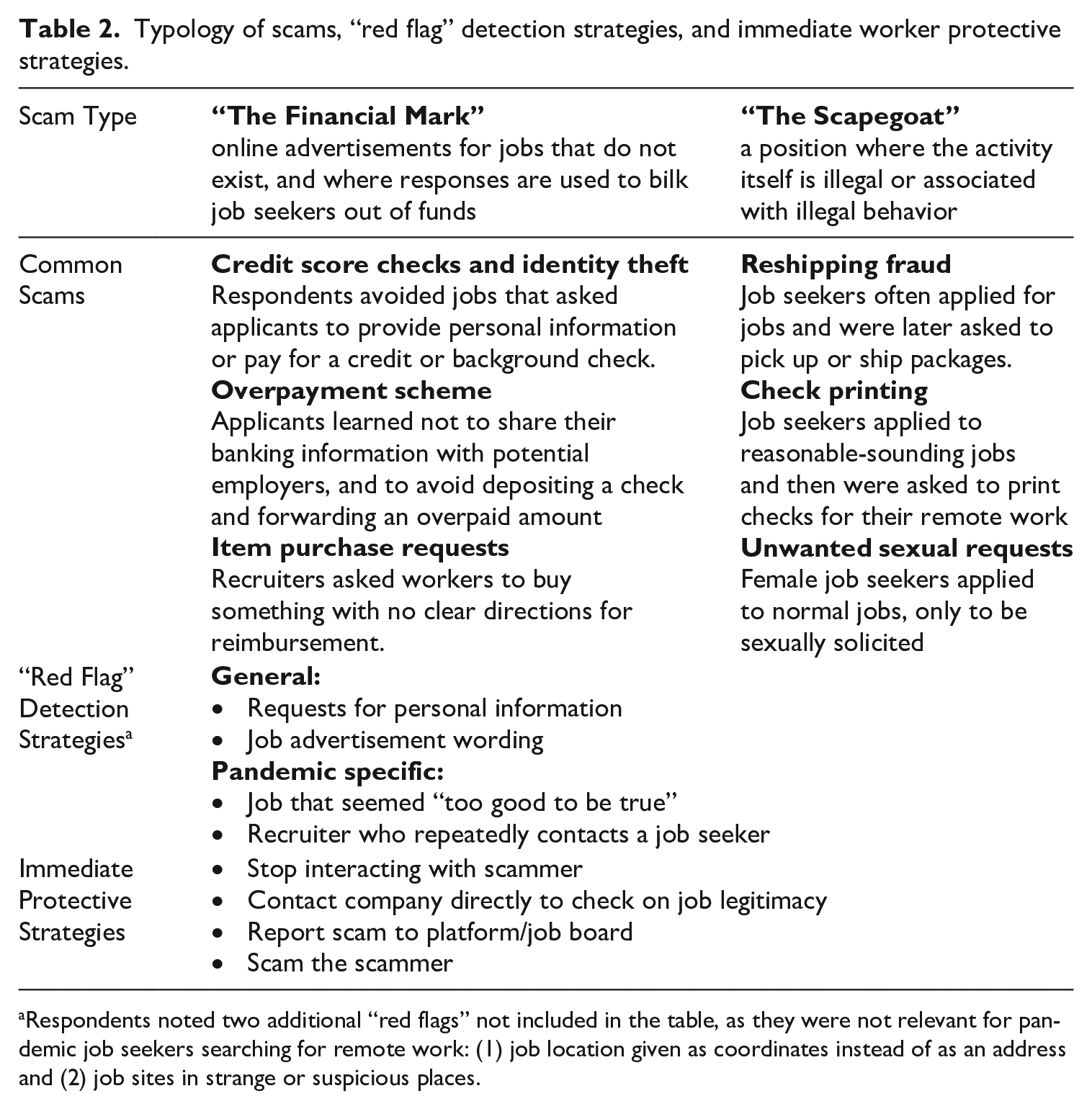
Respondents noted two additional “red flags” not included in the table, as they were not relevant for pandemic job seekers searching for remote work: (1) job location given as coordinates instead of as an address and (2) job sites in strange or suspicious places.
Following the cultural logic of personal responsibility, job seekers did not demand accountability from the websites hosting fraudulent advertisements, but instead took personal initiative to avoid the scams. As a result, they developed a scam detection repertoire influenced by the current cultural moment and the limited lines of action for finding safe work. As part of this focus on personal responsibility, workers were also quick to differentiate themselves—as smart scam-avoiders—from others. As Vilma, 59, explained, If they ask you for money, it’s not legit, it’s a scam. So you’ve got to watch out for people like that. Because now they’re taking advantage of what’s going on to do that to people. And some people want a job and they’ll just pay it. But I’m not going to do it because I already know what’s going on.
Likewise, Aretha, 52, explained, “I’m just thankful that I’m smart enough to see through them and hopefully I’m not going to get caught up by any of them . . .”
Risk internalization: self-blame for near misses
While most workers said they had avoided the fraudulent postings by identifying red flags, or had discovered the scam job before becoming too involved, one worker we interviewed came exceptionally close to becoming a victim of a pandemic job scam. A friend emailed Ashley, 30, an unemployed dancer and dance teacher, an advertisement to record online dance classes for $250 per class, three times a week. As she explained, “I was like, ‘That’s an insane amount of money for like an hour of teaching and would definitely equal what I’m getting from unemployment.’ So it would take me off unemployment in a viable way.”
Ashley applied for the job with a cover letter and resume, and the company expressed enthusiasm for her application and forwarded a dancer release. She followed up with a series of questions about how payments would be handled, the tax forms necessary, and how to upload the video files. “The only contract I got was basically like, ‘We have the right to your image . . .’” she said, but she brushed it off, noting, “I’m supposed to be looking for work. It’s been so hard to do. This is the first thing I’ve seen that feels viable.”
She did not feel like the client answered her questions, but she sent in her measurements for the stylists to pick out her clothes for the video. And then the company sent her a check for $3,600 and directions to cash the check, keep her payment for two classes, and forward the rest to her stylist. “In retrospect, I’m like, ‘that’s insane. That makes no sense,’” she said. “But at the moment I was like, ‘okay, that seems like a lot of steps, but like I need a job.’”
Her credit union flagged the deposit as potential fraud and called her to explain the scam and how to handle the scammer. A few days later the check bounced as expected, but Ashley hadn’t sent on the “excess” payment, and narrowly avoided losing thousands of dollars. As she explains, “$3,100 is a lot of money to just lose accidentally because somebody posted on Playbill that they were looking for teachers.”
As part of this internalization of risk, Ashley blames herself for the near miss. In her recollection of the event, she emphasizes the warning signs that she had missed, not the signs Playbill should have caught before allowing the fraudulent job to be posted. Though she recognized the collective threat of fraudulent job advertisements to her community of fellow dance teachers and performers, she took responsibility for nearly falling for the scam herself; additionally, she only reported the ad after learning that others almost fell for the fraud. However, as Ashley’s reporting of the fraudulent ad on Playbill shows, worker agency is not limited to actively avoiding red flags, but also includes reporting scams and—in some cases—actively fighting back.
Fighting back: “I’m not an idiot . . .”
When their efforts to avoid scams were not successful and they encountered fraudulent job postings, most workers we interviewed stopped their interaction with the scammer. But on occasion, when workers discover they have applied for a scam job, they attempt to figure out what happened. Monika, 41, a former restaurant server, tried applying for jobs online, but encountered “a lot of scammers.” She found one job that seemed promising: there was a company email address and the ad included the company logo, a strategy sometimes used when scammers attempt to appear legitimate (Krebs, 2008). But when she applied, Monika said the recruiter wanted to send her money to buy a printer and special printing paper so she could begin training for the job. As she explained, it just sounded so fishy that I Googled the company and I emailed the company, and they were like, “No, no, no. This is not us. This is a scam. Can you please send us, I don’t know, the job ad so we can remove it from Craigslist?”
Rachel, 31, a TaskRabbit assistant, was not actively searching for platform work when she encountered two scams. 1 One task asked her to purchase an item and get reimbursed, which she quickly rejected as a scam. But the second task caught her attention.
The task was, “Need help organizing a business plan,” and it was in Brooklyn. From the very beginning, I needed to know more about the task. That’s very common, that people just write a tiny, little description, can’t be bothered . . . He needed help doing a business plan, developing an idea around mask fashion, and then his next text was, “need a woman’s finesse.” As soon as he said woman, I knew it was . . . I’m not an idiot . . . He was so obvious. It was so bad . . . You know? I go, “How long would this task be?” He said, “Probably a few hours. As a thank you, I can do some online shopping for you . . .” That’s the common thing that happens online with, I don’t know, I guess cam girls, and they’ll have an Amazon list . . . I’m very out of the loop with this stuff, but it’s the oldest profession . . . Just the intensity [that] this guy really wanted me to get to his apartment was alarming.
Describing herself as a big fan of Chris Hansen’s How To Catch a Predator, a reality television show about undercover sting operations targeting potential sexual predators, Rachel accepted the job. The client began texting her almost immediately, asking her to come over and offering to send an Uber for her. She demurred, insisting that she could get her own Uber and asking for $150 via Venmo upfront. “I felt like a cam girl, like I was trying to think like that,” she explained. Money in hand, along with screenshots of the conversation, she reported the client to TaskRabbit.
Rachel’s experience also highlights an additional issue associated with Swidler’s work on the deployment of cultural repertoires during a period of extreme uncertainty. While jobseekers’ strategies were constrained by the preexisting cultural logic of individualized risk, scams provoked multiple and often contradictory responses depending on how individuals chose to deploy scam detection repertoires. While Rachel scammed her scammer, and Ashley the dance teacher reported her scammer, the internalization of the personal responsibility that is inherent in insecurity culture also affected workers’ longer-term protective measures.
The impact of job scams and long-term worker protective measures
While workers generally tried to protect themselves from job scams by disengaging with the scammer—with few notable exceptions—ongoing worker protective measures also impacted job-seeking efforts. Some workers simply applied for more jobs, arguing that it was a numbers game. For instance, before the pandemic, Ameera screened jobs by the necessary qualifications, but, “I just apply to anything now. It’s just . . . this is crazy because so many of them are scams.” Likewise, Kayla reported, I have sent so many emails I lost count. I have tried everything, because I haven’t anything better to do. I have been applying to everything. Every email that I get either is a scam or I don’t qualify for it.
However, for most workers, the sheer ubiquity of fraudulent job listings meant that workers continually ran the risk of being ensnared in one, and affected workers’ willingness to continue job searching. Mariah, a food delivery worker, was applying to five or six jobs a day back in May, but soon felt discouraged. “Now it’s just slowed down because after I got so many fake responses it killed the vibe . . .” she said. “ I feel like oh, I made the effort and watch, tomorrow, they’ll give me some other email with some nonsense.” Likewise, Alya tried for a few jobs, but after receiving “strange emails” and other “weird stuff,” she “just kind of gave up.”
In addition to admitting defeat and no longer looking for a job, workers also run the risk of becoming hyperconscious of requests from potential employers. Monika, the former restaurant worker who reached out to a company about the fraudulent use of their logo on a scam advertisement, said she was nervous when companies “ask me about my personal information. Because I don’t know if they want to just steal my personal information.” It’s interesting to note here that two of the red flags identified by Diamond, the self-described “Craigslist queen,” involved being asked for a copy of her state identification, and social security number and birthday—three forms of identification that can be used by scammers, but that are also necessary for a W-2 job. The risk, of course, is that continual interaction with scam jobs may lead to heightened sensitivity to the risk of scam jobs and lead workers to reject overtures from employers offering legitimate jobs.
Conclusion
The ability to work remotely has been crucial to reducing the spread of COVID-19; however, this opportunity has been generally limited to white-collar workers in stable jobs. For precarious workers, online advertisements promising the opportunity to “work from home” are often scams, further contributing to the “good job”/“bad job” dichotomy (Kalleberg, 2009). During the pandemic, the high unemployment rate, combined with an increase in online job scams, leaves workers especially vulnerable to website postings that promise the stable wages and safe working conditions of a “good job.” We ask, how do precarious workers conceptualize the risks of scam jobs while job searching online, and how do they identify, avoid, and protect themselves from potential scams?
Using interviews with 192 precarious or gig-based workers, conducted during the height of the pandemic in New York, we find that workers regularly encountered fraudulent job advertisements via digital media. Drawing on Swidler’s (1986) concepts of the cultural tool kit and cultural logic, we find that in this time of uncertainty, workers defaulted to the focus on personal responsibility that is inherent in insecurity culture. Following the cultural logic of personal responsibility, job seekers did not place blame on job search websites for allowing the scams to be posted, but developed a repertoire of scam detection strategies that included identifying red flags and recognizing common scams. While workers are agentic in identifying red flags, and fighting back, such efforts further reproduce a system that allows fraudulent advertisements to be posted on job boards with little oversight from the platforms profiting from paid postings. In an effort to protect themselves, workers changed their job search efforts, with most reporting an increase in efforts to filter out scam jobs and applying to fewer job postings. Allowing job posting websites to avoid responsibility for fraudulent advertisements further contributes to the “risk shift” (Hacker, 2008) from corporations to workers.
This article expands on the existing scholarship on platform labor by examining the consequences of digitally mediated job matching processes on precarious workers and contributes to our understanding of digital media and job-hunting. This article also contributes to the growing literature on the prevalence—and implications—of scams, frauds, and fakes online, and how Internet users conceptualize such risks and seek to protect themselves. Our research provides a novel use of Swidler’s tool kit and suggests that in contrast to Swidler’s (1986) suggestion that while unsettled times may lead to “new styles or strategies of action” in the early months of the pandemic, jobseekers’ strategies remained constrained by the preexisting cultural logic of individualized risk (p. 278). Prevailing ideology is resilient because it appears to objectively define how the world works and prescribe appropriate action (Martin and Desmond, 2010).
Our research also raises issues regarding the connection between gender and scam jobs. While our sample was roughly half female, most of the examples of scam jobs were provided by women. We believe that this issue is multifaceted: scammers have been targeting anyone who is seeking flexible work that could be done at home or around care work responsibilities, which due to school and daycare closures is more likely to include women; increasing “masculinity risk” in the early pandemic, and occupational sex segregation. Men tend to take on jobs that are more physically risky (Stergiou-Kita et al., 2015) and seem to have been more likely to continue to search for work in person. Women who reported scams were often applying to traditional feminine work that could be done remotely such as data entry.
The prevalence of scams targeting women for sex work also raises questions about the vulnerability of female jobseekers online. Historically, women have been feminized and constructed as consumers on the Internet (van Doorn and van Zoonen, 2009), and women are especially likely to face online harassment, sexual, and otherwise, because of the gendered construction of the Internet as a masculine public sphere (Megarry, 2014). This dynamic coincides with the growing frequency of online recruitment for sex work (Jones, 2015). As sex work is increasingly performed by a “flexible, deskilled, and itinerant workforce” (Berg and Penley, 2016: 163), further research should examine how precarity heightens women’s risks of unwanted involvement in sexual labor.
As the economic fall-out of the coronavirus continues, it is likely that more and more workers will find themselves searching for work online—and exposed to scam jobs. Job listing websites would be well advised to increase their monitoring of the situation, to increase efforts to prevent such postings, and to take decisive action against fraudulent listings. Additional research is needed to study the longer-term implications of this rise in online job scams, and how such an increase affects worker perceptions regarding the utility of job search sites and the likelihood of obtaining a job—or being ensnared in a scam.
Footnotes
Authors’ note
All authors have agreed to the submission and this article is not currently being considered for publication by any other print or electronic journal.
Funding
The author(s) disclosed receipt of the following financial support for the research, authorship, and/or publication of this article: This material is based upon work supported by the National Science Foundation under Grant No. 2029924.
