



Abstract
People regularly use and discuss media content with others, such as partners, family, and friends. Such conversations increasingly occur virtually. However, few studies have examined the content and characteristics of mobile messenger communication about media content. We conducted a qualitative content analysis of 128 messenger chats about media content donated by 49 diverse groups. Based on the theoretical concept of group information processing, our analysis revealed six main collective functions of such conversations: (1) discourse, (2) shared emotions, (3) support, (4) joint activities, (5) group positivity, and (6) group identity. We show how these functions are associated with the affordances of messenger communication, group characteristics, and types of media content. Ruptures in the group process occurred only occasionally and were usually followed up by repair attempts. Our research demonstrates that messenger communication about media content not only serves as a substitute for face-to-face conversations but rather complements and enriches them.
Keywords
Media use and processing of media content are usually conceptualized as individual processes. The social reality of media use is quite companionable, however. In 2018, almost half of all video viewing time in the United States was spent with others like partners, family, or friends (GfK, 2019). After media use, people regularly discuss the content with their social circle (Gehrau, 2019). Various studies have shown that this social dimension of media use affects how individuals process media information (Cohen, 2017), leading to different outcomes, for example, on affective attitudes and behaviors related to politics (e.g. Sommer, 2013) and health (Jeong and Bae, 2018).
Most previous research on the collective processing of media content has focused on face-to-face settings such as co-viewing and physical conversations (e.g. Friemel, 2010; Klemm, 2000; Podschuweit, 2019). Increasingly, however, communication about media content occurs virtually, especially via mobile instant messengers. 25 to 35% of instant messenger users in Germany, Italy, and the United Kingdom in 2015 reported publishing and discussing political messages there (Valeriani and Vaccari, 2018). Also, 85% of Internet users worldwide practice second-screening (Mander et al., 2019), meaning that they use “another device [. . .] to text, go online, or use social media in a complementary manner to what is being watched on television” (Nee and Barker, 2020: 3). Second screening is often used to exchange with friends (Mander et al., 2019), especially by younger viewers who regularly text with others about media content (Nee and Barker, 2020).
To date, virtual conversations about media content during and after exposure have mainly been studied on (semi-)public social media platforms (e.g. Haridakis and Hanson, 2009; Selva, 2016; Weber, 2014). Few studies have examined the content and characteristics of private conversations about media content via mobile instant messaging services, usually with a focus on specific media types (e.g. news; Swart et al., 2019), topics (e.g. Covid-19; Wagner and Reifegerste, 2023), and contexts (e.g. young adults; Nee and Barker, 2020; weak ties; Swart et al., 2019). To further elucidate the general nature and functions of such conversations, we conducted a qualitative content analysis of 128 donated messenger chats with a special focus on collective functions of the joint cognitive and affective processing of media content.
Theoretical background
We begin by introducing three theoretical conceptualizations that informed our analysis of messenger conversations about media content. First, we use the concept of affordances to account for the specific conditions of messenger communication in contrast to face-to-face communication. Second, we conceptualize conversations as a form of collective information processing. Third, we focus on collective functions of mediated communication about media content to foreground the holistic nature of such conversations as a group phenomenon that serves as a prerequisite to fulfilling individual functions. Based on an overview of previous research, we then develop four research questions that guided our analysis of collective functions of messenger chats on media content (RQ 1) and how these functions are related to affordances (RQ 2), group characteristics (RQ 3), and types of media content discussed (RQ 4).
Affordances of messenger- versus face-to-face communication
Different communication channels come with different affordances, that is, functional attributes that shape their uses, experiences, and effects. Affordances depend on users’ perceptions and may change with media environments (Fox and McEwan, 2017). To better understand the general affordances of messenger communication on media content, we compare them with affordances from face-to-face communication.
Compared with face-to-face conversations, messenger conversations have lower bandwidth and can, thus, transmit fewer social cues. They also enable less synchronicity in the form of direct turn-taking. Consequently, users sense less social presence, that is, closeness and shared experiences, when texting instead of talking. At the same time, messenger chats have more accessibility than physical conversations, meaning that users can connect across time and space. They allow for more editability to optimize messages before sharing and feature higher persistence as conversations are saved for later access (for an overview, see Fox and McEwan, 2017).
We add shareability as an additional affordance of particular relevance for messaging about media content. The ability to directly integrate media content within a message makes it easier to create a shared focus of attention on the content as a basis for conversations about it. Moreover, shareability of media content (e.g. in the form of text, images, videos, and hyperlinks) can also serve as a form of anchorage (Cavalcante and Hanke, 2020), whereby groups establish thematic frames for their collective information processing.
It is important to note, however that affordances can vary depending on technology, situations, and usage practices. Through features like emojis, gifs, videos, and voice messages, messenger communication may acquire a broader bandwidth and transport as much or even more information than physical conversations (e.g. Miltner and Highfield, 2017). As messaging is accessible at any time and place, it may also lead to a more global form of synchronicity and social presence (Knop-Huelss et al., 2018). Less bandwidth and more editability may promote a focus on connecting and harmonious aspects of a relationship (e.g. Jiang and Hancock, 2013).
In sum, messenger chats are not generally inferior to face-to-face conversations but have context-specific strengths and weaknesses. In everyday life, both modes are not opposed to each other but can serve complementary communication purposes (McEwan, 2021). For our analysis, we, thus, keep the general affordances of messenger communication in mind but also consider their flexibility and context-dependency.
Communication as collective information processing
Conversations unfold through the collaboration of two or more individuals. To account for their inherently social nature, we observe messenger chats through the theoretical lens of group information processing (Hinsz et al., 1997) and include dyads as a special case of groups (Williams, 2010).
Based on extensive results of small-group research, Hinsz et al. (1997) have argued that groups can function as self-contained information processing units. As a basis, they need a certain degree of social sharedness, that is, states and processes that are shared among group members. Social sharedness can include information, motives, attitudes, norms, identities, and cognitive processes (Tindale and Kameda, 2000), as well as emotions (Hinsz and Bui, 2023). Building on pre-existing elements of social sharedness, groups can then perform combinations of contributions, that is, identify relevant contributions of their members and interactively combine them at the group level. For example, such contributions can be resources, skills, or knowledge of individuals, which can be combined by aggregating, linking, and transforming.
Group information processing resembles individual information processing in that it includes objectives, attention, encoding, storage, retrieval, processing, responses, and feedback (Hinsz et al., 1997). At the same time, however, group information processing exceeds the sum of its parts as it emerges from collaboration. It is shaped by internal social influences such as group norms, majorities, and leaders. These social influences can be viewed as inherent elements of group processes that serve the group’s needs, for example, by maintaining the group’s identity, unity, and functionality (Hinsz et al., 1997; Hogg et al., 2004; Tindale and Kameda, 2000). In line with these procedural differences, experimental comparisons have shown that groups process information with different outcomes than individuals (e.g. Kerr and Tindale, 2004). Consequently, we consider messenger conversations as a form of collective information processing and groups as our unit of analysis, offering a holistic understanding of messaging about media content.
Collective functions of conversations on media content
Group communication involves different types of processes (e.g. message production, message processing, interaction coordination, social perception; Burleson, 2010) and interactions (e.g. questions and answers; Bales, 1950), which occur at multiple levels (e.g. individual members, the group, and the environment; McGrath, 1991). With this broader context in mind, the focus of our analysis is on collective goals and functions.
By collective functions, we mean “goals that in some way focus on, include, or require the participation of others” (“social goals”; Burleson, 2010: 152) and, thus, involve social sharedness and combinations of contributions. Collective functions refer to situations in which the group serves itself or serves a group member and vice versa (e.g. group well-being and member-support functions; McGrath, 1991). Following Burleson’s (2010) conceptualization, collective functions include relationship management (initiation, maintenance, and repair of relationships) and instrumental functions (e.g. seeking or providing information, support, or amusement). As explained above, socially shared individual motives are a prerequisite for collective processes, and they are actively co-created, maintained, and deepened through collective processing (Hinsz et al., 1997). At the same time, group processes go beyond individual processes. Therefore, a holistic group-level perspective may unveil new and genuine collective functions that remain unobserved when focusing solely on the individual level.
Research on social functions of virtual conversations about media content is only beginning to emerge (Nee and Barker, 2020; Swart et al., 2019; Wagner and Reifegerste, 2023). Therefore, we complement our literature review with work on traditional face-to-face settings (Friemel, 2010; Klemm, 2000; Podschuweit, 2019; Wagner and Reifegerste, 2023). We also consider research on individual-level functions fulfilled by group communication (Friemel, 2010; Nee and Barker, 2020; Podschuweit, 2019; Wagner and Reifegerste, 2023) to analyze how individual functions relate to the emerging knowledge on collective functions (Klemm, 2000; Swart et al., 2019).
Abstracting from the different terminologies employed, previous studies imply a recurring pattern of individual and collective functions of conversations about media content. These functions appear similar across face-to-face and messenger settings, different media (e.g. online news, TV), and topics (e.g. politics, entertainment). First, studies point to a discursive function when groups discuss facts and opinions. From an individual perspective, this encompasses activities like mutual information, persuasion (Friemel, 2010; Podschuweit, 2021), and information validation (Wagner and Reifegerste, 2023). From a collective perspective, discursive functions involve joint evaluation of content (Klemm, 2000) and joint deliberation of news (Swart et al., 2019). Second, an emotional function was observed when group members express or manage their emotions together—as implied in individual functions like affective processing (Friemel, 2010), coping with emotions (Wagner and Reifegerste, 2023), entertainment (Nee and Barker, 2020), and collective functions such as creating a pleasurable atmosphere (Klemm, 2000), and sharing satire or gossip (Swart et al., 2019). Third, a practical support function was observed in individual-level studies when group members assist each other in getting information—for example, regarding media selection (Friemel, 2010), understanding of content (Podschuweit, 2021), or sharing of information related to their everyday life, profession, and other media content (Nee and Barker, 2020; Swart et al., 2019; Wagner and Reifegerste, 2023). Cognitive support also emerged as a group function (Klemm, 2000). Fourth, group-level studies point to an identity function when groups and their members express their common ground and connection—as in the case of connecting content to their shared lifeworld (Klemm, 2000) and creating an atmosphere of intimacy and community (Klemm, 2000; Swart et al., 2019). In individual-level studies, this function was either absent or implicit in functions like social motives (Nee and Barker, 2020) or social positioning (Friemel, 2010).
Rationale and research questions
To summarize, a recurring pattern of individual and collective functions of conversations about media content can be observed across different communication channels, media, and topics including discursive, emotional, support, and identity functions. However, most of the research from which we derived these functions has analyzed face-to-face conversations (Friemel, 2010; Klemm, 2000; Podschuweit, 2019; Wagner and Reifegerste, 2023). Considering the different affordances discussed above, the precise functions of messenger conversations about media content may deviate from face-to-face conversations and may include novel and distinct aspects not previously observed.
In addition, most previous studies on conversations about media content focused on individual functions (Friemel, 2010; Nee and Barker, 2020; Podschuweit, 2021; Wagner and Reifegerste, 2023). We believe that examining collective functions can offer a promising complementary approach for further research. The functioning of a group serves as a prerequisite for the group’s ability to fulfill individual needs and motivations (Hinsz et al., 1997). Therefore, collective functions might even be considered the primary unit of analysis from which individual functions of group membership are derived. For example, the group’s capacity to create an atmosphere of shared positivity might explain its coping and entertainment functions for individual members.
So far, our insights on the collective functions of conversations about media content have largely been extrapolated from studies on individual functions and are, therefore, preliminary and open to further refinement. To cover a broad range of collective functions of everyday messaging about media content, including previously unobserved functions, we posed an exploratory research question:
RQ 1: What types of collective functions are performed in conversations about media content via instant messaging?
To better understand how collective functions are shaped by messenger affordances, we further asked:
RQ 2: Are the collective functions addressed in RQ 1 associated with specific ways to deal with messenger affordances?
To further contextualize collective functions concerning group characteristics and media content, we inquired:
RQ 3: Are the collective functions addressed in RQ 1 associated with specific group characteristics?
RQ 4: Are the collective functions addressed in RQ 1 associated with specific media content?
Method
To answer our research questions, we collected 128 sections of private messenger chats referring to publicly available media content. The chats were donated by 49 natural small groups and fully anonymized. We, thus, had the chance to explore non-reactive data, providing insight into diverse real-world messenger conversations. Consistent with our exploratory approach, we analyzed the chats via inductive category development.
Sample
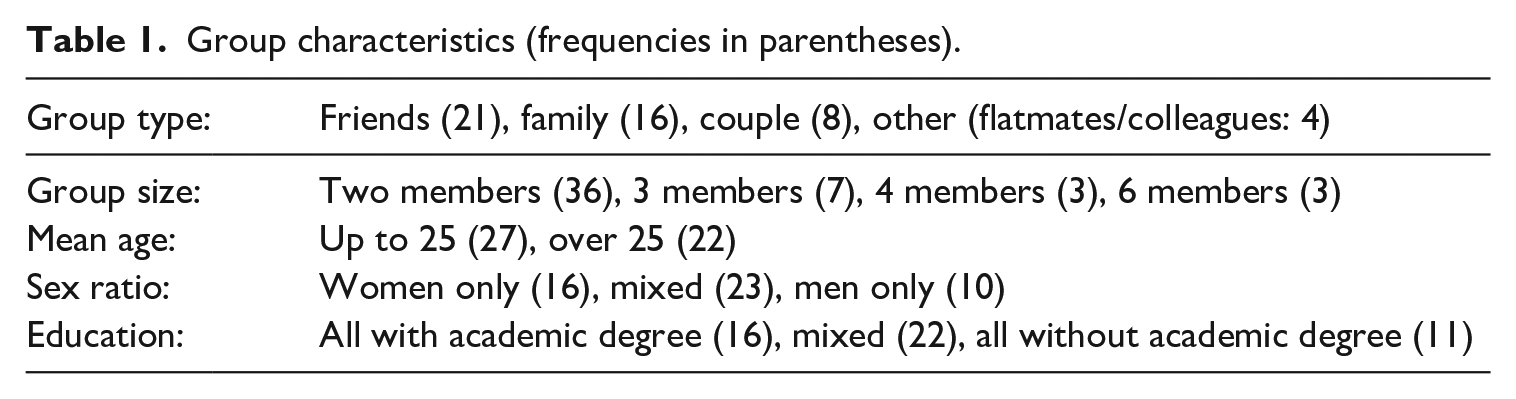
The final corpus consisted of 128 chats from 49 groups that donated 1 to 7 chats (M = 2.6). Each group had 2 to 6 members (M = 2.5). In total, the study involved 123 group members. In some cases, the same individuals belonged to several groups and were not identifiable due to anonymization. The groups represented typical and diverse contexts of messaging about media content. They were friends, family members, couples, flatmates, or colleagues. They also featured different compositions regarding age, gender, and formal education (see Table 1). The age of individual group members ranged from 18 to 83 (M = 31.2; SD = 15.2).
Group characteristics (frequencies in parentheses).
The chats occurred between 2018 and 2022, but mostly in 2021. Nearly three-quarters of the conversations were held via WhatsApp, followed by Instagram Messenger, iMessage, and Signal. About one in five chats happened synchronously with media consumption (see Table 2). In terms of content, the chats contained 161 references to media in various forms, such as hyperlinks, screenshots, or mentions (see Figure 1 for an overview). About three-quarters of media references served as conversation starters; the others were introduced later in the discussions. Media references covered a range of genres, but mostly news, Instagram posts/stories, memes, YouTube videos, and websites in general. While many chats mentioned traditional professional content such as journalism and entertainment, others also referenced user-generated satire, entertainment, and information. The references touched on various topics, most frequently everyday life (e.g. work, studies), COVID-19, celebrities and gossip, food (e.g. recipes), health, and the 2021 German federal elections.
Chats characteristics (frequencies in parentheses).

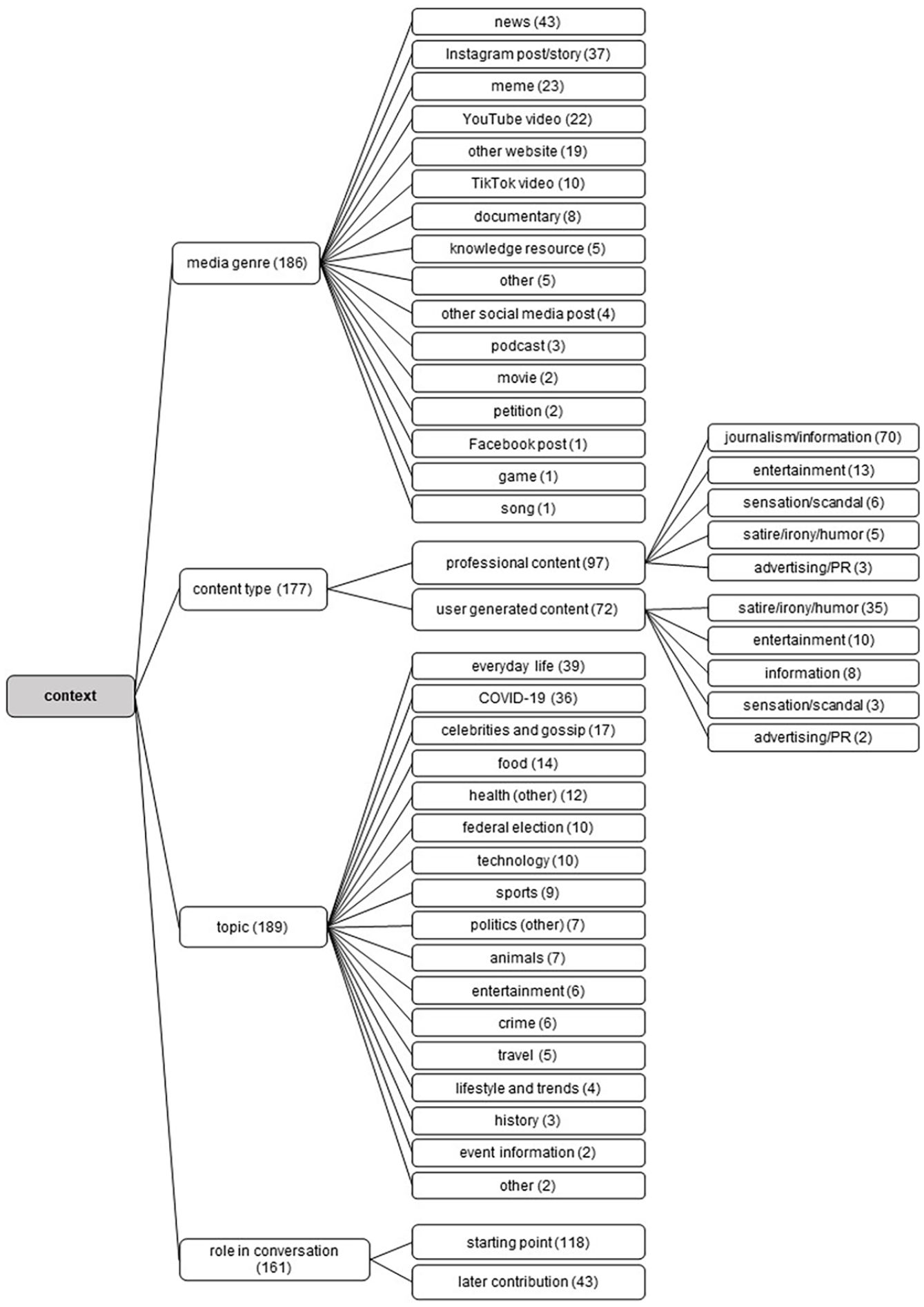
Contexts of the chats about media content.
Procedure
Our study obtained ethical approval from the Institutional Review Board (IRB) of the Department of Media and Communication at LMU Munich. The chats were collected between December 2021 and January 2022 in Germany. Groups were recruited through personal contacts by students of a research seminar. Each group member was informed about the study’s purpose and the data donation and anonymization process. Data collection was only started after all group members had given informed consent. Participants were asked to look for group chat sections about publicly available media content (including social media content, websites in general, or memes). Usually, participants quickly found suitable chat sections. If not, they were guided to check the media files of the chat history for media content and to search their chat for “http” to find hyperlinks. The segmentation of where chat sequences about media content begin and end was performed by those who donated the chats, thus reflecting the groups’ natural understanding of the anchorage of thematic frames (Cavalcante and Hanke, 2020). The students who had recruited the groups fully anonymized the chat sections and transferred them to a data donation platform created with SoSci Survey (Leiner, 2019). They also entered contextual data regarding the chat (platform, synchronicity, and year) and social demographics of group members. Anonymization involved replacing names, mobile numbers, time stamps, private images, and potentially personal data about locations or institutions. Voice messages were fully transcribed. To simplify data analysis, media files and hyperlinks to media content were substituted by short descriptions and context information. Following theoretical sampling principles (Bryman, 1988; Silverman, 2015), we included chat sections from diverse groups about diverse types of media content in our sample.
Inductive category development and analysis
We used MAXQDA 2022 for data analysis (VERBI Software, 2021). In line with our exploratory research design, we started analyzing the chats with a theoretically informed but flexible coding scheme of collective functions of messenger conversations about media content. As discussed above, we deductively derived four overarching categories of collective functions: discursive, emotional, support, and identity functions. These preliminary categories were further refined and expanded through inductive categories derived from the data. In addition, we openly coded contextual information on all media references in the chats, namely their genre, content type (professional or user-generated), topic, and role in the conversation (conversation starter or later contribution). We did not separately code ways of dealing with affordances but observed them in conjunction with the functions. Finally, ruptures in the group process and their repair emerged as additional inductive categories.
In an initial step of collective coding, we analyzed a selection of 40 chats from different groups until we arrived at a high level of consensus. We iteratively added, split up, and merged categories (Mayring, 2021) until new chats brought minimal change, indicating theoretical saturation in the sense that our categorization reached theoretical consistency and stability across diverse cases (Breckenridge and Jones, 2009). Then, we individually coded the remaining chats, documenting open questions for discussion and resolution within the author team. Figures 1 to 3 show the finalized category system. We report frequency counts of each category as a tentative indicator of typicality within the sample. To identify associations between functions and contextual categories, we conducted code relations analyses.
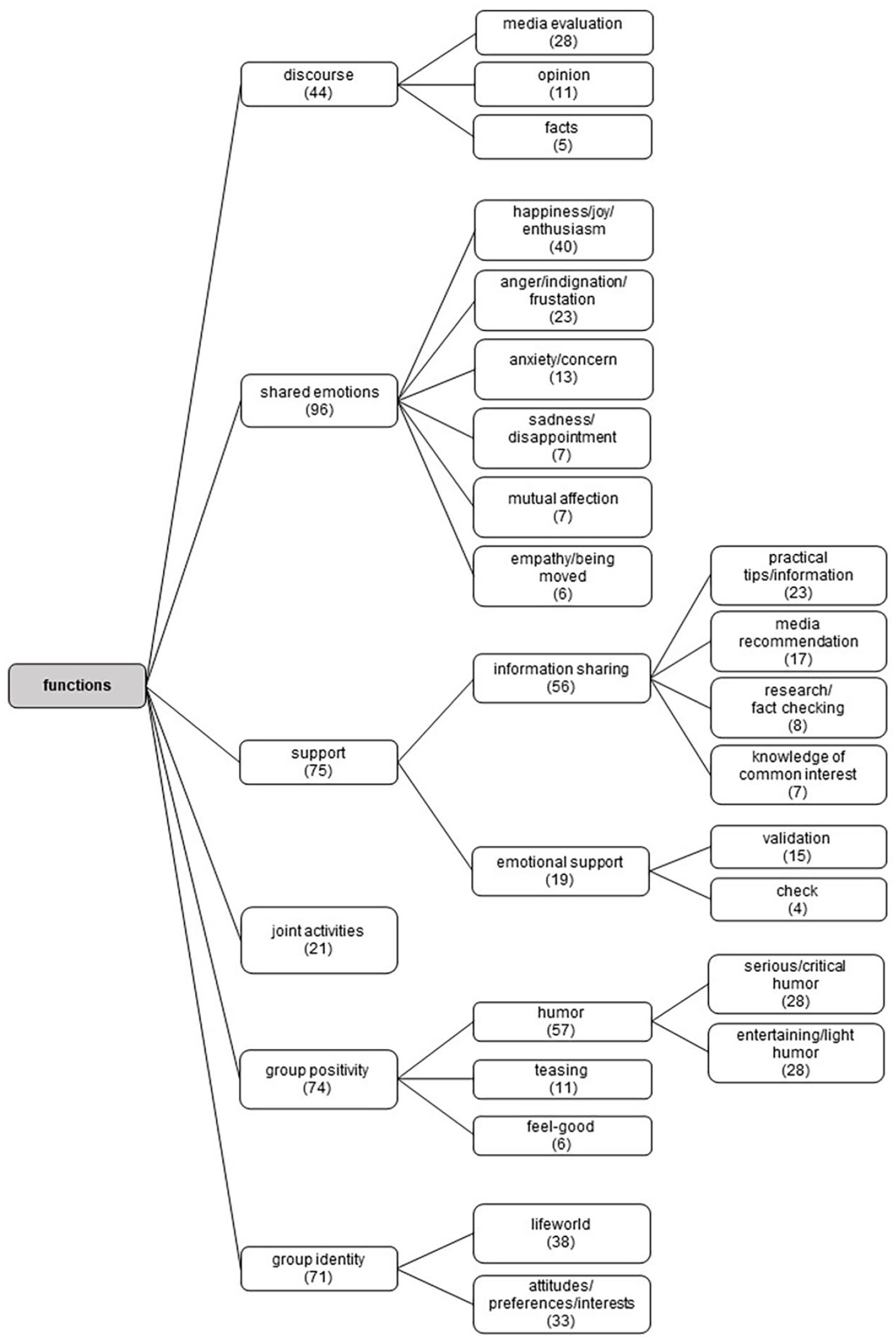
Collective functions of the chats about media content.
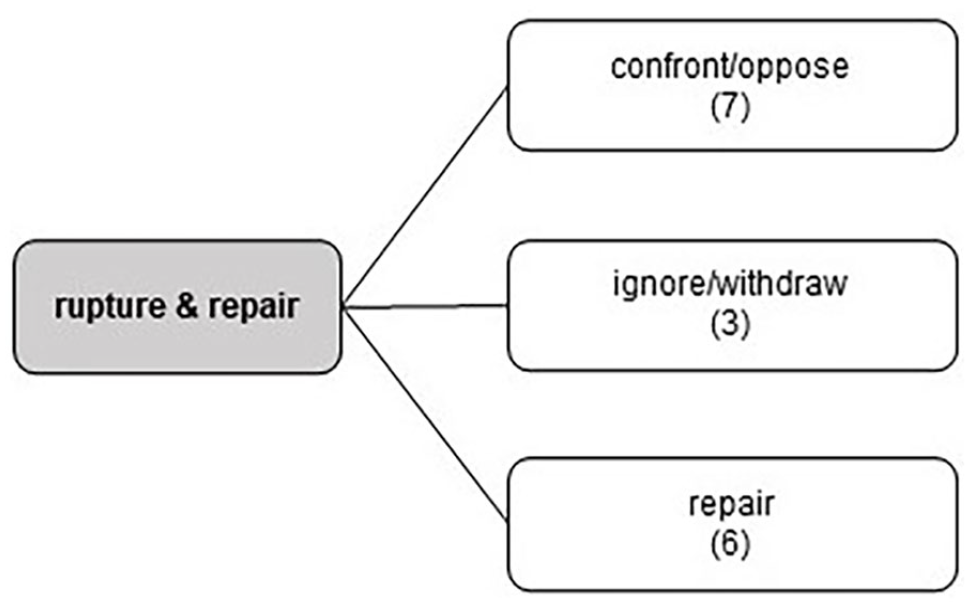
Irritations in the chats about media content.
Results
The results are structured along the main categories of collective functions of messenger conversations about media content (RQ 1). Our deductively derived categories distinguished between discourse, emotions, support, and identity functions of instant messaging about media content. They served as a starting point for inductive category development, which finally revealed six main categories with a total of 25 sub-categories: (1) discourse, (2) shared emotions, (3) support, (4) joint activities, (5) group positivity, and (6) group identity (see Figure 2 for an overview). During the coding process, the category “emotions” was divided up into “shared emotions,” “group positivity,” and “emotional support” as a sub-category of “support.” “Joint activities” was inductively derived as an additional category. Frequently, more than one function co-occurred in one chat.
The following descriptions of these collective functions are illustrated with translated chat sections, annotated with an identification number (ID) and explanatory notes in square brackets. For each main category of collective functions, we also address how groups dealt with specific messenger affordances (RQ 2). Two key affordances were salient in nearly all chats: First, messaging accessibility made conversations possible when participants were not physically present. Second, shareability made media content accessible as a conversation starter or later contribution to the conversation. In terms of anchorage (Cavalcante and Hanke, 2020), these findings suggest that groups routinely used messenger affordances to invoke thematic frames independently of physical co-presence and that shareability of media content served as a key affordance for opening thematic frames. Moreover, shareability and other affordances were associated with specific collective functions of messenger conversations as discussed below. In addition, we contextualize these functions with regard to group characteristics (RQ 3) and types of media content discussed in the chats (RQ 4).
Discourse
In about one-third of the chats, discourse about media content took place. Most of these conversations involved media evaluation. In this category, group members discussed how they liked or disliked the content and how it was portrayed.
*link* [Spotify podcast on the federal elections: “Cross-questioning Janine Wissler (the Left [party])”].
Good format
Janine I like as well to be honest
The one with Lindner [German politician] was also very good
Yes yes yes
I thought so too
[I.D.: 0605_C03]
Another subtype of discourse refers to opinions beyond positive/negative media evaluations. Group members exchanged their opinions and sometimes justified them with arguments. Some discussions also dealt with facts, and groups talked about the truth value of information.
*link* [Documentary by the Austrian private channel ServusTV titled “Corona—in search of the truth,” the documentary is criticized for misinformation].
YouTube is not an information channel [. . .]
Well, you don’t want to know if it’s all true. You just accept it
Who knows if it’s wrong?
No. I get information every day, information that is reliable and correct.
Ok. GREAT  [. . .]
Why is this on TV?
You want “it” to be wrong. You wouldn’t desperately accept lies otherwise. Leading researchers and medical doctors are not a source for you. But people who have no idea are. [. . .]
[I.D.: 0504_C01]
Regarding affordances, group members used emojis and sometimes voice messages to increase bandwidth and social presence during their discussions. Still, the conversations usually evolved asynchronously and were relatively short. At the same time, group members used shareability to contribute further media content to the ongoing group process. They sometimes developed elaborate arguments that may have involved editability. Most importantly, however, they benefited from the accessibility and persistence of messaging to carry out discussions that would not have taken place otherwise, as not all members were physically present and available when the topic of the conversation came up.
Compared to other group types, discourse occurred less in couples. It was mainly related to news but also to user-generated informational content. Political topics (e.g. COVID-19, federal elections) and soft topics (e.g. sports, celebrities) were equally prevalent.
Shared emotions
In roughly three-quarters of chats, the groups shared their feelings about media content and the situations portrayed. Mostly, they collectively expressed happiness/joy/enthusiasm or anger/indignation/frustration.
*link* [Instagram post of the account “everythingstudent” referring to online teaching because of Covid-19: “After this semester I don’t want to ever hear the word “zoom” again”].
True
The next one should probably be hybrid 
Oh no please not 
Said <name of professor> :/
As if LOL
Wow then everything is online again with us anyway 
Well with the current vaccination rate . . .
[I.D.: 1202_C03]
However, the range of emotions we observed was remarkably broad, including anxiety/concern, sadness/disappointment, mutual affection, and empathy/being moved.
*link* [Youtube video: “The Greatest Showman—“This Is Me” with Keala Settle—20th Century FOX”: The video is about the making of the movie song “This is Me” from the U.S. movie biopic “Greatest Showman.” The video shows an interview with the actors and excerpts from the rehearsals, in which they sing together so passionately that the leading actress is in tears]
Yoo, just got goosebumps ey
from the greatest showman the rehearsals
With the real actors

Oh wow how intense
Sadly I don’t know the movie hahaha but this is so awesome
hahah oh, yes it’s really intense
Woooow, I also got goosebumps at least 10 times
[I.D.: 0304_C01]
In this category, the groups used abbreviations (e.g. OMG, LOL), voice messages, emojis, and images (e.g. memes) for more bandwidth and social presence. Visual tools seemed particularly effective in transporting emotions concisely. Although the conversations were often not perfectly synchronous, accessibility and persistence enabled group members to share their emotions at the very moment they occurred and get feedback as soon as possible.
Shared emotions occurred in all types of groups but were especially prevalent among groups with partially or exclusively female members. Friends and younger groups tended to share more happiness/joy/enthusiasm. Furthermore, shared emotions were associated with news and user-generated satire/irony/humor on diverse topics, but mostly COVID-19 (in response to new developments and regulations) and everyday life.
Support
About half of the chats supported the group as a whole or individual group members through combinations of contributions. Most often, support occurred in the form of information sharing. Members shared practical tips/information, media recommendations, or further knowledge of common interest. Sometimes, group members also conducted fact-checking for other members or the whole group.
*link* [YouTube video that is no longer online. It is probably an interview with Biontech founder Ugur Sahin, which is supposed to prove that he did not want to be vaccinated with his own vaccine]
Has this been clarified in the meantime? Who can help me?
Of course, it could also be a fake ARD [public broadcaster] report. Who knows more? [. . .]
Hello <Cousin_02>, info about the interview: The juicy detail, however, that is being concealed in the dissemination of the video: The recording is from December 2020, when Biontech’s vaccine had just been approved. At that time, only medical staff, people in need of care and the very elderly over 80 were allowed to be vaccinated. Sahin was therefore not yet vaccinated for quite good reasons . . .
Well, that’s some information, thank you.
[I.D.: 0505_C03]
In addition, groups provided emotional support for their members. This category refers to cases where groups responded to typically negative or mixed emotional states of their members, triggered by media messages or reported events. Usually, the groups validated their members’ feelings by acknowledging or confirming them. Sometimes, they also checked on a member’s emotional state, for example, by asking how they felt about an upsetting message.
[Friend_01 had posted a news article on a young girl who had died from Covid-19 and all group members had expressed shock and empathy]
What’s it like at your house?
good actually—how is quarantine?
Slowly I can finally smell again! but yes otherwise just really lonely haha
Oh man, as soon as you come out, we’re going for a walk!!!
Yeah for sure
woohoo I’m excited
[I.D.: 0701_C01]
For emotional support, groups handled the messenger affordances similarly to shared emotions (see above). Information sharing, in contrast, required less interpersonal bandwidth, synchronicity, and social presence. Instead, accessibility enabled the group members to contribute or ask for contributions whenever they wanted or needed. They used shareability to link or embed information and sources in their messages directly and persistently for later use.
Mutual support occurred in all group types and was associated with diverse types of media content. Information sharing was associated with more textual content like journalistic/professional information and, to a lesser extent, user-generated information on various topics. Emotional support occurred across different content types, ranging from affect-inducing news to social media posts.
Joint activities
About one in seven chats was related to joint activities of the group. Based on media content, groups or individual members initiated, organized, and followed up group activities like parties, shared meals, or shared media use. Joint activities were included as an additional main category, as they go beyond “support” or “shared identity” (see below).
*link* [link to a post on the Instagram page “PlayStation” featuring a video game].
Resident Evil Village demo is back! We can play this again!
How awesome! Yeah we have to right away!
Very nice
[I.D.: 1104_C01]
The patterns to deal with affordances in this category were consistent with those in support: information sharing (see above). No salient associations emerged between joint activities and types of groups or media content.
Group positivity
In about half of the chats, media references served to create a positive atmosphere within the group. While emotional support (see above) is focused on group responses to mixed or negative affective states of members, group positivity refers to individuals’ initiative to actively induce positive feelings in the group. Group members typically used serious/critical or entertaining/light humor to create positivity, either through humorous media content or reactions to it. The following excerpt provides a relatively elaborate example of entertaining humor.
*link* [Article from geo.de: “How psychopathic is my cat? Researchers develop a questionnaire”]

[text from article] “It is likely that all cats have psychopathic traits, as may once have been useful to their ancestors to secure food, territory or reproductive opportunities.” 

*picture of his cat*
*picture of his cat* [zoomed in on the face]
*picture of his cat* [zoomed in on the face, with photoshopped flames in the eyes]
[I.D.: 0602_C01]
Sometimes, group members engaged in affectionate teasing, as illustrated by the following excerpt.
*link* [TikTok video about a couple where the boyfriend is playing video games and the girlfriend asks him several times when he’s done—he always says two minutes, but is still continuing to play for much longer]
I don’t look so grim when I come over to you 
True
I’ll be done in a minute by the way too
In 2 min?
No
LOL
[I.D.: 0606_C03]
A special case of teasing included attempts to compensate or repair hurt feelings when group members felt their teasing had gone too far (as reported below). Finally, positivity was also created by feel-good content, such as images of cute animals.
Regarding affordances, a similar pattern as with shared emotions emerged (including abbreviations, voice messages, and emojis for bandwidth and social presence), while visual tools seemed even more important.
Similar to shared happiness/joy/enthusiasm, group positivity was slightly more prevalent among friends, younger groups, and groups with female members. In this category, groups referred mostly to visual content like memes or other forms of user-generated satire on everyday life and various other topics.
Group identity
Finally, in about half of the chats, group members mutually confirmed their group identity. This category was often associated with humor (see above). With the aid of media content, they often referred to their common lifeworld, for example, as a family, women, or students.
*link* [Instagram post: “Want to go back to when I was 15-18, when every weekend was a birthday with a house party and getting wasted and the biggest worry was homework.”]
Yep
Those were times!
Those were the best ones
True 

Oh man yess
Yes please—i miss the project x house parties
[I.D.: 0901_C07]
Another way of highlighting shared identity was by referencing shared attitudes/preferences/interests, such as political views, aesthetic ideas, or hobbies.
In this category, bandwidth and social presence appeared relevant to the extent that they helped convey a shared identity—especially via visual means like memes. Again, although not entirely synchronous, groups used accessibility and persistence to cultivate their shared identity across temporal and spatial distance.
References to group identities occurred slightly more among friends and younger groups. The chat sections predominantly referred to news and user-generated satire, such as memes. While shared attitudes/preferences/interests related to a wide range of topics, sections about a common lifeworld primarily revolved around topics like everyday life and COVID-19 (which was pervasive then).
Irritations in the conversation: rupture and repair
As we focused on the group level of analysis, the functions described so far all had a strong element of social sharedness. Sometimes, however, the group process was disrupted by irritations (see Figure 3 for an overview). One sub-category of rupture and repair was confront/oppose, referring to dissent between group members. Group members differed about facts, especially regarding COVID-19, or media preferences.
When group members teased, confronted, or opposed each other, they usually followed up with attempts to repair the group’s ruptured sense of social sharedness. For example, they softened what they just wrote, made concessions, resolved misunderstandings, or reconnected via emojis.
*link* [YouTube video: “YouTube shit: the TV debate”: the video is a humorous compilation of the TV debate of the candidates for the German federal elections]
Worthwile video [. . .]
How did you find it?
That was so pointless.
Oh. That’s exactly my kind of humor. This wasn’t very tactful of you to say, you insensitive clod!  [. . .]
Watch it again and pay attention to what she says at the end.
Bye? [. . .]
No, “that was so pointless” ^^ [. . .]

[I.D.: 0503_C01]
A final sub-category of rupture was ignore/withdraw. Very rarely, group members did not respond to another group member’s attempts to initiate social sharedness. For example, group members ignored or withdrew from conversations about media recommendations or suggestions for joint activities. The most salient characteristic of this category was the absence of closing anchorage, for example in the form of affirmative comments and emojis that served to (re)confirm social sharedness (as evident in most of the chat segments cited above).
Discussion
This study set out to investigate the collective functions of conversations about media content via instant messaging and how they relate to affordances, group characteristics, and media content. We used a combination of deductive and inductive category development on a corpus of 128 private messenger chats about media content donated by 49 natural small groups with diverse characteristics regarding group type and social demographics. The media references via hyperlinks, screenshots, or mentions served as conversation starters or later additions and covered various media genres, content types, and topics.
Our analysis revealed six main functions at the group level (RQ 1): The (1) discourse functions we observed elucidate how groups created social sharedness in their understanding of societal issues. Group conversations not only served to exchange facts, opinions, and arguments but also aimed to resolve disagreement and to fill each others’ knowledge gaps. Another form of creating social sharedness was through (2) shared emotions. Groups used messenger conversations to explore and extend emotional common ground by expressing emotions as well as affirming and enhancing emotions expressed by others. Taken together, discourse and shared emotion functions elucidate how groups created a sense of shared reality within a thematic frame. In a first step, they established a shared focus of attention (here, a shared focus on media content). In a second step, groups created a shared affective and/or cognitive response to the content of shared attention by disclosing, processing, and affirming responses of individual group members. Shared responses could be as simple as a shared positive or negative evaluation or as complex as a shared empathic response or shared deliberation of arguments. Both discourse and shared emotion functions, are, thus, primarily oriented toward the group’s need for a shared reality—which in turn can fulfill secondary functions for individual members, such as self-affirmation, information, persuasion, and social positioning (Friemel, 2010; Podschuweit, 2021; Wagner and Reifegerste, 2023).
The social nature of group functions of messenger chats about media content was also salient in the case of (3) support functions which highlight the role of the group as a mutual support system for their members. Groups engaged in shared problem-solving by asking for, offering, and acknowledging support—which could take the form of informational support (e.g. asking for information, giving advice) or emotional support (e.g. validating feelings, checking on each others’ well-being). While discourse and shared emotions functions were focused on the group, support functions were primarily oriented toward individual members. Still, taking care of its members ultimately also serves the group.
The newly observed category of (4) joint activities illustrates how groups created new opportunities to enrich their repertoire of shared experiences, knowledge, and emotions by initiating and organizing joint face-to-face activities or joint media use. Like joint activities, (5) group positivity functions seemed important to cultivate group cohesion. Humor, teasing, and feel-good content, typically aimed to create a safe and enjoyable “good vibes” atmosphere that contributed to the intrinsically rewarding nature of group interactions. Finally, (6) group identity functions highlight another fundamental principle of group cohesion. By mutually affirming shared attitudes, preferences, interests, and lifeworld experiences, group members renewed their ongoing commitment to the group as a social entity. Again, these functions are first and foremost group-centered, but individual gratifications such as entertainment and socializing (Nee and Barker, 2020) can be derived as secondary functions as well.
A rupture of the group’s process of social sharedness occurred rarely, for example, when group members ignored messages, openly confronted each other, or when teasing went wrong. Usually, such disruptions were followed up by repair attempts.
Taken together, we found substantial overlap with previous findings on functions of face-to-face conversations about media content (see above; Friemel, 2010; Klemm, 2000; Podschuweit, 2019; Wagner and Reifegerste, 2023). However, some remarkable differences emerged as well and will be discussed along with the role of affordances (see below on RQ 2). Furthermore, our findings underscore the importance of a group-level perspective, which offers deeper insights into collective dynamics that are more than the sum of individual contributions. With discourse, shared emotions, joint activities, group positivity, and group identity, five out of the six main functions we identified were primarily oriented toward the group. These “top-down” functions are driven by collective needs like social sharedness and group cohesion, while related individual functions are secondary in the sense that they can only be fulfilled if group-level needs are fulfilled in the first place. Support stands as an exception, predominantly addressing individual members and their needs. It, thus, represents a “bottom-up” function indirectly serving the group by supporting its members.
Complementing previous research, we observed a pivotal role of shared reality, joint activities, and shared identities in conversations about media, and we provided a more in-depth examination of the collective facets of discourse, emotional, and support functions.
With regard to affordances (RQ 2), accessibility was a precondition for almost every chat, because it allowed groups to bridge the spatiotemporal distance between group members. Shareability was also crucial as it facilitated the creation of a shared focus of attention on a specific piece of media content as a precondition for creating shared responses. In face-to-face situations, it is less convenient to share content unfamiliar to others (e.g. by describing it or showing it physically). Instant messaging may, thus, enable additional conversations about more and diverse media content. However, this primarily applies to short content formats and conversations. Whether and under which conditions such brief exposure can serve as a gateway to longer media formats and conversations remains an open empirical question.
Apart from these general results, affordances played different roles for each function. Discursive functions appeared restricted in the messenger setting, with a relatively low frequency and mostly short discussions. This pattern could result from limitations of bandwidth, synchronicity, and social presence, making the exchange of complex arguments and the solution of ruptures in the group’s sense of social sharedness more effortful than in spoken communication. Still, accessibility and persistence enabled discussions that might not have occurred otherwise due to physical distance and time-lagged availability. In the case of more practical functions like information sharing or the management of joint activities, the limitations of messenger communication seemed to have little impact. Instead, group members made prolific use of shareability to make information easily and persistently accessible to the whole group.
Groups also made prolific and creative use of messenger affordances for various emotional functions. Shared emotions, group positivity, and emotional support accounted for about half of the codings, making them the most prevalent group of functions. This focus seemed to exist not despite but precisely because of the technical conditions in messenger chats. First, visual tools like emojis enabled group members to transport emotions more explicitly than in complex face-to-face situations—even though they may reach their limits when dealing with deep, complex, and challenging emotions. Second, persistence and accessibility allowed group members to share short-lived emotions in real time during episodes of arousal.
Finally, identity functions were another integral part of the chats. The combination of restrictions and possibilities of messenger apps helped the groups to focus on shared aspects of their identities and to characterize them with precision through often visual tools like memes that said more than a thousand words. Again, they could do so regardless of time and place to intensify face-to-face identity-building experiences or compensate for their lack. Thus, messenger affordances associated with emotional and identity functions may even enhance a group’s sense of permanent connection and social presence.
Overall, these results imply that messenger communication about media content has similar underlying motivations but different priorities than face-to-face communication. Messenger communication is less suited for extensive and complex exchange. However, it enables groups to communicate anytime and anywhere and to share various information types easily, precisely, and persistently.
The collective functions we observed consistently occurred across contextual factors like group characteristics and media content. There were only minor differences. Regarding group types (RQ 3), we observed less discourse in couples, who might have more opportunities to discuss face-to-face than other group types. In addition, friends and younger groups engaged more in shared emotions, identities, and mood enhancement. Compared to couples and families, friends may be more dependent on actively nurturing their social bonds while not being physically together. Young users grew up with messenger communication and can likely leverage this channel more effectively to transport complex concepts such as emotions and identity. Finally, chats involving female members more often served emotional functions, possibly due to gender norms related to emotional expressions. Variations in media content (RQ 4) mirrored the respective function. Discourse, for instance, was more frequently related to journalistic content and political topics. Mood enhancement, in contrast, was more focused on user-generated content such as memes and everyday life topics.
Limitations
Several limitations of our study are important to note. First, our findings are based on a non-representative sample of natural small groups comprising specific group types (primarily friends, families, and couples) from a specific cultural background (Germany). Thus, even though we approached theoretical saturation of categories within the limits of our sample of messenger chats, theoretical saturation in the sense of completeness of data collection requires the inclusion of more diverse groups and communication channels. We hope that future work will revisit our conceptualization based on more diverse samples of digital group communication. In addition, large-scale quantitative surveys or data donation initiatives could help further determine the phenomenon’s prevalence and characteristics. Second, our sample of messenger chats was selected by the groups who donated the data. Even though all chats were anonymized and we asked for realistic rather than ideal sections, we cannot rule out that the selection was biased toward non-controversial content and harmonious interactions. Third, our interpretations were focused on the chat sections’ content, though we tried to provide context information on the shared media content and the groups. Focus group discussion could provide communicative validation by the groups’ own interpretations of the media content and the conversations about it. Fourth, we exclusively examined messenger communication. Future studies could also explore how groups integrate various modalities, such as messaging and face-to-face communication, to exchange about media content. A fifth and related point concerns the observation of group information processing over time. For example, a longitudinal approach would be useful to observe continuity and change of thematic frames and their anchorage over time as well as their impact on group cohesion and identity formation.
Conclusion
To summarize, our study illustrates how groups and individuals process information within a complex communication landscape at the intersection of mass communication, mobile communication, and group communication. The groups utilized media content in messenger chats to connect, support each other, manage emotions, organize joint activities, and create a shared understanding of individual and societal issues. Their conversations sometimes mirrored societal conflicts, touched upon political attitudes and participation (like voting), or addressed health-related behaviors (like vaccination). Most likely, many of their conversations would not have taken place without messenger apps. Messenger communication about media content, thus, is not just a restricted substitute for face-to-face conversations but complements and enriches them on an additional level. Once again, these findings highlight the importance of (mediated) interpersonal communication. We hope our analysis of real-world messenger conversations may help advance this emerging research area.
Footnotes
Acknowledgements
The authors would like to thank the students of the research seminar on messaging about media content at LMU Munich for their help with data acquisition: Franziska Auner, Nadine Grünn, Sahra Jalili, Dilan Karamanoglu, Cosima Kiby, Linda Mawick, Viktoria Noack, Luis Schönfeldt, and Chiara Vischer. Furthermore, the authors would like to thank the reviewers for their very helpful comments and suggestions.
Funding
The author(s) received no third party funding for the research, authorship, and/or publication of this article.
