




Abstract
Instant messaging (IM) platforms are believed to foster intimate and controlled conversations within small groups and hence provide safe social settings for political conversations, and yet we know little about how political talk emerges from the everyday social interactions in these environments. To fill the gap, this study examines how sociability within small, private WhatsApp groups shapes the extent and forms of political talk among young adults. Relying on in-depth interviews conducted in the Netherlands, we find that young people perceive politics as personal, offensive, divisive, and depressing, hence unsafe for WhatsApp groups where they find comfort in communicating care and phatic exchanges. Nonetheless, rules, relationship qualities, and strategies enacted in these groups allow some political talk to become temporarily possible. However, they perceive that what makes political talk safer also makes it unproductive. Our findings thus contribute to a finer-grained understanding of political talk in the closed digital spaces.
Informal political talk emerges from everyday conversations. Different from deliberation bound by rules and oriented toward solving problems, it is spontaneous, sociable, and outside of the institutional realm of political decision-making (Kim and Kim, 2008; Wyatt et al., 2000). This kind of political chatter is key to promoting a conversation model of democracy (Wyatt et al., 2000), and it is particularly important at a time when politics are being reconstituted through mobile and ubiquitous media that center on everyday life (Martin, 2014; Vorderer et al., 2018). Yet in practice, political talk can be a social achievement in itself (Ekström, 2016). As it operates without clear rules and routines (Warren, 1996), it often evokes anxiety and discomfort and is feared to jeopardize otherwise harmonious relationships (Eliasoph, 1998; Mutz, 2006). While social risks impede political talk, they can be attenuated or amplified by communication settings and the kind of sociability they scaffold (Ekström, 2016; Kligler-Vilenchik, 2021; Lane et al., 2019; Thorson, 2014). Social network sites (SNS) are found to be unsafe places for political talk as they amplify uncertainty and social ambiguity (Ekström, 2016; Thorson, 2014). Meanwhile, people are migrating conversations to the relatively intimate, private, and controlled environment of instant messaging (IM) platforms like WhatsApp (Newman et al., 2019). Survey-based research shows that many users share political messages and discuss politics there, including those who feel uncomfortable expressing political views (Valenzuela et al., 2021; Valeriani and Vaccari, 2018; Velasquez et al., 2021). It has thus brought about renewed optimism that by facilitating a safe environment, IM platforms will be able to contribute to the contemporary repertoires of political talk and help fulfill its democratic potentials.
However, there is little research on how political talk emerges from the supposedly safe social settings on IM platforms. Without accounts of the lived experiences of users, we know little about whether and how these closed digital spaces encourage political conversations, if they are perceived to be safe for political talk, and how safety is understood and enacted. In order to fill the void and move research forward, this study examines how individuals experience and perceive political talk in WhatsApp groups. We focus on WhatsApp groups because WhatsApp is the most popular IM platform worldwide (Statista, 2022a), and sociability in WhatsApp is mainly produced in groups, especially for young users (Matassi et al., 2019). Previous research has looked into large, public WhatsApp groups dedicated to political discussions and found that sociability among members who were (initially) strangers made political talk more intimate, civil and committed to hearing the other side, but socially riskier and more challenging at the same time (Kligler-Vilenchik, 2021). In this study, we focus on small, private, and non-political WhatsApp groups among those who are already close. In these groups, political talk and sociability are likely to be more intertwined, such that people may talk about politics in a way that helps facilitate their social life (Goh et al., 2019; Swart et al., 2019). Compared to large WhatsApp groups, they also tend to have better-defined boundaries, norms, and routines that govern social exchanges (O’Hara et al., 2014), which may offer some “social groundedness” for political talk to emerge from (Thorson, 2014; Warren, 1996).
We focus on young adults as our research population, as they use IM platforms the most to socialize with others and express themselves (Matassi et al., 2019). While they are active on social media, young citizens tend to be less engaged in institutional politics than their older counterparts (Andersen et al., 2021), which makes informal political talk an important means to learn about politics, form opinions, and cultivate political interest and democratic values (Ekström and Östman, 2013; Vermeer et al., 2021). We define political talk as the process in which people voluntarily and spontaneously carry out political conversations without purposes and goals pertaining to formal political deliberation such as solving problems and reaching consensus, but instead to “freely interact with one another to understand mutually the self and others” (Kim and Kim, 2008: 53). Following the tradition in qualitative research, we employ a bottom-up approach to what constitutes “politics” (Kligler-Vilenchik et al., 2021); without a priori definitions, we seek to understand how young people themselves relate to and experience politics as they understand it in their everyday lives.
In sum, this study explores political talk within small, private, and non-political WhatsApp groups where young people socialize. We ask: how does sociability produced in the closed digital spaces shape the extent and forms of political talk among young adults? To answer the question, we first offer a brief review of the existing literature on the social risks associated with political talk and how they are structured by social settings. We then ground political talk in WhatsApp groups; we review the existing research on IMs and political talk and outline the affordances, practices, and meanings that may facilitate political conversations. Following that, we describe the in-depth semi-structured interviews and present the findings. Overall, we find that, from the politically enthusiastic to the apolitical, young adults see politics as personal, offensive, divisive, and depressing, hence an unsafe topic for WhatsApp groups meant for checking in with one another, dwelling in the familiar and mundane, and organizing everyday activities. WhatsApp groups are also considered inappropriate for political talk, as young people believe that political talk should be serious, extensive, and engaging, which is unsustainable as group conversations are fast-paced and constantly shifting. Nevertheless, rules, relationship qualities, and strategies enacted within the intimate spaces reduce some discomfort and allow certain forms of political talk to become temporarily possible. In fact, young people actively produce what they understand as a socially safe space around politics, by following the rule of mutual regards and respect to communicate care and recontextualizing politics to fit in with the ongoing phatic exchanges. While this provides some social groundedness for political talk to emerge from, it also leads to occasional self-censorship and silencing others, and makes many doubt the value of political talk. Our findings thus contribute to a more nuanced picture of how individuals experience and perceive political talk in the closed digital spaces of IM platforms. In doing so, this study offers insights into the implications of the changing online environment for conversational democracy.
The social context of political talk
Empirical evidence abounds that casual political exchanges occurring at home, work, and online can nurture a considered public opinion, foster empathy and tolerance, and encourage participation in the democratic processes (Eveland, 2004; Shah, 2016). However, despite the normative benefits, political talk can be unattractive and uncomfortable for many, because it “emerges within arenas of social groundlessness—spaces within which the rules, norms, institutions, identities that regulate most social interactions become contestable” (Warren, 1996: 244). In other words, it operates in spaces of uncertainty, which often evokes social anxiety and discomfort that overrides motivation to talk about politics. Evidence from both qualitative and quantitative research corroborates this view, suggesting a general tendency of avoidance where people fear that talking about politics would offend others, result in social sanction or conflict, and jeopardize otherwise amicable social relations (Eliasoph, 1998; Mutz, 2006). All in all, concern for social safety is a main reason why political talk is a social achievement in itself (Ekström, 2016).
Of course, the sense of social safety can be a product of social settings (Ekström, 2016; Kligler-Vilenchik, 2021; Thorson, 2014). A rich body of literature suggests that the strength of social ties among interaction partners influences not only political participation like protests (Valenzuela et al., 2018) but also political conversations. Weak ties, namely acquaintances that travel across different social circles, are key to exposing people to new information and perspectives (Granovetter, 1973), but are also brittle in the face of disagreement (Grevet et al., 2014). Hence, weak ties talk about politics less often; when they do, people tend to seek agreement as it represents the safest means to opinion expression and aids relationship development (Morey and Yamamoto, 2020). In contrast, discussion with strong ties—family members and close friends who share the most intimacy and enjoy frequent, reciprocal emotional and instrumental exchanges (Granovetter, 1973)—is generally characteristic of political homophily (Morey et al., 2012). They tend to agree on fundamental issues, but also express disagreements often, arguably because the shared intimacy and trust create a space for them to have meaningful conversations, learn about others’ opinions, and persuade one another (Morey and Yamamoto, 2020). As Matthes et al. (2021) put it, “close relationships offer a safe place for interpersonal political discussions and remain stable over time; whether one agrees on political topics or not, family members are bound to stay” (p. 116). Other than social ties, interaction rules, norms, routines, and boundaries of a social setting also structure political talk. As Eliasoph and Lichterman (2003) point out, it is “a group’s shared assumptions about what constitutes good or adequate participation in the group setting,” namely “group style” that shapes interactions (p. 737). For example, their ethnographic work shows that some suburban activist groups do not expect members to express themselves, as they conform to the suburban norm of privacy and respect the degree of anonymity each other prefers (Eliasoph and Lichterman, 2003).
Moreover, affordances of communication channels also function as a lubricant or inhibitor of political interactions (Lane et al., 2019). Early research on social media highlighted that the large repertoire of communicative actions afforded by SNSs enabled decentralized (co-)production of ideas, creative self-expression, and broadcasting of messages, which could provide new opportunities for political expression and conversations (Skoric et al., 2016). However, in practice, many have come to see SNSs as uncomfortable and risky places for political talk due to uncertain audiences, collapsed contexts, and undefined boundaries between the private and the public (Ekström, 2016; Thorson, 2014). As a result, users resort to self-censorship, avoidance, and neutrality as the safest form of interaction (Thorson, 2014). Others believed that as SNSs fostered connections well beyond the immediate milieus of families and friends, they could augment the development of “networked individualism” (Rainie and Wellman, 2012). While this could in theory bring people holding different political views together in conversations, in practice, these encounters seldom occur (Barberá et al., 2015; Esteve Del Valle et al., 2021). When they do, discussions tend to be confrontational and accelerate tie dissolution via unfriending, especially in times of political conflicts (Yardi and boyd, 2010; Zhu and Skoric, 2021).
Other than sociotechnological affordances, social media platforms are also understood as “culturally distinct spaces”; practices of political talk thus vary according to shared understandings of a digital space and what constitutes appropriate communication there (Mitchelstein et al., 2021: 3). Research shows that in a multi-platform environment, how people use and make sense of one platform is often in reference to their understandings of other platforms (Boczkowski et al., 2018). For example, while Facebook is often seen as massive and used for broadcasting information, WhatsApp is experienced as a more personal and private space for sharing quick content with families and friends (Boczkowski et al., 2018; Mitchelstein et al., 2021). In the next section, we will focus on WhatsApp groups to outline the affordances, practices, and meanings that differ from those of SNSs and may facilitate political talk.
Grounding political talk in WhatsApp groups
In contrast to SNSs and despite the general difficulty of political talk, recent survey-based research suggests that IM platforms have “acquired a relevant position in the repertoires of political talk” among their users (Valeriani and Vaccari, 2018: 1726). While some find this tendency universal across demographics (Valenzuela et al., 2021), others show that IM platforms are particularly appealing to those who tend to otherwise self-censor, hold extreme ideological positions, or belong to minority groups (Valeriani and Vaccari, 2018; Velasquez et al., 2021). Scholars attribute this to the characteristics of the platforms, arguing that they recreate Wellman’s (2002) “little boxes” of small, bounded, densely knitted groups of close relationships; foster intimate and controlled conversations; offer users high control over content flows; and intertwine the political with the personal (Valenzuela et al., 2021; Valeriani and Vaccari, 2018; Velasquez et al., 2021). It is thus often assumed that compared to SNSs, IM platforms are conducive to safe social settings that facilitate political talk. Accordingly, we highlight here three relevant clusters of affordances, user practices, and constellations of meanings associated with small, private WhatsApp groups.
First, different from SNSs that blend strong and weak ties (Ellison et al., 2011), small WhatsApp groups are “bound to particular kinds of collective encounters and relationships in the real world whether these are housemates, groups of friends or specific family relationships” (O’Hara et al., 2014: 1137). In other words, they are inhabited by people who are emotionally and/or socially close. Group members “dwell” in the shared spaces; they exchange ongoing weaves of tittle-tattles and gibberish, plan and organize social gatherings, retell and reflect on past events, and exchange photos and shared memories. It is through these never-ending phatic exchanges that people extend their real-world encounters, perform and experience group memberships, participate in groups’ ongoing narrative construction, and build a sense of solidarity and togetherness (O’Hara et al., 2014).
Second, WhatsApp is experienced to be more private and intimate than SNSs. The architecture of SNSs favors the integration of different social contexts and situations (Marwick and boyd, 2011), and coalesces individuals into what boyd (2011) termed “networked publics.” As the online networks are often seen as massive and crowded, users generally experience SNSs as a public or semi-public space (Boczkowski et al., 2018; boyd, 2011). In comparison, WhatsApp provides a more secluded channel for users to communicate with one another or in a small group of friends (Boczkowski et al., 2018; Karapanos et al., 2016). Indeed, research shows that people express more negative emotions on WhatsApp than on SNSs, which according to injunctive norms indicates intimate disclosure and private behaviors (Waterloo et al., 2018).
Third, WhatsApp allows people to feel connected in ways they can control. Groups formed and maintained on the platform do not traverse established social boundaries, but have their borders and functions well defined (O’Hara et al., 2014). Thus, with smaller and clearer audiences, users are arguably less compelled to engage in a constant negotiation and performance of socially acceptable self-presentation (Boczkowski et al., 2018). At the same time, the platform also affords users high control over communication flows, such as through muting groups, read receipts, and disappearing messages (Matassi et al., 2019; Valeriani and Vaccari, 2018). Moreover, the kind of social connections that inhabit the space can also give users a sense of certainty. For example, some research shows that thanks to the closeness and intimate knowledge between friends, WhatsApp group users do not take the lack of immediate response as a threat to friendship (O’Hara et al., 2014), although others suggest that the lack of response in one-to-one conversations can trigger negative emotions in message senders (Hoyle et al., 2017).
In summary, WhatsApp groups offer closed and private spaces for users to socialize with others in ways they can predict and control. Through the ongoing phatic exchanges, people bond with each other in their social cliques. This intimate backstage context may encourage political talk, compared to public settings (Eliasoph, 1998). But at the same time, mixing personal relationships with politics also makes political talk more delicate and challenging (Eliasoph, 1998; Kligler-Vilenchik, 2021), although the relatively clear boundaries and routines that govern social exchanges in the small groups may help reduce the uncertainty associated with political talk (Thorson, 2014). There is little doubt that this collection of affordances, practices, and meanings will influence how individuals manage political topics in their conversations. But the question is: How does the sociability enacted within small, private WhatsApp groups shape the extent and forms of political talk?
Method
To answer the research question, we conducted semi-structured in-depth interviews with young adults who met the following three criteria: (1) aged between 18 and 25, (2) used WhatsApp groups regularly (at least several times a week), and (3) lived in the Netherlands at the time of the interview. Screening was conducted during the recruitment phase. To secure that participants were frequent users, we asked if they had a WhatsApp account, considered it one of their personal communication channels, and how often they usually used WhatsApp groups. Only those who reported to use WhatsApp groups for personal communication at least several times a week were invited for the interview. In fact, all the potential participants we contacted used WhatsApp frequently, ranging from several days a week to once every few minutes. In terms of WhatsApp groups, we focused on private and relatively small groups that were not dedicated to political discussions. To do so, we took a bottom-up approach instead of prescribing a predefined group size as a recruiting criterion, considering that various aspects of sociality such as group sizes, relationship characteristics, and groups styles are intertwined in shaping political talk (Eliasoph, 1998; Eliasoph and Lichterman, 2003). Specifically, during the interviews, we asked participants to describe their WhatsApp groups, which involved not only the sizes but also group functions, relationships among group members, interaction routines, and usual topics, among others. This resulted in a variety of WhatsApp groups, such as a family group of four people that served to keep each other updated about everyday happenings, a friends group where five close friends articulated friendships through ongoing exchanges of tosh and gibberish, a housemate group of six people that dealt with the practical concerns of household logistics, and a sports or study group of ten people dedicated to event organizations. Large WhatsApp groups such as college groups of around 100 people were also often mentioned. But given its impersonal nature, we did not focus on them in our analysis. We recruited participants in the Netherlands. The Netherlands is a country with sufficient means for political deliberation, relatively high institutional trust, and low political polarization (Swart and Broersma, 2021; Zaslove et al., 2021). WhatsApp is the most ubiquitous social media platform in the Netherlands with an 86.4% penetration rate by 2020, particularly popular among young people (Statista, 2022b).
In our research design, we emphasized sample diversity in order to enhance the validity or transferability of the interview findings and relied on data saturation to reach thematic variability and exhaustion (Guest et al., 2006; Robinson, 2014). To do so, we adopted purposive sampling, interviewing a roughly equal number of male and female, as well as Dutch and international participants; the sample contains 11 different nationalities to allow for cross-cultural variations. We also diversified the sample according to other criteria, including age, education and academic backgrounds, political interest, and engagement levels. Considering that education and academic backgrounds may influence how people experience and engage in the world including politics, we recruited participants enrolled in Bachelor’s and Master’s programs in different disciplines at two universities, as well as participants with different majors from a high vocational education institute (see Table 1). Recent research shows that young people relate to politics differently ranging from “uninterested” to “steadfast expressers” (Kligler-Vilenchik et al., 2021). Hence, in our study, political interest and active political participation were not a prerequisite, as we aimed to capture different approaches to political talk. Furthermore, we conducted two rounds of interviews to enhance transferability and thematic variability. The first round of 18 interviews was carried out between March and May 2021 in the midst of a pandemic lockdown. This context provided us with a unique opportunity to examine the role of sociability in political talk, as it was a period during which social lives primarily occurred in digital spaces like WhatsApp groups. The second round of seven interviews was fielded in March 2022. During this period, major events including the Dutch municipal elections and Russian invasion of Ukraine could provide salient topics for conversations.
Sociodemographic characteristics of the interviewees.
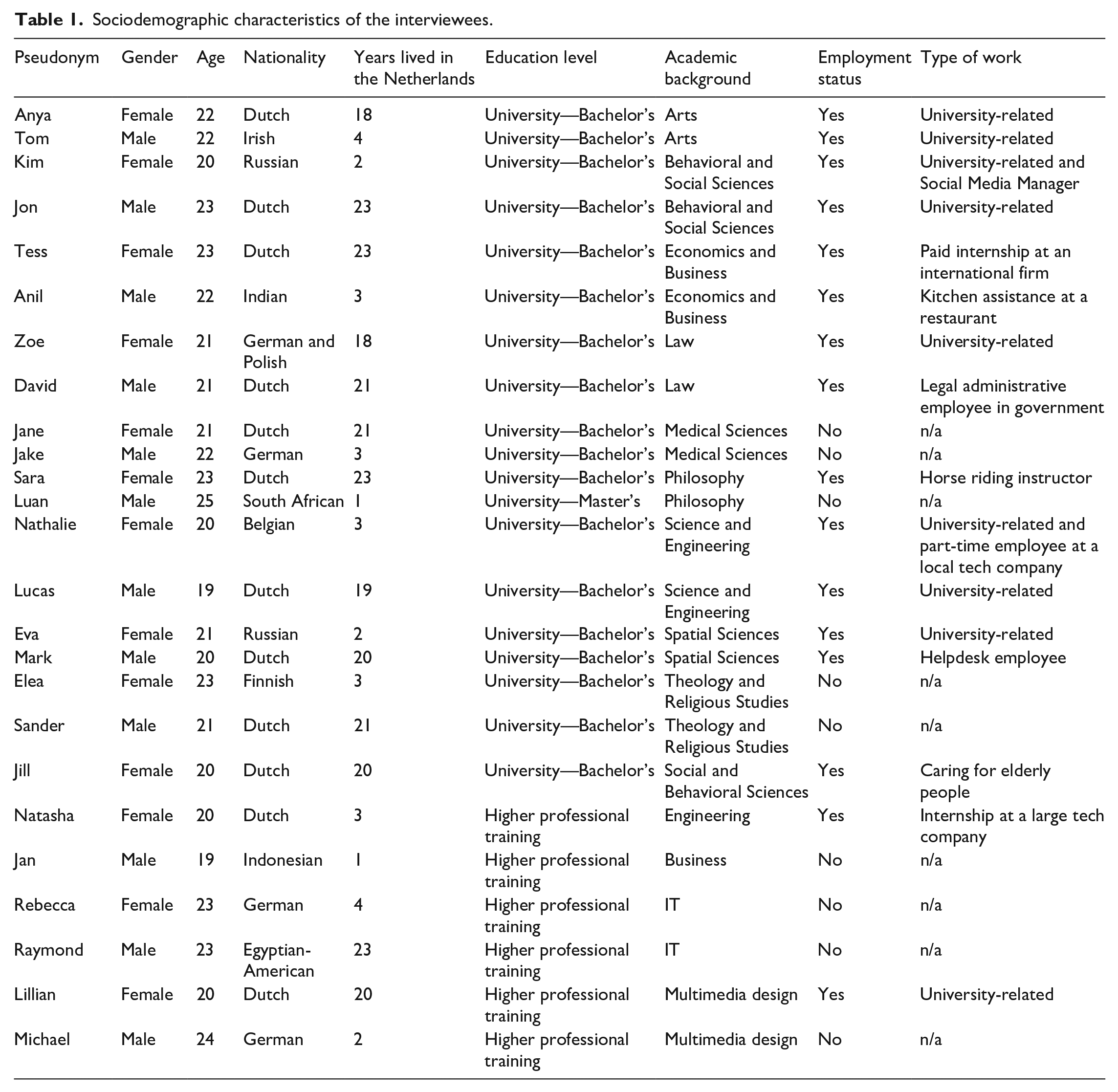
In total, we interviewed 25 participants recruited via our personal and professional networks and through snowball sampling asking the participants for referrals. While we defined the sample size inductively, we followed Guest et al.’s (2006) guideline on data saturation, namely the point where “new information produces little or no change to the codebook” (p. 65), in order to reach thematic exhaustion. Consistent with Guest et al. (2006), data saturation occurred relatively early on; we observed no major new theme in the second round of interviews, and the themes that emerged during the first round remained consistent throughout. This indicates validity of our findings, especially considering the sample diversity and the differing social and political contexts in which the two rounds of interviews were conducted.
The semi-structured interview guide comprised two sections, which was tested and improved through two pilot interviews in February 2021. The first section focused on the habits and routines of WhatsApp use and sociability in WhatsApp groups. We asked overarching questions such as “how do you usually use WhatsApp” and “can you tell me about the groups you are active in,” and followed up with probing questions. The second section delved into participants’ experiences of political talk in WhatsApp groups through open questions such as “have there been any political discussions in the groups; how did it come up; how did you experience it” and “have you talked about politics in the WhatsApp groups and why (not); can you tell us a recent experience.” During the interviews, we encouraged participants to share stories of their experiences, reflect on them in light of social settings and situations, group affordances, and specific political topics being discussed about. We asked probing questions such as “how did the conversation go,” “how did you and others react and why,” “how did you feel,” and “do you feel uncomfortable talking about politics in WhatsApp groups and why (not).” To contextualize this, we also included a brief section about participants’ general interest and participation in politics. The interviews took place online and were conducted in English, each lasting approximately 60 minutes. During and immediately after the interviews, field notes were taken to document initial observations and to provide contexts for data interpretation. All interviews were recorded and transcribed, during which the data was anonymized (names mentioned in this article are pseudonyms). We used thematic analysis for the purpose of pinpointing “both implicit and explicit ideas within the data” (Guest et al., 2011: 10), with a focus on developing overarching themes.
Findings
We identified four main recurring themes regarding how sociability enacted in small, private WhatsApp groups shaped the extent and forms of political talk. To understand these constellations of meanings and practices, we note that the young participants often referred to politics as policies, current events, and social issues that affected them personally, such as the housing crisis, policies on student loans, government measures against Covid-19, voting in local and national elections, global warming, and gender inequality. The patterns observed were similar across gender, cultural, and educational backgrounds.
Politics are personal: regulate political talk with the rule of mutual regards and respect
To some participants, politics was something personal and political talk could be hurtful. As Jon (23) emphasized, “my political views are quite personal. . . . Sometimes I don’t really feel like participating in any discussions . . . because they won’t listen to me” (italics used for emphasis). As for Nathalie (20), when describing an incident where a close friend was criticized for sharing a petition in a WhatsApp group, she said: “criticisms were just criticisms . . . [Even though] they tried to be respectful in the way they shared their opinions, it was just not helpful and I think people were hurt.” Thus, to feel safe, they needed their preferences met and political talk oriented toward care. This was made possible by the rule of mutual regards and respect that governed the social exchanges in small groups of close friends and families.
Self-regulation to avoid shoving politics down others’ throats
For those who were politically interested and engaged, respect for others’ preferences still trumped their political enthusiasm and the normative values they associated with political discussion. It led them to consciously leave politics out of the group conversations in order to avoid forcing politics on others. Jake (22), an active member of the university’s student committee, told us that When I realized that I have a group chat with people who don’t really want to use it to talk about politics, I tried to respect that . . . I mean, I feel like I should sometimes [talk about politics with them], but I also don’t want to shove politics down people’s throats . . . especially if I know these are good friends.
Others reported to adjust how they approached politics in the groups. Some interviewees like Anil (22) kept political talk brief, when taking his friends’ lack of response as a sign of disinterest. Others resorted to sharing political information such as news as a substitute for conversation. For example, Jake (22) explained that I’m very close to all of my immediate family. . . . Because my parents aren’t too fond of [political discussion], or at least my mom isn’t comfortable with it . . . I wouldn’t talk about current events with them, I would send them like an article about something that happened.
Other-regulation in the face of rule violations
The rule of mutual regards and respect also allowed people to feel comfortable expressing their preferences and sometimes demanding them to be met, including a preference for no political talk. For example, Eva (21) who was disinterested in politics and averse to political talk described that All my closest friends are pretty eager to discuss political things . . . like climate change, all the protests and some changes in the laws . . . So before they really understood that I’m definitely not into those conversations, they constantly tried to do this for one and a half years at least. And please, like, until I really said, like, please, let’s not talk about this. . . . I think at the end, they just like said “Okay, let’s not discuss this at all, like anymore” . . . I’ve mentioned before that I don’t like discussing it, and they kind of pushed it on me.
While some explicitly stated their preferences, others used or observed no response (“ignoring” someone’s message) as a way to implicitly express their lack of interest. For example, overwhelmed by conversations about pandemic regulations, Zoe (21), although interested in political issues, said that I think it’s more of a silent understanding. We never mentioned that explicitly. It’s more like I think everybody is pointed, a bit annoyed with it. So it’s more like, okay, let’s just brush past this comment and just continue.
Private chat to communicate care
Since political views were considered personal, confronting others in front of a whole group would be a violation of relationship rules, even when it came to matters one felt strongly about, like anti-vaccination. But instead of brushing disagreement on the side, several interviewees resorted to one-on-one talk. For example, Kim (20), describing herself as politically neutral and disinclined to talk politics, mentioned an incident where she witnessed a friend venting frustration about border control during the pandemic in her study group, “I didn’t really form an opinion . . . but I privately texted him saying that I don’t understand your frustration, because . . . there was a time when the government didn’t help me with my visa.” Nathalie (20) described an event where a close friend shared a petition in her study group and some members criticized that petitions were useless for change: “I checked up on her in the [close friend] group chat, like, are you okay . . . if you want to talk about it, you know, we can talk about it here.”
Politics are offensive: “little boxes” make political talk temporarily safer
It resonated with many that political talk was “a dangerous territory” in the sense that it was prone to misunderstanding and easily offensive. As Zoe (21) explained, “you can take words out of context very easily . . . you could offend somebody by just saying or typing something that you didn’t really mean.” Similar to what was observed on SNSs in previous research (Thorson, 2014), fear of being misunderstood and offending others appeared to be prevalent in larger WhatsApp groups as well (e.g. college group that consists of around 100 people), where many participants described a political talk-avoidant norm. Some felt uncomfortable due to the lack of predictability or uncertain of reception. As Kim (20) explained, “some people can be really opinionated, some are really close-minded. So [it’s] difficult to tell how they are going to react to your words.” Others attributed their reluctance to self-presentation concerns, as expressing political views “has consequences for the way in which people think of me” (Sander, 21).
In contrast, many participants described small WhatsApp groups as a safer space for political talk. Based on the accounts of their own experiences, we observed that, different from what was commonly envisioned, none of them attributed their sense of safety to the control affordances of the platform (e.g. control over the flow of content). While the participants mentioned muting large groups often to manage content flow there, no one reported muting or leaving small groups. As Nathalie (20) told us, “even if they talk about something that I disagree with, the main theme of the group chat is not about political discussion. So I’d never leave a group chat.” In other words, the social orientation and non-political nature of the groups functioned as the glue. Moreover, in many accounts, it was the inherent relationship qualities of the “little boxes” that allowed political talk to become temporarily possible, namely trust, shared knowledge, and homophily.
Trust
For many, safety rested on the trust that group members would care to understand each other’s views even when they disagreed, and the certainty that they would not run into conflict. As Jake (22) described it, compared to political discussion in big groups where “it’s a bit easy to be either misunderstood or come across as confrontational,” political talk in close friends groups was mostly carried out “in good faith that . . . it’s just a discussion.” This was further illustrated by Anya’s (22) story: in the small WhatsApp group with her two best friends from her hometown, despite holding very different views on vaccination, they were able to engage in a “small discussion about that . . . which didn’t really escalate into a fight; it was just like a regular talk [about] why you should be pro or against vaccination . . . So, just a regular conversation.” In other words, it is the trust that relationships will persist despite potential disagreement that made political talk safer.
Shared knowledge
To others like Nathalie (20), the feeling of safety sprang from the intimate knowledge of each other, which could set boundaries and prevent misunderstanding. She felt that political discussion in general was prone to misinterpretation, “because you already have your own biases and also biases about the other person.” But in small groups with close friends, They know who I am. So . . . when I talk . . . they are like yeah “we already know that she thinks this way and these are her opinions” . . . I know kind of the boundaries of political discussion so that it doesn’t get personal.
Jill (20) liked to listen to the other side but was concerned that on WhatsApp, “a little bit of the nuance gets lost sometimes.” But with regard to groups with close friends, she said, “we know each other well enough that that doesn’t really [matter].” Raymond (23) talked about politics the most in groups with families and best friends, because it was easier to be understood: I feel easier to like, talk my heart out to people that are close to me if that makes sense . . . they kind of know how you think, how you behave, or like they know about your views in general. So they will understand a little bit more what you are talking about and what you are trying to say.
Homophily
Others also acknowledged political homophily. Lillian (20) told us that the group where she talked about politics was with her sister and friends, because “we all vote, we all have our opinions mainly aligned when it comes to some most [important] issues.” Jake (22), despite having a passion for political debate, attributed the sense of safety to the “similar values” shared in his close-friend group, which made political talk more predictable: We’ve talked about this before, like, also the monarchy in Britain. It just came up again because of Prince Philip dying. So they kind of knew my position on it already and I kind of knew their position on it already. So I think that also, essentially, we had the same debate as before.
At the same time, he also pointed out the limit of such safe talks and expressed his preference for “big groups [where] you might talk to someone who has a completely different idea,” as it could actually help him “get somewhere or convince someone.” Others felt that agreement made political talk unnecessary, as Michael (24) told us, “You don’t really need to talk about it much when you realize everybody’s on the same page.” Different from Jake or Michael, Lillian (20) explained that the overall agreement actually allowed them to “talk about why [and] how [their] points still like differ . . . or where someone is uncertain, [for example] which party to vote for or which stance to take on a certain issue.”
Other than homophily as a result of strong ties, others also inferred it based on observation. For example, Elea (23) felt comfortable posting things political in her study group because “every now and then, someone shares a meme . . . it does give me the feeling that everyone’s on the left, like they basically sort of feel the same as I do.” This was in contrast to her experience in her small hometown where people held radically different views, which made her feel “scared to say anything.”
Politics are divisive and grim: recontextualize political talk in the phatic exchanges
Politics as something inherently divisive and depressing was another common view among the participants. For example, Luan (25) described politics as “a hot flashpoint between people . . . it often leads to arguments and messy discussions,” and found “the whole political somewhat depressing”: Anything politics ends up just being quite grim to have a look at, you know, you look at what’s happening in America, you look at Israel, you just look at everywhere. It’s just reaching a boiling point. . . . It’ll just make me unhappy.
For many young people like Luan, WhatsApp is where they talk with others to stay in touch, bond, and cheer each other up: “all day, whenever messages come through, I need to get hold of someone. And I do all my phone calls over WhatsApp as well, all the time.” Therefore, for the digital space to be socially and emotionally comfortable, they should be enacted through the weaves of gossip, jokes, and gibberish. As Luan (25) described, “music, art, humorous memes . . . that sort of stuff” should be the appropriate topics. This is consistent with previous findings that conversations in WhatsApp groups are characteristic of phatic exchanges, through which individuals participate in the construction of group narratives and experience a sense of belonging (O’Hara et al., 2014). Accordingly, some participants actively recontextualized political talk (when it happened) into something “light and funny” to diffuse the tension and also as a safety check.
The “light and funny” as an evasive maneuver
While some expunged politics in group chats, others employed tactics to contain political talk. Memes are considered “a very nice, passive way of sharing the events going on, because it’s not threatening or intrusive. . . . It definitely adds a lot of fun and spark to the discussion, and it brightens people’s day” (Luan, 25). Sander (21) saw memes as a way to talk “in a very lightweight sense,” which could neutralize the kind of political talk he described as “too emotionally charged and escalates easily in WhatsApp groups.”
Others also resorted to jokes in an attempt to diffuse the seriousness of political conversations. Tess (23), who generally saw less value in talking about politics than in taking actions, described what she often observed in her housemate group: That [group chat] is hardly ever serious. So someone asked a serious question, they got into overly serious responses. And then someone made a joke, and someone else made a joke on that, and then everyone’s joking. And then the conversation went on about completely different topics. And the whole serious part was not discussed anymore.
This is similar to the previous finding regarding Facebook that “humor is seen as a mechanism to neutralize political opinion, to make it safe to share” (Thorson, 2014: 213). However, it was also why some participants stayed away from political talk in private WhatsApp groups. As Tess (23) explained with frustration, she “rarely had any good conversations because in groups they’re barely, hardly anytime serious.” Lillian (20) said she did not participate in the group chats with her old high-school friends because “they are not really conversations; they are just people posting memes and gifs as a response to each other’s memes and gifs.”
The “light and funny” as a safety check
However, the “light and funny” was not always intended as an evasive maneuver. Similar to previous research finding (Valeriani and Vaccari, 2018), for someone with a tendency for self-censorship, it could be enabling. Elea (23), who used to be “scared to say anything [political]” in her old small-town community, felt that “a lot of my political standpoints in WhatsApp groups come through memes.” Although sharing memes did not start a conversation, it was a safer way for her to express viewpoints and test the water.
Others like Sander (21) reported that they used the “light and funny” to set an agenda for future face-to-face conversations: [we] respond with a smiley, have a laugh. But we don’t further elaborate on the discussion. What we do is that we send this maybe perhaps to initiate a discussion, which we will have when we eat with each other at the dinner table.
In a way, the quick exchange of smileys or laughter also served as a safety check; it ensured agreement, which allowed future conversations.
Political talk should be extensive, but group chats reduce it to quick babbles
For many participants, political talk should be an exercise of discussing, hearing the other side, and learning. Hence, they expected meaningful political conversations to be serious, extensive, and engaging. As Lillian (20) explained about her much desired practice of “paragraph writing,” Like if we’re having a good conversation, the messages can reach up to like four to six lines. And, like most of these conversations, they range from personal stuff to how we interpret certain situations to someone asking advice. I see that we had quite a lengthy conversation about the highest housing crisis right now.
But many described this to be incompatible with the rhythms and routines of conversations in WhatsApp groups that are fast-paced, bouncing through random topics and ideas, and/or logistical. For example, Nathalie (20) explained that, “WhatsApp is mainly used for like, quick sort of quick communication, not like full-length conversations.” Rebecca (23) described a common way of using WhatsApp: “you don’t even open WhatsApp anymore. You just look at your phone, you have some messages, and then you type your answer back and click send. And that happens within 10 seconds or so.” For people who saw each other often, WhatsApp groups were mainly used for organizing everyday activities. Jill (20) explained that in her housemates group, “it’s mostly about when we will be home, if it’s alright if we invite friends over, if anyone needs anything from the grocery store.” Friends also “hang out” in WhatsApp groups, talking about “almost like kind of everything . . . random Corona tests, or then some pictures . . . there was a storm recently . . . just everyday stuff” (Michael, 24). As Anya (22) described, “it is just things all over the place and random stuff.”
Hence, this modality of conversation normalized short messages and brief exchanges, which made discussion or articulation impossible and out of place. As Lucas (19) frustratingly pointed out, “you don’t really have the time to spend like 20 minutes typing a reply, because usually the discussion has moved on.” Jake (22) told us that he “felt awkward sending this kind of long paragraphs.” Instead, as Tom (22) described, political talk “would just literally be like, somebody sends an article about something, and then somebody makes a complaint about the article. And then we just, you know, move on.” Or in Jill’s (20) words: “I know that I’ll see my roommates everyday. So it feels like a waste of energy to just type it all out.”
Of course, this kind of political talk could prevent conflict, since people “never even get to the point where it would get like, somebody is offended by something” (Tom, 22). But it also made many doubt the value of political talk in WhatsApp groups. As David (21) told us, “the pace is so fast . . . me joining this conversation does not bring anything to it . . . the conversation dies very quickly.” Zoe (21) made a conscious choice to avoid political talk in WhatsApp groups because “political issues are so complex” and “it’s impossible to mention everything in WhatsApp texts to the point where you can be concise so people will read it.” Tom (22) explained that, “you cannot really get into like the nuances of your understanding of a situation.” Rebecca (23), who considered political talk a citizen duty, said, I feel like, yeah, there’s so much that could potentially make the discussion harder. Typing, slowly typing with mistakes, not understanding what the other person is meaning, then having to type out a longer text again to explain what you meant, while the other person already being with another argument out there. You’re not making your argument clear, and then missing out on the rest of the discussion.
Discussion and conclusion
As people are migrating conversations from open and semi-public SNSs to the closed and private environment of IM platforms like WhatsApp (Newman et al., 2019), a question that intrigued many scholars in the field is how the changing media landscape would influence political talk and the associated democratic potentials (Valenzuela et al., 2021; Valeriani and Vaccari, 2018; Velasquez et al., 2021). We contribute to this inquiry by understanding how young adults navigate sociability produced and enacted in small, private WhatsApp groups to engage, avoid, or reconstitute political conversations. In doing so, we present a nuanced understanding of whether, how, and why WhatsApp groups are conducive to safe social settings for political talk from the perspective of young people’s lived experiences. Based on results from semi-structured in-depth interviews, our study makes the following theoretical contributions.
First of all, what is considered “safe” entails particular construction and imagination of what “unsafe” is. Existing research on political talk and IM platforms has focused on state surveillance and social sanctions as what constitutes the “unsafe,” especially among minorities (e.g. Valeriani and Vaccari, 2018; Velasquez et al., 2021). Here, we find that to many young users, the unsafe lies in the inherent nature of politics they understand as personal and sensitive, conflictive and offensive, and divisive and depressing. This shows that how people make sense of politics is perhaps a fundamental reason why political talk is hard to achieve. Moreover, this sense of politics as a dangerous terrain is amplified in small, private WhatsApp groups where people find social and emotional comfort in communicating care, phatic exchanges, and dwelling in the familiar and mundane. Consistent with Eliasoph and Lichterman’s (2003) notion of “group style,” politics as it is understood is generally perceived as inappropriate topics there.
Nonetheless, it is also because of the intimate nature of WhatsApp groups that rules, relationship qualities, and strategies enacted in these closed digital spaces allow some forms of political talk to become temporarily possible. We find that political talk is foremost regulated by the rule of mutual regards and respect. Seeing politics as something personal, users eschew their own wants and beliefs to accommodate others’ preferences and regulate their own and others’ political expressions. Although it sometimes stifles political talk, this rule makes a social setting safe in the first place; it allows group members to control or negotiate the extent and form of political talk they prefer, and is particularly protective of people who want to shield themselves from politics. Following the rule of mutual regards and respect, users also create an exclusive space for one-on-one talk to deal with disagreement or ambiguities. Noticeably, different from identity performance on SNSs (Thorson, 2014), the segmentation of social situations here is intended to check in with one another, understand others’ opinions and feelings, and communicate care. Besides, for those who consider politics offensive, the relationship qualities of strong ties that inhabit the digital spaces make political talk safer. Here, safety means being able to trust that relationships will not be tarnished even if they disagree, and that based on shared knowledge of each other and general value alignment, what they say will not be misunderstood or lead to conflict. This echoes the existing finding that strong-tie discussion is more pertinent to everyday political talk (Morey and Yamamoto, 2020) and highlights that relationship certainty rather than control affordances makes content reception more predictable. Furthermore, among those who see politics as divisive and depressing and hence a disturbance to social bonding, strategies and routines are employed to recontextualize politics into something light and funny that fits in with the phatic exchanges; it is meant to diffuse the tension as previous research suggests (Thorson, 2014), but is also used as a safety check that allows future conversations to happen.
Overall, we see that whether and how small, private WhatsApp groups facilitate political talk depends on how people perceive politics in general, how they make sense of the digital spaces, and how they make use of the kind of social relations, rules, and strategies to regulate political talk when it arises. Young people actively produce what they understand as a safe space around politics, rather than passively experiencing it as prescribed by the control affordances of the platform. We thus argue that the kind of sociability enacted in the closed and intimate digital spaces can offer some “social groundedness” for political talk to emerge from (Thorson, 2014). Still, consistent with the recent finding that “face-to-facers” is the most common approach to political talk among young people (Kligler-Vilenchik et al., 2021), we also find that WhatsApp groups are mostly considered an inferior place for political talk. This is partially because many of the young people we interviewed expect political talk to have deliberative qualities; it should be serious, extensive, and involve discussions of disagreements. Although relationship qualities like homophily and the strategy of recontextualizing politics can make politics safer to talk about, this kind of political talk is also perceived as frivolous. It is made even more unproductive by the natural rhythms of WhatsApp group chats that are fast-paced and constantly shifting.
This study offers a finer-grained understanding of political talk in the closed digital spaces of IM platforms. While we have emphasized sample diversity in our research design and relied on data saturation to reach thematic variability and exhaustion, our study is based on a relatively small sample. As it is beyond the scope of this study, we encourage future research to utilize a quantitative design to test the generalizability of the identified practices and perceptions of political talk. Although the patterns we observed here are similar across cultural and educational backgrounds, we caution against drawing broad conclusions, since all the participants including the internationals we interviewed lived in the Netherlands at the time of interview. Hence, our findings should be understood within the context of political culture in the Netherlands and the particular population of highly educated young adults in a “Western, educated, industrialized, rich and democratic (WEIRD) society” (Henrich et al., 2010). After all, how safety is imagined and experienced is framed by what individuals desire and fear in responding to an insecure world. More work is thus needed to theorize the metaphor of digital “safe space” by critically engaging with the lived experiences of users and understanding what politics entails for different groups in different social, cultural, and political contexts.
Footnotes
Acknowledgements
We thank our colleagues from the research group Citizenship and Inclusion in Digital Societies at the University of Groningen and the anonymous reviewers for their valuable feedback that helped us improve the manuscript.
Funding
The author(s) disclosed receipt of the following financial support for the research, authorship, and/or publication of this article: The study is funded by the Groningen Institute for the Study of Culture (ICOG) at the University of Groningen.
