



Abstract
It is widely acknowledged that digital technologies are a part of everyday life. However, the UK Home Office does not consider communication or transport to be ‘essential needs’ for people seeking asylum. One Gigabyte of mobile data can cost up to 10% of weekly asylum support payments and a single bus ticket another 10%. By asking who can move and connect, this article explores the relationship between digital and physical spaces among people seeking asylum. Drawing on an ethnographic study, it argues that access to the Internet can facilitate a sense of belonging in physical and digital space. This, however, is constrained by “real-world” power relations, the consumer orientation of web design and the physical exclusions of the asylum system. The article concludes that digital exclusion, its intersections with physical exclusions as well as race, class and legal status have been brought into even sharper relief by COVID-19.
Introduction
In the United Kingdom, the government department responsible for immigration and asylum is the Home Office. The UK Immigration and Asylum Act 1999 (IAA) makes provisions about immigration and asylum; determining leave to enter, support given to people seeking asylum, detention, bail conditions and rights of appeal. The IAA introduced compulsory dispersal, which provides usually shared accommodation and compulsorily moves people seeking asylum to different parts of Britain. It also introduced weekly support payments to meet the ‘essential needs’ of people seeking asylum, but explicitly excluded ‘computers and the cost of computer facilities . . . travel expenses . . . and the cost of faxes’ from its definition of essential (IAA, 1999). Over 20 years since the introduction of the IAA, transport and communication are still not viewed as essential needs in and of themselves. Wi-Fi is not provided in asylum accommodation and the cost of mobile data; phone tariffs; and public transport can be prohibitively expensive for people subsisting on asylum support, which is currently 29% of the poverty line (Schmueceker et al., 2022). This can exclude people from both physical and digital life.
Digital technologies are increasingly part of our everyday worlds (Pink et al., 2017). For most, opting out is no longer an option (van Dijk, 2013) and digital connectivity is an essential part of everyday life. For new migrants, smartphones are an essential tool (Kaufmann, 2018) that can enable people to navigate and make social connections in a new city (Bork-Hüffer, 2016). Although the ways new media can enhance as well as complicate migrant lives is well documented (Kim and Lingel, 2015; Lim et al., 2016; Smets, 2018), less attention has been paid to the extent to which the state excludes people seeking asylum from digital connectivity and the implications this has for relationships to people and place both online and offline. Although successive judicial reviews have challenged the definition of ‘essential needs’ in the IAA, digital connectivity as an essential need has received limited attention. This emphasises the need to engage with the relationship between legal status and digital connectivity. Existing studies that recognise the precarious and contingent nature of smartphone infrastructure in refugee lives focus on the passage to Europe (Gillespie et al., 2018). By teasing out the relationship between physical and digital space among people seeking asylum, I explore the implications of physical and digital exclusions for those who are awaiting recognition by the state after arrival. The aim of this is to contribute to understandings of digital exclusion in the British context through a specific focus on the experience of the legal status of asylum seeker.
Drawing on an ethnographic study conducted with 15 people at various stages of the asylum process in the city of Sheffield in the north of England, I show how people seeking asylum are excluded from digital connectivity and how this reflects that digital inclusion only extends to those who are deemed to belong to the polity with implications for how arguments for Internet access as a human right are understood and applied. I explore how time spent in digital spaces can facilitate access to physical places in the city and vice versa. I argue that digital space can provide a site of connection to people and place online and offline at different scales thus engendering a sense of belonging. I find, however, that a sense of belonging can be constrained by both physical and digital exclusions. Although digital connectivity among people seeking asylum can compensate for exclusions from physical space (Lintner, 2020), the infrastructural and cost barriers to digital connectivity can lead to digital exclusion. Digital exclusion is then compounded by the encoding of default discrimination (Benjamin, 2019) into applications such as Google Maps. In addition, where free Wi-Fi is available in public spaces, access is constrained by the hyper visibility of being physically present in public Wi-Fi hotspots. By looking at the imbrications of physical and digital life in the lives of people seeking asylum, I aim to develop engagement with the relationship between digital space and a sense of belonging (Marlowe et al., 2016) and call for the need to link the discussion of default discrimination (Benjamin, 2019) to hierarchies of belonging in the asylum system (Griffiths and Yeo, 2021; Sirriyeh, 2014). To do this, I first outline asylum policy in practice, before introducing digital connectivity in the asylum system. I then set out the conceptual framework of belonging which I use to develop understanding of digital exclusion in the findings. Following a discussion of methods, I present the findings in two sections which cover how Internet access can facilitate access to physical spaces and where the Internet is accessed. The penultimate section reflects on the findings considering the COVID-19 pandemic. The final section concludes.
Seeking refuge: contextualising the study
A person seeking asylum is someone applying to be recognised as a refugee. Applying for asylum is a complex process that can take many years and several rounds of re-application including multiple, compulsory moves to different towns and cities. Once someone has applied for asylum, they are accommodated under Section 98 (S98) of the IAA while an assessment for entitlement to Section 95 (S95) asylum support is carried out. S98 accommodation is usually in the form of full-board accommodation in a hostel and is most often referred to as Initial Accommodation. Asylum applicants who are deemed to be destitute and therefore entitled to S95 support are dispersed to flats or houses on a no-choice basis and given usually shared accommodation in a local authority participating in the Home Office’s dispersal scheme (Hynes, 2011). Dispersal, or S95 accommodation, is mostly concentrated in low-cost urban areas in formerly industrial cities (Darling, 2020). People in receipt of S98 support in 2023 are entitled to £8.24 per week to cover ‘non-prescription medication and clothes’ (gov.uk, 2023) on a pre-paid debit card (ASPEN card) as other essential needs are met by the accommodation provider. People in receipt of S95 support in 2023 are entitled to £47.39 per week to cover essential needs on an ASPEN card (gov.uk, 2023).
The methodology used to establish how much financial support people seeking asylum receive and how ‘essential needs’ are defined has been subject to successive legal challenges (Justice Fordham, 2022). S95 payments were initially set at 70% of Income Support payments made to individuals in the mainstream welfare system, or £35.54 per week. These payments did not include transport or communication as ‘essential needs’ (IAA, 1999). By 2011, payments had fallen to 51% of Income Support, or £36.62 per week. A high court judgement in 2014 established that these rates were insufficient to meet essential living needs and failed to include items such as washing powder, non-prescription medication and the need to maintain interpersonal relationships (Home Office, 2016). Although payments were increased to £36.95, subsequent high court judgements ruled that the definition of what can be reasonably called an ‘essential need’ should be established by the Home Office itself. Further legal challenges led to an increase in support payments to £40.85 during the COVID-19 pandemic and most recently, in 2022, the High Court found that £40.85 per week was inadequate to meet essential needs, raising weekly payments to their current (2023) rate of £47.39 to reflect high inflation. The current support payment rate is 51.4% of the current standard Universal Credit allowance for a single person over the age of 25.
The change in approaches to establishing the cost of ‘essential needs’ over time and current inflationary pressures have significant implications for digital inclusion and belonging in physical and digital space. In particular, they highlight the growing literature and campaigning efforts that assert the right to connect as both a fundamental right and an essential need (Mathiesen, 2012; UN Human Rights Council, 2021). Based on this, I turn to the uneven landscape of digital participation and inclusion in Britain.
Seeking connection: asylum and the digital divide
To understand the uneven landscapes for digital participation and its relationship to both physical and digital belonging, it is necessary to consider uneven access to digital participation in Britain. Indeed, the digital divide is determined by structural social inequalities (Helsper, 2021) with digital poverty reflecting wider social divisions in Britain (Allmann, 2022). Among refugees, Georgiou (2019) notes that digital infrastructure can support refugees’ new lives in European cities and that the right to connect and communicate digitally is increasingly interwoven with the right to the city (Georgiou, 2016). In this way, digital exclusion leads to physical exclusion from city life (Wong et al., 2009).
Although the Home Office does not consider communication and transport to be essential needs, it does make provision for transport and communication to meet other essential needs. Following judicial review in 2014, the Home Office accepted that travel and communication may be necessary in ‘limited circumstances to enable other needs to be met, including those related to maintaining interpersonal relationships and a minimum level of participation in social, cultural and religious life’ (Home Office, 2016: 7). The Home Office consequently allocated £4.70 per week for travel and £3.56 for communication in 2021 (gov.uk, 2021). What is striking about the methodology used to calculate communications costs is the explicit exclusion of digital connectivity. In addition to four pens a year, the valuation includes the cost of a basic phone. Both phones identified by the Home Office as appropriate have no Internet connectivity (Home Office, 2020). Instead, the authors of the valuation argued that ‘free access to the Internet is available at libraries’ (Home Office, 2020: 7). In addition, the valuation uses data for contract phones and pay-monthly deals. This is despite the fact that ASPEN cards only work for transactions in shops and at ATMs and cannot be used online or for regular contracted payments (Refugee Council, 2018). This makes it almost impossible to access the cheaper phone tariffs included in the Home Office valuation. A gigabyte of data on tariffs that are accessible to ASPEN card users can cost around 10% of the weekly asylum support payment (Uswitch, 2020).
The digital divide can be broadly understood as the division between people who have access and use of digital media and those who do not (van Dijk, 2020). Using van Dijk’s (2013) four phase framework of motivation, access, skills, and use, it is possible to see the ways that the Home Office and its contractors widen the digital divide by preventing access to digital media. These barriers to access are also exacerbated by wider inequalities. In Britain, those who are least likely to have Internet access are those on low incomes or who are financially vulnerable (Calderón Gómez et al., 2021). Indeed, digital competency and access is associated with socioeconomic and sociodemographic patterns such as income and place of residence (Ragnedda et al., 2019). As people of colour are 2.5 times more likely to be in poverty than their white counterparts (Edmiston et al., 2022), the racialisation of poverty intersects with the ability to access and use the Internet. These dynamics are also spatially determined. The digital divide is more acute in the Northeast of England (House of Lords, 2023) just as racial inequalities are more pronounced in the North and Northeast of England (Edmiston et al., 2022). Cities and towns in the North and Northeast are also major dispersal destinations. The intersection of poverty, inequality, and regional disparities are likely to compound the digital divide among people seeking asylum.
Moreover, the digital divide is exacerbated by many national and local government services—such as access to welfare benefits—becoming online only (Harvey et al., 2021). The policy of digital-by-default which aims to make the Internet the ‘natural place for people to go’ for government services has moved many central government services online but does not cover ‘ways to increase the digital capability of UK citizens’ or ‘the expansion of the broadband network’ (gov.uk, 2012: 4). In addition to not increasing capability for, nor providing digital infrastructure to those who are recognised as citizens, the policy excludes non-citizens who may also need to access online government services, such as school applications. This is alongside the extension of the policy of digital-by-default to immigration. In 2022, the Home Office’s New Plan for Immigration (Home Office, 2022) emphasised the digitalisation of the border—from issuing e-visas, to the further roll out of e-gates, as well as the creation of Electronic Travel Authorisation and carrier integration to prevent the arrival of illegalised migrants. Although the process of applying for asylum isn’t yet fully digitised, the use of digital technologies such as Electronic Travel Authorisation which specifically sets out to deter people seeking asylum, calls attention to the overlapping policy areas and layered exclusions of digitalisation, digital infrastructures, asylum and immigration. The digital exclusion of people seeking asylum consequently merits close attention because it highlights the tensions between the state’s commitment to adopting and promoting digital technologies; emerging discourse around the right to connect as a fundamental human right (Tully, 2014); and the systematic exclusion of certain social groups from digital connectivity. I begin to add to this body of literature using the framework of belonging.
Seeking belonging: a framework for understanding Internet access and place in the asylum system
Belonging as a concept allows for engagement with the construction of boundaries that lead to the exclusion of people seeking asylum and their differential effects as well as the multiple ways in which an individual may feel they belong or not belong at different sites and scales. As Georgiou (2016) argued, the politics of connectivity that shape how we connect and participate online also spill out onto the ways the city is lived and regulated. As online activities become ever more intertwined with offline social life and vice versa (van Dijk, 2013), there is a need to develop our understanding of how access to digital spaces can curtail and prevent access to physical spaces and vice versa. Moreover, recognising the unevenness of digital participation and the structural forces that shape the digital divide requires a framework that is sensitive to individual social locations, structural forces and different sites and scales.
Antonsich (2010) argued that the self emerges emotionally through place. Place-belongingness is composed of the attachments that people form, the social relations that structure people’s attachments and the wider social and political settings that define how people develop a sense of belonging in place. This can be built on using Yuval-Davis’ (2011) intersectional approach to belonging which draws a distinction between the politics of belonging and belonging. The politics of belonging comprise specific political projects which construct belonging to particular collectivities such as state citizenship (Yuval-Davis, 2011: 11). For example, the political projects of belonging that exclude people seeking asylum and reduce support to ‘essential needs’. In contrast, belonging or a sense of belonging, involves a feeling of comfort, familiarity or safety. It is a relational state of emotion and mind (Yuval-Davis, 2011: 155) and an impulse for attachment (Probyn, 1996) that can exist in multiple places at different times both online and offline. The fluidity, multi-scalarity and multi-layered dimensions of belonging can allow us to consider the fluidity of digital and physical space while at the same time reflecting on what the Home Office’s definition of ‘essential needs’ means for the everyday lived experience of the asylum system without losing sight of the political projects that guide the state’s actions and progressively narrow access to fundamental human rights for certain groups of racialised migrants.
Methods
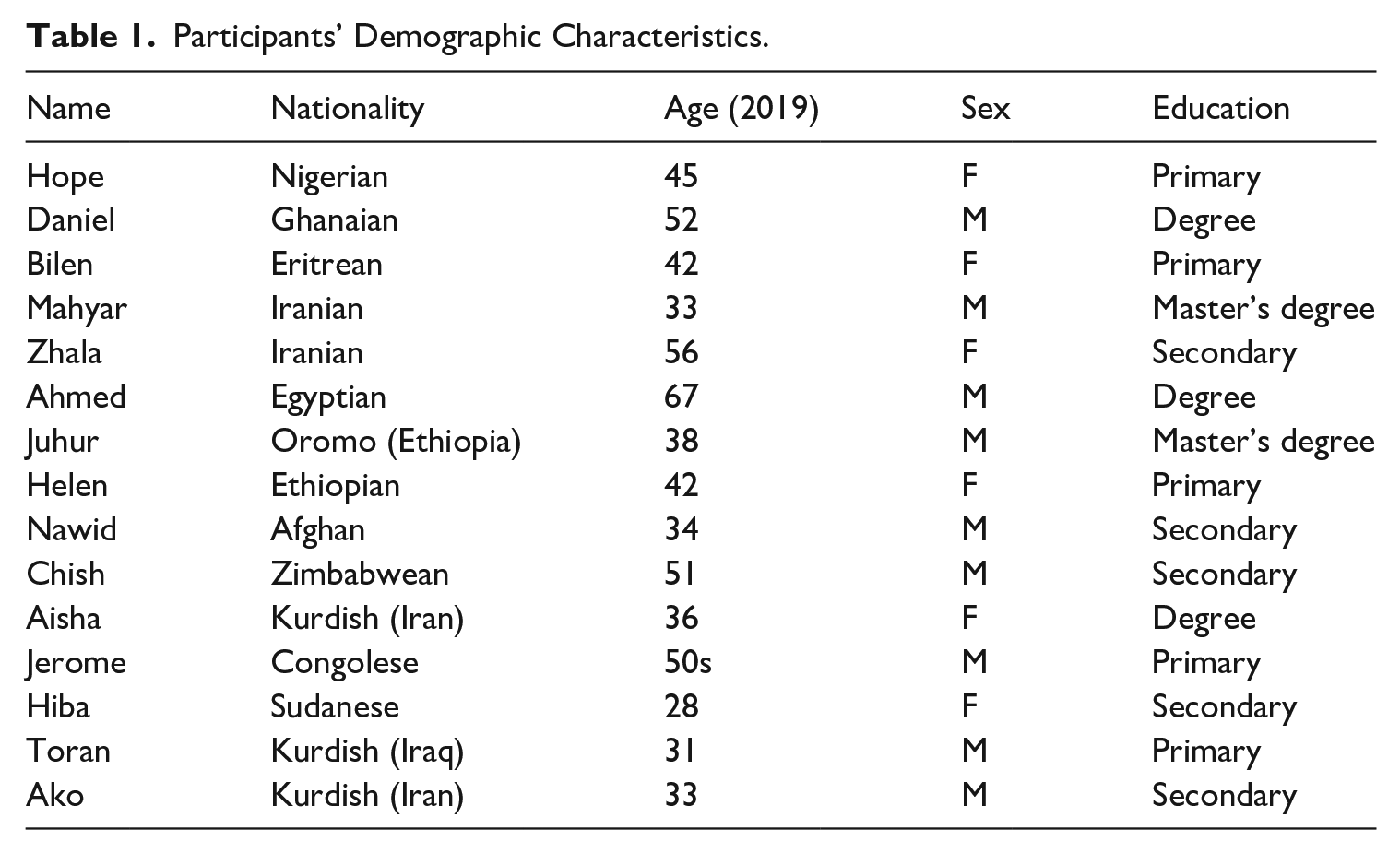
My central research question was ‘how do people who have been made to move to the city of Sheffield as part of their asylum application develop a sense of belonging to people and place over time’. I used an ethnographic approach to reflect multiple and mobile identifications to place (Neal, 2015) to enable engagement with how structural forces unfold in everyday life (Back, 2015). Ethnography as a method is widely used in studies of digital belonging (Hatef, 2022; Moran and Mapedzahama, 2021; Polson, 2013; Ponzanesi, 2021). I used multiple methods common to ethnographers including participant observation, semi-structured interviews and mobile interviews. The 2-hour long semi-structured recorded interviews enabled me to capture data on change over time. I recruited participants through snowball and opportunistic sampling methods (Bryman, 2015) drawing on my existing networks and voluntary work at an asylum charity. I recruited people who had been dispersed to Sheffield between 2013 and 2018. I framed questions around everyday life, preferred activities and where participants spend their time. A clear theme in my initial analysis of the first round of interviews was the importance of access to the Internet. For this reason, I used inductive analysis of the first round of transcripts to create personalised topic guides which included questions on Internet use, Internet access and digital connectivity for all participants. Mobile interviews and participant observation enabled me to capture data on dynamic belonging to people and place. I recorded observations of these research encounters in my field diary. Participants have a range of nationalities, and their genders reflect the gendered ratio of asylum applications. I present participants’ backgrounds in the table below which will help contextualise the data presented in the empirical sections.
Participants’ Demographic Characteristics.
I used thematic coding for my field diary and interview data using NVivo. Once I coded interview data, I coded my field diary data and cross-referenced themes. In the following sections, I present data on digital connectivity as means of accessing and navigating the city and how digital technologies and infrastructure are accessed.
Internet access and physical places
For many, typing a postcode or a destination into an application like Google Maps, City Mapper or Apple Maps has become an essential part of everyday mobility and indeed, an aspect of everyday mobility that often goes unquestioned (Marchant and O’Donohoe, 2019). For new arrivals, mapping or transport web applications can be an important means to access, learn, discover and inhabit the city (Bork-Hüffer, 2016). However, such tools rely on reliable access to a smartphone, mobile data, affordable public transport and having the locations identified on applications such as Google Maps be relevant to an individual’s needs. While everyone who took part in the study had access to a smartphone (usually received as a gift or through a donation) and identified having a smartphone as essential, the digital exclusion of having no Internet access in dispersal accommodation combined with the financial exclusions of paying for mobile data while subsisting on asylum support payments and having no right to work was compounded by the spatial realities of the city—namely the location of dispersal accommodation. More than half of the participants in this study were dispersed to areas where travel time to the city centre took an hour or more by bus. Only three people were dispersed within walking distance (15 minutes or less) of the city centre. While Google Maps served as an essential navigational tool for all participants in this study, spatial inequality in the city was reproduced by inequalities in digital space, thus limiting physical belonging in place.
Although accommodation providers are expected to give all new arrivals an induction pack including information about local services in a language recipients can understand (Home Office, 2023) for the participants in this study, this was not always the case. Hope and Helen both received packs including maps that had been photocopied so many times that they were illegible; Toran and Ako explained that they received no induction pack at all; and Hiba only received one in English. For those with access to mobile data, smartphones consequently played an important role in orientation, navigation and emplacement.
When recounting his experiences of his first day as a new arrival in Sheffield, Nawid, an Afghan tailor in his 30s, described the importance of postcodes and Google Maps: On the first day, I used postcodes. I used postcode and Google Maps for everything. I remember on the way back from Post Office my phone had no charge. I was lost and very scared. I was laughed at by two, three guys when I said, ‘where is [– –] Road?’ It took more than one hour to find my home. (Interview with Nawid)
Access to the Internet enabled Nawid to navigate his new city. Although Google Maps increased his speed of access to new places and allowed him to orient himself, when his phone ran out of battery, he lost his main navigational tool and was forced to depend on hostile strangers. Nawid’s phone thus facilitated movement and, over time, familiarity. Access to the Internet has the potential to facilitate a sense of belonging in place by enabling people to develop a sense of familiarity. As May (2013) argued, a sense of belonging to place arises through familiarity. This is echoed by Mathisen and Cele (2020) who found that a sense of belonging arises through knowledge of places within a city. In this way, navigation and emplacement allow for the emergence of belonging to place through familiarity. Like Nawid, for Mahyar, Google Maps facilitated his mobility: Yes, I research everything on the Google Map and get which number bus and where is it going, yes. (Interview with Mahyar)
Google Maps increased access to new places and acted as a ‘friend’ (Lintner, 2020: 16) thus allowing for the emergence of place belongingness in physical space (Antonsich, 2010) through comfort and familiarity (Yuval-Davis, 2011). However, this was arguably constrained by the image of the ideal or imagined user of Google Maps. For Nawid, being without access to Google Maps led to fear and humiliation when he asked for directions and for Hope, a Nigerian hairdresser in her 40s, Google Maps revealed the selectiveness of its search results: When they drop us in Sheffield, we came on the 17th of December and it was a few days to Christmas and it was really horrible, like really really horrible. We don’t know what to do, we don’t know where to go to and with a little child she’s like 7 years old. Like, they just took her out of her friends from London they brought her to Sheffield. They just gave us a map. We don’t know what to do, we don’t have food to eat and the housing officer, he said ‘oh check the map, if you check the map, you can know what to do and where to go to’ (Interview with Hope)
Hope also chose to use Google Maps, saying she found the spoken directions helpful. Using Google Maps to look for places to buy food on her first day in Sheffield led her to a large out-of-town shopping centre that only had a prohibitively expensive department store food hall and food court with chain restaurants. The kinds of results that applications like Google Maps yield can be seen to be based on an imaginary wealthy, able-bodied, white, and male consumer (Noble, 2018). Search results on Google Maps are more likely to privilege more expensive chain stores rather than cheaper, small, or independent businesses. This is because Google Maps promotes online behaviours conducive to a consumer society and because the application organises ways for users to interpret information by monetising it (Lee, 2010). Results on Google Maps (and similar applications) also reproduce social inequalities. The producers of such apps are more likely to create algorithms and write code in their own image thereby producing default discrimination (Benjamin, 2019) because they have those with greater disposable income in mind as their target demographic. Multinational corporations also often pay the producers of mobility apps to ensure that their destinations feature highly in search results. Rather than being neutral, results yielded by such web applications reproduce real-life inequalities; prioritising department store food halls over discount supermarkets, or shops where it is possible to purchase culturally familiar foods. In this way, while Google Maps was a useful navigational tool, default discrimination had the effect of making it more difficult to become familiar with the city. This suggests that while access to mapping applications can facilitate belonging through place familiarity, this can nonetheless be constrained by the non-neutrality of such applications, which target idealised members of society, most often white citizens with disposable incomes. Or, in other words, those who might be socially deemed as most belonging to the polity through their legal status, income, class, and other intersecting social locations. In this way, mapping applications can simultaneously facilitate a sense of belonging in place and reveal the political projects of belonging that exclude. The way that mapping applications can reveal the political projects belonging that exclude also has implications for how the call for the recognition of the right to connectivity as a human right intersects with default discrimination online.
In addition, mapping applications privilege motorised mobility, offering driving and public transport routes before active (and free) modes of travel. Except for City Mapper (which is unavailable outside the largest British cities), they do not provide information about the cost of routes. Moreover, search results on applications like Google Maps can reproduce the harmful effects of not having access to reliable public transport. In Mahyar’s case, although Google Maps facilitated mobility, it was constrained by the accessibility, affordability and reliability of public transport. Mahyar, a civil engineer from Iran and his mother, Zhala, were given accommodation in peripheral areas of the city. Although the Internet helped them navigate the city, the cost of travel—£3.90 for a single bus ticket to the city centre—had a profound impact on their everyday mobilities and ability to meet basic needs thus negating the savings made by sharing the cost of mobile data between them. Being on the periphery of the city and the lack of a reliable bus service limited their ability to build a sense of belonging to the city beyond their immediate area. This also shows that the £4.70 a week allocated to travel to support meeting essential needs by the Home Office does not cover the true cost of transport, especially when dispersal accommodation is not within easy or affordable reach of essential city centre shops and services. Although mother and son used Google Maps for everything, its usefulness was constrained by physical limitations and barriers to access. The limitations to the search results provided by Google Maps were also compounded by the distances they had to travel, thus ‘inscribing new power geometries onto urban places through algorithmic linkages’ (Shapiro, 2017: 1201): From this guesthouse to the bus stop was a 15-minute walk and this was the worst part of our daily life. The bus was really bad, so the bus would come only once an hour and sometimes it never came. So, if we wanted to go to the city centre, we had to take a 45minute bus just to get to the city centre. I had to get a bus for a long time. In one day, I ended up spending £5 just on the travel costs. (Interview with Mahyar)
Fallov et al. (2013) argued that a sense of belonging to place includes the ability to move with ease across a city. For people seeking asylum, however, ease of mobility is constrained by distance and access to public transport. Although digital connectivity and smartphone use can alleviate some of the challenges of mobility, this in turn is constrained by the imagined user of certain web applications and by access to digital connectivity. The assumed mobility inherent to mapping applications which prioritise motorised transport and give no indication of cost combined with digital exclusion through lack of Internet access intersect with and exacerbate inequalities and exclusion in physical space. In this way, the everyday challenges created by the location of dispersal accommodation, persistent underinvestment in physical infrastructure and public transport services is compounded by digital exclusions. The ideal or target users of web applications thus reflect the political projects of belonging that see certain bodies as the body and construct both an idealised consumer and idealised member of society, thereby amplifying asymmetries of online voice, attention and visibility (Fuchs, 2021). This can then intersect with the exclusions from belonging to state and society within the asylum system. Together, these dynamics can exclude people seeking asylum from physical and digital spaces. Moreover, although mapping and transport applications can facilitate movement through the city and allow for place making practices (Kaufmann, 2018) and new social connections (Bork-Hüffer, 2016) that contribute to belonging, this can be constrained by access to digital devices, Wi-Fi and data. This reveals the deep interlinkages of digital and physical belonging.
Sites of access, sites of connection
For those on the journey to Europe, smartphone infrastructures are precarious and contingent (Gillespie et al., 2018). Individuals require access to plugs, chargers, Wi-Fi and sim cards to connect with and maintain social networks and navigate new places. For those who have ‘arrived’, smartphone infrastructures and digital connectivity remain contingent. Being able to move with ease and develop a sense of belonging to people and place can depend on whether someone has access to a smartphone, tablet, or laptop and is able to purchase mobile data or access Wi-Fi. The ability to access and use digital technologies intersects with class, race, gender, and legal status (Fuchs and Michalis, 2019). As described earlier, asking passers-by for directions led to fear and humiliation for Nawid. Similarly, for Hiba, a Sudanese woman in her late 20s, access to the Internet depended on being highly visible in public spaces. Hiba explained that she was afraid to ask passers-by for directions. Although she would prefer to use mapping applications, she depends on public Wi-Fi hotspots to do so. Hiba described feeling hyperaware of stopping or sitting in outdoor public Wi-Fi hotspot areas such as the bus interchange or outside a multi-storey car park with her smartphone. This is because she felt that she would be seen as out of place or as loitering. Being visibly different in public Wi-Fi hotspots can lead to people staying at home (Lintner, 2020: 11). The provision of free public Wi-Fi hotspots can build towards digital inclusion by providing Internet access (Marlowe et al., 2016). For people who are made vulnerable by being visibly Other in a majority society where they may feel unwelcome, however, the need to access the Internet and web applications can limit a sense of belonging to place. This is because for the most marginalised or, in other words, those who are seen to belong the least, simply being present in public spaces can lead to feelings of discomfort or even verbal or physical harassment. This not only reveals the non-neutrality of public space (Massey, 2005) but also shows the ways the promotion of digital inclusion can be limited by physical exclusions where digital exclusion is compounded by lack of Internet access in secure, safe, private spaces (Allmann, 2022). This was also evident in Bilen’s experience. Bilen, an Eritrean woman in her 40s, would sometimes access Wi-Fi in commercial public spaces to keep in touch with friends in London and Manchester thus enabling her to maintain a sense of belonging through her relationships. Doing so, however, highlighted the exclusions created by her legal status and spatial inequalities. After spending around 10% of her asylum support on a bus fare, Bilen would purchase the cheapest available coffee at Starbucks to access Wi-Fi, spending another 4% of her weekly asylum support payment (Starbucks, 2020) in order to text and video call on her smartphone.
Access to the Internet is not only an important navigational tool but also a means to build a sense of belonging to people by engaging in activism, meeting new people, establishing and maintaining social connections—locally, regionally, nationally and internationally. However, this is contingent on indoor, public, reliable, and affordable connectivity: The library computer here [Huddersfield] is one hour. In Sheffield is two hours and most of the time I don’t have data. I don’t have enough data. I only use £10 a month for my phone so I only have 5GB of data. That’s not enough. I just Google things, I can’t use Skype or video. (Interview with Juhur) Yeah, so in Wakefield I would go to the library just for the Wi-Fi. I must say it’s a godsend. You’re allowed to use the computers for two hours and if there’s nobody waiting you can extend and if there are no computers, you can take your tablet. There are really nice seating areas, and you can just sit there for as long as you want using the Wi-Fi it was a relief, it was good. (Interview with Chish)
Both Juhur and Chish emphasised the time-limited nature of computer access in public libraries. This determined the amount of time that they were able to spend online and what they were able to do with their time. For Chish, this limited the time he could spend updating his blog as a diaspora activist. For Juhur, who has a degree in computer science, time-limited access to library computers combined with limited mobile data prevented him from using video calls to speak with his wife and children in Ethiopia. Although access to the Internet was an important way to maintain a sense of belonging to nation and to people transnationally, it was limited by the time restrictions imposed by public institutions. The first level of the digital divide is inequality of access and the second is inequality of use (Calderón Gomez et al., 2021). For Chish and Juhur, who are both deeply familiar with participation in digital space, inequality of access created restrictions in use. Moreover, the digital divide was reproduced by differences in public provision at the city level. During the fieldwork, both Juhur and Chish received negative decisions on their asylum claims. However, both were able to make further submissions and re-enter the asylum system. Chish was moved to S98 accommodation in Wakefield before being given S95 accommodation in Huddersfield. Juhur was similarly re-dispersed to Huddersfield. Both had to rapidly reorient and learn to navigate in new cities thus increasing their reliance on mapping applications and their smartphones as portable devices. As is evident above, libraries in different local authorities have different Wi-Fi and computer provision. At the time I conducted fieldwork, there was no Wi-Fi in Sheffield’s libraries and computer access was limited to 2 hours. Differing levels of provision can mean different levels of access and use, exacerbating the digital divide between those who are able to connect whenever they want and those who must rely on scarce or underfunded public resources to do so. This, combined with having to learn what provision is available in different local authorities can compound disorientation, thus restricting a sense of belonging to place that emerges through familiarity. The contingencies of access at the city level reveal tensions between local and national government. While the Home Office asserts that people seeking asylum can access the Internet at libraries, spending cuts at the national level have led to widespread library closures and reduced library services at the local level. This compounds digital exclusion because libraries are both pressured to facilitate digital connectivity and they are forced to manage with ever-diminishing budgets (Allmann et al., 2021). For Chish and Juhur, this has meant uneven access to digital connectivity. Similarly for Aisha and Helen (both of whom have small children), the long waits for library computers clashed with their childcare responsibilities. This suggests that although Internet access has the potential to foster a sense of belonging, this was constrained by overlapping policy spheres. Internet access to build belonging as a relational state of emotion and mind and an impulse for attachment was also evident in Nawid’s experience: Before, I would go everywhere for free Wi-Fi, for more than one year, I would try to find somewhere for Wi-Fi. I remember in the share house one guy had some data left and they make for the hotspot. In that time, I was on [– –] Road and lots of Pakistani guys—shops and takeaways have Wi-Fi. Because I know Urdu as well, I meet with them I went to them and sometimes for half an hour, an hour they are giving me Wi-Fi password. One Pakistani guy, I told him I am in this country new, and he gave me Wi-Fi and, in the share house from downstairs, I use that shop Wi-Fi. (Interview with Nawid)
In Nawid’s case, local shop owners were willing to share their Wi-Fi passwords to help him maintain existing social connections and develop new ones. Wi-Fi access gave Nawid greater access to the city, provided him with a means to pass the time and gave him a way to build a sense of belonging to people beyond those he was made to live with. Before being dispersed to Sheffield, Nawid was given S98 accommodation in Birmingham. Connecting with people he met in Birmingham online helped him build a sense of belonging in Sheffield: When I was in Birmingham, we are around 15 Afghani in one area. So, when I moved from there and came here, I play some games online. On that game, we can track each other. So, when I moved here my friend said, ‘where are you now?’, I said, ‘in Sheffield’. On the game, in the chat room, he said, ‘oh my family is there. Can you send me a postcode?’ Then I send my postcode, then exactly that guy who was in Sheffield, he also spent time in the game. So, starting on chat first on the game, ‘where are you living?’ I said, ‘I am in [– –] Road; this is my postcode and my number’, and then after, he said, ‘I am near to [– –] Road’. On the chat room, he says, ‘just give me ten minutes’. After ten minutes, he is coming. He came in my house, so with him I went first to Peace Gardens then Victoria Hall, the library, the books, he showed me all. (Interview with Nawid)
Access to the Internet can lead to a sense of belonging to people and places both online and offline. It can lead to the creation of new places for belonging online and trouble the distinction between physical and digital place (Christensen, 2012). This is because time spent online can provide a means to socialise online and offline and a means to access physical and digital spaces and places (Warnes et al., 2022). The person Nawid met online soon became a close friend. It was this friend who enabled him to access the city centre, its green spaces and a multi-agency drop-in for refugees and people seeking asylum. At one of the green spaces he was shown, he later met another Afghan man who had secure legal status in the United Kingdom. This friend had a significant impact on Nawid’s social connections and mobility as he took a mobile contract out for him: But now, actually I use, you know, my friend they take for me contract. I have data, everything, unlimited everything. My friend is here more than 10 years, they take for me contract. (Interview with Nawid)
ASPEN cards restrict people seeking asylum to more expensive pay-as-you-go tariffs thus limiting access to the city, online-only services, online leisure, and online sociability. When he first arrived in Sheffield, Nawid would search the city for access to Wi-Fi. Within 3 years, through friends he made both online and offline, Nawid had a mobile phone contract with ‘unlimited everything’. The first connection that Nawid made while playing an online game led to a range of new social connections and access to new places over time. Time spent online allowed Nawid to develop a sense of belonging to people and place at different scales, leading to a sense of comfort, familiarity and attachment in the city and beyond. A third of participants in this study accessed mobile data or Wi-Fi through the support of friends and other social connections. Similarly, a third of participants received a secondhand digital device such as a smartphone, laptop, or tablet as a gift through friends and other social connections. The solidaristic social connections participants built thus led to digital connection and belonging both online and offline.
Although the practice of belonging through access and use of digital devices can, in some ways, resist the exclusions of legal status, the ability to build a sense of belonging online is nonetheless shaped by power differentials embedded at the community and neighbourhood scales (Gilbert, 2010). The same set of power relations constitute our online and offline worlds and the ‘political agendas rooted in white power connect across national boundaries via the Internet’ (Daniels, 2012: 710). The same set of power relations that constitute our offline and online worlds consequently reproduce political projects of belonging that exclude. For participants like Zhala and Ahmed who have physical disabilities, Internet access was made more necessary by the physical limitations to their mobility. Zhala spends most of her time online watching soap-operas and speaking to friends on WhatsApp on a smartphone gifted to her by her pastor. While this enabled a sense of digital belonging, her physical disability, dispersal location and poor access to public transport meant that she was less able to practice belonging in physical places. This was like Ahmed’s experience. The relationship between a sense of belonging and the political projects of belonging that exclude people seeking asylum can reveal how our online and offline selves as well as our movement in online and offline spaces are deeply intertwined. Although Internet access can have compensatory effects, access is limited both by financial constraints and by power differentials embedded in digital and physical space. The increasingly porous nature of the online/offline divide shows how the dynamics that shape our movements through physical places also shape our movements through digital ones, raising the need for more sustained engagement with how default discrimination interacts with hierarchies of belonging in the asylum system and what this means for how we understand the right to connect in a hostile environment.
COVID-19, a coda: ‘The Home Office is the virus’
The findings of this study have been brought into sharp relief by the COVID-19 pandemic. For many, the imposition of successive lockdowns limited everyday mobilities and increased the amount of time spent online. As Ahmed, an Egyptian teacher in his 70s, described during a WhatsApp call in March 2020, however, lockdown restrictions brought no change to his everyday life—he ‘sits alone in the home’ and occasionally goes out to buy groceries. Ahmed commented that for him, ‘the Home Office is the virus’. As almost all public and social life moved online, there was no accompanying turn to the screen for people in the asylum system. COVID-19 highlighted the extent of the digital divide (Roberts, 2022). Indeed, as Bastick and Mallet-Garcia (2022) found, the pandemic exacerbated exclusion among undocumented migrants in the United States. For people in the asylum system in Britain, the pandemic exacerbated digital exclusion and demonstrated the extent to which communication should be considered an essential need, highlighting that access to the Internet has become ‘practically indispensable for having adequate opportunities to realise our socio-economic human rights’ (Reglitz, 2023: 441). Since the pandemic, many services have remained online only and access to the Internet is needed for an ever-growing range of public and third sector services. Despite this, communication is still not considered an essential need for people seeking asylum under the IAA. Although City of Sanctuary Sheffield, which opened its own storefront in the city towards the end of my fieldwork, now offers free Wi-Fi, and some third sector organisations provide free data and donated devices such as laptops and smartphones to people seeking asylum, there is no corresponding recognition of this need by central government. Indeed, in the UK government’s latest Digital Strategy published in October 2022, there is no reference to promoting access to digital devices or connectivity—for both citizens and non-citizens alike—at all (DCMS, 2022). At the local government level, however, there is an increasing recognition of the necessity of digital connection (Yates et al., 2016). For example, Sheffield city council now provides free Wi-Fi in its libraries. Despite these positive changes, the digital exclusion of certain groups of racialised migrants remains a powerful example of how the political projects of belonging which construct belonging to particular collectivities exclude people seeking asylum from belonging and the right to connect.
Conclusion
There has been relatively little attention paid in the academic literature on the extent to which the state excludes people seeking asylum from digital connectivity and how this relates to rights based appeals to digital connectivity and inclusion. Throughout this article, I have shown how asylum policy actively excludes people from digital life and the implications this has for life online and offline. The necessity of digital connectivity for many aspects of everyday life reveals how digital connectivity is an essential need and one that can foster belonging. Likewise, the deliberate exclusion of digital connectivity from the category of essential need by the Home Office is indicative of a state led political project that does not see people who seek asylum as deserving of belonging. As the UK government pursues its policy of digital-by-default and digitises borders and state services, it is evident that there is a need for researchers to continue to build an understanding of the relationship between the state, technological power (including the dominance of a select few tech companies), and everyday exclusions from the right to connect, especially when these exclusions are targeted towards those who are not deemed to belong—whether they are racialised as other or seen as economically unproductive.
In the face of increasingly restrictive asylum policy, this article has highlighted the possibilities for researchers and activists alike to champion digital connectivity as an essential need, whether by legal challenge to the definition of ‘essential need’, by supporting access to digital life as a fundamental right, or campaigning for inclusive and democratic web platforms. Overall, this study has shown how Internet access can facilitate a sense of belonging in physical and digital space among people in the asylum system. Having Internet access can enable people to navigate and emplace in a new city. It can allow people to maintain connections and build new ones both online and offline but relies on contingent access. The right to move and seek belonging is consequently deeply related with the right to connect.
Footnotes
Funding
The author disclosed receipt of the following financial support for the research, authorship, and/or publication of this article: White Rose Doctoral Training Partnership, Economic and Social Research Council.
