




Abstract
How do the affordances of microblogging platforms, such as visibility to imagined audiences, shape the nature of ‘everyday talk’? Drawing on a qualitative study of tweets posted during the COVID-19 pandemic and containing the acronym WFH (working-from-home), we draw on Habermasian theorisation of deliberative democratic systems to show how Twitter (X) can act as a third space in which everyday talk about socio-political issues emerges alongside relational talk seeking ambient affiliation. Our analysis shows that tweets expressing already-established political positions that are amenable to reductive symbolism—using memes, images and shorthand stories—gain ‘likes’ and are amplified on Twitter. However, we argue that the desire for ambient affiliation combined with the imperative of reductive symbolism has a constraining effect on public debate, by encouraging the reproduction of established political tropes at the expense of ideas that are novel, controversial or require more complex exposition.
Introduction
Recent scholarship highlights the potential value as well as the limitations of social media as ‘arenas for everyday talk’ (Lundgaard and Etter, 2023: 1) in which citizens can discuss socio-political issues in an everyday manner that contributes to a flourishing democracy (Graham et al., 2015; Mansbridge et al., 2012; Wright, 2012). Debates about the democratising potential of social media draw on the influential work of Habermas (1987, 1989) and his theorisation of the ‘public sphere’. For Habermas, the public sphere is a metaphorical space in which citizens can engage in deliberative debate aiming for consensus about matters that are important in a democracy. When writing, Habermas had in mind arenas where deliberation is well-reasoned. However, scholars investigating social media contend that even the brief, ephemeral and informal talk on platforms such as Twitter (X), 1 about key events or shared personal issues, can transform individuals into ‘deliberative publics, by bridging their knowledge, identities and experiences to society’ (Graham and Hajru, 2011: 18). Their point is that although a short tweet may not contain formal reasoning and argumentation, it nevertheless creates a bridge between personal/private and social/community and can generate political awareness in the public sphere. ‘Everyday talk’ on social media can therefore have a political dimension, even though such talk is more expressive and relational than the kind of formal deliberation oriented towards decision-making or action (Graham and Hajru, 2011: 11; Mansbridge, 1999: 212).
In this article, we argue that there is value in integrating scholarship on everyday talk with a second strand of social media scholarship that focuses more specifically on its relational purpose. Empirically, we explore whether users’ desire for positive relational communication constrains the political dimension of their everyday talk. The relational strand of scholarship draws on Zappavigna (2011, 2013) and Martin and White (2005) to argue that users on Twitter are seeking ‘ambient affiliation’—a bonding with an imagined audience of other people.
Although the two strands of social media scholarship tend to engage different research communities, our study explores the value of combining them to analyse whether communication aimed at maintaining social relationships through ‘social grooming’ (boyd, 2010: 45) and presenting a positive version of ourselves (Bail, 2021: 50; Goffman, 1959) complements or constrains the political dimension of everyday talk. Our empirical focus was the topic of working-from-home as discussed on Twitter from January 2020 to November 2021. It seemed reasonable to expect everyday talk to emerge on Twitter on this topic, given the upheaval in working arrangements triggered by COVID-19 lockdowns from Spring 2020, and the transformation of work-home boundaries that ensued. Our analytical focus was not on working-from-home per se, but as an empirical lens through which to examine everyday talk. In so doing, we drew on scholarship (e.g. Brooker et al., 2018; Graham et al., 2015; Lundgaard and Etter, 2023) that asks critical questions about the affordances of social media platforms, the nature of social media interactions, and their role in deliberative democratic systems. Our study combined computational techniques (to gather a Twitter dataset) with a qualitative analysis of a sample of 2400 tweets. We read the textual content and followed all links to images, videos and articles in order to interpret the meaning of each tweet.
In applying the concept of everyday talk, we make three contributions. Our primary contribution is to the theorisation of everyday talk on social media (e.g. Graham, 2015) by incorporating insights from scholarship on ambient affiliation (Zappavigna, 2011: 801, 2013), affordances (e.g. Marwick and boyd, 2011; Nagy and Neff, 2015; Ronzhyn et al., 2023), and status effects on social media (Bail, 2021). Specifically, we show how users’ desire for ambient affiliation, mediated by affordances of the Twitter platform, seems to encourage a form of everyday talk which reproduces already-established tropes (including political ones) that are easily ‘liked’ or interacted with, to the neglect of talk on ideas that are complex, controversial or require more cognitive engagement. Second, we make an empirical contribution to research on everyday talk on Twitter, by showing how a topic such as working-from-home evolved over 2 years. Third, we demonstrate the value of a qualitative approach to analysing tweets, showing how the meaning of a tweet relies not only on the text, but also on interpreting accompanying images and linked objects.
The article proceeds by first reviewing the affordances literature as applied to social media platforms and their imagined audiences, and second the literature on the relational and deliberative dimensions of social media communication. We then present our research approach to collecting and analysing Twitter data, and provide some context to the COVID-19 pandemic. This is followed by a presentation and discussion of the Twitter dataset. Finally, implications for debates about the mediating effects of Twitter’s affordances in shaping everyday talk are discussed.
Conceptual framing
Affordances
The concept of affordance has become an ‘increasingly influential’ (Ronzhyn et al., 2023: 3165) theme in social media research because it generates insights about the effects of new media on society. In their review of the literature, Ronzhyn et al. acknowledge the influence of scholars who conceptualised ‘affordances’ in relation to domains of environmental ecology (Gibson, 1977), product design (Norman, 1988) and technology (Hutchby, 2001). The interdisciplinary usage of the term has generated some conceptual confusion, and Ronzhyn et al. (2023) make a timely contribution by proposing a definition specifically related to social media; that is, that ‘social media affordances are the perceived actual or imagined properties of social media, emerging through the relation of technological, social, and contextual, that enable and constrain specific uses of the platforms’ (p. 3178). This definition builds on Gibson’s insight that aspects of the natural environment suggest particular uses to an organism—a relational dynamic between organism and environment which he called ‘affordances’. But whereas early appropriations of the term in relation to product design tended to conflate affordances with product features, Ronzhyn et al. draw out the relational, perceptual, and contextual nature of the affordances of social media platforms.
Platforms such as Twitter are not straightforward products or systems. When users interact with Twitter, they engage not only with technical/functional features (such as the ability to ‘like’ and retweet), but also with an ‘imagined audience’ (Litt, 2012: 331; Litt and Hargittai, 2016) or what boyd (2010: 39) calls ‘networked publics’ that cannot be precisely known because Twitter is an open-access platform. The audience will contain people from different social contexts and with different associations to the user (e.g. a family member who is an avid follower, or a stranger). boyd (2010: 50) talks of the problem of ‘colliding contexts’ where an audience is made up of groups of people from diverse contexts, with different expectations of what is appropriate and likeable in a tweet. To avoid alienating part of one’s audience, users may mute their opinions, but this requires imagining the audience’s composition (Bail, 2021). Affordances are themselves imagined (Nagy and Neff, 2015), in that they are perceived and imagined differently by users with different experiences of the platform. Linked to this point, Zheng and Yu (2016) argue that social media affordances are ‘necessarily socialised’ (p. 292). We learn to navigate affordances through experience (see also Hutchby, 2001: 449).
A key point to make is that Twitter’s affordances have mediating effects on the way users’ communicate (see also the influential work of Scollon, 2001, on mediated discourse). An affordance lens enables us to explore how Twitter’s affordances inter-relate with users’ implied intentions for the platform, thereby, shaping the nature of communication they are willing to make visible there. Existing research already demonstrates the value of the affordance lens. For example, a study by Hayes et al. (2018) showed that paralinguistic digital affordances such as ‘liking’ are the social currency of social media, with the result that if users fail to get expected likes, they can feel ostracised and motivated to ‘up their game’ (p. 9), driving a race to post more—and more likeable—content. In other research, analysis of tweets by the UK Leave campaigners before the 2016 EU referendum showed that Twitter’s 240-character constraint encouraged the use of populist sloganeering because there is little space for ‘complex explanations or elaboration’ (Jaworska and Sogomonian, 2020). The next sections develop these insights by integrating research on the relational and deliberative purposes of communication, with the concepts of ambient affiliation and everyday talk.
Relational communication and ambient affiliation
Twitter lends itself to relational communication because tweets must be short, and so text-messages cannot carry much ideational content (see, for example, Zappavigna, 2011, 2013). Tweets are occasionally used to announce breaking news, or give a longer message (by sub-dividing and numbering the consecutive message chunks), and can create dialogue through replies and retweets. Nevertheless, the enforced brevity of tweets tends to encourage simple ‘phatic’ communication which aims at social grooming (boyd, 2010) because it is more difficult to create substantive informational tweets with only a few words (Lyons, 2017: 13; Malinowski, 1923).
Short phatic tweets are addressed to an imagined audience or occasionally to a specific twitter user-name (e.g. ‘@User I love #DowntonAbbey too’). A segment of an imagined audience might be targeted using a transient hashtag group such as one formed around a TV series (e.g. ‘What an ending! #HappyValleyGeeks’) 2 or the person tweeting might have an impression of the audience through knowledge of their followers, or the wide range of people using Twitter. Phatic communication is like a brief hello, or ‘linguistic ping’ (Makice, 2009, cited in Zappavigna, 2014). It serves to create or maintain relational bonds of sociability, usually in a light-hearted way. ‘Keeping in touch’ is what really matters (Miller, 2008: 395). Brief information may be given to maintain relationships. For example, in a study of the tweeting practices of endurance athletes during competitions, athletes deployed an array of linguistic strategies that combined phatic as well as brief informational content in order to create and maintain ambient affiliation with followers (Tovares, 2020). On Twitter, such communicative actions are facilitated through the use of symbolic shorthand, such as hashtag labelling and emojis (Zappavigna, 2018), and by prolific uses of external links, for example to already-online photos and image-memes (Shifman, 2013; Wiggins, 2019) or to articles and webpages.
An important distinction between online and face-to-face communication is that with the latter, the audience is visible, knowable and fixed at a moment in time. This is not the case on Twitter, where users are usually communicating with an imagined audience, both synchronously and asynchronously. Zappavigna (2011) calls this a process of ‘ambient affiliation’, where users deploy various means to create alignments with an audience around shared everyday experiences, usually in the expectation that their tweets will attract ‘likes’ or other interactions such as retweets, thereby perpetuating social grooming (boyd, 2010). In this way, everyday relational communication incorporates an element of social performance, designed (intentionally or not) to elicit a particular impression (see Goffman, 1959).
Deliberative communication and everyday talk
Emphasis on the ‘everyday’ is a bridge to the third strand of social media scholarship pertinent to this article, which highlights the contribution of everyday talk to what Mansbridge (1999) called the ‘broader deliberative system’. The term deliberative draws on the influential work of Jurgen Habermas (1987, 1989). For Habermas, an ideal deliberative democracy involves not only the state (and its regulatory function), but also a metaphorical public sphere in which engaged citizens discuss socio-political issues and influence state-level regulatory action. The public sphere is (or should be) characterised by communicative rationality, a communication that is ‘oriented to achieving, sustaining and reviewing consensus’ (Habermas, 1987: 17), and embodies a sustained effort to understand others’ perspectives and arguments.
Scholars have developed and extended Habermas’ theorisation of deliberative democracy. Mansbridge (1999) argued that Habermas’ depiction of the public sphere over-emphasises the role of reasoned argument. She suggested that ‘everyday talk’ by citizens is ‘a crucial part of [a] full deliberative system’ even though it is not always reflective or carefully reasoned (Mansbridge, 1999: 211; see also Mansbridge et al., 2012). Everyday talk is defined as not typically oriented towards decision-making or action, but usually expressive and talk for talk’s sake (Graham and Hajru, 2011: 11; Mansbridge, 1999: 212). Such talk can be deemed political when it involves issues that the public ‘ought to discuss’, with a view to possible change (Mansbridge, 1999: 214), where what ‘ought’ to be discussed is ‘explicitly a matter for contest’.
Mansbridge’s development of Habermas’s theory is particularly relevant to the transformational context of Web 2.0 technologies and social media. Writing 20 years ago, Dahlgren (2005) argued that while the majority of online communications are about entertainment, consumerism and non-political talk/networking, a ‘small degree’ of these interactions could be considered ‘manifestations of the public sphere’ (p. 151). This proposition has been taken up by social media theorists who argue that everyday talk changes minds through mechanisms other than lengthy reasoning (Brooker et al., 2018; Graham, 2015; Lundgaard and Etter, 2023; Lyons, 2017; Wright et al., 2015). They suggest that talk on social media about, for example, reality TV shows such as the United Kingdom’s Benefits Street 3 is political because through such interaction people ‘become aware of each other’s opinions, discover the important issues of the day, test new ideas, and develop and clarify their preferences’ (Graham, 2015: 248; see also Brooker et al., 2018; Wright et al., 2015). Bringing together these three conceptual strands, we were interested in how the affordances of Twitter not only affected relational communications, but might also shape the political dimension of everyday talk.
Research design
The study investigated how Twitter users talked about working-from-home (‘WFH’) in the period from 1 January 2020 to 30 November 2021. Twitter was selected because the platform attracts a broad range of users (albeit widely considered to be dominated by North American users) who micro-blog on a variety of everyday topics. The aim was to explore how the term WFH was used shortly before and during the COVID pandemic, and to investigate patterns in the term’s usage across the time-period. The study adopted an interpretive approach by analysing text, images and links, and the research design was approved by our University’s Research Ethics Committee.
The research design entailed using the programming language Python 4 to communicate with Twitter’s application programming interface (API) protocols when requesting and ‘scraping’ large datasets. As qualitative researchers, we wanted a closer understanding and greater control over this request process, to experience how the features embedded in Python and the Twitter API influenced the possibilities for data retrieval and analysis. As such, we were inspired by the United Kingdom’s NCRM 5 initiative on Programming as Social Science, which encourages qualitative researchers to ‘do’ some programming in order to understand the sociological implications of computational methods (Brooker and Carrigan, 2019).
Data collection involved designing a Python/Tweepy programming script to search for and download tweets through the Twitter API. We scraped tweets (excluding retweets) that included the acronym ‘WFH’ or the hashtag #WFH, used the English language, 6 and were posted during the two years since January 2020. This was done using a search script requesting 500 tweets for each of the 105 weeks between 1 January 2020 and 5 January 2022, creating a JSON file which was transformed into two Excel spreadsheets each of 52,500 tweets. One spreadsheet contained the full tweets (with over 150 data fields), and a second spreadsheet contained only the fields we selected as most relevant to our research: that is, the tweet itself including URL links, date created, accompanying hashtags, number of ‘likes’, the user’s screen name, and 12 other fields. This provided a large dataset, with many possibilities for filtering, sorting and sampling the data. Our sample dataset was created from the top (most ‘liked’) 200 tweets from each second month of data in our 24-month dataset, that is, from January 2020 to November 2021. This created a sample of 2400 tweets. About half of these tweets contained URLs, linking to user-uploaded content such as personal photos, or to URLs of digital content already available on the Internet, such as gifs, memes, articles, images or video.
We sampled ‘most liked’ tweets because of our interest in user interaction and engagement, and because ‘liking’ a tweet is an indicator of this. The average number of likes each month ranged from 20 (Standard deviation = 23, January 2021) to 59 (SD = 307, May 2021). The higher averages are skewed by the occasionally very popular tweets attracting thousands of ‘likes’. 7 We acknowledge the possible variability between tweets with high or low ‘likes’. To explore differences, we created a control sample of 2400 tweets which had zero or only 1 ‘like’, from each of the same 12 months. 8 From the control group, a further sub-sample of 200 tweets was generated which we content-coded. The 200 tweets which had zero or 1 ‘likes’ had a relatively similar content profile to our original sample, except that the proportion of tweets coded to ‘Pets’ and ‘Selfies’ was much smaller than in our main sample (2% compared to original 7%), and the proportion of ‘Job-seeking/recruitment’ tweets was more than doubled (6% vs 2%).
The proportions of micro-influencers (with 5000–100,000 followers) and mid-influencers (100,001–500,000 followers) were 28% and 3% in the original sample, compared with 8% and 1% for the control sample. Neither sample had >1% of mega-influencers of more than 1 million followers.
Our analytical approach was to read each tweet and open every URL link to see the image, video or webpage. We allocated each tweet to one of 20 category-codes developed during early analysis. For most of the 2400 tweets, we also added notes about our interpretation, including descriptions of linked content. Each co-author initially read the 1200 tweets for either 2020 or 2021. We met after reading each ‘month’ of data to discuss interpretations, to collaboratively look at difficult-to-interpret tweets, and to develop emerging insights. Then, the first author re-read/analysed all 2400 tweets to ensure a consistent coding approach. This close qualitative reading of tweets adds value by enabling interpretation of the accompanying visual data, irony, humour, and the ‘short-hand’ language of tweets, and further helped us to see patterns and themes that are difficult to identify using computational topic modelling methods such as LDA. 9 In addition to (and building on) our preliminary coding, we identified three themes: the journey of the WFH acronym across the two years; the relational ‘reaching out’ to achieve ambient affiliation with an imagined audience; and the socio-political dimension of everyday talk. The themes are presented after a summary of the empirical context.
Context
The contextual background for this study was the global COVID-19 pandemic, proclaimed as such by the World Health Organization on 11 March 2020. 10 In the ensuing two years associated with our dataset, populations around the world faced government-mandated lockdowns or curfews, and many workers were asked to work-from-home where possible. The imposition, lifting and re-imposition of lockdowns throughout 2020 and 2021, and the discovery of new COVID-19 variants (such as Delta and Omicron) 11 created uncertainties and disruptions for many people, whose attitudes around working-from-home developed and changed following prolonged experience and a shifting awareness of what the ‘new normal’ of working/living arrangements might become. In England, by way of example, the first lockdown was announced on 23 March 2020, with phased lifting in late May. But a second wave of COVID-19 deaths in Autumn 2020 plus the discovery of new COVID-19 variants led to the imposition of a second lockdown on 5 November 2020 (lifted in early December), and a third on 6 January 2021. The rollout of the COVID-19 vaccines began in many countries from early 2021, but full population vaccination took time. Therefore, many businesses continued to encourage their workers to stay home where possible during 2021.
Presentation of analysis
Our analysis is presented in three themes, beginning with an overview of the journey of the WFH acronym from 2020 to 2021, with illustrations of tweets coded to each category. This is following by an analysis of relational communications, and of everyday talk.
Journey of the WFH acronym
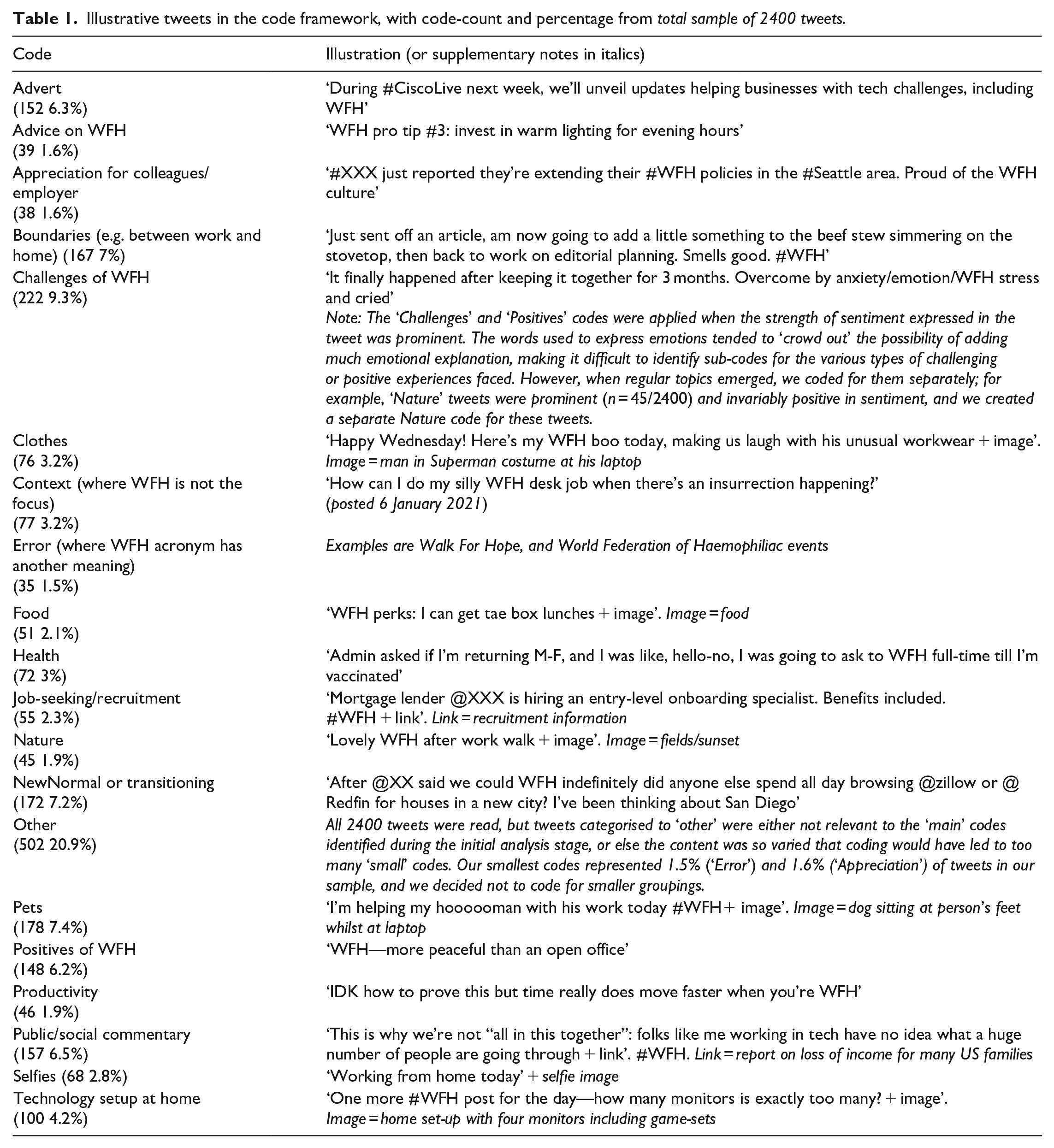
Shared experiences of COVID-19 and social lockdowns brought the acronym ‘WFH’ into common parlance during 2020, and shaped its usage and prevalence on Twitter. Our code framework with illustrative tweets is presented in Table 1. The framework originally contained 25 codes, but during initial analysis, we merged some codes (e.g. PETSatHOME and PETStalking) and deleted others that were seldom used (e.g. WFHvsOFFICE). Twenty codes remained, and each tweet was assigned a code that indicated its dominant meaning. Illustrative tweets have been lightly amended to reduce the possibility of ‘back-searching’ for the tweet. Occasionally (and where indicated), the original text is used without amendment where the tweet was from an organisation or seemed intended for a wide, public audience.
Illustrative tweets in the code framework, with code-count and percentage from total sample of 2400 tweets.
The prevalence of each code is represented in the stacked chart in Figure 1, representing the most-liked 200 tweets for each of the 12 months in our sample of 2400 tweets. The relative prevalence of codes within any particular month reflects the external environment to some extent. For example, the first data month was January 2020 dataset from a pre-COVID world. WFH is mentioned in relation to #snowdays, a reminder that occasional working-from-home has other justifications such as bad weather. January 2020 has the highest coding to Job-seeking/Recruitment, where adverts often relate to jobs in technology or freelancing, which have enjoyed WFH norms for decades. This month also has more coding to tweets to Positives-of-WFH, perhaps because at this point it was a flexible perk, rather than part of an enforced lockdown.
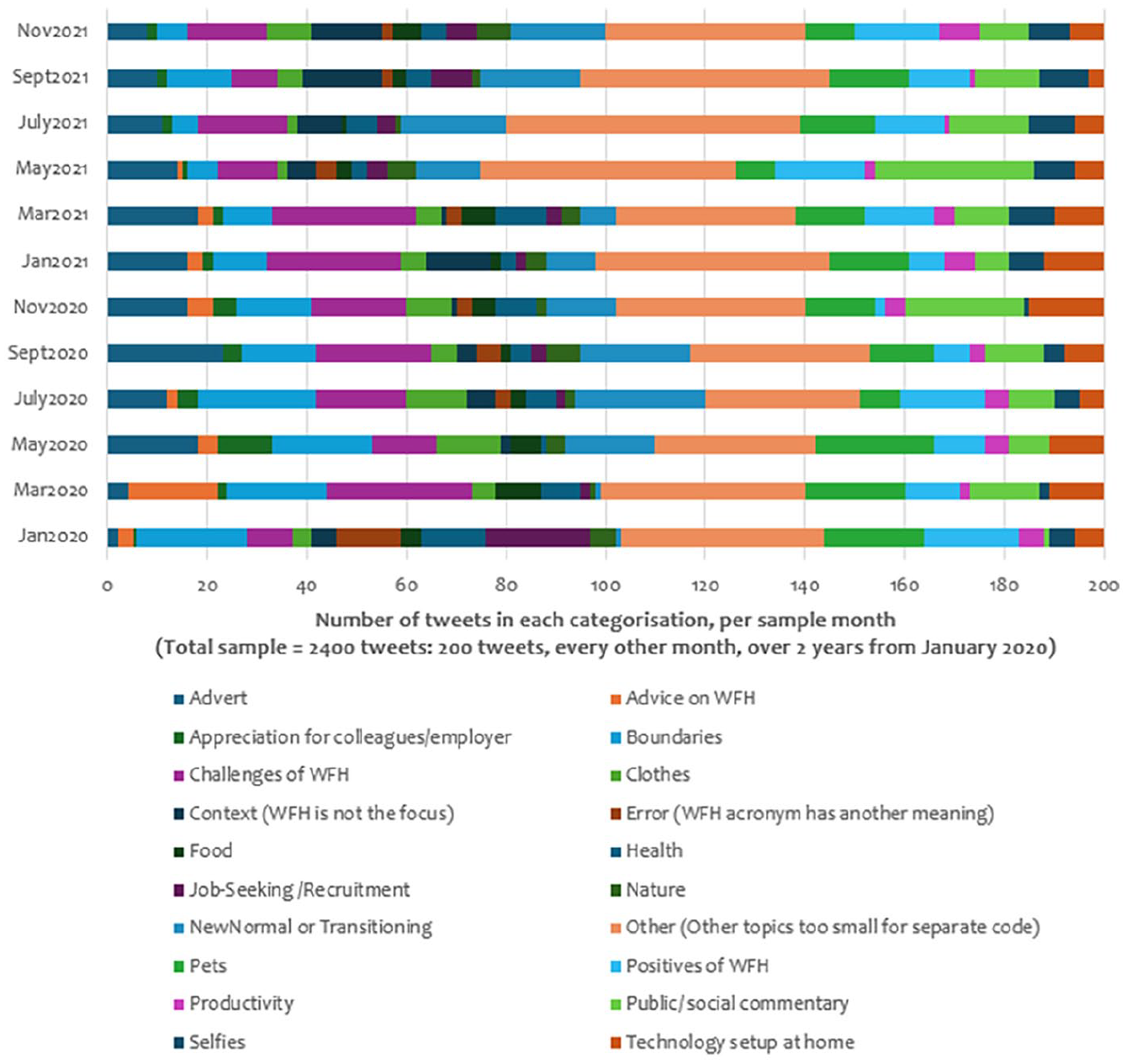
Categorisation of tweets with ‘WFH’ in 2020–2021 (Coloured stacked chart).
In March 2020, many employers initiated WFH arrangements for those who could do so. On Twitter, the March 2020 dataset has one of the highest number of Challenges-of-WFH tweets. Many issues were cited, either directly or through ironic ‘shorthand’ as is typical in microblogging communications. Issues included distractions, boredom from being confined to home, cramped home-office spaces, the complexities of WFH while home-schooling children, isolation, missing work teams, and depletion of organisational belonging. March 2020 also saw a spike in Advice-on-WFH tweets, but the numbers quickly dropped thereafter. Advice seemed to be offered by those with years of WFH experience, who signposted their tweets using hashtags such as #NewtoWFH.
In May 2020, the number of WFH Adverts tweets began increasing, and remained high throughout the 2-year period. Adverts came from businesses such as Logitech, Cisco and Oracle advertising their WFH-relevant technology products, or from commercial or media organisations advertising news articles. May 2020 saw the highest number of tweets coded to Appreciation-for-employer and to Clothes, with the latter invariably including an image. May 2020 was also a starting point for tweets coded to NewNormal-or-Transitioning (‘NNT’). NNT tweets were reflections on the changing times or on possible implications such as trends in residential relocations out of cities, but were not overtly political enough to be coded to PublicSocialCommentary, which is discussed in the third theme of this section.
The spikes in tweets about WFH advice, ‘new normal’, and challenges or positives of WFH emerged alongside a steady stream of tweets on ostensibly more mundane topics, such as WFH food, nature, home set-up, and pets. The majority of these tweets comprised a short text plus an image—often a photo taken by the tweeter, or a link to an adapted meme. These tweets were generally positive in tone, short, simple and dependent for their interpreted meaning on an uploaded image. Their purpose seemed to be a friendly reaching out to others, a gesture akin to what Zappavigna (2011, 2013) calls ‘ambient affiliation’. Another frequent topic in 2020 (but which declined in relative importance during 2021) was Boundaries. Tweets allocated to this code were fairly light-hearted, indicating an integration of work and life activities, or the negotiation of boundary cues with pets or household members.
During 2021, two further trends in the journey of ‘WFH’ tweets were noted. January 2021 saw the first spike in tweets coded to Context. In these tweets, the message included the acronym WFH, but the term was used to evoke background context rather than to talk about WFH as such. The term ‘WFH’ had become normalised as a contextualising descriptor. The second trend was more pronounced and seemed to reflect a rising tide of commentary about the socio-political implications of changing expectations about working arrangements, bridging personal experiences to those of society more generally (an indicator of everyday political talk discussed in Graham and Hajru, 2011). Tweets coded to PublicSocialCommentary (PSC) were relatively high in March 2020 (when COVID-19 was pronounced a pandemic), in November 2020 (when the second lockdown was announced in the United Kingdom), and then later in the spring and summer of 2021. As discussed in more depth in the next section, the PSC tweets were less about expressing personal experiences of WFH; and more about commenting on social change (such as women’s home-working arrangements, or global online recruitment), or about social inequalities (such as different WFH flexibility for white-collar and other workers). Here are two illustrations from July 2021:
WFH makes it possible to uncouple salaries and metro areas, moving out of city limits -this could be a geographic redistribution of wealth and ideology that save Small Town America It’s cool that people are talking about permanent WFH and 4-day weeks, but excuse me if I’m unenthusiastic about white collar gains whilst retail workers regularly have 9-day weeks and irregular hours
In summary, alongside a steady stream of relational tweets and phatic communication over the 2-year period, the WFH acronym quickly became commercialised and mainstreamed (with the rise of tweets coded to Adverts and Context). More importantly for this article, tweets increasingly crossed over from personal tales of the WFH experience towards socio-political commentary, a trend discussed more fully later.
Reaching out for ambient affiliation
This section develops the argument that the dynamics between technological features of Twitter (such as character-length constraints and hyperlinking), imagined affordances (such as visibility, persistence, and association, see Treem and Leonardi, 2013), and users’ assumptions about an imagined audience (boyd, 2010; Litt, 2012) combine to encourage the platform’s use as a vehicle to seek ambient affiliation.
In our sample, WFH tweets tended to be neutral or positive in tone. There were, as identified earlier, comments about WFH challenges, but many tweets employed humour, irony and an upbeat tone, seemingly putting a ‘brave face’ on the difficult situations triggered by COVID-19. This tweet from July 2020 indicates a reluctance to (just) express negative emotions: ‘whining about wfh life is the worst, but i miss being able to print out stories and edit drafts in pen way more than i should’. One possible reason for resisting ‘whining’ is that Twitter users were attempting to negotiate a cultural trauma in a way that builds social resilience. Eriksson (2018) argued that social media platforms can function as a counterbalance to the risk-centred and sensationalist reporting found in traditional media outlets, and illustrated this point with a case study of the 2017 Stockholm terror attack. The case study explored how the hashtag #openstockholm was used, and found that much of the content with this hashtag had a ‘light-hearted tone, flouting the conventional trauma discourses of grief and sorrow’ (Eriksson, 2018: 3980). The ‘social resilience’ argument is feasible, but if applied in our WFH case study, we might have expected more tweets of the kind coded to AdviceOnWFH, which were supportive and offered practical advice to newcomers to WFH. Yet, in our sample, there were only 39/2400 Advice tweets, of which 18 were in March/2020.
Another possibility is that users were engaging in social media practices designed to seek ambient affiliation with an imagined audience. The tweets coded to Clothes, Food, Nature, Pets and TechSetUp epitomised such practices, and together accounted for 450/2400 of our sample. Typically, the tweets acknowledged a socially shared WFH experience with a short, simple comment accompanied by an easily-likeable image. A typical Clothes tweet had a picture of the tweeter in office-top and pyjama-bottoms—a duality experience shared by many others—and seemed a simple, gentle way of reaching out and connecting with an imagined audience. No-one was likely to be offended by such a tweet; more likely, the tweet would attract swiftly-given ‘likes’ as a reciprocal gesture of acknowledgement and affiliation. Pets tweets also fulfilled this affiliation function. Comments were invariably packaged with a cute photo of dogs or cats, designed to elicit a doe-eyed response among the audience. Nature tweets were a similar trope.
This groups of tweets were not designed to elicit a complex response that would generate an informed discussion. Instead, tweets were friendly and anodyne. They carried low downside risk which is important to users because, as Bail (2021) has suggested, we have become ‘addicted to social media’ (p. 10) as it helps us to present different versions of ourselves, and maintain (or at least not harm) our social and relational status. In general, Twitter’s affordances seemed to encourage ambient affiliation as follows: technological features (the character-limit constraints, and the possibility to hyperlink to an appealing or emblematic image) combined with the affordances of visibility to imagined audiences, interact with a user’s socialised desire for ‘likes’ with the effect that tweets seeking ambient affiliation are self-censored to avoid controversy, and are more phatic than informational.
However, the prevalence of phatic communication that is relational but non-informational has problematic implications. Miller (2017: 251) warns that the rise of phatic culture has atrophied the potential for social media communications to foster engaged, content-driven dialogue of the type advocated by Habermas for a deliberative democracy. Miller’s argument resonates with Malinowski’s (1923) comment that phatic communications are ‘neither the result of intellectual reflection, nor necessarily arouse reflection in the listener’ (p. 315), and risk generating ‘idle talk’ (Heidegger, 1962) which closes off efforts at authentic understanding (Miller, 2017: 262). However, the final theme in our analysis suggests that everyday talk with a political dimension seems to be still present, albeit constrained by the very dynamics which influence the seeking of ambient affiliation.
Expressing socio-political concerns in everyday talk
As indicated earlier, the dynamics which encourage users to seek ambient affiliation may simultaneously constrain users’ everyday talk, limiting their talk of novel and complex ideas, and especially politically controversial ideas. This is possibly because users seeking ambient affiliation worry that novel ideas are not easily-assimilated by readers who typically speed-scroll their Twitter feed, and are therefore not swiftly ‘likeable’. It is also possible that if users think ideas will be controversial and alienating for their audiences, they may mute their opinions to avoid ‘sacrifice[ing] the hard-fought status they’ve achieved in their off-line lives’ (Bail, 2021: 83). This dynamic resonates with the work of Mascheroni and Murru (2017) who found that Facebook users adhere ‘to a form of “publicness” aimed at neutralizing conflicts’ (p. 1). However, intentionally hostile individuals—and especially those who engage in status-driven risk-taking (see, for example, Bor and Petersen (2022: 15))—might not be motivated to engage with social issues such as working-from-home, preferring instead to do battle with partisan politics.
To examine the more political dimension of everyday tweeting, we analysed tweets about working-from-home coded to PublicSocialCommentary (‘PSC’; n = 157). These had a socio-political tone, meaning that the tweet indicated the relevance of an issue to society and the broader community of citizens and ‘body politic’. We were interested in how the political dimension of everyday talk manifests on Twitter in order to discern how the dynamics between the platform’s affordances, imagined audiences, and users’ tweeting practices might be shaping the direction and substance of such talk. PSC tweets were present throughout our 2-year dataset, with peaks in November 2020 (the month of the United Kingdom’s second lockdown), and May 2021. These tweets went beyond expressions of personal experiences to move into socio-political terrain: making assertions, reacting, responding, taking stances, or raising issues that had wider social resonance. Three sub-categories were identified within this group of tweets.
The first were tweets making short textual assertions about socio-political implications or issues related to WFH. Here are two examples:
How many new close relationships have you created using zoom, etc? It’s hard. It’s possible that WFH is consuming stock-piled social capital and will worsen over time (May/2020) The thing about this WFH thing isn’t ‘great I can move to a lower cost city and earn the same salary!’ It’s that companies will now hire cheaper labor from outside the US. (March/2021)
The second sub-category included tweets that responded to articles in the mainstream media. The linked articles often took provocative stances about WFH and the implication for workers or managers, quite possibly as a strategy to encourage the viral sharing and commenting on the article. For example, May 2021 saw a slew of tweets responding angrily to a Wall Street Journal article which headlined a comment from the CEO of WeWork (a workspace solutions business) asserting that only the least-engaged employees want to WFH.
12
Another provocation was a Deutsche Bank report in November 2020. The headline statement that employees who WFH should pay more tax was relayed in the Guardian
13
and other media channels. Typical responses were these:
@XXX So Deutsche Bank thinks WFH is cost-free then? No extra costs from buying tables, chairs and other equipment . . . The last time bankers had a bright idea they crashed the world economy Sorry, but since March I have WFH, and I’ve shifted from spending on trains/coffee to local independent businesses, such as cafes, bakers and grocers. How is that not contributing? + link to the article
Tweets in the third sub-category contained links to photos or videos that powerfully symbolised particular aspects of broader socio-political issues associated with WFH. It is likely that the imagery was already emblematic for an audience that then liked, commented, or re-tweeted in response. We identified some instances of tweets in this sub-category being picked up by mainstream media channels and used to launch a debate about the broader issue (i.e. our sample contained some of subsequent tweets which referenced to media channel’s article). Although the original tweet was not necessarily in our sample data, popular tweets that mentioned the original sometimes were. One example is the tweet from Gretchen Goldman on 15 September 2020, picked up in our dataset through a journalist’s tweet. The following is quoted verbatim as the tweet was likely intended for wide public consumption:
Fortunate to talk with scientist, mother and social media hero @GretchenTG on why she tweeted a photo of her real-world wfh life. My latest from @DeseretNews. https://t.co/RyFoWQ4NH8
The link is to a news article of the interview entitled ‘Science mom’s work-from-home tweet goes viral as she advocates for struggling parents’. At the top of the article is her tweet which includes two contrasting photos: one shows her headshot during her CNN 14 interview about climate science, looking professional in a yellow shirt and with a serene background in her home; the second is a photo of her, taken from the far-side of the room and showing the full messiness of children’s toys, the awkward way Gretchen had to position her laptop and body in order to get the right webcam shot, and her ‘below-screen’ clothing. As she explained in her viral tweet (with 282,500 likes), ‘Just so I’m being honest #SciMomJourneys + link to the photos’.
Another example was posted in July 2020 by the health policy research centre of the London School of Economics (a UK University), about a BBC interview with one of their researchers. The video clip showed the researcher being interrupted by her young daughter, who also interacts with the BBC interviewer. The tweet is given verbatim:
The #lockdown has made parents across the country all too familiar with the challenges of juggling home working with childcare. We are ever inspired by @clarewenham and her ability to discuss complex #covid19 research and parent simultaneously! #wfh #keepingitreal #research https://t.co/xBDbRNBUc7
In addition to the tweet quoted earlier from the London School of Economics, five other tweets in our sample referred to the video. Comments indicated that this event was emblematic of WFH dilemmas, and some tweets seemed to advocate that attitudes and social norms (e.g. about what constitutes professionalism for working parents) should change. Here are two of the five comment tweets in our sample:
This is brilliant. Every WFH parent will understand. The negative tweets saying it’s unprofessional have no concept of juggling work and caring responsibilities + link to video Honestly I can’t get enough of these news clips of WFH life. It’s all so HUMAN + link to video
Discussion
Our study was inspired by the work of Mansbridge (1999) and Habermas (1987), and explored how the affordances of Twitter and its networked publics might shape everyday talk on the platform. Mansbridge (1999) argued for a broader understanding of deliberative democracy than the one articulated by Habermas, and she proposed that ‘everyday talk’ was an important component of democracy, an idea taken up by social media scholars (e.g. Brooker et al., 2018; Graham, 2015; Wright et al., 2015). Alongside these developments, research on social media has provided concepts and analytical lenses with which to understand the dynamics of everyday talk of social media platforms, including affordances (Nagy and Neff, 2015; Ronzhyn at al., 2023), imagined audiences (Litt, 2012), networked publics (boyd, 2010), and a relational desire for ‘ambient affiliation’ (Zappavigna, 2011). Our study contributes to this work with a qualitative interpretation of tweets, which entailed not only a reading of the text, but also an interpretation of the additional elements such as images and intertextual links.
Our analysis shows that although Twitter’s 280-character limit constrains text-based talk, the common practice of coupling text with photos, GIFs, videos and articles facilitates the reproduction of mimetic ‘shorthand narratives’ (Lyons, 2017) around emblematic issues and experiences. An example given earlier is the performance-on-screen versus reality-off-screen narrative used either humorously (such as the office-shirt + pyjama-bottoms selfie), or else to make a socio-political point (such as the selfie posted by Gretchen Goldman showing the harsh reality for WFH parents). It seems that the performance-versus-reality visual meme is intuitively and swiftly understood by users who see it in their Twitter feed, and is therefore easy to ‘like’, share or retweet while feed-scrolling—interactions which lead Twitter’s algorithms to promote the tweet on others’ feeds.
It seems plausible that this sharing of shorthand narratives may generate a sense of what issues or events matter and should be discussed in other forums such as long-form blogs that afford prolonged, reasoned deliberation. This interaction may generate a crowd-sourced prioritisation of what deserves attention. Thus, the dynamics between the technological features of Twitter (such as character-length constraints), the imagined affordances (such as visibility, persistence and association), and users’ assumptions about networked publics (boyd, 2010) may combine to shape choices about what to comment on, and what to remain silent about. Our exploratory analysis suggests that ideas amenable to symbolic representation, using images, memes, highly encoded stories or article headlines—all of which can be rapidly decoded by the recipient—are likely to travel well across Twitter, and shape topic trends. Twitter as ‘networked publics’ (boyd, 2010) thus operates akin to a public sphere in the Habermasian sense of a dynamic communicative space where ideas and attitudes evolve. However, complex ideas that need definition, reasoning and argument-development might not emerge or be amplified through user engagement such as ‘likes’.
Twitter’s mediating effect can be interpreted in light of Mansbridge’s (1999) comment that ‘everyday talk produces collective results the way a market produces collective results, through the combined and interactive effects of relatively isolated individual actions’ (p. 212). Marketplaces are not neutral. Platforms like Twitter thrive by promoting content likely to encourage users to employ the platform’s interactional functionality, such as liking and re-tweeting. For platforms, more interaction means more advertising revenue. For users, interaction from others is rewarding if it contributes to the ‘social grooming’ of phatic communication (boyd, 2010: 45). However, Bail (2021) has shown that non-extremist users avoid topics which risk upsetting their audience, a phenomenon he calls the muting of moderates.
The desire for acknowledgement (from individual users) may therefore skew everyday talk towards themes which are already well-established and easily-interpreted. In socio-political talk, this might include themes about class-division (white-collar professionals who can WFH vs pink-collar service workers who need to be physically present at work), and about the invisible realities of combining parenting with WFH. Another consequence of users’ desire for acknowledgement, however, is avoidance of controversy. This resonates with arguments from Miller (2017) who posits that the rise of phatic culture fosters ‘normative codes of politeness’ and encourages communication which is ‘increasingly devoid of substantive content and true dialogue’ (p. 261); in other words, users who want ‘likes’ are more likely to post tweets containing narratives that already have a wide resonance and acceptability.
However, while our analysis supports the proposition that already-established WFH themes dominate Twitter, our data also show that novel instantiations of already-established themes do gain traction, such as the Gretchen Goldman selfie, or the viral video of the LSE researcher whose child interrupted her BBC interview. In this way, the breadth of a socio-political theme is extended through the mimetic shorthand narratives on which Twitter thrives. The interweaving of everyday relational and (occasional) socio-political talk on Twitter may therefore reproduce well-established political themes while at the same time expanding the illustrations and variety of ways of understanding those well-established themes. This broadening of the horizon of shared understanding is indeed one of the hoped-for outcomes in the Habermasian conceptualisation of the public sphere.
Our primary contribution in this article is to the theorisation of everyday talk on social media (e.g. Brooker et al., 2018; Graham, 2015; Lundgaard and Etter, 2023). We show how users’ desire for ambient affiliation (Tovares, 2020; Zappavigna, 2011, 2013), combined with imagined affordances (Nagy and Neff, 2015) of Twitter including its networked public (boyd, 2010), seems to encourage everyday talk which reproduces already-established political tropes, to the neglect of ideas that are novel, complex, or controversial enough to risk damaging status achieved off-line (Bail, 2021). We also make empirical and methodological contributions. Empirically, we show how tweeting practices on a topic such as WFH evolve over time. In our study, the WFH acronym was increasingly appropriated by commercial interests, or became politicised over the 2-year data-collection period. Other Twitter topics will generate different tweeting practices. Methodologically, we demonstrate the value of an interpretive approach to analysing the symbolically rich elements of tweets (and especially the visual imagery) alongside the text itself.
In presenting this study, we acknowledge that the findings are delimited and bounded: our English-language dataset is a small sample, and derived from a platform with a demographic not representative of the global population (e.g. in its dominance of North American users). Other platforms with different technological affordances may have different effects. Furthermore, there is potential value in analysing the relationship between number-of-followers and the topics that users engage with.
Twitter’s mediating power is important because it is the space for everyday talk into which step journalists, politicians and others who seek to assess the public’s mood. Therefore, more longitudinal studies to trace the interaction between everyday talk on social media, narratives in broadcast media, and deliberative talk in public assemblies would be an important area for further research.
Supplemental Material
sj-pdf-1-nms-10.1177_14614448241255562 – Supplemental material for ‘Everyday talk’ about working-from-home: How the affordances of Twitter enable ambient affiliation but constrain political talk
Supplemental material, sj-pdf-1-nms-10.1177_14614448241255562 for ‘Everyday talk’ about working-from-home: How the affordances of Twitter enable ambient affiliation but constrain political talk by Karen Handley and Shelley Beck in New Media & Society
Supplemental Material
sj-pdf-2-nms-10.1177_14614448241255562 – Supplemental material for ‘Everyday talk’ about working-from-home: How the affordances of Twitter enable ambient affiliation but constrain political talk
Supplemental material, sj-pdf-2-nms-10.1177_14614448241255562 for ‘Everyday talk’ about working-from-home: How the affordances of Twitter enable ambient affiliation but constrain political talk by Karen Handley and Shelley Beck in New Media & Society
Supplemental Material
sj-png-3-nms-10.1177_14614448241255562 – Supplemental material for ‘Everyday talk’ about working-from-home: How the affordances of Twitter enable ambient affiliation but constrain political talk
Supplemental material, sj-png-3-nms-10.1177_14614448241255562 for ‘Everyday talk’ about working-from-home: How the affordances of Twitter enable ambient affiliation but constrain political talk by Karen Handley and Shelley Beck in New Media & Society
Footnotes
Acknowledgements
The authors would like to thank Professor Nick Rumens for his valuable advice during this article’s development. We also thank the anonymous reviewers and Professor Steve Jones for their constructive comments.
Funding
The research for this article was supported by the Research Excellence Award from Oxford Brookes University.

Supplemental material
Supplemental material for this article is available online.
Notes
Author biography
References
Supplementary Material
Please find the following supplemental material available below.
For Open Access articles published under a Creative Commons License, all supplemental material carries the same license as the article it is associated with.
For non-Open Access articles published, all supplemental material carries a non-exclusive license, and permission requests for re-use of supplemental material or any part of supplemental material shall be sent directly to the copyright owner as specified in the copyright notice associated with the article.

