



Abstract
Many theorists have expounded on what serial killing says about the social in any given context and the ways in which serial killing and media are entangled, in particular, Mark Seltzer, Jon Stratton and Elliot Leyton. However, in this article, we ask, how is serial killer mythology developing in relation to participatory culture typical of our current digital environment? In scaffolding discourse analysis with theories from various literature, such as Judith Fathalla and Mark Deuze, what we find is that people’s lives as lived in media open up radically new spaces through which media publics consume, cultivate and perform knowledge about serial killers, enabling them to exercise a reconfigured sense of control over the ‘story’ of the serial killer as a myth and as a deviant Other that embodies an encounter with the uncanny.
Introduction
With the evolution of media from the late-19th century onwards the ‘spectacle’ of serial killing (MacDonald, 2013; Seltzer, 2013 [1998]) has moved beyond the realm of ‘one-to-many’ media such as print newspapers and broadcast television. Serial killing is now also distributed across the contemporary ‘many-to-many’ interactive digital environment (Boczkowski and Mitchelstein, 2021). We argue that, as a result, there is a recapitulation of the serial killer mythology through the frame of online participatory culture. The new media landscape is not merely a state of ‘having more media’. Rather, it produces a radically altered experience of being in the world, one that is collective and collaborative, inevitably shared and communal (whether through surrendering our personal information or through our participatory behaviours online) or as Lev Manovich (2009) might say, ‘this new universe is not simply a scaled-up version of twentieth-century media culture . . . we have moved from media to social media’ (p. 319; original emphasis). Through this paradigm shift, media publics perform a kind of co-ownership over the artefact of the serial killer as a cultural phenomenon. As a result, the serial killer archetype becomes, more than ever, an act of co-creation.
In our discussion, we use the figure of the ‘serial killer’ as a symbolic form, especially because we are unpacking the argument that the serial killer is not an accidental exemplar of contemporary digital culture – it is a totem upon which people can project their anxieties about a dehumanisation process experienced in today’s digital environment that produces a distinct sense of the uncanny. 1 This eerie experience is part of people’s life in media (Deuze, 2023) suffused with reminders of humanity’s potential obsolescence such as algorithmic curation, automated assistants, recommendation systems and chatbots, and ubiquitous applications of generative artificial intelligence. Our article examines the specific ways in which users are active agents in the process of co-creative meaning-making about serial killers and, further, how such engagement links to the uncanny as both an expression and consequence of lives lived in new media.
This article is not intended as a treatise on the uncanny, and therefore, we do not offer an extended grounding on the subject. Not only are its uses many and varied, but as Eben Holmes (2010) points out, The concept of the uncanny tends to bleed over into other concepts as well, like Derrida’s spectre and trace, Todorov’s fantastic, Lacan’s extimité and even the Kantian sublime, all of which leads one to believe that the uncanny as an analytic term is about as ambiguous as the phenomena it attempts to describe. (p. 256)
This is the root of the uncanny, both as theory and as experience: that it is somehow always just out of reach, an affective sensation, ever so slightly uncomfortable. Holmes (2010) explains that therein lies its ‘conceptual potency’ because the uncanny ‘cannot contain its meanings since the uncanny designates the very hole in our meaningful world [. . .] The concept of the uncanny [. . .] returns to haunt all aspects of modern life’ (p. 256). With Holmes in mind, the uncanny provides a usefully plastic application in critiquing both modern encounters with new media and the grip of serial killer mythology on society.
It is Freud’s (2003 [1919]) essay Das Unheimliche that tends to be seen as the seminal work on the uncanny (Holmes, 2010: 256), after which its theoretical and clinical uses exploded, most notably in the work of Heidegger (Withy, 2015 [2009]). For our purposes, we read the uncanny following Nicholas Royle (2003: 1) as a ‘crisis of the proper’, in which the uncanny points to and reflects those perturbations of the natural order, those things which are ‘ghostly’ and ‘commingle the familiar and unfamiliar’. The experience of the uncanny has much to do with identity and often sexuality too, in Royle’s (2003) words, ‘one’s sense of self seems strangely questionable’ (p. 1). It is this latter point that we focus on in tracing the intersection of Self and Other in terms of one’s humanity and inhumanity as provoked by the phantasm of the serial killer in media.
In digital culture, the co-creation of serial killer mythology is actioned by overlapping practices. These include streaming and binge-bonding over content (such as serial killer documentaries or podcasts on the major platforms), sharing content (trading serial killer media across multiple channels), commenting about serial killers (which fuels massive threads on YouTube and is a practice that is the raison d’etre of Reddit subs like r/serialkillers), creating amateur content (which is particular to platforms like YouTube and TikTok), as well as remediating or remixing content into memes and other forms of creative expression online, which we consider in the example of the DeviantArt community. Our research fits within a burgeoning academic conversation taking these co-creative practices seriously, such as the work of Naomi Barnes (2019) on serial killer and true-crime communities on Tumblr, Grace Smith’s (2019) commentary on serial killer fandom, and in particular, Judith Fathallah’s (2022a, 2022b, 2024) work on ‘dark’ fandom, online murderabilia collector communities, and serial killer fan fiction. All these practices converge in the appropriation and reappropriation of modern serial killer discourses into a new media language that continues to evolve in the ever-fractalising nature of cyberspace.
While many theorists have expounded on what serial killing says about the social in any given context (Glitsos and Taylor, 2022; Stratton, 1996) and the ways in which serial killing and media entangle (Hier, 2020; MacDonald, 2013; Wilson et al., 2010), in this article, we ask, what is the contemporary new media landscape doing to the idea of the serial killer as it is related to media publics? And how is serial killer mythology developing in relation to participatory culture typical of our digital environment? What we find is that people’s lives as lived in media open up radically new spaces through which media publics consume, cultivate and perform knowledge about serial killers, enabling them to exercise a reconfigured sense of control over the ‘story’ of the serial killer as a myth and as a deviant Other that embodies an encounter with the uncanny.
Below, we also argue that the will to exercise some form of control over the serial killer archetype may also have something to do with diffusing the threats posed by the serial killer. There are two threats here. The first is the obvious risk of serial killer violence. The second is what the serial killer represents for culture – a loss of humanity in an ever-globalising and anonymising community of actors. If the zombie was an allegory for the ‘mindless appetite’ of late-stage capitalism (see Lauro, 2017; McNally, 2011), then perhaps the serial killer is the ‘poster boy’ 2 for a seductive but ostensibly ‘dangerous’ digital world. The serial killer represents digital culture in many ways, for example, at once cold and detached (a common fear for media consumers about losing ‘the human touch’ in lieu of avid techno-consumption) but simultaneously aggressively intimate, affectively working its way into our most private and vulnerable of spaces. The new media obsession with the serial killer archetype betrays deep-seated cultural anxieties about the limits and borders of humanness. The repeated and spectacularised image of the serial killer has everything to do with contemporary anxieties about technology – which manifest on the very platforms that provoke them.
This research uses qualitative language analysis and visual analysis of user-generated materials such as comment threads and fan art. To pursue our argument, we synthesise existing literature – particularly the work of Judith Fathallah – with notable examples from users that congregate on YouTube, Reddit, and DeviantArt. While we acknowledge that each of these platforms has unique affordances and particular interface cultures (Johnson, 1997), it falls beyond the remit of this article to explore their distinctness in detail. As a taxonomical framework to guide the discussion across the various digital sites, we deploy Mark Deuze’s (2006) three principal components of participatory culture laid out in ‘Participation, Remediation, Bricolage’. We point to specific examples throughout our argument for illustrative purposes. It should be noted that we have drawn only from publicly posted data to showcase examples from each of the various platforms. This use does not breach the platforms’ terms and conditions, nor does it infringe on the users’ acceptance of the terms and conditions of use. As Fathallah (2022a) makes clear, these forums ‘are public domain and usernames [can] legally be cited without permission’ (p. 6). We do not individually cite usernames in the article; however, we also do not change the directly quoted source material (so tracing quoted material back to a username is technically possible). Ethically, we follow Fathallah’s (2022a) thinking on this issue, in which exact quotation is expressly used to ‘balance a deontological commitment to the users’ privacy with a pragmatic commitment to the research’ (p. 6), in that paraphrasing a quotation can change its meaning of the text. Finally, we concede that our perspective is Western-centric, in that the examples and literature cited are drawn from English-language sources. There is scope to extend this project to form a comparative analysis across different linguistic and cultural landscapes, which would certainly yield depth considering that serial killing is considered and discussed quite differently around the world.
Serial killers in our media midst
Specifically, this article looks at the intersection of the serial killer with the public as it is produced through media. Drawing on the literature, we first explore how the serial killer construct sits within public consciousness and what that has to do with the media apparatus through which the serial killer comes to be known. We build our argument mainly through references to Anglo-American media, while acknowledging that in today’s digital environment, people’s engagement with the serial killer has gone global.
The serial killer evolved through different media iterations – from a celebrity of the newspaper tabloid to the spectacle of the television, to a ‘public property’ of the new media apparatus. If Jack the Ripper was our first ‘celebrity’ serial killer (Schmid, 2005), then we could say he was celebretised through the medium of the newspaper, with writers such as David Schmid explaining how newspapers would ‘resort to the language of gothic melodrama’ (p. 33) to tell the story of the Ripper. Jack the Ripper was a function – nay a product – of the burgeoning tabloid age. Charles Manson, 3 we might then say, was to television what Jack the Ripper was to newspapers – Manson exploded into public consciousness within the historical moment of the rise of colour television across the United States, and concomitantly, with the media obsession with celebrity, ‘especially “bad” celebrities’ as Mark Goodall (2012: 159) put it. These figures are therefore not just a product of context, but a product of media.
Modernity: serial killers in print
We take the Modern, or solid modern era, as extending from the mid-19th century to the end of the Second World War. It should be noted, however, that prior to the 1970s, the phenomenon we now brand as ‘serial killing’ was not so named, at least not in the popular understanding of the term. Mark Seltzer (2013 [1998]) explains, in his extended work on the topic, ‘The “technical” definition of the serial killer as a kind of person became available in the mid-1970s, with what FBI agent Robert Ressler called a “naming event”: the coining of the term “serial killer”’ (p. 108). 4 After the Ripper murders of the 1880s in London’s Whitechapel district, the phenomenon began to take firmer shape in language and in the media (see Warwick, 2006), but for the most part, serial killers of Modernity were usually referred to as multiple murderers (Leyton, 1986).
We take Jon Stratton’s (1996) work as a point of departure, in which he argues that the evolution of serial killing is a discursive construct that follows the emergence and ‘experience of the social’ (p. 77). Stratton takes cue from the earlier work of Elliot Leyton, who also illustrates how one of the primary functions of the modern multiple murderer construct, 5 particularly as it was produced through the media, was to maintain and regulate morality and the dominant social order, reducing people to the service of industry, of becoming part of the masses migrating to burgeoning cities. Serving as an extension of ideology, serial killers helped carry out ‘the prevailing “need” of the era’s economic formations [. . .] to discipline the lower order into accepting the timetable of the machine and industrial employment’ (Leyton, 1986: 276). This argument is advanced by reflecting on the media coverage of Jack the Ripper – a figure cast in popular culture as the ‘“father” of modern sex crime’ (Curtis, 2008: 254). Put succinctly by Perry Curtis (2008), Ripper news stories ‘brought to the fore some of the most troubling social and moral issues of the day’ (p. 253). Curtis (2008) writes, ‘the East End horrors’ were ‘a media event’ (p. 253), which is to indicate that the newspaper controlled and shaped the relationship between the media public and ‘the killer’.
Another example of this relationship, this time in turn of the century Australia, is the case of Martha Rendell. Despite major protestations of her innocence and the dubious evidentiary support presented at court in 1909, Martha Rendell was the last woman to be hanged in Perth, Western Australia. She was convicted of the murder of her stepson, and ‘in the public mind, of the murder of her two stepdaughters as well’ (Haebich, 1998: 66), positioning her as a serial killer in our typical definition of the construct. In her work on the media coverage of the Rendell case, Anna Haebich (1998) illustrates how the newspaper built a relationship between the ‘wicked murdering stepmother’ and the media public – so much so that the ‘public obsession with the case’ culminated in ‘large crowds that assembled before the coronial inquiry to catch a glimpse of Rendell and their calls to “tear her to pieces”’ (p. 75). Cast as the evil paramour (unmarried and therefore ‘living in sin’ with the father of her stepchildren), in the words of Anna Haebich (1998): Rendell fitted turn of the century constructions of bad mothers and pathology. As such she could expect no sympathy from a society obsessed with respectability, morality, and good mothering. In fact, her trial played a role in fortifying these ideals. (p. 69)
Martha Rendell functioned like a fable character, a visible marker onto which the public could performatively reject and manage the threat posed to the social order by the moral outcast. In Haebich’s (1998) estimation, the colony’s newspaper, The Truth, ‘played a major role in fuelling gossip and passions in the community to the point where neutral debate was impossible’ (p. 73). The newspaper of the Modern functioned as a fulcrum of relations between Rendell and the public’s role in managing the threat of the ‘wicked stepmother’ serial killer.
The social is not a natural or essential formation, it is an always contested imaginary that must be continually reified by practice in order to sustain itself. As illustrated earlier, one of these practices is that of serial killing, and the media coverage (and construction) thereof. Stratton’s (1996) scholarship on this idea confirms the ways in which, ‘The modern experience of serial killing, of murder with a social rather than an individual motive, was only possible within the deployment of the social and served to reinforce the social’ (p. 83). Crucially, serial killing can only function in this way for the public if given life and breath – if mediated. The social imaginary, in the Modern era, was defined by and through its relationship to the newspaper as much as in its explosive urbanisation, thus forming a triangulated relationship between the serial killer, newspaper media and the media public.
Postmodernity: serial killers in living colour
The icon of postmodern mass media is the television. With the shift from the static imagery of the newspaper to the spectacularised moving image – serial killers were reborn in living colour. As a result, during this post-War period, the function of the serial killer construct evolved and became, more than ever before, a function of ‘media spectacle’ (Stratton, 1994: 7). The strategies of television formats find eery parallels to the techniques of serial killer ritual, as Mark Seltzer (2013 [1998]) writes, ‘Repetitive, compulsive, serial violence . . . does not exist without this radical entanglement between forms of eroticized violence and mass technologies of registration, identification, and reduplication, forms of copycatting and simulation’ (p. 265). While still retaining the Modern’s concern with order and morality, the site of the serial killer is also invested anew.
Since at least the late 1960s, with the ubiquity of colour television across the domestic sphere, media primed mainstream culture for the popularity, fascination, and endless imagery of the serial killer (Stratton, 1994: 7). The site of the serial killer became a locus onto which media publics could project their own pathology, and emergent languages about perversion and trauma came to the fore. As such, the ‘serial killer’ becomes a far more somatic threat to the media subject in this era (see Seltzer, 1997: 3), both reminding people of their corporeality as well as confronting them with its dismissal at the hands of these murderers. The visceral engagement between publics and celebrities that was fostered during this era certainly intensified this relationship. David Schmid (2005) explores this phenomenon in his work Natural Born Celebrities: Serial Killers in American Culture in which he argues that The combination of increased visibility and heightened aura go a long way to explain the enormous impact of the Hollywood star system when it emerged in the early years of the twentieth century, but the changing nature of fame orchestrated by developing media technologies was also conducive to making celebrities out of other groups, including criminals. (p. 13)
This is exemplified in the case of Charles Manson whose notoriety skyrocketed after and as a direct result of the Tate-La Bianca murders. Manson understood, shrewd and strategic as he was, that ‘by attacking the famous, you become famous’ (Schmid, 2005: 10). Television culture providing the necessary grounds for the production of violence as celebrity spectacle. Furthermore, with a pathological repetition of the subject of serial killing in the form of television news, true crime documentaries, and ‘serial crime drama’, the public comes to fetishise the serial killer as, ironically, the serial killer fetishises the victim. Brian Jarvis (2007) pinpoints this argument in his work ‘Monsters Inc.: Serial killers and consumer culture’ and notes the irony of serial killer consumer culture where ‘fans’ ‘avidly build collections which mirror the serial killer’s own modus operandi of collecting fetish objects’ (p. 27). We agree with Jarvis (2007) that it would be too simple to ‘dismiss this phenomenon as the sick hobby of a deviant minority’ and rather understand it as ‘merely the hardcore version of a mainstream obsession with the serial killer’ (p. 327). Following which, Jarvis (2007) argues that ‘the serial killer is unmasked as a gothic double of the serial consumer’ (p. 326). Again, we would argue that the serial killer of the 1960s onward, as represented (and promoted) in mass media culture, can also be seen as exemplary of this era’s relative affluent and peaceful nature and the rise of consumer culture, as the middle-class flocked to the (generic, lifeless) suburbs and shopping malls of major metropolitan cities around the world.
The ‘serial killer’ construct continued to gain currency as a manifestation, or even of ‘symptom’, of postmodern media culture itself. In Jon Stratton’s (1996) work on the connections between serial killing and the transformation of the social, he explains that prior to the postmodern period, these crimes were generalised as ‘stranger killings’ (p. 84). When FBI Behavioural Expert Robert Ressler coined the term ‘serial killer’, he admits that what was also ‘in his mind’ were ‘the serial adventures we used to see on Saturday at the movies’ (Ressler and Schachman, 1992: 33 as cited in Stratton, 1996: 84). In effect, labelling serial killing and serialising it on television and film also brought it, like murder back into the home – where it belongs (as Alfred Hitchcock is famously quoted in an interview with the National Observer of 15 August 1966). This is, as Stratton brings to bear, a key semiotic relationship between the mediatisation of serial killing and the act itself. He writes, The connection of serial killers with film serials condenses in one image the importance of repetition, the importance of spectacle and the importance of the excessive – melodrama as a characteristic of the serial form – in the mythic construction of serial killers. (Stratton, 1996: 84)
The mythologising of the serial killer through postmodern media, in many ways, led to the conflation of the mythic with the abject, the grotesque with the sensational, and the tragic with the iconic. This is also what led to the glorification and even glamorising of serial killers that some commentators have condemned (The Late Show with Stephen Colbert, 2019). Regardless of problematic ethical implications, late century broadcast models set the tone and conditions for the mediatisation of the serial killer on new media platforms and practices, to which we now turn. Framing a historical narrative for the ways in which media publics come to engage with the serial killer as people get corralled into the social, as a multitude in part produced by the mass media of their time – newspapers, television and today’s Internet – we offer our argument about contemporary iterations of this process in new media contexts through the lens of participatory culture particular to our digital environment.
The serial killer in new media and participatory culture
We use the three principal components of digital culture (Deuze, 2006) as a framework to identify the ways in which serial killer discourse get appropriated in modes specific to the digital environment. According to Deuze (2006: 16), Internet users:
[Are] active agents in the process of meaning-making (we become participants).
Adopt but at the same time modify, remix and thus reform consensual ways of understanding reality (we engage in remediation).
Assemble particular versions of such reality (we are bricoleurs).
It is important to note that none of these acts are necessarily deliberate, voluntary or intentional. We co-create the digital by the very fact that we are online, as our personal information fuels the datasets upon which algorithms decide what will happen next, in effect creating somewhat unique experiences and realities for each user. We synthesise each of these three components with our argument to illustrate how people use digital media to transmogrify the serial killer into something malleable, fluid and co-created, and in turn, into something that allows people to come to terms with their comprehensively mediated and, to an increasing extent, automated experience. This experience, we argue, is emblematic of uncanniness; a feeling fundamental to the human condition which we cannot help but experience vividly when confronting the serial killer.
Our digital environment adds a particular dimension to the uncanny regarding serial killers, as our lives as lived in media (Deuze, 2023) provide a near-constant immersion in sensations of dehumanisation. This, for example, comes into sharp focus in contemporary debates about the impact and consequences of generative artificial intelligence (AI) sooner or later replacing many, if not most humans. Also, on a more mundane level, in media, we realise we can be read as mere aggregates of data, such as when an online advertisement tells us about a product or service we were just chatting or emailing about with a friend; or when a streaming service suddenly recommends a movie or song from our intimate past. In such instances, the machine seems to really know us as a unique and indivisible person, yet it ostensibly cannot and does not care – much like the ways in which serial killers exploit their ability to ‘understand’ other humans despite their total lack of empathy for them. Like the serial killer lurking in the background of the social fabric (and thereby, in media, constitutes the social), life in a digital environment fundamentally entails a near-constant negotiation with the non-human as agents or actants in our personal lives. It is perhaps not too abstracted to argue that much of what people do in media can be considered as an expression, nay a coping mechanism, to deal with the progressively dehumanised or non-human way in which we live our lives – especially given our contemporary always-on digital environment. People’s love for – and sometimes problematic use of – social media and platforms can be seen as another way in which we try to come to terms with the uncanniness of existence in the context of life in media (Deuze, 2023).
Collaboratively making (and unmaking) the serial killer
As per Deuze’s first component of digital culture, we argue that users are active agents in the process of meaning-making about serial killers. While a recognition of people as ‘active’ audiences in media culture is well-established in cultural and media studies, the new media context includes users’ (inter-)activity as a material affordance as much as an affective practice. Consider the new style of public commentary that exercises a kind of ‘public ownership’ over the ‘social problem’ of serial killing in ways that traditional media did not and could not. Commenting on serial killers fuels massive threads on nearly every social platform, the most notable of which are perhaps YouTube and Reddit, where one can witness raw and unfiltered conversations (some more coherent than others). Partly, this phenomenon stems from the near-zero gatekeeping mechanisms on new media platforms, especially in comparison to legacy media formats, for example, letters to the editor in print newspapers that would be strictly limited by space, as well as carefully selected and curated. Users can also participate in these threads as anonymously (or as visibly) as they wish, a choice that provides another dimension of control over the practice.
Understanding why and how YouTube extends users’ agency in the process of meaning-making is complex and challenging. First, noted by Dhiraj Murthy and Sanjay Sharma (2019), there is a ‘paucity of academic studies exploring YouTube’s comment space’ (p. 192). Second, as Burgess and Green (2013) point out, even though the YouTube platform ‘differs from other social media sites, in as much its “community” is less cohesive and not centred on the individual profile page’ (because it is primarily a broadcast platform), ‘there are a range of other embedded forms of interaction and communication between users’ (p. 194). The authors point out several examples of how this network functions, for example, responses to existing videos can occur by uploaders producing their own videos [and] in addition, each video page has a space for responses via open-ended textual comments. This can involve interactions between the uploader and viewers, and includes the capacity to ‘up- or down-vote comments, in addition to reporting abuse or spam. (Burgess and Green, 2013: 194)
We would add to this list the ability to share and embed YouTube videos on every other platform or messaging service seamlessly and effortlessly. As a result of these convergent mechanisms, YouTube has become an incredibly powerful and impactful social phenomenon, essentially a ‘high volume website, a broadcast platform, media archive, and a social network’ (Burgess and Green, 2013: xvii) and as such, YouTube is ‘a communicative space and a community’, (p. 69) which ‘exemplifies online participatory media with its potential for creativity and civic exchange’ (Murthy and Sharma, 2019: 194). We would add, therefore, YouTube is a ‘media public’ especially because it is a loosely knit co-creative practice.
As such, we also argue that this particular media public conveys a collective sensibility of the uncanny. Let us consider the top two results sorted by ‘view count’ for the search term ‘serial killer documentary’ on the YouTube platform (at the time of writing): ‘Inside the Mind of Jeffrey Dahmer: Serial Killer’s Chilling Jailhouse Interview’ (Inside Edition, 2019) and ‘Ghosts of Highway 20’
6
(The Oregonian, 2019), both of which boast more than 37 million views each. The Dahmer interview video alone hosts more than 70,000 discrete user comments. When sorted by ‘popularity’ (ranked by ‘likes’), the top three comments on this video (as at 27 March 2023) are as follows: The fact that he is so aware and still did it is absolutely terrifying. (51k likes) It’s terrifying how calm and normal serial killers seem, you just never know. (7.5k likes) This interview is literally insane. The way he’s able to recognize the bizarreness with such clarity but at the same time almost be completely detached from the carnal side of himself. Very strange man, it’s like he’s split in two mentally. (3.2k likes)
Each of these top comments separately but distinctly bring into play the notion of the uncanny: the unsettling feeling that the once well-known, familiar and reliable fabric of reality – whether another person, specific social relations, or people’s sense of belonging to a community – has become strange and uncomfortable. 7 As both Freud and Heidegger have argued in different ways, the first focusing on the uncanny as a feeling, the second on its ontological status (see Withy, 2015 [2009]), the experience of uncanniness runs to the heart of the human condition. In fact, much of our actions and behaviour in life revolve around reducing, downplaying or altogether ignoring the uncanny, yet it is always there. The uncanny is waiting to be discovered, acting as a source of estrangement that makes us instantly aware of the fact that who we (think we) are, how things (are supposed to) function, and what all of this means is simply just an act of sensemaking that is essentially arbitrary, and permanently unstable. It is at this nexus that we meet the figure of the serial killer, as the comments above demonstrate, this is the place where the human figure is both monstrous and ‘calm and normal’, the place where the human figure is ‘split in two’ (the other half clearly comprising a non-human, unfeeling and therefore unknown entity). Here, we are forcibly moved beyond the horrors of their actions to the rather unsettling notion that these human beings can do what they do as very much part of our human community, part of us.
On this specific point – regarding the uncanny as an encounter with Self, and the notion that serial killers provoke a part of the spectrum of our own (non)humanity – we highlight further illustrative comments across highly viewed YouTube videos under the search prompt ‘serial killer documentary’ (Table 1).
User comments on serial killer documentaries. a
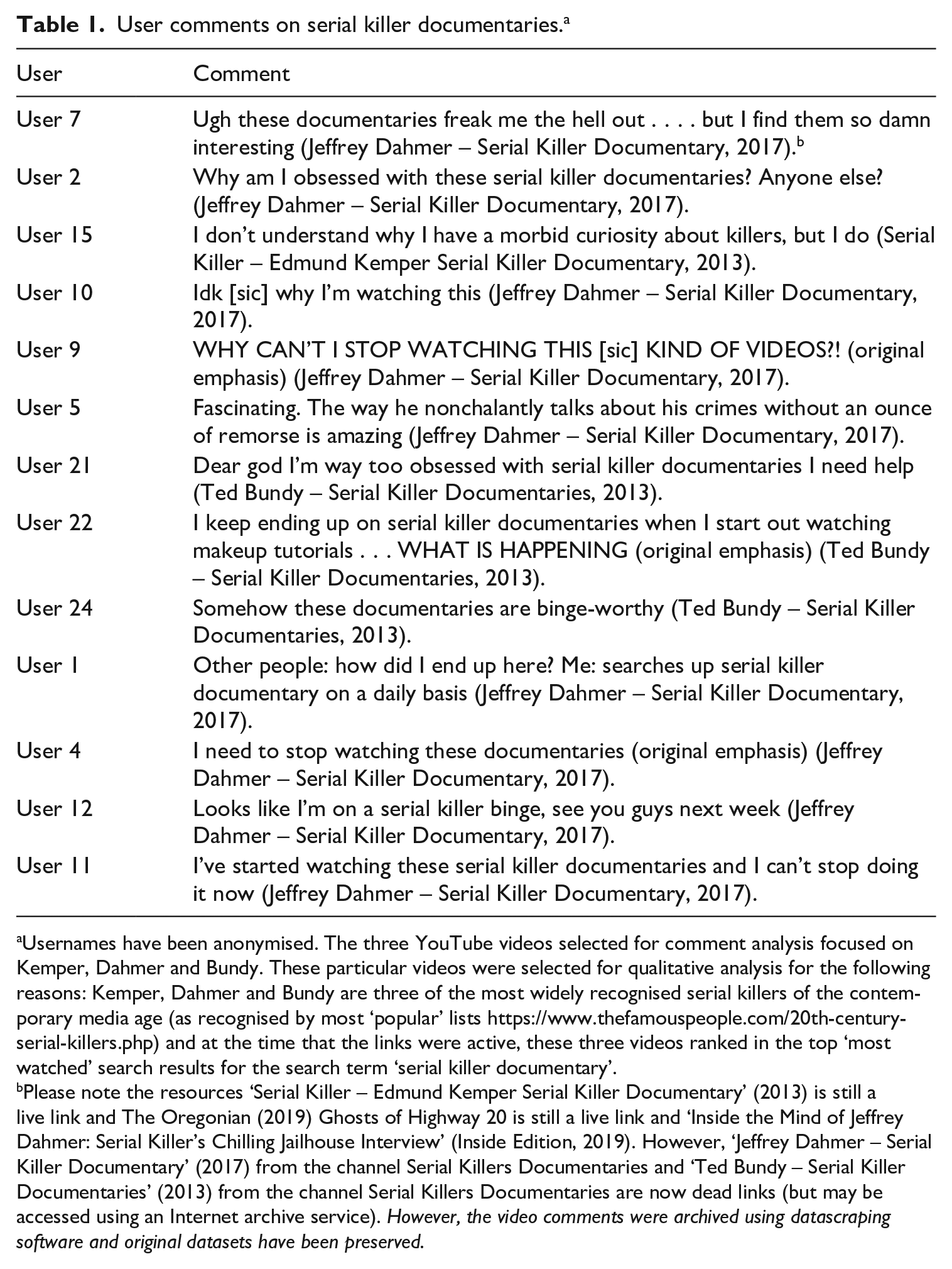
Usernames have been anonymised. The three YouTube videos selected for comment analysis focused on Kemper, Dahmer and Bundy. These particular videos were selected for qualitative analysis for the following reasons: Kemper, Dahmer and Bundy are three of the most widely recognised serial killers of the contemporary media age (as recognised by most ‘popular’ lists https://www.thefamouspeople.com/20th-century-serial-killers.php) and at the time that the links were active, these three videos ranked in the top ‘most watched’ search results for the search term ‘serial killer documentary’.
Please note the resources ‘Serial Killer – Edmund Kemper Serial Killer Documentary’ (2013) is still a live link and The Oregonian (2019) Ghosts of Highway 20 is still a live link and ‘Inside the Mind of Jeffrey Dahmer: Serial Killer’s Chilling Jailhouse Interview’ (Inside Edition, 2019). However, ‘Jeffrey Dahmer – Serial Killer Documentary’ (2017) from the channel Serial Killers Documentaries and ‘Ted Bundy – Serial Killer Documentaries’ (2013) from the channel Serial Killers Documentaries are now dead links (but may be accessed using an Internet archive service). However, the video comments were archived using datascraping software and original datasets have been preserved.
These user comments consistently point to a certain quality of the uncanny that relates to intra-subjectivity, perhaps best placed within Julia Kristeva’s (1982) reckoning in Powers of Horror, in which she acknowledges the ways in which desire (for obsessively watching the abject, in the case of the individuals above) brings about a massive and sudden emergence of uncanniness, which, familiar as it might have been in an opaque and forgotten life, now harries me as radically separate, loathsome. Not me. Not that. But not nothing, either. A ‘something’ that I do not recognize as a thing. (p. 2)
Users are both perturbed and fascinated by their own interest in this subject matter, producing discomfort and a need to reach out to others who may relate – and bring back a sense of humanity and connection. In some comments (e.g. users 22 and 9), there is a confessional tone. In this sense, the ‘digital serial killer’ brings forth the uncanny in Burgess and Green’s (2013) model of YouTube as ‘a communicative space and a community’ (p. 69) wherein people play out their intra-psychic pathologies in communal practice by using the uncanny as a fulcrum.
We lean on Judith Fathallah’s (2022a) work to elucidate the specific ways in which users are active agents in the process of meaning-making about serial killers and its link to the uncanny, which is particularly salient in her examination of the kinds of gatekeeping operations that are active in Reddit’s true crime communities (namely r/TrueCrime and r/SerialKillers).
8
While Fathallah’s focus is primarily on the gendered operations of power within these communities, the research is also useful for understanding the specific ways users join in on the production of serial killer knowledges and exercise a sense of ownership over the ‘social problem’ of serial killing. Take, for example, the ‘patrolling of borders’ about what can be said, could be said and what can absolutely not be said (with the consequence of being permanently banned).
9
Three of the nine rules for participating in the r/SerialKillers community are specifically directed to these language rules: #3. No glorification of serial killers #5. No Self-promotion / Merchandise Links / Murderabilia #9. No Writing To Serial Killers. (https://www.reddit.com/r/serialkillers/)
These rules are completely self-regulatory and independent of traditional ‘rulemaking’ structures (in the sense that there is no legal obligation). Social media language is moderated, discursive and reflexive, particularly in the ways that admins ‘moderate’ posts and can ban users who do not follow these rules.
Fathallah (2022a) explains how these particular communities attempt to ‘maintain these spaces for the right kind of interest in true crime, policing their boundaries to exclude the posited Bad Fan’ (p. 2; original emphasis) – those users who celebrate hurting others or who may show inappropriate interest in deviant sexualities (p. 8). These practices reflect the way the community sees its position in shaping the language and knowledge around serial killers – namely what is right, what is wrong and how users should or should not engage with the cultural site of the serial killer. That is, the ‘serial killer’ must be actively conscripted to its place as deviant Other – the celebration of which is not tolerated.
These structures can also be read as a mechanism of protection against the psychic threat of violence upon the community. This is activated both through the attempt to collectively ‘figure out’ the serial killer as a problem to be solved. For example, users provoke conversations on this issue by posting questions such as the follows: What are some of the wildest conspiracy theories for why SKs killed people? (https://redd.it/1257iun) Why is it commonly believed that a serial killer doesn’t stop killing until they die or are imprisoned? (https://redd.it/xwne4h) Why serial killers don’t kill bad people instead? (https://redd.it/vjr903)
Of course, users could consider referencing or reading the medico-scientific literature on the bio-psycho-social makeup of these kinds of offenders to discern motivations, but there is a preference (and easier access point, especially considering most people do not have access to journals outside the field or the academy) to do this in an online community because it provides the power of collaborative knowledge-seeking and knowledge-making, and the additional psycho-social safety of group dynamics and collectively policed boundaries.
Furthermore, these relatively organic and self-directed rules suggest a broader attempt to distance the Self from the deviant Other. Fathallah (2022a) points out that the term ‘“True Crime Community” (TCC) is a self-description used by enthusiasts of true crime media on Tumblr, Reddit and social media sites’ (p. 2). Across these media publics, Fathallah (2022a) writes that the very fact that these media publics self-describe as ‘a community’ is telling because it denotes a need for ‘boundaries and norms of behaviour’ (p. 3). In the true crime community, this is especially warranted because ‘true crime fans must constantly negotiate and police a boundary that separates them from a posited Bad Fan [. . .] the true crime groupie’ (p. 2). Again, there is a link to the production of the Other, which Fathallah argues, ‘poses a threat to the self-conception of fan communities that consider themselves “properly” and “rationally” invested in true crime’ (p. 2). This is borne out in rules and community discussions such as the mindfulness in ways of speaking, for instance, the r/serialkillers community reminds its members that ‘phrases like “favourite” killer can be construed as glorification and are better phrased as “most frequently discussed”’ (https://redd.it/gctnjx). It becomes the community’s responsibility to regulate, moderate and produce the limits of psycho-ontological spaces – that is, those spaces that function in drawing boundaries around knowledges of ‘bodies and psyches’ (Sytnik-Czetwertynski, 2012). These collectively policed ordinances are the mechanisms of new media that keep the threat of the serial killer at bay.
Remixing the serial killer
The Internet produces just as many unregulated spaces that cultivate taboo as it does self-regulated ones that attempt to contain it. The study of fandom in general, and online fanfiction in particular, shows the power of the communal, self-regulatory, and co-creative potential in all of this. ‘Once upon a scholarly time’, these fringe fanfic communities were considered of little to no import in the academe (Jenkins, 1992) – a notion largely fuelled by attitudes that consider these kinds of alternative/amateur spaces as inconsequential because, as Fathallah (2022b) makes explicit with particular reference to ‘dark’ fandoms, they are ‘associated with women, girls, the feminine, queerness and a whole host of stigma that goes along with such identities (hysteria, silly, irrational, immature, either oversexed or undersexed or somehow, simultaneously, both)’ (p. 1). Serial killer fandom embodies a fascinating paradox, in that its object is celebritised while its fannish practices are the ‘least-academically discussed forms of fandom’ (Fathallah, 2022b: 2). We affirm the significance of dark fandoms (Broll, 2020) in uncovering cultural trends, as fannish work in particular spaces such as Tumblr, Reddit, and DeviantArt produce enables people to navigate the boundaries and taboo engendered by the uncanny.
In these spaces, we see the uncanny emerge in interesting ways, namely, through the production of user-generated remix material. According to Deuze’s (2006) second component of participatory culture, users ‘adopt but at the same time modify, manipulate, and thus reform consensual ways of understanding reality’ (p. 66). The ways in which users reform consensual ways of understanding reality about serial killing and serial killers through the processes of remediation and remix is many and varied (podcasts, memes, vlogs, among others). Here, we focus on fan art. An endlessly creative range of work is posted on the site DeviantArt, a user-generated portal self-described as a place where ‘art and community thrive’ and through which users can ‘explore over 350 million pieces of art while connecting to fellow artists and art enthusiasts’ (deviantart.com).
By its very name, this community already positions itself as the deviant Other. Members are referred to as ‘deviants’ and pieces submitted to the site are called ‘deviations’. It is unsurprising then that users remix serial killer iconography in ways that focus on some of the most troubling aspects of their crimes. Two pertinent examples come to the fore here: Jeffrey Dahmer’s cannibalism and John Wayne Gacy’s clown costume. In the case of Dahmer-themed content, or ‘deviations’, the notions of cannibalism and ‘ordinariness’ collide in a morbid excursion into the uncanny: cartoons of Dahmer ‘cooking’ on a frypan while skulls emanate from the pan (Star90skid, 2018), cartoons remixing Dahmer together in a scene with Albert Fish 10 casually discussing dinner (AGwun, 2015a), and disturbingly ‘cute’ depictions of a child-like Dahmer with a knife and fork exclaiming ‘yummy’ (AGwun, 2015b). The incongruity provoked by the ‘ordinary cannibal’ trope cuts to the heart of the uncanny experience. The primal urge of the cannibal as an origin story of humanity sits at the core of deviant ‘instinctual drives’, along with killing, lust and incest, as famously traced by Freud (1927) in The Future of an Illusion. It is the work of the ordinary – the proper – to put these drives back in their place. What these remixes remind us of is that rather than the ordinary being the opposite of our horror, the ordinary is in fact its twin, that is, the banal and mundane operate in dialogue with the deviant drive as a fortification against these taboos. DeviantArt functions as a site (both a cultural site and a website) that holds space for the uncanny in this way. The ‘realities’ about us that we take as ‘given’ are disturbed and un-realised, made real again. In participating with this digital media, we are both normal (products of our environment) and not-normal (enjoying our taboo par excellence).
Users reflexively assemble their own versions of such reality (we are bricoleurs)
In relation to Deuze’s third and final component of digital culture, we know that users reflexively assemble versions of reality through bricolage, a term borrowed from the French to describe ‘assemblages’ or ‘the practice of transforming “found” materials by incorporating them in a new work’ (Baldick, 2008: 42). The range of John Wayne Gacy amateur work hosted on DeviantArt illustrates a preoccupation with assemblage and transformation that uses the evil clown as a leitmotif. There are literally dozens of remediations all conflating Gacy’s role in the community as ‘Pogo the Clown’ and the horror of his crimes. 11
While the figure of the violent clown dates back at to at least the 19th century (Richards, 2020: 63), in contemporary media, the evil clown archetype is a shortcut to the uncanny and is used prolifically in the horror film genre (p. 62). This is most evident in Stephen King’s (1986) ‘powerful reinvention of the “Evil Clown”’, in the novel It that Harvey Roy (2017) calls ‘a signal example of the heimlich/unheimlich binary, uncannily conflating humor and horror’ (p. n.p.). Amateur artists use this social platform to reimagine John Wayne Gacy by drawing on these culturally shared references, remediating photographs of Gacy dressed as Pogo the Clown with the archetypal ‘gaping grin and bumptious behavior’ of the evil clown caricature (Roy, 2017: n.p.). We highlight one piece to exemplify the ways in which bricolage, serial killer culture, and the uncanny all converge in the digital space in a way that both shapes and feeds serial killer mythology. The ‘deviation’ is titled John Wayne Gacy Jr by the user/artist angelmarthy (2008). The piece is a hyper-stylised caricature of Gacy appearing in his infamous clown costume, drenched in a deep red hellscape, and surrounded by feverish ghosts and ghouls. The confrontation with Gacy’s cartoonish grin transfused with the overtones of ghastly terror work at the interstices of the uncanny. The ways in which ‘Jungian researchers link the Evil Clown to the archetype of the benevolent/malevolent “Trickster” of many cultures’ (Roy, 2017: n.p.) aligns with what is so ultimately horrifying about Gacy’s mythology – the duality of monster/family-man. A ‘pillar of the community’ that dresses up for children at parties, only to murder children in the darkness. We circle back to Broll (2020) and Fathallah (2022a, 2022b), whose work on dark fandom helps to advance our argument. Fathallah (2022b) emphasises that the question we need to ask as cultural theorists is not ‘what’s wrong with people who participate in these communities?’ but, rather, ‘why are serial killers the exemplary modern celebrity?’ (p. 11). In our estimation, a part of this answer is that serial killers are a totem of the uncanny in the particular context of a pervasive and ubiquitous digital environment. As in the above example, these DeviantArt fan works shared through the platform explore and ‘work through’ Gacy’s mythology, illustrating the powerful ways in which digital culture reinvents the serial killer through participatory culture and subsequently confronts the uncanny.
Conclusion
Of salience in our collective reworking of trauma, through the historically conjunctive development of mass media and social order, is the spectre of the serial killer – ostensibly human and non-human. In every era, the serial killer is reinvented, and with each iteration, exposing us to new experiences of uncanniness, of being human and dehumanised at the same time. Statistically, most of us will never interact with a serial killer ‘face-to-face’. Our entire relationship with this character is therefore mediated through all the communication practices which bring this archetype into our knowledge, which is the very basis of discursivity. The serial killer, time and time again, proves to be an enigmatic figure, particularly produced by the mass media of its time, available us to act out and cope with our anxieties about what it is to be human, yet also reproducing us as inhuman cogs of the machine of mass society, industry, and culture.
In doing so, our media act on two levels, at once offering us human agency and effectively reducing it to (almost) zero. First, mass media operate as a way for the collective to regain some psychic protection from the threat of horror posed by the ‘serial killer’ as a social phantasm, not in the least because it is the ‘average person’ that is the typical victim of the serial killer. As Jon Stratton (1994) puts it, ‘In the context of serial killing we are all also potential victims’ (p. 95). However, if we are all potential victims of serial killer attack, then through social practice, we are all potential guardians against it, as much as we are participants (in and through media) of making the serial killer. As Alexandra Warwick (2006) articulates, ‘The figure of the serial killer is being used in ways that go beyond entertainment and police work, having more to do with ways of understanding ourselves and modern society’ (p. 553).
In our analysis, we combine notions of serial killing through mediation and through understanding media as practice to explore the entanglement between the media public, the media apparatus, and the serial killer archetype, in a current interaction becoming re-articulated through digital modes of exchange that provide grounds to share, remix, watch, like and comment simultaneously, in the most voyeuristic and compulsive of ways. These new practices tend to reconfigure the role of the serial killer as a site of shared, complex and profound interactions with our bodies, the notion of bodies-in-pieces, and indeed our humanity and non-humanity all at once. The mediatisation of the serial killer provides a historically embedded trajectory through which we can appreciate, as much as appropriate, our engagement with this abominable figure and the horrific acts they engage in. In short, we suggest that the serial killer today has become the totem with which we work through the fear of losing our humanity – and vitally doing so in a digital environment where the serial killer has come to belong to all of us.
Footnotes
Funding
The author(s) received no financial support for the research, authorship, and/or publication of this article.
