



Abstract
This article investigates the role of social media in scale shift of contention. Contentious politics research grapples with questions of scale shift, while digital activism explores connective potential of social media. Yet, the potential of social media is not fully explored in the scale shift processes. We conduct an explorative semantic network analysis to understand how activists create connections between contentious places to facilitate spatial and substantive scale shift. We define contentious places as places bearing demands and grievances on themselves, expressed with hashtags and connected via co-hashtagging practices. We employ the notion of hybridity to understand the role of online and offline dynamics in this process. Our results show that social media enables connections within and across borders, and across issues, hence expanding contention spatially and substantively.
In 2018, one of Germany’s most contentious environmental protests occurred (Kaiser, 2020). Hambach Forest, an ancient forest located at the heart of Germany’s open mine area between Aachen and Cologne, became the hotspot of climate activism. The forest has been gradually cleared out since the 1970s, sparking periodic mobilizations. In 2018, the resistance reached a critical point, with four waves of forest occupation to stop further clearance. Through sustained efforts, this small forest came to symbolize Germany’s fight against coal mining, and climate change (Mohr and Smits, 2022: 2) and led to the federal government’s decision to preserve the remaining forest in 2020. However, the mining pits have continued to expand since then, and with it, climate activism has arisen.
In 2022, the village of Lützerath, a few kilometers away from Hambach Forest, became the next “zone to defend.” Social media was an indispensable part of activists’ tools for communicating the significance of these places. In the age of social media, users recreate these places with hashtags as a reflection of activist imagination: Activists conveyed the importance of the conservation of the forest and the village with #HambiBleibt #LütziBleibt, diminutive forms used for these places. While calling for the conservation of these places, activists were also drawing connections between them by bringing them together in their social media communication.
The role of places in contentious politics has long been acknowledged (cf. Martin and Miller, 2003). Endres and Senda-Cook (2011) argue that “. . . image of a place” is used to “. . . support an argument” (p. 258) and assert that environmental movements strongly appeal to this kind of place invocation (Endres and Senda-Cook, 2011: 264–265). Martin and Miller (2003: 148) suggest that places address grievances. As such, places carry significant discursive and symbolic power for contentious politics. In this vein, we designate places that are invoked discursively in contentious politics through hashtags as contentious places.
When activists conjure places together, a connection between contentious places is discursively created, and a spatial expansion, or scale shift, occurs. On Twitter/X, activists can create connections via co-hashtagging contentious places within the same tweet. By doing this, they call our attention to the common struggles among these places, hence conveying the message that this place is not only one place to fight for. Instead, places with their particularities enable them mark common struggle, as in this example: 1
“And into the forest I go, to lose my mind and find my soul.” #TagX [DayX] is here, but the #Resistance is stronger! Until all the trees stay! @[user] Absurd to build a #highway in these times! The trees are the best place to live! #dannibleibt #hambibleibt [visual]. 10 November 2020, 11.50 p.m., Tweet
In this example, the Twitter user designates a common fight to protect forests against the construction of highways (in case of #DanniBleibt) or coal mining (in case of #HambiBleibt). Some users not only see the connection between contentious places of the same type (forest) or in the same country (Germany), they connect faraway places with different struggles, as in this case: When we learn to bring our movements together, then we can win  Thank you for the exciting discussion last night
  [link] #LobauBleibt #RiseUP4Rojava #Wien #twitterkurds. 6 January 2022, 2.58 p.m.
It is this discursive scale shift this article seeks to elucidate. McAdam et al. (2001: 331–336) define scale shift as leveling up or down a coordinated action—through mechanisms such as brokerage, diffusion, attribution of similarities, and emulation. These practices can be amplified through social media affordances, creating novel opportunities and a new repertoire of actions.
Indeed, the omnipresence of social media and online spaces renders the ways places are articulated. Earlier online communication scholars suggested that place and space would lose their importance altogether (cf. Lindgren et al., 2019: 4–6). Yet, the spatial arrangement of activism is increasingly gaining importance as we realize its symbolic power (Sewell, 2001), its role in sustaining (Van Haperen et al., 2018) or expanding (cf. Bastos and Mercea, 2016; Dahlberg-Grundberg and Lindgren, 2014) activism offline and online. More concretely, social media highlights the opportunities for locally anchored movements to connect to other places and issues.
Dahlberg-Grundberg (2019) coins the term hybrid activism to define the dialectical relationship between the online and offline dimensions. Following this suggestion, we propose a hybrid perspective to understand how contentious places are connected on social media, which we define as an online form of scale shift (McAdam et al., 2001; Tarrow and McAdam, 2005). Hybridity is used in reference to different aspects of offline and online, such as a conceptual approach bringing the interplay of these dimensions together (Dahlberg-Grundberg, 2019; Lindgren et al., 2019), use of old and new media (Chadwick, 2007), or as a methodological approach combining offline and online data (Treré, 2018). We use hybridity in this article, similar to Dahlberg-Grundberg (2019), as a conceptual and ontological gesture, pointing out the inseparability of the offline and online activism.
We propose that shared online and offline characteristics influence activists’ decisions to connect contentious places. We start with Hambach Forest–related activist hashtags and investigate the connections activists create to other contentious places near and far. By coding their offline and online dimensions, we aim to answer the following questions:
RQ1a. What are the shared properties of contentious places that lead to their co-hashtagging by activists on social media?
RQ1b. What forms of scale shifts emerge from this practice?
RQ2. How are discursive connections between contentious places formed through hybrid (online-offline) dynamics?
Our results suggest the existence of a hybrid logic in connecting contentious places. Features of these places alluding to their offline articulation—such as the issues they bear, their locations (relatedly geographical proximity), and online existence—such as the popularity of the hashtags and the timing of their usage—lead activists to form discursive connections between them. Moreover, these hybrid forms also lead to a scale shift in terms of spatial order and issues arising: connections are formed within and across national and regional borders; activists connect various issues such as climate justice, gentrification, and social justice; they also connect to the contentious places gaining popularity on social media around the same time with their own activism.
Literature review
Social media affordances, as part of the contentious repertoire (cf. Liu, 2020: 47–54), are utilized to expand a local, place-based contention by connecting a place to other places deemed relevant and essential by activists. We take contentious places as our starting point for two reasons. First, they bear a strong symbolic meaning for contentious politics (Martin and Miller, 2003; Sewell, 2001). Second, as Tarrow and McAdam (2005: 126) suggest, contentions are local in nature, and scale shift occurs when they expand. This expansion is necessarily a spatial one, as is also recognized by concepts like transnationalization (Della Porta and Tarrow, 2005). However, despite clear suggestions, the spatial dimension of this scale shift has not yet been fully unveiled (cf. Martin and Miller, 2003; Tilly, 2003). This is important not only because it sheds light on the scale in which activists create connections but also because it highlights the substantial expansion as issues and places symbolically connect, which is suggested by Stoltenberg (2021) as issue spatiality.
Therefore, theories of spatiality in contentious politics and online communication inform the present research. We highlight this literature in two subsections. First, we focus on how the place is articulated in contentious politics and connect this to the scale shift literature. Then, we discuss theories of digital activism in relation to the interplay between offline and online dimensions.
Place and spatiality in contention
Spatial sociology defines places as geographically markable entities formed as distinct units through naming (Löw, 2016: 168–169), which is a communicative action that gives a place meaning (Waldherr et al., 2023: 7). Crucially, although each place can be geographically marked, it is more than a physical location. We understand places as imbued with a specific history, identity, and meaning (Löw, 2020: 155–156), which is continuously contested and discursively negotiated. Hence, places are as much symbolic and socially constructed as they are physical.
Geographers scrutinize the symbolic and discursive significance of place in contentious politics. While they emphasize the impact of the physical construction of the place in mobilization (Nicholls, 2009; Tilly, 2003), simultaneously, they carve out how activists themselves attribute meanings, grievances, and demands on places. Martin (2016) applies frame analysis to what she calls “place-frames.” She explicates the significance of those frames as creating “normative geographies” by activists (Martin, 2016: 86). In this fashion, places are conceptualized as bearing symbolic importance and identifying grievances (Martin and Miller, 2003: 146–148). Tilly (2003), too, emphasizes the role of place and spatiality in the program Dynamics of Contention (McAdam et al., 2001). Tilly (2003: 222–224), by utilizing Tarrow’s “modular repertoire” (Tarrow, 2011: 37–41) concept, argues that some contentious repertoires can move from one site to another more easily than others.
In addition, scholars of contentious politics recognize the omnipresent tension between the particularity of a place-based contention and the border-transgressive nature of social movement demands (Roosvall and Tegelberg, 2018; Tarrow and McAdam, 2005: 126). Scale shift (McAdam et al., 2001; Tarrow and McAdam, 2005), scale jump (Sewell, 2001: 167–168), or transnationalization (Della Porta and Tarrow, 2005) all describe the same process of locally anchored movements expanding beyond this locality.
Despite attempts to scrutinize the spatiality of social media in recent years, the connection between the literature on place and scale in contentious politics and online activism remains limited. Next, we discuss online communication literature and how the question of place and scale is presented to connect these mostly separate fields before.
The spatiality of activism and digital media
Online communication makes the question of spatiality a specifically intriguing one because the “where” of the communication becomes blurry in the online sphere. Pfetsch et al. (2021: 3648) observe three ways in which locality is contained in digital public spheres: in the locality of actors, issues, and interactions. The spatiality of online communication is investigated in terms of locations and networks of actors (Waldherr et al., 2023) or issues as a result of which places come to bear them (Stoltenberg, 2021). Adams and Jansson (2012: 306) suggest a four-category typology in which space and place intersect with communication. According to this typology, spaces and places are “carried by media” (connections and representations), or media is carried and hosted by places and spaces (textures and structures) (Adams and Jansson, 2012: 308; Waldherr et al., 2023: 6). Willems (2019) investigates the boundedness between online and offline spaces in the formation of the public sphere and suggests that a weakening of boundary demarcation does not mean a weakening of the role of spatiality.
Digital media has also reshaped the repertoire of contention (Dahlberg-Grundberg and Örestig, 2017: 312; Lindgren et al., 2019: 1), although the specifics of this change are still hotly debated (cf. Ozkula, 2021). Even though earlier online activism research tended to emphasize the novelties, recent research has focused on the interplay between offline and online (Lindgren et al., 2019: 2). These dynamics of interplay have led researchers to use new vocabulary in describing the omnipresence of digital media in contentious politics; digitally mediated (Freelon et al., 2018: 993), connective action (Bennett and Segerberg, 2011, 2013), digital prefigurative participation (Mercea, 2012), and hybrid activism (Dahlberg-Grundberg, 2019), or organizational hybridity (Chadwick, 2007) are only a few ways in which this interplay is conceptualized.
Bennett and Segerberg’s (2011, 2013) connective action network is one of the most influential theoretical innovations in digital contentious politics; they assert that online media and other socio-political and cultural transformations have enabled new forms of action based on individual expressions and loose networks (Bennett and Segerberg, 2013: 89). These new forms enabled by social media cannot be understood the same as collective action organizations; instead, these networks can be conceptualized as less costly forms of diffusion and brokerage mechanisms. Indeed, some researchers connect social media affordances with contentious politics mechanisms through concepts such as repertoire of action (Chadwick, 2007: 285; Dahlberg-Grundberg, 2019: 72; Liu, 2020: 49–54).
In this vein, the research problematizes the spatiality of contentious actions in two ways. First, researchers scrutinize how offline participation and online actions are connected. This research investigates the sustainability of online activism, asserting that face-to-face communication bolsters participation (cf. Mercea, 2012; Van Haperen et al., 2018). Many researchers have investigated how digital media can be used for organizing local protest activities. Lie (2018) looks at how Facebook intensifies connections in the local context. Dahlberg-Grundberg and Örestig (2017) similarly investigate how activists use Facebook groups to connect the protest site with the outside. Research bearing the role of copresence (Van Haperen et al., 2020) or the activist’s location in relation to the protest’s location (Van Haperen et al., 2023) also relates to this line of research.
The second way research discusses the spatiality of activism in the context of digital media relates to the opportunities that technologies provide for movements to expand beyond their immediate local environment. This is conceptualized as a scale shift in contentious politics literature and is understood as qualitatively transformed in the digital age.
Dahlberg-Grundberg and Lindgren (2014) scrutinize translocal networks formed between Idle No More and other movements on Twitter to investigate how social media affordances enable the connections between dispersed movements and how hashtags work as a form of frame extension between these movements. Marco Bastos and Dan Mercea’s (2016) “serial activism” study focuses on a small but highly active group of users. These groups of activists are a novelty of social media. The study explores the opportunities social media provides to connect with distant yet like-minded others and mobilize their accounts to support struggles scattered across the globe. In studies focusing on global movements, such as Fridays for Future, the global scale is taken for granted, and the discursive and organizational connections between local branches and global movements are scrutinized (Belotti et al., 2022; Boulianne et al., 2020; Sorce, 2022). Roosvall and Tegelberg (2018) uncover how coming together in offline places like climate summits and alternative media venues helps connect geographically dispersed indigenous struggles.
Although distinct, these are not mutually exclusive agendas. More broadly, the hybridity approach captures various aspects of contentious politics in the digital era. Engagement online and offline leads to the formation of hybrid movement forms (Chadwick, 2007). Moreover, the role of technology in shaping movements and their spatial scope is scrutinized (Dahlberg-Grundberg, 2019; Lindgren et al., 2019). Methodologically, hybridity is employed as emerging from triangulating offline and online data (Treré, 2018), which is the result of a theoretical approach that recognizes the inseparability of the two. We use a hybrid perspective for our research agenda: On the one hand, we see contentious place hashtags as communicative gestures and reflections of struggles on the ground (as evident from forest occupations articulated as hashtags on social media). On the other hand, we consider efforts to connect them through co-hashtagging practices online as a continuation of activists’ efforts to connect them offline via participation in different protests, or as gestures of solidarity.
Theoretical framework: bridging digital media and contentious politics through spatiality
Place mediates the message for the activists and is a “linking mechanism” connecting separate sites (Martin and Miller, 2003: 150–151). As a major player in enabling transborder communication (Waldherr et al., 2023), online media is a crucial site for carving out these linking mechanisms.
We build our research on hybrid activism (Dahlberg-Grundberg, 2019) and its effect on the scale shift of contention. We shift the focus of this process to discursive means as an alternative to actor- and movement-centered approaches. Our choice to focus on discursive connections created by activists instead of activists themselves, in terms of who they are and what they do, is a reflection of our understanding of online activism. The discursive connections of contentious places highlight the spatial and substantive features of the scale shift. Moreover, following discursive connections instead of actor networks can allow us to capture the whole actor set instead of identifying them beforehand. Nevertheless, we do not downplay the importance of activists’ positions; on the contrary, we understand the discursive connections we investigate as entirely constructed by activists in the online sphere. Activists create a communicative space highlighting places and their connections.
Building on the existing research, we define contentious places as those places marked contested through discursive and political efforts. Our conceptualization of contentious places is built on spatial approaches to contentious politics as highlighted above. Several researchers point out the physical and symbolic significance of places for activists to raise their issues and organize around them. Here, we built more explicitly on the symbolic aspect of places. As Martina Löw (2020: 157) asserts, places are constructed with communicative gestures. Martin (2016) emphasizes this aspect of discursive utilization of places as putting motivational, diagnostic, and prognostic claims on places. Based on this understanding of place, we assert that when activists bring the names of places together with a demand, in a prognostic frame, contentious places are constructed communicatively.
In the online era, activists can express these “place-frames” through hashtags, specifically on Twitter (Dahlberg-Grundberg and Lindgren, 2014: 57–59; Jackson et al., 2020), when places are framed as desired (#SavetheAmazonForest, #resist_exarchia, and the like) or despised (#NoDAPL, #GegenA49). Although hashtags are not the only way places are marked as contested, Bennett and Segerberg (2013: 90–91) suggest that hashtags direct the flow of information to the relevant actors on Twitter. Yang (2016: 14–15) remarks that activism hashtags generally have a sentence structure that enables reframing as a narrative that can be followed by the related hashtags (Levy and Mercea, 2021). Hashtags can also be used together with other social media affordances, such as tagging or mentioning powerful actors, to profit from their political and diplomatic power (Shea et al., 2022). As such, hashtags have outsized meaning and significance for online activism.
Our primary interest is how activists employ scale shift to move attention beyond the individual contentious places. One key way this takes place in hashtag activism as it plays out on social media is through the use of co-hashtagging. By using multiple contentious place hashtags in conjunction with each other, activists choose to highlight the places’ narratives and grievances as related and belonging together. Using multiple hashtags creates a “communicative space” where movements and discourses are brought together (Dahlberg-Grundberg and Lindgren, 2014: 58).
We analyze these co-hashtagging practices and the resulting communicative space by means of semantic network analysis. We include various aspects of contentious places in our analyses to investigate whether shared features play a role in activists’ decision to connect these places discursively. The network results from many instances of co-hashtagging and thus can unveil the scale shift dynamics and the role of hybridity in the process.
Substantively, we design our research on the premise that scale shifts can occur in various “scales.” Contentious places can become discursively connected to other contentious places and their issues in their immediate environment, to places within the same territories, to places in the neighboring close-by territories that have cultural and political resemblances, or activists may connect them to places far away, hence building transnational connections. Building on Hepp (2009), Waldherr et al. (2023) suggest that networked public spheres can be territorialized and deterritorialized. Similarly, we ask whether discursive connections are bound by territoriality.
Especially in communication, what we see as territoriality’s effect might be the effect of shared language (Takhteyev et al., 2012). If so, we expect contentious places with the same languages across borders to be connected as much as those within the same territory. Therefore, we investigate whether connections are more frequent between contentious places with shared languages.
In both the contentious politics approach and online activism literature, engagement is understood as being mediated through spatial proximity. Tarrow and McAdam (2005: 133) suggest that sit-ins were spread among proximate campuses. Van Haperen et al. (2018) analyze how proximity sustains online networks, and Vasi and Suh (2016) look at the role of proximity in the formation of online activism. Similarly, we propose that geographically proximate sites may be connected more strongly on social media.
Moreover, contentious places always carry specific issues. Therefore, the connections between their issues are made explicit when places are connected. The movement might be substantively expanding, extending its coalition to other issues and movements, or connecting to places far and near that belong to the same issue space (Stoltenberg, 2021). This process pertains to two dimensions: the type of place and the grievances attached to it. In the first case, connections between two urban places may be stronger; in the second case, connections would be formed through shared issues.
However, social media is also utilized in contentious politics to substantially affect repertoire, mechanisms, and contention processes, hence creating a hybrid action repertoire. Thus, we also highlight the online dynamics that affect scale shifts. We take hashtags as a form of online contentious repertoire. Hashtag usage has its dynamics in terms of its popularity and the peak of that popularity. Hence, we examine how this popularity and timing of popularity affect connection formation. Hashtags are a form of narrative formation, which, as Yang (2016) asserts, has a strong temporal dimension. This dimension is also related to co-hashtagging practices. Yang explains the proceeding of the narrative as the expansion of the story. As a narrative expands, it is “used in combination with another” (Yang, 2016: 15). We can think of co-hashtagging as two narratives meeting as they expand and draw legitimacy from each other (Dahlberg-Grundberg and Lindgren, 2014: 55). Hence, when the usage of two contentious place hashtags peaks around the same time, the likelihood that their stories will connect might increase.
Data collection and methodology
To investigate what shapes activists’ discursive connections between contentious places, we utilized network analysis, starting with five Hambach Forest–related hashtags as seeds for an egocentric network. An egocentric network focuses on one node and its immediate surroundings. That is, out of all possible contentious places, we focus on those with discursive connections to Hambach Forest and investigate how they are connected to Hambach Forest and to each other. This enables the inductive identification of places deemed relevant by activists and focuses on the role of similarity and proximity in shaping discursive connections.
Original tweets posted between January 2010 and the end of June 2022 were retrieved via Twitter’s Academic API (Application Programming Interface) utilizing the academictwitteR package (Barrie and Ho, 2021) in two steps, as more popular hashtags were identified (Figure 1). We identified 7814 unique hashtags used more than once in each list. From these, one of the authors identified contentious place hashtags.
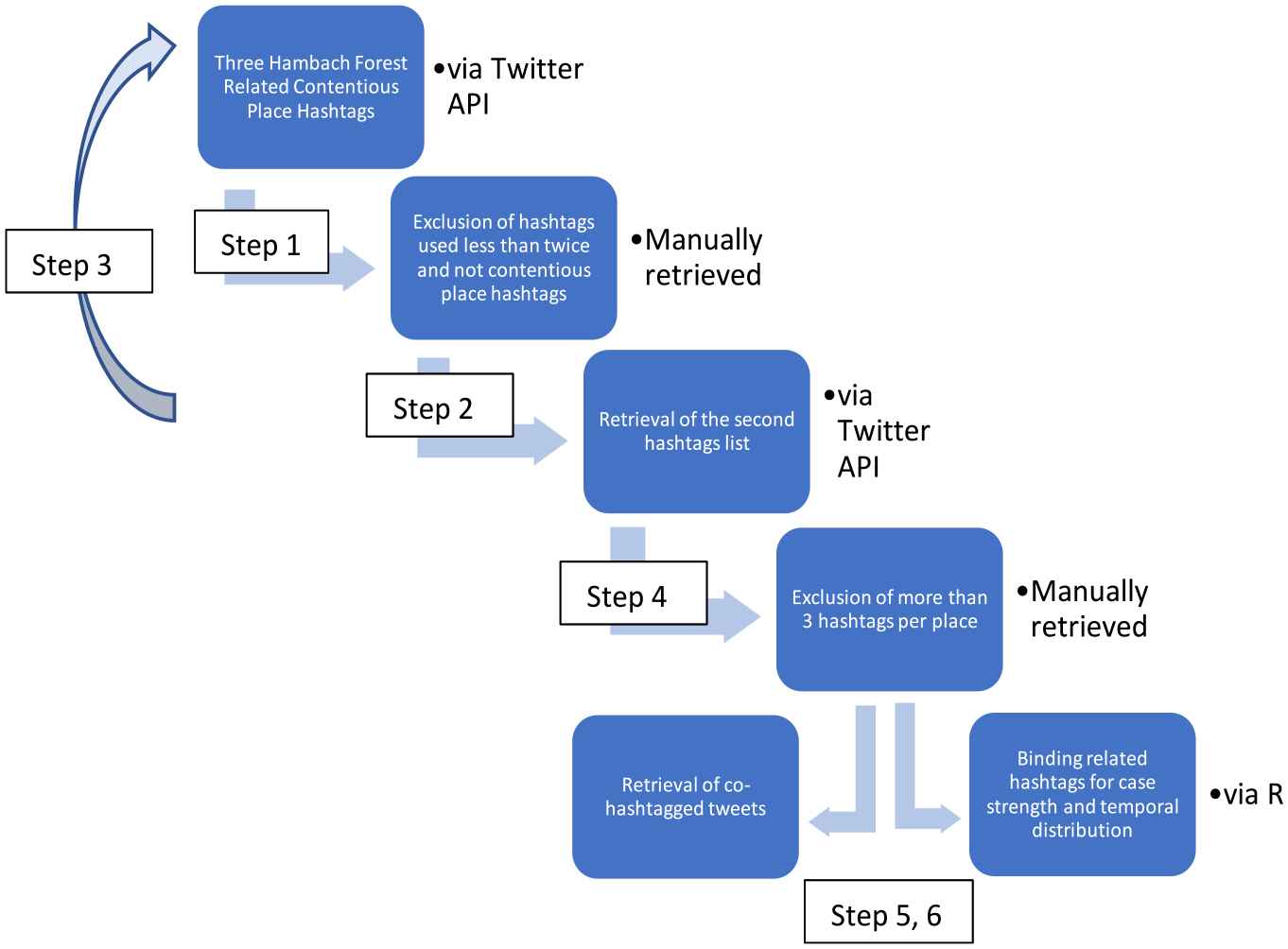
Data collection steps.
Contentious place hashtags include a formal or informal name of a place and some claim or framing to it (#ProtectPontValley). We did not include place names, even if they had an activist connotation (#Palestine, #Chernobyl). We limited ourselves to a maximum of the three most tweeted hashtags for each contentious place because it turned out that some places had tens of related hashtags. This yielded 116 individual contentious places with 174 related hashtags. 2
We are interested in practices of co-hashtagging and the resulting connections between activist places. To understand what shapes these practices, a semantic network of co-hashtagged contentious places was created and analyzed. The nodes in the networks are the hashtagged contentious places. Ties are drawn between them if two contentious places are co-hashtagged in the same tweet at least once. Tie weights are the frequencies with which dyads of places were co-hashtagged.
We then coded the characteristics of the set of contentious places related to their issues, spatiality, and temporality. This process reflects the hybrid approach; they comprise characteristics that identify the offline existence of contentious places as well as their articulation in the online sphere. Hence, although our data collection is not hybrid the way suggested by Treré (2018), it reflects the conceptualization of activism in a hybrid fashion as the interconnectivity of online and offline dimensions. We used a web search for the coding process. If a related website existed, we gathered information directly from there. In other cases, we used news articles or organization webpages.
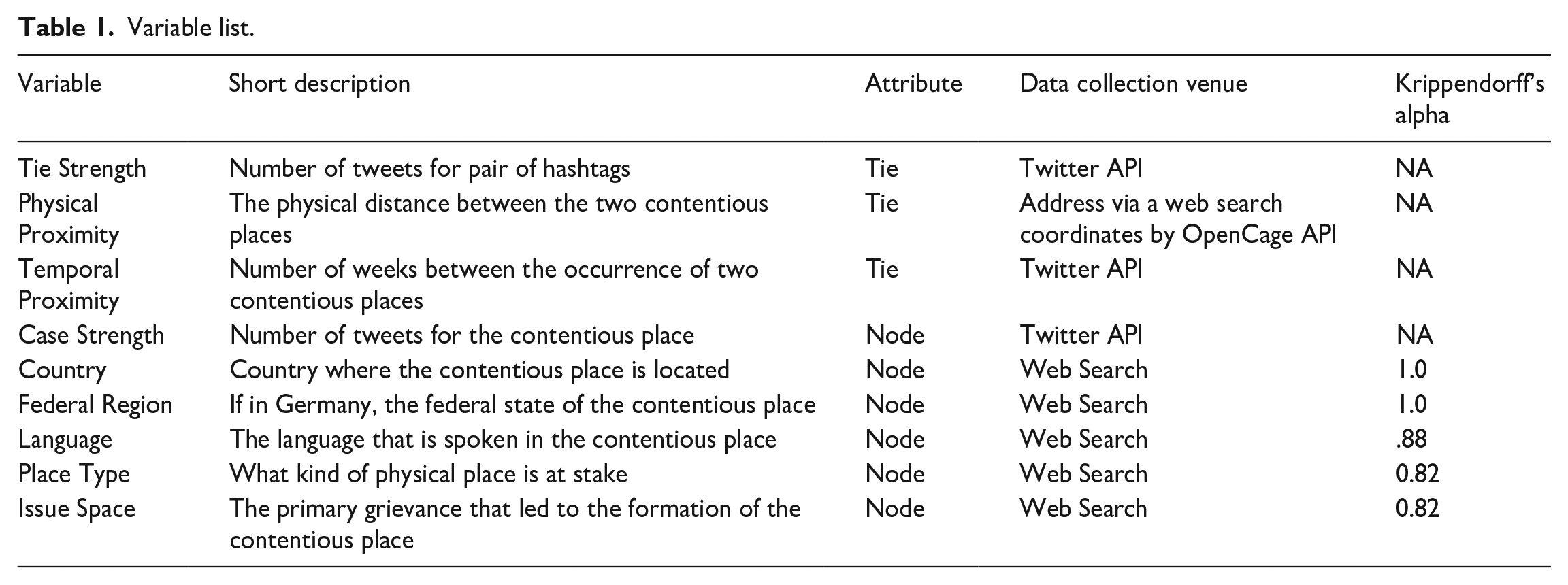
For the Twitter data, Twitter’s Academic API was utilized. We operationalized temporality as the peak date of hashtags on Twitter. Here, we closely followed the approach by Geiß (2022) to identify the first time a hashtag spiked beyond low-level background use. The case strength of contentious places was measured as the sum of all tweets using up to three included hashtags per case.
We coded issues as the grievances behind the emergence of contentious places. To measure geographical distance, we first identified the coordinates of places using the OpenCage API, which builds on OpenStreetMap data. Geographical distance was then calculated as the crow flies for each pair of point coordinates. We equated the distance to zero in ties between nested nodes (e.g. Hambach Forest and North Rhine–Westphalia).
We made further decisions regarding territorial space and language. In countries with multiple official languages, regional languages, or minority languages (when related to the contentious place’s location), we coded the language as multiple. Some contentious places can be understood more as desired places than officially recognized territories (such as Kurdistan in #FreeKurdistan). For these places and places that physically stretch across several countries (such as Europe, Amazon, and Congo rainforests), we coded the country as multiple.
A reliability test for manually coded variables was conducted after the first author and a student assistant underwent two-step training. Whereas for country and region, we reached the complete intercoder agreement, for every other variable, a sufficient agreement was achieved. The complete list of variables, collection procedure, and intercoder reliability results are shown in Table 1.
Variable list.
The semantic network was generated and analyzed in igraph (Csardi and Nepusz, 2006). Our approach is primarily explorative and includes a close description. Our network included alter-alter ties (connections between cases other than Hambach Forest) so that we could investigate the network for densely connected groups of contentious places. Community detection algorithms find clusters of densely connected nodes that are only sparsely connected to the rest of the network. Using the Louvain algorithm (Blondel et al., 2008), we clustered the network and closely analyzed the resulting groups of nodes regarding their socio-spatial and temporal features.
Results
We analyzed the network features in three ways to carve out the hybrid mechanism of scale shift. To investigate the role of shared features, we analyzed the network concerning other places’ resemblance and differences with Hambach Forest. Similarly, we analyzed clusters to determine the effect of these shared features among all places. Finally, we analyzed the hybrid dimension through physical and temporal proximities, which explicate offline and online dimensions.
The semantic network of co-hashtagged places consists of 116 individual contentious places and 662 edges between them, and spans locations around the globe, with a significant number of places located within Germany (Figure 2). On average, an individual tweet leads to 1.52 ties.
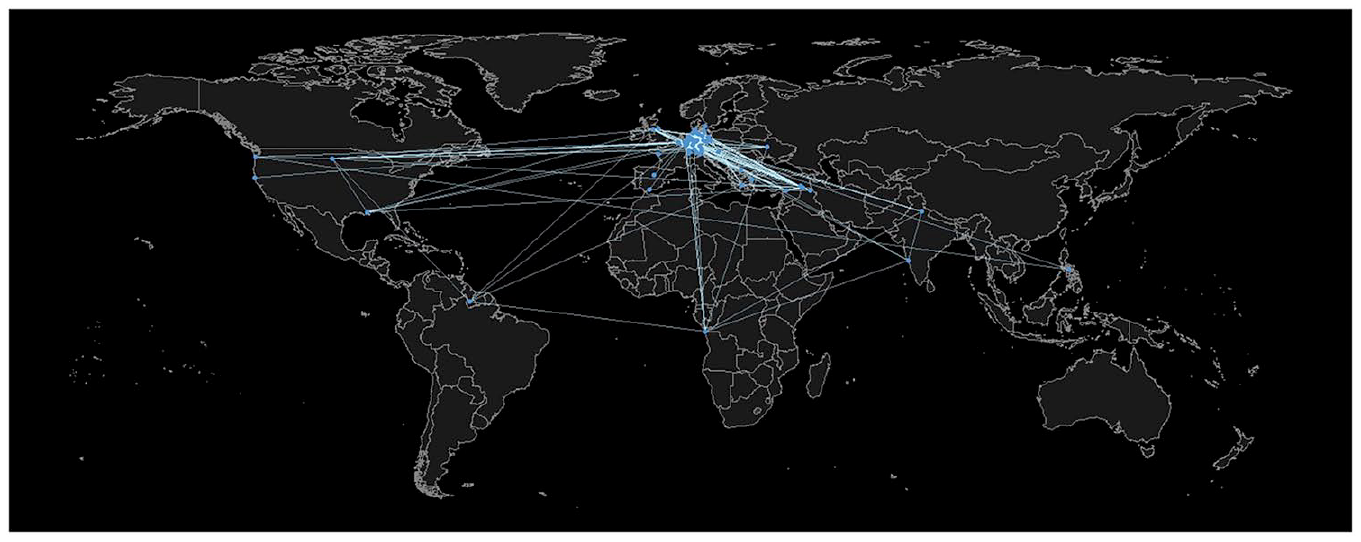
Discursive connections between contentious places.
One way of inspecting the spatiality of discursive connections is to see to what extent other contentious places in the network reflect the spatiality of our starting point, Hambach Forest. If similarity plays a role in the formation of these connections, a network formed around a forest becoming contested because of extractivism in Germany should be dominated by contentious places with similar spatial arrangements and issues. This is indeed the case. More than two-thirds of contentious places connected to Hambach Forest are located in Germany, as shown in Table 2. Territoriality is further evident in the German cases because more than one-fourth of them are located in North Rhine–Westphalia, where Hambach Forest is located. This suggests that scale shift occurs intensively at the national and subnational levels, but also has a transnational dimension.
Country distribution.
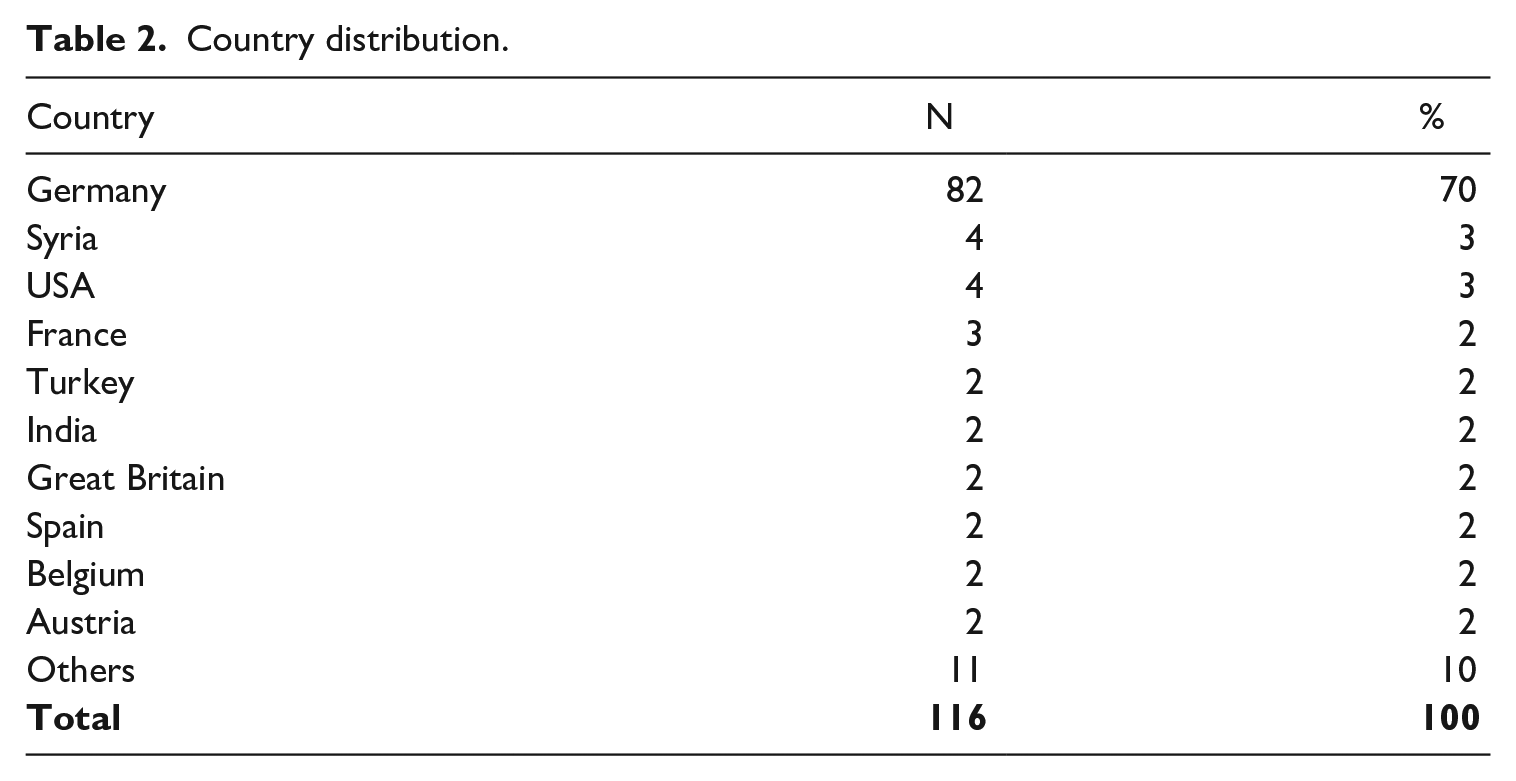
Eighty-four cases are located in German-speaking contexts. Yet, our data cannot disentangle language and territoriality further because the two variables are highly correlated. However, intuitively, we conclude that the effect of territoriality reaches beyond a shared language. The weak presence of other German-speaking countries and the regional distribution signals that the significant shared feature is territoriality, not linguistic.
The most prevalent place type in the network of discursive connections around Hambi is green areas (41 places), followed by urban spaces (32 places). For the issue variable, 41 cases are classified as relating to energy production or extractivism, 34 about construction projects, 20 related to gentrification, and 13 related to racial or social justice. These similarities with Hambach Forest manifest that, indeed, shared features, or proximities in terms of shared issues and place types, inform activists’ decisions of what they find relevant to their issue. Hence, spatial expansion is accompanied by issue connections, which is previously pointed out as issue spatiality (Stoltenberg, 2021).
Nevertheless, a scale shift across issues and borders is evident from the diverse set of places in the network, meaning that there is a substantive and spatial expansion. When construction and extractivism are taken as environmental contentions, we can see that this is primarily an environmental network, yet not exclusively. It also signals a significant substantive scale shift toward anti-gentrification and social justice movements. Therefore, activists attribute similarities to places (Tarrow and McAdam, 2005: 122) with the same issues and borders, as well as across them.
Densely connected contentious places
We further investigate the role of shared features in connecting contentious places and the emerging scale shift, by investigating densely connected cohesive subgroups, which are often co-hashtagged with each other, resulting in stronger connections between them. The semantic network is strongly clustered (modularity = 0.7) into eight subgroups of contentious places, ranging in size from 2 to 71 places. Of the places, 61.2% form the largest cluster, while the remainder are split into seven smaller clusters. Table 3 shows the five clusters with at least seven places (ordered by membership size). Territorial space, shared issues, and place types shape the places activists relate intensively to each other. Looking closely at each cluster of contentious places suggests that spatial arrangements and issue spaces (Stoltenberg, 2021) shape scale shift dynamics.
Cluster description.
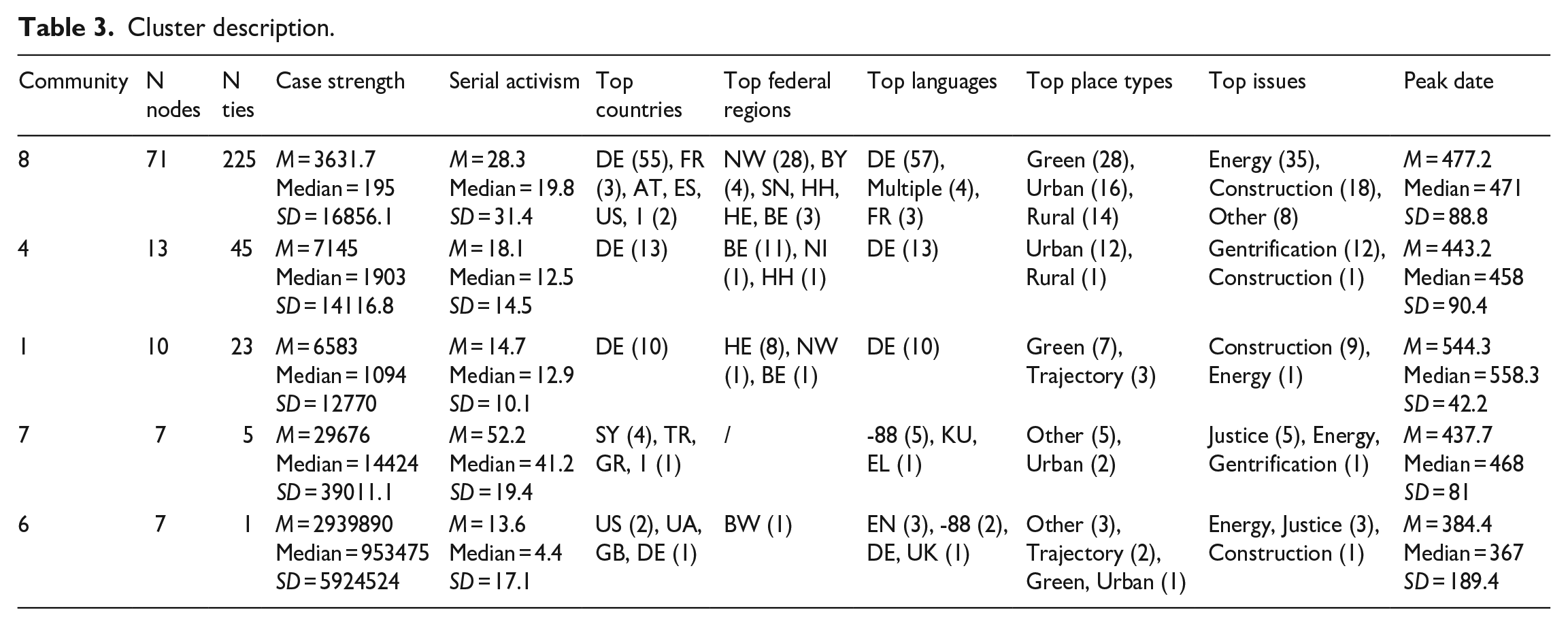
As can be seen in Figure 3 and Table 3, the first three clusters (clusters 8, 4, and 1), which contain 80% of all individual contentious places, mainly connect places in Germany. Specifically, each cluster is formed regionally within Germany and around shared grievances. The first cluster (cluster 8, center of Figure 3(a) to (d)) is formed by places in North Rhine–Westphalia around issues related to energy production, which signals a scale shift around shared grievances. The second cluster (cluster 4, top left) contains contentious places of anti-gentrification struggles in Berlin’s urban space, and as such, shows that expansion occurs across issues and regions. The third largest cluster (cluster 1, bottom left), which is formed in the federal state of Hesse, stems from environmental destruction in the context of construction projects. It signals spatial scale shift and connections around shared issues.
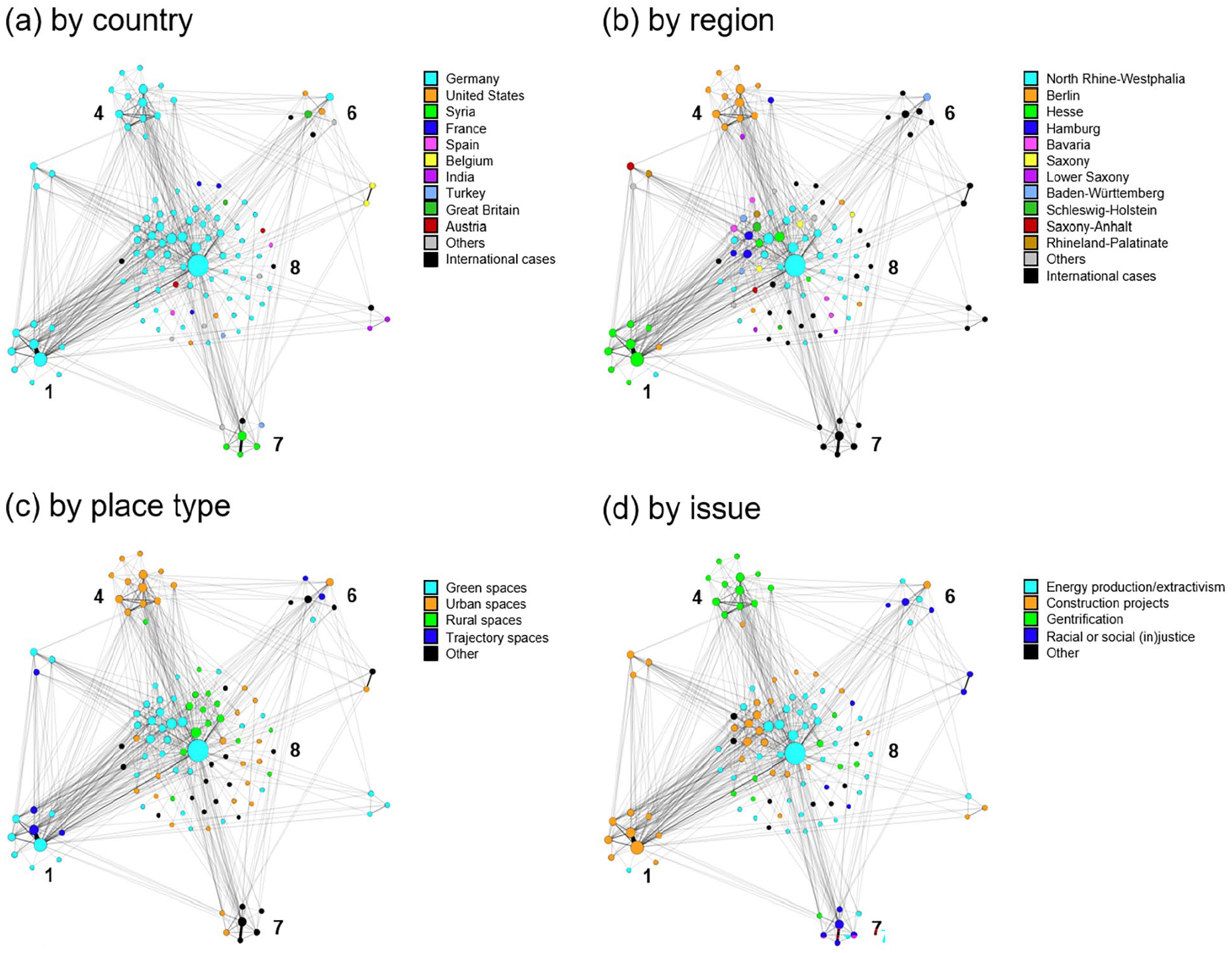
Network and clusters by variables.
Two other clusters further qualify the scale shift. The fourth cluster (cluster 7, bottom center) forms around places in three countries: Turkey and two of its neighbors, Syria and Greece. These are places of social justice. Language is a less visible factor affecting cluster building: Kurdish is one of the languages of contentious places in Syria and Turkey. These connections between three countries with close geographical proximity and shared issues further signal the significance of spatial proximity, which might be translated as a cultural brokerage between neighboring countries and personal ties, as Vasi and Suh (2016) have suggested regarding the proximity of protest sites. In terms of scale shift, this cluster shows that expansion emerges both across issues and borders.
Finally, the fifth biggest cluster (cluster 6, top right) is more heterogeneous. It consists of very large contentious place hashtags (almost all of the cases with the highest number of tweets). Unlike the other clusters, the cases cover many countries, place types, and issues. Moreover, these are mostly English hashtags, signaling its role as lingua franca in creating a transnational network.
The last two clusters (cluster 7 and 6), moreover, demonstrate the attributes of serial activism, which Bastos and Mercea (2016) define as sustained transnational engagement. These results show that transnational connections can also be regionally anchored. Moreover, a scale shift in contentious episodes can emerge across spatial scales and substantive areas. This may also hint at coalition building among actors in different spaces.
Hybridity: physical and temporal proximity
We further analyze our results in terms of the hybrid dynamics. One way of doing this is to investigate whether the physical and temporal proximity between cases influences the formation of discursive connections (Figure 4). As the hybridity approach suggests, both proximities help connect places online. For all possible connections, the mean distance is 1813.7 km (median = 460, SD = 2788.3), while for present connections, it is 855.29 km (median = 294.91, SD = 1758.08). Both the potential and present ties peak at a length of a few hundred kilometers. However, although there is a substantial share of possible longer ties covering thousands of kilometers between our set of contentious places, barely any of them are present in the empirical network. These results confirm that, although social media enables substantial translocal ties, proximity is still a crucial connectivity indicator. For all possible discursive connections, the mean temporal distance is 110.4 weeks (median = 81, SD = 109.4), while for present connections, it is 88.34 (median = 48.5, SD = 110.5). This means that when contentious place hashtags become popular on Twitter around the same time, the likelihood that activists co-hashtag them increases.
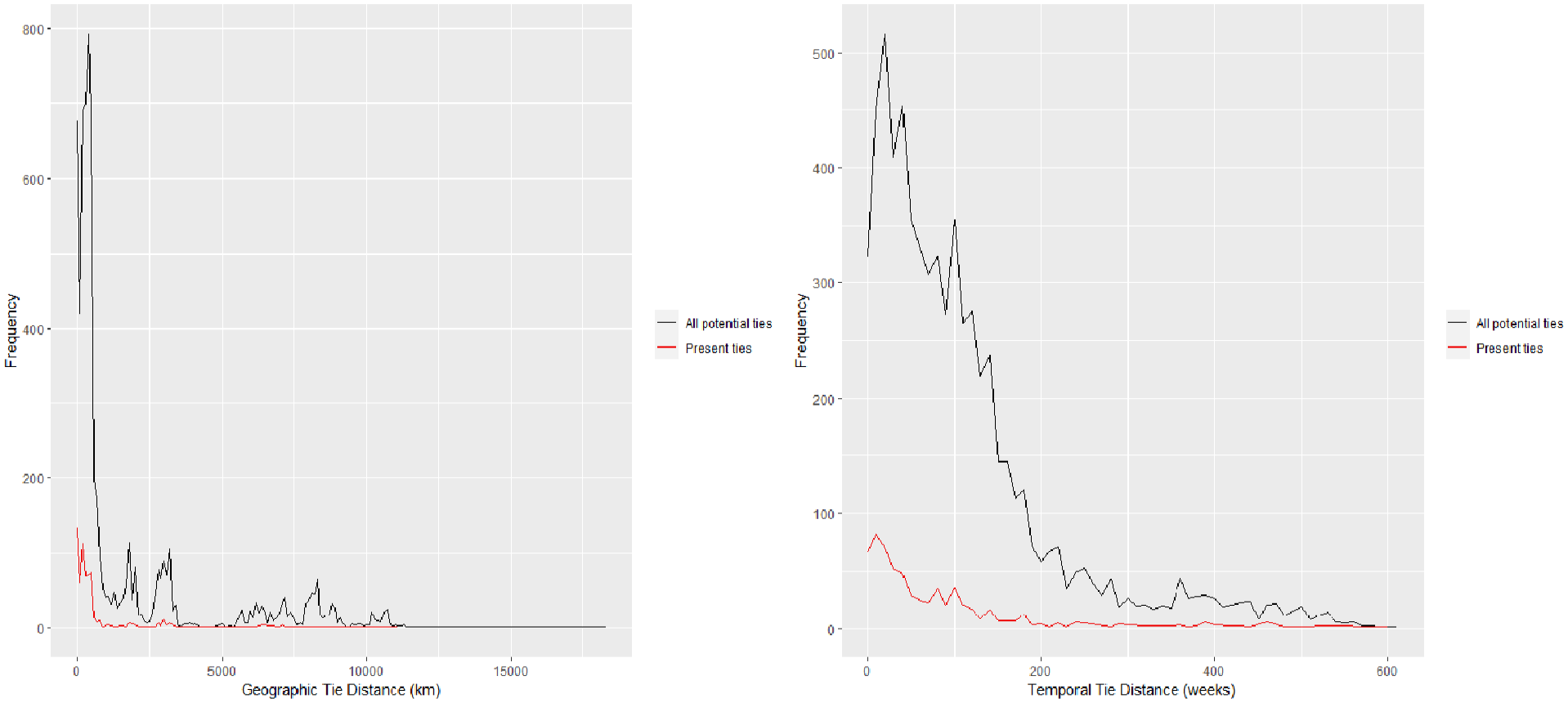
Physical and temporal proximity.
Hence, geographical proximity (offline feature), as well as temporal proximity (online), inform activists’ decisions to connect contentious places. The fact that the temporal dimension related to online use of the hashtag and the geographical proximity related to offline relations of places both increase connectivity shows that a hybrid activist logic is at play.
Discussion
One of the main arguments of this article is that hybrid mobilization forms, which can be understood as a dialectical interplay between the offline and online spheres, create a hybrid spatial order of scale shift. The scale shift in contentious politics is often discussed concerning transnationalization and through actor-centric processes such as brokerage (cf. Della Porta and Tarrow, 2005; Tarrow and McAdam, 2005). By analyzing discursive connections between contentious places without restricting a spatial limit, we have uncovered the complex dynamic of a scale shift. It is neither wholly national nor transnational. Moreover, as Tarrow and McAdam (2005: 131) suggest, a national environmental movement is an aggregate of regionally bound local movements, as we see in the case of local movements in Germany. Like Hepp (2009) and Waldherr et al. (2023), we suggest that contentious places are connected in a translocal network that is territorialized and deterritorialized simultaneously. This is what we call the hybrid spatiality of scale shift.
This article highlighted how scale shift dynamics are operated on Twitter via co-hashtagging of contentious places. Moreover, we display how the shared characteristics of these places, which reflect both their online and offline articulations, drive activists to connect them online, therefore showing the hybrid dynamics in the process of scale shift. Furthermore, we have answered the call to specify how social media affordances might be used as contentious repertoires (Liu, 2020: 53) by looking at how co-hashtagging works as a linking mechanism (Dahlberg-Grundberg and Lindgren, 2014; Martin and Miller, 2003). We have specified online and offline dynamics that influence which places activists choose to connect.
Our results reflect how a hybrid conceptualization of online activism can highlight crucial “relational” (McAdam et al., 2001: 26) or linking (Martin and Miller, 2003: 150–151) mechanisms working through the moderation of spatial, temporal, and substantive shared characteristics. On the one hand, the majority of contentious places connected to Hambach Forest essentially comprise places in the same territories, are formed around similar issues, and have occurred in proximate time and space. On the other hand, many places with different spatial, temporal, or substantive dimensions are also discursively connected to Hambach Forest. With these more diverse places, activists’ discursive connections still lean toward similarity and proximity, as can be seen in the way similarly structured contentious places emerge as densely connected clusters in the network analysis.
Spatially, although national arrangements dominate the formation of connections, they are not exclusive. Moreover, by specifying territoriality at the federal level, we show that attributing dominance to national borders might be misleading. Contentious places connected to other contentious places within borders with regional concentration (territorialized), and across borders with nearby and faraway places (deterritorialized) (Hepp, 2009; Waldherr et al., 2023). This suggests that employing a hybrid contentious repertoire leads to a hybrid spatial scale and logic in the mechanism of a scale shift.
Focusing on connections as a horizontal process highlights what is commonly accepted but less precisely carved out in contention: Contentious politics is, in its origin, a local dynamic and only goes beyond this local dynamic through relational mechanisms and processes (Tarrow and McAdam, 2005), and social media affordances can accommodate such mechanisms.
We have highlighted some of these mechanisms. Some crucial aspects remain to be discovered. We interpret connecting contentious places via co-hashtagging as the attribution of similarities in the online sphere. However, attributing similarities is a subjective process in which activists, as either individuals or organizations, decide what is relevant. Hence, uncovering these subjective dynamics and meanings of the practices, such as place-based activist hashtags and co-hashtagging, is still needed. In this article, we limited ourselves to analyzing the emerging communicative space on Twitter and did not scrutinize why activists might, on the one hand, connect places with similar issues and spatialities and, on the other hand, also expand their scope. Whether this signals a long-lasting coalition building, ephemeral social media connections, or solidarity act remains to be investigated.
Qualitative in-depth analysis can help us carve out such subjective processes and the role of spatiality and hybrid mobilization in highlighting which of the contentious mechanisms, brokerage, emulation, and attribution of similarities, are at play. Moreover, it needs to be investigated whether hybrid spatiality, references to different spatial scales, is the result of social media logic, and if so how. For once, it can stem from the same activists engaging in different scales at the same time. Alternatively, different forms and scales of activism might result from different activist groups struggling to shape the discursive space on social media at the same time. In addition, to further highlight hybridity, the relationship between offline and online participation (cf. Mercea, 2012), the location of activists, and its influence on hybrid activism (cf. Van Haperen et al., 2018) should be further analyzed.
Footnotes
Funding
The author(s) disclosed receipt of the following financial support for the research, authorship, and/or publication of this article: Deutsche Forschungsgemeinschaft (DFG, German Research Foundation) under grant Projektnummer 290045248 – SFB 1265.
