




Abstract
This study explores how media users create and experience spaces of digital disconnection in their daily lives. Guided by spatial sociological theory and using the go-along method—where researchers accompany participants in real-world settings—we investigate three prototypical environments in which individuals often disconnect from digital devices: dining areas, libraries, and movie theaters. In line with the theoretical framework, we analyze how material elements, spatial order, interaction patterns, and traces of past use shape and reflect media practices within each site. Our analysis, based on 18 go-alongs, demonstrates how distinct spatial arrangements and social practices shape digital disconnection. Three distinct disconnection practices emerge, each characterized by its material boundedness and behavioral discreteness: (i) delineated and fluid (dining areas), (ii) delineated and categorical (movie theaters), and (iii) blurred and episodic (libraries). These findings contribute to the existing research on disconnection by highlighting the importance of spatial configurations in digital disconnection practices.
Keywords
Introduction
Situation-specific factors, such as socio-spatial contexts, are essential for understanding the conditions that impact individuals’ interaction with digital media (Schnauber-Stockmann et al., 2025). Prior research on digital disconnection has studied the use and non-use of digital media in specific socio-spatial environments such as schools (Dennen et al., 2019), places of worship (David and Roberts, 2024), or off-grid retreats (Stäheli and Stoltenberg, 2024). This study builds on existing literature by exploring how these socio-spatial contexts both shape and are shaped by disconnection practices. To do so, we employ spatial sociological theory (Löw, 2016). This theory provides conceptual tools to illuminate how material elements, spatial order, interaction patterns, and material or symbolic traces of prior spatial appropriation shape and reflect media practices within each site. This way, the theory sheds light on how material arrangements influence user behavior and how social norms become embedded in spatial practices. We identify three spatial types that hold a prominent place in spatial sociological theory (Oldenburg, 1997): (i) Everyday living spaces where people maintain close social relationships, (ii) shared working spaces where individuals engage in professional activities and structured productivity, (iii) civic leisure spaces where people interact outside of home and work, promoting community engagement.
The research delves into disconnection within these spatial contexts through specific examples: dining areas as central sites in everyday living spaces, academic libraries as prototypical shared working environments, and movie theaters as venues for informal communal experiences.
To capture embodied, spatially situated experiences of disconnection, this study uses the go-along method (Kusenbach, 2003) which involves accompanying participants through real-world settings while observing and interviewing them. By introducing the concept of space as a crucial element in disconnection practices, this research contributes to the existing body of knowledge on digital disconnection.
Conceptualizing three socio-spatial contexts of digital disconnection
Digital media users engage in various practices of disconnection and connection that go beyond a simple dichotomy (Kuntsman and Miyake, 2019; Natale and Treré, 2020; Syvertsen, 2023). Although definitions differ, scholars generally understand digital disconnection as an intentional practice through which individuals limit their engagement with digital media (Altmaier et al., 2024). Following this line, we understand digital disconnection as “a deliberate form of non-use of devices, platforms, features, interactions and/or messages that varies in frequency and duration with the aim of restoring or improving one’s perceived overuse, social interactions, psychological well-being, productivity, privacy and/or perceived usefulness (Nassen et al., 2023: 1).
While current research on digital disconnection primarily focuses on disconnection as an individual choice (Bucher, 2020), less attention has been given to how these behaviors unfold within specific social and spatial contexts. To our knowledge, there are no studies that specifically apply spatial sociological theory to digital disconnection practices.
In the following section, we explore research that examines digital disconnection in different settings, such as dining areas, academic libraries, and movie theaters. We selected these places not only because they align with Oldenburg’s (1997) notion of first, second, and third places, but also because they hold enduring symbolic and practical relevance as spaces where norms of presence, attention, and shared experience shape and encourage disconnection from digital media. Unlike more individualized settings—such as bedrooms or workplaces—these environments foster socially embedded expectations that prioritize co-presence and collective engagement over connectivity. While the socio-spatial settings themselves are usually not the main focus of the studies mentioned in the following sections, we analyze the existing literature to understand what it reveals about these environments and how their social and spatial dynamics influence the decision to avoid media usage.
Digital disconnection in the dining area
Households have faced challenges integrating new media technologies into their daily routines, especially when establishing boundaries for appropriate use in shared spaces like dining areas (Borchers et al., 2025). Despite the rise of Wi-Fi and mobile media leading to more individualized, isolated media consumption, creating what Livingstone (2007) calls a “bedroom culture,” the dining area remains a space for communal meals, fostering social interactions among family members and friends (Hiniker et al., 2016).
Typical guidelines for technology use at home focus on monitoring content and screen time, with little consideration for the spatial and social aspects of media consumption. However, modern households are increasingly attentive not just to what is being consumed, by whom, and for how long, but also to where and how media are being used. This shift reflects the portability and personal nature of digital devices, making the context of use, such as texting during meals, more significant.
Meal times are essential for communication and bonding among household members, providing opportunities to strengthen relationships (Offer, 2013). Yet, the frequency of shared meals constitutes a culturally patterned practice with cross-cultural variation (World Health Organization Regional Office for Europe, 2020), and there are also pronounced differences in the social acceptance of media use during shared meals (Kammoun et al., 2023). Despite the presence of media devices in these shared moments, research highlights the importance of limiting media usage and minimizing distractions (Knobl et al., 2022). Building upon this focus, our study advances the examination by exploring how the socio-spatial context of dining areas influences practices of digital disconnection. By adopting a spatial lens on disconnection, our study extends beyond the well-established research on distraction and social bonding (Komanchuk et al., 2023), foregrounding the socio-spatial conditions that facilitate—rather than inhibit—interpersonal willingness to engage in dining spaces.
Digital disconnection in the library
Libraries have normative expectations for limited digital media use, often enforced upon entry (Aarts and Dijksterhuis, 2003). Research has examined libraries as distinct spatial and social entities with diverse functions, where noise has long been a noted issue (Kawamoto and Koizumi, 2023). Since the early 2000s, research has examined the rising noise levels in libraries, attributing them primarily to the growing presence of computers, scanners, printers, and, in particular, the increased use of mobile phones (Yelinek and Bressler, 2013).
In recent decades, especially public libraries have evolved into vibrant urban hubs. Influenced by the rise of “super” bookstores with amenities like coffee and comfortable seating, many public libraries—and to some extent, large university libraries—have incorporated similar features to attract visitors, accommodate evolving user expectations, and present a more modern identity (Crumpton, 2007).Yet libraries continue to function as transcendent spaces—offering refuge and silence as “a counterpoint to the interior noise” (Tisdale, 1997: 65)—with patrons in academic libraries placing particular value on quiet study environments (Yelinek and Bressler, 2013).
Characterized by Sare et al. (2021: p. 32) as a “quiet agora,” libraries often face conflicts due to the pursuit of silence. Research has shown that library staff and patrons actively regulate digital media use within these spaces (Chaputula, 2021). While specific conditions contributing to decreased personal digital device use are not extensively studied, existing research suggests that libraries intentionally design spatial arrangements to support various functions, including group workstations, computer labs, and quiet study areas (Hanson and Abresch, 2017). As a cosequence, academic libraries face the challenge of balancing the need for quiet study and opportunities for digital disconnection with the demand for collaborative spaces that often rely on mobile phones and other technologies for mediated group work (McEwen and Scheaffer, 2012).
Digital disconnection in the movie theater
The movie theater serves as a liminal space, where individuals temporarily disconnect from everyday life to engage in a suspended environment (Stefanek et al., 2023). Other viewers’ presence is essential in this experience, allowing individuals to express themselves more openly and intensely as part of a shared audience (Hanich, 2014). Although scholarly research on audience distraction from mobile devices in movie theaters is limited, journalistic discussions often emphasize proper theater etiquette to address this inappropriate behavior (Gilliver, 2024; Heritage, 2023; McArthur, 2024).
The experience of moviegoing varies across cultural contexts. In Western societies, audiences are generally expected to remain silent, whereas in other cultural contexts—for example, in India—styles of reception are often interactive and expressive (Srinivas, 2002). The western history of “polite moviegoing” (Hassoun, 2016) is marked by a long evolution, which has generally trended toward the cultivation of silent, attentive spectatorship. Norms distinguishing appropriate from inappropriate audience behavior have frequently mapped onto broader social hierarchies, drawing boundaries along lines of class, gender, age, and ethnicity (Altenloh, 2001). Contemporary movie theaters extend the regulation of conduct into the digital realm by designating zones and times as more or less “phone-friendly”—for instance, the lobby versus the screening room, or the period before versus during the film. Through preshow public service announcements, theaters articulate no-phone policies that implicitly cast certain forms of phone use as socially undesirable. In doing so, they help establish and reinforce an “an ethics of media abstention” (Hassoun, 2016) that encourages patrons to internalize the expectation of self-regulation and to constitute themselves as subjects responsible for their own media behavior.
In conclusion, the movie theater, like the dining area and library, encourages collective action through attentiveness and consideration for others, contributing to a shared experience. Spatial sociological theory is especially well-suited to studying digital disconnection in these three contexts by foregrounding that the deliberat non-use of digital media is not only a personal choice but also a spatially situated practice negotiated through architecture, institutional scripts, and the embodied presence of others.
Theoretical framework: spatial sociological theory
In the aftermath of the “spatial turn” (Falkheimer and Jansson, 2006), social theory has acknowledged that spaces are the results of social production, and simultaneously, social phenomena are inherently spatial. Drawing upon Löw’s (2016) spatial sociological theory, we analyze the socio-spatial factors influencing disconnection behaviors in dining areas, libraries, and movie theaters.
Löw defines space as a “relational arrangement of living beings and social goods” (Löw, 2016: 247), emphasizing that space is not just a substance or a relation. To examine this dynamic structuration, Löw introduces two interconnected concepts—spacing and synthesis—which describe the simultaneous production of space. Spacing involves the physical placement of objects and people in specific locations, while synthesis refers to integrating these elements through perception, imagination, and memory. When space is defined through spacing and synthesis, and formalized through rules and resources, spatial structures are created that influence action and emerge through action. This recursive mechanism, known as the “duality of space” (Löw, 2016: 267), guides our research questions:
Löw’s theoretical framework offers four analytical levels to operationalize these research questions by translating spatial dynamics into concrete dimensions of analysis (Löw, 2016: 326): (i) The material elements that shape the research site, including objects and individuals, create specific possibilities for use. (ii) The observable order that emerges within the site. (iii) Patterns of interaction and agency that influence use, and (iv) traces of prior use, appropriation, and spatial production evident within the site. Prior use refers to how a space was used in the past. Traces serve as indicators of these earlier situations. They render previous practices visible and continue to shape the present, signaling that the space has already been constituted through prior social practices. These prior social practices may, but do not necessarily, be related to digital media. These four levels structure how we analyze our data—they not only guide our perspective but also help us systematically compare the three different socio-spatial contexts of digitale disconnection.
Method
Research exploring the socio-spatial factors of digital media non-use benefits from methodologies designed to capture user behaviors in situ. Due to our focus on how individuals attribute meaning within specific socio-spatial contexts, we chose the go-along method (Kusenbach, 2003) for our study. This method combines observational and interview techniques to collect rich, context-sensitive data.
Nine student research assistants received comprehensive training on the study’s purpose and structure, the principles of ensuring confidentiality, and strategies for maintaining a neutral, engaged, and attentive stance during the go-alongs. The training included selected exercises based on Helfferich’s (2011) training approach and was conducted through role-playing and mock interviews, with particular attention to common challenges in interview situations. In addition, assistants were given detailed instructions on the secure storage of audio recordings and transcripts, including appropriate anonymization procedures. Each assistant carried out two sessions with individual informants they selected. Due to constraints related to access, time, and participant availability a convenience sampling approach was used as the student assistants accompanied individuals in typically inaccessible environments. Each informant had to meet one of three predefined criteria: regular library users, regular participants in shared domestic meals, or regular movie theater attendees.
The student assistants accompanied participants during everyday outings to libraries or movie theaters, as well as during mealtime interactions at their homes, exploring their experiences and practices by asking questions, listening, and observing how they navigated and interacted with their physical and social surroundings. Observational field notes were taken during the go-alongs, followed by guided post-interviews that were audio-recorded for analysis. After the go-along sessions, participants completed a standardized questionnaire capturing sociodemographic information and general media usage behaviors. Approval for this procedure was obtained from the ethical review board of the University of Tübingen.
The go-alongs took place between August and September 2024. Nine participants were female, eight were male, and one identified as diverse. Their ages ranged from 19 to 67 years, with most in their 20s (Mdn = 22 years). Table 1 provides an overview of the sample.
Demographic composition of the sample.
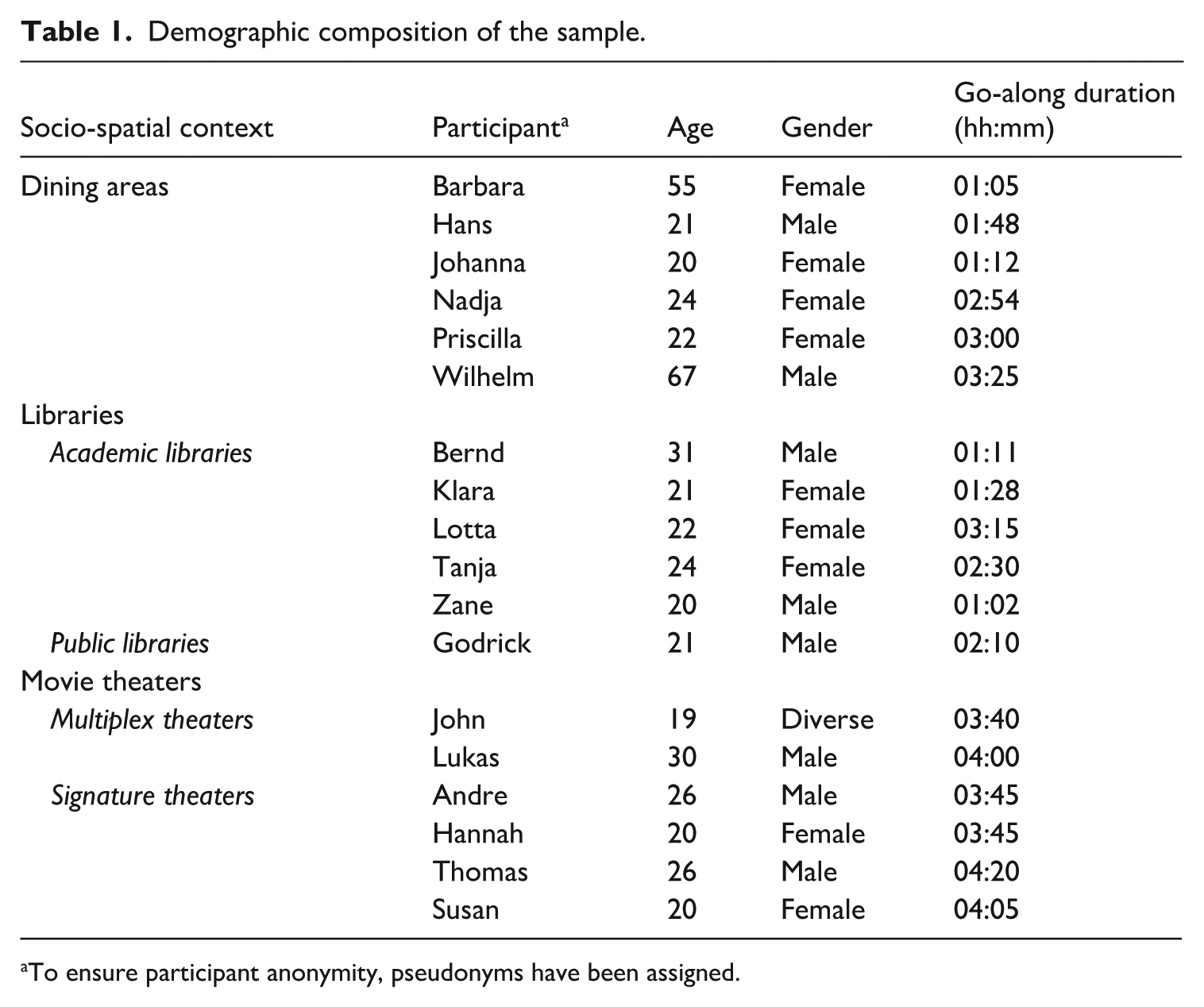
To ensure participant anonymity, pseudonyms have been assigned.
The go-alongs conducted in dining areas happened only in family settings. Most go-alongs in libraries occurred in academic libraries, except for one in a public library. Go-alongs in movie theaters were mainly conducted in signature movie theaters rather than multiplex theaters.
Interviewers were not given specific instructions regarding the timing of the go-alongs. As a result, go-alongs conducted in dining areas took place predominantly in the evening, those conducted in libraries in the late morning and early afternoon, and those conducted in movie theaters in the late afternoon or evening.
The average duration of go-alongs was 162 minutes, with movie theater sessions lasting longer than those in dining areas and libraries due to the shared film experience.
We analyzed the go-alongs in a qualitative content analysis (Schreier, 2012). As a first step, we identified the main categories deductively, drawing on Löw’s (2016) spatial sociological theory. Subsequently, we employed open coding to inductively develop subcategories. The objective of this initial coding phase was to identify practices of spacing and synthesis that emerged from the data. In the following phase, we reviewed and refined the codes to develop overarching themes. Intersubjective reliability of the coding scheme was established through repeated discussions between the first and second author, during which discrepancies were addressed and codes were jointly reviewed until consensus was reached. The final coding process was conducted by the first author.
Results
Dining areas
Material elements and practices
Digital disconnection in the dining area constituted a delineated practice, as it was expected to occur at a specific place and time. Transitions between connected and disconnected states, however, remained fluid in that they could be flexibly adjusted to situational circumstances, varying with respect to timing, device type, and the social acceptability of occasional use. The layout of the dining areas we visited with our informants encouraged interpersonal communication, showing how physical spaces can either encourage or discourage the use of digital devices. Participants highlighted the importance of furniture arrangement and decor in creating a conducive atmosphere for social interaction. For instance, Johanna had personal portraits in the dining area, adding social and emotional significance to the space. Others mentioned warm wall colors and carefully placed lighting as elements that fostered shared meals and conversations.
Participants often kept digital devices, especially smartphones, away from the dining table. Priscilla envisioned an outdoor dining area with charging outlets where she could set her smartphone aside to recharge—just as she herself recharges during dinner. This simple convenience symbolized that the use of digital media in dining areas is influenced by broader patterns of media consumption. Our on-site observations also showed that, while go-along participants articulated very clear ideals regarding the shared consumption of meals as ideally undisturbed by digital media, the dining areas to which they invited us were not media-free zones. In situ, instead of fully rejecting digital technology, participants viewed disconnection as a flexible, situational practice.
The go-alongs revealed that, in line with Löw’s (2016) spatial sociological theory, spacial practices emerge through dynamic relations between people, objects, and meanings. As contexts shift, the same place can trigger different forms of media use. For instance, when digital devices complemented traditional routines, they were seamlessly integrated into the dining experience within their homes. For example, Hans switched from a traditional radio to a smart speaker, while Priscilla’s family stopped their newspaper subscription for environmental reasons and switched to reading the local news on an iPad during breakfast.
Emerging orders
The expectations governing digital disconnection at the dining table reflected broader dynamics of family life. Hans attributed the spatial arrangement of the dining area to his mother, stating: “She’s the one who designed it.” Barbara emphasized that she and her husband “taught the kids that there’s absolutely no phone use when we’re eating together.” Similarly, Priscilla recalled her childhood, noting: “My parents were never on their phones during meals.”
Disconnection behaviors are thus embedded within familial power structures and are acquired through mechanisms such as authority, observation, and imitation—eventually becoming internalized over time. Households, as dynamic social formations, evolve over the life course, and the expectations surrounding digital media use during shared meals adapt accordingly. Wilhelm’s account underscores how norms of digital disconnection shift, particularly when household composition changes. Reflecting on meals with his wife, he noted: “It’s different when it’s just the two of us older folks sitting here (. . .) so it’s easy to get tempted to check what’s new on the phone.” With his adult sons no longer living at home, Wilhelm’s reflections illustrate how changes in household routines and relationships can prompt a reconfiguration of previously established disconnection practices.
Patterns of interaction
Behavior in the dining area is fundamentally oriented toward facilitating social interaction, which typically implies digital disconnection. Domestic routines surrounding shared meals reflect implicit norms that shape both spatial arrangements and behavioral expectations. One such routine—the act of setting the table—typically precedes shared meals, serving not only as a practical preparation but also as a symbolic gesture reinforcing norms around attentiveness and presence.
Informants usually relocated their digital devices to the periphery of the dining area, subtly signaling their exclusion from the upcoming social interaction. Although the spatial configuration of dining spaces often supported interpersonal engagement, whether that engagement occurred depended on both physical co-presence and individuals’ willingness to interact. When either was lacking, spatial design alone was insufficient to discourage media use. The go-alongs revealed several instances of this dynamic: when dining alone, informants often turned to digital media as a substitute for social interaction. As Priscilla put it, “When I’m eating alone and watching something, it’s usually TikTok videos.”
This pattern did not follow a simple binary of presence versus absence but unfolded along a continuum shaped by the quality of social interaction. Priscilla also described how even the presence of others did not necessarily preclude media use: “If there’s been an argument in our family (. . .) that’s when the phone gets used (. . .) to avoid the conversation.” Moreover, not all meals carried the same normative expectations. Smaller, more informal meals—such as quick breakfasts or lunches—tended to involve more relaxed expectations around digital disconnection compared to the symbolically significant evening meal.
Traces of prior use
Two distinct perspectives emerged regarding prior use of dining areas, each shaping how digital disconnection was experienced: one emphasized the layered significance of accumulated memories, reinforcing the symbolic value of device-free interaction; the other highlighted the fluid boundary between connection and disconnection, framing the dining space as multifunctional and adaptive.
Moving through dining areas often evoked recollections of past gatherings. As Hans reflected: “Like Christmas, all the birthdays (. . .) when I think about that room, this stands out to me.” Conversely, the absence of such shared history could produce a lack of attachment. Nadja, who had recently moved into a new apartment with her mother, commented: “The walls are still bare,” pointing to the absence of accumulated memories in the new space.
Go-alongs revealed that traces of prior use were communicated both through symbolic memories—often evoked by photographs or stories associated with the dining area—and through participants’ movements, which revealed more immediate, everyday uses. Informants described dining areas as multifunctional spaces, routinely repurposed for homework, remote work, or casual tasks. Wilhelm, for example, described using laptops and tablets at the table as a matter of routine, emphasizing the room’s adaptable nature.
Several participants noted shifts in the dining area’s function throughout the day. While the table might serve as a workspace earlier, it often marked a transition point in the evening, from shared meals to individual or collective media use elsewhere.
Libraries
Material elements and practices
Although a general norm of silence pertains in libraries, which also entails restricted use of digital media, we found this overarching norm to be blurred. The libraries we visited with our participants were characterized by a zoning of different areas for silent work and for social interaction, and patrons moved back and forth between these areas. Moreover, digital disconnection was never absolute; rather, it was episodic and interwoven with restrained forms of connection. While smartphones and other devices were less actively used, their presence allowed for short, often unconscious moments of connectivity—like checking notifications or sending quick messages.
As informants moved through library spaces, it became clear that laptops, tablets, and power outlets were defining features. A key consideration in selecting a workspace was access to power. As Tanja emphasized: “Yeah, the power outlet is super important to me—it kinda decides where I end up.”
Participants engaged in subtle spatial practices: choosing tables, orienting themselves, and arranging their materials to create zones of concentration. These arrangements supported disconnection strategies, such as placing smartphones out of reach or using headphones to minimize disruption. Phones were often silenced and integrated discreetly into workspaces or hidden altogether. For instance, Tanja kept her phone under the table, while Lotta positioned hers behind her laptop to avoid distraction.
Material infrastructure also influenced how participants imagined ideal disconnection. Lotta envisioned libraries with designated storing and charging areas for phones: “Ideally, everyone would have to leave theirs at the entrance.” This echoed earlier sentiments, such as Priscilla’s notion of the dining table as a site of personal recharging—paralleled by the recharching of the phone.
Taken together, these observations suggest that library environments—with their material configurations and spatial practices—actively shape how digital media are used. The interplay between physical setup, personal devices, and social presence fosters affectively charged, purposeful patterns of episodic disconnection.
Emerging orders
Digital disconnection in libraries was reinforced through a blend of material cues, social oversight, and individual self-regulation. In some settings, signage—similar to that documented by Chaputula (2021)—explicitly prohibited mobile phone use in certain areas. Several go-along participants, including Lotta, Tanja, and Zane, mentioned the presence of staff stationed near entrances who served as visible enforcers of library norms.
While these expectations were institutionally anchored, participants showed they had internalized them. As Bernd noted: “You already know you’re supposed to be quiet in a library before you even see the sign.” Zane added nuance to this, suggesting how social and institutional regulation might unfold: “I guess someone would probably complain, maybe go up to the front desk by the entrance.” Taken together, the go-alongs indicated that the prevailing order in the library was co-produced, anchored in institutional frameworks, internalized by individuals, and maintained through a combination of personal adherence and institutional oversight.
Patterns of interaction
Digital media use—particularly activities that produce sound, such as making phone calls or allowing audible notifications—emerged as a central concern among our informants, who consciously adjusted their behavior to avoid disrupting others within the library environment. As the visibility and audibility of others implied one’s own perceptibility, participants navigated the library with heightened awareness of their potential to disturb fellow patrons. Referring to this regime of sensory exposure, Lotta remarked: “That creates more of this pressure to be productive.”
Informants typically oriented themselves in relation to other patrons and in accordance with the spatial configuration of tables and chairs. The layout facilitated a balance between individual work and a shared sense of presence. This allowed patrons to concentrate while remaining in the company of others—creating conditions not only for focused, undisturbed activity but also for a subtle dynamic of mutual perceptibility. Patrons could see others and be seen, without necessarily hearing or being heard. This mutual visibility implicitly reinforced expectations of silence. “Most people look focused,” observed Klara, while Tanja noted that other patrons “are definitely trying to concentrate.”
Many informants identified distinct zones within the library designated for either quiet study or social interaction, mirroring spatial distinctions documented by Hanson and Abresch (2017). While most participants valued the autonomy this zoning afforded, some highlighted its limitations. Tanja described the transition between zones as a recurring source of disruption: “People (. . .) get up, walk out the door, go down the stairs, grab something from the cafeteria (. . .), then walk back up the stairs and return to their seat (. . .). That door (. . .), it keeps opening and closing nonstop.”
Such accounts illustrate the ambivalence with which many informants perceived the presence of others. While fellow patrons helped reinforce norms of quiet withdrawal and self-regulation, they also introduced moments of visual and acoustic distraction. In response, Klara, Tanja, and Godrick imagined a library occupied by only a limited number of people—highlighting the complex interplay between shared space and individual concentration. In line with Löw’s (2016) relational concept of space, the observations once again illustrate how the qualities of space emerge from shifting constellations of people, objects, and meanings. The ambivalence of library patrons further reveals the fragility of disconnection norms, which hinge on the presence of others supporting focused engagement.
Traces of prior use
Digital disconnection in libraries derived affective meaning from two interrelated dimensions of prior use: the worn material elements that signaled accumulated usage and continued functionality, and the personal attachments and routines that imbued the space with emotional resonance.
Libraries were not only shaped by institutional and historical layers but also by enduring personal habits and attachments formed over time. “It’s usually the same spots—like two or three places you go to,” explained Lotta, who frequently studied there. Participants often remarked on the condition of the furniture, noting signs of wear and tear. “It’s kinda run-down,” Lotta observed. “The chairs have stains on them. It just feels. . . like a typical library.” This sense of “typicality” was conveyed through patina—visible traces of use that underscored the space’s reliability and functionality for focused work.
Signs of wear extended beyond individual objects to the spatial arrangement itself, which often featured symmetrical rows that reinforced the room’s utilitarian character. These material and spatial markers, combined with affective attachments developed through habitual use, coalesced to create a distinctive environment for practicing and experiencing digital disconnection.
Movie theaters
Material elements and practices
Through their material elements and embedded practices, movie theaters functioned as venues for clearly delineated and categorical digital disconnection. The spatial and temporal boundaries of a screening—with its well-defined beginning and end—structured behavior, while strong social norms categorically prohibited mobile phone use during the film. Digital disconnection in movie theaters thus occupied a middle ground compared to the other socio-spatial contexts. As in dining areas, reduced digital media use occurred in the presence of others and was oriented toward a shared goal: the collective enjoyment of an uninterrupted film. However, unlike dining settings, where interaction fostered a heightened sense of community, theaters facilitated a more focused yet socially charged mode of individual reception—closely resembling the library experience.
The architectural design of movie theaters played a key role in shaping this engagement. Informants consistently noted how the layout reinforced immersion. Lukas emphasized how the interior design guides visitors downward into the building, while Andre described the importance of “corridors” leading to the auditorium. Both Andre and Thomas commented on the screen’s imposing size and the auditorium’s warm colors. Hannah likened the space to a comforting enclosure: “Yeah, dark, with really, really soft seats.”
For all informants, the socio-spatial environment of the auditorium curtailed phone use, enhancing immersion. John explicitly compared the experience to watching at home: disconnection from his phone “probably wouldn’t have happened for such a long stretch if I had just been watching at home.” Overall, the reduced use of digital media in theaters emerged from the interplay of spatial design, social norms, and object-centered practices. These elements collectively created an atmosphere in which digital devices were passively relegated to the background, allowing for temporally bounded, behaviorally distinct, and emotionally resonant engagement with the film.
Emerging orders
While movie theater disconnection norms were formally set by operators, they were largely internalized by audiences. As in libraries, these norms were not only absorbed individually but actively maintained through mutual observation and informal social regulation, echoing dynamics seen in dining settings.
Two key factors shaped this regulatory environment. The first was audience composition. John recalled a screening with friends: “I was on my phone probably more often than usual during that screening,” suggesting that the experience was less satisfying due to divided attention. In contrast, he noted, “if I were going with my family, I’d make a bigger effort to stay off my phone.”
The second factor was the nature of the screening itself. Thomas noted that sneak previews attracted unpredictable audiences and carried different behavioral expectations: “The audience is kind of unpredictable.” John added that while general adult screenings usually needed only a reminder to discourage phone use, younger audiences sometimes required staff intervention. Hannah shared a similar view, noting that viewers at films targeted toward adults tended to be more attentive than those at youth-oriented showings.
Patterns of interaction
Once inside the auditorium, smartphone use declined and generally ceased with the end of the pre-show. The clearly defined start and end of a screening created a structured period of disconnection, typically bookended by intensive phone use before and after the film.
In the transitional space of the lobby, visitors often used their phones—for retrieving tickets, checking the time, or buying refreshments. Susan and Andre, for instance, used their devices to access digital tickets, while Hannah checked the time to avoid missing the opening. However, a marked shift occurred upon entering the auditorium. Lukas articulated his desire for immersion: “It’s not just about avoiding distractions. I also don’t like checking the time and knowing how long the movie has been going.” Similarly, Thomas acknowledged social expectations: “I don’t want to be the reason people get annoyed.”
For both, the presence of others reinforced norms of disconnection, while the collective viewing environment fostered emotional resonance. The end credits typically signaled the conclusion of the disconnection period, prompting many—including our informants—to resume phone use and re-engage with digital communication.
As in libraries, informants expressed ambivalence toward the presence of others. While fellow patrons helped reinforce self-regulation around digital media, they also introduced potential distractions. John, Lukas, and Thomas each imagined an ideal cinematic experience in which they had the theater entirely to themselves—highlighting the persistent tension between shared space and personal focus. Socially facilitated focus tends to be amvivalent concerning its enabling social context when based solely on mutual perception without interaction, as in libraries and movie theaters. In contrast, dining areas combine mutual perception with deliberate interaction, reducing ambivalence toward the presence of others.
Traces of prior use
Movie theaters are not only places where stories are told but also places that hold stories—sites imbued with a layered past that affectively anchors digital disconnection as a meaningful and culturally valued practice. Some informants drew attention to signs of prior activity that contributed to the theater’s lived-in character. “It smells like popcorn and the air’s kind of stale,” noted Lukas. This vivid sensory detail is compelling and reflects how sensory cues shape the affective dimensions of disconnection as part of a multisensory atmosphere. Thomas observed: “The wall at the far end of the room, across from the entrance, looks like someone patched it up with tape as a quick fix.” Beverage crates near the exits and remnants left behind by previous visitors further emphasized the cinema’s role as a space of ongoing and active use. Beyond these immediate traces, older film posters served as reminders of past screenings. For Thomas, such material remnants not only evoked personal memories but extended into imagined futures and alternative settings—such as his home—where he planned to watch some of the advertised films later. In this way, the cinematic traces within the theater were refigured as tentative models for attentive, purposeful media engagement outside the theater itself.
Equally significant were participants’ imagined ideals of what a movie theater should represent. Many expressed that a movie theater becomes a “true” theater only once it has accumulated experiences that imbue it with meaning. While everyday visits often took place in commercialized multiplexes, informants frequently referenced smaller, older theaters as offering a more distinctive atmosphere and personal resonance. As John put it: “I really like these cute, old, small movie theaters.”
Within this vision, the movie theater was not merely a site of media consumption but a vibrant, emotionally resonant space capable of sustaining focused, undistracted engagement. This sense of place—rooted in collective memory and affective attachment—provided both the rationale and the energy for temporary disconnection from digital media, enabling individuals to be fully present in the shared cinematic moment.
Conclusion
This study explored how individuals actively shape their environments to reduce digital media use—and how these environments, in turn, shape the practice and meaning of digital disconnection. Dining areas, libraries, and movie theaters each contribute distinct atmospheres that shape how disconnection is experienced and valued; attending to these spatial contexts reveals that disconnection resonates on an affective level, rendering it a deeply sensorial practice.
Digital disconnection materializes in relation to specific technologies, contents, and modes of use. This distinction is important because, in some settings, certain technologies are considered inappropriate (e.g. laptops are generally not used in the screening room of a movie theater), whereas in other settings particular forms of media-related behaviors are discouraged or suppressed (such as playing audio from a laptop in a library). In yet other contexts, specific types of content are pushed into the background—for instance, at the dinner table, where only media use that is relevant to all those present is typically considered appropriate.
Across all three contexts, material configurations and social norms establish expectations around digital disconnection. While similar mechanisms are at play, each setting emphasizes a different dynamic: interpersonal willingness in dining areas, self-regulation and social oversight in libraries, and explicit temporal boundaries in movie theaters. Although these dynamics can be analytically distinguished, they may overlap or conflict. Like movie theaters, spaces such as dining areas and libraries may also be subject to temporal constraints, which shape how disconnection is practiced and experienced within them. However, a limited time frame in dining areas may reduce the willingness to engage in social interaction without digital interruption, whereas in libraries, temporal pressure may actually increase the inclination to refrain from using digital media.
The socio-spatial conditions of disconnection
In all three socio-spatial contexts we studied, digital disconnection emerged as a practice limited in space and time, influenced by interaction with digital media before and after. This observation aligns with Kuntsman and Miyake (2019) and Syvertsen (2023), who question a simple connection versus disconnection dichotomy. Our study demonstrates the post-digital state where digital presence persists even during periods of avoidance. Digital media stay in the background, waiting to be used again.
Architecture and furnishings play a significant role in positioning individuals within their environment and guiding attention, especially when digital media use is reduced. In dining areas, people sitting at the table are placed close together facing each other, promoting visual and verbal interaction. During these interactions, individuals show mutual appreciation by giving each other time and attention, intentionally avoiding the use of digital media. Conversely, libraries are designed with social distancing to encourage quiet, individualized study. Here, individuals are considerate of others, regulating their digital media usage based on the behavior of those around them. Movie theaters are designed to separate individuals from each other’s direct line of sight while still providing a shared space, enhancing the participatory experience.
Appreciation, consideration, and participation are key goals of disconnecting from digital devices, each resulting in specific behavioral patterns. Refraining from digital media in dining areas aligns with Grice’s (1975) cooperative principle by benefiting those present collectively. In this socio-spatial context, disconnection has clear boundaries tied to the mealtime. The flexibility to use digital media when it benefits the group highlights the fluid nature of disconnection in this setting. On the other hand, the deliberate choice to limit digital media usage in libraries follows a governmentality logic (Foucault, 1991), where individual visibility regulates behavior through self-monitoring. In this context, governmentality manifests through a combination of internalized norms, spatial design, and peer surveillance. Digital disconnection is episodic and adapts to intermittent changes primarily controlled by device volume restrictions. Disconnecting from digital media in movie theaters shares similarities with library disconnection but leans more toward “civil inattention” (Goffman, 1963), where viewers acknowledge each other without making anyone a particular focus.
Across all three socio-spatial contexts, remnants of previous visits contribute emotional depth that influences the experience and perceived importance of disconnecting from digital devices. This affective resonance links disconnection research to the literature on affective spaces (Reckwitz, 2012). The dining area carries a sense of shared memories. In the library, remains of past visits indicate personal habits and a collective focus on functionality and practicality, placing digital disconnection in a practical framework of common use. In the movie theater, remnants of previous visits integrate digital disconnection into primarily idealized stories of cultural value.
Beyond the individual: connecting space and social practice
While digital media are often used in spaces oriented toward individualized consumption, the three socio-spatial contexts analyzed in this study instead contribute to what can be conceptualized as a “shared space culture”—one that constrains digital media use by fostering meaningful social interactions with others. We introduce the concept of “shared space culture” to bring our findings in productive dialog with established approaches that emphasize individualized media use, such as the concept of “bedroom culture” (Livingstone, 2007). Our results indicate that individualized media use is, to some extent, socially counterbalanced. This dynamic can be interpreted as a form of “rationality over time,” as described by Elster (2000), who theorized how individuals deliberately impose constraints on their future options in order to render themselves “unable to be unable” (p. 5).
This observation underscores the importance of exploring how individuals navigate both use and non-use of digital media within specific socio-spatial settings. By examining these contexts, we gain a clearer understanding of how social control mechanisms can effectively address challenges related to self-regulation.
Prior research has shown that social gratifications are key motivators for digital media use, encompassing both the desire to connect with others (Ng, 2024) and the fear of missing out (Throuvala et al., 2019). Our study provides additional evidence that social dynamics not only motivate digital engagement but also anchor decisions to abstain from digital media use. This connection has been explored in existing work on phubbing (Stevic and Matthes, 2023), technoference (Stockdale et al., 2018), cell phone etiquette (Towner et al., 2019), and cyberloafing (Lim, 2002). We contribute to this literature by considering the phenomenological dimensions of these behaviors and the socio-spatial inflection that confers meaning and value to practices of digital disconnection.
Our findings align with research showing that digital disconnection is integrated into normative frameworks (Ross et al., 2024; Vanden Abeele et al., 2024). Jorge et al. (2024) found that peer disconnection norms are especially significant for teenagers. Similarly, Luqman et al. (2018) and Geber et al. (2024) demonstrated that subjective norms influence disconnection intentions—with injunctive norms proving more influential than descriptive norms. Geber et al. further noted that disconnection norms tend to be less binding than availability norms, a tension that becomes especially pronounced in situations where boundaries blur (Vanden Abeele et al., 2024). Since norms play a central role in shaping how space is perceived, used, and experienced, our study directly connects with scholarship that foregrounds norms as foundational to digital disconnection practices. Here, our analysis benefited from our methodological approach in two meaningful ways. On the one hand, it provided access to generic injunctive disconnection norms; on the other hand, it demonstrated within concrete socio-spatial contexts how injunctive norms are subject to interpretation.
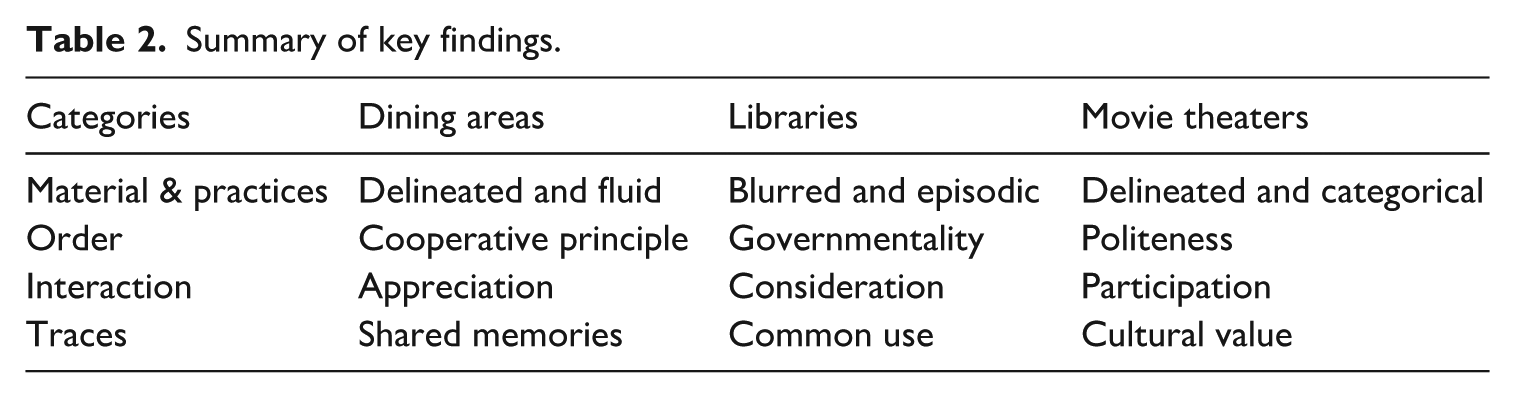
Table 2 provides an overview over the key findings.
Summary of key findings.
No study is without limitations, and ours is no exception. While our sample is not limited to young informants, they do constitute the majority. Given prior research demonstrating age-related differences in perceptions of digital disconnection (Beattie et al., 2024), it would be valuable to investigate whether such differences also manifest across socio-spatial contexts. Moreover, prior research points to cross-cultural variation in the social meanings and normative expectations of shared meals and theater etiquette (e.g. Kammoun et al., 2023; Srinivas, 2002). Further studies in different cultural contexts are needed to evaluate the broader applicability of our findings. Additionally, our selection of the three contexts—family, work, and leisure—was guided by their centrality in spatial sociological theory (Oldenburg, 1997). However, each of these spheres contains significant internal variation, and the specific settings we studied should be seen as illustrative rather than exhaustive. Cultural variation, which was beyond the scope of this study, also presents a promising avenue for future research. Moreover, quantitative approaches could help validate our qualitative insights across broader populations.
Despite these limitations, our study extends the existing body of knowledge by introducing space as a relevant factor in the analysis of digital disconnection. As we have demonstrated, a spatial sociological perspective holds substantial potential for advancing our understanding of disconnection practices. Applying this perspective to additional settings—such as co-living arrangements, museums, classrooms, or formal meeting rooms—promises to yield valuable insights into how spatial practices underpin and shape behaviors around digital disengagement. Understanding how environments facilitate digital disconnection can inform the design of spaces that support individuals’ agency in managing their relationship with technology—not through prohibition, but by cultivating conditions in which meaningful alternatives to digital engagement can flourish. In practice, such conditions might include architectural features that enhance visibility and audibility in public spaces, policy measures such as clearly communicated no-phone zones in schools, places of worship, or recreational areas, or the development of cultural rituals that normalize and celebrate digitally disconnected moments in everyday life. Taken together, these strategies can help individuals reclaim a sense of control over their media use—not by withdrawing from the digital world entirely, but by enabling more intentional, context-sensitive forms of engagement.
Footnotes

Ethical considerations
The study received prior approval from the Ethics Review Board of the Faculty of Humanities at the University of Tübingen.
Consent to participate
Written informed consent was obtained from all participants.
Author contributions
Both authors contributed equally to the collaborative writing of all sections of the manuscript. Data coding was conducted by the first author.
Funding
The authors disclosed receipt of the following financial support for the research, authorship, and/or publication of this article: The authors received financial support for the research, authorship and/or publication of this article from the German Research Foundation (Deutsche Forschungsgemeinschaft), Project no. 440842815.
Declaration of conflicting interests
The authors declared no potential conflicts of interest with respect to the research, authorship, and/or publication of this article.
Data availability statement
The data supporting the findings of this study consist of qualitative materials, including transcripts and field notes collected during go-along sessions. Interested researchers may contact the corresponding author to request access to de-identified excerpts or analytical memos, subject to additional ethical review and agreement.