




Abstract
Terrorism has the potential to divide societies. It is particularly relevant to investigate how Islamist terrorism on social media is associated with Muslim minorities’ attitudes and behaviors. This study examined how seeing terrorism on social media relates to Muslim minority individuals’ perceived stigmatization. We further investigated how perceived stigmatization translates to social media behaviors, namely, terror-related online self-disclosure and correction of false information about religion. A survey among German Muslims (N = 432) showed that social media use for information about terrorism was positively associated with perceived stigmatization. This relationship was moderated by individuals’ national identity, but not religious identity. Perceived stigmatization, in turn, positively predicted terror-related online self-disclosure and correction of false information about religion. The findings accentuate the role of social media use for minorities to cope and stand up for their in-group in the face of terror.
Ordinary Muslims are often linked to Islamist terrorism in public debates, mainstream media (Von Sikorski et al., 2022), and social media (Awan, 2014; Hashmi et al., 2021). Portrayals of the Muslim community in connection with terrorism may promote stigma against the Muslim minority (Baele et al., 2019; Von Sikorski et al., 2021). In fact, there is a strong relationship between terrorism and out-group hostility (Godefroidt, 2022). The links that individuals make between Muslims and terrorism are evident in the general hate climate in response to Islamist terrorism, which is visible in increased numbers of religion-based online hate (Kaakinen et al., 2018), anti-Muslim hate crimes (ODIHR, 2020), and higher levels of Islamophobic attitudes (Choma et al., 2015). This can have disruptive consequences for Muslim minorities living in Western societies and for intergroup relations more broadly. For instance, as a response to 9/11, Muslims experienced stress, harassment, and expressed fears of being in public spaces (Abu-Ras and Suarez, 2009). In the European Union, every fifth Muslim has reported discrimination due to their religion (European Union Agency for Fundamental Rights, 2017). Around 70% of Muslim women in Germany do not wear a hijab; among other reasons, one reason for this is fearing disadvantages associated with wearing it (Pfündel et al., 2021). German Muslims point out that discrimination is strongest whenever Muslim identity is visible with elements such as veils (Holtz et al., 2013). Notably, religiously visible females in Norway and Germany reported more religious discrimination than religiously unrecognizable females (Kunst et al., 2012).
A large number of the current public debates are situated on social media. Hence, it is of particular relevance to study what role social media play for Muslim minority members’ experiences of being stigmatized. Stigmatization may occur on the basis of the assumption that “people who are stigmatized have (or are believed to have) an attribute that marks them as different and leads them to be devalued in the eyes of others,” for example, based on group membership (Major and O’Brien, 2005: 395). Stigmatization or feelings of being stigmatized can be elevated by situational cues, such as exposure to media products that reinforce stereotypes (Major and O’Brien, 2005; Schmuck et al., 2022). Since the general Muslim population is often connected to Islamist terrorism (Downing et al., 2022; Hashmi et al., 2021), when Muslims see terror on social media, they may feel stigmatized by majority members. In this context, we conceptualize perceived stigmatization as Muslims’ feelings of being under general terror-based suspicion because of their faith (Murphy et al., 2020). Because individuals can identify simultaneously with several social identities (Kunst et al., 2012; Verkuyten and Martinovic, 2012), we further investigate the moderating role of Muslim minority members’ national (i.e. German) identity and religious (i.e. Muslim) identity. As it is of importance to study dynamics of social identifications for individuals that identify with both, a national and a religious identity (Saleem et al., 2019), we examine how these two identities are involved in shaping responses to exposure to terrorism on social media. We further suggest that a social identity threat that manifests in feelings of stigmatization is a central driver of social media behaviors, such as terrorism-related online self-disclosure and correction of false information about religion.
To address gaps in prior research, we conducted a survey among Muslims living in Germany. Research about terrorism on social media and minorities’ social identities is to date scarce. In general, Muslims as a minority group are understudied. When Muslims are exposed to terrorism on social media, such content may highlight that their own in-group is devaluated and may threaten their social identity (Saleem and Ramasubramanian, 2019). This study builds on social identity theory (SIT; Tajfel and Turner, 1986) with an aim to examine feelings of stigmatization in response to terror on social media. In order to cope with the feelings of stigmatization and to maintain a positive group identity, Muslims may engage in coping behaviors (Obermaier et al., 2023; Saleem et al., 2021), such as online self-disclosure and correction of false information. Prior research has mainly focused on reactions to (negative) minority depictions in mainstream media, and less attention has been attributed to the investigation of social media exposure, particularly when it comes to Muslim minorities’ responses to such content (for an exception, see Obermaier et al., 2023; Schmuck and Tribastone, 2020). Moreover, some research has explored Muslim minorities’ intentions to engage in collective action in response to negative media portrayals (Saleem et al., 2021), but Muslim individuals’ online coping behaviors remain largely unexplored. However, this is crucial to study. This study investigates two central social media-related behavioral outcomes: (1) minority members’ online self-disclosure as a coping mechanism in response to terror depictions as well as (2) correction of false information when it comes to depictions of religion. First, social media may help minorities to cope with stressors by finding reassurance in their online social network (Stiles, 1987; Zhang, 2017). Second, it is important to study what motivates Muslim individuals to engage in correcting false information about their religion. Ultimately, these coping behaviors may improve the status of the minority group within the multicultural and multireligious societies (see Saleem et al., 2021 for reseach on collective action; Tajfel and Turner, 1986). Against this background, we test how social media use for information about terrorism relates to Muslim minorities’ perceived stigmatization. The assumption is that such social media use is associated with higher perceived stigmatization. In addition, we investigate how this relationship is moderated by Muslim individuals’ religious identity as well as national identity. Moreover, we test how feelings of stigmatization relate to online self-disclosure and correction of false information about religion, hypothesizing that perceived stigmatization fosters social media behaviors.
Muslim minority in Germany
Islam is the second biggest religion in the world (Pew Research Center, 2015). In Germany, Muslims are a religious minority that make up around 6.6% of the total population of 83.1 million (Pfündel et al., 2021). The majority of German Muslims belong to the Sunni faith and have migration background (Pfündel et al., 2021). Especially in the 1960s and 1970s, Turkish Muslims were poached to Germany as “guestworkers” (Hunn, 2002). According to a study about Muslim life in Germany 2020 commissioned by the German Islam Conference, Muslims with Turkish migration background comprise around 45% of Muslims with migration background living in Germany (Pfündel et al., 2021). The report further outlines that the diversity of origin countries has consistently increased over the years, making Muslims today a diverse group—19% have a migration background from the Middle East (particularly Syria), 19% from South East Europe, 8% from North Africa, and 9% from South Asia. In addition, the report suggests that nearly half of the Muslims in Germany in 2019 had German citizenship. The number of German nationals is particularly low in Muslims coming from the Middle East, with many of them arriving to the country as refugees and only in recent years. As such, Muslims from this region are predominantly first-generation immigrants (95%)—as opposed to Muslims from Turkey with 54% first-generation immigrants (Pfündel et al., 2021).
Although Muslims constitute a large religious minority in the United States and Europe, Muslims are subject to Islamophobia. Experiences of stigmatization, discrimination, and marginalization among German Muslims are common (Holtz et al., 2013; Kunst et al., 2012). According to a survey study, Germans Muslims experience religious discrimination, perceive Islamophobia, and experience negative portrayals of Muslims in the media (Kunst et al., 2012). A focus group study with German Muslims showed that German Muslims feel being collectively discriminated and rejected in German society, even though personal experiences of discrimination by non-Muslim Germans were less common (Holtz et al., 2013). When it comes to the media, German Muslims also describe portrayals of Islam in German media as overly negative (Holtz et al., 2013). Consequently, German Muslims “feel under constant subtle suspicion of being terrorists or religious fanatics” (Holtz et al., 2013: 239). In the US context, anti-Muslim sentiments as well as Muslims’ experiences of stigmatization increased especially after the 9/11 attacks (Abu-Ras and Suarez, 2009; Ogan et al., 2014). The so-called “refugee crisis” in 2015 affected the public opinion climate about Muslims in Europe (Sadeghi, 2019). Much of this debate circulated around the themes of security threat and terrorism (Galantino, 2022). In Germany, as a consequence, German Iranians reported a greater sense of threat and stigma, as well as experiences of discrimination and marginalization (Sadeghi, 2019).
Social media use for information about terror and perceived stigmatization
Although there is no unanimous definition of terrorism in the literature, terrorism is commonly viewed as the usage of violence, which is directed at civilians with an intention to spread fear and influence individuals’ political opinions (Moghaddam and Marsella, 2004). Islamist terrorism can be defined as religion-based use of violence with the goal to create an Islamic state based on terrorists’ own interpretation of law and rejection of democracy (European Union Agency for Law Enforcement Cooperation, 2021). In Western countries, Islamist terrorism has been the deadliest form of terrorism in the past decade (Institute for Economics and Peace, 2022). Terrorists aim to instill fear and achieve psychological effects that go beyond the direct victims of the attack (Hoffman, 2018). To achieve this goal, mediated publicity is important as the media—including social media—provide access to large audiences (Hoffman, 2018).
Social media, defined as Internet-based platforms for content creation and exchange by its users (Kaplan and Haenlein, 2010), are an important source of information, including news, political information, or other controversial topics. From a broader perspective, Internet use has transformed how Muslims practice Islam and how Muslims perceive themselves (Bunt, 2009). The Internet and social media are venues for Muslim networks and communities to gather, connect, and dialogue (Bunt, 2003, 2009; Mahmudova and Evolvi, 2021). Prior research has explored Muslims’ experiences and discourses in the online world and how Muslims themselves construct their identities online (Bunt, 2003, 2009; el-Nawawy and Khamis, 2010; Evolvi, 2017; Mahmudova and Evolvi, 2021; Pennington, 2018b; Peterson, 2022; Radsch and Khamis, 2013; Rozehnal, 2019). For instance, an analysis of a blog showed that young Italian Muslims contrast persistent media stereotypes, highlight the compatibility of Islam with Western societies, and discuss the potential of religious diversity (Evolvi, 2017). Exploring the role of Instagram use, qualitative interviews revealed that Dutch Muslim women create narratives that aim at capturing their complex identities, thereby showing “how culture, ethnicity, and identity are entangled” (Mahmudova and Evolvi, 2021: 64). They pointed out that Instagram allows them to follow other Muslim women for inspiration and that popularity of some Muslim women creates awareness about diversity (Mahmudova and Evolvi, 2021). Thus, social media is also a place for challenging existing stereotypes and providing narratives that are less represented in the mainstream media (Mahmudova and Evolvi, 2021; Pennington, 2018a).
But besides this potential, social media platforms can also facilitate the spread of hateful, polarizing, or misleading content to large audiences and affect users and public discourse in numerous ways. For instance, exposure to COVID-related misinformation on social media has been linked to adverse psychological correlates such as fear, panic, and psychological disorders (Rocha et al., 2023). In the political domain, research suggests that voters are frequently exposed to fake news on social media during election periods—that is, “intentionally and verifiably false” news (Allcott and Gentzkow, 2017: 213). Adding to this, established hierarchies of trustworthiness from traditional media are challenged on social media (Flintham et al., 2018). Another concern relates to the polarization of users and the spreading of content in homogeneous clusters, or echo chambers (Del Vicario et al., 2016; Kaiser et al., 2022). Similar structures may also be involved in the dissemination of conspiracy theories that are conditional on the users’ predispositions. In a recent study, Enders et al. (2023) find that the relationship between social media use and conspiracy beliefs is conditional on conspiracy thinking, with a stronger association in users who express higher levels of conspiracy thinking. Disinformation on social media was further acknowledged as a driver of domestic terrorism (Piazza, 2022). During the El Paso mass shooting, a recent study suggests that it was particularly opinion leaders who heavily dispersed misinformation without correcting (Lee et al., 2023). In the wake of an attack, social media serve as primary information media, or are also a space for more general discourses about terrorism not related to any specific attack (Eriksson Krutrök and Lindgren, 2018; Kwon et al., 2017). Social media use can shape citizens’ attitudes. Anti-Islam discourses that are often present in the media are reflected in social media debates as well, for example, portraying Muslims as violent (Awan, 2014; Castaño-Pulgarín et al., 2021; Downing et al., 2022). On social media, Islam is often depicted as a religion of extremism and terrorism (Awan, 2014; Hashmi et al., 2021) and non-Muslim individuals often justify hatred toward Islam because of terrorist actions (Kaakinen et al., 2018; Schmuck et al., 2020). Research also shows that after the November 2015 Paris terror attacks, exposure to online hate that degraded individuals or social groups (e.g. based on religion) increased (Kaakinen et al., 2018). Thus, there are many occasions for minorities to encounter terror content that depicts their in-group in a negative light. Social media serve as a space for hateful content that targets (Muslim) minorities, potentially preventing the dialogic participation of Muslims (Evolvi, 2019).
When Muslims themselves are exposed to Islamophobic content on social media, which often associates ordinary Muslims to terrorism, this can have tremendous consequences. Muslims may come to believe that majority members evaluate them based on these derogatory depictions (Neumann et al., 2018). Moreover, exposure to unfavorable (social) media portrayals of Muslims signals Muslim individuals that their in-group is not held in high esteem, which poses a threat to their social identities (Saleem et al., 2019; Saleem and Ramasubramanian, 2019). Although studies based on Muslim minority samples are to date scarce, some research evidence suggests that negative media portrayals can increase Muslims’ perceived discrimination (Schmuck et al., 2017, 2022), feelings of resentment (Ahmad, 2006), and avoidance of majority members (Saleem and Ramasubramanian, 2019). Furthermore, anti-Muslim hate online may relate to feelings of insecurity and vulnerability, and diminish sense of belonging (Awan and Zempi, 2016). In the context of social media, Schmuck and Tribastone (2020) showed that exposure to anti-Islamic political messages increased young Muslims’ feelings of discrimination. Notably, the authors revealed that this effect persisted not only right after the exposure to such content, but even weeks later, which is suggestive of long-term effects (Schmuck and Tribastone, 2020).
SIT provides a theoretical framework for explaining intergroup behaviors (Tajfel, 1982; Tajfel and Turner, 1986). The very basis that drives intergroup behavior is that humans have a fundamental need of belonging to social groups (Tajfel, 1982; Tajfel and Turner, 1986). SIT suggests that individuals structure the social world into groups, distinguishing between in-groups and out-groups (Tajfel, 1982; Tajfel and Turner, 1986). By Identifying as members or non-members of specific groups, people strive to maintain positive social identity with comparison between groups (Tajfel, 1982; Tajfel and Turner, 1986). Drawing on the SIT, self-categorization theory (Turner et al., 1987) argues that categorizing oneself to groups is dependent on the salience of the social category and on the extent to which this category becomes psychologically activated in a specific situation. Contextual factors and situational cues, such as exposure to negative social media content about one’s in-group, may be perceived as a threat to individuals’ social identity and manifest in feelings of stigmatization. That is, when Muslims see terrorism on social media—content that likely makes links to Muslims and depicts the in-group in a negative light—they may feel stigmatized by majority members of society. Based on these empirical and theoretical considerations, we propose:
H1: Social media use for information about terrorism is associated with higher perceived stigmatization.
The moderating role of religious and national identity
All humans identify with various social identities and self-categorize to several collective categories that inevitably shape their responses to different situations (Verkuyten and Martinovic, 2012; Ysseldyk et al., 2010). We argue that Muslim minority members’ social media use for information about terrorism may not always relate to stigmatization (as hypothesized in H1), but depend on the strength of their religious identity and national identity. That is, the “subjective value of a particular group membership for the self” (Ysseldyk et al., 2012: 3). Based on SIT and subsequent theoretical considerations, esteem derived from group identification organizes attitudes toward the in-group and out-group under conditions of threat (Branscombe and Wann, 1994). Although Muslim minorities inevitably identify with various other social identities, importantly for this study, Muslim minority individuals may identify with their religion (i.e. Muslim identity) and/or with the mainstream society (i.e. German national identity) (Jasinskaja-Lahti et al., 2009; Verkuyten, 2007). These identities may not be mutually exclusive, but intersect (Kunst et al., 2012; Verkuyten, 2007; Verkuyten and Martinovic, 2012). Therefore, it is relevant to account for these two theoretically relevant social identities (Hamidou-Schmidt and Mayer, 2021; Hindriks et al., 2014). Since the activation of intergroup biases can also depend on individuals’ identification with the in-group (Tajfel, 1982; Tajfel and Turner, 1986), social identities may be involved in shaping responses to terrorism. On a more general note, identification, that is, level of identification with the in-group, is a central moderator in social identity-related research (Bizman and Yinon, 2001; Crisp and Beck, 2005; Erba, 2018). For instance, high levels of religious identification correlated with religious in-group bias in Northern Irish Protestants and Catholics (Cairns et al., 2006). Similarly, a study among Dutch–Turkish Muslims found that high religious identification was related to higher in-group bias (Verkuyten and Martinovic, 2012). Another study found that religious identification was associated with less out-group hostility (Ysseldyk et al., 2012). In German and Dutch Muslims, perceived discrimination was significantly related to religious identification, particularly in participants who perceive incompatibility between a “Western” way of life and an “Islamic” way of life (see also Fleischmann et al., 2011, 2019; Martinovic and Verkuyten, 2012).
The focus on religious identity is important, because for religious individuals, religious identification is a central social identity (Seul, 1999). Religion offers a worldview and a belief system, which functions as a buffer against anxiety and uncertainties (Pyszczynski et al., 2015; Ysseldyk et al., 2010). Religion may be particularly relevant when one’s sense of safety is reduced (Muldoon et al., 2007). Religious identity can be considered as a social identity rooted in a system of beliefs, which shapes psychological and social processes (Ysseldyk et al., 2010). Thus, perceptions of (social) media content can specifically depend on Muslims’ religious identification. Individuals that have high levels of religious identification may feel more personally attacked by this content, because it touches a central part of their self-concept and is a verbal attack against one’s own in-group (Kepplinger, 2007; see also Zerback and Karadas, 2023). In other words, high levels of religious identification mean that belonging to the religious group is more important to the individuals’ self and self-esteem than in low levels of religious identification. Thus, among high religious identifiers, the feelings of stigmatization increase in response to terror compared to low identifiers:
H2: The hypothesized positive relationship between social media use for information about terrorism and perceived stigmatization is moderated by religious identity. Muslims with higher religious identification perceive more stigmatization when using social media for information about terrorism compared to Muslims with lower religious identification.
Identification with a national group is important for a sense of connection and belongingness to a country (Leszczensky et al., 2020), but it may also be a protective mechanism when being exposed to terror on social media. Strong national identification among Muslim minority members tends to lessen their perception of social distance to the majority society (Verkuyten and Martinovic, 2012). That is, when Muslim minority individuals’ identification with a country is high, they may not feel as personally targeted by negative social media depictions. Higher identification as a German may be an indication of social distance to the minority in-group and low personal involvement, and thus, serve as a buffer. Hence, we assume that high national identifiers will less likely feel that their group is attacked when seeing terrorism online. We hypothesize that the higher the identification as a German is, the weaker the relationship between social media use for information about terrorism and feelings of stigmatization:
H3: The hypothesized positive relationship between social media use for information about terrorism and perceived stigmatization is moderated by national identity. Muslims with higher national identification perceive less stigmatization when using social media for information about terrorism compared to Muslims with lower national identification.
Perceived stigmatization and online self-disclosure
In order to maintain a positive social identity, to protect their well-being, and to seek for sense of belonging, individuals may use online self-disclosure for coping. Feeling stigmatized can have far-reaching psychological effects, such as reduced well-being (Major and O’Brien, 2005). (Online) self-disclosure is an important coping mechanism in stressful situations or in times of crisis, and specifically, in the context of terrorism (Kaskeleviciute et al., 2023). Self-disclosure can be conceptualized as a process to express one’s feelings about a situation to others, to find reassurance about one’s feelings, or to receive advice (Brunell, 2007). In the present context, online self-disclosure refers to Muslim individuals’ sharing of personal feelings, worries, and fears when it comes to terrorism (Karsay et al., 2019; Kaskeleviciute et al., 2023). To exemplify the content of online self-disclosures during crisis, for instance, a large analysis of social media posts in the context of the COVID-19 pandemic identified “social media language indicative of mental health outcomes (anxiety, depression, stress, and suicidal ideation) and support (emotional and informational support)” (Saha et al., 2020: 1). The fever model of disclosure puts forward that individuals self-disclose in response to experienced distress with a goal to maintain psychological well-being (Stiles, 1987). Thus, the motivation to engage in self-disclosure lies in the idea of finding comfort for one’s feelings within one’s own social network and reducing stress (Stiles, 1987; Zhang, 2017). This act elicits reassurance and helps to cope (Brunell, 2007; Stiles, 1987).
Research suggests that not only offline self-disclosure, but also online self-disclosure is important in (re-)establishing feelings of closeness with other people (Kim and Dindia, 2011). Studies have shown that online self-disclosure helps to receive social support from others (Huang, 2016) and improve psychological well-being (Chen and Li, 2017). However, to date, little is known about how minorities self-disclose online. In the context of health, a study showed that perceived mental health-related stigmatization increased the usage of online health applications for social support among immigrants in the US (Malterud et al., 2022). Translated to the purpose of this study, perceptions of stigmatization among Muslim minority members can relate to online self-disclosure, because individuals seek support from in their social network to help them cope. Therefore, we assume:
H4: Perceived stigmatization is positively associated with online self-disclosure.
Perceived stigmatization and correction of false information about religion
Cognitive media effects relate to perceptions of social reality, such as discrimination, and can result in corrective actions to improve group status (Kepplinger, 2007; Zerback and Karadas, 2023). Individuals go to great lengths to protect and uphold their social identity (Tajfel and Turner, 1986). One way to achieve this goal may be correction of what they believe is false information about their own in-group in case of social identity threats. A survey study revealed that Latino minorities expressed or shared their views on social media about immigration when they felt connected to their in-group (Velasquez et al., 2019). Research on identities and interventions has shown that shared identity is important for intervening behaviors (Levine et al., 2005). Studies further suggest that individuals engage in corrections of false information when the issue is of personal relevance (Tandoc et al., 2020). Thus, when individuals feel stigmatized due to unjustified social media portrayals, they may engage in correction of information posted by others. This rationale is also broadly in line with the social media political participation model, which suggests that when individuals feel a discrepancy between a present state and a desired state, they become politically active (Knoll et al., 2020). Feelings of injustice due to stigmatization may tap into this discrepancy, resulting in active behaviors.
Qualitative studies found that one of Muslim minorities’ strategies in response to stigmatization is confrontation of the source of stigmatization, especially when there is a lot at stake (Eijberts and Roggeband, 2016; Witte, 2018). Ample research in the context of 9/11 has studied Muslims’ reactions and experiences after the attacks (Badr, 2004; Haddad, 2007; Nagra, 2011). This line of research suggests that as a response to 9/11 attacks, a number of American Muslim women, including second generation, decided to begin wearing hijabs (Haddad, 2007). As such, wearing the hijab can be seen as sign of solidarity (Haddad, 2007). The hijab also became a symbol of pride, refusing to be defined by the media, and affirmed authentic Muslim and American identity (Haddad, 2007). American Muslim women also believe that wearing hijab can help paint a positive image of American Muslims (Badr, 2004). In sum, these studies suggest that rather than distancing themselves from religion to avoid discrimination, young Muslims’ religious identification increased in response to 9/11 (Nagra, 2011).
Perceived discrimination evoked by exposure to negative social media representations can also promote non-violent collective action among young Muslims (Schmuck and Tribastone, 2020). Moreover, group-based anger in response to negative news coverage of one’s in-group can empower Muslim minority members’ collective action (Saleem et al., 2021). In the context of online hate, Obermaier et al. (2023) showed that exposure to Islamophobic hate—a social identity threat for Muslim individuals—motivated Muslim in-group members to engage in constructive, factual counter speech. The authors identified perceptions of religious identity threat evoked by online hate as an underlying mechanism, which resulted in Muslim minority members’ feelings of personal responsibility to intervene (Obermaier et al., 2023). Since feelings of being stigmatized due to one’s faith and because of terrorism is, by definition, a threat to social identity, we expect Muslim individuals to engage in more correction of Islam-related false information in order to uphold a positive group status. Hence, we hypothesize:
H5: Perceived stigmatization is positively associated with correction of false information about religion.
Figure 1 depicts the hypothesized model.
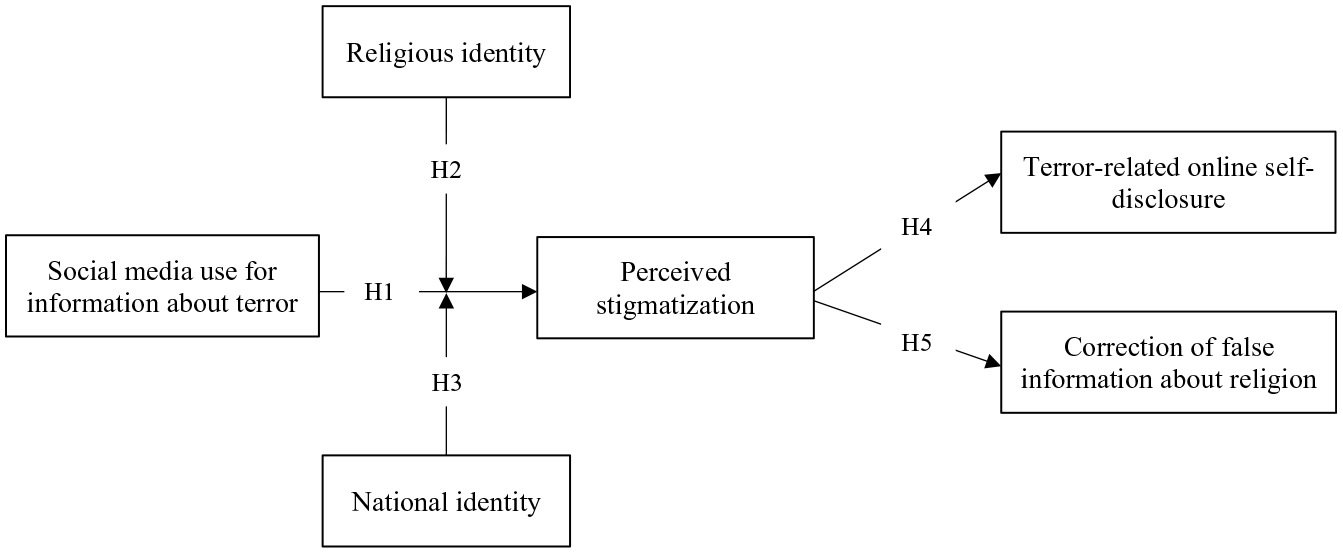
Hypothesized model.
Method
We surveyed German Muslims (individuals that self-identify as Muslims; n = 341, 78.94% Sunni; n = 48, 11.11% Shia; n = 43, 9.95% other) aged 18 or older (M = 37.75, SD = 14.23) with the help of an external panel provider. 27.08% of the sample (n = 117) indicated having converted to Islam. Data were collected online between 4 and 10 May 2022. We received clearance of the Institutional Review Board of the Department of Communication at the University of Vienna prior to data collection (ID: 20220228_007). Before partaking in the survey, participants were asked to provide informed consent. Given the difficulties in reaching minority populations and efforts to acquire a sufficient amount of data, we refrained from using quotas. We did, however, strive for a sample that mirrors the distribution of gender and education as closely as possible. We excluded participants who indicated agreement to three attention check items (e.g. “I have never used a computer before”) to ensure data quality. In addition, participants with completion times below one-third of the median duration were excluded.
The final sample consisted of N = 432 Muslims. Gender was relatively evenly distributed (nfemale = 211, 48.84%; nmale = 219, 50.69%; nother = 2, 0.46%). Furthermore, 116 participants (26.85%) indicated low formal education (no degree, elementary or secondary school) and 143 (33.10%) indicated high formal education (university degree). In order to statistically control for migration background, we created a dummy variable: 94 participants (21.76%) expressed not having migration background, 338 (79.24%) indicated migration background. 1 The data are available on OSF: https://osf.io/qxzb4/.
Measures
All items are provided in the Online Appendix: https://osf.io/qxzb4/. If not indicated otherwise, agreement to the items was measured on 7-point scales ranging from 1 (strongly disagree) to 7 (strongly agree).
Social media use for information about terror
We used two items based on the study by Escobar-Viera et al. (2018) to assess the frequency of social media use for information about terror. Participants indicated how often they used social media to inform themselves about (1) Islamist terrorism in general and (2) Islamist terrorist attacks on a 7-point scale from 1 (never) to 7 (very often). Both items were combined to form a mean-based index (Pearson’s r = .88; M = 3.18, SD = 1.77).
Religious identity
We gauged religious identity with five items adapted from the studies by Verkuyten (2007) and Stevens et al. (2004) (e.g. “I feel a strong connection to Islam”). We used principal component analysis to assess dimensionality and collapsed the items to a mean-based index (α = .94; M = 4.96, SD = 1.63).
National identity
Four items adapted from the studies by Verkuyten (2007) and Stevens et al. (2004) measured national identity (e.g. “I identify strongly as a German”). Following the procedure outlined above, we constructed a mean-based index (α = .89; M = 4.72, SD = 1.57).
Stigmatization
Perceived stigmatization was assessed with three items adapted from the study by Murphy et al. (2020; e.g. “Because of my faith, I feel threatened to be accused of terrorist activity”). The items formed a mean-based index (α = .91; M = 3.36, SD = 1.91).
Terror-related online self-disclosure
We measured terror-related online self-disclosure by adapting two items from the study by Karsay et al. (2019) (“When you think of Islamist terrorism, how often do you typically share on social media . . . (1) your personal feelings? (2) your worries and fears?”). The items were measured on a 7-point scale from 1 (never) to 7 (very often) and combined to a mean-based index (Pearson’s r = .83; M = 2.86, SD = 1.84).
Correction of false information about religion
Frequency of correcting false information about Muslims and Islam on social media was assessed with three items (“How many times have you alerted another person that the information they share or disseminate on social media about Muslims and Islam is . . . (1) false, (2) incomplete, (3) not correct”), measured on a 7-point scale from 1 (never) to 7 (very often). Again, the items were transformed to a mean-based index (α = .95; M = 4.13, SD = 1.90).
Control variables
We included age, female and other gender, low and high education, migration background, political ideology, and political social media use as control variables to our model. Political social media use was measured with two items on a 7-point scale from 1 (never) to 7 (very often), questioning participants how often they inform themselves about political topics (1) on social media, (2) via instant messaging apps (Pearson’s r = .64; M = 4.21, SD = 1.70). We assessed political ideology by asking participants to position themselves on a 10-point scale from left (= 1) to right (= 10) on the political spectrum (M = 5.00, SD = 2.15).
Data analysis
Data were analyzed using R and the PROCESS (Hayes, 2013) for R package (version 4.2) to test our hypotheses (model 10; 5000 bootstrap samples).
Results
All results are displayed in Table 1. Our findings showed that social media use for information about terror was positively related to Muslim individuals’ higher perceived stigmatization (b = 0.20, SE = 0.05, p < .001). H1 was supported. We found no significant interaction effect of social media use for information about terrorism and religious identity on perceived stigmatization (b = 0.00, SE = 0.03, p = .923). Hence, H2 was rejected. The interaction effect of social media use for information about terrorism and national identity on perceived stigmatization was positive and significant (b = 0.08, SE = 0.03, p = .008). The Johnson–Neyman plot of the significant interaction is shown in Figure 2. This finding indicates that for Muslim individuals with high levels of national identity, the relationship between social media use for terrorism and perceived stigmatization was more pronounced and significant. When levels of national identity were moderate to low, there was no association between social media use for terrorism and stigmatization. This rejects H3. Furthermore, we found that perceived stigmatization was positively associated with terror-related online self-disclosure (b = 0.10, SE = 0.04, p = .018). H4 was confirmed. Finally, perceived stigmatization was positively related to correction of false information about religion (b = 0.20, SE = 0.05, p < .001). This confirms H5.
Unstandardized regression coefficients.
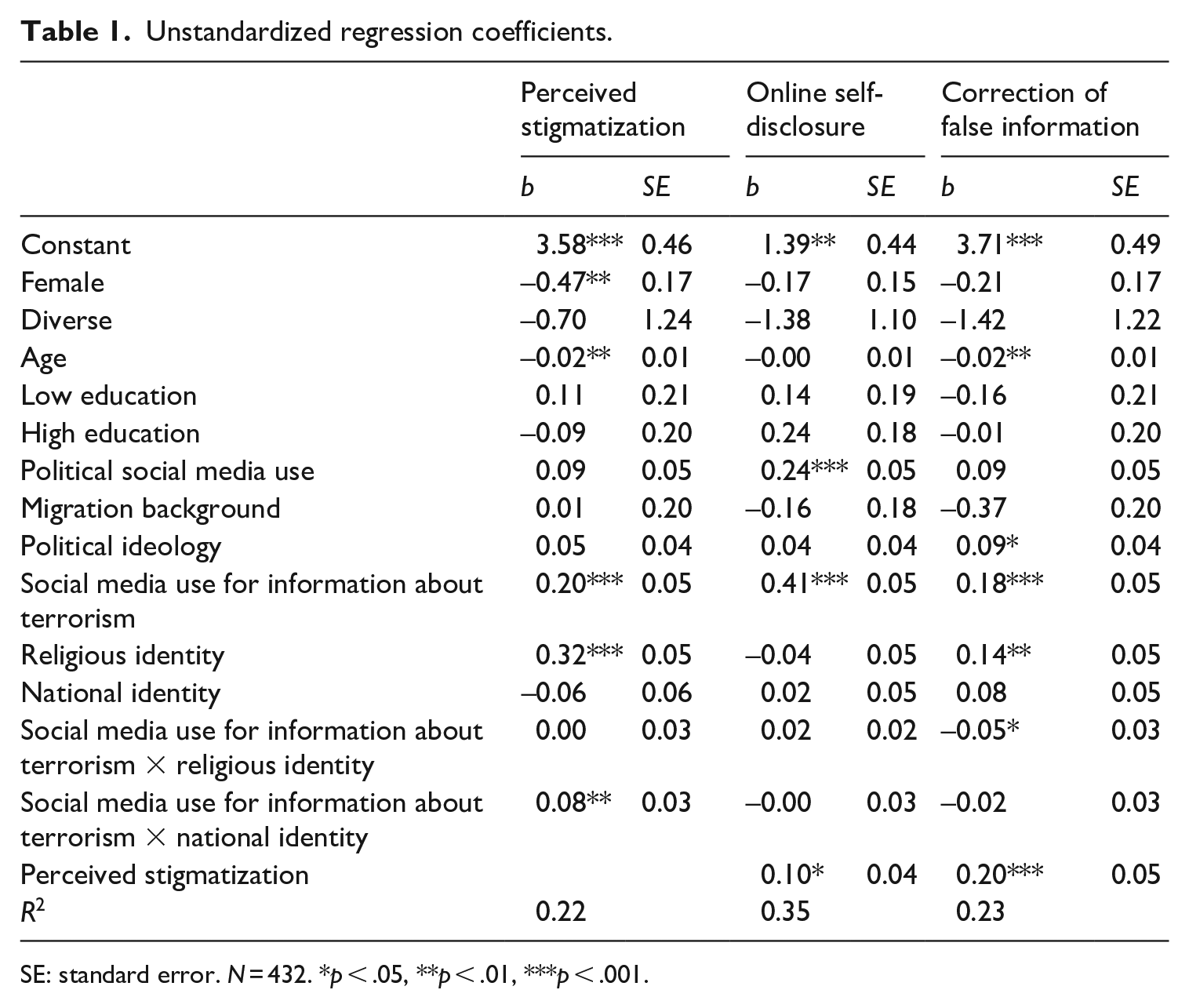
SE: standard error. N = 432. *p < .05, **p < .01, ***p < .001.
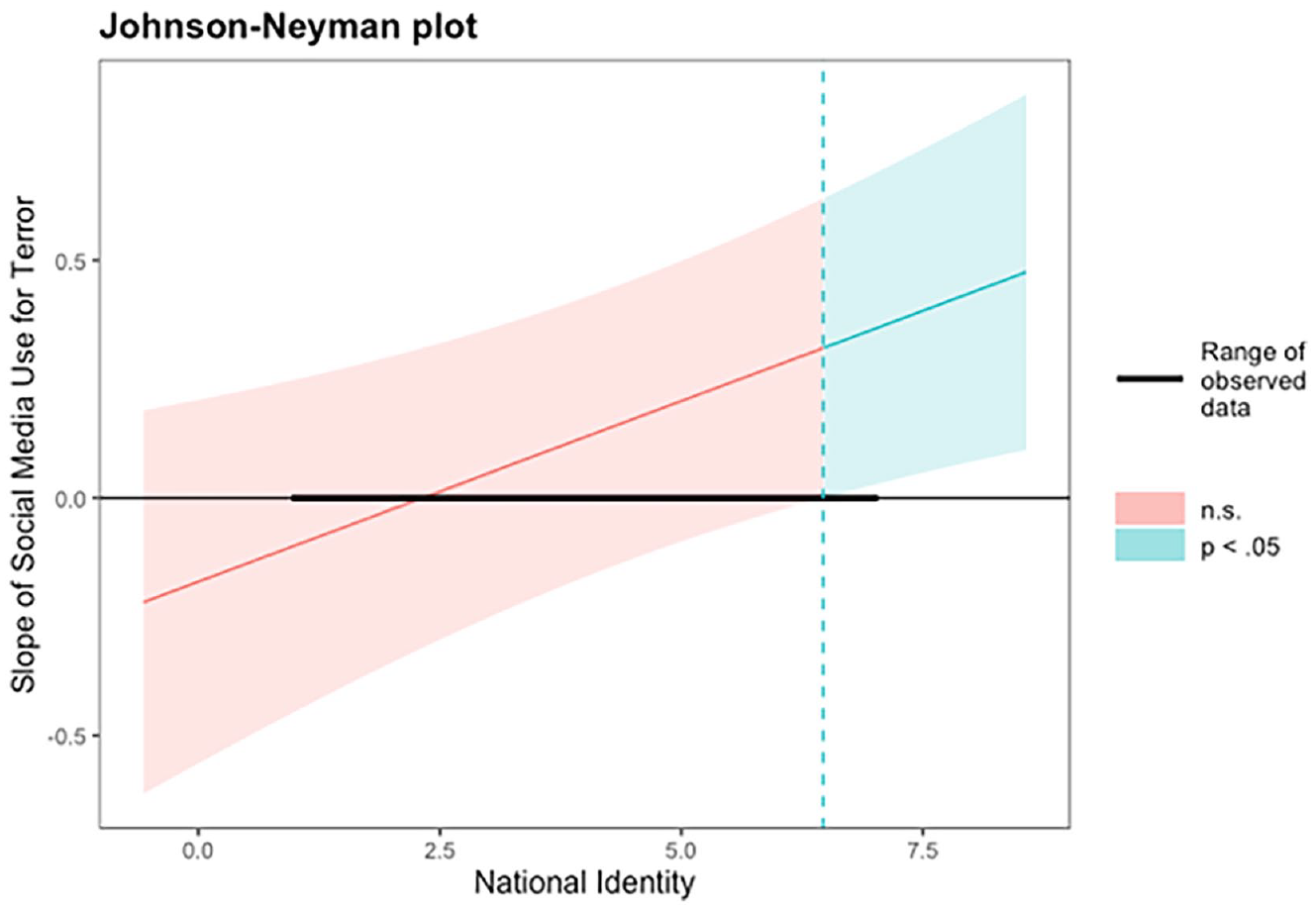
Johnson–Neyman plot for interaction of social media use for information about terror and national identity on stigmatization.
In an additional analysis, we looked at overall indices of partial moderated mediation. In Model 1 (online self-disclosure modeled as dependent variable), this index was not significant for religious identity (b = 0.00, SE = 0.00), confidence interval (CI) = [−0.01, 0.01] nor for national identity (b = 0.01, SE = 0.01), CI = [−0.00, 0.02]. For Model 2 (correction of false information about religion modeled as dependent variable), this index was not significant for religious identity (b = 0.00, SE = 0.01), CI = [−0.01, 0.01], but significant for national identity (b = 0.02, SE = 0.01), CI = [0.00, 0.03].
Moreover, even though this relationship was not hypothesized, the results showed a significant interaction effect of social media use for information about terrorism and religious identity on correction of false information about religion (b = −0.05, SE = 0.03, p = .046). Furthermore, religious identity was positively associated with stigmatization (b = 0.32, SE = 0.05, p < .001) and correction of false information about religion (b = 0.14, SE = 0.05, p = .009). Social media use for information about terrorism was positively related to online self-disclosure (b = 0.41, SE = 0.05, p < .001) and correction of false information about religion (b = 0.18, SE = 0.05, p < .001). Political social media use was positively related to online self-disclosure (b = 0.24, SE = 0.05, p < .001). Regarding control variables, age (b = −0.02, SE = 0.01, p = .006) and female gender (b = −0.47, SE = 0.17, p = .007) were negatively related to perceived stigmatization. Moreover, age was negatively associated with correction of false information about religion (b = –0.02, SE = 0.01, p = .010). Participants leaning to right on political spectrum corrected false information about religion more often (b = 0.09, SE = 0.04, p = .028).
Discussion
This study examined the role of social media use for information about terror using data from a survey among Muslims living in Germany. More precisely, the study sought to shed light on Muslims’ feelings of stigmatization in response to terrorism on social media, while taking into account the moderating function of religious identity and national identity. Furthermore, this study investigated how perceived stigmatization associates with terror-related online self-disclosure and correction of false information about Islam. Since social media are a central space for terrorism content, which often includes anti-Islam discourses and stereotyped depictions of the general Muslim population (Awan, 2014; Downing et al., 2022; Hashmi et al., 2021), it is of utmost importance to understand how Muslims themselves react to this content and what kind of coping strategies they engage in.
Our first finding showed that social media use for information about terrorism was associated with Muslim individuals’ feelings of stigmatization. This finding is not surprising, as Muslims suffer from stress, hate and assaults in the wake of Islamist terrorism (Abu-Ras and Suarez, 2009; Amer and Bagasra, 2013). Similar patterns have been found in the context of traditional media, showing that Muslims experience discrimination when being exposed to news that portrays their religious in-group in a negative light (Schmuck et al., 2022). This finding corroborates the relevance of social media, in line with prior work revealing that anti-Islamic online political messages lead to perceived discrimination (Schmuck and Tribastone, 2020). That is, the finding indicates that Muslim individuals may feel stigmatized due to terror by simply using social media platforms and seeing terrorism content there. This relationship also finds support in the theoretical framework of SIT (Tajfel and Turner, 1986), signaling that negative social media portrayals of one’s in-group pose a threat to one’s social identity (Saleem and Ramasubramanian, 2019). The finding is concerning, as feelings of stigmatization may be followed by more negative attitudes toward integration and the majority society members, , or reduce sense of belonging (see Elsayed and de Grip, 2018; Verkuyten, 2016).
Looking into the moderating role of religious identity, our findings showed no interaction of social media use for information about terrorism and religious identity on perceived stigmatization. Hence, social media use for terror information was associated with stigmatization independent of the strength of identification with religion. We hypothesized that high identifiers would feel more personally touched by terror content, as this content likely depicts their religious in-group—individuals they feel similar to—in an unfavorable light. However, the strength of religious identity does not seem to play a role for Muslim minority individuals. From the perspective of the mainstream society, it can be that others (i.e. majority members) heuristically categorize Muslim individuals as either Muslims or non-Muslims. Thus, even if Muslim individuals do not strongly identify with their religious identity, they might still be classified as Muslims in the eyes of majority population. This rationale may explain the null finding. Similar patterns have been found in recent research on news coverage, revealing null findings of moderating role of Muslim identity in response to news about terror on perceived public opinion (Zerback and Karadas, 2023).
Further examining the moderation of national identity, we found an interaction effect of social media use related to information about terror and national identity on perceptions of stigmatization. The direction of the interaction effect was against our assumptions. Our findings indicated that for high levels of national identity, the relationship between terror information-related social media use and stigmatization was stronger. This was not the case for individuals with moderate to low national identity. We argued that higher national identity signals belongingness to the mainstream society and hence is an indication of social distance to the Muslim in-group (Leszczensky et al., 2020; Verkuyten and Martinovic, 2012). This could mean that individuals do not feel personally offended in the face of terror, since they may not feel as connected or similar to the in-group. However, an alternative explanation seems plausible. It may be that high national identifiers feel strongly as Germans, who are also Muslims at the same time, and see such attacks on their religion particularly unfair, undeserved, and unjustified. Future research should explore this idea.
Moreover, our results revealed that perceived stigmatization was positively correlated with terror-related online self-disclosure. Hence, in line with the basic idea of the fever model of disclosure (Stiles, 1987), Muslim individuals may engage in online self-disclosure in order to cope with the stressful situation and to find comfort in their online social network (Kaskeleviciute et al., 2023; Zhang, 2017). Unjustified stigmatization is obviously a situation of discomfort for minorities, and to cope with these feelings, individuals may turn to self-disclosure. It is crucial to better understand and ensure the well-being of Muslim minorities (Amer and Bagasra, 2013). Notably, we did not investigate the exact content of these self-disclosures. That is, we do not know whether worries or concerns shared on social media were about feelings of being stigmatized or whether these concerns related to, for instance, victims of terrorism more broadly. This is an important research avenue for future studies.
Finally, the findings showed that feeling stigmatized related to correction of false information about religion. This finding suggests that despite of increased feelings of stigmatization in the face of terror, Muslim individuals engage in correction of false information related to their religion. The result is indicative of Muslim individuals’ willingness to be there for each other and stand up for their in-group when it is falsely accused. More broadly, this finding supports the idea of the social media political participation model (Knoll et al., 2020), indicating that feelings of discomfort and unfairness due to stigmatization may induce active behaviors. This finding is also in line with prior research which has shown that Muslims may engage in collective action as a response to negative media portrayals of their in-group (Saleem et al., 2021; Schmuck and Tribastone, 2020) or factual counter -speech in the context of online hate (Obermaier et al., 2023). Moreover, our findings corroborate qualitative insights that suggest that Muslim minorities use social media to challenge existing stereotypes and dominant narratives (Evolvi, 2017; Mahmudova and Evolvi, 2021; Pennington, 2018a). On a broader scope, higher social media engagement including corrective action and content production may pave the way for Muslims to shape their own ways of representation and may offer an important means to counter stereotypes and foster intergroup relations. Studies in the context of Latinx members’ engagement on social media suggests empowering potentials that counteract homogenized representations in traditional media (Gutiérrez, 2021). Similarly, political Latinx activists use social media to promote their initiatives (Montoya and Seminario, 2022).
Limitations and future research
The study comes with some noteworthy limitations. First, this is a cross-sectional survey, which makes it unsuitable for testing for causal directions of the hypothesized relationships. This study serves as a building block for further studies. Future research should investigate the relationships examined in this study with longitudinal designs as well as test the causality with experimental designs. Second, Muslim minorities are understudied and the study was based on a hard-to-reach Muslim minority sample in Germany. This study was conducted in one country context only. Future studies should replicate and extend this line of research to other cultural and country contexts as well. Third, although surveys have advantages in terms of external validity, our study employed self-reports for all measured constructs. Participants may under- or over-estimate their social media use and related behaviors, and their answering may suffer from perceptual biases. Thus, we cannot say anything about the exact content participants were exposed to. Future research studies should make use of other methods, such as content and linkage analysis. Fourth, we did not distinguish between different types of terrorism content that individuals can be exposed to on social media. On social media, terror content is diverse. For example, it may be that exposure to audiovisual content is related to more perceived stigmatization compared to written text only. It may also be that exposure to posts with terror content that were shared by individuals seen as part of the in-group in comparison to out-group relate to different outcomes. Future research should look more closely into these differences. It is also important to consider the caveats of religious identification measures. As Day and Lee (2014) point out in their introduction to a special issue, religious identification does not necessarily capture in-group identification, it can also be more or less meaningless in everyday life and participants only indicate it because the measurement items make this category salient and/or because participants use it to distinguish themselves from other groups. With our two-step approach that first asks for religious affiliation and later on for the level of religious identification, we believe to have minimized this issue.
Conclusion and implications
Given the prominence of terror content on social media, it is of particular relevance to study the relationships associated with exposure to this content among Muslim minorities. This study revealed that Muslim minority individuals’ social media use for information about terrorism is related to higher perceived stigmatization. This association is moderated by national identity, showing that the relationship is more pronounced for high national identifiers. Thus, social identities are important when aiming to understand how Muslims position themselves in societies. Perceived stigmatization, in turn, is related to more online self-disclosure and intentions to correct false information about religion. Moreover, our findings indicate that although Muslim minorities feel stigmatized due to terror, they use social media to amend incorrect information about Islam. Taken together, our findings highlight the relevance of social media as a venue for Muslim minorities to interact and intervene. When Muslim minorities see terrorism on social media and feel stigmatized, they use social media for coping and standing up for their own in-group. Ultimately, these behaviors might improve the minority group status within our diverse societies.
Footnotes
Declaration of conflicting interests
The author(s) declared no potential conflicts of interest with respect to the research, authorship, and/or publication of this article.
Funding
The author(s) received no financial support for the research, authorship, and/or publication of this article.
