



Abstract
In March 2021, Australia enacted the News Media Bargaining Code (NMBC) legislation, which compels Google and Meta to pay for third-party news content on their platforms. To date, Australian newsrooms have made deals with both platforms totalling approximately AUD$200 million (US$126.4 million). The 1-year review of the Code has prompted questions about not just the legislation but also the lack of public detail about the deals made between news organisations and the platforms. This article seeks to critically analyse the strategic positions both Google and Facebook took in supporting public interest journalism before and after the introduction of the Code. Using a mixed methodological approach, we find that both platforms differed in their strategic engagement with Australian media organisations before and after the introduction of the NMBC and that the Code, as it stands, risks increasing platform influence in the Australian news market.
Introduction
In 2021, the Australian Government introduced the News Media Bargaining Code (NMBC), which compelled Google and Meta to pay for third-party news content on their platforms. The Code’s explicit aim was to help ‘sustain public interest journalism in Australia’ (Fletcher and Frydenberg, 2021) by recalibrating the imbalance in bargaining power between news media businesses and digital platforms. Leading up to the Code’s implementation, Google and Facebook publicly claimed that they were committed to supporting journalism without the need for regulatory intervention, noting their existing support of journalism (Leaver, 2021). However, once the legislation was enacted platforms began negotiating deals with various news organisations. Notably, Google has secured more deals than Meta (Sims, 2022). This outcome reveals strategic differences between platforms in their approaches to the news sector. Our article considers this period as a point of departure to better understand these different responses to platform regulation and assess the wider implications for the Australian news media market following the introduction of the NMBC.
Throughout the policy development process, a homogeneous view of platform companies proliferated among Australian politicians and regulators. Google and Meta were accorded a similar amount of market power, which according to the argument, meant they could ‘refuse to pay for content’ despite needing ‘to have news on their platform to maximise user attention and so enhance their advertising revenue’ (Sims, 2022). However, we argue that there are unique differences between Google, a company founded as a search engine and oriented around information retrieval, and Facebook, which originated as a social network. The differences between these companies necessarily influence how each company responds to regulatory initiatives focused on the news sector. By identifying how these differences manifest across the implementation of the NMBC, we contribute to a specific strand of the platform governance literature that examines how platforms operate as policy actors (Gray, 2020; Popiel, 2022; Popiel and Sang, 2021). The argument is supported by a comprehensive study of the impact of the NMBC on the Australian media market, drawing on interviews conducted by news media executives involved in negotiating with Meta and Google, analyses of submissions to a government review of the reform and assessing their financial contribution to journalism.
The article proceeds as follows. We begin with a brief background to the NMBC, providing an overview of the development and implementation of the reform. We then review the literature, situating our research in relation to existing research on the NMBC as well as the aforementioned media policy literature, before briefly outlining our methods. We then detail our findings. Our first set of findings involves tracking Google and Facebook’s pre- and post-Code contributions to news media organisations to gauge the extent to which each company values journalism. We then turn to our interviews, which allow us to identify differences in the negotiation strategies of these two platforms. Finally, we consider a review of the NMBC, which was conducted by the Australian Treasury. An analysis of the submissions allows us to gain further insights into Google and Facebook’s responses to the reform. Finally, we end with a conclusion that notes the divergent priorities of these two companies with respect to news and argue that this has ultimately impacted the overall effectiveness of the NMBC.
Background
In 2019 the Australian Competition and Consumer Commission (ACCC, 2019) investigated the market power of digital platforms, with a specific focus on the news media’s long-term sustainability. The report identified significant imbalances in market power and argued that news businesses were unable to receive fair remuneration from digital platforms for the value of their content. In 2020, at the federal government’s direction and following stakeholder consultation, the ACCC provided government with recommended legislation to enact and enable the NMBC. After some last-minute amendments in response to Google and Meta’s public complaints about the Code, the legislation passed in February 2021, receiving royal assent the next month (Australian Government, 2021).
From the outset, Google and Meta were unified in their public opposition to the NMBC. Both threatened to remove Australian news from their platforms. Google launched an online campaign warning Australians that ‘the way Aussies use Google is at risk’ (Leaver, 2021). Meta went further by withdrawing Australian news stories from its Facebook platform for several days, which coincided with the bill being debated in the Australian Senate (Bossio et. al, 2022). In response, the conservative Coalition government amended the bill, including watering down designation provisions. Designation provisions in the Code are a discretionary power held by the nation’s Treasurer to force designated platforms to negotiate with all registered news businesses. Without designation, deal-making was voluntary. At the time of writing, no platform has been designated.
A year after the Code’s implementation, it appears to have produced some successful outcomes with Google and Meta collectively paying newsrooms approximately AUD$200 million (US$126.4 million) across almost 40 different deals. 1 However, some critics argue the Code’s policy intention to support public interest journalism is not properly realised (redacted for review). Others have questioned the lack of transparency around the deal amounts and processes (Kohler, 2021). Platform selectivity in deciding which media outlets to negotiate with, and the differing deal amounts offered, has also been criticised (Ketchell, 2021).
Notwithstanding the lack of transparency around deal-making, the Australian Code has provided a legislative model for international jurisdictions. Brazil, the United Kingdom and California have drafted similar platform reforms. Canada’s Online News Act ‘Bill C-18’ used Australia’s NMBC as a template and mandates that platforms enter into financial agreements with news organisations for news content. The Canadian law has mixed support from its stakeholders with some believing the legislation further entrenches divisions between metro and regional outlets. Others see it as an opportunity to ‘learn from Australia’s mistakes’ (Miller, 2022), ensuring that deals are transparent, and funds go directly to public interest journalism (Schiffrin, 2023). Google and Meta voiced strong opposition to the Canadian law, with Meta pulling access to Canadian news from Facebook. At the time of writing, Google is experimenting with blocking access to Canadian news links in anticipation of the law coming into effect at the end of 2023 (CTV News, 2023).
In late 2022, the Australian federal Treasury undertook an NMBC review. As the report emerged, uncertain global conditions saw tech companies retrench more than 100,000 employees worldwide in a year. This includes a projected 21,000 jobs at Meta and 12,000 at Google (Capoot and Pitt, 2023). This volatility in the technology sector raises questions about the viability of using competition law to address bargaining imbalances and fund public interest journalism long-term. Google and Meta said as much in public submissions and criticised the NMBC as anathema to their business models. Despite most submissions requesting changes to the Code, the Treasury report made few recommendations. Its most significant was to ask the ACCC to investigate if bargaining power imbalances continue to exist. It also called on the ACCC to assess if it could use its information gathering powers to enforce greater transparency about the deals between digital platforms and news businesses. With a lack of urgency, the Treasury concluded that another review be done in 4 years.
Literature review
There is a growing body of research centred around the NMBC and the broader question of whether digital platforms should pay media companies for their news content. Much of this work has been anticipatory, examining policy debates leading up to the Code’s implementation (Flew and Wilding, 2021; redacted for review) or summative, assessing the final form of the legislation (redacted for review; Lee and Molitorisz, 2021; Wilding, 2021). The field has noted the growing influence of competition law in Australian media policy, the success of its arbitration-led approach, and how the country has diverged from copyright-oriented reforms, previously the most popular method of securing payment from digital platforms (Balasingham and Neilson, 2022; Lindsay, 2022). However, there is not yet consensus among Australian-based scholars about the overall success of the NMBC. Analogous work in Europe has focused on the equivalent reform, the Directive on Copyright in the Digital Single Market, which requires platforms to licence news content (Furgał, 2021). The latter reform relies on copyright rather than competition law and does not involve direct bargaining with platforms. It is in an embryonic stage with many member states still transposing the directive into national law.
The above interventions form part of a growing worldwide interest in platform regulation among policymakers and governments (Flew, 2021). The NMBC is one example of a move towards more interventionist modes of platform regulation, which appears to be part of a global push towards curbing platform power (van Dijck et al., 2019). This departs from a traditional reliance on reputational and market-based incentives for platforms to enact change. Research has shown that digital platforms have overwhelmingly positioned their services as socially important, but otherwise as benign infrastructure (Napoli and Caplan, 2017). This approach stems from ‘safe harbour’ provisions that govern the mostly US-based private social media platforms and grant broad immunity under US law from liability for their content under Section 230 of the Communications Decency Act (MacKinnon et al., 2014). Significantly, under the law platforms are treated as benign intermediaries of published content, and not as publishers. This specific section has informed platform responses to proposed regulation. They claim that any regulation would harm the exchange of their ‘free services’ for user data, and ultimately disrupt an innovative business model and hamper their distribution of users’ content – all tantamount to limiting free speech (Samples, 2019). Heylen’s (2023) analysis finds this approach is the discursive modus operandi for Google and Meta, who attempt to present platforms as benign technical intermediaries, while also pursing operational strategies that ‘protect, strengthen and enforce platform sovereignty’.
Historically, Gillespie (2010: 348) noted that these protections have allowed platform companies to ‘strike a regulatory sweet spot between legislative protections that benefit them and obligations that do not’. However, a series of high-profile platform scandals have increased motivation for legislators and policymakers, including Cambridge Analytica’s misuse of Facebook data and examples of political disinformation spreading across social media platforms. Some countries have increased platform responsibility for content, such as Germany’s content moderation laws, imposing heavy financial penalties for failure to remove hate speech (Heldt, 2019). Various national regulators and supranational authorities have also focused on commercial practices, raising concerns about everything from market concentration across the advertising supply chain, to whether the rights of consumers are respected when they deal with digital platform companies (redacted for review).
Scholars have paid increasing attention to platform power, during this regulatory turn (Flew, 2021). van Dijck and colleagues (2019) offer the most applicable theorisation of this concept for our article, and we adopt their approach here, albeit with an important nuance. They note that much of the regulatory discussion around platforms has focused on legal and economic analyses of platform power that largely focus on markets. By contrast, they propose a theorisation that accounts for citizen wellbeing in addition to consumer welfare, recognises that individual platforms form ‘part of an integrated platform ecosystem’, and move from markets to account for to ‘societal infrastructures, in which platforms introduce new hierarchies and dependencies’ (van Dijck et al., 2019). This broad perspective on platform power is valuable in the Australian context, as the NMBC was an economic intervention oriented around the effective structuring of markets and effective bargaining power between parties. While the ACCC did account for the important role that journalism plays in public life during the policy development phase, we contend that the final legislation did not fully account for these wider public interest concerns captured by notions of ‘citizen wellbeing’ and ‘societal infrastructures’ (van Dijck et al., 2019).
Where we depart from the above theorisation is in embracing more detailed analyses of specific platforms. van Dijck and colleagues (2019) make a valuable case for why assessing the entire platform ecosystem is necessary in certain contexts. However, they predominately prosecute this argument with reference to enforcement actions taken under specific regulatory frameworks, which often necessitates highly specific analyses. We go on to suggest that while there are numerous valuable studies that approach platform ecosystems as a unified concept in scholarship (Mansell and Steinmueller, 2020; Plantin et al., 2018), there needs to be more detailed research about the differences between platforms, especially when it comes to media policy. For example, existing research on platforms as policy actors tends to offer similarly broad studies of platform agendas. Popiel and Sang (2021: 2) note that platform companies tend to prefer ‘using technical tools to address nontechnical problems’, some ‘frictionless regulation’ and ‘multi-stakeholderism’. In related research, Popiel (2022: 133) explains that such efforts favour ‘the speed of tech markets at the expense of the deliberative responsiveness to the public, typical of democratic governance’.
The above descriptions are valuable in so far as they offer an evidence-based analysis of how major platforms have generally responded to regulatory threats. When thinking about the news media sector, the above studies accurately describe the behaviour of Google and Meta prior to the NMBC’s introduction. They have long preferred to support the news media sector through discrete funds for innovative projects (redacted for review) and actively resisted the sort of structural reforms represented by the NMBC (Leaver, 2021). Indeed, digital platforms often share a narrative playbook that seeks to frame regulators and policymakers as brakes on innovation to set a tech-friendly agenda (Popiel, 2022). However, the positions of Meta and Google diverged following the Code’s implementation. Given this difference, we suggest that studying each platform on its own terms is beneficial for several reasons.
First, it allows us to recognise that platforms and the companies that run them are unique. In the context of the NMBC, Meta has de-prioritised news since the late-2010s, has returned to their focus on social connections across their growing platform ecosystem, and has shut down their News Tab in certain countries (Meese and Hurcombe, 2021). Conversely, Google retains an interest in organising information, continues to operate Google News and is arguing that their artificial intelligence (AI) systems should be able to summarise news content (Taylor, 2023). These developments suggest that Google and Meta value news in significantly different ways. Second, the approach helps us better understand the broader influence of platforms across the news sector. Policymakers have largely accepted the argument that the news media are dependent on platforms (Poell et al., 2021; van Dijck et al., 2019), and that platforms need news to make money (Sims, 2022). Google and Facebook’s divergent responses to the NMBC suggest that it may not be possible to make such general statements about the relationships between the news media and platforms. Developing a better understanding of these companies as policy actors helps us also understand the validity of these views, which have been relied upon to support policy reform.
We investigate the differences between Meta and Google by asking the following research questions:
What kinds of support did Meta and Google contribute to Australian media outlets and their journalism prior to the introduction of the NMBC?
What did Meta and Google contribute to media outlets in response to the News Media Bargaining Code?
How have news media stakeholders presented Meta’s and Google’s responses to the News Media Bargaining Code?
Methodology
We employed mixed methods such as desk methods to find and analyse relevant documents, content analyses of these media documents as well as government submissions about the NMBC 1-year after its implementation and semi-structured interviews with media executives, followed by discourse analysis to answer our three research questions. The benefit of combing several methodological approaches enabled us to best address each of the research questions and to triangulate findings. NVivo was used to manually code the Government submissions due to the volume of data (298 pages). Each method is described in more detail below.
Desk methods
A keyword search to locate the platforms’ pre-NMBC funding schemes targeting the news sector was undertaken using Factiva. 2 Search terms included ‘Facebook Journalism Project’ and ‘Australia’; ‘Google News Initiative’, ‘Google News Initiative’ and Australia’; ‘Meta Australia News Fund’ over a 5-year span (2018–2023). This returned 480 results. We cross-referenced our results by querying the archives of specialist Australian media industry outlet Mumbrella, using the terms ‘Google News Initiative’, Facebook Australia News Fund’, ‘Facebook’ and ‘Google’. 3 It produced 576 articles. Articles were then manually assessed to determine relevance to the topic of platform funding of journalism, and whether they were covering initiatives before or after the Code’s implementation. After accounting for these conditions (relevance and pre-Code interventions) we identified 11 unique accounts of Facebook and Google’s different funding schemes to support Australian journalism. These news items, along with tracking press releases and associated publicity from Google and Facebook were subjected to content analyses for non-NMBC funding that allowed us to build a comprehensive picture of platform news funding leading up until the introduction of the NMBC.
Semi-structured interviews
We adopted a snowball methodology to recruit news media executives as interview participants. Drawn from both commercial and public service media organisations, interviewees represented a mix of broadcast, print and online news outlets. We used a grounded approach to the interview methodology and analysis. First, we made two methodological decisions about the grounded approach to sampling and iteration. Regarding sampling, we did not intend for a representative sample of interviewees from across the Australian media industry; rather, we recruited news media executives according to whether the organisations they represented would have met the Australian Communications Media Authority’s (ACMA’s) eligibility criteria to register to negotiate with both platforms under the Code (ACMA, 2022). Eligibility to register to negotiate did not guarantee a funding deal, thus some interviewees represented organisations that were not funded. These choices resulted in interviews with (6) senior executives on the record, and some (number withheld) off record, in which case direct quotes were not used. We spoke ‘on background’ to some (number withheld) senior executives who did not wish to be identified or have responses attributed to them. These latter interviews do not form part of our dataset but provide additional context for our analysis. With permission, on the record responses were not anonymised due to the identifiable information given during the interviews. We conducted semi-structured interviews via online video streaming services for between 45 and 60 minutes. We chose an iterative approach to the interview analysis, which allowed for subsequent interviews, to be completed after initial reading of transcripts, or if more information about the Code emerged. Strategies used in this study to ensure validity were researcher cross-checks, especially around rich description, and clarifying researcher bias. These strategies were approved through ethical review of the study, which used peer and individual ethics mentorship to review and ratify procedures. Data from the interview responses were also analysed using a grounded approach, where themes were hand-coded and subsequently discussed between researchers to identify recurrent themes. Recurrent themes became the key categories through which data from the interview transcripts were organised and compared, and potentially revisited in later interviews (Given and Olson, 2003). Consistency was ensured both through discussion and regular comparison of each researcher’s allocation of interview data to specific categories.
Content analysis of Australian treasury review submissions
The Australian Treasury invited media, stakeholders and the public to make submissions to its 1-year NMBC review in April 2022. The terms of reference asked for submissions to (a) assess the extent to which the Code had delivered outcomes consistent with its policy objective; and (b) identify potential improvements to the Code (The Treasury, 2022). Thirty-four submissions were received including seven confidential submissions. Of the 27 publicly available in November 2022, most were from media organisations (22), but also included submissions from Meta and Google, special interest groups and academics. Using NVivo, a qualitative software designed to parse large amounts of data as was appropriate in the case of extracting information from 298 submission pages in total, we used inductive and iterative coding of the 27 public submissions to identify key themes in the submissions that are relevant to this study such as details about deals not previously disclosed, stakeholder references to the platforms and media outlets’ experiences dealing with the platforms. This resulted in seven major themes (or codes as referred to in NVivo language) relevant to this study’s research questions. 4 NVivo was not used by researchers completing the analysis of the interview content, as an iterative, hand-coded approach was seen as beneficial to ensure validity of the qualitative methods, especially around researcher bias, and researcher cross-checking of recurrent themes. Given the small number of eligible participants for the interviews, there was much less data to parse, and close reading allowed better comparative work between interview responses. Comparison between the results of the various methods also took an iterative approach, focusing on discussion between researchers to identify recurrent themes.
Findings
Platform news funding before the NMBC
Google’s primary vehicle for pre-NMBC funds is the Google News Initiative (GNI), which launched in 2018. Its focus is newsroom innovation, but the company has also established specific projects on ‘subscription growth, media literacy, and the introduction of machine learning into newsrooms’ (Meese, 2023: 229). Meta’s equivalent is the Meta Journalism Project, established in 2017. The project has a similar focus on technology-driven innovation and ‘to improve fact-checking and address misinformation and disinformation’ (Meese, 2023: 231). As is common with many corporate activities undertaken by digital platforms, exact funding amount details are not always publicly available. We can estimate that across the various schemes, globally Google has contributed about US$634 million and Meta has provided approximately US$400 million to the news sector (Meese, 2023). However, these numbers do not account for voluntary payments each platform has provided specifically to the news sector. Google has set aside US$1 billion for selected news outlets as part of its Google News Showcase. Meta ‘has also voluntarily paid certain news companies anywhere from $500,000 US to several million dollars each year’ (Meese, 2023: 233) for news content to feature in Facebook News Tab, but recently cancelled some of these contracts with US news providers.
In the Australian context, Google and Meta were providing both support and monetary contributions prior to the NMBC’s introduction. There is little detail about the cost of these efforts, so it is impossible to state precisely how much was given to Australian news providers prior to the introduction of the Code. 5 However, public reportage provides some insight around how each platform has engaged with the news media sector and there is evidence of a clear focus on innovation and training. That said, we identify some differences with respect to how both parties engage in this patronage and publicise their efforts in Australia, continuing our attempt to understand Google and Meta as separate entities.
As detailed in Table 1, Meta has primarily set the philanthropic agenda by handing over millions of dollars across various schemes to support business development, regional journalism and public interest news. While Google has also provided funds, it is clear from public reportage that there is a greater reliance on in-kind support, through the provision of free G-Suite services, and a more explicit focus on training through the establishment of efforts like the Google News Academy. Certainly, Meta’s multimillion-dollar contributions may also include in-kind support that is not publicised as such. For example, both platforms engage with the Walkley Foundation, the national not-for-profit that hosts Australia’s major journalism awards, which provides training opportunities.
Platform funding of Australian news (pre-NMBC).
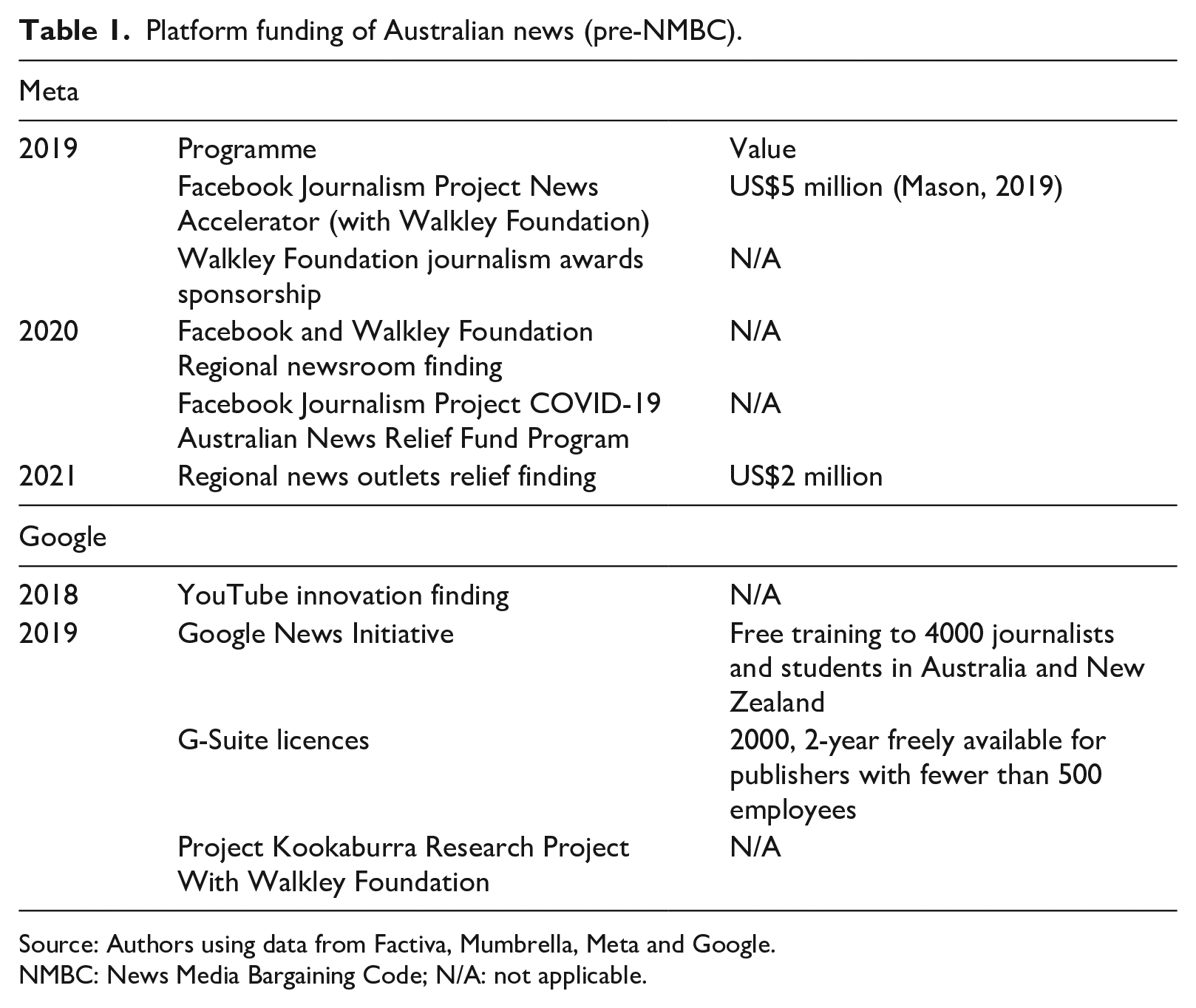
Source: Authors using data from Factiva, Mumbrella, Meta and Google.
NMBC: News Media Bargaining Code; N/A: not applicable.
News funding by platforms after introduction of the NMBC
Before discussing Google and Meta’s NMBC responses in detail, it is worth providing some basic information about the deals each platform made. While the deals are commercial-in-confidence, certain information has been subsequently made public. As noted at the outset of this article, Google has been much more engaged than Meta via the NMBC. Google secured deals with about 23 news companies ranging from large multi-platform news organisations to small outlets focused on specific ethnic or cultural groups (such as the Australian Chinese Daily). In contrast, Meta made deals with about 13 news companies. Only a select group of major media companies secured contracts with both parties including News Corp, Nine Entertainment, the ABC, The Guardian and Australian Community Media, who own a large network of regional newspapers (>100). Other, mainly smaller outlets, only secured deals with Google. Google-only deals (surprisingly, not matched by Meta) included large public interest journalism national publications such as The Conversation and Australia’s second public broadcaster, the Special Broadcasting Service (SBS) (see Table 2). Many smaller independent news organisations received no funding from either platform, such as Broadsheet.
Deals done through the NMBC.
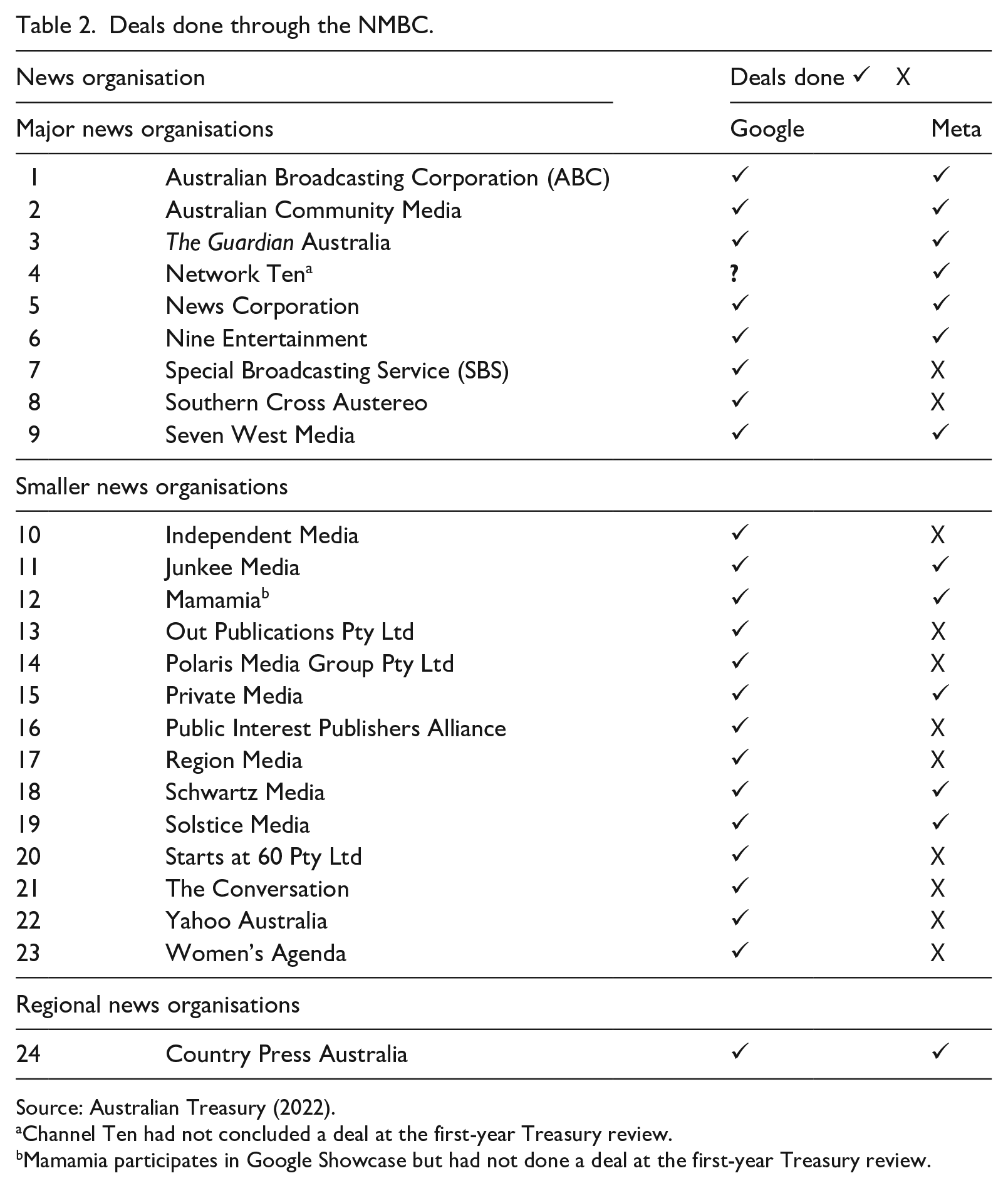
Source: Australian Treasury (2022).
Channel Ten had not concluded a deal at the first-year Treasury review.
Mamamia participates in Google Showcase but had not done a deal at the first-year Treasury review.
As Table 2 shows, there is reasonable coverage across Australia of media outlets who received funding from one or both platforms. The not-for-profit advocacy group, the Public Interest Journalism Initiative (PIJI, 2022), estimated that at least ‘146 news businesses – representing up to 472 print and digital news outlets – are covered across 33 of the deals’ (p. 9). PIJI estimates that 61% of the news market was covered by at least one deal. 6
Due to commercial secrecy provisions, it is impossible to ascertain exactly the total remuneration value for publishers. For example, a large multi-platform outlet like Nine that owns major city news websites, broadcasting licences and major newspaper mastheads in two major cities (Melbourne and Sydney) was rumoured to be receiving AUD$30 million per year over 5 years from Google (Samios, 2021). To provide an alternative example, Country Press Australia – an industry organisation that negotiated with Google on behalf of their 160 members – is likely to have secured a total deal of under AUD$1 million per year, with each member receiving between US$32,000 and US$62,000 (Grueskin, 2022).
Reports suggest that Google is paying more than Meta and offering more beneficial deals, including fee discounts on technology and additional revenue-sharing opportunities (Whitehead, 2021). However, there is little publicly available evidence about the extent of this financial divergence between the two companies. While this article is limited in providing such information, we offer relevant insights into the overall strategic approach of these two companies through our data.
Platform strategies during negotiation with news organisations
Semi-structured interviews with media executives and a qualitative analysis of stakeholder submissions to the NMBC’s 12-month review reveal not just the strategic manoeuvring by the platforms during initial negotiations, but also their overall valuing of news content. As Kleis Nielsen and Ganter (2018) suggest, relationships between publishers and platforms are characterised by the tension of interdependence: traditional news media companies are compelled to engage with platforms for operational and commercial improvement, even though these benefits often carry the risk of becoming dependent on platforms. This tension was evident in the interview responses from news media executives, who while wanting to negotiate with platforms, were otherwise critical of the influence digital platforms had on the distribution of their news content.
Media organisations’ submissions generally criticised the behaviour of platform representatives throughout the policy development and implementation process. This included general criticism of digital platforms, and then specific criticism mainly of Meta. Seven stakeholders also condemned ‘digital platforms’ generally. Commercial Radio Australia (CRA), Croakey and Nine criticised both platforms for behaviour that undermined public interest journalism and the policy intent of the Code. Commercial Radio Australia (CRA) accused the platforms’ approach to negotiations as ‘wholly inconsistent’ with the NMBC because of their refusal to negotiate with radio news media businesses despite being eligible under the set criteria. Croakey condemned Meta and Google for deliberately seeking to ‘undermine the Code and resist regulatory pressure’ by agreeing to deals outside the Code with the sole aim of satisfying the ‘significant contribution’ test.
Media executives provided various examples of the different strategies both platforms had to delimit the kinds of support they would offer under the NMBC. For example, Misha Ketchell, editor of The Conversation (2022, personal communication), suggested that Google and Meta had very different approaches to media relations before and after the introduction of the NMBC. The Conversation had previously had a professional development relationship with Meta before the NMBC: Facebook just basically did this thing where they plied us with champagne, they trained us. They said here’s how you’re gonna make a lot of money. And then they dropped us like a hot potato . . .With Google it was different. They were engaging with us from reasonably early on, before the News Media Bargaining Code came into effect and I think they too were trying to manage the government relations of it and trying to look like they were being good citizens in the journalism ecosystem. But they did seem to have a more genuine intent to want to hear from media outlets about what they were doing, where they felt that it gave value to Google, what a fair value exchange would be. (Ketchell, 2022, personal communication)
Most platform-specific criticism was levelled at Meta, whose behaviour around the NMBC was viewed poorly relative to Google’s conduct. Seven submissions to the Treasury Review criticised Meta for failing to strike agreements with multicultural public broadcaster SBS and The Conversation – two national producers of public interest journalism. 7
Some were also critical of Meta’s ‘take it or leave it’ approach to negotiating,
8
experienced firsthand by The Conversation, as Ketchell (2022, personal communication) who recounted: When we finally had the discussion with them about the News Media Bargaining Code, they just flatly said we’re not going to negotiate with you and that was it, there was no reason given. It was just we’re gonna draw a line somewhere and we’re drawing the line with you.
Both The Conversation and Minderoo (a non-profit who negotiated on behalf of a collection of smaller media outlets) submitted to the Review that upon approaching Meta to negotiate an NMBC agreement, the platform declined and directed both stakeholders to the digital platform’s one-off funding programmes such as the Australian News Fund, a US$15 million-dollar fund introduced after the NMBC.
There appeared to be no standalone criticism of Google in the public submissions, with the likely explanation being that eight news businesses (i.e. SBS, The Conversation) attained commercial deals with Google but not Meta, and only one business concluded deals with Meta but not Google.
9
Dan Stinton, Managing Director of The Guardian, also suggested that Google’s behaviour around bargaining was more fair-handed: Not long after that Senate inquiry, the negotiations really started in earnest with Google. And they were at times very tough negotiations, but always conducted in good faith. And we reached an outcome where we didn’t get everything we wanted, but we were broadly satisfied with it. Facebook I think I can say was a little slower to come to the party. (Stinton, 2022, personal communication)
On occasion, we found contrasts to the dominant interpretations of the two platforms’ deal-making as presented above. Andrew Manuel, who negotiated on behalf of Country Press Australia offers a different story, explaining that following the NMBC’s implementation the company has ‘developed extremely good relationships with both platforms and I think both have been very open and transparent through the process’ (Manuel, 2022, personal communication). Thomas did admit that these ‘good relationships’ occurred after both platforms ‘had to be dragged kicking and screaming to the bargaining table’ (Manuel, 2022, personal communication).
The impact of NMBC negotiations on the news media sector
The previous sections give some insight into the types of strategic approaches Meta and Google took before and after the NMBC’s introduction. Now, we consider the impacts of these strategic approaches on the news media sector, in the context of Meta and Google’s perceived aims and outcomes.
The pre-NMBC funding analysis suggests that while Meta was spending large amounts funding news outlets, Google was investing more time in training and digital tools provision that was likely to help ensure future reliance on Google by news organisations. Meta provided some training around data analytics tools linked to its platforms but was more reliant on the reputational benefits to the platform that large news grants might provide. However, the introduction of the NMBC saw a change in platforms’ strategic engagements. Google secured more deals, at a faster pace, and invested more money overall than Meta – which led to some news executives positing that Google was a ‘fairer’ negotiator. Nonetheless, Google’s actions indicate that its overall strategy was to establish a bigger presence across the news media market.
First, some organisations claimed that Google pushed deals towards content production for Google News Showcase, rather than simply providing funding to support journalism activities. For example, Stinton (2022, personal communication) stated that The Guardian was able to hire 40 new journalists arising from its NMBC deal. He also implied that the deals aligned with platform priorities, such as prioritising digital audio for the GNI: ‘We did a lot more podcasting as a result, we expanded our podcast teams, substantially expand our audio visual team substantially’ (Stinton, 2022, personal communication).
Similarly, Paul Thomas said deals benefitting rural and regional organisations often had stipulations around the kind of content that newsrooms invest in: ‘Part of the agreement was [publishing on] Google News showcase and there were certain other elements to that’ (Thomas, 2022, personal communication). Paying for content according to platform need was not a Code intention, yet media executives found that these transactions appeared to be platform attempts to fulfill the ‘significant contribution’ test, a legal condition necessary to avoid mandatory ‘designation’. This meant that platforms could potentially avoid paying much more under the Code with voluntary payments than if mandatory designation occurred.
News executives interviewed suggested that this wrangling of the NMBC to pay for content that suited the specific platform’s aims (i.e. around content production) was aided by the Code’s lack of transparency and inactivate designation provisions. For example, lack of designation meant Meta could avoid negotiating with some companies. Furthermore, the lack of transparency meant platforms could dramatically alter the content of deals, or remuneration offered, without needing to publicly report or justify outcomes. Half of the public submissions to the Code’s first-year review argued that the Code’s lack of transparency meant it was difficult for media businesses to negotiate on an equal footing. As the platforms remained undesignated, news media businesses claimed they were largely blindly beholden to whatever remuneration Meta and Google were willing to offer (if at all). In the context of negotiating with Google, this meant that some news companies were left short-changed. For example, Ketchell said The Conversation initially settled for less money from Google than they should have, due to not knowing what deals media competitors had achieved: There was a total information asymmetry under the News Media Bargaining Code . . .We had no idea, and we struck a deal for a very modest amount of money. (Ketchell, 2022, personal communication)
Several news executives of smaller, online-only publications noted that where they were normally competitive with traditional news organisations for market share, they were now disadvantaged by deals that seemingly prioritised larger legacy news organisations, and particular content production that benefitted platforms. Founder of independent lifestyle publication Broadsheet Nick Shelton said, being unable to strike equivalent platform deals meant not being able to compete effectively in the news media market: All the major organisations we compete with on a daily basis: for audience, for content, for journalists, for talent and for advertising dollars. So if those guys are all funded and we’re not funded, they get hugely ahead, and we get left behind. (Shelton, 2022, personal communication)
Similar to Shelton’s criticism, 16 submissions to the Treasury Review highlighted how the lack of designation and transparency in the NMBC had created winners and losers in the media industry. 10 Eight submissions claimed the NMBC had worsened competition by providing organisations with platform deals providing significant competitive advantages over those without deals. 11 Ketchell (2022, personal communication) said this asymmetry hurt outlets without deals: ‘The Guardian has just hired 60 people. They’ve just poached our digital editor, who basically drove a lot of our key work. So, we’re placed at a disadvantage’. Similarly, Broadsheet and Urban List’s submissions to the NMBC Review argued that Code beneficiaries were advantaged and able to ‘poach’ their staff by offering salaries that exceeded market rates.
Other submissions claimed the NMBC had a detrimental impact on new, regional and small media businesses. The journalists’ union, the Media Entertainment & Arts Alliance (MEAA), argued that most regional and rural newspapers remained without deals. 12 This created an uneven playing field for those competing with funded regional businesses, 13 let alone major metropolitan mastheads. Small and newer news businesses faced similar challenges. 14 According to four submissions, this was partly because small media businesses (under US$150,000 per year turnover) were ineligible to register with the ACMA to participate in the NMBC scheme. 15 For those that had passed this hurdle and were ACMA registered, ongoing bargaining power inequities meant that small news organisations like Pro Bono Australia failed to attain commercial deals with the platforms. Pro Bono has since closed its media operations.
News executives proffered that smaller organisations in Australia’s highly concentrated media ownership environment were disadvantaged because the Code’s lack of designation effectively meant digital platforms decided who and what was ‘legitimate’ public interest journalism. For example, Shelton (2022, personal communication) said that his company ended up without a deal with Google because the platform was only going to provide limited funding for production of particular content: Basically they said, we’ll deal with you and we’ll give you an offer, but it’s not gonna [sic] be on the level of what a ‘public interest’ journalism publisher is going to receive . . . What they really meant was: You have no leverage. No one’s gonna [sic] make us pay you. (Shelton, 2022, personal communication)
The content analysis and interviews indicate that the platforms acted strategically to avoid further regulation under the Code (e.g. designation). Google attempted to do this by making deals quickly and pushing news organisations towards particular types of content production; whereas Meta’s tactic was to delay or avoid negotiation once a ‘critical mass’ of deals had been achieved to fulfil the ‘significance test’ and avoid designation. Indeed, the structure of the legislation allowed platforms to design agreements that actively worked against formal designation. Broadsheet and SBS drew attention to the fact that many of the voluntary agreements included termination clauses that enabled the platforms to void deals should circumstances change and they are later designated by the Treasurer under the Code (or subject to any other similar legislative or regulatory initiative). Both Shelton and Ketchell noted that platforms could offer significantly less money to smaller organisations, and thus avoid designation by suggesting they were bargaining in ‘good faith’ and able to pass the ‘significance test’. Moreover, these termination clauses made existing deals inherently insecure. As SBS argued, these ‘poison pill’ clauses – as they were colloquially known – incentivised news businesses that had secured deals to actively oppose future platform designation, irrespective of merit, to preserve their own deal-making. In this sense, as Shelton (2022, personal communication) noted: Because they haven’t designated these platforms, the platforms are the ones who are in a position to determine who they deal with and who they don’t deal with. So all of a sudden you have Google and Meta, huge multinational businesses, deciding the winners and losers of the Australian media industry.
Overall, the findings indicate that both Meta and Google’s strategies served to protect and strengthen their own power, notwithstanding their acquiescence to a multimillion-dollar coup for Australian news business.
Conclusion
This article compared the kinds of support Meta and Google offered public interest journalism in Australia prior to and after the enactment of the world-first Code. Our findings identify several differences between the kinds of support provided by Google and Meta before and during Code implementation. We find Google’s strategic engagement with the news media sector during and following the Code’s implementation stood in stark contrast to Meta’s relative disinterest. Nonetheless, these differing approaches to the Code were united in their ultimate aim: to assert control over the negotiation process and avoid further regulatory interventions in their business practices by the Australian government, or other jurisdictions. The differing levels of engagement show that platforms were largely successful in their goal: choosing who to fund, and how much, without any real opportunities for recourse under the legislation. The study reveals the notable divergence between platform strategies and the importance of attending to platform-specific policy responses, despite a perceived Silicon Valley consensus on the general topic of regulation (Leaver, 2021; Popiel, 2022).
This article argues that this is not simply due to different business priorities, but also because these companies value ‘public interest journalism’ in different ways – it is these divergent strategic positions that contribute to the public perceptions about their behaviours under the Code. The analysis of Google and Meta’s support for Australian journalism prior to the NMBC gives us early indication of these divergent priorities. Whereas Meta appears to be initially more generous in terms of the monetary value of programmes, Google invested more in extending training and development opportunities and use of Google tools to media organisations. These different aspects of support suggest different business and reputational priorities. Meta appears to be investing significant funding in presenting as a good corporate citizen, while Google appears more interested in ensuring that the use of Google tools are embedded into media organisations’ practices.
Our findings about Google and Meta’s response to the NMBC, and its impacts on media organisations, suggest that while it was Google that engaged more broadly with the news sector, complicating factors emerged due, in part, to both platforms’ manipulation of some of the features of the Code. Both the public submissions and the interviews suggested that Google was more willing to negotiate deals quickly and with fairer consideration of which organisations produced journalism in the public interest. However, interviews with media executives also revealed some of the ways Google used negotiations to push for deals that served their business interests, like producing content for Google News Showcase, aided by the lack of a firm designation provision under the Code.
In addition to identifying these differences between platforms, our analysis offered an assessment of the NMBC itself. As stated in our ‘Introduction’ the reform’s aim was to address an imbalance in the commercial media market between digital platforms and news organisations. Our findings revealed numerous challenges around implementation. Some of these frustrations were caused by flaws in the legislation itself: most media outlets that made public submissions (22) expressed varying degrees of dissatisfaction with the NMBC legislation. Nearly three-quarters of these submissions argued that the policy exacerbated an unfair playing field in the Australian news media market. This competition power imbalance was attributed to two NMBC issues: the unused designation mechanism and the lack of transparency around negotiation outcomes. These concerns were echoed by editors in our subsequent interviews. As a result, we find that Google and Meta were able to manage these features of the NMBC for their own benefit and often to the detriment of journalism more generally.
We conclude that the way the Australian intervention is currently designed means that platforms can manoeuvre to act in their best interests, rather than prioritising public interest journalism. In this context, Meta was seen largely disinterested in negotiating, underlining their public claim that news was not a core part of their business; whereas Google was much more willing to negotiate, but forced most deals towards their own strategic content initiatives. These outcomes stand as an example of a divergence in platform strategies and signal a notable split in the broadly unified position that policymakers, politicians and scholars often adopt when referencing platform behaviour. While research on platform regulation often speaks of digital platforms in general (Gorwa, 2019), this study recommends the field pay greater attention to how the specific business models of individual platforms inform their subsequent responses to government interventions. Our study also offers a salutatory example of the unintended consequences of interventions nobly enacted to safeguard quality journalism, as they may inadvertently reinforce platform power at the expense of the public interest.
Footnotes
Acknowledgements
The authors acknowledge the reviewers for their thoughtful consideration of this article. They also acknowledge the research assistance provided by Damilola Ayeni and Tenzin Liddy-Corlet. They also acknowledge the work of Belinda Barnet, who worked with one of the authors to complete the interviews for this project. Author ordering for this article is alphabetical only.
Funding
The author(s) received no financial support for the research, authorship and/or publication of this article.
