



Abstract
Supporting children to be digitally resilient when facing online adversity is an increasingly important developmental task. However, conceptual knowledge underpinning digital resilience and how this operates among children and across their home, community and societal contexts is embryonic. A systematic review and meta-ethnography of research focusing on the understandings and experiences of digital resilience of children aged 8–12, their parents and educators identified 11 studies conducted since 2011 across 14 countries. Four main themes, ‘Using connective technologies’, ‘Risky online experiences’, ‘Mediation strategies’ (comprised of sub-themes ‘Proactive coping’ and ‘Reactive coping’), and ‘Risk and protective factors’ were constructed from our translation of first- and second-order constructs, with the overarching theme ‘Constant balancing’ cross-cutting these themes. We argue one cannot have risky online experiences without the potential to develop digital resilience and vice versa. Insofar as current conceptualisations of digital resilience underestimate the role played by wider contexts, important knowledge gaps are highlighted.
Introduction
The Internet is an important tool that is highly valued by children and simultaneously a space where they not only benefit from online opportunities but also encounter adversities. The need to constantly balance risk exposure in ways that enable children to be supported to learn how to recognise, manage and recover from risky online experiences by themselves, but also in ways that are mediated by their homes, communities and wider social context, is a vital, and yet extremely complex challenge (Livingstone et al., 2022; Orben et al., 2022; Vissenberg et al., 2022).
Research has begun to map and interpret this complexity. Evidence illustrates that, as children get older and spend more time on the Internet, they experience more opportunities and yet more risks (InternetMatters.org, 2022a). This is taken further by Orben et al. (2022), who concluded that adolescents have differing windows of developmental sensitivity to social media that can impact their well-being. According to their longitudinal analyses of 17,409 participants (between 10 and 21 years of age), this window first occurs for males aged 14–15 and females aged 11–13 (Orben et al., 2022). Hence, intervening with evidence-based educational programmes that may improve resilience and target pre-teens (children aged 8–12 years) as they transition into early adolescence and begin seeking more independence is a vital educational priority.
A concept attracting increasing interest when seeking to support children to learn how to recognise, manage and recover from risky online experiences such as inappropriate content (e.g. pornography and misinformation), contact (e.g. sexual harassment and ideological persuasion), conduct (e.g. bullying) and contract (e.g. blackmail) – and to learn how to thrive in connective spaces – is digital resilience (Livingstone and Stoilova, 2021; Sage et al., 2021; Vissenberg et al., 2022). Digital resilience is here defined as: ‘. . . a dynamic process whereby individuals and/or groups learn how to recognise, manage, and recover from online risks within and across individual, home, community, and societal levels’ (Hammond et al., 2023b). Finding roots in cyber security and clinical psychology (Heeks and Ospina, 2019; Prior and Hagmann, 2014; Rutter, 2007), digital resilience may be understood as a cyclical process that can moderate the negative impacts of risky online experiences while promoting opportunities to thrive in connective environments (Hammond et al., 2023b). Aligned with clinical perspectives viewing resilience through a multisystem lens (Ungar, 2021; Ungar and Theron, 2020), digital resilience, as understood from a socio-ecological perspective, posits that digital resilience can be built and shown across four levels (individual, home, community and society) and four process domains (learning, recognising, managing and recovering).
Drawing on Bronfenbrenner’s (2005) ecological systems theory, a socio-ecological perspective treats digital resilience as a dynamic process embedded within interdependent micro- and macro-level systems in which the macrosystem (community and society levels) shapes the structure of the nested microsystems (individual and home levels), with the process domains (learning, recognising, managing and recovering) cross-cutting these systems in ways that reside within and beyond each micro- and macro-level system (Hammond et al., 2023b). Grounded in work conducted by Masten and colleagues (Masten, 2001, 2007; Masten et al., 2021), this perspective enables protective factors (i.e. those that enhance adaptive functioning) to emerge either (i) through adjustments made regardless of risk exposure (e.g. via an educational intervention) or (ii) as a result of risk exposure, where digital resilience is not enhanced in the absence of risk experience. Hence, placing digital resilience in a socio-ecological framework contributes to a better understanding of how sociocultural constructs may affect protective factors within individual, home, community (e.g. school and peer) and societal (e.g. laws, values and cultural norms) contexts.
A digital resilience perspective posits that risk is not only inevitable but can also be beneficial. However, the question of whether and how benefits or ‘growth’ are experienced by children following their engagement in risky online behaviour depends on the micro- and macro-level systems they are enmeshed with (Hammond et al., 2023b). Micro- and macro-level systems and their components may come to operate as both risky and protective interchangeably and simultaneously as contextually derived. For instance, protective factors (e.g. home environments, education) may help children foster digital resilience without personally engaging in online risks. However, this may not be the case as the nature of the risk, the support systems available and the child’s developmental stage, among other factors, can influence whether exposure to risk and risk recovery translates into acceptance (i.e. a return to pre-risk functioning) or growth (i.e. increased capability and/or capacity to respond to similar risks in future) (Hammond et al., 2023b).
This is important because some children are more likely to experience risk exposure than others (El-Asam et al., 2021) and, while risk does not necessarily equate to harm, the need to consider how contextual factors impact on children’s resilience when creating educational programmes or interventions is important (Hammond et al., 2023b; Vissenberg et al., 2022).
Identifying the research aims
Within the online safety education space, digital resilience is generating increasing traction but remains conceptually embryonic (Hammond et al., 2023b). While research has shared accounts of risky online experiences, methods employed in existing research are unable to determine causality, nor the interplay of underlying mechanisms through longitudinal studies and/or controlled experiments to ascertain long-term effects (Finkelhor et al., 2021; Mascheroni et al., 2020; Quayyum et al., 2021).
Despite this, there are many educational programmes that are used daily and claim to improve digital resilience (Childnet, 2022; InternetMatters.org, 2022b; Parentzone, 2022). Remarkably, however, there is opacity as to what digital resilience may refer to and a lack of reliable instruments for measuring this concept (Hammond et al., 2024). As a result, there is a lack of rigorous evaluation of educational programmes that aim to improve children’s digital resilience, which leads in turn to ad hoc practices in schools.
For children, learning how to build and show digital resilience when facing online adversity is an increasingly important developmental task. Equipping policy makers and educators with applicable knowledge is therefore vital. An important first step towards addressing this issue is to use the best available evidence to develop appropriate theoretical conceptualisations (Skivington et al., 2021). Hence, before designing and evaluating educational programmes, conceptual knowledge underpinning digital resilience needs to be developed, as does a mapping of the online risk literature in order to highlight gaps and future directions for digital resilience interventions.
In this article, we build on recent work in this area (Hammond et al., 2023b; Kostyrka-Allchorne et al., 2023; Mascheroni et al., 2020; Sage et al., 2021; Stavropoulos et al., 2022; Vissenberg et al., 2022) by undertaking a meta-ethnography to provide robust evidence about children’s, parents’, educators’ and civil society actors’ experiences and understandings of digital resilience. In so doing, we employ a socio-ecological understanding of digital resilience, as provided by Hammond et al. (2023b), to enable the current article to map existing literature against each level of digital resilience (i.e. individual, home, community and societal levels). Similarly, where analytically appropriate, we draw on the ‘4Cs’ online risk framework of Content, Contact, Conduct and Contract produced by Livingstone and Stoilova (2021) in order to identify gaps in knowledge.
Given the exploratory nature of this study, focusing on qualitative research was deemed ideal for examining the views and experiences of different actors in relation to digital resilience as well as for providing, in ways that are mindful of those views and experiences, new directions for how to approach the concept. To achieve this aim, we raise the following research question: ‘What are the views and experiences of 8–12 year-old children, parents and educators of this group and civil society actors concerning digital resilience?’
After examining existing literature, we propose a line-of-argument synthesis. We propose that digital resilience building processes operate, and are influenced, across and by micro-level (individual and home) and macro-level (community and society) systems. Relatedly, we argue that each independent yet interconnected system needs to constantly balance risky opportunities that enable children to build and show digital resilience. This is important as, while in some case children can show digital resilience regardless of experiencing risks, some may not be able to build it in their absence (Masten et al., 2021). There is no ‘Yang’ without ‘Yin’ nor ‘Yin’ without ‘Yang’. Hence, digital resilience cannot be optimally built in the absence of risk, nor does risk happen in the absence of digital resilience building opportunities.
Methods
Qualitative synthesis methodology
We used the seven steps of meta-ethnography, as described by Noblit and Hare (1988) and developed by France et al. (2019b). A meta-ethnographic approach can produce novel conceptual understandings of complex issues through translating and synthesising original participants’ views and experiences, as well as authors’ interpretations (as reported in published studies), into a new higher-level interpretation. Thus, the approach can lead to the development of new theories, models, or frameworks (Noblit and Hare, 1988).
Following Noblit and Hare’s seven-step approach, in step 1, we assembled our research team and formulated our review question (reported above), drawing on a socio-ecological understanding of digital resilience (Hammond et al., 2023b).
Search strategy and processes
In step 2, we conducted systematic literature searching in May 2020, and ran update searches in January 2021, and again in March 2022 to identify relevant studies. The aim of the search strategy was to identify a comprehensive set of potentially relevant qualitative and mixed-methods studies including qualitative aspects that could provide insight into the lived experience and views of children (aged 8–12 years), parents and educators of this age group, and civil society actors in relation to digital resilience.
The search strategy was developed with input from the information specialist. To identify documents for inclusion, we searched four relevant sources covering mental health, education, and other disciplines: PubMed, PsycINFO (via Ovid), ERIC (via Ebsco) and Google Scholar. For more detail on the search strategy, see Supplementary file 1: Search Strategies.
Selection criteria and quality appraisal
Results from the database searches were uploaded to the Rayyan reference management tool, and duplicates were removed (www.rayyan.ai). All screening was according to the inclusion and exclusion criteria (see Supplementary file 2, Table 1: Eligibility criteria). The resulting set of references was then screened in two stages: CD screened results by title and abstract to remove irrelevant items, and the remaining references were then screened by two reviewers working independently SH and GP. The reviewers met to compare findings and resolve discrepancies. Full texts were obtained and screened by reviewers. Reviewers met again with any discrepancies resolved through discussion with a third reviewer (KB). Key journals were hand searched, as well as reference lists of key included papers. During this stage, the age range of our target population was handled in an inclusive manner in that we retained papers that crossed the age boundaries of our review. This meant that during reading, we reviewed extracts and included those in which we could identify the age of the participants in firs-order quotes. Where there were no first-order quotes from participants in our age range relative to authors’ second-order constructs, this theme was not included in our analysis.
For step 3, studies meeting inclusion criteria were read repeatedly and quality assessed using the Critical Appraisal Skills Programme (CASP, 2018) checklist for qualitative research before final decisions on inclusion were made. The CASP checklist for qualitative research features ten questions (including in relation to the appropriateness of methodology, design, data collection and analysis) to help researchers evaluate research studies systematically by ensuring that all important factors and considerations are taken into account, thus increasing consistency in decision-making. Two reviewers independently assessed 40 studies using the CASP tool. Consistent with guidance for undertaking systematic reviews using meta-ethnography, namely Cochrane Methods Qualitative and Implementation (2018), greater weight was given to papers containing a higher quantity of more conceptual or interpretative data within the synthesis. We excluded eight papers during this step due to issues with rigour, analytical depth and/or focus of papers (see Supplementary file 3: Details of excluded studies).
Again, potential disagreements were resolved through discussion and, where necessary, discrepancies were resolved through discussion with the third reviewer.
Data extraction
In step 3, study characteristics (including setting, participant characteristics and methods) were extracted into an Excel spreadsheet. First-order constructs (i.e. participant quotes included in the original papers) and second-order constructs (i.e. author interpretations expressed as concepts, themes or metaphors) were extracted and entered into NVivo version 12 for each study. As step 3 progressed, it became clear that some studies lacked the depth of reporting of original participant views needed for a meta-ethnographic approach. Drawing on France et al. (2019b), we considered papers to be insufficiently rich in data where there were too few quotes from eligible participants (five or less) or where there were more quotes but these were too briefly reported. Such papers, 21 in total, were therefore excluded at step 3. For characteristics of included studies, see Supplementary file 4, Table 2 and Supplementary file 5 for Quality appraisal scores for included studies.
Data analysis
In step 4, papers with sufficiently rich data had their first- and second-order data coded line-by-line to identify concepts (i.e. abstract ideas), themes (i.e. ideas that recur across the data set) and metaphors (i.e. ways of describing something via referring to something else that is similar in a specific way) by two reviewers independently. In line with recent meta-ethnography reporting guidance (France et al., 2019a), papers were read in chronological order with two reviewers independently compiling second-order constructs from each paper, with such constructs being illustrated by raw data from these papers (first-order constructs), in two separate columns using Excel matrices. In a third column, reviewers listed additional ideas that occurred as they read the papers, with this process feeding into the development of third-order constructs reported in this paper using the unit of a ‘theme’.
As a meta-ethnographic approach seeks to preserve contextual meanings (Noblit and Hare, 1988), this permitted the team to ascertain if and how studies were related (or not) in their design (e.g. participants or setting) and findings. The team were then able to move to the next step of analysis (step 5) – that of translation. In this way, the Excel matrices helped to illustrate if similar concepts, themes and metaphors were reported in different studies, even though these were perhaps expressed in differing terms (reciprocal analysis), and enabled identification of disconfirming cases (refutational analysis) – that is, studies that reported findings different from others (Noblit and Hare, 1988).
This was a complex and iterative process involving constant comparison between studies and the development of concept maps to create a new line of argument. Using a framework matrix enabled our analysis to locate how themes operated across cases and themes. As per Noblit and Hare’s approach, this translation process enabled findings to be synthesised into third order, overarching reviewer interpretations, going beyond simple reporting of the original themes (step 6). From this work, we were able to express our synthesis (step 7) to illustrate how the themes related to each other in a line of argument, as represented by our conceptual model.
Ethical approval
This article reports on a secondary research study so did not require ethical approval.
Analysis and findings
Mapping general characteristics of included studies
Literature searching and screening results were reported using Preferred Reporting Items for Systematic Reviews and Meta-Analyses (PRISMA) to guide and illustrate the searching and screening decisions at each stage (Page et al., 2021) – see Figure 1. The PRISMA standards define a minimum set of items for reporting in systematic reviews and meta-analyses and are used here alongside recent meta-ethnography reporting guidance (France et al., 2019a) to improve the completeness and clarity of reporting the meta-ethnography in the current article.
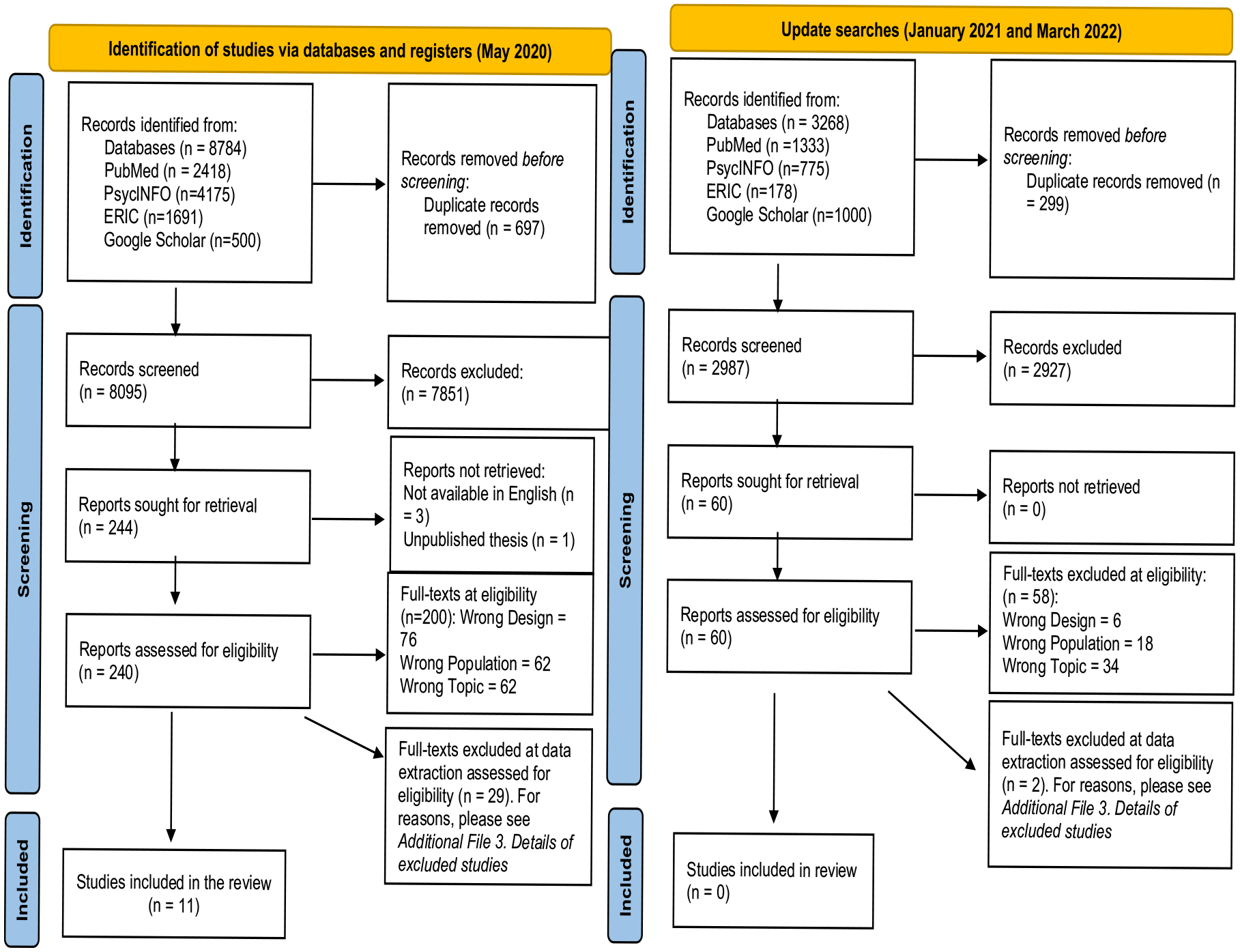
PRISMA 2020 flow diagram.
Our systematic review yielded a total of 11 publications that were translated and synthesised (see Table 2 for characteristics of included studies). Three studies were from Australia (Buchanan et al., 2017, 2019; Nansen et al., 2012), two were from the United Kingdom (Haddon and Livingstone, 2017; Muir and Joinson, 2020) and the United States (McInroy and Mishna, 2017; Mendoza, 2014) and one each from the Netherlands (Baas et al., 2013) and Singapore (Shin, 2015). Three studies reported findings from an international cross-cultural research study with data collected from Belgium, the Czech Republic, Greece, Malta, Italy, Portugal, Romania, Spain, and the United Kingdom (Mascheroni et al., 2014; Smahel and Wright, 2014).
Studies were published between 2012 and 2020, included the views and experiences of children and parents, and used a variety of data collection methods. The majority were semi-structured and/or repeat interviews and focus groups, with only one study including participatory or ‘mobile methods’ in which participants showed researchers where they used digital technologies (Nansen et al., 2012). In addition, some papers reported on the same studies – that is, Buchanan et al. (2019); Buchanan et al. (2017) and Smahel and Wright (2014); Mascheroni et al. (2014); Haddon and Livingstone (2017). However, these were included as each paper discussed different topics and/or from different perspectives. The quality of the included studies ranged from 6 to 9 on the 0–10 CASP scale (CASP, 2018). See Supplementary file 4, Table 2: Characteristics of included studies, and Supplementary file 5 for a detailed breakdown of CASP scores for included studies.
We also sought to gain insights into the lived experiences of carers and civil society actors, but no papers containing data from these perspectives made it through to full-text screening, hence their absence from the paper’s title but inclusion in search strategy.
Synthesis of findings
We abstracted four main themes ‘Using connective technologies’, ‘Risky online experiences’, ‘Mediation strategies’ (comprised of sub-themes ‘Proactive coping’ and ‘Reactive coping strategies’), and ‘Risk and protective factors’ from our translation of first- and second-order constructs. See Supplementary file 6 for Table 3 themes apparent in each study which illustrates how each included study contributed to each theme constructed within this analysis. Through this section, we illustrate each concept with exemplar quotations before constructing and illustrating our overarching or ‘line-of-argument synthesis’ theme, which we label ‘Constant balancing’.
Main theme 1: using connective technologies
This theme is about how predominantly parents experience and report their emotions towards their children’s use of connective devices. Translation of first- and second-order data constructed perceived benefits in two ways. First, parents recognised and sought to acknowledge connectivity benefits in relation to their children’s ‘thick’ agency, that is, having the liberty to act within a broad range of choices (Klocker, 2007). In this way, using connective technologies was orientated as being ‘good’. For example, parents reported positive emotions in relation to technology usage being good for children’s schoolwork or personal interest and when parents recognised their children’s increasing agency in this area. In the following quotation, the father of a pre-teen commented on the extent to which the Internet has enabled his daughter to be more knowledgeable both in general and in relation to using new words: . . . She is more resourceful now because she knows that if she needs to know something, she can go to Google and find out herself. Then she learns the use of certain words sometimes . . . I think she has become smarter . . . (Father of 9-year-old daughter, from Shin (2015: 665))
A second way in which children’s use of connective technologies was reported as ‘good’ by parents was in relation to how they felt these technologies aided their perceived responsibility to manage their children’s safety. As captured by the quotation below: . . . I must admit . . . I do feel safer with my daughter especially having one. It makes my life easier with both of them having mobiles. (Julie, mother of 12-year-old daughter, from Muir and Joinson, 2020: 8))
As articulated in the first-order constructs above, parents’ perspectives were related to how they interpreted the potential learning opportunities offered by these experiences, how these opportunities were recognised by parents and how acting on such opportunities was managed by the child or parent. However, Mendoza (2014) highlights that parents may also fail to recognise the contexts and relational processes within which their children express everyday agency when using connective technologies. In the quotation below, the mother of a pre-teen described use of the Internet as a ‘waste of time’ and secondary to offline involvement in the community: I think that that [being online] is such a waste. It’s a waste of time. I would like him to be more inclined to go out and work at the Food Bank, or become an activist and do something that’s good for the community in some way. (Liz, Mother of 12-year-old male, from Mendoza (2014: 168))
As shown above, parents may not always recognise the skills and knowledge gained from children using the Internet. For example, research indicates that children can display thick agency in the context of youth activism not just offline but also within and via online communities (Belotti et al., 2022). This is supported by a literature review illustrating positive outcomes for children with higher digital information skills than those with lower skills (Livingstone et al., 2022). However, while displays of independence can be promoted in conventional understandings of childhood, parents can often construct a child’s connectivity as a concern until the child has learnt how to recognise, manage and, in some cases, recover from risky experiences made in relation to the opportunities afforded by the Internet (Hammond et al., 2023b). One of the most common concerns reported in the literature, as illustrated in the extract below, was related to overuse: Our main concern is controlling access and over-use. When he first got computer literate, we were worried about overuse, but he has since backed off a bit . . . (Father 3, parent of son 8 years old and daughter, 10-years-old, from Nansen et al. (2012: 242))
As exemplified by the quotation above, adult participants across differing papers in this theme tried to navigate the disjunctures of childhood innocence in the context of a risky society in which protectionism dominates understandings of the Internet (Beck, 1992; Livingstone and Helsper, 2007; Hammond and Cooper, 2015). The quotation above shows that, even though parents might worry that developing digital literacy skills might result in the overuse of digital technologies, this is not necessarily the case, which highlights how adults trying to navigate technological change in real time can become constrained by available discourses. These discursive constraints operate on and/or challenge adults’ experiences of childhood agency and, indeed, the role of parent/guardian/educator within this space. In experiencing these tensions, adults can often resort to framing opportunities for developing digital resilience as subordinate to the perceived need to manage short-term risk (Hammond and Cooper, 2015). A second contrasting quotation from this article illustrates how adults can foreground risks even before perceived overuse occurs: . . . the thought of him locking himself a way in the room for five hours a night . . . I will be trying to stop it. I don’t think it’s good . . . I think it is an horrendous thing to happen to a kid, to do a large amount of their communication by wire. And I will try and discourage it . . . (Father 1, parent of male 9, female 6), from Nansen et al. (2012: 242))
As exemplified by the above quotations, overt appreciations of risky experiences as precursors to developing digital resilience are absent within the literature. In the first quotation above from Nansen et al. (2012), our analysis of this participant’s account illustrates how the pre-teen in question learnt how to recognise, manage and recover following perceived overuse. In the second quotation, we argue that opportunities can be removed before learning may take place in ways which are influenced and/or constrained by available discourses (Hammond and Cooper, 2015; Hammond et al., 2023a). In considering learning how to navigate the Internet as an increasingly important developmental task, the need of moving debates forward from binary notions of risk or resilience when considering ‘using connective technologies’ (Hammond et al., 2024) is an important one. If there can be no digital resilience without online risk, and no risky online experiences without digital resilience (Sage et al., 2021; Sun et al., 2022; Vissenberg et al., 2022), the role of home, community and society in supporting digital resilience development by balancing opportunities for pre-teens to learn needs to reconsider. This is explored further in our line-of-argument synthesis (step 7).
Main theme 2: risky online experiences
Informed by wider psychological resilience literature, it could be suggested that digital resilience involves post-risk growth or ‘recovery’ when online risk occurs (Tedeschi and Calhoun, 2004). Despite this, in the context of our synthesis, the theme of ‘risky online experiences’ related to experiences online that were positioned primarily as negative. Literature included in this review tended to report the emotionality of risky online experiences, rather than unpicking recovery elements, demonstrating the embryonic nature of current conceptualisations of digital resilience within the literature.
To move this forward and to assist with mapping current conceptualisations, we draw on the ‘4Cs’ online risk framework, that of content, contact, conduct and contract (Livingstone and Stoilova, 2021), in this theme. This enables us to draw out areas for future development.
Frequently appearing in this theme was the emotionality of the ‘conduct’ risk of cyberbullying. This was explored in several papers (Baas et al., 2013; Buchanan et al., 2019; McInroy and Mishna, 2017) and from different stakeholder perspectives (children, parents and educators). As emphasised by the mother of a pre-teen in the quotation below: They’re basically – that sort of thing is bringing home the schoolyard bullying into the house and it’s no longer a schoolyard, it’s now more – like every day, constantly, which is worse than the schoolyard . . . (Female parent, Lake Public School, from Buchanan et al. (2019: 174))
Given the conceptualisation of digital resilience in this article as a malleable dynamic and situated construct, McInroy and Mishna’s (2017) illustration of how children report managing conduct risks at the moment during online gaming warrants further attention. As shown by the quotation below, pre-teens might refrain from playing online games when exposed to forms of online abuse: One time when I was playing, a random guy just talked to me. He said a bad word and I just stopped playing . . . [But] I didn’t feel nothing. (Student 037, Grade 4, Year 1, from McInroy and Mishna (2017: 603))
Many first-order quotations spoke in generalities, with second-order quotations commenting on general trends. In relation to online gaming, second-order constructs within this article linked game play aggression to social dominance theory – a social psychological theory that examines how societies organise themselves as group-based social hierarchies, and masculinity in relation to gaming culture (McInroy and Mishna, 2017). However, missing from second-order constructs are authors’ discussions of children’s ability to learn how to recognise, manage and recover from risk exposure. Instead, McInroy and Mishna (2017) highlight different ways in which children see cyberbullying compared to research definitions. Again, the ability of children to deploy digital resilience in the face of hostile behaviours is conspicuous by its absence: Asking youth about ‘cyberbullying’ may not elicit accurate responses about online experiences due to the youth not considering particular behaviours cyberbullying. (McInroy and Mishna 2017: 605)
Within the ‘Risky online experiences’ theme, ‘content’ risk was reported in relation to the acts of making and sharing, or having content made and shared, without consent. Missing from the literature were the contextual influences on the children involved. Instead, primary-order accounts focused on the sharing of incidents with researchers and second-order constructs again reported trends. For example, as shown by the quotes below in relation to an instance of online abuse based on the posting of a sexual image: Melanie: Once I stayed round my friend’s house and like . . . I was . . . taking my top off . . . and she come in and she took a picture of me . . . and she posted it all over BBM . . . (Girls aged 12–13, from Haddon and Livingstone, 2017: 284) Here we see that posting sexual images can be an extension of this practice of embarrassing peers, when in this case the perpetrator is actually a girlfriend rather than the boyfriend discussed in some of the sexting cases. (Haddon and Livingstone, 2017: 284)
Reports of ‘contact’ risk proliferated around adults using dominant discourses informed by technological panics (Orben, 2020) aimed at educating children about online risks via ‘folk devil’ figures (Cohen, 1970). From a digital resilience perspective, efforts reported in the literature focused on providing knowledge to children as a method of enabling them to learn how to recognise unwanted contact. Literature focuses on how children made sense of key concepts through the language used by adults delivering this knowledge, thus making sense of potential risks: Is this catfish, I know about this. Its where someone like . . . say I’d said I was called Lilly, but then I actually go and meet them and I’m not Lilly . . . I think that’s mean to other people . . . (Female, aged 9, from Muir and Joinson (2020: 6))
The quotation above shows how a pre-teen makes sense of the moral dimension (‘mean’) of a concept that exemplifies the risk of unwanted contact (‘catfish’). However, when it comes to ‘contact’ risks, the emotionality inherent in some of these, as in the case of persuasive design or the contextual nature of this type of risk experience, is rarely considered, with one exception. In the following quotation, the mother of a pre-teen questioned the safety of digital products and services, which are designed to make profits and not necessarily with children’s interest in mind: They should ensure that the products or services that they sell are safe and suitable for children . . . Providing ways to monitor the children is also a good initiative. But their motive is to earn money, so this is probably something that they cannot really do. (Mother aged 45, with a 9-year-old daughter from Shin (2015: 659))
Largely, however, knowledge about how risk experiences unfolded, reflections from children about if and how they learnt from these experiences, and their views on the roles of their trusted adult(s) before, during and after these experiences were absent from the studies reviewed in this article. The same applies to reports about how children had/had not recovered and the facilitators and barriers to recovery at individual levels, related to those within home and community environments and societal levels. This is not to say these are not found in the literature more broadly. For example, Whittle et al. (2014) consider retrospective accounts of adolescents in relation to such experiences during this phase of life, but their article was excluded from this review as the participants were teenagers at the time of recruitment. Clearly, while such work would need to be undertaken sensitively, it is not unachievable and warrants attention.
Main theme 3: mediation strategies
Across the data corpus, the presence of mediation strategy research was large. This is unsurprising given dominant conceptualisations of risk as harmful by default, despite discussions to the contrary (Livingstone and Helsper, 2007, 2008, 2010, 2013). Within our synthesis, two sub-themes were constructed in ways that relate to the chronology of risky online experiences. Mediation strategies were ‘proactive’ and therefore aimed to be preventive (implemented prior to risk experiences) or ‘reactive’ (implemented at the moment to cope with risky experiences).
Main theme 3, sub-theme 1: proactive coping
Drawing on Masten et al. (2021), this sub-theme resonates with the idea that adaptive functioning can happen through adjustments made regardless of risk exposure via, for example, educational strategies. Prominent proactive coping strategies included awareness raising (Mascheroni et al., 2014) and mediation by proximity or ‘Parent On Shoulder’ (POS) approaches (Mendoza, 2014), including ‘remote Parent On Shoulder’ (rPOS) approaches (Buchanan et al., 2017; Shin, 2015). In the quotations below, two pre-teens reported being monitored online by their mothers when using digital technologies: Female student 2: My mum, she has like this little thing, and she checks on me on her phone Female student 3: Yeah. My email from the Apple ID is linked up to my mum’s email so she can read [my] messages on her phone to see what I’m writing on my iPad to make sure I’m being nice. (Girls aged 10–12 years, from Buchanan et al. (2017: 280))
As mentioned in the theme of ‘risky online experiences’, awareness raising relied upon adult or media representations of risks linked to discourses of technological panics (Cohen, 1970; Orben, 2020). While some second-order constructs interpreted this as indicating the effectiveness of awareness-raising strategies (Mascheroni et al., 2014), others argue that, rather than simply analysing moral panics researchers need to find useful ways of intervening to ensure public debates are better informed by the available evidence (Lumby and Funnell, 2011).
Advancing this line of argument, Haddon and Livingstone (2017) indicate that adults’ engagement with children about online risk needs to be informed by children’s pre-existing language. They argue that children’s engagement with online risks should also be seen through this lens and needs to be reconceptualised as curiosity (Haddon and Livingstone, 2017).
In the context of advancing conceptual knowledge in relation to digital resilience, proactive coping mediation strategies offer a juxtaposition. This juxtaposition runs throughout conceptualisations of digital resilience, mirroring those in relation to notions of risk and opportunities. Proactive prevention strategies have at their core the notion that risk should be avoided. Simultaneously, conceptualisations of digital resilience propose that risk experiences are necessary to build the capacity to withstand risk, as a way of managing harm so it does not undermine well-being (Vandoninck et al., 2013; Vissenberg et al., 2022).
Main theme 3, sub-theme 2: reactive coping
Running counter to this and prominent within the ‘reactive coping’ sub-theme was the view of digital resilience as a cyclical learning process. Again, drawing on the work of Masten et al. (2021), this sub-theme contained the notion that some protective factors that enhance adaptive functioning occur as a result of risky experiences. In relation to this, children shared occasions when learning had taken place following risky online experiences. This is shown by the following quotation in relation to a pre-teen becoming aware of overusing a computer: Interviewer: Have you ever felt you were a little addicted or not? Girl: Ahm . . . no. It was just . . . sometimes I . . . go to the computer, I have a full battery . . . That has happened, yeah. And then suddenly I go and check how much battery I have left and there’s only 17 minutes and I start thinking: ‘Was I on the computer for such a long time? (Girl aged 11 years, Portugal, from Smahel and Wright (2014: 68))
Where prevention strategies are employed to restrict risk experiences to the point where opportunities to experience risk are eradicated, one’s ability to cultivate digital resilience at individual, home, community and societal levels, through learning how to recognise, manage and recover from risky online experiences, is limited (Hammond and Cooper, 2015). The extract below indicates how ‘reactive’ mediation strategies enable the demonstration of digital resilience across a wide range of domains and levels: Jane: There was the guy and he said that he was going to kill me and then all of my friends. So, I reported him . . . All my friends were calling him names because of this. (Girl, aged 12 years, from Haddon and Livingstone (2017: 297))
Consequently, it would seem appropriate to assume that once restrictions are removed, immunity to risks may be relatively weak. Hence, in the context of digital resilience, prevention at the expense of learning is likely to be harmful rather than helpful in the long term (Hammond and Cooper, 2015). Clearly, there is a balance to be struck and constantly revisited. Baas et al. (2013) do briefly introduce the idea of ‘Thresholds for seeking help’, even though this idea is conceptually undeveloped in relation to contextual factors.
Main theme 4: risk and protective factors
This theme is about factors that are reported in participants’ first-order constructs that contribute to limiting exposure to, or impacts of, risky online experiences. Content in this theme indicated the importance of considering risky online experiences as contextually situated, contested and dynamic. For example, moving beyond individual and home contexts, this theme considers risk within and across the life course and evolution over time and within socially situated contexts. Employing recent understandings of digital resilience within a socio-ecological framework – thus paying attention to individual, home, community, and societal levels (Hammond et al., 2023b) – enables the current article to map and interpret empirical work within this theme.
At an individual level, literature within this theme reported parent/guardian accounts of their child’s characteristics, with this commonly linked to understandings of age-related level of maturity dyadically. If the child was younger with implied innocence, the perceived risk was likely to increase with age-related maturation seen as reducing risk. As captured by the following quotation: His innocence got dented because he believed she didn’t do it . . . he spent all this time building up points and she went and spent it all on crap. (Father 1, from Nansen et al. (2012: 243))
Accounts shared by parents/guardians at the home level were couched in understandings of trust. Open communication was understood by parents as a key prerequisite enabling trust to operate as a protective factor. Many hoped this would assist children as they became more independent and potentially less open to share online events with parents/guardians as they age (Mendoza, 2014; Shin, 2015). As remarked by the parent of a pre-teen in the below: I think probably the most important thing is to try to have a good relationship, a close relationship, with your kids, and hopefully they will tell you the truth on things, if not right at the time, eventually. (Ayesha – parent of 10-year-old male, from Mendoza (2014: 192))
Trust was not exclusively limited to parent/guardian-child relationships but also sibling relationships. Second-order constructs considered the complexity and fluidity of parents/guardians enlisting siblings as mediation resources. Simultaneously, literature in this area conveys how this may also be orientated as more nuanced than a simple protective or risk factor. In the quotation below, a pre-teen reported sharing instances of exposure to unwanted online content with his brother: Interviewer: Do you sometimes talk about this [shocking content] at home? Boy: No, but there are things that my brother and I say to each other. That’s like our ‘bro-code’. Then he says: ‘Come, you should see this’, and then I say: ‘No, turn it off’. Or at school, we also talked about these things at school. Interviewer: Yes? You seem to talk pretty easy about these things. That’s good. Boy: Yes, because if you would keep it for yourself, you’re worried and you feel bad. (Boy aged 9 years, Belgium, from Smahel and Wright (2014: 138))
Here, we see how existing work challenges the understandings of factors as either protective or risky. We consider how such factors operate as both risky and protective interchangeably and simultaneously as contextually derived. This is an important contribution to the conceptualisation of digital resilience and one explored further in our line-of-argument synthesis (step 7).
At the community level, conceptualisations of digital resilience were less overt within the second-order constructs. However, the usefulness of trusted adults (in this case, the parents of friends) was outlined (Smahel and Wright, 2014). This also applies to the role of schools as community assets in a small number of papers where first-order constructs sought education opportunities delivered by educators to parents. As captured by the quotation below: I think parents must also take responsibility . . . I think parents should go and take courses themselves . . . If they want to help their children, they must go and help themselves. (Mother, aged 41, with an 11-year-old daughter, from Shin (2015: 658))
Meanwhile, educators’ first-order constructs distanced the professional from knowing more than parents: . . . what we should be teaching the kids. We’re making it up out of our own common sense. (Female teacher, Beach Public School, from Buchanan et al. (2019: 174))
Second-order interpretations described educators’ feelings of unpreparedness and frustration about their new role in mediating children’s Internet engagement outside of the school environment.
At a societal level, transitions between school settings and age-related expectations were experienced as important. However, adults’ perspectives were that society bestowed certain expectations and privileges upon children, which they (the child) and parents/guardians might not yet be ready for. In the following quotation, a parent reflected on the extent to which children are allowed to have a mobile phone once they transition from being pre-teens to entering high school: . . . The difference between when they were in Year 5 and 6 to high school, everyone’s allowed to have a phone with them all day at school, on school Wi-Fi. So, I think we need to do something in Years 5 and 6 for when they’re ready to get there . . . (Male parent, Beach Public School, from Buchanan et al. (2017: 172))
Throughout this theme children’s ability to self-regulate appears underpinned by developmental maturation assumptions, meaning the suggestion of children learning via experience is diminished. This is juxtaposed with the way in which understanding the Internet as an experiential technology (Dutton and Shepherd, 2006) and, with it, digital resilience operates. It is through experiencing risk that digital resilience develops (Vissenberg et al., 2022). The task for parents/guardians and educators appears to be how to ensure that there is supported exposure to risky online experiences resulting in growth, as opposed to unsupported ones beyond thresholds which children cannot yet cope with.
Line-of-argument synthesis theme: constant balancing
After considering the four main themes of our analysis, we constructed the overarching theme: ‘Constant balancing’ (see Figure 2), which cuts across the themes. Within each of the themes presented, first- and second-order constructs indicated a need to balance and adjust to the dynamic contexts in which Internet technologies were used by children aged 8–12 years. Furthermore, they demonstrated how this use was experienced and interpreted by children themselves and also in relation to the home environments, communities and societies within which actors operate. In reading across the articles, there was a realisation of the lack of approaches to, and therefore the need to consider the concept of, digital resilience as dynamic and contextually situated.
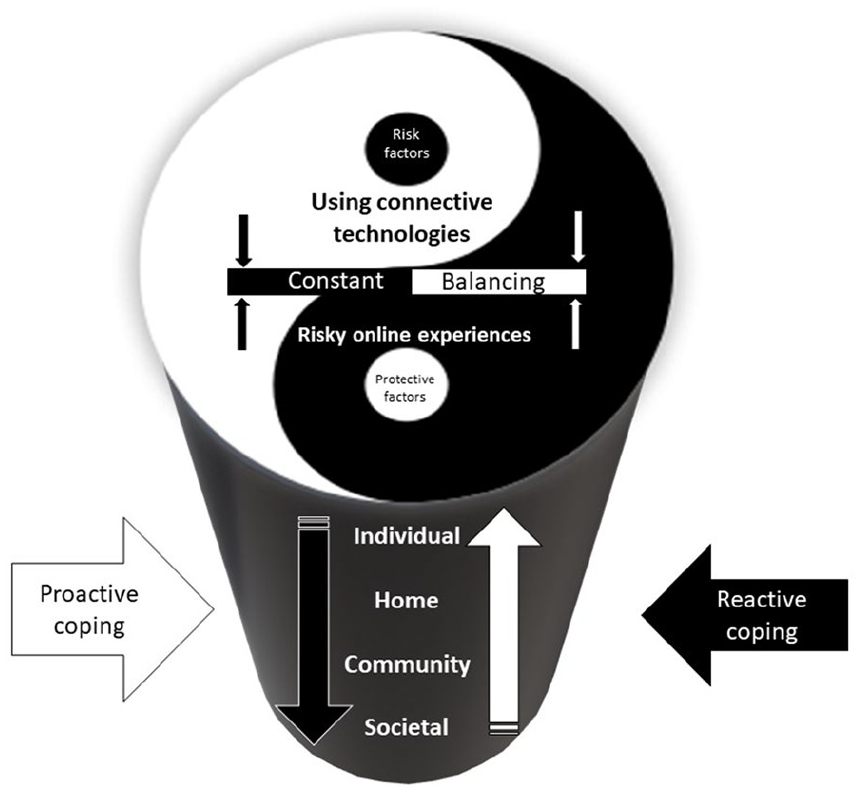
Conceptualisation of children, parents’ and educators’ experiences of digital resilience.
The theme ‘Using connected technologies’ describes the need to balance the perceived benefits of using technologies for learning, with the potential for perceived overuse. The theme ‘Risky online experiences’ describes the assumption that risk equates to harm, with first-order constructs detailing the emotional impacts of risk experiences and second-order constructs commenting on trends. The theme ‘Mediation strategies’, comprised of sub-themes ‘Proactive coping’ and ‘Reactive coping’, illustrates different ways in which mediation strategies employed by children, parents and teachers were experienced by each group, and the potential trade-offs of reduced versus supported exposure. Drawing on Masten et al. (2021) and Seligman (2012), these sub-themes illustrated that, while some adaptive functioning can occur through adjustments made in the absence of risk exposure, post-trauma growth cannot. The ‘Risk and protective factors’ theme describes how various online risk typologies were experienced by children, parents and educators. Through the employment of a socio-ecological understanding of digital resilience (Hammond et al., 2023b), this theme illustrates the need to balance developmental understandings of maturation and self-regulation with understandings of digital resilience as best learnt in practice, not just theory. It follows that constant balancing must happen across individual, home, community and societal levels in ways that enable pre-teens to use connected technologies through mediation strategies. On the one hand, these strategies are needed in order to minimise the impacts and emotionality of risky online experiences. On the other hand, they are crucial to maximising the deployment of protective factors so that such experiences may allow pre-teens opportunities to learn how to recognise, manage and recover – in essence, to show and build digital resilience.
Discussion
The four themes we report in this article were Using connective technologies’, ‘Risky online experiences’, ‘Mediation strategies’ and ‘Risk and protective factors’. In drawing these themes together, our analysis created the overarching or line-of-argument theme of ‘Constant balancing’. The themes we report in this article had elements constructed as positive and negative. While we contend that many of these seemingly dichotomous elements were occurring simultaneously, they were constructed within the literature as predominantly negative for children (Baas et al., 2013; Buchanan et al., 2017, 2019; McInroy and Mishna, 2017; Mascheroni et al., 2014; Smahel and Wright, 2014), with notable exceptions that challenged this version of reality (Haddon and Livingstone, 2017; Mendoza, 2014; Muir and Joinson, 2020; Nansen et al., 2012; Shin, 2015).
Contribution
In recruiting the 4Cs online risk framework of Livingstone and Stoilova (2021), this article maps the literature focused on differing risk experiences which contribute to current conceptualisations of digital resilience. Advancing conceptual knowledge further, the use of a socio-ecological understanding of digital resilience of Hammond et al. (2023b) enabled the mapping of literature to each level of digital resilience. This functions to do several things.
First, it enables this article to further problematise notions of digital resilience as an age-related and/or static trait that children either have or do not have. This relocates the focus of research to learning how to recognise common management strategies and recovery from risky online experiences. Moreover, refocusing research attention on accounts which locate digital resilience as operating beyond the individual level enables the important role of others within and across homes, communities and societies to be recognised. Supporting children to build and show digital resilience, the ‘constant balancing’ required becomes everybody’s business.
Second, the article challenges researchers to move beyond reporting reactions to risk. While some studies do provide rounded accounts where first- and second-order constructs describe the requirement to view online risks as continuous as opposed to dichotomous, others focus on reporting trends in emotionality.
Finally, we illustrate through our line-of-argument synthesis ‘Constant balancing’ how the complexity of balancing and counterbalancing opportunities to thrive with opportunities mediated by potentially risky online experiences is a joint and ongoing venture situated across individual, home, community and societal contexts. We represent this in Figure 2 via the employment of the ‘Ying and Yang symbol’ in our line-of-argument synthesis. There was no absolute; each contained an element of the other. One cannot seek to build and show digital resilience in the absence of risky online experiences and vice versa, and this cannot be fully understood at one level of analysis only. Again, drawing on Masten et al. (2021) and Seligman (2012), while some adaptive functioning can occur through adjustments made in the absence of risk exposure, others cannot. For example, even in the case of protective factors that emerge through adjustments made regardless of direct risk exposure (e.g. via an educational intervention), most, if not all, interventions tend to incorporate learning as a result of others’ risk exposures (Masten, 2001). A recent systematic review work exploring relationships between online risk experiences, digital resilience, digital literacy, digital skills and well-being indicates that the context within which risks are experienced and played out is key (Vissenberg et al., 2022). Clearly, context is complex, so our understandings and theories need to detail the underlying assumptions about how proposed educational programmes or interventions in the online safety and digital citizenship space are meant to work, what impacts are expected and how they can be implemented.
It follows that this article makes an important conceptual contribution to the literature on digital resilience. While most studies in this area refer to digital resilience in individualistic terms, digital resilience needs to be understood as a collective and dynamic process that operates within multiple dimensions and at multiple levels and in ways that require a constant balance between, on the one hand, pursuing risky online opportunities and, on the other, avoiding online risks.
Limitations and areas for future research
In creating our research question and search terms for this article, we sought to include carers and civil society actors, yet our current synthesis does not overtly include the voices of these groups. Carers were excluded from contributing studies due to parental focus, and/or because participants identified as parents rather than carers, and/or because researchers did not collect or report this nuance. All of these issues provide areas to address in future research.
In terms of civil society actors, no literature that includes this stakeholder group was included in our review. Given our socio-ecological perspective towards digital resilience and research indicating that this may be a critical stakeholder group, this is a large gap in knowledge and clear direction for future research.
This article has shown that the digital resilience of pre-teens can be either encouraged or curtailed depending on the combination of influences. Future work might also build on this article, while also building on recent studies that have focused on adults (Kamalpour et al., 2021), to further explore the extent to which digital resilience lies at the intersection of both co-creation and co-destruction values and practices.
As per the work of Hammond et al. (2023b), in this article, we draw on concepts of ‘family resilience’ (though, as in the case of Hammond et al. (2023b), we use the label ‘home’ to be more inclusive of diverse home environments) and community resilience (Khan and Deb, 2021; Pfefferbaum et al., 2017). These terms and respective bodies of literature offer fertile conceptual ground on which to theorise how differing sources and assets of digital resilience operate within and beyond these networks.
In trying to develop conceptual knowledge regarding children’s, parents’ and educators’ conceptualisations and experiences of digital resilience, we focused on the 8- to 12-year-old ‘pre-teen’ age group. The rationale for this was derived from evidence indicating that children are accessing and owning Internet-connected technologies at a younger age (Pew Research Center 2020), and 8–12 years is a time span in which many children begin to look for extra independence at home, school, within society and, increasingly, through online experiences. It is a time when trial-and-error learning is likely to be particularly important. However, in the context of the literature included in the current article, this focus created several challenges.
First, studies could only be included within this review if we were able to disentangle the age-relatedness of the first-order and second-order constructs. In many cases, this was not always possible due to the way in which authors of studies had reported participant demographics related to first-order constructs. For example, focus groups may contain several children of different ages contributing to a discussion. In other cases, study authors did not publish key information such as participant pseudonyms or details around the ages of the children to which primary order extracts related to. This is a basic requirement which can be addressed.
Second, in studies which referred to how children utilised adult discourses while making sense of online risk, there were times when leading questions which involved phrases derived from adult discourses were used but could have been avoided (e.g. Smahel and Wright, 2014: 68). As researchers, we must attend to how we explore this area not just as topic, but as a mechanism for increasing methodological rigour.
Third, more detailed reporting of the situated digital contexts of participant accounts would be helpful. Authors could elaborate on where digital resilience is being built and shown, for example in response to social media pages, multiplayer online games, text messaging/mobile phones, learning management systems and anonymous chat rooms.
Fourth, while digital resilience is not a new concept, there is a paucity of data included in this review which addressed it directly. While we have written about it ourselves elsewhere, the conceptual knowledge of digital resilience in relation to this age group is scant (Hammond et al., 2023b). Instead, there is a tendency for first-order constructs to share emotive elements of online risks and second-order constructs to report risk trends. As per Lumby and Funnell (2011), the need to move beyond reporting and to begin to offer ways in which moral panic discourses can be challenged is a point well made by a minority of studies included in this review (Haddon and Livingstone, 2017; Mendoza, 2014; Shin, 2015).
Fifthly, missing within this review (potentially for ethical reasons) were specific accounts shared by children who had directly been involved in risky online experiences. What was reported was ‘this happened once’ type conversations and children’s, and more commonly parents’, reactions to these events. There were no detailed accounts of the preceding context nor retrospective exploration of support processes from either the child’s perspective or their ecosystems. Neither was there a focus on recovery from the child’s perspective, with narratives being dominated by adults’ safeguarding rhetoric. Given the recent socio-ecological perspective towards digital resilience (Hammond et al., 2023b), this is a large gap indicating future research directions.
Finally, the shortage of longitudinal or routinely and/or repeatedly collected data is a clear direction for future work, which indicates the need for a validated psychometric scale for measuring digital resilience in this age group.
Supplemental Material
sj-docx-1-jiv-10.1177_14614448241232065 – Supplemental material for Children’s, parents’ and educators’ understandings and experiences of digital resilience: A systematic review and meta-ethnography
Supplemental material, sj-docx-1-jiv-10.1177_14614448241232065 for Children’s, parents’ and educators’ understandings and experiences of digital resilience: A systematic review and meta-ethnography by Simon P Hammond, Gainfranco Polizzi, Claire Duddy, Y’etsha Bennett-Grant and Kimberley J Bartholomew in New Media & Society
Supplemental Material
sj-docx-2-jiv-10.1177_14614448241232065 – Supplemental material for Children’s, parents’ and educators’ understandings and experiences of digital resilience: A systematic review and meta-ethnography
Supplemental material, sj-docx-2-jiv-10.1177_14614448241232065 for Children’s, parents’ and educators’ understandings and experiences of digital resilience: A systematic review and meta-ethnography by Simon P Hammond, Gainfranco Polizzi, Claire Duddy, Y’etsha Bennett-Grant and Kimberley J Bartholomew in New Media & Society
Supplemental Material
sj-docx-3-jiv-10.1177_14614448241232065 – Supplemental material for Children’s, parents’ and educators’ understandings and experiences of digital resilience: A systematic review and meta-ethnography
Supplemental material, sj-docx-3-jiv-10.1177_14614448241232065 for Children’s, parents’ and educators’ understandings and experiences of digital resilience: A systematic review and meta-ethnography by Simon P Hammond, Gainfranco Polizzi, Claire Duddy, Y’etsha Bennett-Grant and Kimberley J Bartholomew in New Media & Society
Supplemental Material
sj-docx-4-jiv-10.1177_14614448241232065 – Supplemental material for Children’s, parents’ and educators’ understandings and experiences of digital resilience: A systematic review and meta-ethnography
Supplemental material, sj-docx-4-jiv-10.1177_14614448241232065 for Children’s, parents’ and educators’ understandings and experiences of digital resilience: A systematic review and meta-ethnography by Simon P Hammond, Gainfranco Polizzi, Claire Duddy, Y’etsha Bennett-Grant and Kimberley J Bartholomew in New Media & Society
Supplemental Material
sj-docx-5-jiv-10.1177_14614448241232065 – Supplemental material for Children’s, parents’ and educators’ understandings and experiences of digital resilience: A systematic review and meta-ethnography
Supplemental material, sj-docx-5-jiv-10.1177_14614448241232065 for Children’s, parents’ and educators’ understandings and experiences of digital resilience: A systematic review and meta-ethnography by Simon P Hammond, Gainfranco Polizzi, Claire Duddy, Y’etsha Bennett-Grant and Kimberley J Bartholomew in New Media & Society
Supplemental Material
sj-docx-6-jiv-10.1177_14614448241232065 – Supplemental material for Children’s, parents’ and educators’ understandings and experiences of digital resilience: A systematic review and meta-ethnography
Supplemental material, sj-docx-6-jiv-10.1177_14614448241232065 for Children’s, parents’ and educators’ understandings and experiences of digital resilience: A systematic review and meta-ethnography by Simon P Hammond, Gainfranco Polizzi, Claire Duddy, Y’etsha Bennett-Grant and Kimberley J Bartholomew in New Media & Society
Footnotes
Declaration of conflicting interests
The author(s) declared the following potential conflicts of interest with respect to the research, authorship and/or publication of this article: Dr Simon P Hammond is a member of the Ofcom’s Research Group, UKCIS Digital Resilience Working Group, Vulnerable Users Working Group, Internet Matters Expert Advisory Panel and Parent Zone Research Partner network. Dr Gianfranco Polizzi is a member of Ofcom’s Evaluation Working Group. The remaining authors have no conflicts to declare.
Funding
The author(s) disclosed receipt of the following financial support for the research, authorship, and/or publication of this article: We would like to thank all participants involved in this study and those who reviewed this paper. This work was supported by UK Research and Innovation (UKRI) eNurture Network [Grant number ES/S004467/1]. UKRI does not necessarily endorse the view expressed by the author(s).

Supplemental material
Supplemental material for this article is available online.
Author biographies
References
Supplementary Material
Please find the following supplemental material available below.
For Open Access articles published under a Creative Commons License, all supplemental material carries the same license as the article it is associated with.
For non-Open Access articles published, all supplemental material carries a non-exclusive license, and permission requests for re-use of supplemental material or any part of supplemental material shall be sent directly to the copyright owner as specified in the copyright notice associated with the article.
