



Abstract
This article explores how Disney employs magical discourse to legitimize its MyMagic+ system. Through an analysis of the Disney Parks blog, we introduce the concept practical magic discourse, which entices users to indulge in the fantasy of transcending the constraints of reality, while obscuring the labor involved in the system’s development and maintenance. Practical magic discourse differs from existing conceptualizations of magical discourse, emphasizing experiential aspects of technology rather than capabilities; its mundane, rather than grandiose aesthetic; and individual level, rather than societal effects. Like existing conceptualizations, it is performative in willing a particular kind of relationship with a technology. Consequently, it holds the potential to enhance the allure of data-intensive systems, while diverting attention away from negative consequences. We discuss implications of practical magic discourse and underscore the need for critical examination of the enchanting narratives surrounding technological advancements beyond the realm of Big Tech.
Data-intensive systems promise to make life easier and businesses more efficient and profitable, rendering once-imaginary wishes into reality (Elish and boyd, 2018). Such promises often include visions of technology as magical, which can distract attention from the costs and implications of such systems (Stivers, 1999). In this article, we explore how corporate communications harness magical discourse to legitimize use of a data-intensive system. We focus not on Big Tech, but on a company considered the master of magic: Disney and its MyMagic+ (MM+) system. Though primarily an entertainment company, Disney has always harbored a special interest in emergent technology. From its inception, the company organized its parks around an idealized vision of possible technological futures. Indeed, Disney developed its Experimental Prototype Community of Tomorrow with the goal of building what we now call a “smart city” (Sanfilippo and Shvartzshnaider, 2021). With the creation of MM+, Disney has made strides toward realizing this goal.
MM+ is a suite of tools designed to support the personalization, customization, and automation of park guests’ experiences. System development began in 2008 (Carr, 2015) and continued alongside the “platformization of the web,” wherein data collection became the central economic model of digital services (Helmond, 2015), and the convergence of the digital and physical realms with the proliferation of connected devices (Jurgenson, 2012). Disney’s board approved the project with a budget of nearly $1 billion (Carr, 2015), and at one time it had more than 1000 people working on it (Kuang, 2015). Following its roll out in 2013, Disney executives credited the system with reducing time spent in lines and the accommodation of more daily guests (Barnes, 2013; Palmeri and Faries, 2014).
MM+ consists of five main components: a wearable wristband dubbed the “MagicBand,” scheduling and reservation systems (FastPass, MaxPass, Lightning Pass), photo management systems (PhotoPass, Memory Maker), a scheduling and recommender system (Disney Genie), and the My Disney Experience smartphone application, which acts as the user interface. The MagicBand, which can connect to nearly 100 park systems (Lemon and Verhoef, 2016), acts as a central means of collecting and mobilizing park guests’ data (Carr, 2015). Disney analyzes the data for patterns in park guests’ behaviors to “remove friction or pain points” (Lemon and Verhoef, 2016: 84). Through data streams like location tracking, wait times, food and retail purchases, and use of various services, Disney aims to improve park logistics and efficiency and, thus, park experiences (Lemon and Verhoef, 2016; Sanfilippo and Shvartzshnaider, 2021). As one Disney executive explained, MM+ data offer Disney “a way of understanding the business [. . .] Knowing we need more food here, how people are flowing through the park, how people are consuming the experiential product” (Kuang, 2015: n.p.). The data also support Disney’s Genie service, which debuted in 2021 amid rapidly accelerating interest in artificial intelligence. Integrated into the My Disney Experience application, Genie helps guests create customized itineraries and plans, forecasts wait times, and recommends attractions and experiences.
While Disney has deemed its investment in MM+ a success, the system has also provoked critiques. Some have questioned the extent to which MM+ enhances park experiences (Barnes, 2014). They contend that the allure of amusement parks lies in the spontaneity and escape from the rigid structure of everyday life. In contrast, MM+ emphasizes planning, placing the onus on guests to meticulously organize their visit (Huddleston et al., 2016). Thus, with MM+, “the ‘fun’ of a trip to Walt Disney World is not guaranteed with park admission but must be carefully planned for and achieved by visitors within the limits imposed by the use of customized consumer services” (Huddleston et al., 2016: 220). Here, fun is defined by predictability, convenience, and maximizing consumption, and those who fail to engage MM+ risk a degraded experience. For instance, opting not to wear a MagicBand or use the My Experience App means opting out of certain experiences (Sanfilippo and Shvartzshnaider, 2021). The pressure to utilize MM+ aligns with Disney’s corporate goals, as it not only generates valuable data streams but also revenue through fees linked to many of the system’s features (Huddleston et al., 2016). However, this pressure can spark grievances among guests who feel compelled to pay or miss out on their favorite attractions (Kline, 2023; Whelan and Passy, 2022).
MM+ also intensifies surveillance and control of guests, with one journalist describing the post-MM+ park as “the happiest police state on earth” (Carr, 2019: n.p.). Like large-scale systems developed by Google and Facebook, MM+ collects an immense amount of data via its MagicBand and networks of cameras and sensors scattered throughout the parks, though Disney divulges little about its data collection, handling, and mining practices (Kuang, 2015; Sanfilippo and Shvartzshnaider, 2021). Early on, Disney was scrutinized for concerns over the monitoring of children in the parks via the MagicBand (Carr, 2019), but generally has not received the same level of critical attention as other companies (Kuang, 2015). One possible reason is that people tend to trust the Disney name more than other corporations and government institutions (Sanfilippo and Shvartzshnaider, 2021).
In short, though transformative, MM+ does not represent a flawless artifact that necessarily affords better guest experiences. Rather, it invites some of the same critical questions for which Big Tech companies have come under scrutiny. As a powerful cultural force, Disney’s business practices and media properties have been extensively studied. Less attention has been paid to its recent technological interventions, which mimic notable trends and developments in digital technology over the last 15 years. Investigating how Disney uses magical discourse to legitimize MM+ can help those who seek to resist the tide of datafication sharpen their approaches.
In this article, we focus on Disney and its MM+ system as a case study, exploring how companies engage magical discourse to position their technologies for end-users and the public. Recognizing Disney’s role as a global leader in marketing and public relations, we place our research in the context of Disney’s pervasive influence. Drawing on an analysis of the Disney Parks blog, we introduce the concept practical magic discourse while drawing contrasts with previously discussed magical discourse. Practical magic discourse invites users to indulge in the fantasy of liberating themselves from the constraints of everyday reality, while concealing the labor involved in its development and maintenance. In doing so, it enhances the allure of data-intensive systems while diverting attention away from their negative consequences. Though our analysis focuses on Disney, the company’s influence suggests the possibility of more widespread use of practical magical discourse. We consider the implications of this in our discussion.
Disneyization
Few companies have more global influence than Disney. Nearly 70 years after Disney opened its first theme park, the company’s parks division encompasses 12 theme parks in four countries, in addition to dozens of resorts and a cruise line (Disney Parks, n.d.). Its parks are among the most attended in the world; before the coronavirus disease-19 pandemic, in 2019, they collectively welcomed more than 150 million visitors (Statista, 2023). Disney parks’ success has been ascribed to the company’s focus on customer satisfaction (Borrie, 1999). The company has outlined its approach to optimizing customer experiences in the book, Be Our Guest: Perfecting the Art of Customer Service (Disney Institute and Kinni 2011). Its approach encompasses four standards of quality service across employee training and management, the design of physical spaces (e.g. parks, resorts), and operational processes (e.g. moving guests through rides at parks, checking guests in at resorts). These four standards are: safety (i.e. protecting the welfare of park guests), courtesy (i.e. treating guests with respect), show (i.e. providing outstanding entertainment), and efficiency (i.e. ensuring smooth operations within the park). While Disney did not invent these principles, it has popularized them (Bryman, 2012).
The principles associated with Disney theme parks have shaped American society and spread across economies and cultures worldwide—a process that Bryman (2012) calls “Disneyization.” The company represents a “globalizing force,” and its theme parks act as “reference points” for various companies and industries: restaurants, museums, cultural events, and towns, among others (Bryman, 2012). Likewise, the large-scale technological systems in Disney’s parks act as models for other theme parks, in addition to museums, airports, and malls (Kuang, 2015; Palmeri and Faries, 2014).
Disneyization highlights Disney’s aptitude for generating excitement around the mundane. Disney specializes in staging: making goods and services seem alluring in ways that increases the likelihood of consumption (Bryman, 2012). Disney takes extraordinary measures to present a carefree fantasy world through which guests may escape real-world responsibilities (McCarthy, 2022), thus wrapping the parks “strong dose of all-American ideology” in a warm glow (Wasko, 2020: 501).
These extraordinary measures include practices designed to maintain tight control over park experiences via the parks’ physical layouts, aesthetics and narratives, staff training and protocols, and guest policies (Huddleston et al., 2016; Wasko, 2020). Disneyization, therefore, entails a sleight of hand. It necessitates managing perceptions of park experiences to achieve a fantastical sheen that makes its elements more interesting and appealing than they would otherwise be. Disney excels in “creat[ing] a ludic ambience with which to shroud consumption” (Bryman, 2012: 160). Though this consumption typically occurs within Disney’s retail and theme park context, the company’s investments in technology are part and parcel of this work. For example, following the launch of MM+, Disney’s Chief Financial Officer noted that the system’s value lay in making logistics easier for guests, such that they may “‘spend more time on entertainment and more time on consumables’” (Palmeri and Faries, 2014: n.p.).
Corporate discourse and technology
The significance of Disney’s statements regarding its technological offerings extends beyond the realm of Disneyization, as corporate discourse plays a pivotal role in the realization of technologies’ intended impacts. Discourses around technologies legitimize and shape their use. Here, discourse refers to “a practice not just of representing the world, but of signifying the world, constituting and constructing the world in meaning” (Fairclough, 1992: 64). Technology developers, policymakers, civil society, consumers, and others offer varying visions of a technology that shape its nature, capacity, use, and value (Bijker, 1992; Jasanoff, 2015; Pinch and Bijker, 2012). When various actors’ visions of a technology cohere, they comprise a sociotechnical imaginary reflective of shared desires and fears for the future the technology might bring (Jasanoff, 2015). Corporations are particularly powerful actors, shaping public perceptions, beliefs, and attitudes about their technologies as well as broader cultural assumptions and values embedded therein (Cheney et al., 2004; Pfaffenberger, 1992).
The messages a company transmits about technologies they develop or implement lay the groundwork for mythmaking that presents technologies as natural, inevitable, and necessary (Pfaffenberger, 1992). Companies seek to manufacture a positive self-image via marketing and advertising, demonstrating their essential value to individual users and society (Jaworska, 2020). In marketing their technologies, companies construct user needs and position their technologies as the best solution, while downplaying concerns or controversies that interfere with this narrative (Marone and Heinsfeld, 2023; Pinch and Bijker, 2012). How people use technologies and what they use them for has as much to do with the technologies’ features and functionality as it does with the discourses that surround them (Pfaffenberger, 1992; Woolgar, 1990). The construction of user needs may focus on material (e.g. communicating with loved ones, finding local job openings) or abstract (empowerment, autonomy) matters. Here, the materiality, visibility, and complexity of a technology matters. For example, corporate discourses about complex technologies that do not manifestly appear in people’s everyday lives (e.g. 5G, cryptocurrency) may emphasize what a technology does, rather than what it is (Campbell et al., 2021). Furthermore, corporate discourses about technology reflect the social and political contexts from which they emerge, often intermingled with nation-state aspirations and geographically and culturally bounded conceptions of collective goods (Campbell et al., 2021; Jasanoff, 2015; Mukherjee, 2018).
“Magical” technology
Technological progress is often juxtaposed against magic. Technology is associated with modernity, the development of increasingly complex tools and accompanying ideals of objectivity and rationality, while magic is associated with primitiveness, irrationality, and fantasy (Aupers, 2009; Campolo and Crawford, 2020; Gell, 1988; Stivers, 1999; Weber, 1946). Where magic connotes a sense of wonder, superstition, and enchantment around seemingly incomprehensible forces, technology represents disenchantment, the gradual resolution of all the world’s mysteries (Aupers, 2009; Campolo and Crawford, 2020; Stivers, 1999; Weber, 1946).
Despite perceptions of magic and technology as distinct and incompatible, they often intertwine in the popular imagination (Aupers, 2009; Larsson and Viktorelius, 2022; Stivers, 1999). Technology developers, journalists, and the public ascribe magical qualities to technology (Aupers, 2009; Campolo and Crawford, 2020; Stivers, 1999). Such magical discourse grants extraordinary power to technology (Stahl, 1995), often depicting it as having “a spirit of its own” in a way that preempts human control (Aupers, 2009: 162). Magic, thus, denotes an animistic quality: a supernatural, mysterious force seemingly productive of feats ordinarily considered impossible.
Magical discourse around technology reflects human desires, orienting technology around the goal of achieving “the ideal in the real” (Gell, 1988: 8). “Magical technology” is ideal in that it allows one to perform a function without incurring expenditures of time, effort, and/or resources (Gell, 1988; cf. Larsson and Viktorelius, 2022). Magic produces something out of nothing. It further satisfies a psychological need for reducing contingency, controlling events and conditions (Larsson and Viktorelius, 2022). The possibility of magical technology inspires perpetual attempts to realize ever-more complex technical achievements, not necessarily (or only) for utility or satisfying a material need, but also a desire for play and fantasy (Gell, 1988). A magical vision of technological development, then, enfolds both cost reduction and delight.
When technology achieves a certain degree of complexity, it becomes intangible and opaque (Aupers, 2009; Campolo and Crawford, 2020; Elish and boyd, 2018; Stahl, 1995). As with the natural world, when people face technological feats they cannot explain, they tend to turn to magic. This is true even for technical experts, who may find themselves unable to explain why or how a technology produces certain outcomes (Campolo and Crawford, 2020). Hence, science fiction author Arthur C. Clarke (1974) famously claimed that “any sufficiently advanced technology is indistinguishable from magic” (p. 21). With “sufficiently” complex technology, magic substitutes for technical comprehension and explanation. Opaque, inexplicable technology tends to invite a narrow focus on its results or outputs while ignoring backend processes, which creates a vision of it as exceeding human capacities in extraordinary, awe-inspiring ways. Artificial intelligence that operates through intricate, multi-layered neural networks, for instance, functions autonomously, unpredictably and often inexplicably, which leads to perceptions of its superhuman abilities (Campolo and Crawford, 2020). Describing technology in magical terms acts as shorthand for communicating its perceived exceptional power.
While magical discourse around technology can help quell technopanics by inspiring hope and optimism (Stahl, 1995), it also introduces social and ethical quandaries. For one, it tends to insulate developers from legal and ethical accountability (Campolo and Crawford, 2020). Since the discourse revolves around technology’s all-powerful nature backed by its inscrutability, developers may credibly blame any negative consequences upon the technology as a seemingly autonomous force. Magical discourse, thus, reinforces the opaque nature of technologies by relying on magic as the all-purpose, though amorphous, explanation of their functionality (Stahl, 1995). If a technology is magical, there is no need to question how it works; it works in mysterious, ineffable ways. This discourse may further mitigate any negative consequences of a technology by granting it the freedom to operate in ways that are unprecedented solely due to its perceived “magical” nature.
Magical discourse also has a legitimizing effect, encouraging a view of technologies as both natural and indispensable. This discourse focuses attention on technologies “magical” output and away from the effort to produce them, their functional limitations, and negative repercussions (Campolo and Crawford, 2020; Elish and boyd, 2018; Gell, 1988). This further reinforces the supernatural image of technologies, positioning adoption as a logical imperative difficult to contest (Campolo and Crawford, 2020).
In this article, we examine how Disney employs magical discourse to describe MM+, with an interest in this legitimizing effect. We build on existing scholarship on technology and magical discourse by distinguishing Disney’s discourse from that documented in this literature.
Methods
Data collection and preparation
To familiarize ourselves with MM+, we surveyed Disney’s online materials across social media platforms, patents, forums, frequently asked questions, and other official websites associated with Disney parks that discussed the system. We identified 14 components associated with MM+: Disney Infinity, Disneyland app, FastPass, Disney Genie, Lightning Lane, Magic Shots, MagicBand, MagicMobile, MaxPass, Memory Maker, Mobile Magic, My Disneyland Experience App, PhotoPass, and the Play Disney Parks app. We found the official Disney Parks Blog to be the most comprehensive and central source of information about MM+ and focused on this source.
We used the web scraping tool Octoparse (Version 8.5.0, 2022) to create a list of blog posts that mentioned any MM+ components at least twice, resulting in 462 links. After removing duplicate posts and posts erroneously included (i.e. not from Disney Parks blogs, links to other sites), our dataset consisted of 253 blog posts posted between October 2009 and April 2022.
Data analysis
We used an inductive, iterative approach to analyze the data. To begin, three authors each open-coded six randomly selected posts and met to discuss patterns. The authors each conducted another round of open coding and discussion on six additional randomly selected posts, for a total of 36 open-coded posts. This phase focused on descriptive and initial coding (Saldaña, 2009) to capture characterizations of system features, qualities, and affordances. Drawing on Clarke and colleagues’ (2018) situational analysis mapping techniques, we deepened our analysis around a guiding question: what is “magical” about this system? We each created a situational map to enumerate the human, nonhuman, material, and discursive elements we observed in the blog posts, as informed by initial coding. We then created “relational maps” for a few key elements to further explore relationships between these elements and others.
The lead author then conducted pattern coding to create more meaningful and parsimonious codes (Saldaña, 2009), resulting in a preliminary codebook. The codebook included codes for “wishes” the system grants (e.g. ‘Guests won’t have to worry about planning logistics’); important context for these wishes, which consist of concerns about the system like control and user privacy (e.g. “The system extends park surveillance”); and system descriptors (“The system is convenient”) and descriptive codes (Saldaña, 2009) capturing information about what each MM+ component is and/or does. The authors then applied the codebook to five randomly selected posts and discussed the codes. Some codes were consolidated, and a few child codes created. After finalizing the codebook, three authors split the corpus into equal parts and coded their blog posts. The team wrote analytic memos to describe observations and patterns that arose during coding and discussed the coding at weekly meetings.
Following coding, we became acquainted with the Disney Institute’s Be Our Guest book (Disney Institute and Kinni, 2011). As explained, this book outlines Disney’s corporate philosophy and practices around customer service. We observed a connection between Be Our Guest’s core concept of “practical magic” and the blog posts’ descriptions of MM+. To investigate this connection, we re-analyzed the coded data, focusing on passages that portrayed the fulfillment of “wishes” through MM+. Our aim was to identify any correspondence between coded passages and the book’s descriptions of practical magic. We employed a discourse analysis approach, attending to embedded meanings, ideas, and values reproduced within the blog posts as well as absences (Wood and Kroger, 2023). Per this approach, the ensuing analysis should be considered one of many possible interpretations of the dataset, one that reflects only the aspects of our analysis we deemed most relevant.
The practical magic of Disney’s MM+
Initially, we expected to see Disney describing MM+ as magical in terms of animistic, other-worldly capabilities, per existing magical discourse around technology (e.g. Aupers, 2009; Campolo and Crawford, 2020 Elish and boyd, 2018; Stahl, 1995; Stivers, 1999). Instead, we saw an emphasis on the experience the system affords, which aligns with what Disney calls “practical magic” in Be Our Guest. Disney uses the term practical magic to describe the business of its parks division using a metaphor of a stage magician performing in front of an audience: To the audience, the show elicits feelings of wonder and surprise. Most of those watching have no idea how the magician is creating the effects they are witnessing on the stage. Not knowing how an illusion is created and simply enjoying the show are a big part of the fun. The magician’s perspective is completely different. To the magician, the show is a highly practical process made up of a series of meticulously planned, well-rehearsed steps that are designed to delight the audience. (Disney Institute and Kinni, 2011: 19–20)
Following this analogy, Disney defines practical magic as having both “onstage” and “offstage” components. The offstage components involve the company’s attempts to achieve quality service through standards of safety, courtesy, show, and efficiency, as previously described. Be Our Guest defines the onstage component of practical magic as “the response that it produces in guests when everything comes together into a seamless, seemingly effortless performance” (Disney Institute and Kinni, 2011: 26).
In our data, we saw Disney describing MM+ as part of its staging of practical magic. Here, the magic of MM+ lies in its imagined affordance of a particular kind of experience (onstage component), while obscuring the messier technical complexity of developing and maintaining a system of interconnected digital and physical elements (offstage component). Across blog posts, we observed a narrative unfold that presented MM+ as magical in the sense of providing “ordinarily unavailable this-worldly benefits” (Otto and Stausberg, 2013: 8), though in a tongue-in-cheek manner. Namely, Disney describes MM+ as granting a wish to be transported to a fantasy realm, where guests need not worry about vacation logistics and can make the most of their time in the parks.
Below we describe the practical magic discourse Disney constructs around MM+. Then, we detail the mechanics of this discourse, before explaining how it differs from existing conceptualizations of magical discourse around technology. These differences lie in practical magic discourse’s emphasis on an experience afforded by a technology, rather than its capabilities; its mundane, rather than grandiose aesthetic; and potential effects operating at an individual level, rather than societal level. Like existing conceptualizations of magical discourses around technology, practical magic discourse is performative in the way it wills a particular kind of relationship with a technology.
Being transported to a fantasy world
The blog posts characterize a Disney vacation as a “chance to leave the real world behind and just relax alongside loved ones” (ID7). Elements of MM+ help guests access and remain absorbed in this fantasy realm in “a more immersive, more seamless and more personal experience” (ID112). Disney seeks to actualize this experience via MM+ by transforming how guests interact with and view the parks’ physical space. For example, MM+ includes digital enhancements to photos called “Magic Shots,” which are still and animated effects that can be added to photos taken of guests via Disney’s PhotoPass service. With PhotoPass, professional photographers stationed around the parks take photos of guests, which are automatically and instantly uploaded to guests’ account to be accessed with the My Disney Experience app. PhotoPass photographers offer special Magic Shots, which vary according to their location in the parks. For example, in introducing new, Halloween-themed Magic Shots, a blog post invites guests for an evening visit to the Haunted Mansion attraction: “The photographer outside of Memento Mori will capture the orbs that surround this eerie estate. Weird glows gleam where spirits dwell!” (ID56). Here, Disney describes Magic Shots as elements of a fantasy world that cannot be seen by the naked eye but can be accessed by PhotoPass photographers in the real-world physical space of the parks. Augmented reality lenses offer a similar experience, as Disney suggests in another blog post: “You can interact with themed effects that transform you and the world around you” (ID125).
The My Disney Experience app offers interactive features as another way of tapping into a fantasy world. For instance, a blog post describes how guests can use the app at the Star Wars: Galaxy’s Edge ride: Turn wait time into play time with this app that connects you to the theme parks with unique experiences that bring surrounding environments to life. It also transforms your mobile device into your own Star Wars: Datapad and unlocks a whole new set of adventures when you’re in Star Wars: Galaxy’s Edge. Interact with and explore Black Spire Outpost by translating a galactic language, learning what’s hidden inside crates and containers, accepting missions from residents of Batuu and more. (ID139)
This passage illustrates how Disney uses the My Disney Experience app to keep guests immersed in playful diversion, with app features that distract from the dull reality of queueing, a key business concern for Disney (Barnes, 2014). Indeed, Disney presents the app as performing a kind of alchemy with the oft-repeated suggestion that guests can “[t]urn wait time into play time.”
The blog posts also describe MM+ as transporting guests to a fantasy realm through its upgraded MagicBand, MagicBand+. One blog post explains that MagicBand+ “will help immerse [guests] in Disney stories and connect with characters [they] love like never before” by “com[ing] alive at various times with color-changing lights, haptic vibrations and gesture recognition” (ID86). This includes, for example, lighting up in sync with nighttime spectaculars. Thus, MM+ makes accessing Disney’s fantasy realm seem more real by engaging the physical senses. Like the other MM+ elements described above, MagicBand+ augments the parks’ material reality in a way that makes the dream of being transported to a fantasy world more convincing and, indeed, real. Per the company’s analogy of practical magic, Disney describes the different elements of MM+ as serving to create an immersive, seamless experience: the illusion of sending guests to a fantasy world.
Not having to worry about planning logistics
Having established the fundamental wish that MM+ grants—immersion in a fantasy world—the blog posts characterize the system elements as supporting the seamlessness of this magical experience. Disney suggests MM+ accomplishes this first and foremost by relieving guests of the mundane burden of vacation planning and logistics, such that they may remain immersed in the fantasy world of the parks.
Throughout the blog posts, Disney explains that elements of MM+, particularly Disney Genie, will “do the planning for you” by “quickly and seamlessly map[ping] out an entire day” (ID171). Indeed, with MM+’s cutting edge technology, the blog posts repeatedly explain, ‘it’s never been easier to enjoy your visit’ (ID26). One blog post explains that “Disney Genie does all the work behind the scenes and updates your itinerary continually from morning to night so you can stay spontaneous and make the most of your time in the parks!” (ID177). Elsewhere, Disney says that guests need only “Tell Disney Genie your favorite things—foodie experiences, must-do attractions, Super Heroes or princesses—experiences that make your Disneyland Resort day special, and Disney Genie does all the work to suggest fun options tailored to you” (ID177).
Disney further explains that MM+ allows guests to manage the “few” logistical tasks not performed by the system anytime, anywhere effortlessly “at the touch of a button” (ID41). The blog posts suggest that guests need nothing more than a smartphone and a MagicBand to instantly generate, access, and execute their plans for the day. MM+’s elements function together to allow guests to enter the park without dealing with a ticket counter, have their photos taken around the park and automatically show up in their photo account, and bypass in-person check-in at park accommodations and cashiers or waitstaff at restaurants.
This characterization of the system suggests practical magic via the seamless experience the blog posts describe, namely one free from the responsibility for the time-consuming, burdensome task of managing vacation logistics, which facilitates immersion in a fantasy realm. Here, the name “Disney Genie” deliberately suggests the dream of having a powerful, otherworldly servant to do one’s bidding. The substantial reduction in effort Disney implies MM+ affords gives the experience of “convenience and comfort” (ID179), which helps guests access and remain immersed in the fantasy world of Disney parks during their visit. This, again, is the essence of producing the “onstage” component of practical magic.
Making the most of one’s time
As the blog posts position MM+ as granting guests the wish of not having to manage vacation planning and logistics, they also suggest that the system enhances guests’ capacity to make the most of their park visit. In the vein of practical magic, this characterization of MM+ centers an efficiency that allows guests to minimize idle time and bypass much of the dull business of strategizing optimal itineraries to remain immersed in the parks’ fantasy world. MM+ enables this efficiency through Disney Genie, which builds customized plans that could otherwise require significant expenditures of time, energy, and/or money. As one blog post explains, Disney Genie “ . . . make[s] planning easier and more fun by providing customized itineraries geared to your interests, right at your fingertips” (ID179). Disney continues by presenting Genie as enhancing guests’ ability to plan the “perfect day.”
Disney further suggests MM+ helps guests achieve their perfect day by reducing or eliminating time spent on more tedious activities: waiting in lines, traveling from point A to point B, dealing with hotel front desk staff, and so on. For example, a blog post on the app’s Mobile Order feature notes: The new service saves you time when ordering meals at quick-service restaurants by allowing you to order on demand, pay in advance and skip the line, and not have mealtime interfere with time spent enjoying all of the other attractions and experiences throughout the resort. (ID22)
Another blog post similarly shares a report from a ‘Moms Panel Monday’: ‘We can order and pay from our My Disney Experience app in the park, pick up our delicious meal, and get back to the fun. It’s a real timesaver!’ (ID226). Notably, these descriptions characterize eating, traditionally an important quality time activity for families, as a distraction from the real fun of a parks vacation. In line with the idea of practical magic, these passages imply a desire to keep guests immersed in the fantasy realm of the parks. Ordering and waiting for food would be too reminiscent of real-world concerns and would, thus, spoil the “illusion.”
Other blog posts highlight a variety of MM+’s wait management tools designed to maximize well-spent time in the parks. For example, a blog post explains that a new Star Wars attraction “will be using a virtual queue as one of the tools to help reduce your time in line. This will give you more time to enjoy the rest of the theme park” (ID151). Likewise, another blog post says that the My Disney Experience app’s estimated bus wait times feature will allow guests to “spend less time waiting at the bus stop and more time getting ready for a fun-filled day in the parks” (ID010).
The emphasis on making the most of one’s visit reflects Disney’s goal of seamlessly keeping guests immersed in the fantasy world of the parks. Any idle moment threatens to snap guests back to reality. Disney suggests that MM+ grants guests the wish of being free from everyday preoccupations with time.
Theorizing practical magic
Disney’s descriptions of MM+ present a narrative about an experience the system supposedly affords: being transported to and immersed in a fantasy realm where guests need not think about vacation logistics to make the most of their time. Thus, Disney positions MM+ as extending guests’ capacity to actualize an ideal vacation in ways that would not ordinarily be possible without great expenditures of time and/or money. This characterization of MM+ constitutes the “onstage” component of practical magic, as Disney describes it, with focus on the ways MM+ supposedly affords guests the feeling of experiencing magic. Obscuring the messy “offstage” work of developing and maintaining MM+ allows Disney to disconnect this feeling from the pragmatic reality of the technology’s functioning and human labor underlying it. Creating and sustaining this onstage experience with MM+ depends upon a tremendous amount of human labor: research, development, testing, and ongoing maintenance, as well as data flows and investment. Recall that the development of MM+ alone cost $1 billion. Yet, Disney’s discussion of MM+ largely ignores this “offstage” work. Occasionally, the blog posts pull back the curtain slightly. For example, a blog post announcing the development of MM+ references the “considerable time and resources to create a more immersive, more seamless and more personal experience for each and every guest” (ID112). Yet, despite the expressed desire to provide “a glimpse into the work we are doing to take the entire Disney guest experience to the next level” (ID112), the blog post focuses squarely on system outcomes rather than detailing the development process itself. Likewise, the company only occasionally references the user labor required to produce the data needed to generate this “more seamless and more personal experience.” For instance, Disney regularly touts that images taken by the park’s photographers and at attractions are linked to a guest’s account via the MagicBand. However, Disney rarely notes the steps guests must take to achieve this result, namely, setting up a My Disney Experience account and linking their MagicBands to it.
By giving only the vaguest sense of the time, labor, and money required to build, maintain, and use MM+, Disney trains guests’ attention on the “magical” experience the system supposedly affords (onstage component) and directs them away from the real-world particulars of its existence (offstage component), which might diminish its magical quality.
Practical versus Animistic magic discourse
Disney’s magical discourse around MM+ differs from the kind of magical discourse in past literature. We summarize these differences in Table 1. Disney’s magical discourse characterizes MM+ as affording the illusion of an experience unencumbered by the material constraints of this world and existing independent of any human labor. Adopting Disney’s parlance, we call this practical magic discourse. Previous conceptualizations of magical discourse around technology, which we will collectively call animistic magic discourse, focus on technology as mysterious, awe-inspiring, and possessing “a spirit of its own” (Aupers, 2009: 162; Stahl, 1995). While animistic magic discourse overstates the capabilities of a technology, practical magic discourse overstates the experience a technology offers.
Animistic versus practical magical discourses.
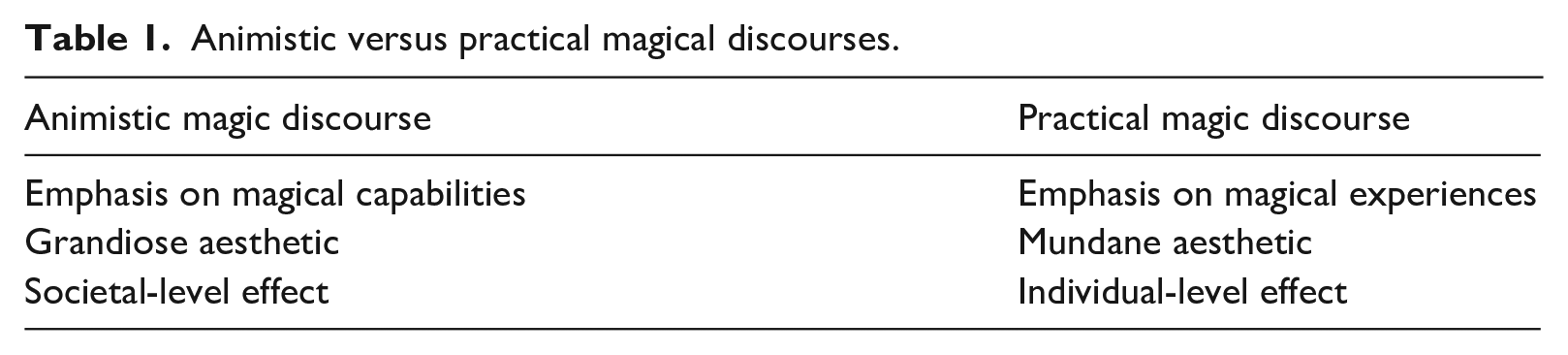
Practical magic discourse also differs from animistic magic discourse in its more mundane aesthetic. Recall that much of Disney’s discussion of MM+ focuses on alleviating the burdens of planning logistics and maximizing time. The onstage illusion MM+ helps create does not stretch the imagination too far. Rather, it remains firmly entrenched in everyday activities and concerns like creating a vacation itinerary, checking in at accommodations, catching buses, ordering meals, and taking photos. The aesthetic of the “magic” practical magic discourse suggests is akin to a TV show witch wiggling her nose to instantly conjure a five-course meal or tidy an entire house.
Moreover, the magic is an illusion, rather than “real,” as is suggested by animistic magic discourses. Disney does not believe that MM+ has an other-worldly effect or quality in the way it helps guests achieve an ideal experience that feels magical. The company always characterizes this experience as an achievement of the underlying technology, in line with its long-standing investments in technological innovation, for example: Innovation is essential to The Walt Disney Company story, dating back to its inception nearly a century ago. As Walt Disney once said, ‘We’ll always be introducing and testing and demonstrating new materials and new systems.’ Well, that promise will come true once again next year when Walt Disney World Resort releases our next-generation wearable technology, MagicBand+. (ID086)
By contrast, animistic magic discourse captures visions of technologies as “brimming with unknown and incalculable forces” (Aupers, 2009: 171) or as “absolutely powerful,” ‘a force greater than that of nature’ (Stivers, 1999: 2). Practical magic discourse entails a “wink” at the audience that animistic magic discourse does not. It enjoins guests to suspend disbelief.
Also in contrast to animistic magic discourse, any effect of practical magic discourse operates at an individual level, rather than a societal level. Animistic magic discourses ascribe new technologies with capabilities that suggest an extraordinary, perhaps god-like, power, implying miracles technologies are presumed to singlehandedly cause (Aupers, 2009). Thus, animistic magic discourse suggests that new technologies’ effects alter our understanding of the natural world, with significant implications for humanity and society. By contrast, practical magic discourse is much more modest, contained to the context of the individual user’s experience with a technology. This focus is evident through the ubiquitous use of “you” in blog posts to address readers as presumed guests/users (e.g. “Disney Genie does all the work to suggest fun options tailored to you” [ID177]). As such, practical magic discourse has no existential implications for society, as any possible direct effects would only happen at the level of individual users in context of use. However, indirectly, like animistic magic discourse, it may encourage broad investments in new technologies by contributing to an ethos of techno-optimism (Campolo and Crawford, 2020; Stahl, 1995; Stivers, 1999).
Despite their distinctions, practical magic discourse and animistic magic discourse share a performative quality, describing and enacting expectations for people’s engagement with technology. Past work argues that animistic magic discourse overhypes technological capabilities (Elish and boyd, 2018), generating “‘awe’—a mixture of fascination, delight and excitement on the one hand and fearfulness on the other hand” (Aupers, 2009: 165). This effect, then, serves to “manufacture legitimacy” for technologies, as they come to be seen as supremely powerful (Elish and boyd, 2018: 2). The technologies are depicted as too powerful to not invest time, attention, and money in them. Disney’s practical magic discourse seems to also have the potential to manufacture legitimacy by willing certain positive outcomes of MM+ into being. By suggesting a fantastical experience delivered by MM+, Disney wills guests to perceive the system as essential to achieving the perfect vacation. Moreover, the obfuscation of offstage work of building and maintaining MM+ may further reduce the chance that guests will consider any problems they encounter with the system to be a result of failures in its (human) design and development. If guests’ experience differs from the narrative Disney puts forth about MM+, it is their individual failing, not that of the system. Thus, like animistic magic discourse, practical magic discourse suggests the inevitability of a technology’s power.
Discussion
This study presented a case study of Disney’s use of magical discourse to characterize of its MM+ system. In contrast to prior work on magical discourse around technology, Disney’s magical discourse emphasized the system’s capacity to generate magical experiences, rather than magical capabilities. Disney portrayed MM+ as a tool for escaping reality, allowing guests to immerse themselves in the fantasy world of the parks, while supposedly reducing labor needed to manage vacation logistics. This imbues MM+ with a more mundane magical aesthetic than is typically seen in magical discourse around technology. It also directs users to suspend disbelief and participate in the illusion of a magical experience, which mainly targets transformative effects on an individual rather than societal level. Ultimately, this discourse downplays both the tremendous efforts performed by Disney to develop and maintain the system and the laborious task of understanding and using the system. This magical discourse aligns with “practical magic,” a concept Disney uses to describe its approach to quality service in which “offstage” efforts remain hidden so that guests may enjoy a seamless “onstage” experience.
Through its practical magic discourse, Disney engages in mythmaking around MM+ that suggests what users should expect from the system: the benefits it should afford and how it should make users feel. The desired effect is for users to readily experience “ordinarily unavailable this-worldly benefits” (Otto and Stausberg, 2013: 8) from their use of MM+, which forms the essence of its magical quality. Disney’s practical magic discourse structures expectations for the “right” way to experience MM+, which in turn nudges “correct” uses. It suggests that users will know they have used the system correctly when they achieve the feeling of transcending their everyday reality.
Obscuring the line between “offstage” work and “onstage” user experiences further helps gild MM+ with a veneer of fantasy, encouraging users to accept as unknowable that which can be understood, at least at a high level. This may serve as an effective form of control over guests’ imaginations (Bryman, 2012): emphasizing the glossy and colorful user experience while sweeping the potential for privacy risk under the magic carpet. Many, if not most, Internet users employ and are satisfied with surface-level mental models about the Internet in perceptions and evaluations of data use (Kang et al., 2015). When datafication is not only opaque, but this opacity is marketed as magical, the ability and interest of the everyday user to recognize privacy or security risks likely wanes. This potential downstream effect of practical magic discourse is notable, given concerns around MM+’s extensive data collection and surveillant affordances (Carr, 2019; Huddleston et al., 2016).
Promoting the willful ignorance of underlying processes and user data being employed to create “magical” technological experiences might be an effective approach for corporations to facilitate greater technological adoption. After all, new technologies perceived to be useful and easy to use are often more likely to be adopted by users, and it is this perception—as opposed to an informed understanding—that drives users’ behavioral intent (Davis, 1989). Practical magic discourse might further encourage users to lower their guards in the detection of threats to privacy and autonomy, as doing so results in the leisure experience they seek in a Disney vacation. As Huddleston et al., (2016) highlighted in relation to MM+ “the promise of pleasurable conveniences makes the sacrifice of privacy more palatable” (p. 224). Although they may be aware of this “magic trick,” guests may trade criticality for indulgence in playful fantasy. Practical magic discourse may prove particularly effective in socializing younger generations to embrace MM+ and similar data-intensive systems, as children represent a key consumer base for Disney.
Nevertheless, the effect of practical magic discourse on perceptions and use of MM+—and other technologies—remains an open question. The magical quality of MM+ depends upon and presupposes a user who has the digital skills and desire to use MM+ in the described ways. Many users will not meet these criteria and may very well reject the company’s portrayal of MM+ based on their actual experiences with it and direct any blame at Disney. Notably, we saw some evidence of this in comments on blog posts. Future work should explore how users perceive practical magic discourse and subsequently respond to it in their use of MM+ and other systems.
The potential impacts of practical magic discourse also underscore a need for greater attention to companies that are not “tech companies,” but nevertheless develop and implement large-scale data-intensive systems like MM+. Although privacy is often an immediate question when tech companies develop new systems (Waldman, 2021), it was conspicuously absent from Disney’s descriptions of MM+. Even early media coverage of MM+ made only passing reference to privacy concerns (Barnes, 2013; Carr, 2015). The absence of privacy from MM+ discourses suggests that Disney may not expect to receive scrutiny over data privacy questions. We call on scholars and journalists to look beyond the “usual suspects” in big tech and attend to the ways that major players in other sectors are legitimizing data-intensive systems. Such broader scrutiny is necessary for those who strive to blunt the force of datafication, especially when it comes to companies like Disney that benefit from more positive public perceptions.
Although we investigated Disney as a case study on magical discourse, we anticipate our findings may offer broader insight on the legitimization of data-intensive systems in both public and private spaces. As mentioned, Disney serves as a model for organizations and industries around the globe (Bryman, 2012). Disney’s technological developments—for example, the effective transformation of its parks into smart cities—and the practical magic discourse it implements to describe them may offer other organizations and municipalities a template for accomplishing a similar technologization of their physical environment.
While Disney positions MM+ as contributing to the experience of its parks as the “most magical places on earth,” our analysis leads us to ask: what realities are necessitated by this technological fantasy?
Footnotes
Funding
The author(s) disclosed receipt of the following financial support for the research, authorship, and/or publication of this article: This study was supported by a grant from the Center for Socially Responsible Artificial Intelligence at Penn State.
Author biographies
