




Abstract
This article presents a sociolinguistic analysis of online identity construction through the lens of chronotope. Based on a longitudinal digital ethnography spanning 2019–2022, we examined 253 WeChat Moments posts collected from a participant referred to as ‘Green’. Our aim is to understand how individuals with migration experiences tactically draw on multimodal and translingual resources to construct a coherent online persona amid offline mobility, change and discontent. Our research uncovers that Green’s posts normalise an ‘alternative reality’ for her online persona presentation, wherein her offline experiences are reconfigured into ‘invokable histories’ contributing to the creation of ‘chronotopic behavioural scripts’. This reconfiguration of time-spaces yields a ‘collaged’ identity continuity, particularly evident during periods of restricted physical mobility such as pandemic lockdowns. This study not only provides a methodological enhancement to sociolinguistic research on identity but also contributes to ongoing discussions on temporal-spatial reconfigurations in social media communication.
Introduction
Mobile communication and social media technologies have brought about significant transformation in contemporary human interactions, leading to unprecedented reconfigurations of temporal-spatial patterns and fundamental changes of cultural norms (Blommaert, 2018; Elsobeihi and Abu Naser, 2017; Szabla and Blommaert, 2020). At the contemporary time, ordinary individuals have access to a myriad of affordable digital platforms that offer diverse avenues for interactive self-expression. Frequently engaging in this digital self-construction, one can employ strategic ‘impression management’ (Goffman, 1990 [1959]) to create a virtual persona and negotiate the intricacies of their identity across various facets. In this virtual performance, an individual presents on the digital ‘frontstage’ (Goffman, 1990 [1959]) by selectively sharing information about themselves for identity construction. For instance, on academic profiling sites such as Google Scholar, an individual’s identity could be primarily shaped through lists of publications and citation indexes, whereas on more informal platforms such as Instagram or WeChat, individuals usually craft nuanced and multifaceted personas, often incorporating dynamic reconfigurations and representations of subjectivity and lived experiences.
The study presented in this article draws data from a longitudinal digital ethnography featuring a participant referred to as Green – a female individual who studied in the United Kingdom from 2016 to 2021 and subsequently was an ‘overseas returnee’ (海归hai gui) in China from March 2021 to early 2023. In recent research, the identity construction of these unique social actors, namely ‘overseas returnees’, has been explored to certain extent, with some studies focusing on overseas students in the host countries (e.g. Antonova and Gurarii, 2020; Zhao and Ebanda de B’beri, 2022), and others on student returnees back in their home countries (e.g. Christiansen et al., 2018; Jin and Wang, 2022; Wang, 2022). Prior research has delved into the identity work of overseas returnees, emphasising their complex negotiations of sociocultural norms exercised in both the home and sojourn countries, as well as their adoptions of the so-called transnational cosmopolitan styles (e.g. Jin and Wang, 2022; Marginson, 2014; Wang, 2022). A common finding from previous research is that overseas returnees often continue their life trajectories carrying rich ‘identity repertoires’ (Blommaert, 2005: 234) that are acquired from their overseas experiences.
However, there have been few attempts in sociolinguistics or linguistic anthropology to investigate how individuals strategically draw on resources to construct their online personas as a means of coping with offline displacement, disruption or discontent. In addition, the methodology of longitudinal ethnography has been rarely used in studying identity work, online or offline. Addressing this research gap, our study offers a renewed discussion on the identity work of transnational youths under the analytical lens of chronotope.
In this article, we first elucidate how Bakhtin’s (1981) concept of chronotope functions as an analytical tool in sociolinguistic studies on identity formation. We posit that a chronotopic analysis of online discourse offers novel sociolinguistic insights into the construction of identity in mobile communication. To conduct such an analysis, we examine the semiotically imbued reconfigurations and representations of invokable chronotopic resources within the participant’s social media posts. This examination focuses on how finely detailed multimodal and translingual indicators are artfully and playfully intertwined to make meaning across time-spaces and thus facilitate the participant’s identity construction, especially in terms of creativity and continuity.
We argue that the entextualisation and resemiotisation of chronotopic features and scripts – as displayed in our participant Green’s WeChat Moments posts – are intrinsic characteristics of social media discourse and online communication. With its affordances and accessibility, social media posting offers users like Green an alternative reality to sustain their preferred online personas and identity continuity, despite the disconnectedness, uncertainty and isolation caused by real-life conditions, such as transnational relocations and pandemic lockdowns.
Chronotope and mobile communication
The concept of chronotope, originally introduced by Bakhtin, has been widely used in discourse studies over the past two decades. According to Bakhtin (1981), chronotope refers to ‘the fusion’ of ‘spatial and temporal indicators’ into ‘one carefully thought-out, concrete whole’ and is a ‘formally constitutive category of literature’ (p. 84). In recent works drawing upon chronotope, scholars have extended the utility of this concept to include social actions in both offline and online contexts, emphasising the ‘inseparability’ of time and space and the creative formulation of time-spaces as an intrinsic norm of human interaction. This has resulted in a growing body of literature elaborating the role of chronotope in shaping identity construction and social interaction, with examples including Silverstein (2005), Agha (2007, 2015), Blommaert (2015a, 2015b, 2017, 2018), Blommaert and De Fina (2017), Lyons and Tagg (2019), Sanei (2021) and others.
Among these scholars, expanding on Agha’s (2007) focus on self-presentation in ‘mass mediated’ spacetime, Lyons and Tagg (2019) introduce the term ‘mobile chronotope’ to describe the ‘socially conditioned configurations of time and space largely within text-based virtual exchanges through apps such as WhatsApp, SMS, and WeChat’ (p. 659). The authors claim that social interactions facilitated by mobile phones intrinsically afford ‘inherently dynamic’ chronotopes, as mobile phone users can re-enter communicative spaces at different times regardless of their physical locations (Lyons and Tagg, 2019). This concept of ‘mobile chronotope’ underscores the limitless affordances and accessibility of online communication, showcasing the infinite possibilities for engagement and interaction across varied temporal and spatial contexts in virtual exchanges facilitated by mobile phones and social media.
Social media platforms, with their ‘unconventional arenas’ for individual interactions (Androutsopoulos, 2011), also play a significant role in shaping the online-offline nexus. These platforms offer dynamic temporal-spatial contexts where users’ online activities overlap, complement, intertwine or conflict with their offline engagements. The ‘mobile chronotope’, with its unlimited affordances for constant virtual exchanges, contributes to this nexus by enabling users to dynamically establish compact units of time-space in the digital realm that discursively connect online interactions with offline experiences. As a result, social media users can leverage these affordances to creatively shape their identities and uphold preferred personas across the online-offline nexus. As argued by Blommaert (2019), this dynamic integration empowers individuals to navigate and negotiate their identities across both virtual and physical domains, manifesting the fusion of online and offline dimensions of contemporary social life.
Within such a ‘mobile chronotope’ (in other words, the instant virtual units of an indefinite time-space brought by mobile communication), social media discourse has become normalised through what Giddens (2018) describes as ‘indefinite tracts’ (p. 18). This term is used to highlight the characteristics of contemporary social life where individuals experience a sense of continuity and extension in both temporal and spatial dimensions. In mobile communication, the normalisation of constant time-space reconfigurations can be achieved through a phenomenon referred to by Castells (2009) as the ‘collage effect’. Utilising such a collage effect in online identity work, social media users extract or distance certain discursive practices and events from their original contexts, and then splice them into new time-spaces for the creation of resemiotised communication. Users often draw upon multimodal symbolic resources (including text, images, audio or video clips) to construct their ‘collaged’ online discourse for identity construction, which then provides them with the frontstage to creatively fashion their virtual being.
These affordances and accessibility of online communication are also conceptualised by scholars using two other valuable terms: entextualisation and resemiotisation. Leppänen et al. (2014) argue that entextualisation and resemiotisation are crucial semiotic resources for identity performance on social media. They provide an in-depth explanation of how these two concepts can be utilised to trace the ways in which social media activities build on the active recirculation, normalisation and appropriation of complex multi-semiotic material. Entextualisation identifies and analyses ‘the trajectories and re-uses of language and textual material in meaning-making’ (Leppänen et al., 2014: 115), or how textual material is extracted from its original context and modified to suit a new context (Bauman and Briggs, 1990). The affordances of social media for identity work through entextualisation is characterised by Kress and Van Leeuwen (1996) as the ‘new realities of the semiotic landscape’ (p. 34). In the same vein, resemiotisation refers to the recreation and rearticulation of meaning across modes, modalities and group norms (Iedema, 2003). In our view, this process of entextualisation and resemiotisation often involves socio-historical explorations, encompassing dynamic meaning-making of the behavioural scripts carried over from various ‘there-and-then’ chronotopes in the ‘here-and-now’ chronotopic performance.
By examining the processes of entextualisation and resemiotisation, researchers can shed light on how social media users discursively employ linguistic and other semiotic sources to construct, perform and negotiate their online identification. Building on the concept of the mobile chronotope as a catalyst for an alternative reality among social media users, and considering the ‘collage effect’ resulting from entextualisation and resemiotisation of online multimodal discourse, we proceed to discuss identity work from the angle of chronotopic framing. This aspect emerges as another central element in our analytical framework.
Chronotopes as identity frames
Blommaert and de Fina (2017) provide a sociological discussion to elaborate the ‘framing’ role of chronotopic configurations in identity work within superdiverse social contexts. Using empirical examples from both an office setting and an inner-city school in Sicily, they demonstrate how time-space conditions regulate identity construction and negotiation among individuals. For instance, the authors highlight that a group of colleagues sharing certain professional identities in the office may adopt a completely different behavioural mode during ‘their weekly happy hour’ in a pub, where ‘job talks’ are off-limits. The authors also call for more research on identity work in the ‘virtual space’, asserting that ‘determining the specific chronotopic nature of cultural practices in a virtual cultural sphere promises to be a stimulating and thought-provoking exercise’ (Blommaert and de Fina, 2017: 13).
In his discussion on Durkheim and the Internet: Sociolinguistics and the Sociological Imagination, Blommaert (2018) further suggested that identities could be viewed as ‘chronotopically organised moralised behavioural scripts’ that are dialogically and interactively constructed; he argued that individuals enact their identities by drawing from a set of dispersed qualities that make up their identity repertoires (p. 57). He proposes that researchers should observe identity work as a ‘chronotopic human conduct’ to understand how individuals deploy highly particular resources to perform certain normative roles in social actions within certain time-spaces (pp. 58–59). According to Blommaert, Goffman’s concepts of ‘frontstage’ and ‘backstage’ are two types of overlapping chronotopes that have their own modes of social actions, identity affordances and normative systems (p. 60).
In our study, through a chronotopic analysis, we are able to trace how Green develop these deploying processes within and across various online and offline time-spaces, negotiating her identity. Green’s experience of studying in the United Kingdom (the ‘offline there-and-then’) and working in Shanghai (the ‘offline here-and-now’) constitutes a set of ‘invokable histories’ (Blommaert, 2015b: 110). Creatively invoking these personal histories to the present, she entextualises and resemiotises small symbolic signs to frame her consistent online persona, which, we would argue, is clearly observable in her translingual and multimodal WeChat Moment posts.
Translanguaging, multimodality and identity
Given that each chronotope consists of distinct discursive frames and moralised behavioural scripts, comprehending how social media users invoke various chronotopic features in their identity construction necessitates an exploration of their exact usage of linguistic and other semiotic signs. This is particularly essential when examining multilingual users who have undergone transnational relocations and mobility, as exemplified in the case of Green. To accomplish this analysis, the concepts of translanguaging and multimodality also come into relevance.
In this study, translanguaging is understood as a practical theory of language (Li, 2018) that empowers social actors to perceive different languages as constituting a speaker’s ‘integrated communicative repertoire’ (García and Li, 2014; Hymes, 1972; Li and Lin, 2019). There is a notable body of empirical research investigating the interplay between multimodal translanguaging practices and the construction of online identity (e.g. Dovchin, 2019; Jonsson and Muhonen, 2014; Leppänen et al., 2014; Leppänen and Kytölä, 2016; Zhang and Ren, 2020; Zhao and Flewitt, 2020; Zhu, 2020). One case in point is the study by Zhao and Flewitt (2020), which discovers that bilingual children adeptly leverage their diverse resources by employing image-based communication to enhance their communicative exchanges and shape their identities. Such research illustrates the intricate interplay between linguistic diversity, multimodality and identity construction in multilingual contexts.
During the process of constructing certain personas in multilingual digital contexts for particular, individuals often agentively, critically and creatively employ different linguistic and semiotic resources from their communicative repertoire across offline and online chronotopes. In our study, when examining Green’s Chinese/English bilingual and multimodal posts on WeChat Moment, we analyse the translingual text, photographs, stickers, memes and emojis not as isolated discourse indicators, but as artfully reconfigured and collaged resources ‘across different codes, modes, and time-spaces’ (Li, 2018). We propose that individuals, like Green, engage in a creative collage of invokable histories across chronotopes as they strive to shape their preferred virtual personas. These chronotopes, comprising different linguistic resources and modalities, serve as frames for the individual’s creative identity work. By analysing small translingual and multimodal signs in Green’s posts through a chronotopic lens, we gain insight into the constant and active reconfigurations of time-spaces created by contemporary multilingual and transnational youths. This dynamic process aids them in constructing continued self-identities in the digital realm.
WeChat moments for identity work
WeChat is one of many popular social media platforms that afford a digital alternative realm for their users. Among its many features, WeChat Moments resembles Instagram’s Story function and provides users with the ‘frontstage’ to share multimodal contents encompassing text, photos, videos, emojis and links to external sources. WeChat Moments posting is designed for users’ friends and acquaintances, with updates and posts being visible only to individuals within the user’s WeChat contacts. Interactions on these posts, such as likes or comments, are only viewable by mutual friends of both the post sender and responder. Previous studies have shown that users of WeChat Moments strategically employ diverse linguistic and visual resources to construct and communicate their identities (e.g. Bozkurt and Tu, 2016; Li and Huang, 2021).
In this article, one of our main arguments is that Moments posts on WeChat offer a compelling context for sociolinguistic ethnographers to observe the dynamic co-creation or recreation of chronotopes as normative frames in online identity construction. Through this chronotopic lens, we can see how discursive events of the past and the present are synthesised into a single Moments post. Green’s Moments posts reflect her efforts to construct and negotiate her self-identity in response to the challenges and experiences that punctuate her daily life. These include the ramifications of COVID-19 lockdown and isolation, nostalgic reflections on her student years in the United Kingdom, and her dissatisfaction with her workspace in Shanghai. In our chronotopic analysis of her translingual and multimodal WeChat posts, we illustrate how Green shapes her online identity by portraying subjectivity, temporality and spatial aspects within the discourse of WeChat Moments.
Research design
Following the theoretical discussion, this section outlines the design of the research with longitudinal digital ethnography as the selected methodology. We start by explaining how longitudinal digital ethnography extends traditional ethnographic methodologies. We then provide detailed information about the participant and the data collection process, concluding with a note on ethical considerations.
A longitudinal digital ethnography
This study employs longitudinal digital ethnography to gain insights by looking at ‘seemingly small occurrences’ (Blommaert and Dong, 2010). Distinctively adapted to the digital age, digital ethnography allows researchers to explore the broadened scope of lived reality moulded by pervasive computing technologies. These technologies have given rise to an all-interconnected communicative ecosystem primarily characterised by digitalisation. The widespread integration of digital technologies into various facets of life has resulted in the phenomenon of ‘living in media’, wherein individuals’ daily lives are deeply, sometimes overwhelmingly, intertwined with media engagement (Deuze, 2011: 137).
Acknowledging that this study primarily centres on digital ethnography, it is essential to recognise the inherent interconnectedness of traditional ethnography and its digital counterpart. Rooted in face-to-face interactions and physical contexts, traditional ethnography provides a foundational understanding of human behaviours and cultural dynamics. Expanding upon this foundation, digital ethnography enables real-time data collection, encompassing online observations, conversations and the gathering of digital artefacts together with other multimodal contents. Moreover, digital ethnography allows ethnographers to capture the nuances of complex interactions and comprehend how individuals navigate between online and offline contexts (Markham, 2012). In this study, employing a 3-year longitudinal digital ethnography, we explored how Green the participant constructs her ‘lived reality’ in a digital realm as part of her identity work.
The data bag
Across our 3-year (February 2019 to March 2022) longitudinal digital ‘field’ work, we have accumulated a ‘data bag’ (Blommaert and Dong, 2010) brimming with Green’s ‘digital traces’ and ‘storytelling elements’ (Underberg and Zorn, 2013: 10). Reflective field notes on data collection and interpretation were also included. Table 1 (Data Inventory) displays the data bag, showing the tools of inquiry, corresponding data sources and the quantity of each type.
Data inventory.
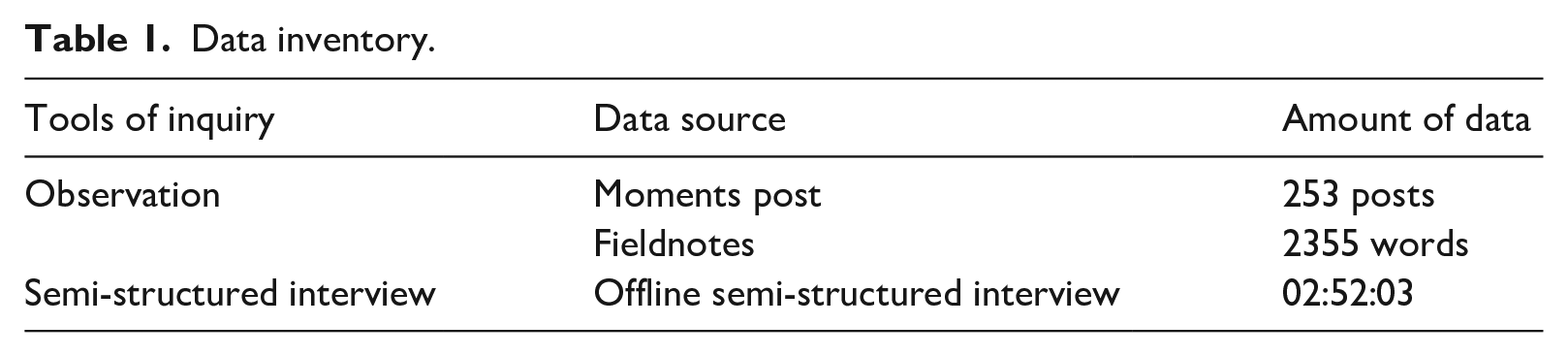
Adopting ‘an unobtrusive observation approach’ in online environments (Ugoretz, 2017), we gathered naturalistic data, specifically Moments posts, from Green’s WeChat account. The first author’s well-established rapport with Green provided full access to her Moments, resulting in the accumulation of 253 Moments posts within the data collection period. During the period, ethnographic observations occurred every 2 days to ensure comprehensive coverage of Green’s Moments, with field notes documenting each update. The overarching themes in the field notes included, but were not limited to, a summary of the post content, linguistic and semiotic resources, interactions between Green and her friends (including likes, comments and shares), broader social events (e.g. pandemic outbreaks), markers of group identity or shared interests, and manifestation of offline-online connections.
In addition to observations, we also conducted semi-structured interviews to further understand Green’s life stories, collecting additional contextual information for the subsequent discourse analysis. Throughout the data collection process, maintaining a positive rapport with Green proved advantageous in yielding rich and meaningful data. Nevertheless, the overlapping roles of being both a researcher and a friend of Green also occasionally posed challenges for the first author. Throughout the data collection process, the first author, in the role the data collection researcher, has been attentive to what Logstrup (1997) termed ‘the zone of the untouchable’, delicately navigating the accumulation of Green’s posts under her full consent.
The participant
Green was purposefully selected as our participant due to her transnational experience, multilingual background, interest in identity studies and ability to communicate in an articulate and reflective manner. In addition, her sensitivity to social media and online information rendered her representative of individuals in the same generation. Having been on WeChat for many years, Green mainly uses its functions to connect with family, maintain friendships and share moments of her life. The frequency of her posting varied; at times, she would share multiple posts per day, while in other months, only one post was added.
Green’s life trajectory
To further introduce our participant, Figure 1 is provided to illustrate Green’s life trajectory. Born and raised in Chongqing, China, she relocated to England in 2016 to pursue her master’s degree and subsequently began a doctoral study in 2017. The onset of the COVID-19 pandemic disrupted her routine from early 2020, when she was in a transition period facing many challenges. In 2021, she officially accomplished her PhD study and secured a job position in Shanghai, China. Her return to China led to experiencing reverse cultural shock and pandemic-induced changes of social norms, which subsequently prompted introspection about her circumstances and influenced her later plans. In the spring of 2023, after 2 years of working in Shanghai, Green secured a job in the United Kingdom and relocated back to England.
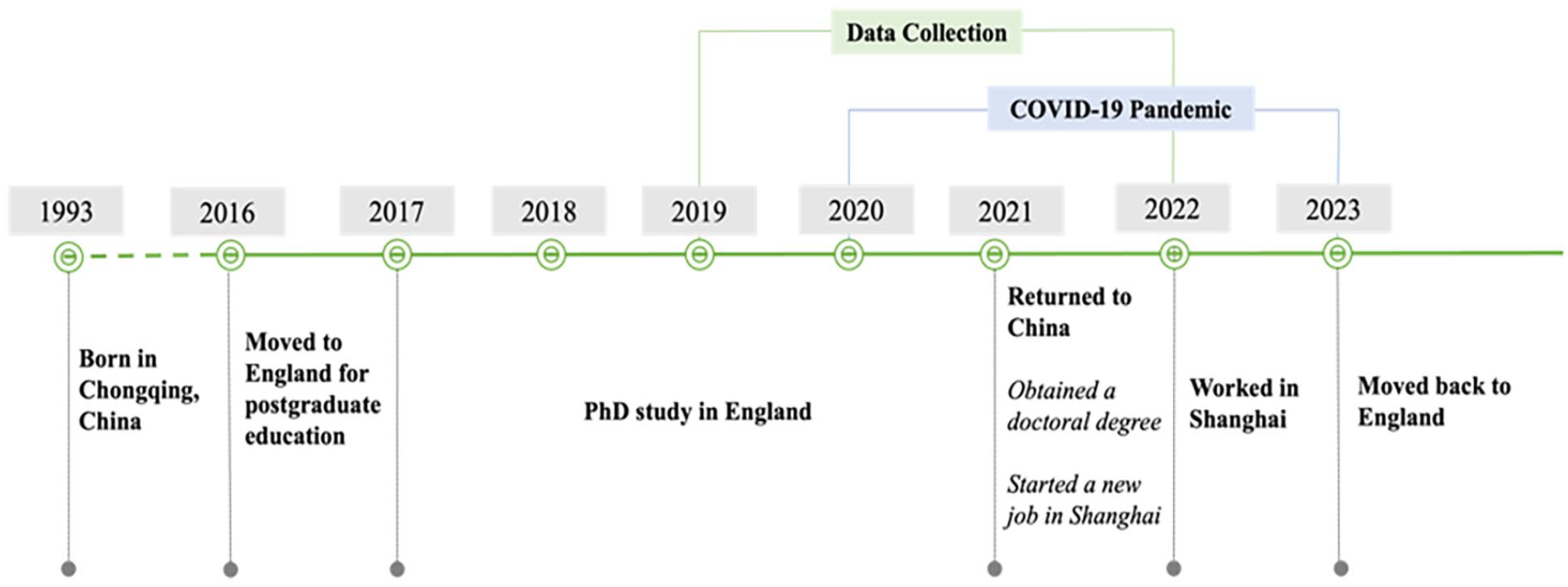
Green’s life trajectory.
Green’s life journey has been marked by shifts spanning time and space, playing a key role in the ongoing shaping of her identity. In this ongoing process, WeChat serves as a platform for her to not only chronicle each transformation but also construct a coherent sense of self amid the wanted or unwanted changes.
Despite facing numerous real-life challenges, Green remains committed to pursuing a fulfilling and active lifestyle, with ‘being a fun person’ as her overarching life goal. She spends a significant amount of her spare time browsing social media for interesting contents, which she then incorporates – often through linguistic and other semiotic signs – into her Moments posts and online interactions with friends. At the offline interviews, Green repeatedly expressed the perspective that maintaining a sense of humour is a powerful way for coping with the challenges inherent in real life. As she aptly stated, ‘life is too hard, we have to be fun, otherwise how can you combat life stress and anxiety?’ (the original Chinese quote: ‘生活太苦了,人嘛还是要有趣一些,不然怎么对抗生活的压力和焦虑’). This aspect of Green’s personality and outlook on life serves as a significant factor in the data analysis in this study.
Ethical considerations
In this longitudinal digital ethnography, ethical considerations played a crucial role, as the data collected from Green’s WeChat account existed in a complex context, straddling the boundary between the public and the private spheres and often intersecting. To safeguard Green’s privacy, we implemented several measures to anonymise her data, including assigning her a pseudonym and pixelating identifying details in all data images. Despite these precautions, nevertheless, the potential for inadvertent disclosure of her personal identity persisted, as her information was accessible to her entire WeChat network. In response to these concerns, we thoughtfully handpicked specific Moments posts to use as data, each approved by Green herself through explicit consent. Participant privacy, as emphasised by Convery and Cox (2012), holds paramount importance, including participants’ perceived levels of privacy. To honour this, we invited Green to review and ensure her anticipated privacy, and adjustments were then explained and enacted accordingly.
In the following sections, we provide three thematic analyses to discuss the key aspects of Green’s identity work. In the first data analysis section, we elaborate on how Green harnesses the affordances of social media posting as an alternative reality to sustain her humorous persona. Moving on, the second section explores how Green invokes chronotopic histories from the past, allowing her to infuse her posts with a rich collage of chronotopic events and scripts. This enables the entextualisation and resemiotisation of seemingly minor elements to shape her identity expression on WeChat, with a particular focus on her creation of a stylised Christmas celebration in 2021 Shanghai. In the final section, we analyse Green’s playful yet strategic juxtaposition of seemingly contradictory chronotopic scripts. This intricate balancing act, while expressing anxiety during pandemic lockdowns, serves to sustain her continuous identity as a vibrant and fun-loving individual. Through this comprehensive sociolinguistic discourse analysis, we provide an in-depth discussion on how Green shapes her chronotopic identity work on WeChat.
Findings
An alternative reality for a preferred persona
Repeatedly expressing her life goal to be a ‘fun person’, Green aspires to embody humour as a coping mechanism to navigate life challenges and moments of embarrassment. This objective is evident in her use of linguistic and semiotic elements to construct her identity on WeChat Moments. Upon Green’s return to Shanghai in mid-2021, she occasionally sought massages (when pandemic restrictions allowed) as a means of reducing the discomfort in her cervical spine. In her WeChat Moments posts, instead of simply recounting the massages as trivial events, she playfully entextualised conversations with a masseur to craft witty messages. The example below vividly illustrates how Green invokes different chronotopes – both online and offline – to skilfully draw connections for her persona construction.
As shown in Figure 2, Green uses the original offline interaction with the masseur at the massage parlour as the invokable history for this online post. She creatively resemiotises it by adding visual and symbolic cues so to imbue the offline event with fresh online connotations. Here, Green extracts the spoken dialogue from its actual offline chronotope (‘last evening at the massage parlour’) and entextualises it within the present digital chronotope. As a result, what was originally a somewhat embarrassing exchange becomes a triumphant representation of Green’s playful persona.
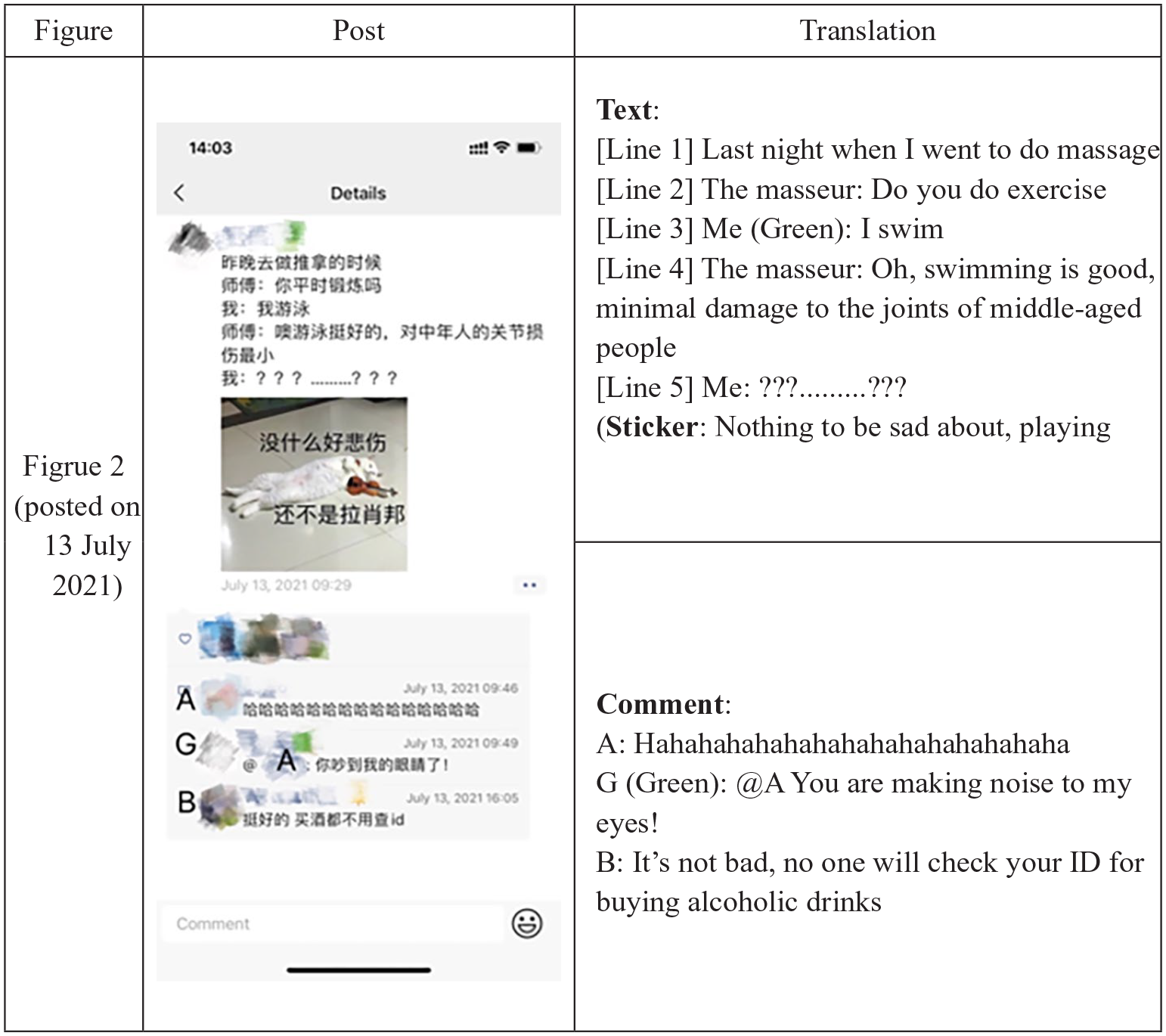
WeChat Moments post—Conversation with a masseur.
This post vividly unveils the creation of an alternative reality through chronotopic framing. Using a combination of Chinese text, question marks punctuated by prolonged ellipses and ‘a cat lying next to a violin’ sticker, Green successfully conveys the humorous meaning she intends to make. The twist is that the masseur wrongly assumed Green as one of the ‘middle-aged people’, while in reality, Green was then in her late 20s and far from middle age. The masseur’s utterance in the offline chronotope took Green by surprise, prompting her response in the online time-space of entextualising the event with a distinctive semiotic element – six question marks interspersed with long ellipses – to witfully express her astonishment. Comments from her friends under the post confirm her success of being a fun person.
Green’s use of punctuation is noteworthy here. In both declarative sentences (line 1, 3 and 4) and interrogative sentences (line 2), Green does not follow Chinese orthographic conventions to end the sentence with terminal marks. Her use of both question marks and ellipses also deviates from the rules of Chinese orthography. Typically, the rule of tone intensification requires the use of a singular question mark that is then reduplicated, up to a maximum of three question marks, when multiple questions are used in conjunction (Ministry of Education of the P.R.C, 2011). However, Green ignored this orthographic rule by using three question marks directly before and after the ellipses (???. . .. . .. . .???). Furthermore, the length of the ellipses used by Green far exceeds the six dots specified by the punctuation norms of Chinese language. With all this irregular usage of punctuation, the appropriateness and effectiveness of this non-verbal expression are there in the given context. In this instance, the elongated ellipses transcend the limitations of formal punctuation, effectively conveying the speechless nature of her reaction in response to the unexpected comment from the masseur.
The use of such ‘deviation’ in language, while being controversial in some ways (Raclaw, 2006), can be seen as normative features of the digital age: certain punctuation marks are frequently omitted or excessively employed in online communicative discourse. Green was aware of this norm and provided additional insights in a follow-up interview. She said, ‘posting (on WeChat Moments) is not like writing primary school assignments; the proper usage of punctuation may come across as too formal and rigid’ (the original Chinese quote: ‘发朋友圈又不像写小学作文,讲究标点符号好像太正式了,很严肃’, 13 July 2021). By defying established conventions, Green in this post transforms the offline event into an online narrative, showcasing how linguistic choices contribute to the construction of her persona across the dynamic interplay of digital and offline chronotopes.
Moreover, through consistent usage of amusing stickers in her online discourse, Green also establishes a habitual pattern to suggest her playfulness. This recurring employment of stickers serves as observable evidence of her inclination towards humour. In this specific post, the sticker features a cat lying on the floor next to a small violin. The accompanying text reads, ‘Nothing to be sad about, playing Chopin carry on’. Vividly exemplifying the multimodal nature of online discourse, this funny sticker is just one demonstration of Green’s adeptness at leveraging social media’s affordances to convey nuanced emotions.
Green’s adept manipulation of communication modes and chronotopes within the digital realm constructs an alternative reality where her playful identity is constantly on the frontstage. The ‘process of entextualisation and resemiotisation’ normalises multimodal discourse and allows Green to ‘effortlessly sustain her preferred persona within this alternative reality’ (Blommaert, 2018; Cook, 1997; Leppänen et al., 2014). By seamlessly blending offline and mobile chronotopes and engaging with multimodal resources, Green presents a captivating representation of herself that transcends boundaries.
An overseas returnee’s invokable histories: identity continuity
In early 2021, Green returned to China and started her post-doc job in Shanghai. From then to late 2022, more than one third of her posts were themed around her previous experiences in the United Kingdom. Those nostalgic posts about her UK experiences opened a way for her to cope with the challenges of reintegrating into her home country during the pandemic years. The multi-dimensional dynamic between her overseas returnee identity, her preferred self-presentation and her offline experiences significantly shaped the portrayal of her online identity during that difficult time.
In Figure 3(a) to (c), three photos are shared in one post with the same text to record Green’s celebration of Christmas in 2021. Figure 3(a) is a picture of a glass of mulled wine, a traditional warm alcoholic drink for wintertime in Europe, especially around the Christmas season. Drinking mulled wine and going to the Christmas market were two Christmas routines Green had acquired and exercised when living in the United Kingdom. Despite that Christmas is not a traditional festival in China, cultural globalisation and mass commercialisation have made Christmas celebrations popular among younger generations. Although it is fair to say that not all Chinese people celebrate the festival, for Green, celebrating Christmas remains as a natural practice and an important ritual in her life in Shanghai. Here, her post starts with an image of her home-made mulled wine and then carries on with two images taken from the Shanghai Christmas market in 2021 (which took place before Shanghai’s major pandemic lockdown).

(a) Home-made mulled wine, (b) the Christmas market in Shanghai and (c) mulled wine from the Christmas market.
Agentively drawing on these Christmas-related chronotopic moments, Green crafts her preferred identity as an overseas returnee. First, this post demonstrates the ‘online-offline nexus’ (Blommaert, 2019) in which Green’s online and offline activities are interconnected, allowing her to move seamlessly between distinct time-spaces and create her own preferred presence within the accessible realm of the ‘mobile chronotope’ (Lyons and Tagg, 2019). More interestingly, these cross-chronotopic moments are also shared through the ‘larger’ time-space of WeChat Moments, reaching a wider audience from different physical localities, particularly those who share similar overseas experiences therefore can resonate with Green’s Christmas celebration. The posting in this example helps Green to construct a sense of ‘virtual alliance’ away from her realistic offline chronotopes and situations, which is to get up at 5:30 a.m. on Christmas day for an undesirable job duty. The text and the two split-face emojis convey her discontent with the job assignment, despite being presented in her usual humourous manner.
Figure 3(b) and (c), showing photos taken in the Christmas Eve at the Christmas market in 2021 Shanghai, tell two offline chronotopic stories. The decorations and signs, including the blue banner with the German word CHRISTKINDLMARKT (Christmas Market), the festive street lights and the wooden house decorated with a Christmas stocking, all together vividly evoke Green’s distant ‘there-and-then’ offline chronotopic memories, the memories about traditional European Christmas atmosphere which Green has enjoyed as part of her lived experience in the United Kingdom. These images, on the other hand, also show the local twists, such as the Chinese characters ‘圣诞市集’ (Christmas market) and the capitalised city name ‘SHANGHAI’ on the cup sleeve, reminding of Green’s ‘here-and-now’ offline chronotope. Having to get up at 5:30 p.m. for job duties shall not affect her celebrative mood, so a ‘Merry Xmas anyway’ message in English is added to conclude the post.
This whole event of Green visiting the Christmas market, capturing snapshots and subsequently sharing them on WeChat Moments serves as a reflection of her in-betweenness. Posting these images invokes a sense of belongingness to certain cultural norms, and a continuity of her preferred identity, irrespective of her current geographical location. The lack of physical presence in the ‘traditional European Christmas market’ chronotope did not constrain Green from celebrating her Christmas in Shanghai, alone. Within the here-and-now chronotope of Christmas celebration, she skilfully entextualises her memories of UK Christmas festivities and resemiotises the festive rituals by making her own mulled wine and going to the local Christmas market. The posting here builds a bridge between her current geographical location in Shanghai and her nostalgic ties to the United Kingdom, creating a mobile chronotope that reflects her identity continuity.
Her preferred sense of belonging to the ‘there-and-then’ chronotope is explicitly negotiated at the real-life moment of having to get up at 5:30 a.m. for invigilation work. This circumstance echoes the temporal disparities between China and the United Kingdom and highlights her unique position – celebrating Christmas Eve with no Christmas holidays while embracing her WeChat network with the joyous spirit of her celebration. Green’s strategic orchestration of these chronotopic scripts attests to her adeptness at weaving her lived experiences in the United Kingdom into her life in Shanghai. Through skilful manipulation of her invokable histories, she constructs and perpetuates her continued identity as an overseas returnee.
The juxtaposed chronotopic identity during pandemic
Apart from festive celebrations, Green also posted about COVID-19 on her WeChat Moments. In the spring of 2022 when Shanghai was in pandemic lockdowns, residents who came into contact with potentially infected individuals would all receive a text message alerting them of potential risks. An example of those messages is shown in Figure 4(a). Here, Green’s WeChat Moments post shows a screenshot of a text message from the ‘Shanghai Disease Prevention and Control Office’ (SDPCO for short), notifying her of the required measures (e.g. self-isolation) for public safety. In the same post, another screenshot of a text message sent by the NHS (the National Health Service functioning in the United Kingdom) is also presented, as displayed in Figure 4(b). Although Green was then physically in Shanghai, she still received an NHS message notifying her ‘close contact’ with a person who had contracted the Omicron variant.

(a) Hello! According to relevant big data screening, you may be at risk of coming into direct or indirect contact with a person infected with COVID-19 recently. For the sake of your and your family’s health and public safety, and in accordance with the Prevention and Control of Infectious Diseases Act, the Emergency Regulations for Public Health Emergencies and other laws and regulations, as well as the relevant pandemic prevention and control requirements of our city, please cooperate in health monitoring after receiving this message. If you have symptoms such as fever, dry cough, nasal congestion, runny nose, fatigue, sore throat and loss of smell (taste), please go to the nearest clinic and inform your doctor. Please take personal measures and do not use public transport when travelling. If you fail to fulfil your obligation to prevent and control the spread of infectious diseases, you will be liable for legal consequences. If you are already in screening, closed management or isolation, this message can be ignored. Thank you for your understanding and cooperation!
With both screenshots presented here, Green adds on a commentary sentence: ‘10086 texted me four times asking me to self-isolate . Even NHS asks me to do nucleic acid testing??’. Here, she uses an emoji sign and two question marks together with a plain statement to document the situation, and more importantly, to express her emotions. As a ‘fun person’, even in times of experiencing anxiety and frustration, she presents her life moments in her humorous manner with a light-hearted touch.
As seen above, the two text messages correspond to different chronotopes, each expecting Green to respond in distinct ways. In Figure 4(a), Green is identified as a resident of Shanghai. She is urged to cooperate in health monitoring and take appropriate actions if any symptoms arise, thereby emphasising her responsibilities as a local resident. Concurrently, in Figure 4(b), she is implicitly recognised as a resident in the United Kingdom and directed to undergo a nucleic acid test. These messages introduce two distinct offline chronotopes, demanding corresponding behaviours from Green and requiring her to fulfil societal roles accordingly. This aligns with Blommaert’s (2018) argument that identities are moralised chronotopic scripts. In this context, a law-abiding resident must adhere to regulations, undertake self-isolation and take a test if notified of ‘close contact’ with a person infected with COVID-19. The perceived expectation for responding to these two messages prompts Green to post and document her situation and feelings.
The COVID-19 pandemic has given rise to what Parui and Simi Raj (2021) term a ‘COVID-19 crisis chronotope’ (p. 1431), characterised by severe lockdowns and isolation that hindered physical transnational connectivity. However, mobile connectivity played a pivotal role in digitally linking seemingly parallel and isolated chronotopes, thereby blurring the temporal and spatial transnational boundaries. It was through such connectivity that Green received both the Shanghai and NHS messages on her mobile phone, which was equipped with two nano-SIM cards. This technological integration highlights the role of mobile communication in connecting and intertwining diverse aspects of Green’s experience within the context of the pandemic.
The Shanghai message accurately captures the ‘here-and-now’ chronotope, reflecting Green’s current location. In contrast, the NHS message, seemingly unexpected and mistaken, aligns with her social role in the ‘there-and-then’ chronotope and brings back her past experiences as an international student in the United Kingdom. The conflicting calls to action in these two distinct chronotopes, coupled with the juxtaposed chronotopic ‘identity scripts’, contribute to a complex entanglement of chronotopes facilitated by mobile communication in Green’s case. Through her intentional act of sharing this juxtaposition, Green foregrounds the convergence of certain chronotopic scripts, effectively drawing attention to her dynamic negotiation of multifaceted identity across different offline and online chronotopic contexts. By tactically framing her online identity work with these screenshots, emojis and text, Green showcases once again her skilfulness at blending transnational experiences into a coherent narrative of identity. In this particular scenario, this construction of coherent identity is not only for fun, but also as a means to cope with anxiety and stress.
Discussion and conclusion
Drawing on discourse examples collected from a longitudinal digital ethnography, this article discusses chronotopic identity work in mobile communication on WeChat Moments. The data analysis and interpretation highlight how Green, a multilingual and transnational Chinese youth, leverages the affordances of invokable chronotopic histories to creatively and aesthetically communicate her self-identity on social media. Given the unique affordances of online communication, social media users like Green can maintain an identity continuity with rich resources dynamically drawn from other chronotopes, both synchronously and asynchronously. The ‘fusion of temporal and spatial indicators’ (Bakhtin, 1981) in the ‘mobile chronotope’ (Lyons and Tagg, 2019) enables such creative online communication for identity work through various forms of discursive practices.
In Green’s case, the seemingly fragmented self-presentations on social media inherently correlate to certain chronotopic frames and features. She alters, collages and reconstitutes these multimodal and translingual features drawn from her lived experiences and communicative repertoire, creatively maintaining a continued ‘alternative reality’ to express herself. Within this alternative reality, Green enjoys the freedom to coherently embody her humorous persona, even in the face of real-life difficulties and distress. Based on this analysis, we argue that, instead of seeing Green’s lived experiences in the United Kingdom and Shanghai as separate and fragmented postmodern events, her WeChat Moments posts evidently illustrate her identity work as chronotopically framed for identity continuity. Her ‘invokable offline histories’ intricately intertwine with her simultaneous online discourse, providing emotional comfort and communicative resources for her construction of self.
This study critically employs the concept of chronotope as an analytical lens, challenging conventional perceptions of time and space to align with the social norm of connectivity in the digital age. This approach helps reveal the complexity, affordances, accessibility and continuity of identity work on social media. Through this discussion, we aim to prompt a reconsideration of fragmented interpretations of identity discourses shaped by postmodern philosophy. We argue that ‘writing oneself into being’ (boyd, 2008) online inevitably requires the integration and continuity of sources invoked from one’s lived experiences. We argue that identity continuity is a dynamic process involving the chronicling and performance of chronotopic identity scripts; it refers to the coherent construction of one’s stable sense of self in the digital realm. By analysing Green’s social media discourse, we have demonstrated how such presentation and communication of oneself can be creatively accomplished.
Through a systematic and selective analysis of 253 WeChat posts, we have identified three key aspects that illustrate Green’s online identity work. The first finding highlights Green’s skilful navigation across different chronotopes to construct an alternative reality, wherein her playful and humorous persona takes the frontstage. The second finding emphasises the intricate fusion of the ‘there-and-then’ and ‘here-and-now’ offline chronotopes, showcasing Green’s unique position of in-betweenness. By seamlessly interweaving chronotopic scripts, particularly in the context of Christmas celebration, Green places herself in a mobile chronotope where her transnational experiences as an overseas returnee living in Shanghai take prominence. This allows her to momentarily enjoy her preferred identity and everyday aesthetics, despite feeling frustrated and constrained by real-life situations. Her strategic use of ‘invokable histories’ enhances her role as a storyteller of identity, establishing an offline-online nexus for her identity construction. The third aspect delves into Green’s intentional juxtaposition of chronotopes in her presentation of contrasting elements for identity work. By placing incompatible public messaging contents side by side, Green foregrounds the convergence of diverse chronotopic scripts. Her deliberate juxtaposition effectively highlights the interconnectedness among varied temporal and spatial elements and the unforeseen emotions (e.g. anxiety) resulting from this interconnectedness. Illustrated through the WeChat Moments post, Green once again demonstrates her expertise in blending transnational encounters into a coherent and continued narrative of self-identity.
Methodologically, this longitudinal digital ethnographic approach is an up-to-date choice for exploring both the ephemeral and enduring characteristics of online identity work. Through extensive participant observations and fine-tuned analyses of multimodal discourse, we can pinpoint sociolinguistic cues and meaning-making markers that might seem fleeting but are, in fact, rich with indexical meanings. Such meanings could not be captured without the in-depth analysis of these cues, markers and semiotic signs as well as the sociocultural conditions. Our 3 years of longitudinal digital field work facilitated the collection, understanding and interpretation of such signs, conditions and the meanings derived from them.
In conclusion, this article presents an original application of longitudinal digital ethnography as a methodology to study identity in the field of sociolinguistics. We also argue that the entextualisation and resemiotisation of chronotopic features, as exemplified in the posts of our participant, Green, are intrinsic characteristics of online communication. Social media posting, with its affordances and accessibility, provides users like Green with an alternative reality to maintain identity continuity irrespective of real-life conditions and scenarios. As Green acknowledged in her interview, ‘life is hard, people need to be fun’. No matter how fragmented real-life experiences can seem to be, an online persona infused with continuous humour and playfulness stays at the core of self-identity.
Footnotes
Declaration of conflicting interests
The author(s) declared no potential conflicts of interest with respect to the research, authorship and/or publication of this article.
Funding
The author(s) received no financial support for the research, authorship and/or publication of this article.
