



Abstract
The worldwide fact-checking movement has grown rapidly over the last decade and achieved remarkable prominence. This study investigates that global movement as a case of deliberate institution-building to consolidate a new transnational field. We use a comprehensive network analysis of the first eight years of the annual Global Fact conference to ask how fact-checkers grew their young field, examining the roles of leading practitioners as well as “meta-level” organizations like the International Fact-Checking Network (IFCN). We identify an elite tier shaping the development of the field, whose membership aligns with other markers of leadership. We show how these organizations play either internally or externally directed brokerage roles, reflecting the characteristic tension in emerging fields between maintaining community bonds and cultivating external stakeholders. And we highlight the pivotal role of the IFCN—while showing that certain fact-checking groups act like meta-level organizations, with resources dedicated to field-building and governance.
Introduction
Nominees for the 2021 Nobel Peace Prize included an unexpected candidate: the International Fact-Checking Network (IFCN), then a 5-year-old organization with a full-time staff of three people. A few months earlier, the IFCN had been honored by the Paris Peace Forum for its CoronaVirusFacts Alliance, a collaboration to fight COVID-19 misinformation spanning 70 countries and 40 languages. In late 2022, the nonprofit landed its largest grant to date, from Google and YouTube, establishing a $12 million fund to support fact-checkers worldwide (Dyakon, 2022). The annual Global Fact conference drew more than 500 participants from 75 countries to Seoul in 2023, up from a few dozen at the first meeting in London a decade earlier (Czopek, 2023).
These accomplishments reflect the rising profile of the IFCN and the fact-checking movement it represents. That movement now includes some 417 organizations operating in more than 100 countries (Stencel et al., 2023), up from just 64 when the IFCN was established “to help grow the international fact checking movement” (Poynter Institute, 2015). Led by the IFCN, against the backdrop of rising concern about “information disorder” (Wardle and Derakhshan, 2017), fact-checkers have increasingly acted together to build their own legitimacy as a distinct field recognized by other public institutions. They developed a professional code and credentialing system which now includes 150-plus signatories around the world. They established a series of partnerships with major social media firms, led by Meta’s program that pays fact-checkers in 119 countries to identify misinformation on Facebook and Instagram. They became active participants in national and international policy processes around misinformation. And in pursuing these collective efforts, they developed increasingly formal governance structures to respond to the needs of a highly diverse global fact-checking community, which includes organizations with very different missions—newsrooms, civil society groups, academic institutions—operating in a wide range of socio-political environments (Graves, 2018; Lauer, 2024; Moreno-Gil et al., 2021; Singer 2021).
This article investigates the growth of the global fact-checking movement as a case of deliberate institution-building. Previous research has linked the spread of fact-checking, or of particular fact-checking practices, to external features of the political or information environment (e.g. Amazeen, 2020; Humprecht, 2020; Lauer, 2024). Here we shift the focus inward, to the organized efforts of practitioners themselves. We ask how fact-checkers grew their young transnational field by studying the annual fact-checking conference, Global Fact, as a “field-configuring event” (FCE; Lampel and Meyer, 2008) which gives insight into institutional development. Specifically, we use network analysis of the first eight Global Fact meetings to map organizational ties and patterns of influence in the early stages of field formation. We investigate (1) which organizations occupy what key positions in the network, (2) how that elite tier changes as the field evolves, and (3) what is the division of labor between active practitioners and dedicated institution-builders like the IFCN. Such “meta-level” organizations are crucial to field development, embracing “the function of coordination, regulation, agenda-setting, information diffusion, and the boundary negotiations of an institutionalized space” (Lowrey et al., 2023: 1155).
Importantly, we do not argue that fact-checking represents a stable, fully developed transnational institution. On the contrary, our analysis highlights the crucial role of powerful outside stakeholders in field development, and points to fragility as the interests of those stakeholders shift. However, the fact-checking movement offers a remarkably clear example of the organized effort to become what DiMaggio and Powell (1983) called a “recognized area of institutional life,” in the contemporary digital media environment. It raises important questions about the roles played by different actors as a new field consolidates and confronts the choices demanded by increased relevance—challenges that emerge sharply in the case of a diverse, global movement like fact-checking.
The next section reviews literature on field formation, considering classic institutionalist perspectives as well as cases from journalism studies. We identify three key institution-building elements common to this literature—professional forums, cross-field ties, and “meta-level” organizations—and highlight the particular challenges faced by transnational efforts. We review the history of the Global Fact conference, the primary institution-building forum for fact-checkers, and use that case to outline a model of field development that foregrounds the tension between demands for internal community and external relevance. This model frames our research questions and our network analytic approach, which identifies a clear leadership tier whose membership aligns remarkably well with qualitative indicators. We show that elite tier’s members perform distinct leadership roles—broadly speaking, inwardly versus outwardly directed—and that some practicing fact-checkers also play a “meta-level” role like the IFCN. Ultimately, this analysis offers a new view of the challenges faced by an emerging and highly diverse transnational field as its relevance and influence grow.
Framework
How do new institutions take shape, establishing more-or-less recognized jurisdiction over some sphere of knowledge? Large bodies of social theory have addressed both the historical rise of the modern institutional–professional order (Abbott, 1988; Freidson, 2013) and the engines of differentiation and convergence that reproduce social fields and give rise to new ones (Bourdieu and Wacquant, 1992; DiMaggio and Powell, 1983; Fligstein and McAdam, 2011). Embracing a Bordeusian “processual” view, for instance, Waisbord (2013) stresses that journalism’s jurisdiction as a “knowledge-producing institution” demands continuous effort: “Because challenges are constant, professionalism is a permanent process by which occupational groups try to shelter members from external influences” (p. 90).
At a micro-level, the process of institutionalization often begins with the kind of strategic efforts we can recognize as deliberate institution-building. For this reason, some field theorists analogize emerging fields to social movements, highlighting a “social movement-like process in which actors begin fashioning new lines of interaction and shared understandings” (Kluttz and Fligstein, 2016: 198). Emerging fields that claim a public-service mission or orientation, like fact-checking, may style themselves explicitly as social or professional movements. These institution-building campaigns typically involve several familiar elements:
Specialized events or forums dedicated to defining, discussing, and celebrating the new area of practice. Core themes may include community-building and knowledge-sharing as well as articulating shared standards and field boundaries.
Specialized organizations dedicated specifically to institution-building, for instance by managing major events, establishing professional standards and awards, gathering financial and other resources, and representing the emerging field. Although often led by former practitioners, field-supporting groups such as professional associations exist to promote rather than practice the new sphere.
Increasingly structured links to neighboring domains and key outside stakeholders which provide institution-building resources and external legitimacy. As discussed below, such links may serve to cement the gatekeeping authority of either field-supporting organizations or leading practitioners.
Such deliberate institution-building campaigns emerge clearly in the case of new subfields making an explicit normative claim on the direction of the wider field (Fligstein and McAdam, 2011). The recent history of journalism, for example, offers many examples of professional movements that took shape to reform or expand conventional newsroom practices by legitimating new alternatives: data journalism (Parasie, 2022), narrative journalism (Schmidt, 2019), public journalism (Glasser, 2016), constructive or solutions-oriented journalism (Bro, 2019; McIntyre and Lough, 2019), and the US fact-checking movement (Graves, 2016).
Each of these cases features the three typical elements of specialized forums, dedicated organizations, and cross-field ties, which have been instrumental to the global fact-checking movement. For instance, the Solutions Journalism Network and the Constructive Institute act as hubs for solutions/constructive journalism by organizing conferences, collecting and distributing grants from charitable organizations, cultivating ties to journalism schools, offering professional training, and recognizing exemplary work. It is worth stressing the role of academic institutions and civil society in helping to define all these movements, nurture their early development, and bolster their claim to journalistic legitimacy.
However, the case of fact-checking stands out in two important ways. First, fact-checking globally is better described as a separate hybrid field rather than as a subfield of journalism. Only about 60% of fact-checking outlets worldwide are attached to newsrooms. 1 Many of the most active and influential organizations in the movement—especially in Africa, Asia, Europe, and South America—emerged directly from academia or civil society, embrace practices of activism and advocacy, and reject the journalistic label (Cheruiyot and Ferrer-Conill, 2018; Graves, 2018; Kajimoto, 2023; Lauer, 2024; Singer, 2021). Second, the IFCN operates explicitly as a credentialing body enforcing the boundaries of legitimate fact-checking, an institutional marker not visible in a subfield like solutions journalism. Failing certification renders an organization ineligible for a range of grants, unable to participate in IFCN governance, and—most importantly—disqualified from Meta’s lucrative partnership program.
Transnational institution-building efforts, like the global fact-checking movement, face particular obstacles: The emerging sphere must seek relevance and legitimacy at both national and international scales, accommodating a wide range of actors and interests. Fact-checkers operate in extremely different socio-political environments, and their problem awareness, strategic alignments, and day-to-day activities are equally diverse (Graves and Cherubini, 2016; Lauer, 2024; Vinhas and Bastos, 2022). Establishing a shared identity across these different political and organizational contexts is key to becoming a collective actor claiming jurisdiction over a designated field of action.
However, transnational institution-building efforts also enjoy unique opportunities to translate resources across contexts—for instance, by drawing on the established transnational order, anchored by institutions such as the United Nations or European Union, as a source of legitimacy in struggles at the local level. Historical cases like the global humanitarian field (Dromi, 2016) as well as newer fields like social and environmental certification (Bartley and Smith, 2010) highlight the importance of external stakeholders and existing institutions in cementing the jurisdiction of an emerging transnational sphere. They also illustrate the tension institution-builders face in maintaining internal cohesion while developing external ties that build legitimacy and open up new opportunities for action. The present analysis proceeds from the notion that these twin pressures—of maintaining community bonds while developing external ties—help to drive processes of structuration that progressively yield the kind of highly consolidated and internally differentiated field associated with established institutions.
The Global Fact conference
Our analysis centers on Global Fact, the annual fact-checking conference hosted by the IFCN. The first meeting, held in 2014 in London, arguably marks the beginning of the global fact-checking movement; while a surge in new fact-checking outlets began about 5 years earlier, mutual awareness and contact among organizations in different countries remained limited (Graves, 2018; Graves and Lauer, 2020). The London conference aimed explicitly to change that situation, sponsoring fact-checkers from different regions to come together as members of a new “fact-checking movement” (Kessler, 2014). The event concluded with participants voting to launch an international association for fact-checkers—what would become the IFCN—and to continue meeting every year.
Global Fact offers a nearly ideal-typical example of a field-configuring event (FCE), a term referring to forums—such as professional meetings or trade shows—which both “encapsulate and shape the development of professions, technologies, markets, and industries” (Lampel and Meyer, 2008: 1026). This theoretical lens has been applied to study a range of commercial, cultural, and public-sector arenas (e.g. Anand and Jones, 2008; Hardy and Maguire, 2010), based on the insight that the shifting structure of these recurring events reflects the institutional logic of the wider field. This is most true in the case of events, like Global Fact, which enjoy a “strong field mandate” as the official or preeminent forum for a given field (Lampel and Meyer, 2008). While a handful of much smaller regional meetings take place each year, Global Fact has no rival as by far the largest and most important fact-checking event each year, attended by a sizable share of the community and with extensive subsidies for fact-checkers from less wealthy nations. 2
The origins of Global Fact illustrate the reciprocal dynamic between field and event at the core of the FCE concept. The key actor in creating the conference was Bill Adair, the founder and former head of PolitiFact, who left in 2013 to join the faculty of Duke University. Adair became head of the Duke Reporters’ Lab (DRL) and retained close ties to the Poynter Institute, the nonprofit journalism training center which operates PolitiFact, as well as to foundations which had supported fact-checking. Adair drew on this mix of ties to the professional, academic, and nonprofit spheres to organize the first two conferences, held in London in 2014 and 2015 with the Poynter Institute as host. The IFCN was a direct product of those two meetings, launched in late 2015 with a grant from conference funders to establish a permanent “international home of fact-checking organizations” at Poynter (Poynter Institute, 2015).
Previous research finds a pronounced emphasis on building community and celebrating organizational diversity at the early Global Fact meetings (Graves and Lauer, 2020). The agenda at the first three conferences focused heavily on fact-checkers getting to know one another, sharing ideas, celebrating diverse approaches, and welcoming new outlets to the rapidly growing movement. These early gatherings invite analysis of fact-checkers as an emerging community of practice (Wenger, 1998) unified by the core practice of verification. Transnational communities of practice, in particular, need to develop a sense of belonging and shared identity (Djelic and Quack, 2010) while also remaining open in principle, valuing newcomers as a source of potential enrichment. Global Fact’s early years reflect these priorities vividly.
However, the Global Fact agenda began to shift with the third meeting, in 2016, which featured a rising emphasis on professional training and standards. The IFCN’s Code of Principles was formally established after the conference; adoption of the Code grew rapidly after Facebook made the credential a requirement for participating in its paid fact-checking program. Formalizing the Code led to the creation of an IFCN Advisory Board, charged with overseeing the credentialing process, and helped to ensure that professionalization and governance became dominant themes at subsequent Global Fact meetings (Graves and Lauer, 2020). As part of this shift, the annual conference itself became more highly structured, with closed sessions and meetings dedicated to strategic planning and decision-making. Global Fact also began to feature outside stakeholders in prominent roles, with sessions dedicated to engaging directly with representatives of platform companies and transnational institutions (Graves and Lauer, 2020). The growing role of the IFCN as a representative of fact-checkers and a gatekeeper in key stakeholder relationships is reflected in the structure of the conference, for instance in a recurring session format which features the IFCN director interviewing tech company executives or foundation officials in front of the community.
Field development and “meta-level” organizations
The history of Global Fact illustrates the role of FCEs as “both the products and the drivers of field evolution” (Lampel and Meyer, 2008: 1028). Forums created to explore an emerging social sphere in themselves tend to create and clarify areas needing governance—beginning with management of the event itself—as well as to generate field-specific structures to address that need, like the IFCN. Conceived initially as a loose network rather than a formal membership association, the IFCN has nevertheless increasingly taken on the role of representing and advocating for fact-checkers, as well as acting as a gatekeeper to external resources such as grants and platform partnerships. This expanding role results at least in part from its own success in cultivating opportunities for fact-checkers in a climate of mounting alarm over “information disorder” (Wardle and Derakhshan, 2017) among researchers, policymakers, journalists, and other elites.
The case suggests how emerging fields become progressively more structured in a kind of feedback loop, where initial steps toward internal consolidation—defining a shared vision and tacit presuppositions, establishing field boundaries, identifying best practices, and so on—make the new arena more valuable to external stakeholders. This in turn increases the gatekeeping authority of structures like the IFCN and its Code of Principles, now required for fact-checkers to be eligible for a range of grants and partnerships. As noted, these dynamics play out across different scales in the case of a transnational field like fact-checking: Individual fact-checkers lend their diversity and breadth to the field as a whole, while gaining status and resources (funding, legitimacy, legal protections) which translate into national or local contexts. Meanwhile, the consolidation and professionalization of the field make it legible to other transnational actors and institutions involved in coordinated anti-misinformation efforts, continuing the cycle.
This dynamic places attention squarely on organizations, like the IFCN, which are dedicated explicitly to developing the field and directly confront the tension between internal cohesion and external relationships. In media research, this field-supporting role has been approached through the concepts of “ancillary” or “meta-level” organizations that “engage in field-level agency” (Lowrey et al., 2023: 1156). The notion of “meta-organizations” originates in organizational studies, where it refers narrowly to bodies, like professional associations, “whose members are other organizations” (Ahrne and Brunsson, 2005: 429) and thus help to solve collective action problems (Gulati et al., 2012). Studying journalism innovation, Lowrey et al. (2023) widen the lens to include other non-practicing, “meta-level” actors such as training and research centers, foundations, trade journals, and so on (see also Lowrey et al., 2019). That approach seeks to complement the literature on meta-journalistic discourse (Carlson, 2016; Zelizer, 1993) with a focus on the agents who actively define and shape that discourse; the authors highlight three core roles or functions for “meta-level” actors, focused on providing information, facilitating interaction, and the “existential role” of defining, defending, and growing the social space (Lowrey et al., 2023). This framework acknowledges the increasing variety of actors involved in the journalistic space but also raises questions about their integration, especially in an emerging field that crosses institutional domains and national borders.
The present study extends the focus on “meta-level” organizations, using an inductive, network-based lens to ask what roles different kinds of actors play in field development. Empirically, a network analytic lens can encompass association-like actors such as the IFCN as well as more “ancillary” supporting groups—and, importantly, fact-checking organizations themselves, which may have field-supporting functions. Conceptually, we echo the emphasis of Gulati et al. (2012) on organizational design and collective action, where a meta-organization is understood as a formal or informal network bound by a common system-level goal (see also Ahrne and Brunsson, 2005). This definition centers on the tension between internal community and external relevance, discussed above, which appears to be so central in the case of fact-checking (Graves and Lauer, 2020). Aiming for external influence, meta-organizations draw on standard-setting and self-regulation to shape an industry or institutional sector; they may also mediate directly between field members and external stakeholders (e.g. Laurent et al., 2020). Crucially, meta-organizations depend on the ability to assume collective agency; their authority proceeds from members’ identification with the larger movement or collective (Berkowitz and Dumez, 2016).
Informed by this framework, this study investigates how the community of fact-checkers has met the demands for collective agency imposed on an emerging transnational field of high interest to external stakeholders. We use network analysis of the annual Global Fact conference to gain a view of the relational structure of the community as well as its interconnection with the wider institutional environment. Specifically, we examine the structure of the conference network over eight years to ask two deceptively simple questions:
Which organizations, and which kinds of organizations, have assumed leadership roles within the community?
What distinct network roles can be identified? How do they speak to the internal and external demands identified above?
Method
This study employs a social network perspective to trace and analyze the relational fabric of the community of fact-checkers as revealed through their annual Global Fact summit, a paradigmatic example of FCE (Lampel and Meyer, 2008). The approach described here emerged from qualitative fieldwork at multiple Global Fact summits by both authors, based on our observation that the changing conference agenda—who is speaking about what to whom—consistently reflected or anticipated important relationships and patterns of influence in the field (Graves and Lauer, 2020).
The analysis begins with a comprehensive database covering all individual sessions and participating organizations over the first eight years of Global Fact conferences (2014–2021), developed from detailed conference materials and field notes gathered as participant observers (see details below). Multiple rounds of independent coding were used to classify all participating organizations into six institutional categories (fact-checking outlet, academic institution, technology firm, etc.) based on their self-descriptions and mission statements. Taking these organizations as the basic unit of observation, we coded their joint involvement in conference sessions (i.e. panels, workshops, seminars, etc.) as links in a cumulative bipartite network covering more than 300 individual conference sessions that span nearly 500 hours of conference-time. We then use the one-mode projection of this cumulative network to transform joint sessions into direct relations among organizations. After excluding isolates (i.e. solo contributions) and minor components, our primary network consists of 142 organizations with an average degree of 6.45 (highest value: 50) and a consequently low density of .045, reflecting the conferences’ steady openness toward new and changing speakers.
That aggregate one-mode network of organizations participating in Global Fact over eight years anchors our analysis. The network is depicted in Figure 1, with conference participants (nodes) colored according to institutional categories. The visible network homophily in that image—as organizations of the same type (academic institutions, tech companies, etc.) cluster together—reflects the tendency for those types to appear in the same conference sessions and/or in sessions with the same brokering organizations.
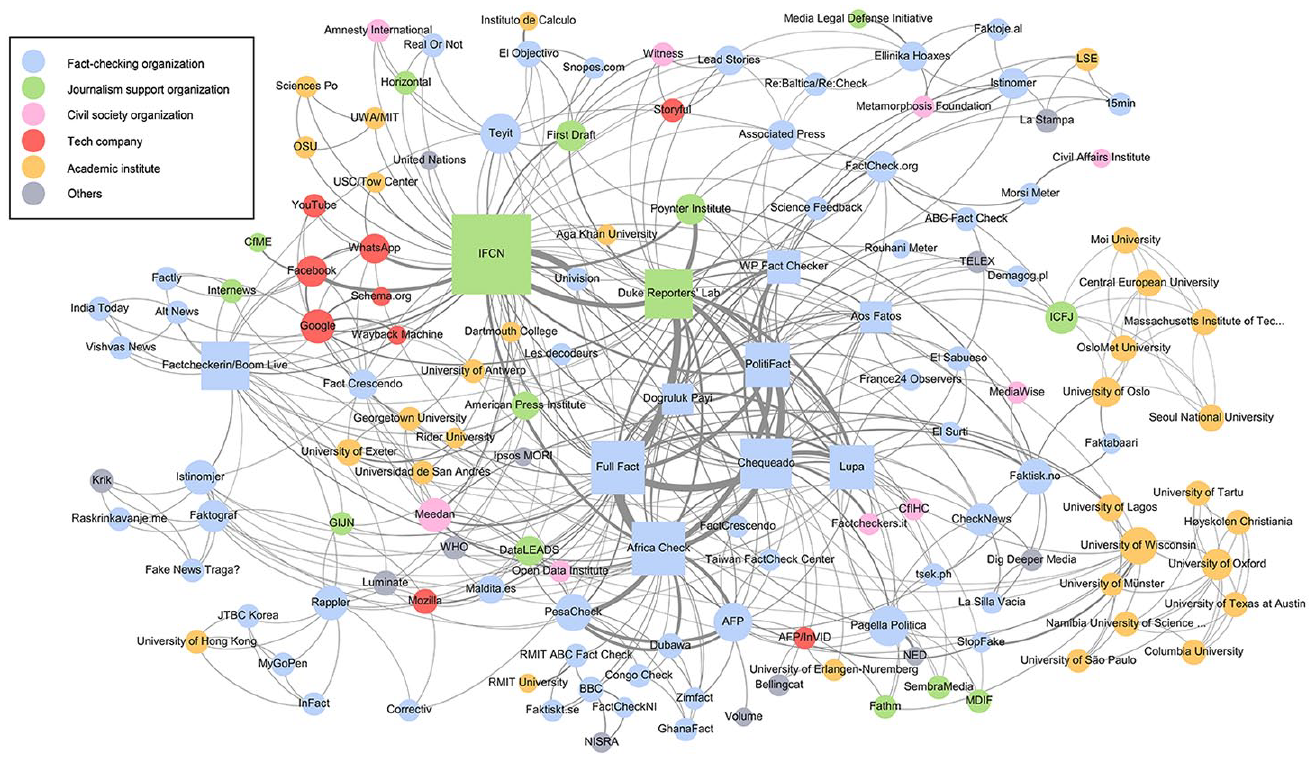
Aggregated network of organizations linked by joint sessions at Global Fact from 2014 till 2021.
We rely on two techniques to analyze the network in-depth, probing relations among fact-checkers as well as to their wider institutional environment. First, block modeling and cluster analysis are used to identify distinct leadership tiers (Doreian et al., 2004). This brings the network’s core–periphery structure into sharp relief, identifying the leadership tier discussed below. Then, a combination of network measures (centrality, betweenness, and triad census) is used to shed light on the organizations’ different roles, comparing their capacity to connect different parts of the network: In effect, we ask which organizations, and which kinds of organizations, play a role in bringing together different leading actors. Based on the different categories of Global Fact participants, four standard brokerage roles identified in the literature—coordinator, itinerant broker, gatekeeper/representative, and liaison (Gould and Fernandez, 1989)—can be differentiated in this network and proportionally attributed to the organizations, reflecting their brokerage role diversity (Becker and Bodin, 2022). Connecting otherwise unconnected organizations, brokers play a key integrating role, both facilitating and shaping exchanges among network members. Conceptualizing brokerage roles in terms of institutional affiliation in this way aligns with our theoretical framework, centered on the tension between internal community-building and external boundary work and stakeholder ties (see the network core section).
Finally, the discussion below draws on extensive ethnographic fieldwork at Global Fact, which we leveraged both to design the network analysis and to interpret its results. One or both authors participated in each of the eight Global Fact meetings covered in the network analysis. Each author conducted field research independently, attending open and closed conference sessions, interviewing participants, and in some instances taking a more active role by moderating sessions or presenting research. It is important to note that both authors have cultivated long-lasting relations within the fact-checking community. This is a source of valuable insight about the wider context in which each conference took place, the significance of specific activities, and the profiles of various actors and organizations that appear in the network analysis (see Crossley, 2021). However, long-term participation in the community may also limit our analysis, for instance making it difficult to recognize changes that would be more apparent to a naive observer.
Analysis and findings
Our network analysis of the first eight Global Fact meetings reveals a strikingly clear picture of an organizational field that becomes highly structured as membership grows, with key organizations consistently playing a bridging role between different groups of fact-checkers, and between fact-checkers and outside stakeholders. For the sake of clarity, we organize the main findings of this analysis into three sections addressing (1) the overall structure of the conference network along a core–periphery pattern; (2) the organizations that constitute the network core, which aligns clearly with other indicators of leadership and influence in the field; and (3) the distinct leadership roles revealed by network analysis, centered on either external brokerage or internal community-building. Importantly, this analysis highlights the central role played by “meta-level” organizations, but also shows certain practitioner groups performing the same field-building functions. We explore the field-supporting role of practicing fact-checkers in the discussion.
Overall network structure
The Global Fact conference network exhibits a pronounced and consistent core–periphery pattern, with a stable leadership group of established fact-checkers and field-supporting organizations, and a clear periphery that includes generally smaller fact-checking outlets as well as universities, tech firms, civil society organizations (CSOs), and other outside groups. Figure 1 offers a representation of the aggregate conference network covering all eight Global Fact meetings, and visibly reflects tendencies toward both hierarchy and homophily. In fact these two features are mutually reinforcing: Similar organizations appear close together not only because they often participate in conference sessions together, but also because—even when they do not—they tend to be connected by the same brokering organizations.
It is worth noting that a strong core–periphery structure, with roughly the same “backbone” of leading organizations, emerges using distinct network analysis methods, 3 reflecting the extent to which a handful of organizations have dominated the agenda at Global Fact. This dominance can also be seen in statistics like stage time, which approximates a power law distribution, with a small number of organizations claiming the bulk of on-stage minutes across the eight conferences. The lists differ, however; the network core captures the cluster of organizations that is most similar to one another in terms of the role they play in shaping the overall network, not only those that appear most frequently.
The network core
The 11 nodes in the core of the conference network include nine well-established fact-checking organizations from seven countries: Argentina, Brazil, France, South Africa, Turkey, the United Kingdom, and the United States (see Table 1). Fact-checkers in this network core are all among the most visible and active in the global movement, scoring highly on other indicators of leadership. For instance, four of the nine have hosted Global Fact or a regional conference; nine have a direct connection to IFCN governance through current or former staff serving on the executive team or the advisory board. Unsurprisingly, they have attended most Global Fact conferences and tend to be veterans of the movement, with an average age of 10 years, compared to 6 years for the field as a whole. However, many well-established organizations with long records at Global Fact do not appear in the network core. For example, FactCheck.org, widely recognized as the founder of political fact-checking, has participated in every annual conference but has not taken an active role in shaping the global movement.
Classification of leadership roles.
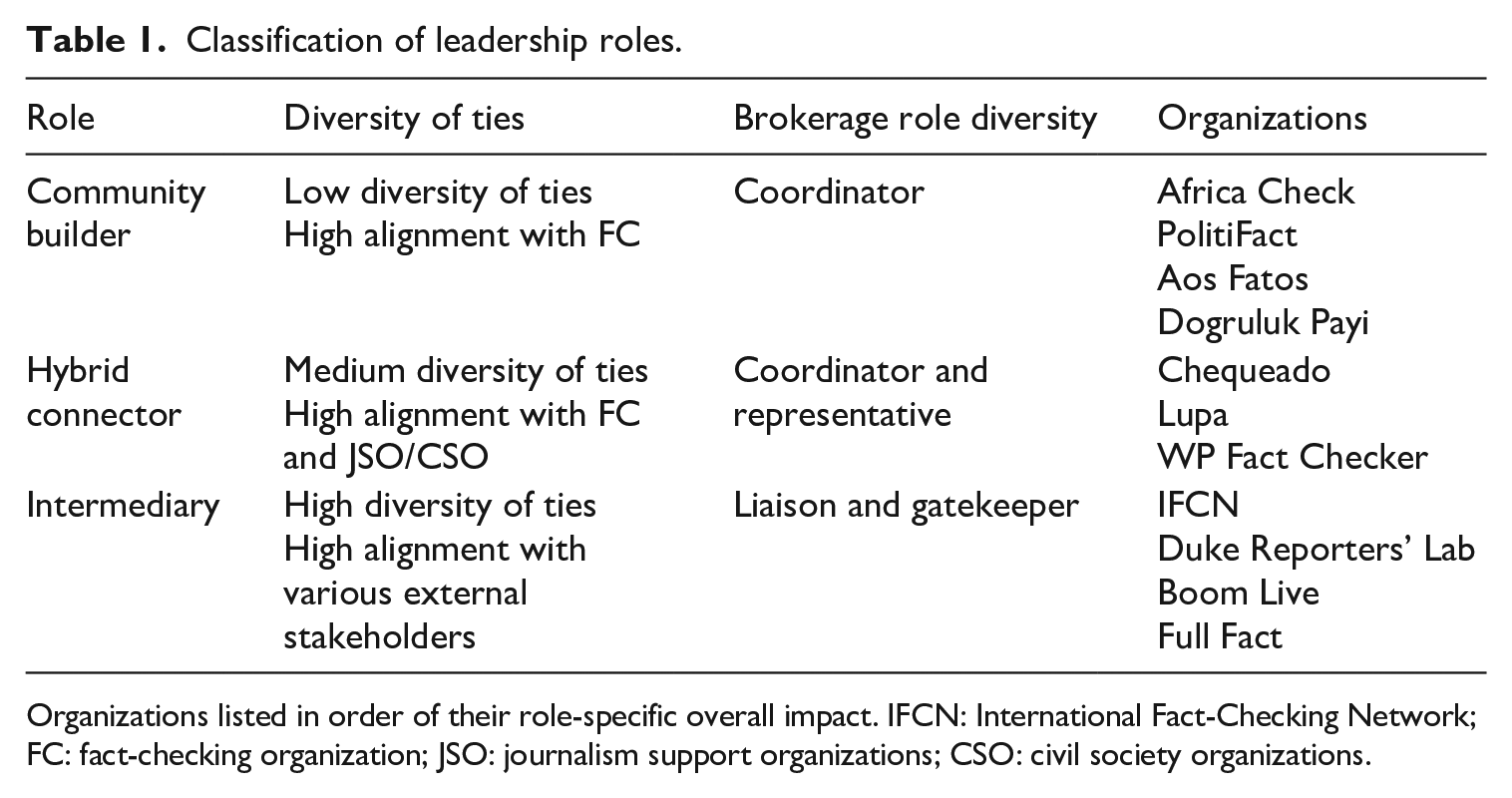
Organizations listed in order of their role-specific overall impact. IFCN: International Fact-Checking Network; FC: fact-checking organization; JSO: journalism support organizations; CSO: civil society organizations.
The network core also includes the two US-based organizations dedicated to supporting and promoting the efforts of fact-checkers around the world, the IFCN and the DRL. These two meta-level organizations are deeply woven into the history of Global Fact and the fact-checking movement, as described previously. They greatly exceed all other organizations in terms of the total number of on-stage sessions and minutes. The role of these two meta-level organizations as conveners is reflected in the tradition of opening and closing the conference, with remarks from the head of each group.
Finally, it is worth noting that the Global Fact network core is not static. While our analysis focuses on the aggregate network of eight conferences, examining shorter spans shows how the core has diversified as the movement has grown. If we analyze only the first four meetings, for instance, Asia and South America are not represented in the core. Conversely, some influential outlets fall out of the core over time; for instance, the Italian organization Pagella Politica, which contributed the IFCN’s first director and has been active at every Global Fact, no longer qualifies for the core once data from the final two conferences are added in.
Leadership roles
Organizations in the core assume different leadership roles that vary in their primary orientation toward either internal community-building or external boundary work, where the former reflects coordination and relationship work among fact-checkers, while the latter refers to managing relations with external actors. Organizations possess different brokerage capabilities depending on their particular constellations of embeddedness among their peers and/or external stakeholders. Crucially, our analysis of brokerage roles considers each brokers’ portfolio of interlocutors in terms of overall institutional variety (diversity of ties) as well as specific functional positions in the network (diversity of brokerage roles).
Weighing these two dimensions brings to light distinct leadership roles that suggest a clear division of labor among the core group of organizations in the Global Fact network. We name these roles “community-builder,” “hybrid connector,” and “intermediary” based on their characteristic significance for the fact-checking movement (Table 1).
Community-builders represent arguably the backbone of the global fact-checking movement, performing work that helps to maintain practitioners’ identification as a collective and to integrate new members. In terms of overall tie diversity, this manifests in almost exclusive connections to fellow fact-checkers, as community-builders mainly participate in conference activities focused on practical concerns relevant to fact-checking as a community of practice, from crowdfunding strategies to working in war zones. In terms of brokerage, community-builders serve mainly as coordinators, consolidating a shared awareness of current problems and approaches to address them. The prime examples of this orientation are Africa Check and PolitiFact, whose coordination role accounts for about 70% of their brokerage positions in each case, and who together make up close to half of all coordination work among the leadership tier.
Hybrid connectors share with community-builders a clear network alignment with other fact-checking organizations, which account for roughly two-thirds of all conference ties for this group. However, their portfolio of linked organizations is more diverse, including journalism support organizations (JSOs) and civil society organizations (CSOs). This is reflected in their brokerage roles: Hybrid connectors do coordinate among fellow fact-checkers fairly often—the prime example here, Chequeado, is comparable to PolitiFact in this regard—but they also serve as crucial links between the community and outside stakeholders (i.e. JSO and CSO). Such gatekeeper/representation positions account for about a third of the organizations’ brokerage roles in this group, with coordination making up about half. Their patterns of conference involvement reflect an emphasis on strengthening the movement by bringing fact-checkers and potential catalyzers together.
Intermediaries, finally, stand out for their capacity to affiliate with external stakeholders and connect them with fact-checking organizations. While roughly half of their connections are with fact-checkers, intermediaries show less categorical preferences individually in the remaining half and, as a group, tie in all stakeholders involved in the conferences comprehensively. Crucially, this group also includes two key non-practicing, meta-level organizations, the IFCN and DRL. This adds another dimension to the analysis, changing the possible pairs of actors connected by available brokerage roles; for instance, what would be a coordinating position becomes a consulting position when a meta-level group is the broker. Keeping this in mind, intermediaries act as coordinators or consultants for fact-checkers in just one-third of their brokerage positions; virtually all their other brokerage constellations involve external stakeholders like technology firms, foundation officials, or state actors.
The mix of external stakeholders intermediaries bring into the network is instructive. Like hybrid connectors, intermediaries help connect fact-checkers to JSOs and CSOs (about 30% of these constellations). However, the bulk of their brokering links fact-checkers to other actors including academics (26%), the technology sector (15%), and others (7%). Crucially, these other actors rely almost exclusively on these intermediaries for their integration into the Global Fact network, suggesting considerable gatekeeping power. (This effect is visible in the pronounced clustering of academics and technology companies in the overall network; see Figure 2.)
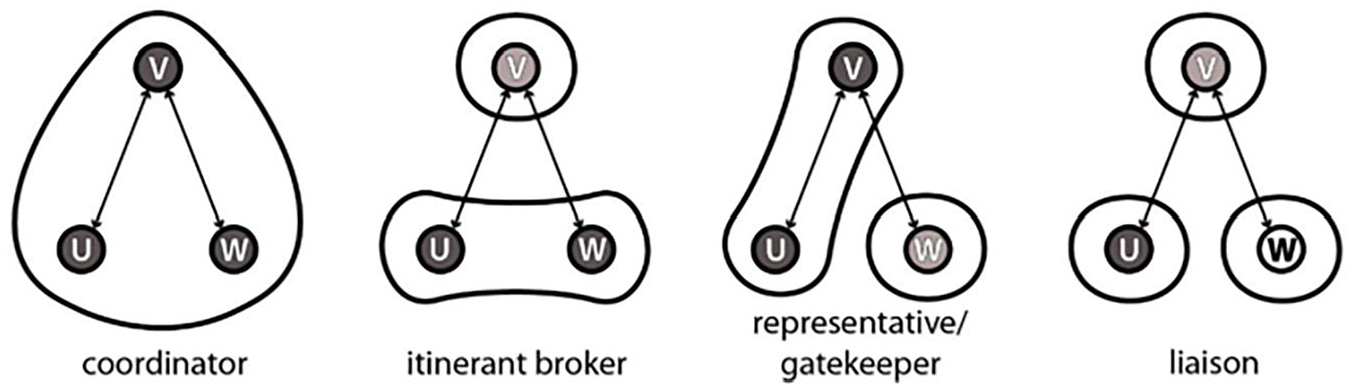
Four brokerage roles of Actor V (Authors, adapted for symmetric networks from Gould and Fernandez, 1989).
Discussion
The rapid spread of fact-checking over the last decade offers a unique opportunity to study the emergence of a new transnational field adjacent to, but distinct from, professional journalism. Approaching the global fact-checking movement as a deliberate institution-building effort, our network analysis sheds light on the process of field formation and the roles that different actors play in that process—as well as on the characteristic tensions that arise as new fields consolidate and gain relevance. Studying efforts to erect new public institutions is vital at a moment of widespread concern over an institutional crisis in journalism and other areas of democratic life (Reese, 2021). Our account highlights the role of platform partnerships in helping to drive development of the fact-checking field over the last decade, as not only a funding source but also a primary rationale for credentialing and governance mechanisms. This in turn raises the question of how fragile those structures will prove as the priorities of platform companies shift, a prominent concern in the movement today (Hsu and Thompson, 2023).
In this concluding discussion, we draw attention to three broad insights emerging from the findings outlined above. First, our analysis underscores the outsized role of a small number of leading organizations in shaping the development of a new field. The small, fairly stable leadership core is especially notable given that the global fact-checking field is characterized by high organizational diversity. This highlights the sense in which leadership in an emerging field with a strong public-service orientation may be thought of in terms of division of labor satisfying a collective need for field governance—perhaps especially in a transnational context where members mostly do not compete for resources or recognition, while collective rewards for institution-building are high. In this context, certain organizations develop an orientation toward field governance. Of course, such leadership roles may also raise questions about the influence that better-resourced outlets from wealthier nations exert over the field, or about the influence of technology firms which have fueled the field’s growth; as in other areas of journalism (e.g. Scott et al., 2019), these influences shape field boundaries (Graves at al., 2023). We understand the evolution of more formal governance mechanisms, like IFCN bylaws and elections, as responding in part to such concerns.
Second, our analysis underscores the central and very specific roles played by dedicated field-building organizations which are oriented to but separate from practitioners. The IFCN offers a paradigmatic example in its roles as convener of Global Fact, steward of the Code of Principles, and the single most important intermediary between fact-checkers and crucial external stakeholders. But these non-practicing field-builders need not be formal “meta-organizations” (Ahrne and Brunsson, 2008) made up of practitioner groups. The DRL is a university-based research center but enjoys a network profile similar to that of the IFCN in our analysis, acting as an intermediary between different groups of fact-checkers and technology firms. This network profile clearly reflects the wide range of field-building activities the DRL engages in: working with platforms to develop new technologies and technology standards for fact-checkers; hosting a regular series of meetings and conferences (the “Tech & Check Cooperative”) focused on fact-checking technologies; and producing research addressed to the community, including the global “census” of fact-checkers which charts the movement’s growth and acts as an important boundary mechanism. Run by a leading former practitioner, and acting as a convener for fact-checking discourses, the DRL may be seen as being meaningfully of the community; it qualifies as an ancillary or “meta-level” organization (Lowrey et al., 2019, 2023). Still, it does not represent or embody fact-checkers in any formal capacity. In contrast, the IFCN, the primary field-builder for fact-checkers, today has some features of a true “meta-organization” (Ahrne and Brunsson, 2008) made up of signatories to the Code of Principles, who are represented in an Advisory Board, with rights and responsibilities spelled out in formal bylaws adopted in 2020. The IFCN’s uniquely pivotal position in the Global Fact conference network, accounting for more than a tenth of all unique stage appearances in meetings it organized, reflects its status as the closest thing to an official body of and for fact-checkers worldwide. However, the IFCN began much more modestly as host of first a mailing list and then the Global Fact conference. Our case underscores how meta-organizations gain legitimacy and authority only gradually. Launched as an informal network of fact-checkers, the IFCN has only gradually and partially assumed formal responsibility for governance and representation—taking on characteristics of legitimate authority—as the field has institutionalized. Put another way, taking on those characteristics can be seen as a measure of the field’s institutionalization.
Third, however, our results also point to the crucial role that may be played by certain practitioner groups acting as dedicated field-building organizations. Our analysis highlights the different internally or externally directed brokerage roles played by fact-checking organizations in the core of the Global Fact network. The question of how to distinguish simple field influence from dedicated field-building, either conceptually or empirically, is a thorny one which this discussion cannot settle conclusively. Still, we emphasize that in certain cases the commitment to “meta-level” field-building is unmistakable in the organizational profile of the practitioners that appear in our network core. For instance, in addition to operating as a fact-checker, the UK-based nonprofit Full Fact dedicates permanent resources to field-building activities that directly parallel the IFCN and the DRL, such as developing fact-checking technologies and standards; conducting original research and aggregating academic research on behalf of practitioners; publishing an annual report that monitors Meta’s “3PFC” partnership program and advocates for fact-checkers involved in the program; and offering policy interventions intended to support fact-checkers in working with other stakeholders (such as a “Framework for Information Incidents” developed in the wake of the COVID-19 epidemic). Similarly, Africa Check and Chequeado have dedicated significant resources to acting as hubs for fact-checking in their respective regions, such as hosting regional conferences for fact-checkers; offering training and other resources to new fact-checkers; developing or adapting technologies for fact-checkers in their regions, particularly in supporting languages other than English; producing or commissioning region-specific research; hosting regional awards for fact-checkers, and so on. We believe this invites much closer attention to how practitioner organizations may function as deliberate institution-builders in an emerging field. This study is limited by the focus on a single, emerging transnational field which remains relatively small today. Our observations, particularly with regard to specific brokerage roles, invite corroboration through other current or historical cases of field emergence; network analysis of larger FCEs (i.e. with thousands rather than hundreds of nodes) would also allow for closer study of how network structure and roles change over time. At the same time, we argue that this study offers a convincing picture of institution-building efforts in a new field. First, the distinction evident here between internal community-building and external boundary work reflects a core tension—and, we argue, a driver of structuration—which is well grounded in field and institutional theory, but has not to our knowledge been well addressed in studies of media. And second, we have suggested how well the key actors and roles identified via network analysis correspond to the organizations and activities revealed in qualitative study of the fact-checking movement. Future research building on this approach can test the correspondences between qualitative and network analytic pictures of this growing field more systematically.
Footnotes
Correction (May 2024):
Legends in Figure 1 have been changed in the article since its original publication.
Funding
The author(s) received no financial support for the research, authorship, and/or publication of this article.
