



Abstract
The COVID-19 pandemic exposed the limits of big data to guide decision-making in times of crisis. As people navigated daily life, they were confronted with the reality that data were often not yet material but rather in-the-making. Drawing upon critical and feminist lenses and participatory methodologies, this study investigates the data stories of nine people of Asian descent living in the United States. Findings illustrate how participants navigated within and across time, space, activity, media, epistemology, race, and politics to produce lively data assemblages. These data stories guided social-distancing and mask-wearing weeks before official US policy even as participants lived in constant fear of dehumanizing racist and xenophobic violence. This study advances theorizing about data practices for human knowing and learning with media, racial and epistemic (in)justice, and community action. It also advances participatory research as a site of epistemic resistance and activism.
Keywords
Introduction
The COVID-19 pandemic provides a unique opportunity to explore how people used media and other sources of information to learn in real time while navigating racial and sociopolitical realities that complicated the collective action needed to mitigate spreading the biological virus. In this article, we bring critical and feminist lenses to examine how people of Asian descent were “attuning to and becoming with data” (Thompson, 2020: 3) as early responders whose knowledge and practices offered actions to mitigate the impact of the COVID-19 pandemic. Important work on media, technology, and society focuses on how big data omits or obscures perspectives in ways that marginalize and further systemic inequities (D’Ignazio and Klein, 2020), how people collect data on themselves (Lupton, 2020), and how grassroots data activism advances agendas for and by marginalized groups within complex sociopolitical contexts (Sun and Yin, 2022). Studies of data practices for learning and taking action often use existing prestructured datasets in formal school settings or use existing datasets as starting points for collecting counter data (D’Ignazio and Klein, 2020). Recently there has been a call to examine learning with data that is not well structured to illuminate a broader range of data practices needed for complex reasoning in the real world (Chinn et al., 2021; Radinsky and Tabak, 2022; Rubin, 2020). Our work contributes to this growing body of research and asks the question: What happens when data are not yet material but in-the-making across many different sources?
Our work extends the relational and humanistic approach to COVID-19 data literacy outlined by Radinsky and Tabak (2022). They found that people engaged in practices of scanning, looking closer, and puzzling through data they encountered to make sense of COVID-19. They also sought to understand how agency, managing emotions, and trust/mistrust played a role in each of these practices. When examining agency, they focused on how participants took actions to guide their investigations and sensemaking with data and did not examine how data sensemaking influenced actions in everyday life. Our work seeks to contextualize emergent COVID-19 data practices inside the everyday decisions and interactions needed to navigate the reality of living with this novel disease. Using community-based participatory research and critical witnessing, this article honors testimony from Asian Americans, immigrants, and nationals as they engaged in data practices for sensemaking, decision-making, and action during the early months of the COVID-19 pandemic (Villenas, 2019). It contributes to theorizing and empirical work on the co-creation and interanimation of data and people (Lupton, 2018) and community-based participatory research as a site of epistemic resistance and activism (Medina, 2013, 2019).
Data-as-assemblage, data stories, and data-selves
People are immersed in written and spoken words, visual and auditory representations, and other forms of human communication and use this seemingly endless stream of sensory information for sensemaking. Our study considers how people’s racial and social positions and culturally available physical tools (i.e. technologies, masks) and psychological tools such as language, visualization, and narratives about past experiences impact their sensemaking and action (Haraway, 1988; Vygotsky, 1987 [1934]). This important starting point places people as meaning makers together with social, cultural, and material tools and information, including technologies, both analog and digital (Lievrouw, 2014; Lupton, 2018, 2020).
From this perspective, data are not found but constructed at the intersection of people and their available tools and resources. Thompson (2020) argues that data are “an assemblage which helps move beyond notions of data as some thing that is, and somehow acts, on its own” (an emphasis in original, p. 2). This situates data not as static entities for consumption but as processes—dynamic acts accomplished at the intersection of human and nonhuman entities. Rowley (2007) notes that data are often defined as “discrete objective facts” or “observations and descriptions of things, events, and activities” that are “unorganized and unprocessed and do not convey any specific meaning” (pp. 170–171). Human beings select and organize data, digital and analog, into information or structures that make data meaningful and useful. Kitchin (2021) argues that data “are not benign, neutral measures that reflect the world as it is, within technical constraints. What data are generated, and how they are produced, handled and used, is the result of choices and decisions by people . . . they are as much a result of human values, desires and social relations as they are scientific principles and technologies.” (p.5) At the beginning of the COVID-19 pandemic, as people confronted an existential threat with no existing data sets to draw on, every report, every past experience, and every interaction became an opportunity to select and assemble data points into stories to support survival.
People’s positionality within society shapes and bounds data construction. Experiences, ideologies, and beliefs impact data assemblages that are possible within communities and cultures (Grasswick, 2017). This recognizes the legitimacy of multiple epistemic positions from which data assemblages are made (Harding, 1991). As people construct and are constructed by data, they interleave new data with existing routines, practices, discourses, histories, and narratives. Lupton (2020) argues that this approach to “lively data” captures the “vitality of human-data assemblages,” and allows for “explor[ing] the onto-ethico-epistemology (Barad, 2014) dimensions of living with and through our lively data, generating our ‘data selves.’” (p. 6). 1
Studying how people created data stories to guide their actions early in the COVID-19 pandemic requires a holistic and multidimensional view of data as created by people as embodied, feeling, and sensing beings. It also requires recognizing reciprocal processes whereby data can position and construct people in ways that they may recognize or reject. Our approach involves eschewing the traditional binary of “big” and “small” data to center instead a more nuanced imbrication of scales that can fully encompass “the global and the intimate” (Pratt & Rosner as quoted in Gieseking, 2018: 151). As Gieseking (2018) argues, “Intimate relations are simultaneously global and local, just as the global is experienced in and through the intimate and all of the scales in between” (p. 151).
Understanding how power and race impact sensemaking and action with data
Feminists argue that power relations result in some epistemic agents having more control over the epistemic agenda than others (Grasswick, 2017; Harding, 1991). They use the term “discriminatory epistemic injustice” when there is a failure to recognize someone’s sensibility, or when someone experiences being “downgraded and/or disadvantaged in respect to their status as an epistemic subject” (Fricker, 2017: 53). Fricker (2017) drawing on Harding (1991) argues that it is important to build up an account of epistemic injustice by “start[ing] thought from marginalized lives” (Fricker, 2017: 56). In this way, the interpersonal is political and “brings into view all the microaggressions and injustices that instantiate and indicate more structural, macro formations of power” (Fricker, 2017: 57). Fricker argues that theorizing from this place exposes what is problematic and unjust within an epistemic system, thereby creating the possibility of actively addressing the injustice.
In our work, we start from accounts of Asian people living in the United States early in the COVID-19 pandemic. Asian Americans, Asian immigrants, and Asian nationals living in the US experienced increased threats from the novel coronavirus and also from anti-Asian racism and xenophobia. The Stop AAPI Hate Reporting Center received 3795 incident reports between March 19, 2020, to February 28, 2021, that included verbal harassment, shunning, physical assault, civil rights violations, and online harassment (Jeung et al., 2021). Anti-Asian ideologies and discourses that surfaced during these early months of COVID-19 are connected to a long history of anti-Asian racism with people of Asian descent routinely positioned as untrustworthy foreigners in the United States. Jennifer Ho (2020, 2021), Daryl Maeda (2009), and Wayne Au and colleagues (Au and Yonamine, 2021) demonstrate that people of Asian backgrounds have been alternatively targeted and scapegoated or praised as a model minority to serve white supremacist agendas. Since first coming to the United States in the mid-1800s during the California Gold Rush, and later serving as a major source of labor for the Transcontinental railway, Chinese immigrants have experienced racism. Chinese immigrants were accused of spreading disease and living under unsanitary conditions. This racist and xenophobic ideology, codified in Yellow Peril sentiment and policies such as the Chinese Exclusion Act of 1882, dehumanized immigrants from China and other Asian countries (Man, 2020). Asian people in the United States constantly negotiated perceived mistrust exacerbated by failures in the US institutional response to COVID-19, which risked their safety and potentially their lives (Darling-Hammond et al., 2020). The murder of a Chinese American named Vincent Chin in the 1980s at the hands of two White men with ties to the Detroit auto industry is another point in history where Asian Americans became explicit targets of blame (Yoo, 2021). At that time, competition from Japanese car manufacturers created economic challenges for the American auto industry. Anti-Asian discourse and violence increased in ways that parallel the early months of the COVID-19 pandemic and continued a history of violence against Asian people in the United States (Man, 2020).
These anti-Asian systems of oppression cannot be ignored as we understand how data stories are created. To contextualize data story creation, we draw on Medina’s (2013) concept of “epistemic resistance.” He argues that “there are many ways in which ordinary people can resist different forms of domination in their everyday lives. We need to look for possibilities of resistance in every discursive practice.” (Medina, 2013: 16) Epistemic resistance is evident in everyday interactions, in ongoing joint activity of groups (like our authorship team), as well as in social movements and activism. Our study seeks to bear witness to how participants built knowledge and took action in ways that centered their own and their community's well-being, even as they lived with the constant threat of anti-Asian racism and violence.
Community-based participatory methods, critical witnessing, and epistemic resistance
This study is part of a larger exploration of COVID-19 sensemaking situated inside two long-standing research-practice partnerships that are grounded in participatory models of research and practice (Greenberg et al., 2020, Calabrese Barton et al., 2021). In public health and education community-based participatory research (CBPR), community members bring expertise to projects based on their lived experiences and join researchers as full and equal partners in all phases of the research process. Rather than assuming a more traditional role of “outside-expert” researchers join community members to create an equitable third space within which the experiences, perspectives, knowledge resources, and skills of all partners are recognized, integrated, and used to co-construct knowledge and generate capacity for new research, benefiting both the community and science (Lasker et al., 2001; Lucero et al., 2020). This is consistent with the way that critical sociocultural theory, feminist epistemology, and epistemic activism disrupt singular views of the world and reject long-standing limited notions of who gets to know and build knowledge, thereby making space for multiple voices and experiences. In our work, educators and young people are positioned as important knowers and drivers of change within their communities. This kind of relational praxis involved an ethics of resistance and possibility as we learned to be with each other in new ways through “ongoing critique, self-awareness, and collective ‘we’ formation” (Elfreich and Dennis, 2022: 16).
Our study context, West Coast City Partnership (WCCP), which began in 2013, centers low-income youth of Color, many of who are first- or second-generation immigrants, and the informal educators and mentors who support their learning in a STEM afterschool program. University undergraduates from multiple fields including the natural sciences, engineering, public health, informatics, and computer science serve as mentors to youth. Most informal educators and university mentors identify as people of Color, low income, women, and/or immigrants/refugees. This specific study began in the early weeks of the pandemic to document how rapid and consequential learning about COVID-19 is shaped by equity concerns and contextual factors including the sources of information people access and leverage, how people rapidly make sense of and evaluate information and what supports them in doing so, and how these understandings are used alongside other forms of knowledge and concerns in decision-making.
Positionality of authors
There are 11 authors who contributed to co-analysis and co-writing for this article. The authors of this article include educators, mentors, and university-based researchers. Five authors are affiliated with the WCCP. 2 Six authors are university researchers (including four students who were learning about research in the context of this study) who did not participate in the WCCP. All researchers bring prior experiences in other educational partnerships in formal and informal learning contexts. We represent different cultures, races, ethnicities, language backgrounds, religions, genders, sexual orientations, and focal areas of study. Three authors identify as Asian, two authors identify as Black, one author identifies as Latino, and five authors identify as White.
We engaged in a process of data analysis and writing to express a collective stance that amplifies the voices of those who are closest to the racialized learning we sought to understand (Medina, 2019; Politics of Learning Writing Collective, 2017). The first three authors (faculty researcher and two WCCP partners) were primarily responsible for overall theory building and empirical analyses. Another WCCP partner contributed to conceptualizing data analysis and acted as a critical friend to provide feedback on the entire manuscript. Six authors (two faculty members, a research fellow, and three graduate students) participated in regular research meetings early in the analysis to discuss participant accounts that launched this analysis. Three authors (a research fellow and two graduate students) assisted with research and writing the theory section of this article.
Study participants
Data for this analysis come from interviews with nine participants connected to the WCCP who identify as Asian Americans, immigrants, or nationals living in the United States. 3 Table 1 includes demographic information provided by participants on their terms and in their words. Figure 1 depicts participants’ roles relative to the WCCP. Five people were participants in the primary site for the WCCP, two were staff members from sister sites and regularly interacted with staff from the WCCP, and one was a leader/administrator who oversees the nonprofit organization’s participation in the WCCP. One participant was a teacher in the school district where the WCCP is located. We note here that most of the participants had STEM backgrounds which may have also played an important role, together with their racial identities, in their early responses to the COVID-19 pandemic.
Descriptive demographics of study participants.
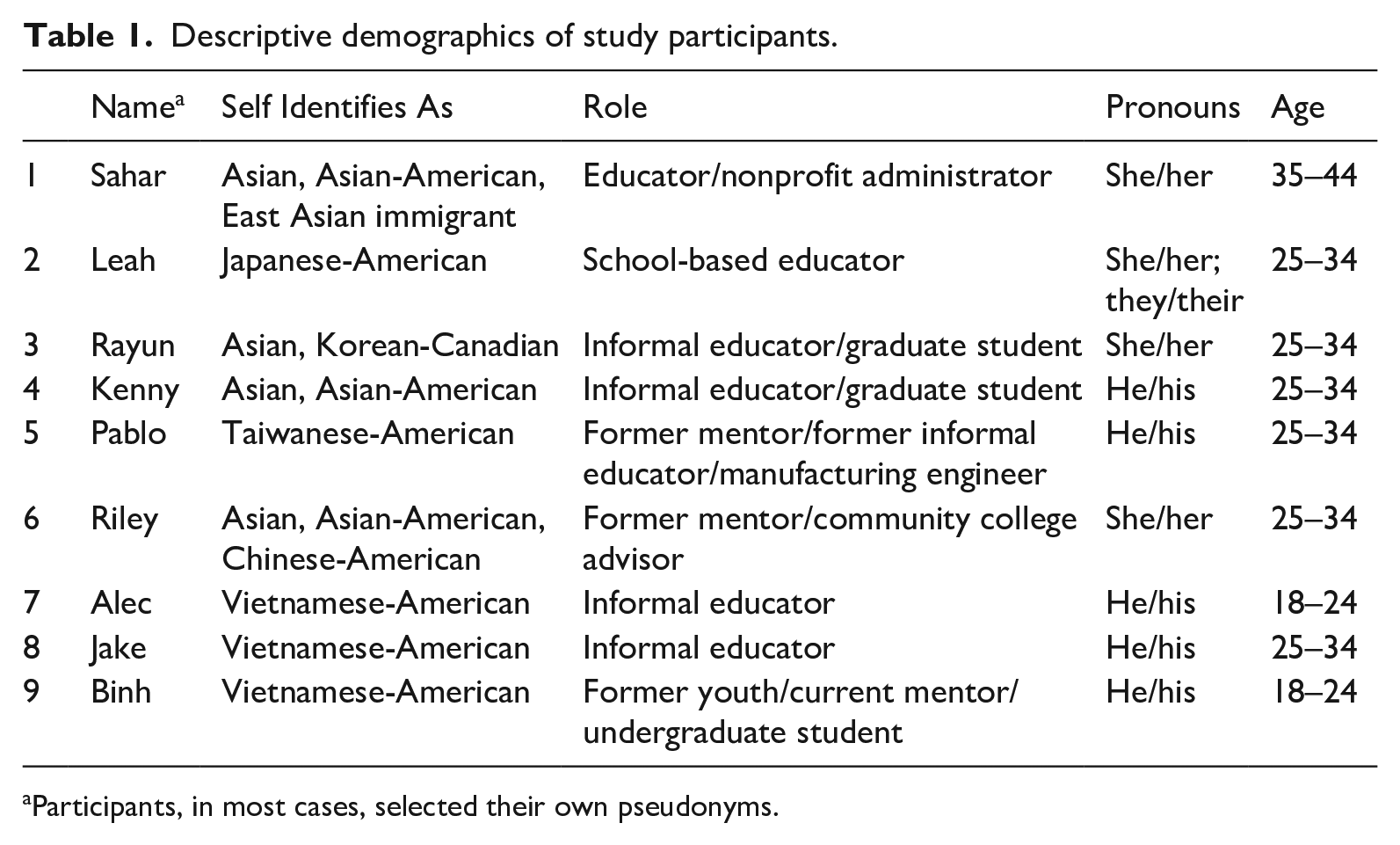
Participants, in most cases, selected their own pseudonyms.
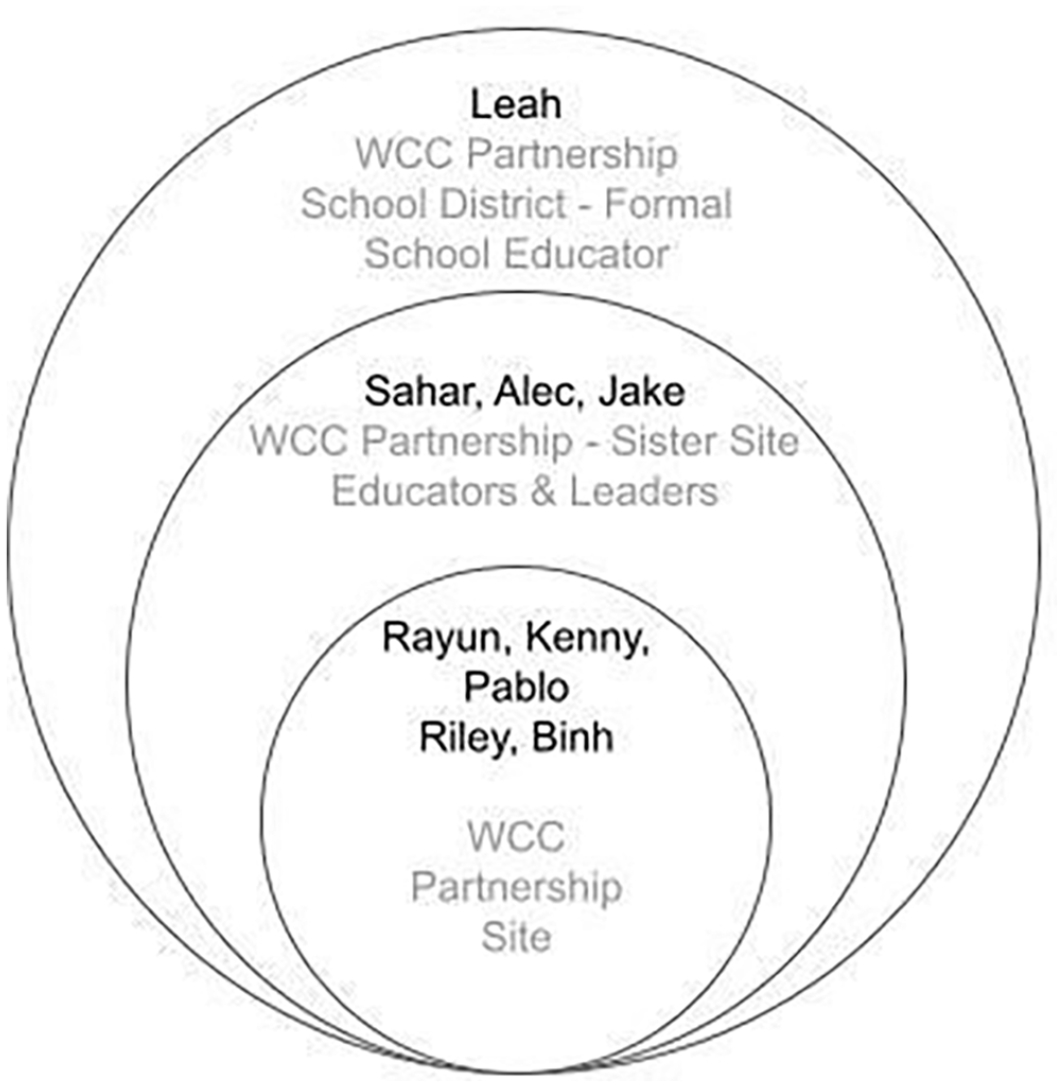
Study participants and their contexts and relationships.
Methods of data generation and data sets
There were three main approaches to data generation in this study: (1) Remote interviewing methods conducted at three points during the pandemic (e.g. phone, video conferencing, text, and other social media platforms), (2) experience sampling method (Csikszentmihalyi and Larson, 1987) twice a month to gather information and reflections remotely from participants, and (3) document collection and resources named by the participants in their interviews to the extent possible.
The analysis presented here focuses primarily on the first two remote interviews. The first interviews were conducted from April 15 to September 22, 2020. The second interviews were conducted from October 13 to December 4, 2020. Some participants also shared their experiences and documents they created or accessed with us through experience sampling method prompts and others did not choose to do so. Examples of documents include mainstream media news articles, social media posts, photographs, and short personal reflections, drawings, or other personal mementos. Our analysis focuses primarily on interviews that were available for all participants and lasted between 90 and 300 minutes (longer interviews spanned multiple days). Interviews addressed a range of questions in a co-constructive interview format with participants guiding which topics and questions to address based on their experiences. Verbatim transcripts were produced for all interviews.
Analytic approach
We engaged in a relational praxis for critical inquiry, shared meaning making and co-writing to amplify the voices of those closest to the racialized learning we sought to understand. We adopted Villenas’s (2019) approach to “critical witnessing” or being with others through dialogic engagement. The research team became “subjects by virtue of addressivity and response-ability—that is, the responsibility to respond and to enable response-ability from others” (Villenas, 2019: 156) in light of participants’ testimony. Medina describes this as “testimonial responsibility or “obligations we have as hearers to give adequate credibility assessments to speakers who give testimony” (Medina, 2013: 54). In this way, we collectively accepted epistemic responsibility, and in Bakhtin’s (1993 [1919–1921]) words, became “answerable” to our developing knowledge. Bakhtin argues that knowledge alone is not enough, that actors must entertain ethical questions about how to act on knowledge and become accountable for it.
We also built on our prior work to co-construct meaning while fostering understanding across lines of difference (Herrenkohl et al., 2019). Working toward transformative change means disrupting oppressive ways of being and in their place constructing liberating and sustaining ways of being together. This approach aims to create “thick critical engagements” that can lead to “social repair (reparative justice), community configuration, and institutional transformation” (Medina, 2019: 25). To guide our joint listening to participant accounts, we adapted the lens of politicized trust, or the building of mutual political understanding, respect, and solidarity among people from different racial, social, and economic backgrounds (Vakil and McKinney de Royston, 2019).
This first step in our collaborative analysis had the researchers listen to individual interviews and review transcripts to understand and document emergent themes in each participant’s testimony. A wide range of initial themes emerged. One of the most salient themes came from participants of Asian descent who all discussed how they weighed concerns about racial profiling and violence as they considered whether or not to wear a mask early in the COVID-19 pandemic, in most cases long before this became a recommended practice in the United States. This early thematic analysis made it clear that participants’ racial backgrounds played a critical role in their experiences around trust/mistrust and mask wearing. The research team sought to fully understand this testimony and explore the similarities in testimony across participants by returning to the participants themselves to further discuss the initial themes.
Researchers met with a subset of participants individually and in small groups to discuss emergent themes specifically focused on the experiences of Asian American participants who discussed using practices to mitigate biological virus spread very early in the pandemic. These meetings advanced new subthemes and a decision to create a collective account and COVID-19 pandemic timeline to ground analysis and writing. Researchers created a first draft of the findings by drawing on analytic discussions with participants. A participant produced the COVID-19 timeline representation that became a figure in our article. Initial writing involved weaving individual narratives together into a collective account structured around emergent themes. Throughout the process, we preserved stories, explanations, and ideas in participants’ own words which sometimes resulted in long block quotes. Participants had opportunities to read and edit or add new text to written drafts at multiple points in time to ensure that the written product reflected our joint analytic work. This article is our collective way of becoming answerable to the knowledge and care we developed together throughout this process.
Findings
Early responders: assembling lively data as a crisis unfolds
I heard it on the radio about Wuhan, they found this new strain of virus. People are dying because of it. It was a very depressive form of coronavirus that’s similar to SARS or MERS . . . my family’s all back in South Korea. . . . they knew earlier that’s what they were dealing with. My parents were struggling to get masks. My mom called and asked me to look for masks in the US . . . Late January or early February I went to different drug and home improvement stores to look for N95 mask. My dad, who is a doctor, he needed it to do his job. I looked everywhere in my neighborhood, and they were sold out. Maybe it was in the car, maybe I came back home. I just broke down crying cuz I was worried about my parents. . . . My dad would always say, “Wear a mask when you go outside. Minimize your trips to grocery stores,” very basic stuff. He just says, “Don’t catch it ‘cuz you never know what that’s gonna do to you.”
In the above-mentioned example, Rayun created a structure—a data assemblage or data story—that mattered to her, her family, and community. She used data coming from global media (early radio reports of a new biological virus in Wuhan, China that kills people, “a very depressive form of coronavirus”) and data from intimate personal relationships (reports from family members in need of PPE) together with familiar data-based narratives and experiences about other biological viruses that impacted her home community (“similar to SARS and MERS”) to determine that her family and community “knew earlier that’s what they were dealing with.” By extension in this data story, Rayun becomes a knower and actor. She reported springing into action after her mother’s call to search for N95 masks. Rayun explained that she initially doubted her father’s direction for her to wear masks because official information from the US Centers for Disease Control (CDC) was that masking was not effective. However, listening to her parents’ pleas, and empathizing with their pain and frustration, created tension or what Medina (2019) calls “epistemic friction” between her realities in the United States and the alternate realities of her family in South Korea (Medina, 2019). This epistemic friction led her to visit different stores to buy personal protective equipment (PPE) including surgical or N95 masks. She understood that these masks were a critical resource (PPE) for her father to safely provide medical care.
Failing to find masks brought her to tears with worry for her parents. It also prompted her to reconstruct her understanding of the COVID-19 pandemic taking into account non-US perspectives to reconsider official US narratives. This data story became a form of epistemic resistance for Rayun as she took action to try and do what she could to help her family and to take their advice about wearing masks herself. In telling this story, she created data-selves, inscribing her proactive and industrious mother who was searching for PPE when larger systems failed to provide for her vulnerable father/doctor. As a worried daughter, Rayun joined her mother to try to provide for her father’s needs. Rayun and her family, acting as early responders, jointly assembled data across media (radio, phone, Internet), place (Korea/the United States), time (past/present), and activity (global/local) to build understanding, serve communities (family, people in need of medical care), and survive.
Like Rayun and her family, Pablo and his parents, prompted by news shared by family in Taiwan, were early responders who assembled data and took action to quarantine before most people in the United States.
I’m a second-generation immigrant and my parents were first-gen . . . Our extended family is all over there . . . they were reporting cases of coronavirus in China . . . China is close in geography, Taiwan has to monitor that and keep themselves safe, and so that’s when we started learning about coronavirus . . . my parents, they used to live under Chiang Kai-shek rule . . . and they understand how governments can say one thing and obviously, be hiding something. The minute they saw how the World Health Organization and China were saying, “Oh, no, coronavirus can’t infect anybody. It’s fine,” their skepticism radar started ringing. They were like, “Okay, we should probably just be on the safe side and start putting on masks and quarantining.”
Pablo’s account adds an additional sociopolitical dimension to our understanding of lively data stories. As his family learned about the coronavirus in Taiwan, his parents’ experience with repressive regimes and unreliable government communication made them skeptical about the reassurance offered by the Chinese government and the World Health Organization (WHO). These reports made them even more certain there was a looming health crisis. As they assembled these sources of information into data that mattered, they acted by masking up and quarantining.
. . . probably around late January, my parents started saying like, “Oh, we should probably start isolating” because Taiwan has been through a similar SARS event before. They know what to do. The minute they saw one case of COVID, they were like, “Okay, shut everything down. Lock it all down.” It helps to have a vice president [in Taiwan] that’s also an epidemiologist . . . Everybody had to wear masks. My parents instantly knew, at that point, you should probably start putting masks on and quarantining.
Like Rayun, Pablo identified prior experience with the SARS outbreak in 2003 as an important experience to use when making sense of emerging information about COVID-19. And, again like Rayun, he concluded that his parents and extended family, “know what to do.” The first COVID-19 cases diagnosed in Taiwan and the United States occurred on the same day—January 20, 2020. As Taiwan immediately took measures to shut things down and require masks, Pablo’s parents felt certain that it was time to start wearing masks and quarantining in the United States. Yet, the national responses were very different as life in the United States proceeded unchanged. Pablo explained that in addition to Taiwan’s experience with SARS, Taiwan’s Vice-President is an epidemiologist. As a trusted dual expert, Taiwan’s VP was effectively communicating public health concerns while paying attention to and critiquing the early reassuring political rhetoric. By the beginning of February, Pablo reported that his family’s data story led to actions of masking up, going to work, and not going out to see friends.
Obviously, my friends weren’t as aware cuz they don’t have the resources that I did, so they were like, “Oh, why aren’t you coming out, Pablo? What are you doing?” It was a little bit sad not being able to see my friends, but I think it’s good because I live with my parents, and I wouldn’t wanna be the one that inflicts anything on them. Come end of January, beginning of February, I was only going to work and wearing masks [outside of work].
Pablo’s family lived with and through data guiding their actions approximately 6–7 weeks before the WHO officially labeled COVID-19 a pandemic (March 11, 2020) and the United States shutdown workplaces, schools, and public gatherings to halt the spread.
Rayun’s and Pablo’s data stories could have served as resources for all communities as the US government failed to mount an effective national response. Instead, our participants found that they, their data stories, and early responses were greeted with suspicion and blame.
Confronting anti-Asian racism, xenophobia, and disinformation: “Who gives a disease an ethnicity?”
As a pervasive, shared sense of existential risk began to take hold in the United States, conditions were ripe for a dangerous response—searching for someone to blame. Politicized disinformation and inaccurate, widespread, and flawed narratives emerged. As Freelon and Wells (2020) argue disinformation is “munition(s) in campaigns of information warfare” (p. 146). Our Asian and Asian American participants found their lives simultaneously made invisible and hypervisible as emergent COVID disinformation positioned them as responsible for both cause and effect. Brad Sears, Executive Director of UCLA’s Williams Institute dedicated to LGBT law and policy, warned in March 2020 that the “early days of the COVID-19 pandemic feel eerily similar to the AIDS epidemic” including the fact that HIV/AIDS was written onto the bodies of gay men. Sears (2020) noted that discrimination and xenophobia were confusing the fact that “risk is created by conduct not by categories of people.” Our participant, Sahar, asked a question that starkly introduces the parallel experiences our participants from the Asian diaspora experienced: Who gives a disease an ethnicity? How can you call it the Chinese Virus? What is that? A lot of our Asian employees and some of our clients have been recipients of ignorant behavior as well.
The WHO guidelines specifically mandate that disease names may not include geographic locations; people’s names; species/class of animal or food; cultural, population, industry, or occupational references; or any terms that incite undue fear (Kupferschmidt, 2015; WHO, 2015). Yet, even repeated and careful explanations of the official name for Coronavirus Disease 2019 (abbreviated as COVID-19: “CO” stands for “corona,” “VI” for “virus,” “D” for disease, and “19” for 2019) were not enough to prevent the disease from becoming affiliated with a geographic region and ethnicity as people in power engaged in the racist practice of misnaming the biological virus. Once this inappropriate and dangerous disease name was established and amplified through the Internet and social media, it became powerful disinformation that was difficult to correct. Participants recounted overt anti-Asian racism as people in positions of power, including the President of the United States, enlivened disinformation, referring to the disease as the “China virus.” Probably the initial onset of Corona, [I] definitely saw a lot more people avoiding me just cuz of the reports of it being “the China virus.” There was a time at the very beginning of the pandemic where my roommate and I were in a grocery outlet and the patrons in front of us were talking about how they hoped that the Asian people would all get it and die first. We were right behind them. My roommate is very clearly of Asian descent. I can be either white-passing or Asian-passing.
Pablo and Leah attest to the racist and xenophobic animosity directed toward people identified as Asian, generating visceral responses. COVID reinvigorated long-standing anti-Asian discourse and violence as COVID-relevant data were interleaved with racist narratives. Modern data violence is predicated on and amplifies long-standing forms of racism. Hoffman (2021) discusses how historical data practices that predate digital data were used to force dislocation of Native Americans and to intern Americans of Japanese descent during the Second World War. Darling-Hammond et al. (2020) found that the use of stigmatizing language in connection with COVID-19 increased perpetual foreigner bias and discriminatory behavior directed at Asian Americans. Brown and Marinthe (2022) identified a similar pattern in France with COVID-19 fear impacting negative attitudes toward Chinese people. Politicians calling COVID-19 the “China Virus” reverberated in time to perpetuate long-standing forms of systemic oppression (Au and Yonamine, 2021; Ho, 2020, 2021; Man, 2020).
Alec, a first-generation Vietnamese American, reported reading accounts and testimony of racist attacks in an Asian-focused news source affiliated with the National Broadcasting Company (NBC) in the United States: I follow NBC, I think, “Asian Americans” or something, which has a lot of articles written by Asian people about . . . these – attacks, you know? And people are still kind of confused about why this language is harmful?
Alec could not understand how some people were confused about why such discourse was harmful when people were being physically and verbally attacked. He was able to epistemically resist, speak back to, and repudiate the harm inflicted by others who reappropriated racist narratives with COVID-19 disinformation, having little or no knowledge of his or other participants’ lives and histories.
Leah described another way that disinformation together with long-standing racist narratives was impacting students at her public school. She recounted the scramble by educators to actively address students’ potential misunderstanding about the risks of contracting COVID-19.
We definitely had to have conversations with students because there were some racial things that were happening because a lot of our student body is Chinese. You can imagine the racial tensions that were there. . . . There wasn’t a unified approach [among school staff], but I think that we were all kind of on the same page with like,“The virus doesn’t discriminate.” I think that we could have taught it better. We could have taken a whole day to teach it. Everyone can get the virus.
Leah and her school staff worried that in addition to perpetuating racial harm that the “China Virus” discourse was actively promulgating disinformation about who could be infected by the biological virus.
Finally, Kenny noted that some people who identify as Asian and Asian American “bought some form of xenophobia at the beginning of the pandemic.” It’s been difficult, I’m not gonna lie to you –to have even my own family member state some racist rhetoric . . . And for them to not change or not even try to change their opinion. And a lot of it is internalized racism, a lot of it’s even toward the Asian American community.
From Kenny’s perspective, it was important to recognize how people within the Asian and Asian American communities struggled against anti-Asian narratives as they made sense of COVID-19 information. He reported that his family member’s stance transformed as the pandemic unfolded, especially as Asian-identified people were increasingly targets of violence and Asian-owned businesses were shunned. Kenny noticed that rice was hard to find except in Asian American grocery stores: I mean, rice is a staple and it had been sold out . . . The stores that I am close to, [store names] rice was always gone. . . . Fortunately though, and this is the crazy part, people weren’t frequenting . . . because, of course, everybody was nervous to go to Asian American establishments. They had it (rice). . . . That’s when I started to realize, we should definitely start to support more Asian American businesses because of that fear specifically.
Kenny recognized the economic consequences for many Asian American small businesses and changed his own practices to support Asian American local businesses, even when they were further from his home and work. Kenny went on to describe how this individual practice was linked to growing political clarity, collective resistance, and solidarity across the Asian American community in the city.
The Asian American community has really banded together to support local businesses and each other. In a communal sense, I think even though, yeah, there’s a lot of racism right now towards Asians and Asian Americans. The way we support each other, I think, is just very, very beautiful. There’s so many Facebook groups supporting local businesses to stay afloat. There’s different online community groups that really support each other.
Kenny’s story showed how the Internet and social media could be tools for sharing care and concern for Asian identifying communities and businesses as well as a tool for disinformation. He demonstrated how being an early responder to COVID-19 was linked to political clarity on the racialized nature of the COVID-19 pandemic. Yoo (2021) explicitly connects the experiences of Asian Americans during COVID-19 to the solidarity built across Asian Americans of different national origins following the 1982 killing of Vincent Chin.
From data assemblages to collective data stories: how data-selves care for communities and take action for justice
Even as participants were concerned about their safety, they reported that their first impulse was to make sense of the biological virus so that they could make decisions about what to do as educators serving youth, families, and students in community-based and educational institutions. They cared deeply about their communities and wanted to take action to protect them.
I learned about it from my family members . . . through word of mouth, and then certain pieces of news . . . in the Singaporean context and Australian context . . . Then as it hit here [in the US] in the (nursing) home, I started going through the public health blog. And also looking at CDC
5
. . . They were especially pertinent to . . . trying to figure out how do we modify our programs. Initially, [I realized] that we don’t know anything about it [Laughter] . . . the disease itself, the construct of it, let alone the treatment of it . . . and then the social impact of it . . . I just knew that social distancing—because in the beginning, masks weren’t even encouraged, because health practitioners didn’t have enough themselves.
Sahar explained how she learned about COVID-19 through word of mouth from her family in Singapore and Australia and through the US CDC/public health blog, which at the time could not provide much information on the virus. One of the challenges of making sense of the biological virus early on stemmed from lack of information as well as conflicting information provided by large-scale entities such as the WHO, national governments, and the US CDC. This necessitated localized responses in US states and counties and especially in neighborhoods, workplaces, community-based organizations, and schools. These “small-scale” entities were on the front lines of figuring out how to create data assemblages and representations to guide action to address COVID-19 and its potential impact. Sahar reported visiting key sources that provided very little data. She used her own reasoning, together with the lack of available data and a recognition that masks were in short supply to quickly conclude that people would have to stay at home. This was important to her as someone overseeing youth programming for a non-profit community-based organization.
Below, Riley shared her community college’s approach to creating a shared data story for action at the school.
. . . people were being verbally abusive to Asian Americans . . . [so]our international programs held this event and invited one of the instructors who was a researcher before coming to the college . . . she was the science expert on this. She shared about the basics of coronavirus, like why is it called coronavirus. It’s similar to this. This is how it spreads. . . . that was really helpful, putting all the science into perspective . . . Then there were other people part of that panel . . . somebody who works with international students . . . somebody from our public safety office . . . one of our counselors . . . they were trying to capture all those different voices to make sure that students and staff in the campus knew what was going on and putting the pieces together for all of them.
Riley discussed how people with different roles in her institution collectively assembled data to help their school community develop shared understanding. The local efforts Riley described were necessary because during this time numerous large-scale entities could not provide much guidance, as Sahar discussed earlier. Advice and media messages presented from large-scale institutions and governments were scattered, incomplete, and in some cases actively misleading, with the President of the United States saying “We have it totally under control. It’s just one person coming in from China. It’s going to be just fine.” 6 The WHO and CDC failed to clarify that COVID-19 was transmitted via aerosols that could travel further and remain in the air longer than large respiratory droplets alone. 7 Participants reported that they relied on their own networks, their professional organizations, their communities, and trusted (often local) experts and media sources to help them build data assemblages, making possible data stories that positioned community members with “agential capacity” (Lupton, 2020) to take action with and on data during the early phases of the pandemic. As Riley discussed in her testimony, these assemblages were built from the ground up, with people working together to share and coordinate information into meaningful narratives at a community level. This dynamic interanimation of data and people involved critically and politically engaged sense-making as racialized narratives about the pandemic were taking shape across scales of activity.
The role of political clarity in authoring data-selves against onto-epistemic injustice “If you’re Asian, and you wear a mask, you most likely have it”
Participants’ early data assemblages helped them conclude that mask wearing was a key practice for mitigating viral spread. Yet, they also knew that disinformation such as “China virus” discourse politicized mask wearing in public spaces making it a fraught decision. Binh, a first-generation Vietnamese American, experienced this on the city bus after his mother implored him to wear a mask after hearing about the biological virus from his family in Vietnam.
. . . if you’re Asian, and you wear a mask, you most likely have it [COVID-19]. It’s like that kind of assumption. And it’s like, annoying . . . Before the pandemic, no shutdowns or anything yet [January], my mom was worried for me, so she had me wear a mask. And whenever I got on the bus, people were like, super far. I was like, ‘Okay, well, you can assume that about me. I don’t care. You know, keep your distance.’ . . . it’s not like I like strangers to sit next to me, so – but it’s still like, a pretty racial assumption. Especially because it’s like a closed space, my mom told me to wear my mask on the bus before the pandemic.
US CDC guidelines initially suggested that COVID-19 was spread by large respiratory droplets, which resulted in public service announcements and videos about how to clean surfaces, food, and packages and how to wash hands to prevent viral spread. Yet, there was general confusion about mask wearing in public in the United States in part because advice from scientists and public health experts was itself in conflict and confusing. Some experts suggested that wearing them was a useful strategy and others were suggesting that it was not, in part due to concerns about the limited supply of masks for health care providers who needed them most. In addition, early messaging stressed that wearing a mask protects other people and is most effective when a sick person wears it—thus, wearing a mask signaled someone to be feared and avoided, as Binh experienced on the bus. While motivated in part by a strategy to preserve a limited supply of masks for healthcare workers, these official messages contributed to blaming people of Asian descent whose general acceptance of mask wearing in adverse conditions (e.g. poor air quality, cold/flu season) or during previous experiences with SARS and MERS caused them to be early adopters of one of the most effective actions to control the spread of the biological virus.
Alec recounted how his parents, who fled Vietnam, questioned the official government reports of infection rates while also recognizing that the widely accepted practice of mask-wearing could be keeping COVID-19 cases lower.
My dad’s side is all still there . . . I hear information from my parents. Yeah, I think they were just very skeptical all the time of all the low numbers . . . But they did say that people wore masks all the time, you know, when they were driving their motorbikes. Masks were like, a necessity to not get dirt in your face. Everyone had masks. It seemed like a thing that people were used to already.
Yet in the United States, Asian-identified people were scapegoated instead of recognized as an important “leading edge” in mask-wearing as a critical mitigation strategy. Grocery stores, worksites, and schools were all described as sites of potential racist attacks. Rayun recounted having to weigh the dangers of exposure to the biological virus versus exposure to racism. She describes her uneasiness in mid-March.
. . . at that time, I was the only person who was just wearing mask outside. I felt a little uncomfortable cuz I’d been reading that Asian people were getting attacked or getting some racial slurs outside of a store for wearing masks . . . I just was afraid that I might be a target by wearing it. I just decided that I need to risk it cuz I don’t wanna catch the virus. Anytime I went to the grocery store, I would be the only person wearing a mask.
Early on Pablo wore masks when shopping or going out in public, but not at work, as he worried about making others uneasy.
I guess at work, they weren’t very strict yet, so I didn’t wanna creep everybody out and make everybody feel really uneasy about going towards me just cuz of that stigma where you’re wearing a mask. Nowadays, it’s nice seeing the relationship of masks being from “this person’s sick” to just being like, “Oh, this person is being considerate of others.” I like that mentality-shift that’s been happening lately. Yeah. It was only in public going out and shopping or something [that I initially wore a mask].
Rayun’s and Pablo’s testimony demonstrates how participants actively weighed the consequences of wearing masks in public early in the United States even though their data stories clearly pointed to the benefits of doing so for themselves and others in the community.
At the same time, Jake commented on the way that health information and mask wearing became politicized. Here, he notes that some people had moved to see mask wearing as an encroachment on their individual freedom and government overreach rather than evidence of strong leadership and community response.
It’s just gotten to a point where health information is getting politicized, right? I mean, now people equate mask wearing to freedom, which is kind of a stretch, you know? It’s kind of – I don’t know. Anything that we can do to help lower the transmission, and the people infected, and the deaths is I’m all for it. . . . You know we’re [Americans], like, so conceited with ourselves. I mean, the lack of response, the lack of leadership. Yeah, I don’t know what else to say about it.
Asian Americans, immigrants, and nationals residing in the United States understood aspects of the COVID-19 pandemic early and built data stories that helped them engage in forms of epistemic resistance and activism, including making decisions to mitigate risk and protect the community. Practices such as mask wearing were known and easily engaged considering their data stories yet they risked shunning and violence if they decided to wear them early in the COVID-19 pandemic.
Against this background of anti-Asian racism and epistemic injustice, participants interrogated the concept of race itself as a form of ongoing epistemic injustice. Participants noted that most White Americans cannot and do not differentiate among people of different East Asian backgrounds. This resulted in all people of Asian backgrounds becoming targets due to disinformation and “China virus” discourses. This exposes another level of injustice—race, as a concept, fails to portray the complexities within the pan Asian category of “Asian American.” Pablo describes how people shunned and avoided him after reports of the “China virus” even though he is Taiwanese American, and not Chinese. He lamented the loss of heterogeneity and texture of people when reduced to generic racial categories such as “Asian,” “Black,” and “White.” Apparently, a lot of people haven’t been educated well enough on the different Asian ethnicities cuz Taiwan is not China. Some people even confuse my Vietnamese friends for Chinese. I have noticed it’s a bit of a trend even in Caucasian or Blacks . . . there are people of Irish descent just like how I’m of Taiwanese descent, but not one lumped-together group because there’s Germans, there’s French, there’s Norwegians, Swedish. There’s so many Caucasian ethnicities, and it is a little bit disturbing that people can’t seem to discern it amongst themselves and also with others. They see all Asian people as Chinese people, for example. They can’t seem to recognize the differences.
Pablo gave voice to a problematic portrayal of Asians as a monolithic group. Race itself is an epistemic injustice from Pablo’s perspective. Racial categories flatten the richness of peoples’ individual and cultural experiences, and he finds this “disturbing.” Yoo (2021) reported that James Shimoura, a Detroit-based American lawyer of Japanese descent who played an important role in activism following the killing of Vincent Chin, reflected on the impact of racism in connection to economic competition in the auto industry saying, “Italian Americans or German Americans don’t suffer because of the imports of Fiats or BMWs, but because of our special visibility due to physical appearance, we (Asian Americans) fall victim to the attitudes toward the Japanese nation.” (Shimoura quoted in Yoo, 2021: 48). Medina (2019) argues that Pablo’s and James Shimoura’s epistemic activism is necessary to expose how race as a category inflicts violence. In so doing, knowers reveal complicity with systems through patterns of thinking and can then actively work to change them.
Yet, at the same time, Maeda (2009) argues that the category of “Asian American” was intentionally created and used to build solidarity, power, and voice toward shared goals of racial justice during the 1960s and 1970s. He argues that the term connotes a “multiethnic formation committed to interracial and transnational solidarity” (p. ix). Claiming a common voice allowed Asian Americans an opportunity to speak to important racial and sociopolitical issues of the civil rights and Vietnam War era. This raises an important tension that race can be used for different means and ends by different speakers at particular points in history. Attending to who is speaking and how they choose to create data stories and identities for particular purposes and audiences is critical. In the case of the COVID-19 pandemic and blaming people of Asian descent for auto industry economic challenges, the racial profiling and (mis)labeling of Asian people was flawed and meant as a form of blame uttered by non-Asian people. It was not used as a coalition-building effort to bring together people to act for common purposes and build trust and solidarity.
As participants discussed their own racialized positioning in the United States, they also examined their positions vis-a-vis the history and experience of race in the United States, particularly the African American experience. Sahar described the problematic experience of her own position and experience as “a person of Color” in the United States with a critical awareness of her social position as an immigrant.
I can be a person of Color . . . but they look at me as one of the oppressed which I am in a certain way by default, being a person of Color, but I’m not a product of oppression here [in the US]. I think the root of it is really in America, the Black African American experience. And from there, there’s offshoots of other people of Color.
Participant political clarity in sensemaking and action-taking with respect to anti-Black racism was important at this point in the pandemic. 8 Participants were historicizing race to make sense of their own and their African American family, friends, colleagues, and youths’ experiences during the COVID-19 pandemic. Building solidarity across race was something that participants reported actively engaging with their communities even as they themselves were subjected to dehumanizing, dangerous narratives that actively politicized mistrust in people of Asian backgrounds. We note how these individual responses from participants mirror institutional responses such as the Association for Asian American Studies solidarity statement https://aaastudies.org/aaas-solidarity-statement/
Discussion and conclusion
“The most generative projects . . . recover the lived experience and the embodied, situated interactions of those immediately implicated in particular assemblages, the material practices and cultural imaginaries that create and articulate those arrangements, and the political/economic investments that sustain them.” (Suchman, 2014: 136) “Data are not inscribed on bodies: they work with and through bodies.” (Lupton, 2018: 9)
While wearing a mask might now seem ordinary, in January 2020 in the United States, wearing a mask was an extraordinary cultural practice. To decide to wear a mask as a person of Asian descent, as Binh, Rayun, and Pablo reported doing that January or early February, brought an unusual cultural practice together with simmering anti-Asian racism and xenophobia. Our study draws attention to people, places, media, and events, past and present, as our participants of Asian descent critically and politically engaged in the COVID-19 pandemic as early responders. Their navigations occurred within and across time (past—present—future), space (home/familial country—US; private/public), activity (education/work/daily tasks), media (analog/digital), epistemology (cultural/scientific), and political borders producing lively data assemblages that opened up the possibilities for political struggle for epistemic justice.
Data were continuously (re)constructed at the intersection of people and their available tools and resources. These encounters evoked transformations (Lupton, 2018)—transformations of data itself, data sense, data stories, and of participants’ data-selves. As participants drew upon personal and familial narratives and experiences, alongside available information, they created data stories both with and against the broader unfolding political climate and their social, relational, and material contexts. How they selected, made sense of, and used data, and what they knew about how others made sense of that too, gave vitality to new data assemblages intended to invoke understanding and action.
The light gray boxes in Figure 2 demonstrate that participants' data assemblages positioned them as early responders to the COVID-19 pandemic in the United States. As early as January, just after the WHO announced the outbreak of the disease, two of our participants started wearing masks, and one alerted people that he could no longer gather. Other participants started to mask up shortly after and followed familiar disease mitigation strategies to stop the spread of the biological virus long before the US CDC recommended these practices. In February, the US institutions failed to respond to growing evidence of a pandemic. Lacking functional test kits and clear public health messages, the United States entered a critical phase of the COVID-19 pandemic in March as political leaders seemed more focused on actively politicizing the disease, spreading disinformation by calling it the “China virus,” than they were on addressing the unfolding crisis.
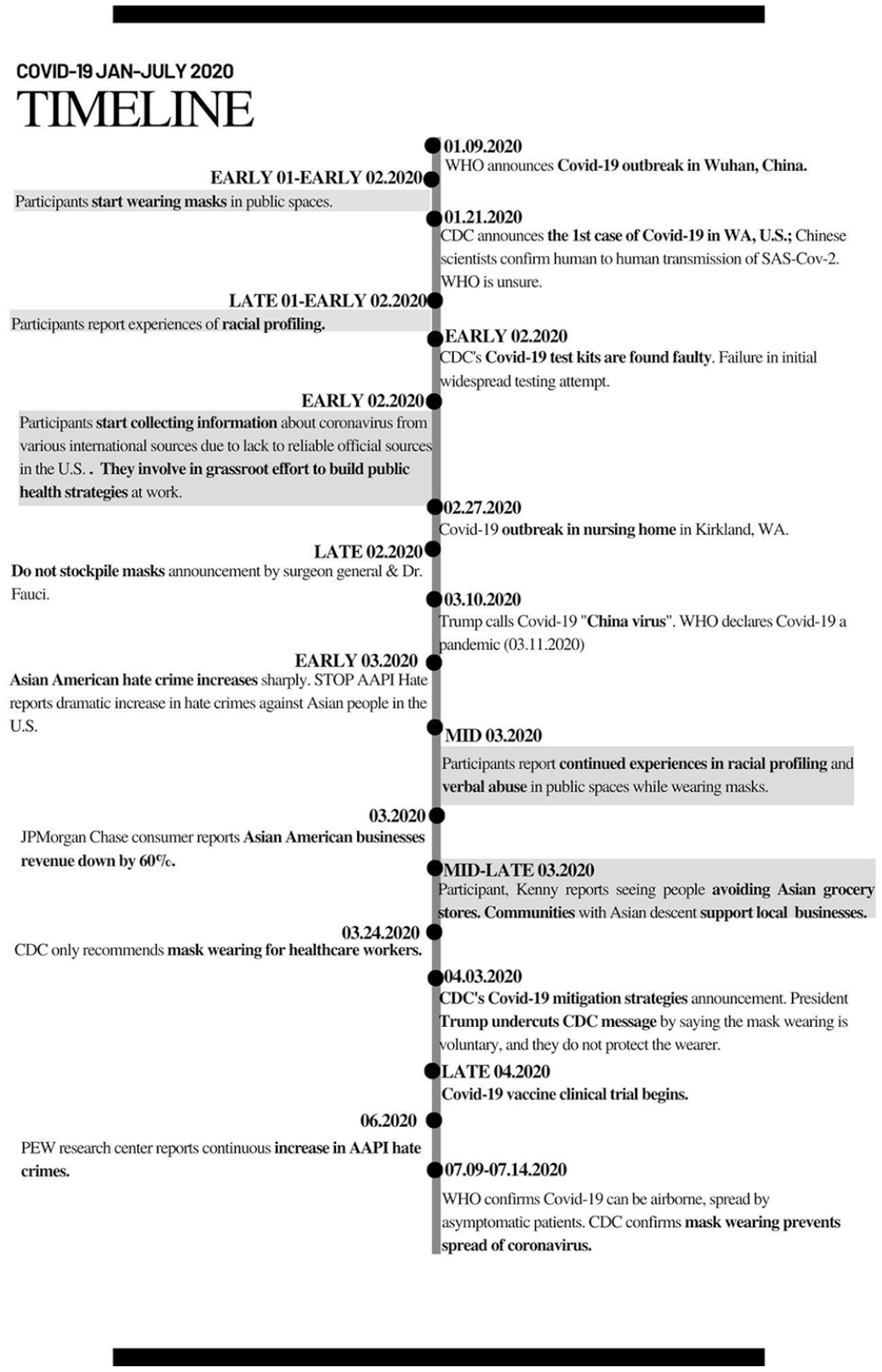
Timeline of COVID-19 January–July 2020 including key events from participants’ perspectives.
However, our participants kept their masks on, even when fearful of being racially profiled, rallied behind their local Asian-owned businesses, and cared for each other to mitigate the spread of the biological virus. As the Figure 2 timeline clearly indicates, participants of Asian descent authored early critical data stories in response to the COVID-19 pandemic that were not taken up by the US institutions. As documented by STOP AAPI Hate Reporting Center and participants, the very people who were in the best position to guide us when our institutions failed to provide insight were blamed and lived in fear of dehumanizing racist and xenophobic violence. This is a racial injustice. In this process of racist blame, their data stories were ignored and denigrated. This is an epistemic injustice. As Medina (2013) argues, “hearers who give less credibility than deserved to speakers commit an epistemic injustice, and a systematic one if their unfair credibility assessments are motivated (or simply mediated) by identity prejudices that amount to structural biases against members of certain groups” (p.54, italics in original). While the racial injustice has been more widely recognized, the epistemic injustice has not been.
For our authorial and research teams, writing this article is a way for us to address racial and epistemic injustices and to let participants know that we heard and understood the sense that they were making and how their actions protected their communities.
For authors and research team members of Asian descent, the analytic process has provided an opportunity to stop internalizing our “minor feelings”: the racialized range of emotions that make us doubt our own senses and blame ourselves because our realities have been belittled so many times (Hong, 2020). We had a chance to share and appreciate each other’s experiences, and recognize that they are valuable and worth learning from.
Non-Asian authors had a chance to exercise testimonial responsibility (Medina, 2013) and learn about the long-standing history of anti-Asian racism and xenophobia in the United States, which many did not understand. They also experienced a kind of “epistemic friction” that triggered a new pattern of response by “uprooting forms of insensitivity that limit our capacity to critically engage with alternate sensibilities” (Medina, 2019: 30). Non-Asian authors learned from the data stories and participants’ experiences which guided their actions to keep their communities safe during the pandemic.
All authors had a chance to ask “What if larger systems of power would have recognized and listened to the critical data stories that people of Asian descent offered early in this crisis? We ask these questions to urge ourselves and readers to act on the knowledge that racism, although targeted at specific groups, impacts everyone (McGhee, 2021). We are dependent on each other at local to global scales and across many lines of difference including race, ethnicity, nationality, and socioeconomic status. How we treat one another and how we demand our institutions act to recognize people’s knowledge and expertise is paramount. To achieve epistemic as well as racial justice, we must amplify data stories that offer counter-narratives to ideologies and discourses that perpetuate racial blame and epistemic silencing.
One major implication of this work is understanding how consequential learning in everyday life may better attune to the processes and outcomes of racial injustice/epistemic injustice. Our study’s framing recognized that focusing on knowledge alone is insufficient because people must also entertain ethical questions about how to act on knowledge and become accountable for it (Bakhtin, 1993 [1919–1921]; Medina, 2013, 2019). We saw how our participants encountered racial violence in the face of their epistemic practices to build data stories from various sources and take action. As participants mitigated risk as early responders, against the backdrop of a national failure to do so, their actions were systematically distorted rendering their expertise simultaneously invisible (thus not taken up as powerful contributions to the public good) and as threats to the American (White) way of life. How such epistemic distortions take shape and the forms of racial violence they fuel as people learn in everyday life should be central to understanding learning, especially in relation to complex social issues. What people understand about SARS-CoV-2—what it is, how it replicates and spreads, and how to mitigate transmission is not separate from who people are and their historicized realities.
Furthermore, we argue that without attention to these political and ethical dimensions of learning, the field runs the risk of being complicit in the social formation of epistemic injustice and the resulting forms of racial violence and dehumanization. When building data stories and acting in a pandemic is stripped from these orientations, then the field gains, what Medina (2019) calls “an alibi and emotional support for their apathy and complacency, for not caring enough or at all about the brutal treatment of their fellow citizens” (p. 26).
A second major implication of our work is methodological. As we consider how studies of knowing and learning become attuned to the processes and outcomes of racial and epistemic injustice in people’s everyday learning, we should consider the processes of research on learning itself. We sought to engage with partners, in long-term research-practice partnerships, to give witness to how systemic injustices of racism shaped learning in everyday life (see also Calabrese Barton et al., 2021). Our approach centers on the practices of “critical witnessing” and “being with”—practices oriented toward epistemic resistance and activism, social transformation, and the public good of communities historically marginalized by systemic inequities. This implicated methodological choices of who we partnered with (communities we have long-term relationships with and are a part of), who was on our research team (active members of the WCCP and our university collaborators), and the roles people played (community partners engaged in co-analysis and co-writing). These methodologies hold promise for harnessing research for transformative change toward more just futures.
Footnotes
Funding
The author(s) disclosed receipt of the following financial support for the research, authorship, and/or publication of this article: This support from US National Science Foundation Grants DRL 2028370 and DRL2055166. The views expressed are the perspectives of the authors and do not necessarily reflect the funder’s views.
