




Abstract
Digitalisation and computation presents us with a vague empirical world that unsettles established links between measurements and values. As more and more actors use digital media to produce data about aspects of the world they deem important, new possibilities for inscribing their lives emerge. The practical work with digital methods thus often involves the production of social visibilities that are misfits in the context of established data practices. In this paper I argue that this dissonance carries the distinct critical potential to design data experiments that (a) uses the act of operationalisation as an engine for creating intersubjective clarity about the meaning of existing concepts and (b) takes advantage of algorithmic techniques to provoke a reassessment of some of the core assumptions that shape the way we pose empirical problems are normally framed. Drawing on the work of Kant, Peirce, Dewey and C.I. Lewis I propose to think of this critical potential as the possibility to practice what I term 'experimental a priori' and I use qualitative vignettes from two years of data experiments with GEHL architects to illustrate what this entails in practice. Faced with the task of using traces from Facebook as an empirical source to produce a map of urban political diversity, the architects found themselves in a need to revisit inherited assumptions about the ontology of urban space and the way it can even be formulated as a problem of diversity. While I describe this as a form of obstructive data practice that is afforded by digital methods, I also argue that it cannot be realised without deliberate design interventions. I therefore end the paper by outlining five design principles that can productively guide collective work with digital methods. These principles contribute to recent work within digital STS on the recalibration of problem spaces and the design of data sprints. However, the concept of ‘experimental a priori’ can also serve as a philosophical foundation for knowledge production within computational humanities more broadly.
Keywords
The resolution of objects […] into facts stated exclusively in terms of quantities which may be handled in calculation […] seem strange and puzzling only when we fail to appreciate what it signifies [...] this is the effective way to think things; the effective mode in which to frame ideas of them, to formulate their meanings. John Dewey – The Quest for Certainty (p. 108)
Introduction
Jeff and Alex are sitting around a digital map of Copenhagen filled with dots in different colours. The map is built on digital traces of 300,000 Facebook users’ interactions with politics and urban events. Each dot represents an urban venue, and its colour indicates whether it attracts a politically diverse audience. The green ones do, and the red ones do not. Jeff is a partner and CIO of GEHL architects. Alex is an associate on the company’s innovation team. Between them, they have years of experience measuring urban life in public spaces. Yet, they are unsure how to translate the cacophony of coloured dots into a relevant narrative about the political geography of Copenhagen. Part of their troubles stem from the fact that they are looking at a map that does not quite resemble the ones they are used to interpreting. It is built on an alien data source. Its meaning is underdetermined. As they discuss which mapping strategies would indeed create a sense of meaning in the seemingly disorganised data, Alex suggests transforming the dots into an aggregated ‘heatmap’. A map that highlights the average political diversity of larger geographical areas instead of foregrounding the urban venues at single dots. He points to the map and explains: ‘This heatmap shows [that] this area over here is generally more diverse than any of these two’. Jeff intervenes: ‘But that’s not really true spatially […]’ (Figure 1).
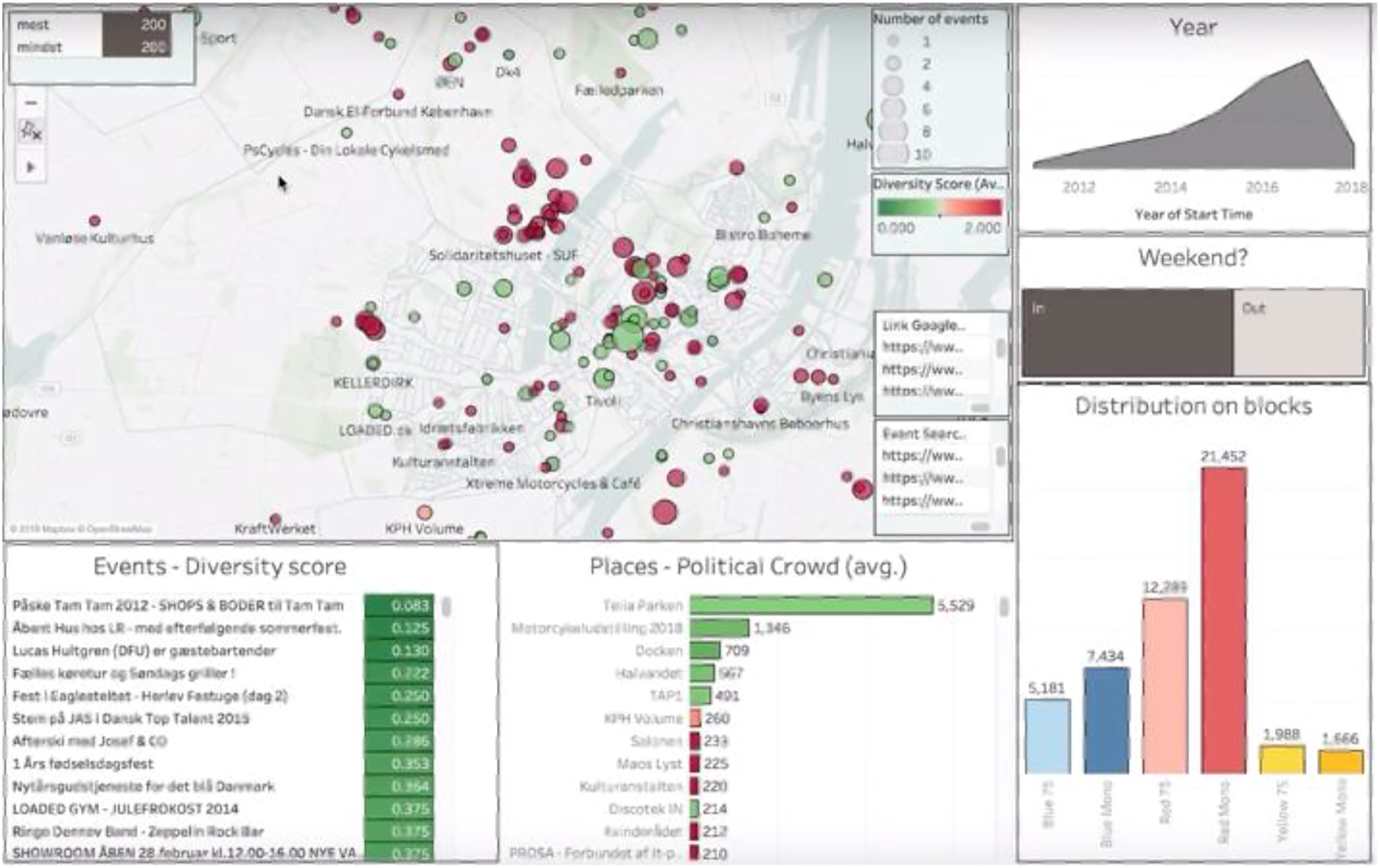
Screenshot from one of the first iterations of the diversity map with which Jeff and Alex work in the opening vignette. You can explore a final interactive version of the datascape here: https://www.tantlab.gehlpeople.com.
This conversation stems from the project ‘Do You Live in a Bubble?’ (DYLIAB), which involved two years of collaborative data experiments between TANTLab and GEHL architects. The aim of the project was to use traces from Facebook as an empirical foundation for cartographies that could provide new insights into the problem of urban political diversity and perhaps even new ways of phrasing this problem. The most tangible outcome of the project is the publication of an interactive datascape that enables users to explore the issue of political diversity in new ways. It offers a map on which each venue in Copenhagen is assigned a diversity index between 0 and 100, depending on how its users engage with politics. This is this datascape that Jeff and Alex are in the process of building above (the full method and the specific findings about diversity are described in Madsen (2022)). In this paper, I will use selected qualitative vignettes from DYLIAB to illustrate how the decision to use digital methods on alien data stimulated specific forms of thinking and reasoning among the people tasked with building a diversity map. More specifically, I will argue that one of the most exciting critical potentials in ‘thinking with digital methods’ is the possibility of practicing a mode of enquiry that I propose to call experimental a priori. A form of technologically assisted enquiry that allows for re-composing the way empirical problems are framed by unsettling established modes of measuring.
Throughout the paper, I draw on the philosophies of Kant, Peirce, Dewey and C.I. Lewis to sketch a philosophical foundation for this specific form of obstructive data practice. First, I use Dewey’s work to argue that the decision to work with native digital data (such as data from Facebook) almost always positions the analyst in a vague empirical situation where the analytical components and their internal relations are unclear. Given that digital traces are produced under constantly changing conditions, it is impossible to work from clear and durable methodological standards. Each new project needs to reassess how digital traces make sense as inscriptions of the specific empirical phenomenon one is trying to produce knowledge about. Although this is potentially frustrating, it is also liberating in the sense that it allows revisiting the elements that make up a problematic situation (such as urban diversity). Second, I draw on Peirce to argue that the best way out of this vagueness is to decide on a set of formal operationalisations that stabilise the connections between measurement, enquiry, and problematisation (such as the heatmap proposed by Alex). Decisions on operationalizations afford a distinct form of intersubjective sensemaking that requires participants to clearly explicate what they mean when they use specific concepts in their problem formulations (such as space). Third, I argue that the availability of a wide variety of explorative algorithmic techniques to identify patterns in unstructured and granular digital traces means that this stabilisation can be achieved in many ways. Drawing on C. I. Lewis, I argue that there is no shared a priori baseline around which the empirical must be ordered. To the contrary, digital analysis requires the active production of such a baseline (see also Madsen 2015; Madsen and Munk, 2019). The fact that this can be done in an iterative fashion is what I propose to discuss as the opportunity to practice the mode of enquiry I call experimental a priori. Fourth, I argue that this specific mode of enquiry carries distinct potential as a critical data practice. However, I also argue that this opportunity does not arise by itself. The critical situation has to be intentionally designed and I end by providing criteria for such a design.
The theoretical framework of experimental a priori takes inspiration from – and further elaborates – important work within digital Science and Technology Studies (STS) during the last decade. First, it contributes to the discussion of how digital methods and the rise of computation allow for new modes of empirical experimentation (Marres and Stark, 2020; Moats and Seaver, 2019). More specifically, the suggestion to work with digital methods with an outset in specific design principles adds to the growing literature on data sprints (Madsen and Munk, 2019; Munk et al., 2019) and participatory data design (Jensen et al., 2021) The arguments in this paper can furthermore be read as an addition to Lury’s (2020) recent work on how the increasingly digital society stimulates a form of ontological disturbance that opens up the possibility to critically recompose the problem spaces that guide our existing epistemic habits. The suggestion to view some of these questions through the works of Kant, Peirce, Dewey and Lewis, hopefully, helps strengthen the attempt for digital STS to work actively with quantification and algorithmic techniques from its own distinct philosophical ground. This ground would also have relevance for broader discussions about digital data experiments (Blok 2020) and the epistemology of computational social sciences and humanities more broadly (see e.g. Nelson 2020 and Benthall 2016).
The computational turn as a generator of vague empirical situations
Digital methods were born in tandem with the so-called computational turn (Berry, 2011) in the early 2000s. As people moved their social lives online, new types of digital data and techniques for analysing them became available to researchers in the social sciences and humanities. The fact that most of these data and techniques were shaped by owners of online platforms changed the way empirical phenomena could be observed. The platforms brought forth a multiplicity of data authors and inscriptions that, by far, outnumbered everything seen before. Furthermore, their data were granular, unstructured and messy (Kitchin, 2014). No matter which phenomenon is of interest to study, no single actor would be in control of the conditions under which data about it would be produced. The unsurprising result is that data after the computational turn rarely follow established classificatory standards. When the state and other public institutions were the main producers of data, their scope and details had a natural limit. Since one had to be strategic about what to count and inscribe, data would often be aggregated into categories and data models agreed upon by these institutions. As digitalisation expands the number of data authors, this limit erodes. The world can be inscribed in various ways by various actors, depending on what they find important.
This is what Dewey (1938) would describe as a vague empirical situation, in which existing concepts and classificatory schemes lose their heuristic value as guides of thought and action. This creates a need to (re)establish the analytical components of the situation one is interested in studying. Which objects are present? How do we distinguish between them? What are they called? How do they relate to each other? Only by answering such questions can we return to a situation in which it is possible to think and act. To Dewey, this form of reconstructive work is the core of critical thinking. Although arguably frustrating, vague situations are valuable because they stimulate a form of suspended judgement that the human mind normally prefers to skip (Dewey, 2007). Dewey thus concluded that good enquiry involves an attempt to deliberately provoke such situations. If we fail to do so, our analytical schemes will ultimately be unfit for the constantly changing empirical world. One of Dewey’s proposed strategies for provoking vagueness was to invent tools and instruments that fundamentally change the way empirical phenomena can be observed (Dewey, 1929). A task that is now routinely done by people within and around academia.
The last decades of work with digital methods in STS can be seen as driven by a desire to take advantage of the vagueness introduced by the computational turn. For instance, Rogers’ (2013) early work with natively digital objects was precisely driven by a curiosity about what we could learn from ‘following the web’ and the ontologies of digital media. This led to the rise of ‘post-demographic’ analyses that differed from most quantitative social sciences by not automatically clustering people based on demographic traits. Similarly, Marres (2005) used the relational structure of the web to trace the composition of issue publics rather than conceptualising ‘the public’ as an entity that had to do with voting intentions and party sympathies. Although these early studies enabled new representations of empirical phenomena, such as groups and publics, they also required analysts to interface with alien methodological traditions. The provenance of digital data was often unknown, and working with it meant relying on infrastructures and analytical techniques developed by people with specific interests in and around Silicon Valley (Marres, 2012). Against this backdrop, I agree with Lury’s (2020) statement that the rise of the digital society means that ‘[…] linkages between measure and value are [...] being recalibrated’ (ibid:87). This is what I refer to as the rise of empirical vagueness.
Returning to the offices at GEHL, I propose that it is exactly the need to engage in such a vague process of recalibration that troubles Jeff and Alex in the opening vignette. Working at GEHL, they are employees of a company with an empirical toolkit that has been developed over decades to make standardised representations of public life in public spaces. This toolkit is called PSPL (Public life/Public Space) and it uses surveys, interviews and observations to map people’s behaviour in pre-selected public spaces. Typically, the spaces observed are identified in conversation with local municipalities, and they have recognisable forms, such as a square, a street segment or a block. GEHL analysts are then sent to the selected spaces with a structured observation guide that enables them to inscribe urban life in these spaces. For instance, if the topic of interest is urban diversity, this guide could include a task to count the number of men and women and to note the extent to which they interact in conversations. This methodological approach is sometimes internally referred to as part of the ‘GEHL lens’ and has been documented in various publications, creating the company’s trademark gaze on the urban (Gehl, 2011; Gehl and Svarre, 2013) (Figures 2 and 3).
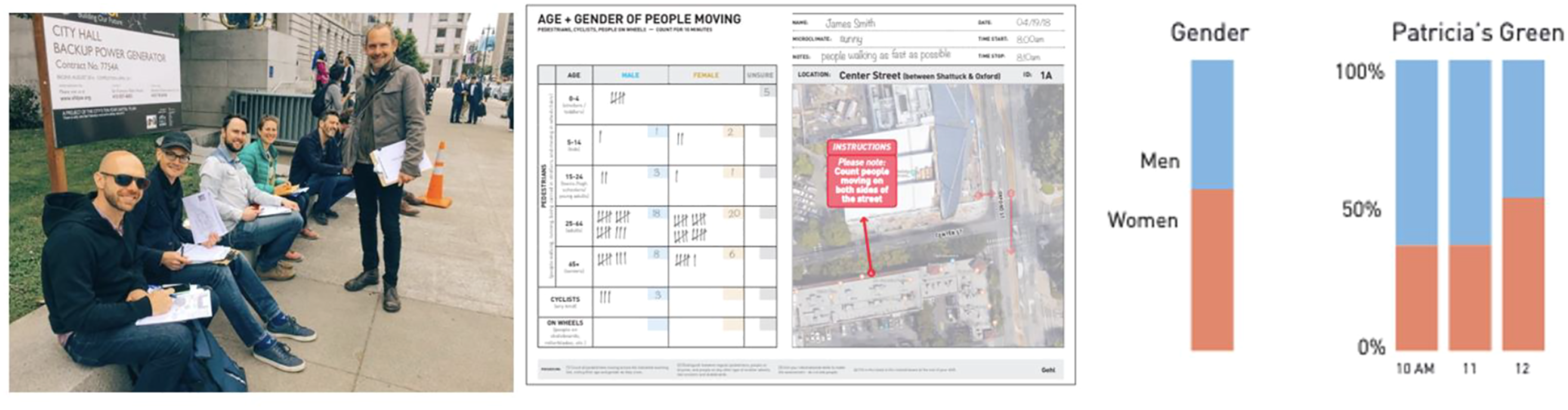
Central elements in the GEHL lens. To the left, employees ready to observe urban life in pre-selected spaces. In the middle, the survey guide structuring their gaze on gender distribution is a predefined street segment. To the right is a visualisation of gender composition in a specific public space.
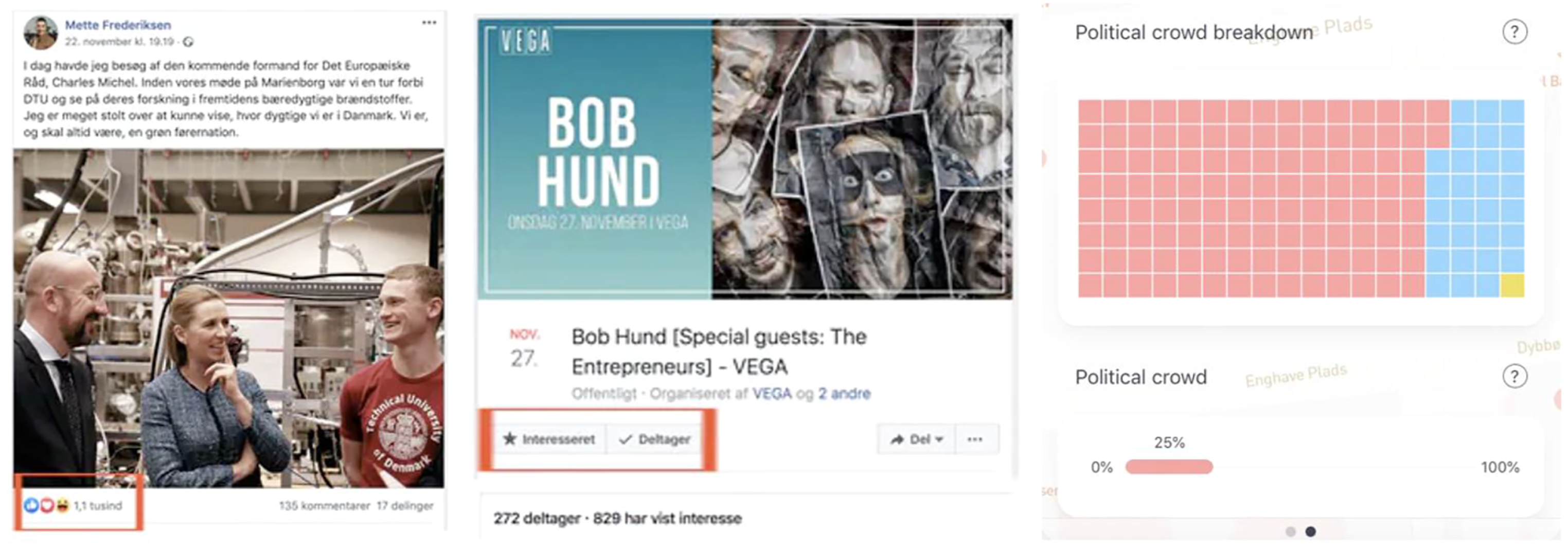
Central elements in the Facebook lens. To the right are traces of anonymous users’ engagement with a political post. In the middle are traces of anonymous users’ interest in a specific concert. To the right is a visualisation of the political composition of the crowd at a specific event.
When tasked with mapping urban diversity through traces from Facebook, Jeff and Alex find themselves working with an alien data source that inscribes public life and public space from a quite different outset. This naturally prompts questions about its provenance and validity. What are we looking at when we examine the way people engage with politics and urban events on Facebook? Who leaves traces such as likes on this medium, and why do they do it? Can we even think of these users as an urban public? Are these traces reliable signals, or are they influenced by platform algorithms? Do we know whether people have been to the events they indicate that they attend? Is this even important for understanding urban life? These were questions that popped up early in our project, and it was questions that GEHL team members had already asked themselves in prior attempts to work with exhaust data from social media (GEHL Studio SF, 2015). The diversity project brought them back to renewed strength. Viewing the problem of urban diversity through the lens of Facebook (Figure 3) rather than through the GEHL lens blurs what counts as public life and public space. The empirical situation is vague compared to a situation in which the established PSPL method is the main empirical tool. This creates frustration but also critical opportunities.
Operationalisation as intersubjective semantics
Vague empirical situations provide an opportunity to engage in what Dewey (1929) termed operational thinking. As long as the empirical components of a situation are unclear, a community of enquires can only move productively forward by agreeing on a procedure to identify them. As argued above, the digital is ripe with vagueness. For instance, it is not obvious how to define and recognise something as fundamental as a person in unstructured traces from Facebook. Individuals can have many accounts that are often deliberately created to distinguish between a private and a professional self. Should these count as two persons or one? What if half of the posts of the professional account are written with the help of a robot, does that make the account less human? This kind of ontological indeterminacy allows for explicating what is meant by the concept of a person. It confronts analysts with the task of creating shared signifiers that can function as referential evidence for a specific analytical object (Dewey, 1910). Big digital datasets require such signifiers to be formalised because their scale makes it necessary to delegate the task of identifying objects (such as persons among thousands of profiles) to an algorithm. A decision on such formal operationalisation is a bottleneck for proceeding. Thinking about conceptual ideas as items that are put to work by sets of operations offers a promising way forward for critical digital enquiry. What counts as a person in our example is defined according to the way we choose to recognise it rather than by reference to some metaphysical truth about what a person really is. What is interesting about the vagueness of the computational turn is that it allows ideas to be put to work in multiple ways.
This connection between operationalisation and meaning owes much to Peirce’s (1878) original formulation of the pragmatic maxim, which stipulated that the meaning of concepts must lie in their tangible 1 effects. The semantic test of a concept is to explicate which procedures to follow to obtain perceptual acquaintance with the objects falling under it. For instance, Peirce argued that the meaning of calling an object ‘hard’ lies in the operational test that it would not be scratched if it were to be rubbed against other objects. Similarly, if one decided that a Facebook profile could only be labelled a person if it made no use of bots, the operational test could be that it would sometimes have periods of inactivity. It would sleep like a human does. To Peirce, it was of utmost importance for meaningful enquiry that the results of such operational tests could be assessed by an intersubjective community of enquirers. Only such a common point of reference would ensure that concepts such as ‘hard’ or ‘person’ were clear enough for this community to critically assess whether an entity was meaningfully labelled as hard or as a person. As Peirce put it, ‘We come down to what is tangible [...] as the root of every real distinction of thought’ (Peirce, 1878): 56). Drawing on Burke (2013), I suggest that Peirce planted the seed for a specific operationalist strand of pragmatism 2 that is fruitful to revisit when identifying the critical potentials of digital methods.
I will motivate this by returning to the dotted screen in the office of GEHL architects. When we left our two urbanists in the opening vignette, Jeff questioned whether the heatmap suggested by Alex would actually give insights into spatial aspects of political diversity (‘Is it really true spatially?’). Shortly after, he motivates this question by introducing an important conceptual distinction: ‘I want to look at the place – not the event’. As described above, this distinction has a quite straightforward empirical meaning in GEHL’s PSPL toolkit. A place would be a specific section of the city, such as a public square, where GEHL employees can be sent out to make their observations. An event would be whatever happens within that predefined place. However, the distinction is not as straightforward when the empirical situation involves traces from Facebook. In Facebook’s native digital ontology, the only geolocated entities are urban venues that own a Facebook page. As the events are announced on this same page, they are co-located with the venues. In this inscription, the place and the venue/event are geographically synonymous. In Facebook’s ontology, there exists no well-defined spatial container in which the events occur.
Accordingly, if Jeff and Alex want to make a geographical distinction between a place and an event, they have to translate this distinction into an operation that has a tangible consequence on the dotted map they both have their eyes on. Following Peirce, one could say that the distinction will only carry meaning when they decide which formalised rules an algorithm must follow to realise the ambition of looking at places rather than events. Collectively, they embark on this task. This time, they are looking at a map with a few more colours than the one in the opening vignette. Venues attracting the left wing are coloured in red, venues attracting the economic liberals are coloured in blue, and venues attracting nationalists or are coloured in yellow. The politically diverse venues are still coloured in green. Alex: I think we should only look at the reds, yellows, and blues, as in events, without the green ones. Because these are polarised events, and if we can do a radius—and we have one red, one blue and one yellow—this radius…this Jeff: If that street, like Studiestræde, had the opportunity to attract […] red, yellow, and blue, that’s super diverse. That’s potentially more diverse than here being green. [Jeff points to a street on the map with green dots.] That’s what I want to try to do. I want to add to what Anders has done and make it a
Jeff and Alex are engaged in the task of settling the components of the vague situation and their internal relations. The necessity of this work is sparked by a shared verdict that the dotted map they are working on is not spatial. Geolocated events coloured by their political diversity scores do not qualify as a relevant representation of urban space. For Jeff and Alex, an urban event/venue is something different from an urban place/space. This is their conflict with the native ontology of Facebook. To ensure that the map represents the latter, rather than the former, they brainstorm on operationalisations that would enable them to look at a spatial map.
In the quote above, Alex suggests two solutions that are both illustrated in Figure 4 below. One suggestion is to ‘draw a spatial radius’ and use this as a container in which to aggregate the diversity score of the events. Whether this spatial radius would come in the form of a hexagon or a physical street grid is less important than the need for some sort of aerial boundary that could substitute Facebook venues (the dots) as the geographical unit dominating the visualisation. To Jeff and Alex, the relevant question is whether people of different political leanings are co-located in the same physical public space – not whether they frequent the same events inside the walls of the private venues that host Facebook events. For instance, if a book launch on identity politics for a leftist crowd (red dot) is held right next to an afternoon update on the stock market attracting a liberal economic crowd (blue dot) and a screening of an old Danish movie attracting a nationalist crowd (yellow dot), ‘that street’ (as Jeff puts it in the quote above) would be an interesting place to study in deeper detail. In fact, Jeff and Alex agree that this would be more interesting than identifying isolated events – such as a football game – that attract a politically diverse crowd. This is also what motivates the suggestion to reproduce the map ‘without the green ones’ (as put by Alex above). The diversity of single events is a form of noise when one wants to identify larger urban areas that serve the function of attracting people from across the political spectrum. It muddles the spatial ontology when the agent of diversity can be both a venue and a street. An illustration of the two proposed solutions for ensuring that the map represents place and not events. In the first frame, the diverse venues are erased, which results in a map with homogenous venues only. The second frame shows that they will each receive a diversity score of 0 because they each attract a homogenous audience. Measured in this way, the street would have low diversity. However, if you shift the geographical unit of analysis to the street, this street will attract a very diverse crowd and get a score of 100.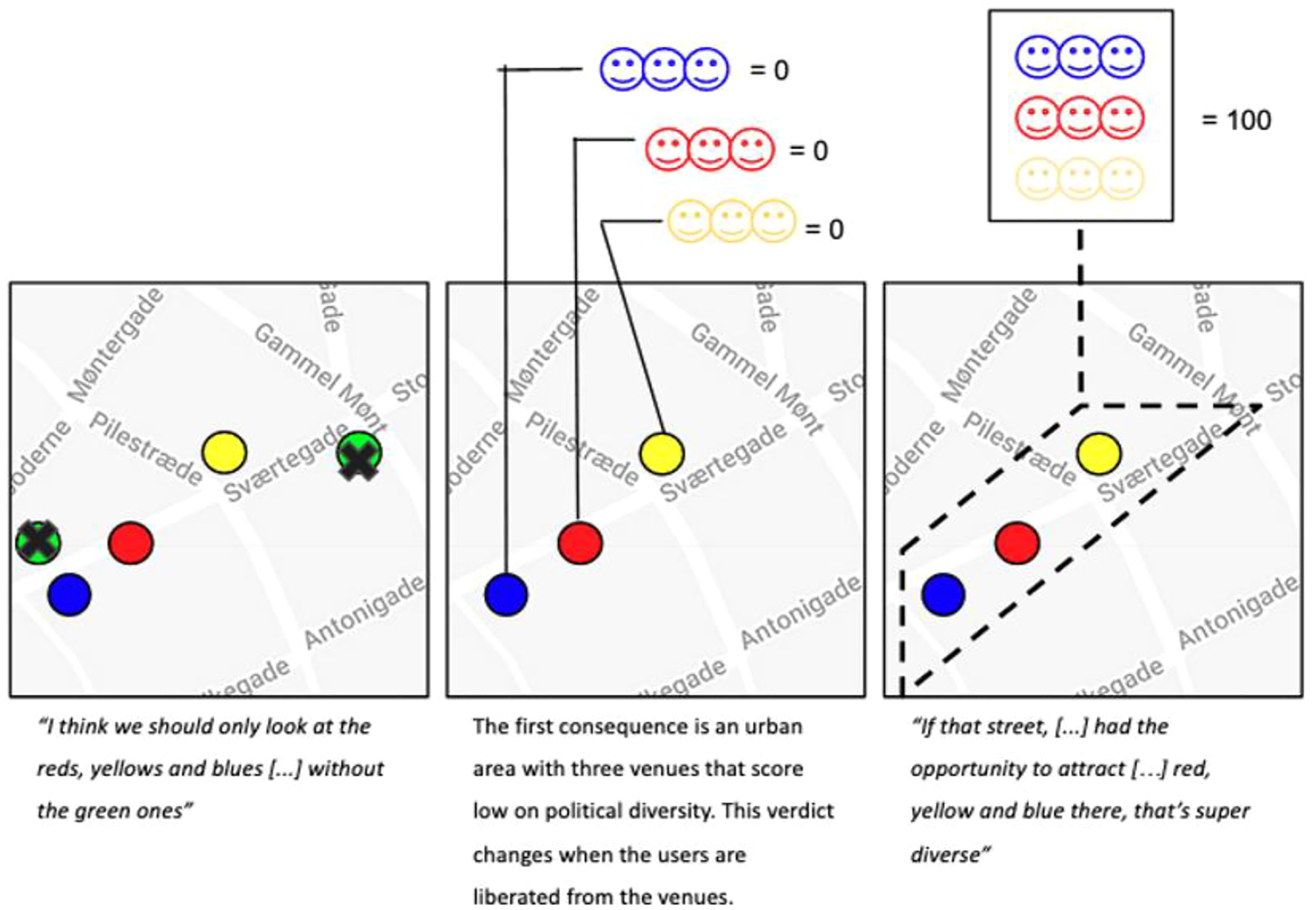
The work done by Jeff and Alex is an instantiation of Peirce’s idea that the decision concerning which operations to perform on an empirical material is also a specific way of opening up concepts for intersubjective assessment. In the process of deciding on the operationalisation, Jeff’s intuitive distinction between events and places becomes clearer and more tangible. By stripping the map for accidental qualities such as the green dots, Jeff and Alex prepare the ground for focused data explorations that they find relevant to the problem they are trying to solve. In this rendering, private venues can no longer be agents of diversity. This also illustrates how data explorations are never random or free of theory. There is an intent driving which operationalisations are tried out. The decision of a specific way of measuring is ultimately an act of selecting some qualitative aspects of a situation as more important than others. It establishes the qualities to be compared and the means for comparing them. Engaging in collective operationalisations is therefore also engaging in a collective (re)composition of the world that highlights some aspects at the expense of others.
In the case of Jeff and Alex, their composition of the map has the consequence that the cacophony of dots is translated into something that is manageable for architects and urban designers to act on. Although these professions cannot change or improve events inside the walls of private venues, they have lots of experience improving public urban areas, such as streets. According to one of their colleagues in an interview on the project, ‘it’s natural [for urban designers] to put the physical at the forefront, because that’s what we’re set in the world to change or to improve’. This ultimately connects the operations of the data with the agency afforded by the resulting visualisation. The dotted map simply carries the wrong kind of agency, whereas the proposed translation into an urban grid fits a spatial ontology that is commensurable with the PSPL methods developed inside the company. This connection between space and agency is also reproduced in the final published version of the map, which includes specific stories comparing the diversity of selected urban areas with reference to their physical traits (see Figure 5). Screenshot of one of the stories on the published website, where we compare two areas of Copenhagen in terms of their political diversity. This comparison shows that Folkets Park is very red and Sundbyøster Plads is more diverse. It allows for conversations about the characteristics of the built environment in these areas rather than the specific venues.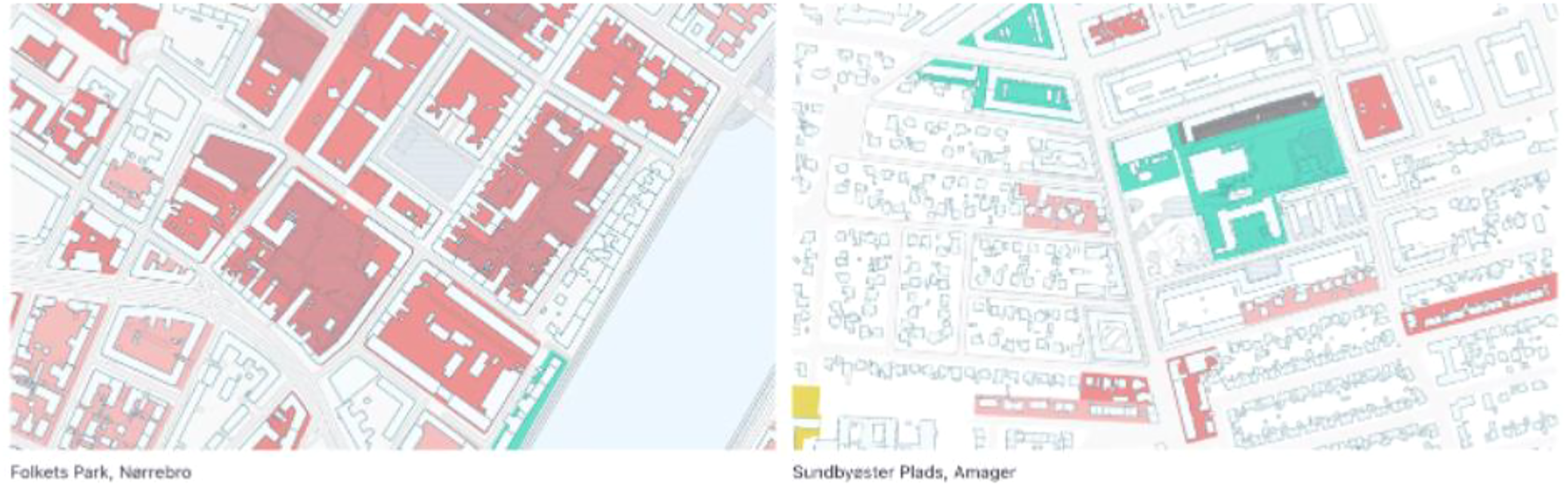
One lesson from the work of Jeff and Alex is that vague data situations stimulate a need to translate conceptual distinctions into novel operationalisations, thereby explicating the assumptions underlying them. As the computational turn provides a plethora of vague situations, it allows for critical reflection on whether the operationalisations that fit an old data environment can meaningfully be imported to a situation with new types of data and analytical techniques. Ultimately, it allows for the kind of recalibration between measure and value discussed by Lury (2020). Seeds of such recalibration are, for instance, visible in a follow-up interview with Jeff, where he states that GEHL needs to talk about ‘[…] whether the public realm includes libraries and schools and even like, some cafés and barbershops […]’ (Interview with Jeff Risom). His concept of space is critically evolving with the practice of inventing new operational procedures and interpreting their consequences. This is also a central point in Dewey’s writings on operational thinking, in which he argued that the practice of establishing new standards relies on successive refinements of operations. Vague situations do not allow for operational revolutions but rather incremental tweaks.
Digital methods as ‘experimental a priori’
The concept of the ‘a priori’ can be translated into that which comes before experience in the production of knowledge. This is a relevant concept in relation to the vignette above, where Jeff and Alex discuss how to instruct a spatial algorithm to structure data before they become perceptually acquainted with it in the form of a map. Their aim is to agree on formal mechanisms of aggregation that the unstructured data must run through before they are made visible in a visual form. I propose thinking of this as an a priori element in their subsequent enquiry and I will argue that an important potential in digital methods to allow for a form of experimental a priori that can provoke the kind of suspended judgment that Dewey thought to be the essence of critical reasoning. Before illustrating this with a return to Jeff and Alex, I want to clarify how my notion of an experimental a priori builds on – but also differs from – the way Kant, and later C.I. Lewis described the a priori element in thinking.
Let’s start with Kant. Before him, most philosophers assumed that the goal of thinking was to mirror a pre-existing world. For instance, empiricists argued that cognitive activity happens after the senses have been provided with raw material from the world. Kant’s great contribution was to flip the script on this assumption. His suggestion was that the human mind provides the scaffold of experience before the senses even enter the game. Experience begins after the mind has imposed certain categories and structures on the world. We can thus think of Kant as the first constructivist philosopher. His main argument was precisely that the patterns and regularities we end up designating as analytical findings of an empirical enquiry cannot be reduced to empirical inputs from a pre-existing world. The mind structures the empirical and thereby sets the boundaries for the way arguments about the world can meaningfully be formulated. Kant used the geometry of space as one example of such a structure. According to Kant, ‘One can never forge a representation of the absence of space, though one can quite well think that no things are to be met within it’ (Kant, 2007/1787: 65 [B38-9]). In this example, Euclidean geometry sets a priori boundaries within which empirical debates about the motion of objects can be meaningful. It is possible to debate whether two objects will collide in space, but the geometry of space itself cannot be derived from – or refuted by – experience. It is what structures experience in the first place. Kant named such structuring principles synthetic a priori. It would be impossible to have meaningful intersubjective conversations without them but they cannot be put into any empirical test. To Kant, the central concern of critical epistemology is identifying and describing these transcendental boundaries.
Peirce found merit in the idea that experience is always already structured by some agency outside the empirical. He proposed that there will always be elements of empirical statements that cannot be disproven empirically. Dewey (1938) took a similar stance when he argued that certain ‘functional essences’ are necessary tools for thinking. However, the transcendental and stable character of Kantian a priori troubled both Peirce and Dewey. Kant ends his Critique of Pure Reason by identifying 12 universal categories, which he believed structures the cognition of all humans across time and space. Euclidean space is one example, and the remaining 11 categories also take inspiration from the Euclidean geometry and Newtonian physics that were taken as ground truths in Kant’s time.
This ground truth was outdated by Einstein’s relativism at the beginning of the 19th century, when pragmatist philosophy matured. To the pragmatists, Kant posed the right questions but arrived at the wrong answers. As processual thinkers, they were interested in describing the ongoing intersubjective construction of the a priori in response to concrete problems, not in arriving at final and universal categories. This pragmatist take on the a priori was most thoroughly developed in the work of C. I. Lewis (1923). To escape the universalist tendencies in Kant’s proposal, he provided the following statement about the a priori in the production of knowledge: “What is a priori is necessary truth not because it compels the minds acceptance, but precisely because it does not [...it...] represents an attitude in some sense freely taken, a stipulation of the mind itself, and a stipulation which might have been in some other way if it suited our bent and need”. (ibid: 166)
Lewis’ ontological premise is that the empirical world is full of unsorted and confusing sensory inputs that cannot meaningfully be discussed as experience in their raw form. There is no single uniformity waiting to be uncovered. Rather, there are several possible structures and patterns that could fit this unstructured mess. Different a priori stipulations afford sifting and ordering the empirical world in their own distinct and legitimate ways. Lewis used the logical law of contradiction as an example of such a stipulation. By stating that nothing can be both X and non-X, this law constitutes a binary world that affords formulating specific problems and conducting specific empirical investigations. However, this law of logic does not ‘compel the mind’s acceptance’. Lewis’ pragmatic twist on Kant’s stance is that this form of a priori stipulation is authoritative for a community of inquirers precisely because it is freely chosen and therefore cannot be put to a decisive empirical test. The only possible test is whether it fits the problem at hand. Lewis called it a pragmatic a priori.
I want to suggest that Jeff and Alex were engaged in stipulating such a pragmatic a priori when we left them above. After having tried different operations on the data at hand (e.g. erasing and keeping the green events), they end with a choice between two modes of ordering space, each of which brings out different patterns and provokes different problem formulations. One is the dotted map. The other is the recomposed heatmap suggested by Alex. The necessity of making a choice between these maps subsequently sparked even more nuanced discussions about the concept of urban space than the one reported above. For instance, the notes in Figure 6 stem from a discussion about whether it made sense to define two venues as close when they have a short geographical distance between them, or whether it would be better to think of them as close if they are placed on a natural walking route between two points. Although this discussion ended with the former solution, the necessity of arriving at this operationalisation involved formulating different ways of formalising space and thereby establishing the pragmatic a priori that would serve as the scaffold for the empirical investigations of space. Notes from the discussion concerning the operationalisation of urban space. In the middle of the green note, we see an attempt to sketch an operationalisation of proximity. In the white note, this is related to the operationalisation of space, which could vary from district level to a specific lake, such as Damhussøen.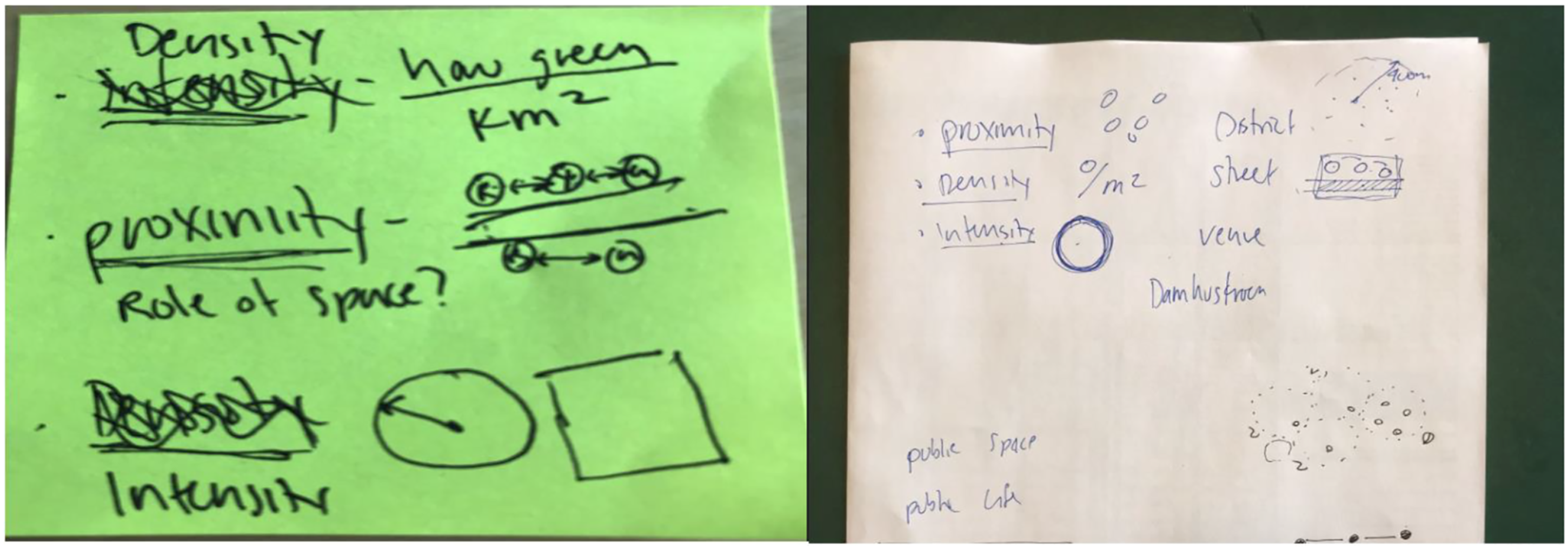
The relational nature of the digital traces from Facebook also allowed for experimenting with the even more radical idea of operationalising urban space as a network where two venues would be ‘close’ to each other if they shared many visitors. The images in Figure 7 below are two outcomes of this experiment. To the left, we see a network in which each dot is a food venue in Copenhagen. Venues of the same colour share users and thereby constitute a food cluster. One example is the cluster to the right, which consists of coffee shops and restaurants that offer reasonably priced vegetarian meals. This visualisation constitutes a very different ontology of urban space than the geographical grid that usually structures GEHL’s gaze on the urban. The empirical object of a food cluster is based on networked distances. Even though the venues in the plant-based cluster are close in terms of shared users, they are positioned geographically far apart in the city. Proximity thus comes to have a very different meaning in the network than in the maps sketched above. Visualisations of the attempt to move from a geographical representation of data to a visualisation that positions urban venues in a relational space.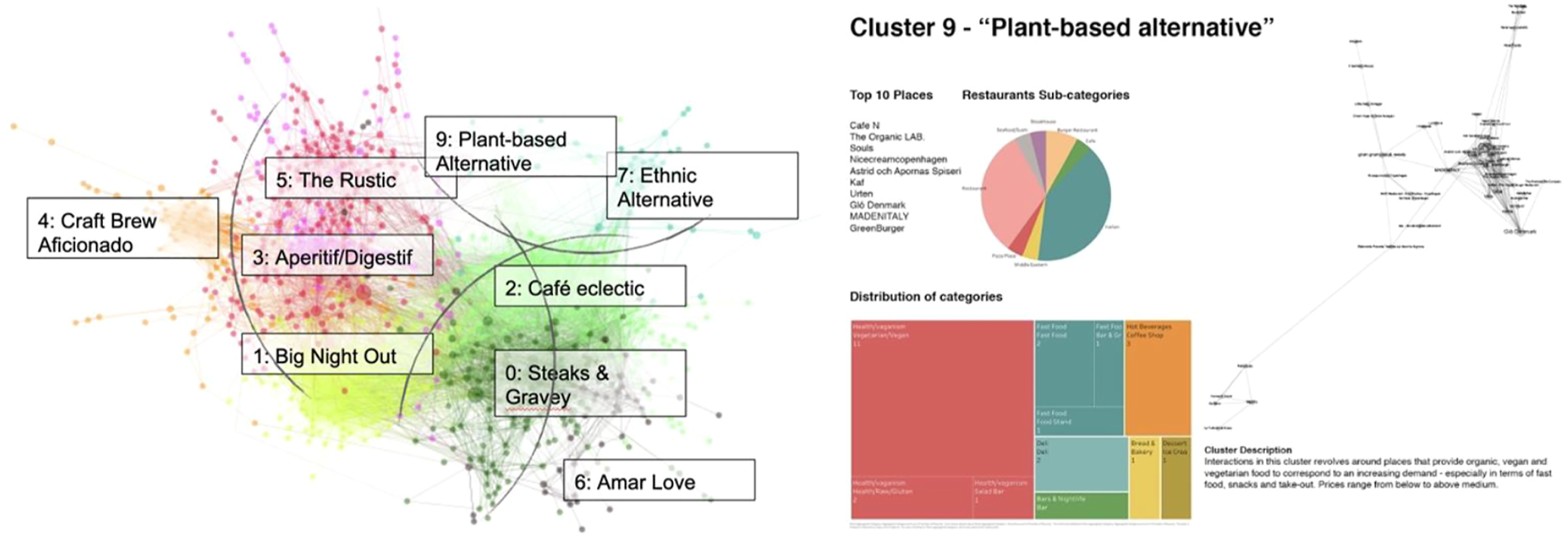
These representations can be interpreted as examples of the kind of diagrammatic reasoning promoted by Peirce (1906) in his later work. They constitute distinct formalised frames within which the space can be observed and tinkered. They shape how the problem of urban diversity can be phrased. Following Lewis, I suggest that the choice between these spatial models cannot be determined by empirical evidence. They all fit the data—albeit in different ways. The choice is a matter of establishing the boundaries within which empirical questions – such as the one concerning which areas of Copenhagen cater to political diversity – can even be asked. Establishing these boundaries is decisive for the ways in which problems can be posed and answered. In the context of urban design, this was already discussed a decade ago, when Christoph Alexander (1968) claimed that one of the main problems of the discipline was the tendency to automatically impose standardised spatial grids on empirical traces of urban life. More specifically, Alexander criticised the tendency of urban designers to define spatial units as mutually exclusive and not overlapping. Similar to the logical law of contradiction discussed by Lewis, this structure limited the way problems about the city could even be formulated.
However, I suggest that the critical potentials of digital methods are best grasped by thinking of them as enabling a form of experimental a priori that is slightly different from the pragmatic a priori formulated by Lewis. Developments in technology and math have once again changed the way we can talk about the role of the a priori in the production of knowledge. Whereas the physics of Einstein demonstrated the arbitrariness of stable Kantian categories, I argue that the computational turn prompts us to substitute Lewis’ pragmatic a priori with a more iterative and experimental version. Whereas Lewis imagines the stipulation of a pragmatic a priori as occurring before the empirical investigation, practitioners of digital methods often find themselves shifting between different structuring principles while performing the empirical analysis. This is possible for two reasons. First, digital data come in less structured and more granular formats than most previous data. They are a good example of Lewis’ unsorted world, which opens up the possibility for various forms of structuring. Second, the availability of explorative algorithmic techniques and flexible visualisation tools makes it possible to iteratively experiment with such structuring on the fly.
This possibility of iteratively probing the structure of empirical material is exactly what Dewey denotes as experimental thinking. To him, the core of experimentation is the decision to translate complex qualitative objects into data that are simple and formal enough to enable things to be brought into relation with each other in multiple ways (Dewey, 1929: 79–80). These relations should be so clearly defined that they can be the subject of controlled interventions, of which an intersubjective community can assess and discuss overt effects. Dewey’s point is that such experimentation does not need to be practiced in a formal laboratory. In fact, we constantly perform quasi-experiments in ordinary practice when, for example, we turn or shake things. Experimentation in the context of digital methods simply allows for the continuation of this mode of enquiry by operationalising different relations and testing their effects.
We have already seen indications of this in the vignettes with Jeff and Alex above. Their attempts to tame the unstructured Facebook traces leave them experimenting with different spatial models that must be critically evaluated with reference to their relevance for the process of enquiry. The important point is that digital methods make it possible to seamlessly switch between these structuring principles. We took advantage of this throughout the DYLIAB project, in which we compared maps with networks and pondered the questions they each generated. It is this type of epistemic practice that I propose to describe as experimental a priori. We are imposing structures that cannot be disproven by empirical data, but we are doing so in ways that enable constant comparisons between them. One could say that in the context of digital methods, Lewis’ pragmatic a priori is permanently beta (Neff and Stark, 2004). The consequence is that established concepts – such as space in the case of Jeff and Alex – are opened for redefinition. When this works, we reach an obstructive and critical mode of enquiry that recalibrates linkages between measure and value in ways that slow down reasoning and ensure that problem spaces are in tune with the situation they are meant to solve.
Why intersubjective and obstructive data practices do not emerge by themselves
However, it is by no means given that this critical potential is realised just because it is possible. Vagueness is not always productive for critical thinking. In fact, in his original discussions of critical technical practices, Agre (1997) explicitly suggested that the vagueness of AI models allows them to be applied in uncritical ways. By having their inner workings black boxed, they often end up supporting a sort of ‘anything goes’ relativism in which the underdeterminacy of data can be used to legitimise almost any pre-existing individual agenda or narrative. My colleagues and I have previously described this as a docile data situation (Munk et al., 2019). Peirce (1877) similarly warned that people’s ‘fixation of belief’ can happen for various reasons, of which few are rooted in the kind of critical operationalist semantics he put forward as the proper form of enquiry.
The fact that the digital data environment carries this risk is nicely illustrated by returning to one of the first data workshops in the collaboration between TANTLab and GEHL. In this workshop, four researchers from the lab met with three GEHL employees to explore the first prototype of the diversity map. This map was portrayed on a large interactive touchscreen that we used to co-explore data patterns. The intention was to use it as a shared empirical ground for selecting specific areas of Copenhagen for further qualitative analysis. The situation was empirically vague because we had no established rules for how to use the data to identify relevant areas. In the words of Lury (2020), we had no procedure for linking the measurements on the map with the value of being an interesting enough urban area to merit further exploration. The aim of the workshop was to develop such procedures and discuss the urban ontologies motivating them.
However, the workshop did not take this desired route. Having recently been engaged in a project on Israel’s Square – a specific area of Copenhagen – some of us approached the screen several times to zoom in on this square and explore the political diversity of its events (see the first image in Figure 8). Thus, the digital traces from Facebook were translated into the role event data play in the standardised PSPL procedure, in which the selection of an interesting place happens as a precursor to looking at its urban life and its events. Throughout the workshop, this form of targeted exploration became a standing joke. When somebody zoomed in on Israel’s Square, he or she was often met with the ironic statement ‘no bias’ to indicate that we were imposing pre-existing interests on a datascape we had not really decided how to navigate. Despite this joke, the workshop continued with us taking turns zooming in on areas that we found relevant or interesting for personal or professional reasons. Snapshots from one of the first data workshops with GEHL. To the right, we are engaged in exploring areas out of personal interest, and to the left, we are engaged in the post-it voting session.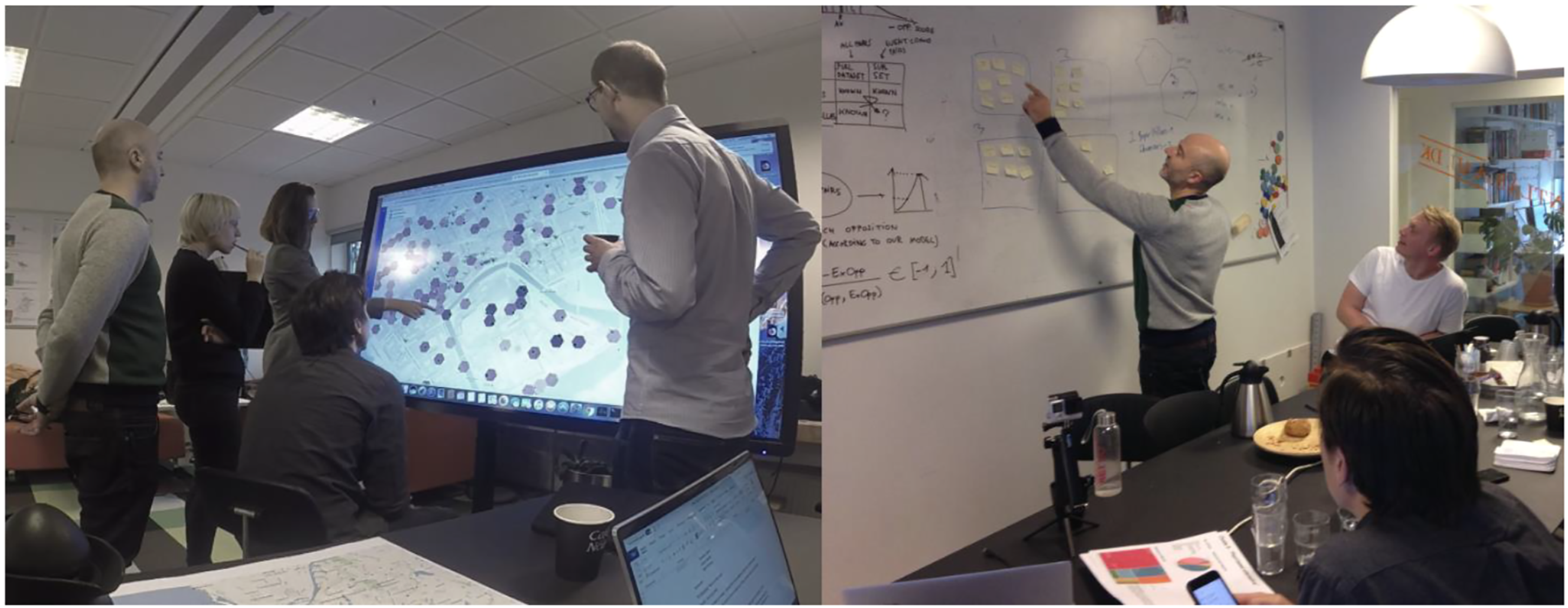
After an hour of exploring the map in this way, Jeff suggested that each of us vote for the areas that we found most interesting. He introduced this strategy of selection with a sarcastic statement that moved the focus from the touchscreen to a whiteboard with post-it’s: ‘It wouldn’t be a workshop without the sticky notes. You guys did well with the big iPad’. By aggregating our individual votes on post-its, we ended up selecting four areas for further exploration (see the second image in Figure 8). Although each of these areas did indeed contain interesting data, their selection was driven by our personal interests in Copenhagen. In fact, the biggest laugh of the afternoon came when someone asked whether we could trace our selection back to some operational structure in the full dataset. Many of us had the sense that we had done exactly what Agre had warned against. Rather than engaging in the hard work of deciding on a shared operationalisation for identifying interesting areas, we imposed our idiosyncratic interests on it. This was nicely captured by one of the GEHL participants, who dryly stated that she thought we should try this method in a city that none of us knew beforehand.
If Peirce had witnessed this workshop, he would have lamented the missed opportunity to engage in the critical work of establishing a formal intersubjective procedure for solving the task of selecting an ‘interesting place’. Instead, we allowed ourselves to fall in love with our own pet stories and subsequently rank them based on votes. The consequence was that nobody took a critical view of their own premises for selection. In the absence of an explicit procedure, any place could be deemed interesting with a good enough narrative.
Experimental a priori in five steps
Throughout this paper, I have tried to establish the practice of experimental a priori as one distinct form of critical data practice that is made possible by the rise of digital methods. However, the fact that such critical practices do not arise on their own is also why recent scholarship in digital STS has discussed the importance of the design of data sprints and participatory data processes (Moats and Seaver, 2019; Munk et al., 2019; Venturini et al., 2018; Madsen and Munk, 2019). I suggest that the operationalist strand of pragmatism offers a useful theoretical foundation for formulating criteria for such a design. Criteria that could function as guidelines for organising data experiments, in which the goal is to use quantification to critically recalibrate the link between measures and values while staying clear of the relativist trap noted by Agre. With reference to the discussion above, I end this paper by outlining five distinct steps in such an iterative process of critical enquiry. 3
Seek alien data sources that create vague empirical situations The first step can be conceived as a sort of self-punishment because it involves actively seeking out data sources that trouble your native categorical schemes. In a world filled with digital data traces, most empirical phenomena will be inscribed by actors with different categorical schemes than yourself. In our example, we saw how the decision to inscribe political diversity and urban space through Facebook traces created classification troubles that would not have existed if we had used a data source, such as the voting behaviour of neighbourhoods. As the structure of Facebook data was alien, it manifested a form of empirical vagueness that forced us to slow down and ponder what we were looking at. According to Dewey, such vagueness is the first step in productive enquiry, and it is therefore a pursuit that analysts could actively seek to produce by asking whether the empirical phenomena of interest are inscribed in data infrastructures that are not part of the standard scoping of data. Doing this can stimulate what organisational scholar David Stark (2011) once called a ‘sense of dissonance’ that can help keep analysts sensitive to changes in their environment.
Operationalise central concepts to recalibrate the link between measure and value Given that the decision to work with an alien data source will most likely break established links between measures and the empirical phenomenon of interest, the second step is to insist that formal operationalisations of central concepts are re-established in collective dialogue. This process is important because the task of formalisation requires a form of prioritisation that brings out people’s commitments to the concepts involved. In Peirce’s vocabulary, it is what makes theoretical distinctions tangible and thereby meaningful. In the examples with Jeff and Alex, such a process is what led to the scribbled notes in Figure 6, but it was also what was bypassed in the workshop depicted in Figure 8. If we were to redo this workshop with the ambition to practice experimental a priori, we should have taken advantage of the fact that the participants from the start suggested criteria for identifying what would count as an interesting place. For instance, several made the point that diverse events hosted by public institutions with free access are more interesting than private events. Instead of zooming in on areas of personal interest and investigating whether they hosted events that met these criteria, we could have spent the time collectively discussing how this qualitative criteria could be formalised, thereby getting closer to what we each meant with the distinction between public and private.
Decide on procedures for algorithmic pattern recognition and let attention follow along After having decided on operationalisations, the third step is for the collective to delegate its attention to the formalised system built in Step 2. The reason for this is not that algorithmic techniques are neutral or devoid of theory, as suggested by Anderson (2008). Lewis’ discussion of the pragmatic a priori already debunked this idea. Rather, the choice to start the conversation from patterns found by such techniques equips data to act as a stumbling block in the discussions. It minimises the risk of the kind of confirmation bias and idiosyncratic interpretation we engaged in the workshop. This way of using algorithms in enquiry was already foreshadowed in Dewey’s (1910) early work, in which he argued that quantitative tools of induction should be thought of as imposing useful regulations of the conditions under which observation takes place. They halt the mind’s tendency to be caught in past experiences. Recently, Hayles (2014) made similar important arguments about the potential of delegating specific aspects of the interpretative process to formal technical systems. In our reimagined workshop, we could, for instance, have used a spatial autocorrelation algorithm (such as Moran’s I) to draw data-driven boundaries with the outset in the formalised criteria agreed on in Step 2. This would have been an instance of delegating our initial focus to an algorithm that could have guided us—as a group—to discuss areas that we might not have turned to by ourselves. It could have functioned as a regulatory device for, in Dewey’s words, ‘selecting the precise facts to which weight and significance shall attach’ (Dewey, 1910: 43). The fact that inductive algorithms require such selection to be formalised puts useful constraints on enquiry. After agreeing on the premises of the formalisation, one is bound to make sense of the consequences. This mode of enquiry reminds us of Peirce’s (1906) description of diagramming reasoning, which involves letting one’s thinking guide through rule-bound experiments, the consequences of which can then be discussed later (see also Stjernfeldt 2014).
Engage in abductive sensemaking The fourth step is to insist on the need to produce qualitative interpretations of the data that are given weight and significance by the co-produced algorithm. Induction only facilitates the ground from which stories can be told – the final interpretation cannot stem from the data. Following Peirce, we could think of algorithms and the resulting maps as a scaffold for further abductive reasoning, which would involve controlled hypothesising about why the patterns in the data look as they do. Peirce emphasised that the practice of guessing should play a central role in the abductive process (Tschaepe, 2014). However, he also argued that there is a normativity to guessing. Whereas hypothesising and guessing would and should be shaped by people’s prior experiences, the fundamental aim would be to make sense of specific tangible empirical patterns. In the epistemology of Peirce, abduction thus involves controlled and piecemeal guessing, not associations running wild. In our reimagined workshop, such an abductive moment could be achieved by using the participants’ background knowledge about urban dynamics – and Copenhagen in particular – to elaborate on the significance of the areas identified through spatial autocorrelation. A way to do this would have been to give the participants the task of digging deeper into these areas and telling a story about their political diversity. In the spirit of Peirce, we could even ask the participants to work with areas that they found especially surprising. Two things could have happened in that process. One could be that the areas singled out were surprising but spawned meaningful stories and hypotheses that would otherwise not have surfaced. Another would be that the areas were surprising and not easy to make sense of. Designing such a session would mean that personal experience would not be eliminated as an important feature but rather that it was designated a more restricted role as an input to sensemaking rather than place selection. It would be used in tandem with the results of induction but never allowed to roam free, as described above. The qualitative interpretations would serve as a complementary role to the inductive techniques.
Backcasting as experimental a priori The fifth step would then be to insist that the outcome of this complementary strategy was followed by a critical evaluation of the formal operations that designated certain aspects of the empirical ground as especially salient. Regardless of which of the two mentioned outcomes ends up being the result of the complementary strategy, there is a benefit to critically assessing the road that led there. For instance, if the result was the development of meaningful narratives about aspects of Copenhagen that were not previously seen as significant by the participants, it would be relevant to backcast the choices that led there. What was the ontology we inherited from the alien data source in Step 1? What were the assumptions behind the operationalisations in Step 2? What kind of worldview underpinned the inductive techniques in Step 3? Why did these choices lead to another focus than we would otherwise have had? Does the relevance of this focus warrant revisiting the assumptions that normally guide our empirical practices? This strategy of critically pondering the coherence between personal assumptions and the consequences of procedures allows for the experimental a priori described above. It involves critically assessing – and perhaps changing – some of the fundamental stipulations behind the representations. This form of backcasting is also a way to adhere to Dewey’s (1929) argument that critique must always involve a consciousness of the principles contained in the methods applied. As they set the boundaries of how the world can be seen, it is of utmost importance to allow them to be part of the experimental process of enquiry. In a sense, this notion of critique can be traced all the way back to Kant, who was concerned with identifying the conditions of possibility for making empirical claims about the world. These are the types of critical questions with which Jeff and Alex engaged when they allowed surprising patterns in the data to prompt a discussion about the ontology of urban space in the first vignette. As we saw, this discussion involved questioning the limits of working with a geographical conception of proximity as well as a reflection on what a purely public conception of space hides regarding the question of diversity. These types of critical reflections were the result of an experimental setup in which backcasting was deliberately built into the exercises. Designing for such reflections is also a way of avoiding the risk of mistaking the data for the world and accepting that streams of data do not come with clear patterns. As argued by Lewis, we structure data based on pragmatic interests, and this structuring affords fruitful discussions about the values underpinning it. Critical data practices stimulate this form for experimental a priori, which could ultimately lead to a redesign of the semantic engines at the heart of our epistemic practices. As we have seen in the story of Jeff and Alex, such engines do indeed shape the way we understand our challenges and distribute agency to specific experts to solve them.
Concluding remarks
In this paper, I have argued that the computational turn presents us with a vague empirical world. People engaged in empirical enquiry with digital methods deal with data that are multi-authored, granular, relational and increasingly possible to treat with inductive algorithmic techniques. Drawing on the philosophy of Kant, Peirce, Dewey and Lewis, I have tried to argue that this situation carries distinct critical potentials. One of these potentials is to design processes of enquiry and data experimentation that use the act of operationalisation as an engine for creating intersubjective clarity about the meaning of concepts. Another is to use algorithmic techniques to stimulate a form of experimental a priori that ultimately involves a reassessment of some of the core assumptions that shape the way we pose empirical problems. The vagueness of the empirical situation is an avenue for creating intersubjective indices that carry the potential for recalibrating the concepts we use to make sense of the world – a chance to experimentally revisit the way we ascribe meaning to the world.
I illustrate this potential with selected interviews and ethnographic material from two years of data experiments with GEHL architects. Faced with the task of using traces from Facebook as an empirical source to produce a map of urban political diversity, the employees found themselves in need of revisiting core assumptions about conceptions of urban space. The dissonance between the notions of space in the ontology of the data from Facebook and the established ‘GEHL lens’ allowed for revisiting the fundamental assumptions underpinning the ways in which the urban space can even be phrased as a problem of diversity. Rather than evaluating the epistemic quality of the involved operationalisations with reference to their ‘external validity’ (Adcock and Collier, 2001), I have argued that their critical potential lies in their potential to afford this sort of intersubjective enquiry. Their obstructive character help slow down reasoning by enforcing suspended judgment among the participants.
I presented this as an alternative to the tendency to think about the algorithmic processing of data as something that is free of theory. The reason why the digital data landscape is interesting is that it comes from an alien infrastructure and has the potential to disturb established infrastructures. As Dewey puts it in the opening quote, measurements and operationalisations are tools for explication and meaning making. Rather than representing an opportunity to escape theory and realise the empiricists’ dream of a production of knowledge freed of human bias, inductive techniques have the potential to manifest surprising patterns that can serve as the starting point for a process of controlled abductive hypothesising. This process can ultimately spark reflections on the ontological stipulations that form the basis of practices of representation.
Drawing on the experiments with GEHL, I argue that this critical potential cannot be realised without deliberate design interventions. Therefore, I ended the paper by outlining five steps involved in practicing this form of experimental a priori. The first step is to deliberately seek alien data sources that could generate empirical vagueness. The second step is to establish formal operational rules that recalibrate the links between measures and values. The third step is to delegate collective attention to the algorithm. Steps 2 and 3 enable people to have a shared point of attention that is the outcome of explicit debates about the meaning of concepts. The fourth step is to use this shared attention to engage in abductive sensemaking with roots in personal experiences. This will lead to specific qualitative stories that may lead to more or less surprising and meaningful stories. The fifth and last step is to reflect on how those stories came to be. By backcasting the results to the assumptions built into the data sources, operationalisations and algorithmic procedures – and perhaps deciding to change them – the road is opened up for the form of experimental a priori that I argue to be a central critical potential in digital methods.
Although I have used the case of GEHL to illustrate why this is a promising critical use of digital methods, I would argue that the approach can productively be used in most other research areas as well. In the contemporary digitised world, there are few empirical problems that do not lend themselves to the iterative cycle illustrated in Figure 9. One example from another recent project in our lab is a principal of a Danish school system who needed to understand pupils’ wellbeing. The standardised measure was a survey with a series of more or less closed questions, but she actively sought out an alien data source in the form of more than 200 pupils’ written assignments on the topic. Through a discussion with representatives from the pupils’ board, she arrived at a way of operationalising the themes brought up in the texts and delegated her attention to a topic modelling algorithm. Sensemaking of the resulting topics was then abductively conducted with the pupils, and the whole exercise led to critical reflections on the assumptions behind the surveys that have served as the original scaffold for experiencing this phenomenon. The approach of experimental a priori could similarly be used in various other empirical contexts. The five steps in practicing experimental a priori.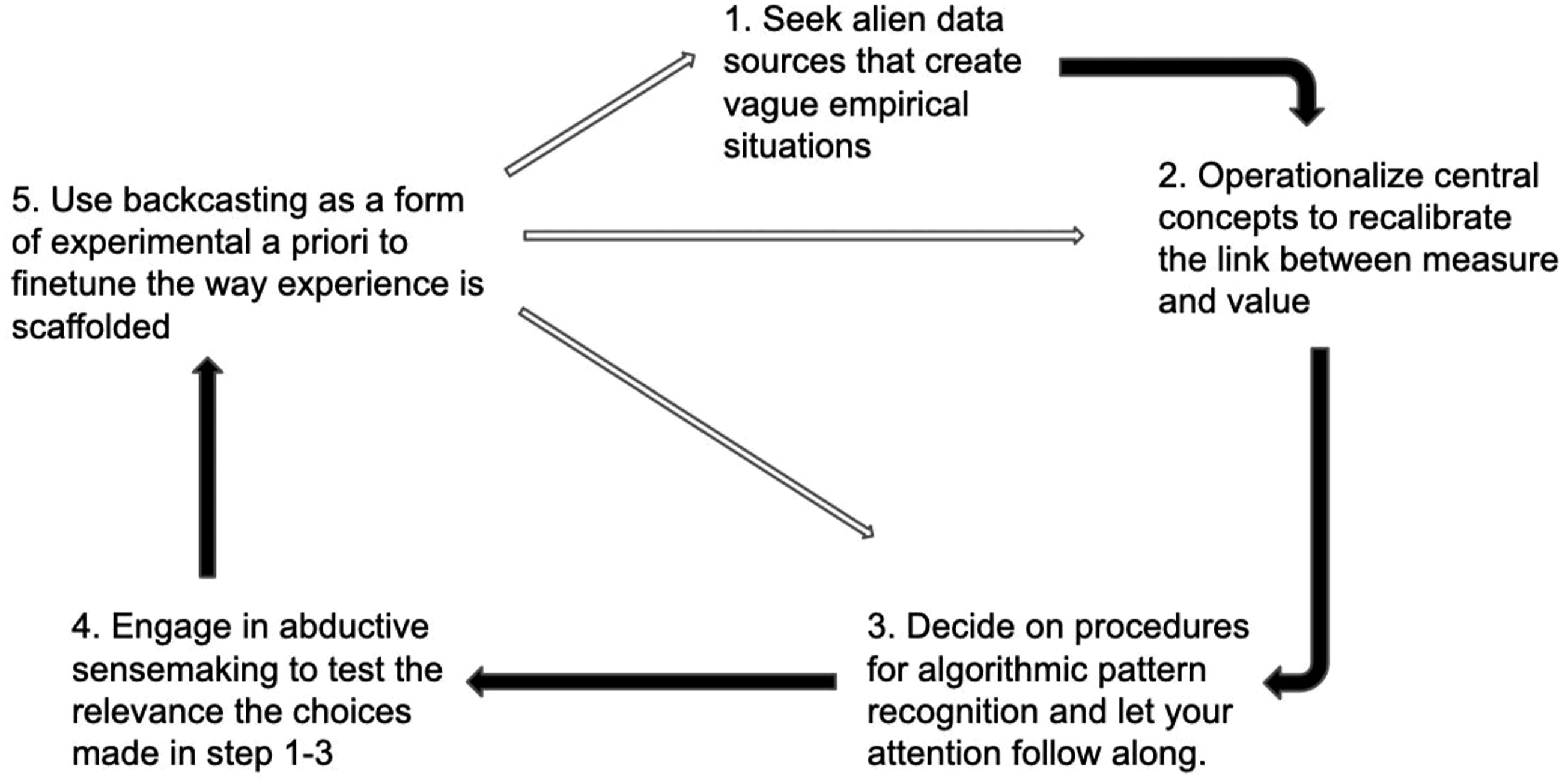
I see this work on experimental a priori as continuing important work in digital STS that has, during the last decade, engaged in discussions about how the digital reconfigures problem spaces and how to design sprints to enable people to engage with the digital. The suggestion to think about digital methods as experimental a priori focuses on the process of enquiry that gives birth to the representational artefacts that are later circulated. This is a quite different take on critique than the one emphasised by theoretical approaches that focus on the circulation, uptake, and effects of the outputs of data projects (see e.g. Latour, 1986; D’Ignasio, Klein, 2020). Whereas such approaches often conceptualise data and visualisations as tools of persuasion that can be used to empower or marginalise specific worldviews, the kind of critique I propose here approaches them as epistemic tools that can guide thinking in critical or uncritical ways. This is a perspective that not only has relevance for STS but also for the broader field of digital and computational humanities.
Footnotes
Declaration of conflicting interests
The author(s) declared no potential conflicts of interest with respect to the research, authorship, and/or publication of this article.
Funding
The author(s) disclosed receipt of the following financial support for the research, authorship, and/or publication of this article: This work was supported by the: Aalborg Universitet; Talent Funds
