




Abstract
This study uses the story completion method to explore how young people and their parents respond to online risks. During 13 family workshops with Australian participants which utilised a participatory action research approach, 197 parents and children responded to hypothetical online risk scenarios by completing one of seven story ‘stems’. Reflexive thematic analysis of participants’ stories revealed empathy and compassion for the hypothetical protagonists, as well as a range of practical, technical and discursive/communicative strategies for addressing risk. Most participants – especially children – demonstrated a pragmatic approach that drew on a range of practical skills and knowledge, eschewing sensationalised accounts documenting worst-case scenarios. This study offers insights which may inform policy and educational approaches to online safety for adolescents, highlighting a need to move beyond a deficit and protectionist approach to minimising online risks for young people, towards recognition of children’s knowledge, competencies, agency and resilience.
Introduction
A paradigm of risk and harm has long framed media discourse, education and policies related to children and young people’s use of digital media technologies (Coulter, 2020; Haddon and Stald, 2009; Vickery, 2017). This has been particularly the case in Australia ever since the widespread adoption of the Internet in the late 1990s (Lumby, 1997; Page Jeffery, 2018; Potter and Potter, 2001). This paradigm of risk and harm is premised on a presumed deficit in the knowledge and skills of children and to a lesser extent their parents in relation to online risks. Within this paradigm, children are framed as at risk and lacking the skills and the maturity to safely negotiate digital spaces (Coulter, 2020). The conceptualisation of the (imaginary) vulnerable child at risk thus justifies protection, which in practice is often exercised as control (Lumby, 1997; Third et al., 2019). Parents, while assumed to possess greater life knowledge and skills than their children (Coulter, 2020), are nonetheless frequently portrayed as being one step behind them technologically (Nelissen and Van den Bulck, 2018; Savic et al., 2016) and lacking the specific knowledge and skills to mitigate online risks despite evidence that shows varying levels of parental expertise (Livingstone et al., 2017).
A vast range of online safety programmes and resources aim to remedy this deficit by providing information about online risks and actions that families can take to mitigate them. While the paradigm of risk and harm is also common across other developed nations, Australia’s online safety regulatory and policy framework, administered by the Office of the eSafety Commissioner which was established in 2015, is especially comprehensive, providing a suite of educational programmes and resources in relation to online risks. A range of online safety programmes are also provided through schools, not-for-profit organisations, and a growing number of commercial providers capitalising on parental anxieties fuelled by media panics about online dangers. Indeed, online safety campaigns within Australia have well and truly reached ‘saturation point’ (Third and Idriss, 2013).
While there has been a shift in recent years towards greater governance of big tech and holding platforms more accountable for ensuring the safety of their technologies, responsibility for recognising and navigating online risks is still largely devolved to families. Discussions about child online safety in Australia are shifting — albeit largely in policy, regulatory and scholarly circles rather than broader cyber safety discourse — towards corporate governance of online platforms and a Safety by Design approach which demonstrates a more considered and proactive framework for online safety.
The Safety by Design framework recognises that the burden of safety should not fall solely upon end users, or parents and caregivers, and that service providers should take necessary preventive steps to ensure that their services are less likely to facilitate inappropriate behaviour (Office of the eSafety Commissioner, nd). This vision, however, remains a long way from being realised. While Australia’s Office of the eSafety Commissioner is said to have consulted with industry, parents, carers and young people to develop key Safety by Design Principles, 1 young people, despite being at the forefront of an ever-changing online environment, and their parents are still often overlooked in platform policy and governance.
The dominance of the risk and harm paradigm, which encourages protection and thus control of young people’s online practices, limits children’s ability to fully exploit the benefits and opportunities of digital media technologies, curtails their online participation and agency and compromises their ability to develop resilience and skills for effectively managing risks (Livingstone et al., 2015; Livingstone and Third, 2017; Vickery, 2017), as well as their rights to autonomy and active engagement in the digital world (Simpson, 2020). Moving beyond the risk/protectionist paradigm towards one of child agency, rights and opportunities, and parental confidence and empowerment, requires a move away from the deficit approach towards an acknowledgement of existing adolescent and parent knowledge and understanding about online risk.
Utilising the story completion method, this study seeks to provide insights into parent and adolescent responses to a range of hypothetical highly publicised online risks. It contributes to existing research by providing insights from the uniquely Australian perspective. The findings and insights have the potential to increase the relevance and efficacy of online safety initiatives, resources and policies aimed at helping Australian families, by justifying a move away from a deficit approach towards one which accounts for parents’ and their children’s existing knowledge, skills and agency.
Literature review
Several studies show that adolescents adopt a range of ‘coping’ strategies in relation to online risks. Most of this research focuses on adolescents, with research about parents and online risk typically adopting a parental mediation theoretical approach. Relatedly, a number of studies examine the extent to which children and to a lesser extent their parents reproduce public scripts about online risks and safety which may in turn influence their risk responses.
Mass media discourses have been found to shape, sometimes powerfully, parents’ and young people’s knowledge about online safety; however, existing research yields contradictory findings. Several studies have found that young people reproduce public scripts and sensationalist discourses about online dangers. Mascheroni et al. (2014) argue that young people define, negotiate and adopt preventive measures in response to that which is socially constructed as risky and problematic. This is especially the case with high-profile risks such as online predators and cyberbullying, where young people distance themselves from their own positive online experiences to reproduce sensationalist media panics (Mascheroni et al., 2014). Third et al. (2017 and 2019) found that young people and their parents reproduce public scripts and mainstream narratives about digital technologies, focussing on the adult-centric concerns of online safety initiatives and articulating views on online safety that echo the concerns framed in the mass media. Spišák (2016) similarly found that young people internalised to an extent public risk narratives about the harmful effects of pornography which led to feelings of guilt and shame.
In contrast, Mýlek et al. (2023) found that information about meeting online acquaintances offline (a risk often framed in terms of ‘stranger danger’ and ‘grooming’) from news media and preventive programmes do not influence adolescents’ perception of that particular risk. Previous research with Australian parents found that parents are ambivalent in this regard, with some parental concerns about online risks heavily informed by mass media and popular discourse, and other parents eschewing panic discourses altogether (Page Jeffery, 2019).
A significant body of literature indicates that young people utilise various coping mechanisms when bothered or threatened by a situation. Coping can be defined as ‘efforts to adapt to stress or other disturbances by a stressor or adversity to protect oneself from the psychological harm of risk experiences’ (Masten and Gewirtz, 2006, cited in Vandoninck et al., 2013: 61). These strategies can be emotional, cognitive or behavioural responses to manage the internal and external demands of stressful situations (Skinner and Zimmer-Gembeck, 2007, cited in Vandoninck and d’Haenens, 2015).
Two distinct approaches to coping dominated the early literature: problem-focussed coping, which strives to tackle the problem directly, and emotion-focussed coping, which addresses the negative emotional consequences of the problem and attempts to evoke more positive feelings (Lazarus and Folkman, 1984, cited in Vandoninck and d’Haenens, 2015). These models, however, have attracted some criticism for their overlapping categories, and recent research has updated adolescent coping typologies, including devising those specifically adapted for online risk situations.
Online coping has been described as ‘Internet-specific problem-solving strategies children adopt after a negative experience online, such as deleting the message or blocking the sender’ (Vandoninck et al., 2013). Scholars have identified various online coping typologies, some of which have been developed in relation to distinct risks such as cyberbullying (see, e.g. Parris et al., 2012), whereas others have been applied to online risks more generally. Adolescents typically employ three types of coping strategies: (1) Fatalistic/passive/indifference – where the child does not take any action; (2) communicative – which involves talking about the problem with trusted others and (3) proactive or problem-solving, where the child takes action to reduce or eliminate harmful outcomes, such as blocking people online (Livingstone et al., 2011; Vissenberg and d’Haenens, 2020). Problem-solving and communicative strategies are considered more effective than passive strategies and have been found to be adopted by more resilient children who demonstrate higher levels of wellbeing (Vissenberg and d’Haenens, 2020). Behavioural avoidance (e.g. going offline for a while) in situations that are not extremely harmful (i.e. content risks) may also be an effective strategy, particularly if combined with communicative strategies (Vandoninck and d’Haenens, 2015). Adolescents have been found to combine two or three coping strategies, particularly problem-solving approaches, when responding to online risks (d’Haenens et al., 2013).
Studies show that adolescents are, in general, proactive in addressing online risks and are sanguine about online consequences, in many cases downplaying online risks and treating them as ‘no big deal’ (Staksrud and Livingstone, 2009; Vandoninck and d’Haenens, 2015; Wisniewski et al., 2016). Even younger children aged 6–10 have demonstrated that they are able to recognise inappropriate online content, threats from strangers and oversharing (Zhao et al., 2019). While responses to risk vary across cultures, gender and age, the most common responses to offensive online content are to talk about the problem with trusted others, delete or ignore it, block offending users, or ‘fix’ the issue (Staksrud and Livingstone, 2009; Vandoninck and d’Haenens, 2015; Vandoninck et al., 2013; Wisniewski et al., 2016). Discursive/communicative approaches whereby young people discussed their risk encounters with parents, other trusted adults and peers were a particularly common coping strategy utilised by adolescents (Staksrud and Livingstone, 2009; Vandoninck and d’Haenens, 2015; Vandoninck et al., 2013; Wisniewski et al., 2016). The current study contributes to this body of research by providing an Australian perspective on responses to online risk against a national backdrop of risk, harm and media panics about young people’s use of digital technologies.
Methodology
The story completion activity used to explore parent and child responses to online risk formed part of a larger project which ran from late 2020 to early 2022 in Australia. The community-based project took a participatory action research approach to work with families to address family conflict and concerns about digital media use. 2
Thirteen workshops involving 225 participants were held over 7 months in late 2021. Workshops brought together parents and their children, most of whom were aged between 10 and 16. The composition of families varied: in some instances, whole families – two parents and one or more children – attended; in other instances, one parent attended with one adolescent child, and some single parents attended with multiple children of varying ages – with some as young as seven. While basic demographic data were collected from participants, including their family composition, these data were used to evaluate the workshops more generally and were not matched to the story completion data.
Seven workshops were held at local primary and secondary schools, and six were held at local community centres. Workshops ranged from five to 40 participants. Participants were recruited through school letters sent home with students, school newsletters, social media pages, and local media. Child participants fell mostly in the 10–16 age-group; however, some fell outside this range. The age range of the participants at the school workshops broadly reflected the demographic and age range of that school. The design of the workshops was based on evidence from research and used a human-centred design approach involving young people, experienced educators, facilitators and researchers to maximise the opportunities for the participants to learn from each other in a ‘non-hierarchical space of dialogue and intergenerational learning’ (Third et al., 2011: 8).
The story completion method
The story completion method is a form of narrative enquiry that gives participants the opportunity to apply firsthand experiences in a hypothetical context, which in turn provides objective insights into how participants perceive their immediate environment (Lupton, 2020). Narrative inquiry is an approach to socio-cultural research that privileges the role of the story in helping people to make sense of and articulate their lived experiences (Clandinin, 2006, cited in Lupton, 2020). The story completion method provides insights into participants’ ‘lived experiences in a way that does not directly question people about their own feelings or practices’ (Lupton, 2020: 3). The method differs from traditional forms of narrative inquiry in that it creates stories about people that are not themselves but instead are fictional and asks participants to respond to a story stem rather than creating the entire narrative themselves. Nonetheless, participants must draw on their own experiences and knowledge to develop the narrative (Lupton, 2020).
The story completion method encompasses two distinct characteristics: (1) it involves the creation of fictional characters rather than solely focussing on firsthand experiences and (2) the researchers prompt participants through story stems (Lupton, 2020).Scholars have highlighted the capacity for stories to act as vehicles for an accurate representation of the socio-cultural factors that influence a participant’s predisposed value and belief system, which may equip researchers with a nuanced understanding that aids the development of strategies or interventions.
Our project devised several scenarios described within story stems, each of which depicted a child protagonist faced with a potential online risk (see Table 1). These scenarios corresponded to high-profile risks that have been the subject of media panics and online safety discourse – for example, online predators and unwanted online contact, inappropriate online content, and online bullying. Some of the scenarios were sourced from the Office of the eSafety Commissioner, and others were written by the lead author. Seven scenarios were used across 13 family workshops, with one scenario selected for each workshop based on two main factors: the concerns raised by parents in the first workshop activity which asked parents to discuss their main concerns about their children’s online activities; and the average age of the child participants. As the issues of inappropriate online content and contact were two key issues raised by parents in the workshops, these scenarios account for most story stems used in the workshops.
Online risk scenarios distributed to participants in the form of story ‘stems’.
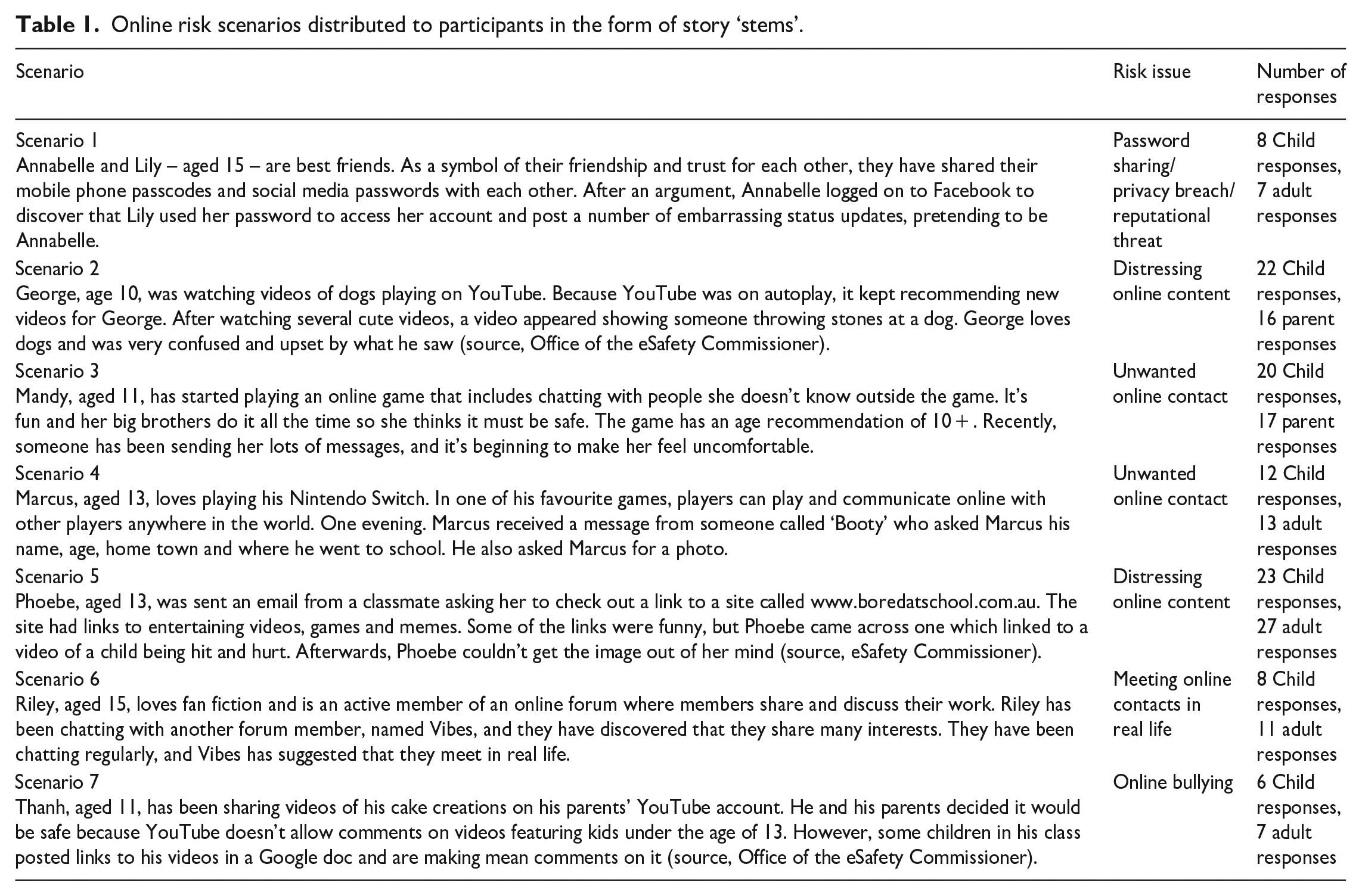
Participants were instructed to read the scenario and consider how the main character might feel and act in this scenario and finish the story in the space provided. Participants were asked to complete the activity independently but were told that they would share and discuss their responses within their family unit on completion. Parents and children were provided with the same story stems on colour-coded paper (orange for children, blue for adults). No other demographic data, such as age or gender, was matched to participants for this activity. Participants were given 10 to 15 minutes to complete the story, and another 10 minutes to discuss their responses with their families. Time permitting, the lead author then facilitated a whole group discussion.
Data analysis
In total, 197 completed stories were collected (from a total of 225 participants), 3 99 from young people, and 98 from parents. Story data were transcribed, collated and inductively analysed and coded using reflexive qualitative thematic analysis (Braun and Clark, 2006, 2021). Reflexive thematic analysis was determined to be the most appropriate method for analysing the story data, as it seeks to identify ‘patterns of meaning underpinned by a central organising concept’ (Braun and Clark, 2021: 4) and also acknowledges the role of the researchers’ subjective experiences in interpreting and analysing data. Data familiarisation and repeated analyses resulted in the identification of seven codes, with most story responses containing two or more codes (i.e. most responses documented affective responses as well as remedial or discursive strategies). These codes, set out below, were then refined to generate three dominant themes.
Findings
Participants documented a range of responses and strategies for addressing the risks presented in the story stems and demonstrated empathy for the protagonists depicted in the scenarios. Story responses were categorised according to seven codes:
Affective responses (e.g. anger, sadness, upset, worried, ‘started to cry’)
Remedial/problem-solving strategies (e.g. block content, turn off Autoplay, delete content, report them to the authorities)
Communicative/discursive strategies (e.g. tell parents or a teacher, talk to friends/siblings, ask the person to leave them alone)
Retaliative action (e.g. ‘do it back, but worse’, ‘post a mean comment’, ‘doxx them’)
Humorous/creative responses (e.g. ‘George turned to chess and became a grand master at the age of 14’).
Consequences of the incident (e.g. parents wouldn’t let her on screens anymore, friendship was over)
Lessons learned/overt advice (e.g. ‘never share passwords’, ‘play only with people you know’, ‘be more careful next time’, ‘remember Stranger Danger!!!’)
From these codes, three themes which encompass shared patterns of meaning across the data were generated: (1) Empathy and compassion: participants expressed empathy and compassion towards the character, putting themselves in the protagonist’s place and acknowledging the emotional impact of the scenario; (2) ‘Block, delete, ignore’: Participants identified potentially risky situations and demonstrated a range of appropriate practical/technical and remedial strategies in response to the issue; and (3) ‘Tell a parent or trusted adult’: Participants’ responses document discursive/communicative strategies to cope with the incident. In most cases, parents and trusted adults were identified; however, some responses named friends or siblings as potential confidantes. The three themes encompassed the first three codes which were the most prevalent across both child and parental responses. The remaining four codes were not developed into themes as they were not considered to represent shared patterns of meaning, and in many cases were scenario-specific. In many ways, children’s responses were not dissimilar to parents’; however, parental responses tended to be longer and more didactic.
It should be acknowledged that the source content – that is, the scenario depicted in the story stems – would have shaped the nature of the participant responses. A breakdown of the codes – from which the three main themes were developed – for each scenario can be found in Table 2, noting that the majority of story responses contained more than one code. While it is evident that some codes were more prevalent in some scenarios, likely due to the nature of the scenario, the three main themes were nonetheless recurrent across all scenarios.
Participant responses according to each code.
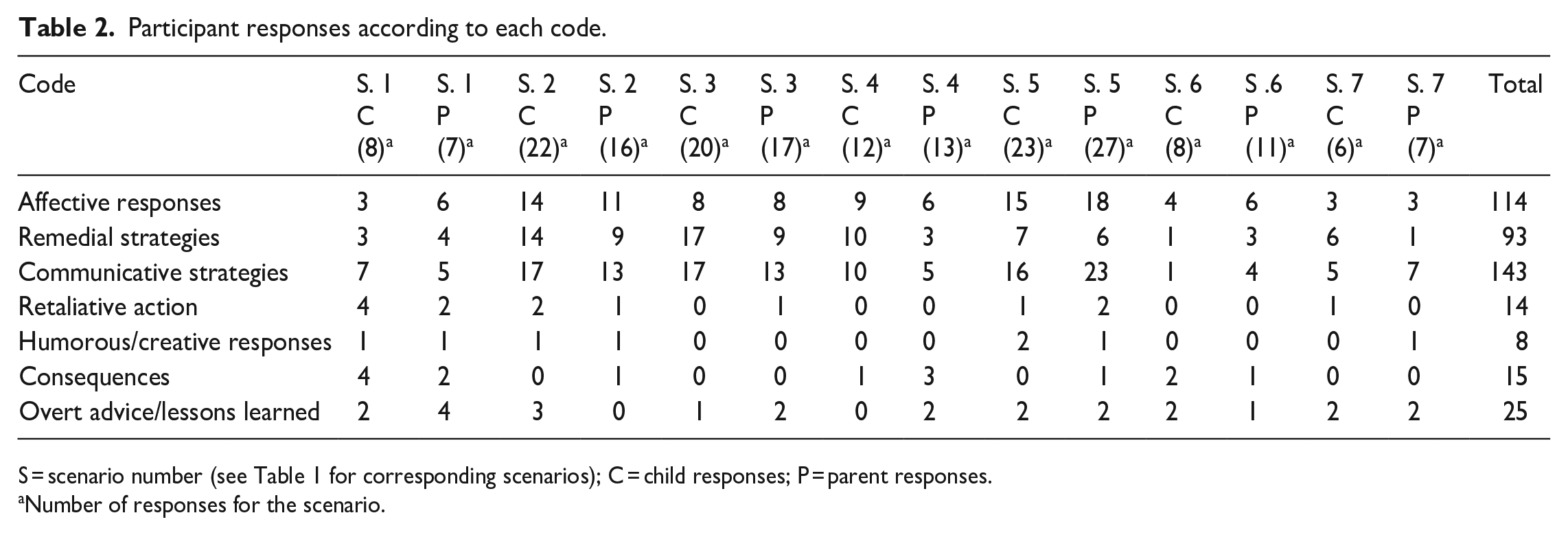
S = scenario number (see Table 1 for corresponding scenarios); C = child responses; P = parent responses.
Number of responses for the scenario.
The responses that are quoted in the section Discussion and implications have been included because they are broadly representative of a larger number of responses across the entire dataset, although extracts from all scenarios have not been included due to space restrictions.
Theme 1: empathy and compassion
Participants were asked to describe how the protagonist might feel about the situation. While participants documented a range of affective responses, including anger, betrayal and confusion (see ‘Affective responses’ code in Table 2), scenarios depicting young people encountering confronting content, or upsetting experiences such as online bullying, elicited considerable empathy and compassion. Children were especially empathetic, documenting a range of emotional responses and acknowledging the distress that may arise in some of the situations. George and Phoebe (see scenarios 2 and 5), who both encounter distressing violent content online and are aged 10 and 13, respectively, elicited considerable empathy among children.
“Phoebe felt worried. She felt like that might happen to her.” “Phoebe thought about it for days and she couldn’t think about anything else.” “[George] would feel rather upset about seeing dogs get abused like that. He would probably not feel very good and not watch any videos about dogs on YouTube for a long time . . . He would probably think is that dog ok as well.”
Most parents also expressed empathy for the protagonists, demonstrating an awareness of how upsetting some online content can be for children.
“George cried at first then became very angry. He started throwing things at the screen, hoping to defend the dog. He continued to be quite disturbed over the next few days, and behaved in ways he wouldn’t normally, until he eventually talked to his Mum and Dad about it.” “Phoebe was scared and upset. She was worried that she might see things like that again even when she didn’t want to, and she was confused because she didn’t know what links she could trust and which ones she couldn’t.”
Scenarios which depicted young people being approached by strangers online, while eliciting some affective responses, did not elicit the same level of empathy from participants, especially young people. Such responses suggest that while being contacted by strangers online may be confusing and sometimes scary, it is less likely to be emotionally distressing. Further, young people demonstrated that unwanted online contact is something that can be promptly addressed through a range of strategies (see Theme 2). See, for example, the following responses to scenario 4: “Marcus would feel confused as he just wants to play Nintendo, he wouldn’t be expecting this. Marcus would either block this user or tell an adult.” “Marcus might feel unsafe and scared. He should block and report ‘Booty’. He should tell a trusted adult, ignore the message and do things how he usually does after that (get on with his life).”
Parents’ responses were not dissimilar to those of their children and for the most part documented pragmatic responses to being approached by an online stranger. The exception was three responses in one workshop documenting worst-case scenarios where Marcus met the online stranger and was attacked, kidnapped, and/or never heard from again (see ‘consequences’ in Table 2). However, these responses were exceptional, with parents as well as their children demonstrating an apparent reluctance to reproduce panic discourses about online strangers, as the following responses from parents indicate: “Mandy would feel like this is not appropriate, and that she should not feel uncomfortable online. She could block the person from sending messages, and tell an adult that she trusts.” “Marcus was not sure about this request. Nobody has asked for so much personal information before. I ask Booty why but he would not say. I told my parents about this. After talking about it with them, I did not respond his request.”
There are clear differences in the affective responses to distressing online content and unwanted online contact. The risk of unwanted online contact, often referred to as ‘grooming’ and amplified by the mass media via its framing of the folk-devil figure of the paedophile, has received considerable media attention and been the subject of recurrent moral panics. In contrast, online violence has been given much less public attention in awareness-raising initiatives (Livingstone et al., 2014). Yet, the empathy and distress demonstrated by participants in response to violent online content, compared to less emotional responses to unwanted online contact, suggest that these scenarios may resonate on a deeper level with young people, possibly reflecting their own online experiences. Such a finding is consistent with earlier studies which have found that distressing online content, including violent content, is at the top of children’s concerns (Livingstone et al., 2014).
Theme 2: ‘Block, delete, ignore’: participants identified potentially risky situations and demonstrated a range of appropriate practical/technical and remedial strategies in response to the issue
Young people and parents articulated a range of practical, technical and remedial strategies for addressing the risks depicted (see ‘remedial strategies’ in Table 2). The most common strategies included: Delete/take down content, block offending user, report content/behaviour, ignore, switch off Auto play (YouTube), cease activity, block channel, change settings, and do something else.
Young people were succinct in articulating a range of strategies for addressing the problem, suggesting a pragmatism that was less evident in their parents’ responses and signalling that they have existing strategies for addressing risks, possibly due to encountering similar online risks personally. For example, in response to George encountering a video of a dog being hurt online (scenario 2), children offered the following strategies: “He would probably stop the video if he was feeling upset. He could report it or just not watch the video. There’s also a great app called YouTube kids, which can moderate what is shown.” “Tell parent. Block YouTube Channel. Stop watching. Find out if the video shows illegal behaviour + report it to police. Dislike it.”
In response to Mandy, who is approached by someone she does not know online (scenario 3), young people similarly demonstrated a range of pragmatic problem-solving strategies.
“Report/ban, ignore, tell a parent, don’t reply, tell an adult, block, change privacy settings, say no.” “Mandy blocks the person that makes her uncomfortable. The end.”
Far from reproducing panic discourses about stranger danger online, these succinct and pragmatic responses provided by young people may be indicative of their own online experiences, whereby risks are proactively dealt with and rarely result in harm. Parents’ responses, while similarly eschewing panic discourses, in contrast appeared more empathetic and descriptive: “Mandy tells her mum and dad about the messages and asks them what she should do. Her mum and dad read the messages and suggest she should turn off or opt out of the messaging function in the game if possible. They also suggest she moves out of that group and joins another one, or perhaps she should try to find a different game altogether where there is no chatting. If the messages are suggesting criminal acts, Mandy’s parents could contact the police to report them.” “The character would be uncomfortable, as suggested in the text. The character might first respond to the person telling them to leave her alone. If the messaging continued the character might first ask her siblings for advice/help. If the advice/help is ineffective, the character may take the issue to her parents or other authority figures.”
The range of strategies and coping responses from young people are consistent with previous studies which show that the problem-solving strategies most commonly adopted by young people are to delete content, block users and discuss the issue with others.
Theme 3: ‘Tell a parent or trusted adult’: participants’ responses document discursive/communicative strategies to cope with the incident
As many of the quotes above indicate, most responses from parents and young people include discursive/communicative strategies. In fact, discursive strategies were the most common response (see Table 2) and were usually utilised in combination with remedial strategies outlined above. Discussion with parents, or another ‘trusted adult’ such as a teacher, was the most frequently mentioned response, although some suggested discussing the issue with classmates or an older sibling. Discursive strategies were framed as being effective for two main reasons by both children and parents: to provide emotional support for the child and to help the child manage the situation and potential future situations. For example, young people’s responses to Thanh, aged 11, who experiences bullying online (scenario 7) included: “Thanh told his parents and showed them. Then they had a chat to those children and their parents. His parents then decided that it may not be safe and watched Thanh’s videos and makes sure there are no rude comments. They talked to the school, and the school decided to make a presentation about cyber safety and everything went well.” “Thanh then tells his parents. His parents tell him to stop posting videos and to tell his school teacher, so that he can talk to the kids in his class about cyberbullying. The kids are made to say sorry and his parents let him keep posting his videos after talking to the school.”
Young people’s responses to Mandy being approached by a stranger online also commonly included discursive strategies: “Mandy should tell her parents and brother. Show them the messages and report him/her. Don’t play the game. Play private servers with people you know in real life/trust. Ask her big brother what to do and their parents.”
Parents’ similarly privileged discursive strategies that also involved collaborative problem-solving between parents, teachers and their children: “Thanh felt very upset that his classmates were making mean comments. He discussed what happened with his parents and also his teacher at school. Together, they came up with a plan. The teacher made sure the other kids took down the links, removed the comments and apologised to Thanh. Thanh and his parents and teacher kept in touch regarding his YouTube and other online activity to make sure nothing like this happened again.” “She talked to her parents and her friends about the video and how it made her feel, and that made her feel better. She also talked to them about how she might be able to recognise sites that could have things she didn’t want to see and which sites she knew she could trust.”
The dominance of discursive strategies in both adolescent and parent responses is not surprising given that discursive/communicative strategies are a commonly cited coping strategy for young people experiencing online risk (Staksrud and Livingstone, 2009; Wisniewski et al., 2016). In addition, the workshops were promoted as ‘facilitating discussion between parents and their children about online risks to reduce family conflict’, priming participant expectations about the purposes of the workshop. Parents and their children were also given the opportunity to discuss their responses as part of the story-completion activity. As such, there may be a degree of performativity and ‘telling parents what they want to hear’ with each party reproducing cyber safety scripts such as telling a trusted adult. Yet, parents and their children may have also used the activity to signal to each other a willingness, or an invitation (especially on the part of parents), to discuss online safety issues when they arise.
Discussion and implications
This study contributes to the existing literature about parent and child responses to risk, confirming some previous findings but providing additional insights. First, it was evident that there were not significant differences between adolescent and adult responses to online risks, with both groups demonstrating that they are able to identify online risks, foresee potential consequences and demonstrate appropriate online safety knowledge and skills. The following discussion focuses predominantly on adolescent responses, as it is they who are assumed to be most lacking in knowledge and skills, and as such subjected to greater protection and control.
Consistent with previous studies, adolescents in this study were sanguine about online risks and deployed problem-solving/remedial strategies and discursive/communicative strategies to mitigate online risk (Livingstone et al., 2011; Staksrud and Livingstone, 2009; Vandoninck et al., 2013; Vandoninck and d’Haenens, 2015; Vissenberg and d’Haenens, 2020; Wisniewski et al., 2016). Adolescents thus employ a combination of both problem-solving coping to tackle the problem directly, and emotion-focussed coping to minimise the negative emotional consequences (Lazarus and Folkman, 1984, as cited in Vandoninck and d’Haenens, 2015). Adolescents in this study similarly deployed multiple coping strategies in response to online risk (see Vandoninck and d’Haenens, 2015) and the combination of problem-solving/remedial strategies with communicative/discursive behaviours are demonstrative of adolescent resilience (Vissenberg and d’Haenens, 2020).
Contrary to findings from Third et al. (2019); Mascheroni et al. (2014), but consistent with Mýlek et al. (2023), there was little evidence of adolescents reproducing panic discourses about online risk, although parents were slightly more ambivalent in this respect, with a small minority documenting worst-case scenarios. In eschewing panic discourses, adolescents instead portrayed the child protagonist as one who is both capable of recognising and addressing online risk but at the same time emotionally vulnerable to distressing online content and upsetting online situations. It is possible that through their responses, which were shared with their parents during the workshops, adolescents were constructing their own counter-narratives in direct response to adult concerns, actively resisting common portrayals of young people as victims (Buckingham and Bragg, 2005). Adolescents did, however, appear to reproduce common online safety narratives in some of their responses, drawing on commonly cited strategies to mitigate risk including telling a ‘trusted adult’, terminology which is suggestive of public cyber safety advice, and also in some situations, providing ‘overt advice’ and ‘lessons learned’ (see Table 2). This is perhaps not surprising considering that the scenarios depicted in the story stems could be interpreted as reproducing, to some extent, public scripts. Through their responses, adolescents appeared to simultaneously reject sensationalist panic discourses but embrace some cyber safety discourses, signalling their own experiences and competence to their parents.
The present study also reveals that different scenarios elicit their own nuanced responses demonstrating varying levels of affective intensity. The response of retaliation, for example, while not prominent enough across all scenarios to be explored as a theme, arose in relation to some scenarios and also highlighted an emotional intensity related to friendship and betrayal that was absent in scenarios depicting contact from online strangers. While it is beyond the scope of this article to explore this further, future research might examine the online behaviours and situations that upset young people the most.
The present study shows that children are able to recognise and, in theory at least, mitigate online risk. This is no guarantee, however, that they will enact the various strategies that they described if personally faced with such a risk. Third et al. (2019) drawing on Herring 2018, note that young people navigate a ‘dual consciousness’ where they attempt to reconcile what they know from online safety education and discourse with their own experiences of navigating online risks. This duality produces ‘contradictions between what they know they should do and what they want to or can reasonably do’ (p. 38). Furthermore, the semi-public nature of the family workshops likely led children to perform online safety knowledge and competence for their parents, as well as the authors delivering the workshops, drawing on multiple sources including online safety education delivered via schools and parents, as well as public scripts. Children are well aware of the public debate that plays out in relation to their media practices, and this inevitably shapes the responses that they give to parents, researchers and other authority figures (Buckingham and Bragg, 2005).
Indeed, the possession of particular knowledge and theoretical skills do not necessarily translate to correlative behaviours. Adolescence is characterised by self-discovery, identity-seeking, growing independence, increasing autonomy and risk-taking (Arnett, 2014; Strasburger et al., 2009). Young people, despite comprehensive knowledge of online safety, may still take risks online. But protectionist approaches premised upon an assumed deficit in adolescent knowledge and skills that constrain young people’s agency and autonomy thwart their ability to develop the online skills and resilience that are needed to navigate and thrive in the digital world.
Parents nonetheless play a critical role in supporting their children to navigate risky online situations. While this study indicates that young people know more than they are given credit for, the strong affective and empathic responses from young people, particularly in relation to violent online content and cyberbullying, may signal that young people rely on social and emotional support from parents and peers. Parental support – both emotional and practical – availability and dialogue, as demonstrated through the discursive strategies documented by many child and parent participants, are essential for helping young people to navigate online risk and thrive in online spaces.
This study provides empirical weight to critiques of deficit and protectionist approaches to online safety by demonstrating that children (and also their parents) are aware of online risks and have a range of tools in their arsenal to navigate risky situations online. And while this awareness can likely be partly attributed to online safety resources and discourses, we cannot say with any certainty that they lead to behaviour change. Nor can we determine from this study the degree to which online safety resources and public narratives contributed to young people’s knowledge and skills in this area, compared to other potential sources of knowledge such as their peers, their own online experiences and trial and error. We suggest that young people’s (and their parents’) knowledge about online safety is multi-faceted, and likely derived from a combination of personal experience, peer and family interaction and discussion, as well as public scripts. Rather than assuming a deficit in young people’s – and their parents’ – skills and knowledge, online safety resources and programmes should acknowledge and build on them. Accordingly, we advocate for an approach which facilitates and encourages parent/child communication, not only about high-profile online risks such as those explored in this study, but also about young people’s everyday digital encounters and what bothers them online. Such dialogue facilitates ongoing support for young people, and ‘flips the script’ to enable young people to be active participants in discussions of online safety.
Conclusion
Within the Australian context where the dominant narrative about young people and digital technologies foregrounds risk, harm and panic, moving beyond protection and control towards children’s rights, autonomy and agency seems like an ambitious leap. We do not deny that the internet and other networked technologies present risks to young people. We do suggest, however, that the prohibitions and restrictions that are typically adopted in response to assumptions about young people’s lack of skills and knowledge may do more harm than good, as they limit young people’s online opportunities and their capacity for developing online skills and resilience.
Adolescents will likely continue to take risks, online and off, that belie the rational responses articulated by adolescents in this study. However, providing young people the opportunity to discuss digital technologies with their parents and other authority figures, and to share their experiences, knowledge and understanding of online risks, provides an important pathway towards recognition of young people’s knowledge and perspectives, and thus a step towards children’s agency, rights, and meaningful participation in the digital world. Further, programmes and resources that enable and facilitate discussion between parents and children about online risk, rather than providing top-down information, help to strengthen the foundations upon which parents and their children can navigate the online world together, through open dialogue, mutual availability, support, and empathy.
Footnotes
Funding
The author(s) disclosed receipt of the following financial support for the research, authorship, and/or publication of this article: This work was supported by the Australian Government through the Online Safety Grants Program.
