




Abstract
This article draws on a qualitative interview-based study and the framework of the ‘critical incident’ to explore whether, how and for whom the first year of the COVID-19 pandemic saw an increased uptake of data-driven automation in Australian newsrooms and with what implications for the field. Our findings show that, while news workers combined and adapted existing technologies to meet increased demands for rolling, data-driven coverage of the pandemic, structural and institutional factors prevented the uptake and embedding of forms of data journalism and editorial automation that may have assisted with providing more timely and effective public health information. The findings highlight the importance of COVID-19 as both an acute event and an ongoing situation that has revealed and prompted reflection on the practical and political challenges of data flows between government agencies and news organisations.
Keywords
Introduction
The global COVID-19 pandemic is widely understood to have been a driver of accelerated technology adoption in a range of sectors and everyday contexts; at the same time, key voices in journalism studies have framed the COVID-19 pandemic as a critical incident and/or critical juncture for news and journalism (Quandt and Wahl-Jorgensen, 2021, 2022; Thomas et al., 2021). ‘Critical incidents’ are disruptive events (including wars, natural disasters and pandemics) that change the regular course of actions and foster transformations in institutional fields and among societal actors (D’Angelo, 2021; Tandoc et al., 2021). Thomas et al. (2021) have outlined two (not mutually exclusive) frameworks for analysing the changes associated with critical incidents: a ‘discourse-centric’ one, where the adverse event or series of events can have an effect on meta-journalistic discourses among internal and external stakeholders (pp. 246–250), and a ‘consequence-centric’ one impacting on the introduction, establishment and cessation of journalistic practices (pp. 250–251). For example, in reference to the technological impacts of critical incidents in the United States, scholars cite Zelizer’s (1992) study of news broadcasting and the Gulf War, which showed not only how the CNN adopted new technological capabilities to inaugurate the ‘real-time’ paradigm of news broadcasting in the United States but also how it compelled journalists to re-evaluate their professional discourse. Her study also shows how particular modes of technology adoption articulated to particular reporting practices to form a kind of new logic of wartime news broadcasting.
In this article, we interrogate the extent to which the COVID-19 pandemic could similarly be interpreted as a critical incident for the digital transformation of journalism in the sense that it has accelerated the implementation of automated technologies in newsrooms. We hypothesise that the pandemic, even more so than other critical incidents prompted by acute events such as bushfires and floods (Bruns, 2020; Burgess and Crawford, 2011), might have at first been assumed to strongly influence the use of automated tools in journalism, not only because of its global geographical scale, widespread population impact and comparatively long duration but also because of its inherent data-centredness (i.e. its organisation around daily infection figures, testing regimes and vaccination rates).
To test how these assumptions compared with reality, in the sections that follow, we first contextualise our approach to Australian news organisations’ experience of the pandemic within both digital journalism studies and science and technology studies’ theories of technological change. We then discuss the design, methods and findings of a study in which we (Author 1) conducted semi-structured interviews on the topic of automation in news work with Australian news workers from a range of commercial and public service media organisations. We draw on these findings to examine the status and longevity of the pandemic as a ‘critical incident’ for journalism, paying particular attention to how news workers used automated tools and adopted data-driven practices in their daily routines, and how they interpret the meanings and implications of these changing practices in relation to the pandemic. We explore the consequential and discursive frameworks of the pandemic for professional practice, noting particularly the development of ‘data beats’ formed by the interactions and data flows among journalists and incumbent government actors, and highlight the political logics of government data supply and control and their consequences for attempts to develop automated reporting routines.
Situating the pandemic in digital journalism
From a global perspective, extant research indicates a wide spectrum of changes associated with the pandemic in news outlets and for journalists. In prominent recent special issues of journals about the transformative consequences of the pandemic for digital journalism, Quandt and Wahl-Jorgensen (2021, 2022) argue that the public health crisis associated with COVID-19 is a defining but heterogeneous moment as journalistic actors responded divergently to the political, economic and social challenging contexts and specificities from country to country and region to region. These differences can be assumed to be partly due to the structures and arrangements of institutional power, as well as the structures and cultures of the news industries, within those societies. For example, in each case, different institutions (governments and corporations) in different political systems variously enabled or controlled the press’s access to data and maintained the public health response to varying degrees (Papadopoulou and Maniou, 2021; Wu, 2021). In addition, scholars (Perreault and Perreault, 2021; Quandt and Wahl-Jorgensen, 2022) point out that COVID-19 required news media actors themselves to address the proliferation of mis/disinformation and accordingly to reconsider their relationship with governments (as information providers, coordinators of the public health response and powerful institutions who must be held to account). The spread of problematic information that accompanied COVID-19 more broadly triggered new questions about the role of data and information in responsible reporting. The daily ‘data rituals’ (Burgess et al., 2022) of press conferences and web updates reporting on infection and vaccination rates presented opportunities for journalists to help the public interpret and make sense of the data deluge (Pentzold et al., 2021), creating a central role and quotidian rhythm for data journalism, normalising it far more than it had previously been. Finally, as in other white-collar professions, COVID-19 prompted (or, perhaps, accelerated) a shift to remote ways of working and the configuration of ‘virtual newsrooms’ (García-Avilés, 2021).
Based on this background, we can assume the Australian experience of COVID-19 has particular characteristics in regard to the development of data journalism and news automation, and it has not been studied up to now. Before COVID-19, the country had been characterised by its relatively early and effective responses to acute events of similar magnitudes, such as bushfires and floods (Shakespeare-Finch et al., 2020), in which data were a crucial resource for the government to manage and mitigate the impacts and for news organisations to coordinate public communication around them.
Despite the primacy of data to reporting on these extraordinary ‘acute events’, studies conducted shortly before the COVID pandemic seemed to indicate that the practice of data journalism was in decline following an earlier period of enthusiasm, with the exception of a small number of organisations who had established in-house teams with the skills and workload dedicated to this work (Wright and Doyle, 2019). Among those data journalists, the use of automated visualisation tools was relatively popular with a tendency towards mixed in-house development and commercial software uses in public service media and commercial software in private news outlets (de-Lima-Santos et al., 2020).
As has been well-established by science and technology studies, innovations generally become embedded only once they become regularised in practice and diffused throughout organisations or societies (Edgerton, 1999). Existing international research in journalism studies suggests that the organisations that succeeded in automating COVID-related news had prior experience in the process, and so their news workers (journalists and developers) already had computational literacies and a predisposition to wrangle data and develop automated and artificial intelligence (AI)-enabled tools (Danzon-Chambaud, 2021). Generally, particular kinds of news organisations, particularly those with global reach and/or very high volume (such as wire services), tend to be the ones that have developed with some degree of success this new model of automated news generation (Beckett, 2019; Diakopoulos, 2019; Dörr, 2016; Graefe, 2016; Linden, 2017). However, given the strong and persistent discourse around the link between COVID-19 and digital transformation more broadly (Amankwah-Amoah et al., 2021), it is understandable that industry observers and researchers assumed that COVID-19 would accelerate the adoption of such tools and data-related organisational practices in a wider range of news organisations (Pentzold et al., 2021; Quandt and Wahl-Jorgensen, 2022; Tong, 2022).
As we said before, the pandemic’s features may have accelerated the use of automated central tools in Australian Journalism. These characteristics include its prolonged duration, its wide geographical scope, its broad impact on the population, and most importantly, the fact that several institutions tracked its progress through daily COVID-19 data (e.g. infection figures or vaccination rates). This might explain why the pandemic increased the adoption of journalistic automated tools more than other critical incidents, such as bushfires or floods (Bruns, 2020; Burgess and Crawford, 2011). In the remainder of the article, we draw on our study of Australian news workers’ experiences of automation during the first two years of COVID-19 (2020-2022) to examine whether and to what extent this was the case.
Study design and methods
The analysis below is extracted from the findings of a larger study that aimed to map the types of automated tools used in editorial processes, and the practices and editorial shifts associated with their implementation, in Australian news organisations. This exploratory research exercise aimed to inspect the use, appropriation and creation of in-house or commercial software for news reporting, writing and distribution to the design of machine learning algorithms and other kinds of AI tools involved in those journalistic workflows.
The primary data collection instrument was semi-structured interviews (Bailey, 2007), which allowed us to adapt the design and sequence of questions according to participants’ positions within organisations (whether working as reporters, editors, audience editors or developers) and the kind of organisation (public service or commercial). The design of the questions was grounded in a background environmental scan designed to map the tools and data-driven routines for every editorial stage, supported by the extant research on journalism and automation, and we explored the use (or not) of these specific tools and techniques with participants. The interviews also explored general questions on current issues in the development of data-driven practices and automation (i.e. data availability or scarcity, problems with journalistic and programming skills, work and replacement, potential codes to treat data and automation and ultimately perceptions of automation’s role in journalism both now and in the future). In total, we (Author 1) conducted 17-hour-long Zoom interviews on the general topic during mid-late 2021 and extending into early 2022. To recruit participants, we approached participants based on a purposeful sampling method (Palinkas et al., 2015), choosing practitioners who were most likely to be working on a daily basis with automated technologies or working on topics the existent empirical research suggests are more disposed to be automated in the immediate future (i.e. sports, finance, weather and breaking news); additional participants were then recruited via referral (the snowball technique).
Within these parameters, we approached approximately 100 news workers in total; of these, 17 people based at 11 different organisations agreed to participate and were interviewed. Some participants chose to be personally identified in research publications (including this one), while others preferred to remain anonymous. Their ages ranged from 25 to 56 years old; 14 identified as male and 3 as female. Slightly more than half of the participants (10 of 17) were journalists or data journalists; the sample also included four audience engagement or social media editors, two editors and one journalist/web developer.
The participants worked for a variety of public and commercial outlets distributed throughout Australia’s states and territories (each of which experienced the first stage of the pandemic differently, due to federal Australia’s system of government under which states have responsibility for and relative autonomy with respect to public health and safety measures). These organisations ranged from national public service media (ABC News and SBS News), to commercial broadcast media (10News First), digital-only outlets (Crikey), legacy national or state-level print outlets (The Guardian Australia, The Daily Telegraph, The Age, The Courier-Mail and Brisbane Times), local outlets (The Courier in Victoria) and a national news wire service (Australian Associated Press). Wherever interviewees preferred to remain anonymous, we have also not identified the outlet.
For the first phase of the interview analysis, Author 1 used NVivo to cluster the interview responses according to the basic topics suggested by the questions. In doing so, we observed a recurrent cross-cutting theme around the role of COVID-19 in digital transformation and decided to explore this theme in depth. We identified more than 60 instances where the pandemic was mentioned as part of the current hurdles and factors associated to the development of automated tools and data-driven practices and part of the pressing routines quoted by the participants. Based on these references and the theoretical categories outlined by the studies on critical incidents in journalism (particularly Thomas et al., 2021 idea of ‘consequential’ and ‘discursive’ frameworks), we developed the following thematic analysis.
Consequential dimensions of COVID-19
As a critical incident, the pandemic’s consequential aspects were felt particularly acutely during the first year. When interviewed via Zoom during the second half of 2021, most of the participants were still working predominantly from home, especially in Sydney and Melbourne, the two cities most deeply affected by outbreaks and prolonged lockdowns. The interview data show that respondents referred to COVID-19 in instances that illustrated daily routines in relation to data handling, the use of data visualisations, general automated tools used in the newsrooms and metrics and audience data behaviour, as well as topics such as data availability in Australia. Taken together, the interviews suggested that the landscape of newsrooms had been transformed due to practices of remote work. As news workers had to work from home, they depended to a greater extent on digital spaces and social media for reporting tasks and relied on quantitative COVID-19 data from a wide range of Australian and global government and non-governmental organisation sources that tracked the evolution of the virus, its spread, waves of infection and subsequently the vaccination rollout.
The first observable consequential level: disarranged routines
The first disruption caused by COVID-19 was the disarrangement of news workers’ routines, coinciding with changes in their workplace. Most respondents mentioned that they had to produce content in relation to the pandemic at some point and that COVID-19 dominated their work agenda, with higher than usual demand for information, and long stories published over the weekends and reports each weekday. During 2020, emerging coronavirus topics shaped coverage and routines, and participants described it as a ‘tumultuous’, ‘messy’ and an ‘odd situation’. Aside from on-the-ground reporting, online monitoring was critical, especially as human contact was limited. Analytics software, social media listening tools, search engines and news wires services were essential to observe trends and track conversations. When asked in the interviews about the most popular stories at that time (based on these metrics), all participants emphasised that coverage of the pandemic was the content that most captured the audience’s attention and therefore dominated journalists’ routines.
Obviously, the Coronavirus has been a massive story for the last 18 months or so. Stories about COVID-19 have typically been the most popular stories, it’s been quite difficult for stories about anything else to get much play (Participant C, Public Service Outlet 1).
The high levels of audience interest in the pandemic demonstrated by the metrics and dashboards resulted, for several of the public service and commercial outlets workers, in the requirement to step up efforts in understanding the type of information that diverse audiences were looking for and refining the coverage and output accordingly, in increasingly granular ways. This day-by-day tracking of audience interests was crucial to propose editorial angles and balance the agenda with other stories during 2021 as there was a sense of COVID-19 information saturation and ‘depressing news’, as reported by two participants. The resulting pandemic stories did not only revolve around the numbers and the COVID-19 quantitative data outbreaks but also combined the more human-interest content associated with the virus. For example, following up on audience interests inferred from web metrics and social media algorithms, some outlets focused more on issues such as vaccination effects and women’s health. Other metrics such as geolocation data allowed journalists to produce personalised stories during the lockdowns, for example as described by one of the participants providing information on ‘where readers could physically exercise, go out with children, visit families and friends or to walk their pets’: We try to break it down to that level and try and talk to them that way and then also try to come up with more relatable ways into those news stories, because otherwise you are just reporting case numbers every single day (Wade Shipard, 10News First).
Many of the journalists we interviewed said that they had to cover new topics and draw on new data sources that ranged from metrics to structured and geolocation data, and all participants dedicated at least one of their everyday stories to cover COVID-19, regardless of their regular news beats.
I generally do one story a day, and then on Thursday and Friday, sometimes, depending on COVID-19, I get to do my own stories and like more original features (Participant A, public service outlet 2). My days consist mostly of day-to-day breaking news. I guess in COVID, and bushfires before that, my kind of work was mostly breaking stuff. By breaking I don’t mean like physically breaking. I mean, like breaking news. News as it comes in (Participant B, public service outlet 1).
In different ways, but irrespective of the nature of outlets (public or commercial), the interviews showed that journalists felt their jobs had taken on new objectives and logics and that they had to get involved in implementing the strategies rapidly developed by their news organisations to keep pace with the newly imposed pandemic news cycles. This changed the practices that formed their everyday work, whether integrating carefully tailored COVID-19 explanations to ward against the increase of mis/disinformation, as some other participants reported, or simply engaging in new and more intensive ways with data to inform their reporting. As a consequence, many participants felt that the pandemic had forced more journalists to become familiar with data-driven storytelling and that data journalism skills would become more necessary to the profession over time. In general, the disarrangement of routines is evident in how the journalists frame their daily tasks in terms of ‘before’ and ‘after’ COVID-19 and in how they refer to the pandemic as a key moment that revealed how quickly data journalism was evolving. As one reporter at a public service news organisation observed, ‘I think [data journalism] is probably an area that’s developing and that we should pay more attention to’. This was a commonplace narrative among participants and represents a discursive and practical shift from data journalism being a niche pursuit to one that, as an inevitable consequence of data abundance and high informational demand, was now becoming a mainstream requirement of journalism practice.
The second observable level: internal decentralised data practices and increased automated data visualisation
Four participants in strategic positions within both commercial and public service organisations referred to automated data visualisation processes as being particularly significant during the pandemic. With the amount of data produced by the pandemic during its most eventful months, there was a perception that continuous automation and assemblages of data feeds forced journalists to be more aware of and engaged with data-driven content, spreadsheets and the particulars of extracting and visualising data. Even though in some organisations visual automated techniques were already in use by data journalists and programmers and were deployed in reporting events such as bushfires, floods or political elections, during the first year of the pandemic, the editorial staff was compelled for the first time to work to a greater extent with datasets and to deliver the main COVID-19 statistics in the form of infographics. The visualisation software packages most frequently named by participants were Infogram, Data Wrapper, Tableau, Flourish as well as Java Script and D3 open libraries, used to customise charts, tables and other infographics and integrate them with the publishers’ content management systems.
One of the participants in a commercial outlet that is a leader in data journalism explained that, before the pandemic, only a specialised team produced and oversaw graphics and visualisation tools. However, once the COVID-19 geolocated tracking system developed by the John Hopkins University in the United States became quite popular and updates were frequent and accurate, developers and designers innovated with the creation of a tool of pre-set graphics for the outlet that fetched the John Hopkins data systems to keep up with updates.
[The tool is] helpful. There’s a way to build a timeline where we don’t have to ask them [the visualisation team], or we could ask them to do very minimal work on it. So, it sort of devolves the content or the visualisation making to us. That is, to me advanced, because only a couple of years ago, they probably wouldn’t have had the rest of the newsroom have that access. But now it’s sort of becoming so commonplace and accepted that people look for these sorts of tools (Chris Zappone, The Age).
Contact with structured data and access to visual tools led to familiarisation with these data pipelines, which allowed news workers to develop COVID-19 visual storytelling and work more independently with the dynamic dashboards that automatically updated data in cities like Melbourne. A similar example of automated data visualisation in Brisbane was referred to by another participant. Participant E noted they received data feeds from Queensland Health authorities therefore journalists’ workload was focused on minor manual data verifications.
We are collecting data, and it’s feeding into infographics. I’m sure that does require a bit of manual entry. That’s not just coming straight out of the government’s feeds, for the most part. I think the contact tracing sites automatically feed to our site from Queensland Health now, and in elections, it’s the same thing. In things where there is an established dataset that’s public, I think that’s where you don’t really need a person. If the government can provide you with the RSS feed of the information, then putting that automatically into an easy-to-read infographic is much better than a person punching it in there manually (Participant E, commercial online outlet).
However, during the course of the first wave of the pandemic, problems emerged with a lack of openness in data sharing on behalf of both federal and state government health authorities, resulting in information being provided in PDFs rather than structured data formats, for example. We explore in the next section how the paradox of data abundance combined with ambiguous openness limited the possibilities for some outlets to develop more standard automated models of news production.
The third level: going beyond ‘the proof of concept’
Automated news writing has not been prevalent in Australian newsrooms to date. The lack of skilled personnel and challenges with data supply have made it difficult for many organisations to engage with even semi-automated news writing, let alone embark on more sophisticated AI-enabled techniques such as natural language generation (NLG). The health crisis pressed journalists to face the difficulties of data processing during the first years of the pandemic with the laborious tasks of data transformation: converting PDF bulletins into structured data and cleaning errors manually. Only two major news outlets tested the implementation of semi-automated news (using manual templates and automatically filling with figures the text blanks without any use of AI) based on previous experiences in scraping data or in creating open software to automate news writing.
The Guardian Australia, an outlet that had previous experience designing a ‘robot journalist’ (Evershed, 2019), tested these functions by translating COVID-19 breaking news and statistics into machine-readable information. One journalist explained that a whole new assemblage was needed to deal with the amount of data produced by the event.
Getting the data has just been a nightmare. Until very recently (we’re talking maybe a week and a half, two weeks) there was no data coming from the government in a machine-readable format. It was all in PDFs that were constantly being changed. So, there was this kind of ecosystem built up. There were some data journalists. There were some technologists. There were hobbyists, working on cleaning a lot of this data and getting it into a usable format (Josh Nicholas, data journalist, The Guardian Australia).
While The Guardian Australia (known as an innovative organisation with respect to data journalism) implemented automated data visualisation, they found it challenging to standardise computer-generated texts during the pandemic. Nicholas was experimenting with ‘taking in daily COVID-19 data and [filling in] the blanks’. However, even though COVID-19 data outputs met most of the conditions required to develop in-house automated content, textual automation was not feasible. The use of AI for automated text generation is appropriate for very specific genres as operated in other global news organisations such as sports scores and financial reports. However, ‘even if it’s something which is not hardcoded, it is not malleable enough for a very fast-moving environment’, according to Nicholas.
On the other hand, Nick Evershed, data editor of The Guardian Australian and the programmer of its first automated news in 2019, noted that obstacles to implementing text automation under COVID-19 circumstances had to do with both the human resources required for, and the technical barriers to, the implementation. ‘It’s easy to automate stuff going onto other people’s websites like a WordPress site or something like that, but to do it onto our site, it would have to be done through an iFrame, which is not ideal’, explained Evershed. In the industry, this HTML tool is commonly used in digital journalism to embed content (either text, video or images) within a website (Juviler, 2022). As for the 2019 first open-source experiment on financial automated news called ReporterMate, ‘it was more a proof of concept, and I was interested to see how it worked, if it would work and, if other people were interested in using it’. These bottlenecks led Evershed to question whether there was a ‘real need’ for automating text.
Participants from Australian public service media organisations reported that they did manage to create, and (for the first time) centralise, a more sustained semi-automated news writing model in the organisation’s Sydney headquarters. To deal with the amount of information and numbers generated by COVID-19, the data team suspended their regular tasks and turned their attention to the problem. The resulting assemblage had two primary phases: (1) scraping data feeds to automate data extraction from official COVID-19 statistics websites and converting the data format to Google Sheets or Excel and (2) automating the population of report or story templates.
The scraping part of this turned out to be challenging. For more than a year, governments delivered the statistics not as structured data files but as text in PDFs; in response, the developers and journalists needed to find workarounds that enabled them to automate the extraction of statistics from official tracking websites and data feeds. ‘So, there’s that side that’s automated. Some of that comes from APIs or from scrapers, or from JSON feeds or whatever. And then that data is fed into the story template, . . . to power the charts that are made’, explained participant G at the Public Service Broadcaster (see Figure 1).
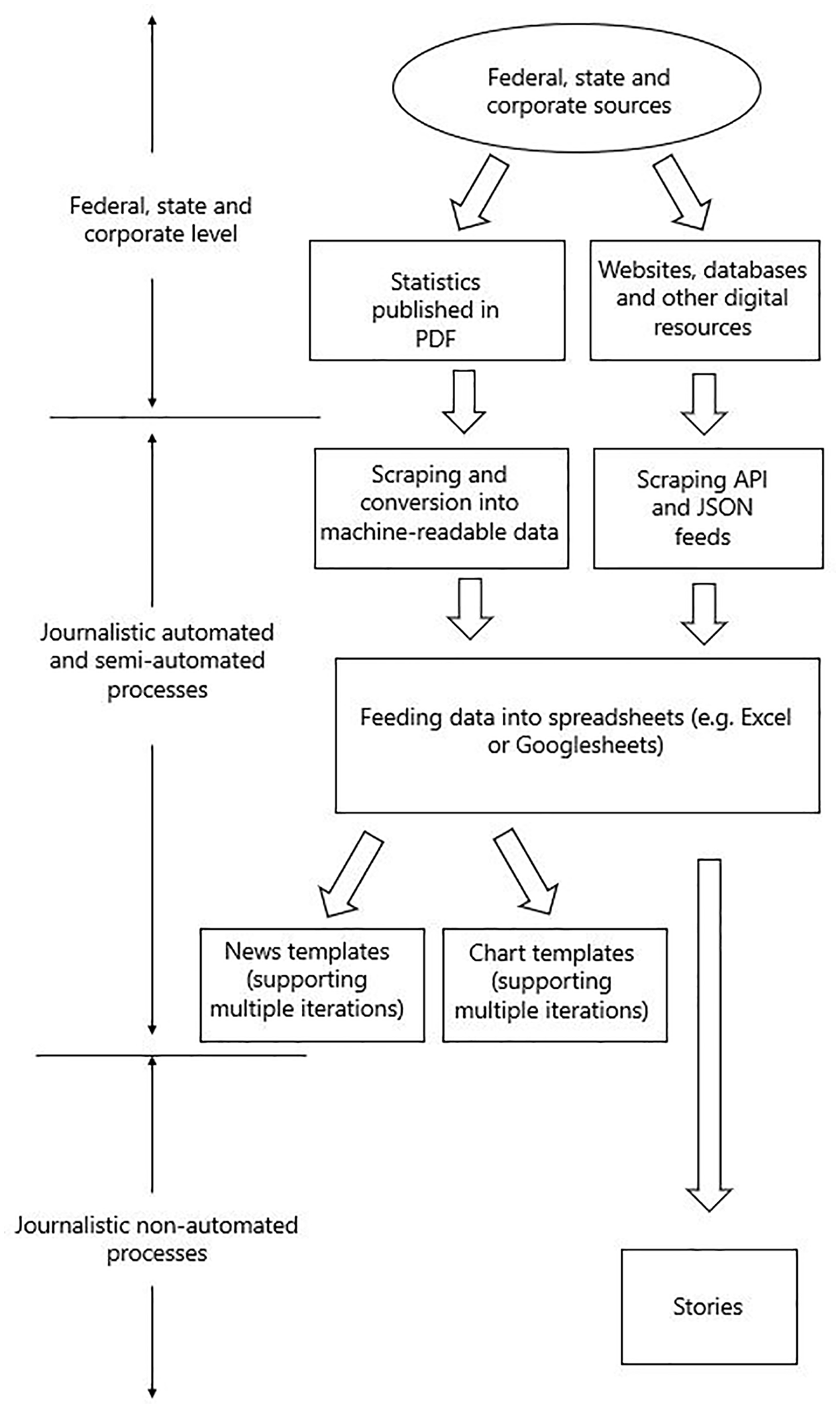
The formation of ‘data beats’ for COVID-19 reporting.
Second, journalists intervened and ended up automating text writing with the use of iterative language templates. The participant manually created different templates customised for different cities, states and territories. Based on these templates, the developers ‘picked out the bits’ (parts of the text) to automate. The participant explains the process of journalistic intervention in conceiving different versions: You had to think through all the iterations, of what could possibly come out in these sentences to make sure they make grammatical sense. So that’s how we’ve used automatic writing the most. So just to fill in the blanks really (Participant G, Public Service Outlet 1).
The consistent, trustworthy data flows necessary to develop automated news production in topics such as public health depend not only on the commercial stakeholders and vendors already associated with the news and media industries but also on governments’ bureaucratic infrastructures – forming a ‘data beat’. As outlined by Fishman (1988: 29) in his account, news beats are defined as ‘an object of coverage’ with thematic continuities and ruptures defined by an institutional source. A ‘data beat’, then, is a news beat structured around a data feed provided by bureaucratic actors underpinning the making of data-driven pieces, including computer-generated news, automated infographics and charts and other manually-written thematic stories. Reliable, transparent ‘data beats’ benefit from the rhythms of well-functioning bureaucracies that can (and arguably should be required to) deliver to news organisations information of the required ‘scope, variety, dependability, and quantity’ for daily reporting in a ‘scheduled, predictable, way’ (Fishman, 1988: 143).
The successive adjustments of COVID-19 data delivery techniques by state and federal government sources in 2021 and beyond already suggest that COVID-19 has prompted some transformation of the relationship between official information sources and journalists. While there is not enough space to explore the causes in depth here, we might speculate that these changes relate to data governance and sharing reforms implemented by countries of the Organisation for Economic Cooperation and Development (OECD, 2021) of which Australia is a member. In addition, the Australian Government’s Data Strategy 2022 provided additional budgetary resources for enhancements to data quality and access, including relevant national data repositories (Department of the Prime Minister and Cabinet, 2022; digitaleconomy.pmc.gov.au).
The existence and practice of data beats, however, is an insufficient condition for deeper adoption of newsroom automation, particularly of the kind implied by the hype around the use of AI in journalism. As suggested by The Guardian’s Nicholas, advanced automated news models built around data feeds would need far larger and more interested publics to justify the necessary investments. This was somewhat echoed by the Crikey audience editor, Imogen Champagne, who observed that, in her experience, public interest in COVID-19 news and stories declined in 2021. Stories on politicians and corruption generally attract large numbers of readers on Crikey, she said. While, in 2020, more general pandemic stories had garnered good levels of engagement as well, by 2021, Champagne was observing that ‘COVID only goes well if it’s a mistake, if we’re talking about the vaccine rollout, and how that was bungled, if we’re talking about Gladys’ [Berejiklian – the then-Premier of the State of New South Wales]. This year COVID stories, just like basic information about COVID, don’t go so well’. Also, readers appeared to be ‘fatigued’ with and to be avoiding pandemic information, as Participant H from a public service outlet suggested – a phenomenon that was also observed in the 2022 Digital News Report (Newman et al., 2022). The agenda was more diverse in the second year of the pandemic, apart from content that was related to major political controversies around the premiers’ pandemic management, as Champagne mentioned. Taking all these variables together, the full institutional embedding of automated news writing would take far more than a single critical incident, even for outlets with existing data journalism capability.
Structural obstacles to news automation
In emergency situations involving a public response (such as the COVID-19 pandemic or natural disasters), Australian news outlets generally depend on the data provided by government actors; and governments depend on the media to help coordinate public communication. Such public interest data are also a promising basis for journalistic investigative work, but this promise is not without challenges, as, despite the decades-old ‘open data’ movement, most government actors continue to use data as a tool of power and control (and this is true in Australia as elsewhere, see also Wu, 2021). The pandemic has indeed been a critical incident in that it intensified journalists’ relationships with data and provoked shifts in some journalists’ attitudes with respect to data literacies and skills. It has also been a critical incident in that it highlighted significant challenges, all of which relate to the role of government agencies as data controllers. These are discussed below as challenges with controlled access, timing and formats.
In terms of controlled access, when exploring what it meant for news workers to work with data and the characteristics of the Australian data environment, participants frequently praised the work done by entities such as the Australian Bureau of Statistics (ABS), framing it as a primary, high-quality source for data journalists. Most participants recognised that the institution facilitated the task of journalists and that especially in situations such as COVID-19, ‘sometimes they will provide the visualisations for us’ (Caleb Cluff, The Courier in Victoria) or ‘that is more open access to data than ever before’ (Participant G, public service outlet 1). Nonetheless, the possibilities of better access to datasets are limited by budget constraints in the last 15 years as pointed out by Evershed from The Guardian who has covered it as a source. In addition to the lack of financial support for modernising data delivery, shortcomings may also be attributable to the desire to retain institutional power in an environment where control over data and statistics increasingly confers authority.
There’s still a real sense among authorities, government and companies that controlling access to the data are still about controlling the messaging and the story (Participant G, public service outlet 1).
Statistical information served as a key resource for the government in developing, justifying and reporting plans of action for lockdowns, travel restrictions and in consequence policies about economic support for Australians affected by the labour crisis during the pandemic. Government and key actors holding power over any kind of data perceive sharing data meant (and still means) to lose control. ‘The pandemic, in particular, has highlighted that there’s still resistance at the highest level to the timely release of important data in a way that can actually be used meaningfully’ as Evershed added.
Even though journalists knew that large volumes of detailed information on many aspects of the pandemic were being gathered, newsrooms had to settle for aggregated figures. This reluctance on behalf of governments to grant full access to COVID-19-related statistics was perceived by journalists to be politically motivated. In key issues such as rates of vaccination among the population, a participant explained that the otherwise reliable government datasets lacked the granularity that should in theory be possible considering the quality and detail of the information actually held by these bodies: We get very good top-level numbers [on vaccination rates but], there is not a lot of fine-grained detail being put out, and that detail and data exist. But it’s not being collated, and it’s not being made public. It would be very valuable both for the government and for user news organisations to have that information available, so the vaccine rollout could be explained to people. These areas where we are lagging behind, these the areas where we are doing well, for various political and even logistical reasons that fine-grained data has not been made available (Participant D, commercial outlet).
These limitations amplified the feeling among the news media participants that the structural problem in access was a problem of political will as much as a technical impediment. Controlled access is also more evident with requests for data journalism projects beyond COVID-19 as one respondent noted: In terms of government, there’s like suppression of information which you can access through Freedom of Information (FOI) things so I’m sure you’d speak to political journalists, who will say that there is not enough access to data on that. Because I know sometimes it’s quite difficult, and it can be costly to lodge those requests for information (Participant F, commercial outlet).
Along with access control, participants noted problems with the timely delivery of data (timing). The control and institutional shielding mentioned by some journalists were usually associated with the conventional pace for providing data access to government datasets under the current FOI process, which most journalists considered costly in effort and time: ‘the process is very slow in Australia and quite guarded. It really does not give much room to get hold of things quickly’, reported Caleb Cluff, from The Courier in Victoria. FOI requests can take 30 calendar days or more to be processed, depending on the kind and volume of information requested, and so data-driven stories that rely on FOI requests need to be planned in advance and take substantial time to produce, even for the most experienced data journalists. The temporality of bureaucratic data delivery can conflict with daily news cycles and journalists’ needs depending on the kind of information required. Although the speed of data provision needed for COVID-19 management in turn demanded a faster pace from the ABS and health state and federal government institutions, the pandemic also uncovered problems of timeliness and outdated data delivery infrastructure.
Finally, structural issues in the control of access and timing pointed to the underlying challenges of data formats. A common theme identified by the news workers we interviewed was the way in which the different federal and health state governments disclosed data related to the COVID-19 pandemic by creating quite complicated transformation processes for newsroom teams: ‘I saw that a fellow journalist pulled statistics from a table in a video released by the federal government about vaccine numbers’, Crikey data journalist Cameron Wilson reported. As mentioned in the previous sections and the outlined particularities in COVID-19 data processing, respondents that worked most directly in producing the daily stories criticised the impracticalities of presenting information in PDFs, which required duplication of effort, as they needed to then use scraping tools to digitise the information. To automate data visualisations, journalists needed well-structured data in the form of spreadsheets or CSV files, which can be readily analysed and rendered by data visualisation software.
Conclusion
The pandemic was a ‘critical incident’ for journalism; one structured and shaped by data and automation. In the first year of the COVID-19 pandemic, government health authorities used devices and systems to collect population-level epidemiological data (Goggin, 2020; Lupton, 2021; Whitelaw et al., 2020). These data also became positioned as vital resources for public communication, emergency response and dissemination through news media. The relationships between news organisations and governments were central, as the former sought to inform a highly engaged public about the pandemic using data provided by the latter, delivering daily updates on numbers of cases, hospitalisations and deaths and (later) vaccine doses. Such forms of data-driven reporting became ritualised – that is embedded in the daily rhythms of the news and media environment and citizens’ everyday lives (Burgess et al., 2022) – in Australia as in many other countries (Pentzold et al., 2021; Perreault and Perreault, 2021; Tong, 2022; Wu, 2021). The continuous flows of data from a range of sources associated with the public health crisis, and the continuous demand for data-driven reporting, intensified the perceived need for news organisations to accelerate the transition towards automated work practices.
Given this background of digital transformation, this article explored whether the COVID-19 pandemic can be understood as a critical incident for Australian journalism, with a particular focus on its impact on data practices and automation in Australian newsrooms. We showed that the pandemic expanded data work beyond the traditional domains of data journalism and increased the interest of reporters in data as source material for their stories. Although not all journalists had the existing competencies to work with it, data flows from metrics and governmental data sources were essential for their daily news production. Indeed, much of the impetus to innovate was focused on attempts to automate tedious and time-consuming tasks in order to make sense of the data provided by the Australian authorities.
The journalists and other news workers we interviewed agreed that the pandemic had altered their work routines and that the news cycle had been reshaped by the COVID-19 data environment. Journalists attempting to expedite data processing for their stories indicated that barriers to the use of automation during the pandemic were also related to the lack of appropriate infrastructures and the absence of open ‘data cultures’ (Burgess et al., 2022) within the government agencies managing COVID-19. One of the principal issues hampering those efforts during the first stages of the pandemic was that data availability and access were politicised by the governments of the day. COVID-19 did not accelerate automation processes for news outlets, but it was the tipping point that reconfigured to some extent sourcing, supply and interdependences of informational systems with those agencies in emerging cycles of crisis ‘data beats’ as we have already discussed. It also heightened the visibility and awareness of the historical struggle for control between authorities and media organisations in a particularly acute moment of epistemological uncertainty.
Overall, while the COVID-19 pandemic can certainly be characterised as a ‘critical incident’ globally (Quandt and Wahl-Jorgensen, 2021; Tandoc et al., 2021), prompting innovation through necessity at first, the initial production conditions created were difficult to reproduce and maintain over time in Australian news organisations.
Beyond the discursive and consequential changes that critical incidents prompt in the practice and understanding of journalism, future research could pay enhanced attention to the role of structural factors, which should also be recognised as grounds to evaluate the lasting effects of these ‘incidents’. In other words, and referring to the theoretical approaches drawn from the study of technology and innovation, a look at the ‘contextual histories’ (Edgerton, 2010) of these incidents can provide the necessary grounds to appreciate the slow unfolding of technological change.
Some key limitations of this study stem from the focus of the original research project on mapping automation tools and data-driven practices in news outlets in general, rather than with reference to reporting on acute events of public concern. The framing of the study did not allow for an in-depth and comparative exploration of the increasing data use and automation techniques in recent natural disasters and environmental emergencies (the fires and floods) that had taken place in Australia in the last few years before the pandemic, and which had similarly required close-to-real-time, data-driven reporting in collaboration with government agencies as part of the public response. This particular configuration of the idea of ‘data beats’ deserves further attention and is a promising direction for future research into the relationship between critical incidents and digital transformation in journalism.
Footnotes
Funding
The author(s) disclosed receipt of the following financial support for the research, authorship and/or publication of this article: This article reports on research that was supported by the ARC Centre of Excellence for Automated Decision-Making and Society and partially funded by the Australian Government through the Australian Research Council (project number CE200100005).

Author biographies
Silvia X Montaña-Niño is a Research Fellow at the Queensland University of Technology node of the ARC Centre of Excellence for Automated Decision-Making & Society (ADM+S). Her research focuses on the role of automation, algorithms, and data-driven approaches in journalism professional practice, training, and career development, as well as strategic, institutional approaches to these emerging tools and technologies in established and emerging news outlets.
Jean Burgess is Professor of Digital Media in the Digital Media Research Centre (DMRC) and School of Communication. She is currently Associate Director of the national ARC Centre of Excellence for Automated Decision-Making and Society. Her research focuses on the social implications of digital media technologies, platforms, and cultures, as well as new and innovative digital methods for studying them. She is the author or editor of more than 120 scholarly publications on these topics. She is a current member of the ARC College of Experts, and a Fellow of the International Communication Association, the Australian Academy of Humanities, and the Queensland Academy of Arts and Sciences.