




Abstract
This article explores Chinese cross-border wives’ experiences, challenges and coping mechanisms and their interaction with the ecology and algorithm of the platform by focusing on their storytelling and practices on YouTube. Through in-depth, semi-structured interviews, narrative analysis and more than 2 years of virtual ethnography, I observed the family politics and power dynamics presented in the videos of Chinese cross-border wives. I found two types of family politics within the ‘power game’ of interculturally married families. Wives who have experienced significant domestic injustice tend to demonstrate and reaffirm their moral capital, whereas those who are content with their marriage lives tend to demonstrate to subscribers how they play the power game with wisdom. Nevertheless, by focusing on a marginalized group on YouTube, I illustrate the platform’s role in these Chinese cross-border wives’ family politics, the great effort they made to attain popularity, the invisibility they endured and their highly unpredictable platform practice.
Introduction
The family and marriage have long been regarded as private; only when family or marriage issues involve such extreme matters as domestic violence, homicide, divorce and child abuse can the government intervene. According to International Organization for Migration (2022), the estimated number of international migrants has grown over the past 50 years. In 2020, about 281 million people resided outside their nation of origin. The United States, Germany and Saudi Arabia are the three countries with the biggest immigration influx, whereas India, Mexico, the Russian Federation and China have the largest immigrant outflow. At the same time, according to World Health Organization (2021), an increase in domestic violence is also occurring worldwide. In 2018, between 736 and 852 million women aged 15 or older (about one-third of all women) have suffered some form of domestic violence at least once in their lifetime. It is difficult, however, because of the ambiguity and secrecy surrounding family–public borders, to determine when and how the government should intervene (Mohr, 1978). With the proliferation of online video platforms, a growing number of Chinese cross-border wives are sharing their experiences and sufferings online, affording researchers a unique opportunity to examine gender and family politics within the cross-border married family.
Immigrant women are disproportionately susceptible to domestic injustice (Anitha, 2019). Previous studies on cross-border marriage have located cross-border marriage within the context of political-economic changes (Hsia, 2000; Kim, 2013; Lee, 2012) and within the contexts of cultural, feminist and gendered changes (Raj and Silverman, 2002). These studies focus primarily on gender politics in the cross-border married family and explore topics such as the life experience of women in these unions (Chávez et al., 2021), daughter duty (Angeles and Sunanta, 2009), racism (Alexander, 2013) and cultural conflicts and identity problem (Williams, 2010). Neither the process of cultural negotiation nor the power game within family politics have received the attention they deserve. In addition, questions can be asked about what the proliferation of online video platforms means to the repression and resistance of women in cross-border and cross-ethnic marriages. Many communication and journalism scholars have investigated the effects of social media and the Internet on women in such digital feminist social movements as #Metoo (Leung and Williams, 2019). However, if we fail to contextualize these effects and analyse them in relation to specific family circumstances and dynamics, the research and its suggestions may be reduced to nothing more than theory on paper.
My study focuses on the storytelling and algorithmic practices of Chinese cross-border wives. Specifically, I ask: what are the family politics in the cross-border married family? How have the platform practices of cross-border wives affected their family politics? And what effect does YouTube’s visibility and profit-driven mechanism have on these cross-border women? I begin with a review of studies on interdependence in intimate relationships (Miller, 2015) and family politics theory (Wu, 2009b) which will assist us in better understanding why cross-border married women post YouTube videos and, ultimately, better understanding family politics in cross-border married families. I then present my analysis in two parts. I begin by analysing the process and key dynamics of power games in cross-border married family politics. Then, I explain the connection between family politics and the content of Chinese cross-border wives’ videos and examine their great efforts to pursue popularity and what their limited YouTube prominence brought to them and their cross-border marriage. I conclude by examining the influence of the platform on the group of cross-border married women, the limitations of this study and the future direction of relevant research.
Intimate relationship and family politics in the cross-border marriage
Cross-border marriage has garnered more attention from researchers than traditional marriage because of the additional obstacles it presents in terms of intercultural, interracial, legal and economic issues. As well, individuals who leave their native nations, who are mostly women, are said to suffer more than men in this form of marriage (Chiu, 2017). Jeffreys and Pan (2013) found that media stereotypes – stereotypes such as ‘passport hunters’, ‘gold-diggers’ and ‘prostitutes’ – marginalize cross-border married women, thereby reducing their access to social assistance. Several studies on the life experiences of women in cross-border marriages in Global South nations such as Vietnam and Thailand have revealed that despite the fact that many women have emigrated to their husbands’ countries, they still retain the cultural traditions and social responsibilities of their home countries (Tosakul, 2010), resulting in numerous family conflicts (Statham et al., 2020) or a reduction in autonomy for many women (Straiton et al., 2019). On the other hand, living in industrialized countries might increase the likelihood of personal development that might lead these women to abandon the gender restrictions of their home countries. Nevertheless, because of the influence of language, culture and other variables, women in cross-border marriages are frequently in a marginal zone between two cultures; that is, they have not assimilated into the new society and culture and are distant from their original social and cultural traditions (Statham, 2020). They may develop a new dependence on their husbands (Butratana and Trupp, 2020). While research reminds us of the vulnerability of women in cross-border marriages and paints a vivid picture of their suffering, it sacrifices the process of cultural negotiation and intersubjectivity inside the cross-border marital family.
In analysing cultural negotiation and intersubjectivity inside the cross-border marital family, I follow scholars such as Thibaut and Kelley (1959), Kelley and Thibaut (1978) who brought us interdependence theory. They approached interpersonal relationships through the lens of interpersonal interdependence, which refers to the mutual influence that occurs between individuals during their interactions. The principle of interaction posits that the outcomes, comparison level (CL) and comparison level for alternatives (CL-alt) are the three fundamental factors that exert an influence on a given interaction. The word ‘outcome’ defines the net profit or loss a person encounters in a relationship – the sum of the benefits and costs connected with a certain encounter. CL is concerned with the kinds of outcomes a person expects to obtain in a relationship, whereas CL-alt encompasses alternative options beyond the current one (Thibaut and Kelley, 1959). The level of satisfaction in intimate relationships is influenced by the comparison between our outcomes and our CL, as well as the quality of alternative options available to us outside of the current relationship, rather than solely by the inherent quality of the relationship itself (Miller, 2015). Not only is the interdependence theory adept at explaining the formation of cross-border marriage issues, but it also presents the intimate relationship in the form of a mathematical formula.
The hypothesis of rational man within interdependence theory ignores irrational and other social-cultural variables such as morality and love which cannot be calculated. To better understand cultural negotiation inside the cross-border marital family, especially the conflicts, I invoke Chinese scholar Wu Fei’s family politics theory which analogizes the cultural negotiation in family life as a power game and focuses on domestic injustice. According to Wu (2009a, 2009b), the fundamental distinction between public politics and family politics is that the former typically occurs between strangers based on the law, while the latter is mainly among relatives based on familial love (p. 259), making it difficult for family policy/law to act if there is no conclusive outcome (p. 270). In family politics, all family members engage in a power game, with the winner being the individual with the highest moral capital (see Figure 1). Moral capital refers to words, actions or positions in a family that are recognized as beneficial to the whole family. The moral capital could be tangible, such as buying a house or paying a family bill; service, such as performing housekeeping or caring for an elderly person or infant; or abstract, such as who loves the other more. Possessing greater moral capital implies dominating the power game in family politics and having one’s ideas, sentiments and family standing taken more seriously than those of other family members. The moral capital of a person must be acknowledged by other family members; otherwise, negative emotions (anger, depression, sorrow, etc.) will surface, and corresponding behaviour (suicide, divorce, the silent treatment, etc.) will ensue. The power game in family politics is not a one-time event but rather an ongoing one, which means that the outcome of this round of power games and the moral capital obtained will be carried over to the next round of power games (Wu, 2009a: 48). In other words, in order to maintain dominance in the power game, one must constantly increase or consolidate their moral capital. Family politics theory is like interdependence theory in that it combines money (moral capital) and calculation in close relationship, but it goes further by including additional social and cultural factors. Although possessing more moral capital and winning the power game is intriguing, the primary objective of family politics is to live a decent life; if the power balance is lost, the family is likely to disintegrate (Wu, 2009a: 115).
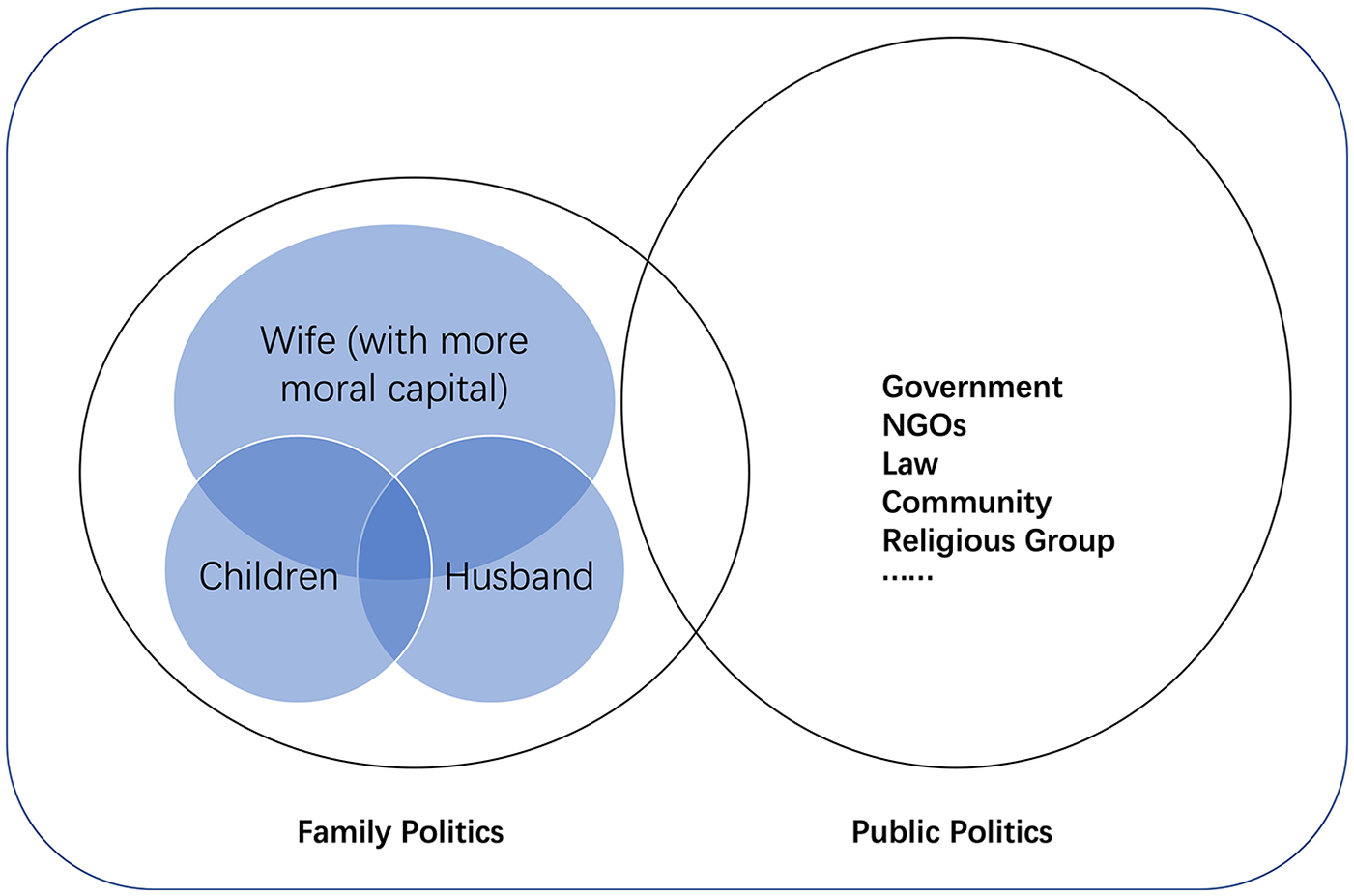
Representation of the relationship between family politics and public politics and the family politics in a family 1 in which a wife has more moral capital.
Family politics theory excels at evaluating the interaction and competition in family life or close relationships, but it has rarely been applied in diverse spatial and temporal situations (Du, 2010) such as cross-border settings or virtualized environments. There is currently a dearth of scholarly research on whether the moral capital of cross-border women is acknowledged in the cross-border marital family and to what degree it is influenced by structural and historical gender inequality in the cross-border setting. Also, there is a scarcity of academic study of the effect of video platforms on family politics. By posting their family and marriage tales on YouTube, the subjects of this study are not only mothers and wives, but also creators or micro-celebrities. They are evaluated by the outside world and affected by platform’s mechanism such as visibility (Bishop, 2019; Bucher, 2012, 2017; Cotter, 2018), which will have an effect on their families and marriage life. By examining the storytelling of Chinese cross-border wives on YouTube, I intend to shed light on the dynamics of family politics within cross-border marriages and ‘platform society’.
Methodology
To acquire an in-depth understanding of cross-border married women’s experiences, family life, and their platform practices, I adopted in-depth, semi-structured interviews, supplementing them with ethnographic notes about the interactions between YouTubers and their subscribers and narrative analysis of their videos.
Participants
The subjects were selected based on a degree of homogeneity of their nationality, race, age, education level, marriage history and length of residence in their husbands’ countries. All interviewees came from China and were now living in a developed country. They were all married to native-born white men who were usually 10 years older than they were. All interviewees were over 50 years old. All had been married once prior to their current marriage, and one had been married twice before. All could speak English and maintain basic communication with their family members but were not fluent.
Data collection and sampling
I began by searching with the keyword ‘cross-border marriage’ in Chinese (#跨国婚姻 or #外嫁女) on YouTube. I subscribed to and browsed the videos the cross-border married women thus identified had posted about their marriage and family life and contacted them by leaving a message. I next observed cross-border married women’s platform practice. I wrote field notes and collected anonymized direct quotes from the subjects. Finally, I performed nine semi-structured interviews with cross-border wives (YouTuber as well) via WeChat Video Call or Zoom. These interviews were conducted between August 2022 and February 2023 and lasted between 45 and 180 minutes. The interviews were digitally recorded; in the case of most interviews conducted on WeChat, only the audio portion of the call was recorded. Open coding and axial coding started after the first interview and then selective coding was done until the research data reached saturation (Corbin and Strauss, 1990: 12–15).
In addition, I supplemented the data with a narrative analysis of 22 other Chinese cross-border wives’ channels for a total of over 1500 videos illustrating various aspects of their marriages and family lives. Before the interview, I explained the purpose of my study and assured the women of complete anonymity and confidentiality. The interviews were conducted in standard Mandarin. To protect participants’ anonymity, I eliminated all identifying information and assigned pseudonyms.
Requesting for judgement on family politics
HU met her present spouse while working as a waitress in the Middle East, where her husband held a temporary expatriate position. Drawn by advertisements of international labour businesses, HU had moved to the Middle East to work in hopes of earning a greater income. She had not anticipated finding her second spouse in the region. After 3 months of dating, however, HU was struck by the sincerity of her American spouse who was 15 years older than she, and she decided to immigrate to the United States, despite the pursuit of two other men from Canada and Australia with decent jobs. Because HU had experienced a failed marriage in China, she did not have high expectations for her second marriage. She hoped that she and her second husband could respect and support each other for the rest of their lives. However, after 15 years of marriage, she claimed in her videos that she and her husband had become platonic friends rather than husband and wife. Although they were not yet divorced, their current marital status differed little from that of divorced persons.
In the early stages of HU and her husband’s marriage, their moral capital is equal: the woman is youthful, and the man can provide superior social welfare and living conditions. HU did not get remarried for money (as previously mentioned, if she did it for money, she could choose other men who pursue her, and those men are wealthier), so their marriage is based on power balance and love. Why is their marriage currently so strained? Two factors contribute to her proclivity to divorce. The most immediate trigger occurred when her spouse abruptly removed her from their joint bank account. In her view, this was a denial of everything she had done for the family for so many years. According to HU, she did not cheat or commit any wrongdoing; as a housewife, she did everything she could. Because of the nature of her husband’s job, she was frequently required to move with him around the United States, following him and taking care of his daily needs. As an acknowledgement of her moral capital, her husband was supposed to pay for her living expenses (his husband’s moral capital), but he refused to do so. The second trigger that caused her to consider divorce was the deterioration of the family’s financial situation and her husband’s disregard for her ideas about change. Because of the effects of Covid-19, her husband’s career had become extremely unstable and was unlikely to improve soon. Although the determination of moral capital is subjective, this does not mean that it can be determined arbitrarily but is determined by ‘benefit to the whole family’, a standard that includes altruism and egoism. HU believes that her husband and she should prepare for an uncertain future or, at the very least, cease spending lavishly. However, her suggestions backfired, and, despite her repeated objections, her husband insisted on purchasing an unnecessary $30,000 tractor. So, in the eyes of HU, she is doing something beneficial for the family, while her husband is doing something bad, and she should have more discursive power in family politics; however, the reality is the opposite, and she is bewildered and angry about it.
Nevertheless, HU does not deny her husband’s other moral capital: he is the family’s only source of income, and he has never refused her anything. But marriage involves more than just two individuals; it involves the entire family (Wu, 2009a: 16). When there are conflicts between the wife and other family members and the wife is treated unjustly, the husband also has the responsibility to safeguard the dignity and rights of the wife, but HU’s husband does just the opposite in reality. Even though HU has endured physical violence from her husband’s sister and verbal humiliation from her husband’s mother, she is still able to find a way to fight back. What made her angry was the fact that her husband did nothing but remain silent in response to her suffering. Her husband’s inaction increases HU’s moral capital and upsets the balance of power between her and her husband. Regarding moral capital with other family members, HU emphasizes their ‘negative moral capital (Wu, 2009a: 113–115)’. HU’s husband’s mother
2
has been managing HU’s husband’s finances, but HU believes his mother is a poor manager, as evidenced by the stagnant growth of the family’s savings. HU repeatedly stated in her video that her husband’s mother is a shopaholic who frequently purchases and stores useless items in a warehouse. She even showed subscribers a portion of her husband’s mother’s collection. She thinks it would be fair if her husband’s mother were to spend only her own money, but HU believes her husband’s mother spends a certain part of her (HU’s) husband’s income in an irrational way. HU ended her relationship with her husband’s sister because the sister relied on HU’s husband’s income to cover unidentified expenditures. HU asked her husband’s sister to explain these unidentified consumptions, but the sister refused to answer and accused HU of being nosy. During our interview, I inquired as to why HU’s mother-in-law has been so hostile towards her. HU mentioned numerous other details but asserted that racial discrimination is the primary factor: My husband’s mother once hosted the white girlfriend of my husband’s brother and showed her around the house with great warmth . . .. We Chinese have a tradition of respecting the elderly (尊老), but this does not hold true in my family. I did all the housework when we lived with her (my husband’s mother) because she did so little. Not only was she not grateful, but she also thought it was what I should have done. Once, I was particularly impressed. I was helping her wash dishes in the kitchen when the girlfriend of my husband’s brother noticed and asked me to move forward. She (husband’s mother) explained immediately that I (HU) enjoy washing dishes. Why do you (HU) bother to help her (husband’s mother)?
According to family politics theory, ‘when every family member is respected as he or she should be, and a power balance is preserved, domestic justice prevails (Wu, 2009b: 70).’ Otherwise, anger and irrational behaviour may result. HU cannot play the justice power game within her family, but she could vent her anger and cash her moral capital out by posting about her bitter family life on YouTube. She does not fear being judged by her subscribers because, in her view, she has made significant contributions to the family, her struggle is also for the family’s benefit and she has a large deal of moral capital. The fact is also as she wished when she posted about suffering on YouTube, she received support from subscribers who acknowledged her moral capital.
In her cross-border marriage, NIU, like HU, experienced domestic violence, racial discrimination and other domestic injustices. The difference is that her husband is nearly 20 years younger than she is, and after more than a decade of marriage, they are still together and have no plans to divorce. According to NIU’s video, she chose to immigrate to Australia out of concern for the future of her daughter and the dissolution of her first marriage. NIU never conceals the fact that her goal in choosing a cross-border marriage was to obtain legal immigration status, but she denies that this is her only motivation. In one video, she discusses her dating history and her decision to marry her current husband. She believed that if she were only seeking legal status, she would not have been so discreet when dating. Generally, cross-border married women whose goal is to obtain legal status are no longer qualified to participate in family politics. They typically rely heavily on their husbands, and their contributions to the family (such as doing all the housework or taking care of their husband) are not acknowledged by their husbands or considered payment for the legal immigration status they obtain. Some of them believe that the husband’s citizenship enables them to immigrate and reside permanently in developed countries, and as a repay, they should pay more for this relationship. If they disobey their husband’s orders or fail to meet their husband’s expectations, their husbands may threaten to cancel their legal immigration status.
NIU has been through so many domestic injustices. In her video, NIU discusses how she was treated unfairly by her husband’s parents – how, for example, when she was pregnant, she could not get help from her husband’s family and had to work to support herself; how she endured one instance of domestic violence and received assistance from women’s and children’s protection organizations; and how she pays for her husband’s excessive consumption. These domestic injustices serve as moral capital for NIU in her present and future family politics.
After more than 10 years of hard work, NIU and her family have achieved success. She and her ex-husband’s daughter, for example, successfully immigrated to Australia; she purchased a house for $1,500,000 Australian dollars for her two daughters; she owns two houses and operates a housekeeping business. NIU has managed to dominate the power game in her family. In her videos, NIU explains that she made all the significant decisions for the family, with her husband typically following her lead and unable to challenge her authority. From NIU’s perspective, her strong position in the family is deserved, but this is not accepted by all subscribers. Some subscribers accused NIU of disrespecting her husband; others listed her husband’s moral capital, such as cooking for the family, being very gentle (in the video) and sponsoring NIU’s immigration. NIU could not accept these criticisms and made several videos to respond to these subscribers. In these videos, NIU either reaffirmed her moral capital or presented evidence that she was not lying. In her opinion, those with greater moral capital should dominate family politics, and her investment talents and other attributes make her more suited to dominate the power game. However, according to Wu Fei’s point of view, controversy arises from the fact that NIU did not comprehend the objective of the family power game, which is not to win the game but to achieve a virtuous circle of family relationships (2009b: p. 99). NIU won the power game decisively, but the family relationship she displayed was not widely accepted by subscribers.
According to Wu’s research, those who have endured long-term domestic injustice and whose moral capital has not been acknowledged by their husbands/wives will choose suicide. Through suicide, the victim communicates to the outside world (neighbours, relatives, acquaintances, etc.) the injustice they have endured at the hands of their partner. This behaviour is typically sanctioned by the outside world, and their companions are morally condemned by the outside world; consequently, the moral capital of these suicides is ultimately realized despite their death (Wu, 2009a: 179–180). In my research, although they amassed a substantial amount of moral capital through their own efforts but seldom qualified to play the family’s power game, these Chinese cross-border wives did not choose to commit suicide but shared their sufferings on YouTube. SHU described a failed cross-border marriage in which she shared the house she bought with her husband – but he had an affair and attempted to seize her property. Her husband never apologized to her. HOU stated that she ended any emotional element in her relationship with her husband’s daughter, which she acknowledges may seem cold-blooded, but she did it for a reason and believed it was fair. She had recently arrived in the United States and was not financially secure. Once, on her husband’s birthday, her husband’s daughter (along with his ex-wife) invited her family out to dinner, but she refused to pay for HOU and her son. In a nutshell, these Chinese cross-border wives do not fear being judged by their subscribers and instead invite them to do so. The majority of subscribers acknowledge their moral capital, whereas their spouses are morally criticized.
Setting a good example of power game
Prior to emigrating to the United States, LONG led the life of a wealthy man in her hometown. She worked as the head of human resources in a state-owned enterprise in China while simultaneously establishing two medical clinics through her own initiative. She has achieved financial independence in China and was married to a capable man. However, her daughter’s failure to pass China’s college entrance examination drastically altered her life trajectory. LONG chose to immigrate to the United States so that her daughter could attend a more prestigious university. LONG has adapted well to life in the United States and hopes that her husband and younger siblings can also immigrate. Throughout the process, however, she and her husband grew further apart, and they eventually divorced amicably. LONG’s current husband is a physician with a high income but a failed marriage in his past. He met LONG by chance in a café; they became acquainted through subsequent exchanges and ultimately decided to marry.
Domestic injustice in family politics leads to a power game where interacting parties will try to make a difference by putting their moral capital to use. When they effectively utilize their moral capital and attain a power balance, they may experience fulfilment; otherwise, they may feel angry (Wu, 2009a: 179). In her videos, LONG primarily demonstrates to her subscribers her blissful marriage and exquisite lifestyle. She attributes the current marriage to destiny and good fortune, but it is primarily the result of the husband and wife’s joint efforts. In her videos, she would enumerate her husband’s moral capital explicitly and lavish praise upon it. LONG expresses great admiration for her husband, stating that he is not only knowledgeable but also demonstrates great kindness by helping disadvantaged people and caring for small animals. Her husband will patiently introduce her to American history, festivals and culture, and assist her in learning English. But in additional videos, LONG demonstrates her contribution and affection for her husband. She reports in her video that her husband did not ask her to cook or maintain the yard, but that she insists on doing so because she believes it is her duty as a wife. She shows herself in her video preparing breakfast and a working lunch for her husband, tidying her home, giving her husband a haircut and massage and so on. In one of her videos, LONG stated that her husband was not good at taking care of the backyard and did not even care about it, whereas she is very attentive to the backyard and maintains it in an orderly manner. She believes this is her contribution to the family, despite the lack of affirmation she receives from her husband. LONG believes that taking care of her husband is a contribution to society even though she does not have a job.
MA shared the same opinion as LONG: if a husband’s hard work is a direct contribution to society, then his wife’s care for him is an indirect contribution to society. The style of MA’s video is very similar to LONG’s, and she also projects the image of a competent housewife. In addition to sharing her cross-border marriage story on YouTube, she demonstrates her great gardening and other life skills. In one video, MA outlined the potential conflicts that could arise in a cross-border married couple’s family, including differences in culture, lifestyle, eating habits and personal characteristics. Her husband finds it difficult to accept Chinese food, resulting in numerous arguments. MA and her husband both rejected ‘one pot, two systems’ (‘一锅两制’) so they decided to eat dinner together. MA prefers boiled dumplings while her husband prefers fried dumplings, so MA makes both types of dumplings and eats with her husband. In MA’s family, maintaining family harmony is regarded as moral capital by both husband and wife. MA and her husband both gain moral capital and achieve a certain power balance when they compromise on the contradictions of their cross-border marriage.
YANG commented negatively on ‘one pot, two systems’. She believes that if there is a dietary difference in cross-border marriage family, then the husband and wife should respect this difference instead of kidnapping each other morally for the sake of family harmony. In her video, YANG explained that her husband developed a mechanism for resolving conflicts after they married in the United States: they would discuss their feelings for 10 minutes every Saturday. During these 10 minutes, they were required to consider the psychological stress each had put on the other during the past week and then apologize. YANG’s husband is also a physician, and his income and living conditions are excellent. YANG had the option to be a full-time housewife, but she chose not to. In her response to one subscriber, she made her position clear: I think marriage is a close partnership with power balance, a kind of teamwork. Do your best to be your best self, so that you can give the other person (your husband) an image of hard work and self-improvement, and he will cherish you and respect you more! Marriage is a contractual relationship, and husband and wife are a community of responsibilities, obligations, and interests. If you just enjoy what others (your husband) give you, you cannot make choice by yourself. If you only live in your comfort zone, you have no room to improve. Learning can make you better and increase your value and confidence. (底气)
YANG determined that her life would be monotonous if she were a full-time housewife. She asked her husband for assistance in the hopes that he would recommend a job for her, but her husband believed that YANG did not have a complete command of English and that there were no jobs that were comparable to her work in China. YANG did not give up but sought out jobs through Chinese friends. In the end, YANG’s first job in the United States was in a restaurant. Eventually her efforts enabled her to be employed by an American insurance company. YANG is extremely content with her current marriage, so when I asked YANG to rate her husband’s performance in their marriage, she awarded him an 8.5 out of 10 rating. This marriage is not the result of luck but rather of YANG’s talent at playing a family’s power games. YANG and HU share a similar experience. YANG also moved frequently due to her husband’s frequent job changes. The difference is that YANG moralized this matter. YANG complained to her husband that his frequent job changes were causing her difficulties. It is unfair for YANG to have to move to a new and unfamiliar place due to her husband’s job after she has finally become accustomed to her living environment. Through negotiation, she finally won the opportunity to relocate to a community with many Chinese people. YANG’s husband has difficulty controlling his temper. He once smashed the computer and dropped the mobile phone. YANG did not communicate with her husband to solve the problem immediately; instead, she waited for her husband to calm down before pointing out his errors. Like many Chinese women who marry abroad, YANG’s husband has some extravagant personal hobbies (buying Chinese antiques), which many Chinese women view as irrational, preferring to spend their limited wealth on things that benefit the entire family. YANG protested to her husband and insisted, as a kind of justice, that she could use their shared fortune to pursue her passion for diamonds. As a compromise, her husband eventually agreed to take a part-time job to support his hobby and became gradually more moderate in his purchase of Chinese antiques.
In his research, Wu concentrated primarily on domestic injustice but did not focus on what happens when relative family justice is done. In my research, I discovered that these Chinese women who are satisfied with their cross-border marriages demonstrate not only their husband’s love for them but also their moral capital and experience with playing power games within family politics. They owe some of their success in marriage to fate, but more to their own wisdom. A participant who was married within 48 hours said proudly, ‘Why did he choose me over someone else?’ Because she has demonstrated her competence, according to another participant, her spouse now places a great deal of trust in her, allowing her to manage the family’s investments and other matters. It is evident that they are eager to discuss their cross-border marriage and experience. As they stated when introducing their motivations for making videos on YouTube, they do not wish to gain attention by gossiping or exposing their or private lives, but rather want other women who are struggling with family conflicts to see their experiences, be inspired to make courageous changes and be encouraged to do so. In a nutshell, they want to set a good example of how to play the power game in family politics.
Platformized family politics with invisibility
Domestic justice necessitates a balance of power, but the premise is that both the husband and wife’s moral capital can be recognized and realized by the opposing party. There are numerous ways to cash out moral capital, including quarrels, threats and so on, but when these methods do not work, the most common method is to obtain the recognition of their moral capital from relatives or friends first, they then can use ‘public opinion’ to exert pressure on their spouse, compelling them to behave in accordance with their expectations (Wu, 2009a: 173). Platforms like YouTube have become an ideal way for these Chinese cross-border wives to gain recognition and defend their rights and interests when they are victims of domestic injustice and are unable to receive aid from relatives and friends in China. Although the family politics displayed on the platform are limited, the platform participates in the family politics of different types of Chinese cross-border wives and has produced a variety of effects.
For Chinese cross-border wives who are adept at playing power games, platforms become the ‘lubricant’ of their family politics. Creating a video praising their husband and uploading it to YouTube is tantamount to promoting his moral capital in public. They gave their spouses a sense of accomplishment while tactfully expressing their life and marriage expectations. YANG invites her husband to watch videos in which she discusses domestic injustice, focusing on her personal experiences and offering advice on how to address them. In her case, creating a video is analogous to writing a letter to her husband, a letter through which her husband can comprehend her thoughts. When LONG met her current husband, he had recently been divorced and was very hesitant to remarry. LONG was unable to accept it and desired to wed as soon as possible. Although they were still boyfriend and girlfriend at the time, LONG repeatedly referred to her boyfriend as her ‘husband’ in the video. She repeatedly attempted to argue with her ‘husband’ but to no avail. Later, she made several videos which garnered the support of many subscribers (and the ridicule of some). In these videos, she did not place blame on her ‘husband’ and continued to look for reasons for his reluctance, but she did reveal her psychological bottom line. She accepted the relationship for only 2 years, after which she would leave. During that time, her ‘husband’ helped her proofread the video’s subtitles, so he saw both the video and the subscribers’ comments. LONG stated that she did not know whether the video she created, or the private communication played a role but shortly thereafter her ‘husband’ decided to marry her. Although its impact should not be exaggerated, the platform has had a subtle effect on the power game as a tool for these Chinese cross-border wives. When Chinese cross-border wives who are not adept at power games suffer family injustice, the platform serves as their ‘loudspeaker’. Their subscribers provide them with the moral capital recognition they lack from their husbands. Numerous subscribers left them encouraging messages, and one participant received job information and the other received legal aid from the subscribers.
On the other hand, their videos not only demonstrate their own moral capital, but their narratives also reveal their husbands’ moral capital. Their husbands also have supporters and produce counter-narratives or outright denials of their moral capital. Interestingly, they seem to enter an ‘echo chamber’ in the face of criticism. One participant told me she did not care at all about the malicious comments because ‘bad guys’ have always existed and the people who made the malicious comments did not live with her and did not know what was happening to them. Therefore, those individuals’ comments are believed to be biased and need not be taken seriously. Those Chinese women who shared their experiences of cross-border marriages also received venomous comments, but they not only shared the former’s point of view, but they also sometimes believed that their subscribers made such remarks out of jealousy. Not only do some wives create videos to respond publicly to malicious comments, but they also modify settings directly in their channel so that those who make malicious comments can no longer view the wives’ videos or comment.
Not only are my participants wives, but they are also YouTube creators, so they are destined to be affected by the ecology of the platform. For these Chinese cross-border wives, the platform’s visibility is essential. In addition to ‘income and opportunities (Bishop, 2019: 2591)’, it implies esteem, the recognition of their moral capital. Although most of them said that the goal of making videos is not to become micro-celebrities, but according to my observation, they are trying very hard to pursue visibility. First, although they lack algorithm knowledge, they did learn from ‘algorithm gossip’ to improve their visibility, inquiring about news from subscribers or other creators, for instance, and retrieving videos explaining YouTube’s algorithm for viewing and learning. One participant, aware that I had been observing the platform perception and practices of Chinese cross-border wives for 2 years, actively requested advice on how to increase viewership. Second, although most of them have less than 10,000 subscribers, they did ‘play the visibility game’ with YouTube. According to Cotter (2018), ‘digital influencer’ can be divided into two categories: ‘relational influence’ and ‘simulated influence’ (pp. 905–906). The former holds that ‘influencers should focus on developing ‘real’ relationships’, while the latter holds that influencers can seek ‘engagement and followers beyond or without efforts to build authentic relationships’. Although they fall under the category of ‘relational influence’, I discovered that these Chinese cross-border wives would also like to use the tactic of ‘simulated influence’ in order to increase their visibility. Third, as Bucher (2017) said, creators’ ‘algorithmic imaginary is not just productive of different moods and sensations but plays a generative role in moulding (the Facebook) algorithm itself’ (p. 30). These Chinese cross-border wives will also modify the content of their videos based on their algorithmic imaginations of the YouTube platform. However, it is important to note that their algorithmic imagination includes strong self-cognition. The majority of them believe that visibility is challenging for them but their low visibility is understandable. When I offered to conduct interviews with them, a number of them expressed their gratitude and astonishment.
Despite numerous attempts, these videos of Chinese cross-border wives have always remained unnoticed, owing to the unpredictability of their production. SHU has nearly 6000 subscribers, and most of her videos receive many views, but she has not updated her videos in over a year. She told me that creating a video was too exhausting. TU has a strong reputation among Chinese cross-border wives who are video creators, but she has not updated in over a year and has deleted all her videos about the domestic injustice of her cross-border marriage. A Chinese cross-border wife with nearly 10,000 subscribers whose videos each received more than 10,000 views mysteriously vanished a year ago. Numerous subscribers left messages asking why she was not uploading her video, but I could see that she liked their comments without responding. These Chinese cross-border wives did not leave YouTube, as I continue to observe most of them commenting on the videos of other Chinese cross-border wives, allowing me to communicate with them.
What does invisibility mean to them? For Chinese cross-border wives who are content with their current marriages, the loss of visibility will deprive them of an opportunity to display their lives and demonstrate their value. For example, LONG wants to find a job, but she finds it difficult due to her limited English proficiency; therefore, she finds making videos more interesting and worthwhile. For Chinese cross-border wives who face financial burdens in life and are not treated fairly by their husbands, the loss of visibility will deprive them not only of an outlet for releasing negative emotions, but also (albeit minimally) of a source of income.
Conclusion
This exploratory case study on the storytelling and algorithmic practices of Chinese cross-border wives on YouTube was conducted in an attempt to understand the power dynamics within the women’s families. My intention was to examine the experiences, challenges and coping mechanisms in women’s cross-border marriage lives from a dynamic, holistic perspective while adhering to the family politics theory. Based on over 2 years of virtual ethnography, nine in-depth interviews and discourse analysis of over 1500 videos, I found that Chinese cross-border wives who shared their marital experiences demonstrate a feminist interpretation of power games with their husbands. Those who consent to their marriage choose to demonstrate their wisdom by playing a power game, but those who endured significant hardships in their marriage are more likely to demonstrate their moral capital. Both sorts of women won the power game in their family politics from their perspective, but the first type seems to say, ‘I win’, while the latter seems to say, ‘I am not lost’. Overall, my results indicate that Chinese cross-border wives play family power games with their husbands, but not all of them can enjoy their winning when they hold more moral capital.
YouTube is supposed to empower these Chinese cross-border wives; nevertheless, they are not the darlings of the platform economy (Rahman and Thelen, 2019; Srnicek, 2017) and have limited visibility and high unpredictability. Some of them continue to update their videos, but many suddenly disappear or become viewers rather than creators. Newcomers keep coming, but they are confused by the algorithm or profit mechanism of YouTube. During my conversations with these Chinese cross-border wives, they not only shared the details of their own stories but also those of several others they know or by whom they were asked for help or suggestions. Many women are in an extremely negative position within their family politics. However, over my 2 years of observations and YouTube searches, I did not find any women mentioned by the Chinese cross-border wives I studied choosing to share their sufferings online. Spivak (1988) used to ask, ‘Can the subaltern speak?’ Here we should ask, ‘Can the subaltern in the group of cross-border married women speak?’
Even though this is the first study to extend family politics theory into intercultural and virtual domains, I did not focus on the temporal dimension. I observed and interviewed middle-aged Chinese cross-border wives, the majority of whom have at least one failed marriage and one child. Young, well-educated Chinese women are expected to be more capable. In comparison with the marriage market of a decade ago, Chinese women who want to immigrate to developed countries and then get married will face many new obstacles. All of these generational differences merit additional study and consideration. In addition, compared to Wu Fei who conducted his research in his hometown and with the assistance of his mother and friends, my research relied heavily on the videos, interviews and online observation of Chinese cross-border wives. Future research would be more comprehensive and vivid if it included the husbands and children of these Chinese cross-border wives, or if the researchers were able to live with them for a period of time.
Footnotes
Funding
The author(s) disclosed receipt of the following financial support for the research, authorship, and/or publication of this article: This work was supported by the China Scholarship Council (No.202007970025).
