



Abstract
With more than 50% of the world’s population living in urban areas, the smart city concept has been introduced as a solution to urbanization problems, with a focus on technological and social innovation. However, critics argue that the concept is more about marketing than actual benefits for citizens. Given the limitations of conventional and formalized e-participation and smart city procedures, we highlight the value of shared citizen knowledge and the potential of e-interaction in this context by analyzing city-related informal social media communication, following recent calls to embrace citizens’ opinions in the smart city framework. This work focuses on major German cities with more than 100,000 inhabitants. The authors identify nine categories of interest in citizens’ discussions. Unlike official channels, citizens tend to focus on social and societal issues. The results of this study can complement existing tools by including citizens’ perspectives in smart city decision-making processes.
Keywords
More than 50% of the world’s population lives in cities, and it is estimated that this percentage will increase to more than two-thirds by 2050 (United Nations, 2018). Cities are spaces where existing social divides deepen, but they also have become sources of inspiration for local publics. Smart cities emphasize combining technological and social innovations in an effort to address current urbanization problems, with a central goal of improving public well-being (Agbali et al., 2019). Citizen participation’s role often is emphasized, as it theoretically links to better policy outcomes, lower crime rates, prosperous communities, and increased health and happiness for citizens (Dalton, 2017). However, critics have argued that the smart city concept is more about marketing than actual benefits for citizens, often prioritizing technological solutions over social and environmental considerations (Sadowski and Bendor, 2019). Social media (SM) facilitates interactions among users (Carr and Hayes, 2015), is easily accessible and widespread, and allows for broad citizen participation, even though industry entities create these sites with economic (and other) agendas (Bayer et al., 2020).
In this article, we focus on SM as a channel for informal public participation, following recent calls to embrace citizens and their opinions in the smart city framework (Lee et al., 2022; Shelton et al., 2015). Thus, we investigate SM data, which rarely has been incorporated into this context (e.g. Bencke et al., 2020). We then provide empirical insights into citizens’ needs, as well as demonstrate and critically discuss SM’s potential for democratic processes and public well-being in an urban context.
The concept of smart cities
Cities are vibrant and densely populated areas that reflect society’s diverse makeup (Hartmann, 2018). However, urbanization has elicited significant challenges, for example, resource scarcity, aging infrastructure, energy shortages, price instability, climate change, health problems, and the need for better economic opportunities and social services (Washburn and Sindhu, 2010). To address these issues, current democratization efforts have been striving to harness cities’ economic opportunities and social benefits while mitigating the negative effects. The smart city concept has been marketed to integrate various aspects of city life—for example, transportation, energy, water management, and governance—into a unified system. It has been praised as a framework to address the fundamental problems of urban living, particularly central aspects of democracy, for example, information exchange and knowledge sharing among formal entities and citizens (Cardullo and Kitchin, 2019b; Washburn and Sindhu, 2010). Various smart city concepts have been put forth to establish standardized metrics that can be used to monitor cities’ progress and facilitate comparisons across different domains, for example, Giffinger and Haindlaier (2010) set a benchmark on how to assess medium-sized cities in particular. The International Organization for Standardization (ISO) has refined this approach further by introducing a set of standardized dimensions for urban services and quality of life (ISO 37120). This allows for cross-city learning and comparison across a wide range of measures, while also being used by researchers as a reference for new approaches to assess smart cities’ status (Bencke et al., 2020). These approaches are intended to help attain the publicly communicated primary goal of a smart city: to improve its citizens’ well-being (Hoadjli and Rezeg, 2021; O’Malley and Smith, 2022).
While the smart city concept theoretically has the potential to address significant urban challenges, critics argue that it is more about marketing than actual benefits to citizens, often prioritizing technological solutions over social and environmental considerations (Sadowski and Bendor, 2019). The geosocial complexity in cities’ design and composition often is reduced to a highly generalizable, homogeneous “public” that can be addressed, diagnosed, and transformed through application of information and communication technologies (ICT; O’Malley and Smith, 2022; Vanolo, 2016). Other concerns include data privacy and security, and the potential for increased surveillance and control over citizens, particularly with respect to smart cities’ crime prevention and security programs (O’Malley and Smith, 2022).
Moreover, the smart city concept has been criticized for being built on neoliberal political rationalities (Cardullo and Kitchin, 2019b) without factoring in the effects of entrenched social, political, and economic inequities. From this perspective, smart cities could be exacerbating inequality and exclusion by favoring the already favored (Valverde, 2012) and neglecting marginalized communities or even increasing the emphasis on those already identified as “problematic” (Zavrsnik, 2018). This raises questions about smart city initiatives’ democratic nature, as they may entrench existing power imbalances further and limit meaningful participation by all citizens in shaping their urban environments (Scally and Tighe, 2015).
Although a smart city’s theoretical objective may be to improve citizens’ well-being, it is crucial to evaluate potential drawbacks critically and ensure that these initiatives prioritize equitable and sustainable development that benefits all members of society. A central promise and premise of smart city concepts is citizen involvement and consultation (Hoadjli and Rezeg, 2021), as the experienced city determines people’s quality of life and actions (Hartmann, 2018).
The citizen in the smart city
Public participation is a critical element in creating smart cities. The goal of public participation is to give citizens a voice in decisions that affect their communities, as citizen engagement is a rich source of information (Dalton, 2017). Requests and opinions that citizens communicate can inform authorities and other members of respective communities about the need for support to ensure development and maintenance of societal conditions for well-being (Fisher, 2019). Citizen engagement is linked to better policy outcomes, lower crime rates, prosperous communities, and increased health and happiness for citizens (Dalton, 2017). Due to local democracy’s changing landscape (Alonso and Barbeito, 2016), traditional forms of participation, for example, association and party memberships, are in decline (van Haute et al., 2018), while new forms of participation, particularly those online, are emerging (Theocharis and van Deth, 2018).
This so-called e-participation (Ingrams and Schachter, 2019) is expected to promote better governance by increasing government decision-making processes’ transparency, holding service providers to account, and curbing corruption in government systems (Zheng, 2016). E-participation also can help broaden participation by creating new channels of democratic inclusion, as well as enriching the frequency and content of dialogue between citizens, elected officials, and all levels of government, making participation less intimidating and more inclusive for previously excluded or hard-to-reach groups (Khadzali and Zan, 2018; Lin, 2022). Given these numerous benefits, governments worldwide have been pursuing enhanced e-participation in their governance processes (Hagen et al., 2015; Lee and Kim, 2018).
However, poorly designed (e-)participation procedures can exacerbate existing inequalities in cities (Liu, 2017; Scally and Tighe, 2015). “[. . .] [D]emocratic procedures do not always product egalitarian outcomes, technical/scientific ones incorporate disguised normative biases, growth does not necessarily trickle down, and popular preferences may be misguided” (Fainstein, 2010: 19–20). It is crucial to apply participation methods widely in their implementation to avoid limiting public involvement to a specific group with vested interests, which could hinder affordable housing projects in cities, among other effects (Scally and Tighe, 2015). Merely implementing ICT cannot solve these problems, as only a privileged fraction of citizens usually participates on official platforms (Liu, 2017). Thus, governments need to empower citizens by increasing their opportunities to participate, eliminating obstacles to inclusion, and augmenting decision-making processes through well-designed systems. This approach will bolster citizen contributions’ efficacy and ensure that technology serves as a tool to help empower people and encourage inclusivity in the decision-making process, rather than provide a solution in itself (Liu, 2017).
The application of ICT in interacting with citizens through service delivery, information sharing, communication, and transactions has been marketed as a key aspect of smart cities (Cardullo and Kitchin, 2019b; Hoadjli and Rezeg, 2021). However, smart city initiatives tend to prioritize pragmatic, instrumental, and patronizing rhetoric and methods over social rights, political citizenship, and the common good (Cardullo and Kitchin, 2019b). This approach may result in citizens playing more passive roles, while companies and city administrations take the lead in exercising power and deciding what is best for citizens (Cardullo and Kitchin, 2019a). The main problem is that citizens generally are consulted usually only after city administrations or other stakeholders set objectives and decide on solutions, leaving problems and suggestions from citizens unaddressed (Cardullo and Kitchin, 2019b). This heavily limits the potential of smart city initiatives and e-participation approaches to reduce existing inequalities in political participation, thereby weakening democratic processes and distributing power to the already powerful, as those who participate determine which problems will be addressed and how they will be addressed (Boulianne, 2022; Dalton, 2017). Given the limitations of conventional and formalized e-participation and smart city procedures, and due to the inherent ignorance toward citizens and their ideas, we aim to highlight shared citizen knowledge’s value and e-interaction’s potential in this context by analyzing city-related informal SM communication.
SM’s unused potential
SM include a variety of social contexts (Marwick and Boyd, 2014) and can be viewed as a gateway to direct interaction and communication with and about cities (Bencke et al., 2020; Cetin et al., 2020). SM tackles the limitations of conventional and more institutionalized channels of public participation (Khadzali and Zan, 2018), providing a wider reach than traditional e-participation methods (e.g. official city websites and e-government platforms; Boulianne, 2022; Distel and Becker, 2018). Most SM users do not aim to participate actively in decision-making processes, nor do they seek political content, but instead just want to socialize or entertain themselves (Nitschke and Schweiger, 2021; Quan-Haase and Young, 2010). However, SM is conducive to porosity between public and private spheres, enhancing circulation of content between them (Audemard, 2021) and providing an informal bottom-up approach to empower citizens and local communities to let their voices be heard. SM also can be used to organize collective actions and social mobilization, even if it does not necessarily meet the classic criteria for a deliberative discourse medium (Lin, 2022).
We focus on SM as an enabling channel for informal public participation, following recent calls to embrace citizens and their opinions in the smart city framework (Lee et al., 2022; Shelton et al., 2015). We aim to utilize existing SM channels, which have grown organically and already are engaging with their respective cities as a resource that often is neglected (Cardullo and Kitchin, 2019b). This approach will provide us with valuable insights into residents’ needs in these cities. First, we offer insights into city-related online communities by answering the following research question (RQ):
RQ: What are citizens discussing in city-related SM communities?
Ethics statement and ethical considerations
Low-risk approval was obtained from our university’s Local Research Ethics Committee on 12 March 2022. As disagreement on institutional review boards exists about which ethical practices to follow, we decided to disclose our ethical considerations here (Vitak et al., 2016). The intended broader impact from this work is to improve the scientific understanding of city-related online communities to enable low-barrier participation in decision-making processes. While we did not share data from our research with city administrators, nor did we collaborate with them, it is conceivable that this work could elicit potential harm, one way being if powerful stakeholders (governments or economic actors) were to use this approach to monitor citizen behavior online and exploit resulting insights in harmful ways, potentially adding to a smart city surveillance dystopia (O’Malley and Smith, 2022; Zavrsnik, 2018). We understand that the individuals whose traces we analyzed are unlikely to anticipate that their data will be used in such a way (Fiesler and Proferes, 2018), particularly as we did not seek consent from the subreddit moderators, which is one principle that Proferes et al. (2021) suggested to avoid irritations. Nonetheless, through the design of our research, we aimed to ensure that no individual was exposed to scrutiny and that the potential for harm was minimal. We only researched publicly accessible subreddits and aggregated data from over 150 for our analysis, as users are more comfortable being part of larger analyses (Fiesler and Proferes, 2018). In the selection process, we read the subreddits’ self-descriptions, and none of the included subreddits forbade research (Proferes et al., 2021). No identifiable statements from users were cited or rephrased, as even anonymized statements often are identifiable (Reagle, 2022), nor did we assign statements to subreddits, aside from which topics are more likely to appear in what subreddit. Further ethical implications from our research will be addressed in the “Discussion” section.
Data and methods
Research context
We analyzed Reddit, one of the largest content-sharing SM platforms (Goudman et al., 2022). Although only registered users can create posts, most subreddits are publicly visible (Hintz and Betts, 2022). Reddit’s primary purpose is to disseminate opinions and foster discussion, resulting in more contextual dialogue than sites that focus on building social networks (e.g. Facebook; Hao et al., 2022). This also is reflected in the platform design: no meaningful profiles/profile culture; an emphasis on following topics/interests, not profiles/users; self-selection into a huge variety of topics; self-organized moderation in subreddits; moderation through voting and reporting; and no institutionalized monetization of user-generated content (Bayer et al., 2020; Goudman et al., 2022; Hao et al., 2022). Reddit’s anonymous environment facilitates these design aspects, making it an effective channel for understanding online community members’ experience through neutral and authentic conversations (Hao et al., 2022; Hintz and Betts, 2022). Thus, Reddit is a useful platform for providing real-time insights into particular groups and populations’ patterns, opinions, and experiences (Sharma et al., 2017).
Data collection
To address our research interest, we collected a comprehensive data set of city-related communication on Reddit. First, we identified all relevant subreddits from the 80 largest German cities (>100,000 inhabitants), including German and English subreddits. We chose Germany as a case study because a wide gap exists between good access to the Internet and e-government tools (Androniceanu et al., 2020), and infrequent use of these tools and other online public services (Distel, 2020). We searched for the cities’ names and their respective city districts on reddit.com by manually entering each search term (e.g. “Berlin” in the Reddit search), selecting the tab “communities,” and scrolling down as far as possible to load all communities (see Online Appendix 1 1 for a description of the procedure and Online Appendix 2 for the resulting data). All communities that either included the search term in the name (e.g. r/berlin) or in the description of the community and could be linked to the respective city/city district were selected. To ensure that Reddit’s search algorithm did not skew this process heavily, the first author and a research assistant conducted this process independently on different computers and browsers and discussed the results afterward (information on the circumstances of the search can be found in Online Appendix 1). No discrepancies could be found. Overall, we identified 322 subreddits.
The next step was a manual coding procedure to determine which of the selected subreddits focused on city-related topics (see Online Appendix 3). We manually reviewed the material and included only subreddits connected directly to living in each respective city in further analyses (a description of the process can be found in Online Appendix 5). This led to a list of 165 subreddits. Four had zero posts and were excluded. Data collection of postings for the remaining 161 was conducted on 16–17 May 2022, using Pushshift API, yielding 149,176 posts. Data collection of comments was conducted on 18–19 May 2022, yielding 1,857,167 comments. To sum up, our sample comprised 2,006,343 texts distributed over 161 subreddits from a period spanning September 2008 to May 2022 2 (see Online Appendix 4 for an overview of the whole data collection process).
Data preprocessing
We limited our data to posts published before 17 May 2022, and comments published before 19 May 2022. We removed duplicates and comments without posts, which reduced the data set to 1,121,962 SM texts written by 139,009 unique accounts. We aggregated comments and posts into threads, and we only kept threads with 1500 or more characters to ensure a meaningful amount of data. 3 All data processing was conducted using R in RStudio (see Online Appendix 8 for an overview of the tools, packages, and versions used). Language recognition was applied to identify the prevalent language. Most SM texts in our sample were in English, so we translated the remaining non-English (mainly German) data into English (n = 142,136) using the Deepl Pro API. 4
Before translation, we applied common preprocessing to the SM texts—including removal of URLs, dates, emojis, and other nonwords—but kept punctuation and stop words to ensure a high-quality translation. Finally, the resulting full-English data set was preprocessed again, including all the aforementioned steps and removal of punctuation and stop words, then again filtered for threads with at least 500 remaining characters to ensure a meaningful amount of data (Walter and Ophir, 2021). Afterward, we used stemmers for English language and deleted words that appeared in less than 1% or more than 95% of a document’s messages (Roberts et al., 2014). The final data set used for topic modeling comprised 615,515 texts aggregated into 32,173 threads (see Online Appendix 4 for a detailed overview of data preprocessing). Our sample comprised threads from 86 subreddits representing 62 German cities with at least 100,000 inhabitants (see Online Appendix 6 for a more detailed description of the sample).
Analytical approach
To process our sample, we used structural topic modeling (STM; Roberts et al., 2014), a statistical technique for analyzing large corpora of documents without reading or annotating the original texts (Blei, 2012). We used STM to determine the topics in our sample because of its ability to incorporate document-level metadata, for example, subreddits, into the model (Rauchfleisch and Kaiser, 2020). To find the optimal number of topics (K), we ran 41 candidate models (from K = 10 to K = 50) and chose the model with the best trade-off between average semantic coherence and exclusivity. The final model was an STM with 21 topics, 32,173 documents (threads), and a 2813-word dictionary.
The topics were validated qualitatively in three steps. First, we used the words with the highest probability and frequency exclusivity (FREX) per topic to create a rough idea of a topic label. Second, we used the top 20 highest per-word, per-topic β-values to identify the most distinctive terms per topic (Maier et al., 2018) and came up with a narrower topic label. Third, we used a random sample of 15 documents with ɣ > .50 per document per topic and inferred the commonality across the messages to create a final label that catches the notion of the underlying concept most concisely (Maier et al., 2018). To reduce further analyses’ complexity, we merged and selected topics that fit together based on our qualitative assessment of the degree of thematic overlap between the selected topics based on individual topics’ top words and the associated documents. This yielded nine more general categories (see Table 1). We discarded Topic 3 (ɣ = 0.036), as it represented only Reddit moderation artifacts (Maier et al., 2018).
Validated STM for Reddit communication in major German cities.
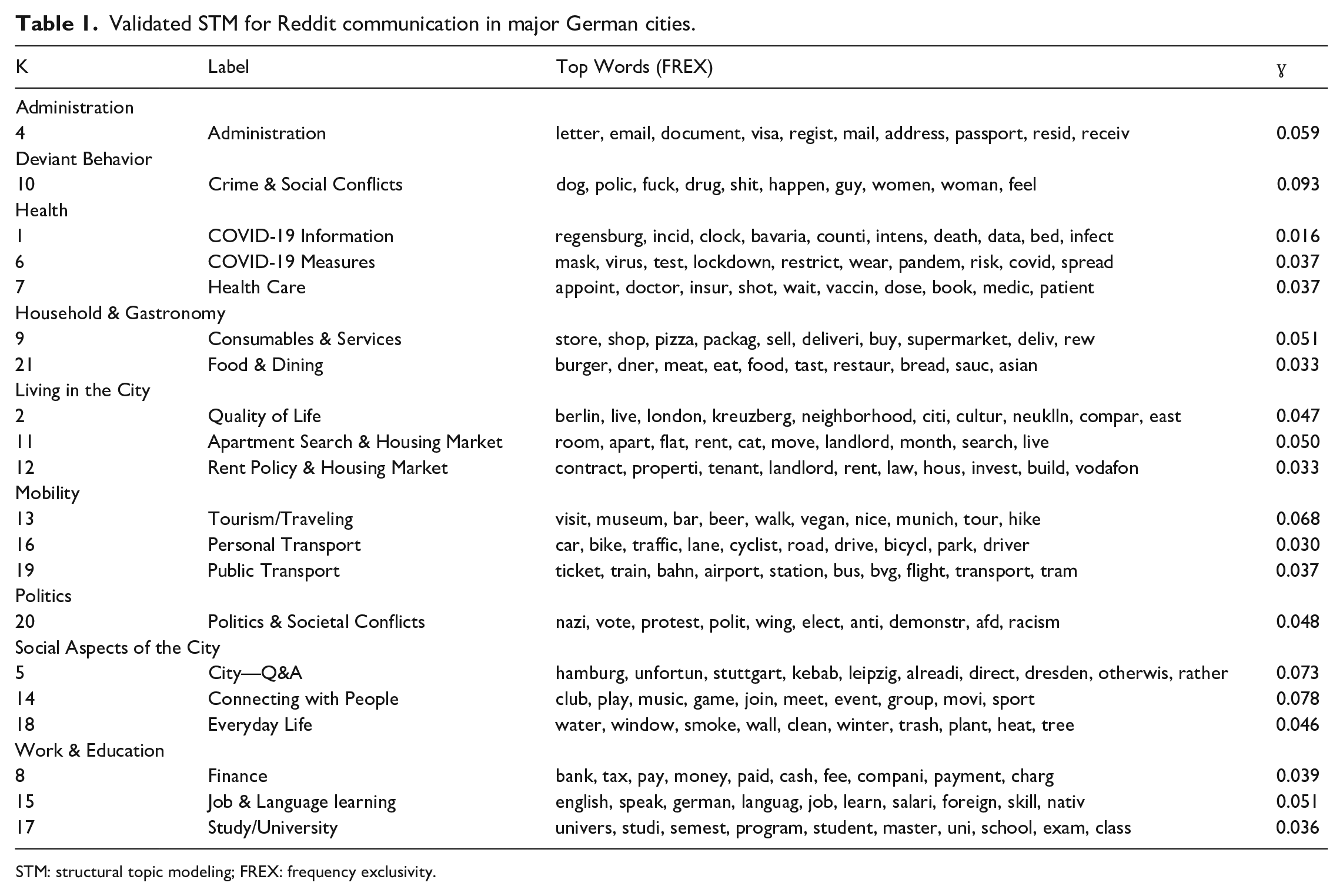
STM: structural topic modeling; FREX: frequency exclusivity.
Note that the final topics are a distribution of terms, and each document is a mixture of different topics; therefore, they are not mutually exclusive from each other, and every thread consists of several of the topics found. To ease interpretation, the most prominent topic was assigned for each document.
In our final analytical step, we qualitatively scanned the top 30 documents per topic based on ɣ. The first author read through these documents and noted everything that might characterize the respective topic (e.g. recurring patterns, as well as unique aspects).
Results
In this section, we discuss our final categories and topics (Table 1) and include examples to illustrate each topic. Generally, we observed a strong increase in threads for all categories after 2017. Only significant metadata effects were reported (see Online Appendix 7).
Administration
This category comprised only one topic and was central to 1952 threads. People asked questions mainly about various bureaucratic and administrative hurdles—often specific documents. We found threads regarding postal voting documents, unemployment benefits, deregistration when leaving the country, travel documents (e.g. passports, IDs), certificates of good conduct, and residence permits. Motives for reaching out ranged from problems with digital services (e.g. whether documents could be sent/ordered online or whether offices could be reached via e-mail) to very complex and specific problems, for example, consider the scenario of two individuals residing in Germany who are not German citizens and intend to marry in a country where neither of them has any legal connections. The responses contained myriad offers of help, for example, by sharing experiences or forwarding documents or links. While many individuals expressed frustration with the intricate and tiresome nature of administrative processes, they also acknowledged, and often with a sense of surprise, the efficiency of specific procedures, notably the online application for the certificate of good conduct. This category (see Online Appendix 5) appeared most often in the subreddits r/berlin and r/Munich, and least often in r/berlinsocialclub, r/dresden, and r/Regensburg. 5
Deviant behavior
Deviant Behavior comprised only one topic and was the most frequently occurring unique topic in our sample (n = 3055). This category was a mixture of social conflicts, deviant behavior, and actual crime, with a variety of themes, including failure to provide help, animal abuse, problems with animals (primarily dogs), flirting and teasing, pickpocketing, beatings, racism, sexist behavior, and assaults. Several threads focused on how to behave in complicated social situations (such as flirting and witnessing crimes, for example, what to do when you see pickpocketing occur or how to interact with people who deny COVID-19), while others reported incidents (e.g. police violence, verbal assaults, toxic masculinity, and strange encounters). Unlike other categories, individuals exhibited a preference for sharing detailed accounts of specific situations. These narratives often concerned instances that made them feel uncomfortable, for example, dangerous encounters with dogs, frustrations stemming from a lack of civil courage, or direct reports of personal experiences with harassment (e.g. “Need to share this. I’m an individual from City District XY and got harassed in City District YZ [. . .]”). In the replies, people provided emotional support and encouragement to contact the police. This topic was covered most often in r/berlin, r/berlinsocialclub, r/bielefeld, r/frankfurt, and r/Munich.
Health
Three topics were subsumed in the Health category (n = 3205): COVID-19 Measures; COVID-19 Information; and Health Care. Both COVID-19 topics stemmed mainly from one subreddit each, r/Regensburg and r/cologne, and had the highest likelihood of being addressed in these subreddits. Regular updates were made to both subreddits on the latest COVID-19 statistics—including incidence, number of infections, deaths, and eventually vaccinations—which followed the same pattern repeatedly. COVID-19 Measures was most likely to appear in r/augsburg and r/Hagen. The third topic in this category was a more general health topic, even though we also observed a strong focus on COVID-19. Many threads addressed COVID-19 vaccines, for example, whether and how vaccinations could be combined and who might be prioritized for them. General health concerns were raised, for example, attention deficit hyperactivity disorder (ADHD) diagnoses and dental appointments, as well as general questions about medical care. Health Care was least likely to be covered in r/augsburg, r/berlinsocialclub, r/cologne, r/frankfurt, r/Regensburg, and r/stuttgart.
Household & gastronomy
The Household & Gastronomy category (n = 2980) is related to food and general consumables, comprising the topics Consumables & Services and Food & Dining. People were looking for all kinds of services and consumables, including a tool shop, woodcutting facilities, formal men’s clothing, office chairs, PC components, glasses, secondhand or household items, electronic devices, Halloween decorations, and school items. People also asked for specific foods, for example, papayas and mushrooms, while many threads focused on recommendations for food of any kind. Nearly all observed threads directly asked for help, mostly looking for specific information. These requests often were phrased in a particular style, for example, “Where is the best place in City XY to purchase a technical gadget commonly used for Purpose YZ?” or “Have you dined at Restaurant XY? Did you enjoy it?” Generally, community members offered direct feedback and solutions, frequently supplementing their responses with personal experiences. Food & Dining was covered most often in r/Braunschweig and r/dusseldorf, and found least often in r/berlin, while Consumables & Services was found least often in r/berlin, r/berlinsocialclub, r/cologne, and 13 more subreddits (see Online Appendix 7).
Living in the city
Living in the City (n = 4213) unified three topics dedicated to where and how people wanted to live: Quality of Life; Apartment Search & Housing Market; and Rent Policy & Housing Market. It included short-term issues, such as comfortable places to dwell, and long-term inquiries, for example, the best places to live in a city and where to find affordable housing. A recurring theme observed in the discussions was the presence of direct requests for rental apartments. For instance, individuals often sought tips and assistance by posting messages, such as “Hey all, I’m looking for advice on how to find an apartment in City XY, preferably in City District YZ.” Many aspects of (good) living were discussed and assessed in these three topics, for example, living costs, building permits, suspected rent overpayment, searches for accommodations, quality of life in different neighborhoods, social structures in cities and neighborhoods, and new housing developments and their impact on former green areas. Some threads included reports and news articles, and people spoke from their experiences and shared links, for example, to popular housing portals. Furthermore, we found more housing policy aspects, including the rent cap in Berlin, how to handle new contracts and rental costs if laws change, criticism of property managers and owners, information about rent reductions, and solar cell obligations in Hamburg. This was reflected in a high likelihood of r/berlin including the topics Quality of Life (together with r/berlinsocialclub, r/duesseldorf, r/frankfurt, and r/Potsdam) and Rent Policy & Housing Market. Apartment Search & Housing Market was most prevalent in r/jena, r/koeln, and r/Munich, and least prevalent in r/berlinsocialclub, r/bielefeld, r/cologne, r/dresden, r/dresdendrones, r/frankfurt, and r/Hannover.
Mobility
Created from the topics Personal Transport, Public Transport, and Tourism/Traveling, the Mobility category (n = 4489) covered threads focusing on one of the central issues in contemporary cities. Personal Transport included individual mobility by car, bike, or as a pedestrian. It was more likely to appear for cities known for their strong cycling culture, like r/FRcycling (a cycling community in Freiburg) and r/Muenster. The topic was present least often in r/berlinsocialclub, r/cologne, and r/Munich. Points of discussion included parking, e-scooter regulations, traffic flow for cars, safety distances for cyclists, speed limits in cities, and questions about behavior in traffic, particularly at one specific intersection. Many thread starters were informative and not necessarily asking a question, and conflicts between car and bike users were common. In contrast, Public Transport was dedicated to trains, trams, or planes and their respective infrastructure, and was most likely to appear in r/duesseldorf, r/frankfurt, r/nuremberg, and r/stuttgart, while least commonly found in r/berlinsocialclub and r/Leipzig. Here, we found mainly questions as thread starters—often related to public transport connections, schedules, or tickets—particularly how special tickets worked and in which areas they could be used. Some threads provided guides on how the public transport system in the respective cities worked. In both aspects of the category, we noticed instances of highly specific information provided regarding traffic situations and suggestions for potential improvements, including detailed descriptions that incorporated specific crossing names/numbers, as well as inclusion of links to satellite pictures or map providers to enhance clarity. In Tourism/Traveling, we observed users seeking social support, as most threads began with requests for recommendations for day trips, hiking, vacations, sightseeing, good photo spots, areas for hanging out/partying, or interesting places to visit and things to do in general. Some users even posted their complete itineraries and asked for feedback. Frequent suggestions included zoos, festivals, castles, parks, museums, and events. The topic Tourism/Traveling was most prominent in r/cologne, r/dresden, and r/nuremberg, while rarely found in r/berlin.
Politics
In the Politics category (n = 1691), we found threads that explicitly discussed politics and political activities, particularly in problematic fields of human interaction, such as racism, xenophobia, and sexism. There were recommendations for documentaries, information about protests and demonstrations, commemorations (e.g. #saytheirnames), reports about conspiracy theories, and questions regarding the political system and German parties, particularly about political orientations, for example, Alternative für Deutschland (AfD), a right-wing populist opposition party in Germany. Geopolitical topics included the Russian war against Ukraine (which pro-Russian writers partly defended), as well as the Near East conflict. Discussions also emerged around controversial writings and certain laws, and between conservatives and leftists. Notably, a significant number of threads within this category commenced with a political statement (e.g. “Why is Party XY not banned?” or “I am right-wing and stand by it.”), which subsequently was expanded upon and further discussed in the ensuing comments. Politics was most likely to appear in 24 subreddits, including r/berlin, r/dresden, and r/HambacherForst (a subreddit dedicated to a forest next to Aachen, which the anti-coal power movement views as a symbol of resistance against environmental destruction and climate damage caused by the coal industry).
Social aspects of the city
As the largest category in our sample, Social Aspects of the City (n = 6573) comprised the topics Connecting With People, Everyday Life, and City –Q&A. Here, we found a wide variety of questions (e.g. city characteristics, dentist recommendations, daycares, repairs, food, living, animals, floor heating, and specific city architecture) about living in specific cities that often overlapped with other categories in our sample. Similar to the Household & Gastronomy category, most requests often were phrased in a particular style, for example, “Where is the best place in City XY to do YZ?.” Weather phenomena were discussed, particularly snow and people experiencing it for the first time. A major theme was finding contacts or people with similar interests, including raving, drinking, pub quizzes, music, movies, sports, and games. Typically, individuals would structure their messages in the following manner: “Looking for anyone interested in doing XY. Hello, would anyone be interested in XY? [They then would provide personal details and potentially suggest a first occasion for engaging in XY] Message me!.” Those who responded helped by directing them to existing groups that were into these kinds of activities, often providing external links to Discord, Telegram, or Facebook. The topic City—Q&A appeared often in 25 subreddits (see Online Appendix 7), while it was least present in r/berlin, r/berlinsocialclub, r/cologne, r/frankfurt, r/Munich, and r/Potsdam. Connecting With People was particularly frequent in r/berlinsocialclub, r/osnabrueck, and a community for queer people, while appearing least often in r/berlin. Everyday Life was most likely to appear in r/berlin, r/berlinpics, r/dresdendrones, r/hamburg, and r/Hannover.
Work & education
Altogether 3283 threads were associated with the Work & Education category, comprising the topics Finances, Job & Language Learning, and Study/University. This category included questions about part-time jobs, tax-free work, blood donations to earn some extra money, problems with money, coin/money exchange, tip amounts, number of paid holidays, bank charges, tax declarations and taxes in general, and questions related to bank cards (e.g. limits for credit cards and how to get a bank card). We found COVID-19 here too, as people wondered whether they were allowed to work during quarantine. Job & Language Learning represented a mixed topic focusing on language, in which people were searching for jobs in general, while non-German speakers were looking for English-speaking jobs or asking what their chances were. We found information on differences between US and German interviews, interest in learning German, and requests for language tandems. Finance and Job & Language Learning were more prevalent in r/Munich (as was Finance in r/berlin), while Job & Language Learning was least likely to appear in r/augsburg, r/Bonn, r/Dresden, r/dresdendrones, r/hamburg, r/Hannover, r/Mainz, and r/Muenster. In Study/University, questions around university and study life were asked and answered. Many threads discussed specific degree programs or focused on the application process for German universities, as well as general impressions of universities, cities, or courses. Study/University was likely to appear only in r/Reutlingen.
Discussion
What do citizens talk about?
Following recent calls to harness and incorporate citizens’ perspectives in smart cities (Lee et al., 2022), we analyzed what citizens were discussing on SM in city-centric contexts. To date, smart city concepts and their realizations often fail to hold up to their promise of addressing significant urban challenges by integrating citizens’ perspectives with the central goal of improved well-being (Cardullo and Kitchin, 2019a, 2019b; Sadowski and Bendor, 2019). Therefore, we followed Shelton et al.’s (2015) suggestion and investigated cities’ existing conditions—in our case, informal SM communication in German cities.
We identified nine overarching categories of interest, some of which can be located within some classic smart city concepts (Hoadjli and Rezeg, 2021; Stratigea et al., 2015). However, the reconnection to existing smart city dimensions remains ambiguous, as no consensus exists on what dimensions are part of smart cities. In the context of SM research, Bencke et al. (2020) used ISO standard 37120 to classify SM data from formal and institutionalized accounts of public service entities. The ISO 37120 guideline is intended to be a set of measures on public services in cities, creating a globally standardized data set of city performance and development based on the following dimensions: economy; education; energy; environment; finance; emergency response; health; recreation; safety; shelter; solid waste; telecommunications; transportation; wastewater; and water & sanitation). For our case, these categories are particularly useful because they can give us an overview of which categories are important to cities and which are important to citizens on SM, potentially highlighting discrepancies. SM accounts that cities operate address issues on transportation, water & sanitation, energy, environment, and other nonrelated topics (Bencke et al., 2020). While citizens from our sample spoke about transportation as well-being reflected in our Mobility category, other aspects relevant to formal city-related SM communication were not reflected in our data. Instead, citizens spoke about dimensions such as economy, education, and finance (which could be linked to Work and Education), health (Health), safety (Deviant Behavior), shelter (Living in the City), or recreation (Social Aspects of the City). Categories such as Administration, Household & Gastronomy, and Politics are not addressed in ISO 37120 even though they seem to be of importance to citizens.
Overall, we found a broad range of dimensions related to the smart city concept generally reflected in citizens’ informal city-related online communication. However, citizens tend to focus on social and societal issues online, unlike on official channels. Thus, our approach and results can be used to complement existing tools, such as ISO 37120, by (1) including a different and less-prerequisite form of participation than, for example, formalized e-participation platforms, and (2) providing the opportunity to discover new themes and dimensions that can be used to enrich existing approaches with citizen perspectives.
Concrete takeaways
Our results not only highlighted city-related SM communication topics, but also provided us with insights into citizens’ needs and ideas that could be used to inform city administration and other parts of city communities to realize smart cities’ promised goals:
Public services’ availability: Citizens in our sample were looking for help finding documents on public websites, seeking e-services, or completing documents. These help requests frequently were found in the Administration category, as well as in Health, Living in the City, and Mobility. Distel and Becker (2018) demonstrated that nearly all German state capitals could provide better public e-services, which also was reflected by the high prevalence of the Administration category in r/berlin and r/Munich, two important German state capitals with high demands for public e-services. Although governments are proactively investing in and attempting to implement e-government tools (Androniceanu et al., 2020), these often are used only by a minority of the population, particularly in Germany (Androniceanu et al., 2020; Distel, 2020). This leads to inequality in democratic representation (Boulianne, 2022) and continued design for only certain groups (Cardullo and Kitchin, 2019b). City administrations could use SM data to identify missing public services and/or flaws in existing services, then start improving them.
Public services’ accessibility: A general theme in our sample was the existence of language barriers in available public services (offline and online), in line with previous studies (Distel and Becker, 2018). Through reductions in geosocial complexities in smart city concepts, implementation of public services often focuses on already-privileged groups and is not benefiting all members of society (Zavrsnik, 2018). Evidently, great potential exists for improvement here, including provision of non-German language forms and websites (Distel and Becker, 2018). Furthermore, citizens said they have experienced difficulties finding public e-services in general, as well as specific documents and clear instructions on how to complete them, and these experiences could be used to improve existing services directly.
Field work: Another great opportunity for cities to incorporate their citizens’ experiences is in the field of mobility. Many threads in the Mobility category were very specific and provided information on, for example, dangerous or unclear traffic management on streets and crossings.
SM, as an informal type of public participation, is a promising way to address the limitations of conventional e-government and public participation approaches (Boulianne, 2022; Distel and Becker, 2018). Authorities could use citizens’ insights and perspectives to improve the common good.
What could go wrong?
In our work, we demonstrated informal SM communication’s potential to inform city administrations about areas and aspects for improvement. While most smart city concepts and initiatives are top-down approaches with generalized solutions, our approach provides room to bottom-up and grassroots initiatives (Cardullo and Kitchin, 2019b), thereby reinforcing ordinary citizens and their ideas and needs.
Including these perspectives would follow Cardullo and Kitchin’s (2019b: 825) alternative vision of a smart city, one that is (1) oriented toward reflecting and serving citizens’ interests with (2) a more inclusive and deliberative framing of citizen participation beyond consumerism and tokenistic civic engagement, incorporating (3) a shift from citizenship grounded primarily in market principles to a framework underpinned by a set of civil, social, political, symbolic, and digital rights and entitlements in which (4) public assets would form commons to be protected and leveraged for the common good, and (5) concerns such as fairness, equity, democracy, and social justice would take center stage.
However, approaches that consider new data sources and computational methods for smart city concepts above all must incorporate ethical considerations in their design to prevent negative societal outcomes, for example, active citizens and inhabitants-as-sensors being subordinated to the interests of state and market (Cardullo and Kitchin, 2019b; Vanolo, 2016). While it may seem like active citizens have a real voice, their agency is limited. They might be reduced to generating data that often are manipulated, controlled, and mobilized in ways beyond most citizens’ understanding. In this scenario, the smart city receives and analyzes data from sensors spread throughout the city and feedback from citizens’ personal devices, for example, smartphones, PCs, and wearables. Citizens living in such a smart city would need to be a homogeneous group that is educated on digital technology, with each person owning both a smartphone and PC, and continuously generating data and feedback about their daily lives. Citizens unfamiliar with digital tools would have little room to express their views, putting them at risk of sharing the same fate as other marginalized groups in cities and democracies (Cardullo and Kitchin, 2019b; O’Malley and Smith, 2022; Vanolo, 2016).
Furthermore, general problems have been associated with the use of SM data, which needs to be addressed too. Bayer et al. (2020) identified four key challenge areas, including authenticity, loneliness, envy, and distraction. Bullying, cyberstalking, and harassment are prevalent on SM platforms, leading to mental health issues (Kowalski et al., 2014). SM can escalate disagreements and conflicts; thus, it can be used to spread hate speech, propaganda, and misinformation (Barberá et al., 2015; Sunstein, 2017). This can polarize society and increase social tensions, particularly in the local context (Scally and Tighe, 2015). Moreover, SM has been linked to manipulation of public opinion through the spread of fake news and political propaganda (Allcott and Gentzkow, 2017; Tandoc et al., 2018).
To avoid these unfavorable outcomes, (informal) SM data should be utilized only if guided by ethical principles developed collaboratively by all segments of society while carefully considering their respective interests and risks. For example, under a principle-based approach (Salganik, 2019), respect for individuals, beneficence, justice, and respect for law and the public interest would be highlighted. While applying these principles is not trivial and can require difficult trade-offs, it is necessary to ensure citizens’ safety and provide a meaningful addition to the smart city.
Limitations
Our scope and results are limited to major cities in Germany, using Reddit as an SM platform. Although we made the process of selecting subreddits and the qualitative validation steps as transparent as possible, it may be difficult to reproduce our results exactly. Our data set included contributions from only about 130,000 unique accounts, yet over 25 million people live in the 80 largest cities in Germany. Also, the scope of Reddit data might be limited further by user demographics, that is, most Reddit users are male and between ages 18 and 34 (Redditcom, 2021). Thus, the democratic reach of topics and discussion in these communities is limited to people (1) who are over-sampled in SM research and (2) who often have a higher socioeconomic status (Hargittai, 2020; Proferes et al., 2021). Another issue with using Reddit data is the problem of self-selection bias, which can lead to a biased data sample that is not representative of the full range of opinions or behaviors within a given community. SM sites such as Reddit transcend the sum of their parts, and analysis of SM data is a means of investigating social phenomena, as well as the features of the sites that shape this content (Bayer et al., 2020; Hintz and Betts, 2022). In our study, we focused on text communication in city-related subreddits, even though we are aware that other areas of Reddit (e.g. main page, news aggregation) and other data types (e.g. images, video, and external content) exist, and that subreddits are intertwined with each other and with other aspects of Reddit. As a result, we may have missed complex platform-inherent interactions. This comes with further restrictions, for example, the need to use an API to collect data always has limitations, and in our case, this is reflected in missing 2013 data. Furthermore, subreddits have their own norms and moderation cultures, potentially limiting the results’ generalizability (Proferes et al., 2021).
Outlook
Our results pose several practical implications. We demonstrated that SM can be a gateway to interaction and communication about cities (Bencke et al., 2020; Cetin et al., 2020). Because of the undirected participation, we were able to observe the communication behavior of those using it without intervention or initiation. This potential can be assessed through future research, for example, by first identifying the level of existing help requests and offering support in city-related online communities, as well as by developing an applicable and safe framework with which to use SM data to improve public well-being. We described an initial approach for collecting and analyzing citizens’ requests, opinions, and needs to meet smart and sustainable cities’ primary goals. A democracy’s strength depends on its ability to engage with as many citizens as possible (Boulianne, 2022), and public institutions and citizens’ public interaction through SM could be one way to ensure this. However, ethical considerations must be integrated into these efforts.
Footnotes
Funding
The author(s) disclosed receipt of the following financial support for the research, authorship, and/or publication of this article: The publication is funded by TAB (Thüringer Aufbaubank) as part of the project thurAI (Grant number: 2021 FGI 0008).

Supplemental material
Supplemental material for this article is available online.