



Abstract
The public sphere has become increasingly digitalized and transformed by the intermeshing of social media platforms and mobile devices cultivating reimagined selves. The negative impact of living in a deeply mediatized world has fostered a phenomenon both in the public mind and academic discourse known as “fear of missing out” or by its acronym FoMO. Historically, and consistent with the “media effects” tradition, hundreds of studies have highlighted the psychological and behavioral dimensions of this construct, noting its negative effects. In opposition to the “effects” paradigmatic studies, we utilize social constructionist mediatization theory and Q methodology as frameworks for audience research that foreground subjectivity and understandings concerning the mediations of FoMO as a sociocultural construct. A total of 37 millennials and post-millennials Q sorted 55 statements resulting in three selfhood factors. Both dominant and counter “hegemonic” accounts were uncovered in the factors, respectively, identified as envy/exclusion, grounded vigilance, and managed vulnerability.
Introduction
Our project delves into the messy world of audience research at a time of extraordinary mediatization of the social world when, as Roger Silverstone (2005) observed, persons in their everyday lives try to make sense of media as both text and object. As omnipresent mobile devices increasingly fuel mediatization of people’s lives, negative impacts of this development (especially among young people) are gaining social scientific attention (for useful reviews see inter alia Elhai et al., 2019; O’Day and Heimberg, 2021; Odgers and Jensen, 2020; and Orben, 2020). Among these harms is a phenomenon popularly known by its acronym FoMO, or fear of missing out. FoMO challenges media effects research, given that selves and media are symbiotically related in a now reconstituted digital media multiverse. While audiences use media, media actively reconstructs reality using the digital trace left behind by such users, a development that needs to be reckoned with. We propose broaching this matter by using social constructionist mediatization theory (Couldry and Hepp, 2017) and Q methodology (Brown, 1980; McKeown and Thomas, 2013; Stephenson, 1953; Watts and Stenner, 2012) as interpretive critical frameworks to interrogate the mediating FoMO discursive practices of persons across a range of social formations or communicative figurations (Couldry and Hepp, 2017).
Social constructionism and mediatization theory
Our theoretical point of departure draws on the material phenomenological approach of Couldry and Hepp (2017), beginning with the premise that the social world is structured through interpretation and communication. Building on this phenomenological platform, the social constructionist version of mediatization theory (Couldry and Hepp, 2013), as opposed to the institutional approach (Hjarvard, 2008), is a non-media centric articulation that foregrounds the role of human actors’ communication practices that are embedded in communicative constellations or figurations (see below), thereby offering a pathway into reception research. Mediatization is a far-reaching meta process involving transformation and change across every facet of the social order, and is sharply contrasted with mediation, which is descriptive of meaning production through ongoing technologically based communication processes (Hjarvard, 2008; Couldry and Hepp, 2017). Lundby (2014: 7) puts it this way: “Mediated communication turns into a process of mediatization when the ongoing mediations mould long-term changes in the social cultural or political environment . . . they may be characterized as transformations rather than simply as changes.” The deepening of this process is an advanced stage of mediatization in which the fundamentals of the social world are deeply related to media and their infrastructures (Hepp, 2020).
The material phenomenological perspective embodies both the materiality of culture (namely “new media”) and the intermeshing of humans with media in constructing the meanings of the social world (Couldry and Hepp, 2017). Phenomenology has a rather lengthy trajectory from its philosophical inception via Husserl and Schutz (Schutz, 1970) to its sociological incarnation by way of Berger and Luckmann’s (1966) The Social Construction of Reality. For Berger and Luckmann (1966: 152), “The most important vehicle of reality-maintenance is conversation. One may view the individual’s everyday life in terms of the working away of a conversational apparatus that ongoingly maintains, modifies, and reconstructs his [sic] subjective reality.” Fundamentally, Couldry and Hepp (2017) build a parallel account of Berger and Luckmann’s constructionist framework, starting from the premise that the social is constructed not only in face-to-face conversation but also through the extraordinary complexity of processes intermeshed with infrastructures of communication media or what they term as the media manifold. That is, instead of humans typifying their world, today data-based artifacts operate to typify humans and reimagine the self for commercial ends, resulting in a sort of tool reversibility, namely, the power to represent the social world back to social actors. The social consequence of the concentration of symbolic power in media institutions is the power to represent reality itself. As such, a materialist phenomenological perspective foregrounds the problematics of meaning, given that the social is ever-more embedded in social platforms and their infrastructures. These processes can seem opaque yet need to remain open and accessible to interpretation and understanding by human actors.
To account for the forms of complexity embedded in the everyday practices with media, Couldry and Hepp incorporated Norbert Elias’ (1978) social theory of figurations into the constructionist mediatization framework, hybridizing his processual social theory with phenomenology, and thereby providing an analytic tool to foreground the processes and practices that arise out of the relationships among large-scale platforms, power, and the individual (Couldry and Hepp, 2017; Elias, 1978; Hepp et al., 2018). Figurations show ordering forces emerging through human processes and patterns of interdependence, interweaving and intermeshing with media, metaphorically, much like a wire mesh fence. The basic face-to-face features of figurations include (a) relevance frames, which means that figurations have a shared purpose and common orientation; (b) a “distinctive constellation of actors”—persons do not randomly constitute a figuration; instead, they are related to each other in purposeful roles that include objects and technologies; and, (c) each figuration is based on typified and distinctive practices related to and dependent on an “ensemble of objects and technologies” (Couldry and Hepp, 2017: 66–67). Communicative figurations are, needless to say, heavily embedded within media, and the media aspect is conceptualized as the entire media environment, the media ensemble, which is a category of media appropriated in a defined social domain or “sphere” and the media repertoires bridging across social domains of persons’ everyday lifeworld (Schrøder, 2018). Not least is also their scalability, ranging (for example) from friendships and families to large-scale political parties. Hence, the meanings and mediations of FoMO are embedded in the socially constructed practices across and within a multiplicity of social domains, conceptualized as communicative figurations and contextualized within the defining trends of deep mediatization (Hepp, 2020).
Although constructionist mediatization theory foregrounds the centrality of human practices, from a non-media-centric frame of relevance it has obscured audience agency (Schrøder, 2019), privileging instead media power, “media logics,” and hence audience erasure (Livingstone, 2019: 175). In a related vein, Jansson et al. (2021) show that etic or imposed theoretical categories regarding media’s transformational role in the deepening of mediatization have neglected people’s subjective, interpretive life-world experience, or emic accounts. Schrøder’s (2017, 2019) notion of “audiencization” adds “audience dynamics” and serves as a corrective for constructionist mediatization research to “recognize the ways in which practises of agency aggregate into a cumulative collective force” (Schrøder, 2019: 162). Audiences’ cultural life-world dynamics likewise defines the Q project (Stephenson, 1967), as elaborated below.
Phenomenologically, FoMO, a brainchild of the digital age, first coined by Herman (2000), constitutes the stock of social knowledges and material practices of selves across a range of social platforms and their infrastructures aggregated in multiple communicative figurations as noted above. Hence as a construct, “fear of missing out” emerges as a mediating process in a deeply mediatized environment brought on by changes and transformation in human communicative practices, not as an effect but as a dialectic that involves the materiality of human actions that are interwoven and interdependent with media that both shape and are shaped by those practices. Discursively, FoMO mediates in sets of everyday practices played out across scalable figurations ranging from families, friendships/peer groups, educational settings, spirituality/religious institutions, and the like. Our own interpretations of FoMO mediations lean toward its explication as a communal, cultural construct with a focus on “kinds of fears,” and less so as a psychopathology (Gergen, 1991).
FoMO research and media effects
Drawing on the media effects paradigm, hundreds of FoMO research papers have been published in psychology and cyberpsychology outlets and their allied fields, with few papers appearing in major communication journals. Most FoMO research publications highlight the psychological and behavioral dimensions of FoMO, noting its mediating psychopathological effects on well-being and foregrounding it as a mental health issue associated with “problematic” social media usage. These studies, utilizing the reductionistic, large variable-centric approaches favored by mainstream psychological research, draw on correlations between established FoMO scales and a variety of other variables that measure anxiety, depression, loneliness, personality, and social media usage.
The first empirical FoMO study (Przybylski et al., 2013: 1841) defined the construct as a “pervasive apprehension that others might be having rewarding experiences to which one is absent, and is characterized by the desire to stay continually connected with what others are doing,” utilizing self-determination theory (Ryan and Deci, 2000) to show that persons with lower levels of satisfaction of need for autonomy, competence, and relatedness experienced higher levels of FoMO. Hundreds of other studies have followed this paradigmatic tradition, employing a range of perspectives such as Festinger’s (1954) social comparison theory (e.g. Reer et al., 2019), Bowlby’s (1969), attachment theory (e.g. Holte and Ferraro, 2020), theories of envy (e.g. Lange et al., 2018; Stenner, 2012; Wang et al., 2019), and other approaches (e.g. Milyavskaya et al., 2018; Neumann et al., 2023; Wegmann et al., 2017). In the main, the effects studies have shown that persons with lower levels of need satisfaction and problematic social comparisons and attachments tend to exhibit ongoing symptoms of problematic Internet use, anxiety, depression, and loneliness (Elhai et al., 2021a; Fioravanti et al., 2021; Tandon et al., 2021).
Mainstream FoMO research follows a long historical trajectory embedded in the paradigmatic media effects tradition ensconced in mass society theory. The model already had substantial currency in European social thought in the 1930s and it attained American hegemony well into the 1960s. Informed across the Atlantic by Ortega y Gasset’s The Revolt of the Masses (1932), an offshoot of a Nietzschean polemic concerning the dangers that the masses posed to high culture (Beniger, 1987), much of communication scholarship in the United States was preceded by a set of speculative hypotheses concerning the nature of societies that were being shaped by industrialization, urbanization, and secularization (DeFleur and Ball-Rokeach, 1989; McQuail, 1969). Unlike the European literary and cultural expression of the debate, the American version was positivistic and behavioral, a hallmark that found expression in the media effects outlook. Although the interpretive, critical/cultural turn in media studies ushered in a critique of the narrow linear effects model of communication (Carey, 1989; Hall, 1980; Stephenson, 1967), this interlude was swiftly followed by current global trends toward datafication of human experience, “evidence based” research and media power (Livingstone, 2019).
Worth noting is the notion that the media effects paradigm can be traced back to its origins in “moral panics” which were perceived to be an unfavorable audience response to the spread of new media throughout the twentieth century and now well into the twenty-first century, following along a trajectory from movies, radio, television, video games, and the like. Stanley Cohen (2011), who coined the term, saw moral panics as a counterproductive, disproportional, and exaggerated response to the spread of new media. Hence, increasingly a pejorative image of audiences took hold in the public imagination, moving ever-more closely to a decidedly pathological characterization (Butsch, 2008: 129–139).
Method
Q methodology provides a systematic mixed method approach to the scientific study of human subjectivity, utilizing both statistical/mathematical and interpretive frameworks. To achieve theoretical and empirical synthesis that foregrounds audience dynamics and “audience logics,” Q methodology fosters sound qualitative generalizations and understandings of audiences’ meaning-making practices (Kobbernagel and Schrøder, 2016; Peters et al., 2022; Schrøder, 2016, 2017). As such, Q opens up a hermeneutic space (Goldman, 1999) for interrogating audiences everyday life-worlds (Davis and Michelle, 2011; Stephenson, 1967) as operant factor structures (Stephenson, 1980), fostering engaged access to the media manifold, media repertoires and FoMO mediations across scalable communicative figurations.
While the procedures and epistemological architecture of Q methodology provides the fundamental framework to elicit subjectivity, its phenomena consist of the ongoing flux of communicability or shared knowledges and are referred to as concourses (Stephenson, 1978). Concourses are ubiquitous semiotic systems of meaning ranging from ordinary everyday communicability to abstract theoretical discussions. Typically, concourses can be gotten from interviews, social media conversations, visual content, and so on, noting that the level of refinement will dictate the character of the concourse, ranging anywhere from the banter of lovers to discussions of quantum theory. The FoMO concourse constitutes such communicability embedded in the media manifold producing power/knowledge and subject positions (Foucault, 1972). Accordingly, Q offers a systematic interpretive subjective scientific framework for reception research in that persons’ meanings become tangible through their self-reflections during of the Q sorting procedure. Concourses set out the formative communicability/knowledges, enabling audience feeling-state typologies of deep understandings to materialize in the subsequent factor structures.
Drawing on a concourse of shared knowledges/communicability (Stephenson, 1978, 1980) of more than a half million online statements referencing “FoMO” or “fear of missing out” throughout the spring and summer 2019, we accessed the social constructions and communicative figurations from online statements, newspapers, magazines, Twitter, Reddit, blogs, fora, Facebook, Instagram, and Tumblr that we identified using a media monitoring service. We extracted approximately 200,000 statements for a closer analysis of the keywords in context, using WordStat, a text mining and indexing software tool, to identify the “frame of relevance” and the concomitant subjective communicability pertaining to FoMO. To provide in miniature the comprehensiveness and representativeness of the larger concourse, it is standard practice in Q methodology (Brown, 1980), to use Fisher’s (1960) experimental design principles as a way of theoretically and systematically structuring and replicating Q-samples as given in Table 1, to reflect and grasp the large nature of the concourse (Brown, 1980; McKeown and Thomas, 2013; Stephenson, 1953). Culling through the numerous statements, FoMO self-functions were identified as anxiety, depression, and isolation, while non-FoMO self-functions included belonging and resilience. The social domains/figurations were likewise theoretically structured to include family, health, and so on.
Fisherian design.
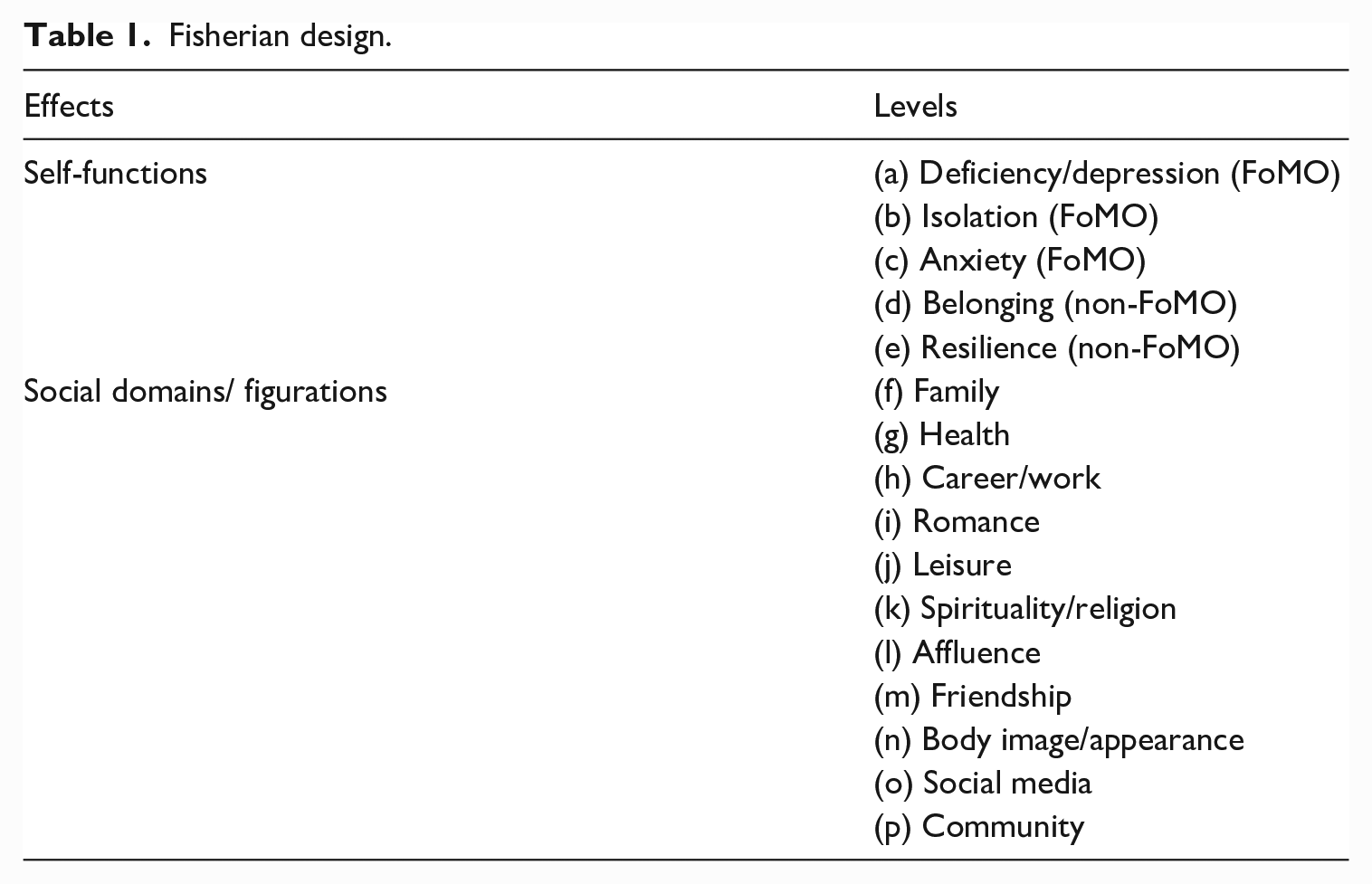
The 5 × 11 design replicated once yielded a Q-sample of 55 statements (Appendix 1). Statement 1, for example, (“I’ve always hated feeling excluded and unimportant and what keeps me from completely severing ties with all of these apps is that I don’t want to be completely in the dark”), is located in cell “b,m” containing “isolation” and “friendship.” Fundamentally, the meanings that respondents attribute to the statements pertain to their own subjectivity brought to light by Q-factor analysis, and not to that of the investigator’s logic in structuring the Q-sample.
Our participant group or P set consisted of 37 young Millennials and Post-Millennials/Generation Z (19–27 years old) at a large, urban Canadian university. We selected Millennials as our target audience, given that they are especially heavy users of social media. In light of their extensive engagement with social media usage, a substantial body of research has emerged which documents concerns over their psychological well-being, including the mediating impact of FoMO (e.g. Alt, 2015).
The 37 respondents were presented with a set or deck of statements and were instructed to rank order, or Q sort, the 55 statements along a quasi-normal distribution from “most like my point of view + 5” to “most unlike my point of view −5,” with the less salient items appearing closer to the 0 position (Appendix 2). All participants were interviewed after they completed their Q sorts according to an interview protocol which we developed. Opinion and not “facts” constitute the statements of the Q-sample, concomitantly subjectivity is brought into play when the Q sorter provides her or his point of view during the Q sorting process. As such, encoding and decoding are dialectical practices fostering multiple degrees of freedom in the Q sorting procedure.
Using PCQ (Stricklin and Almedia, 2000), a dedicated program for the analysis of Q data, the 37 Q sorts were duly correlated, and factor analyzed by person rather than by item with varimax rotation to achieve simplest structure. Procedurally, the weighted averages of highly correlated sorts are amalgamated producing ideal sort typologies, as given in the 3-factor solution in Table 2. Factor loading correlation coefficients are expressions of the degrees to which Q sorts correlate with the respective factors. The standard error for a zero-factor loading calculates significant factor loadings where N equals the number of statements in the Q-sample with the requirement that each factor has at least two statistically significant loadings and is given by the following expression (Brown, 1980: 222–223):
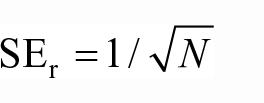
For 55 statements the
Factor loadings.
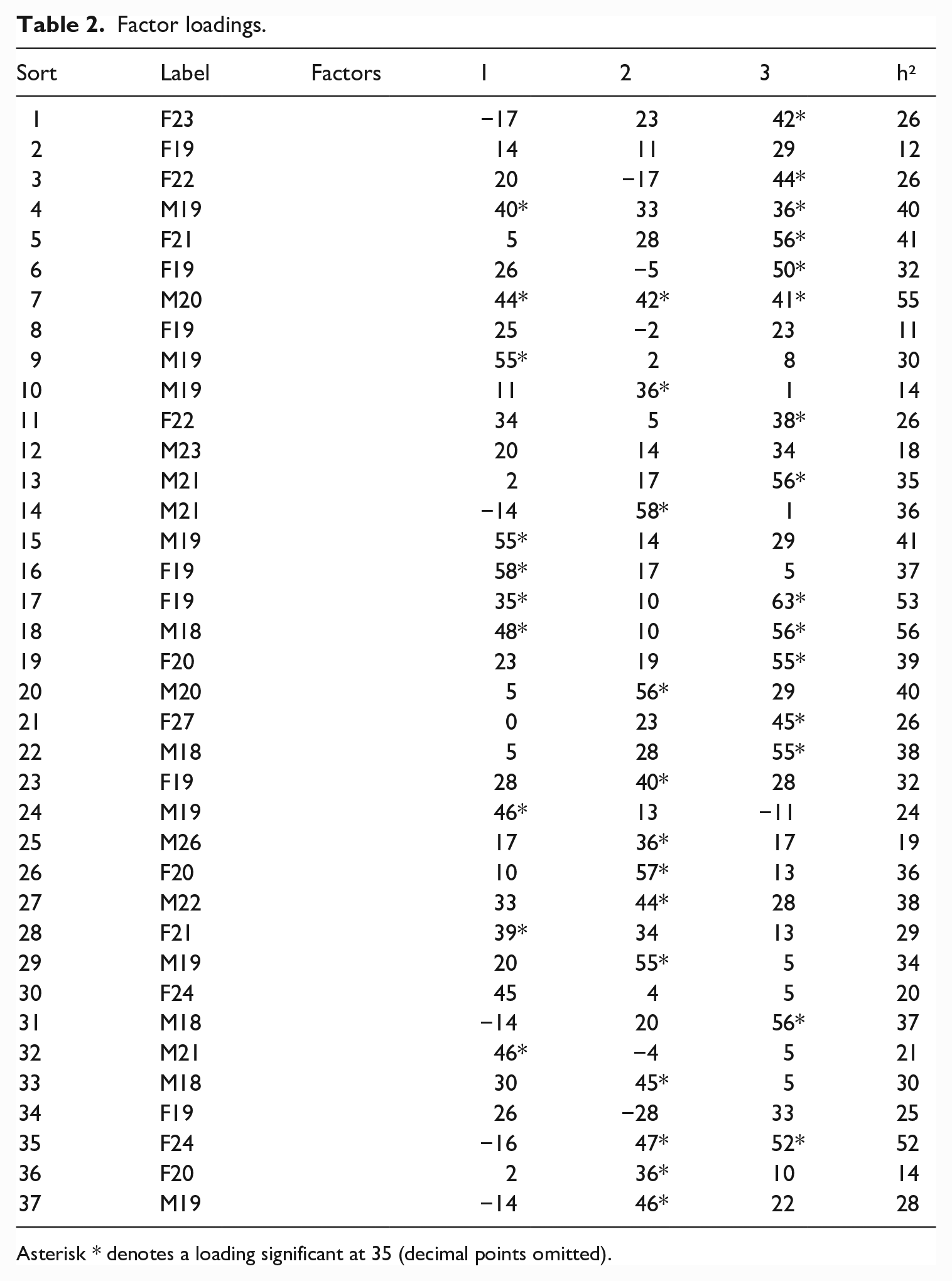
Asterisk * denotes a loading significant at 35 (decimal points omitted).
Results
Using the criteria noted above all factors had at least two loadings in excess of .35. As indicated earlier the factor loadings express the extent to which each Q sort is associated with each factor. Hence, of the 37 respondents, 33 had significant loadings and 4 did not load significantly on any of the factors. In addition, 5 persons cross-loaded meaning that they were associated (correlated) with more than one factor, so, for example, person 7 shared an association with all three factors, while person 17 was affiliated with factors 1 and 3; likewise for persons 4, 18 and 35 as noted by the asterisks across more than one factor. Using factor 1 as a further illustration, we see that persons 4, 7, 9, 15, 16, 17, 28, and 32 have significant loading on the factor all the while also noting that persons 4, 7, 17, and 18 are cross-loaded and hence not “pure types” in that they have viewpoints in partial agreement with other factors.
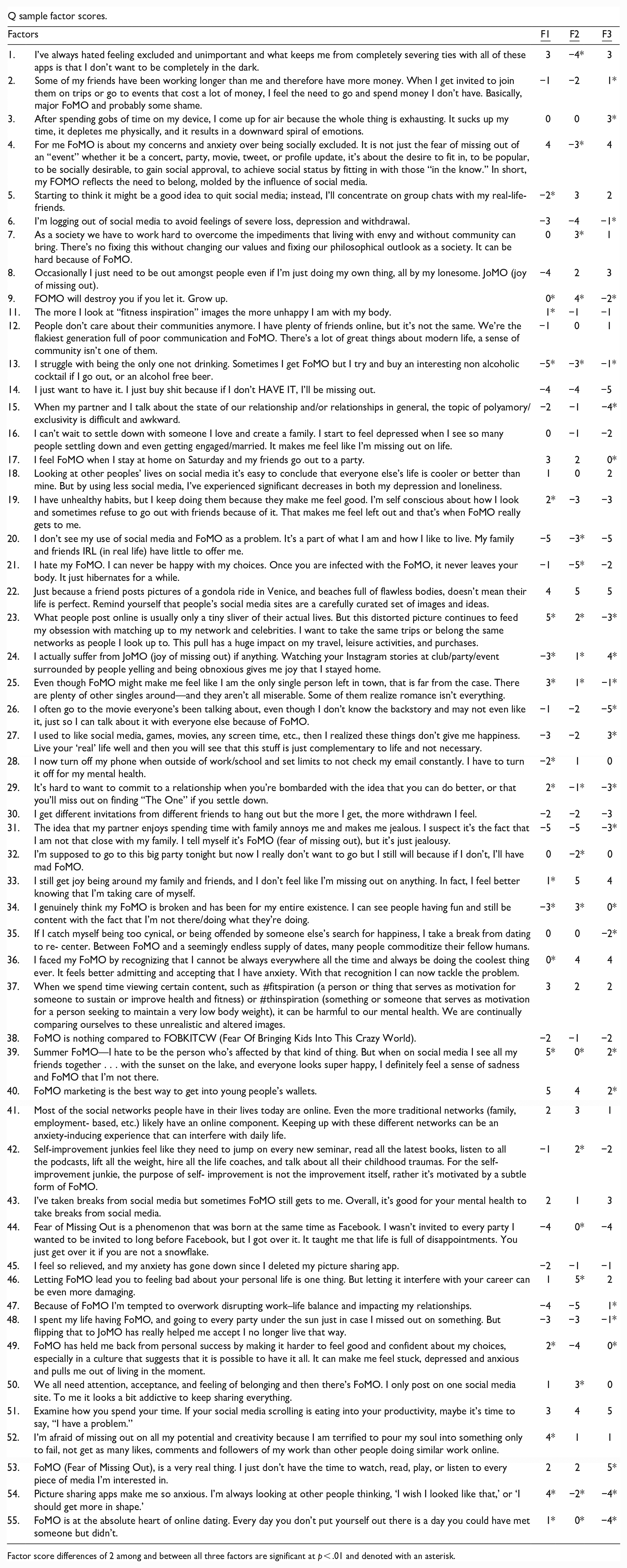
Although factor loadings reflect associations to a factor, the ultimate concern in Q, however, is with the factor scores. That is, interpretation as such proceeds in relation to the factor scores, namely, the items that characterize the factor, as well as those statements which are most discriminative for each factor array, hence distinguishing it most from the others. Accordingly, item scores are noted in parenthesis and in part reflect discriminating items where appropriate. Each factor array is schematical with a stream of feeling running through the entire array from positive to negative. Understandings of respondents’ everyday FoMO mediating discursive practices embedded in the media manifold and across scalable figurations were accessed and brought to light a posteriori by apprehending the implicit meanings of the schemata or feeling-state accounts in the factor-arrays. Notably, interpretations in Q are akin to Geertzian (Geertz, 1973) “experience near” “thick descriptions.”
Feelings of envy tempered by exclusion seem to anchor Factor 1 (which we name “envy/exclusion”) associated with seven men and four women and reflecting the dominant FoMO account, namely, as an effect of social media use that is harmful to well-being. Stenner (2012) draws attention to the interrelated psychosocial dynamics of envy (and jealousy) that are reproduced through the mechanism of exclusion. Driven by social comparison and heightened envy, FoMO then becomes a mediating factor for respondents who may feel that they do not measure up to real or imaginary positive experiences that others may be having in their absence (Przybylski et al., 2013).
The feelings of envy straddle the figurational terrain of work, dating/romance, body image, leisure, and the like. Persons expressing the envy/exclusion feeling-state in the main tend to be heavy users of social media, as explained by a 24-year-old female: “I’m a strong user of social media and want to curtail its use—want to be more critical of it—I want to delete apps but can only do so for a while—what if someone messages me?.” Participants are aware of the harmful feelings related to their practices yet exclude themselves from in real life (IRL) relationships: we “tell ourselves we’re spending more time with others—rate of depression has gone up—for me, I should not be engaging people on social media, I know I should be doing that in person” (21-year-old male).
Respondents expressing the envy/exclusion feeling-state understand that social media content and profiles are curated (item 22) but they are still “obsessed” with keeping up, as well as comparing themselves with idealized images and re-presentations of self on social media (items 23, 39, 54). A 19-year-old woman recognizes that “even if people manipulate their own profiles, they have trouble accepting that other profiles are manipulated.” Specific pain points are mainly “work, love” issues, such as career failure (item 52), apprehension of not connecting romantically (item 55) coupled with romantic relationship commitment hesitation (item 29) and failure (item 25).
On the negative side of the F1 factor, one notes a rejection of social engagement and attachments along with concomitant fears that activate FoMO. Exclusion is experienced as painful—there is no joy in missing out (items 8, 24), as well as limited social satisfaction from school or work (item10). Respondents recognize their use of social media may be problematic (item 20) but also experience agentic inefficacity in the mediatised environment to overcome their problems, as exemplified by an inability to control their use of social media (item 5), unhealthy habits, ignore self-improvement interpellations (item 42), or break FoMO altogether (items 34, 36). As a “strong user of social media,” a 24-year-old female respondent observes that her social media usage, mediated by FoMO, is related to self-esteem: “I want to delete apps but only for a while—self-esteem, feeling good about myself is connected to social media.”
Paradoxically, respondents expressing the envy/exclusion feeling-state exclude themselves from intimacy and community despite the recognition of the toll this exacts on their feelings of well-being. The capacity to manage ubiquitous and pervasive mediatized social comparison is an important new individual responsibility of social and emotional self-regulation, not unlike Elias’ (1978) cultural–historical account that documents embodied restraints. The need for FoMO self-help is eliciting its own literature (Brinkmann, 2019).
Feelings of “grounded vigilance” can best typify the figurations of persons who are associated with Factor 2 as expressed by nine men and five women, rendering a counter-discursive formation. They foreground the importance of relationships and community as well as a declarative resistance to social media that invites FoMO, feeling confident and effective against FoMO.
The F2 “grounded vigilance” feeling-state has an overriding social, affective, and therapeutic orientation toward apparently stable and identifiable offline figurations of community, friends, and family (33), recognizing that as existing social networks move online, it is “anxiety inducing” to try to keep up with these networks and that it can “interfere with daily life” (item 41). Yet, they have an ability to partition “personal life” from an anticipated future self and consider that letting FoMO damage career/work life is worse than “feeling bad” about one’s personal life (item 46).
Participants expressing the F2 “grounded vigilance” feeling-state recognize that FoMO marketing strategies and tactics are curated and a deliberate attempt to induce consumption (item 40), but attribute susceptibility to FoMO as a childish weakness. Their message to both themselves and to others who falter is “grow up” (item 9). For them, society has to “work hard” to overcome envy and life “without community,” framed as a philosophical outlook concerning values and a way of life (item 7). They express a need to mitigate social media use and, in its stead, to concentrate on real life friends (item 5). They also believe that they have “broken” FoMO and express satisfaction with their own lives (item 34). A 19-year-old female observes: “I thought that I had real FoMO but after reading through these statements realized it does not affect my lifeday today.” There is a sense of modest indifference and maintaining personal privacy, hence sharing “everything,” or oversharing, is not recommended (50).
The negative side of the Factor 2 feeling-state is in fact a critique of the insularity brought on by social media and includes fragments of existential choices and empowerment, including a rejection of media infatuation and FoMO. FoMO has not caused them to overwork, disrupting work-life balance and relationships (47). Respondents deny “always looking at” picture-sharing apps (item 54) and reject notions of FoMO-induced undisciplined consumption (item 14). Feelings of empowerment enable persons on this factor to correct unhealthy habits (item 19) such as alcohol (item 13) and body image issues (item 11). Since FoMO has not infected their lives online or off, they are not dissatisfied with life’s choices (item 21). Moreover, FoMO has not held them back from personal success (item 49) nor have they felt socially excluded and unimportant (items 1, 4).
Sixteen persons loaded on Factor 3 (“managed vulnerability”) and included seven men and nine women, once again (along with Factor 1) providing interpretations that show harmful engagement with social media, mediated by FoMO. The figurational spaces inhabited by these respondents seem to be embedded in feelings of vulnerability that must be managed, as well as conflict and unease, associated with social media usage and mediated by FoMO. On one hand, respondents expressing the managed vulnerability feeling-state recognize attachment to social media has negative consequences, such as depression, loneliness, and shame, yet their desire for social attachments (items 17, 24) are paradoxically rejected. On the positive side of the factor, they realize that FoMO is a very real thing (item 53) because of the abundance of choices, yet they understand that using social media less “decreases depression and loneliness” (item 18).
Participants expressing the managed vulnerability feeling-state advocate deliberate problem-recognition, regarding social media misuse as a timewaster (item 51), realizing that social media, games, and movies “don’t give me happiness” the way “real life” can (item 27); at the same time, they report relapses when social media sucks up time and induces an emotional “downward spiral” (item 3). The stance reports strong attachments to offline friends and family (item 33), while at the same time they ominously express some underlying long-term concerns about pervasive social exclusion (items 4, 1). A 27-year-old respondent observes that “social media overall is negative, more bad than good—FoMO is a placeholder for loneliness—more consumption of social media probably means less IRL experience.”
The negative side of the F3 factor is in fact a denial of their vulnerability and unease pertaining to social media and FoMO including human relationships and community, which they desire (items 17, 34). They reject disengaging or moderating social media use, despite feelings of depression and withdrawal that social media precipitate (item 6), as well as the role of social media in dating and romance (items 29, 55). There is a denial that social media are a problem (items 20), similarly they do not consider FoMO to be a result of immature weakness (item 9): “get high not joy from social media—you have to do life to be fulfilled, and social media complements this” (female, 23). They also recognize that FoMO marketing is designed to elicit consumption yet misrecognize being susceptible to this sort of manipulation (item 14). Respondents expressing the managed vulnerability feeling-state deny experiencing FoMO-related body envy (item 54), online dating disappointment (item 55) and romantic partner dissatisfaction (items 15, 29), also dismissing their susceptibility to word of mouth regarding popular media consumption (item 26). Concomitantly, there is a refutation of having gotten over life disappointments, as well as experiencing ontological social withdrawal (item 30).
Discussion and conclusion
In this study, Q methodology and mediatization/figurational theory cultivated an epistemological space that fostered audience-centered knowledges and understandings of FoMO mediations, and the digital ecology. Our own interpretations lean toward understandings of FoMO mediations as more of a communal construction (Gergen, 1991), fundamentally as a product, not an effect, of late modernity where media mold human practices dialectically, and less so as a decontextualized reductionistic individual mental health issue (Szasz, 1961) per se.
Indeed, current media effects studies seem to replicate a historical trend that positions new media as harmful, and therefore as impacting feelings of well-being while concomitantly pathologizing audiences (Butsch, 2008). Seemingly, Gerbner’s “scary world of television” (Gerbner and Gross, 1976a, 1976b) has been replaced by another sort of “fear” within the circuit of digital culture, one that fosters missing out on “rewarding experiences other may be having” (Przybylski et al., 2013). Television, Gerbner argued (Gerbner and Gross, 1976a) was the “cultural arm” of the social sphere, and clearly this now has been replaced by social media, digital culture in general, and at certain points mediated by FoMO. Factors 1 and 3 in fact grasp these meanings within the social media discourse and are contextualized within what Gergen (1990, 1991) has termed the “language of mental deficit.”
Both in the popular culture and effects research, the dominant FoMO discourse circulates within the classificatory frameworks of mental illness and health as a socially negotiated construct producing both the knowledge/power and subject positions embedded in the discourse (Foucault, 1972). In a sense Factor 2 shows the limits of the dominant discourse, favoring in its stead a “counter-hegemonic” FoMO cultural narrative, that is, meanings associated with community, family, friends IRL, and conceptions of adult responsibility.
As one reviewer helpfully suggested, it is tempting to see in the three FoMO feeling-states a reflection of Stuart Hall’s (1980) three main cultural reading positions: dominant (F1), negotiated (F3), and oppositional (F2). Thus interpreted, elicitation of FoMO becomes a mainstream affordance of ubiquitous social media (F1), while in some sense, the negotiated feeling state F3 corresponds to attempts to assert personal agential control over a mediatized social environment. The oppositional feeling state F2 evokes a social world that is apparently receding from reach of more than a few young people: that of supportive family, friends, and community in which eternal issues of love and work are resolvable.
Our project contributes to person-centric research on FoMO (Alutaybi et al., 2019; Elhai et al., 2021b; Fuster et al., 2017; Zylinski and Davis, 2022). The utility of our methodological framework was demonstrated in uncovering and describing varieties of subjective experiences and of complex emotions elicited in the context of ubiquitous interactive mobile social media. This allowed us to go beyond the usual accounts of FoMO that measure the degrees to which individuals exhibit it to a more nuanced appreciation, ultimately providing a unique perspective that foregrounds sociocultural understandings of FoMO: how people experience it, how they believe they manage it, and how they perceive it in others. More generally, our analysis contributes to the development of empirical mediatization research (Schrøder, 2019: 162), particularly in respect of individuals’ everyday experiences of life with social media in moments of deep mediatization.
Footnotes
Appendix 1
Q sample factor scores.
| Factors |
|
|
|
|
|---|---|---|---|---|
| 1. | I’ve always hated feeling excluded and unimportant and what keeps me from completely severing ties with all of these apps is that I don’t want to be completely in the dark. | 3 | −4* | 3 |
| 2. | Some of my friends have been working longer than me and therefore have more money. When I get invited to join them on trips or go to events that cost a lot of money, I feel the need to go and spend money I don’t have. Basically, major FoMO and probably some shame. | −1 | −2 | 1* |
| 3. | After spending gobs of time on my device, I come up for air because the whole thing is exhausting. It sucks up my time, it depletes me physically, and it results in a downward spiral of emotions. | 0 | 0 | 3* |
| 4. | For me FoMO is about my concerns and anxiety over being socially excluded. It is not just the fear of missing out of an “event” whether it be a concert, party, movie, tweet, or profile update, it’s about the desire to fit in, to be popular, to be socially desirable, to gain social approval, to achieve social status by fitting in with those “in the know.” In short, my FOMO reflects the need to belong, molded by the influence of social media. | 4 | −3* | 4 |
| 5. | Starting to think it might be a good idea to quit social media; instead, I’ll concentrate on group chats with my real-life-friends. | −2* | 3 | 2 |
| 6. | I’m logging out of social media to avoid feelings of severe loss, depression and withdrawal. | −3 | −4 | −1* |
| 7. | As a society we have to work hard to overcome the impediments that living with envy and without community can bring. There’s no fixing this without changing our values and fixing our philosophical outlook as a society. It can be hard because of FoMO. | 0 | 3* | 1 |
| 8. | Occasionally I just need to be out amongst people even if I’m just doing my own thing, all by my lonesome. JoMO (joy of missing out). | −4 | 2 | 3 |
| 9. | FOMO will destroy you if you let it. Grow up. | 0* | 4* | −2* |
| 11. | The more I look at “fitness inspiration” images the more unhappy I am with my body. | 1* | −1 | −1 |
| 12. | People don’t care about their communities anymore. I have plenty of friends online, but it’s not the same. We’re the flakiest generation full of poor communication and FoMO. There’s a lot of great things about modern life, a sense of community isn’t one of them. | −1 | 0 | 1 |
| 13. | I struggle with being the only one not drinking. Sometimes I get FoMO but I try and buy an interesting non alcoholic cocktail if I go out, or an alcohol free beer. | −5* | −3* | −1* |
| 14. | I just want to have it. I just buy shit because if I don’t HAVE IT, I’ll be missing out. | −4 | −4 | −5 |
| 15. | When my partner and I talk about the state of our relationship and/or relationships in general, the topic of polyamory/exclusivity is difficult and awkward. | −2 | −1 | −4* |
| 16. | I can’t wait to settle down with someone I love and create a family. I start to feel depressed when I see so many people settling down and even getting engaged/married. It makes me feel like I’m missing out on life. | 0 | −1 | −2 |
| 17. | I feel FoMO when I stay at home on Saturday and my friends go out to a party. | 3 | 2 | 0* |
| 18. | Looking at other peoples’ lives on social media it’s easy to conclude that everyone else’s life is cooler or better than mine. But by using less social media, I’ve experienced significant decreases in both my depression and loneliness. | 1 | 0 | 2 |
| 19. | I have unhealthy habits, but I keep doing them because they make me feel good. I’m self conscious about how I look and sometimes refuse to go out with friends because of it. That makes me feel left out and that’s when FoMO really gets to me. | 2* | −3 | −3 |
| 20. | I don’t see my use of social media and FoMO as a problem. It’s a part of what I am and how I like to live. My family and friends IRL (in real life) have little to offer me. | −5 | −3* | −5 |
| 21. | I hate my FoMO. I can never be happy with my choices. Once you are infected with the FoMO, it never leaves your body. It just hibernates for a while. | −1 | −5* | −2 |
| 22. | Just because a friend posts pictures of a gondola ride in Venice, and beaches full of flawless bodies, doesn’t mean their life is perfect. Remind yourself that people’s social media sites are a carefully curated set of images and ideas. | 4 | 5 | 5 |
| 23. | What people post online is usually only a tiny sliver of their actual lives. But this distorted picture continues to feed my obsession with matching up to my network and celebrities. I want to take the same trips or belong the same networks as people I look up to. This pull has a huge impact on my travel, leisure activities, and purchases. | 5* | 2* | −3* |
| 24. | I actually suffer from JoMO (joy of missing out) if anything. Watching your Instagram stories at club/party/event surrounded by people yelling and being obnoxious gives me joy that I stayed home. | −3* | 1* | 4* |
| 25. | Even though FoMO might make me feel like I am the only single person left in town, that is far from the case. There are plenty of other singles around—and they aren’t all miserable. Some of them realize romance isn’t everything. | 3* | 1* | −1* |
| 26. | I often go to the movie everyone’s been talking about, even though I don’t know the backstory and may not even like it, just so I can talk about it with everyone else because of FoMO. | −1 | −2 | −5* |
| 27. | I used to like social media, games, movies, any screen time, etc., then I realized these things don’t give me happiness. Live your ‘real’ life well and then you will see that this stuff is just complementary to life and not necessary. | −3 | −2 | 3* |
| 28. | I now turn off my phone when outside of work/school and set limits to not check my email constantly. I have to turn it off for my mental health. | −2* | 1 | 0 |
| 29. | It’s hard to want to commit to a relationship when you’re bombarded with the idea that you can do better, or that you’ll miss out on finding “The One” if you settle down. | 2* | −1* | −3* |
| 30. | I get different invitations from different friends to hang out but the more I get, the more withdrawn I feel. | −2 | −2 | −3 |
| 31. | The idea that my partner enjoys spending time with family annoys me and makes me jealous. I suspect it’s the fact that I am not that close with my family. I tell myself it’s FoMO (fear of missing out), but it’s just jealousy. | −5 | −5 | −3* |
| 32. | I’m supposed to go to this big party tonight but now I really don’t want to go but I still will because if I don’t, I’ll have mad FoMO. | 0 | −2* | 0 |
| 33. | I still get joy being around my family and friends, and I don’t feel like I’m missing out on anything. In fact, I feel better knowing that I’m taking care of myself. | 1* | 5 | 4 |
| 34. | I genuinely think my FoMO is broken and has been for my entire existence. I can see people having fun and still be content with the fact that I’m not there/doing what they’re doing. | −3* | 3* | 0* |
| 35. | If I catch myself being too cynical, or being offended by someone else’s search for happiness, I take a break from dating to re- center. Between FoMO and a seemingly endless supply of dates, many people commoditize their fellow humans. | 0 | 0 | −2* |
| 36. | I faced my FoMO by recognizing that I cannot be always everywhere all the time and always be doing the coolest thing ever. It feels better admitting and accepting that I have anxiety. With that recognition I can now tackle the problem. | 0* | 4 | 4 |
| 37. | When we spend time viewing certain content, such as #fitspiration (a person or thing that serves as motivation for someone to sustain or improve health and fitness) or #thinspiration (something or someone that serves as motivation for a person seeking to maintain a very low body weight), it can be harmful to our mental health. We are continually comparing ourselves to these unrealistic and altered images. | 3 | 2 | 2 |
| 38. | FoMO is nothing compared to FOBKITCW (Fear Of Bringing Kids Into This Crazy World). | −2 | −1 | −2 |
| 39. | Summer FoMO—I hate to be the person who’s affected by that kind of thing. But when on social media I see all my friends together . . . with the sunset on the lake, and everyone looks super happy, I definitely feel a sense of sadness and FoMO that I’m not there. | 5* | 0* | 2* |
| 40. | FoMO marketing is the best way to get into young people’s wallets. | 5 | 4 | 2* |
| 41. | Most of the social networks people have in their lives today are online. Even the more traditional networks (family, employment- based, etc.) likely have an online component. Keeping up with these different networks can be an anxiety-inducing experience that can interfere with daily life. | 2 | 3 | 1 |
| 42. | Self-improvement junkies feel like they need to jump on every new seminar, read all the latest books, listen to all the podcasts, lift all the weight, hire all the life coaches, and talk about all their childhood traumas. For the self-improvement junkie, the purpose of self- improvement is not the improvement itself, rather it’s motivated by a subtle form of FoMO. | −1 | 2* | −2 |
| 43. | I’ve taken breaks from social media but sometimes FoMO still gets to me. Overall, it’s good for your mental health to take breaks from social media. | 2 | 1 | 3 |
| 44. | Fear of Missing Out is a phenomenon that was born at the same time as Facebook. I wasn’t invited to every party I wanted to be invited to long before Facebook, but I got over it. It taught me that life is full of disappointments. You just get over it if you are not a snowflake. | −4 | 0* | −4 |
| 45. | I feel so relieved, and my anxiety has gone down since I deleted my picture sharing app. | −2 | −1 | −1 |
| 46. | Letting FoMO lead you to feeling bad about your personal life is one thing. But letting it interfere with your career can be even more damaging. | 1 | 5* | 2 |
| 47. | Because of FoMO I’m tempted to overwork disrupting work–life balance and impacting my relationships. | −4 | −5 | 1* |
| 48. | I spent my life having FoMO, and going to every party under the sun just in case I missed out on something. But flipping that to JoMO has really helped me accept I no longer live that way. | −3 | −3 | −1* |
| 49. | FoMO has held me back from personal success by making it harder to feel good and confident about my choices, especially in a culture that suggests that it is possible to have it all. It can make me feel stuck, depressed and anxious and pulls me out of living in the moment. | 2* | −4 | 0* |
| 50. | We all need attention, acceptance, and feeling of belonging and then there’s FoMO. I only post on one social media site. To me it looks a bit addictive to keep sharing everything. | 1 | 3* | 0 |
| 51. | Examine how you spend your time. If your social media scrolling is eating into your productivity, maybe it’s time to say, “I have a problem.” | 3 | 4 | 5 |
| 52. | I’m afraid of missing out on all my potential and creativity because I am terrified to pour my soul into something only to fail, not get as many likes, comments and followers of my work than other people doing similar work online. | 4* | 1 | 1 |
| 53. | FoMO (Fear of Missing Out), is a very real thing. I just don’t have the time to watch, read, play, or listen to every piece of media I’m interested in. | 2 | 2 | 5* |
| 54. | Picture sharing apps make me so anxious. I’m always looking at other people thinking, ‘I wish I looked like that,’ or ‘I should get more in shape.’ | 4* | −2* | −4* |
| 55. | FoMO is at the absolute heart of online dating. Every day you don’t put yourself out there is a day you could have met someone but didn’t. | 1* | 0* | −4* |
Factor score differences of 2 among and between all three factors are significant at p < .01 and denoted with an asterisk.
Appendix 2
Funding
The author(s) received no financial support for the research, authorship, and/or publication of this article.
