




Abstract
This article uses computational data and social science theories to analyze the misogynistic discourse of the involuntary celibate (“incel”) community. We analyzed every comment (N = 3,686,110) produced over 42 months on a popular incel discussion board and found that nearly all active participants use misogynistic terms. Participants used misogynistic terms nearly one million times and at a rate 2.4 times greater than their use of neutral terms for women. The majority of participants’ use of misogynistic terms does not increase or decrease with post frequency, suggesting that members arrive (rather than become) misogynistic. We discuss these findings in relation to theories of intersectionality, masculinity, and sexism. We likewise discuss potential policies for mitigating incel misogyny and similar online discourse.
In this article, we examine the extent to which involuntarily celibates (“incels”) participate in misogynistic discourse. Incels are a predominately online community of men who define themselves by their inability to establish heterosexual relationships. Incels have been connected to online harassment, stalking, and several mass murders (O’Donnell and Shor, 2022; Regehr, 2022).
Previous studies have detailed incels’ misogynistic discourse and practices. Qualitative work demonstrates that incels see themselves as entitled to sex, while valorizing mass murderers (e.g. Glace et al., 2021; Halpin, 2022; Halpin and Richard, 2021; O’Donnell and Shor, 2022; Preston et al., 2021; Regehr, 2022). Computational studies detail incels’ use of toxic language (e.g. Jaki et al., 2019; Pelzer et al., 2021; Ribeiro et al., 2021). In this article, we leverage the strengths of both qualitative and computational studies. Building on computational work, we analyze a large dataset (N = 3,686,110), and building on qualitative work, we examine incel misogyny in relation to theories of intersectionality, gender, and sexism (Bridges and Pascoe, 2014; Collins, 1990; Connell, 1995; Glick and Fiske, 1996; Schippers, 2007).
We find that the majority of both threads (82%) and users’ post histories (81%) contain at least one misogynistic term. In this sense, misogyny is a product of the incel community, rather than a few select individuals. Furthermore, we find that there is no statistically significant overall association between a user’s post frequency and their use of misogynistic terms, which suggests most users posting on incels.is do not become misogynistic on incels.is but arrive already endorsing misogyny. We further argue that incels degrade all women (Schippers, 2007), but Women of Color are doubly denigrated by incels (Collins, 1990). We also find that incels participate in hybrid masculinity (Bridges and Pascoe, 2014) and that incels’ participation in hostile sexism dwarfs their participation in benevolent sexism (Glick and Fiske, 1996).
Our article engages with policy debates regarding hostile online communities. Organizations are characterizing incels as an extremist community, governments are linking incels to terrorism and hate crimes, and some countries are considering regulating online speech (e.g. Golinkin, 2022; Moonshot, n.d.). Relevant to such debates, we argue that deplatforming sites like incels.is are warranted due to prolific misogyny. However, instead of focusing on deplatforming, we argue that targeted counterresponses are necessary. We outline a multi-level approach for disrupting incel misogyny in our discussion.
Background
Incels and networked misogyny
Incels see themselves as victims of lookism, a form of prejudice and discrimination that orients to physical attractiveness (Dion et al., 1972; Halpin, 2022). Incel discourse is characterized by the “black pill,” the fatalistic acceptance that women’s mating preferences are structured by lookism, and, because of their unattractiveness, incels will be “forever alone” (Glace et al., 2021; Preston et al., 2021).
Incels are part of a larger manosphere, a group of male-oriented websites that share the belief that men face systemic discrimination (Bates, 2021; Ging, 2019; Marwick and Caplan, 2018; Van Valkenburgh, 2021). Incels and similar communities create affordances (Boyd, 2010) for the villainization of feminism, cyberhate, and networked misogyny (Halpin, 2022; Halpin and Richard, 2021; Jaki et al., 2019; Jane, 2018; Jones et al., 2020; Marwick and Caplan, 2018; Moloney and Love, 2019; O’Donnell and Shor, 2022; O’Malley et al., 2020; Pelzer et al., 2021; Preston et al., 2021). Building on such research, we use computational methods to demonstrate the ubiquity of misogyny on incels.is.
Incels are not a monolith. Incels are diverse in relation to social class, age, and race/ethnicity (Halpin and Richard, 2021). While the site we examine bans women, some women identify as incels and some researchers further suggest distinguishing between incels and misogynistic incels (e.g. Arbeit et al., 2022; Kelly et al., 2021). In this article, rather than focusing on misogynistic or non-misogynistic incels, we examine misogynistic discourse produced by users of incels.is. We refer to this group specifically when we use the term “incel” throughout our analyses and discussion.
Gender, sexism, and intersectionality
Our analyses are informed by social scientific theories on intersectionality, masculinity, and sexism. First, we draw on intersectionality (Collins, 1990), which is a framework demonstrating how multiple axes of oppression overlap. From this perspective, misogyny is never just misogyny, but also shaped by other forms of oppression, such as racism. In this article, we ask: how is incel misogyny both racist and racialized? We address this question by comparing misogynistic terms that target White women (e.g. “Stacy”) with terms that target Women of Color (e.g. “big black vagina”). As we argue, incel misogyny orients to a matrix of domination (Collins, 1990), wherein all women are denigrated, but women of color are doubly denigrated through a combination of racism and sexism.
Second, we draw on Connell’s (1995) conceptualization of hegemonic and subordinate masculinity. Hegemonic masculinity is not a trait or a type of man, but rather is a set of practices that legitimate and maintain unequal gender relations, including unequal relations between groups of men (Connell, 1995; Messerschmidt, 2018). While there are many dimensions to this concept (Connell, 1995; Messerschmidt, 2018), we discuss hegemonic masculinity as practices that advance the subjugation of women.
In contrast to hegemonic masculinity, subordinate masculinity refers to practices that have been “exiled” from masculinity. Connell (1995) argues that men who participate in subordinate masculinity have their masculine legitimacy questioned (e.g. gay men). Connell likewise asserts that men who do not participate in heterosexual sex can be positioned, or position themselves, as subordinate. In this article, we discuss subordinate masculinity in relation to incels’ assertions that they are failed men because of lookism and their lack of participation in heterosexual sex (see also Halpin, 2022).
Research has tied incels to both hegemonic and subordinate masculinity. Some of these arguments (e.g. Ging, 2019; Glace et al., 2021) assert that incels practice hybrid masculinity, which is a blending of different masculine practices (e.g. hegemonic and subordinate masculinity; see Bridges and Pascoe, 2014). For instance, Halpin (2022) argues that incels weaponize their subordination, as they strategically position themselves as subordinate, “failed men” to justify their hegemonic practices, such as endorsing interpersonal and systemic violence against women. Situating misogyny as a hegemonic practice that perpetuates unequal gender relations (Connell, 1995; Messerschmidt, 2018), we ask: to what extent do incels participate in hegemonic masculinity? We address this question by documenting the usage of misogynistic terms both in incel.is threads and users’ post histories, as well as examining if users become more misogynistic in relation to posting frequency. We argue that incels enact hybrid masculinity, as they self-identify as subordinate men while ubiquitously participating in misogyny.
Third, we use Connell’s (1987) concept of “emphasized femininity,” a counterpart to hegemonic masculinity, that is defined by nurturing, empathizing, and taking a submissive orientation toward men and their needs. The relationship between emphasized femininity and hegemonic masculinity is asymmetrical, as hegemonic masculinity dominates the gender order. Contrastive to emphasized femininity, Schippers (2007) discusses pariah femininities, which are socially undesirable forms of femininity. Building on these tensions between culturally valued and shunned femininities, we ask two questions: (1) how do incels talk about different groups of women? and (2) how do incels use misogynistic terms in comparison with neutral terms for women (e.g., “women”)? We address these questions by comparing the usage of different types of misogynistic terms (e.g. “Stacy,” “noodlewhore”) and compare the use of misogynistic terms and non-misogynistic terms. We argue that incels rank order women, but nonetheless treat all femininities as pariah femininities.
Finally, while numerous studies detail misogyny in the manosphere, these studies do not leverage the theory of ambivalent sexism (Glick and Fiske, 1996). Glick and Fiske (1996) suggest that sexism is a “special case of prejudice,” as sexist heterosexual men pursue intimacy with women, while simultaneously feeling antipathy toward them. The theory identifies two types of sexism: (1) hostile sexism, which is aggressive misogyny that situates women as controlling, manipulative, and subhuman, and (2) benevolent sexism, which endorses complementary gender roles and frames women as requiring men’s protection. Researchers argue that hostile and benevolent sexism are highly correlated, fitting “hand in glove,” with one another (Glick and Fiske, 1996). However, recent studies suggest that both incels (Halpin and Richard, 2021) and men who see themselves as unattractive (e.g. Bosson et al., 2022) endorse hostile sexism, but have decreased endorsement for benevolent sexism. In this article, we ask: how does incels’ participation in hostile sexism compare to their participation in benevolent sexism? We address this question by using “girl” as an indicator for benevolent sexism, and comparing its frequency to the use of hostile sexist terminology that dehumanizes women (discussed below). Given incels prolific hostile sexism, we argue that they evidence how the “hand” of hostile sexism slips out of the “glove” of benevolent sexism.
Data and methods
This article examines the discussion board on incels.is, a popular English language incel website. At the time of our data collection (15 April 2021), the site had 13,700 registered members who produced nearly 6 million comments and spent more than 54,000 days on the website. These numbers do not count people who view the site without commenting; the site receives several million visits per month (Similarweb, 2021).
Procedure
We collected all posts (e.g. text posted by a user) that appeared on the incels.is discussion board (“Inceldom Discussion”) from 8 November 2017 until 16 April 2021 (N = 3,686,110). We employed custom scraping scripts 1 to extract all public post data. This script automatically traversed and downloaded the corresponding HTML for every page of posts within each thread of “Inceldom Discussion.” Individual comments and user information were then extracted from the HTML and saved as thread-specific text files. The extracted data include post text along with the associated participant user IDs, posting time, thread titles, threads, and the respective order of posts in threads. Our analyses do not include posts that were deleted before we completed our data collection and excludes text quoting other posts in the same thread.
Analytic approach
We use computational methods to collect and describe incel misogyny, while using social science theories to inform our research questions, as well as interpret and discuss our results. In this sense, we aim to leverage computational analyses, while addressing critiques that computational approaches are overly descriptive and/or atheoretical (Edelmann et al., 2020; Nelson, 2020). Likewise, drawing on previous work (Nelson, 2020), we employ an inductive approach that involves first creating a glossary of misogynistic terms, then developing and employing regular expressions 2 to capture all references to these terms, and finally abductively analyzing (Halpin and Richard, 2021) our data in relation to social scientific theories.
Most analyses of the incel community focus on discrete comments or threads. In addition to analyzing comments and threads, we analyze misogyny in the first post, and the post title. We display data at these three levels to describe how misogynistic discussions can develop over the course of a thread (e.g. do discussions begin or become misogynistic?). In further contrast to previous analyses, our dataset also allows us to characterize misogynistic language in relation to a user’s posting frequency (see Table 1 and Figure 2).
Summary use of misogyny among active online incels.
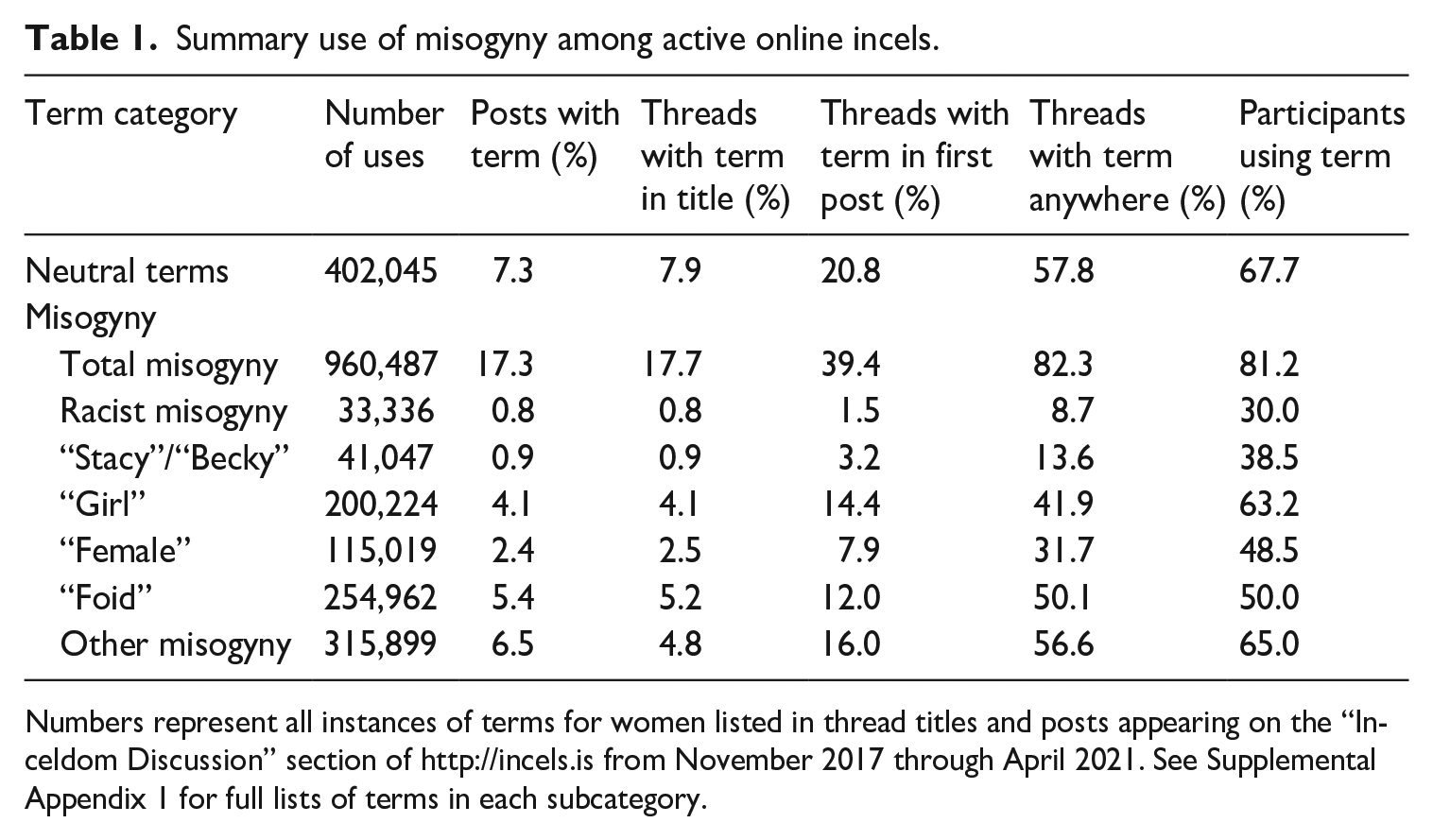
Numbers represent all instances of terms for women listed in thread titles and posts appearing on the “Inceldom Discussion” section of http://incels.is from November 2017 through April 2021. See Supplemental Appendix 1 for full lists of terms in each subcategory.
Since incels use considerable jargon (e.g. terms like “foid”), we first developed a glossary of misogynistic terms to cross-reference against discussion board posts. Our glossary includes the misogynistic terms listed in the incels.is glossary (Incels.wiki, 2021), as well as the misogynistic glossary on Hatebase.org (2021), as the incels.is glossary omits some common misogynistic terms (e.g. “bitch,” “cunt”). In addition to using these glossaries, we also included misogynistic terms that we documented in our prior qualitative analyses (Halpin, 2022; Halpin and Richard, 2021; Preston et al., 2021) that are both used by incels and missing from their glossary (e.g. “currywhore”).
Drawing on the social science theories reviewed above, we assigned a label to each misogynistic term to differentiate between types of misogyny (e.g. “Racist Misogyny”). We employed a decision rule to prevent double-counting terms by prioritizing their category assignment in the following order: “Racist Misogyny,” “Stacy/Becky,” “Girl,” “Female,” “Foid,” and “Other Misogyny.” In practical terms, our decision rules mean that a term like “noodlewhore” is assigned to “Racist Misogyny” and the word “whore” that follows “noodle” is not double-counted into the “Other Misogyny” category. 3
Our category “Racist Misogyny” captures misogynistic terms that are also racist (e.g. calling Asian women “noodlewhores”), while “Stacy” or “Becky,” are misogynistic terms for White women (see also Menzie, 2022). We coded “female” and “girl” separately because these terms can be used non-misogynistically or misogynistically. “Female” can operate as a misogynistic microaggression (e.g. Sue et al., 2007), while we treat “girl” as an indicator of benevolent sexism (Glick and Fiske, 1996). We discuss the coding of “female” and “girl” in the “Fidelity checks” section below. We created a separate category for variations of “foid” (e.g. “foid,” “femoid”), as they are, by far, the most prolifically used misogynistic terms among incels. Any misogynistic term that is not captured by these categories (e.g. “bitch,” “roastie”) is placed in the category “Other Misogyny.”
For comparative purposes, we also identified “Neutral Terms” for women (e.g. “woman”). While we code these words as “neutral” because they are non-misogynistic ways to refer to women, this analysis does not detail the broader context of word use. Consequently, our analysis likely underestimates the extent of incel misogyny (see “Fidelity checks” section).
While our coding rules orient to social science theories (e.g. Collins, 1990; Connell, 1995), our rules are also a limitation, and different rules would produce different analyses and answer different questions. For instance, we could have created a category of incel-specific misogynistic terms (e.g. “foid,” “noodlewhoore”) to potentially address how incels do or do not adopt in-group terminology in relation to their posting history. However, because so many incel-specific terms are also racialized (e.g. “Stacy,” “currywhore”), our prohibition on double-coding terms means we would have to had sacrificed our analyses of racist misogyny, which was a focus of this project. Nonetheless, decision rules for coding must be made to avoid double-counting terms, and different coding approaches are an opportunity for future research.
Fidelity checks
Given the size of our dataset, our analysis contains both false positives (i.e. non-misogynistic terms identified as misogynistic) and false negatives (i.e. misogynistic terms not identified as misogynistic). To improve the accuracy of our categorizations, we manually reviewed a random sample of 100 instances of each term (e.g. “foid”) and compared the results produced by our script with an alternative script. 4 This validity check identified several terms with false positives. For example, we repaired queries that falsely coded “hole” as a misogynistic term when used in “asshole” or “black hole.”
We also considered that some participants might employ misogynistic terms to critique other participants (e.g. “you shouldn’t call women whores”). To investigate the prevalence of such uses, we reviewed a random sample of 500 posts that were coded as “Other Misogyny.” All 500 posts were misogynistic, and none contained instances of discouraging misogyny, suggesting such a practice is either exceedingly rare or absent.
Finally, “woman,” “girl,” and “female” can be used in misogynistic and non-misogynistic ways. We reviewed a random sample of 1000 comments using “woman/women,” finding that 528 (52.8%) were misogynistic (e.g. “when a woman is raped, this takes her power away”). We also reviewed a random sample of 500 comments that include “girl” and another 500 for “female.” We found that 362 (72.4%) of the uses of “girl” were misogynistic. Here, our coding is informed by the concept of benevolent sexism and instances of referring to adult women as “girls” were counted as misogyny. We also found that 463 (92.6%) uses of “female” were misogynistic, wherein users referred to women with the noun “female” (e.g. “females avoid me”).
Results
We first provide an overview of incel misogyny, detailing the usage of misogynistic terms within incels.is threads and within user’s post histories. Drawing on our coding typology (reviewed above), we then detail types of incel misogyny. Results are subsequently discussed in relation to social science theories and policy.
Misogyny in discussion board threads
Misogynistic terms are ubiquitously used in incels.is threads. Summarizing across all six of the misogynistic subcategories that we document in Table 1 (i.e. “Total Misogyny”), discussion board participants used misogynistic terms 960,487 times during the 42-month period of study. Nearly one fifth (17.3%) of all comments contain at least one misogynistic term. While 17.7% of thread titles contain misogynistic terms, nearly double that number (39.4%) of the first posts contain a misogynistic term, meaning that misogynistic first posts might have non-misogynistic titles. When looking at the threads in their entirety, 82.3% of threads on incels.is contain at least one misogynistic term. Put differently, only 17.7% of threads do not contain one of the misogynistic terms in our glossary.
In contrast, we record 402,045 uses of “Neutral Terms” (e.g. “woman”). We find that 7.3% of posts, 7.9% of threads titles, and 20.8% of thread first posts, and 57.8% of all threads contain “Neutral Terms.” These findings demonstrate that misogynistic terms are used 2.4 times more frequently than non-misogynistic terms, meaning that incels refer to women with misogynistic terms considerably more frequently than they use non-misogynistic terms. Moreover, as 82.3% of threads contain misogynistic terms, whereas 57.8% of threads contain neutral terms for women, a substantial portion of threads only refer to women with misogynistic language. These findings demonstrate that threads on incels.is are characterized by misogyny (see Supplemental Appendix 2 for the 25 most frequently used misogynistic terms).
Misogyny in participants’ post histories
The vast majority of participants on incels.is use misogynistic terms. We find that 81.2% of participants used at least one misogynistic term during the study period (see Table 1). In contrast, 67.7% of participants used neutral terms for women (e.g. “women”), meaning that some users exclusively refer to women using misogynistic terms. Participants on incels.is are on average 3.3 times more likely to use a misogynistic term than a non-misogynistic term for women. In terms of participants’ frequency of using misogynistic terms, 45.6% of participants made five or fewer posts containing a misogynistic term (see Table 2). However, participants who used misogynistic terms less frequently also had lower overall posting rates, with users who did not use any misogynistic terms creating an average of 3.8 posts. This suggests that non-misogynistic incels (e.g. Arbeit et al., 2022) rarely contribute to discussions on incels.is. Likewise, we also identify some truly prolific misogynists, documenting 67 users who have produced more than 2000 posts that contain at least one misogynistic term. Most participants are between these two poles, with 54.4% of participants making at least six posts that contain at least one misogynistic term.
Use of misogynistic terms, by number of participants on discussion board.
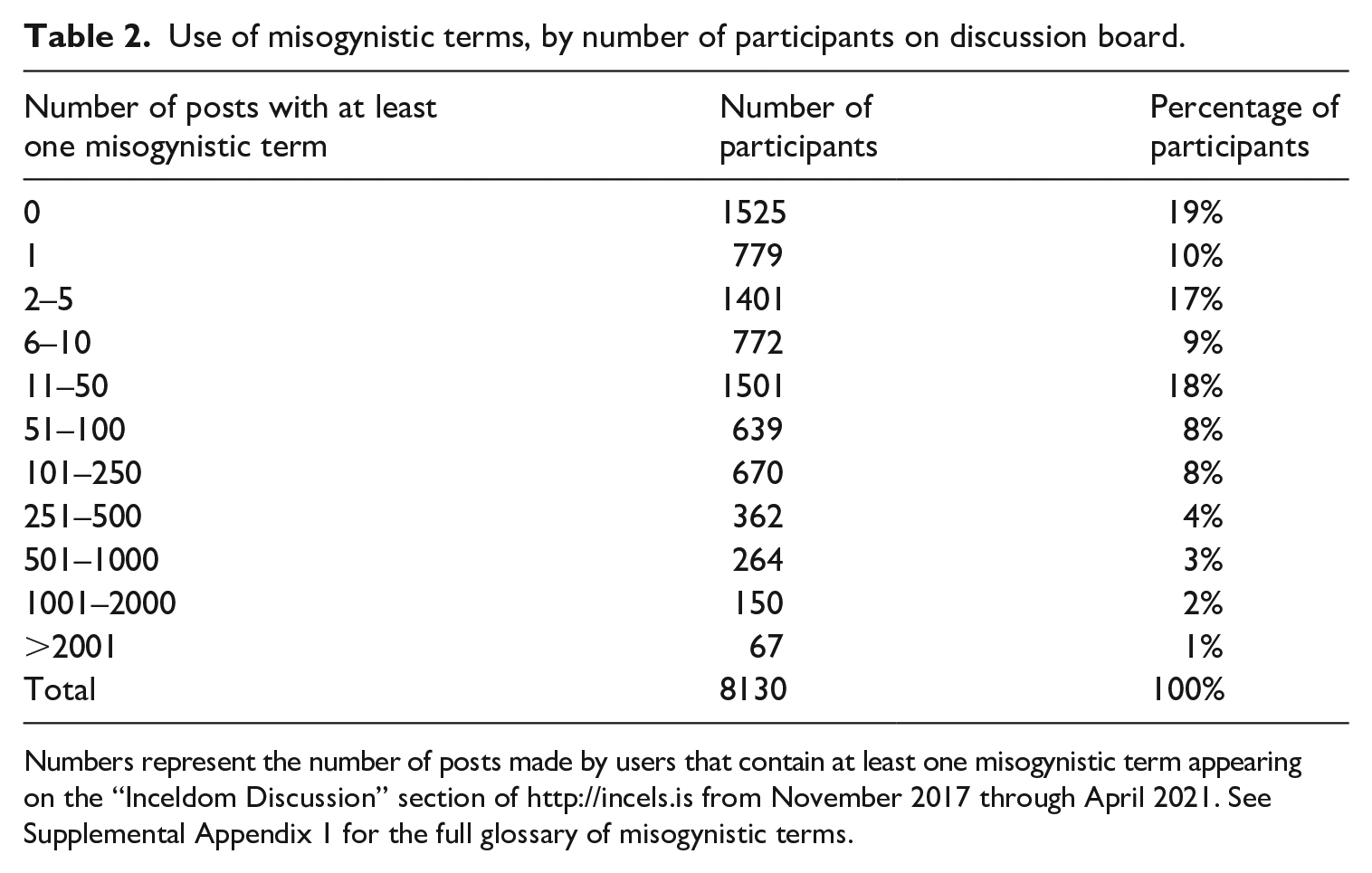
Numbers represent the number of posts made by users that contain at least one misogynistic term appearing on the “Inceldom Discussion” section of http://incels.is from November 2017 through April 2021. See Supplemental Appendix 1 for the full glossary of misogynistic terms.
We also find that users with a higher number of total posts were more likely to have made at least one comment containing a misogynistic term. Figure 1 shows that 53.5% of participants with 1–10 posts used at least one misogynistic term, whereas 92.2% of participants with 11–25 posts have used at least one misogynistic term. This trend continues, such that nearly 100% of participants with 51 posts or more have used at least one misogynistic term. While Figure 1 reports cross-sectional data, Figure 2 reports longitudinal data to assess the relationship between use of misogynistic terms and participation on incels.is.
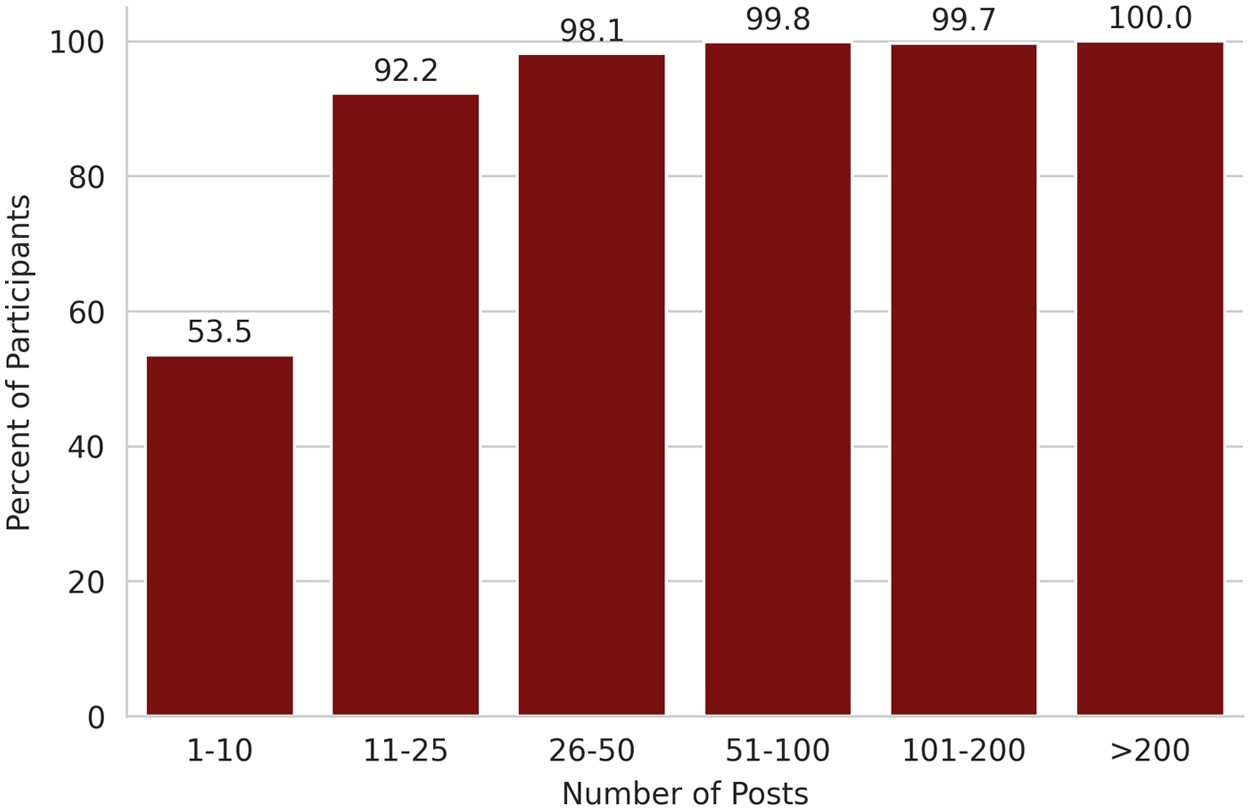
Percentage of participants using misogynistic terms, by total posts.
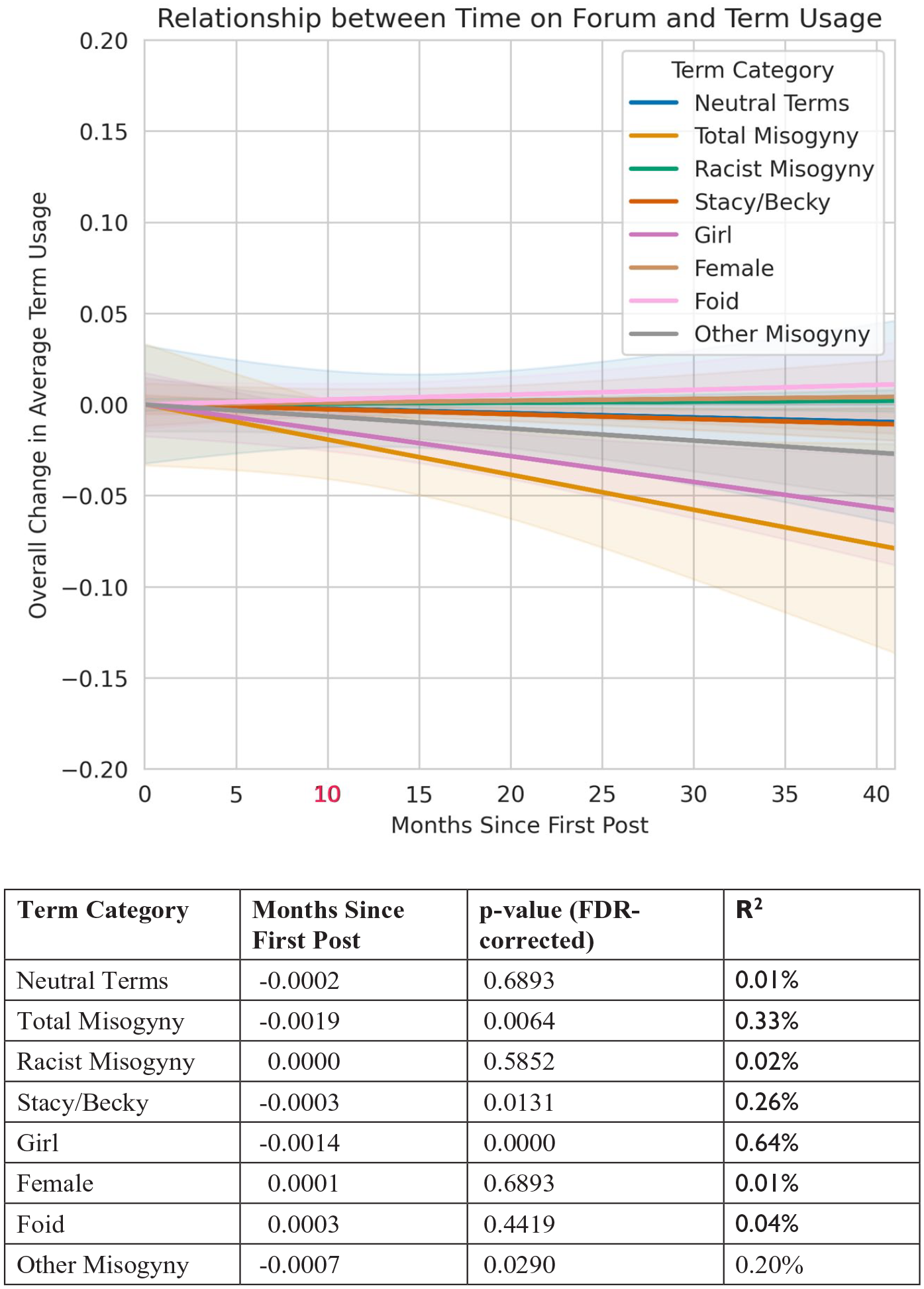
Change in average monthly term usage ~ months since first post on incels.is.
To evaluate the relationship reported in Figure 2, we fit a simple linear regression model predicting the per-participant change in average monthly term usage with the number of months a participant has spent on the forum as the predictor for each of the categories we report in Table 1 (e.g. “Racist Misogyny”). To be able to analyze a longitudinal trajectory, we excluded all users with posting activity in fewer than 3 months to ensure that our results characterize users who participated on incel.is over time. For the remaining participants (N = 3043), average monthly term use was calculated as the number of times a participant used terms belonging to each category divided by their monthly post count. To obtain the change in their average use over time, the difference between a participant’s average usage in their first and last active month was calculated. An ordinary least squares (OLS) model was then fitted for each term category (e.g. “Racist Misogyny”) without an intercept using the statsmodel v0.13.2 library.
As can be seen in Figure 2, these models suggest that there was no clear positive or negative overall relationship between a participants’ use of the terms in any of the categories and the duration of their participation on incels.is. While we observed a significant but weak negative association for “Total Misogyny” (p = .0064, β = −.0019, R2 = .33%), “Stacy/Becky” (p = .0131, β = −.003, R2 = .26%), “Girl” (p < .000, β = −.0014, R2 = .64%), and “Other Misogyny” (p = .029, β = −.0007, R2 = .20%) these models explained <1% of the variance (R2) relative to a constant model with no association.
Together, Figures 1 and 2 suggest that overall participation in misogyny might be tied to a survivorship bias among incels.is users, wherein users who do not produce misogynistic content are less likely to maintain participation, whereas users who maintain membership arrive, rather than become, misogynistic.
Our analyses also allow us to compare misogyny in threads with misogyny in participants’ post histories. For instance, “Racist Misogyny” appears in 8.7% of threads; however, one third (30%) of participants have used a “Racist Misogyny” term at least once. Put simply, by comparing thread data with user post history data, we see that users might not frequently start racist misogynistic threads, but users pile on and join a racist misogynistic bandwagon when such content appears. This finding likewise suggests that while thread-based analyses are a popular approach, such analyses might understate forms of incel misogyny.
Types of misogyny
While misogyny is ubiquitous on incels.is, incel misogyny is not uniform. Drawing on social science theories (e.g. Collins, 1990), our findings also describe different types of incel misogyny. Participants used “Racist Misogyny” terms (e.g. “noodlewhore”) more than 33,000 times. “Racist Misogyny” terms appear in 8.7% of threads, while 30% of participants have such terms in their post histories. The incel terms “Stacy” and “Becky” are also racialized, as they refer to attractive White women who incels situate as rejecting them and selecting attractive men (Menzie, 2022). “Stacy” and “Becky” are not compliments, as “Stacy” is depicted as a “vain . . . entitled whore,” while Becky is used to describe as exploitative women with low self-esteem (Incels.wiki, 2022a, 2022b). Incels used “Stacy/Becky” 41,000 times, with these terms appearing in 13.6% of threads and 38.5% of participants’ post histories. These findings suggest that a substantial portion of incel misogyny is racist or racialized, which we discuss below in relation to intersectionality and conceptualizations of femininity.
Incels’ use “female” just over 115,000 times, with the term appearing in 31.7% of threads and 48.5% of participants’ post histories. Participants employ “girl” more than 200,000 times, with this term appearing in 41.9% of threads and 63.2% of participants’ post histories. Participants use variations of the misogynistic incel term “foid” more than 250,000 times, with this term appearing in 50.1% of threads and 50% of users’ post histories.
Our category “Other Misogyny” consists of misogynistic terms that do not fit into any of the preceding categories (e.g. “Racist Misogyny”). We record more than 315,000 instances of this type of misogyny, which includes common terms like “cunt” and “whore,” as well as terms included in the incels.is glossary, such as “war pig” and “landwhale.” Terms in the “Other Misogyny” category appear in 6.5% of posts, 56.6% of threads, and 65% of users’ post histories.
We also examined incels’ participation in specific types of misogyny in relation to their posting frequency. As Figure 3 shows, users with a higher number of posts are more likely to participate in these types of misogyny. For example, use of “Racist Misogyny” and “Stacy/Becky” increases from almost 0% among the users with 1–10 posts to over 80% for participants with 501–600 posts. While this cross-sectional data might be taken to suggest that users become socialized in relation to racist misogyny as they post more on incels.is, Figure 2 does not support this interpretation, demonstrating that there is no or weak statistically significant relationships between forum activity and any type of misogyny. Once again, these data suggest that the men who arrive to incels.is engaging in racism and misogyny are also more likely to become long-term contributors to the discussion board, rather than have their post content change over time.
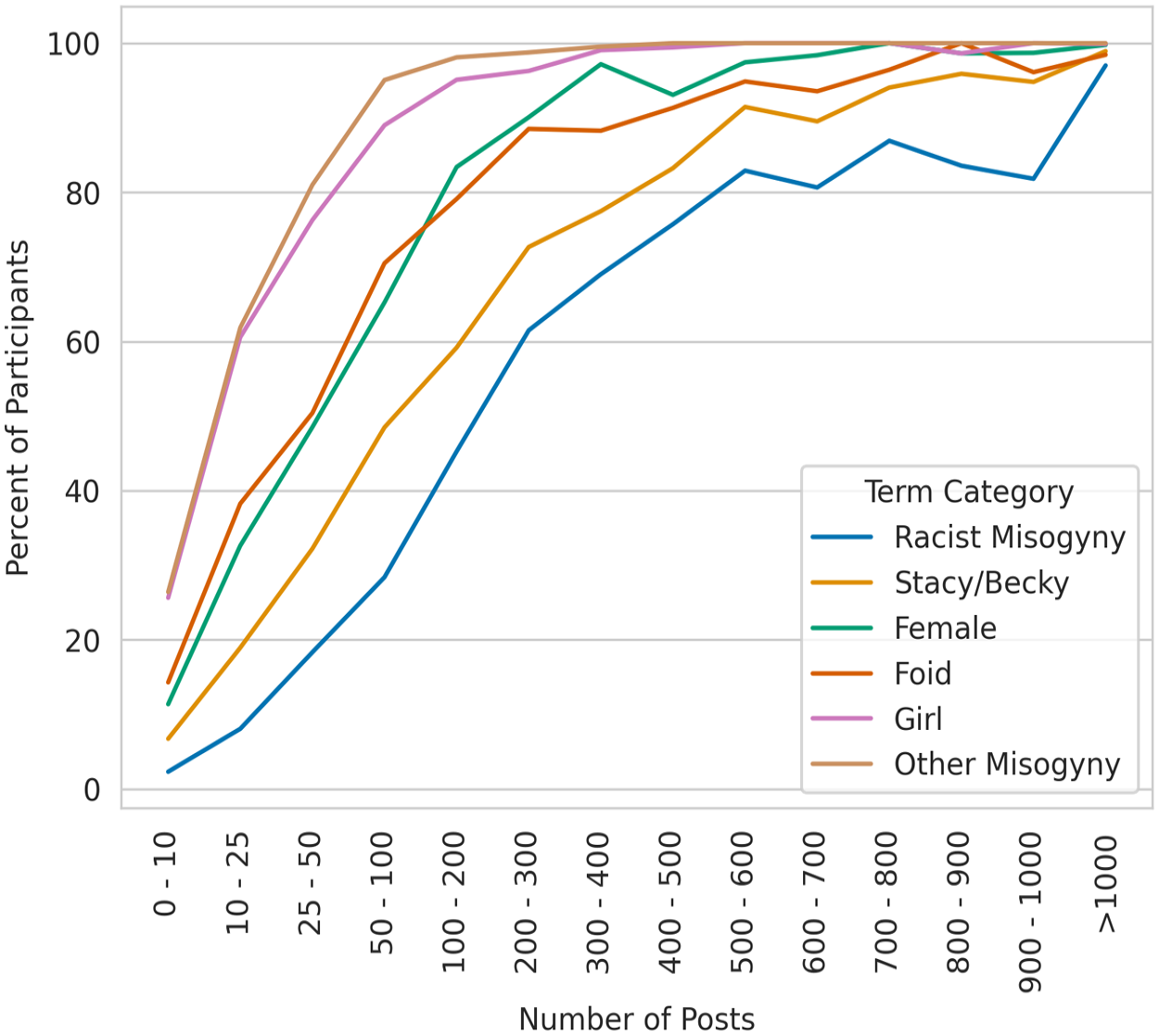
Percentage of participants using misogynistic terms, by number of posts.
Discussion
This article combines computational approaches and social science theories to analyze incel misogyny. Our analyses of incel misogyny demonstrate how incels’ hatred for women orients to a matrix of domination (Collins, 1990). As Collins (1990) observes, all women experience misogyny, but they do not experience the same misogyny, as sexism does not occur independently of other forms of oppression (e.g. racism). Incels’ misogyny is fused to racism, such that, while they situate all femininities are pariah femininities (Schippers, 2007), Women of Color are doubly denigrated in relation to race and gender. Here we argue that incels’ participation in hegemonic masculinity (Connell, 1995) intersects with race and racism (Collins, 1990; Sumerau, 2020). Consistent with other discussions of the intersection of racism and sexism (e.g. Collins, 1990), the incel term “big black vagina” objectifies and hypersexualizes Black women, while the use of “big” simultaneously marks Black women as unfeminine. Other Women of Color (e.g. Asian women) are likewise discussed in reductive and racist terms that quite literally frame them as interchangeable and consumable commodities for men (e.g. “currywhores,” “noodlewhores”).
Incels’ double denigration of Women of Color is tied to their explicit evaluation of women in relation to a racialized masculine hierarchy, wherein the Stacys and Beckys who are reserved for the most attractive White men (“Chads”) are also elevated above all other women. Here, masculine hierarchies (Connell, 1995) further dovetail with intersecting oppressions (Collins, 1990), as White women are targeted with a qualitatively different from of misogyny because they are viewed as the property of dominant White men. Incels’ commitments to masculine hierarchies mean that they exalt some men above themselves, but in so doing they also situate all women as inferior to men, with Women of Color further denigrated through the intersections of racism and sexism. For incels, hegemonic masculinity and whiteness are mutually reinforcing (see also Sumerau, 2020), as they subjugate women while asserting a racial order that also privileges White people.
Many incels identify as Men of Color (Halpin and Richard, 2021). We argue that taking an intersectional approach likewise helps explain why these men participate in the double denigration of Women of Color. As clarified by Hamilton et al. (2019) concept of intersectional domination, groups or individuals can use their position in the matrix of domination to exercise power over others and achieve specific aims or benefits. We suggest that Men of Color in the incel community participate in racialized misogyny because it allows them to uphold unequal gender relations and participate in the denigration of all women. In this sense, such men prioritize unequal gender relations over other forms of domination. These practices demonstrate the intersections of oppression (Collins, 1990), as incels simultaneously buttresses lookism, masculine hierarchies, and White privilege. Moreover, despite situating themselves as subordinated (Regehr, 2022), we argue that incels uphold these systems of oppression to both participate in and justify their hatred of all women (see also Halpin, 2022).
Prior research debates whether incels participate in hegemonic or hybrid masculinity (e.g. Glace et al., 2021; Halpin, 2022). As noted above, we find that incels unequivocally engage in the hegemonic practice of subjugating women (Connell, 1995; Messerschmidt, 2018), as shown by the high rates of misogyny in our analysis. In the same way that men use violence to emphasize their masculinity (e.g. Sumerau, 2020), we find that incels participate in hegemonic masculinity by denigrating women. That said, we argue our findings demonstrate how incels participate in hybrid masculinity, as they both situate themselves as subordinate men while engaging in hegemony by denigrating women (see also Halpin, 2022). We further suggest that the novelty of incels’ hybrid practices has also been under-examined. Hybrid masculinity focuses on men who strategically distance themselves from hegemony by adopting subordinate or marginalized practices (see Bridges and Pascoe, 2014). Drawing on Halpin’s (2022) conceptualization of weaponized subordination, wherein men strategically position themselves as “failed men,” betamales, or victims to justify their misogyny, we argue that incels do perform hybrid masculinity, but rather than strategically distancing themselves from hegemony, they strategically grasp at it. Here, incels’ perceived subordination operates as a resource, allowing them to disguise their subjugation of women as retaliatory. We argue that such practices evidence how male supremacy is flexible and persistent, as incels and similar communities (e.g. Men Go Their Own Way) situate themselves as victims to endorse, advance, and excuse unequal gender relations.
Incels’ misogynistic statements do not tell us anything about women, but they do tell us about incels and their social orientations toward femininity (Collins, 1990; Connell, 1987; Schippers, 2007). At first glance, incels’ orientation to femininity aligns with Connell’s concept of “emphasized femininity,” as they perceive women as subservient to men. Likewise, incels create a typology of women, differentiating “Stacys” from “big black vaginas” and “noodlewhores.” However, we suggest that incels’ terminology challenges the utility of emphasized femininity. First, incels use the word “foid” more than any other misogynistic term, which labels women as uncaring machines, contrary to the qualities of empathy, compassion, and caring that are central to emphasized femininity. In this sense, incels’ misogyny precludes emphasized femininity, as incels label women as cold and heartless for denying them access to heterosexual sex. Second, incels’ use of “female” dehumanizes women by using an adjective as a noun, using a term that signifies biological sex rather than gender, and with the same terminology that we discuss animals (e.g. “a female horse”). Third, while incels appear to rank order women, no group of women is valued. Incels might view “Stacys” better than “noodlewhores” or “landwhales,” but they are nonetheless described as “entitled whores.” We argue that incels do not perceive a valued form of femininity that maps onto the concept of “emphasized femininity” and instead view all femininities as pariah femininities (Schippers, 2007), in that all femininity is disgraced and denigrated.
While our study demonstrates that incels are sexist, how they participate in sexism is also telling. We suggest that “girl” reflects incels’ participation in benevolent sexism (Glick and Fiske, 1996), as they compare adult women with children. Our analysis suggests that incels’ benevolent sexism is dwarfed by their hostile sexism, as incels used just a single hostile term (i.e. variations of “foid”) 26% more often than they used “girl.” As our analysis is not responsive to the context of use (e.g. “all girls should die”), we likely overstate incels’ participation in benevolent sexism. While previous studies suggest that both incels (Halpin and Richard, 2021) and men who perceive themselves as unattractive (Bosson et al., 2022) participate in hostile sexism more than benevolent sexism, we suggest that incels’ relatively low participation in benevolent sexism explains both their lack of orientation to emphasized femininity (Connell, 1987) and their treatment of all femininities as pariah femininities (Schippers, 2007). Here, we argue that incels evidence changes to sexism as a “special case” of prejudice (Glick and Fiske, 1996), as incels desire heterosexual intimacy but their feelings toward women are characterized by antipathy. In this sense, our analysis suggests that the “hand” of hostile sexism is slipping out of the “glove” of benevolent sexism, such that sexist men might desire heterosexual sex, but hostility is becoming decoupled from benevolence. We document this process for incels, but other communities (e.g. followers of Andrew Tate) are also populated by heterosexual men who openly endorse misogyny. These cases demonstrate a shift in sexist practices, wherein heterosexual men crave sexual intimacy that is free of benevolence and is instead characterized by untapered hostility toward women.
We additionally suggest that incels’ participation in benevolent sexism evidences the intersections of misogyny and racism (Collins, 1990). As whiteness is often an unmarked category (Choo and Ferree, 2010; Collins, 1990) and incels frequently use explicitly racist terms (e.g. “currywhore”), incels’ use of “girl” is likely an unmarked reference to White women. Here we suggest that incels’ benevolent sexism is both rare and reserved for White women. This argument is consistent with other patterns we observe, wherein Women of Color are explicitly framed as generic sexual commodities in comparison with White women. While future analyses could explore this potential relationship in closer detail, we suggest that all women are targets of hostile sexism, but incels’ benevolent sexism is tied to whiteness, such that all women can be degraded but that White privilege and supremacy can be maintained.
Our findings are relevant to numerous policy proposals that address hostile online communities (e.g. Jankowicz, 2020). Incels.is creates affordances (Boyd, 2010) for networked misogyny (Marwick and Caplan, 2018) and produces demonstrable harms for women (Regehr, 2022). In this context, deplatforming incels.is is warranted, as is holding incel communities responsible for both their hate speech and endorsement of hate crimes. However, we argue that deplatforming would not address the misogynistic views and actions of the men who are already participating on incels.is and these men might simply migrate to other sites (see Riberio et al., 2021). Indeed, users on incels.is have already circulated a plan to address their potential deplatforming, while incels and other manosphere groups use deplatforming and censorship as “proof” that left-wing and feminist groups are targeting men by restricting free speech (Marwick and Lewis, 2017). As our results suggest that most men that contribute to incels.is arrive as misogynists, specific responses are necessary to disrupt such misogyny. Drawing inspiration from previous arguments (e.g. Donovan, 2020; Jankowicz, 2020), we suggest a group of strategies we abbreviate with the acronym ARCC (Agreeing, Refuting, Correcting, Challenging).
Our first step is Agreeing with accurate knowledge claims. For instance, incels situate themselves as being exclusively aware of lookism as a form of social prejudice, when the impacts of lookism have been studied for decades (e.g. Dion et al., 1972). While agreeing with any incel claims might seem counterintuitive, we suggest that Agreeing establishes a frame for dialogue, disrupts incels’ claims of private knowledge, and dismantles rhetoric that frames incels as victims of censorship (e.g. Marwick and Lewis, 2017). Second, we suggest explicitly Refuting incels’ justifications of their misogyny. While being unable to have a relationship is difficult, such difficulties do not legitimate incels’ misogyny, and many individuals encounter similar hardships without targeting others (Maloney et al., 2022; Papadelos et al., 2021).
Third, we suggest Correcting claims that are based on accurate knowledge but that are interpreted incorrectly. For instance, incels are correct that an increasing number of men report being single, but they are incorrect that this is an exclusively male problem or that it can be blamed on women’s preferences for physically attractive partners. Fourth, we suggest Challenging incels’ incorrect claims. For instance, the incels.is wiki references many academic papers to advance misogynistic arguments. While appearing scientific, incels frequently cite single studies, ignore counter claims, or cherry pick examples, such as citing a study produced by Vagisil to body shame women (Incels.wiki, 2022c). Challenging is labor intensive (e.g. Donovan, 2020) and for Challenging to be successful, it also needs to be efficient. Adopting a resource such as Google’s Fact Check (Google, n.d.) to engage with false claims made by incels could serve as an efficient and effective means of Challenging. We suggest that all four strategies buttress each other and should be employed simultaneously to undermine incel misogyny.
While such efforts to change identity are difficult, they are not impossible (Burke, 2006). For instance, German organizations have had considerable success with deradicalization programs (e.g. Koehler, 2021), while Daryl Davis, an African American man, has convinced hundreds of White men to leave the Ku Klux Klan (Brown, 2017). Deploying ARCC strategies could be further supplemented by identifying incels who are receptive and responsive to change (Pyne, 2023), as well as emphasizing other identities that are discordant with the incel identity (Burke, 2006). ARCC strategies could be further bolstered by educating mental health providers, family doctors, teachers, and other points of contact for men about the incel subculture, increasing public outreach, and setting up hotlines for concerned family members and individuals (Koelher, 2021). In this sense, we suggest ARCC strategies are one component of a multi-pronged approach for addressing incel misogyny and similar extremist orientations.
Conclusion
This article combines computational approaches and social scientific theories to analyze the incels’ misogynistic language. We find that misogynistic language characterizes incel discussions. Specifically, 82.3% of threads and 81.2% of user’s post histories contain at least one misogynistic term. We find that incels used misogynistic terms 960,487 times and that they use misogynistic terms 2.4 times more frequently than neutral terms for women. We find no or weak overall associations between user’s posting frequency and participation in misogyny, suggesting that most participants on incels.is arrive, rather than become, misogynistic. Finally, we find that incels engage in specific forms of misogyny that advance both racist and misogynistic views of women.
Supplemental Material
sj-docx-1-nms-10.1177_14614448231176777 – Supplemental material for Men who hate women: The misogyny of involuntarily celibate men
Supplemental material, sj-docx-1-nms-10.1177_14614448231176777 for Men who hate women: The misogyny of involuntarily celibate men by Michael Halpin, Norann Richard, Kayla Preston, Meghan Gosse and Finlay Maguire in New Media & Society
Supplemental Material
sj-docx-2-nms-10.1177_14614448231176777 – Supplemental material for Men who hate women: The misogyny of involuntarily celibate men
Supplemental material, sj-docx-2-nms-10.1177_14614448231176777 for Men who hate women: The misogyny of involuntarily celibate men by Michael Halpin, Norann Richard, Kayla Preston, Meghan Gosse and Finlay Maguire in New Media & Society
Footnotes
Acknowledgements
The authors thank Jaymes Pyne for his valuable support, insight, and guidance.
Funding
The author(s) disclosed receipt of the following financial support for the research, authorship, and/or publication of this article: We thank Donald Hill, the Killam Trusts, and the Social Sciences and Humanities Research Council of Canada (430-2022-00585).

Supplemental material
Supplemental material for this article is available online.
Notes
Author biographies
References
Supplementary Material
Please find the following supplemental material available below.
For Open Access articles published under a Creative Commons License, all supplemental material carries the same license as the article it is associated with.
For non-Open Access articles published, all supplemental material carries a non-exclusive license, and permission requests for re-use of supplemental material or any part of supplemental material shall be sent directly to the copyright owner as specified in the copyright notice associated with the article.
