



Abstract
Despite much attention for group polarization in online environments, little is known about how group membership affects online behavior. We designed an online platform where ethnic minority and majority users in the Netherlands participated in discussions about controversial topics (homosexuality and abortion). Participants were randomly assigned to either progressive, conservative, or mixed discussions on these topics, which were ostensibly held among ethnic minority or majority users. We find that when ethnic minority users are exposed to discussions among the ethnic majority (i.e., outgroup) with which they disagree, they are less likely to express their opinions and more likely to deviate from their personal opinions. Among ethnic majority users, we find the opposite: when confronted with a discussion among the ethnic minority with which they disagree, they are more likely to voice their opinion and less likely to deviate from their personal opinions. This shows that group membership can affect online polarization.
Introduction
At the turn of the millennium, the democratization of the Internet was perceived by some to carry immense democratic potential. The internet was believed to promote an open exchange of ideas and opinions among people of different backgrounds, who may not be as likely to meet offline. Some argued that it was an instrument that could break down the boundaries that existed and persisted between groups in society (Papacharissi, 2002). Scientific evidence, however, paints a different image: rather than connecting different social groups, individuals mostly interact with similar others online, be it as a result of their personal preference or algorithmic biases of online platforms (Bakshy et al., 2015; Santos et al., 2021). This, in turn, leads to a greater difference in opinions between groups along political lines (ideological polarization) (Sunstein, 2018; Terren et al., 2021) and more hostile intergroup relations (affective polarization) (Törnberg, 2022). As a result, rather than bridging societal divides, the internet – and its associated technologies such as social media – are now popularly believed to amplify such cleavages (Haidt, 2022).
Despite these alarming findings, it remains unclear how online interactions with ingroup or outgroup members affect individuals’ expression of their opinions, and consequently, the online ideological polarization that we observe between groups. Whereas many studies examine how the online opinion climate affects individuals’ willingness to participate in online discussions (i.e. the Spiral of Silence) (e.g. Ordoñez and Nekmat, 2019; Wu and Atkin, 2018) or the content of their online expressions (e.g. Álvarez-Benjumea and Winter, 2018; Munger, 2017; Siegel and Badaan, 2020), how group membership affects this relationship remains unknown. This is a caveat in current research, given that individuals encounter both in- and outgroup members on social media (despite their ingroup bias) and attitudes within groups are heterogenous. In the United States, for example, Democrats and Republicans frequently encounter (content by) members of the opposite party online (Eady et al., 2019; Shin, 2020), and the difference in attitudes between both groups are smaller than people generally think (Fernbach and Van Boven, 2022; Westfall et al., 2015). Still, it remains unclear whether interacting with ingroup members who hold similar or dissimilar views affects the online expression of own opinions differently than interacting with outgroup members who hold similar or dissimilar views.
By studying the role of group membership in online expressions of opinions, this study sheds new light on the mechanisms that may explain the degree of online ideological polarization that we observe between groups. Studies on offline behavior suggest that, in order to maintain the approval of their social group, individuals are more likely to conform to the behavior of ingroup members compared to outgroup members, even when it does not align with their personal preferences (Barreto and Ellemers, 2000, 2003). Hence, if individuals are more likely to connect to ingroup than outgroup members, and they are also more likely to strategically conform to the behavior of ingroup than outgroup members, the observed differences in expressed opinions between online groups become larger over time. Furthermore, this would mean that the degree of ideological polarization that we observe between groups in online environments is most likely not an accurate reflection of the degree of ideological polarization in opinions that these groups actually hold.
We test this proposition using online discussions between ethno-religious groups in the Netherlands, focusing specifically on Muslim ethnic minority groups. Like political and racial groups in the United States, ethno-religious cleavages are ‘bright lines’ in contemporary Dutch society (Alba, 2005). People of Moroccan and Turkish descent are two of the largest ethnic minority groups in the Netherlands, whom, in contrast to the increasingly secular ethnic majority population, are predominantly Muslim (De Hart et al., 2022; Huijnk, 2018). Relatedly, Turkish-Dutch and Moroccan-Dutch on average hold comparatively conservative cultural values compared to the ethnic majority Dutch population, for example, with regard to sexual liberalism (Huijnk and Andriessen, 2016; Kalmijn and Kraaykamp, 2018). Due to these cultural differences, the Turkish and Moroccan ethnic minority is perceived by part of the ethnic majority Dutch population to threaten the liberal Dutch culture, which aggravates interethnic relations (González et al., 2008; Savelkoul et al., 2011).
We designed an online discussion platform where Turkish-Dutch and Moroccan-Dutch (ethnic minority) and ethnic majority Dutch were invited to participate in a discussion on homosexuality and abortion. In the experiment, participants were randomly assigned to conservative, mixed, or progressive online discussions, which took place among either Turkish-Dutch and Moroccan-Dutch users or ethnic majority Dutch users. Based on the attitudes and ethnicity that the participants indicated before entering the online discussion platform, these discussions were incongruent, mixed or congruent with participants’ own views and held among ethnic ingroup or outgroup members. We study how these experimental conditions influence the relationship between individuals’ personal opinions and their online expressed opinions through the likes and dislikes that participants post.
Theory
Opinion climate
Studies find that individuals conform their online expressions to that of others in online environments. These studies generally analyze one of two relationships: First, studies in the tradition of the Spiral of Silence theory (Noelle-Neumann, 1974) find that individuals are less willing to express their personal opinion when the opinion climate is incongruent with their own views (e.g. Ordoñez and Nekmat, 2019; Wu and Atkin, 2018). Second, other studies find that individuals adjust the content of their online expression to align with that of others (e.g. Álvarez-Benjumea and Winter, 2018; Munger, 2017; Siegel and Badaan, 2020), even to the extent that it no longer reflects their own beliefs (McDevitt et al., 2003). Although these research lines are empirically distinct, the underlying mechanism is the same: individuals strive for social acceptance, even in online settings, and an important way to achieve this is through aligning their behavior (opinion expression) with that of others (Cialdini and Goldstein, 2004). They can do this either by only expressing their opinion when this aligns with that of others, or voicing an opinion that aligns with that of others, even when this does not align with their own personal opinion.
In online discussions, users can employ many opinion expression (avoidance) strategies, such as unfriending other users, hiding posts they do not agree with, or sharing posts they do endorse (Wu et al., 2020b). In this paper, however, we focus on one specific strategy, namely (dis)liking posts of other users. Together with commenting and sharing, (dis)liking is one of the three most common ways to express opinions on social media platforms. Compared to commenting and sharing, (dis)liking requires relatively little cognitive effort as it can be completed in a single click (Kim and Yang, 2017). Nonetheless, users actively reflect on this kind of ‘click-speech’ in online discussions and engage in (dis)liking for a large variety of reasons, one of which is expressing support for the content they encounter online (Hayes et al., 2016). 1 In doing so, individuals not only consider the specific content they (dis)like, but also the broader opinion climate of the discussion in which the content is embedded. For example, individuals are less likely to express their views using (dis)likes when online discussions are uncivil or when they hold the minority opinion (Ordoñez and Nekmat, 2019; Pang et al., 2016; Wu et al., 2020a). However, the extent to which these (dis)likes accurately reflect the personal opinions of individuals is not examined in these studies.
In this study, we examine how the congruency of the online opinion climate with participants’ personal opinions affects the (dis)likes they post in two ways. First, we study the probability that participants express their personal opinion on the discussion platform using (dis)likes. Participants can do this by liking comments that align with their personal opinions (congruent comments) and disliking comments that do not align with their personal opinions (incongruent comments). Second, we study the probability that participants deviate from their personal opinion using (dis)likes, that is, express opinions that do not align with their personal opinions. Participants can do this by disliking congruent comments or liking incongruent comments. We expect the following:
H1: Participants are less likely to express their personal opinion using (dis)likes in a mixed or incongruent online opinion climate than in a congruent online opinion climate (expression effect)
H2: Participants are more likely to deviate from their personal opinion using (dis)likes in a mixed or incongruent online opinion climate than in a congruent online opinion climate (deviation effect)
Intergroup dynamics
The social identity approach posits that individuals derive an important part of their identity from the social groups to which they feel they belong (Tajfel and Turner, 1979; Turner et al., 1987). Individuals strive for a positive social identity, which they derive both from the status of the group that they identify with, and their status within that group. An important way to acquire this positive social identity is through behavior that is visible to others (Pagliaro et al., 2011). Individuals that behave in accordance with the group norm, that is, display behavior that is prescribed or common for the group (Deutsch and Gerard, 1955), are evaluated more positively than deviant group members (Marques et al., 1998; Travaglino et al., 2014). Individuals are therefore more likely to behave in accordance with a norm when this is promoted by ingroup members, even when the behavior does not align with the personal opinion of the individual (Barreto and Ellemers, 2000, 2003). When the norm is promoted by outgroup members, on the other hand, individuals do not have the same motivation to fulfil these social goals, which is why outgroup norms are less influential than ingroup norms in shaping individuals’ behavior (Ellemers et al., 2004; Smith and Louis, 2008; Smith et al., 2007). These findings are not limited to offline settings. In fact, studies show that, compared to face-to-face offline settings, the influence of the ingroup norm is even stronger in visually anonymous online settings (Huang and Li, 2016; Spears, 2021).
Despite the strong theoretical and empirical basis to expect a substantial influence of group norms on online expressions, this is often overlooked in current research. Studies on the Spiral of Silence examine how so-called ‘reference groups’ affect individual’s willingness to express their opinion. However, these reference groups refer to the sources from which individuals perceive the dominant opinion climate (e.g. the government, friends or neighbors), not the group to which individuals express their personal opinions (Matthes et al., 2018). Research on group dynamics is also scarce in studies that examine the content of online expressions, although some studies have found that individuals are less likely to post prejudiced content when they are discouraged to do so by ingroup members than outgroup members (Munger, 2017; Siegel and Badaan, 2020). However, these observational studies do not have information on the personal opinions of the participants. They therefore cannot determine the influence of opinion congruency on online expressions, nor can they verify whether online expressions align with personal opinions.
To examine the role of in- and outgroup norms, participants in our experiment were randomly assigned to a discussion platform where discussions were held among Turkish-Dutch and Moroccan-Dutch users or ethnic majority Dutch users. Consequently, participants were exposed to either online discussions among ethnic ingroup members (ingroup condition) or to discussions among ethnic outgroup members (outgroup condition). Even though Turkish-Dutch and Moroccan-Dutch are two different ethnic groups, they share one important cultural property, namely their religion, as 86% of Turkish-Dutch and 94% of Moroccan-Dutch are Muslim. On top of this, 89% of the Turkish-Dutch Muslims and 96% of the Moroccan-Dutch Muslims consider their religion an important part of who they are (Huijnk, 2018). Therefore, given their shared religious identification, we consider the Turkish-Dutch and Moroccan-Dutch as one group in this study. Following previous research on the influence of ingroup norms versus outgroup norms on individual behavior, we hypothesize the following:
H3: The expression effect (H1) and deviation effect (H2) are stronger in the ingroup condition than in the outgroup condition (ingroup effect).
Group differences
Previous research suggests that the degree to which ingroup and outgroup norms influence individual behavior may vary between groups based on their cultural and social properties. With regard to cultural properties, cross-cultural psychology finds that ‘tight’ cultures are characterized by more pervasive and stricter social norms than ‘loose’ cultures (Gelfand et al., 2011; Triandis, 1989). Compared to the Dutch culture, the Turkish and Moroccan cultures are relatively tight (Uz, 2015), which could mean that this group is more strongly influenced by the norm of their ingroup (versus outgroup) compared to ethnic majority Dutch participants.
However, an opposite prediction can be made based on the social properties of the groups. The social identity approach argues that degree to which individuals conform to in- and outgroup norms depends on (a) the degree to which they identify with the groups, and (b) the relative status of the groups (Tajfel and Turner, 1979). Whereas ethnic majority Dutch identify only with the ethnic majority, many Turkish-Dutch and Moroccan-Dutch identify with both the ethnic minority and ethnic majority population (Huijnk and Andriessen, 2016). Additionally, because of the comparatively lower social status of the Moroccan-Dutch and Turkish-Dutch (Hagendoorn, 1995), members of these groups might be inclined to conform to the norm of the higher-status majority group to improve their social identity (Tajfel and Turner, 1979). This would suggest that the influence of ingroup norms (versus outgroup norms) is weaker for Moroccan-Dutch and Turkish-Dutch participants than for ethnic majority Dutch participants. Given these contrasting predictions, we will examine possible differences between ethnic groups exploratively. 2
Data and methods
Data collection
Participants were recruited using a Facebook ad campaign that was online between 27 June 2022 and 26 July 2022. In the ad, the Facebook users were informed that Utrecht University was conducting a study on how ethnic majority Dutch, Turkish-Dutch and Moroccan-Dutch thought about societal issues, and how they share their opinions with others. After providing informed consent, the participants were directed to a survey which asked their personal opinions regarding two issues (homosexuality and abortion) along with a number of demographic variables. After they completed the survey, the participants were directed to the online discussion forum. See Figure 1 for a summary of the data collection.

Summary of data collection.
Online discussion forum
The discussion forum consisted of two pages, the first for a discussion on homosexuality and the second for a discussion on abortion. 3 On each page, the topic was introduced by a post of a fictitious user, in which they presented their personal opinion about an online article. This was followed by a discussion of six to eight comments by other fictitious users. Figure 2 presents an example of a post on the forum (left panel) and a small excerpt of the comments (right panel). Each participant was exposed to the exact same content on the discussion forum based on the experimental treatment that they were assigned to (see ‘experimental treatment’). The participants could not see what other participants had posted on the website, nor could they interact with other participants. The participants could respond to the content of the forum by (dis)liking comments and posts, and posting a comment themselves in reply to another comment or the post. 4 The participant was not prompted to perform any of these actions, as this would interfere with the measurement of our dependent variable.
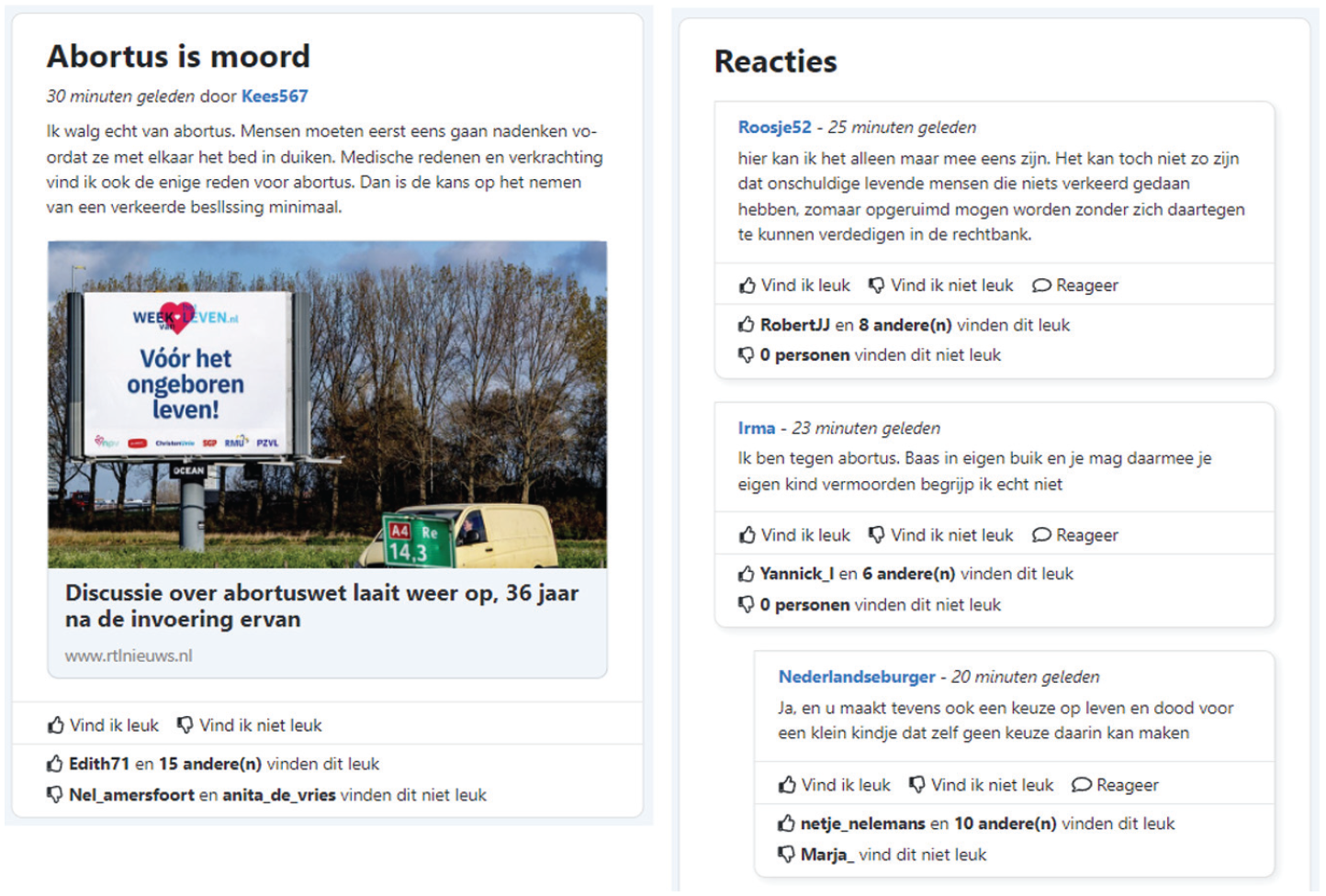
Impression of a forum page (in Dutch).
Experimental treatment
This experiment uses a 2 (ethnic composition) x 3 (online opinion climate) between-subjects experimental design (see Online Supplemental Appendix C for a flow diagram). For the ethnic composition treatment, participants were randomly assigned to a discussion forum where all other fictitious users were either Turkish-Dutch and Moroccan-Dutch or ethnic majority Dutch. For the online opinion climate treatment, participants were also randomly assigned to a discussion forum where both discussions represented either a conservative, progressive or a mixed online opinion climate set by the comments and likes left by fictitious users. For the ethnic majority Dutch forum, we extracted all comments and usernames from www.nu.nl, a popular Dutch news site that allows users to respond to all news articles. For the Turkish-Dutch and Moroccan-Dutch forum, all comments and usernames were taken from the forum of www.marokko.nl, a large online forum with an active Moroccan-Dutch community (some Moroccan phrases were translated to Turkish).5,6 See Online Supplemental Appendix D for the translated discussions.
To create the different opinion climates, two research assistants who were blind to the experimental conditions independently coded all the comments by the fictitious users on a scale of 0 (very conservative) to 10 (very progressive) prior to the start of the experiment. The results showed high internal consistency (Krippendorf’s α = .87), so we took the mean of these two scores as the score for each comment. In the conservative opinion climate condition, the post and all comments expressed a conservative stance on the topic (M = 1.52; SD = .78), whereas in the progressive opinion climate the post and all comments were progressive (M = 6.88; SD = 2.17). In the mixed condition, the post was neutral (i.e. the fictitious user who posted the initial post was not sure what they thought about the issue) and 50% of the comments were conservative and 50% of the comments were progressive (M = 4.38; SD = 2.78). 7 To underline the dominant norm, all comments in the conservative and progressive opinion climate condition received between 7–11 likes and 0–1 dislikes (with most receiving 0). In the mixed opinion climate condition, all comments received between 7–11 likes and dislikes.
Selections
Six hundred and four participants completed the study. Each participant completed two forum pages on the discussion forum, meaning that the total number of observations was 1,208 before selections. After the study, participants completed attention and manipulation checks. We excluded participants who did not correctly identify the topics that were discussed on the forum, and those who did not correctly indicate the online opinion climate and ethnic composition of the forum they were assigned to (33 participants in total). 8 After this, we excluded 183 observations by 143 participants with moderate personal opinions about a topic that was discussed in the forum (see the section ‘measures’ for further explanation of the opinion measure). This was because we could not distinguish between a congruent and an incongruent opinion climate for moderate participants. Lastly, we excluded 1 observation that completed the discussion on a particular topic but had missing values for the associated personal opinion. After these selections, the total sample contained 531 participants with a total of 958 observations (forum pages).
Turkish-Dutch and Moroccan-Dutch participants were significantly younger, more likely to be female and more likely to be conservative than ethnic majority Dutch participants (see Table 1). To account for these compositional differences, we control for these variables in the analyses in which we compare the effects between ethnic majority Dutch and Moroccan-Dutch and Turkish-Dutch participants. 9
Descriptive statistics of the sample.
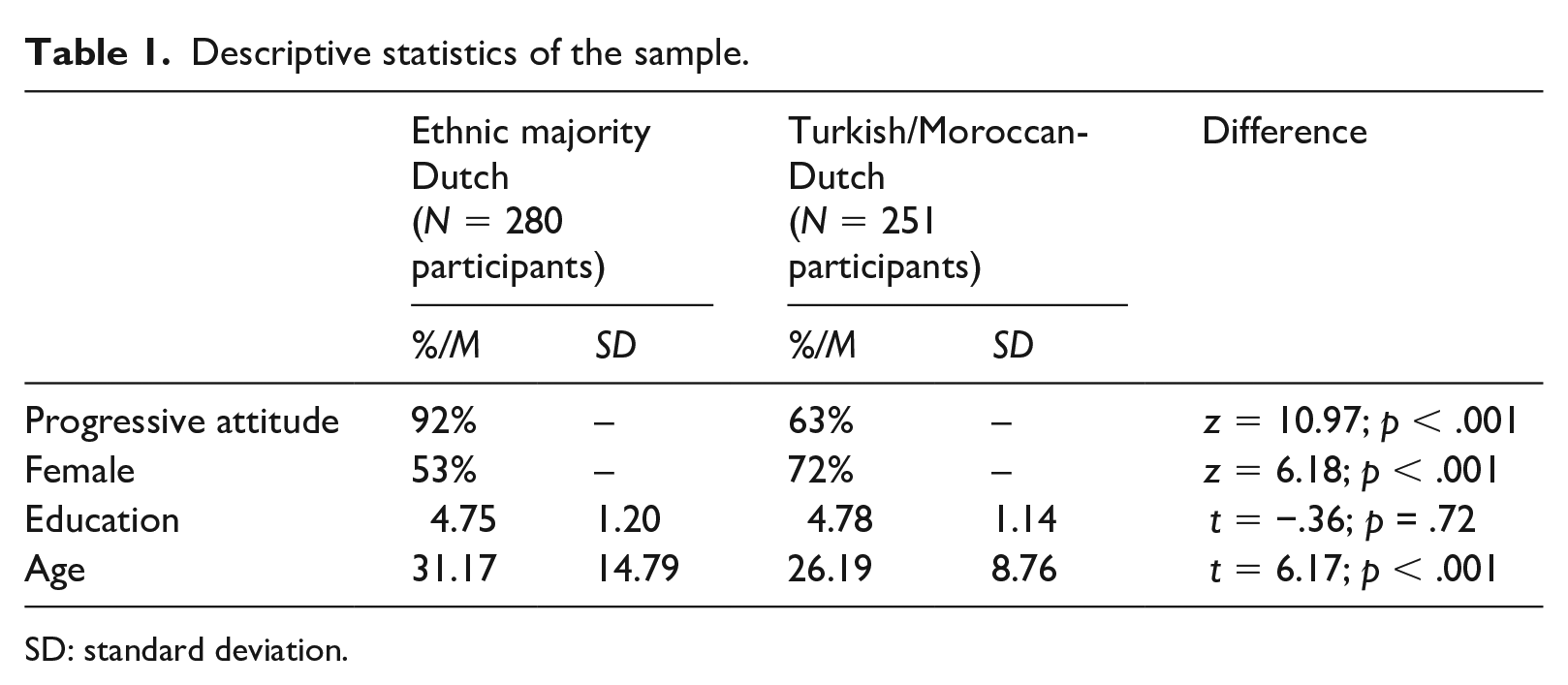
SD: standard deviation.
Measures
This study focusses on two outcomes, namely likes and dislikes. We operationalize these measures as a dichotomous variable (0 = no (dis)like on a page and 1 = one or more (dis)likes on a page). The average probability that participants post one or more likes on a page (55%) is significantly higher than the probability that they post one or more dislikes (47%) (z = 3.25; p = .001).
We examine how these outcomes are influenced by (the combination of) opinion congruency and ethnic in-and outgroup condition. We measure opinion congruency by comparing the personal opinion of the participants and the opinion climate that they are assigned to. To measure personal opinions, participants indicated both for homosexuality and abortion whether they thought it was wrong on a scale of 0 (always wrong) to 10 (never wrong) in the survey prior to the experiment. We only included conservative (score 0-3, N = 205) and progressive observations (score 7-10, N = 753). In the experiment, the participants were then randomly assigned to a conservative (N = 331), mixed (N = 331) or progressive opinion climate (N = 296). Based on their personal opinion, this opinion climate is then congruent (N = 298), partly congruent (the mixed condition; N = 331) or incongruent (N = 329) with their opinion.
To study the ingroup effect, we compare the ethnicity of the participant and the group condition that they were assigned to. In the survey prior to the experiment, the participants indicated their country of birth and the country of birth of their parents. If the participant or at least one of the parents was born in Turkey or Morocco, the participant was assigned to the combined Turkish-Dutch (N = 195) and Moroccan-Dutch (N = 238) ethnic minority group. If both the participant and the parents were born in the Netherlands, we consider the participant ethnic majority Dutch (N = 525). In the experiment, the participants were randomly assigned to a Turkish-Dutch and Moroccan-Dutch ethnic minority forum (N = 468) or an ethnic majority Dutch forum (N = 490). Based on their own ethnicity, participants were exposed to either ethnic outgroup (N = 475) or ingroup members (N = 483).
Analytical strategy
In the experiment, participants can express their personal opinion by liking congruent comments in the congruent and mixed opinion climate, and by disliking incongruent comments in the mixed and incongruent opinion climate. Alternatively, they can deviate from their personal opinion by disliking congruent comments in the congruent and mixed opinion climate, and by liking incongruent comments in the mixed and incongruent opinion climates. Because each participant completes two forum pages, the observations are not independent, which violates a key assumption of logistic regression. Therefore, we use a multilevel logistic regression model account for the correlation of observations. This model includes residual components on the level of the forum page (level 1, fixed at π2/3) and the participant (level 2) (Hox et al., 2017). The level-2 variance captures the variability in the outcome variable across participants. In our analysis, we include both predictors that may differ between forum pages for a participant (level-1 predictors: opinion congruency) and that do not differ between forum pages, only between participants (level-2 predictors: ethnicity, ingroup/outgroup and demographic variables). To ease the interpretation of the results, we compared the predicted probability that participants express their personal opinion and deviate from their personal opinion.
Results
Opinion climate
Figure 3 shows the predicted probability that participants express their personal opinion (Panel (a)) and deviate from their personal opinion (Panel (b)) using (dis)likes by opinion congruency (see Model 1 in Online Supplemental Appendix F and G for the regression results). 10 In Hypothesis 1, we expect that participants are less likely to express their personal opinion using (dis)likes in a mixed or incongruent online opinion climate than in a congruent online opinion climate. In contrast to this expectation, we find no significant differences between the three opinion climates. In line with Hypothesis 2, however, we find that participants are significantly more likely to deviate from their opinion using (dis)likes in the mixed (+11 percentage points (hereafter p.p.); p = .002) and incongruent opinion climate (+12 p.p.; p < .001) compared to the congruent opinion climate.
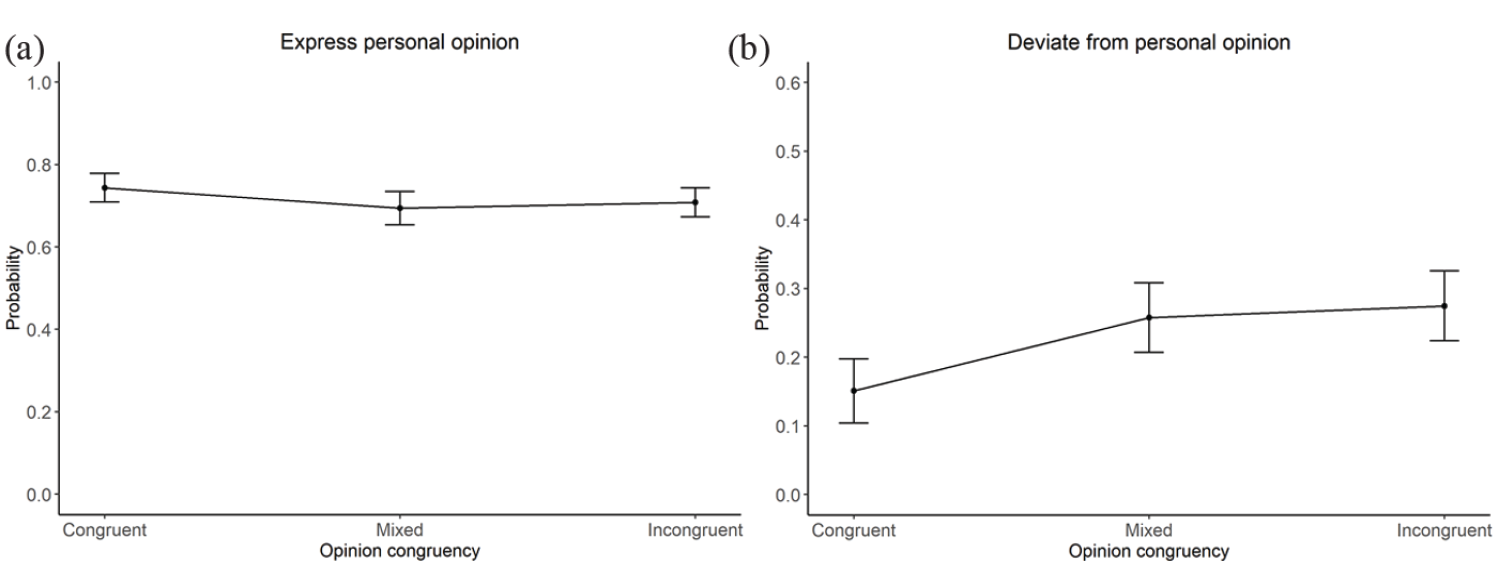
Predicted probability that participants (a) express their personal opinion and (b) deviate from their personal opinion using (dis)likes by opinion congruency.
Intergroup dynamics
Figure 4 shows the results for expressing personal opinions (Panel (a)) and deviating from personal opinions (Panel (b)) separately for the ingroup and outgroup condition (see Model 2 in Online Supplemental Appendix F and G for the regression results). In Hypothesis 3a, we expected that the negative effect of opinion incongruency on expressing personal opinions is stronger in the ingroup than in the outgroup condition. We find that participants in the ingroup condition are significantly less likely to express their personal opinion in the mixed (-9 p.p.; p = .045) and incongruent opinion climate (-8 p.p.; p = .036) compared to the congruent opinion climate. For the outgroup condition, we find no significant differences between the opinion climates. Even though the effect of opinion incongruency is significantly different from zero in the ingroup condition, but not the outgroup condition, the difference between the two conditions is not significant. We thus find no support for Hypothesis 3a.
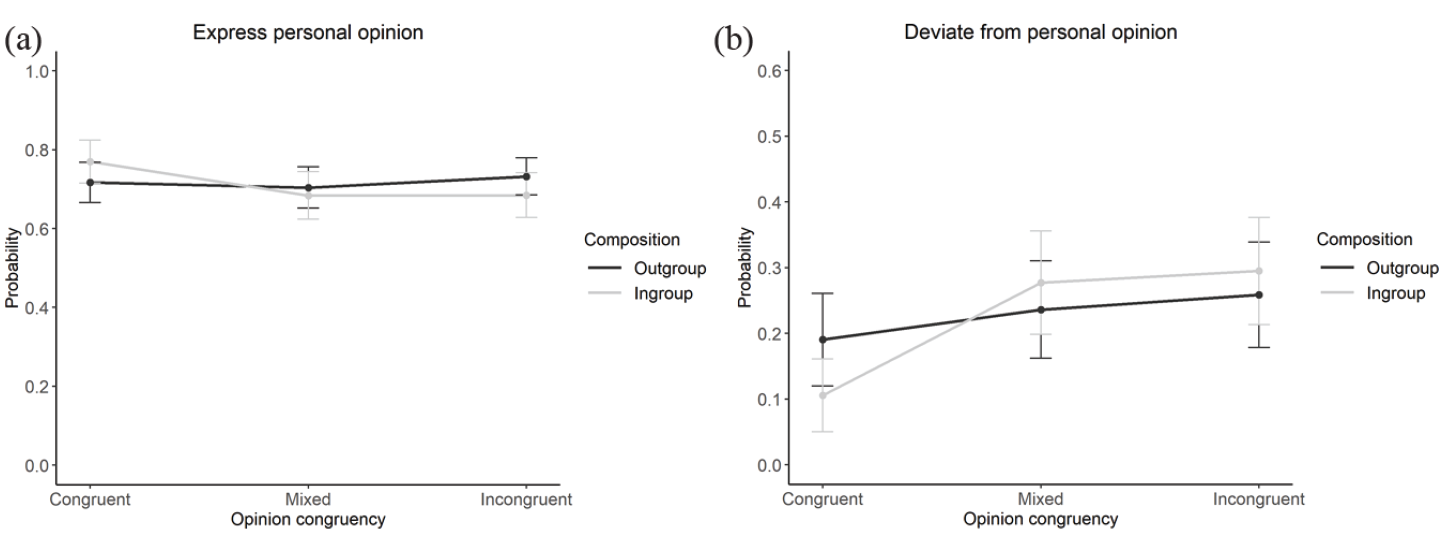
Predicted probability that participants (a) express their personal opinion and (b) deviate from their personal opinion using (dis)likes in the ingroup (grey line) and outgroup (black line) condition.
We find similar results for the probability that participants deviate from their personal opinion (Panel (b)): participants assigned to the ingroup condition are significantly more likely to deviate from their personal opinion in the mixed (+17 p.p.; p < .001) and incongruent opinion climate (+19 p.p.; p < .001) compared to the congruent opinion climate. For the outgroup condition, on the other hand, we find no significant differences between the opinion climates. Still, when we compare the effects of opinion congruency between the ingroup and outgroup condition, we find no significant differences between the two groups of participants. We therefore also find no support for Hypothesis 3b, in which we expect that the positive effect of opinion incongruency on deviating from a personal opinion is stronger in the ingroup condition than in the outgroup condition.
Group differences
Figure 5 shows the results for expressing personal opinions for participants assigned to the ingroup (Panel (a)) and outgroup condition (Panel (b)) for ethnic majority Dutch and ethnic minority Turkish-Dutch and Moroccan-Dutch participants separately (see Model 3 in Online Supplemental Appendix F and G for the regression results). For ethnic majority Dutch participants, we find contrasting effects for opinion congruency between the ingroup and outgroup condition. In the ingroup condition, ethnic majority Dutch are significantly less likely to voice their opinion in the incongruent than the congruent opinion climate (-22 p.p.; p = .002) (see Panel (a)). In the outgroup condition, on the other hand, ethnic majority Dutch are significantly more likely to express their opinion in the incongruent versus congruent opinion climate (+22 p.p.; p = .004) (see Panel (b)). Hence, for this group, the effect of the incongruent opinion climate (compared to the congruent opinion climate) is more negative in the ingroup condition compared to the outgroup condition (-44 p.p.; p < .001).
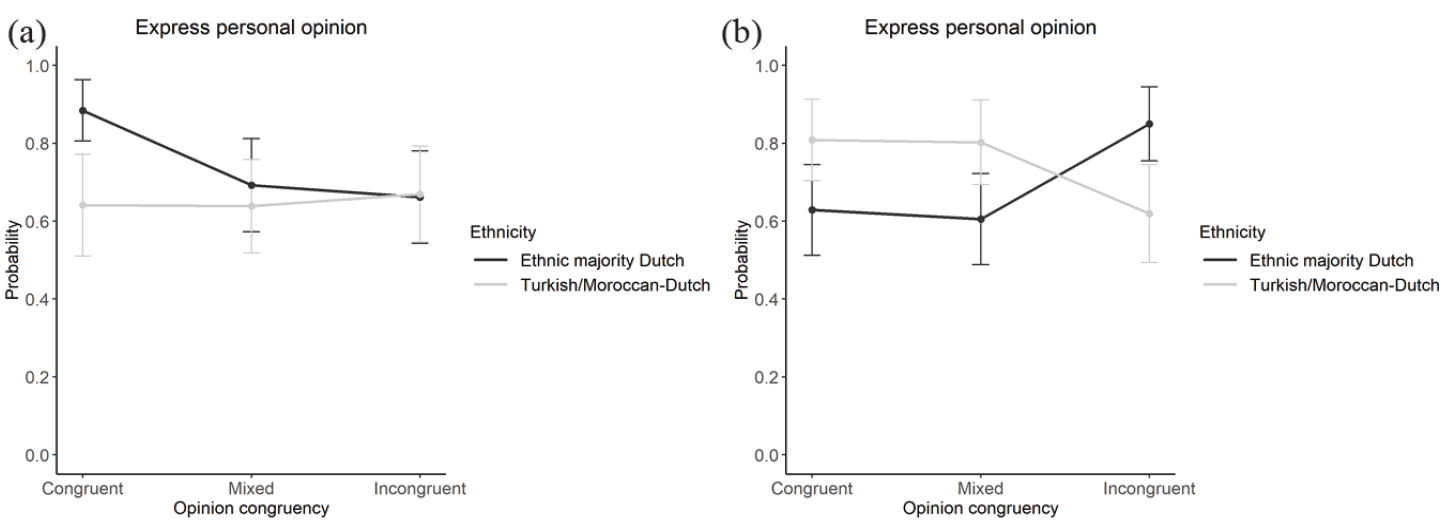
Predicted probability that participants express their personal opinion using (dis)likes in the (a) ingroup and (b) outgroup condition.
For Turkish-Dutch and Moroccan-Dutch participants, we find rather different results: in the ingroup condition, we find no significant effect of opinion incongruency on the probability of expressing a personal opinion (see Panel (a)). In the outgroup condition, on the other hand, Turkish-Dutch and Moroccan-Dutch participants are significantly less likely to express their personal opinion in the incongruent opinion climate compared to the congruent opinion climate (-19 p.p.; p = .022) (see Panel (b)). However, the differences between the ingroup and outgroup condition are not statistically significant.
To summarize, whereas for ethnic majority Dutch, the effect of the incongruent opinion climate is significantly more negative in the ingroup than in the outgroup condition, we find no difference herein for Turkish-Dutch and Moroccan-Dutch. To be more precise, in the incongruent opinion climate, the effect of the ingroup (versus outgroup) is significantly more negative for ethnic majority Dutch compared to Turkish-Dutch and Moroccan-Dutch participants (-63 p.p.; p < .001).
Figure 6 shows the results for deviating from personal opinions for participants assigned to the ingroup (Panel (a)) and outgroup condition (Panel (b)) for ethnic majority Dutch and Turkish-Dutch and Moroccan-Dutch participants separately. In the ingroup condition, ethnic majority Dutch are significantly more likely to deviate from their opinion in the incongruent compared to the congruent opinion climate (+20 p.p.; p = .001). In the outgroup condition, on the other hand, we find no significant differences between the opinion climates. Together, the effect of the incongruent opinion climate (compared to the congruent opinion climate) is significantly more positive in the ingroup than in the outgroup condition (+29 p.p.; p = .002).
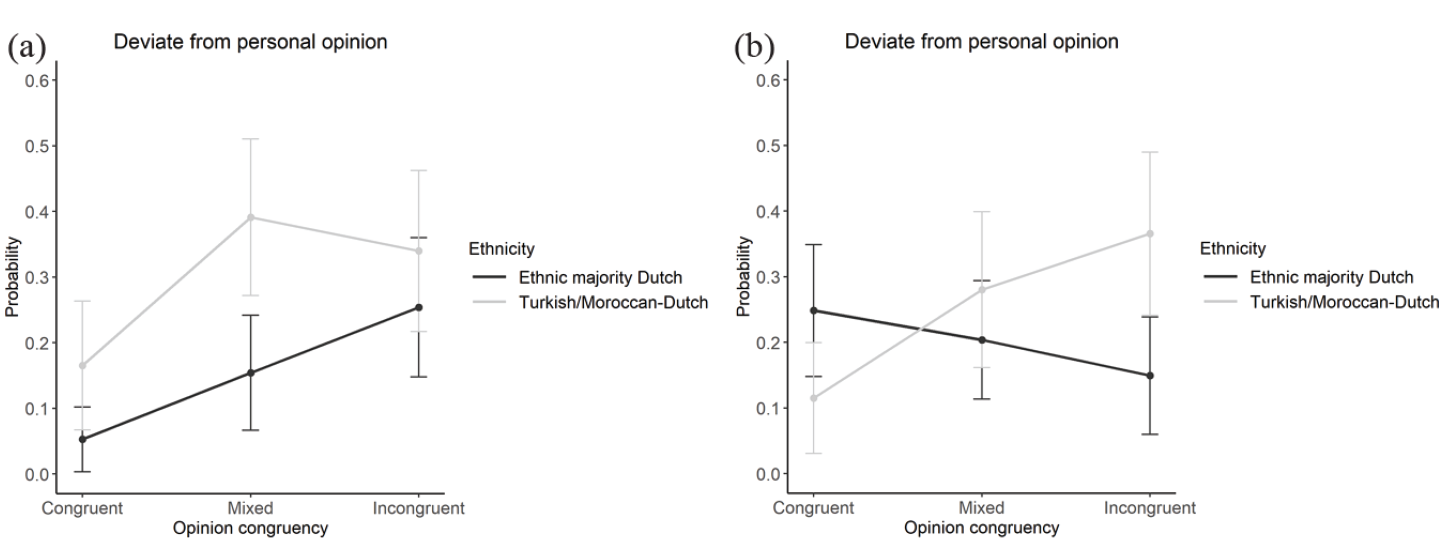
Predicted probability that participants deviate from their personal opinion using (dis)likes in the (a) ingroup and (b) outgroup condition.
For Turkish-Dutch and Moroccan-Dutch, the results of the ingroup and outgroup condition are largely similar. In both conditions, participants are significantly more likely to deviate from their opinion in the mixed and incongruent opinion climate compared to the congruent opinion climate. In contrast to ethnic majority Dutch, we therefore find no differences between the ingroup and outgroup condition for this group.
To summarize, for ethnic majority Dutch the effect of the incongruent opinion climate on deviating from a personal opinion is significantly more positive in the ingroup than in the outgroup condition. For Turkish-Dutch and Moroccan-Dutch, on the other hand, we find no difference herein. Hence, for the incongruent opinion climate, the effect of the ingroup condition (versus outgroup condition) on deviating from a personal opinion is significantly more positive for ethnic majority Dutch compared to Turkish-Dutch and Moroccan-Dutch participants (+34 p.p.; p = .019).
Discussion and conclusion
Rather than promoting an open exchange between individuals from different social groups, scholars and opinion makers alike argue that the internet and social media drive social groups apart (Lorenz-Spreen et al., 2022). Despite this popular belief, we know very little about how group membership influences the expression of personal opinions online, and how this in turn could affect the degree of ideological polarization we perceive online. Therefore, we designed an online discussion platform where ethnic majority Dutch and Turkish-Dutch and Moroccan-Dutch participants were randomly assigned to conservative, progressive or mixed discussions about homosexuality and abortion among ethnic majority Dutch or Turkish-Dutch and Moroccan-Dutch users. We studied how the congruency of the online opinion climate with their personal opinions, and being in a discussion among ethnic ingroup or outgroup members, affected the degree to which they expressed and deviated from their personal opinions using (dis)likes.
In contrast to the Spiral of Silence theory (Noelle-Neumann, 1974), we found that participants were as likely to express their personal opinion using (dis)likes when this opinion constitutes a minority opinion in the online discussion compared to when it constitutes the majority opinion. However, we did find that when other users expressed opinions that were opposite to those of the participant (i.e. in mixed or incongruent opinion climates), the participants were more likely to deviate from their opinion by expressing support for views they did not agree with personally. Importantly, there are several ways in which users can express (deviating) opinions in online discussions (e.g. sharing, blocking, commenting), but since our analysis focusses only on (dis)likes, we cannot distinguish between the different opinion avoidance strategies that have been identified in previous research (Wu et al., 2020b). However, in contrast to the opinion avoidance perspective in general, our results showed that, overall, users actively engaged with comments on the discussion platform using (dis)likes, whether they agreed with the comment or not.
Based on the social identity approach (Tajfel and Turner, 1979; Turner et al., 1987), we argued that ingroup norms would be more influential in guiding online expression than outgroup norms. When we combined the results for all ethnic groups, we did not find such difference. However, when we split the results by ethnic minority and ethnic majority participants, we found that ingroup and outgroup norms affected the online expressions of these groups differently. Specifically, in contrast to expectations that may be derived from their ‘tight’ cultural norms, Turkish-Dutch and Moroccan-Dutch ethnic minority participants expressed (deviating) opinions to the same degree in discussions among ethnic ingroup and outgroup members. For ethnic majority Dutch participants, however, we found an interesting contrast: among other ethnic majority Dutch users, they were less likely to voice their opinion and more likely to deviate from their opinion when their personal opinion is incongruent with the online opinion climate. However, when they are exposed to an online discussion platform dominated by Turkish-Dutch and Moroccan-Dutch outgroup users, we find the opposite: in such an environment, ethnic majority Dutch are more likely to express their opinion and less likely to deviate from their opinion when their personal opinion is incongruent with the online opinion climate.
What could explain this difference between the ethnic groups? Self-categorization theory argues that encountering a noticeable outgroup will increase the salience of a relevant social identity (Turner, 1985). Thus, observing a discussion between Dutch Muslims likely highlighted the ethnic majority Dutch’s identity. In contrast, the distinction between the ethnic ingroup and outgroup was possibly less salient for many Turkish-Dutch and Moroccan-Dutch participants due to their dual ethnic identification (Huijnk and Andriessen, 2016). According to social identity theory, people strive for a positive social identity by exaggerating differences between their own and other groups during social comparison (Tajfel and Turner, 1986). Because this distinction between the ethnic ingroup and outgroup was likely very clear for ethnic majority Dutch participants, this could explain why they behaved in contrast to a norm set by their ethnic outgroup. In contrast, because many Moroccan-Dutch and Turkish-Dutch participants identified with both the ethnic majority and minority, it could be that the ethnic outgroup condition was not so much an outgroup condition in their perception, and as a result, their online expressions were equally influenced by both groups.
Our results have a number of implications. First, we show that ethnic majority Dutch and Turkish-Dutch and Moroccan-Dutch participants respond differently to online norms promoted by ethnic ingroup and outgroup members. Ignoring the role of group membership in studying online expressions and ideological polarization may therefore underestimate the complexity of opinion dynamics in online environments: it is not only important what others say, but also who communicates the message (Taylor et al., 2022). This finding has important implications for interventions that target other undesirable consequences of social media, such as the spread of misinformation and hate speech. Previous studies have analyzed how corrective messages may counter these phenomena (Álvarez-Benjumea and Winter, 2018; Lewandowsky and Van der Linden, 2021), but not how the source of such messages may influence this. The effectiveness of such interventions may increase when the similarity in group membership (e.g. political affiliation, ethnicity) between the sender and receiver is incorporated in the strategy (Munger, 2017; Siegel and Badaan, 2020).
Second, our results suggest a pathway through which online environments may polarize over time that goes beyond the Spiral of Silence theory emphasized in previous research. We find that individuals conform to online norms not by staying silent but by showing support for opinions of others, even when they do not endorse it privately (see also Centola et al., 2005). If sufficient people express deviating opinions, the dominant norm becomes increasingly dominant over time, which further increases the likelihood of expressing deviating opinions that endorse the dominant norm. Through this self-reinforcing mechanism, the degree of ideological polarization that we perceive increases over time, even when it does not necessarily reflect the degree of ideological polarization in the opinions that people hold. Akin to the concept of pluralistic ignorance (Katz and Allport, 1931), it is therefore likely that the degree of ideological polarization that we observe in online environments is to some extent ‘false’, that is, not representative of the actual opinion climate.
This study has a number of limitations. First, although we propose that our focus on online expressions can inform us on the processes that lead to the ideological polarization, we perceive in online environments, this relationship remains somewhat speculative. Indeed, ideological polarization is a dynamic, macro-level consequence of the individual expressions we examine here, but we do not explicitly measure ideological polarization as such. To capture this process, future studies should longitudinally examine how individual expressions affect the online opinion climate, and vice versa. This could help identify under which conditions online ideological polarization arises or decreases because of the behavior we identify in this study. For example, previous studies have suggested that when a minority opinion attains a critical mass, individuals may no longer feel pressured to remain silent or express deviating opinions (Centola et al., 2018; Granovetter, 1978). How this unfolds in online environments remains unknown: like this study, most other studies do not examine the interrelation between micro-level behavior (online expressions) and macro-level consequences (ideological polarization) over time (Matthes, 2015).
Second, we study only how the congruency of the online opinion climate with the personal opinion of the participants affects online expressions. It should be noted, however, that other characteristics of the online discussion may interact with opinion congruency to affect individual behavior. For example, one study shows that individuals are less likely to express a minority opinion in an uncivil compared to a civil discussion (Ordoñez and Nekmat, 2019). Other studies suggest that individuals are more likely to speak out in response to another message if they found the source to be more credible (Leong and Ho, 2021). These characteristics may also be related to the intergroup dynamics that we study here, as outgroup members may be perceived as less civil and less credible than ingroup members (Clark and Maass, 1988; Leyens et al., 2000).
To conclude, despite much popular and scholarly attention for ideological polarization in online environments, what role group membership plays herein has been largely overlooked. Our results show that group dynamics can play a key role in online expressions, and consequently, ideological polarization. We therefore propose to bring the ‘group’ back in group polarization research: future studies should acknowledge that (a) ideological differences occur both within and between groups, (b) individuals encounter both ingroup and outgroup members online and (c) individuals may adjust their online expressions to ingroup and outgroup norms differently.
Supplemental Material
sj-docx-1-nms-10.1177_14614448231172966 – Supplemental material for The influence of group membership on online expressions and polarization on a discussion platform: An experimental study
Supplemental material, sj-docx-1-nms-10.1177_14614448231172966 for The influence of group membership on online expressions and polarization on a discussion platform: An experimental study by Nick Wuestenenk and Frank van Tubergen in New Media & Society
Footnotes
Acknowledgements
The authors want to thank Hendrik Jan Meerveld and the other members of the HTS App Development Team of the Faculty of Social and Behavioral Sciences at Utrecht University for their incredible help with building the website. The authors are also very grateful for Amina op de Weegh for her help with writing the discussions for the website.

Declaration of conflicting interests
The authors report no potential conflict of interest.
Funding
The author(s) disclosed receipt of the following financial support for the research, authorship, and/or publication of this article: This study is part of the research program Sustainable Cooperation – Roadmaps to Resilient Societies (SCOOP). The authors are grateful to the Netherlands Organization for Scientific Research (NWO) and the Dutch Ministry of Education, Culture and Science (OCW) for generously funding this research in the context of its 2017 Gravitation Program (grant number 024.003.025).
Ethical approval
The study is approved by the Ethics Committee of the Faculty of Social and Behavioral Sciences of Utrecht (approval number 22-0268).
Supplemental material
Supplemental material for this article is available online.
Notes
Author biographies
References
Supplementary Material
Please find the following supplemental material available below.
For Open Access articles published under a Creative Commons License, all supplemental material carries the same license as the article it is associated with.
For non-Open Access articles published, all supplemental material carries a non-exclusive license, and permission requests for re-use of supplemental material or any part of supplemental material shall be sent directly to the copyright owner as specified in the copyright notice associated with the article.
