




Abstract
There has been much debate about how cultural differences between ethnic groups may affect the cohesion of multicultural societies. Still, we know little about the extent to which cultural differences between groups also materialize into behavioral differences, especially in online settings. To study this, we conducted an experiment in which second-generation Moroccan and Turkish Dutch participants first indicated their personal opinion on sexual liberalism, and then participated in discussions on this topic on an online platform. On the discussion platform, participants were randomly assigned to either a progressive, conservative or mixed online discussion. Overall, we found that the convergence between personal opinions and online expressions was stronger for progressive than for conservative participants. Additionally, conservatives (but not progressives) were less likely to express their personal opinions, and more likely to deviate from their personal opinions, when they were exposed to an incongruent versus congruent online environment.
Introduction
Due to the large inflow of immigrants, the cultural landscape has changed substantially in Western European societies in recent decades. In contrast to the increasingly secular ethnic majority, many ethnic minorities are Muslim (Simsek et al., 2019; Van Tubergen & Sindradóttir, 2011; Voas & Fleischmann, 2012). Relatedly, whereas the ethnic majority population is becoming increasingly progressive, Muslim ethnic minorities have comparatively conservative views on issues such as sexual liberalism and gender egalitarianism (Kalmijn & Kraaykamp, 2018; Kogan, 2018; Maliepaard & Alba, 2016). Part of the ethnic majority population perceives the conservative values of Muslim minority groups as a threat to their liberal secular culture, which triggers intergroup prejudice and discrimination (McLaren & Johnson, 2007; Schlüter & Scheepers, 2010). As a result, these cultural differences have sparked public debate and scientific research about the consequences of ethnic diversity for the cohesion of Western European societies (Fleischmann & Phalet, 2012; Foner & Alba, 2008; Kogan et al., 2019).
However, by focusing so strongly on the cultural differences between ethnic groups, previous research provides only a limited understanding of how ethnic diversity affects current multicultural societies in practice (Ward, 2013; West et al., 2017). Even though cultural differences between groups may be substantial, this does not necessarily mean that behavioral differences are as well: many studies find that ethnic minorities align their behavior with either the ethnic majority or ethnic minority culture depending on what they perceive as appropriate in their social environment (Howarth et al., 2014; Stuart & Ward, 2011; Ward et al., 2018; West et al., 2017). For example, some studies find that ethnic minorities are more likely to endorse the ethnic majority culture in the public domain, and to maintain the ethnic minority culture in the private domain (Arends-Tóth & van de Vijver, 2003, 2004; Noels & Clément, 2015; Zhang & Noels, 2013). Therefore, to gain a better understanding of the consequences of ethnic diversity and cultural differences, research could not only emphasize the degree to which ethnic groups differ in their personal preferences, but also how and when these preferences materialize in their public behavior.
Previous research on the relationship between personal preferences and public behavior of ethnic minorities focusses almost exclusively on offline contexts. However, in recent years, online discussions (for example on social media) have become ubiquitous in the public debate, and these online discussion platforms are increasingly used by ethnic minorities to engage with—and learn about—the groups that they associate with (Croucher, 2011; Neubaum & Krämer, 2017). Even though the content that we find on these platforms is popularly believed to reflect public opinion in society at large (Anstead & O’Loughlin, 2015), previous research suggests that this is not the case. For example, as predicted by the Spiral of Silence theory (Noelle-Neumann, 1974), some studies find that individuals are more likely to express their personal opinion online when they anticipate that others will agree with them (Chen, 2018; Gearhart & Zhang, 2014, 2015, 2018; Matthes et al., 2018; Ordoñez & Nekmat, 2019; Wu & Atkin, 2018). Other studies find that individuals adjust the opinion they express online so that it aligns closely with that of others (Álvarez-Benjumea & Winter, 2018; Munger, 2017; Siegel & Badaan, 2020).
Given the important role of online discussions in our perception of the public opinion, and for the cultural adaptation and acculturation of ethnic minority groups, it is important to understand how the opinions that ethnic minorities hold relate to the opinions that they express online. For example, if ethnic minorities strategically adjust their online behavior to match those of other users, we may observe very homogenous or even extreme discussions in online environments, while people’s personal opinions are comparatively heterogenous (Noelle-Neumann, 1974). As a result, ethnic minorities may misperceive support for ethno-religious norms among their ethnic group, and strategically adjust their own online behavior in response. Such self-reinforcing processes may inflate our perception of differences between groups (Lerman et al., 2016), and the perceived irreconcilability of these differences may in turn drive salient boundaries between groups in society (Pasek et al., 2022). Despite this societal relevance, previous research on the relationship between personal opinions and online expressions does not focus on (Muslim) ethnic minority samples.
We built a complete online discussion platform to examine whether and when the opinions that ethnic minorities express online converge with the opinions that they express in private. We focus our study on a population for whom the perception of public opinion on online discussion platforms is especially pertinent, namely second-generation Moroccan and Turkish Dutch citizens in the Netherlands. Turks and Moroccans are two of the largest ethnic minority groups in the Netherlands, of which the large majority is Muslim (Huijnk, 2018). Due to their socialization in largely Islamic ethnic minority communities, second-generation Turkish and Moroccan Dutch hold, on average, more conservative attitudes toward issues such as sexual liberalism compared to the predominantly secular ethnic majority (Huijnk & Andriessen, 2016; Kalmijn & Kraaykamp, 2018). However, having also grown up in a progressive Western European country, their attitudes are not as conservative as those of the first generation (Eskelinen & Verkuyten, 2020; Huijnk & Andriessen, 2016; Röder, 2015). This makes this group an interesting group to study the relationship between personal opinions and online behavior: by manipulating the norm on the online platform, we can examine whether this group is more likely to strategically adjust their behavior to a conservative norm (that is widely shared in their ethno-religious community) or a progressive norm (that is widely shared in society).
By building our own online discussion platform, we address a number of methodological limitations in previous research. First, many studies use retrospective self-report surveys, even though individuals are generally not very good at recollecting their online activities—and may not report this truthfully even if they do (Vraga et al., 2016; Vraga & Tully, 2020). Second, other studies use a factorial survey design in which participants indicate how they would act if the hypothetical scenario was a real online discussion. Here it is doubtful whether these scenarios are realistic enough to draw valid conclusions about actual online behavior (A. F. Hayes et al., 2010; Scheufele et al., 2001). Third, many studies that do examine actual behavior in realistic online environments do not measure the personal opinions of the participants (Álvarez-Benjumea & Winter, 2018; Munger, 2017; Siegel & Badaan, 2020).
Additionally, most of the studies that examine the relationship between personal opinions and online expressions share the same theoretical limitation, namely that they rely on the Spiral of Silence theory (Noelle-Neumann, 1974) to study when individuals express their opinions. In contrast, relatively few studies examine whether the opinions that individuals express online actually align with their personal opinions (but see McDevitt et al., 2003). It is a well-known finding in offline studies that individuals may deviate from their personal opinion in order to conform to the behavior of others in their direct environment (Smith & Terry, 2003; Walker et al., 2015; Willer et al., 2009). As a result, the norm that individuals observe through the behavior of others may not be an accurate reflection of the opinions that these individuals actually hold (Centola et al., 2005; Lerman et al., 2016). Therefore, besides the willingness to speak out, it is also important to understand whether and when individuals deviate from their personal opinion when they participate in online discussions.
Theory and Hypotheses
Expressing Opinions
Norms are commonly described as behaviors and attitudes that are common (descriptive norms) or expected (injunctive norms) in a given social environment (Deutsch & Gerard, 1955). Norms exert a strong influence on individuals’ behavior, for example because they provide individuals with an accurate interpretation of reality (informational influence) or because following norms results in the social approval of others (normative influence) (Cialdini & Goldstein, 2004; Deutsch & Gerard, 1955). Although it is often difficult to distinguish between informational and normative influence in practice, they differ (among other things) with respect to the relationship between personal opinions and behavior: whereas informational influence posits that individuals change their behavior because they accept the norm as valid (i.e., opinions and behaviors align), normative influence argues that individuals do so in order to gain social rewards or avoid disapproval (i.e., opinions and behavior do not align) (Deutsch & Gerard, 1955; Price et al., 2006). In this paper, we argue that online norms can lead to a discrepancy between personal opinions and online expressions, hence we focus on normative influence as the main mechanism behind individuals’ online behavior.
Many studies in the field of media and communication rely on the normative account of the Spiral of Silence theory (Noelle-Neumann, 1974) to assess the degree to which individuals express their personal opinion online. According to this theory, individuals refrain from expressing their personal opinions when they are faced with an incongruent norm out of fear of social isolation (i.e., a social motivation). This process can become self-reinforcing: when individuals adjust the expression of their personal opinion to the norm in their environment, the majority online opinion is more likely to be expressed than the minority online opinion. This, in turn, moves the perceived norm further in the direction of the majority opinion, thereby decreasing the likelihood that minority opinions are expressed even more. As people are exposed to only a biased selection of opinions, the Spiral of Silence can lead to incorrect inferences about collective support for a particular norm, as is well documented in social perception biases such as false consensus (Ross et al., 1977) and pluralistic ignorance (Katz & Allport, 1931).
Many studies in online settings have found that the more someone experiences an online norm that is incongruent with their own personal opinion, the less likely they are to post a comment (Gearhart & Zhang, 2015; Ordoñez & Nekmat, 2019; Wu & Atkin, 2018). Similarly, studies on (dis)likes in hypothetical online environments also find that individuals are more likely to express their personal opinions when the norm is congruent with their own personal opinion (by liking) compared to when this is not the case (by disliking) (Ordoñez & Nekmat, 2019; Pang et al., 2016; Wu et al., 2020). Other studies suggest that situational factors, such as the size and composition of the audience, may influence the extent to which individuals are willing to express deviant opinions, which may explain why some studies do not find support for the Spiral of Silence theory (Kwon et al., 2015; McDevitt et al., 2003; Neubaum & Krämer, 2018). Still, given the general support for this theory, we expect that participants are more likely to express their personal opinion in an online environment when the dominant norm is congruent with their personal opinion compared to an environment that is (partly) incongruent.
In this study, participants can express their opinion in two ways, namely by (dis)liking comments and posting their own comments. We assume that they are expressions of the same underlying opinion(s). There are differences, however, in terms of cognitive load and frequency. (Dis)liking is often considered a “lightweight” expression of an opinion on in online discussions compared to commenting (R. A. Hayes et al., 2016). Given the comparatively lower effort that (dis)liking requires, this type of behavior is generally exercised more frequently than commenting (Khobzi et al., 2018; Ordoñez & Nekmat, 2019). Still, like for commenting, studies have found that users actively reflect on this behavior, both when sending and receiving (dis)likes (Carr et al., 2016; R. A. Hayes et al., 2016; Sherman et al., 2018). We therefore expect a similar relationship between norm congruency and opinion expression for (dis)liking as for commenting.
In this study, we examine opinion expression amongst a specific sample of the Dutch population, namely second-generation Turkish and Moroccan Dutch. Among these minority groups, more than 90% self-identify as Muslim, and research findings indicate that their views are on average more conservative than those of ethnic majority members (Huijnk & Andriessen, 2016; Kalmijn & Kraaykamp, 2018), yet more progressive than those of first-generation Turkish and Moroccan Dutch (Eskelinen & Verkuyten, 2020; Huijnk & Andriessen, 2016; Röder, 2015). Importantly, Turkish and Moroccan cultures are relatively tight, meaning that they are characterized by more pervasive and stricter social norms (Gelfand et al., 2011; Triandis, 1989; Uz, 2015). As second-generation Moroccans and Turks have been socialized in this strict, collectivistic culture, it’s likely that they tend to conform to the social norms of their ingroup when expressing their personal views in public, even though their personal views may be different. 1 Therefore, we expect the following:
H1: Second-generation Moroccan and Turkish Dutch participants are more likely to express their personal opinion in a congruent online norm condition than in a mixed and incongruent online norm condition by posting (a) (dis)likes and (b) comments.
Expressing Deviating Opinions
Besides the decision whether or not to participate in online discussions, which is the focus of the Spiral of Silence theory, individuals may also adjust the kind of opinion that they express to the online norm (McDevitt et al., 2003). For example, previous studies on online prejudiced behavior find that individuals express more prejudiced opinions when they are exposed to more prejudiced content by other users (Álvarez-Benjumea & Winter, 2018; Hsueh et al., 2015). Inversely, other studies find that individuals express less prejudiced opinions when the norm in the digital environment opposes such viewpoints (Munger, 2017; Siegel & Badaan, 2020).
Because of the socially beneficial reasons to align public behavior with the dominant norm, individuals may even publicly endorse a norm when they do not support it privately (Barreto & Ellemers, 2003). Research on this discrepancy between personal opinions and expressed opinions is sparse in online settings, but studies in offline settings suggest that it is very prevalent (Smith & Terry, 2003; Walker et al., 2015; Willer et al., 2009). To illustrate, studies on delinquency (Megens & Weerman, 2010) and drinking behavior (Terry et al., 2000), find that individuals who are exposed to a norm that is incongruent with their personal opinions are more likely to display behavior that does not align with their own personal opinions compared to individuals that were exposed to an opinion-congruent norm. As individuals are motivated to maintain a positive social identity in online settings just like they are in offline settings (illustrated by research on the Spiral of Silence, for example), we argue that this offline effect may also occur in online settings. We therefore hypothesize the following:
H2a: Second-generation Moroccan and Turkish Dutch participants are less likely to deviate from their personal opinion in their online expressions in a congruent online norm condition than in a mixed or incongruent online norm condition by posting (dis)likes.
Besides (dis)likes, we also examine the extent to which participants deviate from their personal opinions by the comments that they post on the forum. Because the number of comments in the mixed norm condition was low (N = 10), we compare only the incongruent with the congruent norm condition. Just like for (dis)likes, we expect participants to deviate more from their personal opinion when the norm condition is incongruent with their personal opinions versus when it is congruent. In practice, this means that we expect participants with a conservative opinion on the topic to post more progressive comments when they find themselves in a progressive online environment, and vice versa. We therefore hypothesize the following:
H2b: Second-generation Moroccan and Turkish Dutch participants with a conservative opinion post more progressive comments and those with a progressive opinion post more conservative comments in the incongruent norm condition than in the congruent norm condition.
Thus far, we have focused on normative influence as the main mechanism behind individuals’ online behavior. However, as predicted by social identity theory (Tajfel & Turner, 1979; Turner et al., 1987), group members might also conform their behavior to their perception of a prototypical group member, not out of any majority pressure, but rather because they are enacting their understood roles as group members. This type of influence is also called referent informational influence (Turner, 1982). In contrast to normative influence, which argues that individuals conform to (online) norms out of majority pressure, referent informational influence argues that online norms may influence individuals’ online expressions because they internalize the contextually salient group norm. This is because these groups (and their prototypical behaviors) can be important to how individuals define themselves.
Data and Methods
Data Collection
Participants were recruited using a Facebook ad campaign that was online between October 14, 2021 and October 25, 2021, which targeted Dutch residents aged 18 to 64 who liked pages related to Morocco, Turkey and Islam. The participants were informed that Utrecht University was conducting a study about the opinions of Turkish and Moroccan Dutch on a number of societal issues, and how they share these opinions with others. The recruitment process is summarized in Figure 1. After providing informed consent, the participants were directed to a survey, which asked their personal opinions regarding five societal issues (homosexuality, divorce, abortion, sex before marriage and veiling). 2

Summary of the recruitment process with the Facebook ad.
Online Forum
After they completed the survey, the participants were directed to an online discussion forum, which was designed specifically for the purpose of this study. 3 Here, the participants were informed that they were going to read the comments of others about several societal issues, which they could respond to by commenting, liking and disliking. The participants were then asked to think of a username they would like to use on the discussion forum. This username would be displayed on the screen when they posted a comment, replied to other comments or (dis)liked comments and posts by other users. The participants were then directed to the discussions on the forum.
The discussion forum consisted of five pages, each page covering one societal issue that was asked about in the survey. The content of the discussions on the forum (e.g., posts, comments, users and (dis)likes) had all been uploaded by the researchers prior to the start of the experiment. 4 This means that, aside from the experimental treatment that the participants were assigned to (see section “experimental treatment”), the content of the forum was the same for all participants. The participants could not interact with each other and could not see what other participants commented or (dis)liked. In other words, they only responded to the input of “fictitious” users that had been uploaded by the researchers prior to the start of the experiment.
To maximize the realism of the discussions, all posts and comments were taken from the forum of www.marokko.nl, a large online forum with an active Moroccan-Dutch community. The researchers only made minor changes to these comments to make the discussions more realistic and easier to follow. Some comments were adjusted to make them align better with other comments in the discussions, other comments were shortened, and some typically Moroccan phrases and terms were translated to Turkish, so that half of the comments on the forum could have also been from a Turkish user. Other than this, we made no changes to the argumentation and spelling of the comments, so that the discussions resembled an actual online discussion among Turkish and Moroccan Dutch users as accurately as possible. To further add to the realism of the online platform, all fictitious users had usernames that signaled a Turkish or Moroccan ethnicity, that was displayed directly above their comment.
On each page, the topic was introduced by a post of a fictitious user, in which they presented their personal opinion about an online article (see Figure 2a). The thumbnail image and title of this article (including a hyperlink to the article) was also displayed in the post, as is very common on other online discussion platforms. This post was followed by six to eight comments by other fictitious users (see Figure 2b). The participant could perform four actions on the forum: reply to comments, like comments and posts, dislike comments and posts, and post a comment at the bottom of the page. The participant was not prompted to perform any of these actions). All actions of the participant were immediately updated on the screen (and comments were timestamped) to simulate the discussion experience as accurately as possible. For example, after liking a comment, the username of the participant was shown among the users who liked a comment.
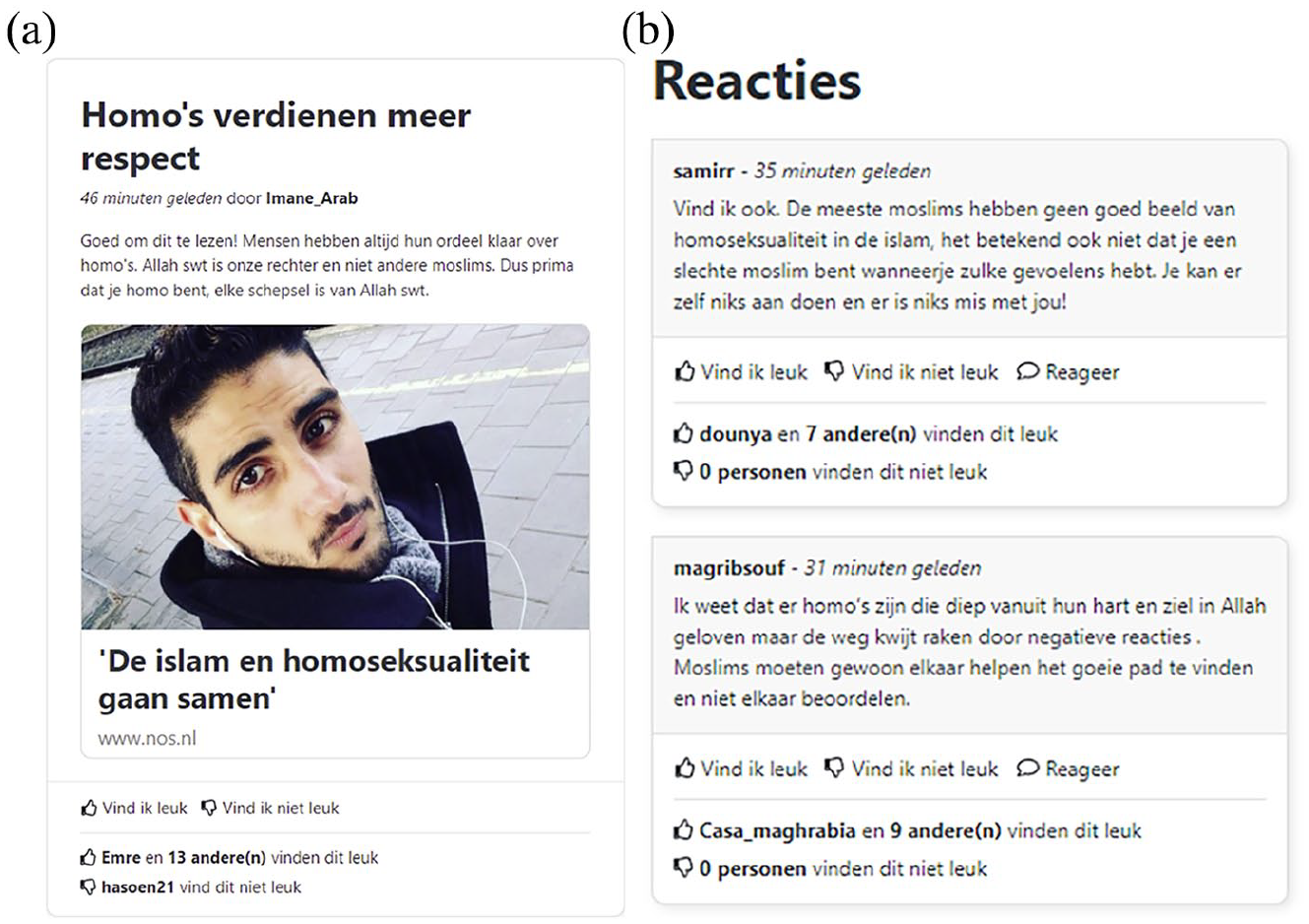
Impression of a forum page (in Dutch). A post on homosexuality in (a) and an excerpt of the comments displayed below the post (b).
After going through all discussions, the participants completed an attention check and were then debriefed about the purpose of this study. Lastly, they could enter their email address to receive a €10 gift voucher, or they could choose a charity to which they would like the €10 to be donated.
Experimental Treatment
The study employed a between-subjects design, in which the participants were randomly assigned to one of three norm conditions, namely a conservative, progressive or a mixed online norm (see Figure 3 for a flowchart). In the conservative norm condition, the post introducing the topic and all comments expressed a conservative stance on the topic that is discussed, whereas in the progressive norm condition the initial post and all comments were progressive. In the mixed condition, the initial post was neutral (i.e., the user was not sure what they thought on the issue 5 ) and 50% of the comments were conservative and 50% of the comments were progressive.
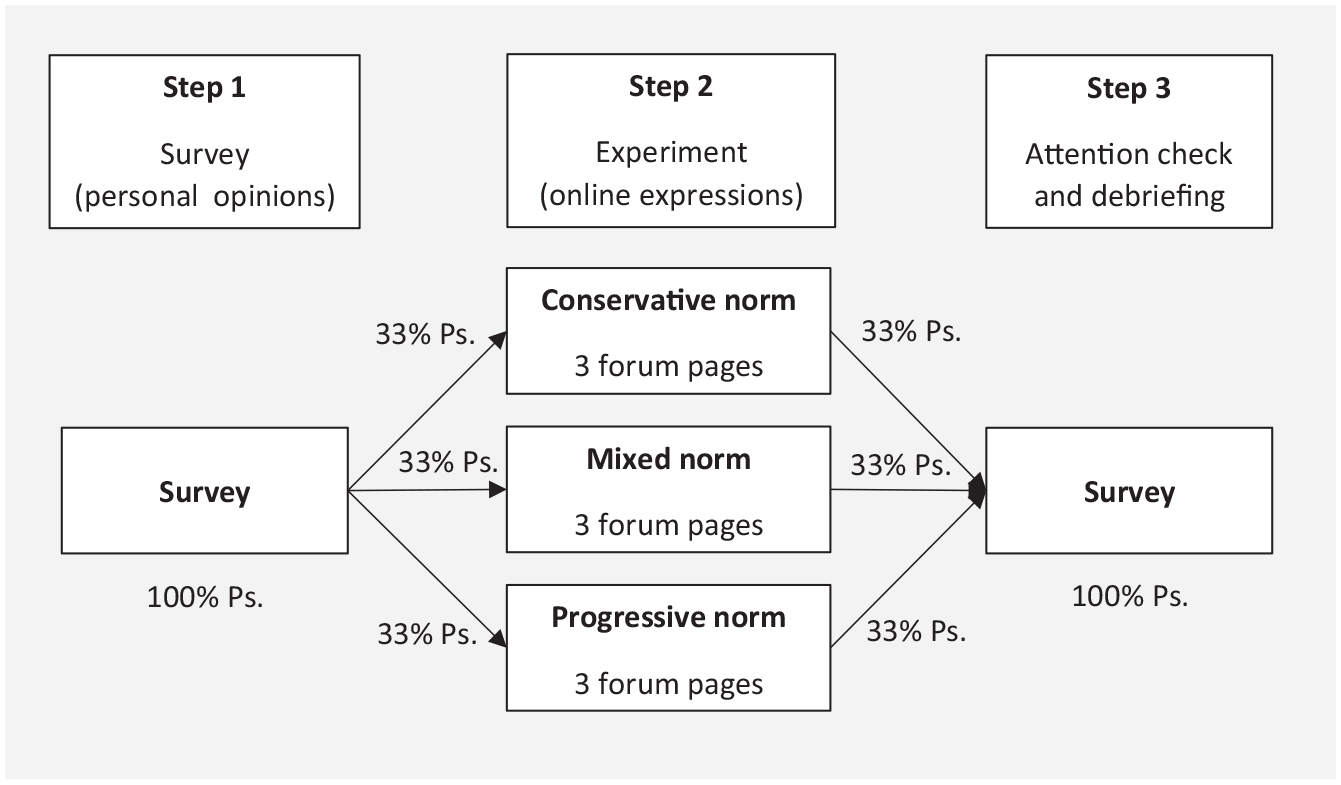
Flowchart of the implementation of the experiment.
To create these experimental conditions, two research assistants independently coded all the comments by the fictitious users on a scale of 0 (very conservative) to 10 (very progressive) prior to the start of the experiment. The independent coders were instructed that conservative opinions expressed support for a conservative ethno-religious norm (e.g., veiling) or opposition to a progressive secular norm (e.g., homosexuality, divorce, sex before marriage and abortion), and the opposite for progressive comments. Based on the finding that individuals generally have an intuitive understanding of the valence of online comments (Chung, 2019; Wu & Atkin, 2018), we did not provide coders with additional criteria for coding the comments. The results showed acceptable internal consistency (Krippendorf’s α = .68), so we took the mean of these two scores as the score for each comment. The comments assigned to the conservative condition received significantly lower average scores (M = 1.80; SD = 0.86) compared to the mixed condition (M = 3.98; SD = 2.16) (t = 6.28; p < .001), which in turn received significantly lower average scores than the progressive condition (M = 5.87; SD = 1.51) (t = 4.80; p < .001). 6
All comments in the conservative and progressive norm condition had between 7 and 12 likes and between zero to two dislikes by other fictitious users (with most comments receiving zero dislikes). In the mixed condition, the progressive and conservative comments on average received an equal amount of likes and dislikes from fictitious users, with each comment receiving between 7 and 12 likes and dislikes.
Selections
In a preliminary analysis, we found that personal opinions toward “divorce” and “not veiling” were very positively skewed, meaning that most participants had progressive personal opinions toward these topics (see Supplemental Appendix C for the distribution of personal opinions for all topics). As a result, only very few participants with a conservative opinion could be assigned to the experimental treatments for these topics. We therefore decided to conduct our analysis only for the other three topics, namely “homosexuality,” “abortion,” and “sex before marriage.”
Of the 222 participants who finished the study, 174 participants were born in the Netherlands with at least one parent born in Turkey or Morocco (the second generation). We also included participants who were born in Turkey and Morocco, but moved to the Netherlands before the age of 10, the so-called 1.5 generation (N = 32 participants). Having spent many of their formative years in the Netherlands, this group has also been socialized in both the ethno-religious community and the broader secular society, just like the second generation. We excluded 16 participants who did not meet these criteria. For each of the remaining 206 participants, we had three observations, one for each of the three topics that were discussed on the online forum.
We also excluded observations by participants with moderate personal opinions toward a topic that was discussed on the forum (see the section “Measures” for further explanation on the opinion measure). We did this because, in contrast to conservative and progressive opinions, it is not possible for these observations to identify a congruent versus an incongruent norm condition. The selection that we excluded amounted to 157 observations by 101 participants.
Lastly, we excluded 11 observations that completed the discussion on a particular topic but had missing values for the associated personal opinions. With these selections, the total sample contained 188 participants with a total of 450 observations.
Measures
We focus on three outcomes, namely likes, dislikes and comment scores. (Dis)likes were measured using a dichotomous variable (0 = no (dis)like on a page and 1 = one or more (dis)likes on a page). Overall, participants were more likely to post a like (M = 60%) than a dislike (M = 44%) on a page (z = 4.94; p < .001). 7 In our study, participants can express their opinion using (dis)likes by liking comments that align with their personal opinions and disliking comments that do not. Also, participants can deviate from their personal opinions by liking comments that do not align with their personal opinions and disliking opinions that do (see analytical strategy). Overall, participants were more likely to express their opinion on a page (M = 60%) than to deviate from their opinion on a page (M = 35%) (z = 7.48; p < .001). To measure the comment scores of the participants, two independent research assistants coded all the comments by the participants on a scale of 0 (very conservative) to 10 (very progressive). The results showed acceptable internal consistency (Krippendorf’s α = .79), so we took the mean of these two scores as the score for each comment (N = 57; M = 4.51; SD = 2.17).
We examined how these three outcomes were influenced by (the combination of) personal opinions and norm incongruency. To measure personal opinions, the participants indicated in the survey before the experiment whether they thought that each of the following issues were wrong on a scale of 0 (always wrong) to 10 (never wrong), namely homosexuality, abortion and sex before marriage. We only included observations that could be categorized as conservative (score 0–3, N = 259) or progressive (score 7–10, N = 191). See Supplemental Appendix C for the distribution of personal opinions for all topics.
To measure norm incongruency, we looked at the combination of the personal opinions of the participant and the experimental condition that they were assigned to. The participants were randomly assigned to a (0) conservative (N = 163), (1) mixed (N = 154) or (2) progressive norm condition (N = 133). This norm condition is then (0) congruent (N = 158), (1) partly congruent (the mixed condition; N = 154) or (2) incongruent (N = 138) with their personal opinions. See Supplemental Appendix D for the distribution of the personal opinions of participants over the norm conditions.
Analytical Strategy
In the experiment, the congruent norm condition contains only congruent comments, the mixed norm condition contains 50% congruent and 50% incongruent comments, and the incongruent norm condition contains only incongruent comments. Therefore, participants can express their opinion using (dis)likes by liking congruent comments in the congruent and mixed norm conditions, and disliking incongruent comments in the mixed and incongruent norm conditions. Alternatively, participants can deviate from their opinion by disliking congruent comments in the congruent and mixed norm conditions, and liking incongruent comments in the mixed and incongruent comments. In the following analyses, we will compare the probability that participants perform these actions between the congruent, mixed and incongruent norm condition to test out hypotheses concerning (dis)likes.
For our analyses concerning the probability of posting (dis)likes and comments, we used a logistic regression. As the three discussions are not independent observations, we used a two-level design to take the clustering of discussions into participants into account. To ease the interpretation of the results of the logistic regression, we compared the predicted probability of posting a comment and (dis)like in our results, rather than the coefficients of the model, which we show in Supplemental Appendices E and I. We used a multilevel linear regression to examine the results for the comment scores.
Results
Descriptive Results
Before we test our hypotheses, we first examine participants’ baseline tendencies on the online platform. Figure 4 shows the average probability of posting a like (a) and dislike (b) by norm congruency. This illustrates how expressions of (dis)approval differ between norm conditions, but not yet whether participants are more or less likely to express their opinion or deviate from their opinion. As can be seen in Figure 4a, the probability of posting a like decreases with norm incongruency. Overall, the participants are significantly less likely to post a like in the incongruent norm condition (43%) compared to the mixed (64%) (z = 3.56; p < .001) and congruent norm condition (70%) (z = 4.65; p < .001). If we split the results by congruency, we observe that participants are more likely to like congruent comments in the congruent norm condition (70%) compared to the mixed norm condition (53%) (z = 3.09; p = .002), and that they are more likely to like incongruent comments in the incongruent norm condition (43%) compared to the mixed norm condition (31%) (z = 2.18; p = .030). On the whole, participants are more likely to like congruent (62%) than incongruent comments (37%) (z = 6.11; p < .001).
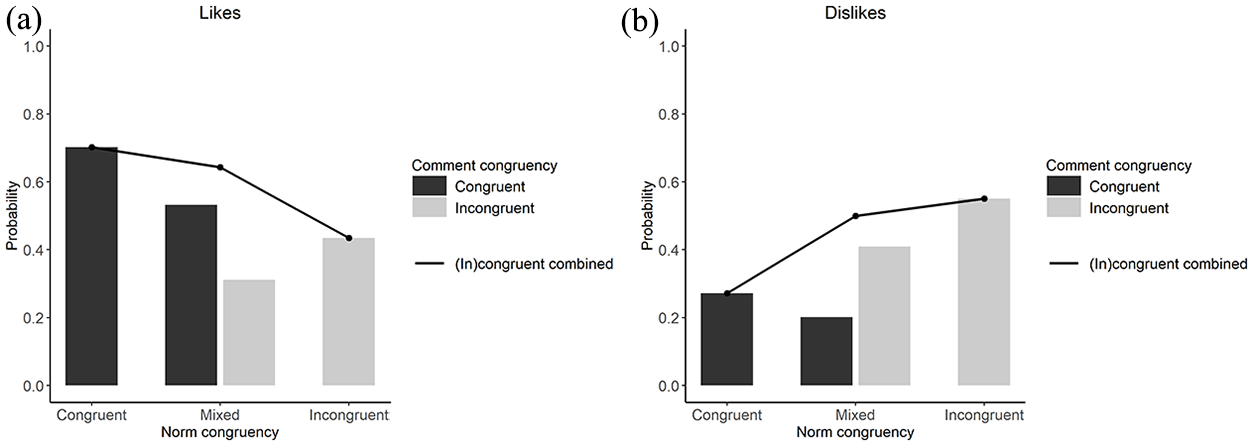
Average probability of (a) liking and (b) disliking (in)congruent comments on a page by norm congruency.
In Figure 4b, we observe that the probability of posting a dislike on a page increases with norm incongruency. Compared to the congruent norm condition (27%), participants are more likely to post a dislike on a page in the mixed (50%) (z = 4.14; p < .001) and incongruent norm condition (55%) (z = 4.88; p < .001). If we split the results by comment congruency, we find that participants are significantly more likely to dislike incongruent comments in the incongruent norm condition (55%) compared to the mixed norm condition (41%) (z = 2.42; p = .016). Overall, participants are more likely to dislike an incongruent comment on a page (48%) than a congruent comment (24%) (z = 6.14; p < .001). When we compare the average comment scores participants with a conservative and progressive opinion toward the topic, we find that participants with a progressive opinion on average post substantially more progressive comments (M = 5.88; SD = 1.98) compared to participants with conservative opinion (M = 3.14; SD = 1.58) (t = 5.04; p < .001).
These results indicate that there is a strong convergence between personal opinions and expressed opinions on the discussion platform: participants are more likely to like congruent comments, and they are more likely to dislike incongruent comments. However, there are still many instances in which participants express opinions online that do not align with their personal opinions by liking incongruent comments and disliking congruent comments.
Expressing Opinions
We now look at how the congruency of the online norm with personal opinions affects the probability of expressing an opinion online. Figure 5a shows that the predicted probability of expressing an opinion online using (dis)likes decreases steadily with increasing norm incongruency (see Supplemental Appendix E for the model). Specifically, we find that the probability decreases from 72% in the congruent norm condition (liking a congruent comment) to 55% in the mixed condition (liking a congruent comment or disliking an incongruent comment) and 52% in the incongruent norm condition (disliking an incongruent comment). 8 The difference in the probability of expressing an opinion using (dis)likes between the congruent and the mixed (z = 2.48; p = .013) and the incongruent norm condition (z = 3.12; p = .002) is significant. The difference between the mixed and the incongruent norm condition, on the other hand, is not significant. Hence, in line with Hypothesis 1a, participants are significantly more likely to express a personal opinion online using (dis)likes in the congruent norm condition compared to the mixed and incongruent norm condition.9,10
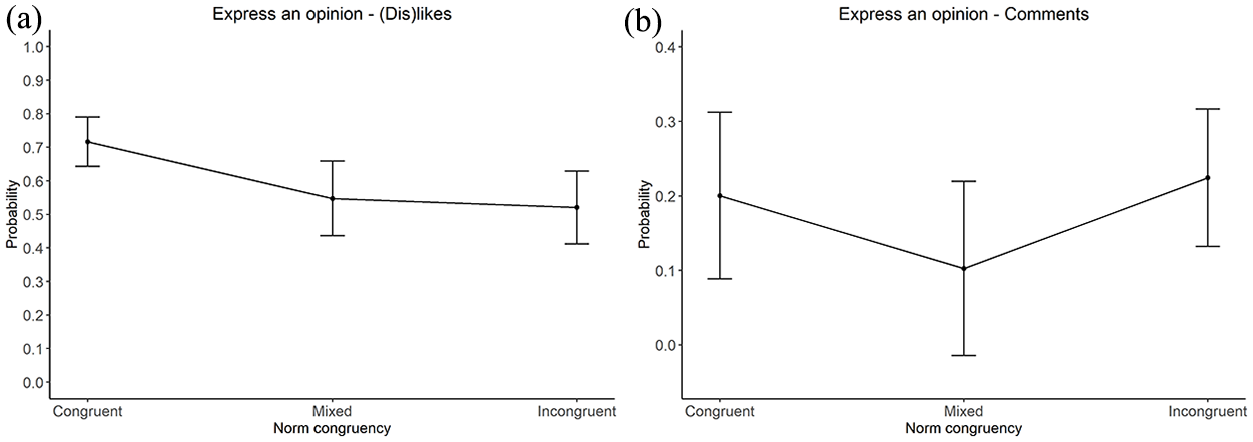
(a) The predicted probability of expressing a personal opinion through (dis)likes by norm congruency and (b) the predicted probability of posting a comment on a page by norm congruency (450 observations nested in 188 participants).
Figure 5b shows the predicted probability of expressing a personal opinion by posting a comment on a page (see Supplemental Appendix E for the model). The probability is lowest in the mixed norm condition (10%), which is substantially lower compared to both the congruent (20%) and the incongruent norm condition (22%). However, in contrast to Hypothesis 1b, the differences between the norm conditions are not significant. 11
Expressing Deviating Opinions
We now examine how the congruency of the online norm with the personal opinion affects the probability of expressing an opinion online that deviates from the personal opinion. Figure 6a shows the predicted probability of deviating from a personal opinion using (dis)likes by norm congruency (see Supplemental Appendix I for the model). The predicted probability to do so increases steadily with norm incongruency. Specifically, we find that probability increases from 28% in the congruent norm condition (disliking a congruent comment), to 36% in the mixed norm condition (liking an incongruent comment or disliking a congruent comment) and 45% in the incongruent norm condition (liking an incongruent comment). 12 In line with Hypothesis 2a, the difference between the congruent and the incongruent norm condition is significant (z = 2.75; p = .006), although we do not find a significant difference between the congruent and mixed norm condition. Hypothesis 2a is thus partially supported. 13
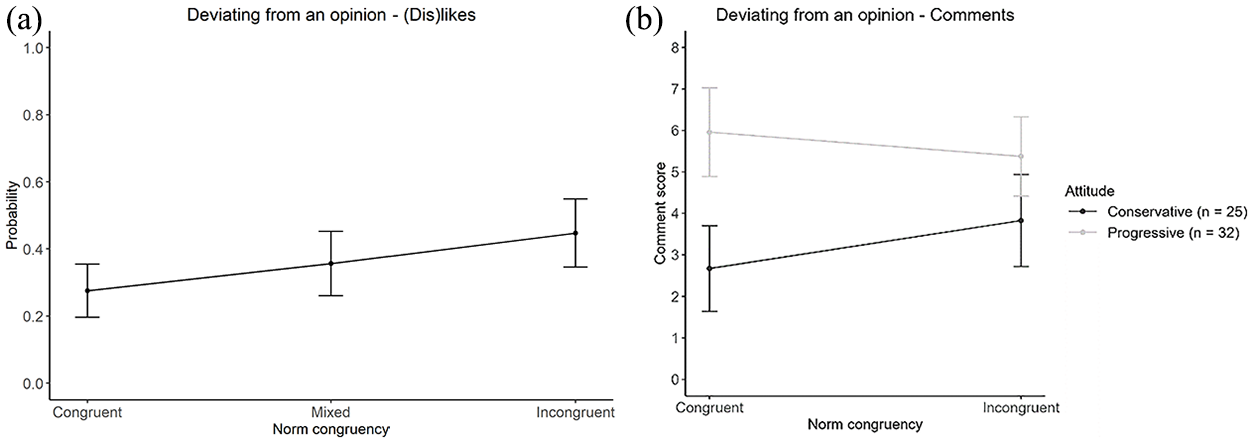
(a) The predicted probability of deviating from a personal opinion through (dis)likes by norm congruency (450 observations nested in 188 participants). (b) The predicted progressiveness of a comment by norm congruency (57 observations nested in 29 participants).
Figure 6b shows the predicted comment score by norm congruency for participants with a conservative and progressive opinion toward the topic (see Supplemental Appendix L for the model). Participants with a progressive opinion post slightly more progressive comments in the congruent progressive norm condition (5.96) compared to the incongruent conservative norm condition (5.37), but this difference is not significant. Participants with a conservative personal opinion toward the topic, on the other hand, post more progressive comments in the incongruent progressive norm condition (3.83) compared to the congruent conservative norm condition (2.67), but this difference is also not significant. Hence, we find no support for Hypothesis H2b, that participants with a conservative and progressive opinion post more progressive and conservative comments, respectively, in the incongruent norm condition than in the congruent norm condition. 14 This is possibly due to the low number of comments (57).
Ethnic Minority and Majority Norms
In this section, we examine whether second-generation Moroccan and Turkish Dutch are more likely to strategically adjust their behavior to a conservative norm (that is widely shared in their ethno-religious community) or a progressive norm (that is widely shared in society). We examine this by comparing the degree to which participants with a conservative and a progressive opinion adjust their online expressions to the online norm. First, with regards to baseline tendencies, we find that the convergence between personal opinions and opinions that are expressed online is stronger for participants with a progressive opinion toward the topic compared to participants with a conservative opinion (see Supplemental Appendix M). Participants with a conservative opinion are approximately as likely to like congruent comments in the congruent norm condition (60%), as they are to like incongruent comments in the incongruent norm condition (55%). For participants with a progressive opinion, on the other hand, this difference is significant (85% vs. 31%, z = 6.21; p < .001). Similarly, participants with a conservative opinion are as likely to dislike congruent comments in the congruent norm condition (34%) as they are to dislike incongruent comments in the incongruent norm condition (37%). Again, for participants with a progressive opinion, we do find a significant difference (16% vs. 75%, z = 6.66; p < .001). Looking at the baseline tendencies, it thus seems as if the congruency between personal opinions and online expressions is stronger for participants with progressive opinions toward the topic than for participants with a conservative opinion.
When we look at the influence of norm congruency on the probability of expressing a personal opinion online using (dis)likes, we find that participants with a conservative and progressive opinion toward the topic follow a somewhat different trend (see Supplemental Appendix E for the model). 15 Compared to the congruent norm condition (86%), participants with a progressive opinion are significantly less likely to express their personal opinion in the mixed norm condition (61%) (z = 2.64; p = .008), but not the incongruent norm condition (71%). For participants with a conservative opinion, the probability decreases steadily with norm incongruency, but only the difference between the congruent (64%) and incongruent norm condition (34%) is significant (z = 3.51; p < .001). Compared to participants with a conservative opinion, participants with a progressive opinion are substantially more likely to express an opinion online in both the congruent (z = 2.65; p = .008) and incongruent norm condition (z = 4.21; p < .001).16,17 For the probability of posting a comment, we do not find differences between participants with a conservative and a progressive opinion toward the topic. 18 To summarize, participants with a progressive opinion are generally more likely to express their opinion using (dis)likes than participants with a conservative opinion. Furthermore, the degree to which participants with a conservative opinion express their opinion is significantly lower in the incongruent setting compared to the congruent setting, which is not the case for participants with a progressive opinion.
When we look at the probability of deviating from a personal opinion using (dis)likes, we find that the probability hereof increases with norm incongruency for both participants with a conservative and progressive opinion toward the topic (see Supplemental Appendix I for the model). However, we only find a significant difference for participants with a conservative opinion: compared to the congruent norm condition (33%), this group is significantly more likely to deviate from their opinion in the incongruent norm condition (54%) (z = 2.34; p = .019). In all norm conditions, participants with a conservative opinion tend to deviate from their personal opinion more than participants with a progressive opinion, but this difference is only significant in the incongruent norm condition (z = 2.02; p = .043).19,20 To summarize, we find that participants with a conservative opinion are more likely to deviate from their opinion than participants with a progressive opinion, but only significantly so in the incongruent norm condition. Furthermore, relative to the congruent norm condition, the degree to which participants with a conservative opinion deviate from their opinion is higher in the incongruent norm condition, whereas for participants with a progressive opinion we do not find any significant differences.
Discussion and Conclusion
While online discussions play an important role in our perception of public opinion, and in the cultural adaptation and acculturation of ethnic minority groups, it is unclear how the opinions that ethnic minorities express online relate to their offline opinions. By measuring both offline opinions and online expressions on an online discussion platform, this study uses an innovative design to study this issue among second-generation Moroccan and Turkish Dutch citizens. The results of this study show that the opinions that participants hold generally converge with the opinions they express online. However, the participants are overall less likely to express personal opinion, and more likely to deviate from their personal opinion, in an online environment that is (partly) incongruent with their own personal opinions, compared to a congruent environment. Further analyses unveil that the convergence between personal opinions and online expressions is stronger for participants with a progressive opinion toward the topic compared to participants with a conservative opinion. Compared to participants with a progressive opinion, participants with a conservative opinion are less likely to express their opinion (in both congruent and incongruent settings), and more likely to deviate from their opinion (in incongruent settings). Furthermore, for participants with a conservative opinion the discrepancy between personal opinions and online expressions is larger in incongruent settings compared to congruent settings, while for participants with a progressive opinion we do not find this difference.
These findings have a number of implications. First, with regards to public opinion research, our findings suggest that the online opinion climate is likely not an accurate reflection of the opinions that individuals hold. As is suggested by the Spiral of Silence theory (Noelle-Neumann, 1974), when individuals encounter online discussions that do not align with their personal opinions, they strategically adjust their behavior to align more with that of others. Like in offline environments (Cialdini & Goldstein, 2004; Deutsch & Gerard, 1955), individuals seek the social approval of others in online environments, and therefore conform their behavior to the dominant social norm out of fear of social isolation, being personally attacked or losing control over the response of their audience (Neubaum & Krämer, 2018). In contrast to popular belief (Anstead & O’Loughlin, 2015), this result suggests that we cannot gauge the opinion of the general population using the opinions that individuals express online. By reinforcing the dominant norm in online discussions, these environments become increasingly homogeneous and extreme over time, even when the personal opinions of individuals are actually diverse (Noelle-Neumann, 1974).
Second, with regards to the integration of (Muslim) ethnic minorities in Western European societies, our findings stress that this process is very context-dependent: the degree to which they adjust their behavior to the progressive values of the ethnic majority depends on the degree to which others in their direct environment also publicly endorse such values. In other words, the more conservative views toward sexual liberalism of second-generation Moroccan and Turkish Dutch citizens in survey research (Huijnk & Andriessen, 2016; Kalmijn & Kraaykamp, 2018) are not necessarily the values that they express in public. Thus, by focusing so strongly on the differences in personal opinions of ethnic groups, previous research limits our understanding of how ethnic diversity affects the cohesion of multicultural societies in practice. To advance our knowledge on this process, future research could put more emphasis on the process through which ethnic minorities perceive and integrate ethnic minority and ethnic majority culture in their daily lives (see Ward, 2013; West et al., 2017).
Third, the different results for participants with a conservative and progressive opinion suggest that online norms do not exist in isolation, but rather interact with offline norms. Specifically, we find that the online norm has a stronger effect on online behavior when it resonates with the societal norm, in this case that of sexual liberalism in the Netherlands. Previous research has found that societal norms influences the motivations to use social media (e.g., Kim et al., 2011), or the disclosure of personal information (e.g., Rui & Stefanone, 2013). We contribute hereto by arguing that, together with online norms, offline norms could also influence the opinions that individuals express in online environments.
How can our results inform policy and practice that aim to reduce negative intergroup relationships between ethnic groups? First, even though the cultural differences between ethnic groups do not necessarily translate into behavioral differences, the perceived irreconcilability of opposing values may nonetheless drive salient boundaries in society (Pasek et al., 2022). Correcting these misperceptions through public information campaigns may be effective in reducing societal divides. For example, some studies have found that correcting for misperceptions of others’ extremity (first-order beliefs) reduces individuals’ own extremity (Ahler, 2014; Ahler & Sood, 2018). Moreover, correcting for incorrect perceptions of how “others” see “you” (second-order beliefs) also reduces intergroup hostility (Kteily et al., 2016; Lees & Cikara, 2020).
Second, promoting the online expression of minority opinions may be a fruitful avenue through which individuals may acquire a more accurate perception of other groups and public opinion. For example, previous studies find that minority voices may more likely to be expressed in civil discussions in which individuals do not perceive a risk to be personally attacked (Han & Brazeal, 2015; Neubaum & Krämer, 2018; Pang et al., 2016). Hence, one way in which online discussion platforms can promote the expression of minority voices is by providing ample opportunity to report uncivil behavior by other users.
In light of the growing importance of online discussions for our perception of the general public opinion (Anstead & O’Loughlin, 2015; Neubaum & Krämer, 2017), it is important to note that social influence processes tend to be stronger in online settings than in offline settings when a group identity is salient (Huang & Li, 2016; Spears, 2021). According to the social identity model of deindividuation (Reicher et al., 1995), this is because the visual anonymity of online settings leads to a more homogenous perception of the ingroup, which enhances the salience of the shared group identity. Even though such group dynamics may thus be less prominent in offline settings, we may nonetheless perceive large (offline) group differences because these perceptions are partially formed in online settings.
This study has a number of limitations: first, we interpret our findings in terms of a discrepancy between personal opinions and expressed opinions. However, it could also be that our results do not show a discrepancy between personal opinions and behavior, but rather a change in personal opinions (see Lee et al., 2022). However, previous studies have suggested that personal opinions that are easily accessible in memory are less prone to be influenced than personal opinions that are not (Blankenship et al., 2015; Hodges & Wilson, 1993). Given the prominence of sexual conservativism in Islamic teachings (Dialmy, 2010), we argue that personal opinions surrounding sexual liberalism are unlikely to change for this group in response to the brief exposure to the online environment of this study. Therefore, we believe that the effects that we find are a good indication of the relationship between personal opinions and expressed expressions. 21
Second, due to our focus on second-generation Moroccan and Turkish Dutch citizens, we cannot tell whether these effects are specific to this ethnic minority group or could also be observed among the ethnic majority population. Moroccan and Turkish culture is characterized by a high degree of collectivism, which means that the transgression of group norms is not tolerated to the same degree as in the more individualistic, Dutch culture (Stamkou et al., 2019). In addition to this, due to the high degree of hostility toward (Muslim) ethnic majority groups in Western Europe, Moroccan and Turkish Dutch citizens may feel that their culture is under threat, which in turn may increase their determination to maintain the ethno-religious culture in their community (Röder & Spierings, 2021; Spierings, 2015). Together, these arguments suggest that ingroup norms have a larger influence on the behavior of second-generation Moroccan and Turkish Dutch citizens compared to the ethnic majority Dutch population, but we cannot test this using this data.
Third, previous research has shown that online behavior may differ between online discussion platforms because of the affordances that they provide, such as anonymity, visibility and persistence (Evans et al., 2017). As a result, the relationship between personal opinions and online expressions may differ between platforms based on the affordances that they provide. It is therefore difficult to establish to what extent the relationship between personal opinions and online expressions that we find here is due to the specific characteristics of our platform, or whether it could also be found elsewhere. Nonetheless, we decided to build our own discussion platform, rather than simulating a particular or representative platform, because these platforms have a lot of characteristics that were not of interest to this particular study, such as sharing content, befriending or blocking other users and setting up a personal profile. By building our own discussion platform that focusses specifically on commenting and (dis)liking, we focus our data collection more specifically on the behaviors that are typically influenced by online norms in previous research (Álvarez-Benjumea & Winter, 2018; Gearhart & Zhang, 2015; Ordoñez & Nekmat, 2019; Pang et al., 2016; Wu & Atkin, 2018; Wu et al., 2020), and furthermore, that may play an important role in changing these online norms over time (Munger, 2017; Siegel & Badaan, 2020).
This study provides a number of avenues for future research: for example, future studies could examine the boundary conditions for the effects we find here. Previous studies have found that people are more likely to behave in line with the online norm when they find themselves among ingroup members, compared to when they are amongst outgroup members (Rains et al., 2017; Sassenberg & Postmes, 2002). Furthermore, as adhering to identity-relevant norms is considered important to earn ingroup respect (Pagliaro et al., 2011), it is likely that the relationship between personal opinions and expressed expressions is stronger for more general norms (e.g., opposition to stealing) that are not tied to a specific group identity.
To conclude, in current public and political debates, the cultural differences between progressive ethnic majority and conservative Muslim minority groups are often perceived as a potential threat to the cohesion of Western European societies. However, in this paper we find that—even though cultural differences between ethnic groups may be large—their behavior may, in fact, be not very different. As a result, the implications of ethnic diversity for contemporary multicultural societies might be considerably smaller than the cultural differences between ethnic groups initially suggest. Rather than inflating differences between ethnic groups by focusing only on their cultural differences, we therefore argue that future scholarly and political attention should also take into account the extent to which these cultural differences translate into behavioral differences.
Footnotes
Acknowledgements
The authors also want to thank Hendrik Jan Meerveld and the other members of the HTS App Development Team of the Faculty of Social and Behavioral Sciences at Utrecht University for their incredible help with building the website. The authors are also very grateful for Amina op de Weegh for her help with writing the discussions for the website, and Koen Veldman and Marthe Blaak for coding the comments by all (fictitious) users.
Declaration of Conflicting Interests
The authors declared no potential conflicts of interest with respect to the research, authorship, and/or publication of this article.
Funding
The authors disclosed receipt of the following financial support for the research, authorship, and/or publication of this article: This study is part of the research program Sustainable Cooperation—Roadmaps to Resilient Societies (SCOOP). The authors are grateful to the Netherlands Organization for Scientific Research (NWO) and the Dutch Ministry of Education, Culture and Science (OCW) for generously funding this research in the context of its 2017 Gravitation Program (Grant Number 024.003.025).
Ethical Approval
The study is approved by the Ethics Committee of the Faculty of Social and Behavioral Sciences of Utrecht (Approval Number 21-0389).

Supplemental Material
Supplemental material for this article is available online.