




Abstract
Following the January 6 insurrection on the US Capitol, we sought to explore how two social media platforms were being used concurrently to disseminate far-right memes and discourse. Our study employs a mixed-methods approach to collect a large data set of images from 4chan/pol/ and using the “#stopthesteal” hashtag on Twitter between 1 January 2021 and 13 January 2021. Our findings reveal how each platform influenced the usage of memes toward identity building and far-right activism in the days leading up to and immediately after the insurrection. Our findings reveal that Twitter was used to mobilize users leading up to January 6 but led to in-fighting among the pro-Trump crowd in the days after. Meanwhile 4chan/pol users took advantage of the Overton window of the Insurrection to disseminate far-right ideology and attempt to recruit and radicalize disgruntled Trump supporters after the insurrection was deemed a failure.
Keywords
Introduction
The 6 January 2021 insurrection on the US Capitol Building came at a time when offline far-right group activity was seemingly on the decline. In 2020, the number of active far-right hate groups in the United States declined by 11% when compared to 2019 (Wamsley, 2021). Yet, the number of individuals who subscribed to far-right aligned beliefs as well as far-right propaganda flyers increased during this same time (Janik and Hankes, 2021). One explanation for this phenomenon is that many adherents of far-right ideology have found online communities of like-minded individuals that offer more security and are less resource intensive than joining and participating in an offline group. Recent events like the 6 January 2021 insurrection and the 2018 “Unite the Right” rally in Charlottesville serve as examples that such individuals are likely to participate in offline action despite not belonging to a specific far-right group (Devries, 2021). Thus, it is important for researchers to better understand the relationship between offline events and the discourse in online communities. This is especially true during times of significant social change, such as the defeat of President Trump in the 2020 Presidential Election that led to a sudden increase in far-right aligned individuals engaging in mobilization without being affiliated to specific far-right movements (Janik and Hankes, 2021). Such individuals are recruited and radicalized in online communities through the help of discursive and memetic texts that have a reflexive relationship with offline political and movement activity (Janik and Hankes, 2021).
Studying the link between online and offline far-right activity is necessary if scholars are to learn how the far-right project has benefited from information and communication technologies.
Scholars agree that social media has become essential for political communication (Davey and Ebner, 2019; Reinsborough and Canning, 2017). Social media engagement has been reliably shown to lead to offline mobilization (Alberici and Milesi, 2016; Lee et al., 2017; McGarty et al., 2014). Particularly, there has been a massive global resurgence in far-right movements as a result of widespread communication between and within online far-right communities (Bael et al., 2020; Zhang et al., 2017).
Researchers have also begun to study how offline events impact online far-right communities. Bliuc et al. (2019) found that “local race riots” correlated with a peak in activity on Stormfront Down Under and led to significant changes to collective identity within the community. Meanwhile, Wiggins (2021) tracked the use of discourse and memes of the Boogaloo Boys on Twitter during the 2020 Virginia gun rally to consolidate identity among online supporters of the movement via conspiratorial thinking and folk heroism. While this research reveals important details about the relationship between offline events and online activity within far-right communities, there is as of yet no comparative studies that look at how discourse develops on two separate social media platforms during a dramatic movement event.
Our research addresses this gap by comparing the utility of two online platforms in relation to far-right user popularity; Twitter (a social networking platform governed by an evolving terms of service criteria for user content) and 4chan/pol (a largely unregulated image board hosted on 4chan. 4chan (2021), as a social media platform, is centered around user-generated threads, which are transitory in nature and anonymous (Dewey, 2014). Of particular concern in this study, is how social media platforms were used to share content relating to offline mobilization events of ingroup members, namely the US Capitol insurrection on 6 January 2021. Specifically, we examine how the platforms, Twitter and 4chan/pol, were used to promote far-right ideologies before, during, and after the 6 January 2021 insurrection.
To evaluate the utility of these platforms for far-right aligned individuals, we employ an emergent coding strategy to identify thematic clusters of content shared on 4chan/pol and Twitter. Our research design is as follows: first, we examine what similarities and differences exist between the nature of user posts that contain memes on Twitter and 4chan/pol, in relation to the events on 6 January 2021; we then examine whether the platforms were used collaboratively in relation to users discussing topics related to the 6 January 2021 insurrection. Specifically, we examine whether 4chan/pol and Twitter were used as separate entities or as complementary mediums to convey far-right messaging. We employ Shifman’s (2014) definition of an Internet meme to our analysis. Internet memes under this lens are defined as “(a) a group of digital items sharing common characteristics of content, form, and/or stance; (b) that were created with awareness of each other; and (c) were circulated, imitated, and/or transformed via the Internet by many users” (pp. 7–8). Wiggins and Bowers (2015: 1892) expand on this definition, adding “Internet memes are messages transmitted by consumers–producers for discursive purposes.” And by extension Internet memes are “. . . dynamic entities that spread in response to technological, cultural, and social choices made by people” (Shifman, 2012: 190). To contextualize our study, we begin by discussing past research on the links between the online and offline dimensions of the far-right.
The intersection of online and offline hate
There is a relative lacuna of comparative research on the deployment of online far-right discourse in conjunction with offline collective action. Existing research establishes that the decentralized nature of the Internet contributed to the proliferation of far-right content because of its lack of temporal and spatial barriers that often hinder offline far-right speech (Davey and Ebner, 2017; Perry and Olsson, 2009). Yet, as barriers to communication are minimized online, an unintended consequence has been the weaponization of Internet sites to increase far-right organizational capacities, such as promotion, recruitment, and mobilization (Conway et al., 2019; Edwards and Gribbon, 2013). Social media platforms, in particular, facilitate the dissemination of far-right content because of their networked structure that increases user connectivity, scope, and visibility (Ekman, 2018; Perry and Olsson, 2009). The far-right conspiracy theory, QAnon, is one example of this weaponization as followers of its ideology use message boards on 8chan to foster a participatory culture among each other (Jenkins et al., 2009; Marwick and Partin, 2022).
While there are existing efforts by social media companies, such as Facebook and Twitter, to regulate user-generated content by establishing terms of use, the spread of far-right content has overcome changing terms of service by adapting new strategies such as the use of seemingly innocuous symbols and memes to communicate hateful messages while bypassing security algorithms (Klar, 2022; Massanari, 2017). For example, using coded language or dog-whistles that sound innocuous to the public but carry a more focused implicit meaning that other members of the far-right understand (Bhat and Klein, 2020). This not only accomplishes the goal of spreading far-right messages but also allows like-minded far-right leaning individuals to connect online. This practice is not exclusive to the far-right, for example, in Wallis’ (2011) examination of social change in China, new media technologies were utilized by youths as new avenues for connection and expression to avoid state censorship.
Online communities have been effective at establishing and maintaining a sense of collective identity among far-right activists (Bowman-Grieve, 2009; De Koster and Houtman, 2008). This is particularly impressive given the fact that contemporary far-right movements often lack uniformity and cohesive movement frames (Sweeney and Perliger, 2018). Anonymous decentralized spaces like 4chan/pol are especially effective at increasing the scope of individualized mobilization of the far-right (Marwick and Lewis, 2017). For this reason, studying online discourse in far-right communities has revealed important insights about far-right ideas have been moving out of the fringe and into the mainstream in recent years. For example, Pauwels (2021) observed that online spaces result in stronger international connections between right-wing radicals. Meanwhile, Wojcieszak (2010) found that exposure to neo-Nazi discourse online increased radical opinion extremism even among those individuals who were regularly exposed to opposing (anti-far-right) views in their offline social circles. At the same time, users on 4chan/pol are sometimes drawn to the community’s antagonistic discourse as a way to distinguish themselves from their offline peer groups who they pejoratively dismiss as “normies” for having progressive political positions (Ludemann, 2021). Nevertheless, it is important to note that 4chan/pol plays host to a plurality of ideologies and political viewpoints that are loosely connected through a diverse stream of conspiracy discourse, generalized White supremacism and the widespread use of memes (Wiggins, 2022).
Memes are effectively used as virtual posters and leaflets to disseminate far-right messaging to normalize far-right ideology by embedding it within mainstream references and jokes (Cammaerts, 2018; DeCook, 2018). While researchers have previously studied the use of memes in conjunction with offline mobilization, there has yet to be research that looks at the relationship between memes deployed in a far-right community like 4chan/pol in conjunction with mainstream social media platform like Twitter during an offline mobilization event such as the 6 January 2021 insurrection. As such, it has been difficult for researchers to identify whether a link exists between fringe far-right platforms and mainstream social media before, during, and after offline movement activity. The existence (or lack thereof) of such a link is important because it reveals the function each platform serves in promulgating far-right ideologies. Understanding this function will help researchers and progressive activists organize and resist far-right activity more effectively, especially in cases where such activity is spearheaded by individuals loosely connected through online networks (rather than specific far-right groups). For example, identifying whether there are similarities or differences in the content and function of memes used on both platforms can lead to the development of anti-recruitment and anti-mobilization efforts for each respective platform. We now briefly turn to discuss the utility of memes as carriers of ideological messages that have the power to radicalize and incite political action among members of the far right.
Memes and the far-right
Researchers have been studying how, when, and why memes are used to engage with the contemporary political milieu (Moreno-Almeida and Gerbaudo, 2021; Reinsborough and Canning, 2017). The deployment of memes as political instruments to meet ideological goals stems from the entrenched political power of visual content to present a particular world view (Bogerts and Fielitz, 2019). Memes usually take the shape of text, images, videos, gifs, or even soundbites that contain within them (often humorous 1 ) cultural references that can easily be reproduced and shared online (Shifman, 2014). Much like propaganda posters, memes are effective at grabbing the attention of individuals with conspicuous imagery and references to popular culture (Beskow et al., 2020). A style guide on the Neo-Nazi community The Daily Stormer directs its members to “always hijack existing cultural memes in any way possible [because] packing our message inside of existing cultural memes and humor can be viewed as a delivery method. Something like adding cherry flavor to children’s medicine” (Feinberg, 2017). Specifically, members are encouraged to carefully encode Nazi messages into viral memes with the agenda of normalizing these ideas within the public discourse. Online far-right communities such as 4chan/pol, 8chan, and Gab often act as a testing ground for these memes before they are deployed to more ubiquitous social media platforms such as Twitter and Facebook (Papasavva et al., 2020). 4chan/pol, for example, often acts as a space of recruitment and mobilization of online memetic antagonism where users are provided with memes carrying pro-Nazi messages and encouraged to spread the memes on other social media platforms (Kasimov, 2021). While this has been an effective strategy at spreading far-right messages to larger audiences, platforms like Twitter (n.d.-a; n.d.-b) do have anti-discrimination policies 2 put in place that allow them to remove text and images that are classified as hate speech.
As a way to get around this censorship, some users have opted to “hide in plain sight” on mainstream social media platforms through the use of dog-whistles such as the triple parenthesis meme (((they))) that carries an explicitly anti-Semitic message (Tuters and Hagen, 2020). The use of such memes allows those “in the know” to flex their insider status and actively discuss racist ideas, while avoiding censorship on social media. These memes also provide exposure to their ideas by gaining the attention of curious users, who then go to search for what the meme means. Alternatively, the use of memes by groups such as the Proud Boys focuses on equating organizations such as Black Lives Matter to the KKK or the Nazis, by presenting them all as hate groups (DeCook, 2018). In this way, the Proud Boys use memes to simultaneously legitimize themselves by distancing themselves from Nazis while also disseminating racist and misogynist messages from what they claim is their true political center.
Aside from encoding and disseminating right-wing extremist messages, memes are used to mobilize. Wendling (2018) found that former President Donald Trump’s 2016 campaign success to be attributable to its utilization of social media and deployment of viral memes. The 2016 election exemplifies the insidious power of humor and cultural references to incite political participation with many young voters claiming that their vote for Donald Trump was spurred by a desire to be part of the meme culture surrounding the election (Beran, 2017). While pro-Trump memes varied in intensity, their usage has been used to promote (and amplify) vitriolic rhetoric and offline violence against the US government. After President Trump warned that his impeachment would result in a civil war, the hashtag #Boogaloo2020 surfaced on Twitter as a reference to the plot of the 1984 movie Breaking 2: Electric Boogaloo, where an alternate reality exists where a civil war breaks out in the United States (Wiggins, 2021). The Boogaloo meme was quickly appropriated by a rhizomatic movement of individuals, some of whom held White supremacist ideals and were eager to accelerate the nation toward a civil war (Newhouse and Gunesch, 2020). The Boogaloo movement depended on memes to negotiate group identities through hyper narrative and identifying oppositional frames due to its hybrid structure of lone-wolf activism and cell-like organization spanning mainstream, radical right, and even dark online communities (Goldenberg et al., 2020).
The Boogaloo meme demonstrates the salience of memes to sustain collective identity among online far-right communities and coordinate connective action, defined as the mobilization of large numbers of individuals into a temporary movement-like group connected only through communication technologies and individual action frames (Bennett and Segerberg, 2013). Memes are uniquely suited for this type of mobilization because of their ubiquitous cultural appeal and their transmissible nature (McDonald, 2015). The Boogaloo meme attempted (with some success) to connect Donald Trump’s call for a civil war (and by extension an implicit anti-Black ideology) with the goal of anti-police protestors in wake of George Floyd’s death, by attempting to promote antagonism between anti-police protestors and the police (Wiggins, 2021). While no collective identity exists between the two groups, the memes helped identify a shared anti-state sentiment between the two, which was temporarily exploited to incite connective action. Nevertheless, there is a lack of research documenting the contemporaneous production of memes on mainstream and far-right platforms in conjunction with monumental offline events. It is unclear whether memetic content on different platforms results in complementary or antagonistic outcomes for the members of each respective community which brings us to our present study.
The present study
Our study takes as a point of departure, Wiggins’ (2021) study of how memes were used on Twitter during the attempt to incite a civil war through the use of the #boogaloo meme concurrently with a gun rally held in Richmond, Virginia in January 2020. While this study sheds an important light on the use of memes on Twitter, it left unanswered the question of how far-right dedicated online communities like 4chan/pol respond to offline events in conjunction to social media like Twitter. That is, are the findings of Wiggins’ (2021) study specific to Twitter or could they be extended to other, less regulated platforms like 4chan/pol? Meanwhile Bliuc et al. (2019) found that offline far-right activity seems to invigorate members of explicitly far-right communities like Stormfront, leading to a stronger collective identity. Both studies lack a comparative analysis of their respective groups. Wiggins does not consider explicitly far-right communities while Bliuc et al. do not include mainstream social media like Twitter in their analysis. We are not suggesting that such omissions weaken the contribution of either study and view the findings of each as essential at moving far-right scholarship forward. However, we also believe that a direct comparison of how each type of platform is used before and after a large mobilization event, can reveal crucial links between online and offline far-right activity.
We feel a direct comparison between Twitter and 4chan/pol will help scholars focused on far-right movements to understand, more specifically, the impact of platform regulatory structure and offline events on the discursive and memetic strategies adapted by far-right aligned individuals online.
We capitalize on the events of 6 January 2021 to map out the differences in communication styles and thematic content of memes posted by 4chan/pol/ and Twitter users before and after the events of 6 January 2021 to demonstrate the ways they contradict and complement each other. We collected text and image data over the span of 13 days (6 days before/during and 7 days after the insurrection). Our study focuses on two research questions: (1) To what extent were there differences in the thematic content of the memes posted to each platform before (and during) versus after the insurrection? And (2) more broadly, how do multiple social media platforms work together to facilitate the mainstreaming of ideas that are otherwise considered socially intolerable or extreme?
These research questions answer the call of social movement scholars interested in the use of communication technologies by the far-right to connect this research back to offline movements and events. At first glance, our findings reveal contradictory themes and content between the memes shared on the two platforms. However, when the timing of when the memes are shared is accounted for (before, during, or after the insurrection), the memes work in concert to radicalize and funnel individuals from issue-specific positions to generalized normalization of far-right ideology. Below, we expand upon our research design, data collection, and findings.
Data collection
We analyzed two data sets of randomly selected media (and accompanying text) posts on two social media sites, 4chan/pol and Twitter.
4chan/pol
4chan’s /pol/ (politically incorrect) image board was selected for the following reasons: first, its popularity among users with far-right ideologies (Colley and Moore, 2022); second, recent literature found that it produces more hate speech than similar sites like Gab (Zannettou et al., 2018); third, posts on the image board tend to be expressive of user sentiment (Topinka et al., 2021); and fourth, it is by far the most active image board on 4chan (4stats.io, 2021). 4chan by design has limited moderation with each board having its own volunteer “janitors” to monitor content. However, interviews with 4chan/pol “janitors” have characterized image board moderation as a largely “hands-off” endeavor, allowing vitriolic content to disseminate (Arthur, 2020).
As threads within image boards on 4chan/pol are not officially archived, analysis of previous threads using 4chan/pol is not possible (4chan, 2021). To address this limitation, we selected image boards from 4plebs.org, a crowd-sourced data archive of 4chan/pol image boards and threads (4plebs.org, n.d.). One thousand opening posts on /pol/ threads by 4chan/pol users were collected from 4plebs based on two different time frames, 1–6 January 2021 and 7–13 January 2021. Five hundred opening post threads were randomly selected from each time period. The data for each of the selected time periods are based on the total number of 4chan/pol opening user posts (start of a thread) that contain media found on 4plebs (20,753 search results for 1–6 January 2021 and 50,946 search results for 7–13 January 2021). Reply posts to opening threads were excluded in the data collection.
Twitter’s Premium application programming interface (API) (Twitter Developer Platform, n.d.) was employed to collect data using the hashtag, “#stopthesteal,” because of its noted popularity leading up to and after the 6 January 2021 insurrection (Booker, 2021). Our search criteria specified that only tweets that contained media be collected, and retweets, quotes, and replies be excluded. Nine hundred seventeen posts were gathered between 1–6 January 2021 and 303 posts between 7–13 January 2021. As before, a random number generator was used to select a subset of 500 tweets from the first time period. As the second data frame contained only 303 tweets, we analyzed all the collected tweets.
Methodology
We conducted an inductive, data-driven thematic analysis on memes and surrounding text on Twitter and 4chan/pol via an event-oriented approach. We followed the framework of thematic analysis of Nowell et al. (2017), which consists of searching across a data set of a range of texts to find repeated patterns of meaning. Thematic analysis can focus on either semantic or latent themes. Semantic referring to surface-level meaning of the texts studied while latent analysis: goes beyond the semantic content of the data, and starts to identify or examine the underlying ideas, assumptions, and conceptualizations and ideologies that are theorized as shaping or informing the semantic content of the data. (Braun and Clarke, 2006: 84)
We opted to conduct a latent analysis for two reasons. First, memes are texts that are already rich in meaning and require a level of interpretation that goes beyond simple semantic description (Shifman, 2014). Second, comparing how memes and surrounding text is used on two different social media platforms during a specific event requires a level of interpretative work that goes beyond the surface meaning of most 4chan/pol posts and tweets. For example, the cultural significance of certain memes (Pepe the Frog is not just a kid’s cartoon but also constitutes part of the collective avatar (Devries, 2021) of 4chan/pol) is crucial to the understanding of how memes are used during large-scale movement events like the 6 January 2021 insurrection.
The most prevalent themes on both platforms were coded and identified during live in-person meetings over Zoom and in-person where at least two of three authors were always present. The first and second authors coded all of the 4chan/pol/ posts and tweets ensuring intercoder reliability through extensive discussions (Westbrook and Schilt, 2014). Phase 1 consisted of all three authors engaging in the emergent coding of each post and then collating the codes into two major themes: mobilization and identity formation. Importantly, these themes were not mutually exclusive and certain posts satisfied the theme of both mobilization and identity formation. The second round of inductive thematic analysis consisted of identifying how each of these themes was expressed on each platform. Specifically, we identified thematic differences in how memes were used for the purposes of mobilization and identity formation during the week leading up to and the week following the 6 January 2021 insurrection. The qualitative analysis of these platform differences in meme usage are presented in the next section.
Findings
Our findings reveal fascinating differences in the thematic content of the memes posted to each platform in relation to the 6 January 2021 insurrection. First, we delineate how platforms like Twitter are used to mobilize users toward far-right causes, while 4chan/pol acts as a space for identity formation and boundary construction relying on ubiquitous memes and language; second, we show that the same memes that composed posts supporting mobilization on Twitter are eventually bundled with even more nefarious images and ideas such as fascism, White supremacy, and violence against the outgroup. Finally, we document how the revolutionary vigor of #stopthesteal protestors gets repurposed away from political party targets such as the Democrats and toward religious and ethnic groups such as Jewish people on 4chan/pol/. Far-right recruiters on 4chan/pol/ capitalize on the Overton window of a failed insurrection to radicalize disgruntled supporters of Donald Trump and the GOP (Grand Old Party). We expand on these findings below.
Action funneling on Twitter
Participating in the 6 January 2021 insurrection was painted as the duty of anyone who wanted to call themselves an American because of how the United States was founded historically. Memes used to mobilize Twitter users channeled the identity of a patriot with repurposed Civil War imagery side by side with text on refusing to surrender and encouraging violent action such as to “tar and feather” traitors attempting to steal the election (see Figure 1). Interestingly, these types of memes were also popular on 4chan/pol with depictions of Thomas Jefferson and Douglas Macarthur used to incite action prior to and during the insurrection (see Figure 2). Memes on Twitter in the days leading up to and on the day of the insurrection also focused on the theme of freedom and being a patriotic American. One Twitter user said: Let’s clear something up!! We LOVE DONALD TRUMP! But HE is NOT the REASON Patriots are in DC right now!!! Patriots went to DC FOR AMERICA!!! We’ve been SOLD like SLAVES to other countries because OUR REPRESENTATIVES are criminals!
The patriot identity was bundled with one of a freedom loving American who was in danger of losing his freedom unless immediate action was taken. Memes with patriotic imagery such as the American bald eagle or references to the movie Braveheart were commonplace (see Figure 3). This type of meme was the least common in Wiggins’ (2021) sample of memes that were used during the #boogaloo inspired insurrection in Virginia in 2020. In our sample, this was the most common meme which signals a shift in the strategic use of memes for the purposes of inciting a civil war on Twitter. In the case of #boogaloo, the government itself was painted as treasonous but #stopthesteal specifically focused on the “treasonous” and “corrupt” Democrats that are threatening to take away the freedom of patriotic Republicans.
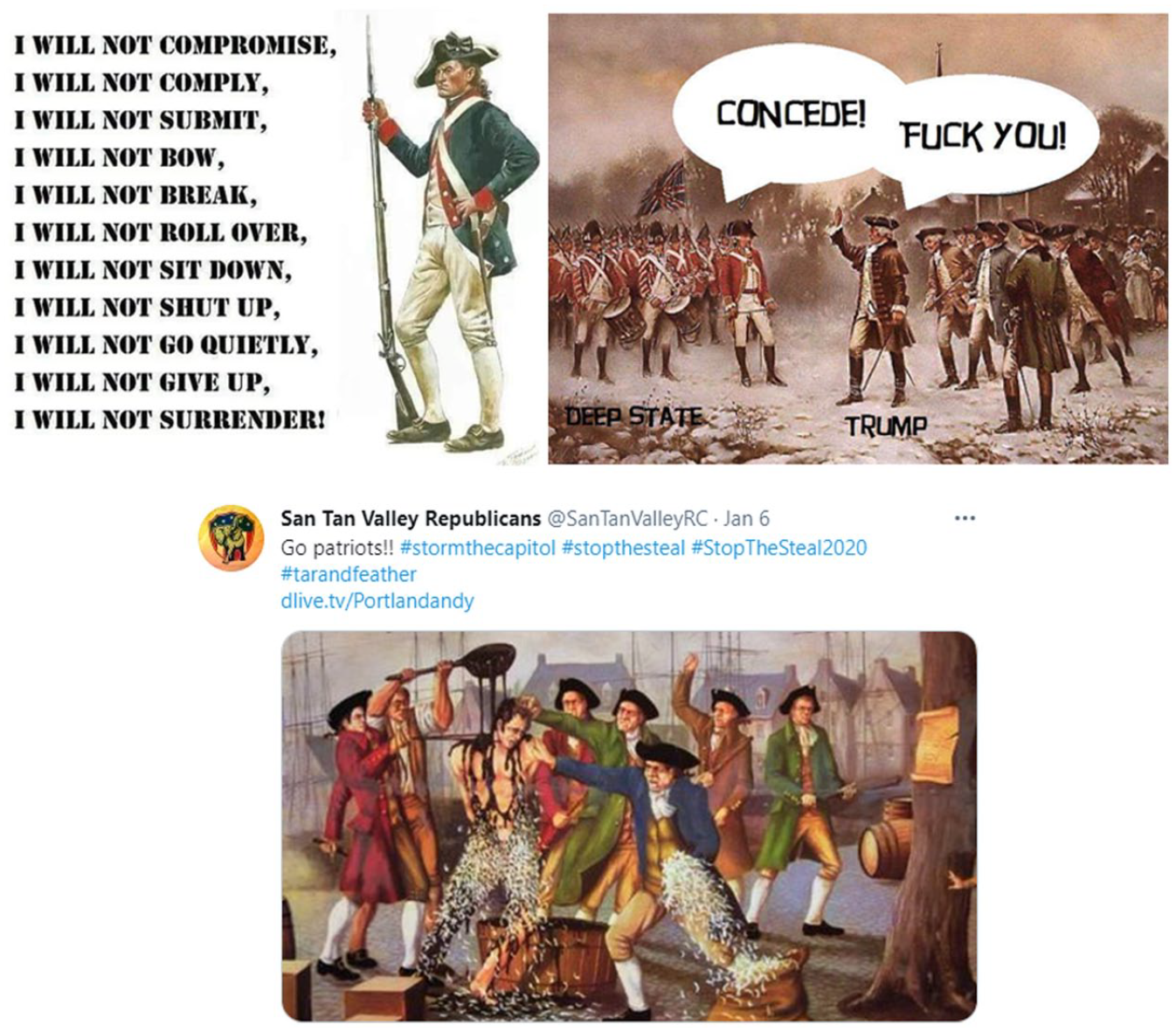
Memes used to mobilize on Twitter.
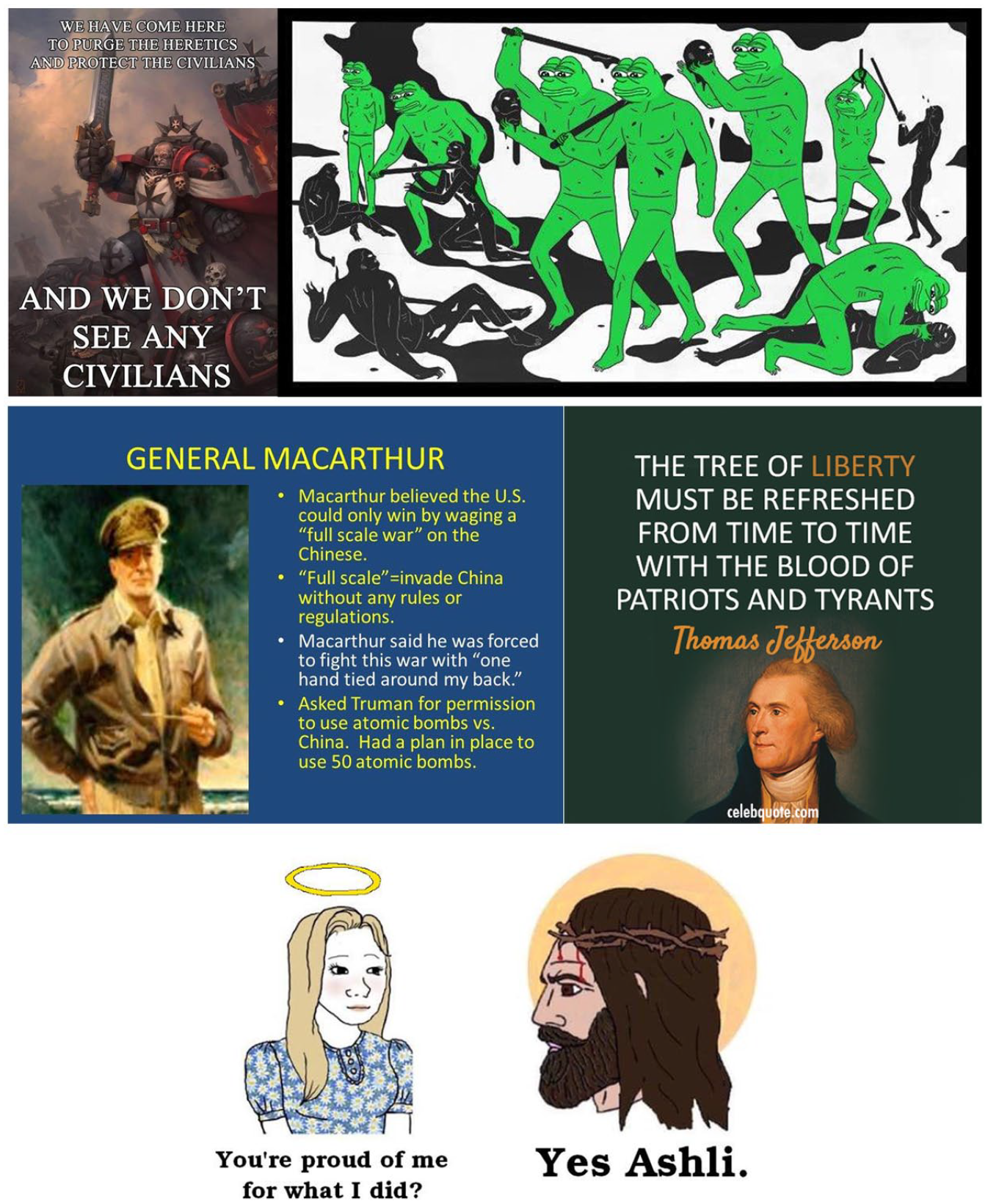
Memes used to mobilize on 4chan.
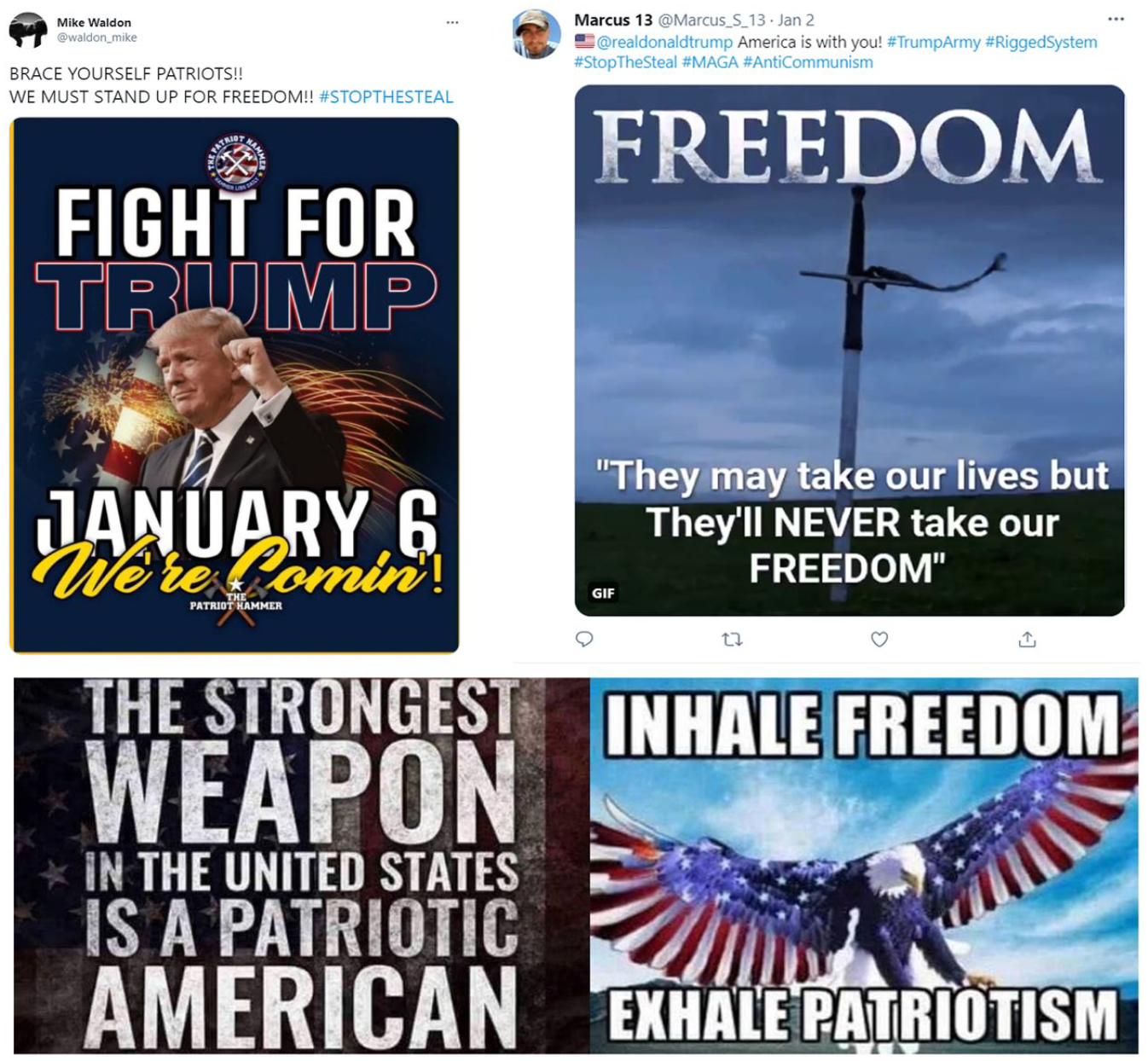
Freedom loving patriots as “us” on Twitter.
Unlike on 4chan/pol, where identity formation memes painted both Democrats and Republicans in coalition with Jews, the memes on Twitter established a dichotomy between Democrats and Republicans in the days leading up to the insurrection (see Figure 4). A popular meme called on patriots to “drain the swamp.” Another likened the Democrats to terrorists and human traffickers because they are against “building the wall.” Despite the patriotic themes of #stopthesteal resembling the civil war themes of #boogaloo, the focus on Democrats rather than the government as a whole as the enemy, suggests an attitude that is more congruent with reform than revolution. Rather, the revolutionary efforts of patriots at Capitol Hill were channeled in an attempt to instill the “right” party (and president) in place rather than overthrowing the government as a whole which seemed to be the sentiment on 4chan/pol. Nevertheless, many threads on 4chan/pol supported the efforts of the insurrection and encouraged others to participate. One major difference between the two platforms was that images and videos of Capitol Hill were used to incite others to join the insurrection by Twitter users, while 4chan/pol users mostly used the images to document what was happening. This is not to say that the two sets of users belong to different groups. Rather, Twitter was simply the platform of choice for mobilizing others to this specific cause via the #stopthesteal hashtag.
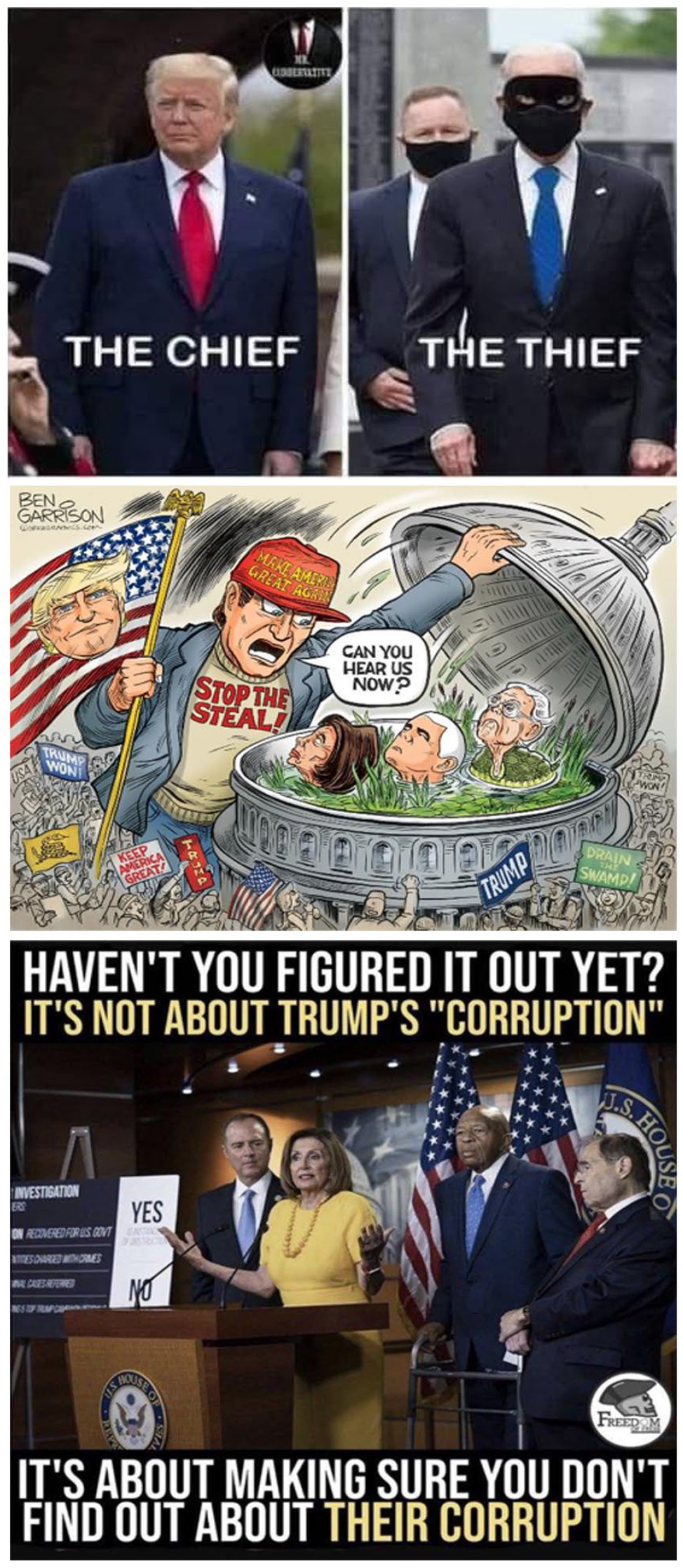
The treasonous Democrats as the other.
Bundling Pepe: meme, medium, and message
4chan/pol users predominantly used the platform to build and maintain identity. One of the ways this was accomplished on 4chan/pol was through using memes to employ a “specific semiotic construction” (Wiggins, 2019: 61). Under this linguistic conceptualization, 4chan/pol users employed memes for the specific purpose to delineate an “us” and a “them” narrative (Phillips, 2016). The most prevalent meme used to identify one as an insider was Pepe the Frog (Figure 5). Pepe the Frog is a children’s book character that has been appropriated and used by groups on the left and right in the past (Pelletier-Gagnon and Perez Trujillo Diniz, 2021). The appropriation of the meme by far-right groups led to it being declared a hate symbol by the Anti-Defamation League (ADL) in 2016. However, the Anti-Defamation League (n.d.) have since then acknowledged that most uses of Pepe the Frog are not bigoted in nature and the interpretation of the meme as a hate symbol is context dependent. Similarly, Pelletier-Gagnon and Perez Trujillo Diniz (2021) find that the meaning of the Pepe meme and how it is used, is in a constant state of renegotiation and repurposing, and is much better understood in relation to the time and place it is used in. In our case, Pepe was used in wide-ranging ways. The most common was to react to the news about the insurrection and pose questions about its meaning and repercussions on US politics. As such, Pepe was used to position some 4chan/pol users as neutral bystanders who were there to “enjoy the show” from the sidelines.
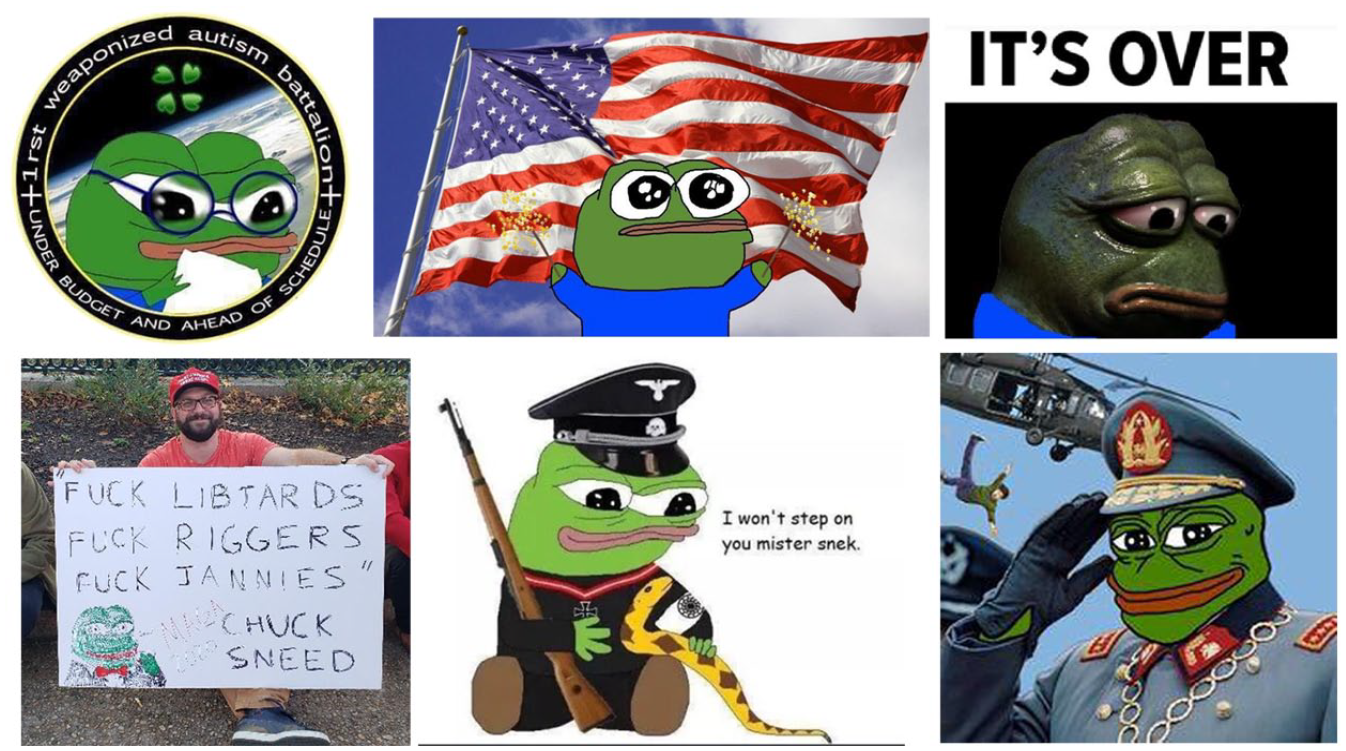
Pepe the Frog as an ingroup on 4chan.
However, Pepe the Frog was also repurposed to depict fascism, anti-Black racism, and to incite violence against people of color. While the Pepe meme remained the most popular symbol of identity before and after the insurrection, posts after the insurrection were also more likely to use memes of Nazi and fascist imagery in conjunction and interchangeably with Pepe. In other words, such memes facilitated a gradual transition into more radical identity that was facilitated by a progression from regular Pepe, to Patriotic Pepe to fascist Pepe and the establishment of 4chan/pol as a Nazi-friendly space (Figures 5 and 6). Memes that were used to incite mobilization on 4chan/pol either depicted direct violence against the “other” or used appeals to authority to urge others to participate in a civil war (Figure 2). Users repurposed themes of crusades to incite violence against anyone who was not White and therefore allegedly “sub-human.” Similarly, the salient identity of Pepe the Frog was used to spark conversations about “race realism”—a White supremacist philosophy—in conjunction with a meme that pictured a violent mob of Pepe’s attacking Black people. Finally, memes were also used to valorize those who took part in the insurrection and were either hurt or killed in action.
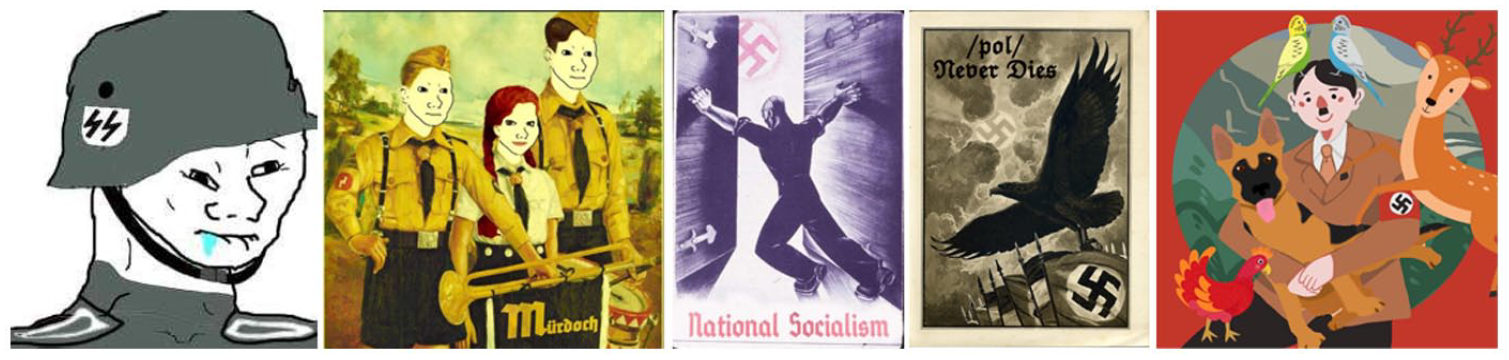
Hitler and the Nazis as an ingroup on 4chan/pol/.
Several memes of Ashli Babbit (shot and killed by Capitol Police during the insurrection), were accompanied by statements such as “say her name” or “are (((they))) going to get away with murdering Ashli Babbit?” Figure 2 depicts a drawing of Jesus validating Ashli’s involvement in the insurrection. Such memes demonstrate that while radicalization occurs via the ubiquitous avatar of Pepe the Frog, those who “go all the way” and commit to the far-right by taking action are acknowledged as an individual rather than just another anonymous user. Memes that valorize individual and collective action for what are deemed as far-right causes are a staple on 4chan/pol (Kasimov, 2021). For example, “Saint Elliot Roger” a racist and misogynist mass murderer said to have inspired the incel rebellion is routinely praised on the platform. Such posts can sometimes have the effect of encouraging further action from other users in hopes that they too will get veneration from “fellow anons” (Miller-Idriss, 2020). The process of this type of radicalization seems to function as follows: (1) Pepe is bundled into memes that acknowledge individual or collective grievances to help an individual identify with Pepe; (2) Pepe is re-bundled with Nazi and fascist imagery so that the individual now identifies or is sympathetic to fascism; and (3) Pepe is replaced by the individual who is reintroduced as a “hero” or a “saint” once they have taken part in a far-right cause.
Redirecting anger and radicalization against a new outgroup
Although Twitter was effective at mobilizing users into a specific cause such as storming the Capitol, it was less effective at keeping these users engaged once the insurrection was deemed a failure. Our sample shows a change in the thematic content of tweets before and after the insurrection suggesting that while the Democrats were viewed as the target outgroup in the days leading up to and during the insurrection, there was a disagreement on who exactly the outgroup was in the days after. While before and during the insurrection, Twitter users identified themselves as freedom loving patriots, for some this identity seemed to shift to apologists for Donald Trump after the insurrection had failed. This shift in sentiment signaled an implicit agreement with the notion that the insurrection was unconstitutional and served the purpose of damage control for the president who was being heavily criticized for encouraging the insurrection. One person tweeted, “the president did not incite the violence at the Capitol, change my mind. But you won’t . . . your opinions mean nothing!” Memes in support of Donald Trump no longer spoke of freedom and the constitution but instead focused on loyalty to the president (see Figure 7).
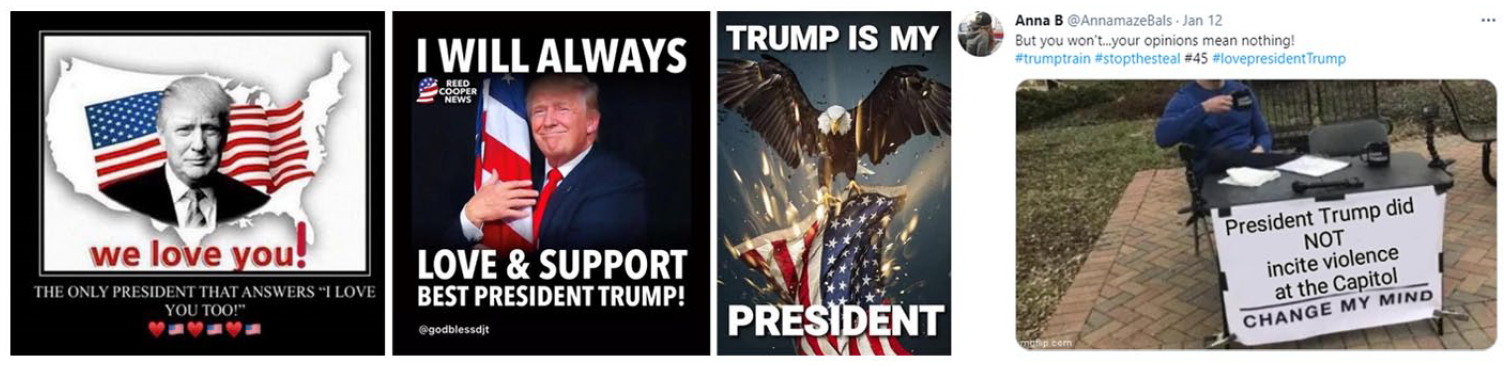
Outpouring of support for Donald Trump after the failed Insurrection.
There was also a shift in who was targeted as the “other” in memes posted after the insurrection. While supporters of Donald Trump maintained their antagonization of the Democrats, a significant number also shifted their focus on Mike Pence and the “traitorous” Republican party as well as the (then) heads of social media companies such as Jack Dorsey of Twitter and Mark Zuckerberg of Facebook (see Figure 8). The former were deemed responsible for the failed attempt of the Capitol Hill protestors to prolong the presidency of Donald Trump and the latter were painted as enemies of free speech for allegedly censoring both Trump and #stopthesteal content from their platforms. Some supporters of Donald Trump distanced themselves from the insurrection via conspiracy theories that the Insurrection was staged to make Republicans look bad. The most common criticism of the Insurrection on Twitter by pro-Trump posters was the conspiracy theory that it was in fact ANTIFA masquerading as Trump supporters who have invaded the capitol (see Figure 9). One user tweeted, “Facebook censored a news clip reporting how Antifa infiltrated the #StopTheSteal rally.” This demonstrates that while Twitter was useful for funneling users toward a single goal such as storming the Capitol, once the insurrection was deemed a failure, participants had a hard time agreeing on who to blame and what to do next.
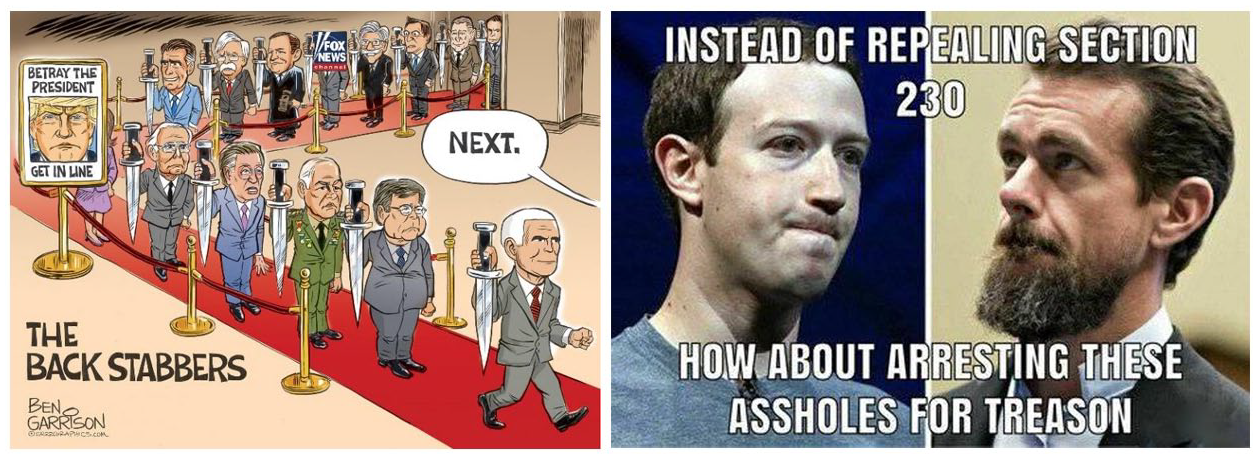
The “other” shifting away from Democrats to traitorous Republicans and tech CEOs.
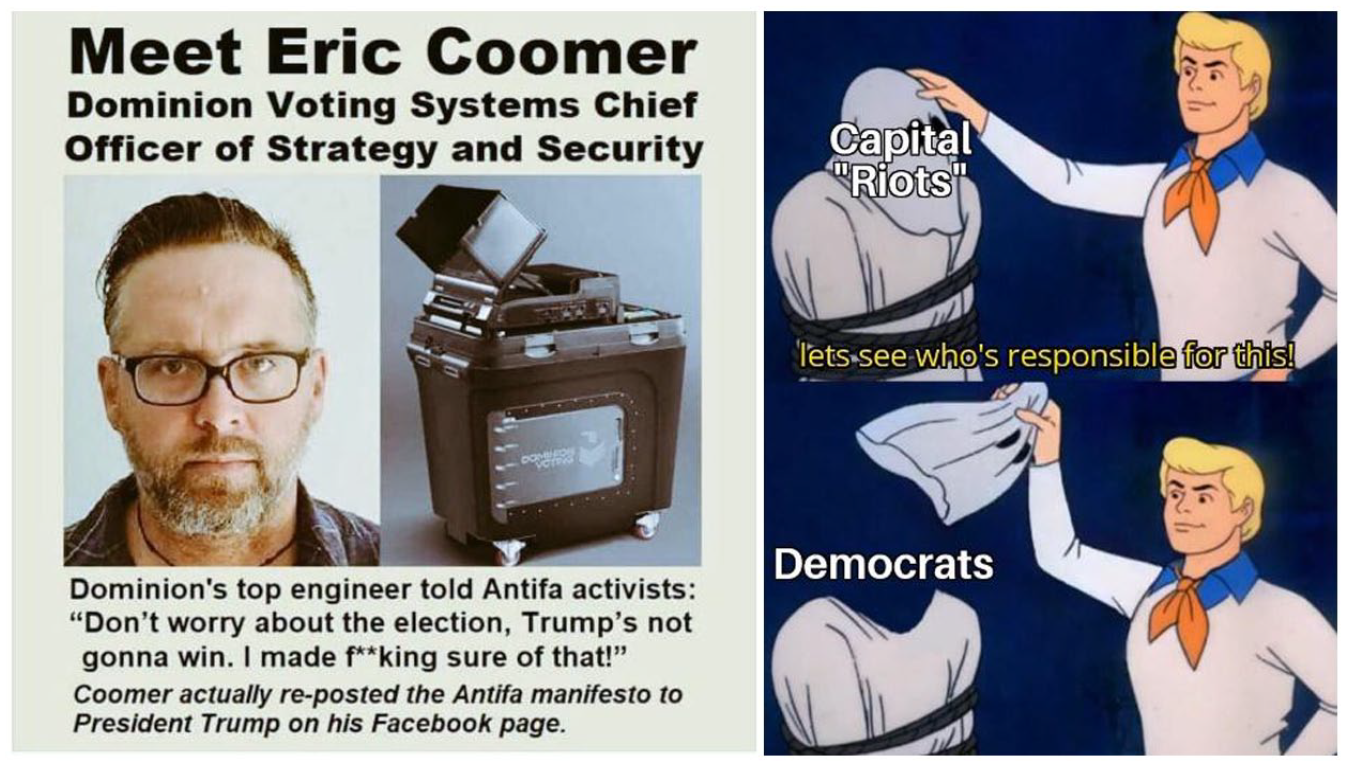
Conspiracy memes about ANTIFA and Democrats.
The lack of a single, agreed-upon scapegoat led to supporters of #stopthesteal to argue among one another while being heavily criticized by their opponents. This illustrates the limitations of Twitter as a platform for mobilization once the fervor of the previous days’ events tapered out.
Unlike Twitter, the insidious capacity of 4chan/pol/ to recruit and radicalize users became apparent in the days after the insurrection. Far-right groups on 4chan/pol/ capitalized on the aftermath of the failed insurrection to channel the anger and disappointment of divided Trump supporters toward a new target through the help of the anti-Semitic angry merchant meme.
In contrast to Pepe the frog, the merchant meme depicting an anti-Semitic caricature of a Jewish merchant (Figure 10) was used to identify the US government (including Donald Trump) as the enemy because of their alleged allegiance to Israel. The greedy merchant meme was used both before and after the insurrection as a way to focus the antagonism of the platform’s users on a single enemy (Jewish people) and their allies (People of Color, the Lesbian, Gay, Bisexual, Transgendered and Questioning [LGBTQ] community, etc.). As such, it was deployed pre-emptively for the purposes of radicalizing Trump supporters should they find themselves in a position of weakness such as the one shortly after the insurrection. These findings demonstrate that despite the lack of ideological uniformity among users on 4chan/pol (Colley and Moore, 2022), the generalized tendency toward White supremacy allows for this meme to be adapted and used ubiquitously on the board.
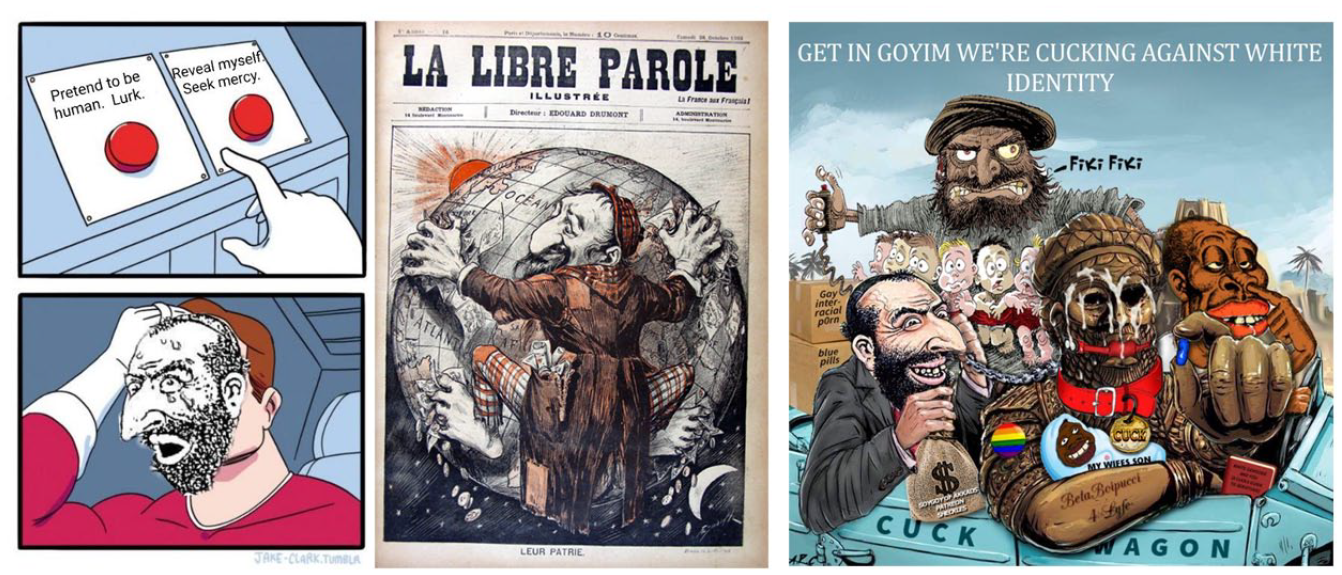
The greedy merchant meme on 4chan.
Memes were used to depict the greedy merchant’s agenda to take over the world and oppress White people and culture (see Figure 10). After the insurrection, the greedy merchant meme was used in conjunction with Donald Trump’s supporter’’ failed bid to overturn the election results (see Figure 11). The insurrection and its supporters were criticized because it was viewed as ultimately detrimental to the far-right cause. Depictions of Donald Trump aligning himself with a Jewish conspiracy to control the United States were commonplace (see Figure 11). Mobilization posts and memes took a more direct approach with one user stating “Americans it’s over. You will never have another Republican president. The last chance is a civil war.” The strategic deployment of greedy merchant memes benefitted from on 4chan/pol’s unregulated structure where racist and hateful speech and imagery are not banned like on Twitter. This affordance allowed 4chan/pol the opportunity to recruit and radicalize disgruntled Trump supporters eager to continue their crusade to make America great again. As one 4chan/pol user stated, All of you wignat fucking morons laughing at “MIGAPEDE” because they are stupid is an enemy. I don’t care if you think its funny, there is nothing to gain from demoralizing Trump supporters. We should be channeling their anger and double down “the ‘revoluti’nary” spirit. Imagine calling yourself an accelerationist while simultaneously trying to cull the flame of MAGA people. Yes they are stupid but they are also the best weapon against a corrupt government.
This statement was accompanied by a meme of a Nazi soldier. Thus, far-right aligned 4chan/pol users took advantage of the Overton Window of the insurrection to spread fascism, anti-Black racism, and anti-Semitism along with targeting people of colour and Muslims.
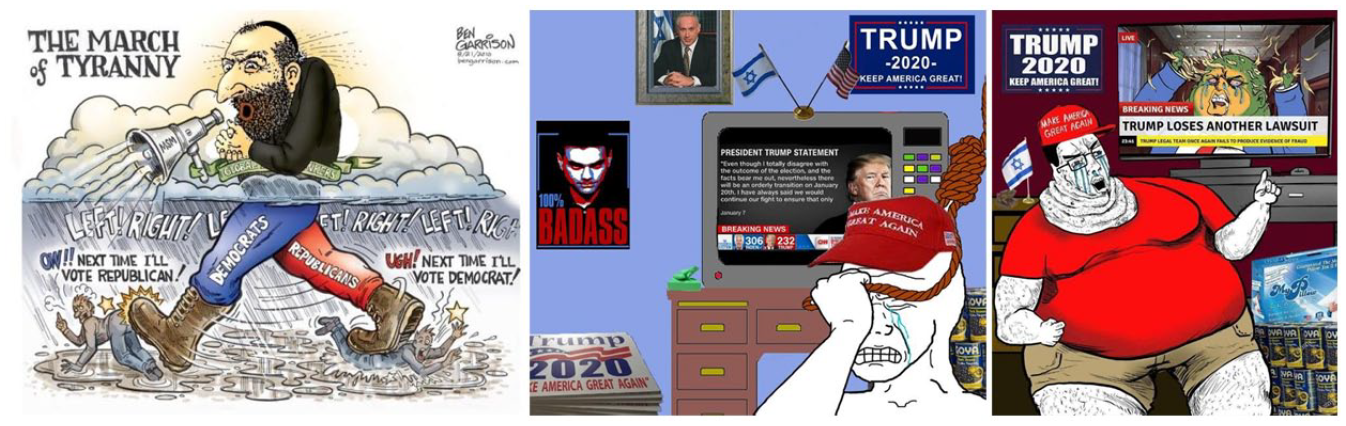
Donald Trump and his supporters as Jewish allies.
Conclusion
While the present study is merely a snapshot of online far-right communication styles, it sheds important light on how differently regulated platforms and offline events influence memetic and discursive practices on the Internet. Our findings build on research that has revealed how platforms such as Twitter are used for the production and dissemination of far-right memes and discourse during large-scale mobilization events (Wiggins, 2021). Unlike past research that has only considered a single platform at a time, we identified important platform-based differences in the use of memes. While Twitter was the preferred platform when it came to mobilization, the scope of this mobilization was narrower than 4chan/pol. Few tweets used the #stopthesteal hashtag in conjunction with memes to recruit or mobilize users for any other causes but to support Donald Trump’s presidency. In contrast, 4chan/pol users capitalized on the insurrection to recruit and mobilize users into far-right causes such as anti-Semitic racism and violence. Memes on 4chan/pol also heavily contributed to the conspiracy-laden identity discourse through the mainstreaming of far-right ideology by bundling it with humor, appeals to authority and pseudo-science that worked to “other” racialized and Jewish people. Our findings also suggest that while platforms like 4chan/pol lack ideological coherence where context is often just as crucial to the interpretation of discourse as the content (Wiggins, 2022), the opportunistic attempts to radicalize users toward a generalized far-right ideology in the wake of a failed coup, mean that /pol/ continues to play a dangerous role long after Twitter becomes ouroboric to the users who depend on it for mobilization.
Our study has demonstrated that Twitter and 4chan/pol serve somewhat different but complementary functions in the overarching far-right online ecosystem. However, the following limitations must be taken into consideration when examining content on 4chan/pol and Twitter. Terminology on 4chan/pol user posts evolves quickly, creating challenges when analyzing intent. Colley and Moore (2022) note the use of sarcasm (often with irony) by users on 4chan/pol, coupled with the transitory nature may create challenges when analyzing the data. The Twitter posts collected via Twitter’s Premium API do not include tweets deleted or suspended by Twitter in accordance with its terms of service (Twitter Developer Platform, n.d.). This also does not include tweets deleted by a user or accounts deleted by Twitter or by its users. This most likely impacted the allocated proportion of categorized tweets in our thematic analysis as Twitter removed far-right content in the aftermath of the events on January 6. This included Twitter deleting then-President Trump’s Twitter account and content that promoted QAnon conspiracy theories (Booker, 2021). We also note that 4plebs data can be removed if a request is made to the site if a post contains copyrighted material or has personally identifiable information (4plebs.org, 2021). On both platforms, we excluded replies from our analysis, focusing on opening posts and user tweets, which could have impacted our classification efforts. Our scope was also limited as our data were split into two broad categories (before and after) that did not separate user posts by day, which may have impacted the degree of change by each classification. Additionally, we focused on one 4chan/pol image board and one Twitter hashtag, which preclude our findings from being generalizable to other image boards or hashtags. Yet, our limitations demonstrate that avenues for future research can be explored, such as applying our findings to other image boards or hashtags, as well as different events or time periods.
Footnotes
Acknowledgements
The authors are grateful for the helpful comments and support of Tina Fetner and Melanie Heath.
Declaration of conflicting interests
The author(s) declared no potential conflicts of interest with respect to the research, authorship, and/or publication of this article.
Funding
The author(s) received no financial support for the research, authorship, and/or publication of this article.
