




Abstract
This article explores how Internet memes can be traced as nodal points for the study of online groups. Such ‘meme tracing’ is specifically pertinent to the study of anonymous imageboards like 4chan, where inquiry cannot be easily based on the individual. Drawing from actor-network theory, I argue ‘panoramic memes’ – memes that repeatedly paint a totalising picture of a collective – are especially useful to identify what narratives hold such anonymous groups together. To operationalise this, I conducted a qualitative-quantitative case study of ‘/ourguy/’: a meme used to suggest a certain public figure is representative of the beliefs of an entire group. Using text mining methods, I traced this term to the names of public figures on 4chan’s far-right /pol/ board. This reveals that Donald Trump and Robert Mueller were most commonly proposed as an ‘/ourguy/’ between 2016 and 2020, while the meme was entangled with conspiracy creation and far-right mobilisation.
Keywords
Introduction
In recent years, Internet memes have increasingly been characterised as central to political debate and cultural conflict (Shifman, 2013; Milner, 2016; Mina, 2019; Wiggins, 2018; Woods and Hahner 2019). Initially praised as encouraging democratic participation and progressive dissent (Milner, 2016; Shifman, 2013), after an alleged ‘toxic turn’ in grassroots Web culture (Proctor and Kies, 2018), it became increasingly clear how the affective rhetoric of memes could also be used to spread bigotry and create new avenues for radicalisation (Woods and Hahner, 2019). While this ‘toxic turn’ is disputed, 1 how seemingly innocuous memes became closely entwined with political action was dramatically emphasised by far-right terrorists who eagerly referenced online in-jokes, with the 2019 Christchurch massacre’s meme-laden livestream as the absolute low point (Beran, 2019). Consequently, it remains a matter of concern what role memes and their surrounding vernacular creativity (Burgess, 2006) play in processes of ideological crystallisation and radicalisation.
In this text, I engage with this concern by exploring the collectivising role of memes on 4chan/pol/, a forum infamous as a cultural breeding ground for far-right hate and violent extremism (Beran, 2019; Hankes and Amend, 2018). On 4chan and other anonymous imageboards, instead of a profile-based ‘networked individuality’ (Adolf and Deicke, 2014), a shared affinity with cultural objects like memes is said to be central to its users’ collectivity (Phillips, 2015). Together with its role in assuring memes became the ‘nodal points’ in far-right ecosystems over the past years (Woods and Hahner, 2019: 3), 4chan/pol/ forms a relevant case to scrutinise how memes are entangled with group-making efforts and political mobilisation.
In this text, I engage with this entanglement foremost out of methodological concern. In what is increasingly called ‘meme studies’, usually the focus is on the semiotic or rhetorical analysis of specific memes or on the theoretical ramifications of memetic circulation more broadly (see, for example, Arkenbout et al., 2021; Woods and Hahner, 2019). Quantitative approaches to meme studies are mostly reserved for the field of computer science (e.g. Leskovec et al., 2009; Zannettou et al., 2018), which are often sparser with cultural and theoretical insights. Both have obvious strengths, but here I propose a qualitative-quantitative middle ground by taking up the call for a ‘meme tracing’ that draws from actor-network theory and digital methods (Boullier, 2018; Rogers, 2013). I argue that, instead of stopping at specific instances of memes, taking them as nodal points with which to trace further associations can be a salient approach to map the ebbs and flows of online groups – especially when leading to ‘panoramic’ metalanguage that reflexively addresses the collective itself. For radical environments like /pol/, such tracing may also untangle how memes are bound up with the development of political sensibilities and processes of mobilisation. I argue this approach is especially pertinent to the study of anonymous imageboards, where memes take centre stage and inquiry cannot easily be based on individuals or profiles. That said, I hope this text is relevant to the study of various vernacular cultures across the Web.
In the opening section, I introduce 4chan and outline why (political) memes tend to thrive on imageboards. Thereafter, I draw from actor-network theory (Latour, 2005) to argue how memes compose conveniently traceable objects that allow to pinpoint insightful metalanguage. However, since not all memes will lead to equally relevant associations, I then conceptualise the category of ‘panoramic memes’: memes that present or evoke totalising views on a collective and, in doing so, may lead to important narratives on their imagined essence. Importantly, their totalising portrayals are often provocative, meaning panoramic memes repeatedly elicit controversies on group boundaries. When reflexively concerning the collectives wherein they circulate, they will moreover lead to insightful moments of self-referentiality. To operationalise this approach and test its value, I then conduct a case study on ‘/ourguy/’, a panoramic meme used on 4chan/pol/ to associate a public figure with the core beliefs of the space as a whole. Using text mining methods, I map the names put forward as an /ourguy/ over 4 years. Finding among others that Donald Trump and Robert Mueller were the most associated /ourguys/, I demonstrate how this reflexive object is used to (re)negotiate the boundaries of this far-right collective.
4chan, memes and meta-awareness
In the past years, an environment that drew attention for its mix of memes and political extremism was 4chan. Created in 2003 as a forum for anime images (Beran, 2019), the imageboard came to be known for its chaotic /b/ ‘Random’ board, which among others birthed LOLcats (Miltner, 2014), trolling subcultures (Phillips, 2015) and the Anonymous movement (Coleman, 2014). From 2014 onwards, the /pol/ ‘Politically Incorrect’ board increasingly became synonymous with 4chan as a whole (Hagen and Tuters, 2021). /pol/ was initially created in 2011 as a ‘containment board’ to prevent neo-Nazi activity from spilling into other subforums. Alongside the /v/ ‘Video Games’ board, in 2014 it became infamous for stirring up anti-liberal, anti-feminist resentment surrounding the Gamergate controversy (Beran, 2019). Thereafter /pol/ made headlines for its pro-Trump activity (Hagen, 2020; Beran, 2017), racist trolling campaigns (Tuters and Hagen, 2020) and being the cradle of various conspiracy theories, most notably QAnon (De Zeeuw et al., 2020). By 2021, /pol/ is more active than ever, 2 spouting COVID-disinformation and welcoming white supremacy in the face of global anti-racism protests.
Whether it concerns /b/ or /pol/, 4chan has historically been (in)famous for its Internet memes, many of which were widely adopted across the Web. To understand why this is the case, here I briefly outline its communicative norms and affordances. As discussed by various scholars (Beyer, 2014; Coleman, 2014; De Zeeuw and Tuters, 2020; Phillips, 2015; Woods and Hahner, 2019) and summarised by David Auerbach (2011), imageboards stimulate ‘meta-aware’ activity surrounding cultural objects like memes. This largely grows from anonymity; imageboards do not require an account to post. To 4chan’s creator Christopher ‘moot’ Poole, this was supposed to enable ‘people to be equal and to say things that they might not otherwise be comfortable sharing’ (2015). In the case of 4chan, it also fosters a culture of vitriol and ‘racist one-upmanship’ (Phillips, 2015: 96). Beyond this, 4chan’s anonymity encourages ironic and playful forms of communication by veiling intent and diminishing personal repercussions. As a result, familiarity with 4chan’s culture is paramount to navigate its dissimulative discourse. Since imageboards often lack useful sorting mechanisms or popularity metrics, this awareness must simply be attained through endless ‘lurking’. Moreover, in the absence of persistent markers of status featured on platforms like Twitter or Reddit (be they followers, likes, or karma) ingroup belonging must constantly be signalled through ‘correct’ use of subcultural vernacular – or better yet, by innovating with it. However, doing so is further complicated by ephemerality: traditional imageboard software deletes old posts as new ones appear. Apart from limiting server space, Poole cherished ephemerality for stimulating the creation of memorable objects that could ‘swim upstream from the waterfall of content, like salmon’ (2015). Keeping up with this transient stream further encourages active participation, meaning the few anonymous users (‘anons’) with the willingness and time to commit are likely to become ‘meta-aware’ of imageboard culture (Auerbach, 2011). For instance, anons of the /mu/ ‘Music’ board know exactly what mainstream tastes should be scorned, while /pol/-anons are often intimately familiar with the latest conspiracy theories.
Important to this article is how this meta-awareness is entangled with the production and circulation of cultural objects – the ‘salmon’ swimming upstream. This relation is addressed in work on ‘metacultures’, which arise when a ‘culture addresses its own generality and conditions of existence’ (Mulhern, 2000: xiv). As Laurie Gries notes, metacultural sensibilities can erupt when cultural objects catapult ‘back into flow in divergent directions and generate even more configurations, which themselves often spur more circulation, transformation, and consequentiality’ (2015: 19). A metaculture can in this sense be understood as any collective that actively partakes in a ‘network of creative consequences’ spawned by circulating objects – from images and videos to phrases and ideas (Gries, 2015). On 4chan such metacultural sensibilities are closely entangled with intimate knowledge of memes, as acquaintance with previous iterations is required to understand the ‘coded cultural information essential for proper interpretation’ (Gal, 2018: 528). While Internet memes are often known for their remixability and diffusion across the Web (Shifman, 2013), 4chan anons often attempt to guard ‘their’ memes from becoming tainted by improper use by outsiders (Douglas, 2014; Miltner, 2014). Correspondingly, memes have been described as the cornerstone of 4chan’s collectives, functioning as their ‘lingua franca’ (Milner, 2016) and ‘locus of memory’ (Coleman and Brunton, 2010).
The understanding of memes as co-shaped by material affordances and ‘synecdochical’ to specific vernacular cultures (Phillips, 2012) strays from its biological-evolutionary roots. As is now well-known, Richard Dawkins originally modelled the meme after gene-like unts that ‘propagate themselves in the meme pool by leaping from brain to brain’ (1976: 192), a view that in the 1990s metastasized into the field of memetics (Sampson, 2012). However, following an emic online uptake of the meme-concept in the 2000s, the ‘memeticist’ outlook was criticised by scholars for downplaying both the agency of the human and the medium (Sampson, 2012; Shifman, 2013; De Seta, 2016). New media literature has subsequently repositioned memes as materially co-shaped and entangled with human creativity (e.g. Milner, 2016; Mina, 2019; Phillips, 2012; Shifman, 2013; Wiggins, 2018). In Shifman’s popular definition, Internet memes can be understood as ‘a group of digital items sharing common characteristics […] created with awareness of each other, and […] circulated, imitated, and/or transformed via the Internet by many users’ (2013: 41). With this definition, ‘many users’ is broad enough to account for how memes can be widely remixed across online infrastructures as well as how they can be specific to vernacular cultures. The coming-together of the two is arguably why relatively small groups on imageboards managed to repeatedly influence global culture and politics in the 21st century. In the case of /pol/, after ‘surviving’ 4chan’s ephemeral waterfall to become ingroup slang, many of its racially laden memes also propelled across the Web. Perhaps most infamous is the 2016 story of Pepe the Frog, the meme that was Nazified by /pol/-anons, tweeted out by Donald Trump and addressed on Hillary Clinton’s campaign website (Woods and Hahner, 2019: 13).
Actor-network theory and meme-tracing
Despite the relevance of this outward diffusion, in this text, I focus on the collectivising role of memes within radical spaces like /pol/. If memes are indeed central to the metacultural manner in which 4chan anons ‘address [their] own generality and conditions of existence’ (Mulhern, 2000: xiv), it would follow that studying their memes also means studying their collective identity. Below I try to operationalise this claim in dialogue with Bruno Latour’s (2005) formulation of actor-network theory. Like Gries’ (2015) new materialist approach, actor-network theory helps in conceptualising how non-human objects like memes can ‘act’ as collectivising agents. Moreover, its methodological implications offer a useful armature to think of how we can ‘trace’ memes without resorting to Dawkins’ biologically deterministic framework. Actor-network theory is inspired by Gabriel Tarde (1903), who (in contrast to the macrosociology of his contemporaries) advocated for tracing minute ‘imitations’ to get a sense of social life. Revitalising Tarde’s thought, Latour (2005) outlines a sociology that does not work with the ‘social’ or ‘society’ as sui generis entities but rather concerns the tracing of associations that together comprise ‘actor-networks’. Importantly, because these actors can be both human and non-human, actor-network theory emphasises that objects and ideas also have agency – how they arise from and evoke human action is exactly what comprises a collective. This outlook has been useful to outline how digital media environments co-shape online groups (see, for example, Massanari, 2017) and informed non-anthropocentric fields that consider non-human objects as ‘vivid’ entities, including the aforementioned new materialism (see, for example, Gries, 2015) and object-oriented ontology (Harman, 2018).
As follows from the first section, when studying 4chan’s collectives, a focus on memes can make a priori sense considering their function as a ‘locus of memory’ (Coleman, 2010). However, picking specific entities over others as the analytical focus is discouraged by Latour, who instead posits that ‘sociologists should travel wherever new heterogeneous associations are made’ (2005: 8). Such radical empiricism might make sense theoretically but is often difficult to operationalise. As Noortje Marres observes, actor-network theory’s dictum of ‘following actors wherever they lead’ might be viable for qualitative fieldwork, but with an expanse of digital data, ‘the demarcation of relevant and irrelevant entities becomes necessary again. […] a minimal, empiricist principle like “follow the actors” won’t do’ (2017: 93). I argue that considering memes as these ‘relevant entities’ is promising for multiple reasons. Operating on the level of affect (Jenkins, 2014), memes can ‘propagate affective desires that induce unconscious collective identifications and unconscious imitative feelings, thoughts, and behaviors’ (Gries, 2015: 115). As such, tracing memes can lay bare what beliefs and desires tend to find a foothold within different online groups and media environments. For instance, Miltner (2014) takes LOLCats as an analytical starting point to expose clashing cultural norms between online groups. Several studies render legible such cultural dynamics through the frame of semiotics or discourse analysis (e.g. Cannizzaro, 2016; Milner, 2016), while others have drawn from Pierre Bourdieu’s work on cultural production (1984) to explain how memes are entangled with group-making efforts, as Nissenbaum and Shifman (2017) demonstrate in the case of 4chan/b/.
Such studies have obvious value but leave untapped the potential for a much more distributed, networked and mobile approach. From a neo-Tardean angle, the academic potential of memes lies not necessarily in reading specific instances as cultural texts or rhetorical devices, but in how they may collectively be repurposed as nodal points with which to ‘navigate’ imitations and associations present in a dataset (Latour et al., 2012). Such navigation has become possible because Internet memes are highly traceable. In contrast to memetics’ universalist theory whereby ‘the meme is missing’ (Sampson, 2012: 70), the introduction of Internet memes has meant a shift from ‘a rather ambiguous metaphor into a concrete textual genre’ (Gal, 2018: 528). Being materialised and constantly replicated, memes may now be concretely delineated as digital objects with a similar syntax or visual features. Instead of analysing these conveniently traceable objects in isolation, this distributed approach allows for reintroducing some of Latour’s agnosticism: perhaps more interesting are not the memes themselves, but the other actors they lead to. Dominique Boullier even argues such ‘meme tracing’ should form ‘the next step for actor network theory-style digital methods’ (2018: 1). Instead of relying on web topologies through software like Gephi (which he criticises for reintroducing the effect of a ‘whole’ to the macro-eschewing actor-network theory) Boullier sees a focus on memes as a better fit because they can be repurposed as ‘drosophila’ to ‘help decode the elementary processes of replications’ (2018: 8–11). Similarly, Matthew Fuller notes how the monitorability of memes can help identifying events across media ecologies while employing ‘the individual operator in culture as a nodal point, not a totality’ (2005: 111–116). While these methodological promises stem from the humanities, so far they have mostly been taken up in quantitative computer science-based work. For instance, Leskovec et al.’s (2009) ‘meme tracker’ traced repeated subphrases to map their diffusion and temporal flow. More recently, Zannettou et al. (2018) followed the propagation of visual memes to study the role of different platforms in their diffusion, finding that 4chan/pol/ was particularly successful in disseminating racist and political ones. Although far removed from media studies and theoretically sparser, these papers testify to how memes may be repurposed to make medium-specific findings without relying on a Dawkinsian outlook.
Panoramic memes
Thus far, I have outlined why memes are pivotal to 4chan’s meta-aware collectives and how an actor-network theory approach may repurpose them as useful nodal points. However, because not all memes will lead to equally salient associations, in this section, I conceptualise a genre of ‘panoramic’ memes that are prone to elicit insightful boundary work. Actor-network theory is marked by a ‘flat’ ontology, meaning it eschews both totalising abstractions like ‘society’ and strong distinctions between micro- and macro-perspectives. Even so, Latour recognises it often seems like a ‘shadow of a huge social pyramid looms over our head’ (2005: 183). To ‘localise’ or ‘flatten’ macro-concepts and grand narratives, he introduces the concept of the ‘panorama’, referring to actors that present a vague, totalising view on a collective. Whether in the shape of statements, narratives, or visuals, panoramas present an illusion of coherence and complete control over a larger whole. Hence, Latour names them after the 360-degree drawings that encircle the viewer with an impressive yet static landscape (see also Benjamin, 2002). For Latour, panoramas are not to be equated with what they depict. Rather, they are ‘a preview of the collective with which they should not be confused’, from when a ‘book retells the origins of the world from the Big Bang to President Bush’ to when ‘some famous scientist summarizes for the benefit of the public “the present state of science”’ (2005: 187–189). Despite this artificiality, however, Latour acknowledges panoramas are relevant actors because they offer metaphors for ‘what “binds us together,” what passions we are supposed to share, [and] the master narratives with which we are disciplined’ (2005: 189).
How reflexive narratives and concepts play a key role in how we ‘create groups with words’ (Bourdieu, 1990: 139) has long been observed in, for example, studies of performativity (Butler, 1997) and ethnomethodology (Garfinkel, 1967). Using a notion like the panorama moreover does not require to retain the methodologically ‘flat’ starting point of actor-network theory. Alberto Toscano and Jeff Kinkle even claim Latour presents a false dilemma because ‘the theoretical desire for totality […] is not incompatible with a painstaking attention to traces, objects and devices’ (2015: 48). Instead, they argue a dialectical account can ‘present both the totality and its constituent devices, as well as the attendant gaps and dislocations’ (Toscano and Kinkle, 2015: 55). In the desire to maintain this theoretical whole, they cite Jonathan Crary’s remark that ‘the panorama image is consumable only as fragments, as parts that must be cognitively reassembled into an imagined whole’ (2002: 21–22). Consequently, they argue ‘reassembling’ such fragments warrants retaining totalising notions like ‘capitalism’ without pathologizing them as just another construct.
Whether retaining or eschewing such theoretical totalities, I argue the idea of the panorama is highly useful in conjunction with the concept of the meme. Panoramic memes can be thought of as replicated digital objects that articulate or evoke totalising views on a collective. By virtue of being repeated and traceable, panoramic memes allow for pinpointing ‘fragments of totalisation’ (Latour, 2012: 93), each potentially leading to different narratives or imaginaries. This means we are not ‘stuck’ with singular panoramic claims but rather are able to navigate between different generalising perspectives. Some panoramic memes will lead to nowhere, their brevity preventing further tracing. Others are more insightful and may lead to ‘a prophetic preview of the collective’ (Latour, 2005: 189–190). They may comment on external collectives, or, when articulating self-commentary, offer salient insights into how actors perceive the ‘whole’ in which they reside.
In practice, panoramic memes can be similar to the ‘panoramic statements’ Latour outlines in Paris: Ville Invisible, like ‘Paris has become unbearable’, ‘Paris wants to breathe’ or ‘Paris welcomes you’ (2012: 92–93). Just like how these ‘totalise Paris’ (Latour, 2012: 93), metacultural online groups often totalise their own platforms through panoramic memes. For instance, the statement ‘we did it Reddit!’ is often used as an ironic exaggeration by redditors after the resolution of an event, attributing the outcome to ‘Reddit’ as a whole – and in doing so, depicting a generalised ‘we’. Similarly, the 2021 GameStop investment craze on the subreddit r/wallstreetbets was closely tied to panoramic statements like ‘apes do not sell’, which portrayed the subreddit’s investors as steadfast and uniformly mindless. Similarly, Tumblr’s networked collectives are often generalised through catchphrases like ‘we stan’, with ‘stanning’ referring to the idolisation of a public figure; again presenting a unified ‘we’ that collectively rallies behind a single person (e.g. ‘We stan Taylor Swift’). Even more so than on the largely pseudonymous Reddit and Tumblr, panoramic memes are commonplace within the ephemeral and anonymous environment of imageboards: in the absence of both infrastructural memory and friend- or follower networks, they offer material anchor points with which to ‘habitually’ depict a collective as a generalised whole (Chun, 2017: 6). For instance, the Anonymous movement rallied behind the panoramic (and ironic) credo ‘We are Legion. We do not forgive. We do not forget. Expect us’ (Coleman, 2014). In other work, we saw how 4chan’s history is commonly compressed in panoramic ‘timelines of 4chan’, presenting distinct ‘ages’ like the ‘/b/ Dynasty’ and the ‘/pol/ Reich’ (Hagen and Tuters, 2021). We also observed how /pol/-anons deployed the anti-Semitic triple parentheses meme – used to encapsulate Jewish names with three parentheses – to panoramically depict a nebulous ‘(((them)))’: an ever-present enemy to rally against (Tuters and Hagen, 2020). Especially in the transient current of 4chan, such habitual generalisations of both in- and out-groups offer a welcome sense of stability.
Panoramic statements can be insightful by themselves, but when studying the boundary work of online groups, even more important is how their infallibility evokes debate. As Latour notes, the panorama’s ‘full coherence is their forte – and their main frailty’ (2005: 187). This frailty refers to how their totalising depictions can easily be disputed, in turn leading to ‘controversies’, or ‘situations where actors disagree’ (Venturini, 2009: 261). For instance, a statement like ‘We did it Reddit’ may provoke contestation on who actually was involved in the event. Through trying to resolve this disagreement, controversies evoke important debate on group boundaries (Gieryn, 1983). As Venturini describes, during controversies collectives enter a ‘magmatic’ state, their uncertainty akin to a fluid seeking to solidify (2009: 264). What makes tracing panoramic memes so pertinent is how, instead of being entangled with brief event-bound controversies, panoramic memes repeatedly elicit debate on a collective. For instance, we saw how ‘(((they)))’ was used in a remarkably consistent fashion, evoking constant speculation on who ‘they’ – the outgroup – actually were (Tuters and Hagen, 2020). As such, panoramic memes are relevant entities to trace not only because they form fragments of totalisation but also because they can act as ‘drosophila’ to pinpoint continuous ‘magmatic’ debate on how actors see the world and themselves.
Case study
These methodological promises would only remain hypothetical without putting them to the test. In this section, I therefore try to operationalise the above by tracing a panoramic meme called ‘/ourguy/’ on 4chan/pol/. Following work on (((them))) (Tuters and Hagen, 2021), /ourguy/ designates the opposite: an ‘us’. The term is used in correspondence with a public figure to assert or question whether they align with the shared values of the entire group. In the case of an assertion (e.g. ‘Trump is /ourguy/’), the meme is panoramic because it paints a totalising and myopic picture of a united in-group whose ideology can be distilled to that of a single public figure. Other times, /ourguy/-posts are less totalising, raising a question (‘Was Stalin /ourguy/?’) and elaborately listing the public figure’s traits to ponder on this (see Figure 1). Nonetheless, every appearance is at least somewhat panoramic since the ‘us’ is imagined as homogeneous, each instance forming a totalising fragment of /pol/’s supposed unity. As the responses in Figure 1 attest to, /ourguy/ commonly evokes disagreement on /pol/’s shared values, bringing the group’s boundaries to the centre of attention. Suffice to say, on the far-right /pol/, /ourguy/-candidates are usually nominated because they represent racist, anti-Semitic, misogynist, xenophobic, or generally bigoted views.
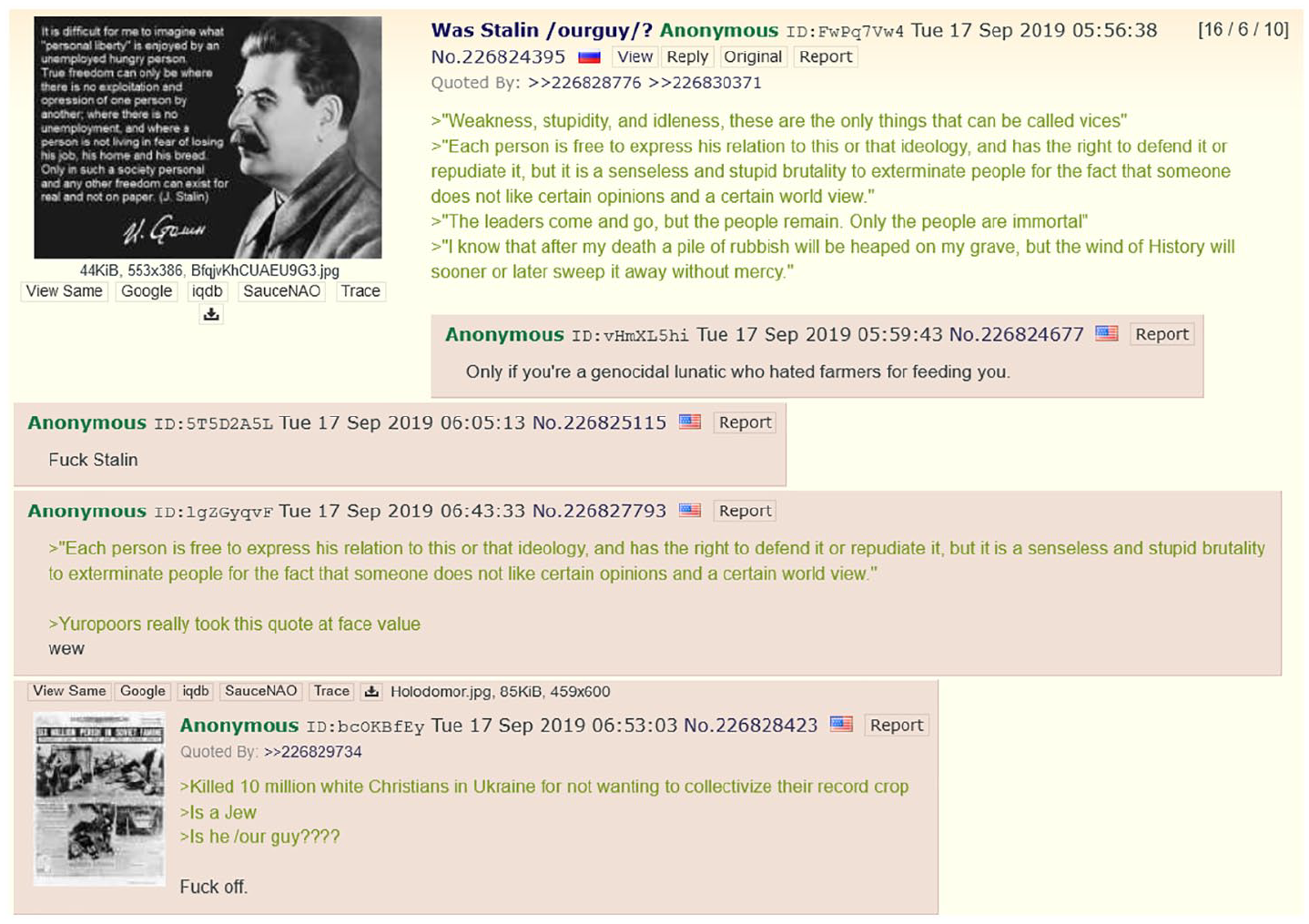
An opening post presenting Joseph Stalin as /ourguy/, with disagreeing replies. Screenshot taken from 4plebs.org on 21 June 2021.
What makes /ourguy/ a relevant case study is how it is a quintessentially networked actor that easily lets us ‘attribute some agency to cultural items such as memes’ (Boullier, 2018: 25). In its most networked state, /ourguy/ simultaneously (1) connects an individual user’s value judgement to a public figure, (2) articulates that individual’s idea on what the larger collective’s core beliefs are and (3) invokes reflexive comments by other users, potentially spiralling into a full-fledged debate on /pol/’s perceived identity. Returning to Gries, here we clearly see how the ‘contagious’ appeal of /ourguy/ lies in propagating ‘affective desires that induce unconscious collective identifications’ (2015: 115). Having made clear how /ourguy/ may act, the goal of the case study below is to trace how it did act. How can we repurpose and trace this meme? Who were /ourguy/’s ‘allies’? What panoramas and magmatic discussion did it lead to? Responding to Phillips et al. (2017), can tracing /ourguy/ help to empirically map the ever-shifting current of anonymous online groups?
Data and method
I quickly encountered the practical difficulties Marres (2017) warns of: with a deluge of data, what associations should be traced, and where do I start and stop with ‘following the actors’? Ultimately, I chose to follow /ourguy/ to names of public figures. These associations were methodologically viable and straightforward, yet likely to pinpoint salient shifts and controversies. To do so, I used 4CAT (Peeters and Hagen, 2021), a tool containing an archive of /pol/ since 2014, to gather posts where /ourguy/ appeared in either the post’s body or the subject title (until 25 May 2020, the time of research). 3 The collected posts contained a lot of spam and repeated text. While inherent to a loosely moderated space like 4chan, this resulted in an overrepresentation of copy-pasted names from posts that did not receive any engagement, so I filtered out most of these. 4 After this, I had to make sure I could follow the /ourguy/-name traces across posts. For instance, a post asking ‘What does /pol/ think of Elon Musk?’ and receiving the reply ‘He is definitely /ourguy/’ should constitute an association between ‘/ourguy/’ and ‘Elon Musk’. Doing so for all posts was overly complicated. Therefore, I took the 735 texts that appeared in the same form twice or more and manually labelled whether they were indirect /ourguy/-referrals (e.g. ‘he is /ourguy/’). With these indirect referrals, I identified which ones replied to other posts 5 and also collected these, adding an extra 4,816. After removing spam from this set as well, the final dataset comprised 92,480 posts and comments (Figure 2). 6

A schematic representation of the case study protocol.
I then used text mining methods to extract the names of public figures. A big limitation here is that I only considered textual associations; traces between /ourguy/ and images were not followed. To extract the names, I first pre-processed the subject and body texts of all collected posts. 7 I then extracted names related to /ourguy/ in two ways. First, I retrieved words near /ourguy/ (co-words), specifically those appearing six positions before or after the term. While this ‘window size’ of six was effective in identifying names in direct proximity, it left names outside of it untraced. As such, I also used entity recognition to extract names within the full post bodies and subject titles, including the referred-to posts. I specifically used SpaCy’s en_core_web_lg model and its entity recognition feature to extract words it labelled as a ‘PERSON’. 8 With both methods, the resulting words contained many false positives (like general terms and non-names). To alleviate this, I removed all words that were not known names. 9 Afterwards, I counted the identified names per post (e.g. four entries of ‘trump’ in one post would only count as one). Finally, I chose to separate names per word; a PERSON-entity correctly recognised as ‘Donald Trump’ would thus be converted and split into ‘donald’ and ‘trump’. This was done to merge names, so, for example, posts mentioning ‘trump’ and ‘donald trump’ would add up. This introduced some issues on polysemy (‘trump’ could also refer to ‘trump jr’.) but was ultimately deemed a necessary evil – manually verifying the precise referrals was too time-consuming and I was concerned with general patterns anyway.
With the spam-filtered dataset, I first made an area graph of the /ourguy/-posts per day to see trends over time (Figure 3). To map the ‘bursts and cascades’ (Kleinberg, 2003) of the /ourguy/-name traces, I then used RankFlow (Rieder, 2015) to visualise the most prevalent /ourguy/-traces per month (Figure 4). Ironically, these visualisations presented panoramic views themselves. While conflicting with actor-network theory’s methodological principles, I contend with Marres (2017) and Boullier (2018) that quantitative approaches necessarily bring along reduction, whether it be in the form of aggregation or a focus on specific entities. Moreover, following Latour et al. (2012), I use the graphs below not as macroscopic views of the ‘whole’ but rather as navigational instruments. Specifically, I used them to focus on the two most consistent names (trump, mueller) and five notable cascades (macron, kanye, little, bernie, yang). I queried and close-read posts containing /ourguy/ and these names on 4plebs.com , a 4chan archive that mimics its interface. For trump and mueller, I took a random sample of 500 posts. For the others, I read every post in the months where they spiked. This exercise allowed to pinpoint why these names appeared as ‘/ourguys/’ in the first place but also allowed ‘following the meme’ to unfolding debates on /pol/’s collective identity. The scope of this text prevented me from doing so at length, but below I detail several posts I found archetypical of different forms of collectivisation and self-imagination.
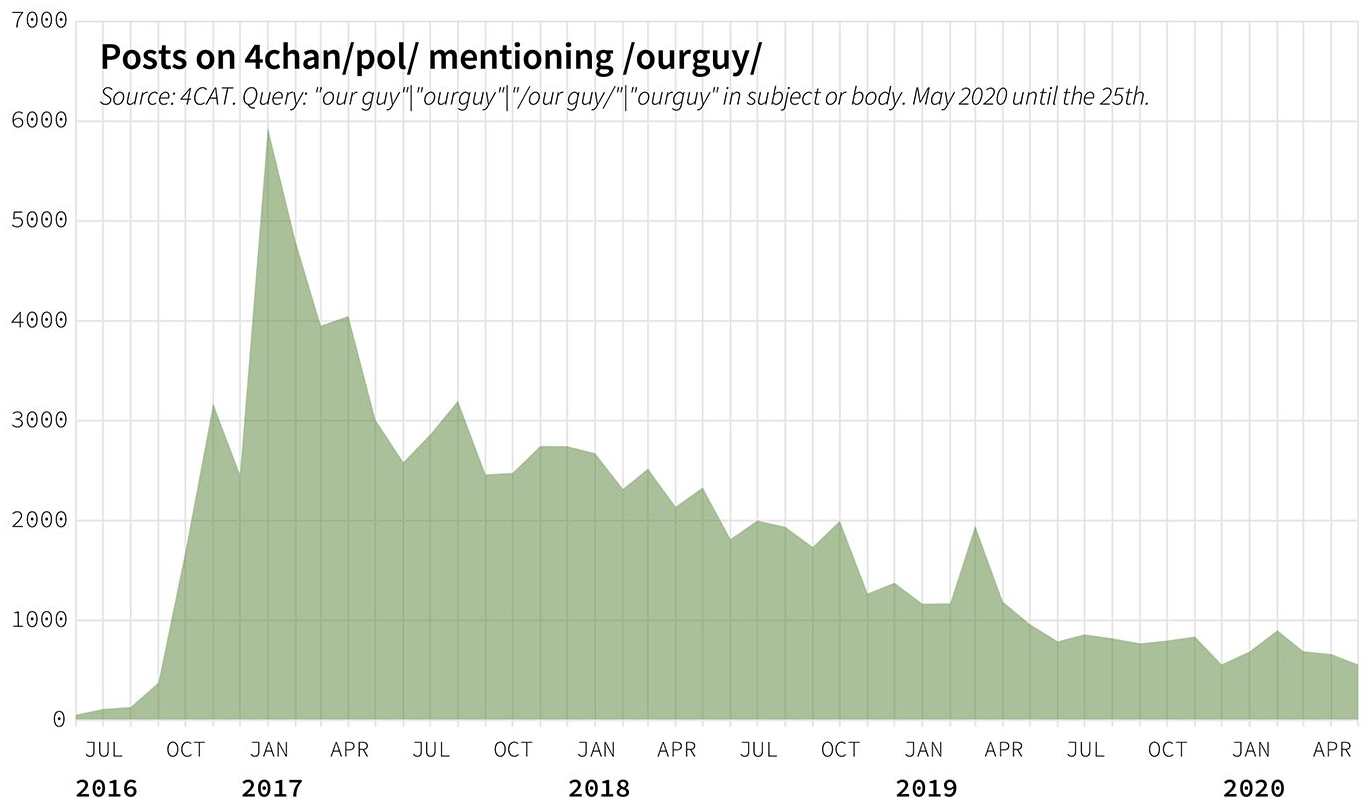
Amount of posts per month on 4chan/pol/ mentioning /ourguy/.
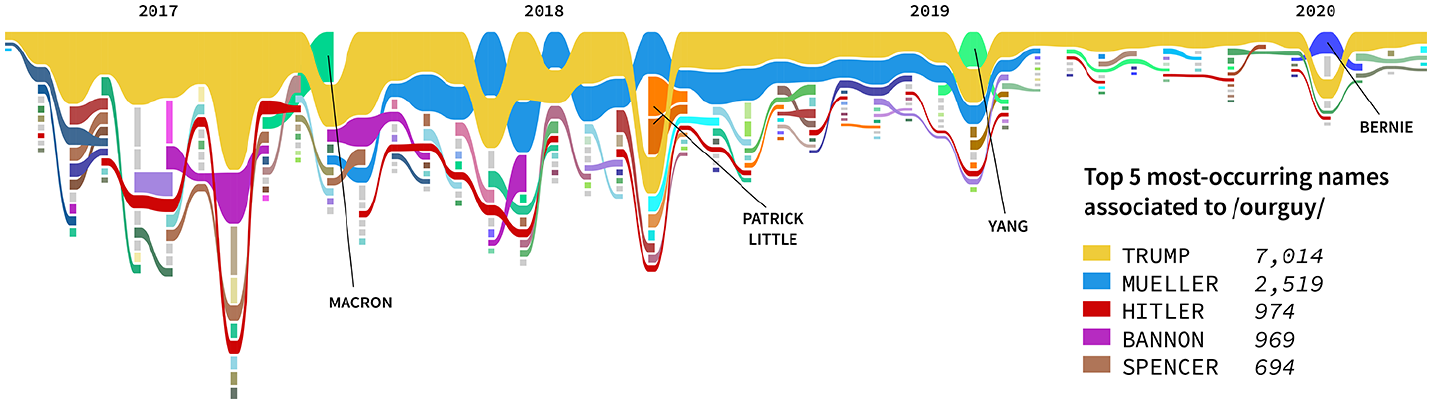
Most associated names to /ourguy/ on 4chan/pol/ per month (September 2016–May 2020). See https://oilab.eu/ourguy for full size.
Tracing /ourguy/
While the meme-database Know Your Meme dates /ourguy/’s origin to a 2016 thread on 4chan/v/, 10 I found it was already used on /pol/ with the encapsulating slashes in mid-2015 – the first unsurprisingly stating ‘TRUMP IS /ourguy/’. During this time, /ourguy/ incidentally appears alongside the names of Republican nominees. It was only from September 2016 onwards that /ourguy/ became a proper part of /pol/’s lexicon (Figure 3). While not as consistent as the triple parentheses (Tuters and Hagen, 2020), /ourguy/ was well-used in 2017 and 2018, with between 50 and 100 mentions per day (around 0.06% of all posts), dropping to around half of that in 2019 and 2020.
Who was associated to /ourguy/? In other words, who did /pol/-anons put forward as representing the entirety of the collective? Looking at Figure 4, what can immediately be learned is the consistency of trump. This is perhaps unsurprising knowing that, at its height, Trump was mentioned in a staggering 10% of all monthly posts on /pol/ (Hagen, 2020). His omnipresent /ourguy/-associations nonetheless further underline his proximity to the /pol/-anons’ idea of an ‘us’. This lends some credence to the provocation that ‘Trump is 4chan’ (Beran, 2017), but it should be noted that he could not always count on support from /pol/-anons. During the nominations for the Republican candidacy in 2015 and early 2016, /ourguy/-associations to trump initially appear supportive, his persona fitting /pol/’s similar mix of racism and political incorrectness. However, after losing his outsider status post-election, it was increasingly asked whether Trump was ‘still /ourguy/’ (452 times). Replies usually argued in an absolutist fashion that this was still the case, or, in an equally panoramic way, that Trump was ‘never /ourguy/’. For instance, one totalising statement comes from a post in February 2020, claiming that ‘/pol/ is NatSoc [national socialist] and doesn’t support Democrats or Republicans. We are not left or right. We’re third position. Trump is a Zionist with ties to Rothschild bankers. He was never ourguy’. While pro-Trump activity on /pol/ is still present by late-2021, panoramic statements like these emphasise how the former President had become a target for /pol/’s anti-Semitism himself (Hagen, 2020). Whether critical or supportive, his /ourguy/-prominence suggests he evoked important metacultural debate on /pol/’s collective identity.
From mid-2017 to 2019, then-Special Counsel investigator Robert Mueller (mueller) is listed almost consistently as the second entry, even overtaking trump in three months. Mueller’s presence at first seems counterintuitive considering he helmed the investigation into the Trump campaign’s Russian collusion in 2016. However, after reading the sampled posts, it became clear the association stems from the QAnon conspiracy theory. In this QAnon-stage, Mueller was claimed to not be investigating Trump, but Democratic elites and ‘deep state’ agents involved with paedophilic and satanic activity. Indeed, around the same time as the first associations between mueller and /ourguy/, the mysterious ‘Q’ also started posting on /pol/ (De Zeeuw et al., 2020). While QAnon is by now well-known, the unlikely appearance of Mueller demonstrates how tracing panoramic memes can help in identifying unexpected shifts in cultural activity. Typical to /pol/’s conspiratorial mind-set, Figure 5 shows a post where both /ourguy/ and the triple parentheses are used, here in a debate on whether Mueller was ‘taking down the deep state’. The totalising conspiracy presented here (Mueller either is or is not /ourguy/ fighting a united elite behind the scenes) attests to how panoramas may take shape as a ‘rough pell-mell of clichés as in the convoluted plots of conspiracy theorists’ (Latour, 2005: 188). However, here we do not necessarily see ‘convoluted plots’ but rather shorts statements enabled by the recognisable grammar of /ourguy/ and the triple parentheses; in the meta-aware environment of /pol/, why Mueller is not /ourguy/ and who (((they))) exactly are is deemed tacit knowledge. The implicitness and simplicity evoked by these shorthand formats suggest how panoramic memes might encourage what Muirhead and Rosenblum (2019) call a ‘new conspiracism’: conspiracy creation not through elaborate theory, but through the repetition of sweeping statements.
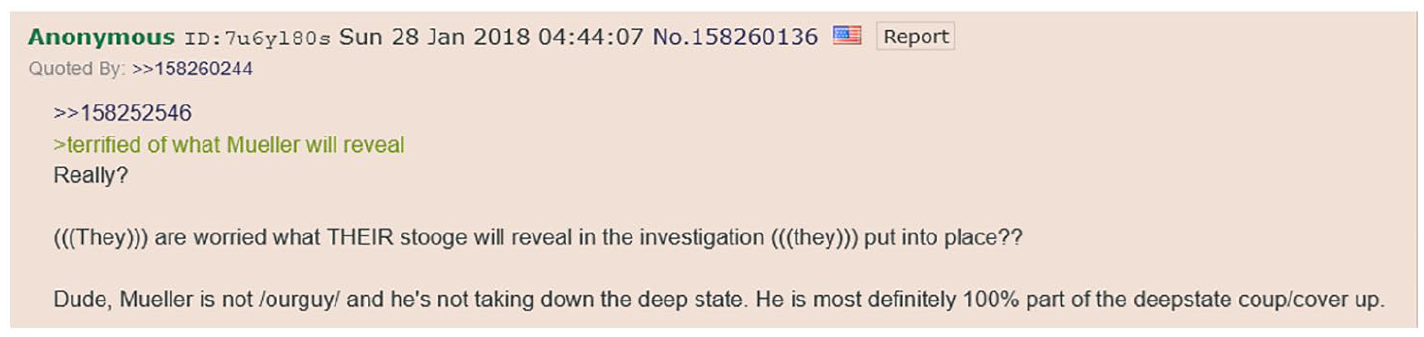
A post on 4chan/pol/ refuting Robert Mueller as /ourguy/. Screenshot taken from 4plebs.org on 28 May 2020.
Contrasting with the consistency of trump and mueller, other /ourguy/-traces are bound to brief controversies. Exemplifying this is macron, dethroning trump in July 2017 (Figure 6). Close-reading posts from this month reveals the /ourguy/-link emerges from Emmanuel Macron’s controversial remarks on Africa. During the 2017 G20 summit, the French President argued the continent was held back by ‘civilisational problems’ and women having ‘seven or eight children’ (Krug, 2017). Similarly controversy-bound is kanye, appearing in November and December 2016. Around this time, rapper-producer Kanye West professed that he ‘would have voted for Trump’, that black people should ‘stop focusing on racism’, and that the United States are ‘a racist country, period’ (The Guardian, 2016). While, again, these /ourguy/-proposals evoked plenty of contestation – that is, because neither Macron nor Kanye were deemed radical enough – these traces indicate how racially laden comments aligned with the /pol/-anons’ sense of an ‘us’, even when coming from liberal or African American figureheads.
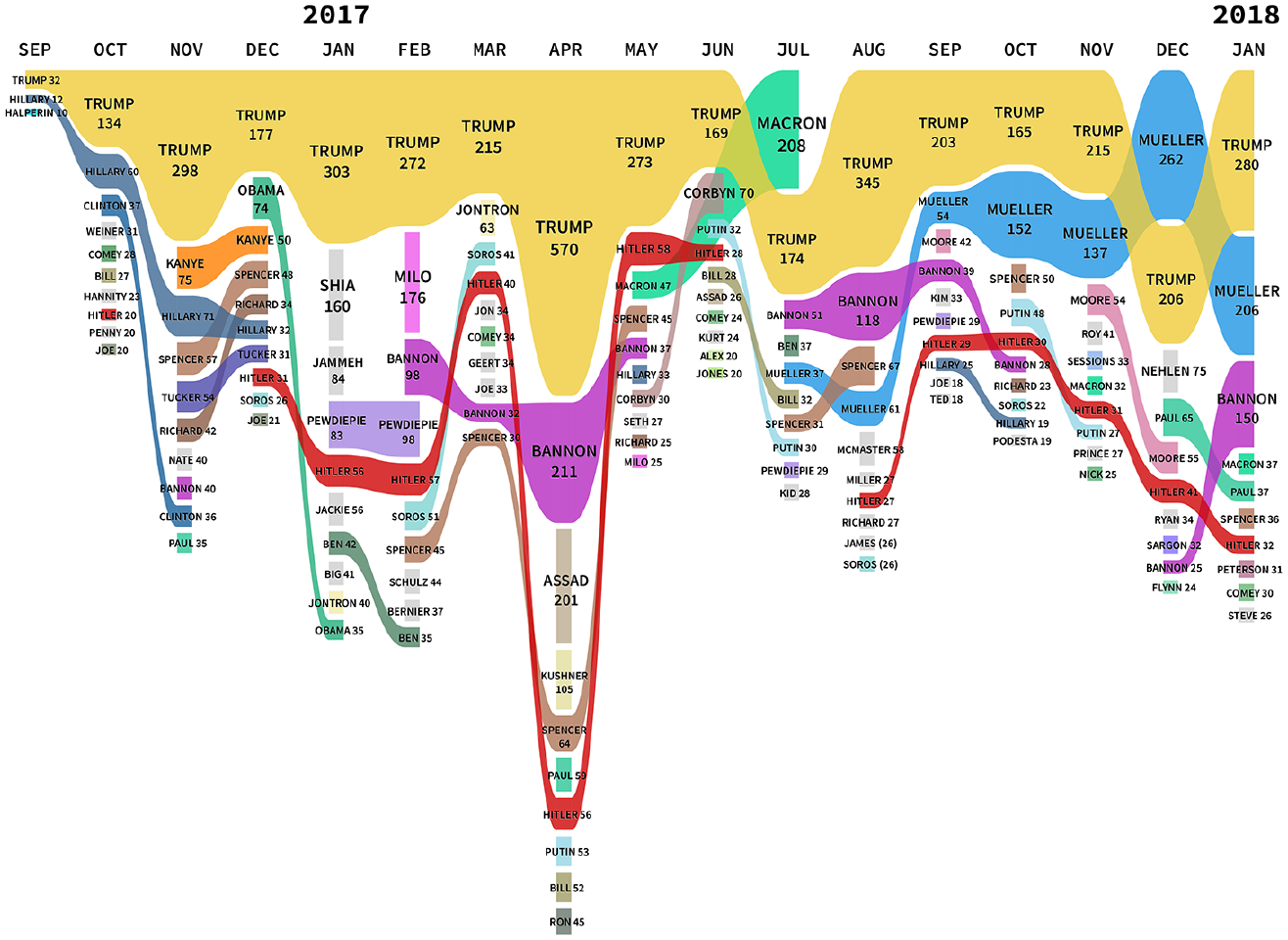
Most associated names to /ourguy/ on 4chan/pol/ per month (September 2016–January 2018). See https://oilab.eu/ourguy for full size.
Tracing other /ourguy/-associations makes clear that such ideological alignment was not always proposed in an organic fashion. One actor revealing this is patrick little, emerging in May and June of 2018 (Figure 7). Patrick Little is a neo-Nazi who ran for the Californian Senate elections in 2018 and lost with 1.35% of the votes (Garofoli, 2018). Since he spouted anti-Semitism on YouTube and the alt-tech platform Gab (ADL, 2018), it seems logical that Little’s campaign resonated with /pol/-anons. However, more interesting are the mobilisation efforts these /ourguy/-instances led to. Many of the Little-traces emerged from copy-pasted messages that are repeated to counter /pol/’s ephemerality. I deleted some of these with the spam filter, but others remain in the form of slightly edited opening posts for threads on Little’s campaign. In these posts, Little is presented as ‘/ourguy/’ alongside links to his speeches, donation options and even installation instructions for an Instagram bot that spammed pro-Little memes. It is not hard to imagine why /ourguy/ became entangled with such forms of coordinated action; akin to astroturfing, the strategic use of in-group vernacular implies grassroots support. At the time, such tactical meme-deployment was commonplace among the broader ‘alt-right’, which Woods and Hahner argue attributed far-right radicals ‘considerable suasory power in terms of recruitment and attracting media attention’ (2019: 5). This coordinated use of /ourguy/ can moreover be read as an attempt to tap into the affective contagious potential of memes – as also eagerly sought after by marketeers (Sampson, 2012). Whether it be alongside or because of these coordinated efforts, pro-Little rhetoric also appeared in more organic /ourguy/-traces, for instance within a post panoramically stating: ‘patrick little is /ourguy/ and anyone who says otherwise is a fucking shill’. Such posts not only attest to /pol/’s rampant anti-Semitism but also to how panoramic memes may ‘stultify political discourse’ (Woods and Hahner, 2019: 15) by reducing ideological contestation to vacuous claims.
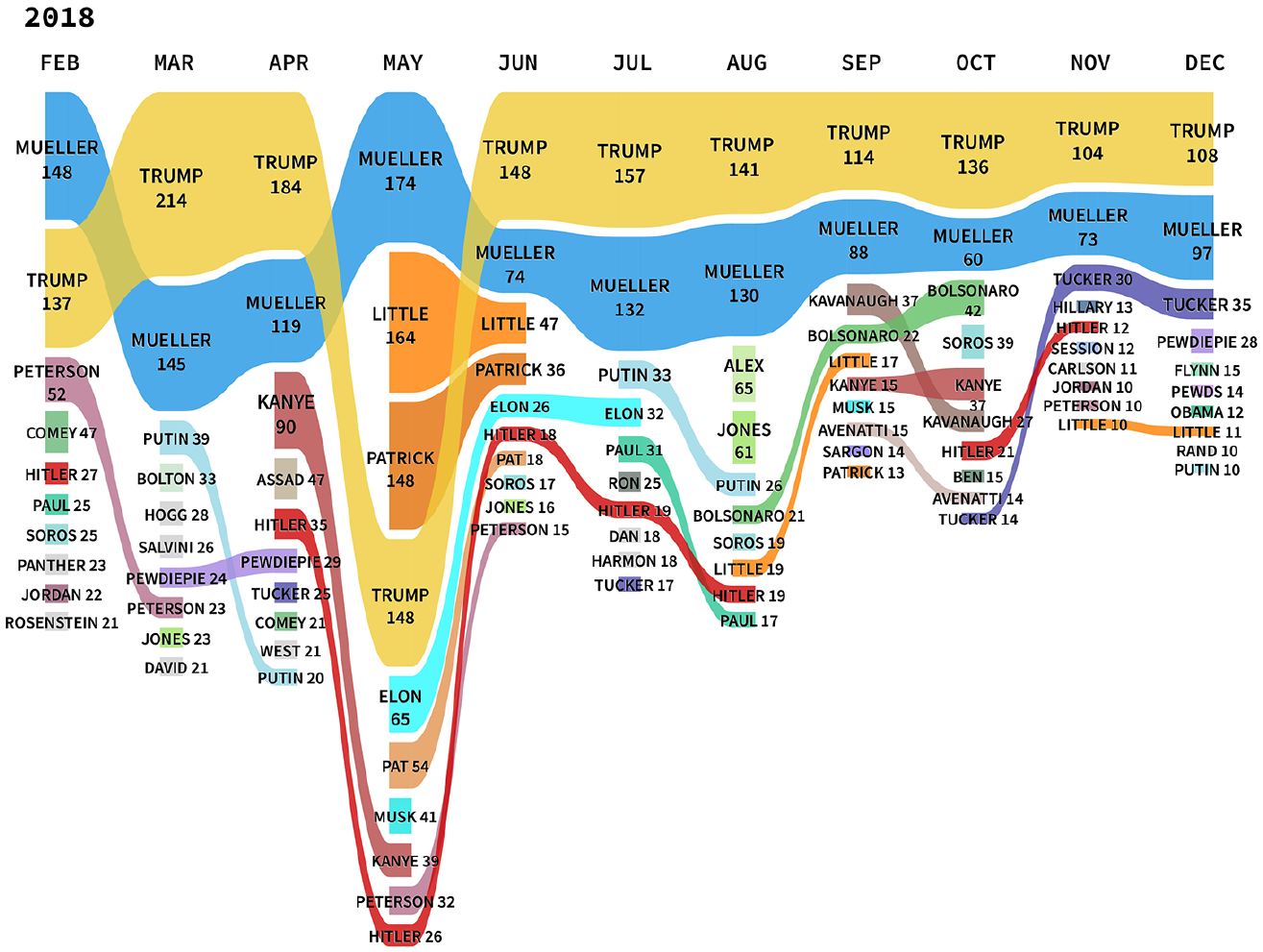
Most associated names to /ourguy/ on 4chan/pol/ per month (February 2018 – December 2018). See https://oilab.eu/ourguy for full size.
As /ourguy/ dropped in popularity in 2019, steady trump-associations remained while mueller disappeared, his investigation ending without the prophesised plot twist (Figure 8). One final noteworthy category of /ourguy/-associations stands out in this time slice. Contrasting /pol/’s far-right activity (see also brenton tarrant, bolsonaro, and hitler in Figures 7 and 8), several /ourguy/-links to US Democratic candidates appeared in 2019 and 2020. Notably, yang and bernie took the top spot in March 2019 and February 2020, respectively. At the time, Andrew Yang’s outsider status and pledge for a universal basic income led to a share of /pol/-anons rallying behind the term ‘Yang Gang’ (Brandom, 2019). Indicating how this was bound to the panoramic views, one notable thread started with the text ‘I think it’s safe to say that all of /pol/ outside of the r_donald shills are on board with Yang right? /ourguy/ of 2020?’ – invoking magmatic discussion with 186 replies passionately debating the provocation. Even more counterintuitive is the appearance of bernie. In the close-read posts, Bernie Sanders’ /ourguy/-links similarly appeared by virtue of his anti-establishment rhetoric, with his criticism towards the corporate elite being appropriated by /pol/’s anti-Semites (despite Sanders being Jewish). Such support was again articulated through /ourguy/’s totalising fragments, for instance, with one comment stating: ‘What was the exact moment [Sanders] became /ourguy/? And how did /pol/ go from being hardcore MAGA men to Bernie Bros in just four years?’. While these pro-Democrat panoramas could be taken as a signal of 4chan’s countercultural tendencies (Beran, 2019), Yang and Sanders’s /ourguy/-appreciations were both short-lived and largely the result of anti-Semitic and racist reappropriation. As biden and bloomberg moreover attest to, such /ourguy/-nominations appeared foremost because of the gravity of the 2020 US elections rather than an ideological change on /pol/. That said, the appearances of Democratic candidates exemplify how /ourguy/ facilitated ongoing micro-controversies on the collective’s core values – and in turn evoked the rearticulation that /pol/ was, in fact, still far-right.
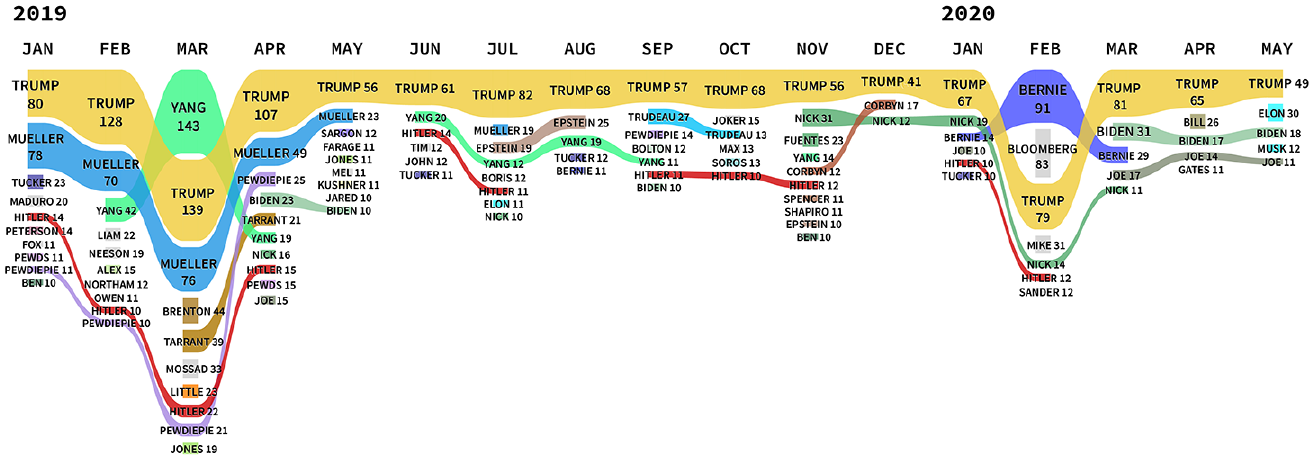
Most associated names to /ourguy/ on 4chan/pol/ per month (January 2019 – May 2020). See https://oilab.eu/ourguy for full size.
Overall, the /ourguy/-traces outlined earlier mostly show how the meme acted as a vehicle to affectively propagate politics through a shallow idea of the political: a simple us-versus-them thinking that can be read as a populist ‘thin’ ideology (Stanley, 2008) and as a sign of how elaborate political debate can become stultified by memetic shorthand (Woods and Hahner, 2019). To illustrate this with a final example, in Figure 9, we see a post that renders visible how the /ourguy/ meme is entwined with nonconscious beliefs and desires that affectively evoke such groupthink (Sampson, 2012: 93). With this anon admitting the irrationality of their support for Trump – solely based on ‘unverified conspiracies’ – they nonetheless cling to the sentence: ‘but he’s our guy’. While but one example, the post highlights the rhetorical power of memes to potentially sway political allegiances (Woods and Hahner, 2019).
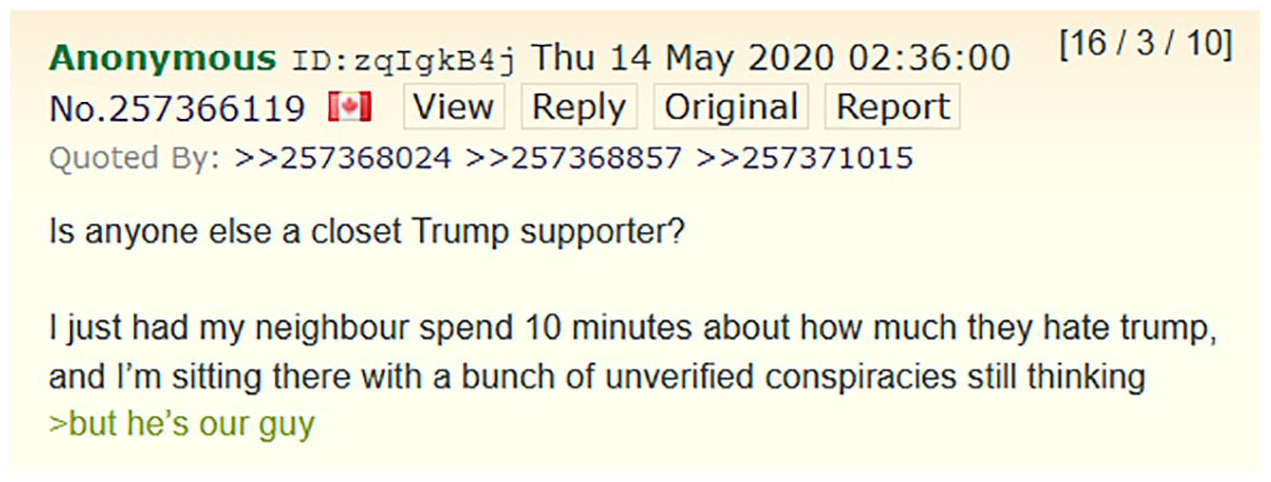
An opening post on 4chan/pol/ professing the poster’s unfounded commitment to Donald Trump. Screenshot taken from 4plebs.org on 12 June 2020.
Conclusion
This text showed how the metacultural language of 4chan/pol/’s anonymous users can be repurposed to map some of its ever-shifting currents. Tracing the /ourguy/ meme to names of public figures revealed various efforts to give a face to a faceless group, whether as consistent associations to Donald Trump, as conspiracy thinking with Robert Mueller or as provocations with Bernie Sanders. Through ascribing agency to non-human actors like /ourguy/, I ultimately contend that online anonymity does not have to be seen as a barrier ‘standing in front’ of the object of study, preventing an analysis based on the individual. Rather, it forms yet another ‘figuration’ with its own ‘instruments’ to trace a collective (Latour, 2005: 57–58). Panoramic memes like /ourguy/, in this figuration, are not windows through which groups on imageboards can be studied. Rather, they are the collective. At the same time, I also underlined actor-network theory’s methodological limits when trying to satisfyingly ‘deploy the content with all its connections’ (Latour, 2005: 147). Instead of ‘following the actors wherever they lead’, I argued that panoramic memes can form useful ‘drosophila’ (Boullier, 2018) as conveniently replicated actors that can be traced and summed up to reveal patterns in ‘fragments of totalisation’ as well as offering nodal points for more qualitative situational approaches (Marres, 2017).
With far-right violence rising in the global West (Global Terrorism Index, 2020) and memes remaining ‘the focal point of […] contemporary political divisions and the online cultural identity war’ (Konior, 2019: 50), it continues to be paramount to assess the mobilising role of panoramic memes within far-right spaces online. But perhaps even more important is to which extent they may ‘stultify discourse’ and ‘challenge foundational deliberative norms’ when diffusing across online infrastructures (Woods and Hahner, 2019: 6, 212). I refrained from addressing this diffusionist aspect here, but a cursory glance on Twitter shows that /ourguy/ is common there as well, prompting questions on its role outside of 4chan. That said, I hope the qualitative-quantitative approach demonstrated here is relevant beyond studies of the far-right or, for that matter, politically oriented groups in general, since the use of memes has intensified in nearly all forms of online communication. For instance, future work could repurpose memes like the aforementioned ‘we stan’ to map affective associations of fandoms on Tumblr. Such cases may also test whether the concept of the panoramic meme is useful beyond the study of imageboards and what different methods may be required (e.g. how can we trace panoramic images?). My hope is that this article at least offers some conceptual and methodological guidance on how to do so.
Footnotes
Acknowledgements
Thanks to Bernhard Rieder, Marc Tuters, Michael Stevenson and Jaap Kooijman for the valuable feedback. I would also like to thank the participants of my project during the Digital Methods Winter School 2020, out of which this paper emerged.
Funding
The author(s) disclosed receipt of the following financial support for the research, authorship, and/or publication of this article: The author has received PhD in the Humanities grant from the Dutch Research Council (NWO).
