



Abstract
Videogames are an increasingly prominent use case for blockchain technology (what has been termed ‘cryptogaming’). Drawing on documents, such as industry presentations, social media posts, interviews and white papers, this article analyses discourses surrounding cryptogames, focusing on the claims made by cryptogame developers and investors. We ask two related research questions: What are the dominant visions of a cryptogaming future, imagined by and for various constituencies? And what sorts of values get realised in such an imagined future of game development and use? We argue that cryptogames imagine players and developers as financialised subjects, adopting attitudes and practices of risk and investment as salves to both microeconomic problems in the games industry as well as broader macroeconomic issues.
Introduction
Over the last half decade, the videogame industry has become a major site for experimentation with blockchain technology. Cryptogaming, as it has been termed (Scholten et al., 2019; Serada et al., 2021) has great breadth. New games and game platforms (such as those for payment processing and software distribution) are emerging to expressly support blockchain technology. The cryptogame industry has seen a sizable cash injection from investment funds (e.g. Andreessen Horowitz, SoftBank), large blockchain firms (e.g. Coinbase), major ‘legacy’ videogame companies (e.g. Ubisoft, SquareEnix) and tech conglomerates (e.g. TenCent). In 2021 alone, corporate investments in cryptogaming totalled US$4 billion (Jordan, 2021) and valuation of large cryptogaming companies rival those of large Triple-A development studios (Jordan, 2021). For many proponents of cryptogaming, videogames are seen as a central component in the wider engine of ‘Web3’ – the so-called next iteration of the Internet, moving beyond the participatory Internet of ‘Web 2.0’ (and its eventual consolidation and capitalisation by a handful of corporations) to one built on the supposedly ‘decentralised’ infrastructure of blockchains (Sadowski and Beegle, 2023; Web3 Foundation, n.d.). As previous work on blockchains and the cultural industries has found (e.g. Baym et al., 2019), blockchains are commonly framed by proponents in highly emancipatory and solutionist terms, reconfiguring industrial norms of production, distribution and consumption in ways that accrue benefits to a variety of production and consumption side stakeholders. Broadly speaking, cryptogames are no different – advocates see blockchains as affording value for both players and developers. In this article, we examine the specific industrial discourses that are used to construct cryptogaming’s value.
When it comes to blockchain technologies, discourse is a particularly important object of study. While the concept of the blockchain now enters its second decade (Nakamoto, 2009), its use-cases are still relatively limited. It is in this sense, as critics like Morozov (2021) argue, that blockchains exist predominantly within a discursive register, and that their value is often largely speculative, hinged upon a belief in a future in which a particular chain or token is widely adopted. Blockchains are, as a growing literature in the social sciences would suggest, perhaps best understood as regimes of promise. It is from this perspective that we aim to analyse the discourses surrounding the technologies and business strategies of companies that make up this new sector of the videogame industry. In so doing, we are occupied with two interrelated research questions. First, what are the dominant visions of a cryptogaming future, imagined by and for various constituencies? Second, what sorts of values and agencies get realised in such a future of game development and use?
To answer these questions, we conducted a discourse analysis of 383 public facing materials (e.g. white papers, social media posts, industry conference talks) published by cryptogame developers and investment firms. Material was dated from the period May 2020 (roughly the beginning of the rapid growth and capitalisation of the cryptogame industry) until May 2022 (which marked a precipitous decline in token prices across the entire blockchain market). The sample period captures what some commentators (Gerard, 2022) have called a crypto bubble. We show that blockchain technologies are variously imagined for gamemakers and players. Our analysis reveals three main promises of cryptogaming embodied in the discourse of developers and their financiers: (1) cryptogames will provide a mechanism for resisting asymmetrical power in production contexts; (2) cryptogaming will allow players to ‘earn’ and ‘retain value’ and (3) cryptogames will afford a high degree of openness, of convergence and composability between games and the blockchains on which they operate.
The overarching promise made by cryptogaming proponents is a simple one: the games industry – construed here as large game developer-publishers and distribution intermediaries – thrives on robbing you of your surplus value, whether as a player in creating the ‘culture’ of a game or creating content using a game’s proprietary software, or a developer who pays platform fees to distribute their software on app stores. Blockchains allow the user to retain this surplus value by ‘buying in’ – with a token or coin. In this sense, we argue, cryptogaming’s boosters imagine players and developers as financialised subjects – adopting attitudes and practices of risk and investment as a salve to unfavourable conditions and business practices in the games industry, as well to broader macroeconomic uncertainty faced by many today.
In what follows, we first provide an overview of key concepts in blockchain technology and cryptogaming. We then survey related work on discourses of emerging technologies, recent work on the discursive construction of blockchain futures, and the emerging literature on cryptogames. From there, we overview our methodology – outlining approaches to sampling and analysis. Subsequently, we present our findings based on three predominant themes in our discourse analysis. The article ends with some brief conclusions and directions for future study.
Key concepts in blockchain technologies and cryptogaming
In basic terms, a blockchain acts as a public ledger, recording transactions between parties. The ledger is made up of ‘blocks’ – a permanent store of transaction data between those parties. Blockchains verify transactions – achieving what is called ‘consensus’ – across a distributed computer network (and once a block is verified, it is closed and unalterable). The two primary mechanisms for consensus are Proof of Work (PoW) and Proof of Stake (PoS). PoW requires members of a network to expend computational power to solve an arbitrary mathematical puzzle to create a new block for transactions. PoS allows for blocks to be advanced by those who hold particular tokens. Where cryptocurrency is used in transactions on blockchains, it is also the ‘reward’ to users for providing the computing power or staked tokens to validate transactions. Further to these two mechanisms is Proof of Authority (PoA), which validates transactions through a small and designated number of blockchain actors.
Across the material we surveyed, most applications ran on Ethereum, a PoS blockchain with a specific focus on decentralised applications (digital applications designed to run on a blockchain rather than on any one computer network owned by a particular organisation) and smart contracts (a digital ‘contract’ with the terms of the agreement between parties being directly written into the code). In some instances, games would run as sidechains (e.g. Ronin), a blockchain connected to (yet operating separately from) another blockchain network (generally to Ethereum).
A central component of blockchains – and blockchain games – are tokens. Tokens are blockchain based assets – representing ‘value’ in one way or another – that can be created and transferred between users. They take two main forms – fungible tokens and non-fungible tokens (NFTs). Fungible tokens are those that can be traded or exchanged at equivalency, one for another. It is this fungibility that makes them suitable as a medium of transaction (e.g. cryptocurrencies). Distinct from fungible tokens are NFTs – enabled by blockchain protocols for ownership (e.g. ERC-721). As the original proposal for the NFT standard describes it (Entriken et al., 2018), NFTs represent ‘assets’ – in effect unique identification codes and metadata that correspond to off-chain virtual things. For example, in games this may include swords, cats or esports trading cards. Unlike cryptocurrencies, NFTs cannot be traded or exchanged at equivalency as each has unique metadata. The metadata also links the asset to a crypto-wallet address, conferring ‘ownership’. It is this combination of uniqueness and ownership to which many ascribe the ‘value’ of NFTs.
Related work
Promissory technologies and blockchains
While blockchains have existed for over a decade, they have largely been characterised by visions and promises of what the technology might do someday. The idea that emerging technologies are socially constructed as valuable through discourses about their future adoption is one that has enjoyed wide usage across social scientific studies of technology (Borup et al., 2006; Jasanoff, 2015). As Bryant and Knight (2019) note, the way that social actors make the future feel more tangible in the present is often through invoking anticipatory and hopeful imaginaries of great societal change, often counterbalanced with fatalistic claims of the inevitability that these futures will eventually come to be. Discourse, in this sense, is often referred to as ‘performative’ (Callon and Muniesa, 2005; Thrift, 2001) – a way to lend ‘structure and legitimation’ to speculative enterprise (Borup et al., 2006: 285–286). We might think, for example, of the role of corporate PR in ‘selling’ ICT equities in the dotcom boom, as the largest components of the equity market shifted from ‘old world’ resources and hard assets to technology (Crain, 2014). Or the way that a subdued macroeconomic climate post-GFC (and investor and corporate access to cheap money) meant that tech start-ups could promise (yet often fail to deliver) considerable returns on long-term capital investments (Vinsel and Russell, 2020). In this way, finance capitalism in the tech sector is increasingly ‘fictitious’ (Haiven, 2014) – money is thrown into circulation without any basis in productive activity, per Marx – but is also shaped by promises, narratives, or fictions of benefit and future yield.
The value of much of the blockchain industry can be described as promissory. As Maurer et al. (2013) wrote of Bitcoin, but applicable to blockchains and cryptocurrencies more generally, ‘monetary value . . . rests as much in the future potential that its users imagine for it as on its current, relatively limited capacity to act as a medium of exchange’ (p. 263). As Faustino et al. (2022) point out in their ethnographic research with blockchain firms, the ‘white paper’ – a document that lays out a particular blockchain service in often future-leaning terms – is deemed practically essential in ‘proving’ the legitimacy (to users and investors) of new blockchain projects. For Swartz (2016), imaginaries of blockchains tend to operate as ‘radical’ (visions of transformative change, upending social and technical norms) or ‘incorporative’ (more modest visions of blockchains as integrated into currently existing social and technical norms).
Studies of blockchains have likewise examined how specific regimes of promise have been deployed. Work on cryptocurrency (specifically, Bitcoin) has examined the years in which the principal imaginary was currency, an alternative to, and ultimately a perceived replacement for, fiat money. For Swartz (2018), many cryptocurrencies represent a technoeconomic imaginary of what she calls ‘digital metallism’ – as a currency that is ‘mined’ rather than issued and regulated by a central authority. As Golumbia (2016) argues, the libertarian imaginaries underpinning Bitcoin’s premise as an alternative to fiat has affinities with right-wing political thought. For Faria (2022), blockchain payment platforms are sold as credible by situating them relative to (and as an improvement over) alternative technologies that exist in the present.
Beyond currency, Swartz et al. also identify the imaginary of ‘infrastructural mutualism’ – one that stresses the benefits that blockchains hold for organisational and governance decentralisation (although for many ostensibly decentralised projects, the vast majority of tokens are held by a small portion of the wealthiest users; see Jiang and Liu, 2021). The term ‘decentralisation’ is a powerful rhetorical device within such discourses, one which Schneider (2019) describes as a ‘floating signifier’ – a term with no common, agreed upon meaning, a status that allows it to appeal to a range of different blockchain constituencies and their interests, something that provides it an alibi for extending into disparate areas of life (real estate, finance, corporate governance, cultural production, and so on). For Baym et al. (2019), writing of decentralised apps in the music industry, blockchains can be conceptualised as ‘convening technologies’, less about offering specific technological solutions, their (largely promissory) projects bring together different social actors. Others have sought to explore specific imaginaries surrounding applications of blockchain infrastructures: Dylag and Smith (2021) on a blockchain-mediated legal system; Woodall and Ringel (2020) on blockchain as a method for archival by heritage and cultural institutions; Baym et al. (2019) on applications to music production and distribution. In these cases, chiming with Faria (2022), blockchains are framed by their proponents in ameliorative, solutionist terms; decentralised databases a salve to problems that exist in the present.
Videogames and blockchains
Most of the literature on cryptogaming centres on early iterations of blockchain enabled games, particularly focusing on the first wave of games that emerged following the launch of Ethereum. It was here that games like CryptoKitties became a popular test case for protocols in Ethereum that enabled ownership of digital assets (and that would later become realised in the ERC-721 standard for NFTs).
From a cultural studies perspective, and perhaps the most comprehensive and critical account of ‘value’ in CryptoKitties, Serada et al. (2021) study the ‘mechanisms through which value is created’ (p. 468). By studying the player experience of the game, they claim that value is shaped through aspects like the symbolic in-game value of tokenised ‘kitties’ – but also through technical-material dimensions of the Ethereum blockchain (e.g. the high transaction fees associated with using the Ethereum network). Other scholarship has focused on the relationship between cryptogames and gambling (Scholten et al., 2019; Serada, 2020), suggesting that blockchain-enabled game features tend to meet criteria found in legal and psychological definitions of gambling. Legal scholarship (e.g. Evans, 2019) has examined the copyright implications of blockchain games, such as in the commonly imagined future of interoperable digital assets. Others (Jiang and Liu, 2021) have analysed the flows of player activity into (and eventually out of) cryptogames, attributing declining playerbases to growing discrepancies in the ownership of digital assets. Parallel to the literature on games, emerging work in media studies has focused on dynamics of ‘gamble-play’ – that is, the ‘blurring of interactive media and gambling’ (Zaucha and Agur, 2022: 6) – in Dapper Labs’ NBA Topshots, an NBA-franchise range of NFTs.
There are several gaps in this existing literature that the present study aims to address. The main point of difference is that existing work has focused on cryptogames and the experience of the player (and within that, a relatively limited sample of applications). Moving beyond early applications (particularly considering the massive growth in the cryptogame industry in 2020 and 2021), cryptogames are imagined and used in ways that go beyond ‘play’ – such as the increasing influence they are imagined as having on channels of distribution and production (emerging in step with wider discourses of Web3 and the ‘metaverse’ as new environments for life, see, for example, Ball, 2022). Second, the present work takes as its object of study the discourses of cryptogaming – the way that proponents sought to discursively frame the value of their projects and investments, especially important in the context of cryptogaming, where there is often no concrete, existing application (and most developers are pre-product startups).
Methodology
Sampling
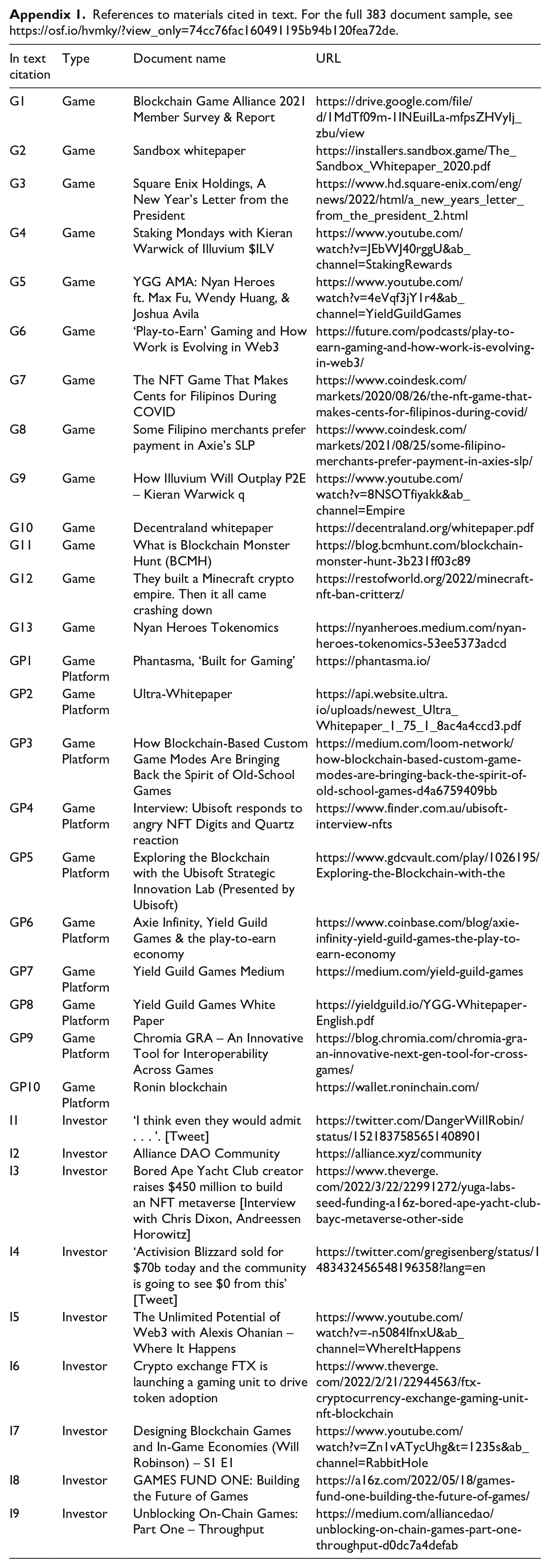
We gathered 383 primary source documents including interviews with cryptogaming industry workers and executives, social media posts, the content of cryptogaming websites, white papers, and industry presentations (e.g. at the Game Developers Conference). Material from this sample directly referenced in this article are tabulated in Appendix 1. 1 Material was dated between May 2020 and May 2022. May 2020 roughly represented the beginning of a period of intense growth for the crypto (and cryptogaming) space. From the CoinMarketCap database, we determined that most gaming projects (viewable under the database’s ‘gaming’ tag) had their Initial Coin Offering (a fund-raising event for new blockchain projects using cryptocurrencies) in 2020 or 2021. Furthermore, peak token prices and trading volume of gaming projects tended to fall within 2021. We chose May 2022 as our end point as it marked a precipitous decline in token prices across the entire blockchain industry (see Gerard, 2022). In other words, the study period represents a unique snapshot of time where investment was high, and cryptogaming’s proponents were eagerly attempting to construct the field as one viable for investment.
We used purposive sampling across the period, focusing on 70 blockchain gaming applications (games, distribution platforms, guilds), offered by a range of different actors (blockchain-specific game developers, big blockchain companies, ‘legacy’ game developers, etc.). We located these applications largely through the CoinMarketCap database – a blockchain industry database that indexes token prices and trading volumes. We focused on applications that had a minimum US$10M market capitalisation (indicative of market perception of token value) or were being funded by another highly capitalised firm (e.g. private venture capital (VC) funds, venture arms of big crypto companies, large game developer-publisher companies, etc.). While an imperfect measure, we chose to scope our sample in this way as we believe it roughly indexes the ‘success’ firms have had in translating their performative discourse into capital.
Further to this, we examined discourses espoused by sources of private finance in the cryptogaming industry. This included VC firms and Web3 accelerators, that is, firms that provide early-stage capital (as well as technical and managerial expertise), generally in exchange for equity. Such sources of capital not only play a key role in financing cryptogames, but have notable public profiles (across social media, the trade press), and are as such a key voice of advocacy for the industry. Consistent with wider accounts of private capital in the tech sector (Birch, 2022; Sadowski and Beegle, 2023), VCs and accelerators exert imaginative force in shaping the collective commitments of institutional investors, as well as industrial entrepreneurship and innovation. To locate these firms, we did a topic search on the business database CBInsights using the terms ‘Blockchain’, and ‘Videogames’ or ‘Gaming’. Within the specified date range our search query yielded over 1000 results. As our object of study was discourse, we narrowed this down to 20 firms who were (1) investors with a degree of specialisation in gaming or interactive technology and (2) maintained public profiles about their investments (such as on social media or at blockchain industry events).
Analysis
To study the discourses surrounding cryptogaming we drew from critical discourse analysis (CDA) – an approach oriented towards the intersections of discourse, power, and social structure (Fairclough, 1995). This approach centres what is said, but also what is unsaid (and what such elision reveals). CDA has productively been applied to understand the discursive construction (and normalisation) of emerging technologies in media studies (see, for example, Egliston and Carter, 2020). To facilitate our analysis, we used an iterative coding system – common in qualitative approaches to the analysis of textual data (Creswell, 2007). We first manually coded the material using inductive coding, organising data according to patterns or concepts in the material (e.g. ‘blockchains as databases that verify things’). From there, we consolidated the material to form our final categories which captured the essence of discursive promises made by blockchain gaming proponents across the study period.
Findings and discussion
In what follows, we present and discuss the three main themes (i.e. dominant imaginaries) that emerged in our discourse analysis. These were: (1) cryptogames will provide a mechanism for resisting asymmetrical power in production contexts, (2) cryptogaming will allow players to ‘earn’ and ‘retain value’ and (3) cryptogames will afford a high degree of openness, convergence and composability. Across these themes, proponents imagine players and developers as financialised subjects. Through buying into blockchains and tokens, they adopt practices and attitudes of risk and investment as a panacea to unfavourable conditions and business practices in the games industry (e.g. platformisation, control exerted by large developer-publisher firms), and more general macroeconomic uncertainty (e.g. job loss and a lack of consistent income during the COVID-19 pandemic).
Resisting asymmetrical power in production contexts
The decentralised and tokenised affordances of blockchains were commonly seen as a form resistance to asymmetrical power relations in game production. This appeared in two main ways: one, providing the means to create new distribution ecosystems (where current centralised platforms are framed as drawing excessive fees for their role in the intermediation of commerce between consumers and developers). Here, these blockchain platforms are framed as a more economically sustainable and equitable alternative to the present-day distribution ecosystem. Two, the affordance of decentralised governance and ownership of games themselves (with emphasis on the redistributive function of audience ownership).
In terms of the former, one platform, Phantasma, describes itself as a blockchain platform ‘designed for gaming’ (specifically, one for hosting games or game distribution services), claiming to ‘increas[e] developer revenue’ (GP1). As the company notes in their white paper, the mechanism for such a promise is that hosting a game on Phantasma (and access to Phantasma’s developer resources) does not attract a flat fee but rather requires staking Phantasma’s governance token. Where this is presented as an alternative to other platforms for distribution (e.g. Steam), what it advocates for is cultural production contingent upon ownership of a volatile asset class. Speaking to the multi-sidedness of the platform, Phantasma emphasises that lowering the cost for developers will result in ‘much lower costs for the end user’ (GP1). Ultra, another similar blockchain-based distribution platform frames such a solution as ‘put[ting] an end to the current distribution monopoly’ (GP2). At the same time, Ultra chastises other companies who are ‘unwilling to play a part in the revolution’ (GP2) – presenting the current moment of frenzied investment in blockchain technologies as a watershed moment in the history of technology.
In these projects, critiques of the role of the major distribution platforms – namely, those operated by Google (Play Store), Apple (App Store) and Valve (Steam) – were central; echoing scholarly sentiment that platforms of ‘Web 2.0’ operate as ‘landlords’ or ‘rentiers’ (Bernevega and Gekker, 2021; Sadowski, 2020). Through the collective mobilisation of blockchains – and specific services like Phantasma or Ultra – we are told game development can operate outside the bounds of the major distribution platforms who control and profit from their access to the majority of the global videogame market, resulting in more equitable returns for producers. But cryptogame proponents are quick with the caveat that this can only be the case if the intervening condition of mass adoption is met (or what is commonly referred to by proponents as achieving ‘critical mass’). For Kieran Warwick of Illuvium, while this future is not yet visible, its manifestation is destined, inevitable or as Bryant and Knight (2019) put it, ‘nevertheless immanent in the present’ (p. 160). As Warwick writes ‘give it 10 years and you won’t find a single game not being built on the blockchain’ (G1).
Beyond a way to challenge the distribution oligopoly, Ultra frames blockchain enabled distribution tools (and blockchain-enabled games more generally) as a means through which game developers can better subsist within an intensely competitive market. The reason why games suffer amid intense competition, Ultra suggest, is due to the lack of tools for developers to differentiate themselves from competition. The issue with visibility, in other words, is the homogeneity of products on the market, rather than the way that platforms algorithmically display app store content or due to market oversaturation (cf. Nieborg et al., 2020) – with Ultra supposedly offering the means for differentiating one’s game. As Ultra have it: ‘With a thriving indie and AAA development ecosystem, there’s never been a better and more urgent time for a platform to provide new opportunities and differentiation’ (GP2). These promises to gamemakers are reminiscent of other recent advances in game-making technologies (Nicoll and Keogh, 2019) which are grounded in an ethos of entrepreneurial opportunity. For Ultra, and its claim to afford developers a means for ‘differentiation’ in a crowded marketplace, blockchain technology provides the means for developers to achieve financial subsistence in a precarious, oversaturated and platform-dependent market. 2
Where cryptogaming production and distribution platforms conjure visions of hope – the possibility of emancipation from adverse conditions of production – platformisation tends to be the single way that cryptogame boosters discuss issues of labour and value in the games industry. Indeed, as writers like Keogh (2023) have suggested, labour struggles in the games industry are not so easily reducible to the technoeconomic logic of platformisation; there are wider structural issues that face aspirant participants. Widespread sexism, racism and ableism, as well as labour issues of precarity and overwork, all pervade the industry – conditions unlikely to be ameliorated through a techno-fix. Yet, for these blockchain companies, presenting the ‘landlords’ of platform capitalism as the main problem for gamemakers today means that their solution is an easily saleable one: a new mechanism for distribution and production that provides supposedly more equitable, creatively just terms for developers.
It is in this way that it is unlikely that such visions would liberate developers from the vicissitudes of contemporary game work. These solutions are particularly unconvincing compared with competing imaginaries of ‘platform cooperativism’ (see Chia et al., 2020), embodied in currently existing game development software. We might think of vibrant platforms like Twine, which aim to create collective consciousness and solidarity among a precariat of game workers (Chia et al., 2020). It is no coincidence that these platforms are widely adopted by minoritised game developers – particularly queer and feminist developers – who have elsewhere been leading the charge for unionisation across the wider videogame industry (Keogh and Abraham, 2022: 7–8). These platforms do not just seek to replace ‘bad’ platforms with new, ‘good’ ones, but rather embody ‘alternative trajectories and potentialities’ (Chia et al., 2020) – particularly, those where gains might be realised at the level of the collective rather than in terms of individualised profit-seeking.
Furthermore, while there are (as we note later) vague gestures towards interoperability between blockchain applications, it is not entirely clear how blockchain-based distribution differs from the platform oligopoly that characterises the current distribution ecosystem – creating the same structurally centralised systems where we are dependent on a handful of central brokers. Highlighting the contested nature of cryptogame imaginaries, Will Robinson – a game studies academic-turned Web3 investor at AllianceDAO (I2) – argues that many blockchain companies operate similarly to large platform companies of Web 2.0, consolidating power by expanding their boundaries (often through vertical integration strategies). Robinson cites the game developer SkyMavis – who operate their own blockchain, wallet, and exchange (along with their game service), all of which extract fees – ‘threaten[ing] to capture enormous amounts of value for their ecosystem’ (I1). It is in this sense, as writers like Schneider (2019) – echoing work by Langdon Winner (1986) – would suggest that decentralisation may still produce economically and structurally centralised outcomes. In effect, decentralisation describes the process of shifting the centre, while at the same time ‘obscur[ing] other aspects of the re-ordering it claims to describe. It steers attention from where concentrations of power are operating, deferring worthwhile debate about how such power should operate’ (Schneider, 2019: 3). The language of decentralisation is used to present blockchains as a viable alternative to platform-based models for production and distribution yet doesn’t address the underlying problems associated with platforms as gatekeepers and rentiers.
Distinct from ‘decentralising’ production, a second application of blockchain technologies to videogames is the decentralised governance and ownership of videogames and videogame companies, through Decentralised Autonomous Organisations (DAOs). DAOs refer to computer programs that are stored and executed automatically on a decentralised network and through systems of smart contracts. DAOs often issue tokens (called ‘governance tokens’) which provide the holder certain control rights (and a share in revenues) not dissimilar to traditional forms of equity and debt instruments. In the context of game DAOs, governance tokens might confer the holder governance rights over the network, enabling them to vote on certain decisions. For example, in Sandbox’s DAO, tokens allow users to ‘exercise voting rights on key elements . . . [such as] feature prioritization’ (G2). Elsewhere, DAO governance structures in emerging ‘metaverse’ games were framed in terms of a broader tech sector push towards the metaverse. Chris Dixon, who leads VC firm Andreessen Horowitz’s crypto arm speaks of the US$450M funding round his firm led in YugaLabs’ ‘Otherside’, a forthcoming game project that draws from the widely publicised Bored Ape Yacht Club IP (with games a major part of the firm’s effort to drive investment in Web3, I8). For Dixon, OtherSide is ‘an important counterweight to companies like Meta’ (I3), whose (just as vague) imagination of a centralised ‘metaverse’ will supposedly hinge on the company’s own hardware and software platforms (cf. Egliston and Carter, 2021; 2022).
Other companies, however, frame blockchains as changing the norms surrounding value and labour within digital environments. For projects like Loom Network, an Ethereum token sidechain, the DAO structure provides a means to properly remunerate the value generated through audience interactions with videogames – the kind of participatory co-production long noted by game scholars (e.g. Kücklich, 2005). As President of SquareEnix Yosuke Matsuda puts it (following his company’s announcement of entry into the cryptogaming space), such player activities are a mode of ‘play to contribute’ (G3), a practice Matsuda sees as incentivised through blockchain technology – making these kinds of ‘contributions’ commensurable (and thus remunerable).
Loom co-founder, Luke Zhang, makes his case for such remunerative affordances by way of a comparison to user modifications (or ‘mods’) – custom game content developed by members of a game’s community, generally using the game developer’s own proprietary software tools. Specifically, he cites the example of Valve – a company that has historically profited from co-opting user mods and their creators (Joseph, 2017). Giving the example of Valve’s Counter Strike (a game released in 1999, over 20 years before the first smart contract blockchains), Zhang notes,
Even if you managed to create a popular mod, the ability to monetize it is missing from the picture. The truly effective monetization models are always going to be reserved for the game company. (GP3)
If, in this hypothetical, the game’s creators Minh Le and Jess Cliffe, had developed Counter Strike using blockchain technology, Zhang suggests that their modification of the game would have verifiable data proving their ownership and creation, allowing them to have independently monetised the game (which would go on to be one of the most popular in the world throughout the mid-2000s). It is here that blockchains – as immutable, verifiable databases – are seen to enforce proof of ownership, and moreover, a proprietarian ethos towards the value generated through interactions with videogames.
Maintaining this same proprietarian ethos, elsewhere the blockchain VC Greg Isenberg argues that blockchain-enabled audience ownership through DAOs would work to remunerate harder to account for forms of value-generating player activity. Specifically, Isenberg refers to the way that videogame communities themselves are generative of value in the sense that they create ‘culture’. The experience economy of (multiplayer) videogames is not simply the outcome of the elements of the game, but rather an ‘arrangement’ (Carter and Egliston, 2021; Egliston, 2020) of technology and players. Isenberg makes this claim in response to news that Activision-Blizzard had been acquired by Microsoft for US$70B in January 2022 – writing that ‘People who participate in a game, should be rewarded for their participation’ (I4).
In sum, proponents of decentralised platforms for production see blockchains as flattening out hierarchies in game production by doing away with the large platform corporations that intermediate development and distribution. Others focus on the affordances of decentralisation as they pertain to the player, a way to institute new forms of audience ownership, framed in relation to microeconomic trends within the videogame industry.
Playing to earn and retain value
A common concept across the material, and by proponents of cryptogaming more generally, is that tokenisation allows play to ‘retain value’. VC Alexis Ohanian suggests we are amid a ‘gaming revolution’ (I5) – meant in the dual sense of blockchains transforming the medium of games, and of blockchain-enabled games coming to powerfully bear upon social and economic life more broadly. As he has it:
In five years, you will actually value your time properly . . . And instead of being harvested for advertisements or being fleeced for dollars to buy stupid hammers you don’t actually own, you will be playing some on-chain equivalent game that will be just as fun, but you’ll actually earn value, and you will be the harvester. (I5)
For Kieran Warwick’s Illuvium, the capacity to retain value through games is articulated through re-writing Vitalik Buterin’s often-cited motivation for creating Ethereum. Buterin, in a WIRED profile, is noted to have said that Blizzard’s gameplay balancing decisions in World of Warcraft awoke him to the ‘horrors centralised services can bring’ (Pybus, 2016). Warwick strategically rewrites this narrative:
Ethereum was created based on Vitalik saying ‘fuck this, let me sell my World of Warcraft gold’ [in breach of the game’s terms of service] . . . That’s literally why Ethereum was created . . . People want ownership. (G4)
For others, ownership is not the end goal, but a means for speculation and investment. For Max Fu, founder of Nyan Heroes, a Solana-based blockchain game, the reality of cryptogaming is a cynical one. Speaking of speculation on the game’s governance token: ‘You can pump it, you can dump it, you can short it, whatever’ (G5). Play is imagined – consistent with existing work (Zaucha and Agur, 2022) – as marketised and transactional. ‘Retaining value’ is shorthand for games coming to function as just another speculative financial asset, something with the potential to sharply appreciate. In this way, players are imagined as arbitrageurs as they bet on prices going up or down or try to maximise revenues buying and selling digital assets in different exchanges (such as Binance, FTX or OpenSea). Play becomes the act of acquiring valuable tokens, spatially extending beyond the game and temporally into a 24/7 market that enjoins us to constantly seek opportunities for profit. For Fu, play is sublimated to the logic of financialisation and speculation.
Yet this imaginary of financial speculation is not universal or uncontested. French entertainment conglomerate Ubisoft, who entered cryptogame development in 2019 (with their platform ‘Quartz’, an NFT marketplace), pushes back against the potential for digital assets as objects of financial speculation. As they write, Quartz (GP5) bakes in ‘eligibility criteria’ such as requisite playtime before one can receive tokenised assets, making the platform ‘primarily for our players’ (GP4), rather than financial investors. Where applications like Nyan Heroes have suggested that they explicitly develop games that first and foremost allow players to derive value from exchange of assets, others have suggested an approach that seek to balance tokenised ownership and provenance features with high ‘enjoyability’ (as crypto exchange FTX put it in describing their US$100M ‘gaming division’ and acquisition of US developer Luck Games, I6).
Another common way of framing the value derived from tokenised assets was through the imaginary of ‘play to earn’ (commonly stylised as ‘P2E’) – the belief that players can accrue tokenised assets through play, sell them on crypto exchanges, with the process acting as a form of income. Notable here is Vietnamese blockchain-game developer Sky Mavis, and its game Axie Infinity. The game – like many others – features both a governance token (AXS) and a utility token (SLP). While these tokens have an in-game function, AXS has come to serve as an asset for speculators. This speculative value is due to Axie’s DAO (comprised of Sky Mavis and other AXS holders), which receives a 4.25% cut of all Axie NFT marketplace transactions. The token, in effect, pays a dividend to its holders.
As SkyMavis investor Gabby Dizon has it, framing the benefits within growing economic insecurity and the COVID-19 pandemic, P2E was a ‘way to escape the economic hardship of the [COVID-19] lockdown . . . these were people who weren’t crypto enthusiasts. These were regular people that were stuck at home that had no jobs’ (G6). The P2E enterprise is sold based on the same kind of promises used to sell the gig economy – convenience, flexibility and prosperity – in a moment of widespread immiseration. SkyMavis, and much of Axie’s positive coverage in the crypto trade presses, focuses on a narrative of combating inequalities in global wealth through the game’s ‘scholarship’ programme, a way that those who own the costly tokenised characters that are required to play essentially lease them out to other players, receiving a cut of any gains in AXS (and subsequently, of the funds generated by the DAO). Through scholarships, the company frames itself as enabling players ‘in Southeast Asia, in India, in Latin America, and other countries to be able to play the game and earn money from it without having to afford the assets upfront’ (G6). In 2021, the company sought to bolster this utopian narrative through hiring crypto-focused PR agency Emfarsis to produce articles for the popular trade publication CoinDesk along with a YouTube documentary on the benefits of P2E in the Philippines – narratives which would go on to be uncritically repeated by mainstream western media like CNBC. For these boosters of P2E, the goal is to use blockchain-based play as the means for addressing broader socioeconomic problems. It is on such a basis that Andreessen Horowitz General Partner Arianna Simpson describes cryptogaming as an example of ‘how work is evolving in Web3’ (G6), an example of how ‘blending . . . work and play will come together and we’ll be using crypto as a means to exchange value’ (G6).
As journalists like Ongweso (2022) have shown, it is only the highest skilled players (who follow strict regimens enforced by the scholarship programme) that earn anywhere near close to (yet still less than) the minimum wage in the Philippines. Furthermore, Ongweso’s informants note that those earning from Axie would often hold their tokens (as opposed to cashing out into fiat) with the hope that they would appreciate in value – internalising the crypto-investor credo to HODL (hold on for dear life). Despite this belief that asset value would appreciate, Axie’s token value sharply depreciated from a July 2021 peak of US$160.36, to its May 2022 value of US$20.76. SkyMavis’ PR firm, in a series of articles for CoinDesk (G7, G8), attempt to get ahead of those who might question its narrative of financial empowerment (particularly around the question of token volatility). Emfarsis downplays the volatility problem by claiming that Axie’s tokens were being widely accepted for payment by a range of vendors (e.g. retail) in the Philippines. As they write
in the developing world . . . volatility is a desirable problem to have if it means you’ve got paying customers. Volatility is a challenge that you can proactively manage within your business; a broader economic recession is probably not. (G8)
Purporting empowerment and inclusion, these regions are seen as sites of hope (problematically, reinforcing a belief in the limited economic expectations of subjects of the global south), sites from which blockchain firms and their investors seek to profit (G12). For American VC firms like Andreessen Horowitz, their investments in SkyMavis (and P2E ventures more generally) espouse a view that Olivier Jutel (2021) calls a ‘fantasy of a blank slate’ (p. 6), a desire to ‘remake’ and empower the developing world through the affordances of blockchains.
Boosters of such P2E models – such as the venture capitalist Matthew Ball (2020) – write enthusiastically of the prospect of toiling in the virtual world for resources that hold value in fiat, making the uncritical comparison to gold farming in World of Warcraft – the practice of accumulating in-game currency (‘gold’) to be sold for real-world currency. Political economists like de Peuter and Dyer-Witherford (2009) disabused us of this fantasy over a decade ago, noting that this work was often outsourced to the poor and incarcerated in China – with the American exchanges who facilitated this work reaping the bulk of the reward; highlighting the very material politics of virtual spaces. 3 Much like gold farming, Axie’s P2E is less emancipatory than it is instituting new forms of financial discipline: wealthy whales who control the bulk of the game’s digital assets also accumulate most of the profit, while SkyMavis benefit from widespread platform dependence (on its Ronin sidechain) and the fees it derives from players.
In addition, the P2E format has been framed as central to the emergence of new economic and investment models in the form of ‘gaming guilds’. Guilds, essentially pooled investment funds, buy or lease (through a process known as ‘yield farming’) assets in P2E games, with the goal of then re-leasing those assets to other players (and creating value in the same manner as the aforementioned scholarship scheme). An emerging model is the DAO structured P2E guild (such as Yield Guild Games, Merit Circle, Guild Fi, Unix Gaming, Astra Guild Ventures and Good Games Guild). DAO Guilds issue governance tokens, and those who own tokens vote on how to allocate funds for investment and earn revenue from the leased P2E assets (revenue is also typically split with the DAO’s development team). Yield Guild Games, a DAO describing itself as ‘one part Berkshire Hathaway and one part Uber’ (GP6), aims to ‘seek yield across the metaverse’ (GP7) through purchasing assets in popular blockchain games (such as Axie, The Sandbox and League of Kingdoms) with the intention of ‘creat[ing] the biggest virtual world economy, optimizing its community-owned assets for maximum utility and sharing its profits with token holders’ (GP8). Much like the rhetoric surrounding ‘decentralised finance’ applications in the blockchain space more generally, gaming guilds are a way that value is generated through games not only for players but for token-holding guild members who act as speculators and rentiers.
In summary, cryptogaming is imagined – in positive terms – as financialising play through the promise of ‘play to earn’. Projects of financialised play embody visions of new rentier control – where digital assets create sources of value, but only for those who have enough money to buy in, and for the game companies who charge fees for minting tokens, accruing least value for those who play to earn.
Openness: composability and convergence
A final theme was the tendency to characterise cryptogaming assets and infrastructures as composable and convergent – an imaginary where different blockchains and tokens could co-exist and interface with each other outside a certain game ecosystem, and where new game projects could be built atop existing ones. Such a ‘flat’ ecosystem (in contrast to the walled gardens of Web 2.0) – arguably one of the most speculative aspects of the Web3 enterprise – is generally seen as a gesture towards producing more economically and structurally decentralised systems in the videogame industry.
A commonly imagined form of convergence was through the affordance of interoperability. A refrain by Web3 boosters is that blockchains will form a key part of the infrastructure for not only a decentralised Internet, but an interoperable one. By this, they mean the capacity to make one product or service work with an existing product or service, in contrast to the walled gardens of the platform-based Internet today where interoperability is often limited. For many in the space, this convergent nature of cryptogames is articulated through speculation around future projects allowing the transfer of digital assets (namely, NFTs of in-game items) between games. For example, Sandbox – an open-world game – stresses its ‘cross-application interoperability’ (G2). As its white paper reads,
Blockchain provides capacity for games to utilize shared assets . . . [Sandbox’s tokens] can be used in other games that allow it. These game items are no longer confined by a narrow digital ecosystem. (G2)
For Chromia, a blockchain developer that focuses on enabling ‘cross game interaction’ (GP9), interoperability is framed as a distant vision – to be developed more expansively ‘in the future’ (GP9).
Critiques of the feasibility of interoperability are common. Game developers, for example, have noted how imaginaries of interoperable digital assets (such as the above Sandbox quote) ignore the material-technical reality of digital assets and the technical specificities of working with common platforms, engines, and programming languages (see for example, Pollock, 2022). To sum up their position, games today cannot effectively make assets interoperable using established toolkits (e.g. between game engines like Unity and Unreal). Critique also comes from within the cryptogaming industry. The emphasis on interoperability between different games and IP, as Illuvium co-founder Kieran Warwick argues, is counterintuitive to developing the underlying technology supporting cryptogaming – noting that ‘we should stick to building in our own ecosystems . . . and maybe in ten plus years, we start teaming up and you can bring an Illuvial [character from Illuvium] into the next Fortnite’ (G9).
The composable nature of nature of cryptogames is imagined through projects like Decentral Games, a DAO built on blockchain ‘metaverse’ Decentraland (what it describes as a ‘building block for Web3’ [G10]). For Decentral Games, token holders can raise proposals on game types, mechanics, and so on. Others (such as Critterz) incorporate blockchains into existing games that allow for user modification, a way to ‘make an existing game play-to-earn’ (G12). For Robinson, it is this modular infrastructure that he sees as the primary affordance of cryptogames. Highlighting the contested nature of cryptogame imaginaries, Robinson offers a critique of the current state of the cryptogame industry, suggesting that much of the current industry seeks to ‘make them [games] financialised’, and implements blockchain in relatively rudimentary ways. As he has it, many games ‘run a normal Web 2 game and then push some data to the chain to get some financialization of players’ (such as iOS or Android games that are linked with a crypto wallet), as opposed to games that ‘maintain their game state trustlessly’, games that are ‘composable, permissionless, open source’ (I9). Yet such on-chain games are rare, and in contrast to Warwick’s call to reign in speculative claims about cryptogames (G9), Robinson suggests we ‘need to have faith’ (I9) that these kinds of projects will proliferate. He pulls his audience in the direction of the future through hope and the great expectation of moving beyond the cynical, hype-driven present of the Web3 boom.
The other imagined form of interoperability is the interoperability between blockchains in gaming related applications. The main term used here is ‘multi-chains’ – a conceptualisation of a blockchain platform that can be deployed across at least two chains. Some games have integrated multi-chains as a central gameplay feature. For example, Blockchain Monster Hunt incorporates different chains into gameplay, where different ‘types’ (e.g. water, fire) of monsters are only available on particular chains. For Blockchain Monster Hunt, multi-chains address a broader problem – steep processing costs associated with high-traffic networks like Ethereum. To play across different chains as such enables ‘players of all financial backgrounds to participate as equals’ (G11).
The convergent nature of cryptogaming’s future was also framed in terms of an imagined affordance of financial liquidity – the ability to quickly transmute a game’s tokens into other cryptocurrencies or fiat currency, allowing it to function as an asset class upon which one speculates, or as a form of income (per P2E). SkyMavis frame the enterprise of P2E as enabled through the Ronin sidechain (a PoA network), one that effectively acts as a ‘bridge’ enabling cross-chain transfers to and from Axie to Ethereum (and further to this, from the crypto assets held in one’s wallet to the Binance exchange). Ronin is – as Skymavis put it – at once an ‘onramp’ to Skymavis’ crypto assets, but at the same time a means for users to ‘cash out’ into fiat; a ‘digital passport’ (GP10) that allows entry and egress. 4 This affordance of liquidity – of moving game assets into other cryptocurrencies or fiat – is seen by some as a way to encourage wider participation in the crypto economy. As Robinson puts it (I7), it is through such mechanisms that games operate as a ‘funnel into the rest of Web3’, and ultimately, ‘a way to disrupt more than the games industry’. Echoing Robinson, Ariana Simpson notes that cryptogames – connected to major blockchains like Ethereum – offer a ‘key way in which the next hundreds of millions of users onboard into crypto’ (G6). For others, this imaginary of convergence is differently seen to bolster the P2E enterprise, particularly in curbing the volatility of token prices. For example, Nyan Heroes pegs its assets to the value of Tether (USDT), a stablecoin – that is, another token that is pegged to the value of the US dollar. Such a vision calls to mind Randy Martin’s (2015) conceptualisation of the social logic of the derivative – the notion that capitalism is increasingly seeking to establish the connection of disparate areas of life and types of capital as to make them commensurable with one another. The answer to the volatility problems that inhere within crypto and the P2E model is, as Nyan Heroes exemplifies, more crypto.
Conclusion
As David Gerard (2022) puts it – echoing the economist Robert J. Schiller – the blockchain and cryptocurrency market from 2020 to 2022 represented a period of ‘irrational exuberance’. Where the entire crypto market boomed in a pandemic macroeconomy, games emerged as a use case for blockchain technology – a narrower and more intuitive application than expansive and ambitious claims of crypto as ‘the future of money’. Through our description and analysis of cryptogame investor and developer discourses, focusing on the period May 2020 – May 2022, we have sought to examine the dominant visions of emerging blockchain enabled games. For proponents, in constructing visions of the future in which blockchains are widely adopted as the infrastructure for videogame use and production, past and future comingle and press upon how user, developer and investor stakeholders think and feel about cryptogaming in the present.
We show that the imagined affordances of cryptogames are promiscuous enough to appeal to the distinct constituencies of game developers and end users, and that particular social and economic logics and values are bound up in their imagination. Proponents of cryptogaming attempt to convince others to see games as a financial asset for speculators, a new vehicle for digital labour (and a new mechanism for digital rentiership), an alternative to the platform dominant ecosystem for game production and distribution and a new infrastructure for cooperation and community building. Beyond applications to changing up consumption and production, visions of cryptogaming are seen as a mechanism for advancing the wider adoption of blockchain technology in society (providing blockchain with a much needed ‘use case’) and for addressing wider social and economic problems. Yet as we show, while these visions are positioned as offering overwhelmingly positive outcomes for users, industry, and investors, many are premised on impossible or vaguely defined logics, and with some visions (e.g. P2E) benefitting some users more than others. If we are to believe cryptogaming’s proponents – who see games as a central driver in ‘future trends in capitalist production, distribution, and . . . consumption’ (Joseph, 2021: 70) – then it is essential to understand and hold to critical scrutiny the social values and logics bound up in these imaginaries.
While we have focused on booster imaginaries, one direction for future work is a comparative study of resistant visions by actors in the games industry. Incumbents like Apple, Valve, Epic and Microsoft, and companies and individuals in the indie space have resisted the implementation of blockchains in games (largely NFTs). Counter imaginaries from the games industry range from seeing blockchains as scams, an exacerbation of capitalistic cynicism, and as exacerbating the environmental harms of digital gaming (Abraham, 2022). In addition, in line with recent work on the political economies of platform ‘metaverses’ (see Egliston and Carter, 2022), future work on Web3 (focusing on cryptogames, and indeed the space more generally) might also look beyond ‘technophilic and hyperbolic discourse’ (Egliston and Carter, 2022: 16) of what investors and companies say, and more on what they do – on how these visions become concrete.
Footnotes
Appendix
References to materials cited in text. For the full 383 document sample, see https://osf.io/hvmky/?view_only=74cc76fac160491195b94b120fea72de.
Acknowledgements
The authors would like to thank the reviewers, as well as Brendan Keogh, Erin Maclean, Benjamin Nicoll and Dan Padua for their incisive feedback on earlier versions of this article.
Funding
The author(s) received no financial support for the research, authorship and/or publication of this article.
