



Abstract
This article argues that GamerGate, a critical hashtag event in the history of digital harassment, is key to understanding contemporary identity verification systems and digital labour. We build our argument from a comparative analysis of two case studies: (1) digital journalistic responses to GamerGate and (2) Twitter’s account verification ‘checkmark’ system from 2021 to 2022. These phenomena showcase the linkages between the gendered and raced policing of journalists and users during GamerGate and the rise of ‘authenticity’ as a key resource for journalists and other platformed creators in the present. We draw on digital games, journalism and critical media studies to analyse the work of ‘authenticity’. We argue that platform affordances such as identity verification badges are fundamentally implicated in the work of users to appear ‘real’, even as the visibility requisite for realness brings uneven risks for marginalised cultural workers.
Introduction
Two dogs sit before a computer, one on the floor and one on a desk chair. The caption reads, ‘On the Internet, nobody knows you’re a dog’. Peter Steiner’s New Yorker 1993 cartoon captured the zeitgeist of the early Internet, when the dream was to leave your corporeal form behind and enter the Matrix as you truly were, dog or not. Scholars like Lisa Nakamura (2014), Wendy Chun (2021) and Safiya Noble (2018) have written extensively against the notion that it is possible to digitise ourselves out of identity, and about the ways that the idea of a raceless, genderless, classless cyberspace utopia only serves to perpetuate existing systems of power and oppression. As Chun (2021) writes, cyberspace was ‘always about libertarian exceptionalism, transgression, and exit’ for a select few (p. 11). As we have moved through the point-ohs of the Internet since that fateful comic, not only does everyone on the Internet know you’re a dog, but you are also confronted with routine incentives to commodify your canine attributes. A user’s identity, we argue, has become digital content as it has been ‘platformized’ (Nieborg and Poell, 2018) – that is, as it has become dependent on digital platforms like Twitter and Facebook to be verified and monetised.
In this theoretical paper, we historicise this widespread labour of realness-making within the framework of a hashtag event that transformed online cultures of realness, legitimacy and professional authentication: GamerGate. In 2014, GamerGate became a discursive vector, hashtag and long harassment event by which primarily female journalists and media critics, as well as video game developers, were targeted with accusations of feminist ‘collusion’ with the video game industry and journalists. GamerGate began in earnest in the wake of digital conspiracy theories that Depression Quest developer Zoë Quinn and other nonbinary and women gaming celebrities had sexual relationships with game reviewers in exchange for positive reviews. GamerGate was marked by staples of harassment well-studied today: the doxing, stalking and swarming of feminist creators in the gaming community. It has been defined as a niche harassment event, an online campaign and a ‘controversy’. To Kishonna Gray et al. (2017), GamerGate typifies ‘how symbolic violence transcends the boundaries of the games into “reality”’ (p. 2). GamerGate’s bad faith calls for ‘ethics in journalism’, framed as a response to supposedly overly close ties between creators and critics and used by trolls as a justification for harassment, are emblematic of the gendered consequences of calls for transparency and authenticity today. This article moves the overlapping literatures on GamerGate and digital verification towards a consideration of the labour and risks of performing ‘authenticity’ as a racialised and gendered endeavour. We respond to two main research gaps: in studies of journalism labour, there remains a dearth of literature contextualising the work of becoming authentic and managing harassment online, particularly for racialised and gendered minorities, alongside the experiences of other creators and cultural workers. Moreover, we respond to the gap in existing scholarship on defining journalists, arguing that platforms and verification policies play a growing role in adjudicating who is recognised as a journalist. Likewise, there is a need in historiographies of GamerGate to understand the long harassment as a part of the increasingly self-responsibilised conditions of communicative labour, rather than a rupture that is hyper-specific to online gamer communities.
From the perspective of multi-platformed creators – be they writers, game streamers, journalists or pornographers – success begins with neither the gaming of algorithms nor policy changes. Rather, it begins with the gaming of authenticity and its affordances: building units of affinity between yourself and audiences that feel ‘real’ enough to see returns in followers, subscriptions and other monetised metrics of reputation. From ‘verified accounts’ to ‘two-factor authentication’, platform affordances have proffered metrics of ‘authenticity’ as an antidote to concerns about online dangers, identity theft or general duplicity. This notion is typified by Facebook founder Mark Zuckerberg’s assertion that dual identities online are proof of a ‘lack of integrity’ (Kirkpatrick, 2010: 199). Yet recent events have also demonstrated that the platformisation of these realness claims may be weaponised against marginalised users, as illustrated by PornHub’s extensive purge of unverified accounts in which pirated, but also niche and amateur footage, was deleted (Caplan, 2020; Hay, 2021).
The centrality of authenticity has been a key interest in studies of digital influencers and branding (Abidin, 2016; Banet-Weiser, 2012; Duffy, 2017; Marwick, 2013). However, less work has been done to explain how the emotive labour of generating ‘real’ connection operates between the also complex but more readily technified affordances of platform identity validation – identity badges, two-factor authentication and passwords. While authentication was once centrally the problem of ‘how computers can confidently associate an identity with a person’ for reasons of safety (Smith, 2002), authenticity is now a user problem with a platform solution. In this article, we trace how verification has moved away from a signal of security to a signal of, and tool for generating, social capital. As André Brock (2015) has argued, notions of online identity as somehow inauthentic when compared to offline identities continue to hold sway; however, for racialised people and other minoritised groups, identity is always a performed self and one is ‘rarely considered authentic’ (p. 1087) when one is an outsider to normatively white spaces. Analysing the experiences of marginalised gaming creators and journalists during GamerGate demonstrates that some people, no matter how hard they work to be considered authentic, will always be seen as liars. Yet digital work increasingly requires a kind of two-factor authentication: authentication from one’s audience and from the platform itself that you are who you claim to be. The labours of making oneself legibly ‘real’ remain uneven as they intersect with gender, race and other markers of identity, and both platform affordances and audience expectations structure how authenticity is performed, worked at and recognised.
We began comparing the (social) capital formed at the intersection of gamer cultures, journalistic cultures, and identity in November 2020. Since Elon Musk’s purchase of Twitter 2 years later, this article has become a look backwards at a seemingly antiquated – but perhaps never forgotten – historical checkpoint. As of time of writing in November 2022, Twitter remains a highly volatile platform in the midst of significant policy changes with the introduction of checkmarks as signifiers that can be purchased via the Twitter Blue programme for $8 a month. Overnight, the signifier of verification transformed from a status users could only game through social capital into a status that could be acquired fairly quickly through financial capital. Because – not in spite – of these rapid changes, the reification of authenticity on digital platforms remains as relevant a topic of inquiry as ever. Platforms remain heavily invested, literally and figuratively, in the policing of users’ authenticity. For an increasing number of workers, including, as we discuss in this article, journalists, being online is something you have to ‘be’ rather than simply ‘do’. Even as platforms’ specific approaches to verification change, this labour to ‘be verified’ and recognised as real, we argue, remains at odds with many platforms’ monolithic approach to user safety.
Why GamerGate?!
This article does not argue that a causal relationship exists between GamerGate and the technified valorisation of authenticity. Rather, we find it productive to reflect on GamerGate as a site of struggle and part of widespread industrial changes regarding the relationship between claims to realness and causes of harassment in cultural work conditions. While we largely centre the experiences of journalists in our analysis, we recognise that its deleterious effects resonate far beyond journalists alone, to critics, gamers, academics, and everyday players and people. As we explore below, GamerGate echoes through journalistic, gaming and user communities online to this day. Yet it is also important to the authors because it beta-tested the rhetorical function of ‘realness’ and ‘legitimacy’ in networked ways that have mass ramifications for those working at the intersection of our chosen disciplines: games and journalism. The experiences of journalists and gaming creators who were harassed during GamerGate act as a basis to revisit and re-understand authenticity policing as it is extended into – and platformed during – the 2020s on Twitter and beyond.
We think with Christian Fuchs’ (2013) conceit of labour as ‘a necessarily alienated form of work’ (p. 26) to argue that the labour of becoming authentic, although unwaged, remains embedded in capitalist processes of exploitation and alienation. We look at the experiences and writing of journalists and gaming creators who experienced harassment during GamerGate, before looking to Black, Indigenous, and people of colour (BIPOC) and female journalists working to be verified on Twitter in the second half of this article. This article draws on scholarship on the political economy of communication (Cohen, 2019; Mosco, 2009) to stress that authenticity online is a site of labour as much as it is one of affect and experience. GamerGate, we argue, acts as a case study that offers productive insights into the policing of authenticity today. Games studies and journalism studies combined help demonstrate the enduring relevance of this harassment event to creators, journalists and general audiences more broadly.
We demonstrate how GamerGate’s logics of authenticity policing were mainstreamed alongside the cultural rationalisations behind the prolific Twitter blue checkmark. Creators, journalists, gamers and content consumers are now interpellated by platforms – and often trolls – to show they are real, but the risks and demands to do so continue to fall on gendered and racialised lines, as we demonstrate below. GamerGate certainly did not instantiate these demands for realness: as Simone Browne (2015) and demonstrate, the policing of visibility has been particularly violent for racialised people and specifically Black people, as in the case of lantern laws or, today, facial recognition software (Amaro, 2019). However, GamerGaters’ investment in labours of believability demonstrates the ways that calls to visibilise one’s realness take place in the same ‘economy of visibility’ as popular misogyny in ways that privilege only a certain few (Banet-Weiser, 2018; Hewa, 2021b). Platforms like Twitter both extend GamerGate’s logics – that one must demonstrate realness to be welcomed – while simultaneously failing to consider how harassment, trolling and digital violence are operationalised within and enabled by these same regimes of visibility. Furthermore, verification measures are often undertaken under the aegis of user safety and digital hygiene even as the penalties for failing to demonstrate realness fall on those who are most at risk. Platforms ask us: are you real?
Authorising the histories of GamerGate
As journalistic work increasingly takes place online, journalists have become content creators themselves, pushed to bring their ‘authentic identities to their digital work’ and build a personal brand that is separate from any particular media outlet (Ferrier and Garud-Patkar, 2018). This makes female and racialised journalists vulnerable to abuse and harassment (Holton et al., 2021). Central to the labour of entrepreneurial journalism, we argue, is the labour of being recognised as a journalist in the first place. As one’s ability to work becomes less tied to newsrooms, which threaten to let go of workers or close entirely at any moment, managing a brand and following only loosely tethered to one’s employment status is becoming crucial to making a living as a journalist. In 2015, Cohen wrote that entrepreneurial journalism, defined as a form of work in which ‘individuals harness digital technologies to succeed where big media have failed’ (p. 513), was gaining popularity as a proposed fix to the media industry’s ills, such as mass layoffs and low pay. While succeeding years have seen the rise of Substack, Revue and other proposed entrepreneurial solutions, harassment events like GamerGate are large-scale versions of the risks entrepreneurial journalists must navigate as they operate outside the confines – and safety nets and legitimacy guarantees – of institutions. The entrepreneurial journalist or digital reporter, Neilson (2021) writes, is one who ‘circulates their stories through their personal social networking accounts and maintains a vibrant online presence across their different profiles’ (p. 1). In a precarious industry, maintaining a personal brand is ‘a vital strategy to stay employed or find other opportunities’ (Neilson, 2021: 1). Similarly, Vos and Singer (2016) write that maintaining visibility as an individual journalist separate and apart from any outlet is now crucial to developing a viable career in the industry. Work on entrepreneurial journalism all highlight the precarity and visibility of this kind of work – being seen and recognised as a journalist by the public is essential to being an employable journalist at all, as one must be flexible and ready to shift to a new job or become one’s own boss at a moment’s notice. During GamerGate, the risks of such visibility were brought to centre stage.
Remembered broadly as ‘a campaign of systematic harassment’ (Massanari, 2017: 330), from 2014 onwards GamerGate mainstreamed from a hashtag specific to subcultures on Reddit, 4Chan and Twitter into a longer multi-site, ideological project aimed at expelling critical feminist and racial justice perspectives from games. In 2014, Eron Gjoni launched a blog post detailing his relationship with his ex-partner and Depression Quest creator Zoe Quinn. The blog implied Quinn conducted an affair with a Kotaku journalist, which snowballed into more infamous claims of accusations of sexual bartering for positive reviews. As non-gaming personalities such as American actor Adam Baldwin started engaging with the post, an extended campaign to dox, stalk and swarm feminist figures in the gaming industry began, and developer Brianna Wu and Tropes vs. Women in Video Games critic Anita Sarkeesian emerged as key targets for grief and threats. Within academia, game scholars laboured to document the experiences of GamerGate’s digital harassment survivors while becoming victims themselves of networked harassment (Chess and Shaw, 2015; Massanari, 2017). Their writing represents a pivotal archive of insight and reactions for researchers seeking to understand the affective and self-making labour of journalism coming under the influence(rs). As Anastasia Salter and Bridget Blodgett (2018) argue, the risks of doing feminist game studies’ historiographies highlight the precarity of the ‘public scholar’ as a subject of not only academic spaces but also journalistic and online communities brought under the same lenses of scrutiny by shared information technologies.
In the context of cultural work and digital gaming, authenticity has been closely aligned with practices of gatekeeping. In gaming cultures from eSports to variety Twitch streaming, the parameters by which ‘real’ games and gamers are demarcated within gaming communities has historically been mapped onto gendered boundaries; for instance, the routine delegitimisation of ‘casual’ mobile games has been associated with the largely female, older consumers of these ludic devices (Chess, 2018; Consalvo and Paul, 2019). At the intersection of gameplay and influencer cultures represented by streamers, derogatory terms like ‘titty streamer’ (Ruberg et al., 2019) and ‘egirl’ (Tran, 2022) have been used to invalidate women’s commodification of affective practices on the basis that ostensible self-sexualisation is antithetical to ‘real’ gaming.
Accounts of GamerGate from platform and game studies emphasise the bad faith motivation behind the attacks on feminists, women, queer and racialised participants in gaming communities. The mantra ‘objectivity in gaming journalism’ became a common refrain as it assigned a ‘loftier ideological purpose’ to harassment and circumvented suggestions that hypervigilance towards women in gaming had everything to do with base misogyny and nothing to do with verification of moral intent (Romano, 2021). In 2014, Newsweek published an analysis of the GamerGate hashtag’s usage across social media platforms to find more harassment of female journalists than calls for debate around ethics in news-making (Wofford, 2014). Here, GamerGate shifted how not only gamers but journalists were appraised, measured and legitimated (or not) in spaces of public discourse.
What media actors refer to as ‘GamerGate’ encompasses a sprawling network of ‘raw emotional rhetoric’ (Mortensen, 2018: 789) embedded into features of online harassment cultures that many are overly familiar with today: disinformation, doxxing and derogatory comments embedded into the various cultures around a single hashtag of still contested origins. Nieborg and Foxman (2018) provide the definition of ‘Gamergate’ as ‘a niche misogynistic online movement primarily targeting female game developers and critics . . . [that] has become synonymous with, if not a benchmark for, mediated misogyny’ (p. 112). Alongside later scholars of GamerGate’s journalistic historiography, Nieborg and Foxman stake GamerGate as a pivot for the way stories about games, their players and the usage of their technologies were mediated to the wider public:
While journalists covering the issue could have easily tapped into existing narratives by following the moral panic script that historically marked game-related news, they collectively chose to free themselves from such strictures. Alternatively, Gamergate coverage can be read as a demarcation of the beginning of the end of a decade-long struggle to mainstream game culture. (p. 125)
From this perspective, GamerGate was an inflection/reflection point for other misogynistic cultures beginning to ferment their way through imaginations of information harassment of the early 2010s. Without GamerGate as an event, games journalism might not have the visibility across online beats it does today. Studies on the role (and question) of digital technologies as platforms for organised misogynistic harassment have garnered a plethora of documentation in the past several years (Chen et al., 2020; Citron, 2014). GamerGate has risen as one of the more prolific, and thus vital, case studies to explore media platforms as conductors of social media controversies (Burgess and Martamoros-Fernandez, 2016). The long event marks both scholarship and journalistic networks complicit in what Marwick (2021) characterised as ‘networked harassment’ emerging as not a bug but rather a ‘regulating force for speech on social media’ (p. 2). Altogether, the movement brings into sharp relief the risks of becoming realised and known between communities of citation. Cross-platform communication helped to legitimise – or realise – mainstream games into news cultures.
For all the novelty that GamerGate might present to digital narratives about mediating misogyny, these patterns of anti-women, anti-BIPOC exclusion were not newly uploaded by the hashtag. For years and even decades before, feminist scholars from gaming have been doing the work to document the technologisation of misogyny, as in the exclusion of women and girls from online gaming spaces and the gendered lines between ‘hardcore’ and ‘casual’ gaming (Chess, 2017; Taylor, 2006). GamerGate can be understood, to draw from its critical origins and affinity with game studies, as a socio-technical assemblage of interests from different scenes: developers, marketers, promotional workers, journalists, budding content influencers and academics, whose shared cultural work conditions have been brought into overly sharp relief by the accelerated and aggregative origins of platforms. Because of the news media’s powerful role in collective perceptions of reality (Gamson et al., 1992; Tuchman, 1998), journalistic accounts represent a salient source of material for analysing technology companies’ acquisition and negotiation of symbolic power (Ball, 2018). In the case of digital platform companies such as Twitter, journalistic discourse is especially integral to deciphering the role that struggles such as GamerGate played in (re)constructing the synonymous cultural values of ‘verification’, ‘objectivity’ and ‘authenticity’ as technological values. In a modern Twitterscape littered with blue checkmarks that verify professional and personal identities to the public, the demand for ‘ethics in games journalism’ reads as a precursor for the regimes of media and visibility labour that we would see disproportionately fall upon women and BIPOC cultural workers entangled in the future of platform journalism.
(Gamer)Gatekeeping the gatekeepers
Work on GamerGate typically argues that while the event was represented by GamerGaters as being about ethics in games journalism, it was, in truth, about closing the gates and reinforcing the barricades against women, people of colour and queer people making their way into the normatively white heterosexual spaces of gaming, with (gaming) journalists making up only a small portion of the critics, creators, and public and private citizens targeted and harassed. By grounding GamerGate in a longer history of authenticity (policing) online, this section makes two arguments: (1) that GamerGate can be seen as both a pivotal moment in digital journalistic practice and in how audiences understand those practices and (2) that GamerGate presciently brought into sharp relief the uneven risks for journalists and other creators online of performing transparency, authenticity and visibility. Focusing on GamerGate as a central node in the admittedly much larger web of authenticity policing and harassment reveals how the disciplines of journalism and games studies have much to say to one another, and the industries of journalism and gaming are more alike than they have historically been held to be. Minority journalists tend to receive the most abuse from their audience (Ferrier and Garud-Patkar, 2018), and women journalists have used pseudonyms to protect their identity (Desta, 2015; Sowell, 2012). The practice mirrors the resistance tactics of women players seeking to minimise harassment and precarious visibility in larger gaming spaces by adopting both masculinised and hyper-feminised personas (Cote, 2017; Tran, 2022). Race and gender minorities across both industries share similar experiences of harassment, exclusion and fights to be recognised as ‘real’ (both real journalists and real gamers).
Indeed, GamerGate was a prelude to the deepening relationship between digital labour and harassment for certain groups – while white male journalists could easily make the jump to becoming online personalities and laud the merits of this form of work, marginalised journalists’ experiences highlight the risks that come with the increased visibility and exposure coeval with being an online brand (Lewis et al., 2020; Vickery and Everbach, 2018; Waisbord, 2020). Although GamerGate trolls framed the issue as one about ‘ethics in journalism’, the target of their harassment were those who were not recognised as real journalists because of behaviours or personal qualities that trolls viewed as not journalistic (read: not objective; read: not male; read: not white). The harassment faced by both journalists and other minoritised creators during GamerGate was certainly not exceptional, and such attacks extend(ed) before and after GamerGate itself, though the shift to online work and the growing necessity of being a visible presence online has exacerbated women and minoritised journalists’ experience of harassment in North America and globally (Chen et al., 2020; Jamil, 2020; Nilsson and Örnebring, 2016; Tandoc et al., 2021). Post-2015 calls to ‘hold journalists accountable’ often take the form of harassment, as when the leader of the People’s Party of Canada (PPC), Maxime Bernier, shared the emails of journalists reporting on the connections between the PPC and far-right groups and encouraged his followers to ‘play dirty’, with journalists of colour facing the brunt of the harassment. These bad faith calls for accountability in the form of racialised and misogynist attacks reproduce the logic of GamerGate trolls by equating criticism of misogyny and racism as a failure to remain objective, and thus journalistic (Ligeti, 2021). Feminist gamers/critics Anita Sarkeesian and Zoe Quinn became targets for their alleged ill-transparency about their allegiances to journalists in their work. Games journalists who were racialised or were women had already, by dint of their bodies, failed to authenticate themselves as real in the eyes of trolls, who assumed they would be unable to cover games rigorously.
This reading of journalists is, of course, not new: controversies about real journalism and real journalists both pre-date and go beyond GamerGate, but the gatekeeping of ethical, objective and distant journalism continues to orbit around female journalists and journalists of colour. Major publications began to demand journalists disclose their social ties to other game creators and communities, even forbidding writers in some cases to Patreon-support indie games, lest this aura of partiality affect the authenticity of their coverage (St. James, 2014). Entertainment news sites from The Escapist to Kotaku – the latter of which was a primary target of pro-GamerGate accusations of feminist collusion – were among the publications whose policies repositioned journalists’ offline and after-hours associations as content for verification and scrutiny. This demand to not only not financially support independent creators but publicly perform transparency and trustworthiness upholds a particular brand of journalism, for which separateness from the topic one covers is proof of legitimacy. As journalists of colour have argued, the demand to show objectivity and distance has been levied against racialised journalists to demonstrate that their coverage of topics from police violence to poverty to elections is unbiased – that is, uncoloured by questions of race or racism (Chowdhury, 2020; Dhillon, 2018; Lowery, 2020).
GamerGate, despite its bounded temporality as an event, is nevertheless emblematic of a larger-scale shift in the landscape of digital journalistic labour. Like Sarkeesian, Emily St. James, and other journalists and critics of the GamerGate ‘era’ who were trolled and harassed, journalists who must develop online brands to be visible and employable also face high rates of harassment, something to which journalism unions are now promising to respond (Wilson, 2021). In the midst of this trolling, visibility is now foundational to journalistic success: as Julia Munslow (2021) expressed in NiemenLab’s predictions for 2022 with a particularly chilling headline, a younger audience now ‘demands personality from journalists’. GamerGate, as an early instance in which the risks of being seen online became particularly evident and violent, continues to haunt journalists’ ongoing experiences of harassment amid exhortations for visibility and openness.
Analysis of checkmark policy
Is there a checkmark next to your Twitter username? While small and fairly innocuous, the proof of being verified – or ‘blue checked’ – unlocks both technological and cultural benefits, from visibly declaring that the user is a credible public figure of some importance to appearing first in Twitter’s search results and growing your audience more quickly. In this section, we think through the verification checkmark from 2021 to November 2022 as a product of ‘authentication/authenticity’ as labour. We connect this to GamerGate’s legacy as an event that highlighted the uneven risks of visibility and the unwaged work of proving yourself to be real. As Haimson and Hoffman (2016) argue, the ‘real-name policies’ of Facebook, and other platforms such as Twitter, are part of a widespread move towards an open, transparent Internet that assumes that knowing everything about someone makes them safe. ‘Safety and findability’, they write, ‘converge in their dependence on a transparent “real identity” model’ (para. 10) even as researchers argue that alts and other pseudonymous and anonymous accounts, whether they are used for anonymous community building and/or trolling and harassment, are just as real an expression of selfhood than those with a legal name attached (van der Nagel, 2018). This work of getting verified by gamers and platforms alike harkens to what Melissa Gregg (2010) terms ‘compulsory sociality’: we argue that social interactions become enforced, disciplined and naturalised in the cultural work sectors to demand what vernacular might call ‘being terminally online’. While Gregg explores Friday night drinks with the boss and the ‘gung-ho positivity and careerist collegiality’ of social networking sites (Seigworth and Gregg, 2010), we apply this framework to the labour of digital audience-building. Monetisation of digital audiences on platforms increasingly demand users engage in personal performances of not only congeniality but also anger, sadness, frustration and so on to feel ‘connected’ and engaged (Caplan and Gillespie, 2020; Poell et al., 2021).
On 21 January 2021, Twitter revamped its verification policy, and we look to it as a snapshot of one platform’s short-lived approach to verification. Your account had to be complete – that is, have a profile picture, a profile name and a confirmed email address or phone number that declared that your offline and online identities are in alignment. The boldness of ‘notable’, ‘active’ and ‘authentic’ in Twitter’s document stressed their importance to the infrastructures of legitimacy that are technologised. A spokesperson for Twitter announced this change would begin with the removal of verification badges that (1) did not meet the new requirements and/or (2) were said to be inactive. With this change in policy, a lack of content (re)production for the platform became incompatible with the status of verification. To be verified, authenticated and really really real for the platform became correlated with the submission of data.
Here, we examine the policies behind Twitter’s blue checkmark as a pivotal locus in the conditions of cultural workers. Platform verification measures in these conditions are emblematic of the growing embeddedness of realness in labour. Legitimacy has become central to the labour of being yourself online; moreover, selfhood has become the foundation to self-professionalisation in ways that were, as we have explored, presaged by the calls for ethics and realness performance of the GamerGate era. While outlets continue to play a role in granting security and legitimacy to journalists, increasingly it is platforms who have the power to give freelancers’ technological-as-career structure in an industry that denies them formal employment security. As layoffs and precarious contracts abound, technological verification in the form of blue checkmarks become a tool – blackboxed and unreliable as it may be – for journalists to signal legitimacy and trustworthiness. GamerGate forecast how high the stakes are, and what the dangers of visibility and realness are for creators with no institution, and only a platform, to support them (or fail to do so). Although the blue check is not directly tied to monetisation strategies, the achievement of the blue check is nevertheless tied to both the free labour so emblematic of social media platforms (Jarrett, 2015; Terranova, 2000), as well as the paid labour journalists conduct on other platforms and traditional media outlets. As climate reporter Fatima Syed (2021) wrote following her verification – after four attempts – the Twitter blue check is ‘stupidly powerful’ in its promise of legitimacy, even as the visibility necessary to earn that legitimacy brings with it a threat of harassment if you fail to be real in the ways that trolls and harassers find convincing. The blue checkmark on Twitter thus functions as a case study for the broader mechanisms of platform governance and the ways that realness and visibility now rule journalistic and creative work online.
Activating your authenticity
Twitter has been verifying accounts since 2009, with the first generation of blue checkmarks mostly verifying the legitimacy of institutions; for example, The Centre for Disease Control, @CDCgov, was the first ever verified account. In 2016, verification was expanded to individuals who occupied non-traditional forms of notoriety and letting all users request verification through an online form (Statt, 2016). Since then, the formalisation of getting ‘checkmarked’ has embedded itself into the journalistic labour of others. In the 2021 update to Twitter’s verification policies, the badge became contingent on references in popular news outlets. Video game personalities such as streamers and eSports athletes needed three citations in a gaming news outlet to be verified. Specifically, these gaming athletes needed ‘Links to three or more articles about or referencing the individual published within the 6 months prior to applying in news outlets such as Launcher, Gamesbeat, Dexerto, Kotaku, Polygon, or IGN’ (Twitter, 2021). Just as digital journalistic websites formed the terrain for early GamerGate discourse, in 2021 games returned again to be these battlegrounds upon which veracity, authenticity and notability as a ‘real’ gamer were tested. This policy rendered verified identity equivalent with visibility, specifically visibility in major technology news outlets. In the process, verification became what Crystal Abidin (2016) ‘visibility labour’, or the work that individuals perform to publicise themselves as viable for future possibilities of employment. This disciplining of the self for verification under terms of institutional visibility is not isolated to just the work of games. In parallel, journalists themselves faced a verification prerequisite of article bylines in news publications that have themselves been verified by Twitter. In short, aspiring verified journalists depended on verified news publications for this status, with journalists and game creators equally reliant on external outlets, and ultimately Twitter, to recognise their realness claims as legitimate. Blue checkmarks are by no means the first time journalistic work conditions and labour policies were shaped by the logics of verification and visibility. As discussed above, in 2014, digital publications’ responded to the mass harassment of GamerGate by redistributing the onus of self-verifying onto journalists and making it mandatory to disclose personal financial support to gaming industry figures. This episode was a precursor to how contemporary journalists and influencers are responsibilised to build their own brands while depending on Kotaku, Twitch or Twitter for mechanisms to prove their authenticity through disclosure agreements or blue checks. Furthermore, being verified and being visible go hand in hand: not only must an account be public when requesting verification, but there are plenty of memes illustrating users’ belief that a verified account should always be public. An account that is both verified and locked is often met with derision and mockery, even if the verified user has gone private following harassment.
Signified by a checkmark – the aftermath of a clerical job well done, a task performed – Twitter authenticity is not only a cultural value. Realness, on this platform, bears a material and economic weight. This omnipresence of the real indicates a deep investment, on the platform’s part, in reifying authenticity as a technified trait. In our analysis, we understand the blue checkmark and other verification models as authenticity technified. The words ‘authentic’ or ‘authenticate’ appeared 33 times across the first page of Twitter’s (now legacy) verification policy. Platform verification promises that you and your work are visible, notable and worthy of being trafficked to audiences of your content. It is an authenticity promised and verified by platforms who continue to believe that people won’t harass under their real names (as though GamerGate has no antecedents in the offline world). News outlets and now platforms have taken it upon themselves to verify whether you’re a dog or not, but the burden of passing through that check and getting a blue checkmark at the end still falls unevenly. The checkmark promises stability, affiliation and protection by the platform from other users, though this promise is contingent on your ongoing good behaviour and your ability to demonstrate realness first. Similar to the verification measures that push ‘unwanted’ or ‘unsafe’ (for work) users off platforms noted in the introduction, it’s an authenticity driven by marketability that foreshadows a move on platforms more broadly for transparency and disclosure. Racialised journalists continue to struggle to be verified despite being established enough to be trolled and harassed, with visibility thus functioning as a double-edged sword that promises future dividends even as it invites present-day risks (Cook, 2022; Nicolas, 2021).
In addition to authenticity, Twitter stressed ‘active’ as a prerequisite to verification: ‘If you are no longer in the position you initially were Verified for – such as an elected government official who leaves office – and you do not otherwise meet our criteria for Verification’ (Twitter, 2021). Such a definition of ‘active’ foreclosed authenticity within the temporality of a chronological resume. Here, the temporal element of authenticity was emphasised: you are presently who you said you were. This association between activity and visibility resonates with contemporary revisitations to GamerGate, which some essayists argue has professionalised the role of harassment in online spaces as a fixture of journalistic labour (Lees, 2016). As Verge journalist Nick Statt (2020: para 3) also observed, this development of the 2021 Twitter’s verification policy was marked by ‘more granular and defined categories for verification badges’. This change gestured towards a differentiation of labour as integral to the structure of verification; the standards by which a professional gamer became verified were distinct, ostensibly, from the standards by which a journalist or scholar became verified. This shift acknowledged the different ways one might become a public figure, even as it flattened what a public figure looks like or how they are disciplined. For our purposes, we are interested in the ways that this shift reflects the relevance of playful and game-related work to the infrastructures of verification. GamerGate’s relevance coincided with games themselves ascending as distinct news beats within and outside of technology and entertainment journalism legacy outlets and mainstream publicity. Active, as it is understood in these legacy guidelines, highlights the precarious temporalities of employment across the cultural industries, which demand our online activity is also on the clock or at the mercy of brands. Forgotten in the retelling of GamerGate was that this had material consequences on the income and careers of targets. GamerGate trolls had an active, campaigning role in convincing major brands like Intel, Adobe and Mercedes Benz to drop digital advertising from certain publications (Johnson, 2014). In 2018, game developer ArenaNet fired two of its employees victimised by GamerGate harassment due to perceived ‘hostility’ in their Twitter reactions (Campbell, 2018). Activity normalises the idea that authenticity is something that you perform, that you must maintain a constant openness to violence and harassment. Always Be Contenting.
As a result, while this type of work at the time of GamerGate was called entrepreneurial journalism, writers like Taylor Lorenz (2021) and Mark Stenberg (2021) have come to argue that journalists are no more than content creators by a different name. Lorenz, herself a journalist covering Internet culture with a significant social media following, has argued that having a recognisable personal brand has afforded her the ability to grow an audience both next to and beyond her readership at a legacy media outlet (at time of writing, the Washington Post), even as that visibility has resulted in cyberbullying, harassment and accusations of failing to produce ‘real’ journalism (and the harassment itself as ‘not real’) (Butler, 2021). Indeed, Lorenz’s harassment is deeply steeped in the traditions of GamerGate: the subhead of one article by Free Beacon, a right-wing outlet, about her reads ‘Raises serious concerns about ethics in teen journalism’, an echo of GamerGate’s mantra of ‘ethics in gaming journalism’ (Dreyfuss, 2022). Being (viewed as) a real journalist has become essential to doing journalism. While authority has been a central preoccupation of contemporary North American journalists in an industry with lower barriers to professionalised entry (Carlson, 2017; Coddington, 2019; Hewa, 2021a; Örnebring and Karlsson, 2022), we argue that digital platforms now play a central role in adjudicating who a real journalist is.
Many journalists are verified on and create content for Twitter, Instagram and TikTok, along with posting regularly on Substack. Such journalists leverage the visibility afforded by platforms to cultivate an audience who can follow and support them from platform to platform, and from outlet to outlet in an increasingly volatile job market. As GamerGate and Twitter’s change in ownership and subsequent verification policy demonstrate, however, the support promised by platforms is highly precarious (not to speak of the enormous amount of labour of producing for multiple platforms). Platforms do not provide the kinds of protections and support of news organisations (as unevenly as those protections were and are doled out), and organisations themselves have been slow to respond to the threat of harassment faced by journalists, often merely encouraging journalists to avoid being on social media. As Chen et al. (2020) note in their study of 75 female journalists in Germany, India, Taiwan, the United Kingdom and Germany, the journalists they interviewed stressed that news organisations ‘must see it as part of their responsibility to prepare these employees and ensure their safety’ if being present online is part of their work (p. 891). While Twitter has modified its Twitter Safety policies to ostensibly better protect users on the platform from being doxed or harassed, media containing information about a ‘public figure’ are exempt. If, as we have shown, being ‘public’ is increasingly a core requirement for journalists, content creators and others to find success, policies like these continue to fall short. Equally, journalists who find their work poached by other content creators – as has happened to several journalists who have worked to make their work visible, findable and Search Engine Optimized as platforms and outlets demand – find that platforms offer few to no protections of intellectual property (Taylor and Hauser, 2019). 1 If everything online is content (Taylor, 2014), then the boundaries between your content and another’s are porous. Public visibility and engagement are, as we’ve argued, an increasingly necessary aspect of creating stability in a precarious industry. Both platforms and newsrooms benefit from journalists having and building followings, but neither have, by and large, put in sufficient protections to secure these workers, despite the years that have ensued since GamerGate as an early incident that marked the risks of visibility to a wide, and sometimes dangerously hostile, public.
Conclusion
GamerGate represented an early pivotal moment in the platform veracity ecosystem wherein influencers, journalists and users alike with social ties to gaming were exhorted to authenticate their lives or lose their livelihoods. By revisiting the historic disciplining of realness via the ascent of verification tools that have permeated the contemporary platform creator economies, using the Twitter blue checkmark as it functioned until November 2022 as an example, we argue that GamerGate illuminates how journalists exist not as separate from digital influencers but as one node in a network of digital labourers. The rise of digital disclosure agreements about the ‘transparency’ between creators and community downloaded realness from a social project to a software problem. Early hashtag harassment events like GamerGate foreshadowed the gendered consequences of digital realness regimes, as notions of journalistic ‘objectivity’ – already contested and fraught – are increasingly replaced by flexible, always gendered and raced notions of authenticity and ‘realness’. Technological verification measures reflect the wider responsibilisation of risk management onto individuals to: the risk of harassment, the risk of visibility and the risk of invisibility, irrelevance and illegitimacy. These are risks both mitigated and invited by the regimes of the checkmark.
Our work engages with existing scholarship on the digital (pre)histories of entrepreneurial journalism and brings it into conversation with GamerGate as a key moment in the industry’s development. The social imaginary of the journalist as a self-regulating individual is a figure who, Cohen (2015) argues, ‘too willingly embraces a model of media production in which financial risk and responsibility for journalism’s future are offloaded onto individuals’ (p. 517). As journalists continue to be pushed to be both providers of news and digital influencers (Lorenz, 2021), we reconsider how these dynamics affect(ed) racialised and minoritised journalists during GamerGate and beyond (Lewis, 2018). While larger social media followings can help mitigate some of the precarity of a career in the news industry, being visible online comes, as we have explored, with harms of its own. We ultimately argue that the alignment of media workers’ labours of authenticity with platform authentification signals like blue checkmarks (1) are an assurance that safety and authenticity/transparency are the same and (2) unfairly exhort racialised and gendered subjects to disclose themselves. By the time this article is published, Twitter’s verification policy may have changed again, or the platform itself may be defunct. Although our analysis of Twitter’s blue checkmark is now a historical look back at a policy that has changed, platforms’ technified policing of authenticity and safety remains, we argue, highly problematic for racialised and other minoritised groups online, even as it becomes increasingly embedded in cultural workers’ labour.
For strategies of visibility and recognition that push back against platform control, we have found ourselves returning to comedian Jaboukie Young-White’s play with the blue checkmark: Young-White has become (in)famous on Twitter by risking verification, often changing his username to that of other verified organisations and tweeting satirical tweets under their usernames. Users themselves, as Brock (2020) argues in his discussion of Black digital practice, are interested in more than ‘(futile) attempts at seeking authentic representation in a white-dominated media sphere’ (p. 30). Rather than seek recognition from the platform, Young-White’s play with verification reads as authentically inauthentic. His tweets scan as either blatantly false or too true to be truly tweeted (as when he tweeted as the FBI that it had assassinated Martin Luther King Jr. but could still mourn him).
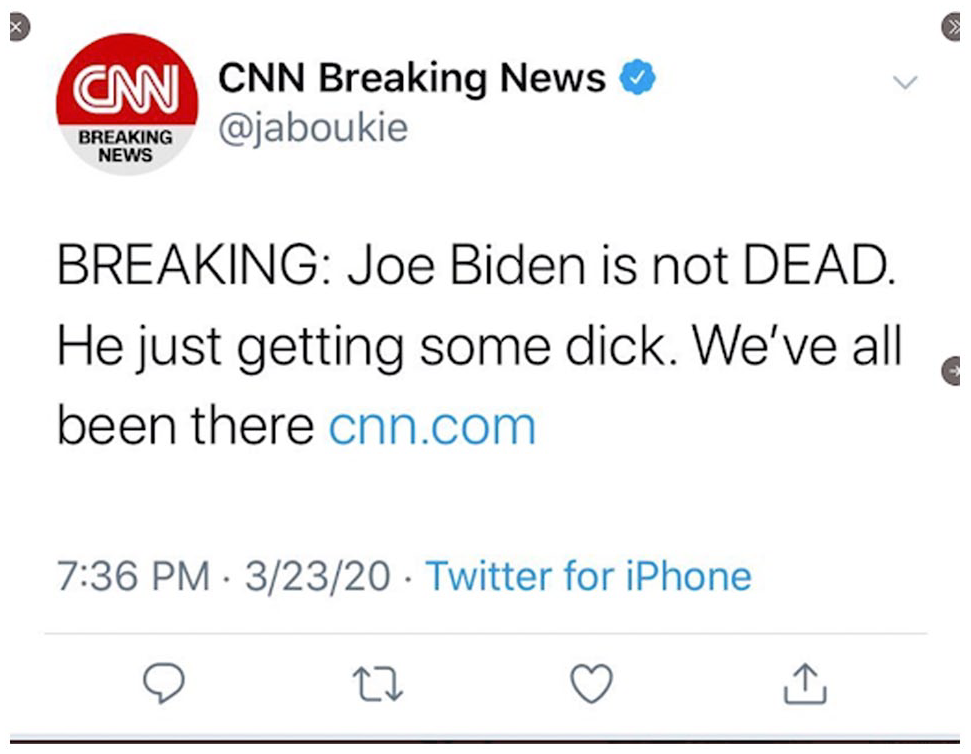
Jaboukie Young-White impersonates fellow verified account CNN Breaking News in the tweet that led to his verification status being revoked and his account suspended.
Of course, this flippancy towards platform policy is not available for everyone. Young-White’s comedic brand plays simultaneously with his Twitter verification status and his flouting the very rules entailed to this privilege of being checkmarked. As an established entertainer, Young-White can benefit from and mock the technocultural badge of realness. His refusal of – yet contingency on – the strictures of verification allows the comedian to play with ‘authenticity’ through the rejection of platform rules. For journalists and other labourers in the creative industries, simple rejection of the chase for authenticity and visibility remains impossible. Audience engagement and a recognisable brand (may) bring career opportunities and job stability, but we argue that platforms and outlets must recognise the risks, particularly to gendered and raced minorities, as integral rather than incidental to digital work. The checkmark is surely a product of cultural work and attention economies, but it is also a plaything. And playthings, as GamerGate showed us, are not exempt from power relations. While the practices of all users cannot be reduced to labour, technified authenticity is, as we have explored, central to the digital labour of journalists and creators on the platformed web. The chase for blue checkmarks is as real as the violence of trolls who reject your realness claims. Today, you need everyone to know you’re a dog. And you have to prove it every day.
Footnotes
Authors’ Note
Although academic norms and the linearity of a Word document demand that there be an author order that we’ve chosen to make alphabetical, we would like to make explicit that both authors of this article contributed equal work, time and affect to this piece as it has come together over more than a year. We think with  in staying with the trouble of an equitable author order and in asking how we may do things differently in future collaborative work.
Funding
The author(s) received no financial support for the research, authorship and/or publication of this article.